Weekly insights and analysis on the latest developments in military technology, strategy, and foreign policy.
The U.S. Air Force has confirmed to TWZ that both of its existing VC-25A Air Force One jets will continue to serve in the immediate future. Several White House officials had suggested that the career of one of the jets had effectively come to an end in social media posts overnight, which are now going viral. There are growing signs that President Donald Trump’s next trip on an Air Force One jet will be aboard the so-called VC-25B “Bridge” aircraft converted from an ex-Qatari VVIP Boeing 747-8i, not a VC-25A.
“The VC-25B Bridge aircraft will soon join the active executive airlift fleet alongside the VC-25A and C-32,” an Air Force spokesperson told TWZ this morning, but did not offer a firm timeline. When asked if this also meant that both of the VC-25As would remain in the service’s active executive airlift fleet, the same spokesperson said “yes.”
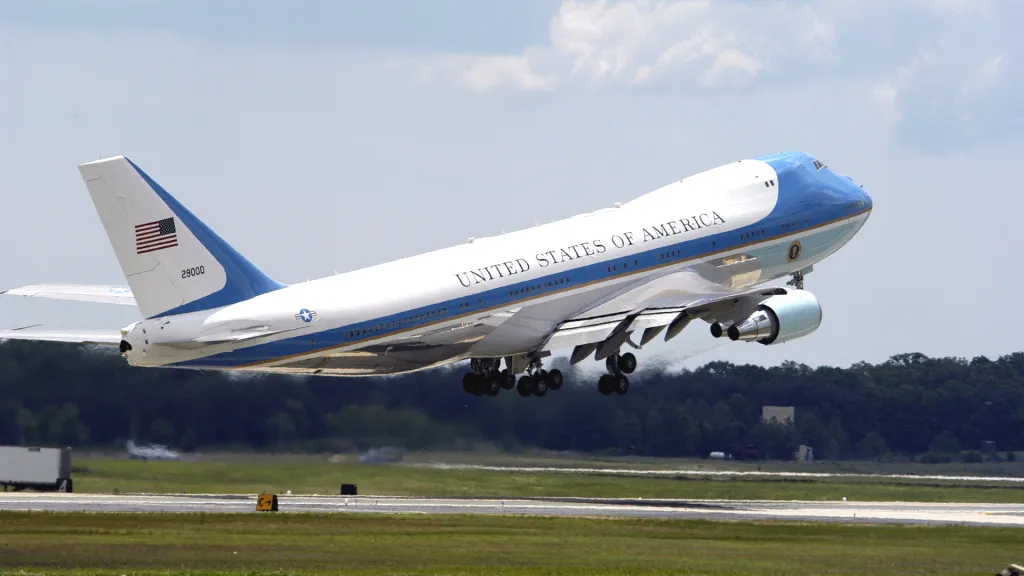
A stock picture of a VC-25A Air Force One aircraft. USAF
TWZ had reached out after seeing the aforementioned social media posts regarding the VC-25A that took President Donald Trump and others to and from the annual G7 summit in France this week. That particular aircraft has the Air Force serial number 92-9000 and is also often referred to simply by the tail number 29000. Several outlets had subsequently reported that one or both VC-25As were being removed from service.
“‘Well done, good and faithful servant.’ The Last Ride,” Steven Cheung, Assistant to the President & White House Director of Communications, wrote in a post on his official account on X, which also included a picture of 92-9000.
“I have been fortunate to fly around the world on this iconic plane for 5 1/2 years — of the 35 years it has been serving U.S. Presidents… THANK YOU… AIR FORCE ONE 2900,” White House Deputy Chief of Staff Dan Scavino also wrote in a post on X that included a video of the aircraft.
I have been fortunate to fly around the world on this iconic plane for 5 1/2 years — of the 35 years it has been serving U.S. Presidents…
The Air Force’s clarification to TWZ today is in line with a story from NBC News just last week. “Once the Qatari plane, which the Air Force refers to as VC-25B Bridge, enters the rotation this summer, the VC-25As will continue to serve in the executive fleet and could still be used by the president as Air Force One,” that outlet reported, citing an unnamed U.S. official.
The VC-25B Bridge “program epitomizes what is possible when clear accountability is placed on one individual, and the entire enterprise of stakeholders aligns behind a single mission outcome … deliver a bridge capability as soon as possible to relieve pressure on the aging VC-25A fleet,” Air Force Gen. Dale White, Direct Reporting Portfolio Manager for Critical Major Weapon Systems, had also said in a statement accompanying a press release last month.
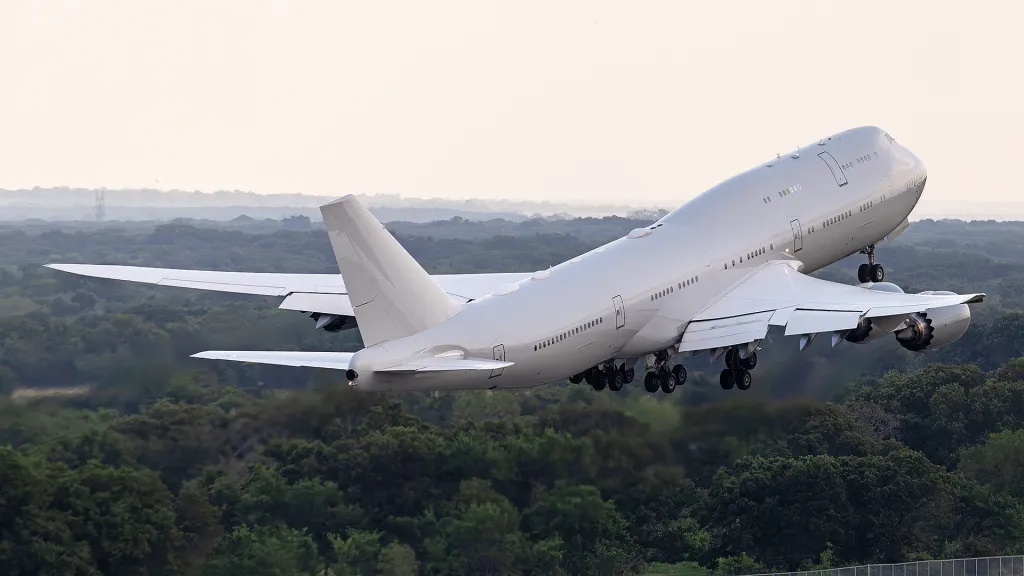
The VC-25B Bridge aircraft seen still painted overall white circa May 1, 2026. Courtesy photo via the USAF
The Air Force is also in the process of acquiring two fully-equipped VC-25Bs from Boeing, and currently expects to take delivery of the first one in mid-2028. The service also said that “on-going [VC-25A] modifications are to extend the service life until the VC-25B aircraft are fielded” in its proposed budget for the 2027 Fiscal Year, which was rolled out earlier this year.
When the Bridge aircraft enters service, it could well become President Trump’s preferred Air Force One option. Since his first term, he has been very eager to accelerate delivery of a new Air Force One jet. The VC-25B program has been mired in delays and cost growth for years. Under the current schedule, the Air Force is set to get the first of those aircraft just months before Trump leaves office again.
Under the original Air Force One replacement plan, the VC-25As would have been retired already. These jets, as well as four E-4B Nightwatch ‘doomsday plane’ flying command posts that remain in Air Force service today, are based on the 747-200. This is a model that first entered production in the 1970s, and they are becoming very difficult and expensive to operate and sustain. 200-series 747s in any configuration have all but evaporated from service worldwide, creating additional supply chain hurdles. Boeing shuttered the 747 line entirely back in 2023.
Another stock picture of VC-25A tail number 29000 taken back in 2013. USAF
As Gen. White said in his statement in May, the Bridge aircraft will help ease the strain on the VC-25As until the fully-equipped replacement VC-25Bs arrive. At the same time, serious questions remain about the Bridge aircraft’s ability to truly support the full spectrum of Air Force One missions, as TWZ has highlighted repeatedly in the past. Operational security concerns about using a former foreign-operated VVIP jet for this mission have also been raised, though U.S officials have downplayed any such risks.
The VC-25As notably have shielding against electromagnetic pulses (EMP) and other features that harden them to be able to operate even in the midst of a nuclear exchange. The Air Force One mission also requires alternate options to be available at all times. Both VC-25As often accompany the president on international trips, with the second acting as one of the backup options.
The arrival of the Bridge aircraft could still allow the Air Force to move at least one VC-25A into more of a reserve status, at least when it comes to taskings for lower-risk trips. The full replacement plan might eventually reach a point where the Air Force could deem it possible to cannibalize 29000 for much-needed spare parts. At the same time, if the Air Force were to be left with just one truly full-spectrum Air Force One aircraft, this would only magnify the aforementioned controversy and concerns surrounding the ex-Qatari jet.
The Air Force did also confirm last year that it was buying two additional 747-8is from German flag carrier Lufthansa to support the Air Force One fleet. The service has now taken delivery of at least the first one of these aircraft, which is being used as a trainer for aircrew and maintainers on the ground. The other will be a source of spare parts.
Regardless, the Bridge aircraft is getting close now to formally entering service, and its public debut could come within a matter of weeks. An Air Force spokesperson had already confirmed to TWZ last week that the jet had received its new livery – as seen in the picture below – and was undergoing “final modifications” ahead of its formal entry into service.
Travis Ghormley
The new paint scheme has itself been a controversial aspect of future Air Force One plans for years now. During his first term, President Trump announced that the future VC-25Bs would wear a new red, white, and blue scheme rather than the iconic paint job that currently adorns the VC-25As, which dates back to the Kennedy administration. President Joe Biden subsequently reversed that decision, but Trump reinstated his original plan after taking office again last year. U.S. Air Force C-32s, as well as new executive jets serving the U.S. Coast Guard and the Department of Homeland Security, have also emerged in the past year with their own versions of this livery.
A rendering of a future VC-25B wearing the same scheme as the current VC-25As. USAF
The Bridge aircraft’s current location is unclear. Last week, still unconfirmed reports emerged that the jet had flown discreetly from Texas, where it had received initial modifications and the new livery, to Andrews Air Force Base just outside Washington, D.C. Andrews is where the VC-25As, as well as various other Air Force executive aircraft, are based.
Full blown operation to get this thing out without us seeing. Fueled, loaded crew, and preflighted in the hangar. Flipped CRANE01 to face me at the south end and beam me with landing lights. Entire airport blacked out, crew and grounds crew all wearing NOD’s.
When the Bridge aircraft will make its first official appearance remains to be seen. In its report last week, NBC News said that Trump could use the jet for a planned trip to Mount Rushmore in South Dakota on July 3, citing an unnamed White House official and another source familiar with the deliberations. Reuters also reported in May that the ex-Qatari 747 might make its debut during a July 4 flyover.
TWZ has reached out to the White House for more information.
Another picture of the VC-25B Bridge aircraft from earlier this year. Courtesy Photo via USAF
The VC-25B Bridge’s official entry in service does now looks to be increasingly imminent, but the Air Force’s VC-25As are also set to keep flying, at least for the time being.
Weekly insights and analysis on the latest developments in military technology, strategy, and foreign policy.
The Senate Armed Services Committee believes that the U.S. Air Force is currently unable to support combat search and rescue (CSAR) operations “in a major contingency.” Legislators say they are concerned about the CSAR force structure after the Air Force trimmed its buy of HH-60W Jolly Green II helicopters and also elected to transfer some of these aircraft to the so-called Air Force District of Washington (AFDW) mission set, as you can read about here. This comes on top of concerns that the HH-60W fleet isn’t well suited for the realities of a war in the Pacific while no better solution is being sought.
The Senate Armed Services Committee released a full copy of the proposed legislation earlier this week. In this, it states that it is “concerned about CSAR force structure” in the Air Force.
Up close with the HH-60W Combat Rescue Helicopter at Nellis AFB for The War Zone.
Now, the committee points to the Air Force’s decision to truncate its buy of heavily modified HH-60Ws, followed by the transfer of 26 of these from CSAR units to the AFDW to replace UH-1N Twin Huey helicopters. AFDW uses these helicopters to support continuity of government plans, contingency response, homeland operations, and ceremonial honors in the National Capital Region. Under normal circumstances, the vast majority of AFDW missions involve VIP movements.
A UH-1N Huey assigned to the 1st Helicopter Squadron at Joint Base Andrews, Maryland, flies over Washington, D.C., during training, March 31, 2026. U.S. Air Force photo by Staff Sgt. Aubree Owens
“The committee believes that these actions have left CSAR forces unnecessarily short of the forces needed to support CSAR operations in a major contingency,” the legislators say. The committee has now called upon the Secretary of the Air Force to conduct a study of CSAR requirements and capabilities, including HH-60Ws and HC-130J Combat King IIs, and provide a report briefing to Congress before the end of March 2027.
Until that study is completed, the committee has called upon the Secretary of the Air Force to avoid making any more changes in CSAR force structure.
The Air Force had once planned to replace its AFDW UH-1Ns with new MH-139A Grey Wolf helicopters, but revealed last year it was considering using HH-60Ws for this role instead. The Air Force’s proposed budget for the 2027 Fiscal Year confirmed that it was moving ahead with these plans.
A U.S. Air Force MH-139A Grey Wolf assigned to the 40th Helicopter Squadron conducts its first operational mission at Malmstrom Air Force Base, Montana, January 8, 2026. U.S. Air Force photo by Airman 1st Class Teniya Caldwell
As we have discussed in the past, the HH-60W will bring a substantial increase in speed, range, and payload capacity compared with the aging UH-1Ns now flying AFDW missions, while also outperforming the smaller, lighter MH-139 in each of those key metrics.
The Air Force’s current plan calls for development of the HH-60W AFDW variant to begin in Fiscal Year 2027, starting October 1, with the first aircraft entering modification the following fiscal year. Those reconfigured Jolly Green IIs would then begin replacing the increasingly outdated UH-1Ns assigned to the AFDW mission at Andrews Air Force Base (now part of Joint Base Andrews).
TWZ had previously raised the question of how the transfer of 26 HH-60Ws for the AFDW role might affect the operational capacity of the rest of the CSAR-focused fleet.
In particular, the Air Force has no plans to procure additional Jolly Green IIs despite the upcoming transfer.
As the Senate Armed Services Committee points out, the Air Force already decided to scale back HH-60W purchases, from an original program of record for 113 of the helicopters. The total planned fleet now stands at 91. This amounts to the CSAR fleet losing roughly 30 percent of its entire Jolly Green II fleet, the first of which began entering Air Force service in 2022.
A U.S. Air Force HC-130J Combat King II prepares to refuel an HH-60W Jolly Green II during a training mission near Nellis Air Force Base, Nevada, April 24, 2026. U.S. Air Force photo by Airman 1st Class Jennifer Nesbitt
The legislators point to the ongoing demand for CSAR capabilities, not just in lower-end conflicts such as the war with Iran, but especially in potential future high-end fights, such as one between the United States and China in the Pacific, where aircrew losses would be greater by an order of magnitude.
For years, TWZ has warned that the growing reach and sophistication of modern air defenses are calling into question the viability of traditional fixed-wing and helicopter CSAR missions. In a high-end conflict, especially against China in the Pacific, even stealth aircraft are expected to face significant risks inside contested airspace. The idea that a Black Hawk helicopter, no matter what is bolted onto it, is going to survive in that same environment is highly questionable, and that’s if it can even reach the rescue point at all. The distances involved in the Pacific are far greater than those in Europe or the Middle East, which the legacy CSAR fleet was largely optimized around.
Back in 2023, one of the Air Force’s senior procurement officers asserted that the HH-60W fleet would not be “particularly helpful in the Chinese area of operations” due to these reasons. The Air Force’s cuts to planned purchases of HH-60Ws reflected this reality, while other senior officials have acknowledged that the service will need to rethink how it carries out this critical mission in future wars. The issue is that the cuts didn’t result in other capabilities taking the HH-60W’s place, like uncrewed systems and tiltrotors. So now there is an emerging gap in CSAR capabilities, both in terms of new ones more aligned with the challenges of the Pacific and just any kind of CSAR capability at all. Turning a large portion of the HH-60W fleet into VIP transports certainly doesn’t help with problem.
For the time being, at least, the Air Force is heavily reliant upon its HH-60Ws, regardless of potential vulnerabilities. With orders for the Jolly Green II slashed, and more than two dozen examples slated to switch to another mission, it is perhaps not surprising that legislators want to know how the Air Force will be able to conduct CSAR in the future.
Israeli air strikes have continued to target towns in southern Lebanon despite an agreement between the United States and Iran set to be formally signed on Friday to end the war on all fronts.
Israeli drones carried out three attacks in Tyre that resulted in injuries while a drone also targeted the Bint Jbeil district in Nabatieh, Lebanon’s state-run National News Agency said on Wednesday.
Recommended Stories
list of 4 itemsend of list
The fighting in Lebanon is considered one of the biggest threats to the framework agreement in the US-Israel war on Iran with Tehran warning that new Israeli strikes on Lebanon and continued occupation of its territory would be regarded as a violation of the deal.
Earlier on Wednesday, Al Jazeera Arabic correspondents on the ground reported that Israeli forces carried out an air strike on the outskirts of Kfar Tebnit, also in the Nabatieh district. They also launched raids on the town of Nabatieh al-Fawqa and shelled the Ali al-Taher heights and the outskirts of the town.
Hezbollah fighters, meanwhile, launched at least 10 rockets towards Israeli forces near Kfar Tebnit.
There has been a reduction in violence since the US-Iran agreement was announced, but attacks have not stopped, Al Jazeera’s Zeina Khodr said, reporting from Beirut.
“Security sources believe that the Israeli army is trying to occupy more ground, especially strategic high ground around Nabatieh,” she said.
“Yes, families have started to return to their villages, but people are worried. They say they don’t trust that Israel will abide by the ceasefire.”
United Nations spokesperson Stephane Dujarric said the number of projectiles fired between Israeli forces and Lebanon fell to 174 on Sunday, compared with 705 the previous Sunday.
Of these, 169 were attributed to Israel and five to Hezbollah, he said.
Lebanon ‘most sensitive issue between the sides’
The situation in Lebanon is one of the main pillars of the US-Iran agreement, Al Jazeera’s Almigdad Alruhaid said, reporting from Tehran.
“As we approach the signing of the deal, it is becoming the most sensitive issue between the sides,” Alruhaid said.
Iran said the Israeli military has violated the ceasefire in Lebanon 84 times in the past two days and warned that Israel should expect “a harsh response” if it does not stop its attacks, he reported.
This came after Iranian Foreign Minister Abbas Araghchi said the withdrawal of the Israeli military from Lebanese territory is one of the core demands right now to move forward with the framework agreement Iran has with the US, Alruhaid said: “So the Iranians say the situation in Lebanon, in particular southern Lebanon, is an integral part of the memorandum of understanding.”
Lebanon was among the top priorities for the Iranians when they started negotiations with US President Donald Trump’s administration, according to Mohammad Eslami from Tehran University.
“Once the Iranians not only retaliated against the Israeli attacks on Dahiyeh and Beirut but also pre-emptively attacked Israeli territory, they showed right from the outset they are determined and very serious about supporting Lebanon, the Lebanese people, the Lebanese government and the resistance factions in Lebanon,” Eslami told Al Jazeera.
Israel’s invasion akin to ‘war crimes’
Meanwhile, the human rights group Amnesty International said on Wednesday that the Israeli army’s mass forced displacement orders in Lebanon amount to war crimes under international law.
“In parts of southern Lebanon, the Israeli military’s forced displacement of civilians and prevention of their return amounts to unlawful transfer – which is a war crime,” Amnesty said in a statement.
The Israeli army has “radically expanded” its use of such orders, displacing hundreds of thousands of people across Lebanon, it said.
“Instead of forcibly uprooting communities and designating entire swathes of Lebanese land as ‘no-go zones’ for civilians, Israeli forces must immediately withdraw from Lebanese territory,” said Kristine Beckerle, Amnesty International’s deputy regional director for the Middle East and North Africa.
The Israeli military declared about 4.6 percent of Lebanon as a “no-go zone” on November 28, 2024, a day after a previous ceasefire took effect, Amnesty noted.
This year, just three days after an April 17 ceasefire announcement, the restricted area was expanded to about 6 percent of the country, and residents were ordered not to return to villages previously home to tens of thousands of civilians.
Lebanese officials said Israel, which has been carrying out a large-scale offensive in the country since March 2, has killed more than 3,800 people, wounded 11,850 and displaced more than one million.
US Department of Justice claims NAACP lawsuit threatens ‘national, economic, and energy security’.
The United States government has intervened on the side of Elon Musk’s xAI in a legal dispute over a $20bn data centre, claiming that efforts to block a related power project threaten national security.
In a court motion filed this week, the Department of Justice requested the dismissal of a lawsuit accusing xAI of illegally operating dozens of natural gas turbines erected to power the Colossus 2 data center in Memphis, Tennessee.
Recommended Stories
list of 4 itemsend of list
The National Association for the Advancement of Colored People (NAACP), the largest civil rights group for African Americans, filed the lawsuit in April under the 1963 Clean Air Act, which allows citizens to seek injunctions and civil penalties against alleged polluters.
The NAACP alleges that xAI built the turbines, located in nearby Southaven, Mississippi, without obtaining the necessary permits, exposing hundreds of thousands of residents to harmful pollutants linked to “increases in asthma, respiratory diseases, heart problems, and certain cancers”.
The lawsuit notes that a “much larger share” of residents are Black compared with the US general population.
In its motion, filed in a US District Court on Monday, the Justice Department accused the NAACP of threatening “national, economic, and energy security by seeking to shut off the power supply for artificial intelligence innovation that supports the Department of War’s military operations”.
The motion also claims that the US Constitution vests the power to seek civil penalties “conclusively and preclusively” in the executive branch, including the “discretion to decide when such an enforcement action is unwarranted or inconsistent with federal enforcement priorities”.
Adam Gustafson, the top prosecutor at the Justice Department’s environment and natural resources division, said in a statement that the government would “not sit idly by while private organisations use environmental laws to undermine our national security”.
xAI, which is a subsidiary of Musk’s SpaceX, did not immediately respond to a request for comment.
Elon Musk listens to a speech by Chinese President Xi Jinping during a state dinner with US President Donald Trump at the Great Hall of the People, in Beijing, China, on May 14, 2026 [File: Mark Schiefelbein/AP]
Earthjustice, an advocacy group representing the NAACP in the lawsuit, condemned the intervention as a “massive power grab” by President Donald Trump’s administration.
“Trump’s Justice Department wants to shield Elon Musk’s data center company, xAI, from being held accountable for its illegal pollution – and it’s attempting to grab power from impacted communities, the courts, and Congress to do so,” Laura Thoms, director of enforcement for Earthjustice, said in a statement.
“There is no moral or legal precedent for this.”
Ann Carlson, a professor of environmental law at UCLA School of Law, described the Trump administration’s argument as a “brazen attempt” to limit enforcement of the Clean Air Act.
“It’s based on a radical notion that the executive branch can dismiss lawsuits brought by citizen groups that Congress has authorised based on no rationale at all,” Carlson told Al Jazeera, adding that the Justice Department’s position would let “polluters off the hook even for blatant violations of the law.”
“This motion is also just one of many ways in which the administration is undermining efforts to protect air quality,” Carlson said.
The Trump administration has cultivated close ties with Musk, the world’s richest man, tapping the tech titan as a temporary cost-cutting tsar and using xAI’s flagship model Grok in the Pentagon’s drive to become an “AI-enabled fighting force”.
In testimony in support of Monday’s motion, Cameron Stanley, the Pentagon’s top official for AI, said that Grok had been used to launch more than 2,000 munitions at 2,000 targets within the first 96 hours of the US-Israel war on Iran.
If Grok cannot be deployed and upgraded due to “limitations in energy supply or limited reserve compute capability”, numerous tools used by the Pentagon would be “severely impacted”, Stanley said in a declaration made under oath.
EastEnders have welcomed back a familiar face, but fans fear this will lead to dangerous scenes for Chelsea and Jordan Fox after they survived serial killer Gray Atkins
EastEnders welcomes back familiar face
A familiar face has come back to EastEnders – and it spells trouble for Chelsea and Jordan Fox. Chelsea’s sister Libby, played by Belinda Owusu, has returned Walford after hearing about her mother Denise’s cancer diagnosis, but while many were happy to see her, it wasn’t long before she and Chelsea started bickering.
They argued about many things, starting with whether Chelsea should have noticed Denise was ill and called Libby earlier. Soon, the conversation turned to Chelsea’s son Jordan, who was recently in a car accident and may not be able to walk again. As Chelsea broke down, Libby comforted her sister. But, again, their peace with each other didn’t last long.
Libby pushed Chelsea to open up more and fill her in on what was going on. As such, Chelsea revealed that she had received a birthday card for Jordan from his great-grandmother, Sheila, along with a cheque for £1000.
When asked why she hadn’t cashed it, Chelsea said she didn’t want anyone connected to her ex husband Gray, Jordan’s father who was abusive and killed multiple people, involved in her son’s life, in case they were still in contact with Gray. The murderer, who was also physically abusive towards Chelsea, is currently in prison for his crimes. Since Sheila is Gray’s grandmother, Chelsea didn’t want to risk her being involved.
But, Libby later took the card, with the cheque inside. Fans were unsure what Libby planned to do with it, but some felt that if she cashed the cheque, this would put Chelsea and Jordan in danger.
One floated the idea that Libby planned to cash the cheque: “First episode back and Libby has already just slotted in like shes been back for ages, although if she does end up cashing the check I hope its actually to help Jordan and not another ‘I’m in debt and need to pay someone off’ storyline again.”
Another added: “Well I hope not since she did say she was willing to give Chelsea money for Jordan’s wheelchair and other stuff so I doubt they writers will make her do that considering what she said today.
“I also hope before she cashes it in she discusses it with Chelsea first because at the end of the day it’s gonna affect Jordan and Chelsea since it’s gonna be from her ex partner’s family and who knows they might still be in touch with him so it could potentially put both Jordan and Chelsea at risk but that’s just my opinion.
“So I hope she discusses it with Chelsea before doing anything bc if I was Chelsea I’m not sure how comfortable I would feel either taking money from my abusive ex’s family.”
A third added that they thought this could lead to a custody battle that puts Gray back in Jordan’s life: “I really hope she talks to Chelsea too, because if she cashes the cheque, Gray’s family could use to suggest that they take over Jordan’s care entirely – they’re already paying and they’ll say Chelsea let him get hurt.
“And if they have custody, they might take him to see Gray, which isn’t safe for anyone, especially Chelsea when she tries to get Jordan back.”
Belinda Owusu, who plays Libby, has already teased that her return to the Square leads to tough scenes for Chelsea, and what will happen with the cheque. She said: “With Chelsea overwhelmed by Jordan’s care and the financial strain, Libby sees it as potential support. She’s torn – she respects Chelsea’s boundaries but also believes it could offer some relief.”
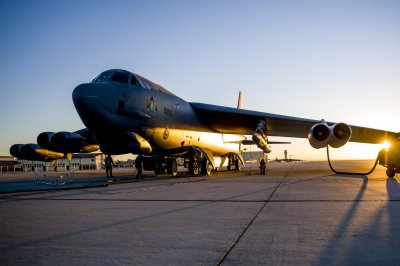
A B-52 Stratofortress assigned to the 419th Flight Test Squadron undergoes pre-flight procedures at Edwards Air Force Base in California in 2020. A B-52 Stratofortress crashed shortly after taking off from the base on Monday. Air Force File Photo by Giancarlo Casem
June 15 (UPI) — California’s Edwards Air Force Base said eight crew members are believed dead following the Monday crash of a B-52 Stratofortress.
The base confirmed the B-52 Stratofortress, which was carrying a crew of eight, crashed shortly after takeoff at 11:20 a.m. Monday morning.
“Initial indications are that the crash was not survivable,” the base said in a release posted to X.
Emergency response personnel were on scene working to account for all eight crew members.
“Our thoughts and prayers are with the families and unit members at this time,” the post said.
‼️ Official release regarding today’s B-52 crash at Edwards. Our thoughts and prayers are with the families and unit members at this time.
The airfield was closed following the crash and all incoming aircraft were diverted.
“All non-commercial visitor passes have been suspended until further notice to allow the installation to focus entirely on emergency response operations,” the base said in an earlier post.
Edwards Air Force Base, located about 100 miles north of Los Angeles, frequently hosts test flights for new and experimental Air Force and NASA aircraft.
The base said more information on the crash will be provided as it becomes available.
Weekly insights and analysis on the latest developments in military technology, strategy, and foreign policy.
Details are still coming in, but a B-52 bomber has crashed at Edwards Air Force Base in California.
The base’s official Facebook and X pages have posted the following statement:
“A United States Air Force B-52 Stratofortress crashed shortly after takeoff on the Edwards airfield at 11:20 a.m. Emergency crews immediately responded to the scene and the situation is ongoing. More information will be provided as it becomes available.”
ALERT: A United States Air Force B-52 Stratofortress crashed shortly after takeoff on the Edwards airfield at 11:20 a.m.
Emergency crews immediately responded to the scene and the situation is ongoing. More information will be provided as it becomes available. pic.twitter.com/x932d3HXHz
— Edwards Air Force Base (@EdwardsAFB) June 15, 2026
From what we can see, the B-52 appears to have crashed on or at least very near the base’s main runway. Still images and video emerging now show a large fire with black smoke that can be seen from miles away.
How many individuals were on board the B-52 when it went down, and their fate, are currently unknown. However, the bomber ejection seat configuration could have presented complications for escape depending on how soon after takeoff the incident occurred. The B-52 has crew positions that eject downward.
Prior to this crash, the Air Force had 76 B-52s in service.
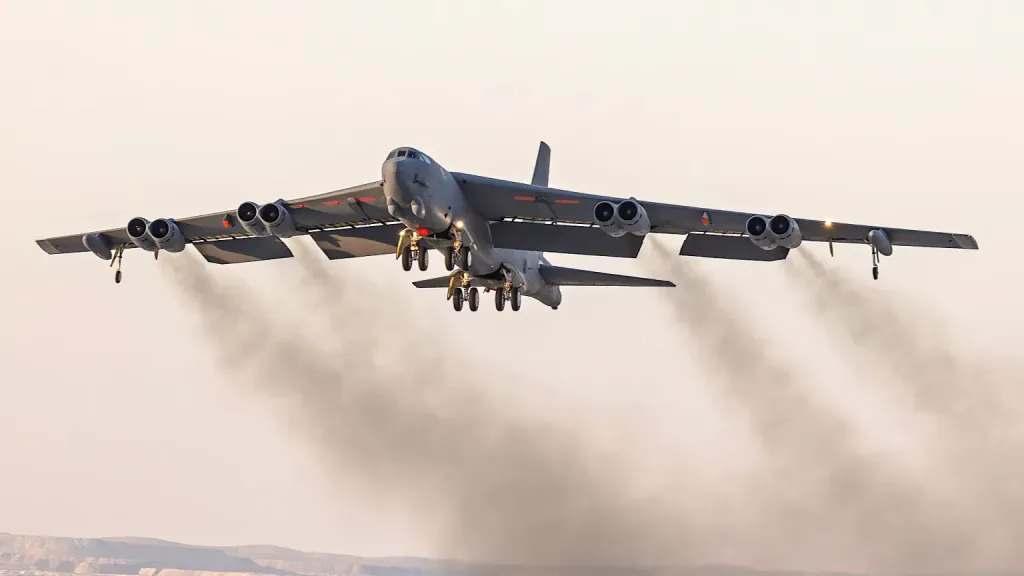
A stock picture of a B-52 bomber at Edwards. USAF
Though the two incidents are unrelated, this is also the second crash of a U.S. military aircraft in three days. A U.S. Marine Corps F/A-18D Hornet assigned to Marine Fighter Attack Squadron 323 (VMFA-323) went down near Mount Rainier in Washington State on June 13. The two individuals in that jet were able to eject safely. The Hornet did start a wildfire after hitting the ground.
BREAKING – 🇺🇸 Footage showing a U.S. Marine Corps F/A-18 crashing into a hillside near Rimrock Lake, Wash., on Saturday. pic.twitter.com/yQ4O6UFZOl
A US Navy F/A-18 crashed near Rimrock Lake, pilot ejected and walked out with medics according to reports. This is along the famous VR-1355 low level route in Washington State.
Fox News has now shared a video it says is of the aftermath of the crash, which shows a very large scorched area along the side of one of the runways at Edwards. There is no readily discernible wreckage, pointing to a total loss of the aircraft.
Update: 4:18 PM ET –
Edwards Air Force Base has shared a new update as of 12:48 PM PDT via its social media accounts. The full statement reads:
“The airfield has been closed, and all inbound aircraft are being diverted. All non-commercial visitor passes have been suspended until further notice to allow the installation to focus entirely on emergency response operations.”
Update- 12:48 PDT: The airfield has been closed, and all inbound aircraft are being diverted.
All non-commercial visitor passes have been suspended until further notice to allow the installation to focus entirely on emergency response operations.
— Edwards Air Force Base (@EdwardsAFB) June 15, 2026
We will continue to update this story as more information becomes available.
Opening today’s Loose Women, Ruth said: “After first appearing in Emmerdale as a fresh-faced Mandy Dingle over 30 years ago, our fabulous Lisa has been recognised for her extensive services to drama and charity in this year’s King’s birthday honours list,” before the room erupted into applause.
Ruth continued: “Round of applause! Fantastic, how exciting! We’re so thrilled for you. How did you find out? When did you find out? How did you feel when you found out?”
Lisa replied: “Honestly, Ruth, this weekend has been absolutely incredible. So, I found out sort of late February. I’d been away with Al [Benković, her partner], we’d had a four-day weekend away and I opened the postbox and there was a very posh envelope. And when I say posh, I mean posh.
“It had my name on it and it said [that it] was from the King, and I was like, ‘Come on, this is an absolute wind up!’ I thought I was being pranked. Lo and behold, I opened it and it said for drama and for charity.”
The star went on: “I’m very blessed I’ve been doing a job I love in a world where I’ve been employed, touch wood, all my life, and I’m so grateful for that. To be honoured and also for people who got in touch with me, that’s been the craziest thing this weekend.
“I’ve had messages from people, like directors that I’ve worked with when I was like 21, and they’re just genuinely over the moon. At work, we have a Dingle WhatsApp group and every single one of the Dingles were like, ‘Go on girl! You’re doing it for the family!’
“Of course, I’m the first person ever at Emmerdale to have got anything like this, so I feel a bit royal!”
Ruth went on to say: “We’re buzzing for you, and actually, it was lovely [for you] to have both things, drama and charity. We know you do a lot for charities, in your mum’s name in particular… You absolutely deserve it.”
Lisa then shared a standout moment from her career away from the Dales, with the star being “forever grateful” her role in BBC drama Three Girls, which dramatised the events surrounding the Rochdale child sex abuse ring.
On what she’ll be wearing to pick up her MBE, Lisa added: “The frock’s going to be amazing, yeah. I’m going to go colour, you know I will. I’ll be taking my family… We’re told that it’s seven months from announcement that I’ll be going, and you don’t know whether you’ll get Windsor or Buckingham Palace.
“Fingers crossed, I really, really want [Prince] William. Is that selfish? I’d love William!”
Ruth noted: “I think he watches, so Your Highness…,” with Lisa adding: “Remember William, I’m a Dingle as well!” Lisa ended the conversation by thanking her co-stars for being her “cheerleaders”.
Loose Women airs weekdays on ITV1 and ITVX at 12.30pm
Five people died Saturday when an Indian Air Force cargo plane crashed during training. Image courtesy of UPI
June 13 (UPI) — Five Indian Air Force personnel are dead after a transport plane crashed during training in Assam, officials said Saturday.
“The Indian Air Force deeply regrets the loss of five personnel in the An-32 accident at Jorhat, Assam. Sqn Ldr Prashant Singh, Flt Lt Shubham Kumar, Sgt Jitendra Sharma, Agniveervayu Khemaram Kumawat and Agniveervayu Danish Alam made the supreme sacrifice in the line of duty. IAF extends its deepest condolences to the bereaved families and stands firmly with them in this hour of grief,” the Indian Air Force posted on X.
“Crash site management and initial enquiries are on at this time,” the Air Force said. It added that an investigation to find the cause of the crash is underway.
India’s air force operates a fleet of about 105 AN-32 aircraft, Al Jazeera reported.
President Donald Trump speaks to reporters about restoring commercial fishing access to areas of the Pacific during a signing ceremony in the Oval Office of the White House on Thursday. Photo by Jim Lo Scalzo/UPI | License Photo
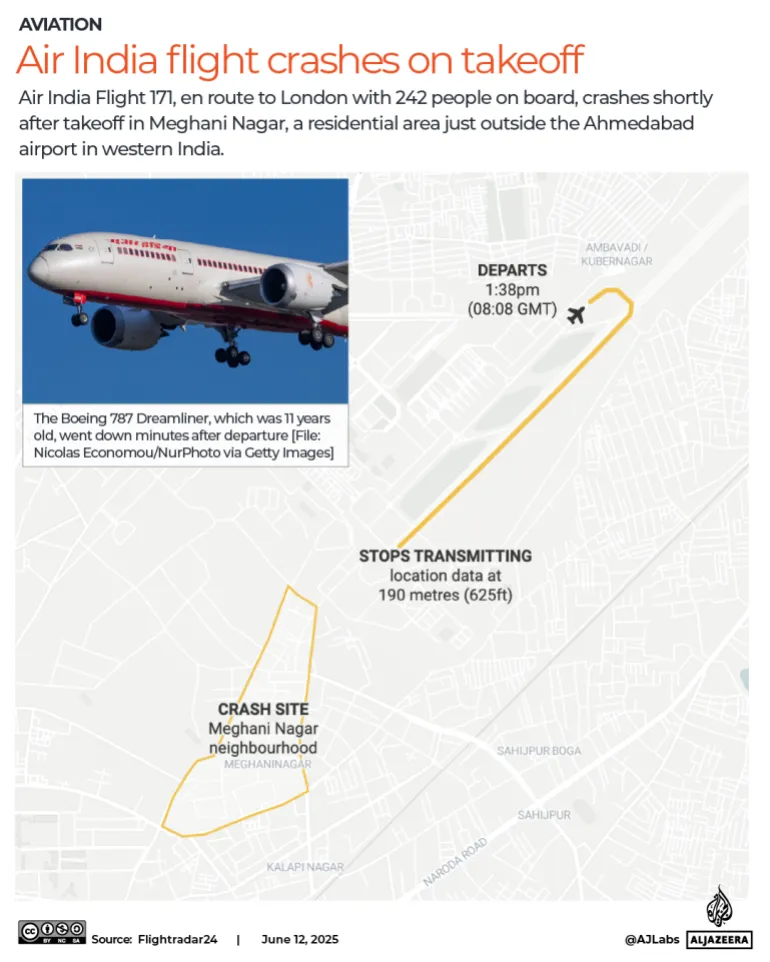
Friday marks one year since a deadly Air India Boeing crash, which killed 260 people in a densely populated suburb of the city of Ahmedabad in India’s western state of Gujarat.
Families of those killed gathered at the site on Friday to mark the anniversary of the disaster, but they are still waiting for answers about what caused the plane to come down shortly after takeoff from the nearby airport.
Indian authorities are expected to issue an interim report in the coming days, another source of frustration for the victims’ relatives, who had been hoping for a definitive finding and a final disclosure. Media reports, citing unnamed sources, suggest that Indian investigators will delay issuing a final report into the crash, citing the need to complete an analysis of the plane’s engines.
Under international aviation rules, a final report is due “if possible” within a year of an accident. If an investigation goes on for longer, an interim statement should be issued on each anniversary.
What happened to the Air India plane?
Flight AI171, an Air India Boeing 787 Dreamliner plane which had taken off only moments before, en route to London Gatwick, crashed into a medical college hostel in the residential area of Meghani Nagar, close to the international airport on the edge of India’s western city of Ahmedabad.
According to flight tracking website Flightradar24, the plane’s final signal was received seconds after takeoff at 1:38pm local time (08:08 GMT). It had reached an altitude of 625 feet (190 metres) before crashing back to the ground outside the airport.
The plane had issued a mayday alert to air traffic control just before all communications from the aircraft ceased.
(Al Jazeera)
How many people died in the crash?
Of the 242 people on board, all except one passenger were killed. These included 169 Indian nationals and 52 British nationals. A total of 260 people died, as 19 people on the ground close to the crash site were also killed. Another 67 people near the site were injured.
The sole survivor on board the plane, Vishwash Kumar Ramesh, is a British national whose brother was killed in the crash.
On Thursday, Ramesh’s representative, Sanjiv Patel, told the UK’s Guardian newspaper that Air India had paid £21,500 ($28,800) in compensation to Ramesh to help support his wife and their five-year-old son. It is not clear whether similar payments have been made to other families.
Relatives of the victims are meeting on Friday at a conference organised by lawyers, along with aviation and air safety experts, in Ahmedabad. They are due to hold a candlelight vigil after sunset.
Officials inspect the site of the crash near Sardar Vallabhbhai Patel International Airport in Ahmedabad, Gujarat, western India, on June 13, 2025. Air India flight AI171, bound for London, carrying 242 passengers and crew members, crashed minutes after takeoff in the Meghani Nagar area of Ahmedabad [Rajat Gupta/EPA]
What have preliminary reports shown?
This was the world’s first airliner crash involving a 787 Dreamliner, a Boeing model that has been in service since 2011.
In accordance with international aviation law, India’s Aircraft Accident Investigation Bureau (AAIB) published a preliminary report one month after the disaster.
That 15-page document said the fuel supply to the jet’s engines had been cut off moments before the crash, raising questions about possible pilot error.
It also published a conversation between the captain and his copilot about the fuel supply being cut off – two brief sentences that prompted theories of pilot suicide.
The report was met with strong criticism.
It did not state why the fuel switches were turned off – whether it was the fault of a pilot, or a result of a malfunction.
The preliminary report did not make any safety recommendations to Boeing or engine maker GE Aerospace, suggesting no technical issues had been discovered.
The crash also hit Air India at a sensitive stage of its post-privatisation turnaround, which has been slowed by supply-chain snags, an airspace ban imposed by Pakistan on Indian carriers and, more recently, the US-Israeli war on Iran.
What’s the latest on the investigation?
Under international rules, a final report is due “if possible” within a year of an accident, but sometimes investigations take longer. If it cannot be completed, therefore, an interim statement should be issued on each anniversary. With investigations continuing, the AAIB is expected to issue only an interim report at this stage.
The Federation of Indian Pilots union has been pushing for investigators to seek more technical data about the plane from Boeing and Air India to allow for a “rebuttal of the pilot suicide theory being explored by the AAIB”.
“It [an interim report only] will cause more speculation and more misunderstanding,” Charanvir Randhawa, the union’s president, told reporters at a packed news conference in Ahmedabad ahead of the anniversary of the crash.
“We have requested the Indian government and India’s Aircraft Accident Investigation Bureau (AAIB) not to come out with any interim report.”
A cockpit recording of dialogue between the two pilots of the Air India 787 before it crashed supported the view that the captain cut the flow of fuel to its engines, according to US officials’ early assessment reported by Reuters last year.
But the AAIB said at the time it was “too early to reach any definite conclusions”.
Investigators conducted engine testing in April and visited France last month as part of their analysis of the engine management unit, a source told Reuters on the condition of anonymity, as the information is not public.
On Thursday, Bloomberg also reported that the final report into the crash can be expected within three months, once studies of the engines, which had been sent to the US for examination, are concluded.
The captain’s father has asked India’s top court to order an independent investigation that examines possible causes other than deliberate pilot action – a cause that has been suspected in some other fatal crashes and was confirmed in the case of Germanwings Flight 9525, which crashed into the French Alps in 2015, killing all 150 people on board.
Weekly insights and analysis on the latest developments in military technology, strategy, and foreign policy.
NASA is moving to hire a contractor to assess whether or not a Boeing 737-73W can meet its needs for a new reduced-gravity testbed aircraft. The use of planes modified for this role is now new, and they are often called “Vomit Comets” because of the extreme maneuvers they perform to simulate zero-G environments and the physical side effects this often induces. However, there’s an unusual twist here with the specific plane that NASA is now eyeing: it currently belongs to the U.S. Air Force and is part of a “classified military program.” There is a strong possibility that the aircraft in question is a mysterious 737 that the service acquired in 2020, and that has been the subject of much speculation as to its purpose ever since.
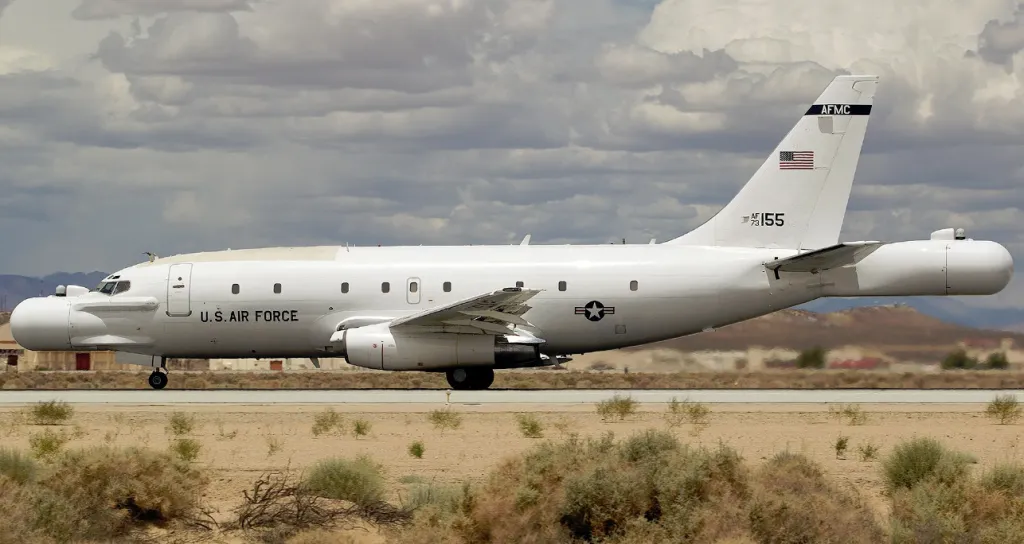
NASA’s Armstrong Flight Research Center posted a contracting notice yesterday justifying a planned sole-source contract to Denmar Technical Services, Inc. in relation to “Reduced Gravity Modification” of the 737-73W aircraft. Earlier this year, signs had already emerged that NASA might be in line to get a heavily modified and highly secretive 737 from the Air Force, designated the NT-43A and commonly referred to by the callsign RAT55. However, yesterday’s notice does not appear to refer to the NT-43A, long used as an airborne signature measurement platform and described in the past as the world’s most secretive 737, which is based on a much older 200-series airframe. We will come back to this later on.
A stock picture of the NT-43A Radar Test Bed aircraft, also commonly known by the callsign RAT55. Phodocu
What NASA wants now
“NASA requires Denmar Technical Services, Inc. to conduct a feasibility assessment to determine the Boeing 737-73W’s suitability to perform the NASA reduced gravity mission; modify the aircraft cabin, if required, to support reduced gravity operations; perform overdue maintenance and inspections, perform airworthiness restoration tasks, and paint the aircraft exterior with NASA identifiers,” the contracting notice NASA released yesterday explains.
The notice adds that the aircraft, if modified, would be used, at least most immediately, “for the Reduced Gravity Test Bed Project in support of the agency [sic] need for performing validation testing on Space Suits in support of the Artemis program.”
Artemis is NASA’s current effort to return U.S. astronauts to the lunar surface. The Artemis II mission, conducted in April, involved the first fly-by of the Moon by a crewed spacecraft since the end of the Apollo program in the early 1970s. However, the spacecraft did not touch down on the surface. The goal now is for a crewed lunar landing to come in 2028. RAT55 was notably used to support the launch of the Artemis II mission and the subsequent recovery of the capsule after its return to Earth.
Back in January, NASA had put out a separate contracting notice calling for information about new options to provide “parabolic flight services” to simulate “reduced gravity environments, including microgravity” for testing and scientific research purposes. The Florida-based Zero-G corporation is currently the primary provider of these services to NASA, using a retrofitted Boeing 727-200 dubbed ‘G-Force One.’ You can read more about NASA’s general use of Vomit Comets in the context of that notice here.
Total Weightless! What Happened on my Zero Gravity Flight?
The Boeing 737-73W under consideration to be turned into a Vomit Comet “is owned by the United States Air Force (USAF). Denmar Technical Services, Inc. has specialized knowledge of this Boeing 737-73W aircraft as they are currently contracted by the USAF to modify the aircraft under a classified military program,” the contracting notice NASA released yesterday adds. “NASA does not have a ‘need to know’ regarding the details of the current modifications being made under the USAF contract and therefore is unable to provide modification details to another contractor or provide another contractor with access to the aircraft. The USAF will transfer ownership of the aircraft to NASA upon completion of the closeout tasks.”
“Denmar Technical Services, Inc. is uniquely positioned to close out work under their existing obligations while performing the feasibility assessment, maintenance, and any modifications required under this action,” the notice continues. “Additionally, due to the constrained timeline for the NASA Extravehicular Activity and Human Surface Mobility Program’s space suit testing for Artemis, NASA requires the assessment and overdue maintenance to be performed immediately upon contract award and any subsequent aircraft modifications to be complete no later than October 1, 2026. The timeline can only be supported if this requirement is fulfilled concurrently with the USAF closeout tasks.”
Denmar is a small aviation firm headquartered in Reno, Nevada. At the time of writing, its website lists a wide array of specialized design, modification, flight testing, and other work among its portfolios. This includes “advanced customized mission system development” that “encompasses the design of unique airborne operator interfaces, specialized emitters and sensors, system integration, and post-mission analytics and processing.” The company also describes itself as the “Nation’s leading experts on IR [infrared] and RF [radiofrequency] survivability, signature modeling, [and] agile software development for analysis and real-world operational assessments.”
In line with all this, Denmar is understood to have been the prime contractor behind the extensive modifications to RAT55. In April, the Air Force confirmed to TWZ that the NT-43A was “being transitioned to start the next phase of its career,” as reflected by its involvement in the Artemis II mission, “after decades of flights supporting the Air Force in various roles.” The aircraft, which is understood to have long called the secretive and remote Tonopah Test Range Airport (TTR) in Nevada home, has been seen much more publicly since then.
Best views of RAT55 yet. Dorsal sensor pod (EO ball) seen in detail here. Also shot inside. I wonder if this is going to be ported in full to a contractor (it is currently operated by a contractor) https://t.co/XoE1zGFN78
However, as NASA’s recent contracting notice makes clear, the 737 it is now looking at as a potential Vomit Comet is a much newer 700-series model. TWZ has reached out to the Air Force and NASA for more information.
The curious case of N712JM
As mentioned, it is very possible, if not highly probable, that the 737 NASA is now considering turning into a Vomit Comet is one that the Air Force acquired in 2020, which TWZ explored in-depth at the time. That aircraft, which is a -73W model, is still officially on the U.S. civil register, with the registration code N712JM. Federal Aviation Administration (FAA) records show that the preceding owner of this aircraft was Denmar, which acquired it in 2019. The plane’s history before that is murky, with Boeing delivering it in 2013 to East West Bank via a trusteeship with Wells Fargo Bank, per the FAA’s records.
N712JM had drawn particular attention in 2020 not just because of its transfer to the Air Force, but also because it emerged at that time wearing a green protective coating and otherwise looking like it had just rolled off the production line. It also had some unusual external features that raised questions about its role, as we explored at the time.
N712JM as it was seen in 2020. Reader submission
In 2020, Jon Ostrower, long-time aviation journalist and editor-in-chief of The Air Current, told TWZ the following:
“This is definitely an airplane that never made it to a formal finish you’d expect from a commercial airplane. The green finish is a protective coating applied to fuselages during manufacturing to protect from scratches and other damage. It is dissolved during painting. You can also still see the manufacturing (line) number as well. That’s from its original trip down the assembly line. There’s also quite a bit of instrumentation visible with sensor wiring leading into the cabin through the passenger windows. This type of arrangement points to a flight test setup of some kind.”
In 2020, N712JM conducted many test flights in U.S. military ranges off the coast of Southern California, flying various flight profiles, some of them quite unusual. The aircraft flew those sorties from Santa Maria Airport in California, and used the callsign STING 38.
What the Air Force has been using N712JM for to date is unknown. Per FAA, the aircraft has been and continues to be registered to an address at Bolling Air Force Base (technically now part of Joint Base Anacostia-Bolling) in Washington, D.C., which looks to belong to the Air Force’s Rapid Capabilities Office (RCO). The RCO has headed up multiple cutting-edge, high-priority programs over the years, including the development of the B-21 Raider stealth bomber and the X-37B reusable spaceplane. A 737-based platform could be configured to support an array of different research and development and test evaluation activities that would fall under the purview of RCO, as well as other stakeholders that this office might engage with.
A screen capture of the entry for N712JM in the FAA’s online database at the time of writing. FAA capture
There has also been some speculation over the years that N712JM might have transformed into an Air Force 737 with the serial number 21-0024, but this appears to still be unconfirmed. The 21-0024 serial has more recently become associated with other shadowy 737s tied to the U.S. military, which have civilian-style paint schemes and may also be on the U.S. civil register. One of them was notably spotted in 2025 at a U.S. forward operating location in El Salvador, sitting directly alongside an Air Force AC-130J Ghostrider gunship and a U.S. Navy P-8A Poseidon maritime patrol plane. This, in turn, raised questions about its involvement in the ongoing U.S. campaign of strikes on alleged drug smuggling boats in the Caribbean and the Eastern Pacific Ocean, as TWZ previously explored in detail.
21-0024, for reference. When I spotted it, FR24 was indeed calling it N712JM, though ADSBx had the BuNo and a different hex. https://t.co/3WwV3kxBC4
Interestingly, there have been several online flight tracking data ‘pings’ suggesting new activity related to N712JM at Colorado Springs Airport since at least February of this year. However, there do not appear to be any confirmed flights by the aircraft from there in that same timeframe. This airport notably sits adjacent to Peterson Space Force Base.
There is still a possibility that NASA could be looking at a different Air Force 737-73W for possible conversion into a Vomit Comet. As the contracting notice makes clear, the aircraft in question is currently in the classified realm. At the same time, this seems far less likely to be the case given everything that is known (and still unknown) about N712JM.
A separate question does exist now as to what effort the Air Force might be in the process of closing out that would allow it to transfer any classified 737 to NASA. TWZ has previously raised tangential questions about how the Air Force might fill the resulting gaps left by the highly-specialized RAT55 moving on to the next stage of its career. It is certainly interesting in its own right that NASA seems to be focused heavily at the moment on leveraging some of the most secretive 737s in existence today to support its much less sensitive needs.
More details may emerge if Denmar deems the “classified” Air Force 737 to be a suitable starting place to create a new Vomit Comet to support NASA’s reduced gravity training needs and the Artemis program.
Update: 3:45 PM EST –
In immediate response to our queries, NASA has directed us to an additional notice about the award of the sole-source contract, valued at $8.4 million, to Denmar Technical Services back on June 1.
“The contractor will modify a Boeing 737-700 aircraft to perform lunar-gravity parabolic flights to test NASA space equipment. Once modifications are complete, NASA Armstrong will own the aircraft and oversee aircraft operations out of NASA Johnson,” the notice says. “The aircraft will be used to validate astronaut lunar suits and associated crew systems required to support Artemis mission objectives. This can be done with the modified 737 aircraft in an operationally relevant, reduced-gravity environment prior to lunar mission execution.”
No mention is made here about the sourcing of the aircraft from the Air Force or its classified mission work, as outlined in the sole-source justification that was released yesterday.
COLUMBIA, S.C. — After a decade of roiling South Carolina and national politics, Rep. Nancy Mace finished a distant fifth in her state’s Republican primary for governor, leaving an uncertain future for one of the nation’s unabashed politicians.
Her campaign mirrored her whipsaw career. Mace courted the support of President Trump after harshly criticizing him over the Jan. 6, 2021, attack on the U.S. Capitol. She emphasized her fights with other Republicans to release files from the Jeffrey Epstein investigation.
In the final days before Tuesday’s primary, she called for a law to prevent anyone not born in the U.S. from holding political office or serving as a judge. She suggested that Rom Reddy, another candidate for governor, wasn’t qualified because he was a naturalized citizen whose mother was from India and father from Italy.
“I didn’t come out of a slum in India,” Mace said during an appearance in Greenville County this month. “I am born and made here in America.”
By the end of her campaign she was only making sporadic public appearances. She struggled to raise money and had no presence on television. Mace mostly communicated through social media — a place she has used to her advantage since first being elected to the South Carolina House in 2017.
In a lengthy statement posted after her loss, Mace recounted her achievements in the U.S. House, saying she had “taken on the rich and powerful in both parties” and “voted to release the Epstein files and lost some support for that.”
Four congressional Republicans were part of the initial group pushing for a discharge petition forcing the files’ release. Mace and Rep. Thomas Massie lost their races, and Rep. Marjorie Taylor Greene resigned in January.
Mace didn’t give an indication of her next plans in her concession speech Tuesday night. She is backing Alan Wilson in the runoff for governor, even though just last year she accused Wilson of protecting child sex abuse defendants.
“When children needed him to act, Wilson looked the other way,” she said.
Wilson will face Lt. Gov. Pamela Evette in the runoff on June 23. Evette received Trump’s endorsement, spurring Mace to lash out on social media.
“Pamela Evette is NOT ENDORSED by DONALD TRUMP,” Mace wrote, incorrectly. “Do not believe her LIES.” Mace posted an AI-generated image of posing with Trump herself.
Mace dropped out of high school and worked as a server at the Waffle House before getting her diploma. She later attended The Citadel and became the first woman to graduate from the state’s military academy. And in recent years, she talked about the importance of defending victims of sexual assault and shared stories of being raped as a teen.
After her political career began in the South Carolina House, Mace got wide praise from Republicans in 2020 for winning back a U.S. House seat around Charleston that had flipped to Democrats for one term.
“For those folks that are out there today that maybe weren’t with us yesterday, I’m asking for a chance — a chance to prove to you that I will be a compassionate leader, a good listener, an independent thinker,” Mace said then.
Collins and Kinnard write for the Associated Press. Kinnard reported from Washington. AP writer Bill Barrow contributed from Atlanta.
The UK’s only direct flight to a destination known as the ‘pink city’ has been launched by Wizz Air, and flights start from £45.99 with no visa required for Brits
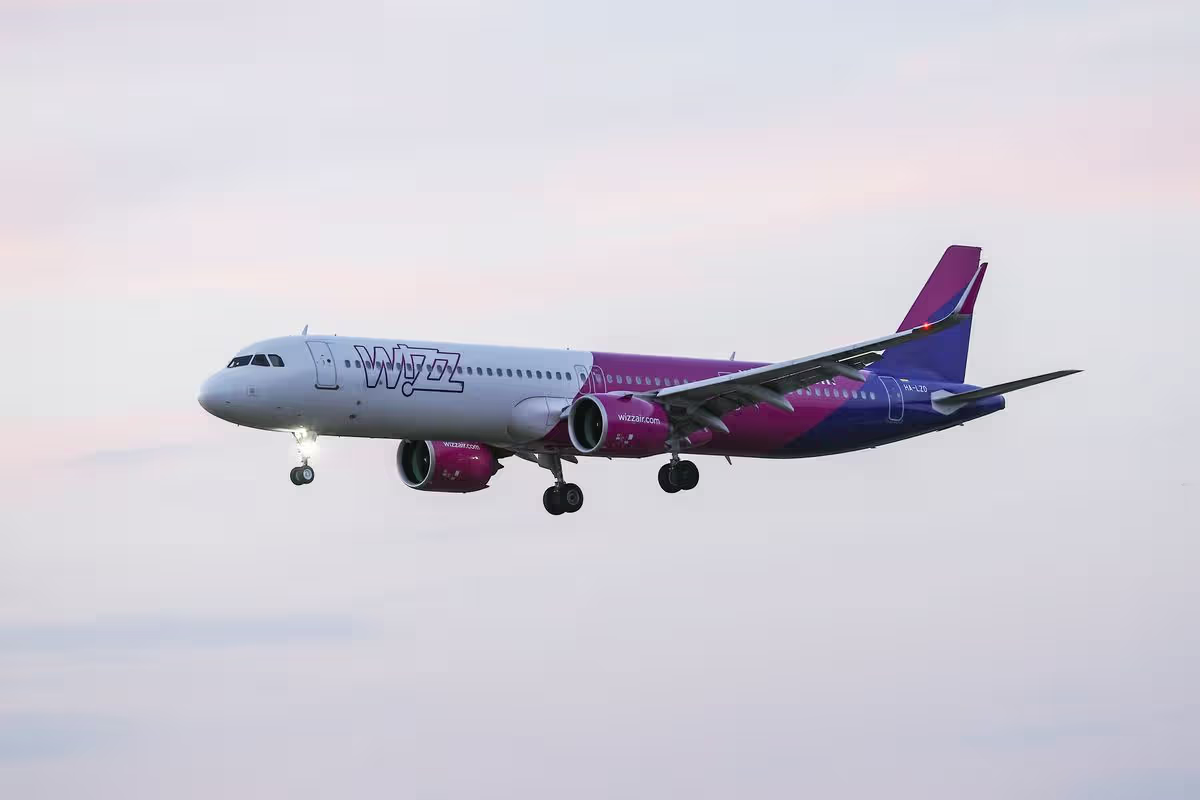
The ‘pink city’ is said to be an undiscovered destination(Image: Getty Images)
Wizz Air has launched the UK’s only direct flight to a walkable destination dubbed the ‘pink city’, which has ditched visa requirements for Brits.
In an exciting addition for the budget airline, holidaymakers can now jet off from London Luton Airport to Yerevan, with flights starting from just £45.99. The Wizz Air route launched on Tuesday, 9 June and is the only direct flight available from the UK to Armenia.
Flights will operate from London Luton to Yerevan, Armenia, twice a week on Mondays and Fridays throughout the year. The direct route takes just over five hours, and after that time, travellers will be rewarded with the dramatic landscapes of mountains and historic architecture in a destination known as the ‘Pink City’.
The city earned its moniker due to the rose-hued stone that characterises its buildings, in addition to its tree-lined boulevards and lively public squares. There are historic monasteries, museums, galleries and markets, along with a thriving café culture.
On the UK’s first direct route to Armenia, Wizz Air pilot, Tom Copestake, exclusively told the Mirror: “I’m really excited about landing in Yerevan, Armenia. It’s a new destination for us, but it’s surrounded by big mountains, and it’ll be an interesting experience to fly around there.”
Adding to the appeal of a trip to Armenia in Asia, British holidaymakers can visit without a visa for up to 180 days a year. Whereas a list of Asian countries still requires Brits to obtain a visa at an additional cost.
Following the new flights, Yvonne Moynihan, Managing Director of Wizz Air UK, said: “Today [9 June] marks an exciting moment for Wizz Air as we launch the UK’s only direct route to Armenia, opening up a destination that remains largely undiscovered by British travellers. At Wizz Air, we’re committed to making travel more accessible and helping our customers explore beyond the obvious. Yerevan is a city rich in history, culture and character, offering an incredible experience for travellers looking for something different, all at an affordable price.
“The response to our Let’s Get Lost campaign showed there is real appetite among travellers to step outside their comfort zones and discover destinations they may never have previously considered. We’re proud to be making Armenia more accessible than ever before and can’t wait to welcome more passengers on board as they experience everything this remarkable country has to offer.”
Alberto Martin, Chief Executive Officer at London Luton Airport, said: “We are delighted to welcome Wizz Air’s new service to Yerevan, marking the UK’s first direct link to Armenia and further strengthening London Luton Airport’s increasingly diverse route network. This exciting new destination in the South Caucasus is a unique city that offers a fascinating cultural scene of contrasts to suit all tastes.
“As well as reinforcing our long-standing partnership with Wizz Air, the addition of Yerevan to our departure boards signals our commitment to offer even greater choice as part of our simple and friendly passenger experience.”
Do you have a travel story to share? Email webtravel@reachplc.com
Weekly insights and analysis on the latest developments in military technology, strategy, and foreign policy.
The U.S. Air Force has confirmed that the VC-25B “Bridge” aircraft is now wearing its new (and controversial) red, white, and blue livery as it undergoes final preparations for its official delivery.
Aviation photographer Travis Ghormley shared the first picture of the modified Boeing 747-8i with its new paint scheme yesterday. It was taken the day before in Waco, Texas. The aircraft had been undergoing modification and flight testing at L3Harris’ facility in Greenville, also in Texas, as part of the conversion into its new role, since at least April, before subsequently moving to Waco to be painted. The jet, gifted to the Trump administration by the government of Qatar last year, is set to serve as an interim Air Force One aircraft ahead of the much-delayed arrival of two fully outfitted VC-25Bs from Boeing.
The VC-25B Bridge aircraft seen unpainted sometime circa May 1. Courtesy photo via the USAF
“The VC-25B Bridge aircraft has been painted and is going through final modifications,” an Air Force spokesperson told TWZ today when asked for more information about the aircraft’s current status. “I don’t have any additional details I can provide on delivery dates at this time.”
A press release the Air Force put out on May 1 said that the “VC-25B Bridge aircraft has officially completed modification and flight testing” and was “being painted.” We have confirmed that the completed modifications referred to here were on the contractor side, but the U.S. government still has additional modifications to make to the jet.
Ghormley’s picture does clearly show the jet wearing the same red, white, and blue scheme that has already been appearing on various Air Force and other U.S. government VVIP jets. The livery also includes a large American flag, depicted blowing in the wind, painted on both sides of the tail and “UNITED STATES OF AMERICA” written on both sides of the fuselage. The paint job is virtually identical to what President Donald Trump had previously chosen for the future VC-25B Air Force Ones during his first term. President Joe Biden had previously reversed that decision, bringing back plans to paint the VC-25Bs in the iconic scheme that dates back to President John F. Kennedy’s administration.
A rendering of a future VC-25B with the livery President Trump had originally selected. BoeingA rendering of a future VC-25B wearing the Kennedy-era scheme. USAF A rendering of a future VC-25B Air Force one jet. USAF
The Bridge aircraft’s current location is also unclear. Video posted on social media yesterday, seen below, purported to be of the jet departing for its new home at Andrews Air Force Base just outside of Washington, D.C. This is where the two current VC-25A Air Force One jets, as well as a host of other Air Force VVIP aircraft, are based.
Full blown operation to get this thing out without us seeing. Fueled, loaded crew, and preflighted in the hangar. Flipped CRANE01 to face me at the south end and beam me with landing lights. Entire airport blacked out, crew and grounds crew all wearing NOD’s.
Online flight tracking data does show that another U.S. military Boeing 747-8i flew from Waco, Texas, to Andrews on June 7, using the callsign Crane 01. However, this callsign has been associated with an ex-Lufthansa 747 the Air Force has also acquired for use as a trainer in support of future Air Force One operations. This aircraft, which may now carry the serial number 25-3200, has been tracked multiple times flying between facilities in Texas and Andrews in recent months. There does not appear to be tracking data for the VC-25B Bridge jet, which may also now have the serial number 25-3300, but it could have made the trip without broadcasting on ADS-B.
Past reports have indicated that the Bridge aircraft could make its public debut on July 4, which this year is also wrapped up in additional celebrations of the 250th anniversary of the founding of the United States. President Trump’s birthday (June 14) is also this weekend.
“L3Harris, known for its executive communications systems and services, was selected to undertake a complex modification of the bridge aircraft. L3Harris not only delivers secure, reliable and resilient communications for VC-25A and the executive airlift fleet but has extensive experience with self-protection and customization of VIP aircraft,” the Air Force wrote in the May 1 press release. “The accelerated timeline was further made possible by a mission-focused partnership with Boeing, who provided the necessary engineering data to support the required structural modifications.”
“Additionally, elite specialists from multiple government agencies developed advanced protocols to detect and-if necessary-neutralize potential technical hazards on previously owned aircraft,” it added. “Their rigorous approach on the Bridge aircraft has literally ‘written the book’ and set the benchmark for integrating used airframes into the secure military inventory.”
Another picture of the unpainted VC-25B Bridge aircraft, seen after arriving in Waco, Texas. Courtesy Photo via USAF
“Safety and security were at the forefront of this program. We deliberately minimized interior aesthetic modifications to focus on modifications for safety, security and mission execution. We assessed which requirements were necessary for an interim capability. We had greater flexibility in developing our mission requirements,” the Air Force also told TWZ directly at that time. “After safety and security, we focused on the mission communications systems.”
“We have made deliberate decisions such as the reduction of the number of airstairs, less chiller space, and exclusion of the Golden Eagle mission [to fly the remains of former presidents] to minimize structural modifications, while prioritizing modifications focused on safety, security and secure communications,” the service added.
Getting a new Air Force One aircraft of some kind into service on an accelerated timetable has long appeared to be a major goal for President Trump. The fully-equipped VC-25Bs from Boeing are years behind schedule. Last year, the Air Force announced that there had been some improvement on that front, but that it still did not expect to have the first of the two jets in hand until mid-2028, which would be just months before Trump is set to leave office.
What we do know for sure is that the VC-25B Bridge aircraft is now wearing Trump’s preferred red, white, and blue paint scheme ahead of its official rollout later this summer.
Cutting-edge weapons, such as the KAAV amphibious assault vehicle and the Bigung guided rocket, are on display at the Seoul International Aerospace and Defense Exhibition, or ADEX, that kicked off at KINTEX in Goyang, just northwest of Seoul. Photo by YONHAP / EPA
June 9 (Asia Today) — Military, industry and academic experts warned Tuesday that South Korea must urgently build an integrated air and missile defense system as drone swarms, artificial intelligence-enabled attacks and missile threats become more complex.
Experts said fragmented air defense weapons cannot respond effectively to modern battlefields where drone swarms are combined with ballistic and cruise missiles. They called for linking sensors, command decisions and interceptors into a unified system.
The Korea Association of Defense Industry Studies hosted the Future of Integrated Air and Missile Defense conference at the Daejeon Convention Center. The Missile Defense Forum organized the event and Northrop Grumman sponsored it.
The conference was held alongside the InLEX KOREA 2026 defense exhibition and drew officials from U.S. Forces Korea, foreign defense attachés, South Korean defense firms and overseas defense companies.
Kim Jin-ki, chairman of the Korea Association of Defense Industry Studies, said building an integrated air defense network is directly tied to national survival in modern and future warfare. He called for closer governance among the military, industry, academia and research institutions.
Rep. Yoo Yong-won, a member of the National Assembly’s defense committee, said South Korea must move faster to advance its missile defense system and secure next-generation air defense capabilities as global interest grows in the Cheongung-II missile interceptor system.
Kim Ki-won, a senior research fellow at the Korea Institute for Defense Analyses, said lessons from the Israel-Iran conflict and the Russia-Ukraine war point to a major shift in air defense strategy.
“Simply increasing the number of interceptors has limits when facing saturation attacks such as drone swarms,” Kim said.
He said South Korea needs AI-based intelligent engagement control and a smart defense network that links multiple sensors into one system.
Sean McLay, Asia-Pacific business development director at Northrop Grumman, said modern attacks are increasingly combining ballistic missiles, cruise missiles and drones.
McLay said South Korea should move away from platform-centered air defense systems and toward a network-centered integrated architecture that connects sensors, command and control and engagement assets.
Northrop Grumman developed the Integrated Battle Command System, which is used by the United States and Poland. The system is built around the concept of linking any sensor to the best available shooter, allowing commanders to match threat data with the most effective response.
Former Air Force 3rd Missile Defense Brigade commander Moon Oh-sun said South Korea’s individual air defense weapons have already reached a world-class level but remain limited by organizational barriers.
“To maximize combat effectiveness, we must break down the closed and isolated silo structure among the military branches,” Moon said. “Complete integration of information sharing and command decision systems is essential.”
Kim Dae-young, a military research fellow at the Korea Research Institute for National Strategy, said South Korea must also prepare for the reality that no missile defense system can intercept every threat.
Operating on the premise that “perfect interception does not exist,” Kim said South Korea should build a multilayered survival structure that allows national functions to continue even if missile defenses fail. He cited the need for public air raid shelters and other measures to help the country withstand attacks.
South Korean defense companies also presented domestic technology related to integrated air defense.
Jung Won-woo, head of LIG D&A’s air defense control development team, introduced integrated fire control network technology based on data distribution service middleware. His presentation focused on the transition from engagement control to integrated fire control.
The conference ended with a panel discussion chaired by Joo Kwang-sup, a visiting research fellow at the Sejong Institute and a retired Army brigadier general. Panelists discussed how South Korea can build an integrated air and missile defense system suited to future security conditions.
Han Kwon-hee, planning director at the Korea Association of Defense Industry Studies, said the association will work to ensure the ideas raised at the conference help strengthen South Korea’s integrated air defense capabilities and improve the global competitiveness of the country’s defense industry.
Former airline captain charged with fraud after allegedly commanding more than 900 flights without required credentials.
Published On 10 Jun 202610 Jun 2026
A former airline pilot in Canada has been arrested for allegedly flying hundreds of flights without a proper licence for nearly 17 years.
Police in Peel, Ontario, said on Tuesday that they had charged former Air Canada captain Geoffrey Wall with fraud and other charges following a four-month investigation.
Recommended Stories
list of 4 itemsend of list
The Peel Regional Police said Wall, 59, had used fraudulent pilot licences to command more than 900 domestic and international flights between 2009 and 2025.
Police said they obtained evidence to suggest that Wall had deceived both Air Canada and civil aviation authorities about his credentials before his retirement in 2025.
While Wall did hold a valid commercial pilot licence, he did not have an airline transport pilot licence, the highest level of pilot certification required to captain commercial aircraft, police said.
Wall faces one count of fraud, two counts of uttering forged documents, three counts of possessing a counterfeit trademark, and one count of public mischief.
Al Jazeera was unable to locate Wall’s legal representatives for comment.
“This case is deeply concerning and strikes at the heart of public trust and safety, as the accused is alleged to have put hundreds of thousands of passengers at risk across more than 900 domestic and international flights,” Peel Regional Police Chief Nishan Duraiappah said in a statement.
Air Canada said that while it viewed the pilot’s alleged actions with “utmost seriousness”, passenger safety had not been compromised, as all pilots undergo mandatory training every six months to assess their competency, in addition to an annual flight check with a certified pilot.
The airline said that Wall had “successfully met or exceeded” his training requirements and demonstrated “a high level of competency to safely operate large aircraft”.
The Canadian flag carrier also said it had found no other instances of non-compliance with licensing requirements following an audit of its pilots.
“Immediately upon Air Canada’s discovery of this, the individual was removed from active duty, and the company voluntarily reported the matter to Transport Canada,” the airline said in a statement.
Hassan Shahidi, a licensed pilot who heads the US-based Flight Safety Foundation nonprofit, described the charges against Wall as an “exceptionally rare case”.
“If the allegations are proven, the key issue isn’t that an untrained person was flying airliners, but that this pilot bypassed a fundamental regulatory requirement for many years,” Shahidi told Al Jazeera.
“The case could point to weaknesses in licence verification and oversight processes, particularly if fraudulent credentials were able to evade detection for so long.”
Shahidi said that Wall’s alleged actions did not appear to have exposed passengers to the same level of risk that they would have faced if an untrained pilot were at the controls.
“The larger concern is the apparent failure of a regulatory safeguard that is supposed to ensure trust in the system,” he said.
NEW direct flights have been launched from the UK to a destination nicknamed the “pink city”.
Wizz Air has confirmed the new flights will connect London to Yerevan in Armenia – the only currenct direct flights.
Sign up for the Travel newsletter
Thank you!
The buildings glow ‘pink’ because of the rose-coloured stone they’re built fromCredit: Alamy
It might not be on most Brits’ bucket list, but Armenia is a more unique destination for those wanting to go off the beaten track.
The pink nickname comes from the buildings made from rose-coloured stone which, during sunrise and sunset, can even turn into a vibrant pink or violet.
The country bordered by Georgia, Azerbaijan, Turkey and Iran is also backed by the enormous Mount Ararat which make for incredible views.
They said: “Arriving in Republic Square, the heart of the capital city Yerevan, the Saturday evening atmosphere was electric with hordes of people enjoying live music alfresco.
“We wandered the main streets past buildings made from pink volcanic stone, before reaching the Cascade Yerevan.
“Made up of 572 steps (we took the interior escalator), this mighty landmark is a must-visit. From its peak, we had stunning views of the snow-capped Mount Ararat, now in modern-day Turkey.”
Away from landmarks, Armenia is known for its brandy and there are lots of vineyards dotted around Mount Ararat.
For those who want to learn more about it, there’s a museum dedicated to it and at the ARARAT Museum, a guided tour which includes a tasting starts from £9.
Armenia is backed by the enormous Ararat MountainCredit: AlamyThey are the only direct flights from the UK to the cityCredit: Alamy
An hour outside of is the popular spot of Lake Sevan which is one of the world’s highest freshwater alpine lakes.
For anyone visiting in the summertime, it’s a popular swim spot and has a sandy shoreline for sunbathing.
You can also pick up local beer for as little as £1 and coffee from £1.20.
According to Kayak, 3-star hotels in Yerevan can start from £30 per night – or if you consider hotels overnight stays can be as little as £15 per night.
One-way flights with Wizz Air start from £45.99.
It is cheaper to visit too, after visa fees were droppedCredit: Alamy
It’s also cheaper for Brits to visit because Armenia has dropped its visa fees.
Holidaymakers can now visit for up to 180 days within a one year period.
The best time to visit Armenia is between May and June as well as autumn between September and October due to the mild temperatures up to 25C.
Yvonne Moynihan, Managing Director of Wizz Air UK, said that the route opens up “a destination that remains largely undiscovered by British travellers”.
She added: “At Wizz Air, we’re committed to making travel more accessible and helping our customers explore beyond the obvious.
“Yerevan is a city rich in history, culture and character, offering an incredible experience for travellers looking for something different, all at an affordable price.”
Wizz Air has made an announcement that will affect passengers planning to fly with the budget carrier from 2027 onwards. It has confirmed that travellers will soon be able to enjoy high-speed internet access on board.
The airline, which is based in Hungary, revealed it is fitting Elon Musk’s Starlink internet system across all its “new generation” aircraft. Wizz Air claims it will be the first European ultra-low-cost carrier to adopt the technology.
The airline has yet to confirm whether passengers will be charged for using the service. Starlink — owned by billionaire Mr Musk’s SpaceX aerospace firm — operates via thousands of satellites in orbit around Earth. A growing number of airlines have already begun offering the service or have announced plans to introduce it, including British Airways and Virgin Atlantic.
Ian Malin, chief commercial officer of Wizz Air, said: “Ultra low-cost travel has always been about making opportunities accessible to more people. In 2027, we’re taking that philosophy into the space era.
“Our customers shouldn’t have to choose between affordable fares and reliable internet onboard to stay connected to the people, work and moments that matter most. We’re proud to lead that change by collaborating with Starlink to bring maximum benefit to Wizz Air.”
In January, a row broke out between Mr Musk and Ryanair boss Michael O’Leary over whether Starlink could be used on the airline’s flights. After Mr O’Leary dismissed the idea as unfeasible, Mr Musk branded Mr O’Leary an “idiot” and a “chimp”, and speculated on X about potentially buying the airline.
Mr O’Leary claimed the “PR spat” had driven a 2-3% increase in sales.
Tensions have escalated between Iran and Israel while ongoing diplomatic efforts have failed to yield a lasting peace deal.
Published On 8 Jun 20268 Jun 2026
Iran and Israel were on Monday locked in tit-for-tat missile attacks, as the fragile ceasefire that has held in place since April 8 appeared closer to collapse than at any point in the past seven weeks.
These escalating hostilities between Iran and Israel come as the United States-Israel war on Iran enters its 101st day on Monday.
Here is what is happening:
In Iran
Explosions heard in Iran: Iran’s IRNA news agency reported that at least “two powerful explosions” were heard in Tehran and at least three in the city of Isfahan. The broadcaster also reported that explosions were heard in Tabriz. The Israeli military had said it “attacked military targets” in western and central Iran.
Power plant in Mahshahr attacked: A security officer in the southwestern Khuzestan governorate told the Fars news agency that Israeli forces have attacked the Karun Petrochemical Company in the city of Mahshahr. The Israeli army confirmed striking the petrochemical plant. The Mahshahr Petrochemical Special Economic Zone announced that its workers have evacuated the site following the Israeli strike.
Iran denies attacking base in Saudi Arabia: Responding to reports of an explosion at the Al-Kharj airbase in Saudi Arabia, Iran’s IRIB broadcaster cited a military official as saying that “Iran has not fired any shots.”
Red Crescent on standby: The Iranian Red Crescent says it is standing by to respond to any fallout from Israel’s attacks across the country this morning.
In Israel
Security cabinet meeting: Israeli Prime Minister Benjamin Netanyahu will convene a security cabinet meeting at 11am local time (08:00 GMT) amid escalating hostilities with Iran, according to multiple Israeli media reports.
The Israeli military issued a series of alerts starting Sunday over waves of missiles launched from Iran towards Israeli territory.
Iran’s Islamic Revolutionary Guard Corps (IRGC) said on Monday that they launched attacks against Israel’s Nevatim and Tel Nof airbases as a response to attacks on radar sites within Iran, the Fars news agency reported.
Israel’s Channel 12 broadcaster and Ynet News said a missile fired from Yemen was intercepted.
In the US
The US State Department issued a security alert for citizens in Jordan over reports of projectiles in the country’s airspace – presumably missiles fired by Israel towards Iran, or by Iran towards Israel.
Democratic Senator Chris Murphy said Israel’s latest attack on Iran “compounds” the “humiliation” for US President Donald Trump, as it comes after the US president reportedly told Netanyahu not to retaliate to Iran’s missiles fired at northern Israel.
In Lebanon
Explosions were heard in the Lebanese capital Beirut early on Monday, but these were likely rocket interceptions, Al Jazeera’s Zeina Khodr reported from Beirut.
On Sunday, Israel had hit the suburbs of Beirut, in attacks that Iran described as crossing a red line in terms of violating a ceasefire between Lebanon and Israel. Iran then said its decision to hit northern Israel was in response to these attacks near Beirut.
War diplomacy
Israel defends attacks on Iran: The Israeli ambassador to the US, Yechiel Leiter, defended the attacks on Iran, saying “no self-respecting country” would tolerate Iran’s missile launches against Israel.
Canada expresses concern: Canada’s Foreign Ministry has expressed concern about the resumption of conflict between Iran and Israel, saying it jeopardises the ongoing negotiations and “the prospects for peace”.
Saudi-Qatari foreign ministers speak: Saudi Foreign Minister Prince Faisal bin Farhan Al Saud spoke by phone with his Qatari counterpart, Sheikh Mohammed bin Abdulrahman bin Jassim Al Thani, the Saudi Foreign Ministry said.
Qatari-Iranian foreign ministers speak: The Qatari foreign minister, who is also the country’s prime minister, spoke by phone with Iranian Foreign Minister Abbas Araghchi about mediation efforts between Iran and the US, as well as the latest developments in Lebanon, according to a Qatari statement.
SIR Ranulph Fiennes and Bear Grylls most likely pop into your head when you think of adventurers. But now, you can add Wizz Air customers to that list.
And me. Last month, I was invited to join some competition winners on a flight to . . . who knows where?
Sign up for the Travel newsletter
Thank you!
Zvartnots ruins and Mount Ararat in ArmeniaCredit: GettyThe architectural highlight was the Mother See of Holy EtchmiadzinCredit: Alamy
As part of the Hungarian airline’s Let’s Get Lost promotion, 22 lucky travellers and their plus-ones were going on an all-expenses-paid trip, to a secret destination.
Even after boarding the plane we were still none the wiser, all we had was a pre-provided packing list and a rough idea of the climate.
It was only once the flight had exceeded three and a half hours that we could guess it was Armenia. A tannoy announcement confirmed it, prompting a round of applause.
I’ll be honest, Armenia was never on my radar as a holiday destination, but that’s exactly what made this trip so special.
Arriving in Republic Square, the heart of the capital city Yerevan, the Saturday evening atmosphere was electric with hordes of people enjoying live music alfresco.
We stayed in the DoubleTree by Hilton Hotel, perfectly located in the city centre of Yerevan.
A walking tour was the best way to get our bearings. We wandered the main streets past buildings made from pink volcanic stone, before reaching the Cascade Yerevan.
Made up of 572 steps (we took the interior escalator), this mighty landmark is a must-visit. From its peak, we had stunning views of the snow-capped Mount Ararat, now in modern-day Turkey.
A 30-minute drive away is Charents’ Arch, a monument dedicated to a much-loved poet in this region. The curved brick structure provides the perfect natural frame for the landscape and is a great photo spot.
The architectural highlight for me was the Mother See of Holy Etchmiadzin — the Mother Cathedral of the Armenian Church.
Remnants of it date back to the 4th century (Armenia was the first nation to adopt Christianity in 301AD), and it is the most ornate church I’ve ever seen.
The ruins of the 7th-century Zvartnots Cathedral are also worth a visit.
The whole place has an otherwordly feel, and with the hot sun beating down on us, it felt spiritual.
In just two days, we ticked off key landmarks, including Garni Temple and the Geghard Monastery, with lunches and dinners in between, accompanied by Armenian wine, which I would highly recommend.
With such a short time on the ground, this trip didn’t allow for loafing, but that’s the brilliance of a Wizz Air mystery getaway — cramming in all the best bits.
The Cascade, made up of 572 steps, is a mighty landmark and a must-visitCredit: GettyYerevan, pictured at night, can be navigated independently and you can tailor-make a cultural and/or foodie breakCredit: Getty
Our final evening was spent at Tavern Yerevan Riverside. The setting, grub and entertainment were truly amazing. Armenian wine was flowing while we tucked into khorovats, traditional Armenian barbecued meats scorched over an open flame.
While we had a curated itinerary, Yerevan can be navigated independently and you can tailor-make a cultural and/or foodie break.
After attempting, and failing, to say ‘shnorhakalutyun’ — Armenian for ‘thank you’ — throughout, I was advised that the French equivalent would also be appreciated.
So, merci Armenia — a destination I’d never planned to visit, but am so glad I did.
GO: ARMENIA
GETTING THERE: Starting tomorrow, Wizz Air flies twice a week from Luton to Yerevan with one-way fares from £45.99.
A YouGov survey has ranked budget airlines by food quality, with results likely to surprise some UK travellers
Airline with the worst food named — and it’s ‘awful’
A recent YouGov survey has revealed the worst airline food on offer, with budget carrier Ryanair topping the list for all the wrong reasons. Travel expert Mr Plane Guy weighed in on the findings, saying: “Unfortunately, not every airline hits the mark when it comes to in-flight dining.
“At the bottom of the list is Ryanair, where only 21% of passengers had good things to say about their snacks and drinks. Worse yet, just 17% found the meals satisfactory, and a staggering 50% labelled them as ‘poor’. Not far behind is Wizz Air, with just a quarter of passengers giving their snacks and drinks a thumbs-up, and 40% rating the meals as bad. easyJet also struggled, with only 35% of travellers enjoying their snacks and 29% happy with the meals.”
He went on to say: “If food is an important part of your flying experience, choosing the right airline can make all the difference! Emirates and Qatar Airways seem to be the safest bet for delicious meals, while budget carriers like Ryanair and Wizz Air might leave your stomach rumbling.”
One Ryanair passenger took to Tripadvisor to share their experience, writing: “Why is the food so bad!? We usually pack a lunch for our flight. In this case, we didn’t, and I ordered the fresh sandwich, which in this case was Turkey and Stuffing. It was truly awful and cost me 5€. I couldn’t finish it. This is not only an issue with Ryanair, but with other low-cost airlines. It must be as easy to source good food as bad. I really don’t understand it.”
Not everyone agrees, however, with some passengers saying Ryanair’s food is acceptable. One traveller recommended the vegan lasagna: “As a vegan, I massively appreciate the vegan lasagna; it’s not bad at all.” Another chimed in with: “The cheese toasties are actually ok, I’ve had it a few times.”