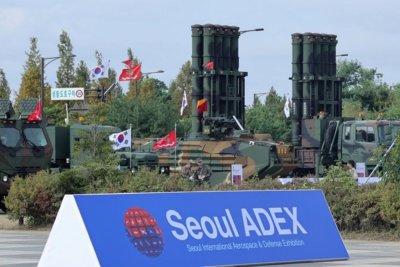

Cutting-edge weapons, such as the KAAV amphibious assault vehicle and the Bigung guided rocket, are on display at the Seoul International Aerospace and Defense Exhibition, or ADEX, that kicked off at KINTEX in Goyang, just northwest of Seoul. Photo by YONHAP / EPA
June 9 (Asia Today) — Military, industry and academic experts warned Tuesday that South Korea must urgently build an integrated air and missile defense system as drone swarms, artificial intelligence-enabled attacks and missile threats become more complex.
Experts said fragmented air defense weapons cannot respond effectively to modern battlefields where drone swarms are combined with ballistic and cruise missiles. They called for linking sensors, command decisions and interceptors into a unified system.
The Korea Association of Defense Industry Studies hosted the Future of Integrated Air and Missile Defense conference at the Daejeon Convention Center. The Missile Defense Forum organized the event and Northrop Grumman sponsored it.
The conference was held alongside the InLEX KOREA 2026 defense exhibition and drew officials from U.S. Forces Korea, foreign defense attachés, South Korean defense firms and overseas defense companies.
Kim Jin-ki, chairman of the Korea Association of Defense Industry Studies, said building an integrated air defense network is directly tied to national survival in modern and future warfare. He called for closer governance among the military, industry, academia and research institutions.
Rep. Yoo Yong-won, a member of the National Assembly’s defense committee, said South Korea must move faster to advance its missile defense system and secure next-generation air defense capabilities as global interest grows in the Cheongung-II missile interceptor system.
Kim Ki-won, a senior research fellow at the Korea Institute for Defense Analyses, said lessons from the Israel-Iran conflict and the Russia-Ukraine war point to a major shift in air defense strategy.
“Simply increasing the number of interceptors has limits when facing saturation attacks such as drone swarms,” Kim said.
He said South Korea needs AI-based intelligent engagement control and a smart defense network that links multiple sensors into one system.
Sean McLay, Asia-Pacific business development director at Northrop Grumman, said modern attacks are increasingly combining ballistic missiles, cruise missiles and drones.
McLay said South Korea should move away from platform-centered air defense systems and toward a network-centered integrated architecture that connects sensors, command and control and engagement assets.
Northrop Grumman developed the Integrated Battle Command System, which is used by the United States and Poland. The system is built around the concept of linking any sensor to the best available shooter, allowing commanders to match threat data with the most effective response.
Former Air Force 3rd Missile Defense Brigade commander Moon Oh-sun said South Korea’s individual air defense weapons have already reached a world-class level but remain limited by organizational barriers.
“To maximize combat effectiveness, we must break down the closed and isolated silo structure among the military branches,” Moon said. “Complete integration of information sharing and command decision systems is essential.”
Kim Dae-young, a military research fellow at the Korea Research Institute for National Strategy, said South Korea must also prepare for the reality that no missile defense system can intercept every threat.
Operating on the premise that “perfect interception does not exist,” Kim said South Korea should build a multilayered survival structure that allows national functions to continue even if missile defenses fail. He cited the need for public air raid shelters and other measures to help the country withstand attacks.
South Korean defense companies also presented domestic technology related to integrated air defense.
Jung Won-woo, head of LIG D&A’s air defense control development team, introduced integrated fire control network technology based on data distribution service middleware. His presentation focused on the transition from engagement control to integrated fire control.
The conference ended with a panel discussion chaired by Joo Kwang-sup, a visiting research fellow at the Sejong Institute and a retired Army brigadier general. Panelists discussed how South Korea can build an integrated air and missile defense system suited to future security conditions.
Han Kwon-hee, planning director at the Korea Association of Defense Industry Studies, said the association will work to ensure the ideas raised at the conference help strengthen South Korea’s integrated air defense capabilities and improve the global competitiveness of the country’s defense industry.
— Reported by Asia Today; translated by UPI
© Asia Today. Unauthorized reproduction or redistribution prohibited.
Original Korean report: https://www.asiatoday.co.kr/kn/view.php?key=20260609010003032