Army Wants New Palletized Short-Range Air Defenses In Service By The End Of 2029
The U.S. Army is aiming to have new palletized short-range air defense systems in service before the 2029 calendar year comes to a close. The service expects these systems to be fielded on crewed and uncrewed vehicles, as well as deployed in static positions. The goal is to give combat units a more flexible array of point defenses against aerial threats, especially drone swarms, but it could also be used against ground targets.
New details about what the Army formally calls the Maneuver-Short Range Air Defense Increment 4 (M-SHORAD Inc 4) program are included in briefing slides recently released online. The presentation was originally produced for an industry day event held in Huntsville, Alabama, last month.
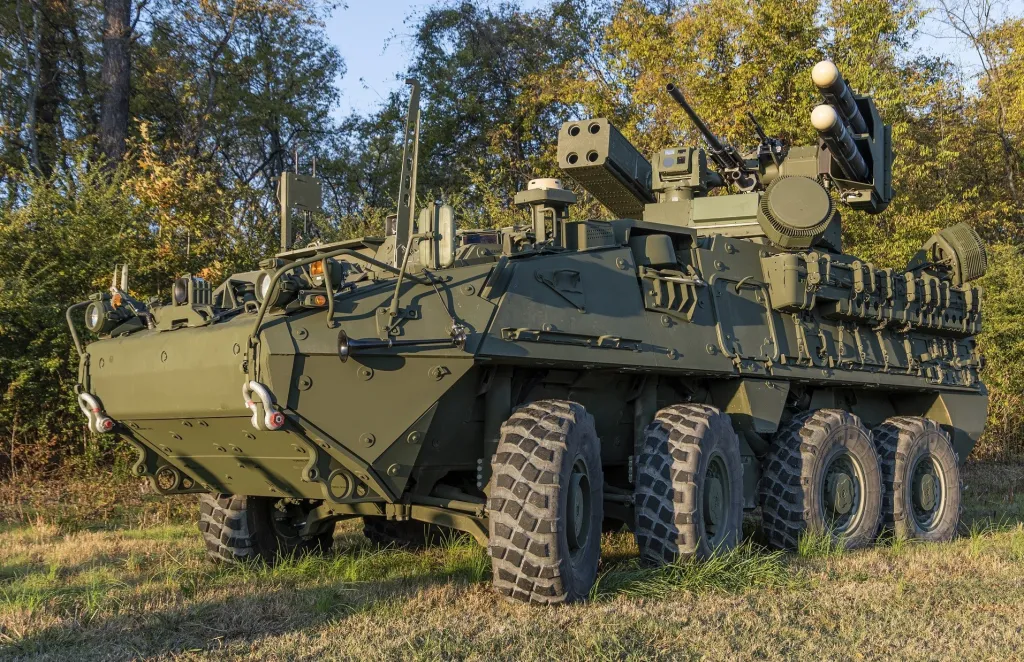
The overarching M-SHORAD program traces back to the late 2010s. Increment 1 produced a new mobile short-range air defense system based on the Stryker 8×8 light armored vehicle, which is now called the Sgt. Stout.

Increment 2 has been focused on operationalizing counter-drone directed energy weapons, and laser-based designs in particular. Increment 3 was originally centered on the Next Generation Short-Range Interceptor (NGSRI), a replacement for the venerable Stinger short-range surface-to-air missile. It also now covers work on the 30mm XM1223 Multi-Mode Proximity Airburst (MMPA) round for use in ground vehicles armed with the M914 cannon, like the Sgt. Stout. Development of another 30mm airburst round for use in the M230 cannons on AH-64 Apache attack helicopters falls outside of the M-SHORAD umbrella.

Increment 4 first emerged in 2025. The Army previously said it was looking for systems that could reasonably be fielded sometime between Fiscal Years 2027 and 2029. Schedule layouts in the newly released briefing slides show the goal now is to reach Initial Operational Capability (IOC) in Fiscal Year 2030. More specifically, the Army wants to hit the First Unit Equipped (FUE) milestone with a battalion-sized element in the first quarter of the 2030 fiscal cycle, which runs from October 1 to December 31 of 2029.

The Army wants the Increment 4 system to be capable of defeating a wide range of uncrewed aerial systems, from small quadcopters up to longer-range one-way-attack drones like Iran’s Shahed 136, operating individually or in swarms. It also has to be able to provide point defense against traditional helicopters and fixed-wing aircraft making attack runs on friendly ground units. The newly released briefing explicitly highlights a secondary “direct fire capability for ground targets,” as well.
No mention is made of cruise missile threats, which the Army is currently working to address through other air defense systems. However, it is possible that future M-SHORAD Increment 4 systems could be able to engage lower-end cruise missiles in certain flight profiles.
Increment 4 systems have to come in a “vehicle-agnostic” palletized format, or what the Army describes as a Self-Loading Equipment Dock (SLED), that can be readily mounted on and dismounted from light vehicles. The service has named its 4×4 Joint Light Tactical Vehicles (JLTV) and Infantry Squad Vehicles (ISV), as well as uncrewed ground vehicles (UGV), as potential hosts. The Army does not want options that require additional trailers. As palletized systems, they could also be offloaded at forward sites for static point defense.

Regardless of how they are configured, the Army wants the Increment 4 systems to “be able to operate for 72 hours independently, and semi-independently with supported force for 3-7 days,” per the recently released briefing. It also lists “C-130 loadable in normal SLED & vehicle configuration without special equipment; air droppable, sling-load and dismount capable” as key requirements.
When it comes to sensors and effectors for Increment 4, the Army continues to leave the requirements wide open for prospective vendors. The recent briefing simply notes that the systems have to feature a “reconfigurable multi-effector MEP [mission equipment package] integrating kinetic effects (e.g. missiles, direct-fire guns), and non-kinetic defeat.”
Several defense contractors – L3Harris, Leidos, Leonardo DRS, MDH Strategic Services, Moog, MSI Defense Solutions, SAIC, and the Sierra Nevada Corporation (SNC), to name a few – have already publicly shown relevant designs. Versions of L3Harris’ VAMPIRE (Vehicle-Agnostic Modular Palletized ISR Rocket Equipment) systems and the Electronic Advanced Ground Launcher System (EAGLS) from MSI are already in at least limited use within the U.S. military. VAMPIRE, as well as the BRAWLR (Battery Revolving Adaptive Weapons Launcher-Reconfigurable) from SNC, are also now combat-proven as a result of service in Ukraine.

Leonardo DRS Explains How Army Counter-UAS Mission Is Evolving
Many of the systems highlighted above feature guns like the aforementioned 30mm M914 cannon or 7.62x51mm M134 Miniguns. Stingers and AGM-114 Hellfires are commonly featured interceptors, too. SNC’s BRAWLR, which the company is also pitching for maritime applications, is notably designed to accommodate traditional anti-air missiles like the AIM-9X Sidewinder, as well.

Virtually all of the potential contenders for M-SHORAD Increment 4 incorporate anti-air optimized 70mm laser-guided Advanced Precision Kill Weapon System II (APKWS II) rockets. Originally designed as an air-to-ground weapon, APKWS II has now firmly established its place as a lower-cost counter-drone interceptor capable of being used in surface-to-air and air-to-air modes. The Ukrainian military was the first to employ these rockets in combat in the counter-drone role, but they are now in widespread U.S. military use in this capacity, too. A growing number of other countries are now moving to field APKWS II, as well as other similar laser-guided rockets, as anti-air weapons, as well.
Whatever specific types of Increment 4 systems the Army ultimately acquires, the requirement that they be palletized will offer inherent mobility and flexibility, even when not mounted on a particular host vehicle. Those attributes, in turn, could be especially beneficial for future expeditionary or distributed operations.
“Think of like a pallet or a sled that I could put in the back of any vehicle — whether it’s an ISV, a Humvee, a JLTV, or even a technical vehicle like a Toyota truck — and I can have that self-contained capability that allows the maneuver commander to have a menu of options,” then-Army Col. Marc Pelini said about Increment 4 at a panel discussion at the Association of the U.S. Army’s (AUSA) main annual convention in 2025. “When I talk about [a] menu of options, I’m talking about being able to pull off a radar like an X-band radar and put a Ku-band radar on, or pull a Coyote [counter-drone interceptor] pod off and put a Stinger pod on.”
At the time, Pelini was the military deputy for the Fires Future Capability Directorate within the Army’s Transformation and Training Command (T2COM). Pelini has since been promoted to brigadier general and is now the Army’s top air defense artillery officer.
“And then, as we look at the various capabilities that are out there, from a sensing perspective, you have acoustic sensors, you have bistatic sensors, you have active radar, you have EO/IR [electro-optical/infrared] cameras. So coming up with a way that we can fuse those at the platform and at the tactical edge, and then eventually bring that up into the cloud, where we can do fusion across the entirety of the AOR [area of responsibility],” Pelini added back in 2025. “The system itself, or the pallet itself, recognizes that and automatically changes the user interface for the operator to engage those threats. So the way that we’re taking that is through an open hardware and software – really kind of a plug-and-play approach to it.”
The networking component here is particularly important as it will allow air defenders to employ Increment 4 systems in a more effective manner even if they are dispersed across a broad area. Since the systems may not all be configured in the same way, this will give operators more options to employ the effectors best suited to the incoming threats they are faced with, too. The Army currently has a network designed primarily for use with shorter-range air defense systems called Forward Area Air Defense Command and Control (FAAD C2). The service is in the process now of transitioning to the newer and more expansive Integrated Battle Command System (IBCS) network.

IBCS a Revolutionary C2 System
As mentioned at the start of this story, the kind of massed effects and fused capabilities that Increment 4 promises to this overarching architecture is seen as particularly important to helping address large volumes of drones operating in their own networked swarms.
“Right now, there is not one system that’s going to be able to defeat that swarm,” now-retired Lt. Gen. Sean Gainey, then commander of the Army’s Space and Missile Defense Command (SMDC), said during a separate panel at the AUSA conference in 2025.
For a decade now, TWZ has been sounding the alarm on the drone swarm threat, and pointing to deeply layered air defense concepts with mixtures of different effectors and soft-kill systems like electronic warfare jammers as the only way to put up an effective defense. We have drawn attention to this in the past specifically within the context of larger short-range air defense gaps facing the U.S. military. The M-SHORAD effort, overall, has been at the center of Army efforts in recent years to close those gaps.
Increment 4 has always been planned to be just one layer in a still-expanding next-generation Army air defense architecture. The Army is in the process of acquiring a slew of new higher- and lower-end anti-air interceptors, as well as launchers to fire them. Laser and microwave directed energy weapons are also set to be part of this ecosystem. New and improved radars and other sensors are included in this broader air defense modernization push, too.
If the Army’s current plan for Increment 4 holds, the palletized systems will start joining its larger air defense arsenal right before the end of the decade.
Contact the author: joe@twz.com