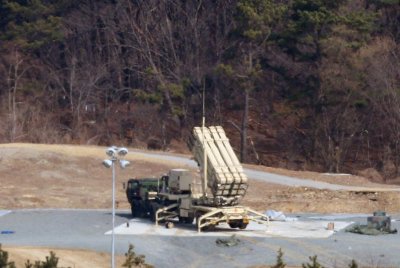

A launch vehicle of the Terminal High Altitude Area Defense (THAAD) system is seen at a U.S. military base in Seongju, North Gyeongsang Province, South Korea, 05 March 2026. File. Photo by YONHAP / EPA
April 3 (Asia Today) — South Korea will accelerate deployment of its long-range artillery interception system, known as the Korean Air and Missile Defense system, aiming to bring it into service by 2029, two years ahead of schedule.
The Defense Acquisition Program Administration said Thursday it approved a revised development and deployment plan during a Defense Acquisition Program Committee meeting.
Under the plan, the military will use prototypes to speed up deployment, advancing the timeline from the original target of 2031. The project was accelerated in response to North Korea’s expansion of long-range artillery capabilities.
The government plans to invest 842 billion won (about $630 million) in research and development for the system through 2030.
The system, under development by the Agency for Defense Development, is designed to intercept North Korea’s long-range artillery fired in large volumes at low altitudes and short ranges. Officials have said the system is intended to outperform Israel’s Iron Dome by engaging a greater number of incoming targets simultaneously.
Separately, the committee also approved plans to procure SM-3 ballistic missile interceptors from the United States by 2031 at a cost of 753 billion won (about $565 million). The missiles will be deployed on the King Jeongjo-class Aegis destroyers.
Additional measures approved include improvements to tactical information-sharing systems for joint South Korea-U.S. maritime operations, as well as a broader 2026-2030 defense industry development plan.
— Reported by Asia Today; translated by UPI
© Asia Today. Unauthorized reproduction or redistribution prohibited.
Original Korean report: https://www.asiatoday.co.kr/kn/view.php?key=20260403010001025