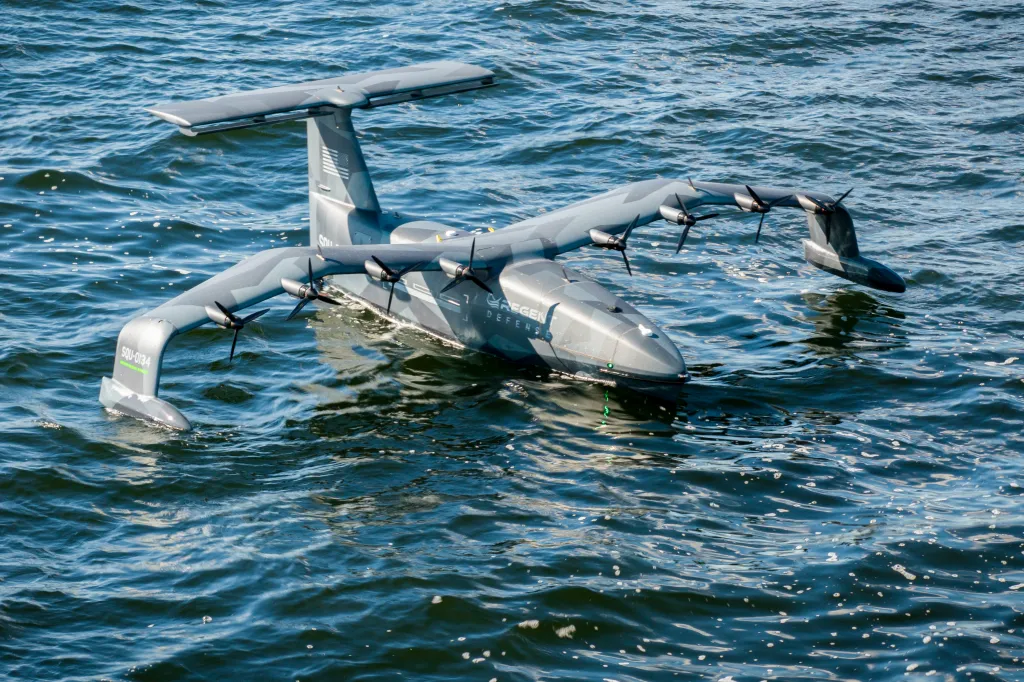
As it prepares for a potential future fight in the Pacific, the Marines tell us they are watching the progress of a wing-in-ground effect (WIG) drone concept that recently had its first test flight as a scale model. Being pitched as “the first ever Unmanned Surface and Aerial Vehicle (USA-V),” the Regent Squire is designed to conduct ISR, logistics, and combat search and rescue (CSAR) tasks in contested areas, the company states. It is also being eyed for counter-narcotics operations and anti-submarine warfare operations.
The WIG drone uses a hydrofoil to get airborne and then cruise in the air at an altitude of about one wingspan above the water. These ground-effect flights are designed to take advantage of the cushion of thick air above the earth’s surface, providing a sweet spot of increased lift and reduced drag. In theory, this should provide the Squire with high-efficiency and relevant speed, all without needing to operate from a traditional runway.


Such over-the-water logistics, ISR and CSAR capabilities would be particularly valuable in a future conflict in the Pacific. A high-end fight with China would see U.S. forces greatly dispersed, including to more remote locations without well-established infrastructure, to reduce their own vulnerability to attack. Existing traditional airlift and sealift assets would be heavily tasked in general to support those distributed operations. In some circumstances, they could also be highly vulnerable to enemy attack.
The eight-engined USV-A recently had a test flight in Narragansett Bay, Rhode Island, according to the company. A video of the event shows a Squire scale model going through its three stages of flight, from floating to hydrofoiling through the water to taking to the air. In the video, the company states that the Squire was traveling at speeds of up to 40 knots. As it gained altitude, Squire’s two hydrofoils retracted. Two support boats were in pursuit as it became airborne for an unspecified distance.

Squire Seaglider Drone Flight Demonstration
According to the company, the Squire has a planned operational 50-pound payload with a range of up to 100 nautical miles at a top speed of about 80 knots.
“The internally mounted payload bay of the Squire model measures 14 inches in length, 12 inches in height, and 14 inches in width, providing a total internal payload volume of 2,400 cubic inches for logistics, ISR equipment, or mission-specific cargo,” the company told us. “We’re designing the payload interfaces so that a two-person crew with minimal specialized training can execute a reconfiguration as realities change and mission requirements adapt.”
The company claimed this USV-A concept “combines the speed and maneuverability of an aerial vehicle with the persistent presence and endurance of an unmanned surface vessel.”

Since the U.S. Coast Guard – the U.S. regulator for this type of vessel – cleared Squire for testing last year, the company said it “has been validating systems, controls, and operational envelopes step by step. Moving forward, Regent will continue to expand Squire performance, autonomy, and operational capabilities for mission-ready maritime operations.”
The Squire concept is one of several WIG craft that the U.S. military is considering to solve the problems of delivering troops and cargo quickly over vast bodies of water, while limiting their vulnerability to enemy weapon systems, the Marines told us.
The U.S. Marine Corps Warfighting Lab (MCWL) recently received additional funds “to continue our investigation into Hydrofoiling Wing-In-Ground (WIG) capabilities,” MCWL project manager Matthew Koch told us Monday morning. Last year, we reported on MCWL’s interest in another Regent WIG offering, a crewed variant called Viceroy, designed to carry 12 passengers or 3,500 pounds of cargo.


The U.S. military’s largest WIG program hit some serious headwinds before the Defense Advanced Research Projects Agency (DARPA) killed it last year. This was the Liberty Lifter X-plane program. Its core goal was to produce a huge flying transport design that employs the WIG effect principle. You can read more about that program in our story here.

Announcing REGENT Defense
“Some 70% of programs don’t meet their metrics,” Stephen Winchell, director of DARPA, said at the U.S. Chamber of Commerce’s Global Aerospace Summit. “The idea there was to be able to move cargo quickly and securely across a vast theater with a lot of logistical challenges, and honestly, the manufacturing and a lot of the other parts of the program that needed to come together — we ended up finding out that it was harder than we thought.”
DARPA also stated that “instead of building a demonstrator aircraft, DARPA is working with industry and DOD stakeholders to accelerate transition of what we’ve learned to encourage rapid fielding of platforms leveraging the technologies developed at DARPA,” regarding the Liberty Lifter’s cancellation.

As we previously explained, the WIG principle is not new, but, as with Liberty Lifter, military applications have not seen much success. The Soviet Union remains the most notable operator of military WIG designs, known in Russian as ekranoplans – a term now widely used as a catch-all for WIG designs – but even their service was limited. Efforts to revive military ekranoplans in Russia in recent years have so far not produced any operational types.
The video below shows the only Project 903 Lun class ekranoplan, a cruise missile-armed design, that the Soviet Union ever completed being moved in the Caspian Sea in 2020 as part of a plan to put it on display.

Буксировка ракетного экраноплана «Лунь» в Дербент
Last year, we got our first full look at China’s WIG craft, loosely similar in scale to what we have seen of their new amphibious flying boat, the AG600, which is intended to perform resupply, search and rescue, and other missions, especially over the South China Sea. Though we noted that this WIG aircraft appears ideally suited for similar applications in the littorals, the status of its testing and whether it will ever be fielded remains unclear.

The Squire still has a long way to go before becoming an official program of record. The company is planning to demonstrate it at Silent Swarm 26, a two-week showcase for new and emerging technologies and conduct a full size test later this summer, Koch told us. He added that he will offer more insights into MCWL’s interests pending the outcome of those events.
“If the technology proves out in Silent Swarm this July and full-size flight in early August, I will have a statement on how the Marines intend to use it in the Pacific,” he explained.
There also appears to be interest in Regent’s WIG efforts from the Pentagon. In February, War Secretary Pete Hegseth visited the company’s headquarters as part of his efforts to spur technological innovation.
“We want capabilities that are driving what we are fielding and not the way it’s always been done,” Hegseth said during the encounter. “If you are able to show that you can fill a gap quickly with something that wasn’t already otherwise envisioned, you’re talking to the right kind of commander there who is going to say, ‘Okay, I am going to use that here.’”

REGENT Briefs Secretary of War on Seaglider Defense Capabilities
We have reached out to the Pentagon to gauge Hegseth’s current interest in the Squire project and see if there was any follow up activity from that meeting.
While still in the nascent phases, the WIG concept continues to draw interest from the U.S. military, though it has only invested a small amount of money in these projects. Given the challenges presented by a potential conflict with China, we will continue to monitor the progress of these efforts and provide updates when warranted.
Contact the author: howard@thewarzone.com