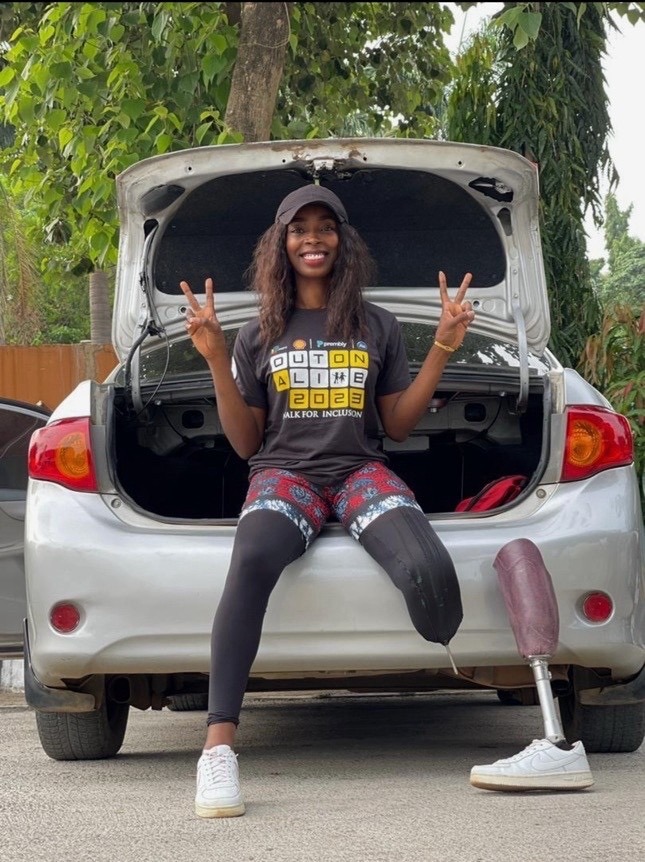
When Wura Hope paints her nails, she paints her prosthesis too. Pink glows on her dark skin like fine art. But her right foot is pale, yellowish-tan, the generic colour of many imported prosthetics. It contrasts with her melanin-rich skin and does not offer the aesthetics she desires.
Wura is a model, fashion designer, and vendor of Ankara fabrics. She also interns at a bank. Sometimes, she doesn’t want the spotlight that comes with being an amputee. But with a prosthetic foot so different from the rest of her body, curious eyes are unavoidable. As a result, she fully covers up her leg.
The unease Wura feels today traces back to when she was 11. One of her daily chores was filling the water tank of the large generator her parents used at their home in Abuja, in Nigeria’s North Central. One day, the propeller caught her long dress and badly injured her right leg. An infection followed, and the leg was eventually amputated.
The 28-year-old barely remembers life with two legs. She has lived with one for so long that she even forgets she has a physical challenge.
“Like, I literally forget,” said Wura.
Every word she says seems to arrive with a smile. And when her lips spread, they show her teeth like fresh corn peeking through a half-opened husk. She’s grateful to be walking again after many years on crutches.
Her current prosthesis is her third. The first, donated by an Indian charity in 2014, was heavy and rigid. The second caused blisters around her stump that took days to heal. The one she uses now is lighter and has a knee joint that makes walking easier. But it is far from perfect. In hot weather, the liner squeaks against her sweaty stump and sometimes threatens to slip off. When that happens, she has to find a restroom, take it off, clean it, let it dry for a few minutes, and put it back on.
“Sometimes in the market, I’ll be looking for somewhere private to clean my liner,” she told HumAngle.
Moments like this remind Wura of her disability, turning long-distance walking into a nightmare.
The struggle is not just Wura’s; it is a shared reality for many who wear devices designed for colder climates. Thirty-year-old Eva Chukwunelo knows it well. She finds her stump in a pool of sweat after walking just a few metres. But in March this year, she walked seamlessly from Washington Park to the Brooklyn Bridge in New York, a distance of more than two kilometres. Back home in Abuja, she would have stopped multiple times to pull off her prosthesis, drain the sweat from its liner, and wait for her stump to dry.
In Abuja, March is one of the hottest months, but it is cold in New York, giving chills rather than sweat. Most advanced prosthetic devices come from temperate countries, where they may be designed with little consideration for Africa’s heat and humidity.
Silicon liners, the technology used by both Wura and Eva, were invented in Iceland and initially called the Icelandic Roll-On Silicone Socket. Made from medical-grade silicone RTVs, they do not absorb sweat. As moisture gathers inside, it simply coats the stump, making every step increasingly uncomfortable. The material is soft and generally reliable, but it does not match Africa’s weather realities.
“So I felt like if you’re wearing a silicone liner, you cannot do so well in a hot environment,” Eva said.
As for the skin covers, they are either too black or not black at all, wrote Eva in the Nov. 5 dispatch of The Amputee LifeStyle, the newsletter where she documents the lived experiences of amputees.
“Somewhere between ‘too white’ and ‘too black’, African amputees are left underrepresented,” she noted. “So yes, we walk again. But sometimes, we walk in discomfort.”

Eva was also born with two legs. As a child, she was always running, climbing trees, playing football, or dancing. Even after she was diagnosed with osteomyelitis, a severe bone infection, she stayed active in school and continued playing with friends. But her left foot soon developed ulcers, prompting concerns about activities that could expose her to germs. The leg began to decay right from between the big toe and the second. When gangrene—the death of body tissue due to lack of blood flow or severe bacterial infection—set in, the only option was amputation.
Eva was just 16. She imagined a future spent on crutches, or confined to a wheelchair, or, even worse, reduced to begging like the lepers who often took shelter under the flamboyant trees outside her parents’ house. She had never heard of prosthetics, a life-changing technology that dates as far back as ancient Egypt. But everything shifted the day her doctor invited a prosthetist into the room.
“The first time I walked again, it felt like a miracle,” she wrote in her newsletter.
Her first two prosthetic devices were heavy, rigid, and, in her words, ugly. They helped her walk, but she was never comfortable enough to let her live freely. Until she got her third device, which came with a silicon liner, she never felt confident leaving her left leg uncovered in public. The fourth was lighter. The fifth, lighter still and more advanced, each upgrade was a small step toward ease, though never quite the perfect match she longed for.
“I think the more money you have, the lighter it becomes,” Eva told HumAngle.
Africa’s difference is not just in climate and skin tones. Like Nigeria, most African countries trail far behind Europe in minimum wage and purchasing power. And for many amputees across the continent, this means the most advanced and most comfortable prosthetic devices are far beyond reach.
On the day 18-year-old Adeola Olailo lost one of her legs in an accident in Ekiti State, South West Nigeria, she had hoped to hawk groundnuts after school. Selling groundnuts and fried pork was how she supported her parents, who struggled to make ends meet. And she was good at it. But when a car veered off the road and ploughed into the students walking home, Adeola lost a limb on the spot, and her family lost a vital source of income. It took repeated media reports and the state government’s intervention for her to receive a locally made prosthesis, one she has now outgrown.
For amputees like Adeola, a matching device must be affordable, too. She dreams of a waterproof leg that aligns with her height, matches her complexion, and lets her jump, walk without pain, run, and dance again, especially now that she is preparing for university. But a prosthesis that can do even a fraction of these may cost up to ₦5 million, an amount far beyond the reach of her household. And like most imports, when the naira slips, the price soars.
Taiwo Akinsanya, founder of Dynalimb, a Nigerian company working to expand access to quality prosthetics, said there are still many barriers to creating truly Nigerian or African-centred devices. One of the biggest, he explained, is the education system that does not encourage home-grown innovation, often producing graduates who take pride in their ability to apply foreign products rather than pioneer new ones for local realities.
“We were taught in medical school to take the approach of what is currently being done in the current market and keep applying it to a number of patients,” he said.
Access and affordability, he added, are also limited by Nigeria’s heavy reliance on foreign manufacturers for key prosthetic components.
“We were trying to develop a locally made prosthetic device here in Nigeria. We did it, and it worked. The major constraint we had was that the raw materials, such as steel, used to produce the metallic part of the prosthetic device, were imported, which made European products more affordable than we wanted to achieve here.”
Every imported part raises the overall cost, making locally assembled devices expensive and out of reach for many amputees. Meanwhile, Dynalimb’s mission was to make prosthetic devices accessible and affordable. They had to scrap the innovation.
Of the estimated 65 million amputees in the world, about five million live in Africa. Many are victims of diabetes, road traffic accidents, industrial mishaps, congenital conditions, and conflict-related injuries. Yet most struggle with prosthetic devices never designed with their bodies, climates, or lifestyles in mind. An even larger number have no access to prosthetics at all.
Amid numerous infrastructural constraints and inadequate government support, African innovators are working hard to adapt foreign inventions to local realities and, in some cases, to build African-centred devices from scratch. Earlier this year, South Africa’s Prosthetic Engineering Technologies launched silicone liners “engineered for the unique challenges of African terrain and climate”. The liners, according to the company, are locally manufactured to reduce costs and improve access. In Nigeria, Immortal Cosmetic Art is creating hyper-realistic prosthetic skin covers for people of colour, an innovation that has already been celebrated both locally and abroad. But the effects of these breakthroughs are yet to be felt at scale. And African amputees, tired of struggling in devices not made for them, want even more.
“My leg is black, but the prosthesis is not,” Adeola said about why she always wears knee-high socks.
“I think it’s time we start designing prosthetics that understand Africa. Products that consider the climate, materials that can breathe, and sweat and heat. Products that match our tones, so people stop asking why your leg looks ‘imported’,” Eva wrote in her International Prosthetic and Orthotics Day newsletter.
Once, Wura received a dark prosthetic foot from a company that imported devices from China. When she painted the nails, it looked “very, very pretty.” It felt like it truly belonged to her. But the joy didn’t last.
“I don’t know what they sell to us here,” she told HumAngle. “I don’t think that foot lasted six months. I like it when the colour of my socket is dark. Because I’m a dark person, my foot should also be dark.”

Taiwo said there are no perfect prosthetics. An artificial limb, he said, will always be an artificial limb. But for amputees like Wura, Eva, and Adeola, progress begins with a limb that matches their skin and survives their weather.