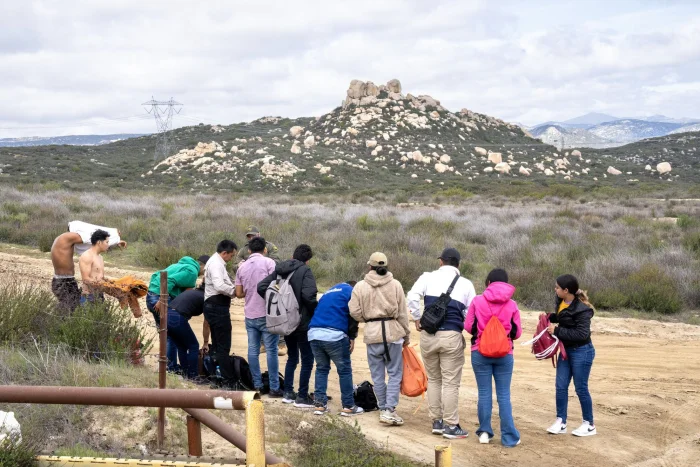
Peruvian police officers monitor the Chacalluta border crossing where migrants are stranded waiting to resolve their immigration status, in Arica, Chile, in May 2023. On Monday, Chile and Peru’s foreign ministers met virtually to coordinate a response to a rise in irregular migration along their shared border. File Photo by Pablo Rojas Madariaga/EPA
Dec. 1 (UPI) — SANTIAGO, Chile, Dec. 1 (UPI) — Chile and Peru’s foreign ministers met virtually on Monday to coordinate a response to a rise in irregular migration along their shared border, after Peru’s interim president, José Jerí, ordered the militarization of the border crossings.
The situation has created a new border dispute between the two countries as more migrants from Venezuela, Ecuador, Colombia and Haiti attempt to leave Chile through its northern frontier, becoming stranded in the border area because Peru no longer allows undocumented travelers to enter.
Chile’s undersecretary of the interior, Víctor Ramos, told ADN radio that the meeting aims to strengthen border control and explore ways to redirect migrants, while downplaying the possibility of a crisis between the two countries.
“There is no crisis at our borders. There is border control, there is a reduction in irregular migration and we have a specific problem in the area between the Santa Rosa and Chacalluta complexes, where people remain because they cannot cross into Peru,” Ramos said.
However, the migration issue has been under scrutiny since Chilean presidential candidate José Antonio Kast urged irregular migrants to “take your belongings and leave the country,” warning they would otherwise be “expelled with nothing” once he takes office in March 2026 if he wins the Dec. 14 election.
The director of the Center for Migration Studies at the University of Santiago, Byron Duhalde, told UPI that Peru’s response stems from Kast’s pledge to expel irregular migrants and implement a national policy of closing the border.
“The presidential candidate is leading in the polls, which is creating fear among migrants in irregular situations and prompting them to start looking for other destination countries or return to their countries of origin,” he said.
“That has increased the number of people at border crossings, mainly with Peru, and because they are in an irregular situation and lack documentation, they cannot leave, which creates crowding,” Duhalde said.
Ramos said that, between 2018 and 2021, irregular migration into Chile increased 700%.
Diego Paco, governor of Chile’s Arica and Parinacota Region, which borders Peru, warned in a television interview that the situation of migrants who are unable to cross could worsen in the coming weeks.
“As the days go by, from late December through March, the number of people stranded in the border area could increase exponentially if Peru closes the border or reinforces it with military personnel,” Paco told Megavisión.
He said the problem is that there is no contingency plan for a border closure by Peru and no direct coordination with Peruvian authorities or with officials from other neighboring countries.
Duhalde agreed, saying that “rather than an overreaction by Peru, what we are seeing is evidence of the lack of coordination among South American countries to agree on measures to manage the departure of migrants who are in situations of forced movement.”
He noted that closing borders is concerning because blocking regular crossings encourages criminal activity along illegal routes.
“We need to address human mobility in South America with a medium- and long-term agenda, because when borders are closed, people are pushed to move through irregular routes where organized crime operates,” Duhalde said.
In late November, Peruvian President José Jerí announced the militarization of the border, declaring a 60-day state of emergency in the Tacna region, which placed the international route connecting Chile and Peru under military control.
“We are going to declare a state of emergency on the border with Chile to provide calm in the face of the risk of unauthorized migrant entries that could threaten public security in our country,” Jerí wrote on his X account.
It is not the first time Peru has taken such steps over migration issues. In 2023, the government also declared a state of emergency in Tacna and closed the border to undocumented travelers. Then-President Dina Boluarte justified the measure as a way to preserve internal order.
