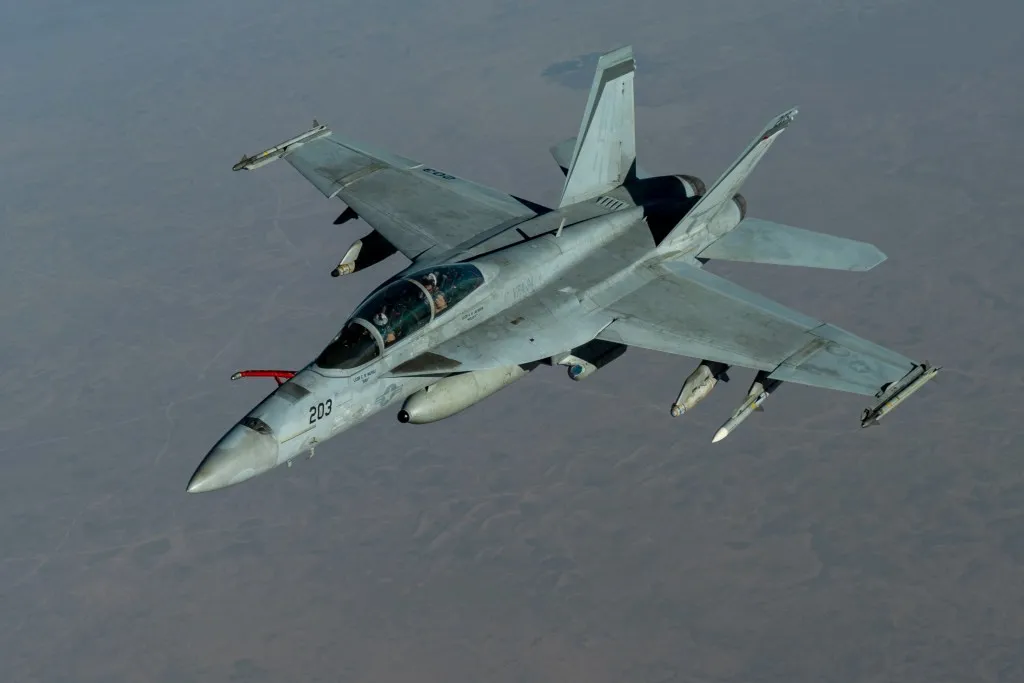
The U.S. Navy has recovered an MH-60R Seahawk helicopter and an F/A-18F Super Hornet from the aircraft carrier USS Nimitz that crashed within half an hour of each other in the South China Sea on Oct. 26. They were located and retrieved at a depth of about 400 feet on Dec. 5. You can read about the effort to find the jet and helicopter in our initial story here.
“Both aircraft were recovered intact,” a Navy official told TWZ on Tuesday morning.
“All recovered aircraft components are being transported to a designated U.S. military installation in the Indo-Pacific region for detailed analysis,” the Navy’s 7th Fleet also said in a press release. Officials have not released details about exactly where in the South China Sea the aircraft went down and were subsequently retrieved.


The retrieval effort was conducted by Commander, Task Force 73 (CTF 73); Task Force 75; the Naval Sea Systems Command’s Supervisor of Salvage and Diving (SUPSALV); and CTG 73.6’s Mobile Diving and Salvage Unit, according to the Navy’s release. Task Force 73 is responsible for logistics activities within the 7th Fleet’s area of responsibility, while Task Force 75 oversees diving and salvage units and other expeditionary capabilities.
In addition, the Navy says it employed a “contracted Vessel of Opportunity, equipped with a government-owned, contractor-operated unmanned system, to lift and recover the aircraft.” The 7th Fleet release did not name that ship, and we have reached out for additional details. Contracted vessels have assisted in the recovery of U.S. military aircraft in the past, including in the South China Sea.
On Nov. 20, the Navy had told TWZ that the USNS Salvor (T-ARS 52), a Safeguard class salvage ship operated by Military Sealift Command, was “on-scene conducting operations in support of the recovery efforts.” It is unclear at the moment what role that ship might ultimately have played in retrieving the lost aircraft. It was seen docked in Singapore on Dec. 7, according to the MarineTraffic ship tracking website.

“This recovery was a true Navy team effort across CTF 73, SUPSALV, Task Force 75, HSM 73 [Helicopter Maritime Strike Squadron 73], VFA 22 [Strike Fighter Squadron 22], and our Mobile Diving and Salvage Unit,” Navy Lt. Cmdr. Christopher Andersen, the CTF 73 officer who led the salvage mission, said in a statement. “Everyone involved brought critical expertise ensuring we could safely and successfully bring these aircraft back under U.S. custody. This operation highlights the importance of naval integration, readiness, and the unmatched capability of our salvage and diving teams.”
As we have previously noted, the tense and contested nature of the South China Sea and its proximity to China would have put additional emphasis on ensuring the aircraft, or components from them, were not recovered by the Chinese. Like the United States, China has foreign materiel exploitation, or FME, programs aimed at recovering weaponry for intelligence analysis and developmental purposes. Both crashed Navy aircraft have a number of sensitive components that would be of particular interest to a major global competitor like China. You can read more about that here.
The aircraft from Nimitz that went down in the South China Sea were recovered a day after the Navy released results of investigations into the separate losses of three F/A-18s from the aircraft carrier USS Truman. Those incidents included one in which a Super Hornet was shot down by the Ticonderoga class guided missile cruiser USS Gettysburg. Unlike the case of the Nimitz aircraft, those jets were never recovered, a Navy official previously confirmed to us.
The cause of the crashes of the Nimitz aircraft in October remains unknown. President Donald Trump previously suggested that the mishaps could have been caused by “bad fuel,” and you can read more about potential fuel issues in our initial coverage here. Navy officials have also previously confirmed to us that they believe there are no “nefarious” circumstances behind the crashes.
With the F/A-18F and MH-60R now recovered, the investigations into their crashes are continuing, the Navy said on Tuesday.
Contact the author: howard@thewarzone.com