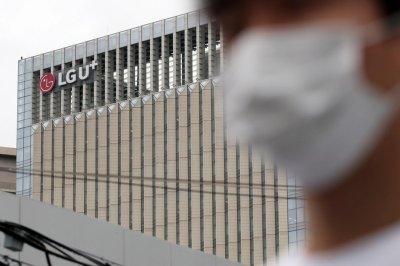

Exterior view of the headquarters of LG Uplus in Seoul, South Korea. LG HelloVision, LG Uplus’s subsidiary is still struggling to revive its mobile virtual network operator business, with subscriber growth and revenue showing little momentum despite broader expansion in South Korea’s budget mobile market. File. Photo by YONHAP / EPA
March 6 (Asia Today) — LG HelloVision is still struggling to revive its mobile virtual network operator business, with subscriber growth and revenue showing little momentum despite broader expansion in South Korea’s budget mobile market.
The company said its budget mobile revenue rose to 156.7 billion won ($118 million) last year from 156.1 billion won ($117 million) a year earlier, an increase of just 0.4%.
The business remains one of LG HelloVision’s key revenue sources, accounting for about 10% of total sales. But its performance has remained largely flat as subscriber growth has slowed.
LG HelloVision said its budget mobile subscriber base, including internet-of-things lines, stood at about 770,000 in the first half of last year, up only about 20,000 from a year earlier.
Industry analysts said the company received limited benefit from increased number-transfer demand that followed last year’s telecommunications hacking incident.
South Korea’s three major wireless carriers responded with aggressive marketing campaigns to attract subscribers, reducing the spillover effect that smaller operators such as LG HelloVision had hoped to capture.
Its parent company, LG Uplus, reported about 21.7 million mobile subscribers last year, up 6.6% from about 20.4 million a year earlier. Mobile service revenue rose to 6.67 trillion won ($5.01 billion) from 6.43 trillion won ($4.83 billion).
One industry official said LG Uplus, which was seen as less affected by the hacking fallout, appeared to absorb a large share of switching demand through aggressive marketing.
Analysts also pointed to LG HelloVision’s cautious approach to new pricing plans and promotions as another reason for the prolonged slump.
The company has faced profitability pressure while growth in its core pay television business has stalled. After posting operating profit in the 40 billion won range in 2023, it has remained in the 10 billion won range over the past two years.
Aside from a new plan introduced late last year that included compensation for financial fraud such as voice phishing, the company has made few notable changes to its budget mobile offerings.
LG HelloVision said it plans to try to revive subscriber growth this year with a new promotion tied to next week’s launch of Samsung Electronics’ Galaxy S26 smartphone series.
Customers who buy a Galaxy S26 device and sign up for one of the company’s plans will receive a 30,000 won ($23) gift certificate. Subscribers to its Coupon Pack plan will also receive additional coupons worth 120,000 won ($90).
The company has also added artificial intelligence features to improve the sign-up process. On its website, users can enter their preferences and receive tailored plan recommendations along with summaries of customer reviews.
Still, analysts say competition with the three major wireless carriers is likely to remain a challenge.
Industry observers expect another round of large smartphone subsidies this year, led in part by KT, which reportedly lost a substantial number of subscribers earlier this year after penalty fees were waived for some customers.
Given the structure of the budget mobile market, analysts said LG HelloVision may need to focus more heavily on low-cost promotional plans and more specialized offerings aimed at specific customer groups.
— Reported by Asia Today; translated by UPI
© Asia Today. Unauthorized reproduction or redistribution prohibited.
Original Korean report: https://www.asiatoday.co.kr/kn/view.php?key=20260306010001749