Iran has rejected a ceasefire proposal from the United States, but says it sees a need for a permanent end to the war, its official news agency has reported. As of Monday, the United States and Iran were considering a framework aimed at ending their five-week conflict, as Tehran stressed its desire for a durable resolution and resisted pressure to quickly reopen the Strait of Hormuz under a temporary ceasefire.
According to the official IRNA news agency, Iran delivered its response to the U.S. proposal via Pakistan, rejecting the idea of a ceasefire and underscoring the need for a permanent conclusion to the war.
The response outlined 10 provisions, including ending regional hostilities, lifting sanctions, and supporting reconstruction efforts, IRNA reported.
According to a report from Axios that cites “four U.S., Israeli, and regional sources with knowledge of the talks,” the two-tier plan was to start with a 45-day ceasefire, planned to lead into a longer-term peace deal.
A senior Iranian official confirmed to the Reuters news agency that Tehran had received the ceasefire plan from Pakistan.
Pakistan has been playing a leading role in negotiations, with its Army chief, Field Marshal Asim Munir, reportedly in contact throughout the night with U.S. Vice President JD Vance, special envoy Steve Witkoff, and Iranian Foreign Minister Abbas Araqchi.
One major sticking point appears to be Iran’s refusal to reopen the Strait of Hormuz in exchange for a “temporary ceasefire.” Around a fifth of the world’s oil supply usually passes through the strait, which Iran has effectively blocked.
The same Iranian official told Reuters that the United States is not ready for a permanent ceasefire. Tehran will not be pressured into accepting deadlines and making a decision, the official added.
Over the weekend, U.S. President Donald Trump threatened to obliterate Iranian power plants and bridges if it doesn’t agree to fully reopen the Strait of Hormuz by 8:00 p.m. Tuesday (U.S. Eastern Time). “If they don’t come through, if they want to keep it closed, they’re going to lose every power plant and every other plant they have in the whole country,” Trump said in an eight-minute interview with The Wall Street Journal on Sunday.
Today, Trump reiterated that the Tuesday deadline is final.
Trump also issued an expletive-laden warning on his Truth Social website: “Tuesday will be Power Plant Day, and Bridge Day, all wrapped up in one, in Iran. There will be nothing like it!!! Open the Fuckin’ Strait, you crazy bastards, or you’ll be living in Hell – JUST WATCH! Praise be to Allah. President DONALD J. TRUMP.”
Iran’s parliament speaker responded with a warning that the US president’s “reckless moves” would mean “our whole region is going to burn”.
Iran’s deputy foreign minister said that those threats could amount to war crimes. “The American president, as the highest official of his country, has publicly threatened to commit war crimes,” Kazem Gharibabadi said on X, citing provisions of international law.
“The threat to attack power plants and bridges (civilian infrastructure) is a war crime under Article 8(2)(b) of the Rome Statute of the International Criminal Court,” he said, cited by AFP. Gharibabadi also warned that Iran would “deliver a decisive, immediate and regret-inducing response to any aggression or imminent threat.”
Iran has itself attacked civilian infrastructure on the Arabian Peninsula, including desalination plants critical to providing water to people living there.
Iran’s parliamentary speaker, Mohammad Baqer Qalibaf, condemned Trump’s threats and argued that he was being misled by Israel’s Prime Minister Benjamin Netanyahu. “Your reckless moves are dragging the United States into a living HELL for every single family, and our whole region is going to burn because you insist on following Netanyahu’s commands,” Qalibaf posted on X.
Iran’s central military command also responded to the latest threats, promising “much more devastating” retaliation if the U.S. military starts to hit civilian targets.
According to Barak Ravid, global affairs correspondent for Axios, the 45-day ceasefire is “one of many more ideas” being discussed.
UPDATES:
Author’s note: We will be updating our readers on what we know about the F-15E WSO recovery in a separate piece.
UPDATE: 4:15 PM EDT –
A recent post on X by the U.S. Central Command shows U.S. Marines preparing an example of the M142 High Mobility Artillery Rocket System (HIMARS) during Operation Epic Fury.
UPDATE: 4:10 PM EDT –
Reuters reports that four Iranian army ground force officers were killed on Sunday during an operation to counter U.S. aircraft in Isfahan, citing the semi-official Fars news agency. It is unclear if this is connected to the F-15E WSO recovery operation, which was taking place in the same region at that time.
UPDATE: 4:00 PM EDT –
Temporary markings in the form of Easter eggs appeared on the nose of this U.S. Air Force U-2S spy plane, seen departing RAF Fairford, in England, for a mission this morning.
U.S. Secretary of War Pete Hegseth says the United States will step up its strikes on Iran under Trump’s orders.
“Per the president’s direction, today will be the largest volume of strikes since day one of this operation. Tomorrow, even more than today. And then Iran has a choice.”
UPDATE: 3:40 PM EDT –
Trump today repeated his familiar assertions about the success of the war and the performance of the U.S. military (it has performed “unbelievably well,” he said), while also praising the “very historic” rescue of the second crew member from the Air Force F-15E shot down over Iran last week.
Shifting to his latest deadline for Tehran to reopen the Strait of Hormuz (8:00 p.m. ET on Tuesday), he added:
“The entire country can be taken out in one night, and that night might be tomorrow night.”
Trump warned that if Iran failed to meet his deadline, it would be left with “no bridges” and “no power plants,” saying the country would be reduced to “the Stone Ages,” reiterating his previous threat to send Iran “back to the Stone Ages.”
He later reinforced that warning, saying strikes on Iran’s bridges and power plants could begin from 8:00 p.m. ET tomorrow and suggesting the operation could be completed in as little as four hours.
“Every power plant in Iran will be out of business, burning, exploding, and never to be used again … I mean complete demolition by 12 o’clock. And it will happen over a period of four hours if we wanted to. We don’t want that to happen.”
UPDATE: 3:45 PM EDT –
In a surprising disclosure, Trump today suggested that Washington armed (Kurdish) Iranian opposition groups during the January demonstrations.
“President Trump told me the United States sent guns to the Iranian protesters,” Trump told Trey Yingst on the Fox News channel.
“He told me, ‘We sent them a lot of guns. We sent them to the Kurds.’ And the president says he thinks the Kurds kept them. He went on to say. ‘We sent guns to the protesters, a lot of them.’”
As well as lending credence to Iran’s claims that the protests were foreign-inspired, the disclosure would appear to put Kurds in an even more dangerous position. For their part, Kurdish groups have denied the claims.
UPDATE: 3:50 PM EDT –
Trump today implied that the widening rift between the United States and NATO began when he floated the idea of taking over Greenland.
“It all began with, if you want to know the truth, Greenland. We want Greenland. They don’t want to give it to us. And I said, ‘bye, bye.’”
He made the comments ahead of a scheduled visit to the White House later this week by NATO Secretary-General Mark Rutte — whom Trump, for what it’s worth, describes as a “wonderful guy” and a “great person.”
“NATO is a paper tiger. We didn’t need them, obviously, because they haven’t helped at all.”
Earlier today, U.S.-Israeli strikes killed the intelligence chief of Iran’s Revolutionary Guards, according to Iran’s Islamic Revolutionary Guard Corps (IRGC).
“Major General Majid Khademi, the powerful and educated head of the Intelligence Organisation of the Islamic Revolutionary Guard Corps, was martyred in the criminal terrorist attack by the American-Zionist enemy… at dawn today,” said the Guards in a post on their Telegram channel.
The IDF has continued airstrikes against Iranian targets, including further attacks on Mehrabad International Airport in Tehran, a major hub for commercial flights, which is also used by the government of Iran, and is one of the bases of the Islamic Republic of Iran Air Force (IRIAF). A video released by the IDF shows multiple Mi-8/17 Hip-series helicopters being targeted on the ground at Mehrabad. The IDF claims that “dozens” of aircraft were hit.
U.S. forces located on Bubiyan Island, Kuwait, were targeted by Iran, Ebrahim Zolfaghari, the spokesperson of Iran’s Khatam al-Anbiya Central Headquarters, said in a video statement shared by state media on Monday. Bubiyan is the largest of Kuwait’s coastal island chain, located in the northwest of the Gulf. Zolfaghari said that Iran targeted satellite equipment and munitions on the island with drones, adding that U.S. forces had relocated there from Arifjan camp in Kuwait after that base was repeatedly struck by Iran.
Israeli rescue teams were searching through debris on Monday for two people still missing after a missile strike in the northern city of Haifa, authorities said. The projectile, reportedly launched from Iran, hit a residential building, killing two people.
Officials said the direct impact on the seven-storey structure caused severe damage, leaving parts of it partially collapsed. Videos showed rescuers combing through the rubble with flashlights, navigating broken concrete and debris as the search continued.
“We have a major destruction site,” said Elad Edri, chief of staff of Israel’s home front command. Israel’s fire and rescue services said later that two of four people trapped under the rubble had been found dead.
The International Atomic Energy Agency (IAEA) has warned that strikes near Iran’s Bushehr nuclear power plant pose a serious risk to nuclear safety and must cease.
Located in the country’s south, the facility, which is home to a 1,000-megawatt reactor, has reportedly been targeted four times since the start of the latest conflict.
Rafael Grossi, director of the IAEA, said that any strikes around the area “could cause a severe radiological accident with harmful consequences for people and the environment in Iran and beyond.” He added that one strike hit just 250 feet from the plant perimeter. “A nuclear facility and surrounding areas should never be struck,” he said.
Israel has struck a major petrochemical facility at Iran’s massive South Pars natural gas field, according to multiple news agencies.
Israel’s defence minister, Israel Katz, confirmed what he described as “a powerful strike on the largest petrochemical facility in Iran,” which accounts for roughly half of the country’s petrochemical output. Meanwhile, Israeli military spokesperson Lt. Col. Nadav Shoshani said there would be “no immunity” for Iran as negotiations continue.
Katz’s remarks followed an earlier report from the Fars News Agency stating that “several explosions” were heard at the South Pars petrochemical complex in Asaluyeh.
The development raises doubts about ongoing efforts to secure a ceasefire between the United States and Iran. The field, which Iran shares with Qatar, is the largest natural gas reserve in the world and lies beneath the Persian Gulf. The latest strikes come just weeks after widespread international criticism of Israel’s March 18 attack on the same South Pars gas field.
Iran widened its attacks on Gulf energy infrastructure over the weekend, carrying out drone and missile strikes on petrochemical sites in Kuwait, Bahrain, and the United Arab Emirates. The Revolutionary Guards also said they had targeted an Israeli-linked vessel at Dubai’s Jebel Ali port.
Authorities in the emirate of Sharjah said on Sunday that they were responding to an incident involving Khor Fakkan Port, one of the United Arab Emirates’ largest container hubs. No injuries were reported, and officials provided no additional details in a statement released by the Sharjah media office.
Earlier, the United Kingdom Maritime Trade Operations (UKMTO) reported that the captain of a container ship at the port had observed several splashes from unidentified projectiles landing close to the vessel.
An Indian-flagged, Japan-owned tanker has crossed the Strait of Hormuz. A spokeswoman for Mitsui O.S.K. Lines told AFP that the Green Asha, owned by its subsidiary, had passed through the strait and was en route to India. The vessel, a liquefied petroleum gas tanker, is the third Japan-linked ship to transit the strait. “Both the crew and the cargo are safe,” the spokeswoman said.
North Korea appears to be stepping back from its longstanding ties with Iran and is carefully shaping its public messaging to keep open the possibility of improved relations with the United States after the Iran conflict, South Korean lawmakers told Reuters on Monday, citing intelligence officials.
There are unconfirmed reports, based on publicly available flight-tracking data, that a U.S. Air Force F-35 fighter flying in an area in southern Iraq, close to the Kuwaiti border, has squawked 7700. This is the universal, international transponder code used by aircraft to immediately alert Air Traffic Control (ATC) of a general emergency.
While we had previously seen Iranian satellite imagery that purported to show the extent of the Iranian attack on Prince Sultan Air Base in Saudi Arabia that occurred on March 27, the destruction of an aircraft maintenance shelter now appears to have been verified by commercially available Sentinel-2L imagery. The attack also destroyed a prized E-3 Sentry Airborne Warning and Control System (AWACS) as well as damaging other aircraft and injuring several American service members, as you can read more about here.
An IDF spokesperson disclosed recently that an Iranian underground complex used for storing ballistic missiles had been targeted.
Based on open-source intelligence, this appears to have been a relatively new and sizable missile base, constructed within the past two years along the Tehran–Qazvin road. It features at least five large access points designed for missile transporters and launch systems.
It also seems that the site was put into operation before construction was fully completed.
In recent days, imagery has emerged showing the reported aftermath of an Iranian drone strike on Camp Buehring in Kuwait, which appears to have destroyed at least one U.S. Army CH-47F Chinook helicopter.
Further signs of an attack on Camp Buehring are provided by infrared imagery from the NASA FIRMS portal.
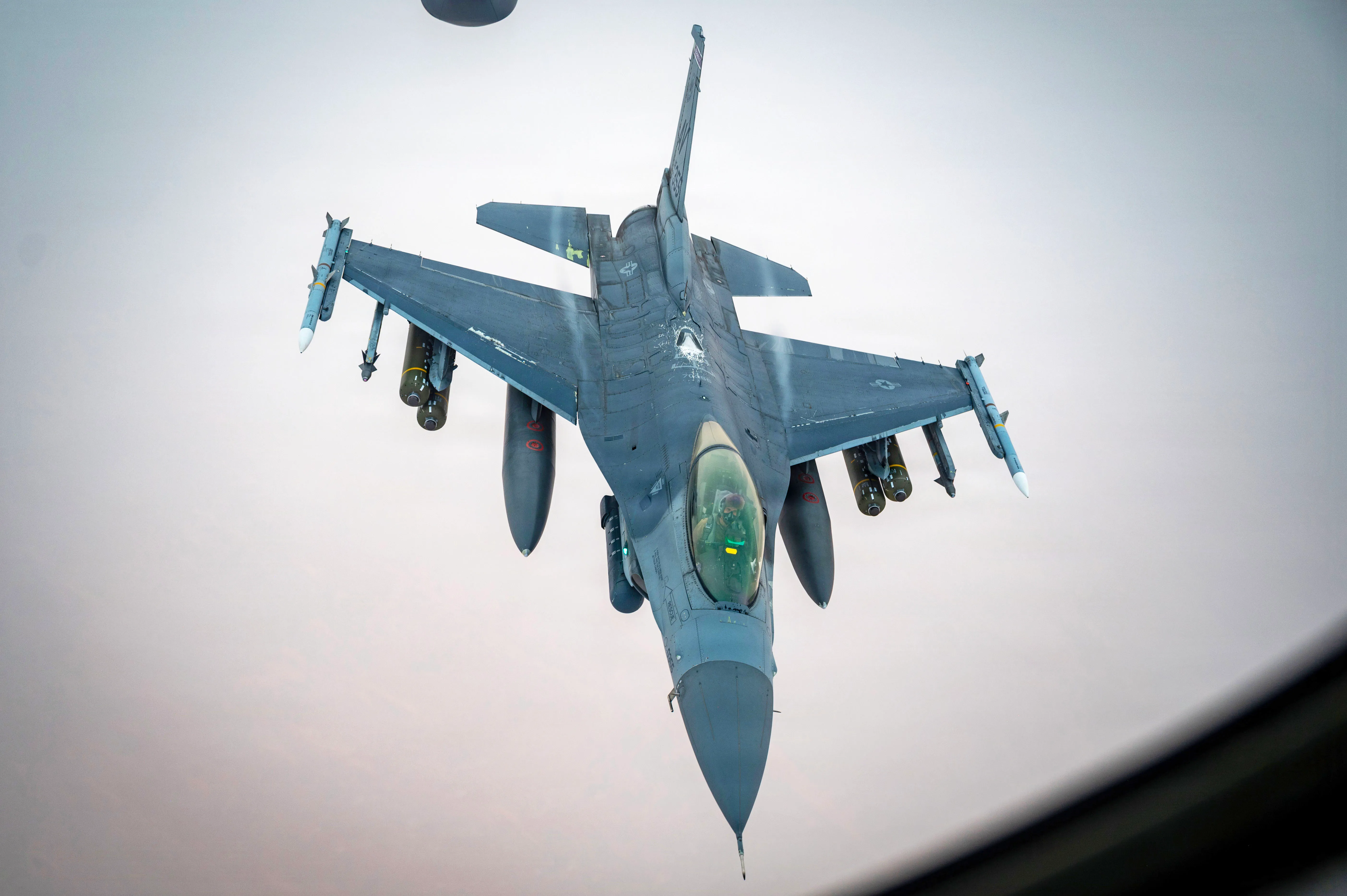
More evidence has emerged of the use of cluster bombs in U.S. airstrikes on Iran. Last week, photos appeared showing Israeli Air Force F-16I Sufa fighters apparently carrying cluster munitions. Now, U.S. Air Force F-16s have also been photographed with cluster bomb units underwing. The kinds of submunitions that might be inside remain unknown. However, Iranian officials previously accused the United States of employing air-dropped BLU-91/B anti-tank mines, which are delivered via cluster bomb. This seems most likely to be part of a limited-use area denial strategy to contain long-range missile launches, as you can read about in our previous reporting here.

Contact the author: thomas@thewarzone.com