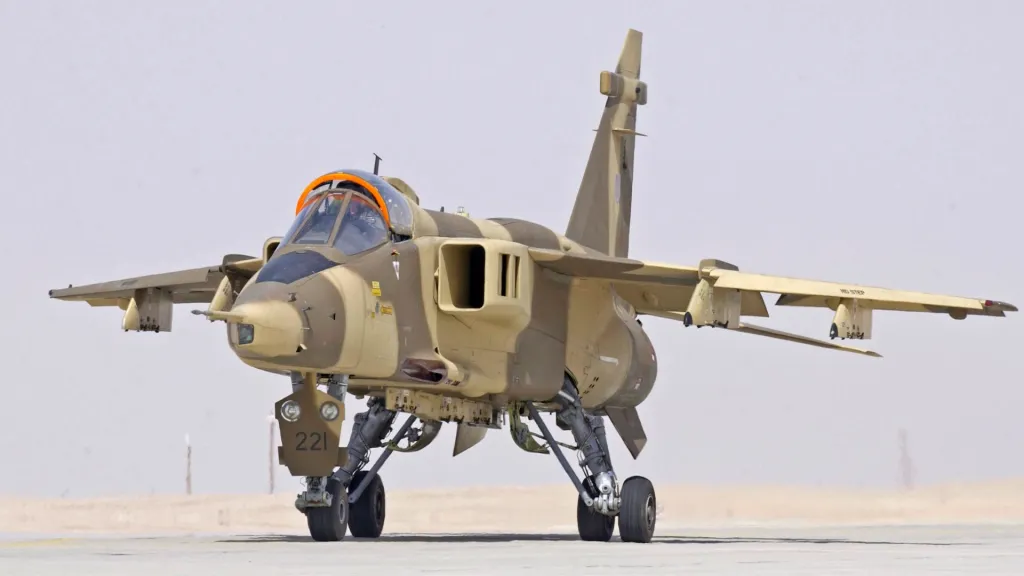
India, now the sole operator of the Anglo-French SEPECAT Jaguar strike aircraft, is to acquire surplus examples of the Cold War-era jets from Oman, which retired the type in 2014. The decision reflects the continued value of the Jaguar to the Indian Air Force (IAF) but also points to the service’s shrinking fighter force and delays in acquiring new equipment.

Multiple reports indicate that India and Oman have come to a deal that will put an undisclosed number of former Omani Jaguars into Indian hands. Starting in 1977, the Royal Air Force of Oman (RAFO) received a total of 27 British-made Jaguars, comprising 20 single-seaters, five two-seaters, and two ex-U.K. Royal Air Force aircraft used as attrition replacements. At least 13 of these were involved in various accidents, which would leave a maximum of ‘intact’ airframes 14 for India. Potentially, some further components could also be harvested from Omani aircraft that were written off while in service.

As for the IAF, the service selected the Jaguar for its Deep Penetration Strike Aircraft (DPSA) in 1978 and received 18 aircraft from U.K. Royal Air Force stocks as ‘interim’ equipment, 40 ‘flyaway’ aircraft direct from British Aerospace (BAe), plus around 128 more that were license-built in India under a transfer-of-technology agreement with Hindustan Aeronautics Limited (HAL).
The ex-Omani jets won’t be inducted into IAF service but will be broken down into spare parts to support the aging but still in-demand Indian Jaguar inventory. TWZ contributor and IAF historian Angad Singh told us that the jets will be dismantled in Oman and then shipped to India for ease of transport.
The IAF’s demand for increasingly hard-to-find Jaguar spares saw India turn to France in 2018–19. France, which retired its last Jaguars in 2005, shipped 31 complete airframes plus various spare parts to India, with New Delhi paying only for the cost of transport.

These airframes and spares are being used to support the IAF’s current six Jaguar squadrons, each of which has between 18 and 20 aircraft on strength. However, the fleet is being slowly eroded by attrition, with three Jaguar losses this year alone.
The last new Jaguar to be built in India came off the HAL production line in 2008; British and French production had long since ceased by this date. Since then, obtaining spare parts and components, including new or refurbished engines, has become much more complex. Already, India is reportedly having to cannibalize some aircraft to keep the others in the air.
Further evidence of the importance of the Jaguar to the IAF’s plans comes from the continued efforts to upgrade the jets, the oldest of which are now around 45 years old.

At the center of this effort is the Display Attack Ranging and Inertial Navigation (DARIN) modernization program for the Indian Jaguars, which first began in the 1980s and which has since progressed through three rounds of upgrades.
The first of these, DARIN I, kept the Jaguar’s original ‘chisel’ nose profile but added a new Sagem navigation/attack system, a combined map and electronic display, and a head-up display and weapon-aiming computer. A new Mil Std 1553B databus was added, making it easier to integrate new weapons and sensors. This would pay dividends during the 1999 Kargil War with Pakistan, during which Jaguars employed laser-guided bombs.

Starting in the early 2000s, DARIN II changed the nose profile, with a new Thales laser targeting and designation system fitted. Other new additions included an Israeli-made Elbit head-up display, an inertial navigation/GPS system, and a multifunction display in the cockpit. Self-protection was enhanced with an Israeli-made Elta EL/L-8222 jammer, locally made Tarang radar warning receivers, and new countermeasures dispensers. New weapons included the ASRAAM air-to-air missile and the Textron CBU-105 Sensor Fuzed Weapon.
In a category of their own are India’s Jaguars tasked with maritime strike. These were originally fitted with a radar nose accommodating an Agave radar, used in conjunction with Sea Eagle anti-ship missiles. Under DARIN II, these items were replaced with the Elta EL/M-2032 and the AGM-84 Harpoon Block II, respectively.

The most significant of the upgrades is DARIN III, begun in 2008, which includes a new active electronically scanned array (AESA) radar, the Israeli-made Elta EL/M-2052. The Jaguar became the first Indian combat jet to feature an AESA, and you can read more about the upgrade here.
The DARIN III program, led by HAL and informed by the Tejas Light Combat Aircraft program, saw the first flight of an upgraded Jaguar in 2012, but thereafter it suffered significant delays. Issues included integration of the locally developed open-system-architecture mission computer as well as a re-engining effort, which planned to replace the original Rolls-Royce Turbomeca Adour afterburning turbofans with Honeywell F125-INs. Replacement engines were finally canceled in 2019, after they were judged to be too expensive.
Other advanced DARIN III features include a fully ‘glass’ cockpit with three multifunction displays, an engine and flight instrument system (EFIS) digital display, and a digital head-up display. Also new is the Elbit Display and Sight Helmet (DASH), which is used to cue the ASRAAM missile. The ASRAAM, like the Magic 2 before it, is carried on the Jaguar’s unique overwing missile pylons.

The DARIN III program is planned to extend the life of at least some of the Indian Jaguars until 2050. However, the initial phase-out of the aircraft will begin before then. As Singh explained, the oldest (British-made) jets will not undergo the full upgrade, meaning that at least two of the IAF’s six Jaguar squadrons are due to disband in the near future.
Even the India-made HAL jets are now getting long in the tooth, but with examples still going through the DARIN III upgrade, at least some of them will be able to see out another 10 years or more of service.
“The Jaguar is still useful as a strike aircraft, and has been kept relevant with upgrades to electronic warfare, nav-attack systems, standoff weapons, and so on,” Singh told TWZ.
The fact that New Delhi has pressed on with upgrades to the Jaguar is a testament to the rugged reliability and precision-attack capabilities of the jet, despite its age, but it also points to underlying problems in the IAF, especially in terms of the size of its combat jet fleet.

Faced with the dual threats of Pakistan and China, the Indian government has said that the IAF needs at least 42 squadrons of combat aircraft. Currently, it has just 29, meaning the service is operating its smallest combat force since it went to war with China in 1962. The retirement of the veteran MiG-21 Fishbed has not helped matters in this regard.
Meanwhile, India’s plans to buy new off-the-shelf fighters are going nowhere fast.
After buying 36 Dassault Rafales, India announced a requirement for 114 fighters, initially specifying single-engine types. Subsequently, the competition appeared to be wide open, with the F-15EX, for example, now also being offered to India, and with the Rafale and the F/A-18E/F Super Hornet also in the running. If India decides to procure another single-engine fighter, after all, the Indian-specific F-21 configuration of the F-16 is also a viable candidate. But with no decision made, and with homegrown combat aircraft programs also proceeding slowly, the ‘squadron gap’ is only set to grow.

“The Indian Air Force is at 70 percent of its planned 42-squadron fighter strength — a number that was arrived at in the 1960s and will only be revised upward on any fresh assessment. Given this dire situation, the brass simply has no choice but to keep aircraft around, no matter how old,” Singh concluded.
Faced with this stark reality, it is less surprising that India is now searching far and wide for spare parts that will ensure its prozed Jaguars can see out their service life as maintaining them becomes ever more of a challenge.
Contact the author: thomas@thewarzone.com