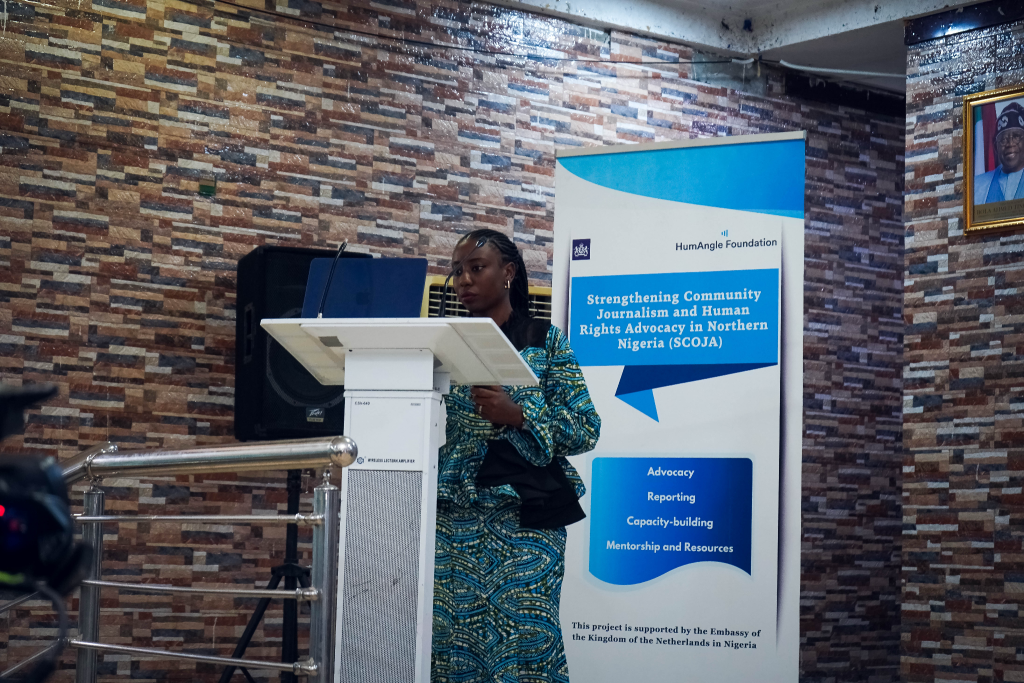
HumAngle Foundation, in collaboration with the Embassy of the Kingdom of the Netherlands, has launched a guide for community journalism, as part of the Strengthening Community Journalism and Human Rights Advocacy in Northern Nigeria (SCOJA) project. The project, which started in 2025, has trained 90 journalists and human rights advocates so far, and their work has recorded some impact in their communities.
The launch was held on Tuesday, July 21, at the University of Maiduguri in Borno State, northeastern Nigeria, and was hosted by the Faculty of Communication and Media Studies. Angela Umoru-David, HumAngle Foundation’s Programme Director, welcomed dignitaries, students, and speakers to the gathering. In her remarks, she noted that partnerships like these were instrumental in ensuring the reach of journalism resources to those who need them the most.
“We developed this manual to serve as a guide for community journalists in Nigeria,” she said.

HumAngle’s Founder/CEO, Ahmad Salkida, noted in his introduction to the manual that the role of community journalists was crucial to social cohesion. “Community journalists, often the first witnesses to crises and transformation, are the unsung custodians of enduring social realities,” he wrote. “Their proximity to the people and understanding of local realities make them indispensable to the national narrative… We hope that every journalist who engages with this manual will find in it a field companion, a guide, and an inspiration to tell deeper, more authentic stories, to stand firm in truth, and to amplify the voices that matter most.”

Jessica Odudu, Senior Policy Advisor on Human Rights and Public Diplomacy at the Embassy of the Kingdom of the Netherlands in Nigeria, reiterated this point in her welcome remarks.
“While information has become abundant, trust is increasingly scarce. In moments like these, the role of journalists becomes even more important. Community journalists are often the first to report conflict. They understand the realities in their communities in a way outsiders don’t. Yet, many do this work with very few resources. Over the past year, the Embassy of the Kingdom of the Netherlands has had the privilege of strengthening community journalists’ capacity to do their work,” she said.
During the keynote speech, Prof. Mu’azu Abubakar, Dean, Faculty of Communication and Media Studies, University of Maiduguri, emphasised the importance of viewing ‘community’ as an expansive and diverse concept. On his behalf, Mohammed Auwal Umar delivered a paper they co-authored, which sought to understand the fragile conditions in which community journalism must thrive.

“Community journalism curates content, generates it, and develops it in a way that is relevant to the community we are serving. It is not meant to serve a classical divide,” he said.
The event also featured a panel discussion with Dr Abdulmutallib Ado Abubakar, Head of the Department of Mass Communication, University of Maiduguri; Abdulhamid Al-Gazali, Editor-in-Chief, Yerwa Express; Hauwa Shaffii Nuhu, Managing Editor, HumAngle Media; and Hassana Danyerwa, Founder, FeelandHeal Initiative and SCOJA Fellowship alumna. The discussion, which focused on strengthening community journalism in Nigeria, was moderated by Abdussamad Ahmad Yusuf, HumAngle Foundation’s Human Security and Policy Analyst.
Speaking during the discussion, Abdulhamid said, “We have to understand that as a people, the most important aspect of our society is the kind of information our people consume. Communities must have media that understand their fundamental issues, curate relevant information, and take responsibility for disseminating the right information. If we do not take control of what we consume, it affects society.”

Hassana, while reflecting on the impact of the SCOJA Fellowship, said, “Although I am not a journalist and I joined the SCOJA Fellowship as an advocate, my experiences from the fellowship set me up for a global experience where I was the only Nigerian selected. The mentorship aspect of the fellowship helped me and opened a new professional pathway for me.”

Other past SCOJA fellows, including Faiza Jibrin, Yahuza Bawage, and Nathaniel Ishaya, also shared their experiences with attendees.
As the guide was formally launched, Angela Umoru-David announced the donation of copies to the University of Maiduguri. The guide, available in both Hausa and English, can be downloaded here for free.