For the second time in as many weeks, a leading California-based thoroughbred has been retired.
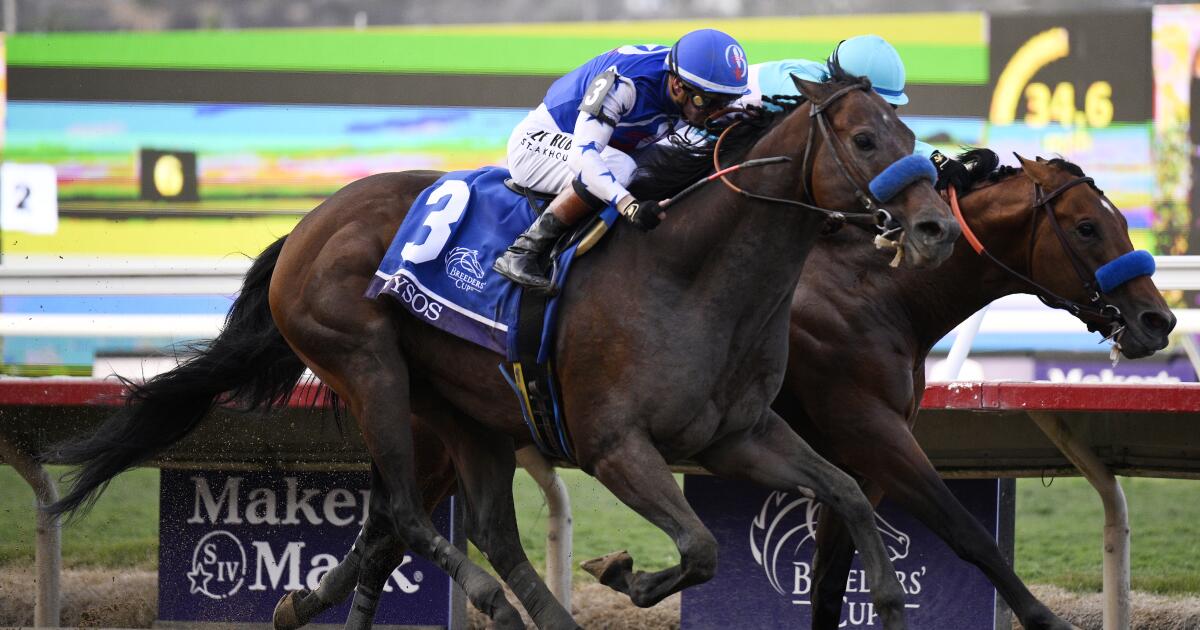
Nysos, who would have been favored in the $1-million Pacific Classic later this month at Del Mar and was a top early contender for the $5-million Breeders’ Cup Classic this fall, won’t race again, Coolmore America announced Monday.
The 5-year-old son of Nyquist is headed to stallion duty next year at Coolmore’s Ashford Stud in Versailles, Ky., the same farm where Journalism, another horse who was being pointed for those two races, was sent last month after his retirement because of injury.
In a statement, Coolmore said Nysos is sound and uninjured but “the decision was made following a routine diagnostic evaluation that revealed subtle imaging changes on a scan.” Trainer Bob Baffert and Nysos’ owners, Baoma Corp. and Coolmore, “unanimously agreed to take a strict precautionary approach, prioritizing the horse’s long-term health and safety above all else.”
Said Baffert: “Nysos is not hurt or injured, but taking a precautionary approach is strictly about doing what is right for the horse. With the minor changes shown on the evaluation, we simply don’t have the time needed to prepare him for the Breeders’ Cup the way we would want to. He has given us everything and retiring him completely sound and at the top of his game is the proper decision.”
Nysos retires after eight wins and two seconds in 10 lifetime races, with earnings of nearly $5.3 million. He was considered a top prospect for the 2024 Kentucky Derby but was injured that winter and didn’t race again for 15 months.
He returned in May 2025 and won four of five starts last year, including the Breeders’ Cup Dirt Mile at Del Mar. This year Nysos finished second to Forever Young in the Saudi Cup before defeating Journalism in the Met Mile in June at Saratoga, which turned out to be his last race.
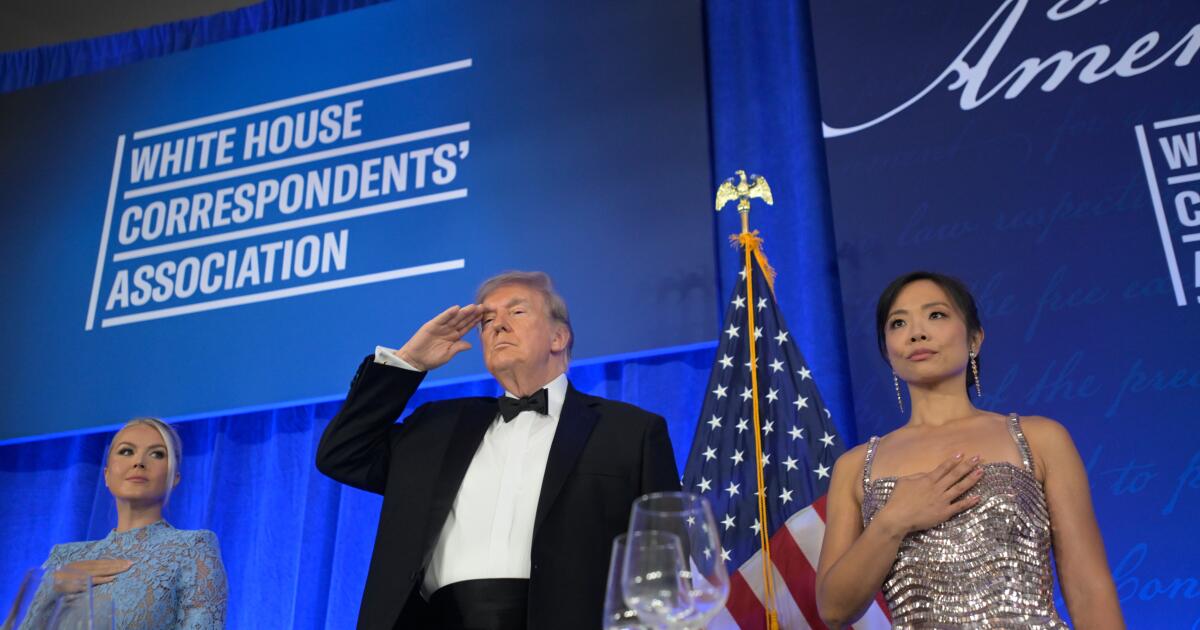
WASHINGTON — For the rescheduled White House Correspondents’ Assn. dinner on Friday at Washington’s Waldorf Astoria hotel, security will be much tighter, the guest list smaller, the partying pared down, and the dress code more relaxed.
That much, the correspondents’ association can control.
What remains out of its control — and perhaps the biggest question — is what the dinner’s most prominent guest, President Trump, will bring to the table.
Call it White House Dinner 2.0, or Take Two, or, in Trump’s own words, a “HOT ticket.” The big unknown is whether Trump will bring the fighting words (“rather nasty,” he said) against the press that he’d planned to deliver in April — before the event descended into chaos when a gunman stormed a security checkpoint, forcing an evacuation of the room.
“The president looks forward to finishing what he started,” press secretary Karoline Leavitt said on Thursday, confirming Trump’s attendance. “I encourage everyone watching tomorrow night to tune in for what promises to be a very entertaining and memorable evening.”
Trump has been coy about what he might say
As for Trump himself, he indicated last month he wasn’t sure. “I don’t know whether or not I will give the same rather nasty statements, at least as it concerns certain people, but we will soon find out,” the Republican president wrote on his Truth Social platform. “In any event, it will be a ‘HOT’ ticket!”
Besides the pared-down approach, there is another change at Friday’s dinner: two additional awards. One will be presented to Victor Gonzales, the Secret Service agent who was staffing a security checkpoint in April and was struck in his protective vest.
“Officer Gonzales … ran toward danger so that thousands of others could make it home safely,” WHCA President Weijia Jiang said in a statement. “His courage stemmed from a dedication to service, which we are looking forward to honoring this week.”
A second award will be presented to the staff of the Washington Hilton hotel, site of the first dinner.
Other changes: With security in mind, there will be only one entrance at the much smaller venue, with airport-style metal detectors. Guests received individual QR entry codes in advance, and nobody can get in unless recognized. “There is NO red carpet at this dinner,” said a memo Jiang sent to some guests last month, seen by The Associated Press. “There are NO onsite pre-dinner receptions.”
The dress code this time is a looser “black tie optional,” and dinner includes grilled peach and burrata salad, lobster, and beef Wellington. The evening, as at the last dinner, has entertainment by mentalist Oz Pearlman, along with the awards presentations and Trump’s remarks.
Jiang and her fellow board members worked hard to bring about this WHCA dinner 2.0, not wanting to let a violent act — or the image of colleagues hiding under tables — remain the final thought. Announcing the rescheduling, she emphasized the dinner’s stated purpose: “a celebration of a free press and the vital role of journalism in our democracy for over a century.”
“We will not allow an act of violence to have the last word, especially during a year when we are reflecting on the 250th anniversary of America and everything we stand for,” Jiang said.
There’s still lots of criticism of the event
But it’s also clear that some people felt the dinner should not be rescheduled at all.
Many never thought it was much of a good look in the first place, with the sight of journalists in formal wear cozying up to their sources, or the objects of their reporting.
“It undermines the public faith in how the press does its work, and it makes it look like we are pals with the people we cover,” Kelly McBride, an ethics expert at the Poynter Institute, a journalism think tank, said when the deliberations were taking place.
The new dinner comes during a time of fast-increasing tension between the media and a president who, in his second term, has tried to exert pressure on media outlets he is unhappy with in a variety of ways. That pressure has ranged from sanctions against members of the White House press corps to regulatory actions through the Federal Communications Commission to outright lawsuits.
Those tensions have only escalated since April, with the latest example reaching a New York courtroom on Thursday. There, criticized by a federal judge for sloppy legal work, the government withdrew subpoenas that would have compelled three New York Times reporters to testify about their sources for articles about Trump’s Qatari-gifted Air Force One jet.
That escalation was the impetus behind a letter from a coalition of press freedom groups and hundreds of former journalists, urging the WHCA to stand up to Trump forcefully at the dinner.
“We believe it is hypocritical to celebrate the First Amendment in front of the man who relentlessly attacks it,” the letter says. “We urge the WHCA to condemn the administration’s actions from the podium and pledge to fight all attempts by his administration to undermine this core pillar of a functioning democracy.”
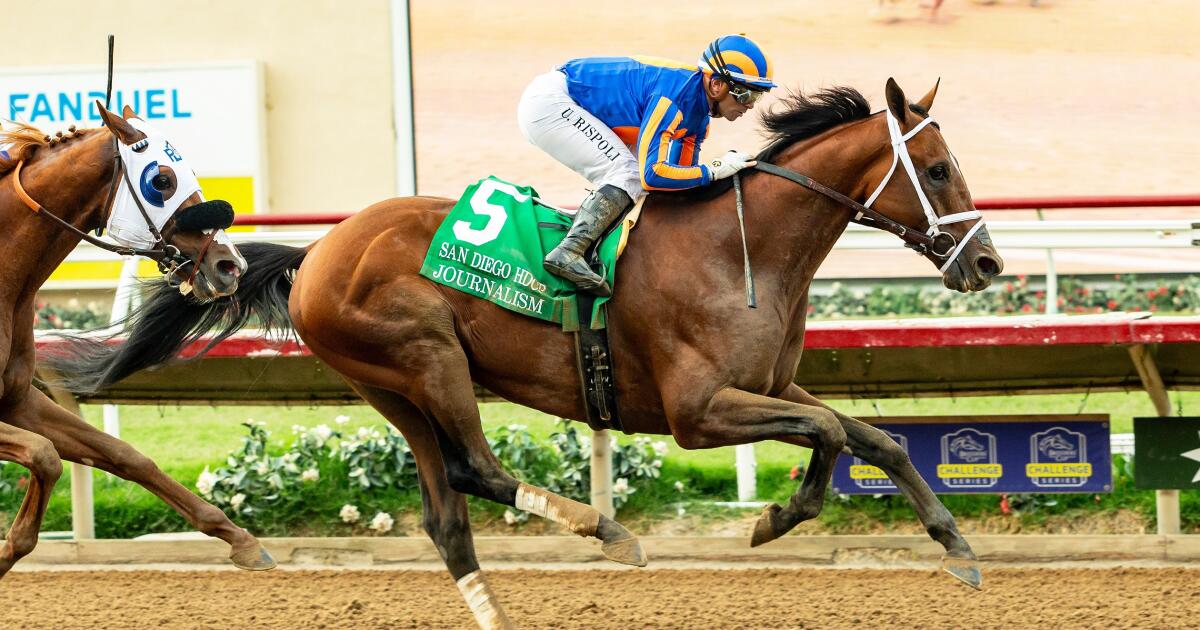
Six days after winning his first race in nearly a year, the multiple Grade 1-stakes-winning colt Journalism has been retired.
Coolmore America and Journalism’s ownership group on Friday announced the 4-year-old son of Curlin sustained an injury at the start of Saturday’s San Diego Handicap at Del Mar. The nature of the injury was not revealed.
Journalism broke slowly in the race when he moved forward just before the gate opened, then hit the side of the stall. He spotted the field several lengths but rallied to capture the 1 1/16-mile race for his first victory in five starts since winning the Haskell Stakes last July at Monmouth Park.
In addition to the Haskell, Journalism earned Grade 1 wins in the Preakness Stakes and Santa Anita Derby and was second in the Kentucky Derby, Belmont Stakes and Pacific Classic. The San Diego was his third Grade 2 win, along with the Los Alamitos Futurity and San Felipe Stakes.
He retires with seven wins, three seconds and three thirds from 14 starts, with earnings of $4,770,755.
Michael McCarthy trained Journalism for an ownership group headed by Eclipse Thoroughbred Partners, which paid $825,000 for him as a yearling. The colt already was scheduled to begin stallion duty next year at Coolmore’s Ashford Farm in Versailles, Ky.
“What Journalism did at Del Mar was the mark of a true champion,” McCarthy said in the news release. “To suffer an injury in the gate, give away that much ground, and still win purely on heart and class tells you everything you need to know about him. He owes us absolutely nothing. While it’s tough to see his racing career end this way, protecting him is our top priority, and he goes to stud at the top of his game.”
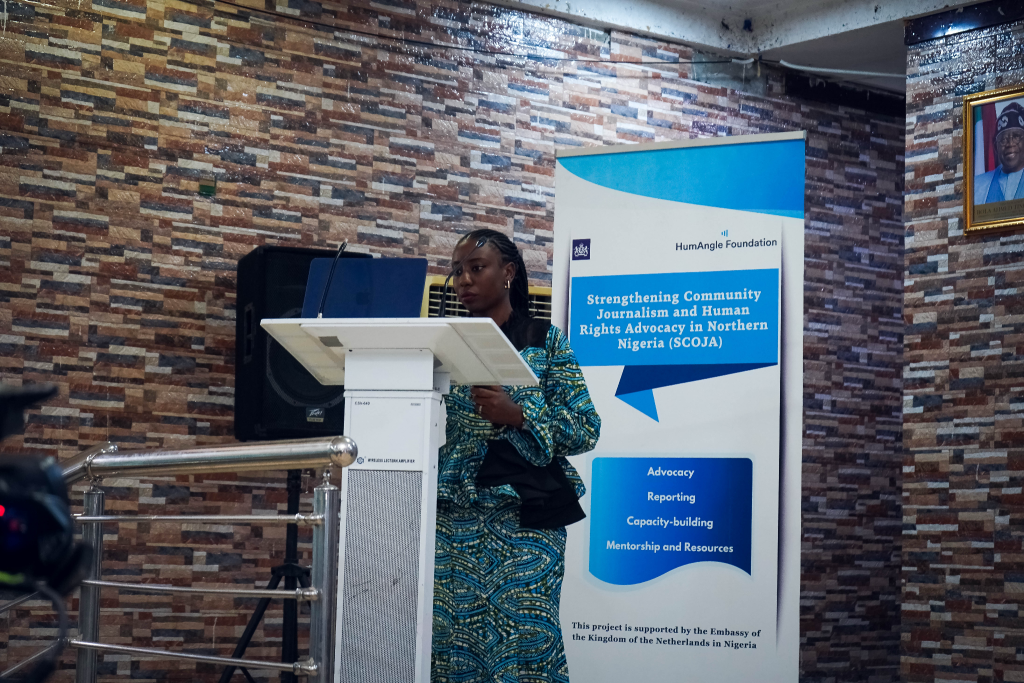
HumAngle Foundation, in collaboration with the Embassy of the Kingdom of the Netherlands, has launched a guide for community journalism, as part of the Strengthening Community Journalism and Human Rights Advocacy in Northern Nigeria (SCOJA) project. The project, which started in 2025, has trained 90 journalists and human rights advocates so far, and their work has recorded some impact in their communities.
The launch was held on Tuesday, July 21, at the University of Maiduguri in Borno State, northeastern Nigeria, and was hosted by the Faculty of Communication and Media Studies. Angela Umoru-David, HumAngle Foundation’s Programme Director, welcomed dignitaries, students, and speakers to the gathering. In her remarks, she noted that partnerships like these were instrumental in ensuring the reach of journalism resources to those who need them the most.
“We developed this manual to serve as a guide for community journalists in Nigeria,” she said.
Angela Umoru-David, Programme Director of HumAngle Foundation. Photo: Al’amin Umar/HumAngle.
HumAngle’s Founder/CEO, Ahmad Salkida, noted in his introduction to the manual that the role of community journalists was crucial to social cohesion. “Community journalists, often the first witnesses to crises and transformation, are the unsung custodians of enduring social realities,” he wrote. “Their proximity to the people and understanding of local realities make them indispensable to the national narrative… We hope that every journalist who engages with this manual will find in it a field companion, a guide, and an inspiration to tell deeper, more authentic stories, to stand firm in truth, and to amplify the voices that matter most.”
Cross-section of the audience. Photo: Al’amin Umar/HumAngle.
Jessica Odudu, Senior Policy Advisor on Human Rights and Public Diplomacy at the Embassy of the Kingdom of the Netherlands in Nigeria, reiterated this point in her welcome remarks.
“While information has become abundant, trust is increasingly scarce. In moments like these, the role of journalists becomes even more important. Community journalists are often the first to report conflict. They understand the realities in their communities in a way outsiders don’t. Yet, many do this work with very few resources. Over the past year, the Embassy of the Kingdom of the Netherlands has had the privilege of strengthening community journalists’ capacity to do their work,” she said.
During the keynote speech, Prof. Mu’azu Abubakar, Dean, Faculty of Communication and Media Studies, University of Maiduguri, emphasised the importance of viewing ‘community’ as an expansive and diverse concept. On his behalf, Mohammed Auwal Umar delivered a paper they co-authored, which sought to understand the fragile conditions in which community journalism must thrive.
Prof. Mu’azu Abubakar, Dean, Faculty of Communication and Media Studies, University of Maiduguri, delivers a keynote speech. Photo: Al’amin Umar/HumAngle.
“Community journalism curates content, generates it, and develops it in a way that is relevant to the community we are serving. It is not meant to serve a classical divide,” he said.
The event also featured a panel discussion with Dr Abdulmutallib Ado Abubakar, Head of the Department of Mass Communication, University of Maiduguri; Abdulhamid Al-Gazali, Editor-in-Chief, Yerwa Express; Hauwa Shaffii Nuhu, Managing Editor, HumAngle Media; and Hassana Danyerwa, Founder, FeelandHeal Initiative and SCOJA Fellowship alumna. The discussion, which focused on strengthening community journalism in Nigeria, was moderated by Abdussamad Ahmad Yusuf, HumAngle Foundation’s Human Security and Policy Analyst.
Speaking during the discussion, Abdulhamid said, “We have to understand that as a people, the most important aspect of our society is the kind of information our people consume. Communities must have media that understand their fundamental issues, curate relevant information, and take responsibility for disseminating the right information. If we do not take control of what we consume, it affects society.”
The panellists discuss strengthening community journalism in Nigeria. Photo: Al’amin Umar/HumAngle.
Hassana, while reflecting on the impact of the SCOJA Fellowship, said, “Although I am not a journalist and I joined the SCOJA Fellowship as an advocate, my experiences from the fellowship set me up for a global experience where I was the only Nigerian selected. The mentorship aspect of the fellowship helped me and opened a new professional pathway for me.”
Abdulkareem Haruna, NUJ President, Borno State chapter, offered some closing remarks at the end of the event. Photo: Al’amin Umar/HumAngle.
Other past SCOJA fellows, including Faiza Jibrin, Yahuza Bawage, and Nathaniel Ishaya, also shared their experiences with attendees.
As the guide was formally launched, Angela Umoru-David announced the donation of copies to the University of Maiduguri. The guide, available in both Hausa and English, can be downloaded here for free.
DEL MAR — Umberto Rispoli waited nearly 11 months to ride Journalism again and then, well, let track announcer Larry Collmus describe it:
“They’re off in the San Diego Handicap and Journalism brushed the gate just as it opened, and he’s left behind the field. Journalism has been left behind about five lengths. … A disastrous start for the big favorite Journalism.”
“I won’t tell you the swear (word) that I throw out there,” Rispoli said.
“It just kind of took the starch out of everything,” said Aron Wellman, managing partner of Eclipse Thoroughbred Partners, co-owner of the 4-year-old colt.
Fortunately for Rispoli, Wellman and anyone else associated with Journalism, including the fans who bet him down to 1-5 odds Saturday at Del Mar Racetrack, this story ended much happier than it began.
Rispoli patiently guided Journalism back into close contact with the other four horses in the 1 1/16-mile race, swung him outside entering the stretch and the son of Curlin cruised to a victory — his first since the same Saturday a year ago in the Haskell at Monmouth Park.
In the ensuing 12 months, Journalism started four times and finished between second and fourth each time. He didn’t run poorly in any of the races; in fact, of the seven horses who beat him, five were Breeders’ Cup winners and a sixth won the Kentucky Derby and Belmont.
But when your resume includes not only the Haskell but also the Santa Anita Derby and Preakness, sometimes close isn’t good enough.
“Frustrating for sure,” Wellman said earlier in the week.
The San Diego presented the weakest field Journalism had faced since at least the 2025 Preakness, and his task seemed to get easier when Full Serrano, the Breeders’ Cup Dirt Mile winner here in 2024, was withdrawn Saturday morning because of recurring foot issues.
But as Rispoli noted, “You can’t go in a race and think of course he’s (1-5). You have to respect everybody in the field. Because you see, everything can happen in horse racing.”
Including your horse starting to move forward just before the gate opens, then hitting the side of the stall and spotting the field several lengths.
“I was concerned [with] the bad start, obviously,” Rispoli said. “But it wasn’t the first time I was in that situation. I know what I have underneath myself. I know what’s he’s capable of.”
The official margin was three-quarters of a length over the Cal-bred Shea Brennan, who was the longest shot in the short field at 23-1. Iron Man Cal, like the runner-up trained by Phil D’Amato, was third, with The Goat fourth and pacesetting Mirahmadi fading to last.
The final time was 1:42.65 and Journalism, who paid $2.40 for his seventh win in 14 starts, earned $180,000 to push his career total to $4.77 million.
“Umberto did a good job of getting him to recover and his class won out,” winning trainer Michael McCarthy said.
And, given what Rispoli has been through, maybe Saturday was supposed to be difficult. The Italian jockey only recently resumed riding a few weeks ago after missing five months beacuse of a fall in January at Gulfstream Park. He sustained a fractured right fibula and tibia as well as a displaced ankle and torn ligaments.
“I was in severe pain,” Rispoli said of his rehab, which included time spent at a specialist in Spain. “The first two weeks [in Spain], I said to myself, this is gonna be hard to do it. You know, I’m almost 38, first time a very hard accident happened to me. It was really bad.
“But this is what gave me the strength, horse racing. And I know I have a job incomplete … so I have to come back for this guy.”
When Journalism enters the Del Mar Racetrack starting gate shortly after 5:30 p.m. Saturday, 363 days will have passed since he last won a race.
Anyone who watched the colt win six of eight starts — including the Santa Anita Derby, Preakness Stakes and Haskell Stakes — during the eight months leading up to July 19, 2025, might find that unthinkable.
Imagine being his primary owner.
“Yeah, it’s pretty hard to believe that a horse like him hasn’t won a race in a year,” said Aron Wellman, managing director of Eclipse Thoroughbred Partners, which co-owns the 4-year-old son of Curlin. “Frustrating for sure.”
It’s not like Journalism has been disgraced during his four-race winless streak. Two of the races came when he was a 3-year-old facing older horses. His speed figures have ranked among the highest of his career. And five of the seven horses who finished ahead of him have won Breeders’ Cup races while a sixth captured two legs of the Triple Crown.
“You can understand how he might have found it hard to make his way into the winner’s circle,” Wellman said. “But it’s not for lack of ambition or lack of trying, or I don’t think any deterioration in his form, really. It’s just been a matter of circumstance, and hopefully he can get back in the win column on Saturday.”
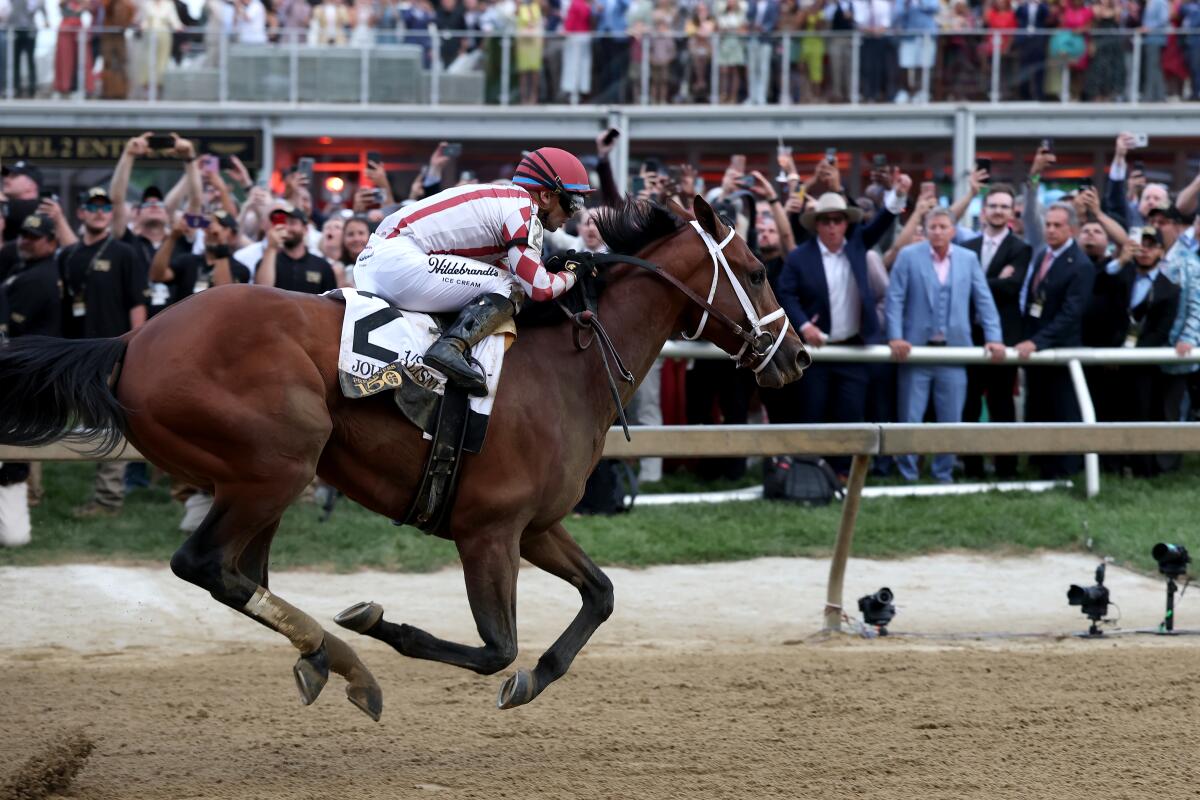
Journalism, with jockey Umberto Rispoli, crosses the finish line to win the 150th Preakness Stakes in 2025.
(Rob Carr / Getty Images)
There’s no guarantee Journalism, the even-money favorite on the morning line, will win the $300,000, Grade 2 San Diego Handicap. But even with another past Breeders’ Cup winner (Full Serrano) among his five opponents in the 1 1/16-mile race, it’s unarguably the weakest field he will have faced since winning the Haskell last July at Monmouth Park.
In the last year he finished second behind Fierceness in the Pacific Classic; fourth behind Forever Young, Sierra Leone and Fierceness in the Breeders’ Cup Classic; third behind White Abarrio and Sovereignty in the Oaklawn Handicap, and third behind Nysos and Knightsbridge in the Met Mile.
Even with those defeats, as well as his runner-up showings last year behind Sovereignty in the Kentucky Derby and Belmont Stakes, he has six wins, three seconds and three thirds in 13 starts, with earnings of nearly $4.6 million. Nothing to apologize for, but there’s also no question Journalism’s star has dimmed. He no longer is ranked among the top 10 older horses in the National Thoroughbred Racing Assn. weekly poll.
Wellman, though, believes Journalism is not done writing his story. A good performance Saturday, one in which he shows what the owner calls “the explosivity that we’ve seen in the past,” surely would make him one of the favorites for next month’s Pacific Classic. And his connections would like to give him another chance to win the Breeders’ Cup Classic, scheduled for Oct. 31 at Keeneland, before he goes off to stud next year.
“We haven’t lost any faith in him,” Wellman said. “I mean, he’s a horse that’s inspired confidence from Day 1, and put together a campaign last year for the ages. You don’t see many modern-day horses string together the type of races that he did, travel back and forth across the country multiple times, take on all comers and maintain elite performance, race in and race out.
“So, are we frustrated by the fact that he hasn’t won in some time? Absolutely. But when you compete at this level, you can’t play scared. You’ve got to continue to take on the best of the best, and no matter how much any horse or human has accomplished in this game, or in any sport, I think the best and the most driven athletes, equine or otherwise, feel as though you’ve constantly got to prove yourself.”
Perhaps reuniting with the jockey who was aboard Journalism during a streak of eight straight wins or runner-up finishes will provide a boost. Umberto Rispoli was replaced by Jose Ortiz before the Breeders’ Cup Classic, but the 37-year-old Italian is returning to the saddle Saturday. Rispoli, the leading jockey at last fall’s Del Mar meeting, has had his own rough stretch, missing five months of action after breaking his right ankle and leg in a January spill at Gulfstream Park.
“It was a difficult, difficult situation,” Wellman said, “considering the success that Umberto had on Journalism. It was hard on everybody for a lot of reasons. But the relationship speaks for itself between (trainer) Michael (McCarthy), our group, and Umberto.
“Obviously, Umberto holds Journalism himself in the highest regard and maintains an incredible rapport with the horse. It’s great to see Umberto coming back so strong off a serious injury, and we’re delighted to give him the opportunity to get back on Journalism. Hopefully they can find that magic again with the camaraderie that they share for one another.”
Del Mar underway
Del Mar’s annual eight-week summer meeting opened Friday, with racing normally held Thursday through Sunday. Post time is at 2 p.m. every day except closing weekend, Sept. 5-7, when it shifts to 1:30. Daily coverage is available on FanDuel TV.
We have seen several scenes of relatives of victims of the earthquakes telling soldiers they are not helping, or even forcing them and police officers to return or destroy the goods and money they were caught looting in the ruins. Rather than the return of freedom of speech with Maduro’s capture, what we have witnessed in La Guaira is the crisp, absolute ire of someone who already lost everything, someone who is living the ultimate experience of struggling to find the body of a loved one to bury them in a cemetery instead of smelling them decompose under the rubble of a building.
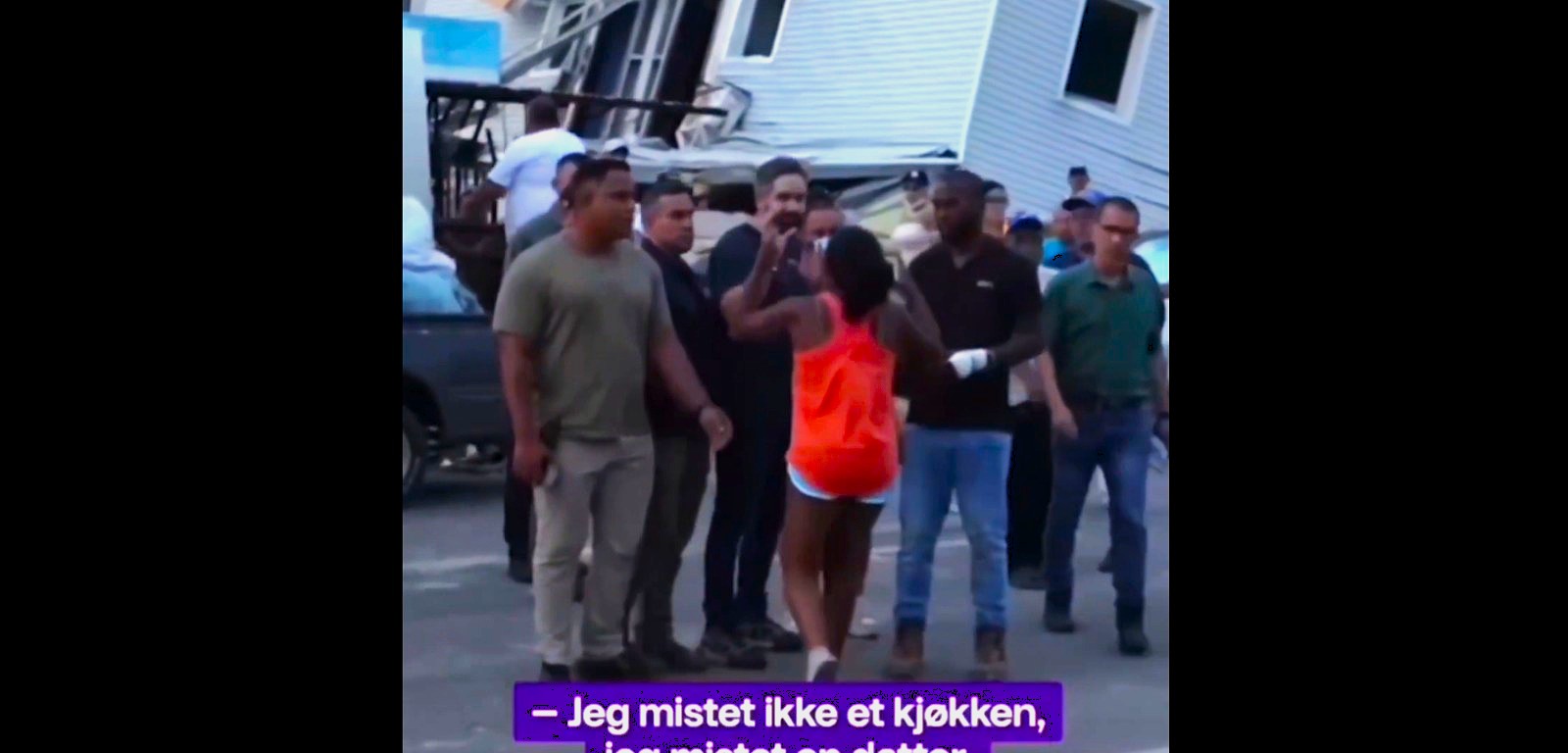
But we hadn’t seen something like this: a woman who lost a daughter and a home walking through a security detail and screaming in the face of Nicolás Maduro Guerra, a local lawmaker and son of the imprisoned dictator.
This scene is a powerful proof of the reality exposed by this tragedy: collective anger against a useless regime that lost its leadership even among the people who once supported it, and that failed to prevent the truth from reaching the world.
This happened when Sonja Skeistrand Sunde, Simen Askjer and Synnøve Gjerstad, journalists from TV 2, the second-largest TV station in Norway, were interviewing former residents of a State-built neighborhood destroyed on June 24.
First, Moraima Antón showed them what was left of her home in the 200-house complex:
“These buildings are very poorly constructed. They should never have been built,” Antón rages. It is still not known how many lives were lost right here. “The smell from the ruins bears witness to the fact that deceased victims still lie under the debris.”
Then, Damely Díaz talked to them to tell them her story:
“Damely Díaz was among those who survived. She was standing just outside her house when the ground began to shake. Her six-year-old daughter, Daymaris, was inside. Within seconds, the building collapsed on top of her. ‘My daughter was buried for four days. She could have been saved during that time. She was a little child who didn’t ask to be born, and who didn’t ask to die either,’ Díaz says. The mother is convinced that poor foundations and weak construction caused her daughter’s death. She cries incessantly and demands that those responsible be held accountable. While she is speaking with TV 2, a motorcade slowly rolls into the neighborhood. It turns out that Nicolas Maduro Guerra is sitting in one of the cars… ‘You need to go to prison! Go to prison, all of you!’ Díaz shouts at the motorcade. ‘That bastard Nicolas,’ another shouts. When Maduro Guerra gets out of the car, Díaz storms toward the entourage. ‘I didn’t just lose a kitchen, I lost a daughter! You are responsible for all of this and you must pay for it!’ she screams until her voice cracks. ‘They built garbage! Garbage!’ she yells”.
Maduro Guerra did his best to calm the woman and look reasonable before the Norwegian crew, but his escort attempted to hide the whole thing:
“Maduro Guerra’s security guards try to prevent TV 2 from filming the incident, but the people in the neighborhood form a ring around the TV crew and demand that the documentation continue. ‘Film it! Film it!’ a man urges.”
This scene is a powerful proof of the reality exposed by this tragedy: collective anger against a useless regime that lost its leadership even among the people who once supported it, and that failed to prevent the truth from reaching the world.
This case also confirms how the Rodríguez regime lost the battle to control the narrative. After they recorded the scene, two officers from the Maduro Guerra detail asked the Norwegian journalists for their names, and later they contacted them to “have a meeting”. The crew refused to go, left Venezuela, and once they were back home, they ran the story today, on July 9:
“TV 2 declines the meeting with the authorities. It is difficult to know what the risks are. Equipment or recordings could be confiscated, or in the worst-case scenario, they could face arrest.”
The chavista regime was slow and lousy to corral so many foreign correspondents they had to let in, and Delcy Rodríguez only looked worse in her press conference. TV 2’s story in particular shatters the image of efficiency and moderation that Maduro’s successor is trying to sell to the country and the world.
This feature from TV 2 also quotes political scientist Benedicte Bull, a Latin America researcher at the University of Oslo’s Center for Global Sustainability: “There is an enormous anger among the people against the authorities because they were slow to respond. I am getting reports of this anger through all channels now. The disaster has exposed all the deficiencies that have actually been there for a long time, but have now become visible to everyone…The discourse we are now hearing from President Delcy Rodríguez…suggests that the authorities are ready to implement harsher repression again, and this is what people are afraid of,” Bull says…While the situation felt unsafe for the journalists, it is Díaz who lives with the greatest risk by openly defying the regime. ‘These people must leave Venezuela. They can kill me, I don’t care. I’m not afraid to die anymore, Díaz says.
Since last week, the world’s attention has been set again on Venezuela just like six months ago.
Of course, the differences between the events of January 3rd and the terrible disaster of June 24th could not be more stark, even if both evenets have massive implications for the country’s future.
Most coverage coming from international media these days has highlighted two things: first, the terrible devastation seen in worst-hit areas like parts of Caracas and especially in La Guaira State (formerly known as Vargas); and second, that many are complaining about the official response and even calling it “negligent”, like in this report from BBC News correspondent Yogita Limaye.
Interestingly enough, in recent months there has been a reopening to the presence of foreign reporters in the country, a shift from the heavily restricted access during the Maduro years. A larger number of reporters and media crews arrived in the last few days. They have been mostly allowed to do their job (unlike Sky News’ Trump 100 podcast, interrupted by government officials while recording), but they’ve been facing their own set of specific challenges.
Earlier this week, NGO IPYS Venezuela offered a summary of some apparent restrictions from the Communication and Information Ministry to international media workers, like indicating that they could be mobilized to affected areas only through State-authorized buses and establishing a schedule for those trips from the Media Center established at La Carlota Airport in Caracas.
One person quoted in the summary is British freelance journalist Catherine Ellis, who’s covering the disaster for Al-Jazeera and UK weekly magazine The Spectator while also doing some radio interviews for other outlets. She has worked in Venezuela since 2023 and, before that, volunteered for an NGO in Colombia and Spain, helping Venezuelan immigrants. It was Ellis who published on X a picture of the buffet the regime was offering to foreign correspondents while thousands of people were thirsty and hungry.
At the time of writing, several international reporters told Delcy Rodriguez during her recent press conference what they’ve seen firsthand. She minimized those criticisms against the official response and pointed her finger at “media matrixes created in laboratories” (matrices de opinión is a popular term in Venezuela to describe artificial narratives in journalism or social media).
Caracas Chronicles interviewed Ellis earlier this week to discuss what she recently witnessed.
How has it been for you and other international correspondents to cover the disaster on the ground? Have there been any limitations by government officials and particularly from the Communication and Information Ministry?
The experience so far as a journalist in terms of getting in and communicating with the Ministry has been quite strange in some ways. It needs to be said that it has been much more open than it usually is. Quite often, if I come to Venezuela, I can’t really do any reporting or get a journalist visa; they give very few journalist visas, and it’s particularly hard for freelance journalists when you’re not a fixed employee for a certain media outlet. But this time they let journalists in. They’re letting foreign journalists in without visas. On one hand, it’s been much, much better. This time journalists are actually allowed into the country, and access is not restricted, although we don’t know how long that will go on for. Communications have been terrible and completely lacking to the point of being almost non-existent.
How was your experience with the bus trip to La Guaira the day after registering at La Carlota airbase in Caracas?
We took the bus on June 28, the day after we registered in La Carlota. They told us they would take us there, and we left for La Guaira an hour and a half late. No problem, that happens sometimes, but there was no communication about what was happening. The following day was the worst because I arrived early thinking it might leave on time, only to wait for two hours with no explanation at all. Then we knew from other journalists that the trip was cancelled and access had been suspended for 48 hours for journalists. No one on the logistics team provided any explanation. They just said: “we are not in charge of it, we don’t know.” One person told me: “you have to be patient, you have to wait… This is a complex situation, and things don’t move quickly.”
How are you and your colleagues doing your work in the disaster area?
We were completely given free rein… We were taken to a Misión Vivienda place, but we could go wherever we wanted, so I spoke to people from that place, and some were very critical of the government. I went to other buildings around, which were either for retired people or just normal apartment buildings, and I spoke to lots of people. I was very, very free to speak to people. So much that I missed the bus and the Guardia (Nacional) took another journalist and me to the next site to speak to people.
Have there been any issues involving the police, the military, intelligence services or local officials?
Some people have been helpful, and some haven’t in terms of the authorities. In La Guaira, generally, no one stopped me from doing anything. Police and military pulled me away from a building because they were excavating to take bodies out, but to be honest, that was more for health and safety reasons, and I did understand. I went to the hotel in Caracas where the Venezuelan deportees were supposed to arrive after they got back, and the hotel collapsed. It was full of SEBIN agents. We weren’t allowed to pass because of “security reasons.” When I started to take photos, I was told off by SEBIN. That was interesting.
Genuinely, I have to say the police and military have not stopped me speaking to anybody or stopping doing anything. And to be honest, some of them haven’t really been around. I think it’s because, as you wear the pink armband (identifying as foreign press), they know you’re press, that you’ve been approved, but getting to the hotel where the deportees were was impossible.
How has the relationship been with the civilians in the area? How do they react to the presence of the media?
Civilians have been brilliant. Absolutely brilliant. Everybody is very, very open to talking. Venezuelans are incredibly warm and open people. I have no problem chatting to people. If I see people who are visibly, incredibly upset, who have family (members trapped) in buildings, it’s not the right time to talk to them.
Sometimes, I’ve approached them very sensitively, and people have shared their stories, described the people they have lost, told about what they’re lacking or what they need. Some people openly criticize the government, but others who have criticized the government then say they don’t want their names used, and others are not thinking about politics. They’re just in shock.
How has the relationship been between international correspondents and Venezuelan journalists?
Venezuelan journalists are incredibly helpful. I think there has been a lot of solidarity between all journalists, between Venezuelan and international journalists and among the international journalists themselves. I’ve been speaking to people from the US, Canada, Argentina, parts of Europe, and they all want to help each other.
On a critical note, there have been a couple of international journalists who either pushed me out of the way at certain sites because they want to film or come up to me when I’m interviewing people and taking my interviewees. This isn’t a show, people have lost (their) lives. I would encourage the international press to have a heightened level of sensibility and respect for all Venezuelans and all affected by this crisis.
Have you noticed the difference between how you see the situation on the ground, how it is covered outside, and how it is covered inside, how the government is presenting it?
From what I’ve seen, Delcy and the government are trying to project an image of solidarity with the international community, thanking and praising them for being here and helping Venezuelans in their time of need. But not necessarily announcing tangible and concrete steps of what they’re actually putting in place. Someone put it to me like this: “The government has been very visible, key figures have been very visible in terms of presence on social media and even visiting sites, but there has not been enough concrete information about donation centers, about what’s happening next, about actually managing the actual crisis.”
How have people in La Guaira been coping?
A lot of people are still in shock. It’s very hard to process, but everybody seems to be very grateful to everyone who is helping them, either members of their own community or the international rescue teams. Some people have said, “Other governments are helping us more than our own government.”
I think the most important thing to emphasize, which is non-political, is that people are saying “Venezuelans are helping Venezuelans, they’re helping each other.” Someone said to me the other day, “We are a family, this is what we do, we help each other, we won’t give up, and you know, keep going.”
I spoke to a guy who came from Valencia. He had three kids back home and said, “I couldn’t bear to think of my own kids lying somewhere like that and no one going to find them,” so he came on his way, he got lists from people, and he came so he can help with the search and rescue.
There’s definitely a lot of shock. A lot of kids are still scared and adults feel that any movement or anything, not just aftershocks, mean something is going to happen again. People are getting through by supporting each other.
Is the aid arriving properly? Have you seen aid being delivered?
There’s so much aid everywhere. In Caracas, I’ve seen so many trucks coming in. The problem is that I can’t exactly say what’s happening to the aid. Some aid is getting through, but there seem to be a little bit of bottlenecks or bureaucracy; I don’t know the full reasons… It’s getting through to some people but isn’t getting through to other people, and they’re running out of some things. People want proper accommodation also. Definitely, in a lot of places there are now international NGOs setting up food points as well.
–
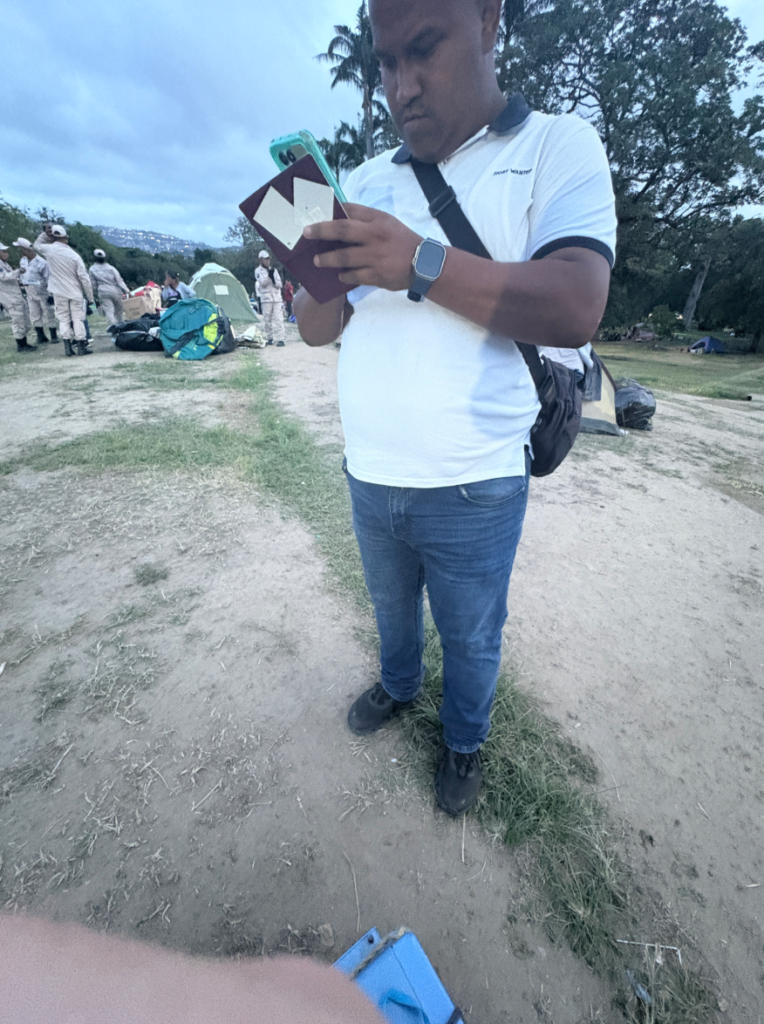
Just yesterday, while covering relief efforts taking place at Parque del Este, Ellis was approached by a couple of suspicious looking fellows. This was the exchange:
I was in Parque del Este tonight speaking to volunteers and affected families camping there. I was chatting to one family when two men came over to look what was going on then left. I started helping the family move their stuff to the road (I was carrying the cat!) as they were moving somewhere else. The two men called me over, asked me if I was a journalist, to which I said yes and showed them my wristbands. Asked more questions, who I was, where from, what I was doing. I asked who they were, as they still hadn’t introduced themselves by this point. One (the politer one) said they were intelligence police, asked what I was doing, so I said speaking to the family etc. Asked if I knew them, I said no. Then asking qus like my age, which was weird as one had my passport which has my DOB. Took photos of my passport. Asked where I lived, said I didn’t want to give that info. I asked why they wanted to know all this, they said for security and that people were taking children, so I asked if they thought I was taking kids. They said no. I told me they were asking me because I was a journalist and there was not a real free press. One was fairly polite and said they didn’t want to make me uncomfortable. I said they already had. Eventually they gave me it back. It’s ok to check who someone is, check they have a wristband which you now should have in the park – but I did, and I showed them, so why the need for questionning and taking photos of my passport? And why was the first qu, are you a journalist? Does everyone who enters the park get that level of treatment?
It doesn’t take much for chavismo to step back into its old ways.
Your friendly neighborhood regime intelligence goon.