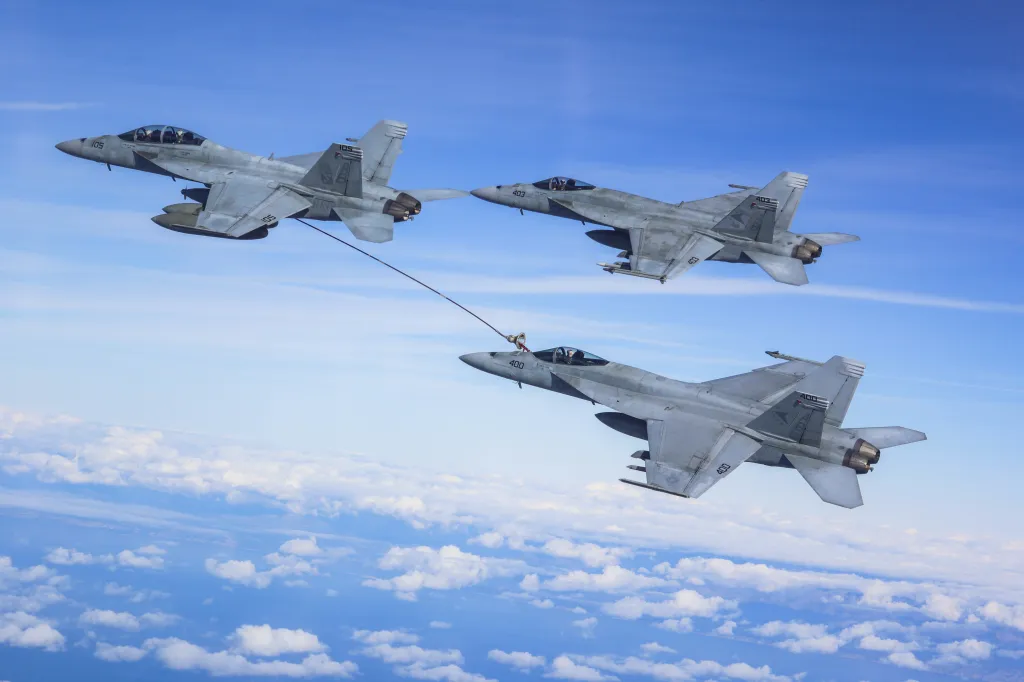
On the approach to land on the aircraft carrier Harry S. Truman, the F/A-18F Super Hornet’s pilot looked out the canopy and saw a Standard Missile-2 (SM-2) launched from the Ticonderoga class guided missile cruiser USS Gettysburg speeding through the sky. At first, the pilot thought the missile was aimed at a Houthi drone or cruise missile, one of several fired at the carrier strike group on Dec. 22, 2024, during an attack from the Yemeni rebel group. But as the SM-2 drew closer and changed its course toward the Super Hornet, configured as an aerial refueler, the crew knew it was heading straight for them. However, they had no way of knowing that on the Gettysburg, their jet had been identified as a Houthi anti-ship cruise missile like others fired at the strike group, and thus a threat.
What happened next, the cascading series of problems that led up to it, and efforts to correct those issues are laid out in a Navy investigation report released Thursday. The investigation was one of four conducted into mishaps aboard the Truman during its troubled deployment to the Middle East. There were two additional Super Hornet losses and a collision with a merchant ship. You can read more about that in our initial story about the investigations here.

“Are you seeing this?” the F/A-18F pilot asked the Weapons Systems Officer (WSO) as the missile came dangerously closer shortly before 2 a.m. local time.
“Yeah, I’m watching it,” the WSO responded prior to the two ejecting from the jet before it was hit by the missile.
As the stricken fighter’s crew headed down to the water and their eventual rescue, the crew of a second Super Hornet was approaching the carrier a minute later for a landing. That crew saw the explosion from the missile detonation on the first jet, which had just given them fuel a short while earlier. Then they saw another missile from the Gettysburg launch and make a course correction toward their aircraft. They briefly considered ejecting as well.
“Give it one more second,” the pilot told WSO as he hit the afterburners to try to speed past the threat. “I have my hand on the [ejection] handle.”

Seeing the motor of the incoming missile burn out, the pilot paused. The missile continued its course upward, but passed about “one to two plane lengths behind the aircraft,” the pilot said. As the Super Hornet shook from the resulting turbulence, its crew watched the SM-2 crash harmlessly into the water before they landed safely on the carrier.
Both friendly fire incidents were the result of several factors and came as the Truman CSG was engaged in one of the Navy’s fiercest battles since World War II. The incident took place just seven days after the strike group entered the Red Sea and just hours after it launched its first attack on Houthi targets in Yemen. That was followed by what crew on the Gettysburg said was an “earlier than expected” response from the Houthis in the form of a volley of drones and anti-ship cruise missiles fired at the strike group, adding additional stress to the crews and the equipment they had to rely on.
A myriad of issues, some systemic, contributed to the shootdown and the near miss. How all these factors could have combined to cause the friendly fire incident is something we examined in a deep dive back in January about the stresses the Red Sea deployments were putting on Navy surface combatants’ Combat Information Center (CIC), the nerve center and tactical brain of those vessels.

One factor that led to the so-called blue-on-blue incidents was “a lack of re-integrated training opportunities between USS Gettysburg and the carrier strike group,“ a senior Navy officer (SNO) told a small group of reporters, including from The War Zone, on Thursday afternoon. Amid the ongoing fights with the Houthis, the Gettysburg left the Truman, only returning to the Red Sea three days before shooting at the Super Hornets. As the strike group’s air defense command, the Gettysburg played a vital role in protecting the ships, but had limited time working to synchronize operations and didn’t take part in the pre-mission planning for the Dec. 21 attack on the Houthis.
That time apart “contributed to the misidentification and subsequent engagement of the US Navy aircraft,” the SNO explained. “This was manifested through non-following procedures, lack of forceful backup on the cruiser and lack of cohesion across striped units.”
“It is important to note that over the immediate 45 days prior to the incident, [Gettysburg] only operated with the [strike group] 15 percent of the time (seven of 45 days),” investigators concluded.

Beyond that, key crew members on the ship “failed to execute” the proper steps that would have prevented firing on friendly jets, a Navy Surface Officer (NSO) posited. There was confusion about what the Gettysburg crew was firing at, and calls to ceasefire were ignored or unheard, the report explained. The carrier and cruiser gave aircrews conflicting information. On top of all that, the Gettysburg‘s embarked MH-60R Seahawk helicopter was landing, requiring the ship’s SPY-1 radar coverage to be reduced until shortly before the engagements. In addition, the E-2D Hawkeye airborne early warning and control aircraft operating overhead at the time had problems with its radar.
Meanwhile, exacerbating the situation was the fact that, not only did these crew members fail to take the proper actions, but they were also dealing with faulty systems, according to the investigation.
There were numerous problems with the Link 16 tactical datalink system used for the exchange of related positioning, surveillance, weapons coordination, and air control information.
“In the weeks and hours prior to the friendly fire engagement, Link 16 performance on [Gettysburg] was noticeably degraded,” investigators found. The ship “suffered numerous losses of Link 16 during the days/hours before the friendly fire engagement.”
The Identification Friend Or Foe (IFF) system proved even more problematic, going on the fritz several times during this cruise.
“Multiple watchstanders stated that {Gettysburg] had frequent IFF [problems]…suffering from several types of intermittent failure manifesting as stale IFF video, IFF not displaying M5 video, IFF not correlating with CEC, and IFF spiral tracks…,” according to the investigation.

Adding to the problems, information about these system failures was not properly reported up the chain of command. The watchstanders on duty at the time of the shootdown, for instance, did not know the IFF system, which would have properly identified the Super Hornets, was not working
Some of these technical problems existed on many surface combatants, especially involving the Aegis Weapon System, a centralized, automated, command-and-control (C2) and weapons control system allowing warships to deal with the massive volumes of air and sea surrounding them.
“We’ve had over 30 of our surface warships involved in these sustained combat operations,” the NSO stated. “There have been a number of Aegis Weapon System [software code issues] that have been identified that pose levels of risk to that team as they’re executing combat operations, primarily defensive combat operations.”

“Specific to the Gettysburg incident,” the NSO added, “the interoperability piece that has been associated with the Identification Friend or Foe, we discovered that was not just a cruiser issue. That was across the board, and we worked aggressively to identify it and then to get that software fixed, and our industry partners were committed to executing that, and we’re on a path to burn down that technical debt across the board.”
All told, “we’ve invested over $55 million since this incident to correct those Aegis Weapon System deficiencies,” the SNO pointed out. “And I will tell you, over the last two years, our industry partners have demonstrated their commitment and their ability to rapidly correct these software deficiencies, and it’s been very impressive.”
The friendly fire incident has also spurred a wide-ranging retraining effort.
“We’ve implemented a total of 15 initiatives across our combat-focused training organization, led by the Naval Surface and Mine Warfare Development Center,” the NSO noted.
Regardless of the system failures, the Navy investigation held the Gettysburg’s commanding officer responsible for shooting down one Super Hornet and narrowly missing another.
“The decision to shoot was wrong when measured against the totality of information available to the [Gettysburg’s commanding officer],” the investigation determined. “Constrained by a series of previous actions/decisions (both in and beyond his control), the [commanding officer] had low situational awareness, and his CIC team was unable to help him regain it.”

Moreover, the “totality of the circumstances, including the deficient condition of the [Gettysburg’s) (IFF, CDEC and Link 16 PPLI issue), deficient unit and force watchstander proficiency, and possessing the ability to have understood and mitigated both, conclude that the [Gettysburg commanding officer’s] decision to engage was neither responsible nor prudent, and could have been prevented by action at multiple levels.”
A little more than a month later, that commanding officer, Capt. Justin Hodges was relieved and replaced by Capt. John Lucas. However, Hodges’ name appears nowhere in the investigative report.
Despite the many problems that contributed to the friendly fire incident, the Navy redacted the names of those responsible and any punishments they may have received. The same blackout was true for the other three investigations about mishaps aboard the Truman as well.
At the press conference, Navy officials stood by their decision to keep that information from the public.
“I assure you that accountability actions were taken across all the operators involved in this,” the SNO explained. “I don’t feel an obligation to publish those results to the world. I am here to tell you that everyone from the top commanders up to me…reviewed those actions and deemed them to be appropriate.”
Contact the author: howard@thewarzone.com