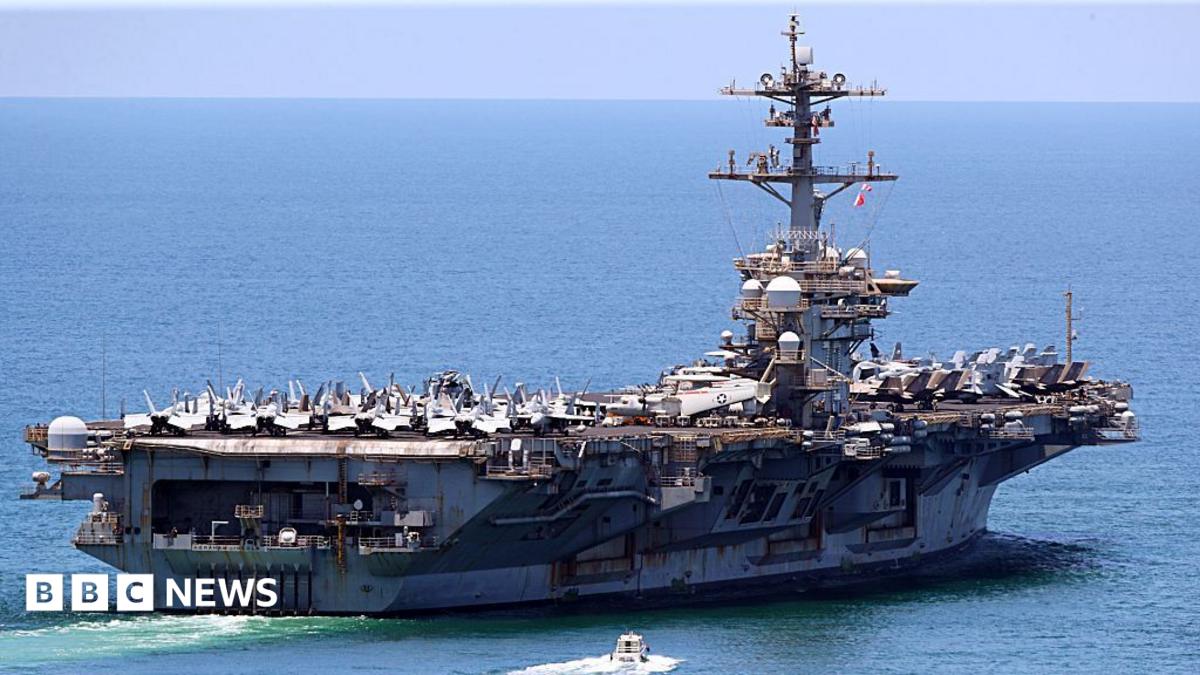
USS

How long can Iran survive the US’s Hormuz blockade? | US-Israel war on Iran News

United States President Donald Trump has claimed Iran is “collapsing financially” and said the country is losing millions of dollars a day due to Washington’s naval blockade of Iranian ports.

In a post on his Truth Social platform on Tuesday night, Trump wrote: “Iran is collapsing financially! They want the Strait of Hormuz opened immediately – Starving for cash! Losing 500 Million Dollars a day. Military and Police complaining that they are not getting paid. SOS!!!”

Recommended Stories

list of 3 itemsend of list

The US blockade of Iranian ports began at 14:00 GMT on April 13. Since then, the US has fired on and seized an Iranian-flagged tanker near the Strait of Hormuz, and redirected ships in the open seas carrying cargo to or from Iran. Iran’s armed forces have called this “an illegal act” that “amounts to piracy”.

In response to the US naval blockade, Iran has closed the Strait of Hormuz to all foreign shipping and has captured several foreign-flagged ships. Previously, it had allowed some ships deemed “friendly” to Iran to pass.

On April 19, Iran’s First Vice President Mohammad Reza Aref said the “security of the Strait of Hormuz is not free”.

“One cannot restrict Iran’s oil exports while expecting free security for others,” he wrote in a post on X.

“The choice is clear: either a free oil market for all, or the risk of significant costs for everyone,” he added. “Stability in global fuel prices depends on a guaranteed and lasting end to the economic and military pressure against Iran and its allies.”

In a statement on social media on Thursday, Iran’s parliamentary speaker and lead negotiator in the ceasefire talks, Mohammad Bagher Ghalibaf, said a full ceasefire could only work if the US naval blockade is lifted.

Analysts say the blockade is hurting Iran but believe the country has the economic and political will to sustain it.

How long can Iran survive the naval blockade?

Here’s what we know:

How is the naval blockade hurting Iran?

Iran exports oil, gas and other goods including petrochemicals, plastics and agricultural products by sea. Analysts say the US naval blockade of its ports, including in the Strait of Hormuz, could therefore affect this trade.

Soon after the start of the US-Israel war on Iran on February 28, authorities in Tehran implemented the effective closure of the Strait of Hormuz, the only waterway out of the Gulf, through which 20 percent of the world’s oil and liquefied natural gas (LNG) supplies were shipped from Gulf producers in peacetime.

The near-shutdown of the vital chokepoint sent global oil and gas prices soaring, and since then, Iran has controlled the strait. However, it has continued to export its own energy products through the waterway.

Iran’s oil exports through the Strait of Hormuz account for about 80 percent of its total oil exports. According to Kpler, a trade intelligence firm, Iran exported 1.84 million barrels per day (bpd) of crude oil in March and has shipped 1.71 million bpd so far in April, compared with an average of 1.68 million bpd in 2025.

From March 15 to April 14, it exported 55.22 million barrels of oil. The price per barrel of Iranian oil – across its three major variants, known as Iranian light, Iranian heavy and Forozan blend – has not fallen below $90 per barrel over the past month. On many days, the price has surpassed $100 a barrel.

Even at the conservative estimate of $90 a barrel, Iran has earned at least $4.97bn over the past month from its ongoing oil exports.

By contrast, in early February before the war started, Iran was earning about $115m a day from its crude oil exports, or $3.45bn in a month.

Simply put, Iran has earned 40 percent more from oil exports in the past month than it did before the war.

Stopping this is a key motivation behind the US naval blockade of Iranian ports.

In an interview with Al Jazeera on April 14, Frederic Schneider, a nonresident senior fellow at the Middle East Council on Global Affairs, told Al Jazeera that the previous six weeks had been a boon for Iran in terms of oil revenues, but with the US blockade, that will change.

“Iran has some buffer in the form of crude oil reserves in floating tanks – basically parked tankers – which was estimated at about 127 million barrels in February. But that doesn’t mean that the blockade wouldn’t hurt Iran,” he said.

On Friday, Schneider told Al Jazeera that Iran, however, seems to be “playing the longer game” and has anticipated and prepared for this sort of conflict to some degree.

“The naval blockade has added economic strain, as several civilian ships have been captured in international waters. But it remains unclear how tight the blockade is, how many ships manage to pass given the considerable amount of floating Iranian oil, and how long Trump can maintain the blockade,” he said.

INTERACTIVE - Strait of Hormuz - March 2, 2026-1772714221
(Al Jazeera)

Can the US keep the blockade going for long?

Schneider noted that Trump will face a legislative challenge by May 1, when the 60 days he can maintain a foreign offensive without congressional approval come to an end.

Dire conditions have been reported on the ships that are upholding the blockade, he said, and it remains to be seen how China will react to the continuing seizure of ships that carry any of its cargo.

“China has already said it sees the blockade of Chinese trade with Iran as unacceptable. Further, the closure of Hormuz by Iran in retaliation is hurting, if not the US itself that much, American allies in the region and globally, raising the pressure on Trump,” he said.

“If we can glean anything from the behaviour of the two sides, it is Iran that is signalling patience and Trump showing impatience,” he added.

Adam Ereli, a former US ambassador to Bahrain, told Al Jazeera’s This is America programme that while the US blockade of Iranian ports and seizure of vessels transporting Iranian oil “makes sense” as a policy, it may not work as intended due to domestic political considerations in the US.

“The Iranians have prepared for this, for this eventuality. They have their own plans. They’ve got alternative means of storing their oil or selling their oil,” Ereli told Al Jazeera.

“Even if they ran out of oil, they have ways to survive a very tough blockade and sanctions regime that, frankly, I think will outlast Trump’s patience and the patience of the American people,” he said.

“Remember, this isn’t just about moving soldiers and ships and planes around on a map. There’s politics involved here in the United States,” he added.

“Trump is nothing if not attuned to the political winds. And for that reason, I think that you’ve got this Iran strategy on the one hand that runs up against an electoral strategy on another hand, and therefore, the question is, which one is going to give?”

Can Iran store the oil the US is blockading in the meantime?

Iran’s domestic refineries have a capacity of 2.6 million bpd, according to consultancy FGE Energy. Its oil and gas production facilities are concentrated in southwestern provinces: Khuzestan for oil and Bushehr for gas and condensate from the South Pars gasfield.

Iran is also the third-largest oil producer in the Organization of the Petroleum Exporting Countries (OPEC) and exports 90 percent of its crude oil via Kharg Island for shipping through the Strait of Hormuz.

The US naval blockade has begun affecting the country’s storage capacity, according to TankerTrackers, the maritime intelligence agency. The blockade means Iran has to store more oil, and space could become tight.

TankerTrackers said that on Kharg Island, to prepare for the possibility of running out of oil storage space, Iran has brought an old tanker named NASHA (9079107) out of retirement.

“She’s a 30yo [year old] VLCC [Very Large Crude Carrier] that’s been anchored empty for the past few years; currently spending 4 days on a trip that should take 1.5-2 days,” TankerTrackers said in a post on X, suggesting that the tanker is being used to store oil. It is unclear if the ship has a heading or course.

Can Iran continue to earn revenues from oil?

Yes, analysts say that for a few months, Iran can continue to earn revenue from oil which is already in transit at sea.

Kenneth Katzman, former Iran analyst at the Congressional Research Service in Washington, DC, said Iran is not exporting new oil amid the US blockade of Iranian ports, but Tehran has between 160 million and 170 million barrels of oil “afloat” on ships around the world currently.

Those supplies, which transited the Strait of Hormuz before the US blockade was imposed, are on board hundreds of tankers and “waiting to be delivered”, Katzman told Al Jazeera.

Katzman said he had been informed by an Iranian professor that, based on those supplies, Tehran could have revenue flows that can last until August despite the US naval blockade.

“Which is a long time. Does President Trump have until August? Probably not,” he said.

“He’s probably going to have to look at kinetic escalation if he wants to bring this to the conclusion that he wants, or he’s going to have to accept less than the deal he ideally wants,” he said.

Iranian ships will still have to avoid US naval ships on the open ocean, as the US Navy has also recently intercepted ships carrying Iranian cargoes.

On Wednesday this week, for example, the US military intercepted at least three Iranian-flagged tankers in ‌Asian waters, Reuters reported, and was said to be redirecting them away from their positions near India, Malaysia and Sri Lanka.

How else can Iran earn revenue?

Besides oil revenue, Iran is also currently receiving revenue from a “toll booth” system that the country imposed on the Strait of Hormuz in March.

On Thursday, Iran’s deputy parliament speaker Hamidreza Haji-Babaei said Tehran’s central bank had received the first revenues from tolls imposed since the start of the war, according to the semiofficial Tasnim news agency. It is unclear how much that toll revenue is.

Iranian politician Alaeddin Boroujerdi told the United Kingdom-based, Farsi-language satellite TV channel Iran International in March that the country has been charging some vessels as much as $2m each to pass through the strait.

According to Lloyd’s List, the shipping news outlet, at least two vessels that have transited the strait so far have paid fees in yuan, China’s currency. Lloyd’s List reported that one “transit was brokered by a Chinese maritime services company acting as an intermediary, which also handled the payment to Iranian authorities”. It is, however, not clear how much the vessels paid.

How resilient is Iran’s leadership?

In recent days, while pressuring Iran to negotiate a ceasefire deal, US President Donald Trump has claimed that Iranians are “having a very hard time figuring out who their leader is”, alleging that there is “crazy” infighting between “moderates” and “hardliners” in Tehran.

But the country’s officials have insisted that Iran’s government is united.

Mohammad Reza Aref, Iran’s first vice president, said on Thursday: “Our political diversity is our democracy, yet in times of peril, we are a ‘Single Hand’ under one flag. To protect our soil and dignity, we transcend all labels. We are one soul, one nation.”

Foreign Minister Abbas Araghchi also dismissed allegations that the Iranian military may be at odds with the political leadership.

“The failure of Israel’s terrorist killings is reflected in how Iran’s state institutions continue to act with unity, purpose, and discipline,” he wrote on X, referring to the assassinations of Iranian political and military figures Israel has carried out in recent weeks.

“The battlefield and diplomacy are fully coordinated fronts in the same war. Iranians are all united, more than ever before.”

One of the strongest messages of unity came from Iran’s President Masoud Pezeshkian.

“In Iran, there are no radicals or moderates,” he said on X.

“We are all Iranians and revolutionaries. With ironclad unity of nation and state and obedience to the Supreme Leader, we will make the aggressor regret.”

How strong is Iran militarily?

Iran has demonstrated considerable military resilience in the face of weeks of US-Israeli strikes through its use of asymmetric warfare.

This includes the use of guerrilla tactics, cyberattacks, arming and supporting proxy armed groups and other indirect tools.

During its war with the US and Israel, Iran has targeted energy infrastructure in Israel and across the Gulf, threatened to target banking institutions and targeted US data centres of technology companies such as Amazon in the United Arab Emirates and Bahrain.

Iran has also blocked the Strait of Hormuz and reportedly placed mines in the strait to disrupt shipping, sending global oil prices soaring.

Since the US began its naval blockade of Iranian ports in mid-April, Iranian officials have repeatedly promised that their country will defend itself and respond to any US attack.

Earlier this week, after the US military said it had seized an Iranian vessel and ordered dozens of others to turn around, Iran also retaliated by capturing foreign commercial vessels around the Hormuz Strait, which it said violated naval regulations.

Ereli, the former US ambassador, told Al Jazeera that Iran and the IRGC have “revolutionary fervour”, which means they can “survive”. “They can tolerate pain for a lot longer than I think most American decision makers and planners calculate,” Ereli said.

Ereli said it was unknown how long Tehran could last under “siege conditions” imposed by the US, but probably a lot longer than the US anticipates.

“I think they can go a lot longer, especially than most people imagine, and especially when it comes to kneeling to the Americans,” Ereli said.

“There’s a level of pride and survival. They’re at war with us, and for them it’s a war of necessity. They’ve got to survive,” he added.

Source link

USS Spruance Blasting A Ship With Its Deck Gun Is A First In Nearly Four Decades

A U.S. warship striking another vessel with its deck gun is very rare occurrence in modern times. When the Arleigh Burke class guided missile destroyer USS Spruance opened fire on the Iranian cargo ship Touska on April 19th with its 5-inch MK 45 gun, it marked the first time in almost four decades something like that had happened. In fact, the prior incident took place almost exactly 38 years ago to the day in the same general vicinity against the same enemy. 

“From what we are tracking, the last known irrefutable instance of a Navy ship firing its deck gun at another ship was on April 18, 1988 during Operation Praying Mantis,” a U.S. Navy official told us, referring to a duel between the U.S. and Iranian navies in the Persian Gulf.

That’s when the Belknap class guided missile cruiser USS Wainwright, Knox class destroyer escort USS Bagley and the Oliver Hazard Perry class guided missile frigate USS Simpson all fired upon the Iranian Karman class fast attack ship IRIS Joshan.

Aerial view of the Iranian frigate IS Alvand burning after being attacked by aircraft of Carrier Air Wing 11 from USS Enterprise. (USN)

In addition to launching anti-ship missiles at the Iranian ship, the Wainwright and Bagley engaged the Joshan with 5-inch deck guns while the Simpson used its 3-incher, the official noted. The three ships belonged to what was then known as Surface Action Group (SAG) Charlie.

Praying Mantis was part of the much larger Operation Ernest Will, which began in 1987 when Iraqi and Iranian forces increased attacks on merchant ships in the Persian Gulf during latter stages of the Iran-Iraq War.

Ernest Will involved reflagging Kuwaiti oil tankers under the American banner, allowing them to be escorted by U.S. Navy ships. In July, 1987, during the first such escort, one of those ships struck a mine, setting off a chain reaction of events that led to Praying Mantis. That operation was in response to the Oliver Hazard Perry class guided missile frigate USS Samuel B. Roberts striking an Iranian mine.

USS Samuel B. Roberts underway after the ship struck an Iranian mine on April 14, 1988. (USN)

The mine’s detonation against the Roberts “blew an immense hole in the ship’s hull,” according to a Navy history of the incident. “Ten Sailors from Samuel B. Roberts sustained severe injuries. Four were seriously burned. Commander Paul X. Rinn was hurt as well. The ship should have sunk, but thanks to an extraordinary damage control effort by all hands of an extremely well-trained crew, Samuel B. Roberts was kept afloat.”

A view of damage to the hull of USS Samuel B. Roberts while in dry dock in Bahrain. The damage was sustained when the ship struck a mine while on patrol in the Persian Gulf on April 14, 1988 (USN)

“The U.S. response was fierce,” the Navy history continued. “Operation Praying Mantis was the largest of five major U.S. Navy surface actions since World War II. It was the first, and so far only, time the U.S. Navy has exchanged surface-to-surface missile fire with an enemy, and it resulted in the largest warship sunk by the U.S. Navy since WWII.”

At 10:48 a.m. local time, “an approaching Iranian frigate, Joshan, was identified,” according to Defense Media Network. “The Joshan ignored three warnings issued from the Wainwright, and launched a Harpoon missile that narrowly missed the cruiser.”

The vessels in the U.S. Navy’s surface action group returned fire with SM-1 and Harpoon missiles, heavily damaging the Joshan. The burning frigate was then sunk with gunfire.

The Joshan wasn’t the only Iranian asset hit that day.

“In the one-day operation, the U.S. Navy destroyed two Iranian surveillance platforms, sank two of their ships, and severely damaged another,” according to a Navy history of the event.

A view of an Iranian oil platform after being strafed by US forces. Marines raided the platform to gather intelligence data and military equipment used by Iranians. The platform was later destroyed by gunfire from US destroyers in retaliation for the Iranian mining of the guided missile frigate USS Samuel B. Roberts in the Persian Gulf (USN)

Praying Mantis helped change the course of events.

“Stung by its defeats, Iran decreased its attacks against merchant vessels after the US responses,” the Modern Warfare Institute at West Point noted.

While the Spruance attack on the Touska is the Navy’s first use of a deck gun on another ship since then, there are more differences than similarities between these engagements.

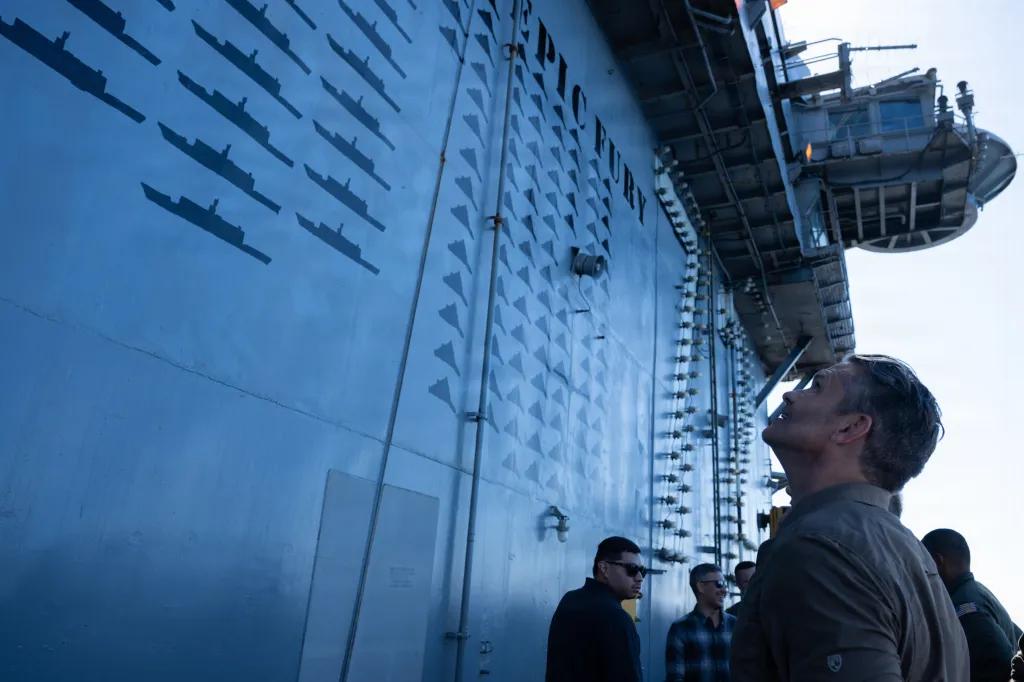
The Touska is an unarmed civilian cargo vessel that tried to evade the Navy’s blockade on Iranian ports. While the Spruance’s gun blew a hole in Touska’s engine room, the ship didn’t sink, but was instead boarded and seized. The vast majority of Iran’s navy has been destroyed during Epic Fury, leaving an array of small attack craft, but nothing the size of the Joshan still afloat.

You can see video of the Touska being hit with a 5-inch gun below:

US Navy seizes an Iran-flagged ship near the Strait of Hormuz thumbnail

US Navy seizes an Iran-flagged ship near the Strait of Hormuz


Here is a file video of a Arleigh Burke class destroyer firing its 5-inch gun:

5-inch 62-caliber Mk 45 Naval Gun Live Fire – Arleigh Burke-class Destroyer thumbnail

5-inch 62-caliber Mk 45 Naval Gun Live Fire – Arleigh Burke-class Destroyer


The Touska encounter didn’t seem to have the same effect on Iran as Praying Mantis. If anything, as we previously noted, for at least certain factions within the fragmented Iranian power structure, it hardened the resolve not to enter a second round of negotiations to end the war. Though Trump has extended the deadline for a ceasefire, Iran has yet to indicate it will return to the bargaining table.

Iran, calling the Touska incident an act of piracy, has demanded the return of the ship and its crew and has threatened retaliation. However that has yet to happen.

Regardless, now we know the last time the U.S. Navy has used one of its main deck guns against another ship in anger was 38 years ago.

Contact the author: howard@thewarzone.com

Howard is a Senior Staff Writer for The War Zone, and a former Senior Managing Editor for Military Times. Prior to this, he covered military affairs for the Tampa Bay Times as a Senior Writer. Howard’s work has appeared in various publications including Yahoo News, RealClearDefense, and Air Force Times.


Source link

Navy Fires Drone-Frying LOCUST Laser From Supercarrier USS George H.W. Bush

The U.S. Navy has disclosed the test of an AeroVironment LOCUST laser counter-drone system, which has been in the news recently, aboard the Nimitz class aircraft carrier USS George H.W. Bush. As far as TWZ is aware, this looks to be the first time a laser weapon has been fitted to a carrier. Earlier this year, Chief of Naval Operations Adm. Daryl Caudle, the Navy’s top officer, said his goal was for directed energy weapons to eventually be the go-to choice for the crews of American warships when facing close-in threats.

The Navy has shared three pictures of the LOCUST system onboard USS George H.W. Bush, seen at the top of this story and below. They were all taken on October 5, 2025, but released today. This coincides with the start of the Navy League’s annual Sea-Air-Space exposition, at which TWZ is in attendance.

An AeroVironment LOCUST laser counter-drone system aboard the USS George H.W. Bush during a test in October 2025. USN

The captions to each of the images include the following: “During the live-fire event, [the] LOCUST LWS [laser weapon system] effectively detected, tracked, engaged, and neutralized multiple unmanned aerial vehicles marking a milestone toward fielding operational directed energy capabilities.”

TWZ has reached out to the Navy for more information.

Another view of the LOCUST system on USS George H.W. Bush’s flight deck during the test last year. USN/Chief Petty Officer Brian Brooks

“The successful demonstration of its palletized LOCUST Laser Weapon System (LWS) aboard the USS George H.W. Bush (CVN-77) in October 2025″ was conducted “in collaboration with the U.S. Navy and the U.S. Army Rapid Capabilities and Critical Technologies Office (RCCTO),” according to a press release from AeroVironment.

A stock picture of the supercarrier USS George H.W. Bush. USN

“During the live-fire event, the Palletized High Energy Laser (P-HEL) system tracked, engaged, and neutralized multiple target drones – marking a major milestone toward fielding operational directed energy capabilities across all domains and platforms,” the release adds. “This achievement validates that the LOCUST LWS is truly platform-agnostic, seamlessly transitioning from fixed-site and land-based mobile platforms, such as the Joint Light Tactical Vehicle (JLTV) and Infantry Squad Vehicle (ISV), to the dynamic and demanding environment of a maneuvering aircraft carrier.”

A P-HEL version of LOCUST seen during US Army testing in 2022. US Army

The central element of LOCUST is a laser directed energy weapon in a turret, which also includes built-in electro-optical and infrared video cameras for target acquisition and tracking. Tertiary sensors, including small-form-factor high-frequency radars and passive radio frequency signal detection systems, can also be used to cue the laser. The JLTV and ISV-based configurations mentioned in AeroVironment’s release both feature small radars.

A JLTV-based LOCUST system. AeroVironment
LOCUST mounted on an ISV. US Army

LOCUST’s power rating is generally understood to be in the 20-kilowatt range at present. When it comes to laser directed energy weapons, this is at the lower end of the power spectrum, fully in line with a system intended to defeat smaller drones. LOCUST has also been demonstrated with a 26-kilowatt power rating, but how much more it could be scaled within the existing form factor is unclear.

As of December 2025, the U.S. Army was known to have taken delivery of palletized LOCUST systems, as well as ones mounted on JLTVs and ISVs. The Army has at least deployed the palletized versions overseas operationally in the past. One of the service’s LOCUST systems was also at the center of a widely criticized and controversial shutdown of airspace around El Paso, Texas, in February of this year, as you can read more about here. The system had been on loan to U.S. Customs and Border Protection (CBP) at the time. Earlier this month, the Pentagon signed an agreement with the Federal Aviation Administration (FAA) regarding the continued use of anti-drone laser systems along the southern border with Mexico.

The U.S. Marine Corps has also moved to acquire JLTV-based LOCUST systems in the past. In addition to appearing to be the first instance of a laser-directed energy weapon going aboard a carrier, last year’s test aboard USS George H.W. Bush also looks to be the first known instance of the Navy even evaluating LOCUST for use on ships or in any other context.

Quadcopter-type drones seen after being hit by the P-HEL version of LOCUST in testing. US Army

Navy interest in using LOCUST to defend ships, especially very high-value ones like aircraft carriers, is not surprising. For years now, the service has been very active in pursuing shipboard laser and microwave directed energy weapons with a particular eye toward providing additional layers of counter-drone defense.

Experience gained in recent years from operations in and around the Red Sea, as well as against Iran, has only underscored the critical importance of bolstering the ability of U.S. warships to protect themselves against uncrewed aerial threats. The Navy has also been adding counter-drone systems that use physical interceptors as their effectors to a growing number of ships to help address this reality.

In general, lasers like LOCUST offer the promise of functionally unlimited magazine depth, which could be exceptionally valuable in the counter-drone role when faced with large volumes of incoming threats. The dangers that uncrewed aerial systems pose are only set to increase as artificial intelligence and machine learning-driven capabilities, including automated targeting and fully networked swarming, continue to improve while the barrier to entry steadily drops.

Palletized and containerized systems like the P-HEL version of LOCUST can also be employed with more flexibility on a wide variety of ships, as long as sufficient deck space and available power. The test aboard USS George H.W. Bush involved simply lashing the system to the flight deck. This also means the systems can be installed and/or removed more readily depending on mission requirements. The Navy also has a demand for counter-drone capability on land to protect key facilities and assets abroad and at home, where LOCUST would also be relevant.

LOCUST Laser Weapon System thumbnail

LOCUST Laser Weapon System


At the same time, especially when it comes to employing lasers on ships, there are also potential pitfalls. As TWZ has previously written:

“A single laser can only engage one target at once. As the beam gets further away from the source, its power also drops, just as a result of it having to propagate through the atmosphere. This can be further compounded by the weather and other environmental factors like smoke and dust. More power is then needed to produce suitable effects at appreciable distances. Adaptive optics are used to help overcome atmospheric distortion to a degree. Altogether, laser directed energy weapons generally remain relatively short-range systems.”

“In addition, laser directed energy weapons, especially sensitive optics, present inherent reliability challenges for use in real-world military operations. Shipboard use adds rough sea states and saltwater exposure to the equation. There is also the matter of needing to keep everything properly cooled, which creates additional power generation and other demands.”

Over the years, the Navy has faced continued and significant hurdles in attempting to field operational laser weapon systems more broadly across its fleets. U.S. military officials have often sought to temper expectations, while also being open about their frustrations with the lack of greater progress, in recent years.

Still, the Navy, in particular, has persisted in its pursuit of these capabilities, given the benefits mentioned earlier. Lasers are set to be a particularly important component of the full arsenal aboard the future Trump class “battleships.”

A rendering depicting the first planned Trump class “battleship,” to be named USS Defiant, firing its lasers and other weapons. USN

“My thesis research at [the] Naval Post Graduate School was on directed energy and nuclear weapons,” Adm. Caudle told TWZ and other outlets at a roundtable back in January. “This is my goal, if it’s in line of sight of a ship, that the first solution that we’re using is directed energy.”

In particular, “point defense needs to shift to directed energy,” the admiral added, emphasizing that “it has an infinite magazine.”

“What that does for me is it improves my loadout optimization, so that my loadout, my payload volume is optimized for offensive weapons,” Caudle added at the time. Furthermore, “as you increase power, the actual ability to actually engage and keep power on target, and the effectiveness of a laser just goes up.”

Laser directed energy weapons with higher power ratings could potentially defend ships against other threats, including certain types of incoming missiles.

Whether or not the Navy decides to acquire and field LOCUST operationally on its ships, the service’s general demand for more counter-drone capabilities across the board does not look set to decrease any time soon.

Contact the author: joe@twz.com

Howard is a Senior Staff Writer for The War Zone, and a former Senior Managing Editor for Military Times. Prior to this, he covered military affairs for the Tampa Bay Times as a Senior Writer. Howard’s work has appeared in various publications including Yahoo News, RealClearDefense, and Air Force Times.


Joseph has been a member of The War Zone team since early 2017. Prior to that, he was an Associate Editor at War Is Boring, and his byline has appeared in other publications, including Small Arms Review, Small Arms Defense Journal, Reuters, We Are the Mighty, and Task & Purpose.


Source link

Navy Calls It Quits On Attack Submarine USS Boise’s Never Ending Overhaul

The U.S. Navy has abandoned plans to return the Los Angeles class attack submarine USS Boise to active duty. This brings an end to the saga of a still-incomplete major overhaul of the boat, which has lasted more than a decade now. In that time, it has become a poster child for the Navy’s worrisome struggles to tackle huge maintenance backlogs, as well as larger concerns about the availability, or lack thereof, of naval shipyard capacity in the United States.

The Navy announced its decision to inactivate Boise, which was first commissioned into service in 1992, earlier today.

“After a rigorous, data-driven analysis, we’ve made the tough but necessary decision to inactivate the USS Boise,” Navy Adm. Daryl Caudle, Chief of Naval Operations, the service’s top officer, said in a statement. “This strategic move allows us to reallocate America’s highly-skilled workforce to our highest priorities: delivering new Virginia and Columbia class submarines and improving the readiness of the current fleet. We owe it to our Sailors and the nation to make these tough calls to build a more capable and ready Navy.”

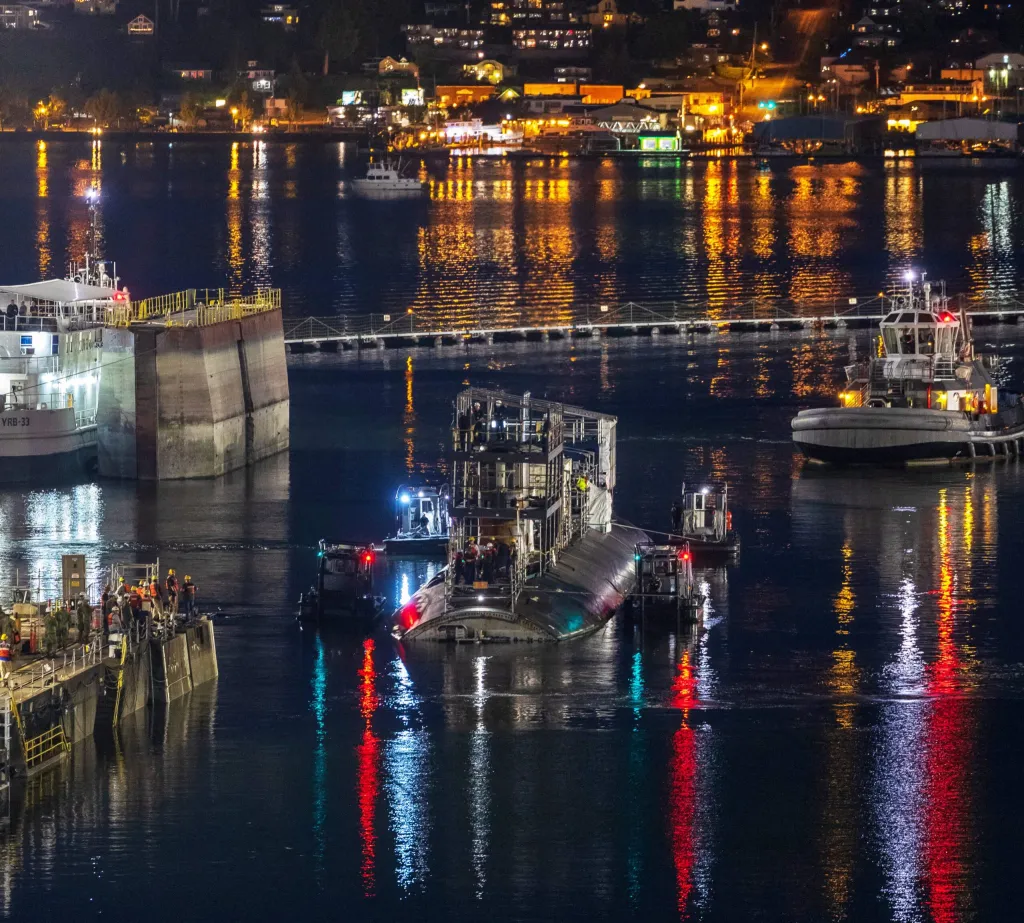
A picture of USS Boise sitting idle in Norfolk, Virginia, in the late 2010s. USN

“The move is part of the Navy’s broader, data-driven initiative to optimize the fleet’s composition, ensuring that every dollar is invested in capabilities that directly contribute to maintaining a decisive warfighting advantage,” the service also said in a press release. “Funds and personnel associated with the planned overhaul of USS Boise will be redirected to support other Navy priorities, including the timely delivery of America’s submarine capability.”

To date, the Navy has spent approximately $800 million on Boise’s overhaul, which is still only 22 percent complete, the service separately told Semafor. The total estimated cost to complete the overhaul had risen to $3 billion, according to Fox News.

“At some point, you just cut your losses and move on,” Secretary of the Navy John Phelan also told Fox News in an interview ahead of today’s announcement. “The Boise represents 65% of the cost of a new Virginia class submarine, yet it only delivers 20% of the remaining service life.”

The Navy had originally planned for Boise to begin its overhaul in 2013, but the timetable was repeatedly delayed, primarily due to a lack of shipyard availability. The submarine has not been to sea since it returned from its last cruise in January 2015. The boat was deemed unable to conduct normal operations by 2016, and it formally lost its dive certification the following year.

The Navy moved Boise from its home port in Norfolk, Virginia, to Newport News Shipbuilding’s facilities in 2018. Newport News Shipbuilding is a division of Huntington Ingalls Industries (HII).

The submarine returned to Norfolk the following year amid competing funding priorities. It went back to Newport News in 2020, but did not actually enter a dry dock there until 2021, after which limited maintenance work began. The full overhaul was then further set back due to budgetary issues, with a formal contract only signed in 2024.

The USS Boise seen arriving at the Newport News Shipbuilding yard in 2018. HII

As of last year, the Navy was still pushing to complete Boise‘s overhaul and return it to the fleet, which was expected to occur in 2029. By that point, the submarine would have spent more than a third of its service life in port.

The overall size of the Navy’s Los Angeles attack submarine force has been steadily declining for years now already, as the service has acquired more modern and capable Virginia class types. The Navy commissioned 62 Los Angeles class boats between 1976 and 1996, and 23 remain in service today.

As noted, the Navy’s struggles with Boise are reflective of larger and more serious issues that have long challenged the service’s ability to meet even its peacetime operational demands. Back in 2018, the Government Accountability Office (GAO) published a report saying that the Navy had more than two decades’ worth of operational time across its submarine fleets due to maintenance shortfalls.

The Los Angeles class attack submarine USS Helena arrives at Norfolk Naval Shipyard for major maintenance in 2015. USN

These are concerns that would only be magnified if a large-scale conflict, especially one with China in the Pacific, were to break out. For years now, TWZ has also been sounding the alarm on the interrelated issue of dwindling U.S. naval shipbuilding capacity, in general, where the disparity with Chinese state-run enterprises has become enormous.

The Navy, with support from Congress, has been trying to take steps in recent years to reverse these trends, including moving to increasingly leverage foreign shipyard capacity. The second Trump administration, through Navy Secretary Phelan, has been particularly open about its efforts to shake up how the service acquires and maintains ships, and otherwise does business across the board. This has notably already included the cancellation of the Constellation class frigate program, which had become beset by huge delays and ballooning costs, as you can read more about in detail here. The Navy has been touting efforts to try to avoid similar pitfalls with new shipbuilding programs like the FF(X) frigate and Medium Landing Ship.

“I think, by killing these programs, it’s sending a message that we’re not going to continue to send good money after bad investments, and that we’re going to try to make prudent economic decisions that are in the best interest of the fleet and the force,” Phelan said, speaking generally around today’s anouncement about Boise, according to Semafor.

How the Navy fares in its broader efforts to turn things around when it comes to shipbuilding and maintenance remains to be seen, but the USS Boise‘s increasingly sad story is now coming to an end.

UPDATE: 2:10 PM EDT –

Todd Corillo, an HII spokesperson for the Newport News Shipbuilding division, has now provided TWZ with the following statement:

“We have been notified of the U.S. Navy’s decision to discontinue engineered overhaul (EOH) work on USS Boise (SSN 764). We will work with the Navy to execute this decision in an efficient, cost-effective way. We anticipate there will be no impact to our workforce and will transition shipbuilders currently assigned to USS Boise to other work underway at Newport News Shipbuilding.”

“We understand the importance of a strong submarine force to our national security. While our work on USS Boise will end, our commitment to ensuring our nation maintains our undersea maritime supremacy will not.”

Contact the author: joe@twz.com

Joseph has been a member of The War Zone team since early 2017. Prior to that, he was an Associate Editor at War Is Boring, and his byline has appeared in other publications, including Small Arms Review, Small Arms Defense Journal, Reuters, We Are the Mighty, and Task & Purpose.


Source link

What we know about the US’s 15-point plan Iran proposal | US-Israel war on Iran

NewsFeed

US media is reporting the Trump administration has proposed a temporary ceasefire and a 15-point plan to end the war on Iran. The reports emerge as Trump claims the US is already talking to Iranian officials – a claim Iran has vehemently denied.

Source link

USS Boxer The Second Amphibious Assault Ship Now Heading To Middle East (Updated)

The Pentagon is reportedly sending the Wasp class amphibious assault ship USS Boxer and the rest of its Amphibious Ready Group (ARG), loaded with elements of the 11th Marine Expeditionary Unit (MEU). This comes as the Trump administration is reported to be increasingly considering seizing or blockading Iran’s highly strategic Kharg Island in the Persian Gulf as part of a new phase of Operation Epic Fury.

It has now been widely reported that what is described as an “accelerated” deployment of the Boxer Amphibious Ready Group and the 11th MEU from the West Coast will be in support of Operation Epic Fury.

#BREAKING #EXCLUSIVE
The US military has accelerated the deployment of thousands of Marines and sailors to help reinforce US troops in the Middle East amid the war against Iran.

Four officials tell Newsmax the Boxer Amphibious Ready Group and the embarked 11th Marine…

— Carla Babb (@CarlaBNewsmax) March 19, 2026

The Boxer Amphibious Ready Group also includes two other amphibious warfare ships, the San Antonio class USS Portland and the Whidbey Island class USS Comstock. The 11th MEU has roughly 2,500 personnel, in total, and includes air and ground components.

This follows reports last week that the America class amphibious assault ship USS Tripoli and its ARG, carrying elements of the 31st MEU, had also begun moving from the Pacific toward the Middle to support ongoing operations against Iran.

Axios reported today that the Trump administration could be leaning toward establishing a blockade around Iran’s Kharg Island, through which it exports much of its oil, or occupying it, citing unnamed officials. The central goal of doing this would be to step up pressure on the regime in Tehran to, in turn, force it to reopen the Strait of Hormuz. Traffic through that waterway has come to a virtual halt, which is causing massive reverberations across global energy markets.

“[Trump] wants Hormuz open. If he has to take Kharg Island to make it happen, that’s going to happen. If he decides to have a coastal invasion, that’s going to happen,” one official said, according to Axios. “But that decision hasn’t been made.”

The U.S. military carried out extensive strikes on Kharg Island this past weekend. A deployment of U.S. ground troops there would be a major escalation that could have significant ramifications, including domestically.

Last night, U.S. forces executed a large-scale precision strike on Kharg Island, Iran. The strike destroyed naval mine storage facilities, missile storage bunkers, and multiple other military sites. U.S. forces successfully struck more than 90 Iranian military targets on Kharg… pic.twitter.com/2X1glD4Flt

— U.S. Central Command (@CENTCOM) March 14, 2026

“We’ve always had boots on the ground in conflicts under every president, including Trump. I know this is a fixation in the media, and I get the politics, but the president is going to do what’s right,” a second official, who also said no decision has yet been made, said, per Axios.

A senior official told Axios: “We’ve always had boots on the ground in conflicts under every president, including Trump. I know this is a fixation in the media, and I get the politics. But the president is going to do what’s right.” https://t.co/6dbDy9zCHr

— Axios (@axios) March 20, 2026

Just yesterday, TWZ spoke with Joseph Votel, the former commander of U.S. Central Command, with a particular focus on the tumultuous Strait of Hormuz, through which around 20 percent of the world’s oil passes. You can read that interview here.

In the meantime, publicly available flight-tracking data indicates that the U.S. Navy is using MQ-4C Triton intelligence, surveillance, and reconnaissance drones to monitor Kharg Island as part of their patrols of the northern Persian Gulf.

A US Navy MQ-4C Triton UAV just completed a reconnaissance mission of the northern Persian Gulf and Kharg Island.

The drone orbited off Iran’s largest oil terminal at Kharg Island. pic.twitter.com/062HrbdEt8

— OSINTtechnical (@Osinttechnical) March 20, 2026

Trump has warned that he might consider targeting oil facilities on the island if Iran or other countries “do anything to interfere” with the safe passage of ships through the strait.

Destroying or damaging oil infrastructure on Kharg could have unintended side effects, however. On the one hand, it would further push up global oil prices. The complex nature of infrastructure might take years to repair, which would compound this. In the long term, there is also the question of whether oil infrastructure here should be preserved for the benefit of a potential new Iranian government.

Any successor to the current regime would lose out on vital oil income, potentially driving further internal strife.

There is also the possibility that seizing the island and cutting off the current Iranian government from its most vital source of revenue could be used as a catalyst to bring about its fall.

Then there is the huge question about the kind of military effort that would be required to seize Kharg. This would require a large-scale, sustained operation and would be brought with risk. The island is only 20 miles from the Iranian mainland, putting whatever U.S. force is there at extreme risk of bombardment of multiple types. Getting amphibious assault ships through the Strait and into the Gulf would be an issue, as well, and those ships would be heavily targeted during transit and especially once inside the Gulf. With this in mind, a longer-range aviation assault would be most likely.

A naval blockade of the island might be easier to achieve in the short term, but it would run the risk of Iranian attacks, likely involving uncrewed surface vessels (USVs), drones, and other asymmetric options, as well as anti-ship cruise missiles, the use of which has been limited up to this point, as you can read about here.

As already noted, additional U.S. forces are headed to the region in the form of the Tripoli ARG and the 31st Marine Expeditionary Unit (MEU). While the deployment of the big-deck amphibious assault ship USS Tripoli had already been reported, we now know it is being supported by the amphibious transport docks USS San Diego (LPD-22) and USS New Orleans (LPD-18), thanks to publicly available ship-tracking data.

USS Tripoli (LHA 7) America-class amphibious assault ship westbound in the Singapore Strait – March 17, 2026 SRC: INST- sgshipspotting pic.twitter.com/iC4qBZUZML

— WarshipCam (@WarshipCam) March 17, 2026

ARG TRANSIT: Likely spot of the USS New Orleans

Mar 19 imagery caught a San Antonio-class LPD operating ~109 km North of Banda Aceh (6.545, 95.538), right on the edge of the satellite pass.

Based on the last known AIS ping, and speed of the USS Tripoli (19 knots on her last AIS… pic.twitter.com/aAl5jUTuB1

— MT Anderson (@MT_Anderson) March 19, 2026

What exactly the next phase of Operation Epic Fury will look like could be clearer as the Navy amphibious warfare ships and the thousands of Marines they are carrying get closer to the Middle East.

UPDATES

UPDATE: 6:16 PM EST

There are some mixed messages coming out of Washington about the future of Epic Fury.

President Donald Trump said he is considering “winding down” the war on Iran. His comments, delivered on his Truth Social account, come even though two Marine Expeditionary Units (MEUs) are steaming toward the Middle East and the Pentagon has reportedly drawn up plans to put American troops into Iran with the president’s approval.

Trump added that the U.S. could end the war effort even with the Iranians still closing the Strait of Hormuz.

“We are getting very close to meeting our objectives as we consider winding down our great Military efforts in the Middle East with respect to the Terrorist Regime of Iran,” Trump proclaimed.

He stated that the U.S. has: “(1) Completely degrading Iranian Missile Capability, Launchers, and everything else pertaining to them. (2) Destroying Iran’s Defense Industrial Base. (3) Eliminating their Navy and Air Force, including Anti Aircraft Weaponry. (4) Never allowing Iran to get even close to Nuclear Capability, and always being in a position where the U.S.A. can quickly and powerfully react to such a situation, should it take place. (5) Protecting, at the highest level, our Middle Eastern Allies, including Israel, Saudi Arabia, Qatar, the United Arab Emirates, Bahrain, Kuwait, and others.”

The Strait, Trump added, “will have to be guarded and policed, as necessary, by other Nations who use it — The United States does not! If asked, we will help these Countries in their Hormuz efforts, but it shouldn’t be necessary once Iran’s threat is eradicated. Importantly, it will be an easy Military Operation for them.”

Since Day One of Operation Epic Fury, President Trump clearly outlined the U.S. Military’s objectives to end the threat of the Iranian terrorist regime.

The President and the Pentagon predicted it would take approximately 4-6 weeks to achieve this mission.

Tomorrow marks week… pic.twitter.com/A5F8UTxpPZ

— Karoline Leavitt (@PressSec) March 20, 2026

Our coverage has ended for the day. Stay tuned for more.

UPDATE: 5:15 PM EST –

Retired Marine Gen. James Mattis, who served as Defense Secretary and CENTCOM commander, weighed in on the war, saying he doesn’t believe regime change is likely.

Former General Jim Mattis says that it’s “very unlikely” that this Iranian regime falls right now.

“They’ve told the Iranian parents, don’t let your sons and daughters demonstrate because we will shoot them. We will go after them. So no, they’re not going to go away anywhere… pic.twitter.com/gq3RzIpPlZ

— Firing Line with Margaret Hoover (@FiringLineShow) March 20, 2026

Iranian state media warns Iran will target the UAE’s industrial port city of Ras Al-Khaimah if Iranian islands are again attacked from that nation, Arab News reported.

UPDATE: 4:20 PM EST –

Trump ruled out any ceasefire with Iran.

.@POTUS: “We can have dialogue, but I don’t want to do a ceasefire. You don’t do a ceasefire when you’re literally obliterating the other side… we’re not looking to do that.” pic.twitter.com/g2Yjik41GS

— Rapid Response 47 (@RapidResponse47) March 20, 2026

He suggested that re-opening the Strait is “a simple military maneuver.”

.@POTUS on opening the Strait of Hormuz: “It’s a simple military maneuver, it’s relatively safe, but you need a lot of help in the sense that you need ships, you need volume. NATO could help us but they so far haven’t had the courage to do so… it would be nice if the countries,… pic.twitter.com/KDOWOI3rgx

— Rapid Response 47 (@RapidResponse47) March 20, 2026

The president also declined to say if he will order troops into Iran.

REPORTER: Are you deploying additional troops to the region for deterrence or to optimize your operational capabilities?@POTUS: “I would say this, that if I told you the answer to that question, my military people wouldn’t be very happy — but we have a lot of troops, we have… pic.twitter.com/2jX7t4tgqq

— Rapid Response 47 (@RapidResponse47) March 20, 2026

CBS News is reporting that Pentagon officials have made detailed preparations for deploying U.S. ground forces into Iran. The network cited multiple sources briefed on the plans.. 

“Senior military commanders have submitted specific requests aimed at preparing for such an option as President Trump weighs moves in the U.S.-Israel-led conflict with Iran, the sources said,” according to CBS. The news outlet’s sources do not specify how those troops would be used. Meanwhile, the Trump administration hasn’t committed to any such plan to put boots on the ground, which would greatly escalate the war.

CENTCOM provided us an update of the number of troops wounded so far in Epic Fury. To date there have been 232 wounded, up from about 200 on Monday. Of those troops, 207 returned to duty. The number of seriously wounded has held steady at 10. The Associated Press was the first to report these details.

The command also shared video of what it says was an attack on The Esfahan Khomeynishahr Drone Production Plant that produced Shahed one-way attack drones.

The Esfahan Khomeynishahr Drone Production Plant produced Shahed one-way attack drones that have been used by the Iranian regime to attack targets across the region. The photo dated March 3, 2026, shows the plant before U.S. strikes. The photo taken on March 12, 2026 shows the… pic.twitter.com/nXxYpv2eyw

— U.S. Central Command (@CENTCOM) March 20, 2026

New video shows another Iranian cluster munition exploding over Israel. There were no reports of injuries from the attack, which was the ninth so far this evening, according to Times of Israel military correspondent Emanuel “Mannie” Fabian in a post on X.

One of the missiles launched by Iran at central Israel a short while ago carried a cluster bomb warhead, footage shows.

There are no reports of injuries in the attack, the ninth from Iran since midnight. pic.twitter.com/pH2IMCmSOq

— Emanuel (Mannie) Fabian (@manniefabian) March 20, 2026

NATO provided us a statement about pulling its forces out of Iraq as Iranian-backed militias have carried out several attacks there:

“‘I would like to thank the Republic of Iraq and all the Allies who assisted in the safe relocation of NATO personnel from Iraq,’ said Gen. Alexus Grynkewich, Supreme Allied Commander Europe. “‘ would also like to thank the dedicated men and women of NATO Mission Iraq, who continued their mission throughout this period. They are true professionals.’

The last NATO Mission Iraq personnel departed the country on March 20.

NATO Mission Iraq will continue from Joint Force Command Naples. NMI is a non-combat advisory and capability-building mission to assist Iraq in building more sustainable, transparent, inclusive and effective security institutions and forces, so that they themselves are able to stabilise their country, fight terrorism, and prevent the return of ISIS/Daesh.”

Amidst the conflict in the Middle East, the NATO Mission in Iraq has relocated its personnel from the Middle East to Europe, per a release from NATO’s SHAPE page. pic.twitter.com/lSNZ4tH8Kh

— OSINTdefender (@sentdefender) March 20, 2026

Iraq ​​declared a ‌”force majeure” ⁠on all oilfields developed ​by foreign oil companies, ⁠as attacks in ⁠the ‌region have ‌disrupted navigation through ‌the ‌Strait ​of ⁠Hormuz,” Al Arabiya reported on X. This is ​”preventing most of ​the country’s crude exports from ⁠moving,” oil ministry sources told the outlet.

A force majeure is a contractual clause freeing parties from liability due to extraordinary, unavoidable events, like the war.

‌Iraq ​​declares ‌force majeure ⁠on all oilfields developed ​by foreign oil companies, ⁠as attacks in ⁠the ‌region have ‌disrupted navigation through ‌the ‌Strait ​of ⁠Hormuz, ​preventing most of ​the country’s crude exports from ⁠moving, oil ministry sources say. pic.twitter.com/8mFHXiaRBP

— Al Arabiya English (@AlArabiya_Eng) March 20, 2026

The U.K. Defense Ministry offered its latest update on the war.

The Iranian space program, one of the most advanced in the Middle East, has suffered extensive damage from US and Israeli airstrikes, Bloomberg News reported. The attacks are “potentially driving Tehran to deepen cooperation with China and Russia,” the outlet posited.

The Iranian space program, one of the most advanced in the Middle East, has suffered extensive damage from US and Israeli airstrikes, potentially driving Tehran to deepen cooperation with China and Russia https://t.co/aApWOdfCao

— Bloomberg (@business) March 20, 2026

UPDATE: 2:12 PM EST –

Earlier in our story, we noted that the USS Boxer (ARG) was deploying to the Middle East. Images emerged on line of the Boxer, the Portland and the Comstock departing San Diego.

The USS Boxer Amphibious Ready Group and the 2,500 Marines from the 11th MEU are heading to the Middle East as the US builds up its amphibious assault capabilities in the region.

The USS Boxer, USS Portland, and USS Comstock departed San Diego over the past 48 hours. pic.twitter.com/SKWTleAbG7

— OSINTtechnical (@Osinttechnical) March 20, 2026

Ukrainian President Volodymyr Zelensky is once again touting a deal to provide drones to the U.S., an arrangement Trump has so far dismissed.

“I am very interested in signing this agreement with our close partner – the United States of America,” Zelensky stated on X. “So when President Trump is ready, I will definitely be ready. Our negotiating team will discuss this issue at the meeting in the United States.”

As early as a year ago, we proposed a Drone Deal to the United States of America, because it is our key partner.

The agreement is not only about interceptor drones. First and foremost, it includes naval drones and long-range drones that have been proven in the war. It also…

— Volodymyr Zelenskyy / Володимир Зеленський (@ZelenskyyUa) March 20, 2026

Jerusalem’s Old City, home to some of the most sacred sites in Christianity, Islam and Judaism, was reportedly hit by missile shrapnel that fell near the Al-Aqsa Mosque compound. The official Turkish Anadolu news outlet reported that missile fragments also fell in the Jewish Quarter near Jerusalem’s Old City, amid heightened tension and a security alert in the area.

Shrapnel landed in several locations across Jerusalem, with no immediate details available on the extent of the damage, Anadolu added, citing Israeli media.

Another video shows the moment a fragment from an Iranian ballistic missile struck Jerusalem’s Old City this afternoon. pic.twitter.com/qNvTXmRDr6

— Emanuel (Mannie) Fabian (@manniefabian) March 20, 2026

Shipping giant Hapag-Lloyd provided us with a statement on the current state of their maritime commerce.

“We are monitoring the situation very closely, but the situation in the Middle East remains very fluid. Based on our current risk assessment, we have suspended all transits through the Strait of Hormuz and the Suez Canal as well as bookings from and to the Upper Gulf region. As a result, schedules and port calls may change at short notice, and some services will be adjusted. We have contingency plans in place, and the safety of our people on ground and ocean remains our top priority. Our teams are working closely together to find the best possible solutions for our customers’ shipments.”

A Greek-owned medium-sized cargo vessel, also known as a panamax, became the first bulk carrier to transit the Strait of Hormuz with its Automatic Identification System on since March 2, according to Lloyd’s List.

A Greece-owned panamax has become the first bulk carrier to transit the Strait of Hormuz with its Automatic Identification System turned on since March 2. pic.twitter.com/gfNjJsz517

— Lloyd’s List (@LloydsList) March 20, 2026

Moscow proposed a quid pro quo to the U.S. under which the Kremlin would stop sharing intelligence information with Iran, such as the precise coordinates of U.S. military assets in the Middle East, if Washington ceased supplying Ukraine with intel about Russia, according to a report from Politico. The outlet cited two people familiar with the negotiations.

Moscow proposed a quid pro quo to the US under which the Kremlin would stop sharing intelligence information with Iran – such as the precise coordinates of US military assets in the Middle East – if the US ceased supplying Ukraine with intel about Russia.https://t.co/rpN0x8XqOZ

— POLITICOEurope (@POLITICOEurope) March 20, 2026

UPDATE: 1:00 PM EST –

The Israel Defense Forces (IDF) and Iranian media have both reported the death of Iran’s Islamic Revolutionary Guard Corps (IRGC) spokesperson, Ali Mohammad Naeini. The Israeli military said in a post on X that he was killed in an overnight airstrike.

Just before his death, Naeini issued a statement insisting Iran was still able to produce missiles despite the attacks from Israel and the United States.

Naeini made the comment in response to a claim by Israeli Prime Minister Benjamin Netanyahu that Iran could no longer build missiles. Referencing how Iranian schools consider a 20 as a perfect score, Naeini said: “Our missile industry score is 20 and there is no concern in this regard because we are producing missiles even during war conditions, which is amazing, and there is no particular problem in stockpiling.”

Naeini joins a growing list of high-profile Iranian regume figures who have been killed so far in the conflict, others including the former supreme leader Ali Khamenei, the security chief Ali Larijani, head of the paramilitary Basij force, Gholamreza Soleimani, and the intelligence minister, Esmail Khatib.

Tehran has accused the United Kingdom of “participation in aggression,” reflecting the fact that the country has permitted the U.S. Air Force to use its airbases as a launchpad for bombing missions over Iran.

Iranian Foreign Minister Abbas Araghchi warned his British counterpart, Yvette Cooper, and insisted on his country’s right to self-defence. “These actions will definitely be considered as participation in aggression and will be recorded in the history of relations between the two countries. At the same time, we reserve our inherent right to defend the country’s sovereignty and independence,” Araghchi said on his official Telegram channel.

⚡️🇺🇸🇬🇧🇮🇷 Footage of a US Air Force B-52H bomber returning to the UK following a reported strike mission linked to operations against Iran.

US B-52 and B-1 bombers have been deployed to RAF Fairford and are known to be conducting long-range strike missions. pic.twitter.com/m3sj39PHc3

— War Monitor (@monitor11616) March 20, 2026

U.S. Central Command says that it has destroyed an Iranian ballistic missile plant in Karaj, to the west of Tehran. The plant was used to “assemble ballistic missiles that threatened Americans, neighboring countries, and commercial shipping,” CENTCOM said.

Prior to Operation Epic Fury, the Iranian regime used the Karaj Surface-to-Surface Missile Plant to assemble ballistic missiles that threatened Americans, neighboring countries, and commercial shipping. The photo dated March 1, 2026, shows the plant prior to U.S. strikes. The… pic.twitter.com/QEs5toZQpX

— U.S. Central Command (@CENTCOM) March 19, 2026

Satellite imagery from Bandar Abbas suggests that airstrikes have targeted the naval base and port facilities once again. The imagery below shows fires burning at several different structures, although the level of overall damage is not entirely clear.

BDA Update: Bandar Abbas Southern Fleet HQ
Mar 18 high-res imagery confirms another wave of strikes near the primary navy piers

➡️Impacts focused heavily on the infrastructure and support buildings just off the waterfront
➡️Active fires with at least 6 distinct structures… pic.twitter.com/KPFAMNacst

— MT Anderson (@MT_Anderson) March 19, 2026

Other recent targets of U.S. airstrikes appear to include Qeshm Island in the Strait of Hormuz. Satellite imagery shows cratering, but it unclear if the attacks collapsed the IRGC’s tunnel complex that is understood to be on the island. The underground complex is reportedly used to store small boats, missiles, and drones.

A U.S. strike hit the IRGC’s tunnel complex on Qeshm Island, causing visible surface damage (craters, hits on nearby facilities), but failed to destroy or penetrate the hardened underground tunnels, meaning key assets likely survived.

Crater impacts near tunnel entrances, but no… pic.twitter.com/lr4JWKSllz

— Clash Report (@clashreport) March 20, 2026

Israel conducted airstrikes on Tehran today, as Iranians marked Nowruz, the Persian New Year. In a statement on X, the Israel Defense Forces said: “The IDF has now begun a wave of strikes targeting infrastructure of the Iranian terror regime in the heart of Tehran.”

Meanwhile, there are growing questions about the degree to which Israel and the United States are on the same page as regards the war against Iran.

Israeli Prime Minister Benjamin Netanyahu has said that Israel acted alone in the bombing of Iran’s South Pars gas field, one of the largest in the world. He also confirmed that Trump had asked Israel to stop any further such attacks. “President Trump asked us to hold off on future attacks, and we’re holding out,” Netanyahu explained.

Iran is being “decimated” and no longer had the capacity to enrich uranium or make ballistic missiles, but a revolution in the country would require a “ground component,” Netanyahu added.

When asked whether he had dragged Trump into the conflict, Netanyahu responded: “Does anyone really think that someone can tell President Trump what to do?” Netanyahu told reporters, at a press conference. “He didn’t need any convincing,” he added. “I don’t think any two leaders have been as coordinated as President Trump and I. He’s the leader. I’m, you know, his ally.”

Israel, Kuwait, and the United Arab Emirates today all announced that their air defenses were responding to Iranian missile attacks. Elsewhere in the region, Bahrain’s interior ministry announced an air raid alert, while Saudi Arabia’s defence ministry said it had intercepted a drone in the country’s east.

Kuwait’s state oil firm KPC reported that its Mina Al-Ahmadi refinery was hit by multiple drone attacks early on Friday, causing a fire in some units. No initial casualties were reported, according to the state news agency.

Early this morning, multiple Iranian attack drones hit Kuwait’s Mina Al-Ahmadi oil refinery, setting several areas of the refinery complex ablaze and causing a partial shutdown. pic.twitter.com/9HwqC0fHZi

— OSINTtechnical (@Osinttechnical) March 20, 2026

Iranian attacks on energy infrastructure have taken a toll on Qatar, too. Ras Laffan Industrial City in Qatar has been forced to reduce the country’s liquefied natural gas (LNG) export capacity by 17 percent, according to QatarEnergy, the state-run energy giant. The “extensive damage” could reportedly reduce its annual revenues by $20 billion and take “up to five years” to repair.

Footage shows a fire and the moment of impact of an Iranian ballistic missile in Ras Laffan Industrial City, home to the world’s largest liquefied natural gas (LNG) production. pic.twitter.com/zIyGJ5p9ue

— OSINTWarfare (@OSINTWarfare) March 18, 2026

Iran has also launched strikes against energy infrastructure in Israel.

According to Israel’s energy ministry, an Iranian missile attack — reportedly using cluster warheads — hit oil refineries in the northern port city of Haifa but did not cause “significant damage.” Energy Minister Eli Cohen added that power was disrupted, but electricity was soon restored to most of those who were affected.

The video below purports to show debris from an intercepted Iranian ballistic missile landing on a car in central Israel.

According to the Fars news agency, the Iranian military has reportedly threatened American and Israeli military personnel and officials. In a post on Telegram, the agency quoted a senior spokesperson for Iran’s armed forces as saying: “We are keeping an eye on your cowardly officials and commanders, your wicked pilots and soldiers… From now on, based on the information we have from you, the world’s tourist attractions, resorts, and entertainment centers will not be safe for you either,” the spokesperson reportedly said.

Contact the author: thomas@thewarzone.com

Thomas is a defense writer and editor with over 20 years of experience covering military aerospace topics and conflicts. He’s written a number of books, edited many more, and has contributed to many of the world’s leading aviation publications. Before joining The War Zone in 2020, he was the editor of AirForces Monthly.


Joseph has been a member of The War Zone team since early 2017. Prior to that, he was an Associate Editor at War Is Boring, and his byline has appeared in other publications, including Small Arms Review, Small Arms Defense Journal, Reuters, We Are the Mighty, and Task & Purpose.


Source link

USS Tripoli, 2,500 Marines headed to Middle East

The USS Tripoli, right, pictured in February sending fuel to the USS Rafael Peralta in a replenishment-at-sea, is heading to the Middle East near Iran as U.S. military commanders have asked the Pentagon for additional options in the ongoing operation in Iran. Photo by Mass Communication Specialist 1st Class Ryre Arciaga/U.S. Navy

March 13 (UPI) — The USS Tripoli, and the 2,500 Marines on the amphibious assault ship, are headed to the Middle East to bolster U.S. military power there as the war in Iran enters its third week.

The Tripoli, along with Marines of the 31st Marine Expeditionary Group, had been operating in the Philippine Sea but is now headed west south of Taiwan through the Luzon Strait, USNI News reported.

Although the Tripoli had been with the USS San Diego and USS New Orleans in the Philippine Sea, it is not clear if the San Diego and the New Orleans are also being moved closer to Iran.

As Iran has closed the Strait of Hormuz to most traffic, and is targeting vessels that transit it, the move comes as U.S. Central Command asked the Pentagon for additional military options in the conflict, Axios reported.

The 31st MEU can conduct ground operations, which have not been announced but have not been ruled out, according to the Trump administration.

The deployment comes as President Donald Trump said he is considering sending U.S. Navy vessels to escort shipping vessels through the strait, the military is planning to take out anti-ship missiles that have been sent by Iran to the area.

CENTCOM is particularly focused on ensuring freedom of navigation in the straight, Joint Chiefs of Staff Chair Gen. Dan Caine told reporters on Friday, which “means going after Iran’s mine-laying capability and destroying their ability to attack commercial vessels.

Oil prices have surged over the last week after Iran shut down the strait, though Caine noted that some traffic is moving through it.

Defense Secretary Pete Hegseth also said Friday that the military is “dealing with” Iranian attacks on the strait, saying that “we have been dealing with it and don’t need to worry about it.”

Hegseth added that as the military campaign continues and Iran’s military capabilities weaken, the United States has also been taking out Iranian defense companies to prevent the ability to build more weapons.

An Iranian man raises a portrait of new supreme leader Mojtaba Khamenei during a rally on Revolution Street in Tehran on March 9, 2026. Photo by Hossein Esmaeili/UPI | License Photo

Source link