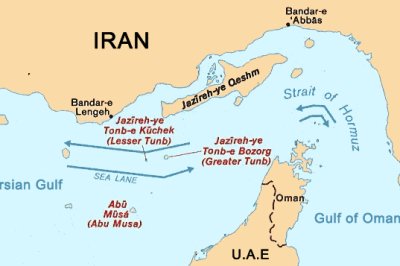

Map of the Strait of Hormuz. Photo courtesy of Wikimedia Commons
March 3 (Asia Today) — Concerns about a potential “second oil shock” are spreading as tensions rise around the Strait of Hormuz, but Japanese analysts say a prolonged blockade is structurally unlikely because China and Iran would suffer the greatest damage.
The Strait of Hormuz, a strategic chokepoint through which roughly 20% of global seaborne crude oil passes, has effectively entered a state of disruption, rattling energy markets and financial investors.
However, Japan’s Sankei Shimbun reported Tuesday that a sustained closure would impose excessive costs on all parties involved.
The first factor is China. According to data from the U.S. Energy Information Administration, China accounts for the largest share of crude oil imports transiting the strait, about 30%. An estimated 40% to 50% of China’s total crude oil imports pass through Hormuz.
China’s strategic petroleum reserves are estimated to cover about 110 days of demand. With its economy already strained by a property downturn and youth unemployment, a prolonged surge in oil prices and supply disruptions could intensify pressure on manufacturing, inflation and exchange rates.
The second factor is Iran. While Tehran appears to hold leverage by controlling the strait, its economy depends heavily on oil exports. China has remained Iran’s primary buyer even under sanctions, accounting for roughly 90% of Iranian crude exports.
A long-term blockade would likely reduce export volumes and slash foreign currency earnings for Iran itself. Japanese financial officials were quoted as saying that maintaining a full blockade over an extended period would not be a rational choice. While it may serve as a short-term bargaining tool, a prolonged standoff could inflict serious damage on Iran’s economy.
The third variable is the United States. Since the shale boom, the United States has become the world’s largest crude oil producer. Only about 3% of U.S. crude imports pass through the Strait of Hormuz, meaning a blockade would not directly paralyze the U.S. economy. Although higher global oil prices could weigh on American consumers, analysts say it is unlikely to serve as a decisive strategic weapon against Washington.
Taken together, a prolonged blockade would amount to what analysts describe as an “asymmetric self-harm” strategy, imposing heavy political and economic costs on all sides. Short-term price spikes and volatility are possible, but sustaining such measures over time would be difficult.
Japan holds strategic petroleum reserves equivalent to more than 250 days of supply and says it has sufficient capacity to absorb short-term shocks. South Korea also maintains government and private stockpiles capable of covering several months of demand.
While rising oil prices would burden South Korea’s trade-dependent economy, energy experts say fears of an immediate physical supply cutoff may be overstated. They stress the need to distinguish between short-term price volatility and actual disruptions to physical supply.
— Reported by Asia Today; translated by UPI
© Asia Today. Unauthorized reproduction or redistribution prohibited.
Original Korean report: https://www.asiatoday.co.kr/kn/view.php?key=20260303010000544