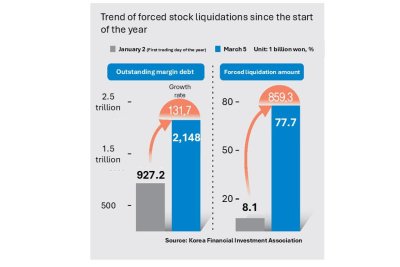

Trend of forced stock liquidations since the start of the year. Data from Korea Financial Investment Association. Graphic by Asia Today and translated by UPI
March 8 (Asia Today) — Forced stock sales in South Korea surged this week as rising market volatility triggered margin calls for investors who borrowed money to buy shares.
According to the Korea Financial Investment Association, forced liquidations totaled 77.7 billion won ($58 million) as of Wednesday, the eighth-largest amount recorded since the data began in 2006.
Outstanding margin balances also climbed to 2.15 trillion won ($1.6 billion), the highest level on record.
The sharp increase follows a strong rally in South Korean stocks earlier this year, driven largely by optimism surrounding artificial intelligence and semiconductor demand. However, geopolitical tensions in the Middle East have increased market volatility and halted the rally, prompting forced selling by heavily leveraged investors.
Margin balances occur when investors purchase stocks through brokerage accounts but fail to fully pay for the shares by the settlement deadline. If the funds are not repaid within two business days, brokerage firms may liquidate the holdings to recover the debt.
Analysts say the surge in forced sales highlights structural vulnerabilities in the South Korean stock market.
After tensions escalated in the Middle East, major East Asian markets including Japan, China, Taiwan and Hong Kong fell about 1% to 5% on the first trading day. South Korea’s market, however, dropped more than 12%, reflecting its heavier concentration in semiconductor stocks that had previously surged during the AI-driven rally.
The scale of outstanding margin balances has more than doubled since the start of the year. On the first trading day of 2026, unpaid balances totaled about 927.3 billion won ($690 million).
Because forced liquidations typically follow unpaid margin balances from the previous trading day, analysts warn that additional selling pressure could emerge if the outstanding balances remain elevated.
Yang Jun-seok said investors relying on borrowed funds should adopt a more cautious strategy.
“While the AI rally could continue supporting the broader market, volatility may increase due to developments related to Iran,” Yang said. “Investors using leverage are particularly vulnerable to market shocks and should consider exit strategies.”
— Reported by Asia Today; translated by UPI
© Asia Today. Unauthorized reproduction or redistribution prohibited.
Original Korean report: https://www.asiatoday.co.kr/kn/view.php?key=20260309010002100