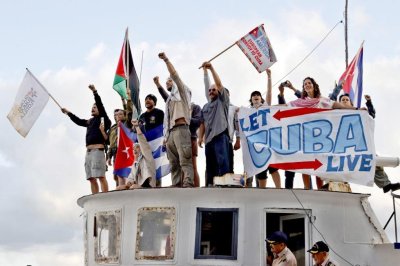

Members of the Nuestra America Convoy wave as they arrive at the port in Havana on Tuesday. The convoy, inspired by the Global Sumud Flotilla that delivered humanitarian aid to Gaza in 2025, aims to send a message of political support to Cuba, which has been subject to a U.S. oil embargo since January. Photo by Ernesto Mastrascusa/EPA
March 26 (UPI) — The flow of humanitarian aid to Cuba has increased in recent days with shipments of food, medicine and fuel from governments, regional allies and an international flotilla of activists amid a crisis marked by widespread blackouts and shortages of basic supplies.
However, alongside the arrival of that assistance, a debate has also grown inside and outside the island over its real impact, distribution and motives of some of those behind it.
Mexico provided the most significant shipments, with more than 1,200 tons of food transported on two Navy vessels in mid-March, followed by new cargo announced days later.
Meanwhile, Caribbean countries are preparing additional packages with powdered milk, infant formula, nonperishable food, medical supplies and energy equipment, such as solar panels and batteries. China sent 60,000 tons of rice.
Fuel shipments confirmed by Russian authorities, in an attempt to ease the energy crisis affecting the island, have not arrived and seem to be in limbo because of the U.S. embargo.
Cuba faces a structural deficit in electricity generation — because of a massive shortage of oil — that has led the system to operate under severe pressure, producing barely half of the electricity needed to cover total demand.
The gap between supply and consumption has forced authorities to implement widespread outages to avoid a total collapse, especially during peak hours, causing prolonged blackouts across the country that affect hospitals, transportation, cold chains and daily life.
Seeking to assist, the international flotilla “Nuestra América” arrived in Havana starting Friday. Organizers said they transported more than 20 tons of essential supplies.
The initiative brought together more than 650 participants from 33 countries, including doctors, activists, political figures, artists and digital content creators. Most participants arrived by air, while a vessel arrived Tuesday in Havana. President Miguel Díaz-Canel personally received those aboard.
Organizers of relief missions say Cuba is on the verge of an “imminent humanitarian collapse” and attribute the situation to United States policy, including sanctions and restrictions linked to oil trade.
But inside the island, some Cubans express doubts about the destination of that aid.
“These people come here to benefit the regime in Cuba,” said Berta Solórzano, a resident of Old Havana, in statements reported by Radio Martí.
Activist Yanaisy Curvelo, mother of a political prisoner, expressed an even more direct view:
“They believe in dictators, that’s why it works like this. …. None of those donations go to the people, everything goes to the stores — in MLC [a digital currency created by the Cuban government] or dollars.”
Near the port of Havana, where the relief ship Granma 2.0 docked, a resident identified as Manuel Soria said, “What they came here for is to support the dictatorship of the Castro regime. If it comes under these conditions, then they should not come anymore because we have not seen any help. We have not benefited, what we are is hungrier every day.”
Opposition figure Manuel Cuesta Morúa questioned the convoy’s approach.
“Instead of talking about the conditions and circumstances and the real situation of the country, they decide and dedicate themselves to reviving their utopia,” he said.
He also used a metaphor to describe the situation: “The most powerful image I have was given by [Cuban American] activist [Manolo De Los Santos] Ramallo is that this is like the Titanic. It is like someone playing music on the deck of the ship while it’s sinking.”
Doubts are not limited to opposition sectors. Cuban researcher Elaine Acosta, affiliated with Florida International University in Miami, described the convoy in statements to El País as a political maneuver more linked to elites than to citizen needs, and she warned about the risk of aid diversion.
Egyptian filmmaker Basel Ramsis Labib, with historical ties to Cuba and experience in flotillas to Gaza, questioned the initiative and described it as “ridiculous.”
“Cuba is not Gaza,” he wrote, adding that anyone who wants to help can send medicine and food directly, without incurring the high logistical costs of a flotilla.
He said those resources could have been allocated more efficiently to the population and criticized what he described as a component of “egocentrism” and a search for political visibility.
He also questioned the symbolic nature of the initiative, including the name “Granma 2.0,” and warned that some attitudes are “insulting” in the face of food shortages, fuel scarcity and the energy crisis.
“The Cuban people need gasoline, medicine, food and serious reform,” he said.
The controversy was amplified by the participation of international figures and scenes that some considered disconnected from the crisis context.
Irish hip hop group Kneecap performed a concert in Cuba during a blackout, which generated criticism on social media over the contrast between the event and the country’s energy situation.
Another focus of criticism was American political commentator Hasan Piker, who participated in the convoy and said he sought to raise awareness about the effects of United States policy on Cuba. During his visit, he described the country as “incredible” and highlighted the resilience of its population.
His statements were criticized and compared to a disconnect between that discourse and his behavior. Piker came under scrutiny for staying at a luxury hotel and wearing expensive clothing and accessories, prompting comparisons with living standards on the island.
Former Spanish Vice President Pablo Iglesias also became part of the controversy after defending the humanitarian mission from Havana in a video recorded from a five-star hotel, according to posts and analysis shared on social media.
In that message, he said the situation is “difficult, but not as it is presented from outside.”
The reaction included direct criticism from Cuba. Journalist Ariel Maceo Téllez questioned the legitimacy of such interventions and said Cubans understand their reality better than foreign observers.
In his message, he denounced the coexistence of widespread shortages and the development of luxury tourism infrastructure, noting that many Cubans cannot access those places.
Humanitarian aid to Cuba has increased in volume and visibility, but its impact is conditioned by internal distribution capacity, state control and the persistent energy crisis.
The Cuban Observatory of Human Rights said in its 2025 report that 89% of the population lives in extreme poverty and that 71% has been forced to skip meals due to food shortages.
The real impact of the aid will depend on its ability to effectively reach the population in a scenario of increasingly widespread needs.