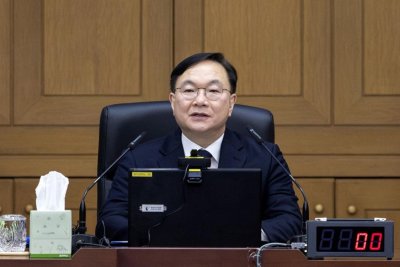

Park Young-jae, head of the National Court Administration, speaks during a meeting with chiefs of district and appellate courts nationwide at the top court in Seoul, South Korea, 25 February 2026. Park said that the opinions of the judiciary should be reflected in deliberations for controversial judicial reform bills pushed by the ruling Democratic Party (DP), after three DP-led bills were met by strong opposition from the judiciary. Photo by YONHAP / EPA
Feb. 27 (Asia Today) — Park Young-jae, chief of the National Court Administration, has offered to step down, just over 40 days after taking office, as the ruling party moves ahead with a package of judicial reform bills.
According to court officials, Park conveyed his intention to resign Thursday morning to Chief Justice Cho Hee-dae.
In a statement, Park said, “Considering recent discussions both inside and outside the judiciary, I concluded that stepping down would better serve the public and the courts.”
“I regret leaving at a time when the judiciary faces many challenges,” he added, expressing hope that discussions on reforming the judicial system would proceed “in a direction that benefits the public.”
His resignation is widely seen as linked to the National Assembly’s handling of three controversial reform measures: the creation of a new crime of “distorting the law,” the introduction of a system allowing constitutional complaints against court rulings and an increase in the number of Supreme Court justices.
The National Assembly has been processing the bills in plenary sessions since Monday. Lawmakers passed a revised version of the “distortion of law” bill Wednesday, narrowing its scope to criminal cases and adjusting the elements required to establish the offense. A separate bill to allow constitutional petitions against court decisions was expected to be voted on later Thursday.
Since his appointment last month as successor to former court administration chief Cheon Dae-yeop, Park had repeatedly voiced concerns about the reform package.
He warned that the proposed “distortion of law” offense could be abused and lacked sufficient clarity, raising potential constitutional issues. On the plan to allow constitutional complaints against court rulings, he said it risked plunging citizens into excessive litigation. Regarding the proposal to expand the number of Supreme Court justices, Park said it could weaken lower courts by drawing experienced judges away without a clear plan to fill the gaps.
Earlier this week, he convened an emergency meeting of court presidents nationwide, saying the three bills could bring fundamental changes to the courts’ role and directly affect the public. He stressed that the judiciary’s views should be reflected in the legislative deliberation process.
Park had also faced criticism from some lawmakers over his prior involvement in an appeal case related to President Lee Jae-myung under the Public Official Election Act before his appointment as court administration chief.
His departure comes as tensions between the judiciary and the legislature intensify over the scope and direction of judicial reform.
— Reported by Asia Today; translated by UPI
© Asia Today. Unauthorized reproduction or redistribution prohibited.
Original Korean report: https://www.asiatoday.co.kr/kn/view.php?key=20260227010008381