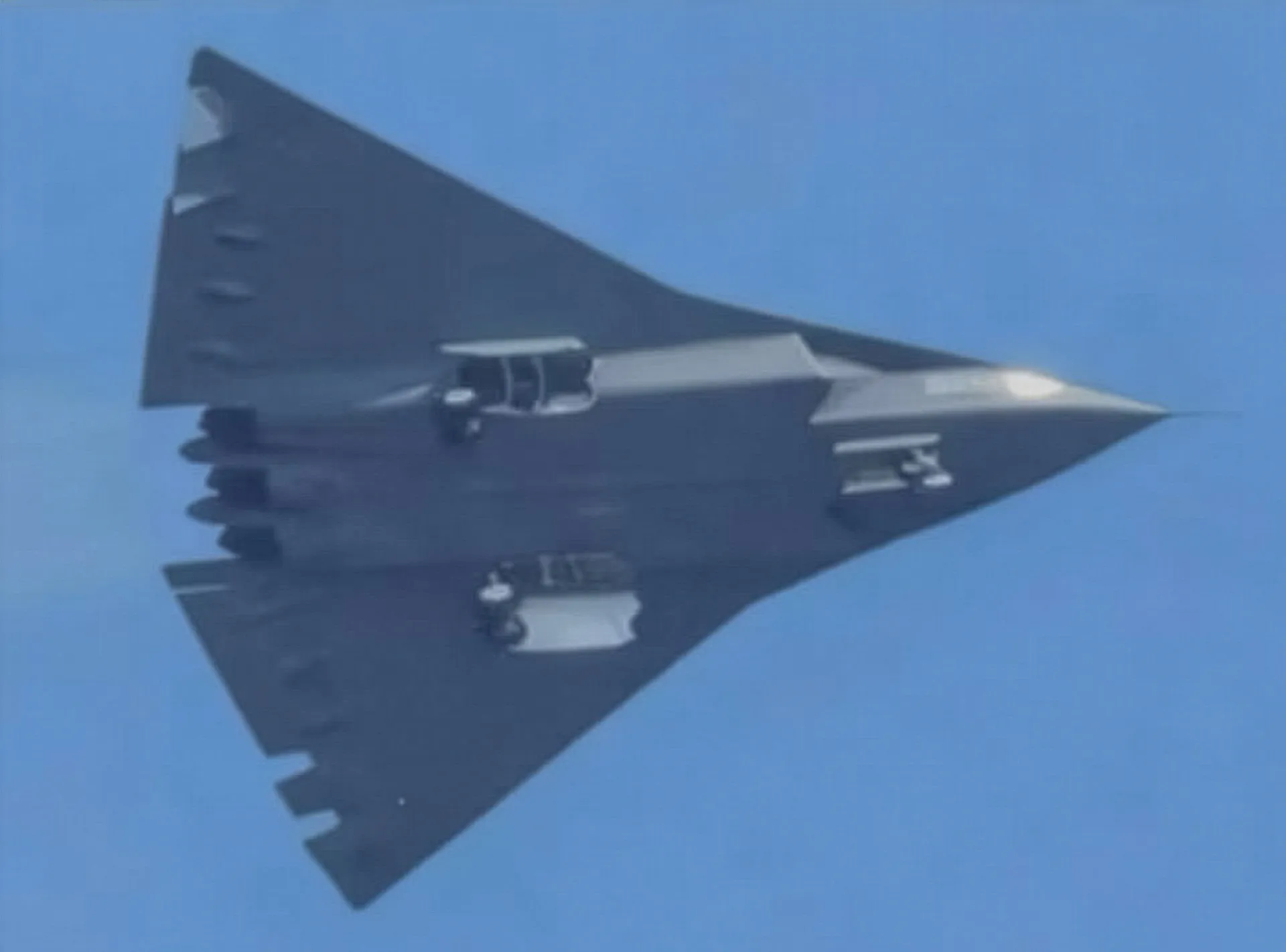
We have gotten two new images of the Chengdu Aircraft Corporation’s second ‘J-36’ heavy tactical jet airframe, which features significant changes over the first. The aircraft first emerged in late October. Along with new inlets and main landing gear, the addition of what appeared to be two-dimensional thrust vectoring across its bank of three engines was highly intriguing. Now we are seeing a rear aspect of this new exhaust configuration that further confirms our original analysis.
You can read our recent report on the new J-36 configuration here and our original deep dive on the J-36 here.

The new images show the J-36 from behind during landing and from directly below. The rear image is the star of the show here, as we can see what appears to be the jet’s three-pack of 2D thrust vectoring nozzles, similar to those found on the F-22. China has been developing this exhaust capability for some time now, but its addition on the J-36 is very interesting.
Generally speaking, thrust vectoring provides additional maneuverability throughout different areas of the flight envelope for a tactical jet, including, in many cases, in the post-stall regime. It also allows for better overall controllability and stability, the value of which is magnified on a highly unstable tailless fast jet design. It can also play a key role when operating at high altitudes, a performance goal that could be very beneficial to the J-36, as we discuss in our large analysis feature. At the same time, it adds weight and complexity to the aircraft, although this likely isn’t a major concern for a jet as large and complex as the J-36. It is also not as efficient as traditional conical exhausts when it comes to thrust output.

The first J-36, which emerged just 11 months ago, had recessed trough-like exhausts, vaguely similar to what was found on the YF-23. There is likely a low-observable (stealth) penalty from some rear aspects when trading the previous configuration for this new one.
The addition of thrust vectoring is a major design departure and clearly points to its advantages outweighing its costs. It also will raise the question, once again, about the intended role of this aircraft and how to define it. We went over this in great depth in our original analysis, but suffice it to say, keeping a certain level of maneuverability is likely seen as beneficial, but thrust vectoring provides other advantages beyond straight agility, as we discussed earlier.

All that being said, we still don’t know definitively if this second aircraft is purely evolutionary, depicting something that is truly a step closer to a final production configuration, or if it is experimental and we could see some of its features exchanged for those of the first model on future iterations.
It’s worth noting that the J-36’s smaller counterpart, the J-XDS, also features similar 2D thrust-vectoring capabilities. It’s additionally possible that the J-35, China’s medium stealth fighter, could one day ditch its serrated round exhausts and adopt 2D thrust vectoring, as well. We have seen such a configuration mocked up at Chinese arms expos.

With the one-year anniversary of the J-36 emerging from the shadows approaching, it’s remarkable just how much we have seen of it and how two prototype/demonstrator aircraft are now in known existence. It and the J-XDS, along with a flood of advanced uncrewed combat aircraft and naval aviation developments, mark 2025 as a truly remarkable year for Chinese military aviation, one that is clearly drawing concerns of potential adversaries.
Contact the author: [email protected]