Discover the latest happenings and stay in the know with our up-to-date today news coverage. From breaking stories and current events to trending topics and insightful analysis, we bring you the most relevant and captivating news of the day.
“Seek overhead cover and shelter in place immediately,” the U.S. Embassy in Jordan cautioned this morning. “Remain indoors and pay attention to local announcements and alerts. The U.S. Embassy in Jordan will continue to review the situation and provide additional information as needed.”
Security Alert: U.S. Embassy Jordan – July 9, 2026
Location: Jordan, countrywide
Event: Reports indicate missiles, drones, or rockets are in Jordanian airspace. Seek overhead cover and shelter in place immediately. Remain indoors and pay attention to local announcements and… pic.twitter.com/QOpNpKLXTA
— U.S. Embassy Amman (@USEmbassyJordan) July 9, 2026
The Jordan Armed Forces-Arab Army (JAF) General Command said the country’s air defense systems “intercepted and shot down eight missiles launched from Iran toward Jordanian territory on Thursday. The interception operations resulted in the fall of missile debris, but no casualties or property damage were reported.”
“JAF is closely monitoring regional developments and remains at the highest level of operational readiness to safeguard the Kingdom’s airspace and defend its sovereignty and territorial integrity,” the command added. “JAF will not allow any party to violate Jordanian airspace under any circumstances.”
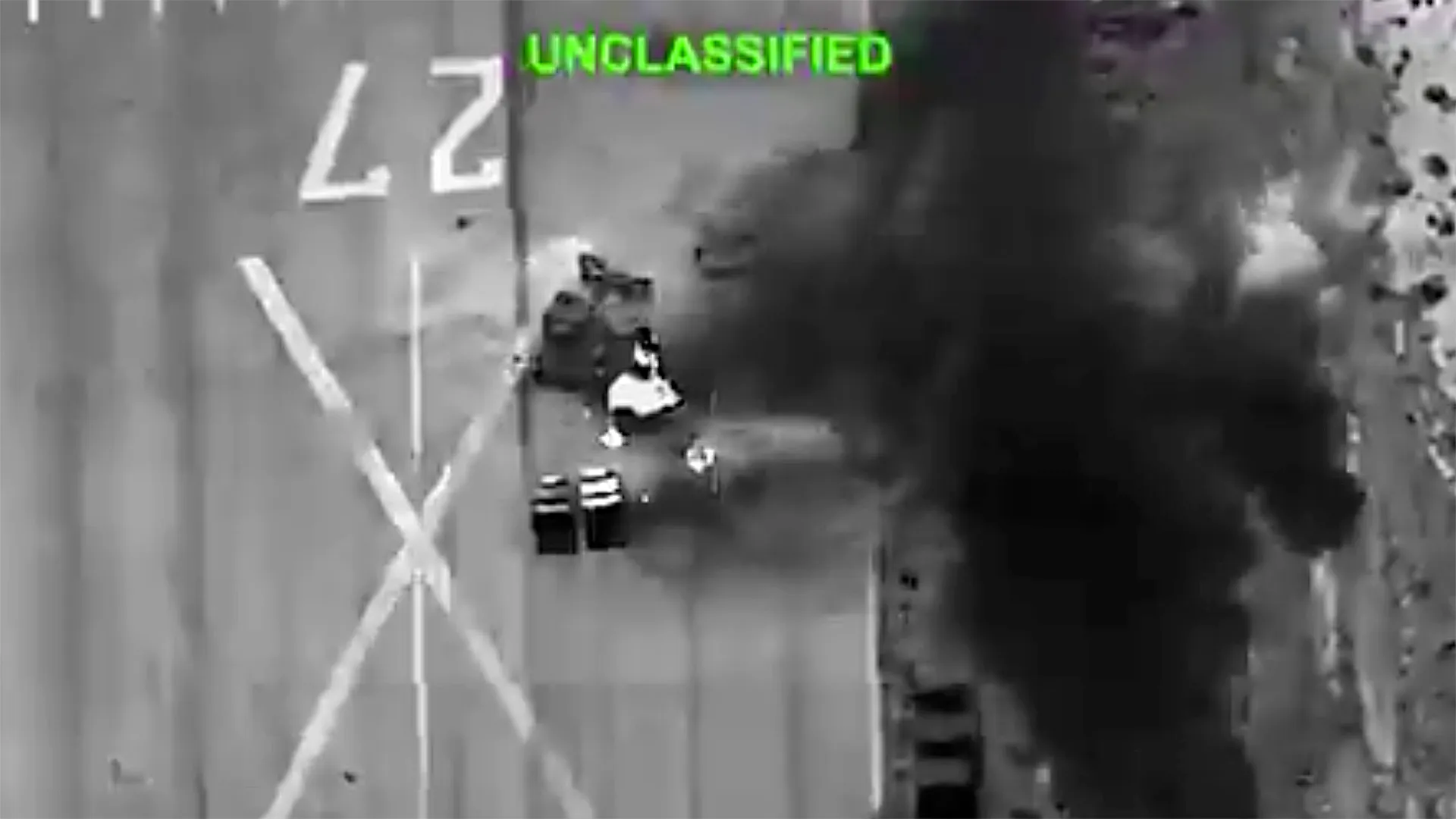
The Islamic Revolutionary Guard Corps (IRGC)-connected Tasnim media outlet claimed “that multiple explosions occurred at the Muwaffaq Salti Air Base in Jordan,” and that “Iranian forces also targeted American ships stationed off the coast of Bahrain with cruise missiles.” However, no visual proof of that has emerged. U.S. Central Command declined to provide any new operational details.
Muwaffaq Salti, as we have previously reported, has come under attack numerous times. The air base has long been a major regional hub for U.S. operations, and is being very actively utilized in the current conflict. It hosts the greatest concentration of U.S. tactical aircraft in the region, and thus is an extremely important target, where even one ballistic missile landing on an apron could destroy multiple prized fighter aircraft and take the lives of U.S. service members.
Scenes from IRGC Navy and Aerospace retaliatory strikes on Thursday answering the American terrorist army’s aggression and disloyalty. pic.twitter.com/qwKo0SkLE2
Iranian officials also claimed the U.S. carried out new strikes in southern Iran, including on the perimeter of the Bushehr nuclear power plant.
“According to the deputy governor of Bushehr Province, a U.S. projectile hit the perimeter area of the facility, which had already been hit several times during the current conflict prior to the April 8 ceasefire,” the Jerusalem Post reported Thursday.
🚨 Iran reports that a few minutes ago, additional explosions were heard near the Bushehr nuclear power plant. https://t.co/zVJczmOpb5
Today’s attacks follow a series of strikes carried out on Wednesday by U.S. Central Command (CENTCOM). The U.S. attacked scores of targets across Iran after President Donald Trump warned on Wednesday that “we’ll probably hit them hard again tonight.”
“U.S. forces struck approximately 90 Iranian military targets including air defense systems, coastal surveillance assets, missile and drone storage sites, naval capabilities, and military logistics infrastructure along Iran’s coastline,” the command said in a statement on X. “The latest strikes follow successful execution of offensive strikes in Iran the night before.”
🚨 CENTCOM RELEASES THE HIGHLIGHT REEL U.S. Central Command says American forces completed another round of strikes against Iran on July 8, hitting approximately 90 Iranian military targets along the coastline. Targets included air defense systems, coastal surveillance assets,… pic.twitter.com/y2HiEMNWdy
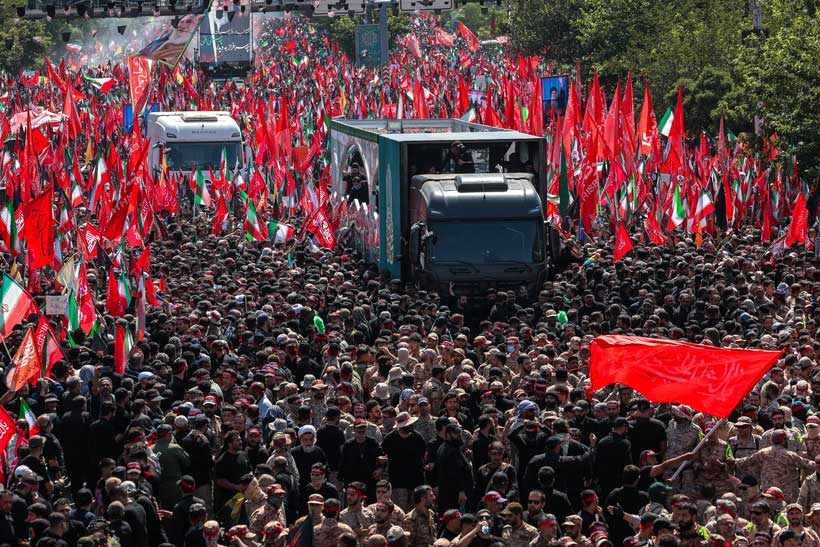
Iran, however, claims the attacks took place further inland, including on a railway bridge for a line linking the cities of Tehran and Mashhad, where former Supreme Leader Ayatollah Ali Khamenei is scheduled to be laid to rest. He was killed on the first day of the U.S.-Israeli attacks on Iran. The official Iranian IRIB media outlet claimed on X that the bridge attack interrupted rail service.
Passengers on the Tehran-Mashhad train, stranded due to the U.S. striking the railway, are chanting: “Iranians do not accept humiliation, even at the cost of their own lives.” pic.twitter.com/9NhlUQqidr
— IRIB (Islamic Republic of Iran Broadcasting) (@iribnews_irib) July 9, 2026
There were also unconfirmed reports from official Iranian media, an independent media outlet and eyewitnesses that another bridge in that region was attacked. The Agh Tekeh Khan Bridge in Iran’s northern Golestan province is a key link in a railway line running to Central Asia and ultimately Russia and China. The line has reportedly been an important means of trade between Iran, China and Russia during the now paused U.S. naval blockade on Iranian ports.
Eyewitness video shows damage to the Aq Taqeh Khan railway bridge in Iran’s northern Golestan province following overnight US strikes. The bridge is a key trade link connecting Tehran with its strategic partners, China and Russia.#US#Iranpic.twitter.com/0k5y50w79V
— Al Arabiya English (@AlArabiya_Eng) July 9, 2026
According to local reports, several enemy projectiles have struck the “Aq-Tekeh Khan” bridge on the railway line in the western area of Aq Qala, Golestan province. pic.twitter.com/eMO5todo2i
— IRIB (Islamic Republic of Iran Broadcasting) (@iribnews_irib) July 8, 2026
Where all this leaves the ongoing negotiations between the U.S. and Iran remains unclear. As we have frequently noted, the two sides signed a 14-point Memorandum of Understanding (MoU) on June 17. The MoU provided a 60-day extension of the ceasefire to iron out an agreement to end fighting throughout the region, including Lebanon, prevent Iran from seeking nuclear weapons, end U.S. sanctions and resume the flow of traffic through the Strait of Hormuz among other points.
Control over the Strait has proven to be the biggest flashpoint, as evidenced by the aforementioned flare-up of fighting sparked by Iranian attacks on shipping there.
As we mentioned earlier in this story, both sides have declared the ceasefire over.
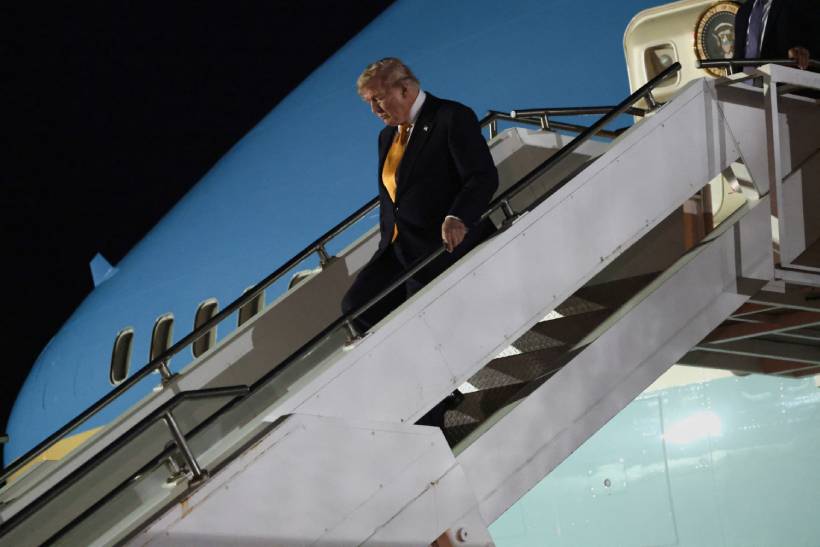
Speaking to reporters aboard Air Force One yesterday after departing the NATO Summit in Ankara, Turkey, Trump claimed Iran still wants a peaceful solution.
“They called a little while ago,” the president proclaimed. “They want to make a deal so badly — I just don’t know if they’re worthy of making a deal. I don’t know that they’re going to honor the deal. That’s the problem.”
.@POTUS on Iran: “They called a little while ago. They want to make a deal so badly — I just don’t know if they’re worthy of making a deal. I don’t know that they’re going to honor the deal. That’s the problem.” pic.twitter.com/jQTENvyRGM
— Rapid Response 47 (@RapidResponse47) July 9, 2026
The American leader also called the Iranians “cuckoo.”
.@POTUS on Iran: “We hit them very hard last night — very, very hard — and we’ll probably hit them hard again tonight… They’re cuckoo. There’s something wrong with these people. For 47 years, they’ve been the bully of the Middle East… It’s very simple: they can’t have a… pic.twitter.com/FtZH8l1f8L
— Rapid Response 47 (@RapidResponse47) July 8, 2026
Given all this, the future of diplomacy is an open question.
UPDATE: 2:50 PM EDT –
The official Iranian Mehr news outlet is reporting on Telegram that new explosions in Iran’s southern port city of Bandar Abbas, Bushehr and Choghadak. TWZ cannot independently confirm this and CENTCOM declined comment.
UPDATE: 3:13 PM EDT-
A U.S. official told the Jerusalem Post that the explosions in Iran are not a U.S. airstrike.
UPDATE: 3:49 PM EDT –
The official Iranian IRNA news outlet stated on X that the source of the explosions could be the armed forces’ defense systems, enemy fire or a downed drone.
After confirming residents in Bushehr and Choghadak heard the noise, the local governor stated that it is still unknown whether it stemmed from armed forces’ defense systems, enemy fire, or a downed enemy drone, and no final conclusion has been reached.
Three wins to go. How can your team reach the final and win World Cup 2026? Click here to find out.
Who: Spain vs Belgium What: FIFA World Cup 2026 – quarterfinal Where: Los Angeles Stadium in California, United States When: Friday at noon (19:00 GMT) How to follow: We will have all the build-up on Al Jazeera Sport from 15:30 GMT before our live text commentary stream.
Recommended Stories
list of 3 itemsend of list
After crushing the “American dream” by taking down cohosts USA in a politically influenced encounter, Belgium are gearing up for their next big challenge.
They face the daunting task of tackling Spain, whose robust defence and careful, possession-based football have made them one of the bookmakers’ favourites at the tournament.
Since an unconvincing performance in the first match, Spain have improved with each contest and punched their ticket to the quarterfinals in style.
They are the first team in history to keep six consecutive World Cup clean sheets – a record achieved by taking out Portugal on Monday and ending Cristiano Ronaldo’s last bid for a world title.
Belgium’s knockout campaign in North America has been nothing short of a roller-coaster, and come Friday, it could take another turn if they upset the reigning European champions to reach the semifinals.
Al Jazeera tells you everything about Spain vs Belgium:
How did Spain and Belgium reach the quarterfinals?
Spain topped Group H with seven points, beating Saudi Arabia and Uruguay and drawing with Cape Verde. They began their knockout campaign with a 3-0 thrashing of Austria in the round of 32 before beating Portugal 1-0 with a late goal in an Iberian football derby in the round of 16.
Belgium topped Group G with five points, winning against New Zealand, and drawing with Iran and Egypt. They defeated Senegal 3-2 in extra time in the round of 32 before thrashing the USA 4-1 in the last 16 contest that was eclipsed by the bitter row over Folarin Balogun’s red card ban.
Courtois is confident Belgium can take down Spain
There may be only five spots between Spain’s and Belgium’s FIFA rankings with La Roja third and Belgium eighth, but the gap in their quality is quite stark.
Spain, the 2010 world champions, are unbeaten in 35 matches, a run that has turned coach Luis de la Fuente’s side from promising European champions into a team that exert confident control over their opponents.
Historically, Belgium have been far behind their Spanish counterparts, especially at major tournaments, having been knocked out in the group stage at the 2022 World Cup and in the last 16 at Euro 2024.
Yet goalkeeper Thibaut Courtois believes Belgium can pull off an upset after finally beginning to show some form at the tournament with a come-from-behind extra-time win and a statement performance in their last two games.
“Everyone on our team realises it’s possible. I think we have a strong squad with qualities that Spain will have to take into account,” Courtois told reporters on Wednesday.
“There are always surprises, and I think we can be one of them. Eliminating the European champions would obviously be a huge upset. The confidence is there.
“People were a bit disappointed in us, but we’ve set that right. We’re getting better and better,” he added about Belgium, whose best finish was third place at the 2018 World Cup.
The World Cup is likely the last hurrah for the remainder of Belgium’s so-called golden generation, including creative midfielder Kevin De Bruyne and striker Romelu Lukaku.
Lukaku is Belgium’s top scorer at the tournament with three goals while Leandro Trossard has made an all-round impact with two goals and two assists. Charles De Ketelaere and Youri Tielemans also have two goals each.
‘Yamal brings so much to the team’: Olmo
Slowly finding his feet in his debut World Cup, the prodigiously gifted Lamine Yamal has not enjoyed the hero’s status he’s often used to.
With one goal in five games, the 18-year-old winger – who came into the World Cup on the back of a hamstring injury – is playing catch-up with Mikel Oyarzabal, Spain’s leading tournament scorer with four goals.
Midfielder Dani Olmo said his Barcelona teammate Yamal is growing into the tournament.
“He brings so much to the team with his dribbling and presence. When he receives the ball, two or three opposing players close in on him, which opens up space,” he said.
“Lamine scores and assists. He’s always done that in his short career, and even when he doesn’t, he’ll keep helping us with the work he’s doing.”
Spain forward Lamine Yamal is playing at his maiden World Cup [Etienne Laurent/AFP]
Spain vs Belgium prediction
The Opta supercomputer gives Spain a 59.3 percent likelihood of winning in regulation time while Belgium’s chances of winning are 18.3 percent.
The model estimated a 22.4 percent probability of the game going to extra time.
Kickoff time, TV schedule
Spain: LA1, Teledeporte, RTVE Play, DAZN Mundial (9pm, Central European Summer Time)
Belgium: VRT Max, Tipik, Auvio, Sportz, VRT (9pm, Central European Summer Time)
United Kingdom: STV, STV Player, ITVX, ITV1 (8pm, British Summer Time)
To check the TV listings for your country, head to FIFA’s TV listing schedule here.
Who will the winner face in the semifinals?
The winner of the Spain vs Belgium match will face France in the semifinals on Tuesday in Dallas, Texas. France defeated Morocco 2-0 on Thursday to reach the last-four.
Head-to-head
Spain and Belgium have met twice at the World Cup with honours even at one victory apiece.
Their first meeting dates back to 1986 when Belgium beat Spain 5-4 on penalties in the quarterfinals. Then they met in the group stage in 1990 with Spain winning 2-1.
Friday’s match will be Belgium’s third quarterfinal in four World Cups and fourth overall.
For Spain, the quarterfinals have not often been a happy hunting ground. They have only cleared this stage twice, making it to the final group stage in 1950 and beating Paraguay on their way to lifting the trophy in South Africa in 2010.
Team news
Belgium’s midfielder Amadou Onana will miss the remainder of the World Cup after suffering a torn anterior cruciate ligament (ACL) in his right knee during the last match.
Weekly insights and analysis on the latest developments in military technology, strategy, and foreign policy.
Much discussion and debate continue to surround a video said to have been taken near Area 51 that went viral after it was released last month. The footage shows an exotic aircraft that still looks likely to be a progenitor of Boeing’s F-47 sixth-generation fighter for the U.S. Air Force. Its apparent design, with a long shovel-like nose, large canards, and rear-set swept wings, is much different from the tailless, modified delta-winged heavy fighter that many were expecting to come out of the Next Generation Air Dominance (NGAD) program. This, in turn, raises interesting questions about why certain design decisions may have been made and the broader implications of the resulting tradeoffs.
The Project Fear YouTube channel posted the footage of the aircraft in question online back on June 5. Readers can find our initial assessment of the aircraft and its features here.
The full video from Project Fear can be viewed below. The clip of the mysterious aircraft passing by starts at around 49:34 in the runtime, if it does not automatically start playing at that point.
We Filmed a Top Secret Craft Flying at Area 51
TWZ talked at length with Darold Cummings to more deeply analyze features of the design that appear to be visible in the video and, by extension, what might be inferred about the F-47. Cummings is an aerospace engineer with decades of experience who played a key role in developing Northrop’s YF-23 Black Widow, which lost out to what became Lockheed’s F-22 Raptor.
A screen capture that Project Fear had posted as a teaser before the release of the full video had also prompted new interest in another advanced fighter concept that Cummings had crafted in the 1980s. TWZ previously explored this design, nicknamed the “Christmas Tree” because of its planform, in detail. Cummings has worked on a host of other projects over the years for other companies across the aerospace industry and is now president of his own firm, ForzAero. He has also previously shared his own notional concepts for what the F-47, as well as a navalized derivative, might look like.
The teaser image Project Fear posted ahead of sharing the full video. capture via Project Fear
We reached out to other experts and long-time observers to get their views on Project Fear’s footage and the F-47, as well. Olivier Vargas, a 3D artist who goes by the handle @ollysaerospace on X and Instagram, was also kind enough to share his artwork based on what could be seen in the Project Fear video, one of which is seen at the top of this story and others throughout it. These are just extrapolated artist impressions and should not be taken as literal.
One of Olivier Vargas’ notional renders based on what can be seen in the Project Fear video. Olivier Vargas/@ollysaerospace
There are also years’ worth of official artwork from Boeing and other U.S. companies, as well as the Air Force itself, depicting concepts for advanced fighters. These have largely revolved around tailless, modified delta-winged designs, a sampling of which is shown in the collage below.
Renderings of advanced fighter concepts from, starting at upper left and going clockwise, the Air Force Research Laboratory (AFRL), Lockheed Martin, Boeing, and Collins Aerospace.
A useful starting framework
Cummings offered a valuable general rubric for considering advanced combat aircraft designs in his interview with TWZ.
When it comes to designing any fighter, “you just have a team of people who bring in all their needs. It’s like I say, the weapons, the landing gear, the wing, structure, and all the doors, all that stuff comes together,” he explained. “And all those people have to say, ‘what is the best I can do to get the [radar] cross-sectional area down?’ How can I move the landing gear to get the cross-sectional area down? How can I make the weapons bay smaller to get the cross-sectional area down? And all that relates to fineness ratio, and all that relates to the Sears-Haack plot.”
Fineness ratio refers to the ratio of the length of a ‘body,’ such as an aircraft, to its maximum width. The ratio increases the longer and narrower the body is. The Concorde supersonic airliner, with its long, slender fuselage and relatively short wingspan, is a common example of a plane with a very high fineness ratio.
The Concorde airliner is an example of an aircraft design with a very high fineness ratio. British Airways
A Sears-Haack plot, or Sears-Haack body, is a shape offering the lowest theoretical drag while traveling at supersonic speed based on a set length and volume. In high-speed aircraft development, the goal then is to devise a planform that is as close to that plot as possible.
A generic example of a Sears-Haack body. TriAero Project/SourceForge
“We spent probably a whole year on the Sears-Haack plot on the YF-23,” Cummings recalled. “I remember the structures guy wanted to have me fired because I had to have such [a] thin structure there to get the area down. He wanted to have me tar-and-feathered [sic].”
As noted, the tailless design seen in Project Fear’s video appears to have rear-set swept wings, as well as rhombus-shaped canard foreplanes. From the teaser image that Project Fear released, it had initially appeared that the nose might also have something of a “double arrowhead” shape akin to Cummings’ Christmas Tree concept. However, the full video looks to show a more shovel-like forward fuselage more typically found on low-observable (stealthy) aircraft. Even without the double arrowhead nose, the planform is distinct and notable.
Wings
The wings on the aircraft seen in Project Fear’s footage look to have a significant dihedral, and possibly drooping tips. At the same time, the relative quality of the video, given how far away the subject was, as well as the fact that it was captured in infrared at night, makes it hard to say definitively.
The design has already evoked the memory of Boeing’s Bird of Prey advanced technology demonstrator aircraft, which is understood to have been tested at Area 51 in the 1990s, but was only revealed to the public in 2002. This wing shape would also be in line, broadly speaking, with the renderings of the F-47 that the Air Force has released to date, which also shows the wings have a positive dihedral, though those may not fully reflect the actual design for operational security reasons.
“Now, whether that has the gull wing, up/down, like the Bird of Prey, I can’t tell,” Cummings told us. “I would be surprised if they had the droop [sic] wingtips, like on the Bird of Prey.”
“They’re a little hard to do once you have landing gear in that, because the inboard section would have to have a lot of dihedral to it, and I don’t know what you’re gaining,” he explained.
Boeing’s Bird of Prey. USAF
“Now, that’s not saying that the Bird of Prey doesn’t work. It works. I’m just saying, for simplicity’s sake, and long straight edges,” using “a clipped delta wing with MANTA-type exhaust, to me would be the best solution,” he added, speaking broadly. “Long straight edges for LO [low observability; stealthiness] are the best, no matter what you do. The longer the edges, the better RCS [radar cross section] you have in terms of the types of radars that use – the shorter it is, kind of the worse it is. So, if you can have a nice long straight leading edge and a relatively long straight trailing edge, combined with 3D thrust vectoring, in my opinion, it just doesn’t get much better than that.”
MANTA here refers to the Multi-Axis No-Tail Aircraft (MANTA), a Lockheed design derived from the F-22, which is also known by the designation X-44A. The MANTA never came to be, at least that we know. The designation was later re-applied to a completely unrelated flying wing-type drone, the existence of which was first reported by TWZ.
Renderings of the X-44A MANTA. Lockheed Martin/NASA
Cummings also highlighted the stealth advantages, in general, of choosing a tailless planform.
“There’s no intersections. Every time you have an intersection, you have a chance for an RCS reflector. I mean, anytime you have an angle, you have a chance for a reflector. So, if you do [it] with a way without any tails, mostly vertical tails – you can use a horizontal tail like we did on a YF-23, a V-Tail, if you keep it ported, lined up with a wing,” he explained. “You can see that there’s no gap between the wing and the tail [on the YF-23], and if you look at the angles from above, they’re exactly the same. To me, that’s a really ideal configuration. But if you can eliminate the tails completely by using thrust factoring, even better.”
“Ported” in this case means keeping the control surface locked in the same geometric plane as the wing while cruising.
A top-down look at the YF-23, and the shaping of its wings and tail, during a flight test. USAF
In terms of wing shaping, “ideally it would be the old Dorito chip,” Cummings said, speaking generally. “Remember the ‘Hopeless Diamond,’ the original [Lockheed’s Have Blue demonstrator that evolved into the F-117]? I mean, that would be the optimum shape, but that’s very poor aerodynamically, very poor – very hard to balance, very hard to control.”
The Have Blue demonstrator. Lockheed/USAF/Public Domain
“You have a very, very high sweep, very, very long edge, you know, followed up by an angular [sic] on the back, which is less of a threat area. With a nice angled cut off on the back. If you can make it fly,” he continued.
A combination of high dihedral and drooping tips can be potentially beneficial for supersonic flight, gaining performance from riding on the resulting compression wave. However, Cummings said he did not think this would be applicable in the discussion around the potential design of the F-47.
One of the official US Air Force renderings of the F-47. USAF
“You really, in my opinion, need to be going more like Mach 3 to really take advantage of that, and this airplane, I’d be surprised if it did more than Mach 2.2,” he said. “Like the Bird of Prey, it was subsonic. I mean, there was no reason at all, from an aero-lift standpoint, to do it that way, from an aero-lift standpoint. There might be some advantage from an RCS standpoint, but not from an aero-lift standpoint.”
Cummings used the XB-70 Valkyrie bomber, which had wingtips that could be canted down into a drooped position during flight, as an example of an aircraft that does benefit from this feature when it comes to aero-lift. The XB-70 was designed to fly at speeds above Mach 3.
An XB-70 seen in flight with its wingtips in their ‘drooped’ position during testing. USAF
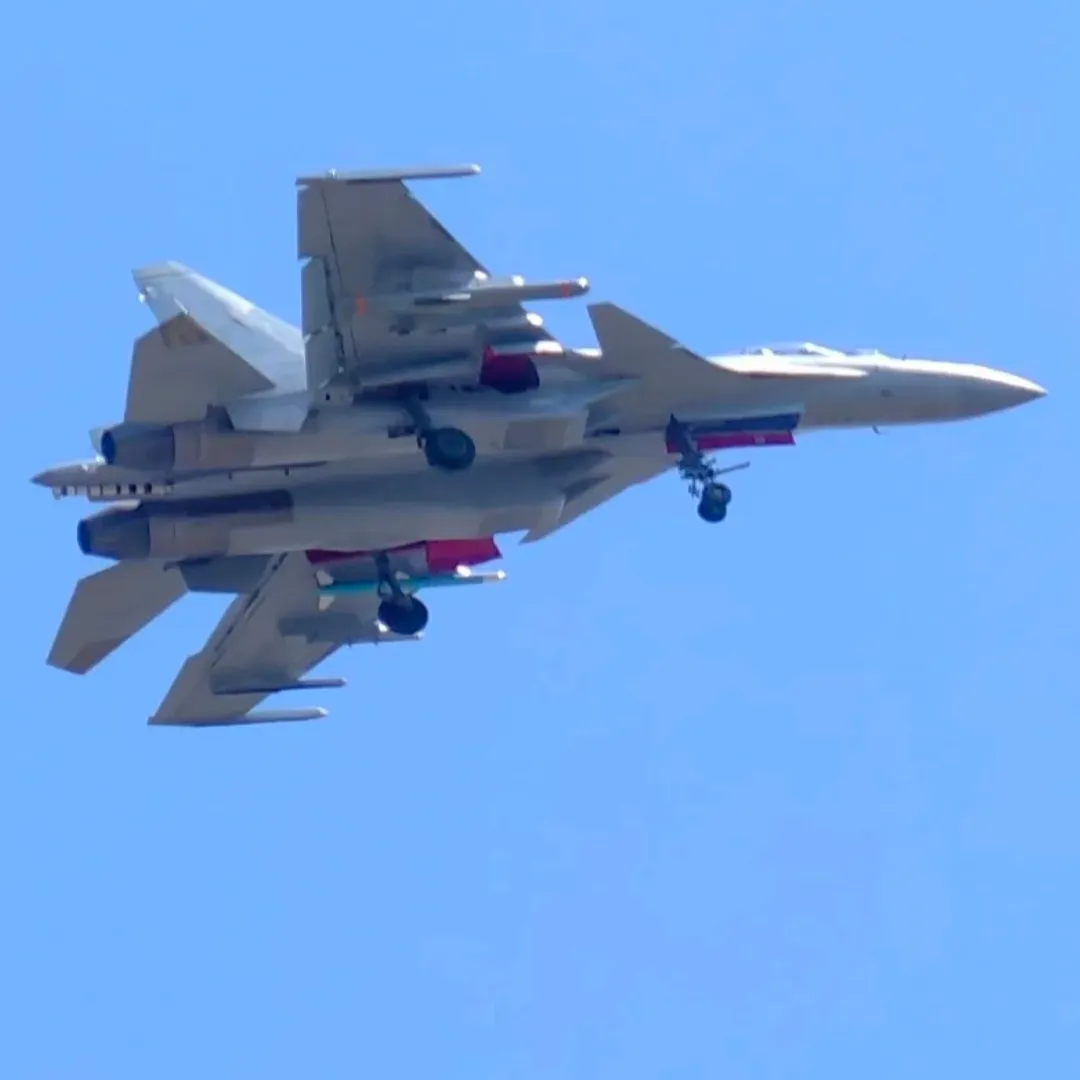
There is the possibility that what looks like ‘droop’ in the wingtips of the design seen in the video Project Fear released could actually depict wingtips that articulate. We cannot say with certainty one way or the other at this time. China’s J-XDS heavy sixth-generation stealth fighter notably has swiveling wingtips, which could help provide critical stability at slower speeds and during hard maneuvering, which are especially sensitive areas of the flight envelope for tailless designs.
Pictures of the J-XDS prototype showing its articulating wingtips. Chinese internet via X
Fuel capacity will also be a major factor in the design of the wing. A tailless delta-winged aircraft could offer greater fuel capacity compared to what is seen in the Project Fear video. Significant unrefueled range has long been expected to be a major requirement for the F-47, which we will come back to later on.
For its part, in May 2025, the Air Force released a graphic with unclassified details about its current and future fighter fleets, which listed the F-47’s top speed as “Mach 2+” and put its combat radius at “1,000+” nautical miles. While this is greater than that of any other fighter in the USAF’s inventory by a relatively sizable margin, it is not what one would expect from a heavy tailless delta, so this makes some sense considering the F-47’s unique planform.
The F-47 specifications provided in the May 2025 infographic. USAF
Canards
The presence of canards has been a hot topic of discussion surrounding the F-47, even before Project Fear released its video. Canards were a feature that was visible in one of the official renderings released back in March 2025, and that came as a surprise to many.
Canards do provide additional maneuverability and stability, especially for a delta-wing aircraft, and at high angles of attack. Traditional vertical tails also help with stabilization, so canards could offer further benefits when used in tailless designs. However, they have historically been less than ideal for low observable designs, especially from the frontal aspect, which is of critical importance for the survivability of tactical jets flying into harm’s way. TWZexplored all of this in detail at the time.
The official USAF F-47 rendering annotated to highlight the canards. USAF
The presence of canards in the F-47 rendering, and now on the design in the Project Fear footage said to have been taken near Area 51, together with the rest of what can be seen of their planforms, has also recalled the design of the X-36 uncrewed demonstrator. Also known as the Tailless Fighter Agility Research Aircraft, this X-plane was developed by Boeing’s Phantom Works advanced projects division, and you can learn more about it here.
“I’ve always liked the X-36. I always thought that was a great place to start if you’re going to have a canard airplane,” Cummings told us. “The X-36 had yaw thrust vectoring, so they eliminated the vertical tails, which was really fantastic. So, yeah, I think X-36 would be a good place to start.”
Boeing’s X-36 demonstrator. NASA/Carla Thomas
“I suspect the wing would probably be either level or maybe minus two degrees, and the canard would probably be plus 10 degrees,” he added when asked about whether the F-47’s canards might have the same dihedral as the main wings.
“You need that type of separation to really have the canard be extremely effective throughout the envelope of the airplane. In fact, if you look at the Chinese J-20, I think that’s about exactly what the J-20 use[s],” he explained, noting that this kind of configuration is called a “close couple.”
Another head-on look at a J-20, underscoring Cummings’ comments about the angling of the canards relative to the main wings. Chinese internet
“Now, if you’re widespread, you might be less than that, but if you’re close coupled, I would say, plus 10 on the canard, minus two to three on the wing, would be about optimum,” he added.
The degree to which the canards on the F-47 or the design seen in the Project Fear video might be able to articulate is not clear. The canards on the J-20 and many other existing designs have a wide range of motion up and down, and can deflect asymmetrically.
This picture of an unpainted Chinese J-20 fighter offers a good look at its canards and their ability to articulate. Chinese internet
“The original LockMart [Lockheed Martin] design for CALF [the Common Affordable Lightweight Fighter], pre-JSF [Joint Strike Fighter], was a canard,” Bill Sweetman, a long-time aviation journalist, also told TWZ. “You might want to lock the foreplane in cruise to avoid gaps, but all very doable. The key is to maintain the edge alignments.”
A Lockheed subscale test vehicle from the ASTOVL/SSF era, which fed into the CALF program. Public Domain
“As for range – might be a toss-up. A delta [wing] gives you huge capacity but a lot of wetted area, and a canard might trim differently in the cruise,” Sweetman also noted, highlighting a potential link between decisions relating to the wing design and canards.
As mentioned earlier, the still image that Project Fear released had also raised the possibility of the design having not just canards, but a “double-arrowhead” configuration. This sparked new interest in Cummings’ “Christmas Tree” fighter concept, also known as the DP-21. From what is visible in the full video, it seems less likely now that the aircraft has this kind of configuration.
“The only advantage of the Christmas Tree design, the only advantage, is it’s a four-spike design,” Cummings said. “No one, to my knowledge, no one in the history of aerospace has made a four-spike fighter.”
The blueprint of the DP-21 “Christmas Tree” fighter concept. Darold Cummings
It would be “pretty much invisible to radar, as a four-spike airplane,” he added. “In my opinion, it would be a true breakthrough, because it’s never been done.”
“A four-spike design like the B-2 critically has nothing from the head-on aspect, as well as from the rear, which helps immensely with survivability. These are the most critical signature areas, especially the front as the aircraft is heading into hostile territory. Also, because these are located along the path of flight, these spikes can stay consistent on a threat radar as the aircraft moves directly toward or away from the sensor, and are not fleeting in nature like those from the side. So a four-spike aircraft would be very attractive for a tactical fighter meant to persist in contested territory.”
When it comes to a navalized design, canards would be beneficial “mostly for control in landing, and really good control at takeoff,” Cummings said. “If you do it right, you can use the canard in conjunction with thrust vectoring to get everything to do positive lift instead of the wing. You got a wing now that’s giving you pitch-down moment, and now you got a canard giving you pitch-up moment to counter it. So you get the kind of moments you need to get off quickly off the airplane [sic; aircraft carrier] and land in a very, very good aerodynamic situation.”
“Let’s put it this way, we did this same kind of layout on the YF-23, and it worked. Believe it or not, we had a canard version of YF-23. Most people don’t know that, but we actually did, and that was for the Navy, for the same exact reason,” he noted.
Weapons bays
Project Fear’s video does not offer any clues as to the configuration of any weapons bays on the design said to have been spotted near Area 51 or the F-47. However, Cummings spent considerable time in the interview highlighting how these internal bays influence the rest of any fighter design.
“Every fighter design is driven around the weapon bay, period. What weapons do you take? How big are they? How long are they? And you design from the inside out,” he told us. “So, then the question becomes, what can I do to wrap this in an airframe that’s really, really good aerodynamically, and really, really good from an RCS standpoint.”
An F-35C Joint Strike Fighter seen with its weapons bays open during a test, underscoring the space constraints that Darold Cummings spoke about. Lockheed Martin
“There’s really two separate issues there. The wing really has very little to do with the actual weapons bay itself. That weapons bay, the airplane’s laid out around the weapons bay, and then the area plot is laid out around the weapons bay and the wing integration,” he continued. “Those things together have to have a nice, beautiful, smooth, Sears-Haack plot. And that’s really hard to do, by the way, it’s really hard to do.”
“Everything wants to be in the CG [center of gravity],” Cummings added. “The wing[‘s] maximum thickness, the weapons bay, the inlet, and the landing gear, they all want to be in the same place where you want the least amount of cross-sectional area. And yet they’re all there, and nobody wants to give anything.”
A close-up look at the left-side cheek bay on an F-22 Raptor open ahead of a sortie. USAF
“The thing that would work the best was [sic] if you had really small diameter weapons,” in Cummings’ opinion. “That would be good, because then you could really tighten everything, because you can’t do anything about landing gear size. It’s very difficult to do anything about inlet size. It’s very difficult to do anything about wing thickness.”
“About the only area where you can make any headway is if somehow you could get smaller diameter weapons, or like that new Peregrine weapon,” he added.
“To me, the biggest improvement, the way to get the area down, is if you could put the Peregrine weapon in,” he said. “Then you could slim the weapons bay down. … That would be a home run.”
The new AIM-260 Joint Advanced Tactical Missile (JATM), a joint development effort by the U.S. Navy and Air Force, is also interesting to consider in the context of slimming weapons bays down. A core requirement for the AIM-260 was to have roughly the same form factor as the AIM-120. However, JATM’s only control surfaces are four small fins at the tail, making it narrower than the AMRAAM. The AIM-120 has fins around the middle of the body, as well as at the tail end of the missile. AMRAAM variants have also been developed with mid-body fins with clipped tips, a change originally driven by the constraints of the F-22’s internal bays.
An AIM-260 missile seen loaded on a U.S. Navy F/A-18F Super Hornet. Jonathan Tweedy/ @flightline_visualsA stock image of an AIM-120C AMRAAM. This subvariant has mid-body fins with clipped tips. USAF
Weaponry may be something of a wild card when it comes to the F-47 due to a new factor in the equation: Collaborative Combat Aircraft (CCA) and other similar loyal wingman-type drones. Acting as quarterbacks for uncrewed aircraft will be a key role for the Air Force’s new sixth-generation fighters. The service’s future CCA fleets will be armed, at least for air-to-air combat, right from the start.
An Anduril YFQ-44 Fury drone, one of two designs the Air Force has now picked to be part of its future CCA fleets, seen carrying an inert AIM-120 during a test. USAF
CCAs will open up new operational possibilities that might allow for the F-47’s organic weapons load to be kept more limited, with drones providing the additional magazine depth. It might be possible then to truncate the F-47’s overall design, or optimize it differently, including for higher performance and lower cost, by limiting its organic weapons carriage capacity.
An AI-generated image of a notional light fighter concept serves as the backdrop for now-retired U.S. Air Force Gen. David Allvin’s talk at the Global Air and Space Chiefs Conference in 2024. At the time, Allvin was Chief of Staff of the Air Force, the service’s top uniformed officer. Tim Robinson
At the same time, the F-47 is supposed to be a heavy-hitting, deep-penetrating fighter in an era where standoff weaponry, even for very stealthy aircraft, is also of increasing importance due to advancements in enemy air defenses. So we will have to wait and find out if weapons carriage capacity was exchanged for other advantages or if the F-47 will pack a major, outsized punch of its own.
Other design aspects
Project Fear’s video does not offer clear insights into a host of other features that would be important factors in the overall design of the plane seen therein, as well as the future F-47. For instance, the shaping and location of the inlets are absolutely critical for safe and reliable engine function, and blending them with other aspects of a stealthy aircraft can be especially complicated. As Cummings noted, other essential components like the landing gear also have to be squeezed into the available volume, and trade-offs have to be made to accommodate everything that is necessary.
In very general terms, adaptive jet engines have bypass ratios that can be adjusted on demand while in flight between modes optimized for fuel efficiency or power. With this kind of propulsion, a tactical jet like the F-47 could switch between higher and lower bypass modes as appropriate for general cruising, including transits to and from operating areas, and actual combat. This would help conserve fuel, as well as extend the aircraft’s range and loiter time. As TWZ has noted in the past, this could be particularly valuable in a future high-end fight against China in the Pacific, where tankers would be in high demand and under threat, and available bases could be few and far between.
The General Electric video below offers a general overview of adaptive cycle technology in relation to that company’s XA100 engine, which preceded its XA102 design.
GE XA100: Tested and Ready for F-35
“General Electric’s advanced programs lead, Harvey Maclin, was at the time [of the X-36’s development] talking about fluidic thrust vectoring — injecting air into an engine’s exhaust on one side or the other — as a solution that did not involve stealth-defeating outside flaps,” Sweetman wrote in a piece for the Australian Strategic Policy Institute (APSI), which was published on June 16. “Maclin was GE’s advocate for an engine design (the Controlled Overall Pressure-ratio Engine) that had evolved from the variable-bypass F120, the losing candidate for powering the ATF. This new design could switch from a configuration good for subsonic flight (as a turbofan) to a turbojet mode that could push a fighter through the air supersonically without afterburning – that is, it could cruise supersonically. The design was the direct ancestor of today’s adaptive engines and a perfect match for an X-36-like combat aircraft.”
Supercruise is a huge factor here. As mentioned earlier, this is a key capability for the F-22, with its two F119 turbofans. However, the Raptor also has a notoriously short combat radius. Its design is optimized for higher-speed flight, but it still consumes a lot of gas in supercruise. As such, F-22s typically only use their ability to cruise supersonically for relatively short dashes. The jets also regularly fly with underwing drop tanks to extend their range and on-station time, but this negatively impacts their radar signature. Stealthy drop tanks are now in development as part of a larger Raptor 2.0 upgrade package. TWZ has discussed much of this in the past in a detailed piece that explored what might be expected from the NGAD combat jet in terms of performance, which was published years before the F-47 selection.
F-22s with underwing tanks seen during a so-called “Elephant Walk” short-notice combat readiness exercise. USAF
Unrefueled combat radius and maximum range requirements are also key parts of this equation.
“My preference would be one of the newer types that are compound engines with variable flow, where they have [the] capability to operate both as what you call a turbofan and as a turbojet,” Cummings also told us. “They’re more complex, but I think in the end you would get the kind of range you’re going to need out of this airplane in the Indo-Pacific region. I think the range, just my estimations, I think the range is going to be double that of the F-22. I think it’s going to have to be double to get the range in the Indo-Pacific region.”
“It’s not, but I think it will be,” he added when asked if he felt this view was reflected in what has been seen on the F-47 design so far. “I think it will be part of the design. I think the engine will have to meet the needs of extremely long range. That’s my opinion.”
As noted earlier, the Air Force has said the F-47’s combat radius will be “1,000+” nautical miles, which is long, but not necessarily as long as many were expecting. The infographic that provided the specifications for the service’s forthcoming sixth-generation fighter also offered figures for the F-22 (590 nautical miles) and the F-35A (670 nautical miles). Based on the official data, the F-47 will offer at least a roughly 30 percent boost in combat radius over the F-35A. This is broadly similar to what the Navy has said it is aiming for with the F/A-XX in terms of range extension (a 25 percent increase) compared to existing types.
The full US Air Force infographic that included the F-47 specifications. USAF
As mentioned in the discussion about the wings, the need to carry sufficient fuel to meet (or even exceed) unrefueled range targets will have impacts on various aspects of the design. This would notably be another potential trade-off when it comes to determining the size and configuration of the weapons bays.
There are other performance parameters to consider, as well, including operational ceiling. F-47’s capability in this regard is expected to be in line with that of the F-22, which is capable of regularly operating at over 60,000 feet. Flying at similar altitudes and being able to remain there longer would be advantageous for the F-47. A perch like this would extend the reach of its weapons and increase the field of view for its sensors. This would also be very beneficial for line-of-sight datalinks, including those used to control drones.
Another outstanding question is whether the F-47 might be a single- or two-seat design.
“I suspect it will be [a two-seat] one. There’s been a lot of talk about having a two-place [design] to operate the CCAs, but I don’t know – it would have to be in the requirements to start with,” Cummings said. “The way they would do it was, there would be, like the F-18 [F/A-18 Hornet], there would be a common fuselage that accommodated both a single and a two-place [configuration] from day one. You would do it from day one. You wouldn’t do it later.”
A single-seat F/A-18E Super Hornet (at top) flies alongside an F/A-18F (in the middle) and an EA-18G Growler (at bottom). The F/A-18F and EA-18G are both two-seat variations on the core design. Boeing
TWZ has long highlighted the value of two-seat designs, including the Air Force’s new F-15EX Eagle II, in the airborne drone controller role. Cumming said that if it were up to him, he would have a two-seat version available for this reason.
“I’m looking at what’s going on with the CCAs. I would at least have a two-place version on paper,” he said. “Because, and again, this is just my opinion, with all the information that’s coming in, especially like on F-35, all the information that’s coming in on all the other threats and everything else that’s going on, to do that, along with operating the CCAs, to me [it] would be a bit overwhelming. And if they’re really, really going to have that many CCAs in the air, again, just to me, it just seems reasonable and logical to have a second seat, at least in some versions.”
Advances in autonomy, helped by developments in artificial intelligence and machine learning, could help reduce the workload to a level that is more manageable by a single pilot. There would still be major tradeoffs to doing this, especially given the broader complexities of the missions that F-47s are expected to be tasked with.
Go with what you know
At the end of the day, one of the biggest factors for Boeing in designing the F-47, and that of its progenitors, may just be efforts to leverage past work on designs like the Bird of Prey and the X-36 to help burn-down risk. Broader institutional practices can also drive companies to lean toward particular designs as a rule.
“It’s been my expectation that Boeing would lean heavily on their experience with Bird of Prey and the X-36. It’s deeper than risk reduction in the traditional sense,” Steve Trimble, another long-time aviation journalist, Aviation Week‘s defense editor, and friend of TWZ, told us. “These companies have a system of design codes that they’ve built up over decades that they stray from at their peril. You build what you know, in other words.”
Another one of Olivier Vargas’ notional renders based on the design seen in the Project Fear video. Olivier Vargas/@ollysaerospace
“Beyond that, it’s difficult for me to comment knowledgeably about why Boeing went this route versus a tailless delta. They obviously committed to that approach three decades ago for a reason,” he added. “Darold Cummings has spoken about how difficult it was to make his Christmas Tree design for Northrop controllable, but Boeing accepted a similar challenge. One would presume that their analysis showed it was worth it. But I don’t feel knowledgeable enough to speculate on their reasons.”
“I didn’t have any particular expectations. Western concept art is usually misleading and has no input from the high side,” Sweetman also told us. “I had seen what I thought was some X-36 legacy in the 2025 concept, but would not have gone there without the connection of Wiechman consulting for the RCO [Rapid Capabilities Office] (and presumably the APO [Aerospace Projects Office] too).”
The Wiechman mentioned here is Alan Wiechman. He “began his career at Lockheed Martin’s Skunk Works, supporting the HAVE BLUE, Sea Shadow, and F-117 Nighthawk” and then later worked for McDonnell Douglas, where he “contributed to many efforts including the F-15, F-18E/F, F-23, X-45, X-36, the Boeing Bird of Prey, and other classified activities,” according to an obituary following his passing in 2023.
“Wiechman’s obituary in 2023 noted that he had ‘most recently’ been an adviser on stealth to the USAF Rapid Capabilities Office,” Sweetman also wrote in his APSI piece. “And now there’s an X-36-like shape over Nevada.”
At several points during his interview with us, Cummings also reiterated his particular design preferences.
“If I were doing the airplane, and I’ve done it, I would use the longest straight edge possible,” Cummings told us. “Looking down from the top or the bottom, you really couldn’t see the inlet, it would be underneath the wing, and you would use the MANTA-type 3D thrust vectoring. To me, that would be the optimum.”
Darold Cummings has previously shared a drawing of a notional F-47 (at left) based on his design preferences, as well as one of a navalized F-47N derivative (at right) with canards. Darold Cummings
“The ‘Christmas Tree’ design, to me, is not a very maneuverable airplane. It’s not very maneuverable, because it really has difficulties at high-angle-of-attack maneuvering, like tight turns, because you have the way the surfaces are laid out,” he added. “For an overall airplane that’s not a four-spike, I would rather do the designs … like the MANTA type of a layout than what we’re seeing in the pictures of what they’re saying is the Boeing F-47.”
Lingering questions
Many questions still remain as to why the Air Force would pursue a sixth-generation fighter with rear-swept wings and canards rather than a more triangular, modified delta-wing planform. As noted, the design that looks to be emerging now could offer greater maneuverability, but also trade-offs in other capabilities as a result. This is all despite a steady trend in downplaying the importance of maneuverability in future aerial combat and focusing more on engaging threats beyond visual range, hopefully before friendly forces are even detected. This has been going on for decades now, and has been fueled further by the advancement of stealth technology and deeply networked ‘kill webs’ that incorporate assets from across air, land, sea, space, and even cyberspace domains.
“The other thing is, it’s really interesting when we did it with YF-23 – and this is, again, 43 years ago – the whole thing was first shot, first kill,” Cummings noted in speaking with us. “Before the enemy even saw, you killed them. You don’t really need to maneuver.”
As another point of comparison, despite its previous experience with fourth and fifth-generation canard fighters, China has notably gone in the opposite direction with its next-generation J-36 heavy tactical jet and, to a lesser extent, the aforementioned J-XDS. The J-36’s planform is clearly optimized for straight-line performance, combat radius, and payload over maneuverability and agility. The smaller J-XDS presents a more balanced design, but one that is still not likely to possess extreme agility. Much debate remains about the expected mission profiles of both of these aircraft, and how that influenced their design. TWZ explored all of this in far greater detail in a feature last year.
A composite of images of the Chinese J-36. Chinese Internet via X
As highlighted at the start of this story, years of prior concept art from U.S. companies, including Boeing, had also largely pointed to a canard-less, tailless delta-wing design being in line to become the U.S. Air Force’s next-generation fighter. Canards have been present, on-and-off, in renderings of notional sixth-generation carrier-based designs for the U.S. Navy.
One of several renderings Boeing previously released of a notional next-generation stealth combat jet design, showing a design distinctly different from what has been seen of the F-47 to date. Boeing
It’s worth pointing out here that we also have very little information on the designs that lost out to the F-47. In 2025, former Secretary of the Air Force Frank Kendall said that Boeing’s design was distinctly different from the competing entry from Lockheed Martin, but did not elaborate further. He also described both designs as viable. Kendall’s remarks came during an edition of the Defense & Aerospace Report‘s Air Power Podcast.
How the Air Force’s Agile Concept Employment (ACE) concepts of operations could have shaped the selection of the F-47, and the aircraft’s design, is something else worth considering. ACE is a set of concepts for distributed and disaggregated operations that puts heavy emphasis on deploying forces rapidly or in an otherwise irregular manner, to forward locations that may be remote, austere, or otherwise non-traditional in nature.
Visualizing ACE
ACE is seen as critical for enabling future operations and reducing the vulnerability of friendly forces, especially in a high-end fight, such as one against China in the Pacific. New logistics and other requirements are also now emerging, particularly when it comes to what will be necessary to push stealthy platforms with more specialized maintenance requirements far forward. The demands of ACE operations are already known to be deeply baked into the Air Force’s requirements for its future CCA drones. It could very well be that this unique canard and rear-set wing design was significantly better than a modified delta for operating from shorter fields, we just don’t know.
The first F-47 is in production now, and the Air Force has publicly said that it is targeting a first flight in 2028. Despite some speculation about what was seen in the Project Fear video, there is no hard evidence so far that it has already entered flight testing. The Air Force will eventually have to show the actual design to the public, at least in part, with the fighter set to be the service’s premier tactical aviation asset, starting hopefully in the early 2030s.
There is always the possibility that the actual F-47 looks quite different from what we have seen so far, and even does away with the canards. We have no indication that this is the case at this time. In fact, now with this demonstrator aircraft, everything points to that not being the case.
As progress continues on the F-47, more insights into what certain design decisions were and what benefits they offer, as well as more details about their origins, should emerge. For now, it is interesting to see a design continue to materialize that is distinctly different from what many were expecting the Air Force’s sixth-generation fighter to look like.
Special thanks again to Olivier Vargas for sharing his interpretation of the design seen in the Project Fear video.
US President Donald Trump gave his blessing earlier this week to domestic Ukrainian production of the missiles.
Published On 10 Jul 202610 Jul 2026
Ukraine must make every effort to start domestic production of desperately needed Patriot interceptor missiles as soon as possible, now that Washington has agreed to grant Kyiv the necessary licences, President Volodymyr Zelenskyy has said.
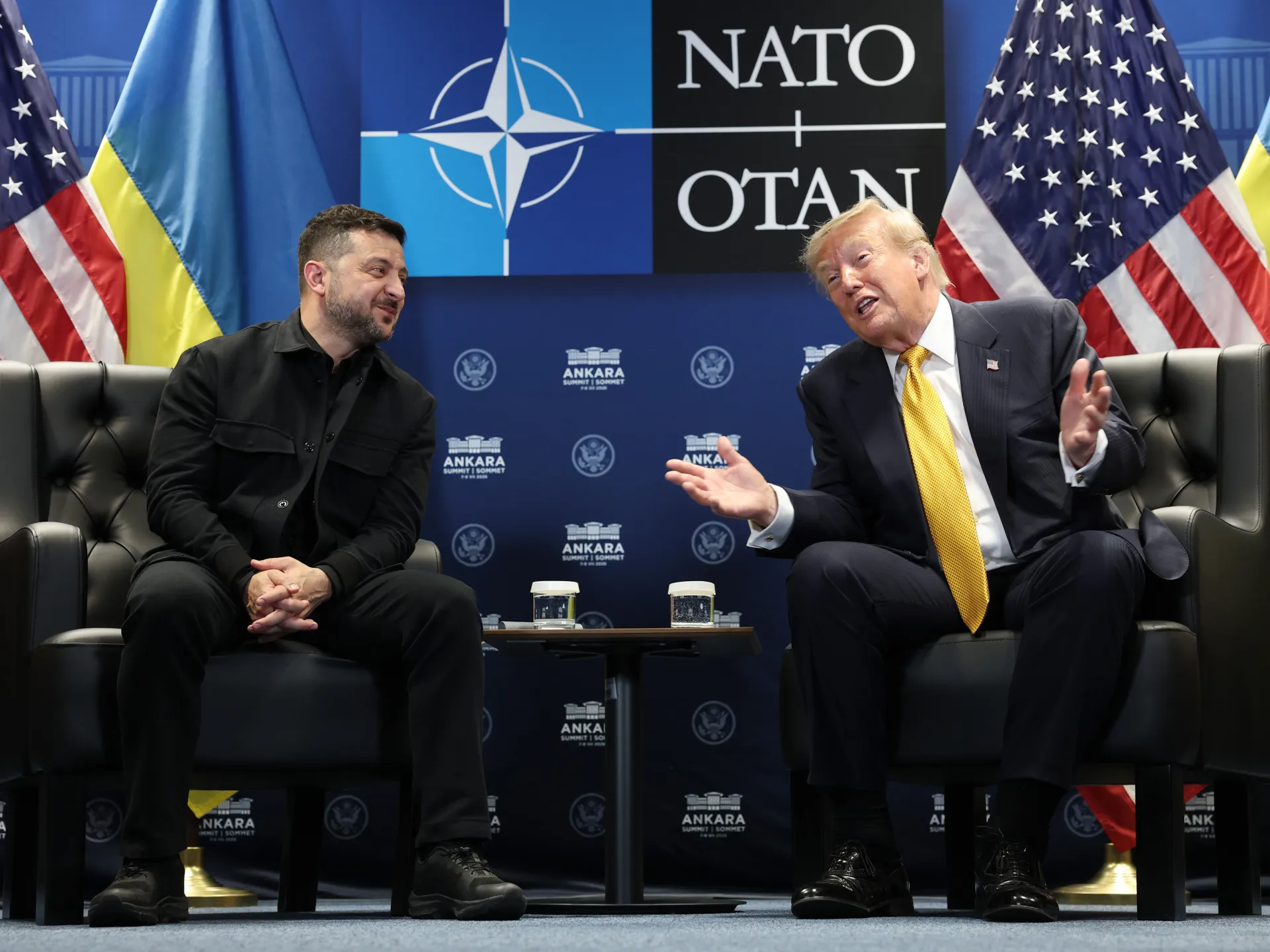
Speaking to reporters on Thursday after returning from this week’s NATO summit in Turkiye, Zelenskyy said that political approval had been obtained from US President Donald Trump when they met in Ankara and the challenge now was to quickly take the practical steps needed to begin production.
Recommended Stories
list of 3 itemsend of list
“We resolved this issue politically,” he said. “It’s now very important that our technical teams, all our representatives from different ministries, representatives of the executive branch, start working on this without delay, so that we can get licences very quickly and start production in Ukraine as soon as possible.”
Although Kyiv has received regular donations of Patriot missiles from its allies for its defence against Russia’s invasion, global supplies are running low, and Ukraine is using the interceptors at a faster rate than they can be produced in the US.
Zelenskyy has been pressing the US to allow Ukraine to start producing the missiles itself to overcome the supply shortage.
At a joint news conference with Zelenskyy in Ankara on Wednesday, Trump told him: “We’re going to give a licence to you to make Patriots. This way, you can’t complain that we’re not giving them enough.”
The Patriot is a US-made air defence system. Its PAC-3 interceptor – short for Patriot Advanced Capability-3 – is one of the few Western weapons capable of shooting down the ballistic missiles Russia has increasingly fired at Ukrainian cities.
Zelenskyy said his meeting with Trump had been a success, and he had also reached agreements with European allies.
“I believe this was a productive summit for Ukraine. In the coming days, we’ll receive a package from the United States, and there were also some separate agreements,” he said, referring to securing more PAC-3 interceptors.
“President Trump has repeatedly emphasised that today, only two to three countries in the world can produce Patriots, because the others are not technologically ready. Ukraine is recognised by America as a country that is ready to do this,” Zelenskyy said.
“Now, after our agreement with the president, our teams, our diplomats, the foreign ministries and defence ministries need to agree on all the remaining technical details. The sooner we reach those agreements, the sooner we will be able to produce Patriots.”
Patriot production will take months
However, Serhii Beskrestnov, an adviser to Ukraine’s defence minister, warned that setting up domestic production of the mobile, surface-to-air systems will take many months.
On his Telegram channel, Beskrestnov said a production licence would typically come with technical process documentation, training for specialists, supplier contacts and foreign consultants to help launch manufacturing.
The main obstacle would be time, rather than Ukraine’s technical or organisational capacity, he said, due to bottlenecks, including the long production cycle for some subcontracted components, which could take 12 to 24 months.
During the NATO summit, Trump praised Zelenskyy for doing “an amazing job”, a sharp change in tone from past criticisms of the Ukrainian leader.
Trump insisted that he remained determined to facilitate a peace deal between Russia and Ukraine.
“It’s not the easiest; not the easiest thing,” the US president said of an eventual peace settlement. “There’s a lot of commitment, and there’s a lot of love of the countries and everything else. But I think we’ve made a lot of progress in the last couple of weeks.”
South Korean computer chip maker SK Hynix has raised $26.5bn (£19.8bn) in its New York share offering, marking the largest ever listing by a foreign firm in the US.
The company, a key supplier to artificial intelligence (AI) chip giant Nvidia, said on Thursday that it had sold 177.9 million American depositary shares for $149 each. The shares are set to begin trading on Friday on the Nasdaq.
Its share price has more than tripled in South Korea this year, which along with Samsung Electronics has helped boost the benchmark Kospi index by more than 70% over the same period.
SK Hynix is one of the world’s leading memory chip makers. The industry has been given a major boost by the hundreds of billions being spent on AI.
Shares in rivals Samsung Electronics and Micron have more than doubled in recent months.
The US listing gives SK Hynix easier access to huge amounts of potential investment from the world’s biggest economy, which has fewer barriers than South Korea, said Seoul National University finance professor Jaewon Choi.
Traders are closely watching the listing as a “yardstick to test the water” for whether investor enthusiasm for memory chip makers will continue, Choi said.
The AI boom has triggered a rush of companies raising money on the the stock market.
In June, GrokAI owner SpaceX became the world’s biggest ever listing as it raised $85.7bn.
Meanwhile, AI developers Anthropic and OpenAI are preparing to go public, with valuations of more $1tn.
Demand for SK Hynix’s offering was reportedly over seven times more than the number of shares available, highlighting the strong investor appetite for a key company in the AI supply chain.
Each American depositary share is equivalent to a tenth of a Seoul-traded common share, SK Hynix said.
The offering gives US investors a way to buy SK Hynix shares without having to trade via an overseas stock exchange.
The company has pledged major investments to develop South Korea’s chip making and AI capabilities in the coming years.
The country’s government is likely to be counting on SK Hynix’s US listing to raise funds that can support the firm’s domestic investments, said Hanyang University business professor Yun Youngjin.
But the Nasdaq listing carries some risks, especially if investors move money towards the US and away from South Korea’s stock market, Yun added.
In June, the country’s government unveiled plans for more than $880bn of investments in partnership with SK Hynix and Samsung.
Both SK Hynix and Samsung have stock market valuations of more that $1tn, joining growing group of firms which includes tech giants Nvidia, Apple, Microsoft and Google-owner Alphabet.
Weekly insights and analysis on the latest developments in military technology, strategy, and foreign policy.
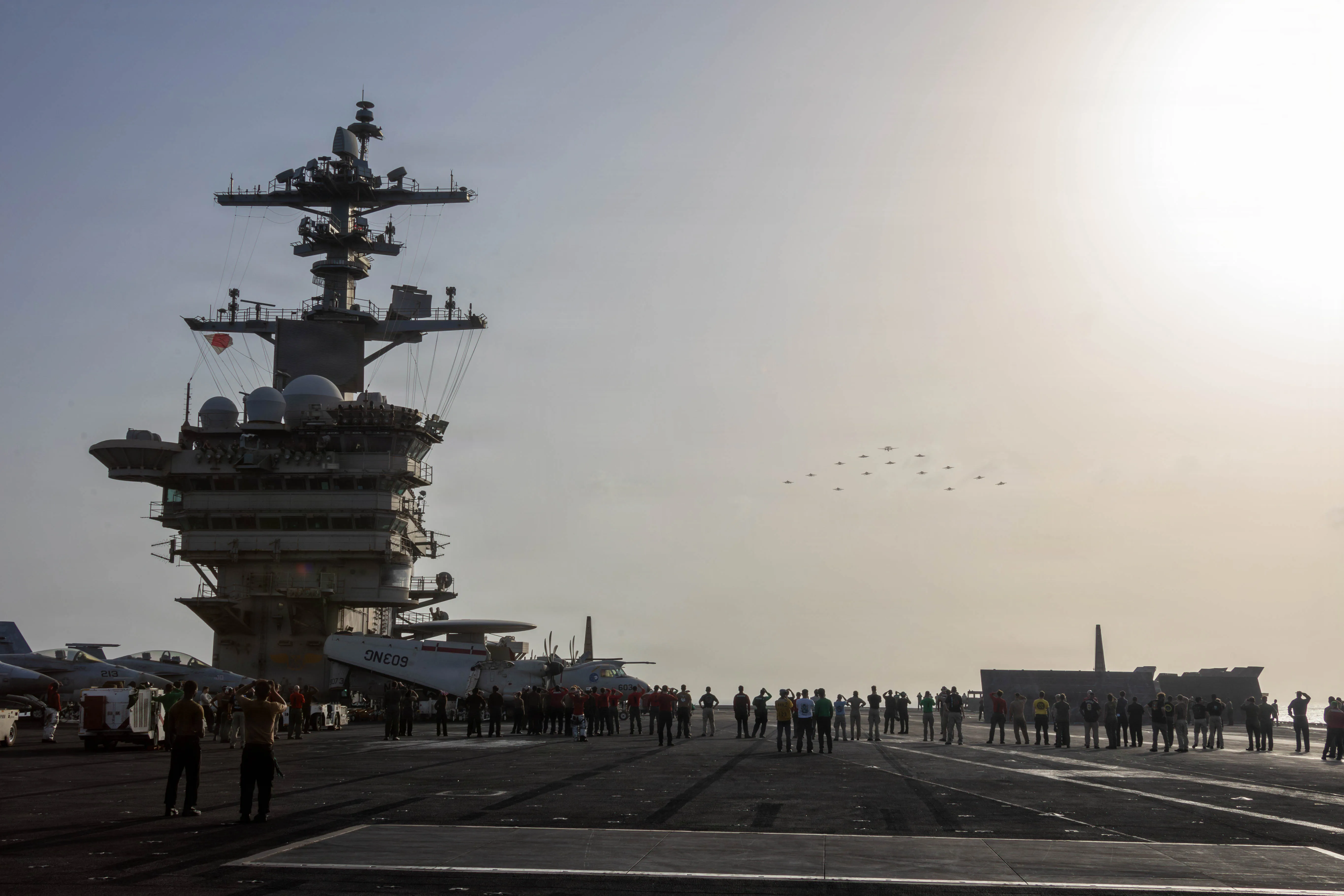
The U.S. Navy’s Nimitz class aircraft carrier USS Abraham Lincoln has been underway for 210 straight days – well over half a year – in support of Operation Epic Fury and the subsequent blockade of Iran. This looks to be a record-setting milestone. Lincoln, the flagship of Carrier Strike Group 3 (CSG-3), is currently operating in Middle Eastern waters.
Aircraft attached to Carrier Air Wing 9 fly over the flight deck of USS Abraham Lincoln, June 28, 2026. U.S. Navy photo U.S. Central Command Public Affa
Abraham Lincoln, the fifth Nimitz class supercarrier and self-styled “most capable CSG in the fleet,” departed Naval Base Guam on December 12, 2025, after a quick one-day port call. Port calls, or temporary visits to friendly countries, allow the crew to disembark for “liberty” – to step on solid ground – and break up the grueling, nonstop schedule experienced during deployments. However, the stop in Guam, a strategic U.S. territory in the Western Pacific, was so brief that much of the crew likely never went ashore.
USS Abraham Lincoln pulls into Naval Base Guam for a scheduled port visit, Dec. 11, 2025. U.S. Navy photo by Valerie Maigue Valerie Lynn Maigue
Lincoln and CSG-3, made up of more than 5,000 Sailors and Marines, quietly left Naval Base San Diego three weeks earlier on November 21, 2025. At the time, the U.S. military buildup in the Caribbean was the focus of public attention, and Lincoln was expected to conduct a routine Pacific patrol. An Iran contingency was on the table following Operation Midnight Hammer, when B-2 bombers struck nuclear targets deep inside Iran, and Lincoln’s Composite Training Unit Exercise (COMPTUEX) included preparing for a fight in the Middle East. COMPTUEXs are weeks-long capstone training events for carrier strike groups that come right before they deploy.
Abraham Lincoln pulls out of San Diego on November 21, 2025. U.S. Navy photo by Mass Communication Specialist 3rd Class Mario Castro Gamez Petty Officer 3rd Class Mario Castro Gamez
After leaving Guam, Lincoln conducted operations in the South China Sea before entering the Indian Ocean and arriving in the northern Arabian Sea in late January. Aircraft from Carrier Air Wing (CVW) 9 launched sorties in the opening salvo of Operation Epic Fury, and the CSG was instrumental in enforcing the naval blockade that followed. Since the Memorandum of Understanding (MOU) was signed on June 17, Lincoln has remained in the northern Arabian Sea, launching retaliatory strikes during the recent skirmishes.
F-35C Lightning II, attached to Marine Fighter Attack Squadron (VMFA) 314, staged for flight operations on the flight deck of USS Abraham Lincoln in support of Operation Epic Fury, Mar. 3, 2026. U.S. Navy photo U.S. Central Command Public Affa
The CSG has been deployed for more than seven months now and would likely be among the first naval assets to rotate out of the theater if an agreement is reached between the U.S. and Iran. The details and scale of the drawdown of forces in the U.S. Central Command (CENTCOM) AOR, as per the MOU agreed to by American and Iranian officials last month, are to be determined within 30 days if a final deal is reached before the deadline in mid-August. A new spate of tit-for-tat strikes just this week has created serious uncertainty around future talks between Washington and Tehran. More than 20 U.S. Navy surface combatants are still operating in the region.
“We’ve officially claimed the title for most consecutive days at sea for any modern aircraft carrier,” Lt. Commander Alexis Travis, an officer currently serving aboard Lincoln, wrote on Instagram on June 16.
We have reached out to the Navy to confirm whether this is indeed a record-breaking period at sea. However, we have not received a response as of the time of publication.
In June 2020, the U.S. Navy did announce that the Nimitz class carrier USS Dwight D. Eisenhower and the Ticonderoga class cruiser USS San Jacinto had set a new record after spending 161 days consecutively operating at sea. Eisenhower did not make a stop in port until the next month, having been at sea for 206 consecutive days in the end. This was, in part, due to the COVID-19 pandemic, when port access was severely limited due to quarantine restrictions. The carrier had left Norfolk in January 2020 for a deployment to the Middle East and launched combat sorties during Operation Freedom’s Sentinel in Afghanistan, returning home nearly seven months later without a single stop. Prior to that, USS Theodore Roosevelt held the record in 2002, supporting the post-9/11 response. Roosevelt left Norfolk in September 2001 to participate in Operation Enduring Freedom and spent 160 days at sea before anchoring in Bahrain for a reprieve in February the following year.
USS Dwight D. Eisenhower transits the Arabian Sea on June 12, 2020, during a record-setting deployment. U.S. Navy photo by Mass Communication Specialist 1st Class Aaron Bewkes
In April, USS Gerald R. Ford, the newest American carrier and largest in the world, logged the longest deployment on record at 326 days. Ford, while deployed for nearly eleven months, was operating primarily in the U.S. European Command-6th Fleet area of responsibility (AOR) and U.S. Southern Command-4th Fleet AOR, which is relatively friendly territory, and made at least nine port calls in Marseille, Oslo, Palma de Mallorca, Split, St. Thomas Island, and Souda Bay. Between port calls and stops to refuel and make emergent repairs, Ford averaged a visit to port every 36 days.
USS Gerald R. Ford arrives at the NATO Marathi Pier Complex in Souda Bay, Crete, Greece, during a scheduled port visit on Feb. 23, 2026. U.S. Navy photo by Mass Communication Specialist 3rd Class Hannah Donahue Petty Officer 3rd Class Hannah Donahue
The Lincoln CSG, which also includes guided-missile destroyers from Destroyer Squadron (DESRON) 21, served as the tip of the spear in Operation Epic Fury. DESRON 21 fired dozens of Tomahawk Land Attack Missiles (TLAMs) against Iran, and provided defensive measures for the CSG, using Standard Missiles and other armaments to intercept incoming threats. The embarked “air wing of the future,” CVW 9, launched thousands of sorties and pressured Iran’s southern axis during the 40-day war, successfully escorted commercial ships through the contested Strait of Hormuz, and hunted and disabled Iranian-affiliated vessels attempting to run the blockade. The carrier’s air wing notably includes F-35C Joint Strike Fighters assigned to Marine Fighter Attack Squadron 314 (VMFA 314), giving it better penetrating capabilities. The CSG has proven its ability to blend and interoperate high, medium, and low-end naval and joint capabilities, for offensive and defensive purposes, as well as integrate across platforms, including manned and unmanned systems, conventional and unconventional, surface and subsurface, overt and covert, and more, during nonstop combat operations.
USS Abraham Lincoln, USS Michael Murphy, USS Frank E. Petersen Jr., USNS Henry J. Kaiser, USNS Carl Brashear, USCGC Robert Goldman, and USCGC Clarence Sutphin. Jr. sail in formation in the Arabian Sea, Feb. 6, 2026. U.S. Navy photo by Mass Communication Specialist 1st Class Jesse Monford
The destroyers escorting Lincoln were able to make port calls before the war began, but some have been at sea for over four months. USS Frank E. Petersen Jr., the Integrated Air and Missile Defense (IAMD) Commander, moored at Navy Terminal in the Port of Duqm, Oman, for two days in mid-February. USS Michael Murphy, the last destroyer to leave the Persian Gulf before the first shots were fired, docked in Dubai, UAE, from February 25-27, and left the day before the city was targeted in the initial waves of Iran’s counterattack. Satellite imagery reviewed by TWZ at the time showed Murphy’s precise location the day prior was targeted. USS Spruance, the only San Diego-based destroyer operating with CSG-3, deployed on the same day as Lincoln, and has been at sea for just as long, with one port call in December in Guam. Spruance was spotted firing a black TLAM on the first day of Epic Fury.
Arleigh Burke-class guided-missile destroyer USS Spruance fires a Tomahawk Land Attack Missile (TLAM) in support of Operation Epic Fury, Feb. 28, 2026. U.S. Navy photo NAVCENT Public Affairs
“Literally no one signed up for this,” Lt. Commander Travis also wrote on Instagram. “And yet here we are, still doing it safely and successfully. Just a strong group doing tough stuff, breaking records and then waking up and doing it again.”
When the crew serving tirelessly aboard Lincoln will next set foot on land is unknown, and with the fate of the U.S.-Iran MOU similarly uncertain, it may be some time.
Contact the author: ian.ellis-jones@teamrecurrent.io
Gold reserves and special drawing rights, held by the UK and the IMF, are the main assets Venezuela is looking to recover. (AFP)
Caracas, July 9, 2026 (venezuelanalysis.com) – Venezuelan Acting President Delcy Rodríguez has called on UK King Charles III to release her country’s gold reserves held at the Bank of England in order to finance relief and reconstruction efforts following the devastating earthquakes that struck Venezuela on June 24.
“I have decided to send a letter, among others, to the King of England asking for the release of the gold being held at the Bank of England. That gold belongs to our people and should be used to address the terrible, tragic consequences of the twin earthquakes,” Rodríguez said in a televised broadcast on Wednesday.
The acting president also revealed that she held a phone conversation with International Monetary Fund (IMF) Managing Director Kristalina Georgieva to discuss the release of Venezuelan resources that remain blocked by the institution.
Earlier on Wednesday, during a virtual meeting with the UN Office for the Coordination of Humanitarian Affairs (OCHA), Venezuelan Foreign Minister Yván Gil likewise urged countries holding Venezuelan assets abroad to “begin a process of releasing” those funds so they can be used for the country’s recovery.
Gil specifically referred to the gold reserves held by the Bank of England and Venezuelan funds blocked under US sanctions. Around 31 metric tons of gold, currently valued at approximately US $4.2 billion, remain frozen in London. In addition, nearly $5 billion in Special Drawing Rights (SDRs) allocated by the IMF in 2021 also remain inaccessible.
On Wednesday, Rodríguez and Georgieva reportedly discussed the use of Venezuela’s $350 million SDR reserve fund, which is different from the SDR allocation.
On June 25, the US Treasury’s Office of Foreign Assets Control (OFAC) issued General License 60, authorizing earthquake relief-related transactions until October. However, OFAC’s waiver does not authorize the unblocking of assets subject to US sanctions regulations or “any other transaction or activity prohibited by another Executive Order.”
Meanwhile, 113 prominent economists, including Isabella Weber, Jeffrey Sachs, and James K. Galbraith, signed an open letter calling for immediate action to “unfetter Venezuela’s humanitarian response and reconstruction from ongoing economic and financial sanctions, asset freezes, and onerous debt burdens.”
“We urge governments, international financial institutions, and creditors to act now, on the principle that lives, public health, and economic recovery take precedence over coercion and collection,” the statement read. The economists suggested mechanisms including emergency liquidity, sanctions relief, and debt cancellation as a “minimum response […] to allow Venezuelans to rebuild with dignity.”
Along similar lines, UN Emergency Relief Coordinator Tom Fletcher warned that the earthquakes are likely to generate “a very difficult economic situation” that could reduce Venezuela’s GDP by “several percentage points,” arguing that sanctions “must be eased so they do not hinder the arrival of humanitarian assistance or recovery efforts.”
Fletcher added that during emergencies, access to financial resources, banking channels, and international cooperation mechanisms can determine how quickly aid, supplies, and reconstruction funding reach affected communities.
Preliminary assessments by the United Nations Development Programme (UNDP) estimate infrastructure and essential services losses at approximately US$6.7 billion. However, the final figure could reach $8.7 billion, depending on housing and asset losses, and the estimates do not include the full extent of infrastructure damage or the long-term reconstruction costs.
For its part, the UN Office for Disaster Risk Reduction (UNDRR) estimates that rebuilding Venezuela will require approximately $37 billion. According to its assessment, $24 billion would be needed to replace damaged buildings—including homes, schools, businesses, and hospitals—while another $13 billion would be required to repair critical infrastructure such as telecommunications, highways, and electricity networks.
Different analyses have placed the recovery costs between $12 and $20 billion.
So far, however, the Trump administration has pledged $300 million in humanitarian assistance, whereas Venezuela’s US-based frozen assets are valued at $11-13 billion. The White House also retains control over Venezuela’s oil export revenues, returning a portion of the funds to Caracas at its discretion.
Rodríguez announced on Wednesday that countries offering humanitarian aid can monitor its distribution through a digital platform used to coordinate deliveries across the 87 temporary shelters established for displaced families throughout the country. The acting president has vowed to prioritize the well-being of families who lost their homes and to provide new housing solutions in the coming months.
The latest official update placed the death toll from the earthquakes at 3,889, while the number of injured remains at 16,740 and the number of displaced people stands at 17,907.
Generally, Gospel Day falls on July 10th, but it may be shifted around depending on what days of the week the three days of holidays cover. These dates are not usually updated until close to the start of the year, so check back here for the latest dates.
The main religion in Kiribati is Christianity. It was brought to the islands by missionaries in the 19th century. Today, Roman Catholics and Protestants account for the large majority of followers.
This holiday was established to create a day for Kiribatians of all faiths to join in combined services to give thanks and strengthen the sense of shared community between the different branches of Christianity in the country.
Regional health agency warns of increased risk of a disease outbreak after Venezuela’s twin earthquakes
Published On 9 Jul 20269 Jul 2026
Venezuela’s authorities say the death toll from twin earthquakes last month has risen to 3,889, as regional health agencies warn of an increased risk of disease.
Lawmaker Jorge Rodrigues said on Thursday at least 16,740 people had been injured and 17,907 displaced.
Recommended Stories
list of 3 itemsend of list
The Pan American Health Organization (PAHO) warned that displaced people across Venezuela’s northern coast, the area most affected by the tremors, are at risk of disease because of limited access to clean water and regular medical care.
“In the coming weeks, the greatest health risks may stem not only from injuries caused by the earthquakes, but also from disruptions to health services, overcrowded conditions, deficiencies in water and sanitation and reduced access to vaccination and routine healthcare,” PAHO’s director Jarbas Barbosa said.
The agency is working with Venezuela’s health ministry to improve vaccine access and trace any outbreaks of respiratory or digestive illnesses, especially in shelters set up for those who lost their homes.
The United Nations launched an appeal for roughly $300 million to assist 1.3 million people in urgent need of aid in Venezuela.
PAHO urged immediate disbursement of the remaining $15 million in requested emergency aid to repair damaged hospitals and to maintain basic sanitation in camps for the displaced to prevent a health emergency.
The current heatwave is not expected to break any daily temperature records, however, on Thursday the Met Office announced there have been eight days in 2026 where the heat has reached or exceeded 34C.
There were two in the May heatwave, four in June’s and so far two in this one, which is a record for the calendar year, surpassing 1976 and 2020. A further 34C plus reading is anticipated on Friday.
Wales also recorded its hottest June day with 35.9C in Cardiff, while Northern Ireland equalled its June record with 30.8C in Castlederg, County Tyrone.
Scotland fell just slightly short of hitting its all-time June record which was 32.2C set in 1893. In June its top temperature was 31.2C at Threave, in Dumfries and Galloway.
In this July heatwave the highest temperature so far this time has been 35.5C at Wisley in Surrey, on Thursday.
Although temperatures will drop off a little into the weekend, many places will still reach the official heatwave thresholds through much of next week.
People may be drawing comparisons with 1976, where the UK saw 16 consecutive days above 30C, but this record is not likely to be broken.
The highest temperature recorded in the UK was during the unprecedented heatwave of 2022, when an astonishing 40.3C was recorded in Coningsby, Lincolnshire.
Weekly insights and analysis on the latest developments in military technology, strategy, and foreign policy.
An image has appeared, apparently for the first time, showing a Chinese J-15T carrier-based fighter launching while carrying four anti-ship missiles. The photo offers the clearest indication yet that China’s rapidly evolving carrier force is overcoming one of its longstanding operational constraints: getting heavily loaded strike fighters airborne from its flattops.
The image, at the top of this story, shows a J-15T in full afterburner moments before leaving the deck of the Fujian, the first People’s Liberation Army Navy (PLAN) carrier equipped with catapults. The fighter is armed with four YJ-83K anti-ship missiles — double the number previously seen carried by a J-15 — amounting to a weapons load of roughly 6,400 pounds before accounting for any additional stores that may not be visible.
Previously, in fact, it seems that the latest J-15T version has only ever been seen with a single YJ-83K training round, while the aircraft was still in prototype form.
Two views of a prototype J-15T carrying a single YJ-83K training round and an inert PL-15 medium-range air-to-air missile. via Chinese internetvia Chinese internet
The YJ-83K is a widely used subsonic anti-ship missile, broadly equivalent to the U.S.-made AGM-84 Harpoon. The radar-guided, turbojet-powered weapon has a reported range of around 112 miles and is armed with a 360-pound high-explosive, semi-armor-piercing warhead. The YJ-83K is a sea-skimming missile cruising at an altitude of 65-100 feet, before dropping down to 16-24 feet during the terminal phase. Most significantly, each of these weapons weighs around 1,600 pounds.
A YJ-83K anti-ship missile under the wing of a STOBAR J-15 version. via Chinese internet
The very reason behind the development of the J-15T was to maximize the potential of Flanker operations from the Fujian, which is equipped with an electromagnetic aircraft launch system (EMALS), and subsequent carriers. As such, the J-15T is primarily distinguished from the original J-15 in being equipped for catapult takeoff but assisted recovery (CATOBAR) operations, as well as short takeoff but assisted recovery (STOBAR) operations.
Videos provide a comparison of a STOBAR J-15 carrier launch and a CATOBAR J-15T launch from Fujian:
The previous two PLAN aircraft carriers, the Liaoning and Shandong, both employ ‘ski-jump’ takeoff ramps to launch fixed-wing STOBAR aircraft.
As we have discussed in the past, the primary benefit of the J-15T is its ability to be catapult-launched from a carrier with a heavier payload of fuel and weapons. After all, the Flanker airframe has always been able to carry impressive fuel and weapons loads, but this has been strictly limited when configured for STOBAR operations. This is something that has hampered Russian Navy carrier operations, as much as Chinese ones.
Another STOBAR J-15 armed with a YJ-83K, on the deck of the Liaoning. via Chinese internet
Also significant is the fact that the J-15T has started to introduce domestically produced WS-10H turbofans in place of the Russian-made AL-31F engines previously found on production J-15s.
One of the prototype J-15Ts fitted with WS-10H engines. via Chinese internet
In the past, it appears that the heaviest loads seen carried by STOBAR J-15s launched from the Liaoning or Shandong comprised two YJ-83Ks and four air-to-air missiles, or, for air defense, four PL-12 medium-range air-to-air missiles and two short-range PL-8B air-to-air missiles.
Regardless, the fact that J-15Ts are now launching from the carrier with weapons loads of around 6,400 pounds is significant.
As well as increasing the anti-shipping potential of the J-15T, the same payload could be translated into additional fuel or other weapons loads.
Among the other weapons options for the jet are the more advanced PL-10 short-range and PL-15 medium-range air-to-air missiles. The J-15T has also been noted with the long-range YJ-15 anti-ship missile, and with a ‘buddy’ refueling pod. Other versions of the YJ-83K that could find their way onto the J-15 include the improved YJ-83KH, which features an imaging-infrared seeker and extended range.
A poor-quality but interesting image of a J-15T carrying a pair of YJ-15 anti-ship missiles. via Chinese internet
The ability for the J-15T to launch from a catapult-equipped carrier with a heavier payload doesn’t just impact the potential of the strike fighter. It will also translate to the two-seat carrier-compatible J-15 versions, intended to take on additional roles. Chief among these is the CATOBAR-capable J-15DT electronic warfare aircraft, intended to operate in a role similar to the U.S. Navy’s EA-18G Growler. With its array of external jamming pods, the J-15DT also needs to launch (and recover) at heavier weights to make the most of its potential.
A J-15DT catches the wire onboard the aircraft carrier Fujian. via Chinese internet
There are also rumors concerning a CATOBAR version of the two-seat J-15S, which could serve as a carrier trainer and/or as a multirole strike platform equivalent to the F/A-18F. Here, again, the EMALS will greatly enhance its capabilities.
Beyond marking another milestone in the rapid evolution of China’s carrier aviation capabilities, the new image suggests that the combination of the J-15T and the catapult-equipped carrier Fujian is beginning to deliver the kind of fully armed launch performance that its ski-jump carriers have long struggled to achieve.
Turkey emerged as one of the biggest diplomatic winners from the NATO summit in Ankara after President Donald Trump lavished praise on Turkish President Recep Tayyip Erdogan, promised to lift U.S. sanctions and signalled openness to restoring Turkey’s access to the F-35 fighter jet programme.
The public display of warmth contrasted sharply with Trump’s criticism of several NATO allies during the summit and highlighted improving U.S.-Turkey relations after years of tensions.
Turkey rolls out high-profile welcome for Trump
Turkey spared little effort in welcoming Trump to Ankara.
The visit featured a red, white and blue aerial display by Turkish jets, while a newly opened airport terminal was named after the U.S. president. Erdogan personally greeted Trump at the airport before the two leaders walked together, exchanged warm remarks and held talks ahead of the summit.
Stay ahead of the geopolitical week.
MD Briefing delivers expert analysis across five global fronts — the Indo-Pacific, energy, geoeconomics, European security, and the Middle East — every Monday morning. Free.
Trump later described Erdogan as a close friend and repeatedly praised the Turkish leader during the two-day gathering.
Trump says Erdogan convinced him to attend
For Turkish officials, securing Trump’s attendance was itself considered a diplomatic achievement.
Trump, who has frequently criticised NATO and questioned the alliance’s value, said he attended the summit because Erdogan was hosting it.
Erdogan welcomed the remarks after the summit.
“It was valuable that Trump emphasised the importance he places on myself and our friendship,” Erdogan said.
US signals shift on sanctions and F-35 fighter jets
The most significant outcome for Ankara was Trump’s indication that he intends to remove U.S. sanctions imposed after Turkey purchased Russia’s S-400 missile defence system in 2019.
Trump also said he was willing to consider allowing Turkey back into the F-35 stealth fighter programme, although he later clarified that he had not made a final decision.
If implemented, both moves would reverse major elements of U.S. policy that had severely strained bilateral relations during Trump’s first presidency.
U.S. lawmakers have previously insisted Turkey cannot participate in the F-35 programme while retaining the Russian-made S-400 system, making congressional approval uncertain.
Turkey could also face complications with Russia because agreements governing the S-400 purchase include end-user obligations that may limit Ankara’s options.
As a result, the announcements currently represent political commitments rather than guaranteed policy changes.
Erdogan strengthens Turkey’s position inside NATO
The summit reinforced Turkey’s ambition to play a larger role within NATO.
As the alliance’s second-largest military, Turkey has increasingly promoted itself as an indispensable security partner while seeking greater participation in European defence initiatives.
Trump also publicly defended Erdogan against criticism from Israeli Prime Minister Benjamin Netanyahu, who opposed potential U.S. sales of F-35 fighter jets to Turkey.
The episode underscored Ankara’s growing diplomatic influence within the alliance.
Trump overshadows summit with disputes involving allies
While relations with Turkey improved, Trump generated fresh tensions elsewhere during the summit.
He threatened to halt U.S. trade with Spain over defence spending disputes and repeated claims regarding Greenland, drawing criticism from fellow NATO members.
Despite those disagreements, NATO Secretary General Mark Rutte later described the summit as demonstrating alliance unity.
Human rights concerns receive limited attention
The summit also highlighted how Turkey’s strategic importance has reduced public Western criticism over democratic issues.
The gathering took place amid arrests of opposition figures, journalists and a prominent comedian in Turkey, prompting questions about democratic freedoms.
Rutte reiterated that democracy includes freedom of expression, free media and the right to protest.
Opposition figures argued Erdogan’s increasingly close relationship with Washington reflects growing political dependence on the United States, while critics contend Western governments have become less vocal about human rights as Turkey’s military and geopolitical importance has grown.
Future outlook
The NATO summit could mark a turning point in U.S.-Turkey relations if Trump’s pledges on sanctions relief and the F-35 programme translate into policy. However, congressional resistance, Turkey’s continued possession of the Russian S-400 system and wider geopolitical considerations remain significant obstacles. Ankara is also expected to continue pushing for greater influence within NATO and broader participation in European defence initiatives.
Analysis
The NATO summit marked one of the strongest public displays of U.S.-Turkey relations in years, with President Donald Trump using the gathering to signal a willingness to reset ties with Ankara after years of friction over Turkey’s purchase of Russia’s S-400 missile defence system. For President Recep Tayyip Erdogan, simply hosting Trump and receiving repeated public praise from him represented a significant diplomatic victory that reinforced Turkey’s strategic importance within the alliance.
Trump’s promises to lift sanctions and reconsider Turkey’s return to the F-35 fighter jet programme address two of Ankara’s longest-standing demands. However, turning those pledges into reality will be far more difficult. U.S. law and congressional opposition remain major obstacles, particularly while Turkey continues to possess the Russian-made S-400 system. Moscow could also object if Ankara takes steps that undermine agreements linked to the missile purchase.
The summit also highlighted a broader shift in Western priorities. During previous U.S. administrations, especially under Joe Biden, democratic backsliding and human rights concerns were central issues in relations with Turkey. This time, those concerns received relatively little attention as NATO focused on defence spending, military cooperation and regional security, reflecting Turkey’s growing value as a defence producer and a key NATO member on the alliance’s southeastern flank.
Trump’s warm embrace of Erdogan contrasted sharply with his confrontational approach toward several other NATO allies, including Spain and Denmark. That dynamic allowed Turkey to emerge from the summit with enhanced diplomatic standing even as broader alliance tensions persisted.
Whether this diplomatic momentum produces lasting policy changes will depend on decisions in Washington after the summit. If sanctions are eased and progress is made on the F-35 issue, bilateral ties could enter their most constructive phase in years. If congressional or legal barriers prevent those moves, however, the summit may ultimately be remembered more for its symbolism than for delivering concrete strategic gains.
England defender Jarell Quansah has been given a two-match ban for his red card against Mexico.
Quansah was sent off in the 54th minute of the 3-2 win following a high challenge on Jesus Gallardo.
It was classed as serious foul play, meaning the Bayer Leverkusen player was handed an extra match on top of the automatic one-game suspension by Fifa’s disciplinary committee.
Former Liverpool man Quansah will miss Saturday’s quarter-final with Norway (22:00 BST) and a potential semi-final against Argentina or Switzerland.
Quansah, 23, will be available if England reach the final in New Jersey on 19 July.
The Football Association (FA) was considering whether to appeal, but under the tournament regulations there is no avenue to contest the ban.
However, BBC Sport has been told the FA made very strong representations to Fifa over the process that reached the Quansah red card decision, arguing that the referee was shown a still image of the tackle and slow-motion replays before being shown the incident in real-time on the pitchside screen, and that this could have resulted in ‘outcome bias’.
In the Premier League, officials are always shown incidents at full speed first – though England’s top flight is an outlier.
The ban complicates matters for head coach Thomas Tuchel at right-back.
Quansah filled in against Mexico while England were without the injured Reece James, with Djed Spence only used as a substitute after a minor fitness issue.
However, Tuchel has said he expects James to be available against Norway after missing games because of the hamstring injury he sustained in the second group match against Ghana.
Tuchel’s assistant coach Anthony Barry said the Quansah news was “disappointing”.
“Disappointing, not with the decision, just the fact that we lose a good player,” he added.
“He was excellent in training, and of course we have some injuries in that position, so it looked like a space had opened up for Jarell.
“But the decision’s been made, we won’t waste any more energy on it. Overall for us, we lose a good player for two games, but it’s just another hurdle that we have to overcome.”
Winger Bukayo Saka said the ban was “incredibly frustrating for us, and for him”.
“But it is what it is. We have to adapt and pick a team to win against Norway,” he added.
Fifa has announced that French referee Clement Turpin, who took charge of England’s 4-2 win over Croatia, has been appointed to officiate the Norway game.
Quansah will miss England’s quarterfinal against Norway after being sent off for a sliding studs-up tackle.
Published On 9 Jul 20269 Jul 2026
England defender Jarell Quansah has been suspended for two matches following his red card in the team’s World Cup last-16 victory over Mexico, leaving manager Thomas Tuchel short of back-line options for the latter stages of the tournament.
The two-match ban, confirmed on Thursday, means that Quansah will miss England’s quarterfinal against Norway on Saturday in Miami and a potential semifinal should they advance.
Quansah was sent off after a video review determined that he made a sliding studs-up tackle in the round-of-16 match against the cohosts.
Jude Bellingham’s goal and a Harry Kane penalty double inflicted a rare defeat on Mexico at their Estadio Azteca as 10-man England won a nerve-racking World Cup classic 3-2 to reach the quarterfinals.
England had been weighing a possible appeal after FIFA overturned a one-match suspension imposed on United States striker Folarin Balogun earlier in the tournament.
The defender would only be available again for selection if England reach the World Cup final.
The suspension is a setback for Tuchel as England attempt to continue their run in the tournament, with the team’s defensive problems compounded by injuries.
England midfielder Jordan Henderson had surgery on his left wrist following an injury sustained after tripping over an advertising board during the team’s celebrations for the win over Mexico. He rejoined the team at its camp in Kansas City and has been ruled out for the remainder of the World Cup.
A day earlier, France coach Didier Deschamps revealed that an appeal against a yellow card shown to Michael Olise in the World Cup last-16 win over Paraguay had been rejected by FIFA.
“The yellow card has not changed. We were notified by FIFA this morning; it has been maintained,” Deschamps told reporters in Foxborough on Wednesday, on the eve of France’s quarterfinal showdown with Morocco at the Boston Stadium.
A court ruling clears the way for Marine Le Pen to run for president next year.
A French court ruling allows the leader of the far-right National Rally to run for president next April. It reduced and suspended Marine Le Pen’s prison sentence and ban on seeking public office, while upholding her conviction over a European Parliament jobs scam.
She will have to wear an electronic monitor for a year while on house arrest. Le Pen has said it will prevent her from campaigning and plans to challenge the decision in France’s highest court. But she is leading in opinion polls.
Recommended Stories
list of 1 itemend of list
Will her candidacy take her all the way to the Elysee Palace? Or will voters who are wary of Le Pen’s nationalist, anti-migrant policies unite around a common rival, as they have in the past?
Presenter: Tom McRae
Guests:
Bruno Cautres – Professor at the Centre for Political Research at Sciences Po
Rim-Sarah Alouane – Legal scholar specialising in civil liberties and constitutional law
Victor Mallet – Senior editor and former Paris bureau chief at The Financial Times and author of the book Far-Right France: Le Pen, Bardella and the Future of Europe
Weekly insights and analysis on the latest developments in military technology, strategy, and foreign policy.
Berlin says it has agreed a deal with the United States to buy U.S.-made Tomahawk cruise missiles, providing a significant boost to Germany’s long-range strike capabilities. The move comes after the United States appeared to renege on its plan to deploy a long-range fires battalion in Germany, and as NATO allies in Europe race to enhance their conventional standoff missile deterrent against Russia.
An agreement on the sale of Tomahawk missiles to Germany was reached with U.S. officials on the sidelines of the NATO Summit in Ankara this week, German Chancellor Friedrich Merz announced after his return from Turkey.
U.S. President Donald Trump and German Chancellor Friedrich Merz shake hands during the 36th NATO Summit in Ankara, Turkey, on July 7, 2026. Photo by Mehmet Ali Ozcan/Anadolu via Getty Images Anadolu
“This will close an important strategic gap in our defense, and at the same time, we will work to develop our own European systems and station them in Europe,” Merz told the Bundestag lower house of parliament in Berlin today.
Citing German government sources, Reutersreports that a letter of intent for the procurement was signed Tuesday.
Germany had previously sought to buy Tomahawks, but these efforts had been rebuffed by Washington.
Specifically, Berlin wanted to acquire the ground-launched version of the system, with up to 400 of the latest Tomahawk Block Vb missiles, valued at more than $1 billion, according to reports.
Block V Tomahawks seen with its distinctive ‘chined’ nose cone. U.S. Navy
All Block V Tomahawks are provided with a two-way datalink, allowing them to receive course correction and other targeting updates, as well as be entirely re-tasked, during flight. The Block Vb subvariant is fitted with a joint multi-effects warhead that makes it suitable for striking a wider variety of land targets.
The Tomahawk Block V has a range exceeding 1,000 miles depending on the exact configuration.
Currently, the longest-range indirect fires capability fielded by the German Army is the M270 Multiple Launch Rocket System (MLRS), known in German service as the Mittleres Artilleriraketensystem II (MARS II). The longest-range artillery rockets currently available for the system can hit targets out to around 43 miles. Germany has not received the far larger Army Tactical Missile System (ATACMS) short-range ballistic missiles that can engage threats out to 186 miles depending on the variant.
An M270 of the German Army fires rockets during an exercise. Bundeswehr/Carl Schulze Carl Schulze
As well as the Tomahawk missiles, Germany will need to buy the Typhon launchers to deploy them. Reports in the German media suggest that a request for the launchers was already made in July 2025.
Germany had also been looking at the possibility of acquiring the naval version of the Tomahawk, to arm its planned Type 127 frigates, although these have since been canceled.
Regardless, acquisition of the Tomahawk would be a big deal for Germany.
Outside of the United States, only Australia, Japan, the Netherlands, and the United Kingdom currently use the Tomahawk. All of these export operators use the naval version of the missile, making the German development all the more significant.
Washington’s approval to sell the Tomahawk/Typhon combination to Berlin would seem to confirm that the United States won’t, after all, be sending a U.S. Army long-range fires battalion to Germany.
A complete U.S. Army Typhon system. U.S. Army Darrell Ames
In May, amid something of a breakdown in relations between Berlin and Washington, triggered by German criticism of the U.S. war in Iran, the United States announced it would reduce its military presence in Germany by 5,000 soldiers.
At the same time, it was reported that the Pentagon had also decided to abandon plans to deploy the Army’s 2nd Multi-Domain Task Force (2MDTF) to Germany.
German officials moved to try to smooth things over, stating that there had been no “definitive cancellation” of the missile deployment by the United States.
First announced under the Biden administration, the 2MDTF was to start “episodic deployments” to Germany in 2026, followed by “longer-term stationing” of various types of long-range missiles in the same country. As well as Tomahawk, 2MDTF’s Typhon launchers can fire the SM-6 multi-purpose missile. In the future, they are also intended to be armed with “developmental hypersonic weapons,” like the Dark Eagle, and potentially others like the Operational Fires (OpFires) hypersonic missile and the Precision Strike Missile (PrSM) short-range ballistic missile.
A Typhon system fires an SM-6 missile during a live-fire exercise in Australia. U.S. Army photo by Sgt. Perla Alfaro Sgt. Perla Alfaro
With that in mind, Germany’s Typhon launchers could potentially receive some of these missiles in the future, too.
For Germany, however, the Tomahawk procurement is seen as a temporary solution until domestically (or European) developed long-range weapons become available.
For the longer term, Germany is part of the European Long-Range Strike Approach (ELSA). The initiative, led by France and also involving Italy, Poland, Sweden, and the United Kingdom, aims to develop a new long-range strike capability, potentially in the form of a cruise missile, a ballistic missile, or a combination of both.
Earlier announcements indicated that ELSA is intended to deliver a missile with a range of 1,000 to 2,000 kilometers (621–1,243 miles), with entry into service planned for the 2030s.
Separately, Germany and the United Kingdom have also unveiled plans to jointly develop a deep precision-strike weapon with a range exceeding 2,000 kilometers. However, the project remains at an early stage, with no industrial framework yet agreed.
New heights in 🇩🇪🇬🇧 military cooperation – Defence Ministers Healey & Pistorius agreed: 👉 develop 2,000km Deep Precision Strike Capability 👉 joint procurement of Sting Ray torpedoes for P-8 Poseidon aircraft 👉 strategic land systems partnership 👉 continue BOXER co-operation pic.twitter.com/W5U3cJaWAY
— German Embassy London (@GermanEmbassy) May 16, 2025
Together, these initiatives underscore the growing determination among European NATO members to develop long-range strike capabilities in response to the increasing Russian threat along the alliance’s eastern flank.
This is a strategic defeat for Putin who lobbied hard against selling the Tomahawks to Germany, as they provide credible deterrence against Russia.
The Kremlin succeeded for some time in convincing U.S. that this would be a problematic escalation. Yet ultimately Merz prevailed. https://t.co/krs1LU5IlK
— Hans von der Burchard (@vonderburchard) July 9, 2026
Germany’s planned procurement of ground-launched Tomahawk cruise missiles reflects a dramatically altered European security environment following the collapse of the Intermediate-Range Nuclear Forces (INF) Treaty. Signed in 1987 at the height of the Cold War, the accord prohibited the United States and the Soviet Union — and later Russia — from deploying ground-based ballistic and cruise missiles, whether nuclear or conventionally armed, with ranges between 500 and 5,500 kilometers (310 and 3,420 miles).
Ironically, one of the weapons outlawed by the INF Treaty was an earlier ground-launched version of the Tomahawk cruise missile, the U.S. Air Force BGM-109G Gryphon, which was also deployed in Germany, not without controversy.
A BGM-109G Gryphon Ground-Launched Cruise Missile (GLCM) rises from the transporter-erector-launcher (TEL) during a test firing. HUM Images/Universal Images Group via Getty Images HUM Images
The treaty effectively unraveled after the United States withdrew in 2019 during President Trump’s first term, citing Russia’s deployment of the prohibited 9M729 (SSC-8 Screwdriver) ground-launched cruise missile, an allegation Moscow has consistently denied. Russia formally suspended its own participation in the agreement in 2023, removing the last legal barriers to the deployment of intermediate-range land-based missiles in Europe.
A 9M729 missile container at the Patriot Congress and Exhibition Center, outside Moscow, Russia, in 2019. Xinhua/Bai Xueqi via Getty Images Bai Xueqi
Since then, both Russia and NATO have moved to rebuild capabilities that had been absent from the continent for more than three decades. Even before its formal withdrawal, Moscow had signaled its intention to field new INF-range missiles in response to comparable U.S. deployments, while repeatedly using nuclear signaling — including high-profile exercises and explicit threats — in an effort to deter greater Western support for Ukraine.
Russia has also used the war in Ukraine to demonstrate and refine its expanding missile arsenal. In November 2024, it employed the new Oreshnik intermediate-range ballistic missile in combat for the first time. Although the version used against Ukraine carried conventional warheads, perhaps even inert ones, a nuclear-armed Oreshnik would be capable of striking most major Western European capitals and critical NATO military infrastructure.
Ukrainian Security Service has demonstrated the pieces of Oreshnik that Russia used to attack Lviv region.
The parts found so far: ▪️ stabilization and guidance unit (the missile’s “brains”, essentially); ▪️ spare parts from the engine installation; ▪️ fragments of the… https://t.co/Tk9XwcSfAfpic.twitter.com/KHsMvoE6tE
At the same time, there are indications that Russia has employed the 9M729 operationally in Ukraine, while continuing work on additional intermediate-range strike systems, including a reported ground-launched hypersonic missile that could be based on the Zircon naval missile, or an enhanced Iskander-M ballistic missile. Russia has also reinforced its forward posture by deploying nuclear-capable Iskander missiles and MiG-31 Foxhound aircraft armed with Kinzhal air-launched ballistic missiles to Kaliningrad in the Baltic, while transferring tactical nuclear weapons, or at least their delivery infrastructure, to neighboring Belarus.
Against this backdrop, Germany’s decision to acquire ground-launched Tomahawks is part of a broader effort to restore NATO’s long-range conventional deterrence and strike capabilities. The missiles are part of a wider European push to counter Russia’s growing inventory of intermediate-range weapons and reestablish a more credible balance of long-range conventional firepower on NATO’s eastern flank. This has become all the more important since the previous security guarantees provided to the continent by the United States are increasingly being questioned.
While we don’t yet know the numbers of Tomahawks involved, they will still likely be divorced from the reality of a high-intensity conflict. Ukraine is now striking Russia with long-range cruise missiles regularly. The numbers needed across NATO for a sustained engagement will be very high, so collectively Europe will likely only accelerate and broaden its long-range missile capabilities based on these lessons learned.
Germany’s Tomahawk procurement reflects a fundamental shift in NATO’s approach to deterrence in Europe, where long-range conventional strike capabilities are once again viewed as essential rather than escalatory. With Russia fielding new intermediate-range missiles, NATO’s relations with the United States under strain, and European allies launching their own development programs in this area, a new missile race is accompanying the changing security environment on the continent.
Syria regains voting rights in the OPCW as new leadership makes progress in addressing chemical weapons issues.
Published On 9 Jul 20269 Jul 2026
The global chemical weapons’ watchdog has announced it has handed voting rights back to Syria because “concrete steps” have been taken to address outstanding issues since the fall of the Bashar al-Assad regime.
In a statement published on Thursday, the Organisation for the Prohibition of Chemical Weapons (OPCW) said the decision follows a “significant change” in circumstances since Syria was suspended in 2021. That was due to the former government’s failure to declare the full scope of its chemical weapons programme and the repeated use of poison gas during the civil war.
Recommended Stories
list of 3 itemsend of list
Since a lightning offensive ousted long-time ruler al-Assad in 2024, “the new Syrian authorities committed to fulfilling Syria’s obligations under the Convention and have since taken concrete steps to cooperate with the Technical Secretariat to achieve this goal”, read the statement.
Actions taken by the new government of President Ahmed al-Sharaa include facilitating verification activities and taking initial steps in destroying identified remnants.
“These decisions reflect the tangible progress achieved through continued cooperation and constructive engagement between the Technical Secretariat and the Syrian Arab Republic, with the support of the wider community of States Parties,” said OPCW Director-General Fernando Arias.
In 2013, Syria joined the OPCW and agreed to the destruction of its weapons to be supervised by the watchdog. Back then, Syria was believed to possess about 1,000 tonnes of toxins and had agreed to destroy them under a joint Russian-US proposal designed to avert a US military strike on its territory.
Syria’s decision followed a global outcry over a suspected chemical attack that same year in Ghouta, an eastern suburb of the capital Damascus.
US intelligence estimated that at least 1,400 people, including 426 children, were killed in that attack which it attributed with “high confidence” to the Syrian government. Al-Assad denied involvement and blamed rebels.
According to OPCW, while Syria submitted an initial declaration of its chemical weapons programme, the former government did not declare all its chemical weapons programme and attempted to mislead inspectors about its overall scope and scale.
NATO leaders emerged from their summit in Ankara relieved that U.S. President Donald Trump reaffirmed Washington’s commitment to the alliance, but European officials acknowledge that relations with the United States remain fragile and expect further periods of uncertainty.
While the gathering ended on a positive note, diplomats say the alliance continues to face questions over Trump’s long-term approach to NATO, burden sharing and Europe’s security.
Summit ends on a more positive note
The two-day summit began amid fresh tensions after Trump criticized several allies, announced he wanted to cut off U.S. trade with Spain, and revived disputes over defense spending.
However, the atmosphere improved significantly by the end of the meeting.
Stay ahead of the geopolitical week.
MD Briefing delivers expert analysis across five global fronts — the Indo-Pacific, energy, geoeconomics, European security, and the Middle East — every Monday morning. Free.
Trump endorsed the summit declaration reaffirming NATO’s Article 5 mutual defense commitment, praised the unity among allies, and approved a license allowing Ukraine to manufacture Patriot missile interceptors.
European leaders viewed those moves as an important signal that Washington remains committed to the alliance despite months of increasingly strained relations.
Trump also described the summit as one filled with “love,” easing fears that the gathering could end in open confrontation.
European allies remain cautious
Despite the improved tone, European governments are preparing for continued volatility in transatlantic relations.
Officials note that Trump’s approach toward NATO has often shifted rapidly, creating uncertainty over U.S. security commitments.
Recent disputes have included Trump’s renewed interest in Greenland, criticism of allies during the Iran conflict, and repeated suggestions that European members should assume greater responsibility for their own defense.
Many European capitals believe maintaining strong ties with Washington remains essential despite these disagreements.
Without U.S. military capabilities, officials fear NATO’s ability to deter Russia would be significantly weakened.
Rutte emphasizes America’s central role
NATO Secretary General Mark Rutte stressed that the United States remains the alliance’s indispensable military power.
He noted that the U.S. economy accounts for roughly half of NATO’s combined economic strength and that American military capabilities remain unmatched within the alliance.
According to Rutte, NATO’s credibility and deterrence against Russia remain intact despite recent political tensions.
Not everyone shares that optimism.
Some former U.S. defense officials argue that repeated political disputes have already damaged perceptions of alliance unity and provided Moscow with opportunities to question NATO’s cohesion.
Several European diplomats privately acknowledged that while the summit avoided a major crisis, it did little to erase concerns created over recent months.
Defense spending helps ease tensions
One factor that helped calm relations was Europe’s significant increase in defense spending.
Trump has long argued that NATO members rely too heavily on the United States for their security.
Ahead of the summit, NATO officials highlighted large increases in military spending by European members and Canada, presenting the figures as evidence that Trump’s pressure has produced tangible results.
Alliance officials also emphasized billions of dollars in new defense procurement agreements announced during a defense industry forum held before the summit.
The deals covered surveillance aircraft, transport planes, drones and other military equipment worth more than $50 billion.
The announcements were intended to demonstrate that allies are translating higher defense budgets into concrete military capabilities.
NATO counters criticism over Iran conflict
Alliance officials also sought to push back against Trump’s criticism that NATO members failed to support the United States during the conflict with Iran.
Officials argued that, with the exception of Spain restricting U.S. access to military facilities, most allies honored existing agreements governing American military operations.
Those efforts were designed to reassure Washington that European allies remain reliable security partners even when political disagreements arise.
Pentagon review adds fresh uncertainty
Despite the summit’s relatively positive conclusion, uncertainty remains over America’s future military posture in Europe.
The Pentagon has already reduced some of the forces allocated to NATO defense plans and recently launched a review of approximately 80,000 U.S. troops stationed across Europe.
The review has fueled concerns that Washington could further reduce its military presence on the continent as European governments work to strengthen their own defense capabilities.
European leaders seek fewer flashpoints
Several officials suggested NATO may reduce the frequency of high-profile leaders’ summits to avoid repeated political confrontations.
Plans for a NATO leaders’ meeting in Albania next year have reportedly been put on hold as alliance members reassess the format of future gatherings.
Some diplomats believe limiting opportunities for public disputes could help preserve alliance unity while allowing practical cooperation to continue behind the scenes.
Why the Ankara summit mattered
The Ankara summit represented an important test of NATO’s ability to manage internal political differences while maintaining collective security.
Turkey, as host nation, sought to strengthen its standing within the alliance and improve relations with Washington, while NATO leadership worked to keep attention focused on defense cooperation rather than political disagreements.
Although tensions remain, the summit demonstrated that both the United States and European allies continue to recognize the strategic importance of NATO amid Russia’s war in Ukraine and growing global security challenges.
Future outlook
The immediate crisis surrounding the Ankara summit may have eased, but European governments expect relations with the Trump administration to remain unpredictable.
Future disagreements over defense spending, U.S. troop deployments, support for Ukraine, trade disputes and broader geopolitical issues are likely to continue testing alliance unity.
For now, NATO leaders appear determined to strengthen Europe’s military capabilities while keeping the United States firmly engaged, recognizing that preserving transatlantic cooperation remains central to the alliance’s long-term security strategy.
Iran said on Thursday it had targeted U.S. military infrastructure across the Gulf in retaliation for fresh American strikes on Iranian territory, marking the latest escalation in a conflict that is increasingly testing a fragile ceasefire brokered just weeks ago.
The renewed exchange of attacks came as Iran prepared to bury its late Supreme Leader Ayatollah Ali Khamenei at the holy city of Mashhad following a week of nationwide funeral processions.
Although oil prices eased after surging on fears of wider disruption, investors and governments remained focused on whether the latest violence represented a temporary escalation or the beginning of a broader collapse of efforts to end the conflict.
Iran retaliates after U.S. strikes
Iranian armed forces said they targeted U.S. military facilities in neighbouring Gulf states after American forces struck military infrastructure across Iran’s southern coast and eastern provinces.
Stay ahead of the geopolitical week.
MD Briefing delivers expert analysis across five global fronts — the Indo-Pacific, energy, geoeconomics, European security, and the Middle East — every Monday morning. Free.
According to Iranian officials quoted by state media, the latest U.S. attacks killed 14 people and wounded 78 others across five provinces on July 8 and 9.
The semi-official Fars news agency reported that one strike hit a railway bridge used for trade links with Russia and China.
Explosions were also reported on Thursday morning in Bushehr province, home to Iran’s only operational nuclear power plant, though authorities did not immediately provide details on the cause.
Gulf military installations targeted
Iran’s military said it launched drone and missile attacks against several U.S.-linked military facilities across the Gulf region.
According to Iranian state media, the targets included:
U.S. Patriot missile systems in Kuwait
An early-warning installation in Qatar
A U.S. military fuel storage facility in Bahrain
Kuwaiti authorities said their air defences intercepted a cruise missile, three ballistic missiles and ten drones. Officials reported one person was injured by falling debris.
Qatar, which hosts the largest U.S. military base in the Middle East, called for restraint and urged all sides to return to diplomatic negotiations.
During a phone call with Iranian Foreign Minister Abbas Araqchi, Qatari Prime Minister Sheikh Mohammed bin Abdulrahman al-Thani also condemned attacks on commercial shipping in the Strait of Hormuz.
Strait of Hormuz remains at the centre of tensions
The latest military confrontation follows attacks on commercial tankers in the Strait of Hormuz, one of the world’s most important energy shipping routes.
The U.S. military said Wednesday’s strikes were designed to protect international navigation after blaming Iran for attacks on three commercial vessels.
Although Tehran has not officially claimed responsibility for those attacks, analysts say Iran has increasingly used pressure around the Strait of Hormuz as leverage in negotiations with Washington.
Before the war began in late February, roughly one-fifth of global oil supplies passed through the narrow waterway.
Iran has since exercised significant control over maritime traffic in the strait, giving it considerable strategic influence over global energy markets.
The U.S. Central Command (CENTCOM) said American forces struck around 90 Iranian military targets.
According to CENTCOM, the operation targeted:
Air defence systems
Coastal surveillance infrastructure
Missile and drone storage facilities
Naval assets
Military logistics centres along Iran’s coastline
“The United States is holding Iran accountable for recent unjustified aggression against commercial shipping and civilian crews freely navigating a vital international waterway,” CENTCOM said.
President Donald Trump defended the operation on Wednesday, writing on Truth Social: “This is in retribution for yesterday’s bombing of ships by Iran. If it happens again, it will get much worse.”
Trump says ceasefire agreement is effectively over
While attending the NATO summit in Ankara, Trump said he believed the memorandum of understanding signed with Iran to halt the fighting had effectively collapsed.
Asked whether the agreement remained in force, Trump replied:”It’s a very interesting question. To me, I think it’s over. I don’t want to deal with them.”
He later added that even if another agreement were reached, he doubted Tehran would honour it.
Despite the renewed military exchanges, Trump said he did not expect the confrontation to develop into another prolonged war.
“Anything that happens is going to be over very quickly… and will only make it safer, including for oil,” he told reporters.
Iran vows continued retaliation
Iranian officials condemned the latest U.S. military operation as another breach of understandings reached after the ceasefire.
Parliament Speaker Mohammad Baqer Qalibaf warned Washington that future attacks would receive a military response.
“The U.S. has yet to learn that bullying and breaking its commitments no longer come without a cost,” he wrote on social media.
“The Strait of Hormuz will be reopened only under Iranian arrangements, not through U.S. threats.”
Oil markets remain on edge
Oil prices retreated on Thursday after jumping sharply a day earlier, as traders assessed whether the latest fighting would significantly disrupt Gulf energy exports.
Shipping also remains under close watch.
One of the vessels struck this week the Qatari LNG tanker Al Rekayyat remains stranded off Oman after suffering an engine-room fire following a projectile strike.
Industry sources said its liquefied natural gas cargo appears secure and that the immediate risk of explosion remains low.
Future outlook
The latest exchange of strikes has significantly weakened confidence in the U.S.-Iran ceasefire, even if neither side appears ready for a return to full-scale war.
Attention is now focused on whether further attacks occur around the Strait of Hormuz, where any prolonged disruption could quickly tighten global energy supplies and drive oil prices higher.
Diplomatic efforts led by Gulf states are likely to intensify, but Trump’s declaration that the interim agreement is “over” and Iran’s vow to continue retaliating have raised doubts over whether negotiations can still produce a lasting settlement.
Weekly insights and analysis on the latest developments in military technology, strategy, and foreign policy.
In his latest spat with a fellow NATO member, U.S. President Donald Trump condemned Spain as a “wasted cause” and “terrible partner” in the alliance. Speaking at the NATO Summit in Ankara, as NATO Secretary General Mark Rutte looked on, Trump said he wanted to cut off all trade relations with Spain. While Spanish officials have stressed that relations won’t be affected, it does raise questions about the long-term status of the U.S. military presence in Spain, should the situation deteriorate further.
.@POTUS: “Spain is a wasted cause. We don’t want to do any trade business with Spain anymore by the way… Spain is a terrible partner in NATO. They don’t participate, they don’t pay. I don’t want anything to do with Spain.” pic.twitter.com/3prqux6p54
— Rapid Response 47 (@RapidResponse47) July 8, 2026
“We don’t want to do any trade business with Spain anymore… I’d like you to cut it off,” Trump said. “Spain is a terrible partner in NATO. They don’t participate; they don’t pay. I don’t want anything to do with Spain. Cut off all trade with Spain, please, including visits. Watch them, watch them come running back; oh, they’ll come running back.”
He continued: “We don’t have to trade with them. I don’t want to do any more trade with them… Don’t even talk to them; they’re hopeless, bad people, because you know they have everybody else going and paying and working… They’re open about it, they’re hostile about it, and let’s see how hostile they remain when they call up, and they ‘please, please, we want to trade with you, sir. We want to trade with you, sir.’ They make so much money with us, and we’re going to see that they make a lot less. I want no business with them.”
According to U.S. Congress figures, mutual trade between the two countries was worth $75 billion in 2025, and the United States made $3 billion more from the relationship than Spain.
In an effort to heal the rift, Spanish Prime Minister Pedro Sánchez later insisted that relations with the United States were “very positive,” and that he had spoken to Trump.
“We talked about the World Cup… there was no tension whatsoever, on the contrary it was all very friendly,” said Sánchez.
Spanish Prime Minister Pedro Sanchez downplays tensions with President Donald Trump after the US leader threatens to halt trade with the NATO ally, describing their exchange as informal and courteous with “absolutely no tension.” pic.twitter.com/SRNfdfuWkV
— Al Arabiya English (@AlArabiya_Eng) July 8, 2026
The BBCreported that government sources in Madrid said that Spain had no plan to change their “excellent social, cultural, and economic relationship.”
The background to this is Trump’s unhappiness with the Sánchez government refusing the U.S. military permission to use its bases at Morón and Rota in Spain for missions during the war against Iran.
Another point of conflict is Sánchez’s refusal to increase defense spending to five percent of GDP, in line with NATO targets.
This is not Trump’s first threat to cut off trade relations with Spain. The same had happened back in March, in response to Sánchez’s stance on the Iran war.
While there was no change to trade between the two countries after that, were relations between the United States and Spain to worsen, the continued access to Morón and Rota would become a question.
The approximate location of Morón and Rota in southern Spain. Google Earth
Of the two, Naval Station Rota, in the province of Cádiz, is the most critical. It sits in a strategic position at the mouth of the Mediterranean, which is one of the world’s most important naval control points.
Described by the U.S. Navy as “the gateway to the Mediterranean,” Rota is one of the most strategically important U.S. military hubs in Europe, critical to supporting U.S. and allied naval operations across multiple theaters. The installation is central for Naval Forces Europe-Africa/Central (EURAFCENT) and the U.S. Sixth Fleet.
Located on a 6,100-acre Spanish Navy facility in southern Spain, Rota functions as a major logistical gateway linking North America with Europe, the Mediterranean, Africa, and the Middle East.
Naval Station Rota. Google Earth
The base supports the movement of personnel, equipment, fuel, and supplies through its three operational piers, a 670-acre airfield capable of supporting U.S. Navy and Air Force aviation operations, and some of the largest weapons and fuel storage facilities in Europe.
Perhaps the highest-profile resident unit at Rota is Destroyer Squadron 60 (DESRON 60), one of three U.S. Navy destroyer squadrons permanently based outside the continental United States and the only one of these to call Europe home.
In 2024, the Arleigh Burke class destroyer USS Oscar Austin arrived at Rota, as the first of two additional destroyers to join the Forward Deployed Naval Force-Europe, which will have an eventual total of six. These warships are notably modified with special defenses tailored to the European theater, as you can read about here.
The USS Oscar Austin arrives at its new homeport of Naval Station Rota, Oct. 15, 2024, as the first of two additional DDGs to join the Forward Deployed Naval Force-Europe. U.S. NavyA SeaRAM defense system awaits testing aboard USS Porter, March 3, 2016. Porter, a destroyer forward-deployed to Rota, Spain, was preparing for deployment in the U.S. Sixth Fleet area of operations. U.S. Navy photo by Lt.j.g Laura Adams/Released U.S. Naval Forces Europe-Africa/
Other key Navy units at Rota include Helicopter Maritime Strike Squadron Seven Nine (HSM-79), the “Griffins,” flying the sub-hunting MH-60R Seahawk, and Explosive Ordnance Disposal Mobile Unit Eight.
MH-60R Seahawk helicopters assigned to Helicopter Maritime Strike Squadron 79 land on the flight deck of the Spanish Galicia class landing platform dock Castilla during a bilateral flight operations exercise at Rota, April 28, 2026. U.S. Navy photo by Mass Communication Specialist 1st Class Drace Wilson Petty Officer 1st Class Drace Wilson
Turning to Morón, this airbase is located southeast of the city of Seville in southern Spain. While Naval Station Rota is a springboard for U.S. maritime forces, Morón provides a similar role for the Air Force. Its strategic position means it plays a key role as a forward operating location for air operations, rapid response missions, and contingency support across Europe, Africa, and the Middle East.
Morón Air Base. Google Earth
The base’s capabilities include airfield operations, aircraft support, logistics, maintenance, communications, security, and host-nation support, all of which are geared toward rapid deployment and sustainment of U.S. forces when and where they are needed.
U.S. Marines with Special Purpose Marine Air-Ground Task Force-Crisis Response-Africa (SPMAGTF-CR-AF) 19.1, Marine Forces Europe and Africa, prepare to conduct a helicopter support team training event using a U.S. Marine Corps MV-22 Osprey at Morón Air Base, Spain, March 13, 2019. U.S. Marine Corps photo by Sgt. Katelyn Hunter Staff Sgt. Katelyn Hunter
Resident U.S. Air Force units at Morón, under the Third Air Force, include the 496th Air Base Squadron, a geographically separated unit (GSU) that comes under the command of the 86th Airlift Wing at Ramstein Air Base in Germany. The 86th Airlift Wing flies C-130J airlifters as well as C-21A and C-37A staff transports.
Morón also serves as a critical node in the transatlantic and transeuropean tanker bridges, making it a key logistical gateway for the massive movements that are critical to buildups in Europe and the Middle East, as well as for more routine transatlantic deployments.
A KC-10, KC-46, and three KC-135s sit on the flight line at Morón Air Base on April 14, 2022. At the time, the three airframes represented the entire might of the U.S. Air Force’s refueling arsenal. The KC-10 has since been retired. U.S. Air Force photo by Staff Sgt. Nathan Eckert Tech. Sgt. Nathan Eckert
As well as other U.S. Air Force assets that temporarily deploy to Morón, including from the Bomber Task Force, the base also regularly hosts deployments of U.S. Marine Corps aircraft.
Two B-1B Lancers with the 9th Expeditionary Bomb Squadron from Dyess Air Force Base, Texas, are prepared for takeoff in support of Bomber Task Force Europe at Morón Air Base, Spain, April 4, 2024. U.S. Air Force photo by Senior Airman Zachary Wright Staff Sgt. Zachary Wright
Both Morón and Rota operate under the U.S.-Spain Agreement on Defense Cooperation, which allows the United States and Spain to operate alongside one another and share critical infrastructure.
Morón Air Base and Naval Station Rota remain key nodes in the U.S. military’s global posture, providing a strategically positioned bridge between Europe, Africa, and the Middle East. Their combined capabilities allow U.S. forces to rapidly move, stage, and sustain aircraft, ships, personnel, and equipment across multiple theaters.
A Spanish Air Force Eurofighter flies next to a U.S. Marine Corps MV-22 Osprey with Special Purpose Marine Air-Ground Task Force-Crisis Response-Africa 20.1, Marine Forces Europe and Africa, as part of a tactical recovery of aircraft and personnel (TRAP) exercise near Morón Air Base, Spain, May 6, 2020. U.S. Marine Corps photo by Cpl. Kenny Gomez Sgt. Kenny Gomez
A loss of access to Morón and Rota would extend far beyond a bilateral dispute between Washington and Madrid. While the United States could maintain operations through other European and regional locations, replacing the unique combination of air, maritime, and logistical capabilities provided by the two installations would take time and impose additional strain on U.S. forces. Loss of access to these bases, especially Rota, could be one of Spain’s most powerful cards to play if Trump’s rhetoric turns into action.
More importantly, any decision by a NATO member to restrict access to critical allied infrastructure would have broader implications for the alliance, raising questions about the reliability of defense commitments and the political cohesion that underpins collective security.
The late supreme leader will be buried in his hometown, the eastern holy city of Mashhad.
Published On 9 Jul 20269 Jul 2026
Huge crowds have gathered in the eastern holy city of Mashhad as Iran prepares to bury its slain Supreme Leader Ayatollah Ali Khamenei.
The burial in Khamenei’s hometown on Thursday follows a week of mass funeral processions, rallies and mourning ceremonies held across Iran, including a day dedicated to neighbouring Iraq.
Recommended Stories
list of 4 itemsend of list
There were marathon ceremonies to project strength and unity amid the US-Israel war on Iran, which began with strikes by the two countries on Tehran that killed Khamenei and several of his relatives on February 28.
Despite a promised pause in US attacks, Khamenei’s burial ceremony comes after the US and Iran traded attacks for a second day.
After massive processions in Iraq’s holy cities of Najaf and Karbala, Khamenei’s remains arrived on Thursday at Mashhad international airport, footage shared by the official news agency IRNA showed.
Iraq’s paramilitary group Popular Mobilisation Forces (PMF), or Hashd al-Shaabi, said on Wednesday more than 2.3 million people took part in Khamenei’s funeral procession in Najaf alone.
Khamenei’s remains, along with those of four family members killed alongside him, were also paraded through Tehran and the Shia clerical centre of Qom.
The Tasnim news agency and the broadcaster Press TV reported that millions of mourners attended the funeral procession in Tehran, with Iranian officials describing the event as the “largest public gathering in the country’s modern history”.
Crowds marched through Mashhad on Thursday morning, waving Iranian flags, photographs of Khamenei and placards with revolutionary slogans.
The mourners also chanted slogans demanding vengeance against US President Donald Trump for his role in the assassination.
“I swear by the blood of the supreme leader, Trump, we will kill you,” they shouted, with women holding up placards reading “Kill Trump”.
The incumbent supreme leader, Mojtaba Khamenei, has been notably absent from the processions. He has not yet appeared in public since taking over days after his father’s assassination.
Officials have said he was wounded in the air strikes that killed his father, but the severity of his injuries remains unclear.
Iranian state television reported that Khamenei’s burial ceremony in Mashhad would be pushed to 2:30pm local time (11:00 GMT) as larger-than-expected crowds had delayed the funeral processions in Iraq.
Reporting from Tehran, Al Jazeera’s Resul Serdar Atas said Iranian officials had confirmed that the overnight US attacks on the Tehran-Mashhad railway line, which have put it out of service, had not delayed the burial ceremony.
Mohammad Mohammadi Golpayegani, head of the late leader’s office, said Khamenei had requested to be buried in Mashhad, near the shrine of Imam Reza, a descendant of the Prophet Muhammad.
Weekly insights and analysis on the latest developments in military technology, strategy, and foreign policy.
President Donald Trump has left Turkey on an older VC-25A Air Force One jet. The U.S. Air Force’s new VC-25B Bridge aircraft had brought Trump to that country yesterday for the NATO Summit, but left without him on board earlier today. Trump had earlier confirmed that he would head from Turkey to RAF Mildenhall in the United Kingdom on the VC-25A rather than the Bridge aircraft “for old time’s sake.” The Bridge aircraft, a modified, Qatari-gifted Boeing 747-8i, flew to Mildenhall first. This is all highly unusual and has prompted questions about whether other factors, specifically changes in operational security, may be at play.
The VC-25A had followed the Bridge aircraft to the Turkish capital, Ankara, yesterday, as a backup. The change in planes follows a new round of U.S. strikes on Iran yesterday, which Trump reportedly ordered directly from the summit. Questions also continue to be raised about the full suite of communications, defensive, and other capabilities on the Bridge aircraft.
POTUS has just departed Turkey on the “Old Air Force” (VC-25A) Speculating if it will meet the new VC-25B Bridge in the UK for a fuel stopover and POTUS will return to Andrews on the VC-25B Bridge. pic.twitter.com/Xm4qOt52uq
“To honor our brave men and women of the Military, we are sending the brand new, and truly spectacular, Air Force One [the VC-25B Bridge aircraft] to Mildenhall Air Force Base, in the United Kingdom, to give them a chance to tour the Aircraft – Everybody is so excited, and we thought that they should be the first,” Trump wrote earlier today on his Truth Social site. “For old time’s sake, we’ll be taking the former Air Force One, from Turkey to Mildenhall, a short trip that is totally worth doing in order to give our Great Military Heroes a chance to appreciate our beautiful new addition to the Air Force Fleet!”
“To honor our brave men and women of the Military, we are sending the brand new, and truly spectacular, Air Force One to Mildenhall Air Force Base, in the United Kingdom, to give them a chance to tour the Aircraft…” – President Donald J. Trump 🇺🇸 pic.twitter.com/Nf2qCGDKUs
While Trump referred to the VC-25As as “former” Air Force One aircraft in his Truth Social post, the Air Force has expressly confirmed to TWZ that they are set to remain in service and in the rotation despite the delivery of the Bridge jet. It’s also worth remembering that any Air Force aircraft that carries the President will use the Air Force One callsign.
RAF Mildenhall is a major hub for U.S. air operations and was heavily utilized to support strikes on Iran earlier this year. The President has also hinted that the Bridge aircraft may make stops elsewhere in Europe before returning home.
The VC-25B Bridge aircraft seen arriving at RAF Mildenhall today. Andrew McKelvey
“It’s flying to Europe to one of the big bases, two or three of the big bases, where we can show it to the people,” Trump also said at a press conference at the NATO summit today in response to a question about his travel plans. “We’ll be going home by normal methods.”
Q: But why aren’t you flying the new plane home?
TRUMP: Uh, it’s flying to Europe to one of the big bases where we can show it to the people. And we’ll be going home by uh normal methods pic.twitter.com/rWXV3bsGla
“We are boarding the old, big plane. No eyes on POTUS / no under wing gaggle.” Politico‘s Megan Messerly, a member of the press pool accompanying Trump, also shared before the VC-25A left Ankara. “We have been advised to keep our window shades in the press cabin closed. See you on the other side.”
Travel pool note #25 // Wheels up 🛫
We are wheels up from Ankara as of 8:43 p.m. We have been advised to keep our window shades in the press cabin closed. See you on the other side.
Megan Messerly POLITICO Wed. Jul. 8, 8:44 PM
— White House Press Pool Reports (@WHPressPool) July 8, 2026
Travel pool note #24 // Boarding AF1 ✈️
We arrived to Ankara Esenboga Airport at 8:25 p.m.
We are boarding the old, big plane. No eyes on POTUS / no under wing gaggle.
Megan Messerly POLITICO Wed. Jul. 8, 8:28 PM
— White House Press Pool Reports (@WHPressPool) July 8, 2026
As noted, President Trump traveled to the NATO summit aboard the VC-25B Bridge aircraft and with one of the Air Force’s two existing VC-25As in tow. This was the first time Trump had used the Bridge jet for an overseas trip. The President flew on the aircraft for the first time ever last week for a visit to North Dakota for events marking the 250th anniversary of the United States. A VC-25A was also used as a backup for that trip.
The Boeing VC-25B Bridge, Air Force One, carrying President Donald J. Trump has landed in Ankara, Turkey, ahead of this week’s NATO Summit. pic.twitter.com/Qqea5RihiM
As also mentioned, U.S. forces launched new strikes on Iran yesterday. “President Trump approved and ordered the Iran strikes from the NATO summit” after meeting “with senior U.S. officials in Ankara, including Joint Chiefs Chairman Dan Caine, Defense Secretary Pete Hegseth and Secretary of State Marco Rubio,” according to a report from The New York Times, citing an unnamed U.S. official.
The latest U.S. strikes were in response to a new round of Iranian attacks on commercial ships in and around the Strait of Hormuz. Earlier today, Trump raised the prospect of further action against Iran tonight. This, in turn, has prompted new concerns about the possibility of the resumption of a large-scale conflict between the two countries, as you can read more about in TWZ‘s separate reporting here.
A key requirement for aircraft serving in the Air Force One role is ensuring the President remains securely in contact with top U.S. military leaders, as well as other senior officials, to be able to respond immediately to any serious contingency. This would be particularly important now, given the fluidity of the situation in the Middle East and the prospect of further military action against Iran in the very near term. Key planning efforts and other meetings are likely to be underway.
The new VC-25B Bridge aircraft, at left, and one of the older VC-25As, at right, seen together at Andrews Air Force Base ahead of flyovers over Washington, D.C., on July 4, 2026. USAF
The decision to strike Iran yesterday and the possibility of doing so again today may well have also had impacts on the overall force protection posture around Trump. The regime in Tehran has threatened Trump directly on multiple occasions in the past.
As an aside here, pictures now circulating on social media also show tractor-trailer trucks and tarps apparently being used to at least try to block the view of Mildenhall from a spot outside of the base’s perimeter where plane spotters regularly gather. Spotters have still been able to catch glimpses of the Bridge aircraft.
Defensive countermeasures, in particular, take time and careful work to integrate onto any airframe, let alone a newer type for which there might not be pre-existing procedures. Rigorous testing has to be done after integration to ensure those systems work as intended and do not conflict with other features, physically or in the radiofrequency spectrum. To date, there have been no visible signs of any of the obvious defensive systems installed on the VC-25As present on the VC-25B Bridge aircraft.
U.S. officials and L3Harris have repeatedly downplayed any operational security or other concerns surrounding the newest addition to the Air Force’s executive transport fleet, but questions remain. This has been just one aspect of the criticism and controversy surrounding the jet. The very circumstances surrounding its gifting to the U.S. government were highly irregular, and the justification for needing it at all remains a subject of debate.
Just yesterday, Breaking Defense reported that a group of 13 Democratic Senators, led by Connecticut’s Chris Murphy, had sent a letter to Secretary of the Air Force Troy Meink and L3Harris CEO Chris Kubasik asking for more information to address their ongoing concerns. The legislators contend that the Trump administration has been stonewalling their request so far, according to that story.
Another look at the VC-25B Bridge aircraft as it comes in to land at RAF Mildenhall today. Andrew McKelvey
For its part, Boeing has been working for years now to transform a pair of other 747-8is into fully-equipped VC-25B Air Force One jets. That program has been mired in delays and cost growth, and the first of these two jets is not expected to be delivered until 2029. The Air Force also now has an additional ex-Lufthansa 747-8i that it is using as a trainer for aircrew and ground personnel assigned to support the expanded VC-25 fleet. Another former Lufthansa 747 will be cannibalized for spare parts.
If nothing else, Trump has now flown overseas on the new VC-25B Bridge aircraft, but his trip today underscores that the older VC-25As are very much still available if needed.
Update: 7:02 PM ET –
The VC-25A carrying President Donald Trump has arrived at RAF Mildenhall.
“We just landed and met up with our new Air Force One, which was sent earlier to RAF Mildenhall, so we could show the wonderful Servicemembers, as per the entire Base’s request. They were very excited, picture enclosed,” Trump wrote in another post on Truth Social, which was also shared on other official White House social media accounts. “It was on our way back to the States from Turkey, with virtually no deviation of flightpath.”
One of the U.S. Air Force’s C-32A executive transport aircraft was also spotted arriving at RAF Mildenhall ahead of the VC-25A. The C-32A was later seen being moved from where it had been parked on the apron to make way for Air Force One.
Special thanks to local aviation photographer Andrew McKelvey for sharing his pictures of the VC-25B Bridge aircraft arriving at Mildenhall.