Stay informed about the latest developments in politics with our comprehensive political news coverage. Get updates on elections, government policies, international relations, and the voices shaping the political landscape.
NEW YORK — A federal immigration court in Lower Manhattan has come to represent the Trump administration’s deportation campaign in New York City, with agents carrying out chaotic and sometimes violent arrests in the hallway as migrants leave hearings.
Now the court is serving as a front in a different kind of battle: one of the city’s most closely watched congressional races.
In the Democratic primary between incumbent U.S. Rep. Dan Goldman and former city Comptroller Brad Lander — for a district so solidly blue that the June primary is considered its deciding election — both candidates have made the Trump administration’s treatment of migrants at 26 Federal Plaza a feature of their campaigns, but with decidedly different approaches.
Goldman — an heir to the Levi Strauss denim fortune and former prosecutor who was lead counsel for President Trump’s first impeachment — has approached the topic with a lawyerly bent that leverages the power of his office.
He sued the administration to open immigration detention centers to members of Congress, conducts oversight visits and turned his office across the street into what he’s called a triage center that connects immigrants with advocacy groups and legal services that has, his campaign said, helped more than 30 people get released from federal custody.
After a recent visit, Goldman credited his oversight work as a reason conditions at a holding facility inside the building have improved.
“What you see from our multipronged approach is the way that I push back, which is not performative, but it is substantive,” he told the Associated Press outside 26 Federal Plaza after he toured the detention center that is closed to the public.
Meanwhile, Lander — a progressive city government stalwart who is running with the support of Mayor Zohran Mamdani — has acted as protester and court observer, watching hearings and attempting to accompany immigrants out of the building past masked federal agents.
His efforts have gotten him arrested twice, with the most recent case headed to a trial scheduled to take place just before the primary.
“I would characterize his oversight function as strongly worded letters,” Lander told AP when asked about Goldman’s approach. “And my oversight function is: Show up with hundreds of your neighbors and bear witness and accompany people and demand access and stay until they give it to you or they arrest you.”
Lander’s first arrest happened last year when he linked arms with a person authorities were attempting to detain in the hallway outside the court. Lander was running for mayor at the time, and the arrest gave his campaign a jolt of excitement at a time when Mamdani and former Gov. Andrew Cuomo were considered the front-runners in the race.
A few months later, after losing the mayoral primary but not long before launching his congressional campaign, Lander was arrested again during a large protest at the building and hit with a misdemeanor obstruction charge.
But instead of accepting a deal that would have made the case go away in six months, Lander instead opted to go to trial. He said the case would extract information about the federal government’s immigration enforcement efforts at the building during a tense period that predates Goldman’s oversight visits.
Goldman dismissed Lander’s efforts as performative.
“I don’t understand why someone would reject a dismissal of a case so that he can have a public trial, ostensibly to ask for information that I could provide him whenever he wanted because I have the answers from doing my oversight,” he said.
This week, Lander returned to 26 Federal Plaza to sit in on hearings. But just before entering the building, his team got word that federal agents were lingering outside an immigration hearing at a different federal courtroom in a building across the street. He raced over and eventually found the agents, who were wearing masks and milling around in the court’s waiting room.
“The challenge is trying to figure out who they’re going to arrest,” Lander said, popping out of the hearing, where he sat in a back row and took notes. After a while, the agents walked away from the hearing room, down a hallway and exited the floor. It was not clear why they left.
“Maybe we have different styles,” Lander said of his opponent after the agents departed. He later went back across the street and filmed a campaign video in front of 26 Federal Plaza.
As Eileen Wang and her supporters tell it, the former Arcadia mayor was led astray by a man she trusted and loved.
After chasing her political ambitions in the San Gabriel Valley suburb, Wang, 58, won a City Council seat in 2022 with the help of a campaign advisor who was also her romantic partner. Two years later, he was charged by federal authorities with secretly working on behalf of the Chinese government.
Wang, a naturalized U.S. citizen, distanced herself from her ex and remained in office, becoming mayor earlier this year. The scandal had mostly quieted — until Monday, on the eve of President Trump’s planned trip to Beijing, when a plea deal was unsealed revealing Wang’s own murky role as an agent for China.
A man walks past an empty space where a photograph of former Mayor Eileen Wang was removed in the lobby of Arcadia City Hall.
(Genaro Molina/Los Angeles Times)
Now, Wang has become a national political talking point, with critics painting her as a calculating foreign agent who sought to infiltrate the American government and undermine democracy.
Katie Miller, wife of top Trump advisor Stephen Miller, blasted Wang on social media site X as a “spy.”
“This is pure China trying to influence U.S. politics and U.S. elections,” Katie Miller said on Fox News.
Back home, some of Wang’s former colleagues in local government say they repeatedly tried to raise alarms about her.
“There were red flags everywhere,” said Sharon Kwan, an Arcadia city council member and former mayor.
Wang admitted in her plea agreement to posting and editing web content at the request of the Chinese government — without disclosing her ties to U.S. authorities, as the law requires. She ran afoul of the Foreign Agents Registration Act, or FARA, a federal statute that experts said has seen ramped up enforcement over the last decade, particularly in cases involving China.
But those familiar with the law — and international espionage — said it does not appear that Wang was engaged in spycraft as it is commonly understood.
Dennis Wilder, a former senior U.S. intelligence official and professor at Georgetown University, said that, in the CIA, Wang would be referred to as “an agent of influence.”
“She’s not a spy in the Jason Bourne sense,” Wilder said, referring to the fictional American agent. “She’s not out there recruiting sources and that sort of thing. That’s not the role that they want for her. But they see this other role as extremely important.”
A man exits Arcadia City Hall on Tuesday.
(Christina House/Los Angeles Times)
A run for city council
Wang moved to the U.S. around 30 years ago, in part, she told The Times in 2024, because she wanted “freedom for speech, freedom [for] thinking.”
Her mother was a Chinese medicine and acupuncture doctor and her father was a physician in Sichuan province before working at USC, she said. Authorities have not detailed how she immigrated or her path to citizenship. She landed in Arcadia, she said, lured by what the school district in the affluent city of 54,000 could offer her two young boys.
She ran an after-school program and was involved in some community organizations, but said she did not move in political circles until shortly before her 2022 run for city council. She switched her party affiliation from Republican to Democrat, which, she said, spoke more to the needs of voters in her district, where many share her Chinese roots.
“I walk about 140 days,” she said of her campaign, adding that she hit every door in her district five times. “I never stop.”
Yaoning “Mike” Sun, Wang’s former fiance, managed her campaign.
Arcadia City Councilmember Sharon Kwan stands outside the front entrance of the San Gabriel Valley suburb’s City Hall. “This is not something where we can just dismiss and pretend nothing happened,” said Kwan regarding the case against ex-mayor Eileen Wang.
(Genaro Molina/Los Angeles Times)
Kwan, who was elected to the city council at the same time, recalled Sun as a constant presence at city meetings and events, “always with the camera.”
“Always recording, always promoting her,” Kwan said. “She was like a celebrity to him.”
Two years after Wang took office, in December 2024, federal authorities arrested Sun on suspicion of acting as an illegal agent of China.
Prosecutors accused Sun in a criminal complaint of working with another man to cultivate Wang as a political asset for the People’s Republic of China or PRC. Federal prosecutors in Los Angeles identified the other man as John Chen, describing him in a sentencing memorandum as “a high-level member of the PRC intelligence apparatus,” who had “met personally” with Chinese President Xi Jinping.
Chen instructed Sun to submit reports on Wang, referred to throughout the complaint as “Individual 1,” to Chinese officials, including one the federal complaint said they referred to as the “Big Boss.” A draft of the report allegedly included a request for $80,000 to “support pro-PRC activities in the United States.” Sun was also told to tout Wang’s relationship with an unnamed U.S. congressperson, the complaint said.
Both men eventually pleaded guilty to working as unregistered agents of China, with Sun sentenced this year to four years in prison. Chen was sentenced to 20 months.
Wang spoke with Chen on the day she was elected and three more times over the next few months, according to the complaint in Sun’s case.
“You are doing a good job, I hope you can continue the good work, make Chinese people proud,” Chen told Wang, in a conversation on Jan. 23, 2023, according to the complaint in Sun’s case.
Chen and Sun also coordinated a trip to China in 2023 for Wang to meet with “leadership,” which would include stops in six different places, according to the complaint. It’s unclear whom Wang met with on the trip.
The fallout
After Sun’s arrest, Wang denied to several people that they had been engaged to marry. She said during a council meeting that their relationship ended in spring 2024.
Jolene Cadenbach, a pastor in Arcadia, said Wang confided in her that “she had been lied to” by Sun.
“I think he did a con job on her,” Cadenbach said.
The recent plea agreement gave the wrong impression about Wang, the pastor said.
“It made her sound like she was some kind of spy and it wasn’t like that at all,” she said. Wang was only following Sun’s orders, she added: “He told her to put up this site, she did it. She didn’t really investigate it.”
In a statement, Wang’s lawyers said she “apologizes and is sorry for the mistakes she has made in her personal life.” They said “she genuinely loves this city and is devoted to the people and the community within it,” but “her trust and love for apparently the wrong person… ultimately led her astray.”
Arcadia resident Sonia Martin sits on the porch of her home. Martin said she had long expressed concerns about the city’s former mayor, Eileen Wang.
(Genaro Molina/Los Angeles Times)
After Sun was charged in 2024, Sonia Martin and other Arcadia residents showed up at council meetings carrying protest signs. Martin said she expected Wang to be pushed out. Instead, she said, most council members appeared to unite behind Wang.
“They wanted to have this feeling of, like, everything’s great here. We’re all warm. Look at us, it’s kumbaya,” Martin said.
Kwan said she repeatedly tried to bring up the concerns of constituents to her fellow council members but was brushed off.
“Everybody was just so silent,” Kwan said. “This is not something where we can just dismiss and pretend nothing happened.”
The job of mayor rotates among Arcadia City Council members, and when it was Kwan’s turn last April, she warned during her swearing-in speech that constituents “must remain vigilant against influence of foreign governments, including efforts by the Chinese Communist Party, that may seek to shape local policy for the interests that do not align with our residents.”
Since Wang’s plea agreement became public, some have scoffed at the notion that Chinese spies would establish an outpost in Arcadia, or that the web posts she made before becoming mayor amounted to any sort of meaningful propaganda campaign.
But according to Sun’s plea agreement, local office was just the start. Prosecutors said Sun’s 2023 report for Chinese officials boasted that “during the 2022 U.S. midterm elections, I orchestrated and organized my team to win the election for city council.” He called Wang a “new political star.”
Wilder, the former U.S. intelligence official, said that sounded like a familiar strategy.
“Maybe she would end up in Congress some day or at the state government level. They invest in these folks hoping they move up the political food chain,” the Georgetown professor said. “That is part of the Chinese long game.”
‘San Gabriel Valley deserves better’
In her plea agreement, Wang admitted that from late 2020 through at least 2022, she worked with Sun to run a website called U.S. News Center that branded itself as a news source for Chinese Americans.
Wang and Sun “executed directives” from Chinese government officials, posting requested articles and reporting back with screenshots showing how many people viewed the stories, the agreement says.
Prosecutors also say Wang edited articles at the request of officials and shared information showing the reach of the posts.
“Thank you leader,” she wrote on Aug. 20, 2021, after being complimented for a post that was viewed more than 15,000 times, according to the plea agreement.
Wang never disclosed that the Chinese government had directed her to post the content, according to court documents.
That sort of low-level violation of the law is not supposed to trigger federal charges unless, according to a February 2025 memo by then-Atty. Gen. Pam Bondi to Justice Department prosecutors, the case involved “conduct similar to more traditional espionage.” The Trump administration has pursued other high-profile foreign agent cases recently, with prosecutors winning a conviction Wednesday of a man charged with running a covert police station in Manhattan and keeping tabs on political dissidents.
When news broke of the charges and plea deal involving Wang, current and former city officials said they were not surprised.
A wall of photographs of former Arcadia mayors hang inside Arcadia City Hall. Eileen Wang is shown second from left on the bottom row. Wang admitted in court filings this week to working as an unregistered agent for China.
(Genaro Molina/Los Angeles Times)
“The warning signs around Eileen Wang were public for more than a year before this plea, agreement, and too many people in positions of influence defended and supported her,” April Verlato, a former mayor of Arcadia, said in a statement. “Our electeds should have represented what was best for the community and held her accountable. The San Gabriel Valley deserves better.”
Paul Cheng, mayor pro tem of Arcadia, said the council didn’t move earlier to oust Wang because a majority of its members wanted to let the federal investigation run its course.
“The public always says, ‘Why didn’t you investigate her when her boyfriend was arrested? Why didn’t you do something?’” he said.
Pedestrians walk along a sidewalk next to Huntington Drive in downtown Arcadia on Wednesday.
(Genaro Molina/Los Angeles Times)
But, he emphasized, “council members are not federal investigators.”
“We are not supposed to get involved,” said Cheng, an attorney. “It would make the situation 10 times worse.”
Cheng spoke highly of Wang, painting her as a committed civil servant with a passion for veterans, first responders and diversifying the businesses on Baldwin Avenue, the city’s main corridor.
“She probably attended the most events compared to all of us,” he said. “People have tried getting me to say she’s a horrible person, but I can only say what I saw, which was I thought she did a good job on council.”
TALLINN, Estonia — Belarus’ authoritarian leader on Friday greeted U.S. Rev. Franklin Graham, who arrived in the tightly controlled country to hold the largest evangelical Christian gathering in its history.
Belarusian President Alexander Lukashenko asked Graham to convey warm greetings to President Trump and tell him that he has “reliable friends and supporters in Belarus.”
Since Trump returned to the White House, Lukashenko has released hundreds of political prisoners as part of U.S.-brokered deals that lifted some U.S. sanctions, part of the isolated leader’s efforts to improve ties with the West.
“Without the U.S. president, it might have been more difficult for us to establish our relations,” Lukashenko told Graham, president of Samaritan’s Purse and the Billy Graham Evangelistic Assn. Graham was accompanied by Greta Van Susteren, the anchor for Newsmax TV who is married to Trump’s special envoy for Belarus, John Coale.
Lukashenko has ruled the nation of 9.5 million with an iron fist for more than three decades, and the country has been sanctioned repeatedly by Western countries — both for its crackdown on human rights and for allowing Moscow to use its territory in the full-scale invasion of Ukraine in 2022.
Graham is set to hold the largest gathering of evangelicals ever in Belarus’ history, with thousands expected to attend what the organizers called the Festival of Hope at an indoor sports arena in Minsk, the capital.
Lukashenko’s rule was challenged after a 2020 presidential election, when hundreds of thousands took to the streets to protest a vote they viewed as rigged. In an ensuing crackdown, tens of thousands were detained, with many beaten by police. Prominent opposition figures fled the country or were imprisoned.
Five years after the mass demonstrations, Lukashenko won a seventh term last year in an election that the opposition called a farce.
As part of a deal in March that Washington helped broker, Lukashenko ordered the release of 250 political prisoners, while the U.S. agreed to lift sanctions from two Belarusian state banks and the country’s Finance Ministry, and to remove the top Belarusian potash producers from a sanctions list.
Another deal in April released prominent journalist Andrzej Poczobut in a swap with Poland that saw a total of 10 people freed.
However, Belarus still has 845 political prisoners, including 22 journalists, according to the Viasna human rights center.
Belarus opposition leader-in-exile Sviatlana Tsikhanouskaya voiced hope that Graham’s visit will help the release of all political prisoners. “We continue to push for a complete end to the harsh political repressions in Belarus,” Tsikhanouskaya told the Associated Press.
Belarusian authorities’ permission for the massive gathering of evangelicals marks a shift, following years of crackdown on clergy — Catholic, Orthodox and Protestant — which saw dozens jailed, silenced or forced into exile for protesting the 2020 election. In the country of 9.5 million, about 80% are Orthodox Christians; nearly 14% are Catholics, residing mostly in western, northern and central parts of the country; and about 2% belong to Protestant churches.
A 2024 law required all religious organizations to reregister with authorities or face being outlawed if their loyalty to the state is in doubt.
The U.S. Commission on International Religious Freedom has listed Belarus among countries with religious freedom violations, particularly noting its restrictive legislation.
Natallia Vasilevich, coordinator of the Christian Vision monitoring group, noted that even as Graham’s visit to Belarus was a “mega-important event” for evangelicals in the country, they continue to face a repressive environment.
“Some believers view Graham’s visit as a miracle and a window of opportunity, while others see a risk that they will have to turn a blind eye to repression and take part in something that makes the regime look nice,” Vasilevich said.
NEW YORK — Democratic leaders, desperate to compete in red states where their party brand is toxic, are embracing something new this midterm season: not backing Democrats.
In states like Nebraska and Alaska, Democratic officials are, in some cases, looking past their own party’s candidates while subtly encouraging — or even openly promoting — independent candidates they hope can outperform the Democratic label. The Democratic National Committee and some of its allies in Washington are quietly supporting the new strategy.
Meanwhile, some of the independent candidates are chatting in a group text about their approach as they plot a path that could shake up Congress, which is consumed by partisan gridlock.
Nebraska Democrats this week chose a nominee for U.S. Senate, Cindy Burbank, who said a major campaign priority was to ensure a Democrat wouldn’t be on the fall ballot to pull support from independent Dan Osborn. Shortly after polls closed, Burbank reiterated her plan to drop out in the coming weeks during a private conversation with a party official, according to state Democratic chair Jane Kleeb.
Democratic leaders believe Osborn, who came within 7 percentage points of winning a Senate seat in 2024, has the best chance to defeat Republican Sen. Pete Ricketts.
Democrats’ pivot toward independents is part of an intentional strategy in some places — and something closer to a wink and a nod in others — that covers a handful of high-profile Senate and House and even statehouse contests. Independent Senate candidates are also running in states like Idaho, South Dakota and Montana, where Democratic leadership has so far been unwilling to fully embrace the independents, although many view them as the Democrats’ best chance to stop Republicans this fall.
“For some states, and Nebraska is one of them, where Democrats are 32% of the electorate, this is a long-term strategy for us,” said Kleeb, who also serves as a vice chair to the Democratic National Committee.
Kleeb said her state party is backing independents in at least four state legislative seats in addition to the U.S. Senate: “We have to build a coalition with independents in order to win elections so we can do good work for the people. Period.”
Some of the Democratic Party’s national political machine appears to be on board.
The Democrats’ fundraising site, ActBlue, serves some of the independent candidates, as do popular Democratic-allied website builders. At the same time, some of the party’s campaign committees in Washington quietly provide logistical support in some cases, while avoiding public criticism of the independent candidates even in some races where there is a Democratic nominee.
“The Democratic Party’s brand is awful right now,” said Democratic strategist Josh Schwerin. “The combination of the brand problem and the existential nature of the threat that our country is facing requires us to have a big tent and look for candidates who can win.”
There are risks for the Democratic Party
Some Democratic donors, strategists and party leaders from other states have privately pushed back, insisting Democrats should not look past their own nominees for short-term political gain. They want Democratic officials, in Washington and on the ground in red states, to work harder to make the Democratic brand more attractive — even if it takes several more years to be competitive.
“What’s the independent going to do for the Democratic Party if they win?” asked Democratic strategist Mike Ceraso, who sees the shift toward independents as an attempt to disguise Democrats in some cases. “We’re the party of truth and honesty and integrity, but we’re playing these stupid political games?”
And there is no guarantee that the independent candidates, if elected, would support all of the Democrats’ policy priorities or even Democratic leadership in Congress.
In Idaho, independent Senate candidate Todd Achilles, an Army veteran and former Democratic state legislator, said he won’t be caucusing with either party if elected. He explained his politics as “straight down the middle,” and said he believes in individual liberties.
“Idahoans should be able to live how they want,” he said. But the Democratic Party was a bad fit because it “has given up on little red states like Idaho.”
On his list of problems with Democrats is that the party made a big mistake by initially running Joe Biden again for president in 2024. But he also said “the shine is coming off” Trump, whom Idaho voters backed by 36 points in 2024.
Achilles said he and other military veterans running for Senate as independents chat in the text chain and are “very much on the same page.” He says the group wants to see “guardrails,” including term and age limits and campaign finance reform.
“The priority is to get Congress functioning again,” he said. “We gotta break the grip of the two-party system.”
‘I’ll never vote for a Democrat’
In South Dakota, Navy and Air Force veteran Brian Bengs has launched an independent bid to defeat Republican incumbent Sen. Mike Rounds, who’s seeking a third term this fall.
Bengs ran as a Democrat against Senate Majority Leader John Thune four years ago and lost by 43 points.
A lifelong independent, he said he got turned down by the party this time when he sought to run with its organizational support but without the label. Still, he insists he can win without the party’s formal backing.
One key lesson from his 2022 campaign, he says, was how hard it was to break through with the Democratic Party label.
Voters would immediately ask, “What are you?” he recalled.
“When you say, ‘I’m a lifelong independent running as a Democrat,’” Bengs said, the response was quick. “‘I’ll never vote for a Democrat.’ And that was it,” he said.
“So that takeaway soured me on running again in any party system, because it was just a soul-sucking experience.”
In Alaska, some Democrats believe that commercial fisherman Bill Hill, a retired school superintendent, may represent their best hope in defeating first-term Republican Rep. Nick Begich for the state’s only House seat.
Hill, a lifelong independent, raised more than $780,000 in the first three months of the year, besting Democrat Matt Schultz, a pastor, who raised $578,000 from last October through March.
The state Democratic Party declined to endorse Schultz at its recent convention, which Hill also attended. The House Democrats’ campaign committee in Washington has also declined so far to promote Schultz’s candidacy. Hill, meanwhile, is racking up local union endorsements.
Hill’s message to voters, he said, is the same for Republicans, Democrats and independents: “You need to be pragmatic about who you choose to support in this election cycle, because at the end of the day, we need a change in the House seat in Alaska.”
A spokeswoman for the National Republican Senatorial Committee criticized independents like Osborn, Bengs, Achilles and Seth Bodnar, who is running in Montana, as “fake Independents who would push liberal Democratic policies in the Senate.”
Currently, there are two independents in the Senate: Maine Sen. Angus King and Vermont Sen. Bernie Sanders. Both caucus with Democrats.
In an interview, Hill said he’s unlikely to caucus with Republicans in Washington if elected, but he’s not committing to joining Democrats either. He was reluctant to criticize the Democratic Party or Trump.
Hill acknowledged the challenge of running for Congress as an independent, but said there are benefits, too.
“There’s freedom,” he said. “I can truly represent the working people of Alaska.”
Peoples and Catalini write for the Associated Press.
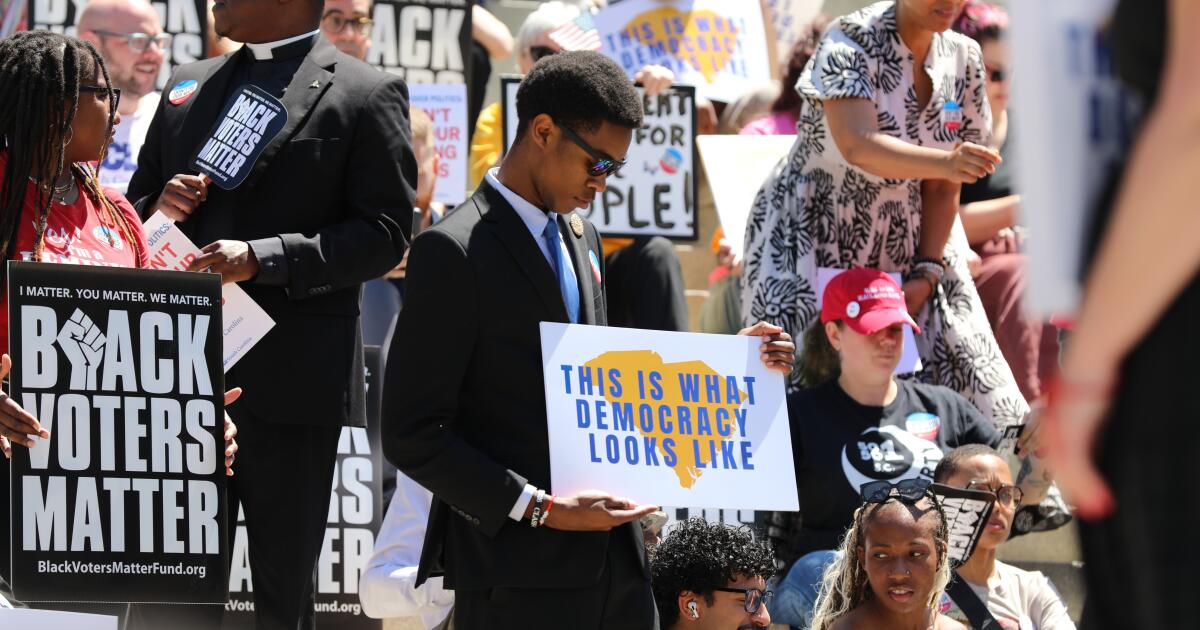
That’s the mantra of a multiracial group of civil rights leaders and activists organizing opposition to a mostly white conservative alliance dismantling the Voting Rights Act and political districts that allowed Black and other nonwhite voters to choose more of their elected leaders for the last half-century.
“We have to respond as quickly as possible,” NAACP President Derrick Johnson said in an interview. “The real question,” Johnson told the Associated Press, “is how do we as a country really address the effort to shrink us backwards into a 1950s reality?”
Johnson’s 117-year-old association, which was at the forefront of legal and legislative fights for Black political rights in the 20th century, is among scores of groups coming together Saturday in Alabama for a rally and tribute to the Civil Rights Movement that helped bring about the 1965 Voting Rights Act. They plan events in Selma, where voting rights advocates were attacked by white law enforcement officers on Bloody Sunday, and Montgomery, where a rescheduled march concluded two weeks later.
Unlike 61 years ago, the Alabama events are not the pinnacle of a protracted movement. Instead, civil rights activists hope they serve as a catalyst for a renewed crusade after the U.S. Supreme Court, two weeks ago, further weakened the VRA by no longer allowing race to be considered in how congressional and other districts are drawn.
They acknowledge difficulty in countering a white-dominated conservative network entrenched in the White House, Capitol Hill, federal courts and many state legislatures of the Old Confederacy, where a majority of Black Americans still live.
The VRA “was the foundational nucleus of the Civil Rights Movement,” said Jared Evans of the Louisiana-based Power Coalition for Equity and Justice. “They’ve taken that from us,” he said, with the recent Louisiana v. Callais decision on congressional districts and the earlier Shelby v. Holder decision in 2013 that rolled back federal oversight of election procedures in states and localities with a history of discrimination.
Georgia Sen. Raphael Warnock, who is senior pastor of Atlanta’s Ebenezer Baptist Church, where the Rev. Martin Luther King Jr. once preached, said from his pulpit that the result is “Jim Crow in new clothes.”
Warnock pointed to King and the last voting rights movement. “We need political power. We need economic power. We need personal power,” he said, assuring parishioners that “your adversaries know that your voice matters” because they’re “bending over backwards” to diminish it.
Evans reached further back into history to say what must happen next.
“Our response must be and will be a second Reconstruction period,” Evans said.
Some Democrats want an answer from Congress
The ultimate goal, organizers said, is to win more elections, sway policy fights and protect diverse political representation at all levels.
U.S. Rep. Terri Sewell, a Black lawmaker who represents Selma, Alabama, said an immediate priority is to “reform and reintroduce” Democrats’ flagship voting bill, the John R. Lewis Voting Rights Act.
Sewell, whose seat ultimately could be threatened under redistricting, said Democrats want to “completely” eliminate partisan gerrymandering.
She also said the legislation would “bring back pre-clearance,” the requirement for certain federal approvals that the court struck down in Shelby.
“We need to come up with a modern-day formula for showing just how egregious the behavior of these state actors is,” Sewell said.
The Supreme Court ruled in Callais that states do not have to draw majority nonwhite districts under the Voting Rights Act and, in fact, should not consider race at all when drawing boundaries. By arguing that the law’s remedies to combat discrimination had themselves become racist, the decision allows states to redraw heavily Black districts that have historically elected Democrats while arguing that the designs are based on party interests, not race.
President Trump praised the decision as “a BIG WIN for Equal Protection under the Law, as it returns the Voting Rights Act to its Original Intent, which was to protect against intentional Racial Discrimination.”
Groups mobilized for redistricting sessions
Many of the same groups who’ll be in Alabama on Saturday have already gone to Southern statehouses, where white Republican lawmakers moved swiftly to redraw congressional districts after Callais.
Alabama and Louisiana lawmakers reverted to a single majority-Black district, each scrapping a second district that had been ordered by lower federal courts under now-reversed VRA interpretations. Tennessee lawmakers gutted a majority Black district by splitting greater Memphis into three different sprawling districts — itself an obvious racial gerrymander the court had previously forbidden, Evans said.
Anticipating the Callais outcome, Florida and Texas proceeded with redistricting before it came down. Georgia Gov. Brian Kemp, a term-limited Republican, has called a June session to redraw congressional lines for the 2028 cycle. Mississippi and South Carolina have delayed the matter for now.
South Carolina state Senate Majority Leader Shane Massey was among the few white Republicans who pushed back against GOP redistricting plans. He said that not even pressure from Trump could sell him on disenfranchising Black South Carolinians instead of doing what’s best for his state.
Other white conservatives are still talking openly about ousting Reps. Jim Clyburn and Bennie Thompson, the only Black U.S. House members from South Carolina and Mississippi, respectively.
Evans, the Louisiana activist, predicted the fight ahead won’t just be about congressional representation.
“Look for them to go after state house and state senate seats — and then it will be the local level,” he said, adding that “it’s going to be an entire erasure of Black representation.”
The issue is more than a partisan Washington fight
Heavily minority districts drawn under the VRA before Callais nearly always elect Democrats. Black Americans have overwhelmingly aligned with the party since President Lyndon B. Johnson signed the Civil Rights Act and Voting Rights Act, sparking a decades-long migration of most white Southern politicians to the Republicans. Latino and Hispanic voters still lean Democratic in most places as well.
The immediate fight shapes the midterm campaign scramble for control of the U.S. House during the final years of Trump’s presidency. Trump initially pushed Republican-run states to redistrict to protect the party’s fragile House majority.
But Johnson, the NAACP leader, said all voters should see more than partisan warfare or a regional battle over race.
Beyond party allegiance, Johnson argued, white conservatives want to curtail a range of rights “depending on how you pray, depending on who you love,” while also pushing economic policies that punish workers across racial and ethnic lines. From legislation to the confirmation of federal judges who decide constitutional questions, those policy outcomes start with election results.
“It’s not a Black problem,” Johnson said. “That’s an American problem.”
There is no singular movement or leader yet
Evans, Johnson and others acknowledged the complexity in harnessing disparate organizations and galvanizing voters on issues like redistricting and gerrymandering. But they insist the brazen nature of Republicans’ course has spurred engagement.
Johnson said he was on an organizing call in Mississippi this week that had 8,000 participants. Evans pointed to packed hallways in the state Capitols in Baton Rouge and Nashville, respectively.
The NAACP and allies have challenged new maps in multiple states, despite Callais. Many groups want to spur midterm turnout among Black voters, and others are disenchanted with white conservatives’ maneuvers in racially diverse places.
Johnson stressed the need for perseverance.
The 1954 Brown v. Board of Education decision was seismic, with a unanimous court declaring segregated public schools unconstitutional and reversing 19th-century precedents denying Black Americans’ fundamental rights.
But it took 17 years — and many more court battles — for it to be implemented in most Southern school districts. Fights over mandated student busing continued beyond the South. It was a decade after Brown before Congress and Johnson enacted the movement’s seminal laws.
There’s no clear leader of a modern movement.
Johnson said it’s worth remembering that even with King at the helm before his assassination, “there was tension around strategy” in the 1950s and 1960s.
But even “through that tension, through many episodes, we were able to get directly in the right place.”
CHICAGO — President-elect Bill Clinton used a community college in Chicago Monday to try out an updated economic message that Americans will be hearing frequently from him in the weeks to come: We’re not out of the woods yet.
“When you read that things are getting better with the unemployment rate, inflation rate, housing starts, things of that kind, that’s a good thing,” Clinton told an audience of some 150 students at Wilbur Wright Community College on this city’s northwest side. But, he warned, those improvements are merely part of the short-term business cycle.
“Underneath that,” he said, are “20 years of problems.”
“We may or may not be coming out of the recession,” Clinton said. “There are some good indicators that we are, but the long-term problems are there and that is what I have to address.”
Clinton’s statements reflect a basic dilemma that he faces: He relied on a bad economy to help him get elected. And while he would like to see improvements, he must rely on continued worries about the economy to get his programs enacted over what is certain to be fierce opposition from vested interests in Washington. In addition, of course, having defeated President Bush on the issue of the economy, Clinton would like to be able to say that economic improvements occurred on his watch, not on that of his predecessor.
With the economy showing steady signs of improvement, those factors have impelled Clinton and his aides to try with increasing diligence to focus public attention on the long-term trends of economic stagnation–and his long-term agenda to change them–rather than on talk of a short-term stimulus to help an economy that may well be moving out of recession on its own.
The emphasis on the long-term agenda will be central to the economic conference that Clinton plans to convene in Little Rock next week. Aides envision the conclave in large part as a tutorial to explain to Americans why the country needs Clinton’s agenda of raising taxes, revamping the health care system, and increasing spending on education, training and new technologies to reduce the deficit.
In answering questions from the students, Clinton provided the most detailed view since the election of how he intends to form a coherent agenda out of the many promises he made in the campaign.
Repeatedly he referred to two key proposals: His plan for a national service trust fund to let Americans finance their educations by borrowing money and paying part of it back through public-service work, and his plans to reform the nation’s health care system.
Changing the health care system is the one thing that he would do “if I could wave a magic wand,” Clinton said, reminding the students of the effect that rising health care costs have had on the ability of American companies to compete.
At the same time, the session with the students showcased a shift in Clinton’s rhetoric from the language of the campaign to the sterner realities of governing. During the campaign, Clinton struggled against his natural tendency to give four-part answers to all questions. Now he appears to have given up that fight.
And repeatedly, as the students asked Clinton for more federal money for program after program, the President-elect, mindful of the massive deficit he soon will inherit, responded with a polite version of “no.”
One woman asked if he would provide special incentives for minority students to attend college. No, Clinton said, the goal should be to make loans and scholarship funds broadly available and then recruit in minority communities. A nursing student asked about special incentives to encourage people to pursue nursing careers. No, Clinton replied, noting that nursing salaries have gone up because of shortages.
Still another noted that some of the classes he wanted to take have been canceled due to a lack of funds. Could the federal government help? he asked. “The federal government, with the huge deficits we are now facing, does not have the capacity to take over substantial funding of the community college system,” Clinton replied.
Despite that, Clinton seemed to win the student’s enthusiasm simply by having shown up.
“He could have just gone to Princeton or Yale and spoken in their auditorium. Instead he came here,” said Erika Marie Dimitrijevic, a 35-year-old mother who attends an ultrasound training program at the school. “I think he wants to get closer to the people.”
Dimitrijevic is in many ways representative of the school, whose average student is a 31-year-old woman. Roughly 50% of the 14,000 Wright students are white, while 20% are black and 30% are Latino. About 15% are women who head households.
The President-elect also used the occasion to score some points with the area’s political leaders, who were crucial in his battles to win his party’s nomination and to defeat President Bush. They will be equally important to whatever success he manages in the next four years. Clinton took time to meet with Chicago Mayor Richard M. Daley, along with Daley’s brother William, who has been touted in Chicago as a potential secretary of transportation in the Clinton Administration.
And in speaking to the students, Clinton made a point of praising their local congressman, Rep. Dan Rostenkowski, chairman of the House Ways and Means Committee, whose panel will have jurisdiction over much of Clinton’s economic and health care proposals and whose help Clinton has courted assiduously in recent weeks.
If he succeeds in changing the nation’s health care system, “it will be in no small measure because of Danny Rostenkowski’s leadership,” he said.
Later in the day, Clinton arrived in Washington and courted members of Congress by attending a reception for newly elected freshmen.
He will spend most of today on Capitol Hill, meeting with freshmen congressmen again as well as with congressional committee chairmen.
Clinton’s attempts to woo members of Congress, both the powerful and the new, are in sharp–and deliberate–contrast to the approach of Jimmy Carter, the last Democratic President, whose relations with Capitol Hill were tense and troubled. Clinton and his aides, by contrast, have taken every possible opportunity to try to bring members of Congress onto his team, an effort which is likely to include appointing several to his Cabinet.
The first of those expected Cabinet appointments are expected later this week.
As Clinton left the White House guest quarters at Blair House Monday night, en route to a party at the home of Washington Post Co. Chairwoman Katharine Graham, he was accompanied by several members of his transition team and Lawrence Summers, a World Bank economist, who is considered a possible choice for economic security adviser.
After a scheduled return to Little Rock tonight, Clinton likely will resign from the post of governor Wednesday, closing a 12-year chapter of his life. He is also expected to release new ethics guidelines for his Administration.
Researcher Tracy Shryer in Chicago contributed to this story.
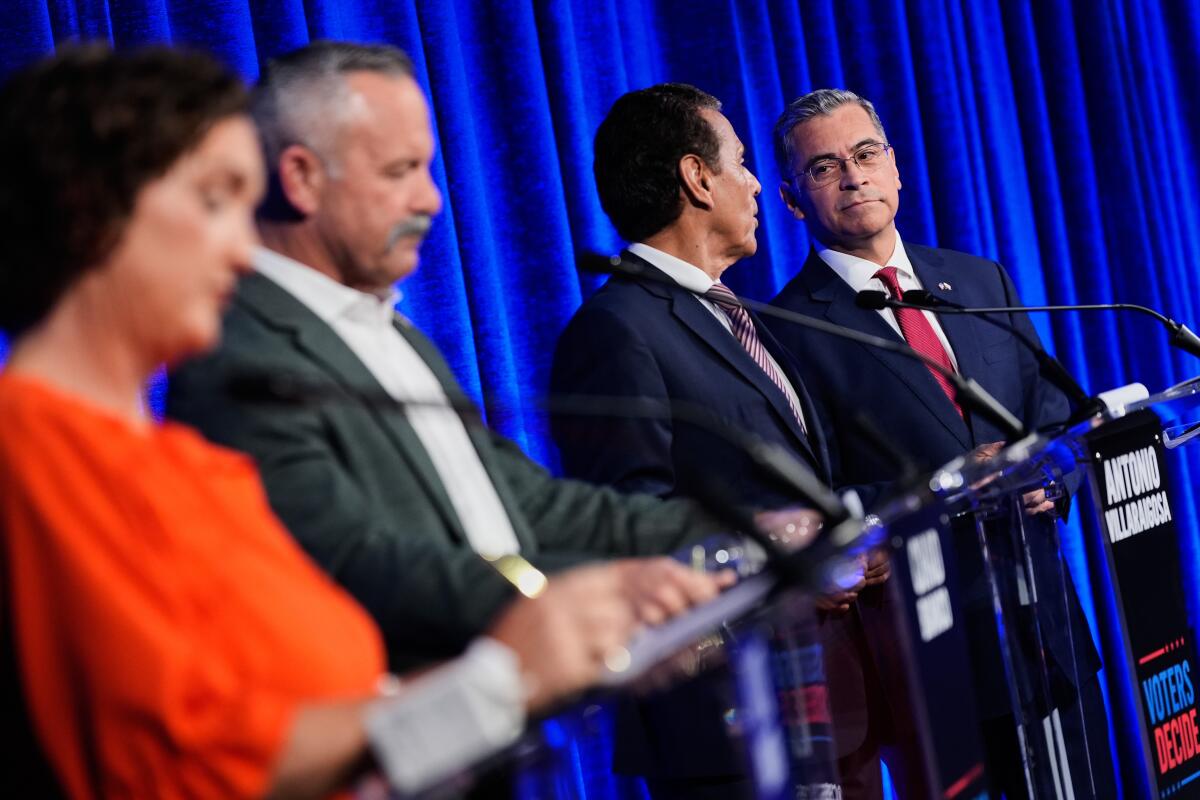
SAN FRANCISCO — As Californians cast ballots in the most unsettled governor’s race in recent history, former U.S. Health and Human Services Secretary Xavier Becerra, a Democrat surging in the polls, once again took most of the heat during a contentious debate among the top candidates for California governor.
Becerra’s rapid rise as the top Democrat in the race was greeted on stage by a fusillade of political attacks from rival Democrats and Republicans, notably regarding his former campaign manager’s guilty plea to federal corruption charges hours before the clash.
Then came accusations that he wavered on support for single-payer healthcare, and failed to stem healthcare and unemployment fraud while serving as California’s attorney general.
“This is what happens when you take the lead in the polls and you’re ahead of everyone else. They all come at you,” Becerra said. “I get it. So they have to try to beat you down. This is a great Trump tactic that’s used. I didn’t expect it to come from fellow Democrats.”
“With friends like that, who needs enemies?” Becerra later said.
The face-off took place at a critical moment before the June 2 primary. Republican voters appear to be consolidating behind Hilton, who was endorsed by President Trump, while Becerra and billionaire hedge fund founder Tom Steyer are favored most by Democrats.
From left, Katie Porter, Chad Bianco, Antonio Villaraigosa and Xavier Becerra at Thursday’s debate.
(Godofredo A. Vásquez / Pool via Associated Press)
Up for grabs
As ballots land in mailboxes, California voters are finally tuning in to the race to lead the nation’s most populous state and fourth-largest economy in the world. Thursday’s 90-minute CBS debate may have been the final opportunity for candidates to directly address large numbers of voters.
Until now, scandal drew the most attention to the contest, as former U.S. Rep. Eric Swalwell (D-Dublin), once an establishment favorite and nominal front-runner, dropped out in April amid allegations of sexual assault and misconduct
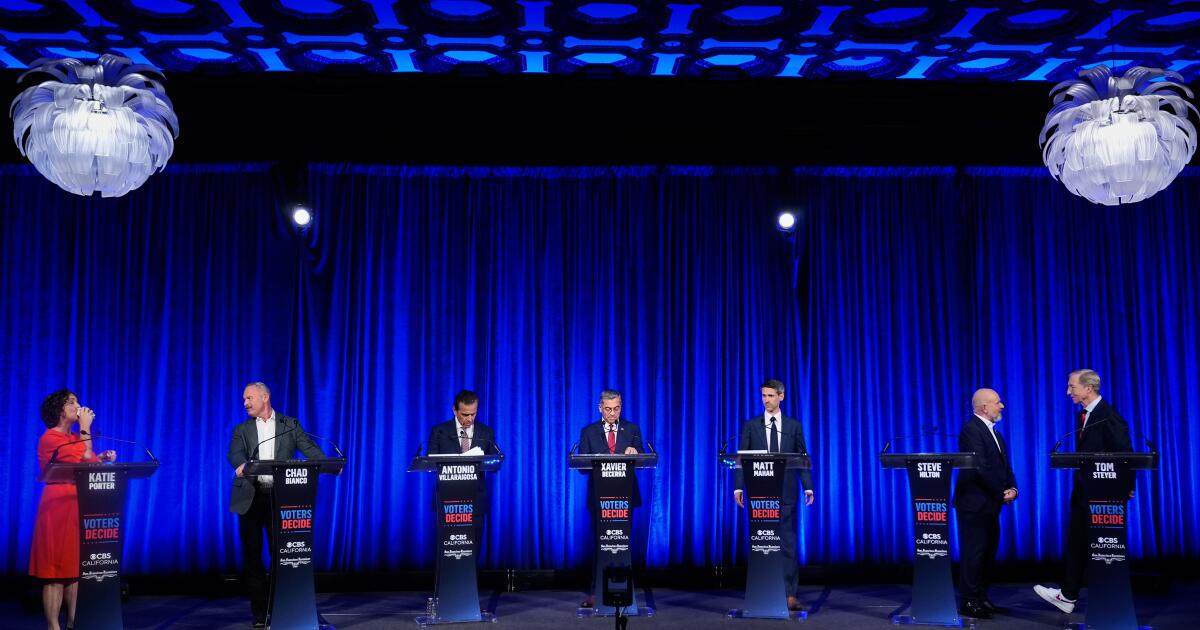
Five Democrats — Becerra, Steyer, San José Mayor Matt Mahan, former Orange County Rep. Katie Porter and former Los Angeles Mayor Antonio Villaraigosa — and two Republicans — Riverside County Sheriff Chad Bianco and former conservative commentator Steve Hilton — clashed about affordability, housing, public safety, climate, education and healthcare. State Supt. of Public Instruction Tony Thurmond, a Democrat, failed to reach the polling threshold to qualify for the debate.
CBS News Bay Area reporter Ryan Yamamoto, CBS News Los Angeles reporter Tom Wait, and San Francisco Examiner Editor-in-Chief Schuyler Hudak Prionas moderated the face-off in front of nearly 200 people at the historic Julia Morgan Ballroom in San Francisco’s Financial District, with sweeping views of the city.
The opulent Beaux-Arts venue contrasted with the tense confrontations among the candidates that underscored Becerra’s swift rise among Democrats in the field after Swalwell dropped out of the race. Even before the face-off, his Democratic rivals began ramping up their focus on Becerra.
Becerra under attack
The candidate faced a barrage of attacks over a string of unfavorable publicity this week, including a widely circulated exchange with a KTLA reporter in which the Democratic candidate asked, “This is a profile piece, this is not a gotcha piece, right?”
Although Becerra has not been accused of wrongdoing, that did not temper criticism from his political rivals during Thursday’s debate. They questioned his judgment and said Becerra should have noticed where his money was going.
Hilton said Becerra should be preparing his own criminal defense, rather than running for governor. Porter warned that damning evidence against Becerra could come out later — which, if he finishes as the top Democrat in the primary election, could undercut his campaign and lead to a Republican being elected California’s next governor.
Becerra defended himself, pointing out that federal prosecutors never accused him of being involved and stated that none of the candidates for governor were implicated in scandal.
Democrats also painted Becerra as a leader who allowed fraud and mismanagement to fester under his watch.
“He wasn’t minding the shop” as state attorney general, Mahan said, pointing to fraudulent unemployment and hospice claims early in the COVID-19 pandemic. “I mean, the Biden administration had to sideline him during COVID. This is not good leadership.”
Matt Mahan, left, is polling in the single digits and made a last-ditch effort to leave an imprint during Thursday’s debate.
(Godofredo A. Vásquez / Godofredo A. Vásquez/pool Ap Via Ap)
Major focus on kitchen table issues, a critical concern among voters
Affordability was a major theme in the debate, which included an introductory video of a single mother struggling to fill her gas tank and buy groceries.
Steyer said he would reduce costs by taking on special interests and bringing about structural change and breaking up monopolies.
“I am the person who will tax the billionaires like me, and the big corporations so we can afford to make the changes” to pay for healthcare and great education, he said.
Mahan said the answer was to “put more money in people’s pockets by bringing down costs,” and that that would not occur under either Steyer or Hilton.
“Tom Steyer’s structural change sounds to me more like socialism. His plans literally would double the size of state government,” Mahan said. “That’s not going to drive affordability. Steve Hilton is touting his Donald Trump endorsements. You’ve got tariffs and wars driving up costs.”
Hilton returned fire: “I love the way Matt talks about how he’s going to lower costs when his city was recently rated the most expensive, the least affordable for housing, in the world.”
Daylight between Republicans about climate change
The Republican candidates avoided attacking each other during the debates, offering compliments instead. But the two split when asked about whether climate change was having a real-world impact.
Bianco said California is destroying itself with its environmental policies.
“Of course we can say that temperatures are increasing,” he said, but he also said he was not “naive” enough to think that humans can affect or control the climate, which has been changing since he was a child, and that California has to stop all the environmental regulations that are “activist related” and destroying the state’s economy.
Tom Steyer spoke Thursday of affordability, a hot-button issue: “I am the person who will tax the billionaires like me.”
(Godofredo A. Vásquez / Pool via Associated Press)
Hilton said he believes in climate change but that California needs to have “common sense” on the issue rather than ideological responses. He said it is “of course” right to want clean water and air but that policies in California are not working — as has been made clear by the recent “mega-fires” in the state.
The Democrats on stage were closely aligned on the need to respond to the climate crisis and ensure that environmental protections are not dismantled by the Trump administration.
Last-ditch efforts by struggling candidates
Candidates in the crowded field who have struggled to break through — centrist Democrats Mahan and Villaraigosa, who have languished in the single digits in the polls — made a last-ditch effort to leave an imprint during Thursday’s gathering.
Mahan went after nearly every candidate on the stage in the opening moments of the debate.
“The change we need is rooted in accountability for results,” Mahan said. “It’s not the change billionaire Tom Steyer’s offering, which is higher taxes and bigger government. It’s not the change Fox News talking head Steve Hilton’s offering — fear, division and more Donald Trump. And let’s be honest, Xavier Becerra is not offering change; he’s the embodiment of the status quo.”
Villaraigosa leaned heavily into his experiences leading Los Angeles and in the state Assembly to argue that he was most qualified to lead the state while castigating his fellow Democrats’ policies.
“This is a state with big challenges, the challenge of affordability, the challenge of healthcare, homelessness, and dirty streets and crime-filled streets,” Villaraigosa said. “The fact is, I’m the only candidate on this stage who, in addition to hitting Donald Trump, which I do, have challenged us, challenged this party, and said, ‘Hold it, a lot of the problems that we face have come from Sacramento policies.’ We need someone with the courage to take on Donald Trump, but also take on our friends when they’re wrong. I’ve had a record of doing that.”
Mehta reported from Los Angeles and Nixon from San Francisco.
BEIJING — A conciliatory President Trump on Friday hailed success in his state visit to China, claiming a tonal reset with Xi Jinping despite departing Beijing with few concrete achievements.
The visual spectacle around Trump’s visit was itself considered a breakthrough by the two sides, who expressed an eagerness entering the talks to move on from a yearslong stretch of deteriorating relations.
But Trump’s homage and deference to Xi were a striking display of an often commanding president adapting to a new power dynamic, understanding China’s rise and its emerging role in the world.
Trump deployed a charm offensive throughout his stay here, confident in the impact of his personal touch on world leaders, often seen patting Xi on the back and repeatedly calling him his friend.
Yet in private, tensions gripped negotiations that touched nearly every major issue on Trump’s agenda, from trade relations to the U.S. war in Iran.
“He’s all business,” Trump said from Beijing in an interview with Fox.
China agreed to buy 200 Boeing jets and spend billions on American agricultural products, U.S. officials said — modest deals that fall short of restoring Chinese investment levels to their pre–2025 highs, before Trump launched a trade war that aggressively targeted Beijing.
Nevertheless, Trump referred to the trade agreements as “fantastic,” and said Xi had also pledged to purchase U.S. energy going forward. Beijing did not confirm any such agreement.
Nor did the Chinese Foreign Ministry comment on any commitment to help the United States reopen the Strait of Hormuz, effectively shuttered by Iran since the Trump administration launched a war against the Islamic Republic earlier this year.
Chinese President Xi Jinping and President Trump participate in a friendship walk through Zhongnanhai Garden Fridah in Beijing.
(Evan Vucci / Pool / Reuters via Associated Press)
“We feel very similar on Iran, we want that to end,” Trump said Friday. “We don’t want them to have a nuclear weapon. We want the straits opened, and we want them to get it ended, because it’s a crazy thing — they’re a little bit crazy.”
At the beginning of the summit, Xi warned the Trump administration that the longstanding U.S. position of strategic ambiguity on Taiwan had set the two nations on a collision course, Chinese state media reported. But departing Beijing, Marco Rubio, the president’s national security advisor and secretary of state, said that Washington’s position on Taiwan remained “unchanged.”
Their second day of meetings was held at Zhongnanhai, an imperial garden and lake district that has served as the secretive seat of power for the Chinese Communist Party since the revolution of 1949.
The two men strolled quiet pathways dotted with Chinese roses and ornamental archways before taking tea and lunch in Xi’s private quarters. Trump was offered rose seeds to bring home for the White House Rose Garden, the Chinese said.
“This has been an incredible visit,” Trump told reporters at the compound. “A lot of good has come of it.”
It was not the first time that Xi has hosted a president at the historic compound. In 2014, the Chinese leader, still relatively new to the presidency, hosted President Obama overnight at Zhongnanhai, where the two met in private over dinner.
President Trump and Chinese President Xi Jinping tour Zhongnanhai Garden.
(Evan Vucci / Pool / Getty Images)
It was another smoggy day for Trump in the Chinese capital, although cooler than Thursday, when Xi greeted Trump at the footsteps of Tiananmen Square with a lavish state welcome. There, Xi hosted Trump and his delegation at the Great Hall of the People for a day of meetings and a banquet dinner of Peking duck and pan-fried pork buns.
The two men will have future opportunities to meet, with Trump inviting Xi to Washington for a state visit at the White House in September.
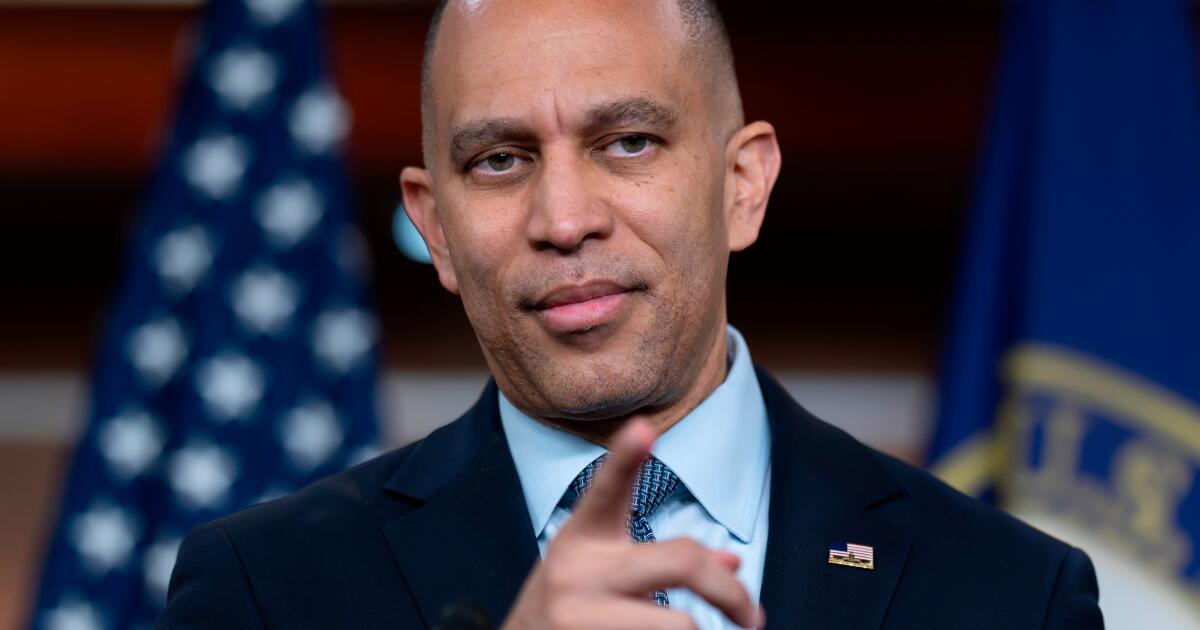
WASHINGTON — House Democratic leader Hakeem Jeffries had warned Republicans they would come to regret the congressional redistricting fight, and when Democrats counterpunched last month with a redrawn Virginia map, he had made his point.
The net tally of seats gained and lost was essentially a wash.
“F— around and find out,” said Jeffries after the election victory.
But in a matter of days, the race for control of the House — and the speaker’s gavel — was dramatically reset by back-to-back court rulings that wiped out the Democratic gains in Virginia and now threaten to erode Black representation by Democrats in the Deep South.
The shifting political prospects have been a wake-up call for Democrats, who have been favored to win back the House this November, riding the wave of President Trump’s dipping approval ratings, and a test for Jeffries as the party faces an enlarging map of Republican-friendly seats.
The leader’s aligned outside group has spent some $60 million, much of it on Virginia alone, a hit to the Democrats’ resources as they confront Trump’s Republicans.
“It sort of crystallizes the election is now a contest between one side that has the money and the maps, and the other that has the voters and the candidates,” said Jesse Ferguson, a Democratic strategist and former deputy director of the House Democrats’ campaign arm.
Jeffries would make history as the first Black speaker of the House
Jeffries, who is in line to make history as America’s first Black speaker of the House, acknowledged the Democrats may need to flip twice as many Republican seats — a total gain of six rather than just three — to win the majority in the aftermath of the redistricting fights.
But he insisted that Democrats were on track to pick up seats, as they did in 2018 during Trump’s first term, because Republicans are relying on redistricting — rather than policy solutions — to win elections.
Trump Republicans “don’t give a damn” about Americans’ financial struggles, Jeffries said, paraphrasing the president’s own remarks.
During a closed-door meeting on Wednesday with House Democrats, Jeffries described the work ahead in almost existential terms for the country.
He said the court rulings against the Voting Rights Act and the Virginia measure were “disgusting.” And he warned his colleagues that Republicans would proceed with “diabolical intensity” in their campaigns to regain control of the House, which Democrats will not only have to match but “we have to exceed it with righteous intensity at all times.”
“Failure is not an option,” he told the Democrats, according to a person in the room granted anonymity to disclose the private remarks. “We have to win, and we are going to win.”
Path to power depends on a handful of House seats
Never easy, the race to the House majority was also not expected to be this complicated. Republicans hold a slim majority, among the most narrow in modern House history, and midterm elections tend to favor the party out of power, as a check on the White House.
But when Trump said last summer that Republicans were “entitled” to five more GOP seats from Texas, it sparked a redistricting crusade that led Jeffries to respond in kind.
Rather than take what they call the high road, Democrats said they decided to fight back, believing they could not fully count on the nation’s institutions — in this case, the courts — to provide a check on the GOP power play.
Jeffries flew to Austin to join the Texas Democrats fighting the redistricting plan in their state and stood with those same lawmakers in Chicago where they fled to deny statehouse Republicans a quorum. He joined the private meetings of California Democrats as they launched their counter attack, a voter initiative that put five more seats in the Democratic column. The Democrats picked up a seat in Utah.
And on it went.
“We had to very quickly make a decision, set a course and take a risk,” said Rep. Jared Huffman, D-Calif., recalling the closed-door talks last summer. “There was no guarantee this was going to work out.”
The Virginia measure became a turning point, Jeffries’ biggest swing yet, putting Democrats essentially at parity, if not a potential upper hand in the number of seats gained, and shifting Old Dominion more securely into the party’s column.
He rallied some 1,000 churchgoers in Richmond ahead of Election Day as voters headed to the polls.
House Speaker Mike Johnson on Wednesday called the Democratic play for Virginia a “crazy overreach” that was rightly rejected by the state’s high court.
“Fortunately, the plan failed spectacularly,” Johnson said.
Redistricting battles push into 2028
While Democrats said they expected the Supreme Court to gut the Voting Rights Act, the Virginia Supreme Court’s decision to toss last month’s election results blindsided many of them.
Jeffries joined a call with furious Virginia Democrats over the weekend who said they were more determined than ever to win the Republican seats outright, regardless of their loss over the map changes.
The overall tally after nearly a year of redistricting battles is still shifting as Republican legislatures in the South rush to redraw their maps in the aftermath of the ruling in the Voting Rights Act case, many of them preparing to eliminate districts held by some of the most senior Black lawmakers in Congress.
Rep. James Clyburn, the veteran Democratic legislator from South Carolina whose own seat is at risk, blamed the justices, not Jeffries, for the outcome in Virginia and elsewhere.
“What the hell, he can’t control the courts,” Clyburn said, vowing to run for reelection regardless of where his district is drawn. “Don’t put that on Jeffries. We won the vote.”
Jeffries acknowledged that this year’s maps are almost set, and pivoted to 2028 when he said Democrats will redouble their efforts to confront the GOP redistricting battle ahead of the next election.
“We know this unprecedented assault on Black political representation, the likes of which we have not seen since the Jim Crow era, the ghost of the Confederacy” will continue, he said. “The challenge that is in front of us is ensuring that there is a decisive and overwhelming response in advance of 2028.”
For the sixth and final time before votes are counted, the leading contenders for California governor gathered Thursday night for a televised debate, this one a 90-minute session in San Francisco.
Times columnists Gustavo Arellano, Mark Z. Barabak and Anita Chabria absorbed the rhetorical blows, followed the heated back-and-forths and took in each and every one of the candidates’ myriad policy prescriptions. Here’s their assessment:
Arellano: Near the end of the debate, co-moderator and San Francisco Examiner editor-in-chief Schuyler Hudak Prionas groaned as candidates talked over each other while trying to answer a question that was supposed to elicit a yes or no response.
That’s pretty much how California voters have reacted to this primary.
In an era where politics are far too often about choosing the least worst option, voters in this election are left with the political version of the Angels baseball team.
No candidate has polled higher than 20-some percent — a testament to how many are in the running, but also an indication that none of them has truly captured the zeitgeist of today’s California.
This year’s debates have done little to catapult anyone to the top, and tonight was more of the same. I still don’t know who I’m going to vote for, and no one inspired me to side with them. No one offered a clear vision of how they would pull Californians out of a spiritual malaise that has so many of us leaving the state, or thinking about leaving.
Instead, what I heard too many of the candidates evoke was the glories of the past — their past.
Antonio Villaraigosa’s closing remarks made a mantra out of “Dream with me,” a slogan he used back when he was L.A. mayor — that was 13 years ago.
Xavier Becerra bragged about how he stood up to President Trump as California attorney general — that was five years ago.
Katie Porter pulled out a white notebook with something written on it and directly challenged Becerra to answer a question — a callback to her time as a congressmember grilling people on Capitol Hill with a whiteboard and a marker, which she first made famous seven years ago.
The two Republicans, Riverside County Sheriff Chad Bianco and conservative commentator Steve Hilton, spoke of a halcyon California destroyed by feckless Democrats and vowed a return to those days.
The only candidates who didn’t live in the past were San José Mayor Matt Mahan and hedge fund billionaire Tom Steyer — but they seemed particularly out of their league, with Steyer too often looking down at notes instead of speaking off the cuff with his well-rehearsed populist pluck.
The word “nostalgia” first emerged to describe what doctors back then considered a malady, thinking it unwise to long for the past. It’s a concept historically antithetical to California, long boosted as the land of today and tomorrow by everyone from the Mission fathers to orange barons, developers to politicians. Indeed, nostalgia has sometimes been a dangerous factor in California politics, unleashing the Spanish fantasy heritage movement, Prop. 13, Prop. 187 and all sorts of other nonsense.
The two candidates who advance to the general election would be wise to offer Californians a hope for the future that doesn’t call back to our yesterdays. For now, the only real winners are the political consultants, and the only real losers are Californians, because we still don’t know for sure that any of the candidates can make things better.
All we can expect is that they’ll turn things for the worse.
Barabak: A popular expression — which Steyer mentioned — defines insanity as doing the same thing over and over and expecting a different result.
By that measure, was the audience for Thursday night’s throwdown insane? Masochistic? Or a group of high-minded, dutiful, quite-conscientious California voters?
The leading gubernatorial candidates have been at this so long that they’re like actors in a stage troupe, delivering well-rehearsed lines, or an old band getting together to play their greatest hits, though far less melodious.
Among those reprising familiar roles were Steyer as the boastful billionaire; Bianco as the angry white avenger; Hilton as the chipper doomsayer; Mahan as the kid brother insinuating his way into the conversation; Porter as the left-wing tribune promising a progressive Valhalla; and Villaraigosa as the old political war horse.
Once more, Becerra was the focal point of attacks, befitting his newfound status as the candidate to beat. “This is what happens when you take the lead in polls,” he rightly noted.
And so rivals again assailed Becerra’s performance as state attorney general and Health and Human Services secretary in the Biden administration. They accused of him being a shill for Big Oil. They tried, implying guilt-through-association, to rope Becerra into the scandal involving his former aides who embezzled from a dormant campaign account.
(Becerra, crisper and more lively than he’s previously been, noted that prosecutors in the case have described him as a victim and not a perpetrator or co-conspirator.)
It’s hard to see all the jostling and thrown elbows making a huge difference. The promises made and attacks scattered like buckshot on the San Francisco soundstage all seem much less important than the numbers that show up in opinion polls between now and Election Day.
Many Democrats, spooked by the prospect of their party being frozen out in June’s top-two primary, have been clinging to their ballots, intending to vote at the last moment for whichever Democrat appears likeliest to finish first.
In that way, the race seems to be shaping up as less a competition than a self-fulfilling prophecy. And Thursday night’s performance, while not wholly irrelevant, was just another television rerun broadcast to a less-than-mass audience.
Chabria: Here’s what I’ll say about Thursday night: It was a debate. The old-school kind where everybody is mostly well-behaved and polite, and the audience scrolls on their phones to stay awake.
The candidates themselves seemed low-energy, even with their jabs — which were largely directed at Becerra, as Mark said.
But no sparks also means we have more clarity. Barring an Eric Swalwell-style blow-up, the top three — Becerra, Steyer and Hilton — are really the only true contenders.
But I’ll give a shout-out to Porter, who had her best performance to date with answers that were clear and laid out policy with detail. Still, I fear it’s too little, too late.
Becerra, on the other hand, seemed subdued to the point of flat (sorry, Mark, he came off crisp like a week-old apple to me) often relying on the line that he sued Trump more than a hundred times as attorney general of California during Trump’s first term. I’m not sure that’s inspiring, though it did lead to some court victories.
Granted, Becerra has had a hard week, with a gaffe with a reporter that went viral and a plea deal by a former aide in that case of money misappropriated from his dormant campaign account. It’s not clear yet if voters care about either of those glitches — but if they stick in people’s minds, that could open a path for Steyer to scrape up the small margin he needs to get through the primary.
But Thursday night also did little to help Steyer’s cause — or hurt it. He made some clear, forceful points that positioned him as the changemaker progressive, especially around his policies on moving away from fossil fuels. He also had some convoluted answers that didn’t land. He didn’t give undecided voters much to work with.
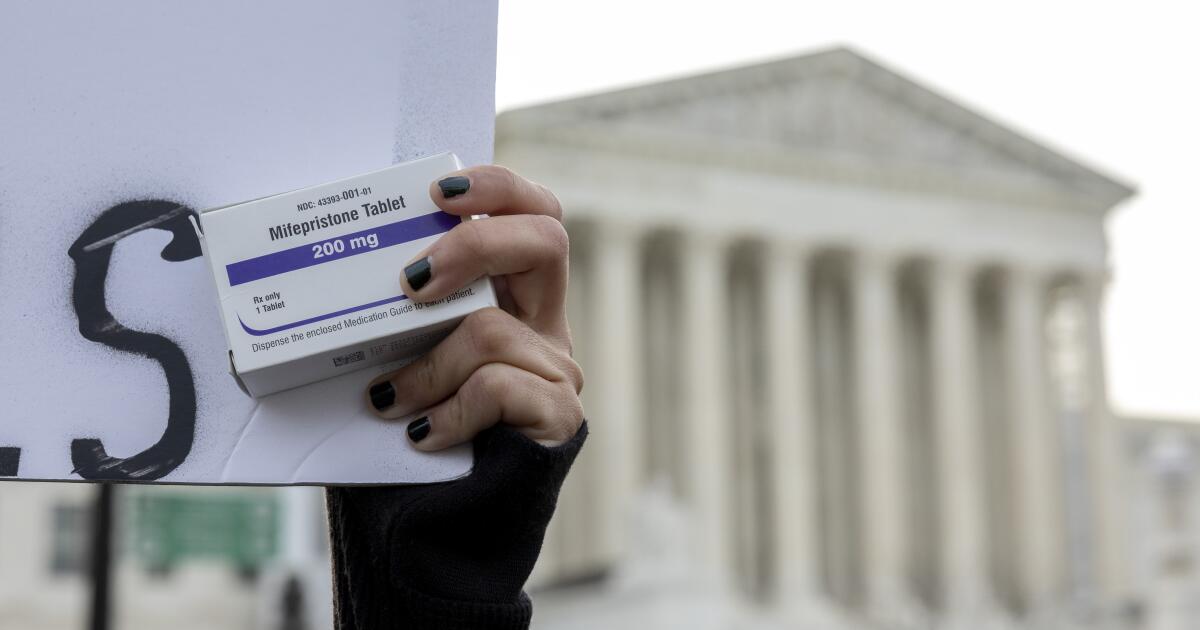
I’ll end with one answer from Hilton that women should pay attention to: He said that if elected, he would allow California abortion providers to be extradited to states such as Louisiana to face criminal charges for mailing abortion medications.
Women across the U.S. now must rely on states such as California for any access to abortion care. Hilton’s position is not just bad for California but presents a risk to women everywhere.
For me, that answer should disqualify him for the highest office in our pro-choice state.
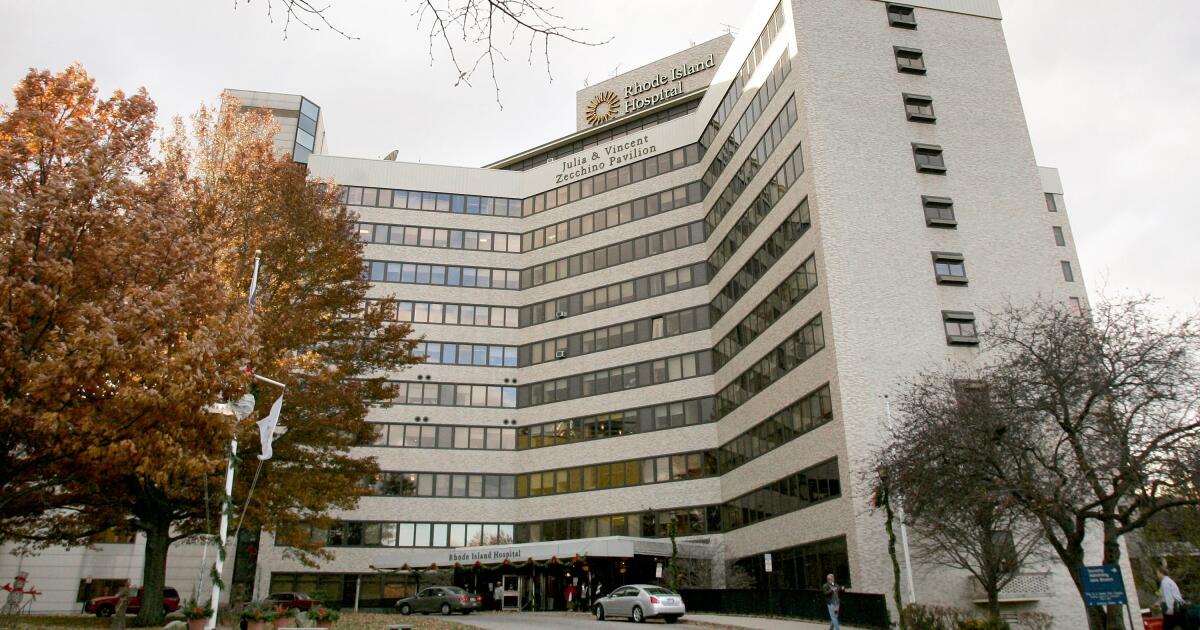
PROVIDENCE, R.I. — A federal judge has blocked the Trump administration’s sweeping demands for confidential transgender patient information from Rhode Island’s largest hospital that provides gender-affirming care to minors.
U.S. District Judge Mary McElroy’s Wednesday ruling is the latest setback for the U.S. Department of Justice, where at least seven other federal courts have agreed to quash or limit the expansive civil subpoenas sent to more than 20 doctors and hospitals last summer.
McElroy’s decision also echoed similar concerns raised by judges surrounding the expansive scope of the subpoenas, describing the Justice Department as having “immense prosecutorial authority and discretion” but no longer trustworthy it will enforce its power fairly and honestly.
“DOJ has proven unworthy of this trust at every point in this case,” McElroy wrote.
A Justice Department spokesperson said Thursday that it would appeal and continue with its investigations.
“The Rhode Island court’s attack on the professionalism and integrity of DOJ attorneys is outrageous and unjustified,” the department said.
According to the subpoenas, the Justice Department had demanded Rhode Island Hospital hand over the birth dates, Social Security numbers and addresses of every patient who received transgender care over the past five years. It also included instructions to provide all documents detailing adverse side effects in minor patients who received gender-related care, assessments that formed the basis for prescribing puberty blockers or hormone therapy, as well as patient intake forms and guardian authorization.
The Justice Department has repeatedly argued that the information sought in the subpoenas is needed to investigate possible fraud or unlawful off-label promotion of drugs. Most recently during a hearing in Rhode Island, the DOJ said that the investigation was taking place in the Northern District of Texas, where the court’s chief judge ordered Rhode Island Hospital to comply with the subpoena before McElroy’s decision voided the subpoena.
Assistant U.S. Atty. Brantley Mayers told McElroy during the hearing that the Justice Department is investigating potential “misbranding” of drugs approved by the U.S. Food and Drug Administration, such as puberty blockers for young people. While off-label prescribing is legal, Mayers said that the DOJ is concerned that pharmaceutical companies are providing “financial incentives” to Rhode Island doctors to prescribe the drugs.
The subpoenas were crucial in getting the names of children and their families so the Justice Department could interview them.
McElroy rejected that argument.
“The administration has publicly characterized gender-affirming care for minors as abuse, directed the DOJ to bring its practice to an end, and celebrated when hospitals curtailed such programs as a result of this subpoena campaign,” McElroy wrote.
The Rhode Island decision is the latest development in the fight over transgender youth health records. Earlier this week, 11 families filed a class-action lawsuit seeking to block the Justice Department from obtaining the documents. The lawsuit, filed in Maryland’s federal court, is backed by families with transgender children who have received care from hospitals across the U.S.
And separately, a New York hospital announced that it received a grand jury subpoena from federal prosecutors in Texas seeking information about children who received gender-affirming care and the medical providers who administered it.
NYU Langone is the first hospital system to publicly acknowledge receiving a subpoena for such records as part of a federal criminal investigation. But the institution said in its statement Tuesday it was one of several that received a subpoena out of the Northern District of Texas on May 7. It said it was deciding on how to respond.
“The government cannot use its subpoena power to intimidate families out of seeking lawful medical care. To trans and gender-diverse children and their families, we want you to know that you are valued, you are not alone,” Kevin Love Hubbard, an attorney with the Lawyers’ Committee of Rhode Island, who represented the plaintiffs in the case, said in a statement.
Gender-affirming care includes a range of medical and mental health services to support a person’s gender identity, including when it’s different from the sex they were assigned at birth. It may include counseling, medications that block puberty, hormone therapy to produce physical changes or surgeries to transform chests and genitals, although those are rare for minors.
Most major medical groups say access to the treatment is important for those with gender dysphoria and see gender as existing along a spectrum.
At least 27 states have adopted laws restricting or banning the care for minors, while several others have adopted laws or policies protecting access to transgender healthcare.
A briefing memo obtained by The Times appears to support former Rep. Katie Porter’s accusation that a Tom Steyer staffer leaked a video of her yelling at an employee, an outburst that tainted her gubernatorial prospects when the video became public.
The video, which was obtained in October by Politico, showed Porter erupting at a staff member who appeared in the background of a prerecorded Zoom call between the former congresswoman and then-Energy Secretary Jennifer Granholm.
During a nationally televised interview on CNN by Dana Bash on Monday, Porter accused the Steyer campaign of leaking the damaging video.
“I am confident that is the case,” Porter said after Bash asked how she knew Steyer was the source. “I’ve been told by many people it’s a Department of Energy video, it was only held by the Department of Energy, and people can follow the trail to who his campaign staffers are and understand what happened there.”
Following the CNN interview, Steyer’s campaign denied that the candidate was involved with the leak.
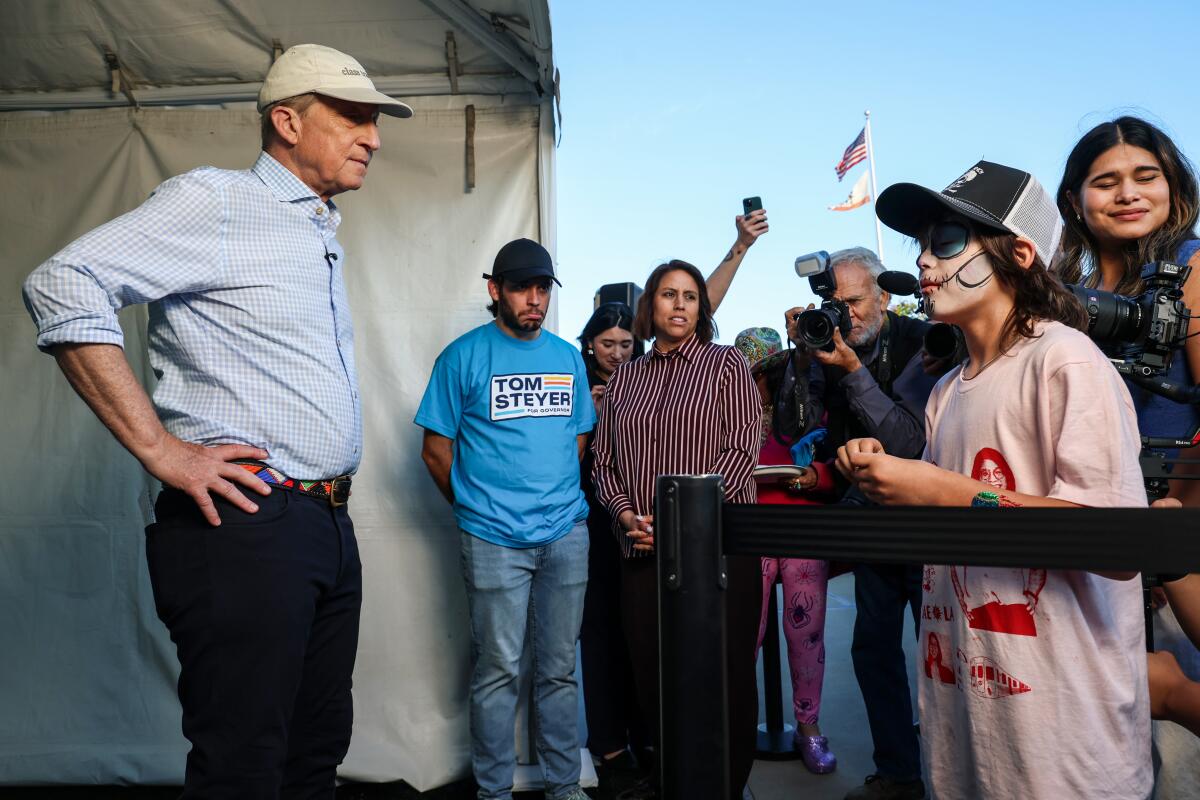
Gubernatorial candidate Tom Steyer hosts an “LA Block Party” campaign event Wednesday at East Los Angeles College in Monterey Park. Rocky Mosse, 9, waits his turn for a photo with Steyer.
(Robert Gauthier/Los Angeles Times)
“Tom has nothing to do with that video,” Steyer campaign spokesperson Sepi Esfahlani said after Porter levied the accusation on Monday. “This is an attempt from Katie Porter to deflect from her past mistakes. Katie Porter only has one person to blame for her standing in the race, and it’s herself.”
According to a briefing memo from the meeting obtained by The Times, Steyer spokesman Kevin Liao was listed as an “expected participant” on the video call between Granholm and Porter, which took place on June 21, 2021, and was filmed to promote electric vehicles by the Biden administration. Granholm and Liao were the only participants listed from the Energy Department, according to the document obtained by The Times.
“This is a 20 minute recorded Zoom with Energy Secretary Jennifer Granholm to discuss the importance of investing in electric vehicles,” the document apparently prepared for Porter and her staff states. “Kevin Liao, Granholm’s press secretary, reached out to set this up. His team will edit this video down into a 2-3 minute clip for social media. Secretary Granholm will have a whiteboard, as noted in the script.”
The edited video conversation was posted on the U.S. Department of Energy’s Facebook page in early July 2021. Politico reported that the Porter staff member snapped at by the congresswoman was not the source of the video provided to the news outlet.
The clip from the Porter-Granholm call was the second unflattering video of the candidate to surface last fall. Days earlier, another clip began to circulate, showing Porter threatening to end an interview with CBS California reporter Julie Watts after becoming frustrated by Watts’ questioning.
U.S. Secretary of Energy Jennifer Granholm speaks during the UNFCCC COP29 Climate Conference in Baku, Azerbaijan, in 2024.
Before the videos became public, Porter had a narrow edge in the race, according to a poll by UC Berkeley’s Institute of Governmental Studies, though many voters at the time remained undecided. Though Porter has continued to hover in the upper tier of gubernatorial hopefuls, she currently trails behind two Democrats — Steyer and former Biden cabinet member Xavier Becerra — and one Republican, former Fox News host Steve Hilton.
The UC Irvine law professor has repeatedly said she apologized to the employee, who spent four more years working in Porter’s congressional office. Dozens of former staffers also came to her defense in an open letter last month.
Liao declined to comment when reached Wednesday evening. He is a primary spokesman for Steyer’s campaign and sent the press release announcing the San Francisco billionaire’s campaign for governor in November. Granholm, when reached via text message, denied leaking the video and said she did not know who did.
According to his LinkedIn profile, Liao, a Los Angeles-based political consultant, worked as Granholm’s press secretary from January through October 2021, during the time the Porter video was recorded. In 2024, he founded Frontrunner Strategies, a consulting firm which has been paid more than $45,000 by Steyer’s campaign, according to campaign finance records.
Porter’s campaign declined to comment on the document.
Voting is underway in the primary election to replace Gov. Gavin Newsom, who is term-limited and exploring a 2028 presidential bid.
A Wednesday Emerson College poll showed Democratic former U.S. Health and Human Services Secretary Xavier Becerra leading with 19%, followed by both Republican former Fox News host Steve Hilton and Steyer at 17%. Riverside County Sheriff Chad Bianco, a Republican, had support from 11% of likely voters and Porter had 10%. San José Mayor Matt Mahan, former Los Angeles Mayor Antonio Villaraigosa and state Supt. of Public Instruction Tony Thurmond were in single digits. Twelve percent of voters were undecided, according to the poll.
Top candidates, with the exception of Thurmond, are slated to appear in a Thursday night debate hosted by CBS California and the San Francisco Examiner.
SACRAMENTO — Dana Williamson, one of the political heavyweights at the center of a financial scandal involving gubernatorial candidate Xavier Becerra, looked shell-shocked Thursday morning in a federal courtroom in downtown Sacramento, as most folks do when bad choices collide with the hard realities of the justice system.
A thousand-yard stare in her eyes, Williamson responded “guilty” three times in a voice that required a microphone to be heard as the judge walked her through a plea deal reached days before with the U.S. Department of Justice. She likely won’t be sentenced until fall (possibly close to the general election) but will — again, just a likely here — at best face home confinement and at worst upward of three years in prison.
It was her savvy and ability to deliver whatever was needed through her deep connections and knowledge of the complicated structures — official and cultural — that govern the California halls of power that make her predicament all the more confounding. Especially because, far from stealing money for self-enrichment, she actually paid money to be part of this scheme.
That alone, to me, raises questions.
Though Williamson’s guilty plea may seem like an ending to the saga, it shouldn’t be, because there’s still a lot lurking in the dark corners of this deal.
If Becerra makes it past the primary, which seems (I’ll use that word again) likely, voters have a right to know.
Here’s the simple backstory, according to court documents. Becerra’s close aide, Sean McCluskie, took a pay cut to remain with his boss when he moved to Washington to become President Biden’s secretary of Health and Human Services.
Strapped for cash, McCluskie asked Williamson to receive money from Becerra’s dormant campaign account — which Becerra was legally not allowed to manage while holding federal office — and pass it through a bunch of other accounts before giving it to McCluskie’s wife as payment for a nonexistent job.
Williamson’s attorney, McGregor Scott, said Thursday that Williamson received $7,500 each month from the Becerra account and added $2,500 from her own funds before sending it on to ultimately reach McCluskie — for a total of $10,000 a month.
McCluskie was “living on a government salary,” Scott said Thursday after court. “Wife is home with the kids. They didn’t have enough money, and that’s where this all originated. [Williamson] was simply trying to help a friend in a pinch as best she could.”
Scott, a former Bush and Trump United States attorney, managed to get Williamson’s original 23-count indictment knocked down to the Becerra account issue, along with lying to the FBI and filing a false tax return.
Becerra, who is a slim-margin front-runner for governor, was the victim in this case — or more precisely, his state campaign bank account was, according to court documents.
There has never been any indication that Becerra was investigated as a participant, and he has forcefully denied wrongdoing, calling it a “gut punch” that his advisers allegedly betrayed him.
That, of course, hasn’t stopped the other candidates from using the case against him.
“My opponents have spent millions spreading lies to purposefully mislead voters,” he wrote Thursday on social media. “Today confirms what I have said from day one: I did nothing wrong. Case closed.”
Meanwhile, Scott, the attorney, also said Thursday that Williamson assumed, based on her conversations with McCluskie, that McCluskie had spoken to Becerra about the concept of the money transfer. Text messages in court records show a brief and ambiguous exchange between McCluskie and Williamson that backs that up.
Scott said that Williamson never spoke directly with Becerra about the scheme.
That leaves the distinct possibility that Williamson believed Becerra knew what was happening — but never asked him. Dumb? Maybe. But Williamson isn’t usually dumb.
“The understanding that McCluskie conveyed to my client was it was OK to proceed,” Scott said.
Becerra has repeatedly said he believed the $10,000 a month was a legitimate fee being paid to manage the funds in the dormant account while he could not — though that is an amount above what is usual for such work, as my colleague Dakota Smith has reported.
Becerra has also repeatedly used some variation of the “case closed” line, seemingly hoping to move past this scandal without further answers.
But at the very least, it deserves some kind of mea culpa from Becerra or lessons learned, a more robust conversation than the brush-off it’s been getting. Because either McCluskie is one heck of a con man who rolled both Becerra and Williamson, making both believe what was happening was kosher with entirely different tales, or someone isn’t being entirely honest.
Did Becerra never question why an account with almost no activity was costing so much to manage? Did he never wonder what Williamson was doing to earn all that money? Should he, with his decades of legal and political experience, have seen red flags, even with a trusted adviser? Or is Williamson, facing sentencing, just trying to paint herself in a sympathetic light?
“I’m not trying to paint my client as a victim,” McGregor said. “She’s accepted responsibility today for what she did by pleading guilty. She’s now a felon. So you know, we’re not trying to do anything to dance away from that.”
Williamson may be done dancing, but the music’s still playing, and the fancy footwork of politics continues.
WASHINGTON — The Supreme Court on Thursday rejected an antiabortion challenge to federal regulations that permit sending pills through the mail once a patient has consulted a doctor online.
The justices granted an emergency appeal from the makers of mifepristone and set aside an order from a U.S. appeals court in Louisiana that would have made it illegal to send or receive the medication by mail.
Justices Clarence Thomas and Samuel A. Alito Jr. dissented.
“The court’s unreasoned order granting stays in this case is remarkable,” Alito wrote. “What is at stake is the perpetration of a scheme to undermine our decision in Dobbs v. Jackson Women’s Health Organization, which restored the right of each State to decide how to regulate abortions within its borders.”
The decision is a setback for abortion opponents, including Louisiana Atty. Gen. Liz Murrill, who sued and argued that her state’s ban on abortion has been thwarted by abortion pills sent by mail.
Thursday’s order preserves access to the medication under the current rules, but it is not a final decision.
The case will now return to the 5th Circuit Court in New Orleans for further review.
“Today’s ruling buys time, but no peace of mind,” said Nancy Northup, president of the Center for Reproductive Rights. “Mifepristone access remains highly at risk as this case moves forward and the Trump administration conducts a politically motivated review of this pill with the hardly disguised aim of making it harder to get.”
National Right to Life expressed deep disappointment.
“Women facing unexpected pregnancies deserve real medical care and support, not a one-size-fits-all mail-order abortion system that minimizes risks and leaves women isolated during medical emergencies,” said Carol Tobias, the group’s president.
The legal dispute has put the Trump administration in a politically awkward spot.
Critics of abortion, including Republican attorneys general from 23 states, argued that the regulations adopted during the Biden administration have thwarted their state laws and allowed patients to obtain medication from doctors in California and New York.
But the Trump administration has shown no urgency to change the regulations that allow for dispensing the pills by mail.
Alito, who spoke at the 5th Circuit a week ago, said he agreed with the state’s argument.
“Louisiana’s efforts have been thwarted by certain medical providers, private organizations, and States that abhor laws like Louisiana’s and seek to undermine their enforcement,” he wrote. “These medical providers and private organizations have developed an operation enabling women in Louisiana and other States that restrict abortions to place an online order for a pill called mifepristone that induces abortion.”
Thomas said abortion is a crime in Louisiana.
The makers of the abortion pills have no grounds to sue “based on lost profits from their criminal enterprise. They cannot, in any legally relevant sense, be irreparably harmed by a court order that makes it more difficult for them to commit crimes.”
But most of the court’s conservatives refused to go along, even though they had voted to overturn the constitutional right to abortion.
Chief Justice John G. Roberts and Justices Neil M. Gorsuch, Brett M. Kavanaugh and Amy Coney Barrett refused to block the current regulations on a fast-track appeal.
Two years ago, the court handed down a similar decision involving abortion pills and the 5th Circuit Court.
The justices overturned a 5th Circuit ruling on the grounds that the antiabortion doctors who sued had no standing because they did not prescribe or use the medication.
In 2000, the FDA approved the use of mifepristone as safe and effective for ending an early pregnancy or treating a miscarriage. It is used in combination with a second drug misoprostol, which induces cramping.
Since 2016, the FDA has relaxed regulations on its use. They include a requirement that women obtain the pills directly from a doctor or a medical clinic. However, it was understood the medication would be taken later at home.
The agency temporarily suspended this rule in 2021 in response to the COVID-19 pandemic, then lifted it entirely in 2023.
Medication abortions now account for almost two-thirds of abortions in the United States, and telehealth is used in 27% of abortions nationwide. Last year, in response to abortion opponents, the Trump administration agreed to review the safety record of mifepristone.
“Mifepristone is one of the safest and most well-studied drugs on the market,” said Dr. Camille A. Clare, president of the American College of Obstetricians & Gynecologists. “The FDA removed the in-person dispensing requirement after careful evaluation of the data because mifepristone is safe and effective even when distributed by mail.”
But the Louisiana attorney general decided to sue in federal court without waiting for the FDA.
She argued that the mailing of abortion medication, which was approved under the Biden administration, was undermining her state’s strict ban on abortions.
A federal judge in Louisiana said the state appeared to have a strong claim, but he decided not to rule on it until the FDA completed its review.
The 5th Circuit Court of Appeals responded a few days later by ruling the FDA erred by relaxing its regulations to allow for dispensing the pills by mail. The three-judge panel then put its ruling into effect immediately on May 1.
Abortion law experts called out the decision as extreme and unusual.
“To our knowledge, no court has ever ordered the FDA to reimpose on a drug a safety rule the agency has thoroughly studied and deemed unnecessary,” said Melissa Goodman, executive director of UCLA’s Center for Reproductive Health, Law and Policy.
COLUMBUS, Ohio — The bitter divorce between an Ohio congressman and his former wife, the daughter of one of the state’s U.S. senators, has escalated into new legal action.
Republican U.S. Rep. Max Miller filed a defamation lawsuit against Emily Moreno, his one-time spouse, on Wednesday in Cleveland, citing “the considerable reputational and financial harm” caused to him by her accusations that he was “a violent and abusive husband and father.”
Miller, a two-term congressman up for reelection this fall, alleges that Moreno, her attorney Andrew Zashin and his law firm have engaged in a defamatory campaign against him by spreading knowingly false information about him to media outlets including the Daily Mail, a British tabloid, and the New York Post. The action contends that the resulting damage to his reputation undermines his chances of reelection.
Those outlets have “circulation measured in the tens of millions of print and online readership,” the complaint states, and their articles have been read, viewed or discussed by Miller’s constituents, his congressional colleagues, ”his political supporters and donors, the media, and the general public.”
The suit seeks compensatory damages in excess of $25,000, punitive damages sufficient to deter future similar conduct and attorney’s fees.
“Congressman Miller is seeking to hold those responsible accountable and to obtain damages for the significant personal, professional, and political harm that he has suffered,” his spokesman said in a statement.
Zashin declined comment.
The incident brings to mind a similar situation that played out as Miller, a White House aide to President Trump during the Republican’s first term, made his first run for Congress in 2021.
Miller’s former girlfriend, one-time White House Press Secretary Stephanie Grisham, raised allegations in her book and in a Washington Post op-ed at the time that a former White House staffer later identified as Miller had physically abused her while they were dating. Miller responded by filing a defamation lawsuit against her. He voluntarily dismissed the suit with prejudice in August 2023, just before the case was set to go to trial.
Moreno’s spokesperson, Stefan Mychajliw, cited the earlier lawsuit in a statement Thursday.
“Mr. Miller is upset because he’s tried to silence Emily Moreno the same way he silenced Stephanie Grisham — and Emily won’t let him,” he said, suggesting Miller is “running the same playbook against a woman with photographs of her bruises and burns.” He added, “Mr. Miller will not silence Ms. Moreno.”
Miller married Emily Moreno in 2022. They had a daughter in 2023.
He filed for divorce in August 2024, as her father, Bernie, was making a successful run for U.S. Senate backed by Trump. The abuse allegations — most recently, Moreno said Miller threw boiling water at her, an allegation he denies — come amid a messy custody battle that has included Miller seeking a restraining order against his ex-wife and subpoenaing the senator to testify. The divorce was finalized last June.
Miller’s spokesperson provided documentation that several allegations that he had abused his daughter were investigated by the Cuyahoga County Division of Children and Family Services and deemed unsubstantiated.
Amid the drama, Democrat Brian Poindexter, a five-term local councilman and union ironworker, is looking to oust Miller and flip Ohio’s 7th Congressional District in November.
WASHINGTON — When Kash Patel visited Hawaii last summer, the FBI took pains to note the director was not on vacation, highlighting his walking tour of the bureau’s Honolulu field office and meetings with local law enforcement.
Left out of the FBI’s news releases was an exclusive excursion that Patel took days later when he participated in what government officials described as a “VIP snorkel” around the USS Arizona in an outing coordinated by the military. The sunken battleship entombs more than 900 sailors and Marines at Pearl Harbor.
The swim, revealed in government emails obtained by The Associated Press, comes to light amid criticism of Patel’s use of the FBI plane and his global travel, which have blurred professional responsibilities with leisure activities. The FBI did not disclose the snorkeling session or that Patel had returned to Hawaii for two days after his initial stopover on the island.
“It fits a pattern of Director Patel getting tangled up in unseemly distractions — this time at a site commemorating the second deadliest attack in U.S. history — instead of staying laser-focused on keeping Americans safe,” said Stacey Young, who founded Justice Connection, a network of former federal prosecutors and agents who advocate for the Department of Justice’s independence.
With few exceptions, snorkeling and diving are off-limits around the USS Arizona. The battleship, now a military cemetery reachable only by boat, has stood as one of the nation’s most hallowed sites since Japan bombed and sank it in 1941. Marine archaeologists and crews from the National Park Service make occasional dives at the memorial to survey the condition of the wreck. Other dives have been conducted to inter the remains of Arizona survivors who wanted to rest eternally with their former shipmates.
Still, since at least the Obama administration, the Navy and the park service have quietly allowed a handful of dignitaries, including military and government officials responsible for management of the memorial, to swim at the site. The Navy and park service declined to provide details of those permitted to take such excursions.
Former FBI directors have visited Pearl Harbor on official business, but none going back to at least 1993 has gone snorkeling at the memorial, according to those familiar with their activities and a former government diver who spoke to AP on condition of anonymity for fear of retribution. The diver said it was unusual for a director or anyone not connected to the memorial to be granted such access because the swims come with physical risks and present security, safety and logistical challenges.
Patel has faced scrutiny over his leadership for the past year, with his use of government resources emerging as a recurring storyline of his tenure. The issue flared in February when video surfaced of Patel partying in the locker room with members of the U.S. men’s hockey team after their gold medal win at the Winter Olympics in Milan. Patel defended the trip as recently as this week as “purposely planned” in connection with a cybercrime investigation involving the Italian authorities.
Unanswered questions about exclusive outing
Patel’s excursion was in August as he spent two days in Hawaii on his return to the United States from official visits to Australia and New Zealand. On his way to those countries, he stopped in Hawaii to visit the Honolulu field office. An FBI spokesman did not answer questions about the snorkeling session.
The FBI said in a statement that top regional commanders hosted Patel at Joint Base Pearl Harbor-Hickam “as they commonly do with US government officials on official travel.” The Pearl Harbor visit, the spokesman said, “was part of the Director’s public national security engagements last August with counterparts in New Zealand, Australia, our Honolulu Field Office, and the Department of War.”
It was not clear how Patel’s snorkeling session was arranged. A Navy spokesperson, Capt. Jodie Cornell, confirmed the outing but said the service was not able to track down who initiated it.
Participants in Patel’s swim were told “not to touch/come into contact with” the sunken ship in any way, Cornell said. She added that the snorkelers were also briefed about “the historic significance of the Memorial as the final resting place/tomb for hundreds of service members.”
A ‘VIP Snorkel’
Government emails obtained by the AP through a public records request show military officials coordinated logistics and personnel for the “VIP Snorkel.”
The National Park Service, which administers the site in coordination with the Navy, told AP it was not involved in Patel’s swim and declined to comment on the excursion. It also declined to answer questions about any other such outings.
Among those afforded invitations to snorkel have been Navy admirals, secretaries of defense and interior, according to the former government diver. The diver added that the swims were intended to provide officials with insights into the memorial and its operations.
The Navy declined to provide examples or numbers showing how frequently it organizes such excursions. It described Patel’s outing as “not an anomaly.”
Hack Albertson, a Marine veteran, is part of a select group from the Paralyzed Veterans of America trained to dive on the Arizona annually to check on the condition of the wreck. He said it was inappropriate for Patel and other political figures to snorkel or dive at the memorial.
“It’s like having a bachelor party at a church. It’s hallowed ground,” he said. “It needs to be treated with the solemnity it deserves.”
Some family members don’t object to snorkeling
Some family members of Pearl Harbor survivors said they were not bothered by such official excursions, though some expressed a desire to also be permitted to snorkel at the site. They said they have not been permitted to do so.
“I have not heard of anyone who would object to these visits as they are very rare and there aren’t any survivors of the Arizona left alive,” Deidre Kelley, national president of the Sons and Daughters of Pearl Harbor Survivors, wrote in an email. “Their children might have some objections but I haven’t heard any.”
Patel visited Pearl Harbor several years ago during a trip he made to Hawaii while serving as chief of staff to Christopher Miller, then the acting secretary of defense, according to the former government diver.
Miller said he snorkeled over the Arizona during an official visit to the base, but Patel was not present for that excursion. Miller said he was invited to snorkel by regional military officials and was told such a tour was for “special occasions and for special visitors, of which you’re one.” He called it a “meaningful” experience.
“It was a very somber and meaningful event,” Miller said in an interview. “It was a historical tour. It wasn’t a recreational thing.”
FBI will not discuss Patel’s return to Hawaii
Beyond the snorkeling excursion, it is not clear what else Patel did during his second stop in Hawaii.
Flight tracking data for the Gulfstream G550 typically used by the FBI director show the jet remained on the island two nights during that stay before flying on to Las Vegas, Patel’s adopted hometown. The jet has a published range of about 7,700 miles, meaning the plane would have needed to refuel somewhere between New Zealand and Washington.
The snorkeling session happened one day after Patel stopped in Wellington to open the FBI’s first standalone office in New Zealand. The visit sparked controversy after the AP revealed that Patel had gifted that country’s police and spy bosses inoperable 3D-printed replica pistols that were illegal to possess under local gun laws.
Mustian, Tucker and Biesecker write for the Associated Press. Mustian reported from New York. AP writers Audrey McAvoy in Honolulu, and Konstantin Toropin contributed to this report.
A federal judge has ordered the Trump administration to bring a Colombian woman back to the U.S. from Congo, after she was deported to the African nation that had refused to accept her.
The deportation of Adriana Maria Quiroz Zapata “was likely illegal,” U.S. District Judge Richard J. Leon ruled Wednesday.
Zapata, 55, who has diabetes and a thyroid condition, “has been sent to a country that refused to accept her because they cannot provide sufficient medical care,” the ruling said. “As a result, she faces a daily risk of medical complications, up to and including death.”
Black spots began to grow on Zapata’s back and foot while she was in detention, her skin started to peel and her nails blackened, according to a declaration that Zapata submitted in court, and which was provided to the AP by her lawyer.
“She’s not doing well and does worry that she’s going to die,” her lawyer, Lauren O’Neal, said.
Zapata entered the U.S. from Mexico in August 2024 and was taken into Immigration and Customs Enforcement custody. Since being deported, she has lived in a hotel in Kinshasa, Congo’s capital. The hotel gates are locked, O’Neal said. Zapata and other deportees are rarely allowed out, and only with supervision, she said.
Zapata was among thousands of immigrants living legally in the U.S., waiting for rulings on asylum claims, when they were suddenly issued deportation decrees that ordered them expelled to countries where most had no connections.
More than 15,000 third-country deportation orders were issued in the White House push for ever more immigrant expulsions, advocacy groups say, though only a fraction of the orders have been carried out.
Few details are known about the agreements to accept these deportees, though the U.S. has signed them with a range of countries, including Ecuador, Honduras, Uganda, Cameroon and Congo. Advocacy groups estimate only a couple of hundred third-country deportations, at most, have been carried out.
WASHINGTON — The head of U.S. Border Patrol, the agency tasked with securing the nation’s frontiers and increasingly tapped by the Trump administration for immigration operations in American cities, announced his resignation Thursday.
Michael Banks’ decision, announced in a Fox News interview and later confirmed by the Department of Homeland Security, is the latest leadership shake-up of officials implementing President Trump’s immigration crackdown and comes as the Republican administration appears to be recalibrating its approach.
“It’s just time,” Banks was quoted as saying in a report on the Fox News website. “I feel like I got the ship back on course from the least secure disastrous chaotic border to the most secure border this country has ever seen,” he said.
In a statement, the U.S. Customs and Border Protection commissioner, Rodney Scott, thanked Banks for his service “during one of the most challenging periods for border security.”
The White House did not immediately respond to a request for comment.
It was not immediately clear who will replace Banks. He led an agency at the forefront of Trump’s high-profile immigration enforcement efforts but kept a lower profile than some other officials such as Gregory Bovino, a now-retired commander who became a public face of the city operations.
CBP is one of the federal agencies that participated since last year in a series of immigration enforcement operations, carried out primarily in cities governed by Democrats —an effort that triggered a spike in arrests and led to the fatal shooting of two U.S. citizens in Minneapolis this year at the hands of federal immigration officers.
Banks’ resignation takes place two months after Markwayne Mullin, a former Republican senator from Oklahoma, became homeland security secretary. DHS oversees CBP and U.S. Immigration and Customs Enforcement, also known as ICE.
Banks is stepping down at the same time that ICE is also going through a leadership transition. Todd Lyons, the acting ICE director, is leaving later this month and will be replaced by David Venturella, who worked for years for private contractors before returning to government service.
CBP was established in 2003 and handles customs, immigration, and agricultural regulations to secure U.S. borders.
Banks returned to the Border Patrol last year after a long agency career that had never landed him in its senior ranks. His star had risen as border czar to Gov. Greg Abbott, R-Texas, during a period when illegal crossings reached record highs and the state launched a multibillion-dollar enforcement surge that led to turf battles with the Biden administration.
Banks kept a relatively low public profile as arrests for illegal crossings that have plunged to their lowest levels since the mid-1960s, a trend that began toward the end of that Democratic administration.
Banks did not appear publicly at the Border Security Expo this month in Phoenix, an annual conference at which government officials update contractors on the state of the border. Scott, who was Banks’ supervisor, is a close ally of Trump border czar Tom Homan and has acted more as the agency’s public face.
In the interview with Fox News, Banks said that after 37 years, “it’s time to enjoy the family and life.”
WASHINGTON — Senators unanimously approved a resolution Thursday to withhold their pay during government shutdowns, an attempt to make federal closures financially painful for lawmakers after a string of record-breaking impasses in the past year.
The bipartisan support for the measure comes at a time when federal closures have become longer and more frequent, frustrating lawmakers who say there should be punishment when Congress fails at its most basic legislative duty.
Under the resolution, senators’ pay would be withheld by the secretary of the Senate whenever a government shutdown affects one or more agencies, then released once funding is restored. It will take effect the day after the Nov. 3 general election.
“Shutting down government should not be our default solution to our refusal to work out our issues and our differences,” said Sen. John Kennedy, the bill’s sponsor, in a floor speech Wednesday.
“This is about putting our money where our mouth is,” said Kennedy, R-La.
Two shutdowns in the past year created significant financial hardship for tens of thousands of federal workers, particularly at the Department of Homeland Security. The department reopened last month after a 76-day partial shutdown, the longest agency funding lapse in history.
The Homeland Security shutdown came just a few months after a 43-day lapse of the entire federal government, which was the longest such closure on record.
The Constitution stipulates that lawmakers must be paid so they have received salaries during shutdowns even as federal workers went without paychecks. When the full government shutdown began in October amid a dispute over health care subsidies, Sen. Lindsey Graham proposed a constitutional amendment to require members to forfeit their paychecks when the government is closed.
“If members of Congress had to forfeit their pay during government shutdowns, there would be fewer shutdowns and they would end quicker,” Graham, R-S.C., said at the time.
Graham said his legislation was the most “constitutionally sound” way to deal with the problem, but the process would have been much more laborious as three-fourths of states must ratify an amendment.
Lawmakers in previous shutdowns have often pledged to forgo their paychecks while federal workers went unpaid.
Kennedy told reporters Wednesday that he pushed his measure to ensure there is “shared sacrifice” during shutdowns. He added that it does not go as far as he would like, but that it’s a start.
Asked why it does not extend to the other chamber of Congress, Kennedy said “the House’s business is the House’s business” while also touching on the tensions between the Senate and House.
“There’s a very strong undercurrent of animosity among some of my friends in the House,” Kennedy said.
“It’s quickly becoming like two kids fighting in the back of a minivan,” he said.
Cappelletti and Jalonick write for the Associated Press.
Sacramento — A veteran California political consultant has agreed to plead guilty in a scheme to steal campaign funds from Xavier Becerra, now a leading candidate for governor, when he served in the Biden administration, according to filings in her criminal case on Thursday.
Dana Williamson will plead guilty to three counts, including bank fraud and lying to authorities. In exchange, the federal government will dismiss 20 other counts against her related to her tax filings and a federal COVID-era loan she received.
A court hearing is scheduled Thursday morning.
Williamson, a former chief of staff to Gov. Gavin Newsom, was arrested in November and pleaded not guilty. The government secured guilty pleas in December from two advisors who worked with alongside her to skim money from Becerra.
Prosecutors say that Williamson, Becerra’s then-chief of staff Sean McCluskie and lobbyist Greg Campbell took part in a scheme to siphon money from Becerra’s dormant campaign account and funnel it to McCluskie.
McCluskie needed the money, according to prosecutors, so he could afford to fly home frequently to see his family in California while working for Becerra, who was Biden’s health secretary, in Washington, D.C.
As part of the scheme, Williamson and another consultant charged Becerra’s account up to $10,000 a month to manage one of his dormant state campaign accounts.
Becerra approved the payments, even though he had never paid such a high amount for a similar job. He told The Times that McCluskie told him to pay the fees.
Becerra’s rivals in the governor’s race are hammering him over his decision, arguing he should have known something wasn’t right. Becerra has said that he didn’t know about the criminal behavior and has called the charges a “gut punch.”
Known as an hard-nosed and aggressive operator, Williamson’s career in politics also included working for former governors Jerry Brown and Gray Davis and mentoring other women.
McGregor Scott, Williamson’s attorney, told reporters last year that federal authorities initially approached Williamson about helping them with a probe into Newsom. She refused, he said, and was subsequently charged.
Details contained in the indictment and other public records suggest that federal authorities were looking into the state’s handling of alleged sexual harassment at Activision Blizzard Inc., a video game company.
Trump is shelling out $2 billion of taxpayer money to kill wind power projects, but his hatred for the technology is based on myths
Picking the wildest fantasy promoted by President Trump as a basis for public policy is increasingly challenging — is it his yarn about schoolchildren being secretly abducted from their classrooms and given sex-changing operations? The notion that the vaccines given to children are like “a vat, like a big glass, of stuff pumped into their bodies?”
Here’s one that has disrupted the economics of renewable energy generation and will cost Americans billions of dollars: It’s Trump’s “completely weird war on wind power in the United States,” based on a sheaf of “fact-free arguments.”
That judgment comes from Steven Cohen, a climate policy expert at Columbia University, who points out that wind already accounts for 10.5% of U.S. energy generation, that it’s destined to continue growing — and that most of it is generated today in red states such as Texas, Oklahoma, Iowa and Kansas.
Fifty years from now, people are going to be amazed that we burned these rare, useful hydrocarbons for fuel, when the sun was just sitting up there providing an essentially infinite source of energy.
— Steven Cohen, Columbia University
There is no question that Trump’s weird war against wind is full blown. On the day of his second inauguration, he issued an executive order shutting down all new permits for offshore wind farms and ordered the Interior Department to review existing permits.
A federal judge in Massachusetts blocked the executive order in December, and his orders suspending work on existing offshore wind projects have been halted by other federal judges. The Trump administration has blocked or delayed as many as 165 wind projects on private land, citing “national security” concerns, according to the American Clean Power Assn.
Get the latest from Michael Hiltzik
Commentary on economics and more from a Pulitzer Prize winner.
By continuing, you agree to our Terms of Service, which include arbitration and a class action waiver. You agree that we and our third-party vendors may collect and use your information, including through cookies, pixels and similar technologies, for the purposes set forth in our Privacy Policy such as personalizing your experience and ads.
Most recently, Trump has reached agreements with offshore wind firms in which the government will pay them a combined $2 billion to abandon their U.S. projects.
At some level, this crusade resembles Trump’s misguided effort to revive the American coal industry, which is on the glide path to inevitable extinction. In that case, Trump is waging an explicitly partisan and ideological battle. “We’re ending Joe Biden’s war on beautiful, clean coal,” he declared last April.
Trump’s anti-wind program is part of his campaign to dismantle U.S. renewables policy because of its roots in the Biden administration.
Additionally, multiple commentators conjecture that his hostility to wind originated in 2011, when he groused that an offshore wind farm would be visible from one of his golf courses in Scotland. He sued to thwart the “ugly” project, and lost.
But Trump has mustered other arguments against wind, on- and offshore, none of which holds water.
During a cabinet meeting in July 2025, he called wind “a very expensive form of energy.” In fact, on average it’s cheaper than natural gas, coal and nuclear generation. Perhaps more important, the cost has been coming down sharply as technology improves and the sector reaches critical mass: falling to eight cents from 21 cents per kilowatt-hour from 2010 to 2024 for offshore projects, and to 3.4 cents from 11.3 cents for land-based wind farms over the same period.
Trump blamed wind turbines for mass killing whales and birds. Neither assertion is correct.
The National Oceanic and Atmospheric Administration, a federal agency, says “there are no known links between large whale deaths and ongoing offshore wind activities.”
The Audubon Society reported in January that although wind turbines can present hazards to birds, “developers can effectively manage these risks without significantly increasing project costs.” The biggest risks to birds come from the climate: “Two-thirds of North American birds are at increasing risk of extinction from global temperature rise,” the society reported — a threat that wind power can ameliorate.
Trump spokeswoman Taylor Rogers didn’t respond to my questions about the derivation of his anti-wind stance, but told me by email only that “President Trump has been clear: hard-earned taxpayer dollars shouldn’t be wasted on unreliable and costly wind farms that pose serious threats to our national security. Instead, we should be strengthening and expanding our infrastructure that produces reliable, affordable, and secure energy like natural gas plants.”
That brings us to the recent deals with offshore wind developers. The largest single deal, signed in March, was with the French firm TotalEnergies, which is to receive approximately $1 billion from the federal government to abandon all of its U.S. offshore wind projects and invest instead in oil and gas projects, including a liquefied natural gas export facility in Texas.
In his March 23 announcement of the deal, Interior Secretary Doug Burgum called offshore wind “one of the most expensive, unreliable, environmentally disruptive, and subsidy-dependent schemes ever forced on American ratepayers and taxpayers.”
This is what Huck Finn would call a “stretcher,” given the decades of subsidies spooned out to the oil and gas industry, reaching more than $30 billion a year in federal and state tax credits, indulgent regulation of pollution and low-cost access to federal lands. Indeed, the investment firm Lazard recently reported that renewables, including wind, are a cost-competitive form of generation even without subsidies. (Lazard’s calculation is of the “levelized cost of energy,” meaning the average cost over a generating plant’s lifetime.)
TotalEnergies fell into lockstep with the Interior Department in its own announcement, explaining its willingness to renounce U.S. offshore wind power because “offshore wind developments in the United States, unlike those in Europe, are costly,” echoing the agency’s position that “the development of offshore wind projects is not in the country’s interest.” Never mind that one factor that makes U.S. offshore wind development costly compared with Europe is the Trump administration’s opposition.
The government subsequently reached an agreement to pay the French company Ocean Winds $885 million to walk away from two offshore wind projects, including one in the waters off California. Ocean Winds described the deal as one driven chiefly by economics, but hinted at pressure from the White House.
“We welcome the opportunity to engage constructively with the administration on this agreement and acknowledge the clarity they have provided with this decision and deal,” Michael Brown, the chief executive of Ocean Winds North America, said when the deal was announced last month. “Our priority remains disciplined capital allocation and delivering reliable energy solutions that create long-term value for ratepayers, partners, and shareholders.”
The TotalEnergies deal, which the government has described as a “refund” of money the firm paid for its offshore leades, raised the hackles of congressional Democrats, who assert that it violates the law and constitution in multiple ways.
“We will hold you accountable for this billion-dollar ripoff,” Reps. Jamie Raskin (D-Md.), ranking member of the House Judiciary Committee and Jared Huffman (D-San Rafael), ranking member of the House Committee on Natural Resources, warned TotalEnergies CEO Patrick Pouyanné in an April 29 letter.
Among other infirmities Raskin and Huffman alleged, the government’s national security rationale for canceling offshore wind leases looks “fabricated”; the payout violates the statutory formula for compensation for canceled leases; the money is to come from a fund designed only to pay court-ordered judgments and settlements of lawsuits, which don’t exist in this case; and includes a provision preventing the deal from being reviewed by a court.
The last of those provisions would have to be authorized by Congress, the letter states, asking for documents and a response from the company by Wednesday. Committee spokespersons weren’t available to say whether they received a response from TotalEnergies, and the company didn’t respond to my request for comment. I received no response from the Department of the Interior.
The California Energy Commission has opened an investigation into the Ocean Winds deal.
“The Trump Administration is recklessly spending billions of taxpayer dollars on backroom deals that would turn back the clock on innovation” CEC Chair David Hochschild said. “Taxpayer dollars should be used to build a sustainable energy future, not to pay to make projects disappear.”
What’s especially wasteful about Trump’s crusade against wind power is that it’s almost certain to be time-limited.
It’s hardly debatable that renewables such as solar and wind will be our principal sources of energy in the future; holding back the clock achieves nothing but injecting uncertainty into investment decisions that need to be made now, at a time when the price of oil is on the upswing thanks to Trump’s Iran adventure and Europe and China are racing to transition away from fossil fuels, while the U.S. remains becalmed by ideology.
“In the long run, fossil fuels will be used for petrochemicals and not for burning,” Cohen told me. “Fifty years from now, people are going to be amazed that we burned these rare, useful hydrocarbons for fuel, when the sun was just sitting up there providing an essentially infinite source of energy.”
SACRAMENTO — Hours before Gov. Gavin Newsom is expected to present his budget plan on Thursday, his office released new projections of a $16.5-billion state revenue windfall over three years and offered a rosy outlook on California’s fiscal position during his final year in office and the year after.
Newsom’s office provided few details about his plan to reduce spending or other adjustments that he would need to propose in combination with the increase in revenue to eliminate projected deficits from 2026-27 through 2027-28.
The unusual early look at his budget proposal comes as Newsom begins to wind down his time at the state Capitol and considers a run for president in 2028.
Two weeks ago, the Legislative Analyst’s Office issued an analysis of state spending that said California could not, in the long term, afford to pay for existing services and the new programs that Newsom and Democratic lawmakers have enacted since he took office in 2019. State spending has outpaced California’s strong revenue growth by about 10%, creating a perennial budget shortfall, defined as a structural deficit.
California’s spending problem threatens to define Newsom’s fiscal legacy and could provide ripe fodder for his critics. If projections of the unexpected tax windfall, which analysts attribute to stock market interest in artificial intelligence companies, bear out, the upswing could mark a lucky break for Newsom.
The governor has largely resisted adopting new across-the-board tax increases or sharply curtailing his expensive policy proposals in order to align state spending with revenue.
His budget proposal includes a call to increase taxes on corporations by limiting state tax credits to no more than $5 million, or 50% of a company’s tax liability, beginning in the tax year 2027. No estimates were offered to explain how much revenue the new cap would bring in to support the state budget.
The preview of his budget has several new spending proposals, including providing $300 million to help low-income Californians keep $0 monthly premiums on healthcare coverage through the Affordable Care Act in response to cuts by the federal government, as well as $100 million to help wildfire victims afford construction loans to rebuild their homes. Two days before Mother’s Day, Newsom also introduced a plan to provide 400 free diapers for every California newborn at select hospitals beginning this summer.
Newsom is expected to present his budget in more detail late Thursday morning in Sacramento.