POLITICS

Stay informed about the latest developments in politics with our comprehensive political news coverage. Get updates on elections, government policies, international relations, and the voices shaping the political landscape.

3 ads that explain California politics

Three political ads meant to break through our collective indifference caught my eye this week, as we come down to the wire on the June 2 primary election.

Each one says less about the candidates involved, and more about this moment in politics and where the races for California governor and L.A. mayor may be headed. Each ad also hints at deeper issues that haven’t quite reached the water-cooler conversation level, but maybe should.

Becerra blunder

The first ad that grabbed my attention was a quick-turn by San José Mayor and gubernatorial candidate Matt Mahan (still stuck in single-digit polling numbers), who jumped on Xavier Becerra’s first major mess-up.

Becerra chastised KTLA interviewer — on camera — not to give him too many hard questions because, “This is not a gotcha piece, right?”

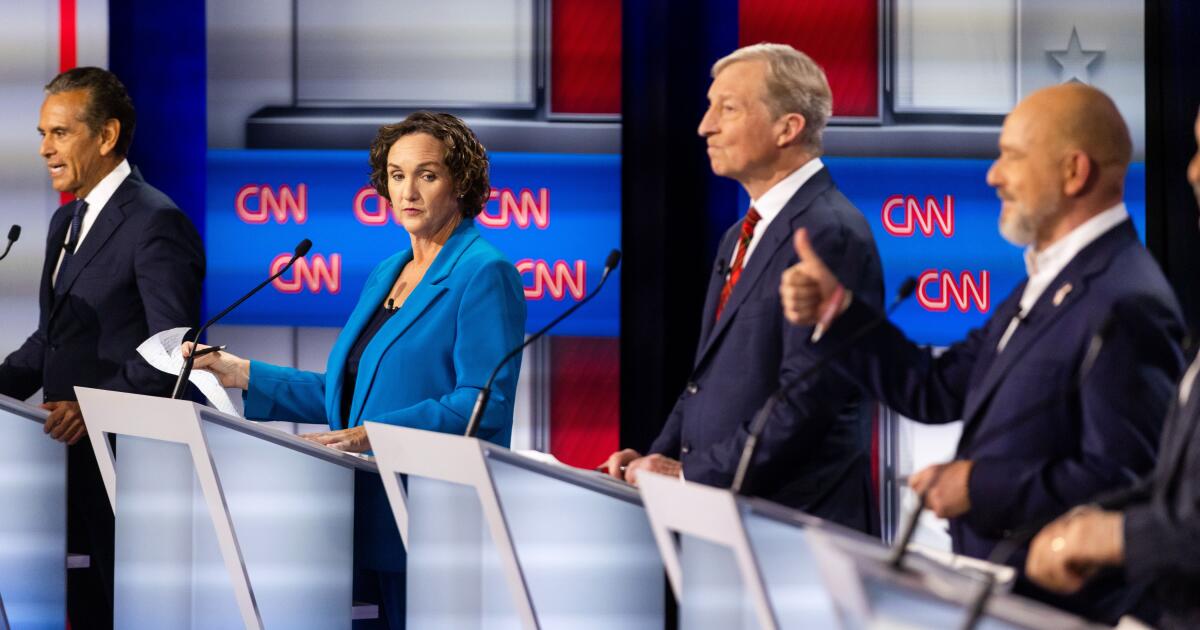
That left a lot of folks wondering about his temperament and transparency, something rival Katie Porter knows a bit about.

The video went viral, and Mahan mashed it up with now-infamous clips of Porter walking out of a different interview earlier in the campaign cycle.

The result was a fast, funny, pointed jab that made both Becerra and Porter look prickly and unaccountable. For Porter, that damage was done long ago. But this moment for Becerra, the very-slim-margin front-runner, could have sticking power.

New polls, which likely don’t account for the impact of this gaffe, have Becerra edging up in a lead over Tom Steyer or maybe just tied. If Becerra is leading, it’s not by much, and he’s not a shoo-in by any means.

The bigger issue is that there are many hard questions that Becerra will likely need to answer if he does make the general election — questions he’s largely been dodging with pat answers.

This week, one of the lobbyists charged in a scheme that allegedly stole more than $200,000 from one of Becerra’s old campaign accounts will appear in court again.

She’s apparently been working on a plea deal, so it’s likely either that will be formalized, or the case will move forward to a trial. Becerra is not accused of any wrongdoing and told my colleague Dakota Smith that he had testified before the grand jury in the case.

But Becerra has also said he was aware that up to $10,000 a month was being paid out of a dormant campaign account to manage that money, since his role as the Health and Human Services Secretary made it illegal for him to be involved directly.

The question that seems relevant in this age of fraud-and-waste panic is who pays $10,000 a month to have someone watch over a dormant account and doesn’t think that’s excessive? Becerra may have been an innocent victim, but $120,000 a year is a lot of money to pay someone to babysit a largely unused stack of cash.

If Becerra does make it through to the primary and faces Hilton or potentially Steyer, both successful businessmen, expect this lack of financial acumen to be an issue — a hard question that is fair to ask of the person who wants to run the fourth largest economy in the world.

Steyer backers

Speaking of money, the second ad (or sort-of ad) that caught my attention is tied to Steyer, the billionaire who has spent more than $100 million of his own money in this race.

The Sacramento Bee reported that Steyer’s campaign has been paying influencers to post support of him online. The account mentioned in the Bee’s report seems to have removed those videos, but others have archived some of them.

These posts are meant to decidedly not feel like advertisements, but just organic support from Steyer supporters. Steyer’s is far from the first campaign to do this and won’t be the last.

Trump, Kamala Harris, Charlie Kirk’s Turning Point USA — all of them have courted influencers, paid or unpaid, to reach voters, especially young ones. California is one of the few states with a law that tries to regulate some of this type of content, but it’s not a strong law.

While there may be nothing shocking in Steyer’s digital strategy, it should alarm us on the larger level of having a healthy democracy. We’ve largely forgotten the black hole of delusion that millions of Americans fell into during the pandemic era from online misinformation brokers. Remember QAnon?

Influence campaigns are shockingly powerful, and growing in sophistication by the minute. While Steyer’s efforts may be run-of-the-mill, it’s an area of political communication that demands greater transparency and regulation.

Pratt problems

Which brings us to Spencer Pratt, and the ad (ads, really) that caught everyone’s attention — the AI-generated mini-movies that blatantly steal the “Batman” and “Star Wars” intellectual property and which have earned so much viral attention that the mayor’s race can now fairly say it’s got national reach.

Pratt did not make these ads, but he’s reposted them, and millions have watched. Though it may seem obvious they are made by artificial intelligence, they are not identified as such.

Pratt has portrayed himself as angry with what he’s sees as Bass’ failure after the Palisades and Eaton fires — a fair criticism that many share. He’s made his own ads highlighting how his family is forced to now live in an Airstream trailer, though TMZ reported Wednesday that Pratt has actually been camping out at the Hotel Bel-Air, where rooms were starting at $1,420 a night this week. (Pratt disputes this reporting and said Wednesday that he doesn’t live anywhere.)

Though parody is protected speech, one of the AI videos Pratt has promoted ends with a crowd, including a child, pelting L.A. Mayor Karen Bass, Gov. Gavin Newsom and Kamala Harris with fruit until they flee.

Jeb Bush, the former governor of Florida, posted online that it was “maybe the best political ad of the year.”

I disagree. While a certain segment of conservative white male voters might find it hilarious to pelt women of color until they run in fear, I’m pretty sure there are some messages in that missive that aren’t getting the scrutiny they deserve.

The links between hate speech and political violence are well documented. Outrage and action are tied, but now increasingly removed from reality. How AI — especially AI depicting political rivals as unhinged, evil villains — will affect voters, and democracy in general, isn’t yet understood.

I doubt these ads on behalf of Pratt will change the minds of many voters, but they do change politics.

And not for the better.

What else you should be reading

The must-read: Ex-gubernatorial candidate Stephen Cloobeck interfered with witness in girlfriend’s case, authorities say
The deep dive: How a fast food taco showed us who Steve Hilton really is
The L.A. Times Special: A bombshell fraud case takes the spotlight in California’s high-stakes race for governor

Stay Golden,
Anita Chabria

Was this newsletter forwarded to you? Sign up here to get it in your inbox.
Source link

Column: Trump surrendered to China before he even landed there

Ahead of President Trump’s arrival in Beijing on Wednesday for his summit with Chinese President Xi Jinping, longtime China expert Kurt M. Campbell offered a novel way of watching the two leaders’ high-stakes faceoff. Think of it not as nation-versus-nation or army-versus-army, but as the sort of “single combat” celebrated in ancient literature, along the lines of David and Goliath in the Bible or Achilles and Hector in “The Iliad.”

“This one has the feel of a geopolitical heavyweight matchup,” Campbell, chairman of the Asia Group strategic consulting firm, wrote in Foreign Affairs this week.

Unlike in their initial get-together early in Trump’s first term, both men now are seasoned leaders in their separate ways — Xi an unchallenged dictator, and an envious Trump seeking to be. Both act with few immediate checks on their power, though Xi acts strategically and Trump impulsively and transactionally. And both, as leaders of super-powers, have the capability to shape the economic and security fates of a wary world.

That world, Campbell concluded in his essay, is “eager to see whether the two leaders emerge driving together in the chariot, or with one dragging the other behind,” as Achilles did the vanquished Hector.

However the Trump-Xi meeting ends, Trump is no Achilles going into this match. In fact, in the six decades of U.S.-China relations, perhaps no American president has entered the summit arena in a weaker position than Trump, the would-be strongman and artiste of the deal. Worse, his weakness — and by extension his country’s — is mostly self-inflicted.

Trump had postponed what was intended as an early April meeting in hopes of striding triumphantly into Beijing as the conqueror of Iran, a China ally. Instead China is receiving him as a “giant with a limp,” in the phrase of its Communist Party-controlled Global Times newspaper.

Trump’s Mideast war, the sort he’d promised never to start, lingers for a third month in a costly stalemate — $29 billion and counting — that has humiliated the president in the public words of Germany’s chancellor and the private thoughts of many more global leaders, Xi likely among them. Trump can’t “project the same arrogance” as he did visiting China in 2017, a former Chinese army officer, Yue Gang, told the New York Times.

At home, the conflict has caused gasoline prices and inflation to spike while tanking Trump’s already depressed polls. A newly released CNN poll conducted April 30 to May 4 had 65% of Americans disapproving of his overall job performance and a whopping 70% against his handling of the economy — the issue that arguably got him elected. With experience, American consumers and soybean farmers now know that they, not the Chinese, have paid for Trump’s beloved tariffs.

The president’s standing at home could hardly have been helped by his parting words to reporters at the White House. Asked “to what extent are Americans’ financial situation motivating you to make a deal” with Iran, Trump blithely replied, “Not even a little bit.” He added, in the sort of political gaffe that journalist Michael Kinsley defined as telling the truth: “I don’t think about Americans’ financial situation. I don’t think about anybody.”

He’s already a loser in the negotiations with Xi. For weeks the Trump administration has unsuccessfully urged China to use its leverage to goad Iran to accept a peace on Americans’ terms or, at a minimum, to reopen the Strait of Hormuz, given China’s self-interest as Iran’s biggest oil customer by far. As China scholar Henrietta Levin of the Center for Strategic and International Studies told the Associated Press, “I don’t think China has any interest in solving the problems the U.S. has created for itself in the Middle East.”

Not least, perhaps, because China has seen that, by the Pentagon’s own reckoning, the war has depleted U.S. stockpiles of weaponry after thousands upon thousands of strikes against Iran. And that has further raised questions in China and beyond about whether Trump would have the United States come to the defense of Taiwan, the self-governing, U.S.-armed island that China claims as its own.

After all, the thinking goes, if the United States can’t bring a lesser power like Iran quickly to heel, how might it fare against a near-peer such as China, especially with a diminished U.S. arsenal and Mideast distractions?

It’s mostly a mystery what the leaders’ talks might yield. In a break with diplomatic tradition, though not with Trump’s seat-of-the-pants style, apparently little planning went into this super-power summit — another reflection of a distracted U.S. side. Still, with a number of tech, agribusiness, finance and aerospace chieftains in tow, Trump and his team are hoping for a few politically appealing deliverables, such as sales of U.S. soybeans and Boeing aircraft, to give the president a lift back home.

But don’t look for progress on the longstanding issues dividing the United States and China over trade and military dominance in the Pacific region. And as for another of those perennial issues — climate change and clean-energy technology — the U.S. under Trump has willfully surrendered global preeminence to China, ceding markets for solar, wind energy, electric vehicles, grid storage and more in his backward-looking, ostrich-like obsession with drilling oil and mining coal.

Whatever hyperbolic claims Trump makes for his China trip, the outcome of the summit (on top of his quagmire in Iran) should at least be this: retiring the myth of Trump the deal-maker and savvy businessman.

If he were such a visionary, Trump would be prodding the nation to global leadership in technology and clean-energy investments, not reversing past progress and paying companies billions of taxpayers’ dollars to stop clean-energy projects. In markets worldwide, the future is now and America is forfeiting the game to China.

In this contest, Trump is letting Xi drive the chariot. Unfortunately, average Americans are the ones being dragged through the dust as China rides into the 21st century.

Bluesky: @jackiecalmes
Threads: @jkcalmes
X: @jackiekcalmes

Source link

Trump builds momentum with at least 3 more wins; Rubio drops out, Kasich takes Ohio

Donald Trump romped to victory Tuesday in Florida, chasing Marco Rubio from the race, but Ohio Gov. John Kasich won his home state, raising hopes for those seeking to stop Trump and settle the presidential contest on the floor of the Republican National Convention.

Trump also won North Carolina and Illinois and was locked in a close fight with Sen. Ted Cruz in Missouri.

“I’m getting ready to rent a covered wagon, we’re going to have a big sail and have the wind blow us to the Rocky Mountains and over the mountains to California,” Kasich said at a jubilant rally outside Cleveland.

That is just the sort of extended nominating fight the GOP establishment sought to avoid by stacking the political calendar with big early contests, capped by Tuesday night’s winner-take-all primaries in Florida and Ohio. California votes on June 7, near the close of the primary season.

Now, many of those same party types see an inconclusive nominating contest as the best and perhaps only chance of thwarting Trump, even if it threatens to shred the GOP in the process.

The setback in Ohio, where Trump campaigned hard, was his most disappointing performance since he finished second to Cruz in February’s Iowa caucuses.

His unhappiness was evident as he addressed reporters at his posh Mar-a-Lago private club in Palm Beach, Fla., and complained about the miseries of running for president.

“Lies, deceit, viciousness. Disgusting reporters. Horrible people,” the Manhattan businessman and reality TV star said. “Some are nice.”

Cruz, speaking with 99% of the Missouri votes counted, once more insisted he was the only candidate who could defeat Trump.

“Starting tomorrow morning, every Republican has a clear choice. Only two campaigns have a plausible path to the nomination — ours and Donald Trump’s,” the Texas senator told supporters in Houston. “Nobody else has any mathematical possibility whatsoever. Only one campaign has beaten Donald Trump over and over again.”

With Trump’s unmatched string of victories, no other candidate is nearly as well positioned to win the nomination ahead of the July convention in Cleveland. He padded his overall delegate lead with Tuesday’s victories, putting him ahead of Cruz and Kasich, who had not won a state before Ohio.

But there were signs Tuesday that not just the establishment but rank-and-file Republicans have yet to rally around the party’s polarizing front-runner.

Nearly 3 in 10 Republican voters across the five states said they would not vote for Trump if he wins the party’s nomination, according to exit poll interviews. Four in 10 said they would consider voting for a third-party candidate if the choice came down to Trump or the Democratic front-runner, Hillary Clinton.

Defections of that magnitude could badly undermine Trump in the general election, and that prospect will probably be stressed by his opponents going forward into next week’s contests in Arizona and Utah.

Rubio spoke to the controversy surrounding the GOP front-runner as he departed the race.

In a Miami concession speech delivered less than half an hour after the polls closed in Florida, the freshman senator congratulated Trump, wagging a finger and shushing members of the audience who booed his kind words.

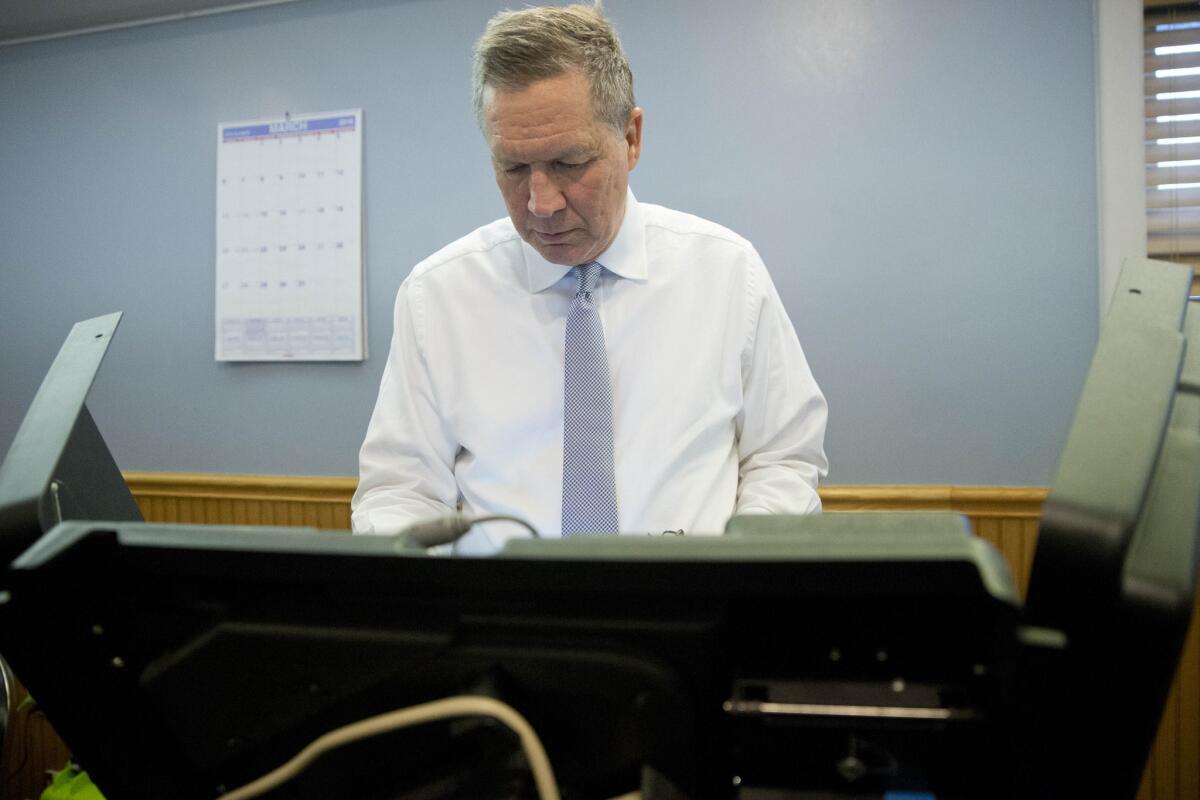
Ohio Gov. John Kasich votes Tuesday in Westerville, Ohio.

Ohio Gov. John Kasich votes Tuesday in Westerville, Ohio.

(Matt Rourke / Associated Press)

Rubio then devoted the bulk of his lengthy remarks to warn against succumbing to the anger and frustration that have fueled Trump’s improbable rise.

“The politics of resentment against other people will not just leave us a fractured party,” Rubio said, as disconsolate family members stood by onstage. “They’re going to leave us a fractured nation” where people hate each other for their political views.

“Do not give in to the fear,” Rubio said. “Do not give in to the frustration.”

The son of Cuban immigrants and, at age 44, the youngest candidate in the field, Rubio was seen as one of the GOP’s rising stars, with a capacity to broaden the party’s support among millennial voters and the nation’s fast-growing Latino population.

But he failed to win more than a few contests and was never seriously competitive in his home state. Trump captured 99 delegates in Florida’s winner take-all-primary, more than a quarter of those at stake in Tuesday’s balloting.

The victory in winner-take-all Ohio gave Kasich 66 delegates, more than doubling his total but still leaving him well behind Trump. His goal is to build momentum with a series of wins positioning him as the strongest candidate heading into the Cleveland convention even if, as seems inevitable, Kasich is shy of the 1,237 delegates needed to win the nomination outright.

Pennsylvania, where Kasich was born, is the next big target on April 26.

The results Tuesday followed one of the oddest, most contentious weeks in a campaign that has been filled with strange and surreal moments.

The precipitating event was a racially charged near-riot at a Trump rally Friday night in Chicago, which was canceled out of security concerns.

Trump’s opponents quickly seized on the moment and the violent imagery that played around the world to once more challenge his temperament and fitness to be president. They accused him of fomenting the unrest through belligerent remarks that seemed to egg on his audiences into physically confronting dissenters.

Trump denied any responsibility, blaming the violence on what he called professional agitators linked to Democratic hopeful Bernie Sanders. He said the protesters provoked his supporters and were stifling their rights to free speech and assembly.

“I don’t condone violence,” Trump said repeatedly, though he sympathized with backers who chose to “be effective” with protesters in the audience. (Previously he used more pugilistic language.)

Trump said he might even pay the legal fees for a supporter who sucker-punched a demonstrator at a North Carolina rally, drawing widespread condemnation. He won the state anyway.

Indeed, for weeks increasingly desperate Republican opponents have mounted an effort to stop Trump, to seemingly little effect.

More than $10 million in negative ads blazed across the Florida airwaves in just the last week alone, attacking Trump for his ethics, the failings of his business empire and his all-over-the-map political ideology.

Those meant nothing to Mark Owens, who stepped into the Miami Beach sunshine Tuesday and lighted a cigar after casting a ballot for the political neophyte.

“We’ve trusted politicians for 200 years to run our country,” Owens said. “It’s time to give someone else a shot.”

With polls suggesting Florida was firmly in Trump’s grasp, much of the campaign focused on Ohio, another traditional fall battleground.

Trump laid on extra events, including an election-eve rally outside Youngstown in place of a planned Florida appearance, and he turned his attention to attacking Kasich after long ignoring the Ohio governor.

He assailed him for his support as a congressman for the North American Free Trade Agreement, a pact with Canada and Mexico that, Trump said, devastated the state’s economy. He also laid on personal insults in a bid to snatch a victory in Kasich’s home state and clear the governor from the race.

Kasich, whose strategy centered on staying above the salvos flying among other candidates, accused Trump of creating a “toxic” political atmosphere and, wrapping himself in the establishment mantle, spent Monday stumping alongside Mitt Romney, the party’s 2012 nominee.

With Kasich suddenly a factor in the GOP contest, the skirmishing here in Ohio seems a likely preview of what is to come.

While he pledged to take the high road at his victory party Tuesday night, Kasich sent a different message speaking to reporters earlier in the day.

He said, “I will be … forced going forward to talk about some of the deep concerns I have about the way this campaign has been run by some others — by one other in particular.”

There is no doubting who he had in mind.

mark.barabak@latimes.com

Twitter: @markzbarabak

Times staff writers Michael Finnegan, Kurtis Lee and Seema Mehta in Los Angeles and Kate Linthicum in Miami contributed to this report.


Source link

Bashing Obama on both coasts

Republican presidential candidates renewed their criticism of President Obama’s healthcare program Monday in a double-barreled assault from both coasts.

Standing before a “Repeal and Replace Obamacare” banner at a medical device manufacturer in San Diego as he opened a campaign swing in the state, Mitt Romney called the president’s policies “an attack on free enterprise, an attack on economic freedom unlike anything we have ever seen before.”

“We’ve got to make sure that we replace President Obama with someone who truly understands what it is that makes America’s economy work,” Romney said.

Decrying a tax on medical devices that is a component of the healthcare law, he argued that the Obama administration was thwarting the endeavors of entrepreneurs like NuVasive’s chief executive “tax by tax, regulator by regulator, regulation by regulation.”

“Washington is crushing the dreams, and crushing the dreamers. We can’t let it happen,” he said.

Rick Santorum, who has doggedly criticized the healthcare program his rival Romney pushed as Massachusetts governor as “the blueprint” for Obama’s law, made an unannounced stop outside the Supreme Court, where the first day of arguments were being held in a challenge to the law.

He called for its repeal and underscored what he says is a key argument for his candidacy — that he would be a stronger adversary against Obama in November.

“There’s only one candidate who has a chance of winning the Republican nomination, who can make this [Obama’s healthcare law] the central issue, a winning issue for winning the presidency back, and that’s Rick Santorum,” the former senator from Pennsylvania said. “The worst person to make that case is Mitt Romney.”

Later, in an interview on CNN, Santorum chided Romney for campaigning in California. “The whole world is watching what’s going on here in Washington,” he said. “Mitt Romney is 3,000 miles away. He should be here.”

Romney, who has defended his Massachusetts healthcare mandate as an appropriate statewide approach, brushed aside Santorum’s criticism by asserting that he was “not going to worry too much about what Rick is saying these days.”

Romney’s speech at NuVasive, whose chief executive, Alexis V. Lukianov, is an avowed critic of the Obama healthcare law, was a brief diversion from his main objective in California: raising money.

Over two days, he plans to hold five fundraisers headlined by leading figures in the state Republican establishment: 2010 gubernatorial nominee Meg Whitman, former Los Angeles Mayor Richard Riordan, real estate mogul Donald Bren and former Gov. Pete Wilson.

Alex Spanos, owner of the San Diego Chargers, is hosting one of the fundraisers at his Villa Angelica mansion in Stockton. Dean Spanos, Alex’s son and president of the Chargers, is leading another fundraiser at the U.S. Grant hotel in San Diego.

His star-studded political events stood in contrast to those of Santorum, who will visit California later this week. While donors were asked to contribute as much as $25,000 at Romney’s events, Santorum supporters were asked for a maximum of $2,500. Santorum’s admirers may gain entree for as little as $125 at a dessert reception Thursday at the Alamo home of Ubokia.com Chief Executive Mark Pine. Hosts include former Rep. Bill Baker and tea party activist Bridget Melson.

Though Romney has built what his campaign views as an insurmountable lead in the Republican delegate count, his rivals have refused to step aside — lending greater importance to California’s June 5 primary, when 172 delegates will be at stake.

“I need you guys to get ready, to organize your effort, to get your friends to vote, to collect some money, to get campaign contributions,” Romney said in San Diego on Monday. “We’ve got a ways to go.”

A new USC Dornsife/Los Angeles Times poll showed Romney drawing the support of 42% of registered Republican voters. Santorum trailed him by 19 percentage points, with Newt Gingrich and Ron Paul a distant third and fourth.

Gingrich and Santorum acknowledged Monday that they were unlikely to pass Romney in delegates through the remaining primaries, but they said the race for the nomination would go to the party convention in August.

“If he can get to 1,144, he’s the nominee. But if he can’t get to 1,144 on the 26th of June, the last primary, then it is going to be a wide-open electronic convention for 60 days of talking among the American people,” Gingrich said on CNN.

Santorum, speaking on the same program, said the likelihood was that no candidate would accumulate enough delegates by the time the voting contests concluded.

“This race is going to — is [in] all likelihood going to go to the convention,” he said.

maeve.reston@latimes.com

seema.mehta@latimes.com

Reston reported from San Diego and Mehta from Los Angeles. Ian Duncan in the Washington bureau contributed to this report.

Source link

Republican resistance to Iran war grows in the Senate as Murkowski flips

Senate Republicans on Wednesday again blocked Democratic legislation that would halt President Trump’s war with Iran, but the number of GOP senators voting against the war grew.

Republican Sen. Lisa Murkowski of Alaska voted against the war for the first time since it began at the end of February. Two other Republicans, Sens. Susan Collins of Maine and Rand Paul of Kentucky, also voted against the war, as they had done previously.

The war powers legislation ultimately failed to advance 49-50, with Sen. John Fetterman of Pennsylvania the only Democrat to oppose it, yet the close tally reflected growing unease with Trump’s war. Several other Republican senators have signaled they want Congress to weigh in on the direction of the conflict.

“There will be a day — and it might be soon, I believe — where this Senate will say to the president, ‘Stop this war,’” Democratic Sen. Tim Kaine of Virginia, who has spearheaded his party’s tactic of forcing repeated votes on the war, said before the vote.

Even if it passes the Senate, a war powers resolution would have a slim chance of passing the House and would also certainly be vetoed by Trump. But Democrats say the votes are about building political pressure on the president either to withdraw from the conflict or seek congressional authorization to wage the war.

Trump officials downplay role for Congress

The White House, meanwhile, has asserted that it does not need congressional authorization for the war and has circumvented legal requirements to gain approval from Congress to continue the military campaign. It claims that it has “terminated” hostilities with Iran because the U.S. has entered a ceasefire.

That posture has created tension between the Republican-controlled Congress and the White House because presidents under the War Powers Resolution of 1973 are required to obtain authorization from Congress after 60 days of engaging in a conflict.

Defense Secretary Pete Hegseth told lawmakers this week that the U.S. could start attacking Iran again without the White House seeking congressional approval. He told Murkowski during a hearing on Tuesday that the Trump administration believes it has “all the authorities necessary.”

Murkowski voiced skepticism about that argument. She pointed to the troops and war ships deployed to the region, saying, “It doesn’t appear that hostilities have ended.”

GOP leaders back the war, but unease grows

Republican leadership has continued to back the war with Iran, arguing that the stalemate in the Strait of Hormuz that has blocked most commercial shipping puts more economic pressure on Iran than it does on the U.S.

“Iran’s economy is on life support. Its leadership is eliminated,” said Sen. John Barrasso, the No. 2 Republican in leadership, during a floor speech Wednesday.

He also argued that the Democratic effort on the war is all about undermining Trump. Forcing the issue just as he arrived in China for a summit would “pull out the rug from under him,” Barrasso said.

Still, Republicans are also growing uneasy about the high gas prices, especially as the November elections draw near.

Sen. Mike Rounds, a Republican from South Dakota, said Wednesday he’d prefer that the two branches of government work out the constitutional issues instead of a congressional war powers vote or a potential challenge in court.

The two sides should sit down together and say “we have shared constitutional responsibilities,” Rounds said.

Democrats plan to keep forcing weekly votes on war powers resolutions and are looking ahead to put limitations on Trump during the debate over annual legislation that authorizes and funds the military.

Sen. Jeff Merkley, an Oregon Democrat who sponsored Wednesday’s resolution, told reporters that he believes there is an “erosion of support, erosion of enthusiasm, an increase in skepticism” about the war from Republicans.

Groves writes for the Associated Press.

Source link

Newsom to propose fund to help California wildfire victims rebuild

Gov. Gavin Newsom will propose a new $100-million fund to help wildfire victims afford loans to rebuild their homes under a revised budget plan set to be released Thursday.

The Newsom administration estimates that thousands of victims of the Los Angeles wildfires cannot afford to rebuild, blaming a lack of access to affordable loans and a gap between insurance payouts and the cost to build again.

“We have been on the ground in L.A. since Day One of recovery from these fires, and we aren’t turning our backs now,” Newsom said in a statement. “This community deserves continued support to help them get back on their feet, and rebuild their homes and their lives. “

The new fund would be designed to cover loan-loss guarantee to lenders, in which the state would commit to paying back a percentage of a loan amount if a borrower defaults, in order to lower the risk for lenders and encourage them to award construction loans to borrowers who might not otherwise qualify or only be eligible for loans at high interest rates. The money would also be available for homeowners to buy down their interest rates during the construction period, according to Newsom’s office.

The Eaton and Palisades fires killed 31 people and destroyed over 16,000 structures in January 2025.

A recent survey of the wildfire victims found that homeowners estimate they need more than $600,000 on average above their insurance payouts to rebuild their homes, according to a report from a wildfire recovery nonprofit called the Department of Angels. The gap in Altadena was about $550,000, and between $1.19 million and $1.73 million in Pacific Palisades and Malibu.

Under Newsom, California has also provided mortgage relief to more than a thousand wildfire survivors under CalAssist, a program that provides grants to eligible homeowners to cover mortgage payments for 12 months up to $100,000.

The governor’s new proposal will be included in his funding plan for the upcoming 2026-27 budget year that begins July 1.

State revenue from income tax collection is higher than initially forecast, a boon that is expected to wipe out a projected deficit in the year ahead. Analysts attribute the revenue increase to an artificial intelligence boom in the stock market.

Though likely temporary, the extra funding is expected to give Newsom enough cushion to balance the state budget without major cuts and lower a projected shortfall in 2027-28.

The proposal to create the rebuilding fund requires support from both houses of the California Legislature and would move forward as a trailer bill accompanying the state budget. The funding would be available to disaster survivors, though details on eligibility will be determined during the legislative process.

Source link

Former private prison executive will become ICE’s acting leader

David Venturella, a former executive at a private prison operator, will serve as the acting head of U.S. Immigration and Customs Enforcement, the Trump administration says, after the agency’s current leader steps down at the end of the month.

A spokesperson for the Department of Homeland Security said late Tuesday that Venturella would succeed Todd Lyons, who led the agency through much of the administration’s tumultuous crackdown on immigration. ICE did not immediately respond to an email seeking additional information Wednesday.

Venturella left the Geo Group in early 2023 and has been working at ICE leading the division that oversees detention contracts, members of Congress wrote in a public letter earlier this year.

At the Geo Group, which houses around one-third of ICE detainees, Venturella served in a number of posts, including executive vice president overseeing corporate development, according to a Securities and Exchange Commission filing. He also oversaw removal operations for ICE in 2011 and 2012 after working for federal contractors, including one that specializes in security clearances and background checks.

Geo has benefited from President Trump’s mass deportation push, garnering big contracts to open three shuttered facilities. Among them was a $1-billion, 15-year deal for a detention center in New Jersey’s largest city.

“Last year was the most successful period for new business wins in our company’s history,” Geo’s CEO George Zoley said during an earnings call last week.

Geo owns and operates 23 ICE detention facilities, with about 26,000 available beds. Zoley also said that ICE’s air transportation subcontract had continued to steadily increase and that it secured a new contract last year for electronic monitoring.

Venturella will lead ICE at a time when the public mood has soured on Trump’s immigration crackdown, which sent surges of federal immigration officers into American cities to round up immigrants. Those raids sent tensions soaring and prompted clashes between protesters and law enforcement, leading to the fatal shootings of two U.S. citizens in Minneapolis earlier this year.

Trump returned to the White House on a promise of mass deportations, and ICE has been a central executor of that vision. Under Lyons’ leadership, the agency used a massive infusion of cash to expand hiring and detention capabilities, and it ramped up arrests to meet demand from the Republican administration.

Federal officials announced Lyons’ departure last month from ICE, which had gotten $75 billion from Congress to fulfill Trump’s mass deportation campaign.

Venturella’s appointment comes as Homeland Security Secretary Markwayne Mullin settles into his role atop the Cabinet agency overseeing ICE. Mullin has promised to keep his department out of the headlines and has indicated a softer tone on immigration, although he is expected to align with the president’s priorities on mass deportations.

One contentious issue confronting Homeland Security now is a plan for converting warehouses into immigrant detention centers. Conceived while Kristi Noem led the department, the effort has encountered multiple lawsuits and intense community blowback, including in Republican-led states.

The $38.3-billion plan would increase detention capacity to 92,000 beds and mean acquiring eight large-scale facilities, capable of housing 7,000 to 10,000 detainees each, and 16 smaller regional processing centers.

Those, and other sites, were supposed to be running by the end of November. But after Noem’s departure, the department paused the purchase of new warehouses as it scrutinizes all contracts signed during her tenure.

Last month a judge extended a pause on transforming a massive Maryland warehouse into a processing facility for immigrants, and there are signs that federal officials are scaling back the plans.

This could be good news for Geo. The Florida-based company has about 6,000 idle beds at six company-owned facilities, Zoley said last week.

Zoley had offered a note of skepticism about the warehouse plan during an earlier earnings call in February, noting that renovating a warehouse is “more complicated than you may think.” At that point, he said the company was “cautiously” looking at whether to bid to help operate some of them.

Hollingsworth writes for the Associated Press.

Source link

Trump marvels at Chinese power as summit kicks off

An extraordinary display of power and precision along Tiananmen Square greeted President Trump in Beijing on Thursday, kicking off a two-day summit with particularly high stakes for the Americans.

Trump’s meetings with his Chinese counterpart, Xi Jinping, began at the Great Hall of the People moments after a welcome ceremony that seemed to impress the president, featuring a Chinese military honor guard and a greeting from excited school children. American flags waved as “The Star Spangled Banner” rang out on a smoggy day in the heart of the capital.

Children holding Chinese and U.S. flags rehearse before the welcome ceremony for President Trump.

Children holding Chinese and U.S. flags rehearse before the welcome ceremony for President Trump.

(Maxim Shemetov / Associated Press)

Trump reflected on the stakes of his visit at the top of the meeting, telling Xi that the ceremony was an honor “like few I’ve seen before.”

“There are those who say it may be the biggest summit ever,” he said. “I have such respect for China, the job you’ve done.”

Both men struck a conciliatory tone, despite the agenda for the summit featuring some of the thorniest issues facing the two superpowers today, from the U.S. war in Iran to trade relations and the future of Taiwan.

“We’ve gotten along — when there have been difficulties, we’ve worked it out,” Trump added. “We’re going to have a fantastic future together.”

Trump is expected to ask Xi for help reopening the Strait of Hormuz, a vital commercial waterway disrupted by Iran since the start of the war, and for the extension of a truce in the trade war he started at the beginning of his second term.

China, in turn, will ask the Trump administration not to proceed with arms sales to Taiwan, despite their approval by Congress, and for a declaration of opposition to Taiwanese independence. Beijing also seeks access to top-end chips made by American manufacturers.

Chinese President Xi Jinping and President Trump shake hands at the Great Hall of the People.

Chinese President Xi Jinping and President Trump shake hands at the Great Hall of the People.

(Kenny Holston / Associated Press)

The agenda exposes the mutual dependence of the two rival superpowers, marked by distrust but driven by a quest for cooperation and stability.

The welcome ceremony outside of the Great Hall kicked off with Xi shaking the hands of Trump’s delegation, including figures such as his political advisor, James Blair, his communications director, Steven Cheung, and his daughter-in-law, Lara Trump.

They were just a few members of a U.S. delegation accompanying Trump filled with curiosities.

Chinese officials were surprised to learn that Pete Hegseth was joining Trump in Beijing this week, marking the first time a president has brought his secretary of defense on an official state visit. It wasn’t immediately clear to the Chinese what his inclusion was meant to convey.

Eric Trump, the president’s son, is here, seeking to leverage the family name for lucrative business deals as Beijing aggressively campaigns against government corruption at home. And First Lady Melania Trump decided to stay at home, an unusual snub of such a high-level event.

A contingent of U.S. business leaders was given little notice to prepare for the trip, including the CEO of Nvidia, who raced to join Trump aboard Air Force One at a refueling stop in Alaksa.

The diplomatic faux pas follow weeks of Chinese frustration over what they see as the Trump administration’s lack of preparation — a perceived display of incompetence that boosts their confidence heading into the negotiations.

Over the course of the visit, Trump is expected to visit the Temple of Heaven, a monument to imperial China and Confucian thought in the center of Beijing. Ahead of Trump’s arrival, an area roughly the size of 400 American football fields was closed in preparation for a stop here.

On Thursday night, local time, Trump will return to the Great Hall of the People for a banquet dinner. Additional meetings are scheduled for Friday morning before Trump departs midday for home.

Source link

Senate confirms Trump pick Warsh as chairman of the Federal Reserve

The Senate confirmed President Trump’s nominee to lead the Federal Reserve, Kevin Warsh, bringing new leadership to the world’s most powerful central bank at a fraught moment for the global economy.

Warsh was confirmed Wednesday in a largely party-line vote. His nomination had been thrown into doubt in recent months after Republican Sen. Thom Tillis of North Carolina said he would block the nomination while the Justice Department investigated Fed Chair Jerome H. Powell. The Powell inquiry was dropped in April, clearing the way for the Senate to confirm Warsh.

Senate Majority Leader John Thune (R-S.D.) urged colleagues to support Warsh during a floor speech Wednesday morning, saying it’s crucial that a Fed chair “understand not only the macro” but also “appreciate the microeconomy: and that’s the hardworking Americans, their jobs and their livelihoods.”

“Kevin Warsh is just such a person,” Thune said.

Warsh, 56, a former top Fed official, will become chair at an unusually difficult time for the independent agency.

Inflation has topped the Fed’s 2% target for five years and is now rising faster because of surging gas prices. The Fed’s interest rate-setting committee is divided and saw the most dissenting votes in more than three decades last month. And Powell, after years of personal attacks from the Republican president and an unprecedented legal investigation by the Justice Department, plans to stay on the Fed’s board even after his term as chair ends, potentially creating a competing power center.

Trump has demanded change at the Federal Reserve

The Fed has faced numerous threats to its independence from Trump, who has repeatedly attacked Powell for not cutting interest rates. Trump also sought to fire Fed Gov. Lisa Cook and launched an investigation into brief Senate testimony by Powell on a building renovation.

Kevin Hassett, director of the White House’s National Economic Council, said in a Fox News interview on Sunday that he believes the markets are relieved that Warsh “is going to help lower interest rates over time.”

“Obviously, data driven,” said Hassett. “I’m not putting any pressure on Kevin Warsh.”

In December, Trump said on his social media platform that he wanted a Fed chair who would cut interest rates when the stock market rose — the opposite of what traditional economics would prescribe — and added, “Anyone that disagrees with me will never be the Fed chairman!”

Trump’s comments have fueled concerns over whether Warsh will set rates based on economic conditions or seek to cut rates to appease Trump, even if doing so could worsen inflation. At Warsh’s confirmation hearing last month, Sen. Elizabeth Warren, a Democrat from Massachusetts, derided him as a “sock puppet” for Trump. Warsh declined to say that Democrat Joe Biden had won the 2020 election against Trump, who has falsely claimed that voter fraud cost him reelection.

Still, Warsh denied at the hearing that Trump had pressured him to reduce the Fed’s key rate.

“The president never once asked me to commit to any particular interest rate decision, period,” Warsh said then. “Nor would I ever agree to do so if he had. … I will be an independent actor if confirmed as chair of the Federal Reserve.”

A critic of the Fed’s leadership in the past

Warsh has been highly critical of the Fed’s recent track record, particularly the inflation spike in 2021-22, the worst in four decades, and has called for “regime change.” Yet he has provided only broad outlines of what that change would involve.

He has called for limiting the Fed’s communications, which would be a sharp shift after decades of increasing transparency. He has argued that some of its communications tools, such as quarterly forecasts of where its key rate may head, have made it harder for officials to switch gears.

Senate Democrats also have condemned Warsh for not fully divulging the details of his extensive wealth, which disclosures show amounts to at least $100 million. His investments include stakes in Polymarket and SpaceX, but he hasn’t revealed how large those holdings are. He promised to sell all such assets within 90 days of being sworn in.

“He will be the wealthiest Fed chair in history, but he refuses to provide transparency to the American people about who he is entangled with,” Warren said.

Warsh faces difficult economic conditions

The Fed is still grappling with how to respond to the 50% jump in gas prices from the Iran war. The increase has boosted inflation, which reached 3.8% in April.

The Fed is tasked by Congress with keeping prices stable, which it seeks to do by raising its short-term rate to make borrowing and spending more expensive, cooling growth and inflation.

The Fed typically looks past temporary price increases that stem from supply disruptions, such as the war’s cutoff of oil through the Strait of Hormuz, because those prices typically level off — or even fall back down — once the supply is restored.

But the Fed also followed that approach after the COVID-19 pandemic snarled global supply chains for goods, lifting prices for things such as cars, furniture and electronics. Inflation turned out to last longer than expected, and Powell and other Fed officials have acknowledged they waited too long to raise rates. Inflation surged to 9.1% by June 2022.

The Fed’s rate-setting committee has kept rates unchanged for three straight meetings as it evaluates the effect of the gas price spike. At its most recent meeting last month, three members of the committee objected to language that suggested its next move would be a rate cut. They preferred more neutral language that would allow for a hike. Many Fed watchers saw those dissents as a warning shot to Warsh that he won’t be able to easily engineer rate reductions.

A fourth member of the 12-member committee, Stephen Miran, dissented in favor of a rate cut, as he has at every meeting since Trump appointed him to the Fed’s board last September. Miran is serving until a replacement is named, and Warsh will take his spot.

Powell, meanwhile, said at a news conference April 29 that he would remain as a Fed governor until the Justice Department closes its investigation into the Fed’s building project, the first time a chair may stay on the board for an extended period since 1948. His term as a governor lasts until January 2028.

U.S. Atty. Jeanine Pirro has dropped the government’s investigation, but she has said it could be reopened if the Fed’s inspector general office, which has looked into the renovation project since last July, finds evidence of criminal activity.

Rugaber and Cappelletti write for the Associated Press.

Source link

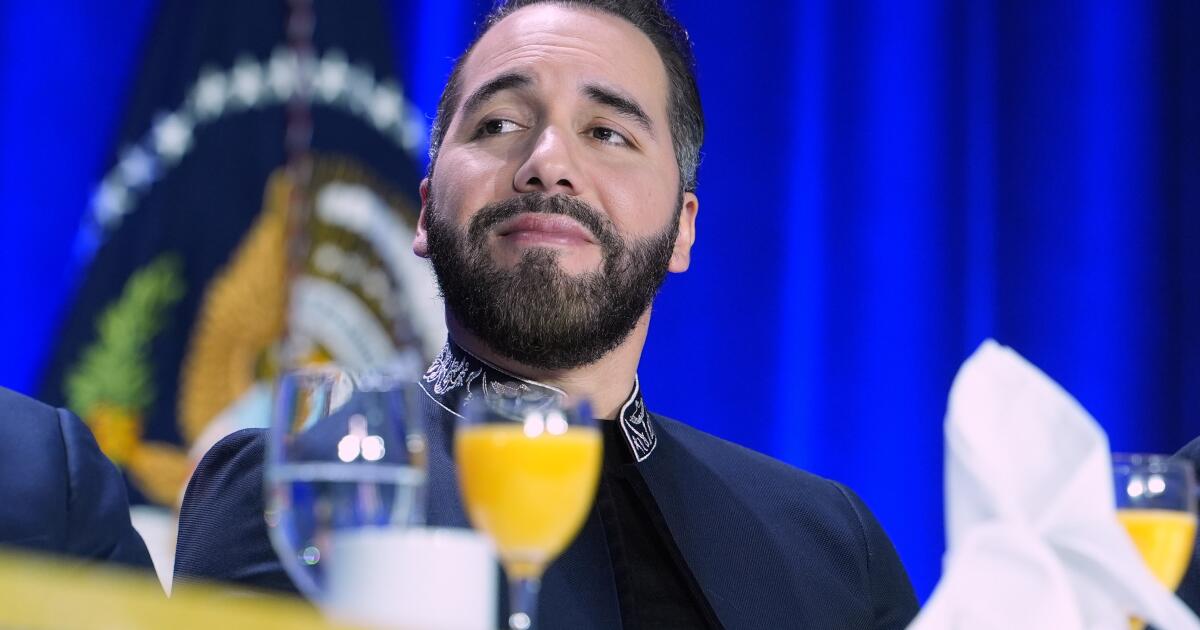
U.S. deportations to El Salvador double as Bukele aligns with Trump

The number of people deported to El Salvador from the U.S. nearly doubled in the first months of 2026, according to official figures, coming as Salvadoran President Nayib Bukele has positioned himself as an ally willing to help the Trump administration accelerate deportations, a central priority.

The U.S. deported 5,033 Salvadorans back to their country in the first three months of 2026 compared with 2,547 deportees in the same period in 2025, according to El Salvador migration authority figures obtained by the Associated Press on Tuesday.

That marks nearly a 98% increase at the same time that the Trump administration has boosted deportation flights across the world. Globally, deportation flights from the U.S. rose an estimated 61% between 2024 and 2025, according to data compiled by the Asociación Agenda Migrante El Salvador, or AAMES, and other organizations.

The U.S. has stopped regularly releasing deportation data, so experts instead are relying on other information from countries such as El Salvador, deportation flights and other numbers.

The sharp increase in deportations “confirms a real hardening of the U.S. immigration system toward the region,” said César Ríos of AAMES.

The jump comes as Bukele, a tough-on-crime politician, has sought to align himself with President Trump, and the U.S. government has lined up allies across Latin America to help the Republican carry out his agenda. While Mexico and other Central American nations have quietly accepted deportees from third countries, Bukele has boldly embraced Trump’s efforts in Latin America.

In March 2025, Bukele most notably accepted 238 Venezuelan deportees accused of being members of the Venezuelan gang Tren de Aragua and locked them up in a mega-prison built for accused gang members in the Salvadoran leader’s ongoing offensive on domestic gangs. The incident fueled widespread accusations of human rights abuses.

The geopolitical firestorm came after Trump’s government struck a deal with Bukele to accept what they described as transfer and imprisonment of foreign criminals to El Salvador. Under the agreement, El Salvador would receive $6 million from the U.S.

In March 2025, the Trump administration mistakenly deported Kilmar Abrego García, a Maryland resident and Salvadoran citizen with protected status in the U.S., setting off yet another legal and political controversy. Bukele originally refused to return Abrego García and denied accusations of beating and torture — which have been widely documented by human rights groups in Salvadoran prisons.

He was returned to the U.S. in June to face charges that he helped bring immigrants to the U.S. illegally, something his lawyers call “baseless.” Abrego García has pleaded not guilty and asked a judge to dismiss his case as the U.S. Department of Homeland Security announced that it hoped to deport Abrego García to Liberia.

Even more recently, Bukele joined a coalition of other right-leaning Trump allies in a group of countries that the Republican president dubbed the Shield of the Americas, purportedly aimed at cracking down on criminal groups in Latin America, even though the two most essential countries in that effort — Mexico and Colombia — refused to attend.

Meanwhile, many migrants in the U.S. are turning their eyes on U.S. Supreme Court arguments as Trump seeks to stop shielding hundreds of thousands of migrants from Haiti and Syria, a decision many of the more than 200,000 Salvadoran migrants with temporary protections worry might eventually affect them.

Bukele has helped the U.S. with its immigration agenda even before Trump entered office.

In 2023, El Salvador’s government began to slap a $1,130 fee on travelers from dozens of countries connecting through the nation’s main airport, amid pressure from the Biden administration to help control the number of migrants moving toward the United States’ southern border. At the same time, migration from El Salvador, fueled by gang violence and poverty, dipped after Bukele’s contentious war on the gangs.

Analysts said that Bukele’s government used dips in migration as a bargaining chip to offset human rights criticisms by the U.S.

Alemán and Janetsky write for the Associated Press. Janetsky reported from Mexico City.

Source link

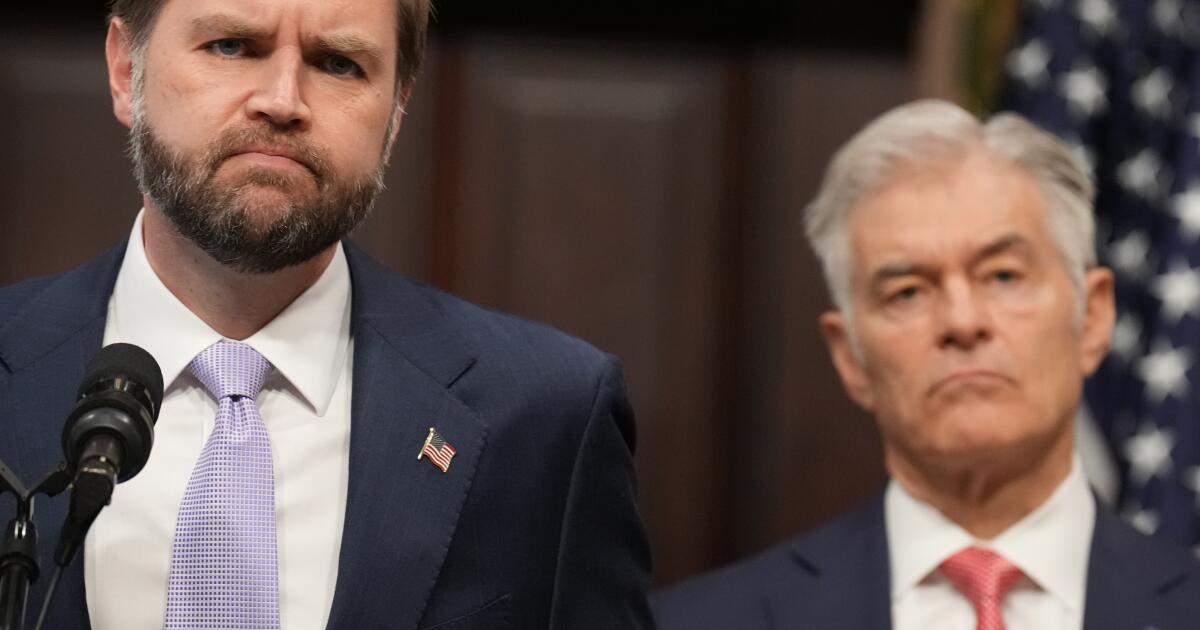
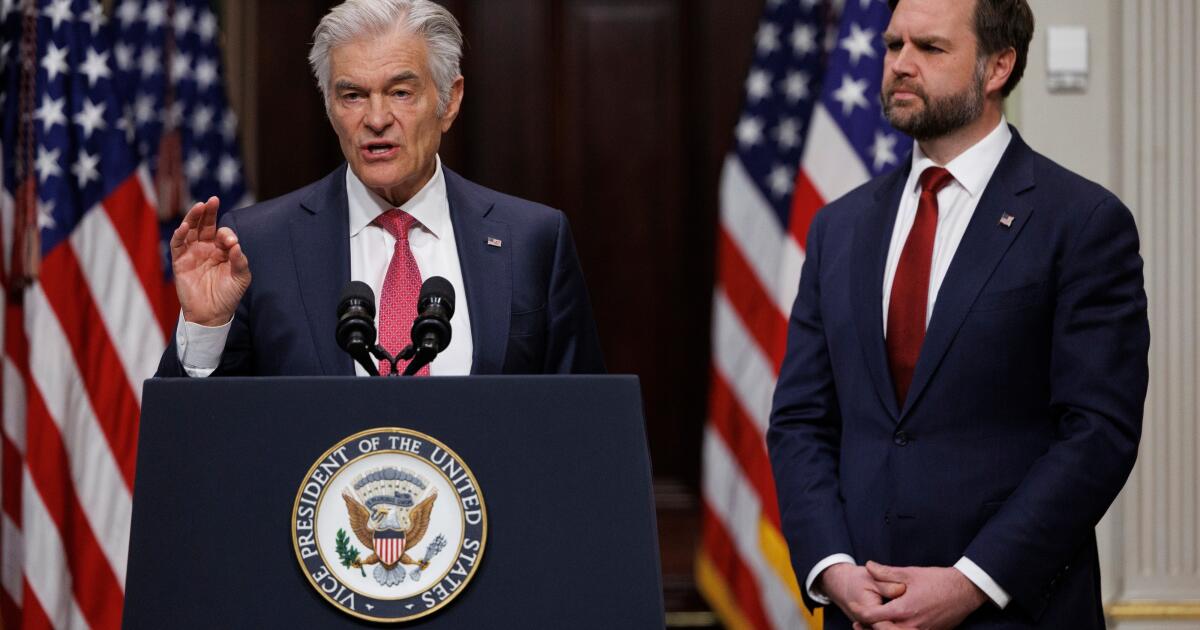
Vance says $1.3 billion in Medicaid payments to California will be deferred over fraud concerns

Vice President JD Vance said Wednesday that the Trump administration is deferring $1.3 billion in Medicaid reimbursements to California over concerns the state is allowing “fraudsters” to drive up costs to taxpayers, including by pushing unnecessary medications on unsuspecting patients.

“There are California taxpayers and American taxpayers who are being defrauded because California isn’t taking its program seriously. But also, you have people who’ve been prescribed medications that they don’t even need,” Vance said. “Sometimes they’ve had drugs put into their bodies that they don’t need because fraudsters have actually encouraged false prescriptions and false administration and medications.”

Vance, standing alongside Dr. Mehmet Oz, the administrator for the Centers for Medicare and Medicaid Services, said the administration is also sending letters to all 50 states informing them that if they do not “effectively and aggressively prosecute Medicaid fraud in their states,” they will see federal funding cut off as well.

“We want California to get serious about this fraud,” said Vance, who President Trump named his “fraud czar” last month.

Oz called out what he said was widespread fraud in hospice services and similar in-home care programs nationally — and particularly in the Los Angeles region — and announced a six-month moratorium on new Medicare enrollment for hospices and home health agencies.

“A third of all these programs in the entire country are in Los Angeles. Ask yourself, how is that possible? It’s not,” Oz said. “They’re not that many people dying in Los Angeles. We’re not talking about California, just Los Angeles.”

He said he and others in the administration determined that “at least half of the hospices, in the entire area around Los Angeles, are fraudulent,” and had shut down 800 of them that last year had “charged the federal taxpayer $1.4 billion,” which “will no longer be paid.” That is a major increase from the 450 providers the administration said it had suspended as of last month.

The announcement was the latest attempt by the Trump administration to highlight and rein in fraud in federal healthcare benefits programs, particularly in blue states. The actions were met with immediate push back from California officials.

“We hate fraud. But that’s NOT what this is,” Gov. Gavin Newsom’s office posted on the social media site X. “Vance and Oz are attacking programs that keep seniors and people with disabilities OUT of nursing homes. Pretty sick.”

Newsom’s office said that the growth of In-Home Supportive Services placements in California was “simple,” and due to California “keeping more people OUT of far more expensive nursing homes!”

Such services cover assistants who help people with daily tasks such as bathing, laundry or cooking; provide needed care such as injections under the direction of a medical professional; and accompany them to and from doctor’s appointments. A 2020 report by the California state auditor found that nearly three-quarters of IHSS caregivers assist a family member.

Newsom’s office wrote IHSS care costs $30,000 a year, while nursing home care costs $137,000 a year. “SAVING TAXPAYERS: $107K per person,” it wrote.

California Atty. Gen. Rob Bonta also criticized the administration’s moves.

“Once again, California appears to be targeted solely for political reasons,” Bonta said. “The Trump administration is planning to defer over $1 billion in Medicaid funding for vital programs that helps seniors and people with disabilities remain safely in their homes.

“My team is carefully reviewing all available information. We have not hesitated to challenge unlawful actions by the Trump administration, and we will continue to act whenever Californians’ rights or access to critical services are threatened,” he said.

Democratic Sen. Alex Padilla also lashed out at the Trump administration.

“The Trump Administration is attacking California over claims that they can’t back up,” Padilla wrote on social media. “Let’s be real, this isn’t about fraud — it’s about punishing a state that didn’t vote for him. Political retribution plain and simple.”

Fraud in California’s hospice industry has been a problem for years.

Authorities in the state promised to crack down on the issue after a Times investigation in late 2020 revealed that unscrupulous providers were billing Medicare for hospice services and equipment for patients who were not actually dying — with the hospice industry in the state exploding in size.

California’s Medicaid program, known as Medi-Cal, is expected to cost about $222 billion for the budget year starting July 1, including both state and federal funding. Roughly 15 million Californians, more than a third of the state, are on Medi-Cal.

Vance, a potential 2028 presidential hopeful, has taken up his work as “fraud czar” with vigor, traveling around the country to drive home the idea that the Trump administration is working diligently to bring down healthcare costs by addressing waste, fraud and abuse that is rampant across the system.

He has said that waste and abuse is particularly prevalent in Democratic-led states such as California, New York and Minnesota.

“We have red states and blue states that go after fraud aggressively, but we also, unfortunately, have some states, mostly blue states, unfortunately, that do not take Medicaid fraud very seriously,” he said Wednesday.

Vance specifically threatened to cut off what he said is billions in federal funding for state-run fraud control units that are meant to prosecute people who abuse the system, but which he said aren’t doing the work. “This is a tool that we want the states to use, but unfortunately, a lot of states aren’t using these tools at all,” he said.

The focus on fraud comes against a backdrop of criticisms that other policy measures pushed by the administration have driven healthcare costs up or made it harder for people to access healthcare — including cuts to Obamacare subsidies and new work requirements in Medicaid, which are expected to strain hospitals around the country and led to millions of people losing healthcare coverage.

Democrats and Republicans have argued over who is to blame for rising healthcare costs, and Vance and Oz have clashed with California leaders before.

In January, Newsom filed a civil rights complaint against Oz after he posted a video accusing Armenian crime groups of carrying out widespread healthcare fraud in Los Angeles. In the video, Oz was shown driving around Van Nuys, saying about $3.5 billion worth of Medicare fraud had been perpetrated by hospice and home care businesses — and “run, quite a bit of it, by the Russian Armenian mafia.”

Newsom called Oz’s claims “baseless and racist.”

The administration previously launched investigations into potential healthcare fraud in at least five states — California, Florida, Maine, Minnesota and New York — and halted some $243 million in Medicaid payments to Minnesota over fraud concerns.

The Centers for Medicare & Medicaid Services has also acknowledged using errant figures to justify a fraud probe in New York, deepening concerns in the administration’s methods for identifying problematic activity.

Vance said the deferral of funds to California and the letters warning other states to get serious is not about political retribution, but a wake up call. He said the Trump administration wants to help states root out fraud and abuse, including with new technologies — but can’t do so if they are not “willing to help themselves” first.

“We don’t want to turn off any money. What we want to do is ensure that people are taking fraud seriously. We want to protect Medicaid, we want to protect Medicare,” Vance said. “But we can’t do that if the states that are administering those programs are allowing those programs to be fleeced by fraudsters.”

The Associated Press contributed to this article.

Source link

Expected closure of Everglades detention center is no accident, environmentalists say

Environmental groups say that the timing of the expected closure of an immigration detention center in the middle of the Florida Everglades, likely in the next month or two, is no accident because it will come as their lawsuit challenging its existence returns to a federal judge who had previously ordered it shut down.

A federal appellate court decided last month to keep open the detention center nicknamed “Alligator Alcatraz,” for the time being, blocking a lower court decision ordering it to wind down operations. But the case was sent back to the lower court judge who now gets jurisdiction over the lawsuit as the litigation over the facility’s fate continues.

“Knowing that the same district judge who previously enjoined the operation would soon reassume oversight — the defendants are now effectively waving the white flag,” said Paul Schwiep, an attorney for the environmental groups that had sued, saying the facility’s construction hadn’t undergone a required environmental review.

When asked about the future of the state-run facility and its costs on Wednesday, Florida Gov. Ron DeSantis said that he hadn’t gotten any “official word” that federal authorities are going to stop sending detainees to the center.

But vendors who supply and help run the facility have been told that the closure could be as soon as next month, according to reports Tuesday by the New York Times and CBS News Miami. The Florida Department of Emergency Management, which operates the detention center, didn’t respond to an emailed inquiry on Wednesday. The Republican governor’s press secretary, Molly Best, referred questions about the facility to the state emergency management agency.

“We didn’t build any permanent facilities down there because we knew it was going to be temporary,” DeSantis said Wednesday at a news conference in Titusville, Fla.

DeSantis’ administration opened the facility in July to support the immigration crackdown by the administration of President Trump, who visited the detention center last summer. An attorney for two detainees has accused guards of severely beating and pepper-spraying detainees. Other detainees have said worms turn up in the food, toilets don’t flush and mosquitoes and other insects are everywhere.

“This monument to cruelty, waste and environmental and tribal lands abuse should have never been built,” U.S. Rep. Debbie Wasserman Schultz, a Democrat from Florida, said Tuesday.

Friends of the Everglades and the Center for Biological Diversity sued state and federal officials a short time after the facility opened, claiming the remote airstrip site in the Everglades wasn’t given a proper environmental review required by federal law before it was converted into an immigration detention center. U.S. District Judge Kathleen Williams in Miami agreed and ordered in August that the facility must wind down operations within two months.

The appellate court blocked the order, saying the Florida-run facility wasn’t under federal control and didn’t need to comply with federal law requiring an environmental impact review.

But the appellate court made clear that once Florida got federal reimbursement for the facility, it would have to comply with the federal environmental law, Schwiep said.

DeSantis said Tuesday that the state expected to be reimbursed by the federal government for $608 million, which has already been approved by the Federal Emergency Management Agency.

“There’s no negotiations on that,” he said.

Schneider writes for the Associated Press.

Source link

White House freezes new Medicare enrollments for hospice, home health

The Trump administration on Wednesday pursued new efforts in a sweeping initiative to root out fraud in federal health programs, including announcing a nationwide six-month freeze on some new Medicare enrollments and warning states to actively investigate Medicaid fraud or risk losing funding.

The moves are related to Vice President JD Vance’s anti-fraud task force, which has been accelerating its messaging before the November elections. The panel set up by Republican President Trump seeks to crack down on potential misuse of public money.

The most significant step Wednesday came from the Centers for Medicare and Medicaid Services with a nationwide six-month moratorium on all new Medicare enrollments by providers of hospice and home care.

“We’ve seen systemic and deeply troubling fraud in the hospice and home health space, with bad actors exploiting some of our most vulnerable Medicare patients and stealing money from the American taxpayer,” the agency’s administrator, Dr. Mehmet Oz, said in a statement. “Today we’re shutting the door on fraud — preventing new bad actors from entering Medicare while we aggressively identify, investigate, and remove those already exploiting them.”

The Department of Health and Human Services’ internal watchdog has sent letters to state attorneys general warning them to vigorously investigate possible fraud or risk losing federal money.

People across the United States have raised concerns about rising healthcare costs and barriers to access, sometimes from the federal government’s actions. New work requirements in Medicaid, for example, are expected to strain hospitals around the country and result in millions of enrollees losing their health coverage.

Several alleged fraud schemes have been prosecuted in the hospice and home health care categories, and states have acknowledged that it is a legitimate concern. But some have pushed back on the administration’s aggressive tactics and raised concerns that the catchall efforts could needlessly punish law-abiding providers that are trying to serve patients.

What the freeze does

The administration contends the enrollment freeze and other actions it is taking will help prevent potential fraud in Medicaid and Medicare and preserve funding and resources for people most in need. Under the six-month pause, existing hospice and home health care providers will continue to operate as usual. But the Medicare and Medicaid agency said it will “intensify targeted investigations, deploy advanced data analytics, and accelerate the removal” of providers in the category that are suspected of fraudulent activity.

Such a freeze is not unprecedented, said Tricia Neumann, a senior vice president and executive director for the program on Medicare policy at the healthcare research nonprofit KFF. She said President Clinton’s Democratic administration also imposed a temporary moratorium on home health agencies.

“A brief moratorium gives the administration time to crack down on true fraud and prevent new fraudulent entities from popping up,” she said.

Maine becomes a focus

Vance, a potential 2028 White House hopeful, has used the high-profile assignment from Trump to remind Americans struggling with high costs that he is trying to claw back taxpayer dollars. Vance has promoted the task force’s work during campaign stops for Republican candidates and is expected to focus on the effort Thursday in Maine, where there are closely watched primary races on June 9.

Oz said earlier in the year that he was calling for corrective action on alleged fraud in government health programs in Maine, a request characterized by the state’s Democratic governor, Janet Mills, as a “political attack.”

Federal investigations and oversight

In recent months, the Medicare and Medicaid agency has suspended payments to hundreds of hospice and home care agencies in Los Angeles over alleged fraud and issued another six-month moratorium on suppliers of durable medical equipment, prosthetics, orthotics and certain other supplies in Medicare.

The administration also has approached at least five states with investigations into potential healthcare fraud and halted about $243 million in Medicaid payments to one of them, Minnesota, over fraud concerns. Last month, Oz announced his agency would add to that oversight by requiring all 50 states to share how they planned to revalidate some of their Medicaid providers.

In at least one case, the administration has erred in its accusations against states. In April, the Medicare and Medicaid agency acknowledged to the Associated Press that it made a significant error in figures it used to help justify a fraud inquiry in New York. The acknowledgment deepened doubts about the administration’s methods and raised a common criticism about the second Trump administration — that it tends to attack first and confirm the facts later.

Swenson and Price write for the Associated Press. Swenson reported from New York. AP writer Geoff Mulvihill in Haddonfield, N.J., contributed to this report.

Source link

Memphis residents claim harassment, arrest and abuse by Trump-ordered Memphis Safe Task Force

Four Memphis residents are suing U.S. and Tennessee officials, saying they have been harassed, arrested and physically mistreated for engaging in First Amendment protected activities by observing and recording law enforcement agents in their city.

A lawsuit filed Wednesday in federal court targets the Memphis Safe Task Force, comprising agents from 13 federal agencies that President Trump ordered to the city to fight crime alongside Tennessee State Troopers and the Tennessee National Guard.

Since late September, hundreds of federal, state and local law enforcement personnel tied to the task force have made traffic stops, served warrants and searched for fugitives in the majority Black city of about 610,000 people. The lawsuit says the task force has conducted over 120,000 traffic stops.

“In the professed name of crime control, Task Force agents have stopped, menaced, and arrested Memphians engaging in routine, day-to-day activities,” the lawsuit states. “In response, Memphians encountering Task Force agents in public, including Plaintiffs, have stopped to gather information about and record Task Force activities.”

Emails from the Associated Press to the U.S. Department of Justice and a spokesperson for the task force were not returned on Wednesday morning.

Federal officials including Defense Secretary Pete Hegseth, former Atty. Gen. Pam Bondi and White House Deputy Chief of Staff Stephen Miller, have visited Memphis to praise the task force. Miller in October predicted the surge in law enforcement would make the city “safer than any of you could ever possibly imagine” and that “businesses and investment are going to pour in, and Memphis will be richer than ever before.”

The task force is part of a larger effort by Trump to use National Guard troops and surge federal law enforcement in cities, particularly ones controlled by Democrats. Following troop deployments in the District of Columbia and Los Angeles, he referred to Portland, Ore., as “war-ravaged” and threatened apocalyptic force in Chicago. Speaking last year to U.S. military leaders in Virginia, Trump proposed using cities as training grounds for the armed forces.

The lawsuit accuses task force agents of systematically retaliating against the four plaintiffs and other members of the public engaged in similar observations. It claims the threats and harassment are the “direct result of federal policy” that views observing federal agents performing their duties in public as a threat of harm to those agents. The lawsuit also claims that federal and state officials have failed to train their agents not to retaliate against citizens engaged in First Amendment protected activities.

The lawsuit asks the court to declare that retaliation against the plaintiffs for observing and recording law enforcement activity is unconstitutional and to prohibit the agents from further retaliation. It also targets a Tennessee law that requires observers to stand at least 25 feet away from law enforcement officers, if they are warned to do so, or face arrest. The suit asks the court to declare unconstitutional the use of the “Halo Law” against defendants who are not interfering with agents or impeding their duties.

Loller writes for the Associated Press.

Source link

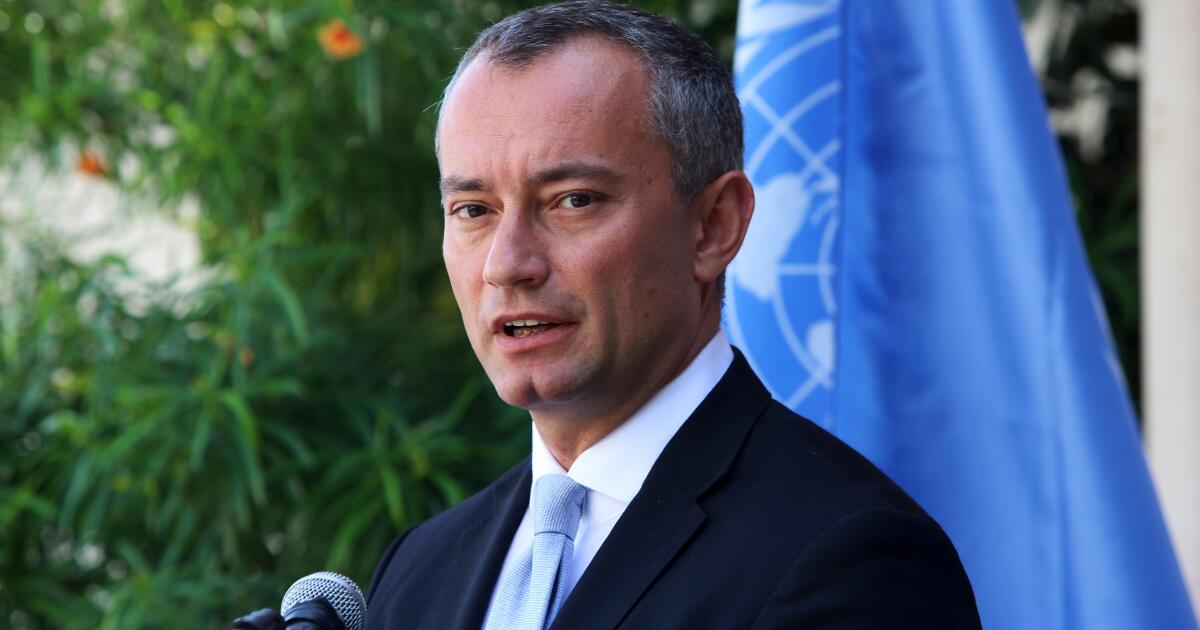
Board of Peace envoy says ceasefire hinges on Hamas’ disarmament

Nickolay Mladenov, the top diplomat overseeing the U.S.-brokered ceasefire in Gaza, said Wednesday the truce hinged on Hamas’ disarmament, a sticking point that has stalled progress on other fronts, including rebuilding the mostly destroyed enclave.

The high representative for President Trump’s International Board of Peace in Gaza, Mladenov, said months without progress implementing the deal benefited neither Israel nor Palestinians. He said the phased deal was paralyzed over Hamas not yet disarming, calling it “not negotiable.”

International mediators have long said disarmament is core to the ceasefire, to which Hamas has agreed, but no significant progress has been made toward it. The Palestinian militant group has sought to link any demilitarization to Israeli troop pullbacks. Israel’s military remains in control of more than half of Gaza.

“The only way that we believe that we can ensure that Israeli withdrawal takes place to the perimeter is if we have the full element of the plan unfolding in Gaza,” Mladenov said at a rare press conference in Jerusalem.

Mladenov stated plainly that the plan envisioned in the ceasefire was off to a rocky start. He also said conditions remain dire and miserable for the more than 2 million people in Gaza. He accused both sides of violating the ceasefire but said it had mostly held and staved off the return of full-scale war.

Disarmament is among the most challenging elements of the ceasefire. Hamas, whose founding charter calls for armed resistance against Israel, has been reluctant to give up its arsenal, including rockets, anti-tank missiles, and explosives.

Mladenov did not answer questions about what could lie ahead for Gaza in the absence of disarmament. He criticized Hamas for consolidating power in parts of Gaza under its control, saying it hoped “to squeeze better terms of a negotiation.”

He also said that he could envision a role for Hamas in postwar Gaza if it disarms.

“We are not asking Hamas to disappear as a political movement,” Mladenov told reporters.

Israeli leaders have said they want to destroy the militant group that has governed Gaza for two decades and orchestrated the attack on Israel on Oct. 7, 2023, killing some 1,200 people and taking 251 as hostages.

Israel’s ensuing offensive has killed over 72,724 Palestinians, including at least 846 since a ceasefire took hold last October.

Mladenov’s remarks came as the Board of Peace faces scrutiny, with efforts to advance the phased ceasefire stalled.

The truce envisioned Hamas handing over its weapons, Israeli forces withdrawing and rebuilding destroyed swaths of the coastal enclave after more than two years of war.

Instead, the seven months since the ceasefire have seen Israel and Hamas trade accusations of violations. Aid groups say Israel has not allowed the promised amount of aid in. Hamas has not disarmed and remains in control of roughly half the strip.

Trump’s 20-point plan says that all of Hamas’ “military, terror and offensive infrastructure, including tunnels and weapon production facilities” in Gaza must be destroyed. It also says that weapons must be placed “permanently beyond use.”

Israel and the U.S. say this language is clear and that Hamas must surrender all of its weapons.

Hamas has sought to differentiate between “heavy” weapons, such as rockets, and “light” weapons like rifles and pistols, Hamas officials and mediators say, speaking on condition of anonymity to discuss the negotiations.

Israel has stepped up its attacks in Gaza in recent days, since the U.S.-Iran ceasefire, and many Palestinians fear a return of more airstrikes and full-scale war may be imminent.

Frankel and Metz write for the Associated Press.

Source link

Trump arrives in Beijing for talks with China’s Xi on Iran war, trade and U.S. arms sales to Taiwan

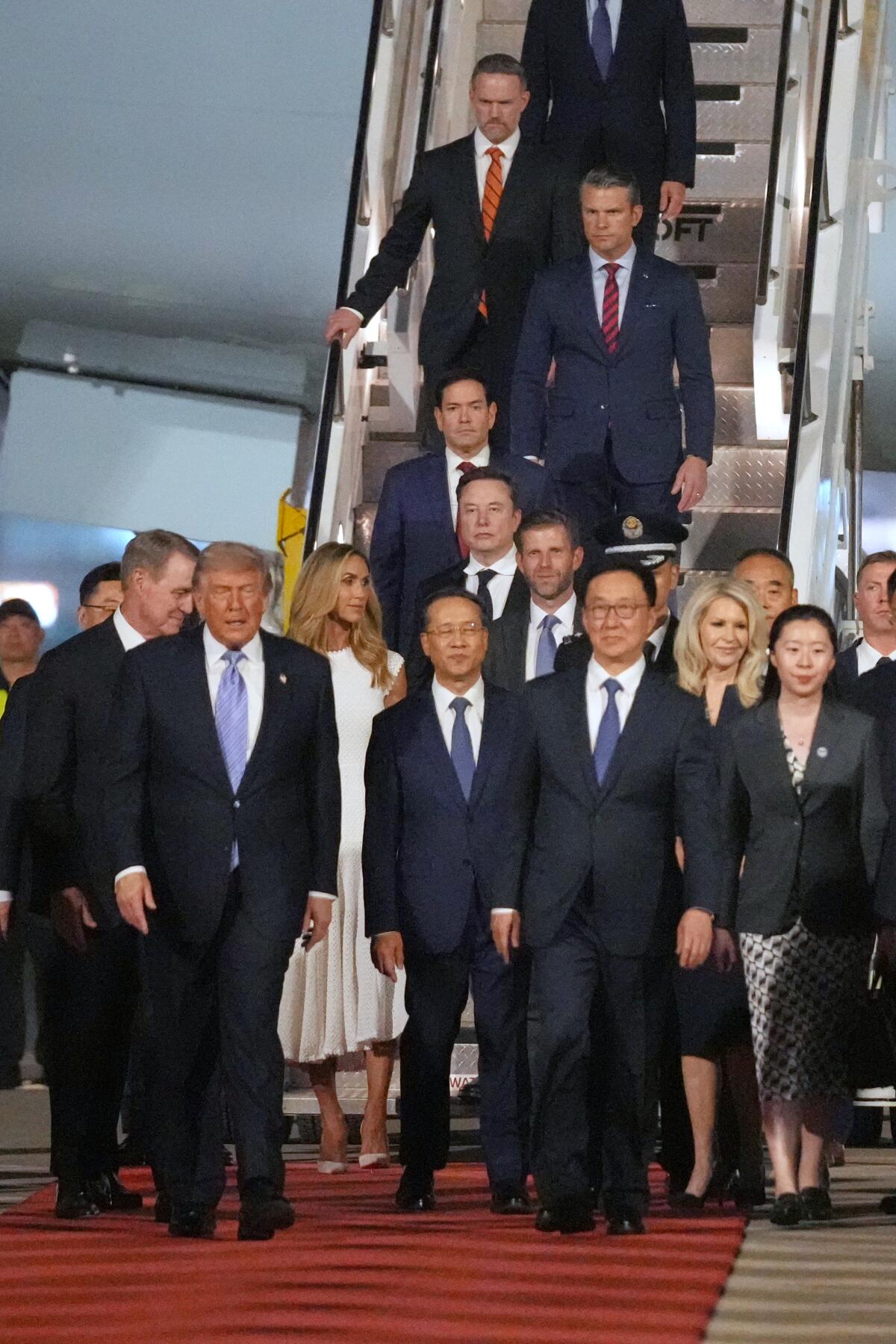
President Trump arrived in Beijing on Wednesday for his hotly anticipated talks with Chinese President Xi Jinping on the Iran war, trade and U.S. arms sales to Taiwan.

The meat of the summit doesn’t start until Thursday, when the leaders hold bilateral talks, visit the Temple of Heaven, where Chinese emperors once prayed for bumper crops, and take part in a formal banquet. But the Chinese offered Trump a pomp-filled welcome, literally rolling out the red carpet for him after Air Force One landed in the Chinese capital.

The president was greeted by Chinese Vice President Han Zheng; Xie Feng, China’s ambassador to Washington; Ma Zhaoxu, executive vice minister of foreign affairs; and the U.S. envoy to Beijing, David Perdue.

The welcoming ceremony included a military honor guard, a military band and some 300 Chinese youths waving Chinese and American flags and chanting, “Welcome, welcome! Warm welcome!” as Trump made his way to his waiting limousine. The youth greeters were decked out in white and robin’s egg blue outfits that matched the paint job of the iconic presidential plane.

President Trump walks with China's Vice President Han Zheng during an arrival ceremony

President Trump walks with China’s Vice President Han Zheng during an arrival ceremony Wednesday at Beijing Capital International Airport, as Eric and Lara Trump, Elon Musk, Secretary of State Marco Rubio, Defense Secretary Pete Hegseth and U.S. Trade Representative Jamieson Greer follow.

(Mark Schiefelbein / Associated Press)

“We’re the two superpowers,” Trump told reporters as he departed the White House on Tuesday for the long flight to Beijing. “We’re the strongest nation on Earth in terms of military. China’s considered second.”

While Trump likes to project a sense of strength, the visit occurs at a delicate moment for his presidency as his popularity at home has been weighed down by the U.S. and Israel’s war with Iran and rising inflation as a consequence of that conflict. The Republican president is seeking a win by signing deals with China to buy more American soybeans, beef and aircraft, saying he’ll be talking with Xi about trade “more than anything else.”

The Trump administration hopes to begin establishing a Board of Trade with China to address differences between the countries. The board could help prevent the trade war ignited last year after Trump’s tariff hikes, an action China countered through its control of rare earth minerals. That led to a one-year truce last October.

But Trump is visiting Beijing when Iran continues to dominate his domestic agenda. The war has led to the effective closure of the Strait of Hormuz, stranding oil and natural gas tankers and causing energy prices to spike to levels that could sabotage global economic growth. The U.S. president declared that Xi didn’t need to assist in resolving the conflict, even though Iran’s Foreign Minister Abbas Araghchi was in Beijing last week.

Fellow rescuers carry the coffins of two members of the civil defense who were reportedly killed in Israeli airstrikes

Fellow rescuers carry the coffins of two members of the civil defense who were reportedly killed in Israeli airstrikes in Nabatieh the previous day, during their funeral in the southern city of Sidon on May 13, 2026. Israel hammered south Lebanon with strikes on May 12 ahead of talks between the two countries in Washington, as Beirut reported 380 people killed in Israeli attacks since an April 17 ceasefire took effect.

(Mahmoud Zayyat/AFP via Getty Images)

“We have a lot of things to discuss. I wouldn’t say Iran is one of them, to be honest with you, because we have Iran very much under control,” Trump told reporters Tuesday.

Taiwan high on the agenda

The status of Taiwan also will be a major topic as China is displeased with U.S. plans to sell weapons to the self-governing island, which the Chinese government claims as part of its own territory.

Trump told reporters on Monday that he would be discussing with Xi an $11 billion weapons package for Taiwan that the U.S. administration authorized in December but has not yet begun fulfilling. The arms package is the largest ever approved for Taiwan.

But Trump has demonstrated greater ambivalence toward Taiwan, an approach that’s raising questions about whether the U.S. leader could be open to dialing back support for the island democracy.

The Taiwanese flag at Democracy Boulevard is lowered at the Chiang Kai-shek Memorial Hall

The Taiwanese flag at Democracy Boulevard is lowered at the end of the day as the Chiang Kai-shek Memorial Hall is seen in the background in Taipei on May 13, 2026.

(I-Hwa Cheng/AFP via Getty Images)

At the same time, Taiwan — as the world’s leading chipmaker — has become essential for the development of artificial intelligence, with the U.S. importing more goods so far this year from Taiwan than China. Trump has sought to use Biden-era programs and his own deals to bring more chipmaking to America.

The Chinese Communist Party’s news outlet, People’s Daily, published a strongly worded editorial ahead of Trump’s arrival underscoring that Taiwan is “the first red line that cannot be crossed in China-U.S. relations” and is “the biggest point of risk” between the two nations.

Trump was already portraying the trip as a success before he even left White House grounds. He openly mused about Xi’s planned reciprocal visit to the U.S. later this year, lamenting that the White House ballroom under construction would not be completed in time to properly fete the Chinese leader.

“We’re going to have a great relationship for many, many decades to come,” Trump said of the U.S. and China.

Counter snipers and other security forces watch over Air Force One while refueling at Joint Base Elmendorf

Counter snipers and other security forces watch over Air Force One while refueling at Joint Base Elmendorf during a trip with US President Donald J. Trump in Anchorage, Alaska, on May 12, 2026. Donald Trump was due in Beijing on May 13, 2026 on the first visit to China by a US president in nearly a decade, as he seeks to ramp up trade despite potential friction over Taiwan and Iran.

(Brendan Smialowski/AFP via Getty Images)

Trump embarked on Air Force One for the big meeting with a coterie of aides, family members and business world titans, including Nvidia’s Jensen Huang and Tesla and SpaceX’s Elon Musk. While en route to Beijing, he posted on social media that his “first request” to Xi during the visit will be to ask the Chinese leader to bolster the presence of U.S. firms in China.

“I will be asking President Xi, a Leader of extraordinary distinction, to ‘open up’ China so that these brilliant people can work their magic, and help bring the People’s Republic to an even higher level!” Trump wrote.

Tajikistan's President Emomali Rahmon and China's President Xi Jinping attend a welcoming ceremony

Tajikistan’s President Emomali Rahmon and China’s President Xi Jinping attend a welcoming ceremony at the Great Hall of the People on Tuesday, in Beijing.

(Maxim Shemetov—Pool / Getty Images)

Despite Trump’s outward confidence, China appears to be entering the meeting from “a much stronger place,” said Scott Kennedy, a senior adviser on Chinese business and economics at the Center for Strategic and International Studies, a Washington think tank.

China would like to reduce tech restrictions on accessing computer chips and find ways to reduce tariffs, among other goals.

“But even if they don’t get much on any of those things, as long as there’s not a blow-up in the meeting and President Trump doesn’t go away and look to re-escalate, China basically comes out stronger,” Kennedy said.

U.S. Treasury Secretary Scott Bessent and Chinese Vice Premier He Lifeng met on Wednesday to discuss economic and trade issues at Incheon International Airport, just west of the South Korean capital of Seoul, according to the Chinese state run Xinhua News Agency.

Bystanders are kept back by police tape as they film the motorcade of President Donald Trump as he arrives

Bystanders are kept back by police tape as they film the motorcade of President Donald Trump as he arrives at the Four Seasons Hotel on Wednesday in Beijing.

(Kevin Frayer / Getty Images)

Trump wants 3-way nuclear arms deal

Trump also intends to raise the idea of the U.S., China and Russia signing a pact that would set limits on the nuclear weapons each nation keeps in its arsenal, according to a senior Trump administration official who briefed reporters ahead of the trip. The official spoke on the condition of anonymity under ground rules set by the White House.

China has previously been cool to entering such a pact. Beijing’s arsenal, according to Pentagon estimates, exceeds more than 600 operational nuclear warheads and is far from parity with the U.S. and Russia, which each are estimated to have more than 5,000 nuclear warheads.

The last nuclear arms pact, known as the New START treaty, between Russia and the United States expired in February, removing any caps on the two largest atomic arsenals for the first time in more than a half-century. As the treaty was set to expire, Trump rejected a call by Russia to extend the two-country deal for another year and called for “a new, improved, and modernized” deal that includes China.

The Pentagon estimates China will have more than 1,000 operational nuclear warheads by 2030.

Madhani, Weissert and Boak write for the Associated Press. Boak reported from Washington. AP writers Darlene Superville in Washington, Huizhong Wu in Bangkok, Hyung-jin Kim in Seoul, South Korea, and Kanis Leung in Hong Kong contributed to this report.

Source link

Louisiana advances plan to eliminate majority-Black U.S. House district after court ruling

Republican senators in Louisiana advanced a plan Wednesday to eliminate one of two majority-Black, Democratic-held congressional seats following a U.S. Supreme Court ruling that struck down the state’s U.S. House map as an illegal racial gerrymander.

The early morning Senate committee vote came after hours of impassioned testimony from Black residents and Democrats opposed to the move. Republicans opted not to pursue a more aggressive approach, which could have targeted both Democratic seats for elimination.

The Supreme Court’s recent ruling weakening federal Voting Rights Act protections for minorities has prompted Republicans in several Southern states to try to eliminate House districts with large minority populations that have elected Democrats. Tennessee and Alabama already have acted to implement different House maps that could help Republicans win an additional seat. But a similar effort fizzled Tuesday in the South Carolina Senate.

The redistricting efforts to undo minority districts are the latest variation in a 10-month-long national redistricting battle that already has involved about one-third of the states. It gained steam when President Trump urged Texas Republicans last year to redraw House districts in an attempt to win more seats in the midterm elections. Democrats in California responded with their own new districts. Numerous Republican states have redistricted since then.

Republicans think they could gain as many as 15 seats so far from new House maps in Texas, Missouri, North Carolina, Ohio, Florida, Tennessee and Alabama. Democrats, meanwhile, think they could gain six seats from new maps in California and Utah. The Virginia Supreme Court last week struck down a redistricting effort that could have yielded four more winnable seats for Democrats.

Brook and Lieb write for the Associated Press. Lieb reported from Jefferson City, Mo.

Source link

Becerra’s advisor pleaded guilty. Gubernatorial rivals are piling on

As Xavier Becerra rose to the top echelons of power in Washington and Sacramento over the last two decades, his trusted advisor Sean McCluskie joined him at every step.

The son of a Scottish immigrant, McCluskie had a reputation as a political street fighter and his gruff style complemented Becerra’s more measured, cerebral approach.

Now Becerra is under attack in California’s wide-open governor’s race after McCluskie, 57, pleaded guilty in December to stealing more than $200,000 from Becerra’s campaign account.

The charges were part of a broader scandal that implicated or brushed up against some of Sacramento’s most influential Democratic political advisors, a scheme prosecutors allege included payments, bank fraud and an FBI sting operation that swept McCluskie’s incriminating private conversations and texts into evidence.

Rivals in the California governor’s race have seized on the case to question whether Becerra, one of the front-runners in the contest to succeed outgoing Gov. Gavin Newsom, is fit for office and could be swept up in the case.

“We can’t have someone who is running as a Democrat who could run into legal difficulties,” said candidate Tom Steyer, who is close to Becerra in the polls.

Becerra has not been accused of wrongdoing, and prosecutors’ court filings describe him as a victim. He told The Times that he cooperated with investigators, including appearing before the grand jury.

“Sean was as close as any staffer that I’ve ever had,” Becerra said in an interview last week, describing how McCluskie moved across the country twice to work for him.

He added that he’s “racked” his brain to understand the case involving McCluskie and his longtime political consultant, Dana Williamson, both of whom he described as “very highly accomplished people.”

Williamson, who also served as Gov. Gavin Newsom’s chief of staff, was indicted in November. She had refused to cooperate with federal investigators and pleaded not guilty, but recently discussed a plea deal with prosecutors. A court hearing is set for Thursday, according to court filings.

An agreement could unearth more details about the case in the coming weeks, a possibility not lost on the Democrats and Republicans running for governor.

Former Orange County Rep. Katie Porter, one of the Democrats who has watched Becerra’s rapid ascent in the race, said in a CNN interview Monday that California can’t risk having Becerra in the race with the specter of the ongoing criminal case.

She acknowledged that “I do not have the facts” about the case, but said if Becerra were to finish in the top two in the June 2 primary and then be indicted by the Trump administration’s Department of Justice, a Republican ultimately could win the governor’s race in November.

“Secretary Becerra cannot and has not guaranteed or promised the people of California that he will not be named as a co-conspirator and indicted,” she said.

Other candidates, and reporters, have questioned whether Becerra had a blind spot in trusting McCluskie.

Appearing on Fox40 News last year, Becerra likened the criminal case to being “married for 20 years” and “all of a sudden you find out that your spouse has been cheating.”

According to prosecutors, McCluskie, Williamson, and another consultant skimmed $225,000 from one of Becerra’s dormant campaign accounts and funneled it to McCluskie through various entities.

McCluskie, who declined to speak to The Times, sought the money because he’d taken a pay cut after joining Becerra in Washington when Becerra became Health and Human Services secretary in 2021, according to prosecutors.

And unlike Becerra, he didn’t move full-time to D.C., and was splitting his time between the nation’s capital and California, where his family lived.

On a phone call recorded by the FBI in 2024, McCluskie talked about the scheme and told a consultant, “This money you guys are giving me is helping me fly back and forth to D.C. and live there half part time.”

Becerra, in an interview, said McCluskie never mentioned his money problems. The pair worked together when Becerra served in Congress and as California attorney general.

After President Biden appointed Becerra to lead Health and Human Services, the pair discussed the move back to D.C.

“Even before we went to HHS, we had talked about whether we wanted to do this,” Becerra said. “We both agreed, ‘Yeah, you know, it’s going to be a sacrifice. We’re going to have to make changes.’”

Former Becerra staffers told The Times that Becerra and McCluskie were such a close team that they have a hard time imagining Becerra working in government without McCluskie.

Another former staffer, Amanda Renteria, said the two men bonded over their humble immigrant backgrounds. McCluskie’s family came from Scotland and Italy; Becerra’s relatives came from Mexico.

McCluskie relished going to battle for those less fortunate, she said.

“When Becerra became A.G., [people questioned] whether or not he had the style that could really take on Trump. If you were to meet Sean, you’d be like, Oh yeah, Sean is totally ready for a fight, he’s ready to take him on.

“That was sort of a difference with Becerra. Becerra had that fight in him. Sean wore it a little bit more,” said Renteria, a political strategist.

Becerra has faced repeated questions about his financial judgment after the criminal case revealed that he agreed to pay up to $10,000 a month to Williamson and another consultant to oversee one of his dormant campaign accounts.

The consultants charged him the fee as part of the scheme to divert money to McCluskie, prosecutors allege.

At the time, Becerra, a Biden Cabinet member, was barred from involving himself in campaign matters.

Becerra defended the payments during an interview with Fox40 last year, stating, “I was told that’s the rate I would have to pay to get someone who could manage that and make sure that I don’t have to worry about [violating any federal rules].”

Campaign finance records show Becerra had never paid such a high fee for his other accounts.

Becerra told The Times that his longtime attorney Stephen Kaufman, whom he was also paying to oversee the account, didn’t flag the payments. “I would have expected him to raise issues if he thought there was something wrong,” Becerra said.

Kaufman didn’t respond to questions about the account.

Los Angeles-based political consultant Eric Hacopian told The Times that the fees are “certainly high.”

“It’s obviously something he should’ve noticed. Either he was not paying attention, or was too trusting of these people,” said Hacopian, who isn’t involved in the governor’s race. “At the end of the day, he’s the primary victim.”

At a debate last week, rival candidate Antonio Villaraigosa pounced on the payments made by Becerra, saying that the politician “has to be under suspicion because it doesn’t pass the smell.”

Danni Wang, a spokesperson for Steyer, said in a statement, “So, which is it — did Becerra know about the illegal payments and participate in the campaign’s corruption, or was he a totally incompetent manager oblivious to what was going on underneath his nose?”

Renteria, the former Becerra staffer, said the allegations against McCluskie and others are particularly surprising given Becerra’s reputation as a “straight A student.”

“Part of it broke my heart,” she said.

Jonathan Underland, a Becerra spokesperson, said Becerra “has always been consistent and clear: Every action he took was in accordance with the law.”

“What he didn’t know — and what the FBI’s own investigation goes out of its way to clarify — is that his staff cooked up a scheme designed to deceive him.”

Becerra, in an interview, repeatedly said that he relied on McCluskie. It was McCluskie, he said, who advised him to make the payments. “I trusted him to handle the accounts,” he said.

He also said he was unaware of some of the details laid out by prosecutors.

Prosecutors said Williamson and others created a “no show” job for McCluskie’s wife, Kerry MacKay, to do work for the consultants.

MacKay never was paid, however, and the money went to an account controlled by McCluskie. MacKay, who didn’t respond to requests for comment, was not charged.

McCluskie’s plea agreement states that he told Becerra about his wife’s job with the consultants, though he didn’t tell the politician that his wife wouldn’t actually be doing any work.

Becerra, in an interview, said he didn’t recall McCluskie informing him about his wife’s work.

McCluskie’s sentencing is scheduled for June 4, two days after the primary.

Source link

How a Del Taco in Barstow exposed Steve Hilton for who he really is

Out in the high desert city of Barstow stand three Del Tacos that bill themselves as better than their corporate cousins.

They’re the last ones owned and operated by Ed Hackbarth, the founder of the Mexican fast food chain. Two of them feature the word “Original” under their marquees, even though that’s historically inaccurate — Hackbarth opened the first Del Taco in the nearby town of Yermo in 1964.

That hasn’t stopped thousands of devotees — myself included — from trekking to these Cal-Mex shrines to buy memorabilia, gawk at historical photos and gorge on hard shell tacos, burritos and bun tacos that they insist are tastier than the ones at regular Del Tacos.

Among those visitors was Republican gubernatorial candidate Steve Hilton.

He stopped by the Original Del Taco off 1st Avenue on Saturday after a town hall with lieutenant governor candidate and Barstow native Gloria Romero. His campaign posted a short video on social media of him standing outside the spot — the oldest operating Del Taco — while holding something that looked like a melted Frisbee.

It was what the place calls a Barstow Taco: ground beef, a few strips of lettuce, a blizzard of bright yellow cheese and a thick red tomato slice on top, all inside a hard taco shell.

Hilton gleefully wielded the crunchy mass with one hand as he pointed to the Original Del Taco sign with the other.

“My Barstow street taco, I’m going to enjoy,” he concluded in an accent from his native England, while giving a thumbs-up. “See you soon.”

He didn’t take a bite.

The social media blowback exploded like a digital Montezuma’s revenge. Haters ridiculed Hilton for visiting a Mexican restaurant in what seemed like an attempt to attract Latino voters — if he was going to do that, why on Earth pick a multimillion-dollar empire founded by a gringo? Others noted that “street tacos” are made with corn tortillas and bought from a food truck or street stall. As the author of a book about the history of Mexican food in the United States, I pointed out that this Del Taco isn’t actually the original, despite what the marquee says.

A humble man would have immediately owned up to his mistakes. Hilton is not a humble man.

To someone who pointed out that “Barstow street taco” is a misnomer, Hilton shot back, “It’s what they call it!” To someone who accused him of supporting bland corporations instead of mom-and-pop shops, Hilton responded that he went there because Romero once worked there.

“Not everything in life has to be turned into a political argument!!” he whined.

Hilton and his followers are treating Del Taco-gate as much ado about nada — and yet it tells voters everything they need to know about the man.

Three hard shell tacos on a plate.

Three hard shell beef tacos from Mitla Cafe, the San Bernardino restaurant that indirectly served as the inspiration for Taco Bell and Del Taco.

(Jenn Harris / Los Angeles Times)

Endorsed by President Trump, he has consistently topped the polls this year, mainly because the many Democratic candidates have split the vote. Hilton has outperformed his main Republican rival, Riverside County Sheriff Chad Bianco, by promoting a message of positivity with weak-salsa slogans like “Make California Golden Again” and “Califordable.”

During debates, the former Fox News host has relied on his dry wit and posh tone to make his answers sound stronger than they are. He has especially focused on selling himself to Latinos. Months before announcing his run, we sat down at my wife’s restaurant in Santa Ana as he tried to pick my brain about this crucial swing vote, asking questions I kept telling him I had already answered in my columna.

Hilton is no pendejo. But I have to wonder about his judgment after that Del Taco video.

I have no problem with Hilton campaigning at a Mexican restaurant — it’s a political trope practiced by candidates of all persuasions. It’s unfair to expect a British immigrant who’s been in California only since 2012 to be fully versed in taco culture, as essential to the state as it is. And people shouldn’t bash him for highlighting a California culinary institution that’s one of the better legacy fast food chains out there, even though the Barstow Taco is, well, whatever. (Del Taco’s half-pound bean and cheese burrito, on the other hand, is as silky as a Luther Vandross slow jam.)

A proper hard shell taco is a beautiful thing. Just head out to San Bernardino’s Mitla Cafe, where Hackbarth’s former boss, Glen Bell, learned to make the tacos that turned the two of them into millionaires. But bragging about enjoying a hard shell taco nowadays is like showing up to a street takeover in a horse buggy.

As relevant to modern-day California as tamale pie, hard shell tacos are a reflection of Hilton’s pitch to voters: Instead of offering a bold vision for the future, he offers a return to a past that will never happen again and that wasn’t as great as people make it out to be.

I’ve tried to be as open as possible to Hilton’s campaign. California could benefit from a governor who didn’t emerge from the Sacramento swamp. It might even benefit from a Republican, as in the 2000s when Arnold Schwarzenegger forced Democrats to fight instead of fester.

But Hilton disappoints again and again. He launched his campaign in Huntington Beach, enamored of politicians there who seek to silo their city from the rest of California and humiliate liberals at every opportunity. His embrace of Trump‘s endorsement and refusal to admit that Joe Biden legitimately won the 2020 presidential election expose him as a toady. Hilton’s ongoing boast that he is the candidate for legal immigrants disqualifies my father, who originally came to this country without papers yet has contributed more to the California experiment (and is now a U.S. citizen) than Hilton ever has.

I’ll even be gracious and excuse Hilton for wrongly calling the Del Taco he visited the original one — the background is admittedly confusing. But his Barstow street taco flub is a stand-in for his campaign, which will flop come November if he doesn’t get his Mexican meals straight.

Hilton told me over the phone that it was his first time eating at a Del Taco (he enjoyed the Barstow Taco off-camera but felt their fish taco was better). He didn’t stop by “for the food, frankly,” but rather for its meaning to Romero and to California entrepreneurship.

“The idea of going to the first location of a business that ends up going big is actually pretty cool,” the former restaurateur said, noting that he had shot a video at the San Bernardino location of the first McDonald’s, which is now a museum.

He didn’t get defensive when I told him the Del Taco wasn’t the first one and that what he ordered wasn’t actually a street taco — “I would say I’m learning, and I love learning and I love food, and exploring places and community through food, and I really would love to learn more, for sure.”

Hilton said he does enjoy “real” tacos but couldn’t name any places he favored. He asked for recommendations. I suggested we go get some tacos with my dad, and he immediately agreed.

“So you can explain to him how you’re the candidate of legal immigrants,” I added. “My dad came to this country in the trunk of a Chevy.”

Hilton stayed silent for a second. “OK, let’s have that conversation,” he said.

Dear reader: Where should we eat?

Source link

Disabled veterans may be getting a big property tax break in California

Severely disabled veterans in California could be getting an expanded tax break.

State lawmakers are considering legislation that would exempt from taxation 50% of the residential property owned by a fully disabled veteran, or 100% if their household income does not exceed $40,000.

“I’ve seen firsthand the financial challenges many disabled veterans face just trying to stay in their homes,” Assemblyman Jeff Gonzalez (R-Indio) said Thursday. “We always say we support our veterans, but support has to mean taking meaningful action to make life more affordable for them.”

Gonzalez, who introduced Assembly Bill 2022, is a Marine Corps veteran and vice chair of the Assembly Committee on Military and Veterans Affairs.

The legislation would apply only to veterans who became disabled as a result of their military service. It defines a fully disabled veteran as one who is blind in both eyes, has lost the use of at least two limbs, or is otherwise incapacitated due to an injury or disease. Surviving spouses would be eligible for the same exemptions, provided they do not remarry.

The exemptions would sunset in 2032 so legislators could review the bill’s effect before deciding whether to enact the policy permanently.

California is home to more than 1.8 million former service members, which is the largest veteran population of any state in the nation, according to the most recent census. The California Department of Veterans Affairs estimates there are 184, 283 veterans this year residing in Los Angeles County.

During a legislative hearing earlier this year, Gonzalez told lawmakers that about 380,000 veterans in the state live with service-related disabilities. He explained the rising cost of living in California is especially challenging for those on fixed incomes, and said reducing property tax burdens could help prevent the most vulnerable veterans from ending up on the streets.

“For a veteran who has already sacrificed so much, losing their home is not just a financial hardship, it is a failure of our commitment to them,” Gonzalez said.

The bill has passed two committees with unanimous support and was most recently referred to the Assembly Committee on Appropriations.

There are currently two property tax exemptions offered for fully disabled veterans in California, according to the State Board of Equalization.

The basic property tax exemption, or the $100,000 exemption, is available to all fully disabled veterans. The low-income exemption, or the $150,000 exemption, is available to fully disabled veterans whose annual household income does not exceed a specified amount — currently $81,131 — that is adjusted periodically for inflation. The exemption amount reduces the assessed value of the property, resulting in less property taxes due.

Patrick Murphy, an urban affairs professor at the University of San Francisco who focuses on tax policy, doubts the legislation would have a significant effect on homelessness.

“Homelessness among veterans is a big problem; that is pretty well-documented,” he said. “But I think if we were to list the reasons why veterans end up homeless, the burden of their property taxes would be pretty far down.”

Murphy also cautioned that Assembly Bill 2022 could face potential legal challenges if signed into law.

“Since Prop. 13 is written into the California Constitution, I would almost think there would need to actually be a proposed ballot initiative to change this,” Murphy said.

Proposition 13 mandates that property should be assessed and taxed uniformly based on purchase price. It caps property tax rates at 1% of a property’s value at the time of purchase, and limits annual assessment increases to a maximum of 2%.

Scott Kaufman, legislative director for the Howard Jarvis Taxpayers Assn., believes the legislation is on solid footing.

“I don’t see a problem,” he said. “The disabled veterans exemption already exists in the constitution, so I don’t think Prop. 13 trumps it because they both exist together.”

The California Teacher’s Assn. has raised other concerns with the legislation.

“We oppose tax exemptions that cut into the state’s ability to fully fund public schools by putting Prop. 98 funding at risk,” spokesperson Maggie Sisco wrote in an email.

Proposition 98 guarantees a minimum annual funding amount for K-12 schools and community colleges. The money comes from state funding and local property taxes.

According to the State Board of Equalization, the state does not reimburse local governments for the property tax revenue losses from the Disabled Veterans’ Exemption.

The bill is backed by several veterans organizations, including the American Legion, California State Commanders Veterans Council and Vietnam Veterans of America California State Council.

It also has support from the California Assn. of Realtors. Sanjay Wagle, the association’s senior vice president of government affairs, said property taxes are a concern for many disabled veterans looking to purchase a home.

“A lot of our members have seen them struggling, frankly, to make ends meet,” Wagle said. “This kind of property tax relief could be vital.”

A similar bill, SB 296, is being sponsored in the state Senate by Sens. Bob Archuleta (D-Pico Rivera) and Suzette Martinez Valladares (R-Acton).

Another measure, Senate Bill 888, is also seeking to reduce property tax burdens for disabled veterans.
The legislation, whose author is Sen. Kelly Seyarto (R-Murrieta), would exclude service-related disability payments from being included in the household income used to determine eligibility for exemptions.

Counting unhoused populations is difficult due to the transient nature of homelessness, but the most recent analyzed data from the U.S. Department of Housing and Urban Development indicate veteran homelessness is on the decline nationwide. In 2024, the department’s annual count found 32,882 homeless veterans, the lowest figure since the count began in 2009.

Source link

In war with Iran, China sees a familiar pattern of U.S. mistakes

The Trump administration has repeatedly framed the war in Iran as a quick, winnable fight, vowing to defeat the Islamic Republic “totally and decisively” — incomparable to the “dumb” wars in Iraq and Afghanistan.

But from China’s perspective, the parallels are clear.

“You can blow everything up — destroy it all,” one Chinese official told The Times, describing the Americans, “but you don’t have a strategy.”

President Trump arrives in Beijing this week for talks with a Chinese government that is confident as ever in its ascendance on the world stage, taking stock of its leverage and still baffled the U.S. administration chose yet another costly war in the Middle East.

China has watched as the United States, over seven weeks of fighting an outmatched enemy, has depleted nearly half of its stockpiles of high-end munitions — including its THAAD and Patriot batteries — and fired its Army chief of staff, among other Pentagon leaders, who had warned of critical shortages.

Marco Rubio, Trump’s national security advisor and secretary of State, has said the military operation that started the war known as Operation Epic Fury “is over.”

But the Strait of Hormuz, one of the world’s most vital commercial waterways, remains effectively shuttered. Iranian attacks in the region continue. And talks between Washington and Tehran have failed to reach a diplomatic agreement to bring a definitive end to the conflict.

“The Chinese have high regard for the operational proficiency of U.S. forces, but they recognize that, thus far at least, the Trump administration has not achieved its core objectives in going to war with Iran,” said David Ochmanek, a former deputy assistant secretary of Defense now with the Rand Corp.

The war has given Beijing an opportunity, Ochmanek said, “to double down on the claim they have made for the past year and a half that the [People’s Republic of China], not the U.S., is a force for global stability.”

The war has allowed China to demonstrate some diplomatic prowess. An initial ceasefire reached between the United States and Iran last month was only clinched after Beijing pressured Tehran to agree. And China’s advocacy for an open strait — rejecting Iranian attempts to impose a toll system — while opposing the U.S. war itself has allowed Beijing to maintain leverage with both sides.

It has also inflicted costs. Allies of Beijing noticed when the government did not leap to the defense of Tehran at the start of the war. And China has its own vested interest in a free and open waterway, where nearly 50% of the country’s crude oil imports pass through each day.

Building up to the start of the war and throughout its initial weeks, Washington diverted significant military assets from Asia — where Trump’s own national security strategy says they are needed most — to the Middle East.

The USS Abraham Lincoln was redirected from the South China Sea, along with scores of advanced missile interceptors from South Korea and Japan and nearly the entire U.S. inventory of long-range air-to-surface missiles in the Pacific.

Policy experts at the Pentagon were brought in to discuss a potential invasion of Kharg Island, the jewel of Iran’s oil industry, to draw lessons from planning a defense of Taiwan, according to a Defense official, who was granted anonymity to speak candidly. A Marine expeditionary unit was sent from Okinawa to the region for the potential operation.

Chinese officials and analysts have been candid in their assessments of U.S. hard power, impressed by a military they acknowledge remains the best in the world.

But Beijing sees a persistent flaw in U.S. strategy: the belief that military strength alone can reshape political realities, a view further weakened by the pressures on a democratic government whose public grows impatient with wars that drag on beyond days or weeks.

China’s autocracy is free from accountability to the public — and anyway has confidence that Chinese public opinion would be on its side if it were to launch a major military operation against its main target, Taiwan.

But there are lessons of caution to be learned from the Americans, as well.

Over the last year, the Taiwanese Navy has been practicing the rapid deployment of cheap and domestically produced smart mines for the sea — a potential bulwark against enemy blockades of ports and hostile invasion forces.

It is the type of asymmetric warfare that has so far frustrated the U.S. military in the Strait of Hormuz, protracting a war that Trump vowed would last a month or less.

Taiwan, too, would confront Beijing with political realities that military force cannot erase. Nearly 90% of the Taiwanese people oppose a Chinese takeover, and about 60% say they would resist it at all costs.

“Chinese analysts see two things at once,” said Craig Singleton, senior director of the China program at the Foundation for Defense of Democracies. “They are impressed by U.S. military reach, precision and operational capability, but they also see a familiar pattern of American power struggling to translate battlefield success into a durable political outcome.”

That matters for Taiwan, Singleton said, “because China’s own military modernization has borrowed heavily from the American model, relying heavily on joint operations, high-tech precision strikes, decapitation concepts and information dominance.

“If the world’s most experienced military can still struggle to convert military pressure into political success,” he added, “Beijing has to ask whether the [People’s Liberation Army] could do better in a far more complex Taiwan scenario.”

Source link

Court delays Trump’s $83-million defamation award to E. Jean Carroll

President Trump won’t have to pay an $83-million defamation award to a longtime advice columnist until the U.S. Supreme Court gets a chance to review the case or reject an appeal, according to a court entry Tuesday.

The 2nd U.S. Circuit Court of Appeals agreed to a request by one of Trump’s lawyers to let the president delay the payment to E. Jean Carroll, though it required that Trump post a $7.4-million bond to cover any additional interest costs, a request Carroll’s attorney had made.

The appeals court late last month refused Trump’s request for a rare meeting of the full 2nd Circuit to hear an appeal of a three-judge panel’s affirmation of the January 2024 verdict.

Afterward, Trump attorney Justin D. Smith asked the 2nd Circuit to stay the effect of its decision upholding the award so that the president would not be forced to pay the judgment before the high court has a chance to consider an appeal.

Smith said last week there was a “fair prospect” that the Supreme Court will find in favor of Trump, who has called Carroll’s claims — first made publicly in 2019 — that she was sexually attacked by Trump in a Manhattan luxury department store dressing room in the spring of 1996, a “made-up scam.”

The $83-million award to Carroll, 82, came from a jury that briefly heard Trump testify and observed his animated behavior for several days.

In upholding the verdict, a 2nd Circuit panel wrote in September 2025 that Trump continued his attacks against Carroll for at least five years, making them “more extreme and frequent as the trial approached.”

“He also continued these same attacks during the trial itself,” the appeals court said. “In one such statement, issued two days into the trial, Trump proclaimed that he would continue to defame Carroll ‘a thousand times.’ ”

The jury had been instructed to accept the findings of a jury that in May 2023 awarded Carroll $5 million after concluding Trump sexually abused her in the department store and then defamed her after she published her account of it in a 2019 memoir.

Trump is challenging the $83-million award on several grounds, asserting “absolute immunity” for comments he made while president as he disavowed knowing Carroll and attacked her motivations, saying they were politically driven or arose from a desire to promote her memoir.

Sisak and Neumeister write for the Associated Press.

Source link