Stay informed and up-to-date with the latest news from around the world. Our comprehensive news coverage brings you the most relevant and impactful stories in politics, business, technology, entertainment, and more.
In many ways, Saturday was a typical July 4 holiday in the United States.
The country marked the anniversary of its Declaration of Independence with hotdog-eating contests, parades, fireworks and baseball games.
But this Independence Day was different, not least because it marked the country’s semiquincentennial: the 250th year since the US’s founding.
It also was one of the most politically charged Independence Day celebrations in recent memory.
President Donald Trump is expected to speak this evening from the National Mall in Washington, DC, right before what has been billed as the “world’s largest fireworks display”.
More than 850,000 fireworks are expected to launch from barges in the Potomac River, lighting up the sky above the capital.
But while Independence Day festivities have long been billed as non-partisan events, Trump has pledged to make the night’s celebration “the most spectacular TRUMP RALLY of them all”.
The event comes as Trump’s Republican Party seeks to defend its control of Congress in November’s midterm elections, with a heated primary season already under way.
Trump’s involvement in the semiquincentennial has long been controversial.
On January 29, 2025 — just nine days into his second term as president — Trump issued an executive order establishing a White House task force to oversee celebrations for the 250th anniversary. Trump named himself its chair.
That task force would eventually set the groundwork for Freedom 250, a public-private partnership that organised some of the biggest events of the semiquincentennial, including the Great American State Fair on the National Mall.
But Freedom 250 was accused of funnelling resources away from America250, a congressionally approved panel that had likewise been charged with planning semiquincentennial celebrations since its founding in 2016.
The existence of the two groups has also spurred confusion. In late May, for instance, a suite of performers dropped out of the Great American State Fair, alleging they had been misled about its affiliation with Trump.
Before Saturday’s events, Democrats in the House of Representatives released a report (PDF) accusing Trump of using Freedom 250 for political purposes, including by awarding contracts to Trump allies.
It also alleges that Freedom 250 has been “operating outside the transparency and accountability requirements” Congress imposes on such celebrations — and that it may even have committed wire fraud by redirecting “unsuspecting donors” away from America250 and towards its own programmes.
“Under President Donald Trump, this anniversary has been hijacked and perverted into a hotbed of corruption and self-enrichment,” the report reads.
But speaking at a naval parade in New York City on Saturday, Vice President JD Vance brushed aside the criticisms. He called on revellers to reject the “small but loud voices” that “speak obsessively” of the US’s “imperfections”.
“What I’d ask you to do, my fellow Americans, on our 250th birthday, is to reject the two-dimensional view of your fellow citizens and reject the two-dimensional view of your country,” he said.
“Reject that America is a place for zero-sum thinking because it is not. Our history is one of people carving a great civilisation out of the wilderness. Reject the view of your nation that sees only its sins but not its grace and its greatness.”
The world is witnessing one of the most horrific onslaughts and siege against Palestinian civilians in Gaza by the Israeli occupation forces, which show no end to their appetite for death and destruction. As we watch helplessly while the people of Gaza search for food and water, amid Israeli air strikes destroying building after building, town after town, including civilian infrastructure, we are reminded of an earlier genocide and siege in the early 1990s. Sarajevo and Srebrenica are bywords for siege and genocide during the Bosnian War of 1992-1996, and carry striking similarities to what is happening in the “complete siege” of Gaza. The siege of Sarajevo lasted for four years, and while the siege in Srebrenica lasted for “only” three years, it proved to be more detrimental due to the genocidal killing of 8,000 Bosnian Muslim men and boys. These prolonged sieges, including the one in Gaza (which has actually been blockaded by Israel and its allies since 2006), serves as a sobering reminder of how oppressive powers use such tactics to inflict collective punishment on whole populations.
While it is essential to recognise the specific histories, approaches and geopolitical factors that contribute to each situation, both the war in Bosnia and the war in Palestine remain a struggle for control over land.
In Palestine, the occupation of the land in question took place within living memory.
What is unfathomable is the “genocidal conduct” committed with intent to destroy, in whole or in part, a national, ethnical, racial or religious group by military forces involved in these conflicts. The actions of the Bosnian Serb army in Bosnia and the Israel Defence (Occupation) Forces in Gaza have an unsettling resemblance, particularly in imposing a blockade and restricting the movement of civilians. In both cases, civilians faced (and in Palestine continue to face) immense human rights violations, including indiscriminate shelling, sniping, the demolition of religious buildings and the destruction of civilian infrastructure, including homes, schools and medical facilities. As this reign of terror is unleashed, the entire territory is cordoned off and people are unable to seek safety elsewhere. Mass graves tend to be a common factor. When Israeli soldiers left Gaza’s Al-Shifa and Nasser Hospitals after ransacking and destroying both, hundreds of decomposed dead bodies were dug-up in the hospital compounds. In Bosnia, mass graves were found across the country.
During the Bosnian War, the Serb army used hunger as a tactic to create unbearable conditions before launching a final offensive. Similarly, in Gaza, Israel has weaponised starvation against civilians. The task was made easier by the occupation state being in a position to cut off water, food and fuel supplies completely, and block humanitarian aid.
Moreover, humanitarian workers are often attacked. Since 7 October, at least 249 aid workers have been killed in Gaza, including 181 UN staff. In Bosnia, thousands of humanitarian workers were killed. Such killings are deliberate, and intended to deter NGOs and their staff from entering conflict zones, exacerbating the humanitarian catastrophe affecting the local population in desperate need. EU foreign policy chief Joseph Borrell blamed Israel for blocking aid and closing land crossings used for transporting essential supplies. Such acts reduce the potential for peace and security.
Another disturbing aspect witnessed in both Bosnia and Palestine is the dehumanisation of the people. For instance, Bosnian Muslims were often called “balijas” (“dogs”) that must be left to die without food and water. After announcing the “complete siege” of Gaza and cutting off the food, fuel and water supplies, Israeli Defence Minister Yoav Gallant announced that, “We are fighting human animals and we will act accordingly.” Such abuse exposes deep-seated religious and racial hatred. Moreover, the denial of the very existence of an “undesirable population” of Muslims in Bosnia and Palestine is common among hyper-ethnonationalist forces; the Serbs and Israelis share this characteristic.
The targeting of journalists in Palestine is yet another common feature shared with Bosnia. Local and foreign journalists are often harassed, intimidated and physically attacked while doing their job. Such actions perpetuate a culture of fear and censorship, making it increasingly difficult for the international community to gain on the ground knowledge and a comprehensive understanding of what is going on.
Whether in Bosnia or occupied Palestine, the displacement of millions of people has far-reaching consequences.
They include not only the immediate loss of homes, belongings and security, but also the long-term challenges of rebuilding lives and addressing the physical and psychological effects on displaced individuals. The war in Bosnia displaced at least 2.2 million people, and the ongoing war in Gaza has already displaced 80 per cent of the population: that’s 1.8m people.
In any war, women face a higher risk of sexual and physical violence, which has severe and long-lasting physical and psychological consequences. Although, the violence in Gaza mirrors that in Bosnia with civilians targeted disproportionately, it is the vulnerable sections of society such as children, pregnant women and the elderly and sick people who are most at risk. This, of course, is entirely deliberate on the part of the aggressors.
Thirty years after Bosnia, we are again seeing a world watching as genocide unfolds. Political and diplomatic bias, as well as military support for one side or the other, makes members of the international community complicit in what is happening. In Bosnia, the West was determined to make sure that a Muslim state did not materialise in Europe after the break-up of the former Yugoslavia. In occupied Palestine, the settler-colonial state of Israel acts as a “bastion of European civilisation in a sea of barbarism”, to quote its early proponents. The latest crisis is entirely man-made.
Although, the US Congress and the EU have condemned starvation as a weapon of war, both have failed to take strong action to hold Israel accountable for its actions in Palestine. Similarly, the US and Europe condemned the genocide in Srebrenica but failed to take any measures while the mass slaughter was going on. In fact, the US responded very differently to the situation by saying that, “We are not and we cannot be the worlds’ policeman.”
As a Senator, Joe Biden openly blamed the West for its failure to intervene with air power in Bosnia. He also visited the country at the time of the siege and expressed his anger over the atrocities: “Shame on the West,” he railed. As US president, though, he has an altogether different stance towards Bosnia, whereby he favours Bosnian Serb and Croat hardliners while side-lining the Muslims. Palestinians and Bosnians alike have called Biden’s foreign policy ‘hypocritical’ and ‘deeply flawed’. Unquestioned US support for Israel echoes Senator Biden’s 1986 statement that, “If there were not an Israel, we’d have to invent one.” He repeated that in October, as America’s commitment to uphold international law and its own federal law flew out of the window in order to protect the Zionist state.
The genocide in Srebrenica was recognised by the International Criminal Tribunal for the former Yugoslavia and the International Court of Justice as such, but the ICJ failed to classify the entire conflict as genocidal in nature. The current appalling situation in Gaza also raises the same questions about the international community’s responsibility to prevent genocide occurring, whether in Gaza or elsewhere. It also challenges the credibility of the West in claiming to uphold international laws and conventions in the pursuit of peace and justice around the world, not least in Bosnia and Palestine.
The views expressed in this article belong to the author and do not necessarily reflect the editorial policy of Middle East Monitor.
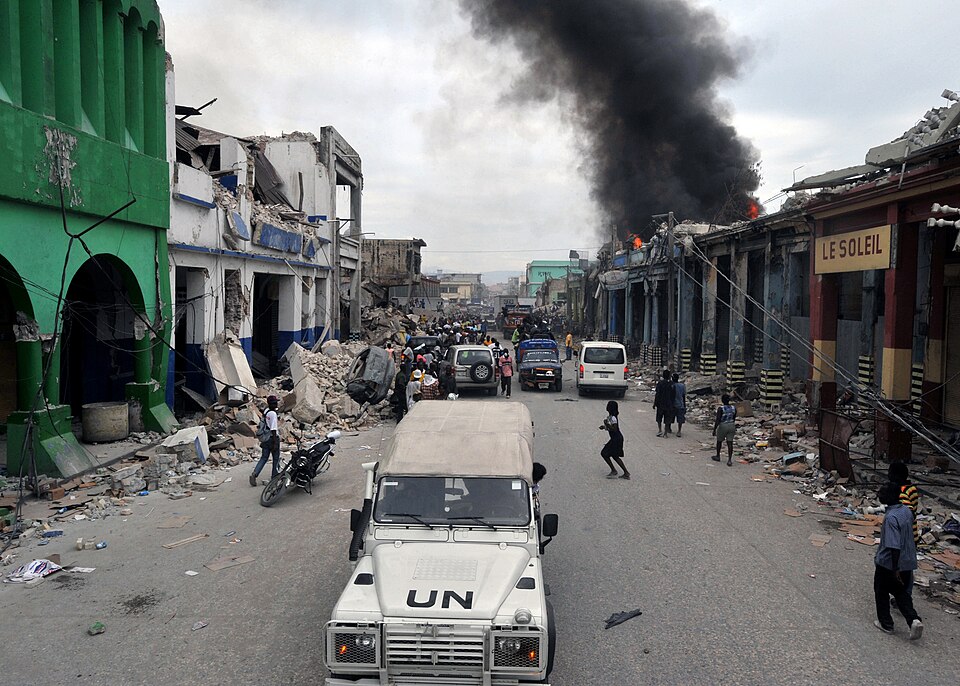
A UN peacekeeping truck in Haiti following the 2010 Earthquake. (Wikimedia Commons)
The U.S. has attacked Venezuela through various means for decades and kidnapped President Maduro but is now claiming to assist with earthquake relief. If it’s role in Haiti is any guide, that so-called aid from the U.S. is a Trojan Horse bringing more plunder and control.
For decades, the U.S. has waged a carefully planned and unrelenting attack on Venezuela’s economy using unilateral coercive measures, commonly known as economic sanctions, to destabilize and destroy the country’s socialist Bolivarian government. Though the earthquakes that devastated the nation were not caused by the U.S., the destabilization of the Venezuelan government, economy, and infrastructure was. The damage from those sanctions was so pervasive that any natural disaster large enough would be catastrophic, leading to foreign aid being used not only to produce enormous capitalist profits for foreign interests but also to bring the country more firmly under U.S. control. This is the situation Venezuela faces today.
George W. Bush imposed the first coercive measures against Venezuela in 2006. Democratically elected President Hugo Chávez had the nerve to criticize the U.S. for its bloodthirsty response to 9/11 and refused to support or participate in the U.S. sham counterterrorism efforts. Chávez did so in a very public and embarrassing way for Bush, as he declared from the lectern at the United Nations that George W. Bush was the devil, and that the podium that Bush had just delivered his own remarks from still smelled like sulfur. Bush responded by declaring Venezuela a state sponsor of terror along with Cuba and Iran (notice a pattern here). Bush also claimed that Venezuela refused to adhere to international counternarcotics agreements, breathing life into the claim that the Bolivarian government was a sponsor of narcoterrorism. But even before that, in 2004, Bush restricted non-humanitarian aid to the country, claiming they weren’t doing enough to stop human trafficking. Bush did all of this after the failed U.S.-backed coup against Chávez in 2002 that was tied to his administration.
The aggression toward Venezuela did not end with the Bush presidency. In December 2014, Obama signed the Venezuela Defense of Human Rights and Civil Society Act after U.S. intelligence agencies and the Department of State claimed that the Venezuelan government was committing human rights abuses against government opposition members. This was done in response to the Maduro government charging opposition members with engaging in conspiracies to overthrow him. Obama imposed sanctions on seven Venezuelan officials, and in March 2015, he issued an Executive Order implementing these sanctions and expanded them to block their visas and freeze the U.S. property of the targets. Obama publicly declared Venezuela an “…extraordinary threat to the national security of the United States.”
In response, President Maduro said in a nationally televised speech, “President Barack Obama, representing the U.S. imperialist elite, has personally decided to take on the task of defeating my government and intervening in Venezuela to control it.” One of the impacted Venezuelan officials, Diosdado Cabello, said, “What is being planned are attacks against our land, against our country, military attacks.” It took the U.S. a few years, but…
President Donald Trump imposed more, wider-reaching economic coercive measures in 2017 during his first term. In addition to recognizing unelected opposition figure Juan Guaido as president of Venezuela, Trump also sanctioned the state-run oil company PDVSA, denying the government access to U.S. financial markets. He froze PDVSA’s assets and finally imposed a near-complete economic embargo on the country. And in 2020, the Trump Justice Department indicted President Maduro on charging the president and 14 others with narcoterrorism, conspiracy to import cocaine, and gun charges. It also accused him of coordinating with the leftist guerrilla peasant militia Fuerzas Armadas Revolucionarias de Colombia (FARC), or Revolutionary Armed Forces of Colombia. Founded as the military wing of the Colombian Communist Party, which sought to redistribute land and resources that the Colombian government denied to the desperately poor peasants in rural areas. After years of fighting with the government, FARC was officially dissolved in the 2016 Peace Accord with the Colombian government. They are now a legal left-wing political party, initially called the Common Alternative Revolutionary Force and later renamed the Comunes (Commons). Trump then issued a $15 million bounty for information leading to Maduro’s arrest. Not to be outdone in attempting to enact regime change in Venezuela, President Joe Biden doubled the bounty to $25 million, with no additional indictments added.
The measures barred Venezuela from importing equipment, spare parts, and industrial chemicals to maintain its oil production facilities and shipping capabilities. Oil infrastructure across the country deteriorated, and oil production was driven far below the previous 3 billion barrels a day at its 2008 height to barely above 300,000 barrels a day.
While many people accurately note that the U.S. is after control of Venezuela’s enormous oil reserves, the country’s mineral wealth is also crucial to the U.S. and much of the world, as it includes bauxite and rare earth minerals critical for weapons systems, satellite manufacturing, and AI technologies. When we consider the struggle we are engaging in to stop the proliferation of these technologies from being used to violate our privacy, whatever freedom we have left, our environment, and our very lives, consider that the U.S. pursuit of these materials has already directly caused the instability, suffering, worsened health outcomes, and deaths of tens of thousands of Venezuelans.
Venezuela relies largely on oil exports to fund its public sector commitments; the collapse of oil exports crippled its primary source of public revenue, making it impossible to import essential goods like food and medicine. The Center for Economic and Policy Research (CEPR) estimated that 40,000 Venezuelans died due to economic coercive measures between 2018 and 2019 alone. Former U.S. Special Rapporteur Alfred de Zayas estimated the deaths to have been over 100,000 by 2020. But this is neither unexpected nor unwanted by the U.S. government. Economic sanctions are designed to cause so much hardship for the people of a country that they will rise up in frustration and anger at their own government. U.S. officials understood that imposing economic sanctions on the country would prevent it from importing not just materials to maintain the oil sector but also necessities for the Venezuelan people, such as food, medicine, fuel, and even toilet paper. But public infrastructure, from hospitals and office buildings to apartment buildings and water systems, also fell into disrepair as materials needed to maintain it could not be imported due to sanctions. With the physical buildings weakened, the country was far more vulnerable to disasters like the June 2026 earthquakes than it would have been had the sanctions not been in place.
By the time Trump returned to the White House in 2024, despite the immense damage already done to the country’s economy and infrastructure, they had not done what successive U.S. presidents wanted: to bring about the collapse of the Bolivarian government in Venezuela. Trump imposed more measures after his return to office, doubled Biden’s bounty increase on Maduro to $50 million, and eventually carried out the violent kidnapping of President Nicholas Maduro and First Combatant Cilia Flores in the pre-dawn hours of January 3, 2026, with the help of the Navy and Marines of the Southern US Command (SOUTHCOM), which also carried out the indiscriminate murders of Caribbean fisherfolk in the months prior to the kidnapping. The bounty was never paid to anyone. He also added to the original 2020 indictment against Maduro by adding his now-kidnapped wife and National Assemblywoman Flores, and adding charges of “…narco-terrorism conspiracy, cocaine importation conspiracy, possession of machine guns and destructive devices, and conspiracy to possess machine guns and destructive devices against the United States.” They are both held in separate solitary confinement cells in the Metropolitan Detention Center (MDC) in Brooklyn, NY, awaiting their sham trials.
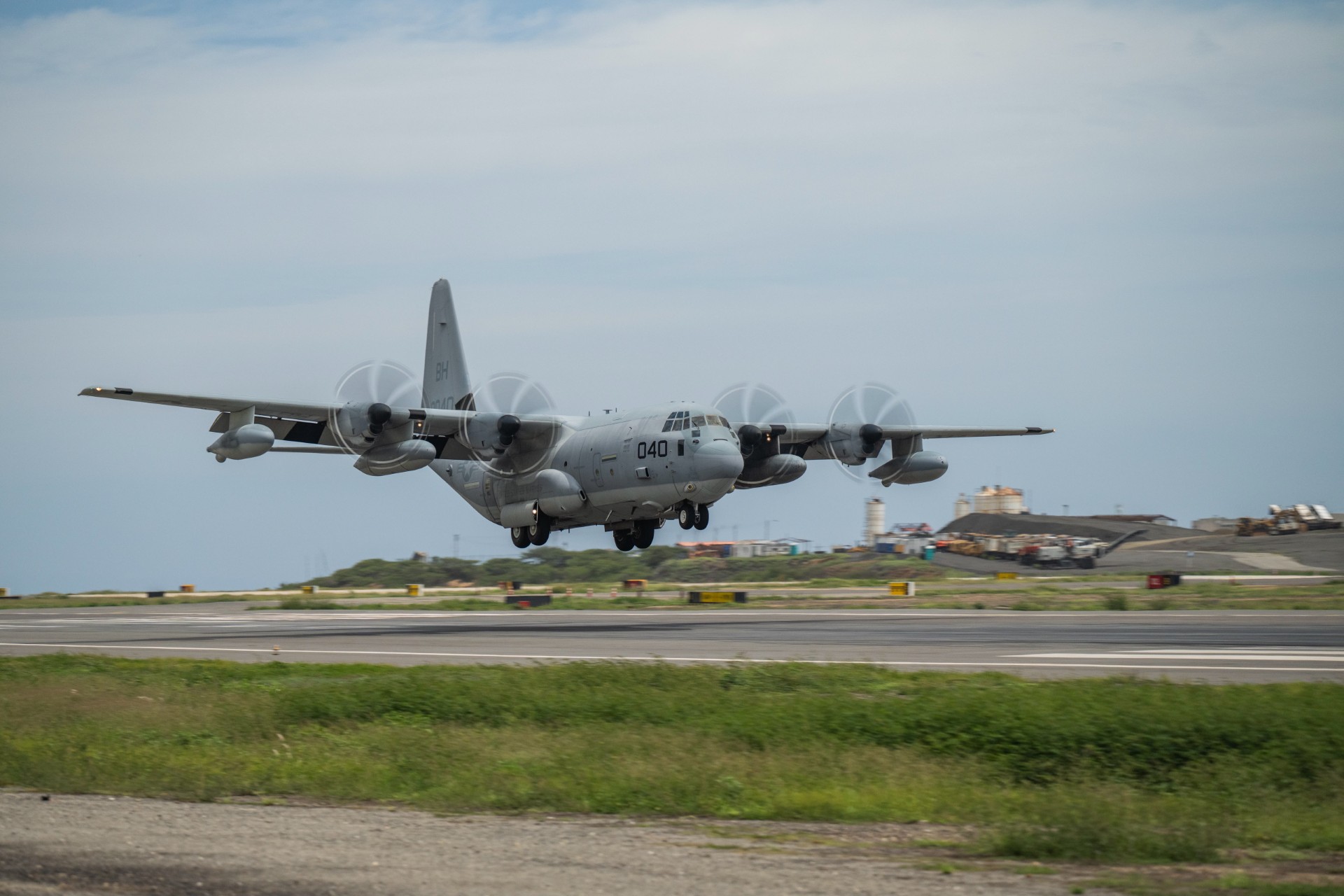
It is an obscenity that the same SOUTHCOM is now deploying forces to Caracas to provide post-disaster air traffic and airport support. But it is a greater crime that the U.S. has positioned itself and its interests to finally get what it wants – control of Venezuela’s oil and minerals sectors and eventual privatization of public services that define the Socialist Bolivarian government – even if it is a natural disaster that provides them the perfect opportunity to achieve it. This, after expropriating Venezuela’s oil industry and profiting from selling the stolen crude, Trump sending a measly $150 million in “aid” to the country he stole their sovereign materials from is a settler colonial level insult.
This is “disaster capitalism,” popularized by Naomi Klein in her book The Shock Doctrine, but a well-documented aspect of imperialist plunder. In the process of imposing economic shocks through sanctions by an external entity or through the implementation of neoliberal policies internally, Klein explains how governments and corporations exploit the shock of an unplanned, catastrophic event to impose radical, wholesale austerity and control. Disaster response becomes the vehicle for enormous foreign investment and development, foreign control of that development, and ultimately the usurpation of the existing but weakened state in favor of the foreign governments and corporate interests behind the aid money. Economic policies that would be rejected under normal circumstances are more easily imposed on an already vulnerable state when that state and its people are rendered desperate by a natural disaster.
The use of disaster relief as a Trojan Horse for neoliberal plunder and control after the 2010 earthquake in Haiti may give us a terrifying vision of what could be in store for Venezuela today.
The earthquake in Haiti was used as a pretext for the US to assert near-total control over the country’s recovery, if not the country itself, along with its foreign allies in the UN-imposed Core Group that governs the island nation. Aid and reconstruction, and the billions of dollars for it, were directed by those and other foreign governments and contractors, bypassing the Haitian state under then-president René Préval. International entities justified this by claiming Haiti was hopelessly corrupt. What they were, however, was in disarray after the earthquake destroyed much of the government’s infrastructure, including the National Assembly and the National Palace, and years of imperialist control usurped its sovereignty.
But this excuse was needed to justify the Haitian government seeing very little of the billions of dollars pledged for relief and reconstruction. The Associated Press reported in 2013 that CEPR found that out of the $1.15 billion pledged, only 1% went to Haitian companies. They found instead that “…the ‘vast majority’ of the money it could follow went straight to U.S. companies or organizations, more than half in the Washington area alone.” And what was constructed was for the benefit of foreign corporate and Haitian comprador interests, who had the protection of the United States government to bend Haiti to all of their will.
The $224 million Caracol Industrial Park, built with reconstruction funds allocated through the recovery mission co-chaired by former U.S. President Bill Clinton, is a continuing example of disaster capitalism and the nefarious ways that Western imperialists profit from natural and human catastrophe.
In 2011, scores of farmers and other residents were evicted from their fertile agricultural land, far from the impact zone, to make way for its construction. They were given little notice to leave and insufficient compensation. They fought for years to secure a reparations agreement with the Haitian government and the Inter-American Development Bank (IDB) in 2018, which included new land, jobs, equipment, and other compensation. Many finally received reimbursement in 2020, but not all, and not nearly enough for what was taken from them by the U.S., the IDB, and USAID, who were the major funders of the project.
The park was designed to attract foreign garment companies with tax exemptions and cheap labor, as wages were promised to be kept as low as $1.75 a day. The garment companies did come, and the Clintons promised hundreds of thousands of jobs. But fewer than 10,000 were produced, and they were at the same low rate of less than $2.00 a day that Haitians had been fighting to raise for years before the earthquake against a small group of Haitian manufacturing, import/export, and political elites controlling the country’s existing manufacturing industries with the backing of the U.S. government. When the Haitian government passed a law in 2009 to raise the country’s minimum wage for garment workers to $3 a day and $5 a day for other sectors due to the people’s agitation, foreign companies and the Haitian elite colluded with the U.S. State Department and, with a study from USAID that said raising the minimum wage would make the garment sector economically unviable, successfully blocked the legislation.
While Bill and Hillary Clinton have never admitted involvement in suppressing Haitian wages, Hillary Clinton was Secretary of State under President Barack Obama when the State Department cables that WikiLeaks published revealed the covert wage-suppression scheme that resulted in legislation being passed in the U.S. to favor the Haitian elite and foreign investors: the Haitian Hemispheric Opportunity through Partnership Encouragement (HOPE) Acts I & II. There was no way the Clintons were not involved, as it was the Clinton Foundation through which they did much of their work in Haiti, and Haitians hold them responsible for the abysmal outcome.
By the end of 2011, one year after the earthquake, most of the promised aid had not been disbursed, and what was went to projects unrelated to housing, feeding, or providing any aid or support to the displaced, like the Caracol Industrial Park. The scandal was compounded by revelations that some major aid organizations achieved very little with the funds they received, so no one could really account for where the billions of dollars went, other than into the pockets of non-Haitians.
Today, Haiti is still among the poorest countries in the world. Haitians have continued to protest not just against the minimum wage, but also the lack of sovereignty and human dignity imposed upon them as they endure a rise in U.S.-fueled gang violence, attacks on Haitian immigrants from this administration, continued control from the UN-appointed Core Group with no elected leadership chosen by them, and another UN invasion/intervention to quell unrest.
This is the future that the U.S. wants for Venezuela. To make Venezuela like Haiti or something close to it, at least in the manner of creating a dismantled state that the U.S. can swoop into, plunder, and control. Although Haiti and Venezuela may not be perfectly similar in many ways, but the use of an earthquake to further imperialist takeover of a country already weakened by relentless Western hegemony in response to the successful liberation struggle of largely Afro-descendent and Indigenous peasantry to free themselves from European settler colonial domination and capitalist exploitation are complementary examples of how a natural disaster is be used to deepen imperialist control under the guise of aid, instead of the most powerful and wealthiest country in the world using that power and money to help suffering human beings. And then the same country calls those states failed, and demonizes the government and the people as immature, unable to govern themselves, and an example of the failures of socialism or communism.
As U.S. officials are on the ground in Venezuela openly “coordinating” with the Interim President Delcy Rodriguez, it must be understood that this is done with the threat of her own indictment and imprisonment on bogus charges of narcotrafficking, human rights abuses, corruption, or grave robbing, depending on how amusing the U.S. wants to be with the sham accusations over her head.
And now, the U.S. is poised to use this unbelievably tragic disaster as an even bigger cudgel to force the Venezuelan state to concede much, much more, seizing this opportunity to tighten its control over the country’s oil and mineral resources, effectively absorbing it into the U.S. sphere of influence, to be used as a weapon against the rest of the U.S.’s designated enemies, Cuba, China, and Russia. Venezuela has had friendly relations with all of these countries, and all countries that the U.S. is also softening up with sanctions, embargoes, and threats of worse treatment.
We must expand and deepen the struggle against the U.S. re-colonization of the Western Hemisphere and join our struggling brothers and sisters in the Global South for an end to imperialist aggression, hegemony, and gangsterism, and we must target the enemy in whose camp we reside with clarity and purpose.
Because natural disasters will never stop happening. But disaster capitalism never has to happen again.
Not if we destroy capitalism and the empires that are erected upon it.
Jacqueline Luqman is a radical activist based in Washington, D.C., as well as a co-founder of Luqman Nation, an independent Black media outlet available on YouTube (here and here) and Facebook.
The views expressed in this article are the author’s own and do not necessarily reflect those of the Venezuelanalysis editorial staff.
Weekly insights and analysis on the latest developments in military technology, strategy, and foreign policy.
The U.K. Royal Navy has launched a kamikaze drone, the Nyan one-way effector, from a ship at sea, marking a significant step toward the U.K.’s ambition of a so-called ‘hybrid’ naval force. This is just one element of a much broader push toward increased reliance on uncrewed platforms, something that was underscored in the long-awaited Defense Investment Plan, unveiled earlier this week.
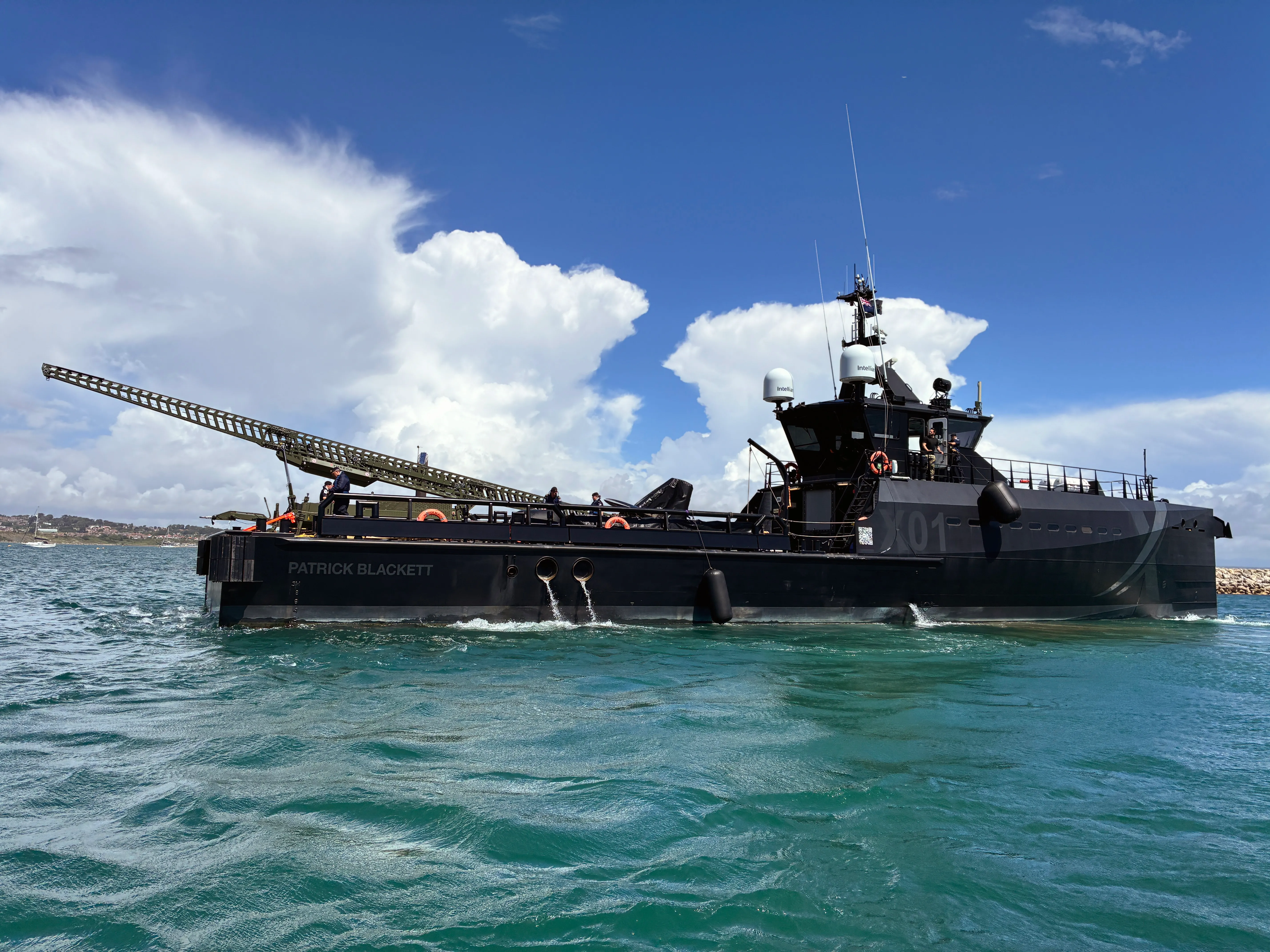
During recent trials off the south coast of England, the Nyan one-way effector drone was launched from the experimentation ship XV Patrick Blackett, a platform used by the Royal Navy as a testbed for new technologies.
The trial, known as Exercise Neptune Reach, involved personnel from the Royal Navy’s 744 Naval Air Squadron, 26 Royal Artillery of the British Army, and the Royal Air Force.
In a statement, Luke Pollard MP, Minister for Defense Readiness and Industry, said: “Britain is serious about the transition to a Hybrid Navy with new, powerful drones at the heart of the Royal Navy. By bringing together Army and Navy expertise to field strike drones from a ship at sea, we are accelerating the capabilities our forces need to stay ahead of our adversaries.”
The experimentation ship XV Patrick Blackett with the launcher for the Nyan drone installed. Crown Copyright Royal Navy
The catapult launcher for the Nyan was installed on the ship’s deck. Operators then programmed the drone to fly to a specific target, which it flew to autonomously, while the ship was underway.
Developed starting in 2022, specifically for precision strike, the Nyan was designed and built by Callen-Lenz, a subsidiary of BAE Systems. It is intended to be a low-cost strike platform, with a unit cost of less than £100,000 ($132,000), according to the manufacturer.
The drone has a wingspan of around 9.5 feet and a reported range of more than 93 miles (150 kilometers) — meaning it can hit targets at a greater distance than the Harpoon anti-ship missile. Built mainly of carbon fiber, the Nyan is powered by a small turbojet engine. The design of the drone and its construction include reference to low observability, including a stealthy exhaust nozzle, making it harder for hostile air defenses to detect and destroy.
Royal Navy and British Army personnel prepare a Nyan for launch on experimentation ship XV Patrick Blackett. Crown Copyright Royal Navy
The Nyan drone and launcher have already been tested extensively during land exercises. During Exercise Spring Storm in Estonia this year, the British Army used the system in support of NATO allies on maneuvers. Thereafter, the British Army’s Royal Artillery adopted the Nyan for operational service.
In the maritime context, the Exercise Neptune Reach trials from the Patrick Blackett were part of the wider, tri-service Project Vantage. This is focused on rapidly testing and delivering one-way effectors for the Royal Navy.
“This trial makes a significant step forward in delivering maritime one-way effectors at pace,” explained Lt. Cmdr. David Burton, Maritime One-Way Effectors Capability Sponsor with the Royal Navy. “Under Project Vantage, we are planning to integrate these capabilities into the Hybrid Navy, combining crewed platforms with uncrewed systems to expand reach, increase tempo and enhance lethality.”
A palletized Nyan drone is lowered onto its catapult launcher installed on the ship’s deck. Crown Copyright Royal Navy
The Nyan is already in quantity production, with more than 1,000 units manufactured so far, according to Matt Foster, CEO of Callen-Lenz.
The Royal Navy has said that the recent at-sea trials pave the way for further experimentation and also potential future deployment of the Nyan across the fleet.
Beyond the strike mission that the Nyan is currently equipped for, Callen-Lenz has said that the Nyan could be adapted to carry other payloads, or potentially be scaled up for increased range or endurance.
Interestingly, BAE Systems has also outlined the potential for further trials of the Nyan aboard the aircraft carrier HMS Queen Elizabeth.
In its last Strategic Defense Review, published last year, the U.K. Ministry of Defense described how plans for a hybrid naval force would also affect the two carriers and their air wings:
“The Royal Navy must continue to move towards a more powerful but cheaper and simpler fleet, developing a ‘high-low’ mix of equipment and weapons that exploits autonomy and digital integration,” the review stated. “Carrier strike is already at the cutting edge of NATO capability, but much more rapid progress is needed in its evolution into hybrid carrier air wings, whereby crewed combat aircraft (F-35B) are complemented by autonomous collaborative platforms in the air, and expendable, single-use drones. Plans for the hybrid carrier air wings should also include long-range precision missiles capable of being fired from the carrier deck.”
Already tested extensively during land exercises, the autonomous drone was taken to sea to explore how it could be operated from a ship. Crown Copyright Royal Navy
Earlier this week, the Defense Investment Plan noted that the development effort for the hybrid carrier air wing will include trials of jet-powered drones from the carrier. Previous drone trials aboard the British carriers have involved the QinetiQ Banshee Jet 80+, an adapted target drone, launched from HMS Prince of Wales in 2021. Subsequently, the General Atomics Mojave short takeoff and landing (STOL) drone was operated from the same carrier in 2023, as you can read about here. The Mojave’s impressive STOL capabilities meant that no launch and recovery systems were required for these tests.
A Mojave STOL drone landing on HMS Prince of Wales. GA-ASI
Beyond catapult-launched drones like the Nyan, the Royal Navy has a longer-term ambition for ‘cat and trap’ drone operations aboard its carriers, under an effort named Project Ark Royal.
If successful, Project Ark Royal will see the two carriers start to operate drones that can undertake a variety of missions and then increasingly heavier, complex, and higher-performance ones. In the past, General Atomics has pitched to the Royal Navy a carrier-capable fifth member of its Gambit drone family, intended to fit into a future air wing aboard the U.K. carriers.
A rendering featuring a catapult-equipped HMS Prince of Wales with a Gambit-series drone ready to launch. GA-ASI
Later on, full catapult-assisted takeoff but arrested recovery (CATOBAR) capability could even add fixed-wing crewed aircraft, as we have explored in the past.
Of course, the United Kingdom is not alone in these aspirations, with China and Turkey, most notably, also increasingly exploring using drones aboard big-deck amphibious warfare vessels and other non-conventional-takeoff-and-landing aircraft carriers.
For the time being, the Nyan represents a fairly modest strike capability. Based on its range, what is likely a relatively small warhead, and subsonic performance, it is best understood as a low-cost tactical precision weapon. It lacks the reach and payload of the kinds of long-range precision-fires capabilities that the U.K. Armed Forces are increasingly looking to develop. However, it is an affordable means of engaging targets at relatively short distances and could be particularly effective if launched in large numbers and from a variety of platforms. As we have explored in the past, quantity has its own advantages in this context, and launching swarms of these at enemy ships or shore targets would make them very hard to defend against.
At the same time, experience with the Nyan in a maritime environment will help pave the way for introducing more capable drones.
An experimental Banshee Jet 80 target drone on the flight deck of HMS Prince of Wales during an earlier test of uncrewed technology on the aircraft carrier. Crown Copyright LPhot Ben Corbett
As such, the successful at-sea launch of the Nyan drone marks an important milestone in the Royal Navy’s transition toward a hybrid naval force.
More generally, by demonstrating the ability to deploy low-cost, autonomous strike drones from a moving ship, the trial highlights the U.K.’s commitment to expanding precision strike capabilities and expanding its use on uncrewed platforms.
As the Royal Navy continues to experiment with ship-based drone operations, including air wings featuring uncrewed systems, these kinds of assets are set to play an increasingly important role, complementing traditional platforms and enhancing the fleet’s overall combat effectiveness.
Weekly insights and analysis on the latest developments in military technology, strategy, and foreign policy.
The Ukrainian SBU launched a drone strike on Russia’s Saki Air Base in Crimea on Friday. The attack, the latest in a string of strikes against Russian aviation and logistic assets on the peninsula, is part of Ukrainian President Volodymyr Zelensky’s latest campaign to inflict so much pain on Russia that Vladimir Putin moves to end the war.
“At the ‘Saki’ airfield, seven hangars storing aviation equipment were hit, in which Su-30SM, Su-30, and Su-24 fighter jets and frontline bombers were located,” SBU added. “According to preliminary information, at least seven aircraft were destroyed or damaged.”
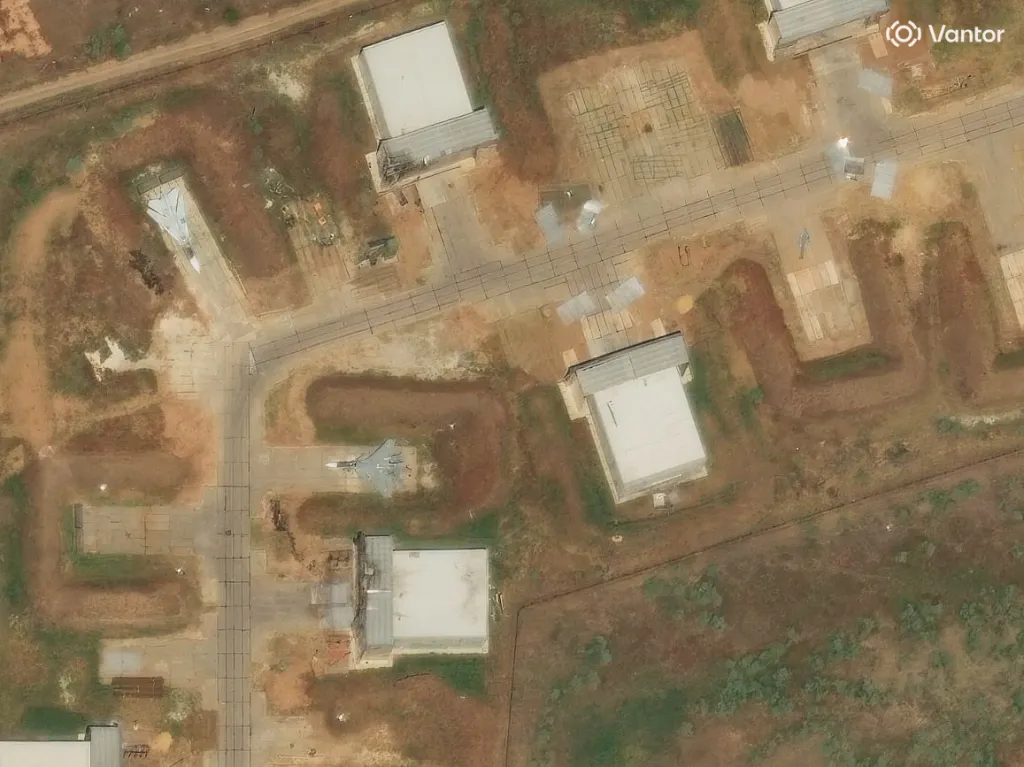
SBU told us it had no visual evidence from either attack to back their claim, but we reached out to Vantor to see if they had any satellite imagery of the base. Vantor provided us a picture that showed damage to four hardened aircraft shelters that was taken this morning. Some of shelters have clear damage to their structures, others literally have their doors blown off and laying on the taxiway in front of them. From the overhead angle of the image, it is impossible to determine if aircraft were in those shelters at the time, and if they were, what, if any damage, was inflicted. In addition, we can’t tell when this happened from just one picture, although imagery we reviewed from Planet Labs dating to June 27th doesn’t appear to show the same damage to the shelters.
It is very possible that any aircraft in those shelters could have been damaged by fire, as the SBU claimed, or by shrapnel, but we just don’t know. Regardless, the shelters remain generally intact. We have written frequently about Russia’s efforts to protect its aircraft this way, including on Crimea.
Regardless, these attacks come after months of Ukrainian strikes on bridges connecting the peninsula with the mainland and on it’s fuel infrastructure. The situation has gotten so bad on Crimea that the officials there have tried to initiate gasoline rationing, making life miserable at the height of the traditional summer vacation season there.
The fuel crisis in Russia escalates into a conflict between Crimean Russians and Russians from the nearby Krasnodar region.
Residents of Krasnodar Krai are complaining that “non-Russians” from Crimea have occupied their gas stations.
Amid the ongoing Ukrainian pressure campaign, a Russian military officer said he recently took part in an exercise to see what it would take to fend off Ukrainian attacks on Crimea.
“I participated in the operational command-staff military game ‘Crimean Alert,’” Russian reserve colonel and military expert Viktor Murakhovsky claimed on Telegram. “The game was dedicated to the landing of the Ukrainian Armed Forces in Crimea and our measures to repel it. The staffs were organized according to the scenario from officers (in reserve and retired) of our armed forces.”
“The ‘Blue’ side acted unconventionally, widely using the latest means of detection and destruction,” he added. “The ‘Red’ side was forced to act ‘on the defensive.’ Overall, the exercises went smoothly and at a high level thanks to the organizers.”
Clearly, Ukraine does not possess much of a Navy, let alone landing craft to carry out a Normandy-style invasion. However, that is not the scenario played out in this wargame, according to an analysis by the award-winning The Insider news outlet.
“The scenario clearly simulates an amphibious or maritime operation: numerous blue arrows and routes are drawn across the Black Sea, extending from the direction of Odesa and the northwestern Black Sea toward Crimea,” the publication noted. “Red defensive positions are marked on the map within Crimea, particularly around Sevastopol, in northern Crimea, and in the eastern part of the peninsula.”
The map “shows the Kerch and Kerch Strait area on the right—also densely marked with red icons—indicating that the game scenario accounted for the eastern flank in addition to western Crimea and Sevastopol,” The Insider proffered. “Judging by Murakhovsky’s post, the scenario likely envisioned not a classic World War II-style amphibious landing—with hundreds of ships approaching the shore—but rather a modern operation involving the mass use of drones, long-range precision-guided weapons, reconnaissance systems, and possibly small, high-speed boats.”
1/ QUICK TAKE: Russian authorities are wargaming a Ukrainian landing in Crimea: Recently, a “Crimean Reveille” operational command-and-staff military exercise took place that focused on a hypothetical amphibious landing by the Ukrainian military in Crimea. https://t.co/p0CzROgL8Epic.twitter.com/7iMXPmUOmf
Ukraine, as we reported in the past, has already carried out several incursions on the peninsula. In October 2023, the Ukrainian Defense Intelligence Directorate (GUR) sent a small raiding party into a point north of Tarkhankut Bay. It was carried out by troops traversing the Black Sea on Sea-Doo GTX 300 personal watercraft. They were loaded down by grenade launchers, machine guns, man-portable air defense systems (MANPADS) and other equipment needed to assault Russian positions. You can read more about that raid in our interview with the unit commander here.
Ukrainian forces have already carried out several raids on Crimea. (GUR screencap) GUR screencap
Those attacks did not lead to a sustained presence, but they were not intended to. They were meant as a morale-boosting reminder to Moscow that Crimea would never be completely out of reach.
Whether Ukraine can marshal enough of its asymmetric assets and troops to really carry out any sort of a wide-scale amphibious landing on Crimea remains questionable bordering on impossible. One thing, however, is not. Ukraine is inflicting significant amounts of pain on Russian forces and assets on the peninsula.
UPDATE: 4:49 PM EDT –
Vantor provided us with additional satellite images of Saki. A very cursory analysis shows that six out of seven hardened aircraft shelters were damaged, with doors blown off of four of them.
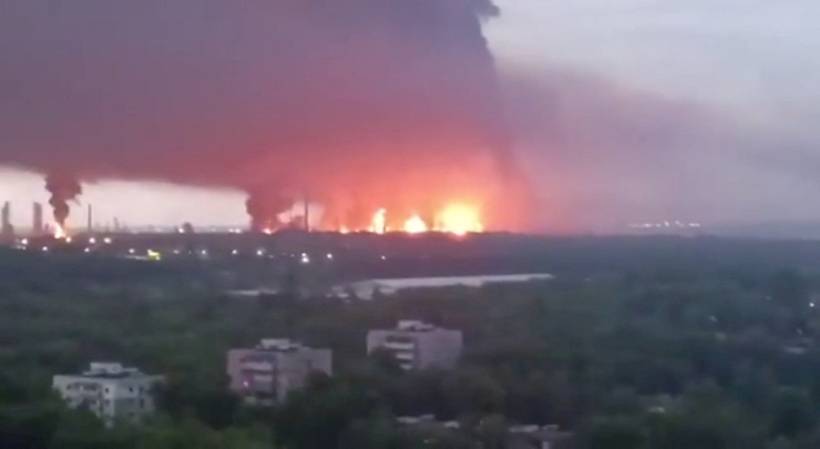
A well-known Russian city, Nizhny Novgorod, is incredibly famous for its place on the energy map as the location for the largest energy production and refinery for both local consumption and for exports to Europe. But the energy history has suddenly changed in early July 2026, primarily due to unexpected attacks by Ukrainian drones. The Ukrainian drone attacks, described in official reports, have left an indelible devastating mark on Lukoil-Nizhegorodnefteorgsitez (Norsi), considered the largest oil refinery of the Lukoil corporation in Kstovo (Nizhny Novgorod region), and had to suspend its routine refinery operations.
Reuters reported this serious military-related incident on July 3, citing two sources in Russia’s oil industry. According to The Moscow Times, a reputable foreign media outlet, the drone attack damaged the plant’s main primary processing unit, AVT-6, which provided 53% of the Norsi refinery’s capacity. Another unit, AVT-5, which accounts for 25% of the plant’s capacity, was disabled by a drone on June 24. As of July 2, Norsi (Russia’s fourth largest oil refinery and the second largest gasoline producer) stopped selling wholesale quantities of gasoline and diesel fuel on the St. Petersburg Commodity and Raw Materials Exchange.
As The Moscow Times reports, Norsi, which has an annual capacity to process 15 million tons of oil and produce 5 million tons of gasoline, became the fifth Russian refinery to halt production since the beginning of June. Gazprom Neft’s Moscow refinery ceased refining on June 16, with repairs, according to Reuters sources, potentially lasting until 2027. Tatneft’s Taneco refinery in Nizhnekamsk has been idled since June 12; the Kuibyshev refinery, since June 10; and the Volgograd refinery, since June 1.
Moreover, the authorities of the aggressor country will likely be unable to increase the capacity of Russian oil refineries damaged by BP-LA strikes in the coming month, local Russian media Kommersant reported. According to its source, refining volumes in July will “at best” remain at June levels, and only if there are no further attacks at the refineries.
Stay ahead of the geopolitical week.
MD Briefing delivers expert analysis across five global fronts — the Indo-Pacific, energy, geoeconomics, European security, and the Middle East — every Monday morning. Free.
Ukrainian Defense Forces attacked the Kstovo oil refinery on May 18 and 20, 2026. As a result of the repeated attacks, the AVT-6 primary oil refining unit was damaged, after which the refinery suspended operations.
On July 2, Sergei Sternenko, advisor to Ukrainian Defense Minister Mykhailo Fedorov, reported that drones had again attacked the Kstovsky refinery of Lukoil-Nizhegorodnefteorgsintez, and a major fire had broken out at the plant. Later that same day, the General Staff of the Armed Forces of Ukraine confirmed that the strike on the Kstovsky Oil Refinery was carried out by the Defense Forces, as a result of which the AVT-6 primary oil refinery unit was damaged. Ukrainian officers noted that this oil refinery is one of the largest in Russia and has a design capacity of about 17 million tons of oil per year.
Reports also circulated this early July that Russia has turned to fuel imports from India after Ukrainian strikes disrupted its refineries, a rare reversal for one of the world’s biggest fuel exporters that could bring African oil giants into focus if Moscow widens its search for alternative suppliers. The reports further indicated Russia to likely seek imports from Belarus, with which it has a strategic partnership, and both formed the Russia-Belarus Union. Moscow and Minsk have been working together productively in all areas, coordinating their efforts in countering external threats and coordinating challenges through various institutions of the Russia-Belarus Union.
But for African oil producers, such as Algeria, Angola, Libya, Nigeria, and Egypt, Russia’s fuel crisis could open a new window for countries with active refineries, as global markets seek more secure supplies after US-Iran tensions and disruptions around the Strait of Hormuz reshaped fuel trade. That possibility has gained attention because Russia is now turning to foreign imports to ease domestic shortages.
Meanwhile, Russia has not traditionally depended on African crude oil, but its worsening fuel shortages could make Africa’s oil producers and refiners more strategically important as Moscow seeks supply through direct purchases or alternative refinery routes, while sanctions pressure complicates access to Venezuela and Iranian oil networks.
India is the fourth-largest oil refiner in the world. Indian Minister of Petroleum and Natural Gas Hardeep Singh Puri said at a press conference held on July 2 that India was ready to support Russia with oil and gas supply. “We could potentially supply fuel to Russia if needed,” the minister said, explaining it depends on how the situation develops.
Russian Deputy Prime Minister Alexander Novak told TASS that Russia had sufficient fuel reserves to supply the domestic market, but the stir around the situation with gasoline had led to a demand increase of approximately 20-30%. However, he added, “the system’s logistics connections are currently being restructured to meet needs,” and this will take some time. He also stated that he could restrict exporting diesel to manufacturers “to further fill the domestic market.”
As Kremlin spokesman Dmitry Peskov stated on June 30, if Russia can reach cost-effective deals to import fuel, that could help stabilize the market. However, Peskov added that the Kremlin will not disclose which countries it is in contact with regarding possible fuel imports.
In the meantime, Russia has taken a few steps to control the situation. The government has already reduced the mandatory sales of gasoline on the exchange trading from 15% to 10% of the volume. The Kremlin’s presidential decree has been signed, aimed at stabilizing the domestic petroleum product market. Interfax sources explained that the gasoline volumes freed up by the measure would be used to supply agricultural producers and socially significant consumers. While Russia makes no request for fuel from Kazakhstan, Orenburg processing plants are receiving 28% of usual gas from Kazakhstan. In addition, Bashkortostan’s oil refineries are boosting output, owing to unprecedented emergency demand of fuel, and this is stabilizing the situational challenge.
Ukrainian drones have attacked many cities, including Tver, Tula, Smolensk, Kaluga, Belgorod, Bryansk, Kursk, Rostov, Krasnodar, and Moscow regions, as well as the republic of Crimea and the Sea of Azov and the Black Seas.
Prince Harry will not be joined by his wife the Duchess of Sussex and their two children when he visits London next week, it is understood.
Meghan, Archie, seven, and Lilibet, five, will not travel to London as had originally been planned after it was confirmed that the family would not be provided with taxpayer funded police security during the visit.
There remains a possibility that they will join Harry later in the week when the trip moves from London to the Midlands.
Harry is in the UK on a five-day trip to mark the one-year countdown to the Invictus Games in Birmingham.
He had previously said he wouldn’t bring his wife and children to the country without improved security arrangements.
Speaking to the BBC last year, he said he “can’t see a world in which I would be bringing my wife and children back to the UK at this point”.
The challenge over security has been over the rulings of the Royal and VIP Executive Committee (Ravec), which decides on the security provision for senior royals and other public figures.
Prince Harry and Meghan were last together in the UK in 2022, at the time of the funeral of the late Queen Elizabeth II.
He has since travelled to the UK alone – he met his father on a trip last September.
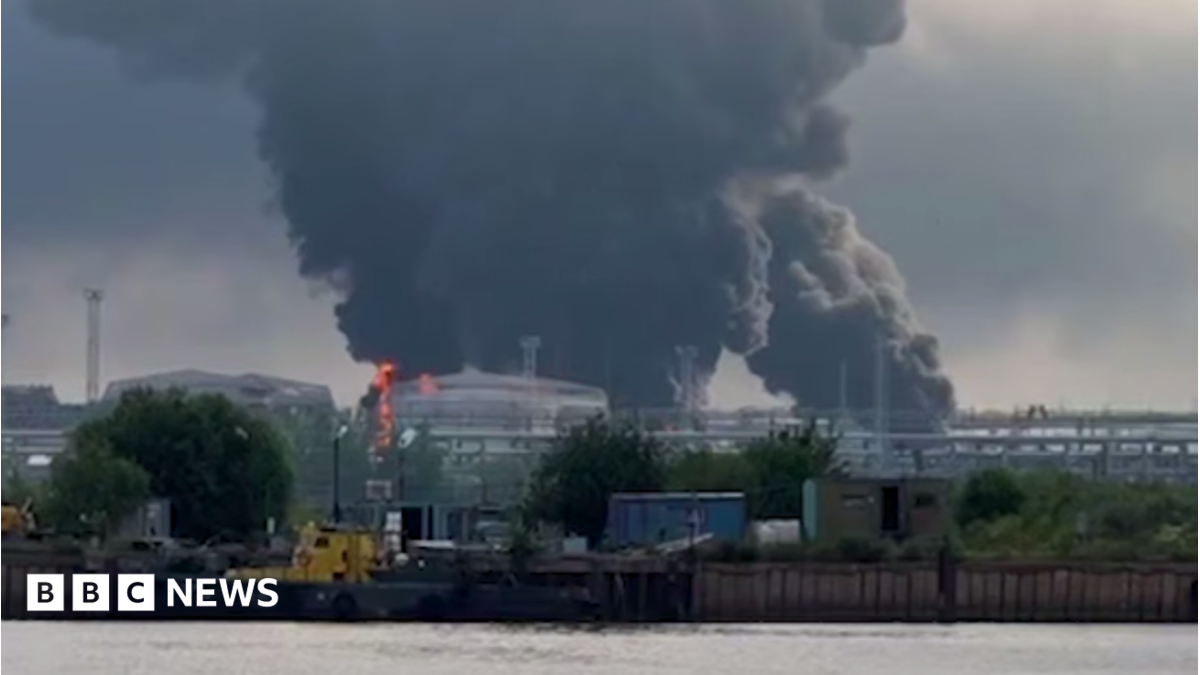
Ukraine has struck a major oil terminal in Russia’s second city of St Petersburg and other targets in the country’s north-west.
In a post on social media, President Volodymyr Zelensky wrote: “Ukraine’s defence forces struck port oil infrastructure that generates revenue for Russia’s war.” He also said an “important military target” was hit overnight in Kronstadt, a nearby naval base.
St Petersburg Governor Aleksandr Beglov said the city was under a “massive” drone attack, admitting the oil terminal was hit. He reported no casualties.
Ukraine has in recent months intensified its long-range drone attacks on Russia’s critical energy infrastructure, causing fuel shortages in a number of regions.
In his post on Saturday morning, Zelensky said the targets hit in St Petersburg and the surrounding region were about 850km (528 miles) from Ukraine’s border.
The extent of the damage was not immediately clear, but a video posted by the Ukrainian president showed a drone flying towards a target and a huge column of black smoke billowing from the area after the strike.
The BBC later verified that St Petersburg’s oil terminal was hit.
Ukraine’s military described the terminal as “one of the largest” in Russia, capable of producing 12.5 million tonnes of petroleum products per year.
The military also said a key naval base of the Russian Baltic Fleet in Kronstadt was hit.
Russia has not publicly commented on the claim.
Writing on Telegram, Governor Beglov said that 72 Ukrainian drones were shot down over St Petersburg and the wider Leningrad region.
He urged city residents to stay indoors until the drone threat was lifted. Mobile internet services may also be disrupted, he warned.
More than five million people live in St Petersburg.
In a separate development on Saturday, Ukraine’s military denied that the key eastern Ukrainian town of Kostyantynivka was now under full Russian control.
Military spokesman Maj Andriy Kovalyov told the BBC that “Kostyantynivka remains under the control of the Defence Forces of Ukraine”.
He admitted that there were “cases of infiltration by small infantry groups deep into the combat formations of our forces”, but added that those groups were being identified and destroyed.
His comments came a day after Russian President Vladimir Putin said that Russian control had been established over the town of Kostyantynivka in June.
Putin provided no evidence to back his claim.
Later on Saturday, Zelensky wrote on Telegram: “If Kostyantynivka is now under Russian control, then Putin will probably have no problem meeting me there and finding diplomatic solutions to finally end the war. But still, he will not cross the front line: the truth is very different from Putin’s words.”
Kostyantynivka is one of several heavily-fortified towns that make up Ukraine’s “fortress belt” in the Donetsk region, most of which is occupied by Russia.
President Putin launched a full-scale invasion of Ukraine in February 2022, and Moscow currently controls about 20% of Ukrainian territory.
Protesters from unions, civil society and left-wing parties aim to disrupt AfD annual conference in Erfurt.
By AFP, AP, DPA and Reuters
Published On 4 Jul 20264 Jul 2026
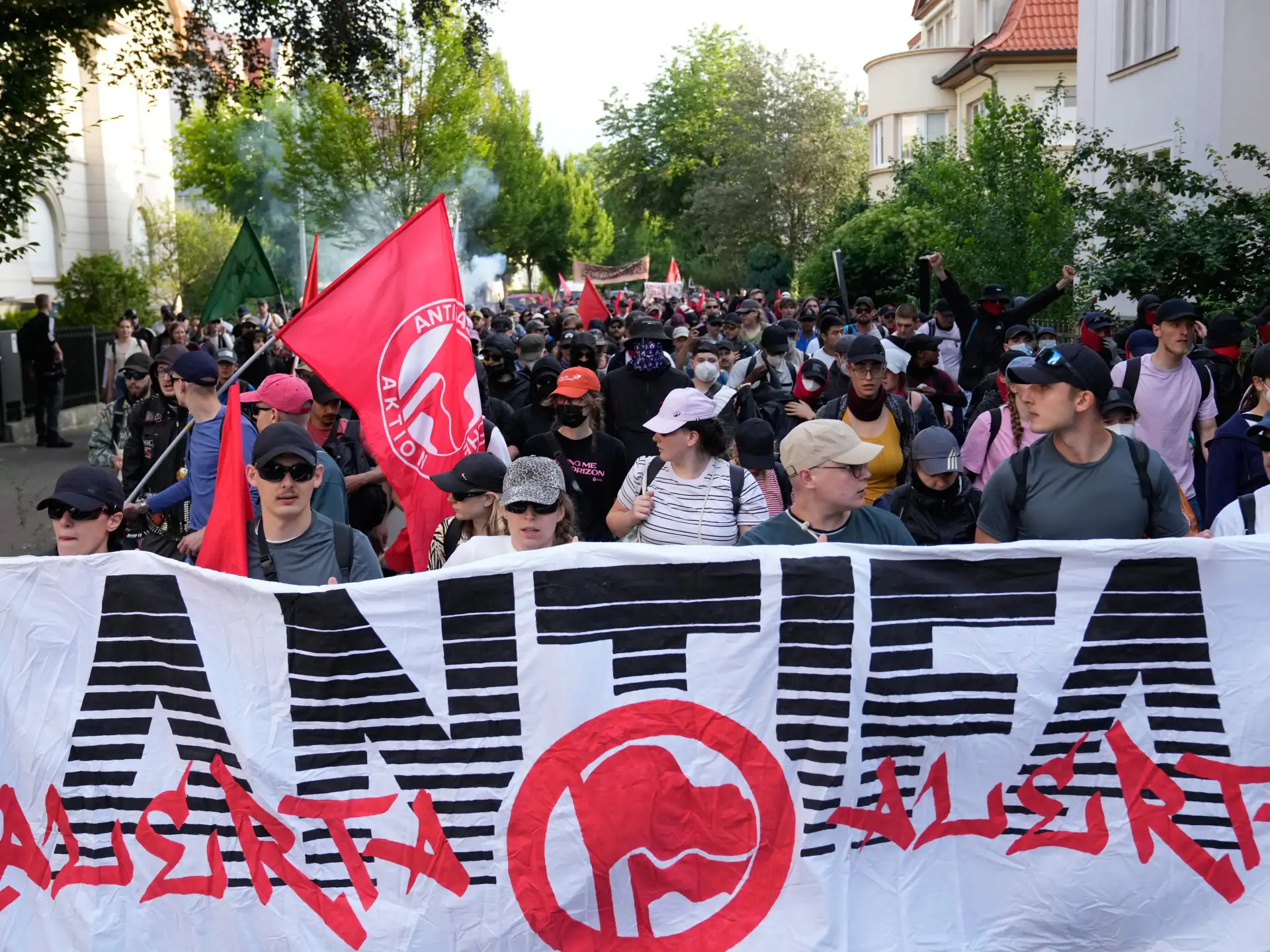
Thousands of opponents of the far-right Alternative for Germany (AfD) party have blocked roads leading to the party’s annual conference ahead of regional elections.
An estimated 20,000 people flocked to Erfurt, in Thuringia state, on Saturday, according to German police.
Recommended Stories
list of 3 itemsend of list
Protesters from unions, civil society groups and left-wing parties gathered in the centre of the city, some 250km (155 miles) southwest of the capital, Berlin. The police also reported several street blockades.
“We want to make it clear that we simply won’t tolerate this, that fascism is on the rise here in Germany,” Georg Becker, a spokesperson for Widersetzen (“Resist”), an anti-AfD umbrella group, told the Reuters news agency.
Large numbers of police, including reinforcements from across Germany, were deployed ahead of the AfD’s two-day conference. Police told the dpa news agency they counted more than 200 buses of protesters arriving in Erfurt.
Protesters blocked routes into the city, with some abseiling from a motorway bridge. Several groups staged sit-in blockades around the city centre, the AFP news agency said. The Associated Press reported that some protesters clashed with police in riot gear.
Still, most AfD delegates managed to reach the conference centre where party representatives said the congress began on time despite the protests.
‘Anti-democratic’ and ‘extremist’ views
AfD became the second largest party in elections last year, scoring the best result for a far-right party since World War II.
Opinion polls suggest that the party has opened a clear lead over German Chancellor Friedrich Merz’s conservatives, partially driven by years of economic stagnation. AfD seems likely to take power at a state level for the first time in the eastern state of Saxony-Anhalt, paving the way for more success at a national level.
Although AfD has grown in popularity, it remains controversial. All mainstream parties have ruled out cooperating with AfD over “anti-democratic” and “extremist” views.
AfD has also been monitored by the domestic intelligence agency for several years on suspicion of anti-constitutional activities.
Protesters in Erfurt want the party banned.
Noa Sander, another spokesperson for the Resist protest alliance told AFP, “The AfD wants mass deportations and ethnic cleansing,” in reference to the party’s “remigration” demands.
“It should be banned. We intend to do this by blockading their party conference and standing in the way of the AfD, its policies and members wherever they appear, making sure they have no place in society.” Sander said.
Tuareg-led armed group says it attacked northern town where Malian troops and Russian fighters are based.
Published On 4 Jul 20264 Jul 2026
Armed fighters have launched attacks in five locations across Mali, more than two months after gunmen attacked the capital and other parts of the country.
The attacks took place on Saturday in areas including a northern town where government forces and Russian fighters are based, and a town south of the capital, Bamako, Mali’s military and security sources said.
The army said the attacks targeted Aguelhok, Anefis, Gao, Sevare and Kenieroba.
The AFP news agency said a prison in Kenieroba was attacked, citing residents and security sources.
It reported that the fighting in different locations started at about 5am local time (05:00 GMT).
A Tuareg-led armed group confirmed that it had attacked a northern Malian town early on Saturday.
Mohamed Elmaouloud Ramadane, a spokesperson for the Azawad Liberation Front (FLA), told the Reuters news agency that fighters from the group attacked the town of Anefis in the northeastern Kidal region.
Government and Russian troops deployed in Anefis in the wake of attacks on April 25 and 26, in which the FLA and the regional al-Qaeda affiliate seized control of Kidal town.
Ramadane also told AFP that “several positions have fallen, but fighting is still underway inside the city” of Anefis.
An Anefis resident contacted by AFP said “armed groups are in the town, but the army is still putting up resistance. The camp [there] has not yet fallen”.
Anefis and Aguelhok, both in the north, are the last remaining locations where Mali’s army maintains a presence in the Kidal region, following the April attacks.
Meanwhile, in the central city of Gao, a local official told Reuters that gunfire and rockets had been launched at a military camp since before dawn. It was not immediately clear which fighters were responsible.
In Sevare, another central town, “explosions rang out … around 5am, though their origin is not yet known. Shortly thereafter, several aircraft were spotted flying over the area”, a security source told AFP.
In Kenieroba, the major prison complex was also under attack, a prisoner in the facility told AFP.
Saturday’s assault was the latest threat to the military-led government in the landlocked Sahel country where rebels staged high-profile attacks in April, hitting the airport in the capital, Bamako, killing the defence minister and seizing a string of army bases in the north.
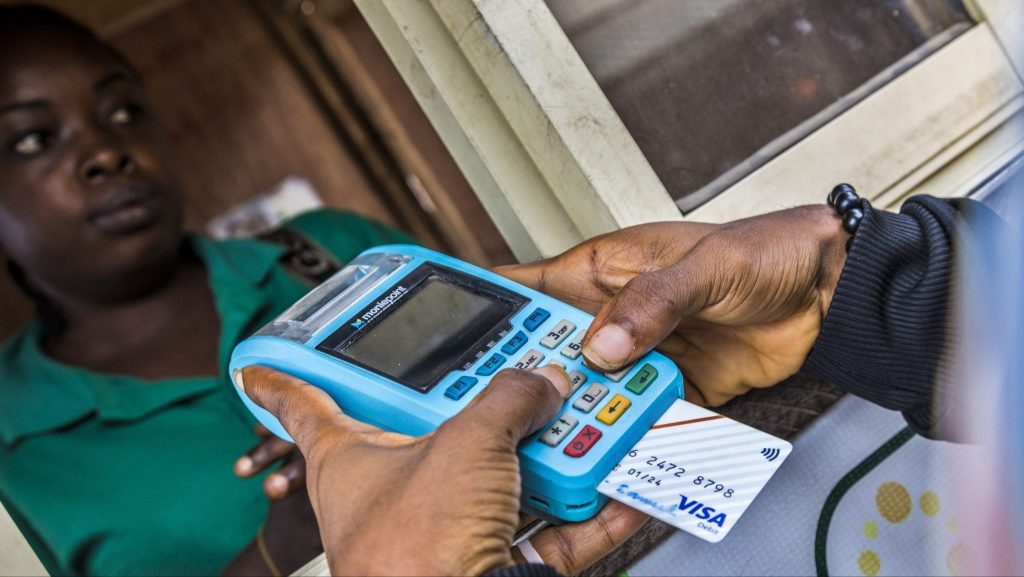
On a hot Tuesday afternoon in Yola, Adamawa State, in northeastern Nigeria, 32-year-old Fidelis Mbai walked to a point-of-sale (POS) stand to withdraw ₦35,000. The POS operator, Abu Sani, collected his Automated Teller Machine (ATM) card and inserted it into a POS terminal. Fidelis entered his Personal Identification Number (PIN). Within seconds, he received a debit alert. The money had left Fidelis’ account, but Abu’s terminal showed that the transaction had not been completed successfully.
The two men stared at their screens. One had seen ₦35,000 withdrawn from his account; the other had received nothing. For nearly 30 minutes, they kept refreshing their mobile bank apps. “I was angry because the money had left my account immediately,” Fidelis said. “As far as I was concerned, the transaction was successful.”
Abu understood the frustration, but he had a problem of his own. “The customer was debited, but I didn’t receive the money,” he said. “If I gave him cash and the transaction eventually failed completely, the loss would be mine.”
Eventually, Fidelis left without cash. His money would later be reversed. But for several hours, ₦35,000 simply disappeared into Nigeria’s digital payment infrastructure.
This experience has become familiar to many Nigerian residents. As digital payments increasingly replace cash, it is ordinary citizens, not institutions, who bear the cost of failed transactions. The consequences often extend beyond the value of the failed transaction itself. Delayed payments can prevent traders from restocking goods, force customers to borrow money while waiting for reversals, disrupt access to healthcare, transport, or other essential services, and erode trust in digital financial systems. For small businesses and low-income households that depend on immediate access to funds, even a short delay can translate into lost income, missed opportunities, and significant financial stress.
Nigeria’s digital payment revolution
Nigeria’s digital payment ecosystem has expanded rapidly over the past decade. According to data from the Nigeria Inter-Bank Settlement System (NIBSS) – which operates the core infrastructure that processes and settles electronic payments and fund transfers between banks, discount houses, and card companies in Nigeria, and is jointly owned by the Central Bank of Nigeria and all licensed banks – the value of instant digital payments reached ₦1.07 quadrillion in 2024, up from ₦600.36 trillion in 2023. The data also showed that Nigerians conducted 1.38 billion POS transactions worth ₦18.32 trillion during the same period.
These numbers reflect one of the most successful examples of digital public infrastructure (DPI) in Africa. At its core, DPI refers to the digital rails that allow citizens to identify themselves, make payments, and access services. In Nigeria, these rails include bank transfer systems, mobile money platforms, POS networks, identity systems such as BVN and NIN, and shared payment infrastructure.
Photo: Andrew Eseibo/Rest of World.
Together, these systems enable millions of transactions every day. For most users, the process appears simple: send money, receive money, and move on. But when something goes wrong, the burden often shifts away from the infrastructure and onto the people who rely on it.
While there is no official national estimate of the total amount Nigerians lose annually to failed digital payment transactions, the scale is substantial. During the 2023 cashless transition, industry reports indicated that as many as 40 per cent of failed e-payment complaints remained unresolved for extended periods, with affected transactions running into millions of naira.
Given that Nigerians processed over ₦1.07 quadrillion in instant payments in 2024 alone, experts say that even a failure rate of less than one per cent could leave billions of naira temporarily trapped in failed, delayed, or disputed transactions each year.
The last mile bankers of Nigeria
Every morning, Abu begins work with a few simple calculations. How much cash does he have? How much electronic value is in his account? And how much of that money is trapped in pending transactions?
“Almost every week, we experience failed transactions,” he said. “Sometimes two or three times. During network problems, it can happen many times in one day.”
Officially, Abu’s role is to provide financial services. Unofficially, he has become something else: a lender, a mediator, and a shock absorber. He is one of an estimated 1,600 POS operators per square kilometre in Nigeria, according to the International Monetary Fund (IMF). As banks have reduced their physical footprint in some communities, these agents have become the last-mile providers of financial services, connecting millions of Nigerian residents to the formal financial system.
One afternoon, a regular customer named Musa Ibrahim arrived to withdraw ₦50,000. The debit alert arrived immediately, but Abu’s account was not credited. Musa needed the money urgently for a hospital bill, and Abu had to choose between trusting the system and trusting the customer. “I knew him very well,” Abu said. “So I gave him the money from my own cash.”
The confirmation took two days to arrive. For 48 hours, Abu had effectively given Musa an interest-free loan. Nobody paid him for the risk. Nobody compensated him for the anxiety. Yet this informal lending happens every day across Nigeria. Thousands of POS operators use their own money to bridge gaps created by delayed transactions.
At Jimeta Modern Market in Yola, 38-year-old Aisha Mohammed sells food items. More than half of her customers now pay by bank transfer. Like many traders, she has adapted to Nigeria’s cash-light economy, but that adaptation comes at a cost. Several months ago, a customer purchased a bag of rice worth ₦80,000. He presented a transfer receipt. The money did not arrive.
File: A grocery store attendant operating a POS terminal. Photo: Opay
“The customer looked genuine,” Aisha said. “He showed me everything on his phone.”
She released the goods. The payment did not arrive until the following day. That night, she barely slept. “You start asking yourself whether you have been scammed,” she said.
Delayed transactions create a dilemma for traders like Aisha. If they reject digital payments, they risk losing customers; if they accept them, they risk losing money. Many solve the problem through selective trust. “If I know the customer, I may release the goods,” she explained. “If I don’t know them, I wait until I see the money myself.”
This has created a parallel trust economy operating beneath Nigeria’s digital economy. In theory, transactions are guaranteed by technology; in practice, they are often guaranteed by relationships.
Get our in-depth, creative coverage of conflict and development delivered to you every weekend.
Subscribe now to our newsletter!
Dr Ibrahim Sule, a financial inclusion expert at the Adamawa State Ministry of Finance described it as a hidden feature of Nigeria’s digital economy. “It shows that people are finding ways to compensate for weaknesses in the system. Personal trust often fills the gaps where technology falls short,” he said.
Borrowing money while waiting
For Ibrahim Yusuf, a resident of Damilu, a community in Jimeta, the consequences were far more serious. In October 2025, he transferred ₦43,000 to a shop owner as payment for foodstuffs he had purchased. The money left his account instantly, but the shop owner never received it.
One day passed, then two, three, four, five, and six. During that period, Ibrahim had no extra money with him. “The money was meant for foodstuffs, but I couldn’t leave the market with what I bought because the shop owner didn’t receive an alert,” Ibrahim said.
By the third day, Ibrahim borrowed ₦20,000 from a friend. The irony was difficult to ignore. His own money existed somewhere inside the banking system, yet he needed someone else’s money to survive. “It wasn’t even the financial loss that hurt the most,” he said. “It was the uncertainty. Nobody could tell me exactly where the money was.”
His experience illustrates a hidden cost rarely captured in transaction statistics. When payments fail, people do not simply lose access to money. They lose opportunities, business deals collapse, and relationships become strained.
The financial system eventually restores the funds. But it rarely restores the time, trust, or opportunities lost along the way.
How the money moves
While a bank transfer feels like a simple process for customers, financial experts say that transactions often travel through multiple systems. According to Hakeem Abdulkareem, a tech expert at NIBSS, “When you initiate a transfer on your bank app or through your bank, your bank first authenticates the transaction and verifies the beneficiary’s account details. The payment instruction is then routed through the NIBSS Instant Payment (NIP) platform to the receiving bank, which validates the request before crediting the beneficiary’s account. For the transfer to succeed, each of these systems – the sending institution, the NIP switch, and the receiving institution – must exchange information correctly and in real time,” he explained. “Each stage must communicate properly for the transaction to be completed.”
Any disruption along that chain can create problems. Not every failed transfer originates from NIBSS. Payment experts note that delays can occur at the sending bank, the receiving bank, a fintech platform, telecommunications networks, or the central payment switch. One way to determine where a transaction stalled is through the unique ‘Session ID’ generated for every transfer, which allows institutions to trace the payment through the system.
“Delays often occur when there are network issues, system outages, or communication problems between institutions involved in the transaction,” Hakeem added, noting that NIBSS continues to work with banks and fintech companies to improve transaction monitoring, automate reconciliation processes, and strengthen the resilience of the NIBSS Instant Payment (NIP) platform as transaction volumes continue to grow.
In the first quarter of 2025, electronic payment transactions reached ₦284.99 trillion, a 17.7 percent increase from ₦234.49 trillion recorded during the same period in 2024. POS transactions alone rose to ₦10.45 trillion during the same period, more than double the ₦3.62 trillion recorded in the first quarter of 2024.
While these figures highlight growth, Hakeem noted that “as transaction volumes increase, maintaining system efficiency becomes even more important.”
The institutions behind Nigeria’s digital payment system agree on one point: public confidence depends on reliability. As transaction volumes continue to grow, banks, fintech companies, and regulators say they are investing in infrastructure, monitoring systems, and consumer protection to reduce delays and strengthen trust.
Adi Dansanda, Customer Protection Officer at the Central Bank of Nigeria, Yola branch, told HumAngle that “Consumer confidence is critical to the success of Nigeria’s digital payment ecosystem. We continue to work with financial institutions and payment service providers to strengthen compliance, improve service quality, and ensure that customer complaints are resolved within established timelines.”
CBN Yola Branch Office. Photo: Obidah Habila Albert/HumAngle.
Despite these commitments, the experiences of everyday Nigerian residents suggest that the gap between policy and practice remains significant. For them, confidence is built every time a transfer arrives on time, every time a complaint is resolved quickly, and every time money moves when it is needed most.
Lessons from elsewhere
Building a reliable real-time payment system is not unique to Nigeria. Countries with some of the world’s most advanced digital payment platforms have also experienced outages and technical failures as transaction volumes increased.
In India, the Unified Payments Interface (UPI), which processes more than 18 billion transactions each month, experienced several nationwide outages in 2025. An investigation by the National Payments Corporation of India (NPCI) traced one of the largest disruptions to excessive transaction-status requests from participating banks that overwhelmed the system. In response, the regulator tightened technical protocols, limited repeated status checks, and strengthened monitoring to reduce the risk of similar failures.
Brazil’s Pix platform has also experienced periodic service disruptions linked to participating financial institutions and network issues. Rather than eliminating failures entirely, authorities have continued to improve interoperability, operational resilience, and incident response as usage has expanded.
Nigeria has already built one of Africa’s largest real-time payment systems through the NIBSS Instant Payment platform. Experts who spoke to HumAngle say the lesson from other countries is not that payment systems can avoid failures altogether, but that maintaining public trust depends on continuously strengthening infrastructure, improving coordination among participants, and responding quickly and transparently to disruptions.
This report is produced under the DPI Africa Journalism Fellowship Programme of the Media Foundation for West Africa and Co-Develop.
At Mount Rushmore, Trump warns of ‘communist menace’, ties rhetoric to immigration ahead of November midterms.
Published On 4 Jul 20264 Jul 2026
United States President Donald Trump has used the opening weekend of the nation’s 250th anniversary celebrations to praise the US military and critique democratic socialists, warning of a “communist menace” that he claims poses a major threat to the country.
Speaking beneath the granite monument at Mount Rushmore on the eve of Independence Day on July 4, Trump invoked national identity and ideology ahead of the November midterm elections.
Recommended Stories
list of 3 itemsend of list
“We created the strongest and most powerful military. We won two world wars,” he said, claiming that the Cold War had left the US’s enemies “in the depths of history”.
He also said the US “beat Venezuela in one day” and “knocked the hell out of Iran”.
The address comes amid voter concerns over persistent inflation and elevated energy prices driven by the ongoing US-Israel conflict with Iran.
Briefly addressing the Iran war, Trump said Tehran is “dying to settle” and that Washington had granted “a week off for a funeral because we’re nice”, in reference to the days-long state funeral being held for late Iranian Supreme Leader Ali Khamenei, who was killed in a strike on the first day of the US-Israeli war.
‘Communist menace’
A larger chunk of Trump’s address was focused on what he considers ideological threats at home.
“There is now a resurgence of the communist menace in our land, including from newcomers to our country who embrace ideas totally opposed to our way of life,” the president said, calling communism “the enemy of the Constitution”.
He pledged that “the citizens of the United States of America will vanquish communism quickly.”
Trump tied his anti-communist rhetoric to a hardline immigration stance, suggesting that left-wing political figures and certain undocumented arrivals should be removed from the country.
He labelled the rise of democratic socialists the “greatest threat to our country since its founding”, comparing the movement’s potential impact with World War II and the September 11 attacks.
He closed the address by calling the anniversary “the beginning of the golden age of America.”
Trump’s ‘grip on America steadily slipping away’
Speaking to Al Jazeera, Republican strategist Eli Bremer said parts of the speech were unifying enough that they “could have been delivered by Ronald Reagan … 45 years ago,” but added that “the gap between the American left and the American right has really never been wider”.
However, Democratic strategist and former Obama campaign adviser, Ameshia Cross, told Al Jazeera that Trump wants to wipe out the country’s diverse history.
Trump “is upset that there is a younger crop of Democrats who are running and winning across this country,” she said, adding that the speech reflected “a president who sees his grip on America steadily slipping away”.
She noted that it also came “on the heels of him losing a Supreme Court decision just a couple of days ago to eradicate birthright citizenship“.
The address highlighted the contrasting visions framing the country’s milestone anniversary.
In New York, progressive Mayor Zohran Mamdani offered an alternative narrative during a naturalisation ceremony, using a desk once belonging to George Washington to praise immigrants’ contributions and frame civic dissent as patriotism.
Democrats have also criticised the administration’s handling of the anniversary, alleging a conservative group took control of 250th-anniversary planning from a previously bipartisan congressional commission.
Donovan expressed hope that the US deployment would improve “military-to-military” cooperation with Venezuela. (SOUTHCOM)
Caracas, July 2, 2026 (venezuelanalysis.com) – United States Southern Command (SOUTHCOM) Commander General Francis Donovan has announced the deployment of some 2,000 military personnel in response to Venezuela’s June 24 earthquakes.
“The US military, the Department of War, has roughly 2,000 teammates in the area on land, air, and sea around Venezuela,” Donovan said in a Wednesday press briefing. On Tuesday, Donovan told Reuters that US forces had 900 servicemen and women in Venezuelan territory.
The US general claimed that the military presence aims to improve logistics and that US forces will leave once “they are done.” He also expressed confidence that the mission would improve “military-to-military” relations with Venezuela.
Washington activated its response force in the wake of the 7.2- and 7.5-magnitude double earthquakes that caused widespread destruction in the Caribbean nation, especially in coastal La Guaira State. The latest official figures reported 2,295 dead and over 11,000 injured, with thousands still declared missing.
Alongside specialized urban search and rescue units, US forces have also dispatched a significant contingent of Marines together with air and sea assets.
After carrying out repair works on a runway, the US Air Force’s Contingency Response Element (CRE) has been conducting “airfield management, air traffic coordination, communications, and security” at the Simón Bolívar International Airport. SOUTHCOM press releases have documented the arrival of multiple military transport aircraft, while MQ-9 Reaper drones and combat helicopters have conducted intelligence reconnaissance over Caracas and other affected areas.
US forces have likewise taken a position at La Guaira port with the docking of the amphibious USS Fort Lauderdale warship. US officials have assessed conditions and necessary works at the port and aim to establish a “vital command-and-control node” for the delivery of humanitarian aid.
In a Thursday press conference, Venezuelan Acting President Delcy Rodríguez thanked US President Donald Trump and Secretary of State Marco Rubio for their “permanent contact and support.” She went on to acknowledge the US’ “major logistical deployment to receive humanitarian aid.”
Since the January 3 military strikes on Caracas and kidnapping of Venezuelan President Nicolás Maduro, the Trump administration has dramatically increased its foothold in the Caribbean nation. The Venezuelan legislature has approved multiple reforms catered to Western corporate interests, while oil export revenues are currently controlled by the US Treasury Department.
In addition, US forces ran military drills over Caracas on May 23 and conducted an extrajudicial execution of an alleged gang leader in southeastern Bolívar state in June in “coordination” with Venezuelan security forces.
Following the recent natural disaster, the US Treasury Department issued a time-limited license allowing relief-related transactions with Venezuela while maintaining its wide-reaching sanctions regime in place.
Washington and its allies likewise hold billions worth of Venezuelan frozen assets, including 31 tonnes of gold deposited at the Bank of England that the UK government has refused to release.
Edited by Lucas Koerner in Caracas.
[Updated on July 3 to include Rodríguez’s comments]
The Daily Mail says the family of the late Bobby Moore have launched a High Court “crusade” to get back the red football jersey he wore, external when he led England to their 1966 World Cup victory. According to the paper, his former wife, Tina Moore, has lodged a case against a businessman she believes either “has or has had possession of the shirt, or can help her recover it.” He denies having the garment.
The Guardian has a double-page spread on Taylor Swift’s wedding to Travis Kelce., external It notes the celebration “caused the closure of 11 streets” in Midtown New York – and says that on Friday the “first class lounges of Heathrow and JFK airports were crawling with celebrities” who were on their way to to the event.
The FT Weekend reports that two World War II foes have united, external, after a German defence company bought a firm that supplied gears for Spitfires. The paper says Huddersfield-based David Brown has been purchased by Renk, which created gearboxes for tanks in Nazi Germany.
And Alistair Wilson, deputy headteacher at Whipton Barton Federation primary school in Exeter, Devon, is opening at normal time but running a non-uniform day and showing match highlights in classrooms after breakfast.
“It’ll be a wonderful way to celebrate the day, World Cup fever has definitely hit them,” Wilson says.
Even among the schools opening late, teachers are still advising pupils to get some sleep.
Oaks Park High School, a secondary in Carshalton, south London, which is opening at 09:45 “strongly” encouraged sleep before the game to avoid being “extremely tired”.
Some on social media, including teacher and podcaster Lee Parkinson, have called for some “common sense” leniency on attendance figures on Monday.
Others point out many schools across the country already shuttered for multiple days during last week’s heatwave, bringing disruption to learning.
Back in Wolverhampton, Kelly Wall has noticed a lot of positive chatter at the school gates.
She says she can understand the point of view of any naysayers, but adds: “It’s so rare that we get to have these special moments with he kids, because our lives are always so busy.
“Really, let the children join in, watch the game and let them have a bit of family time.”
Lionel Messi opens scoring but Argentina taken to extra time by Cape Verde, which threatened greatest World Cup upset.
Published On 4 Jul 20264 Jul 2026
Reigning champions Argentina needed an extra-time own goal to overcome a Cape Verde side with incredible levels of resilience 3-2 in a thrilling contest and secure their spot in the last 16 of the World Cup.
The Africans, playing in their first World Cup, had twice come from a goal down on Friday to silence the vast majority of the crowd of 64,478 packed into a hot and humid Miami Stadium.
Recommended Stories
list of 4 itemsend of list
Six minutes into the second period of extra time, Lionel Messi swung a corner into the box, and Cristian Romero rose to head home off the arm of Cape Verde centre-back Diney Borges and finally set up a date with Egypt in Atlanta next Tuesday.
Messi had, almost inevitably, given Argentina the lead in the 29th minute with his seventh goal of the tournament, but Deroy Duarte equalised just before the hour mark.
The Blue Sharks held on to send the match into an additional half hour before Lisandro Martinez lashed a sumptuous shot into the roof of the net in the second minute of the first period of extra time to put Argentina ahead again.
Cape Verde were not done yet, however, and left back Sidny Lopes Cabral curled a beautiful shot into the top corner of the net in the 103rd minute of the contest to put the scores back on level terms at 2-2.
Lopes Cabral could have equalised again after Romero’s goal, but his finely struck free kick was saved by Argentina goalkeeper Emiliano Martinez, who had to be at his best to deny Cape Verde in the dying minutes.
Cape Verde were beaten but far from outclassed by the three-times world champions as they put in a fourth magnificent display of teamwork and grit at their first World Cup.
The only one of the four World Cup debutants to make it to the last 32 and ranked 67th in the world coming into the tournament, Cape Verde had hoped to frustrate Argentina as they did Spain, Uruguay and Saudi Arabia in group-stage draws.
They succeeded, while showing no shortage of quality of their own, for much of the game with a never-say-die desperation and a neat pass-and-move game.
Cape Verde’s Sidny Lopes Cabral scores their second goal past Argentina’s Emiliano Martinez [Paul Childs/Reuters]
Messi aside, Argentina were largely bereft of ideas against an obdurate defence and Cape Verde libero Kevin Pina was the most impressive player on the park for long periods of the contest.
It was Argentina who made the breakthrough in the 29th minute, however, when Lisandro Martinez lofted a long ball over the top of the defence to the feet of Messi.
The 39-year-old maestro took a touch with the outside of his left boot and buried it in the roof of Vozinha’s net for his 20th goal over six editions of football’s global showpiece.
Cape Verde knew they would need to score to keep their World Cup campaign alive and Duarte fired a shot at goal soon after half-time that drew a diving save out of Martinez.
Just before the hour mark, captain Ryan Mendes was freed down the right, and his pass into the box found the Dutch-born midfielder, who controlled the ball with his left foot before drilling it past Martinez with his right.
Messi had a chance to put Argentina back in front four minutes later when he was played through on goal, but Vozinha stood up well to keep his shot out of the net.
One of Messi’s trademark free kicks was tipped away by Vozinha in the 72nd minute, and Cape Verde defender Pico Lopes had to intervene to prevent Enzo Fernandez from scoring 10 minutes later.
Cape Verde held on to force the dramatic period of extra time, and they will now return home heroes having put their tiny island-nation firmly on the footballing map.
The Iranians have come out on top after the conflict. They have demonstrated themselves as a pure and united nation by not dividing into small factions during the recent militarily confrontation with the United States and Israel. The Americans and Israelis were seemed to be launching a shock and awe strategy against the Iranians to overwhelm them and easily bring down their regime.
However, they were unable to accomplish their task, resulting in social pressure from within the United States, as 61% people were not in favor of launching a war of choice against Iran while the escalation concluded in huge financial setbacks for both the U.S and Israel.
According to John Kiriakou – the former CIA officer, Trump was told by the Israeli Prime Minister that they could easily topple the regime of Iran due to prevailing social unrest at that time. But the Iranians remained intact and united, rallying behind their government. This shattered Americans and Israelis ambitions.
On the day Americans and Israelis launched an unprovoked aggression against Tehran, Iran imposed a closure of the Strait of Hormuz, which made Iran to maintain upper hand throughout the confrontation and sustain its position against the enemy.
Stay ahead of the geopolitical week.
MD Briefing delivers expert analysis across five global fronts — the Indo-Pacific, energy, geoeconomics, European security, and the Middle East — every Monday morning. Free.
Strait of Hormuz was open before 28th February, but during the war it was observed that the United States presented its closure as a cause of war, whereas it was obviously a consequence of the war. In addition to this context, Tehran laid a lot of mines in the waters of the Strait of Hormuz to hinder the flow of maritime trade across the strait.
From the beginning, the Iranians adopted a military strategy called Mosaic Defense, in which they decentralized their defense system, dividing their military into 31 factions which were able to take any decision on spot without asking from the central command of Tehran. This gave their military to take sudden military decisions and hit military targets as per their choice. This strategy significantly helped the Iranians hold the upper hand in the conflict, maintain their position, and stand firm against their enemy.
The Iranians also pursued the strategy of asymmetric warfare, attacking with cheap Shahed-136 drones and using different types of missiles to overwhelm the enemy. They used drones of worth around 20000 to 50000 $ while the Americans and Israelis were using expensive defensive equipment of worth 1 million to 4million dollars.
Iran fought Americans forces using a strategy called horizontal warfare, broadening the conflict across the Middle East by attacking Americans bases in the region and making the region increasingly vulnerable and unstable for the other countries there. This helped Iran consolidate their hard power in the region.
Islamic Revolutionary Guards Corps (IRGC) eliminated the most expensive radars of the US situated in different countries of the region. They blew up AN/FPS-132 and AN/TPY-2 Radar systems of the US in Qatar and Jordan respectively.
Along with that, they decimated American 5th fleet headquarter in Bahrain, which held 75% of the US military power in the region, resulting in heavy losses for Washington. Furthermore, Iran inflicted pain on more than dozen American bases in the Middle East.
It was seemed that Tehran converted this war into a war of attrition by slowly weakening the Americans over time. They were fully prepared for this protracted war but it did not go in favor of the United States, as Washington was unable to afford a protracted war at lot.
Therefore, President Trump was increasingly perceived as pursuing a deal with Tehran over time, emphasizing that a deal was in progress and would be reached soon. As a result, president trump had to sign a memorandum of understanding (MOU) with Tehran on 17th June 27, 2026 to save the world economy from another Great Depression.
The extent which Washington achieved its objectives remain open to debate. These goals included the overthrow of the regime, the de-weaponization of Iran, and the weakening of the country’s strategic potential.
According to the U.S political scientist Robert Pape, Iran has emerged as the fourth center of power, following the US, China, and Russia. It was obvious that Iran had been preparing for possible military misadventure by the U.S and Israel since 1979.
One of the crucial steps that Iran took after the Islamic revolution was the creation of the Islamic Revolutionary Guards Corps (IRGC) parallel to its national army. Consequently, it had huge leverage over the US and Israel during overall confrontation.
Moreover, this military confrontation between the U.S and Iran gave huge advantage to Tehran, making its position stronger in the regional politics and globally. Resultantly, Tehran has achieved what it had been unable to gain over the last 47 years. It successfully gained the removal of sanctions, the release of its $24B frozen assets, dominance over the Strait of Hormuz, and recognition as a regional power. Apart from that, it still retains its regional proxies and ballistic missile program.
While the Americans and Israelis miscalculated the war, assuming that they could win a quick and decisive victory by decapitating the regime. For that they orchestrated a plan to quickly topple the regime through a shock-and-awe campaign and they wanted to place people on the top that were subservient to them. However, the Iranian military emerged as a key deterrent against the adversary and made the pursuit of Washington’s objectives complicated.
Loop’s website shows images of people wearing their devices in casual, fun settings, and the brand has also collaborated with festivals such as Coachella and Tomorrowland.
Alpine CEO Arthur van Keeken says their ear-plugs have been popular with “younger, urban people” – exactly the audience for these types of events.
He believes they are more conscious of looking after their hearing, and wants a future where music fans view ear protection in the same way skiers see helmets.
The British Association of Audiologists – healthcare experts who specialise in diagnosing and treating ear problems – say hearing loss is one of the most common disabilities.
According to the Royal National Institute for Deaf People (RNID), it affects about one in three UK adults.
The charity’s audiology manager Franki Oliver says that, under a microscope, the sound-sensing cells in our ears and the tiny hairs growing out of them resemble a patch of grass at a festival.
“The first day, the grass looks absolutely beautiful,” she says. “Nice and green.”
“After the first couple of days, it’s OK. But at the end of the weekend it’s looking pretty dead and it’s probably not coming back.
“The same thing is happening with our ears when we expose them to loud noises”.
Oliver says it’s a good thing that ear-plugs are increasingly seen as an “accessory to a night out, rather than something you have to use”.
But, like our ears, they are not all created equal.
Sudan has been engulfed in a devastating civil war since April 2023, when fighting erupted between the Sudanese Armed Forces (SAF), led by Abdel Fattah al-Burhan, and the Rapid Support Forces (RSF), commanded by Mohamed Hamdan Dagalo. The conflict has evolved into one of the world’s worst humanitarian crises, displacing millions, collapsing healthcare and public services, and triggering repeated warnings of famine and ethnic violence.
The latest concern centres on Al-Obeid, the capital of North Kordofan. The city is strategically important because it links central Sudan with the western Darfur region and serves as a major logistical and commercial hub. Control of Al-Obeid would provide whichever side captures it with a crucial military corridor for moving troops and supplies across Sudan.
According to the Office of the United Nations High Commissioner for Human Rights, civilians in the city have endured siege-like conditions for around 18 months, with dwindling food, water and medical supplies, while drone strikes and shelling have intensified.
Stay ahead of the geopolitical week.
MD Briefing delivers expert analysis across five global fronts — the Indo-Pacific, energy, geoeconomics, European security, and the Middle East — every Monday morning. Free.
Why it matters
The warning from UN High Commissioner Volker Türk suggests international concern that Al-Obeid could become another major atrocity site similar to previous battles in Darfur.
Several factors make the situation particularly alarming:
Strategic military battle: Both the SAF and RSF view Al-Obeid as critical to controlling supply routes between central and western Sudan.
Civilian catastrophe: Thousands of civilians remain trapped as fighting intensifies, with limited humanitarian access and worsening shortages of clean water, food and healthcare.
Risk of mass atrocities: Britain requested the emergency UN debate amid fears that an RSF offensive could result in large-scale civilian killings similar to previous episodes documented elsewhere in Sudan.
Humanitarian spillover: Further escalation would increase refugee flows into neighbouring countries already struggling to absorb displaced Sudanese populations.
Key stakeholders
Sudanese Armed Forces (SAF)
Controls parts of central and eastern Sudan.
Seeks to prevent RSF advances into North Kordofan and maintain control over key transport routes.
Rapid Support Forces (RSF)
Attempting to expand territorial control after major campaigns elsewhere.
Surrounding Al-Obeid could strengthen its position in western and central Sudan.
United Nations
The OHCHR is documenting civilian casualties and warning of possible mass atrocities.
UN agencies are pushing for humanitarian access before conditions deteriorate further.
United Kingdom
Requested the urgent debate at the United Nations Human Rights Council, highlighting growing Western concern over another possible humanitarian disaster.
Humanitarian organisations
Aid agencies face increasing difficulties reaching civilians due to insecurity and siege conditions.
Regional countries
Neighbours including Chad, South Sudan and Egypt remain vulnerable to additional refugee inflows and regional instability.
Future outlook
The immediate outlook depends on whether the RSF launches a full-scale assault on Al-Obeid or negotiations produce humanitarian access.
Possible scenarios include:
Escalation: A major offensive could trigger another urban battle marked by heavy civilian casualties, infrastructure destruction and further displacement.
Prolonged siege: Even without a direct assault, continued encirclement could deepen shortages of water, food and medicine, increasing disease and starvation risks.
International pressure: The UN and Western governments may increase diplomatic pressure for humanitarian corridors, though previous efforts have had limited success.
Limited accountability: Despite mounting documentation of alleged abuses by both sides, meaningful international enforcement remains difficult given the fragmented nature of the conflict.
Volker Türk’s warning reflects growing concern that Sudan’s conflict is entering another dangerous phase rather than improving. Al-Obeid represents more than a humanitarian hotspot—it is a strategic military objective whose capture could reshape the balance of power between the SAF and RSF.
The battle also illustrates a recurring pattern throughout the war: military gains are increasingly achieved through sieges, attacks on civilian infrastructure and restrictions on humanitarian access. These tactics magnify civilian suffering even before major ground offensives begin.
For the international community, the warning underscores a familiar challenge. The UN can document abuses and raise alarms, but translating those warnings into protection for civilians has repeatedly proven difficult. Without stronger diplomatic leverage or sustained international engagement, there is a significant risk that Al-Obeid could become the latest symbol of Sudan’s worsening humanitarian crisis rather than the point at which the conflict’s trajectory changes.
Weekly insights and analysis on the latest developments in military technology, strategy, and foreign policy.
I hope all our American readers, have a great weekend enjoying the 250th birthday of the United States of America! Sit back, have a brew and a dog, smoke a cigar, enjoy the fireworks! And, above all else, watch tomorrow’s flyby!
Have a great weekend everyone and happy bday Lady Liberty!
This week’s caption reads:
A F-117 Stealth Fighter from the 49th Fighter Wing, based at Holloman Air Force Base in New Mexico, shows off its paint job during a March 12 refueling mission flown by the Columbus-based 121st Air Refueling Wing of the Ohio Air National Guard. (Photo/Senior Master Sgt. Kim Frey)
Prime Directives:
If you want to talk politics, do so respectfully and know that there’s always somebody that isn’t going to agree with you.
If you have political differences, hash it out respectfully, stick to the facts, and no childish name-calling or personal attacks of any kind. If you can’t handle yourself in that manner, then please, discuss virtually anything else.
No drive-by garbage political memes. No conspiracy theory rants. Links to crackpot sites will be axed, too. Trolling and shitposting will not be tolerated. No obsessive behavior about other users. Just don’t interact with folks you don’t like.
Do not be a sucker and feed trolls! That’s as much on you as on them. Use the mute button if you don’t like what you see.
So unless you have something of quality to say, know how to treat people with respect, understand that everyone isn’t going to subscribe to your exact same worldview, and have come to terms with the reality that there is no perfect solution when it comes to moderation of a community like this, it’s probably best to just move on.
Finally, as always, report offenders, please. This doesn’t mean reporting people who don’t share your political views, but we really need your help in this regard.
Venezuela’s acting president Delcy Rodriguez, whose 180-day mandate ends Friday, dismissed criticism of the government’s earthquake response, saying rescue crews were deployed immediately with adequate equipment. Residents have said they were on their own for the first 48 hours.
A three-armed spacecraft rockets into orbit to rescue a NASA telescope that’s in danger of crashing back to Earth.
By AFP and The Associated Press
Published On 3 Jul 20263 Jul 2026
NASA has launched a robotic mission to try to prevent one of its ageing telescopes from burning up in the atmosphere in a complicated operation expected to last several months.
Northrop Grumman launched the Link spacecraft – built by United States-based Katalyst Space Technologies – from the Marshall Islands in the Pacific Ocean on Friday.
Recommended Stories
list of 4 itemsend of list
A Pegasus rocket blasted off from the belly of a modified aircraft putting Link on course to reach and capture NASA’s Swift Observatory in about a month.
Initially scheduled for Tuesday, the robot’s launch was postponed due to weather, then technical issues. Blast-off happened on Friday at 0836 GMT from an atoll in the Pacific Ocean.
The unprecedented $30m effort involves sending a robot to rescue the Swift space telescope that is falling towards Earth. If successful, the mission could pave the way for giving other satellites a second life.
Launched in 2004, Swift is sinking faster than ever because of recent solar storms. The $250m telescope studies gamma-ray bursts, the most powerful explosions in the universe.
Once it reaches an orbit close to Swift’s, the robot will deploy its solar panels and perform a series of checks.
It will then have to locate the Swift telescope in the vastness of space, circle around it and dock using three robotic arms – manoeuvres expected to take several weeks.
Finally, it will attempt to propel the satellite approximately 300km (186 miles) higher above the Earth, roughly to its initial orbital position. That operation is expected to last at least a month.
“This is a lot of firsts stacked on top of each other,” Shawn Domagal-Goldman, director of NASA’s astrophysics division, told reporters on Tuesday. “I’m just deeply thankful that we’re even giving this a go.”