Stay informed and up-to-date with the latest news from around the world. Our comprehensive news coverage brings you the most relevant and impactful stories in politics, business, technology, entertainment, and more.
A small plane carrying five people crashed into a residential building in Belo Horizonte, Brazil, shortly after takeoff, killing three and leaving two others hospitalised. The aircraft went down minutes after departing Pampulha Airport, with no injuries reported among residents on the ground.
Weekly insights and analysis on the latest developments in military technology, strategy, and foreign policy.
Israel’s first Boeing KC-46A Pegasus tanker — now given the Hebrew name Gideon, after a biblical judge and military leader — has completed its first flight in the United States, with delivery expected soon. As we have discussed in the past, new tankers that can provide additional refueling capacity to support its operations are much in demand with the Israeli Air Force.
The first Israeli KC-46 Gideon refuels from a U.S. Air Force KC-46. Israeli MoD
New imagery of the first flight of an Israeli KC-46 — with national markings yet to be applied — came just one day after Israeli Prime Minister Benjamin Netanyahu hinted at plans to develop “groundbreaking Israeli-made aircraft,” as well as referencing the approval for two additional fighter squadrons. As you can read about here, these will be made up of F-15IA and F-35I Adir jets, providing an eventual total of four squadrons of F-35Is and two of F-15IAs.
Announcing the first flight of an IAF KC-46, the Israeli Ministry of Defense said the tanker would be delivered to Israel in “approximately one month.” It is the first of six examples on order as part of what the ministry describes as a “wide-scale force buildup program.”
The first Israeli KC-46 Gideon with its refueling boom extended. Israeli MoD
Back in 2020, the U.S. State Department approved the potential sale of eight KC-46s to Israel, with the entire package having an estimated price tag of $2.4 billion.
In 2022, the U.S. Department of Defense awarded Boeing a $930-million contract for the first four KC-46s for Israel. At this time, it was said that deliveries were due before the end of 2026.
On the back of very heavy utilization of its aging Boeing 707 Re’em tanker fleet in operations against Iran, as well as for other long-range combat missions and domestic ones, Israel added two more KC-46s to its order last year.
One of the IAF’s KC-707s refueling an F-15. IAF
The Israeli Ministry of Defense says that the KC-46 will be equipped with Israeli systems and adapted to the operational requirements of the IAF. It is unclear what systems will be added, but Israel has a long history of adapting foreign-made aircraft with locally made equipment, and its tankers have been no exception.
One strong possibility is that the KC-46s will be equipped to serve as a command-and-control station and communications node. The current 707 Re’em tanker carries a satellite communications suite to provide critical, secure beyond-line-of-sight communications with appropriately equipped tactical aircraft like the F-15 and F-16, and command centers far away. This is especially important for long-range strike operations.
The Israeli KC-46 Gideon refuels from a U.S. Air Force KC-46. Israeli MoD
Were Israel to order more KC-46s, this would not be entirely surprising.
Currently, the IAF is assessed to field no more than seven 707 tankers.
The 12-day war against Iran in 2025 had already led to questions about the IAF’s aerial refueling capacity, and the U.S. government was forced to deny — despite claims to the contrary — that it had provided additional tanker support for the operation.
U.S. Air Force tankers also arrived at Ben Gurion International Airport in Israel in significant numbers earlier this year, when the United States and Israel launched combined strikes against targets across Iran.
U.S. Air Force KC-135 refueling tankers sit at Ben Gurion International Airport on March 8, 2026. Photo by Alexi J. Rosenfeld/Getty Images ALEXI ROSENFELN
At the same time, it’s not entirely clear how the KC-46s will be outfitted.
In the past, it was expected that they would be delivered with the next-generation version of the critical Remote Vision System (RVS) that has proven so challenging to perfect. Ironically, the Israeli 707s that the KC-46 will replace have long used a locally developed RVS that has apparently proven very effective, and which you can read more about here. We have reached out to Boeing for more details on that feature.
A rendering of an Israeli KC-46 refueling an F-15IA fighter. Boeing
With its existing tanker fleet (and with or without U.S. refueling support), the IAF has demonstrated that it can sustain a remarkably high tempo of operations, striking multiple targets across great distances, as well as supporting combat air patrols and multiple other requirements.
Now, with its first KC-46 Gideon set to arrive in the coming weeks, the Israeli Air Force will begin the start of a long-awaited modernization period for its aerial refueling capacity, ultimately allowing the withdrawal of the antiquated 707.
Alabama lawmakers adjourned their special session after protesters entered the State House during demonstrations over redistricting. The unrest follows a US Supreme Court ruling that weakened protections of the Voting Rights Act, fuelling a battle over electoral maps as Republicans push to redraw districts ahead of upcoming midterm elections.
A parade of celebrities, including Naomi Osaka, Angela Bassett, Madonna, and Sabrina Carpenter posed for the cameras. Some famous faces – Bad Bunny, Heidi Klum, and Katy Perry – were nearly unrecognisable thanks to their commitment to the “costume” theme.
Weekly insights and analysis on the latest developments in military technology, strategy, and foreign policy.
It’s hard for me to comprehend that it’s really been a decade. TWZ went live 10 years ago today. Nearly 11,000 articles later, we are still here and growing faster than ever.
While the site has evolved immensely over the years, our mission remains the exact same: to provide uniquely deep insights into the world of military technology and strategy, while tying those perceptions into the broader foreign policy context when applicable. It is our laser focus on this mission, along with our unique style of analysis, open source investigative abilities, and distinct voice that has differentiated us and will hopefully continue to do so for many years to come.
To say the least, it has been such a wild ride and it flew by way too fast. From covering multiple wars to spearheading the conversation on the threat posed by lower-end drones to being the first news outlet that has the ability to task an imaging satellite, it’s absolutely wild all the stuff we covered in those 11,000 articles. The truth is, producing this site every day has been the hardest thing I have ever done, and also the most rewarding. I have edited every single article ever posted here, aside from maybe a dozen. This has not been a job, it’s been something of a way of life. It’s not just my place of work, it’s my passion. And I never would have had such a rare opportunity to make this crazy dream a reality without the help of somanypeople. Even when it was just my byline on every article at the beginning, it took a village to make TWZ the truly special place it quickly became.
I want to thank…
First off, our readers. You guys keep me going.
I have never gloated publicly about the massive audience this site has, but after 10 years, I think context matters here. TWZ averages around eight million page views a month these days, but that number has been as high as 16 million, depending on what is going on in the world. For the topics we cover, we touch a lot of screens.
In fact, I do not know of a larger site in this category in terms of audience, not even close really, but that’s not what’s important. It’s where that traffic comes from that matters. With remarkable consistency over many years, roughly half of that readership at any given moment comes straight to the homepage. Yes, around 50% of TWZ’s traffic are people literally typing in the URL or hitting their bookmarks. We do not rely on Google or social media or other referrers to stay alive. This is not normal. This incredible loyalty and trust, over all these years, from readers all over the world, is quite possibly the thing I am most proud of.
My goal has always been to have our team available to our readers directly, via our email, posted at the bottom of every article, or on X, among other avenues. From this has come great leads, fascinating personal stories, and friendships with remarkable individuals, some of whom we have lost along the way.
Our commenting community is like a unicorn from another planet in how special and rare it is. Nothing like it exists on any news-like site that I know of. TWZ gets thousands upon thousands of comments a week. Our open discussion Bunker Talk weekend segments do on average well over 4,000 comments each. The vast majority of these people are the heart and soul of our audience. They have helped create an informative, hilarious, engaging, thoughtful and sometimes bizarre (mostly in a great way) online community in a world where that concept is rapidly evaporating outside of massive social media sites. Yes, this part of our site is an incredible feature, but it’s also a testament to how different TWZ is and how much passion exists amongst our readership.
Other sites like to talk about reader engagement. Most of that is smoke and mirrors. At TWZ, it’s anything but. All you have to do is look at the comments section to see just how strong it is for us. And not on some Reddit thread or Facebook group, but right here on our own website.
Amazing.
The bottom line here is that without all of you, everyone who clicked, shared, commented, emailed, tweeted and everything else, TWZ would never have lasted. And even on my worst day here, I pinch myself that I have the opportunity to do what I do and the freedom to do it with such a great team of people, both in terms of staff and readers. So thank you all from the bottom of my heart for giving me this incredible gift. To be able to immerse one’s self in a topic they care so much about and to get paid to produce the exact site I always wanted to read, it’s just so incredible.
Next, I want to thank my team. There is no site on earth that covers military technology and strategy across all domains — air, sea, land, and space, sprinkled with a little cyber — and that also ties it all together in a neat geopolitical bow. We do all this with a tiny but extremely dedicated editorial team of fivepeople.
I often get asked by colleagues from other outlets how big our team is. When I tell them, they cannot believe it. The reaction is always the same. They totally reject the idea. It’s always a shocked response. They have no idea how we do this, at this tempo, with this depth, across such a massive topic set, and do so with such authority. Well, I am going to tell you all the secret of how:
An unmatched work ethic and a true passion for the subject matter.
Nobody that works here is just hanging their shingle so they can leap on to the next best thing. Nobody here just fell into this topic by chance after graduating journalism school. This is a passion project. Everyone here has that passion. So, yes, we are huge nerds. It’s from this place, this love for what we do and deep curiosity for what we cover, that the articles you read here emanate daily.
Nearly every article, even those with a single byline, have been molded in some way by other members of the team. We work as a fully integrated unit at all times. There are no stove pipes. It’s all about how can we execute the story the best way possible for our readers. We all work together to do this moment to moment. It’s an extremely fast moving (crushingly at times), highly charged, and, well, intense (and exciting) environment. This crew has to recreate the wheel every single day and do it to TWZ standards of depth and accuracy. Not easy!
Our focus on open source intelligence means massive amounts of info has to be fuzed together in very short periods of time. It’s far harder than it looks, but we make it happen by pulling on the collective talents of the whole team. TWZ staff have sacrificed a lot at times to accomplish our mission and they have done it without complaint. I can’t thank them enough for all their hard work and for how seriously they take our mission in order to make this place what it is.
Next, I want to thank our ownership and management. We all read the horror stories near daily of what it’s like working in the modern media industry. The misery that my colleagues have experienced at so many outlets simply has not been the reality for us at TWZ.
No company is perfect, far from it, but Recurrent has supported TWZ consistently over the years, through thick and thin. They have always been there when they are needed and, most importantly, they have been absent when they are not. THIS is the magic sauce.
They don’t screw with our program. They stay out of the way so we can operate to the best of our potential, as defined by us. Much of TWZ’s success is thanks to them letting our staff live in a purely creative space nearly all the time and not meddling with our work. There is no corporate busy work. They allow us to keep laser focused on making the magic happen and use their abilities to make sure we can keep doing it without worry. I am so thankful for this. It is such a rare thing these days.
Our CEO Andrew Perlman and Recurrent Military’s General Manager Kathy Torres-Pummill are truly the best I have ever worked with. We are incredibly lucky to have such an amicable ownership and management situation where our goals are so well aligned.
Finally, I want to thank our advertisers and sponsors, large and small, and our sales team who is the nexus between them and TWZ.
Our sponsors have been incredibly understanding of our editorial standards and have been willing to work in unconventional ways at times to get their message across in the best way that is also really interesting for our readers. While editorial lives in a separate universe from our ad team, we have always had the ability to veto anything and have worked to make anything we put on the site to be as interesting to our great audience as possible. By and large our advertisers really get this and have gone the extra mile to work within that vision. We thank them for their continued support. We also thank our incredibly patient and creative sales team, led by Phil Hladky, for all their hard work, love, and respect for this brand. They are the unsung heroes of the TWZ team. We would not be here without them either.
Looking forward
Now, for what’s to come. This year is a big one for TWZ. And when I say TWZ, I mean it! The War Zone will be referred to exclusively by our staff and in branding as solely TWZ going forward — just like how it has long been referred to by our readers. That change has been ongoing for years, but since the site launched on its own URL two and half years ago under TWZ.com, it’s time we formalize it. So, you have probably noticed the logos on the homepage and our social media channels have already changed over the weekend. We figured everyone has called it TWZ in our community for nearly 10 years now, we should make it official!
We are also making a big push into video with the fantastic Jamie Hunter at the helm. This will include two major segments that have already been established on our channel. First off is our Special Access series, which puts TWZ in the field with the technologies we write about and with those who build and operate them. We see a huge opportunity with YouTube to bring TWZ’s unique voice and expertise to this concept, and Jamie has already begun with some fantastic installments — but just wait for what’s to come! We also have our Showtime segment, which provides great interviews and insights on leading-edge capabilities from major industry expos and conventions.
This is just the start, other segments are on the horizon.
Please hit subscribe on YouTube, if you haven’t already. You can check out a sampling of Special Access here:
Inside The Air Force’s Elite Ghost Tanker Unit
Private F-5 Adversaries Take The Fight To Navy Fighter Pilots
And of Showtime here:
Will The X-BAT Stealth Fighter Drone Change The Air Combat Game?
The H-60 Black Hawk Gunship Evolves With New Wings And Weapons
We will be launching a subscription service very soon, too. Wait, I know what you are thinking! ‘You are paywalling TWZ?!?!’ As many of you know, I have worked very hard to keep this site free to all and it will continue to be that way for the foreseeable future.
The initial subscription offering will be a supporter tier. I get asked every day, ‘how can I support your work? Where is your Patreon?!’ Well, now you can directly support us and get some features along with it, the biggest being a nearly ad free (ad light) experience. YES! After all these years, this most requested feature is coming to TWZ. This will limit advertising to one ad per article and those will only be from our direct sponsors. Oftentimes there will be none at all.
So, if you want to support us directly, and enjoy a nearly ad free experience, this will be the way you can do it. More tiers will come later on with added features, but there is no pressure to join. You can still enjoy TWZ just as you have been for all these years.
We will also be expanding the team. We are looking for a couple key individuals to really evolve certain areas of our coverage. We just hired Ian Ellis-Jones as our head of audience development, and he is also our guy for interpretive graphics and short-form open source intelligence posts. You will see a new section popping up in the near future featuring these posts, some of which you have already seen on the site. This lighter format will allow us to cover visual topics in new ways. Ian is also rapidly evolving our social media strategy, so TWZ will be showing up in more places than ever before.
These are just some of the new features that are in the works that we can talk about, but there will be others, including new ways I can interact with you more directly and more regularly. More to come on all that. While the future is remarkably bright for TWZ, everything has been built on the foundation you, the readers, have helped us lay.
Once again, from all of us, thank you so much for the last 10 wonderful years.
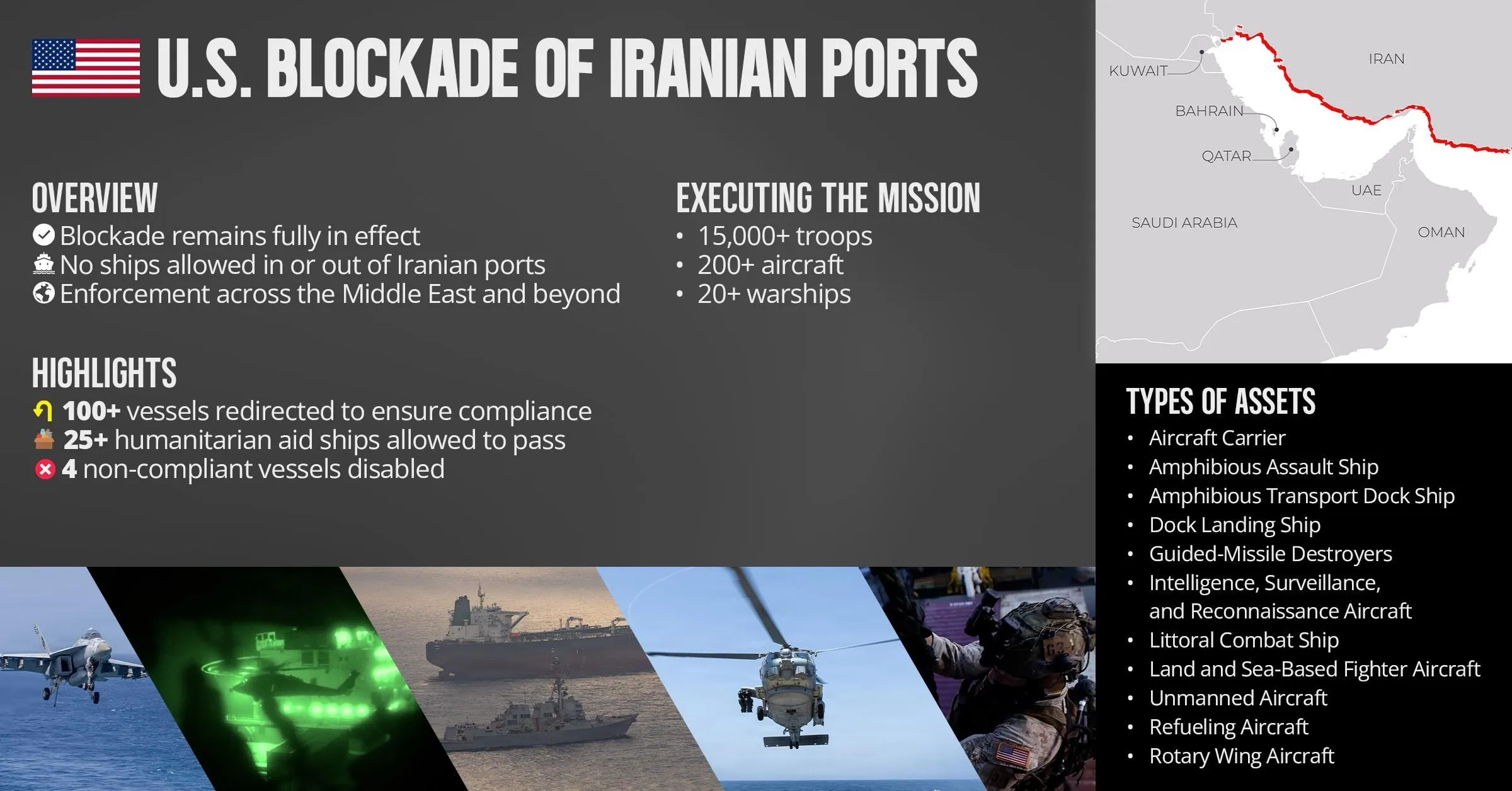
The U. S. military announced that two Navy guided-missile destroyers entered the Gulf to counter an Iranian blockade, while two U. S. ships passed through the Strait of Hormuz. This follows Iran’s claim of preventing a U. S. warship from entering the Gulf. U. S. Central Command (CENTCOM) stated that forces are supporting President Trump’s “Project Freedom,” aimed at helping commercial ships stranded due to the U. S.-Israeli conflict with Iran, and are enforcing a blockade on Iranian ports.
The U. S. intervention increases the possibility of direct confrontation with Iran in a crucial waterway that carries a significant portion of the world’s oil and gas, which has been blocked for two months because of the war. CENTCOM reported that two U. S.-flagged vessels successfully transited the strait while destroyers worked in the Gulf. Iran claimed it made a U. S. warship turn back, but CENTCOM denied reports of any missile strikes on the ship. An Iranian official mentioned a warning shot was fired, with uncertainty about any resulting damage to the warship.
Trump detailed a plan to assist ships running low on supplies in the Gulf, stating, “We will guide their Ships safely out of these restricted Waterways. ” In response, Iran warned oil tankers and commercial ships to coordinate movements with its military, asserting that it controls security in the Strait of Hormuz and would attack any foreign armed forces, particularly the U. S. military, attempting to enter. Since the war began, Iran has largely blocked shipping movements, causing oil prices to surge significantly.
CENTCOM plans to support “Project Freedom” with 15,000 troops, over 100 aircraft, warships, and drones, asserting that this mission is vital for regional security and the global economy.
At first sight, last week’s unprovoked attack on a French nun walking along a street in occupied East Jerusalem came without warning. However, for the roughly 180,000 Christians living in Israel – and the 10,000 or so Christians living in East Jerusalem – the attack is the latest in a growing number of incidents of abuse, assault, and intimidation that the community says has increased in tandem with Israel’s turn towards far-right nationalism.
While incidents of violence and arson grab the attention, low-level incidents of spitting, insults, and disparaging graffiti have become a daily experience for many Christians in the area – the majority of them Palestinian – contributing to the desire on the part of nearly half of all the religious community under 30 to leave.
Recommended Stories
list of 4 itemsend of list
Israeli officials have been quick to condemn the attack on the nun, calling it “despicable” and with “no place” in Israeli society. A man has also been arrested, after the arrest of Israeli soldiers blamed for smashing a Christian statue in southern Lebanon last month.
But ultimately, trust in the Israeli state is thin on the ground, with many of the incidents going unreported, analysts say.
Christians in Israel and East Jerusalem have been present in the area for more than 2,000 years. But they now find themselves attacked by Israelis, just for practicing their faith.
According to the volunteer-run Religious Freedom Data Center (RFDC), in the first three months of this year, Christians reported 31 incidents of harassment, most involving spitting or defacing church property. Last year, analysts with the interreligious Rossing Center for Education and Dialogue tracked 113 known attacks on individuals and church property in Israel and occupied East Jerusalem, including 61 physical assaults mainly targeting visible members of the clergy, such as monks, nuns, friars, and priests.
‘It’s definitely increased in the last three years,” said Hana Bendcowsky, programme director at the Jerusalem Center for Jewish-Christian Relations. “Resentment toward Christianity existed in the past as well, but people did not dare express it openly.”
“Over the past three years, the political atmosphere in Israel – where there is less concern about how the world perceives us – has led people to feel more comfortable harassing Christians,” Bendcowsky added. “This broader sense of Israeli isolation, and the reduced concern about international reactions, is also reflected in the way the State of Israel has acted regarding what has taken place in Gaza and southern Lebanon.”
Rising nationalism
Israel’s shift towards ultranationalism, particularly when it comes to policies towards Palestinians, has intensified under the current government of Prime Minister Benjamin Netanyahu. Under his administration, far-right voices that were once at the fringes of Israeli society have become incorporated into its heart, and now play defining roles in government.
Fuelled by a not entirely unfounded sense of impunity, a survey by the Rossing Center for Education and Dialogue last year found it was largely ultra-Orthodox and ultra-nationalistic Israelis who were responsible for the majority of attacks on Christians.
“The hate and attempt to harass non-Jews by some of the elements, particularly settler elements, knows no bounds,” Rabbi Arik Ascherman, an Israeli peace activist, told Al Jazeera. “Therefore, anything from spitting, harassing, and desecrating, to government actions to prevent churches from bringing in staff and clergy from abroad… is simply part of the reality here.”
Bendcowsky noted that “the complexity of Jewish–Christian relations goes back to the early centuries.”
“While some churches have undergone processes of rethinking their attitudes towards Jews and Judaism and have begun a path of healing, this has not yet taken place within Israeli Jewish society,” she said. “In education, the focus is on Jewish victimhood, so the lack of familiarity with Christians, together with the historical memory of Christianity, tends to be negative. In the current political climate, there are those who exploit this as a chance to strike back.”
Incidents are rarely reported, researchers say, with concern over foreign visas, or not wanting to draw attention to the issue, mixing with a profound absence of confidence in the state to take action.
‘There’s an absolute lack of confidence in the police, and I think that’s leading to many of the attacks going unreported,” Bendcowsky said. “Unfortunately, that’s often borne out by the evidence. Unless an incident gains international attention, particularly in the US, it often goes uninvestigated, or investigations are closed without any official conclusion.”
Losing support
High-level international objections to attacks on Christians and Christianity, especially those coming from Israel’s principal backers in the United States, have typically elicited swift responses from the Israeli government.
After viral footage of Israeli soldiers destroying a Christian statue in southern Lebanon sparked international outrage, the Israeli prime minister’s office was swift to publish its own condemnation. And in March, following a backlash from many world leaders, including avowedly pro-Zionist US Ambassador to Israel Mike Huckabee, after Israeli police prevented Latin Patriarch of Jerusalem Pierbattista Pizzaballa from reaching the Church of the Holy Sepulchre, official apologies and “clarifications” were quick in coming. But Israeli military attacks on Christian churches in Gaza and Lebanon have only been acknowledged when international and specifically US sympathy for Israel risks being undermined.
In Israel, Christianity is often associated with the Palestinians – and it is therefore perhaps inevitable that as Israel becomes increasingly unrepentant in its killing of Palestinians and seizure of their land, Palestinian Christians and other Christians in the area will not find themselves spared.
Shaiel Ben-Ephraim, an Israeli analyst with Atlas Global Strategies, said that he has noticed intolerance towards Christians increasing. He noted that along with Israel’s violence in Gaza and the wider region, this is contributing towards Israel’s increasing unpopularity worldwide and in the US, and making it more difficult for Christian supporters of Israel to square their support for the country with its treatment of their co-religionists on the ground, a plight they have ignored for decades.
‘In the long term, these attacks on Christians are massive,’ Ben-Ephraim told Al Jazeera.
“Older evangelicals may be forgiving, but the young are already turning against Israel,” he said. “This erodes the little support [Israel has] left. So, while current-day leaders like [US President Donald] Trump and Huckabee will pretend this isn’t happening, this will shape an entire generation of religious Christians in a way that Israel does not even begin to imagine.”
Weekly insights and analysis on the latest developments in military technology, strategy, and foreign policy.
Earlier today, U.S. Army AH-64 Apache and U.S. Navy MH-60 Seahawk helicopters destroyed six small Iranian boats that were threatening commercial ships in and around the Strait of Hormuz, according to the U.S. military’s top officer in the region. He also confirmed that Iran has launched new attacks aimed at American warships, as well as merchant vessels. All of this comes after the U.S. kicked off a new operation to safeguard commercial shipping through the Strait of Hormuz, dubbed Project Freedom, which you can read more about in our initial reporting here.
A US Navy MH-60S Seahawk armed with Hellfire missiles takes off from the Arleigh Burke class destroyer USS Pinckney somewhere in the Middle East on March 27, 2026. CENTCOM
“We have an enormous amount of capability and firepower concentrated in and around the strait, including AH-64 Apache and MH-60 Seahawk helicopters used just this morning to eliminate six Iranian small boats threatening commercial shipping. So we’re backing up commitment with action,” Navy Adm. Brad Cooper, head of U.S. Central Command (CENTCOM), told TWZ and other outlets during a press conference today. “We also have A-10s, F-15, F-16, F/A-18, F-35, EA-18 Growlers, RC-135s, KC-46s, and KC-135 fixed-wing aircraft, and numerous U.S. warships, including destroyers, two carrier strike groups, [an] amphibious readiness [sic] group, and [a] Marine Expeditionary Unit.”
“The cruise missiles were going after both U.S. Navy ships, but mostly after commercial shipping,” Cooper added when asked about attacks so far. “We defended both ourselves and, consistent with our commitment, we defended all those commercial ships.”
“We had drone launches against commercial ships, all of which were defended against, consistent with our commitment, and then the small boats were all going against commercial ships, and all were sunk by Apaches and Seahawk helicopters,” he continued.
UPDATE: More Details From Adm. Cooper’s Briefing
On the scope of Project Freedom:
“We are employing U.S. ballistic missile defense-capable destroyers, over 100 land and sea-based aircraft, multi-domain unmanned platforms – meaning under the sea, on the sea, and from the air – and then 15,000 service members to extend this defensive umbrella across the Strait of Hormuz to protect our forces and also, as committed, to defend commercial shipping.”
On international reaction
“Vessels currently in the Arabian Gulf represent 87 countries from around the world. As the president mentioned, they’re merely neutral and innocent bystanders. Over the last 12 hours, we’ve reached out to dozens of ships and shipping companies to encourage traffic flow through the Strait, consistent with the president’s intent, to help guide ships safely through the narrow trade corridor. This news has been quite enthusiastically received, and we’re already beginning to see movement.”
“The President has also said that if the process [Project Freedom] is interfered with, we will react forcefully. And over the last 12 hours, Iran has interfered. The IRGC [Islamic Revolutionary Guard Corps] has launched multiple cruise missiles, drones, [and] small boats at ships we are protecting. We have defeated each and every one of those threats through the clinical application of defensive munitions.”
On whether U.S. warships were hit:
“I can confirm there’s been no U.S. military ship hit, and there’s been no U.S. flagged-ship [sic] that have been hit.”
🚫 CLAIM: Iranian state media claims that Iran’s Islamic Revolutionary Guard Corps hit a U.S. warship with two missiles.
✅ TRUTH: No U.S. Navy ships have been struck. U.S. forces are supporting Project Freedom and enforcing the naval blockade on Iranian ports. pic.twitter.com/VFxovxLU6G
On whether these attacks mean the ceasefire is over:
“I wouldn’t go into detail of whether the ceasefire is over or not. I think the key thing for us is we’re merely there as a defensive force and a force to give a very thick layer of defense to commercial shipping to allow them to proceed out of the Arabian Gulf. That’s what we’re focused on. What we saw this morning was Iran initiating aggressive behavior. We are simply going to respond to that consistent with the president’s direction.”
On whether Project Freedom is protecting ships in port in the United Arab Emirates (UAE), which have also come under attack today:
“I don’t want to give the details of what we’re protecting and what we’re not. I wouldn’t want to tip our hand on that. But in the case of the Fujairah attack, I’d really refer to the UAE on that. That’s really a matter under their national jurisdiction and not part of our project operation.”
On how close the Iranian missiles and drones got to ships:
“I don’t want to get into the specific details of differences. All of the missiles and drones that were fired at both us and the commercial ships were effectively engaged. So that’s the good news. No personnel injuries in that regard, and also in terms of where specifically, the area in the strait was transited, probably not worth getting into details. What I will say is, over the past several weeks, we’ve used low-observable capability to clear that path, and we validated that in multiple ways. And then we took the risk by using U.S. flagships [sic] to go first, setting the example. Since then, we’ve had great communication with industry, as I mentioned, and ships, multiple ships, are already heading that way. So the summation of that is, we used our own military technology in a unique way to clear a free lane that’s not obstructed in any way, shape or form, through the Strait, executed by setting the example of U.S. ships. And over top of all that, we have a US military defensive umbrella.”
On whether U.S. destroyers transited the Strait today:
“Yes, we have gone through the Strait today. As we sit here right now, we have multiple U.S. Navy guided missile destroyers operating in the Arabian Gulf.”
U.S. Navy guided-missile destroyers are currently operating in the Arabian Gulf after transiting the Strait of Hormuz in support of Project Freedom. American forces are actively assisting efforts to restore transit for commercial shipping. As a first step, 2 U.S.-flagged merchant… pic.twitter.com/SVDxDhK72I
On whether U.S. warships are providing escort through the Strait:
“There’s no specific escort. If I just describe this overall, if you’re escorting a ship, you’re playing kind of one-on-one, I think we have a much better defensive arrangement in this process, where we have multiple layers that include ships, helicopters, aircraft, airborne early warning, electronic warfare – we have a much broader defensive package than you would have ever had if you were just escorting. I feel good about that, and it was proven just in the last couple of hours.”
“In terms of mines, I’m not going to talk about specific capabilities. You know, they all have varying degrees of influence. I think the key thing about mines is that we have cleared an effective pathway for ships to lead. At this point, for the first time, there seems to be great enthusiasm to do that, but we’re going to stay in contact with the commercial shipping and support them along the way.”
On our question about whether Project Freedom is just for getting ships out of the Strait, or whether it is also for getting them into it.
“It will ultimately be a two-way path. The most important thing is in the near-term getting ships out. And then over time, we’ll also, for sure, see ships go in.”
On our question about what munitions the Apaches and MH-60s used:
“We don’t want to get into the munitions or how we’re doing things tactically. I will just kind of put that off to the side. But the munitions that were used were very effective, and the tactics worked just as described.”
UPDATE: More on AH-64s and MH-60s in the counter-small boat role
Today’s use of AH-64s and MH-60s to engage Iranian small boats as part of a larger effort to ensure access to the Strait of Hormuz highlights a larger contingency plan that the U.S. military has been working to refine for decades now.
Small boat threats, and in the context of a Strait of Hormuz crisis, especially, became even more of a focus of U.S. military planning in the early 2000s. Al Qaeda’s attack on the Arleigh Burke class destroyer USS Cole while it was in port in Aden, Yemen, was one key driver. The fallout from the still-controversial Millennium Challenge war game in 2002 was another very important factor.
The USS Cole seen being transported aboard the heavy lift ship M/V Blue Marlin after suffering severe damage as a result of the Al Qaeda attack in 2000. USN
All of this impacted the addition of new close-in defense capabilities to existing and forthcoming warships. It also put additional emphasis on the role of armed helicopters, as well as fixed-wing aircraft, in responding to swarms of small boats. The Air Force’s A-10 Warthog ground attack planes have trained extensively to fly counter-small boat missions for the past two decades, for instance.
Army AH-64s and Air Force A-10s had already been conducting missions targeting Iranian naval assets in and around the Strait of Hormuz before the announcement of the ceasefire in April. Navy MH-60s are known to have been flying armed force protection missions as part of Operation Epic Fury against Iran, as well. As an aside, Seahawks also destroyed small boats belonging to Iranian-backed Houthi militants in Yemen as part of previous operations to safeguard commercial shipping in and around the Red Sea.
A flight of US Army AH-64 Apache attack helicopters, armed with rockets and Hellfire missiles, seen taxing out to conduct a recent scheduled flight in the CENTCOM area of responsibility. US Army
Armed helicopters remain key assets for defending against swarms of small boats. This is in part because of the added flexibility they offer in terms of their ability to launch from forward bases on land and ships at sea, either of which can also be situated closer to the threat area. This, in turn, can help reduce the time it takes to react and increase time on station. Helicopters’ ability to fly slow and low also allows them to spot, identify, and make rapid attacks on small moving targets. For naval vessels that carry helicopters, arming them with more advanced weaponry to go after small boats means they can provide an on-call outer highly flexible layer of force protection that would not exist otherwise. New munitions, including laser-guided Advanced Precision Kill Weapon System II (APKWS II) rockets, will only increase their capabilities to engage larger swarms of small boats
US Army Apaches operate from the US Navy Expeditionary Sea Base ship USS Lewis B. Puller during an exercise in the Middle East in 2020. USN
Small boats are, of course, not the only threat Iran is already bringing to bear in the Strait of Hormuz. As Adm. Cooper noted in his briefing, Iranian forces have been launching cruise missile and drone attacks on ships in and around this critical waterway. There is also the continued threat of Iranian naval mines, as well as explosive-laden uncrewed surface vessels. Iran has also launched a new round of missile and drone attacks on the United Arab Emirates.
All of this only reinforces the general risks that U.S. forces will face as Project Freedom gets further underway, especially if it grows to include more direct escort and/or convoy missions.
UPDATE: Reaction to the Iranian missile and drone barrage
In a phone conversation with ABC News Chief Washington Correspondent Jonathan Karl, Trump “”stopped short of saying Iran has violated the ceasefire,” Karl stated on X. “Regarding the Iranian drone and missile attacks on UAE today: ‘They were shot down for the most part,’” Trump told Karl. “‘One got through. Not huge damage.’ Regarding the Iranian attack on a South Korean ship: ‘We’re going to look into it. Shots were fired at a South Korean ship, and I think South Korea should take some action. … This was a South Korean ship riding by itself. It was not an escorted ship.’”
In a phone conversation a short while ago, President Trump stopped short of saying Iran has violated the ceasefire.
Regarding the Iranian drone and missile attacks on UAE today: “They were shot down for the most part,” Trump told me. “One got through. Not huge damage.”…
Trump said Iran will be “blown off the face of the Earth” if they attack U.S. vessels carrying out Project Freedom.
Trump made the comments during an interview with Fox News‘ Trey Yingst on Monday, adding that he believes Iran has become “much more malleable” in peace negotiations.
The president also emphasized that U.S. military buildup in the region is continuing.
“We have more weapons and ammunition at a much higher grade than we had before,” Trump said. “We have the best equipment. We have stuff all over the world. We have these bases all over the world. They’re all stocked up with equipment. We can use all of that stuff, and we will, if we need it.”
Trump again said that Iran has “no navy, they have no air force, they have no anti-aircraft equipment, they have no readar, they have no nothing, they have no leaders actually…the leaders happen to be gone also.”
President Trump on Iran: “They have no navy, they have no air force, they have no anti-aircraft equipment, they have no radar, they have no nothing, they have no leaders actually…the leaders happen to be gone also.” pic.twitter.com/JBkAV7OKwi
UAE air defense systems “engaged 12 ballistic missiles, 3 cruise missiles, and 4 UAV’s launched from Iran, resulting in 3 moderate injuries,” the UAE MoD stated on X. “Since the beginning of the blatant Iranian attacks on the United Arab Emirates, the air defences have engaged a total of 549 ballistic missiles, 29 cruise missiles, and 2,260 UAV’s.”
تتعامل حالياً الدفاعات الجوية الإماراتية مع اعتداءات صاروخية وطائرات مسيرة قادمة من ايران وتؤكد وزارة الدفاع أن الاصوات المسموعة في مناطق متفرقة من الدولة هي نتيجة تعامل منظومات الدفاعات الجوية الإماراتية للصواريخ الباليستية، والجوالة والطائرات المسيرة.
Qatar “strongly condemns the renewed Iranian attacks targeting civilian sites and facilities in the sisterly United Arab Emirates using missiles and drones, which resulted in injuries to three Indian nationals,” the country’s Foreign Ministry stated on X. “Qatar considers these attacks a blatant violation of the UAE’s sovereignty and a serious threat to the security and stability of the region.”
Qatar Strongly Condemns Renewed Iranian Missile, Drone Attacks on UAE
Doha | May 4, 2026
The State of Qatar strongly condemns the renewed Iranian attacks targeting civilian sites and facilities in the sisterly United Arab Emirates using missiles and drones, which resulted in… pic.twitter.com/UU0tV5w111
— Ministry of Foreign Affairs – Qatar (@MofaQatar_EN) May 4, 2026
The U.S. and Israel are “holding feverish consultations on how to respond and assist their loyal ally.” Israel’s Israel Hayom news outlet claimed, citing three sources familiar with the matter.
“The likely options include targeted attacks against launchers and military targets threatening the strait, or a parallel attack on an Iranian energy facility in response to the attack on Fujairah,” the outlet posited.
We cannot independently verify that claim.
Tehran had no prior plan to attack Emirati facilities in Fujairah port, an Iranian official told Iranian media.
“What happened is the result of the American army’s adventure to illegally open a passage for ships to cross from the prohibited passages in the Strait of Hormuz,” the official said.
BREAKING: Iranian Military source to Iranian TV:
Tehran had no prior plan to attack Emirati facilities in Fujairah port
What happened is the result of the American army’s adventure to illegally open a passage for ships to cross from the prohibited passages in the Strait of… pic.twitter.com/Pt3GKSUIDb
In the wake of today’s attacks from Iran, UAE has partially closed its airspace for one week, effective today through May 11. Commercial traffic is restricted to narrow corridors through specific waypoints only.
UAE has partially closed its airspace for one week, effective May 4 through May 11.
Vide NOTAM A1722/26, Emirates FIR partially closed. Commercial traffic restricted to narrow corridors through specific waypoints only.#airspacepic.twitter.com/dfmJFuOAlA
Meanwhile, Israel’s Ben Gurion Airport management has raised the alert level for an attack scenario, which includes a rapid “departure procedure” for international companies, according to Israel’s Channel 14 news outlet.
“Against the backdrop of increasing security tensions and reports of the closure of the airport in the United Arab Emirates today (Monday), Israel is on high alert for the possibility of a widespread escalation,” the outlet added. “As of this time, Ben Gurion Airport continues to operate as usual, but behind the scenes the alert level has been raised to the highest level with the understanding that the schedule could change within minutes.”
Ben Gurion Airport is on high alert in preparation for a possible closure of Israeli airspace and evacuation of aircraft -CH14
ICE agents arrested a Nigerian immigrant in Brooklyn on Saturday night. People promptly staged a protest outside Wykhoff Heights Medical Center, where Chidozie Wilson Okeke was taken after the violent arrest. NYPD officers assaulted and arrested protesters.
The leader of Mali’s military government, Assimi Goita, has taken on the role of defence minister following the killing of the previous minister in last week’s uprising by rebel groups.
State television channel ORTM reported on Monday that Goita was taking on the post following the death of Sadio Camara in large-scale attacks by an al-Qaeda-linked group working with Tuareg separatists.
Recommended Stories
list of 3 itemsend of list
The report noted the presidential decree that Assimi Goita will remain president while also taking on the new role
General Oumar Diarra, who was military chief of staff, has been appointed as delegate minister to the defence ministry.
Car bomb blast
During the assault on strongholds of the military government, more than a week ago, Camara was killed by a car bomb blast at his residence. The rebel armed groups were able to capture the key northern town of Kidal in the largest attack in the West African country in nearly 15 years.
The fighting killed at least 23 people, with the United Nations children’s agency UNICEF reporting that civilians and children were among the dead and injured.
Mali has been beset by security crises since at least 2012. Al-Qaeda-linked Jama’at Nusrat al-Islam wal-Muslimin (JNIM) controls large areas of rural territory, especially in the north and central regions, and has active cells around the capital. Similarly, the ISIL (ISIS) affiliate in Sahel Province (ISSP) controls areas in northeastern Menaka city.
At the same time also in the north, armed Tuareg separatists of the Liberation Front for Azawad (FLA) group are fighting for an independent nation called Azawad. They are battling Mali’s military and allied Russian mercenaries who have been deployed since 2021.
Together with the JNIM, they control Kidal, but also want Gao, the largest city in the north, as well as Menaka and Timbuktu, to complete the self-declared state of Azawad.
Those groups sometimes work together: they operate in the same areas and draw from the same pool of fighters from aggrieved communities. In the latest widespread attacks, the JNIM worked with the FLA against the army.
Goita’s military government took power after coups in 2020 and 2021, pledging to restore security, but has struggled to achieve that.t It has cut ties with its former colonial ruler, France, and expelled French forces and United Nations peacekeeping missions.
Last July, military authorities granted coup leader Goita a five-year presidential mandate, which can be renewed “as many times as necessary” without an election.
The previous month, Russia’s Wagner Group, which had been aiding Malian forces against armed groups since 2021, said it would complete its mission. It has now become the Africa Corps, an organisation under the direct control of the Russian defence ministry.
In the wake of last month’s attacks, the rebels announced a blockade of the capital Bamako in retaliation for “the population’s support of the army”. However, that blockade has only partially been effective, according to an AFP correspondent in the city.
Dealing with emissions could help alleviate effects of Iran crisis on global energy supply, says report.
Published On 4 May 20264 May 2026
Tackling methane emissions in the fossil fuel sector would help efforts to hold back climate change and increase energy security, especially as the Iran crisis threatens global supplies, according to a report by the International Energy Agency (IEA).
The oil, gas and coal industries account for about 35 percent of all methane emissions from human activity, notes the IEA’s Global Methane Tracker 2026, released on Monday. However, there is little progress in reducing them, the report points out.
Recommended Stories
list of 4 itemsend of list
“There is still no sign that methane emissions from fossil fuel operations are falling, despite well-known and proven mitigation pathways,” the IEA said.
Methane, the second-biggest contributor to climate change, stays in the atmosphere for far less time than carbon dioxide, but its warming effect is roughly 80 times more potent over a 20-year period.
The IEA estimates that methane emissions from oil, gas and coal total 124 million tonnes a year. Oil is the largest source at 45 million tonnes (Mt), followed by coal at 43 Mt, and natural gas at 36 Mt.
“A further 20 Mt comes from bioenergy production and consumption, largely from the incomplete combustion of traditional biomass used for cooking and heating in developing economies,” the report added.
Oil prices have soared since the United States and Israel launched their war against Iran in late February and Tehran closed the Strait of Hormuz in response. An April ceasefire between the sides is currently holding, but global energy supplies remain limited.
The ongoing crisis is reshaping the global energy system and disrupting about 20 percent of global liquefied natural gas (LNG) trade flows.
Nearly 100 billion cubic metres of natural gas could be made available annually through a global effort to cut methane from oil and gas operations, the IEA said, estimating that nearly 15 billion cubic metres could be made available in a sufficiently short period of time to provide some relief to gas markets.
A further 100 billion cubic metres would be unlocked through the elimination of non-emergency flaring worldwide, it added.
Paris initiative
France, using its role as rotating chair of the Group of Seven (G7) bloc of industrialised powers, convened government officials, industry leaders and experts on Monday to build momentum on cutting methane emissions.
The conference aimed at reducing methane emissions ahead of the United Nations’ November COP31 summit.
“I sincerely hope that the discussions we will have today will enable us to join our forces to accelerate the implementation of effective solutions to reduce methane emissions,” French Ecological Transition Minister Monique Barbut said in a speech.
“Of course, action on methane is not a fight of any single actor and nobody can win it alone,” she added, noting that the world remains “very far” from meeting a pledge to cut methane emissions by 30 percent by 2030 compared with 2020 levels.
“Reducing methane emissions remains one of the best things we can do to slow global warming while cleaning up our air, improving public health, and increasing our energy security,” British Secretary of State for Energy Security Ed Miliband said in a video message.
Raman Kapoor, an Indian oil tanker captain stranded in the Gulf, says no vessel will attempt to exit the Strait of Hormuz without assurance of safety, despite the announcement of a US evacuation plan for ships stranded by the war.
The Palestinian National Popular Action Committee have today issued a press statement strongly condemning the Israeli abduction of activists Saif Abu Khashk and Thiago Ávila in international waters near the island of Crete. “This act of maritime piracy,” the Committee said, “is part of a continuing pattern of violations of all international norms and laws.” The statement said Israel’s cross-border lawlessness comes as no surprise from an occupation that systematically disregards international law. “We hold all those complicit in these crimes, including those who remain silent, fully responsible.”
It added; “While we hold the occupation fully accountable for the safety of Saif and Thiago, we urgently call on the Governments of Spain and Brazil to intervene immediately to secure their safety and ensure their prompt release.”
The Committee expressed its appreciation and esteem to the two activists, Saif and Thiago, as well as to all participants in the “Sumud Flotilla” who confronted the occupation’s arrogance and piracy with their unarmed presence and firm determination. “These sacrifices reaffirm that the struggle for freedom and justice will continue,” it concluded.
The security landscape along the border between the Democratic Republic of Congo (DRC) and South Sudan is deteriorating amid a series of alarming attacks attributed to armed men believed to be South Sudanese soldiers. The Kakwa chiefdom, particularly the Roumou tribal group and the village of Agoroba in Aru territory, Ituri province, has been severely affected by these incursions.
Local sources said the suspected South Sudanese soldiers looted cattle and money, and abducted Congolese civilians.
“These armed men coming from South Sudan have looted from the population, taking away cows, goats, money, and even abducting young men, whom they continue to hold in the bushes. This situation does not date today. It has been several months since these armed men have been crossing the border to attack our villages,” a local chief told HumAngle.
Dieudonne Tabani, a national parliamentarian, has raised concerns about the worsening security situation along the border between the DRC and South Sudan in the Aru territory of Ituri province. He condemned how the repeated incursions in several localities of Kakwa chiefdom are characterised by the looting of belongings as well as the abduction of civilians.
“The number of our soldiers along the border with South Sudan is very minimal. When these armed men enter, they are not faced by a rigorous response. We call on the provincial authorities, under the state of siege, to urgently reinforce the military presence in the zone,” a local in the Ituri province told HumAngle. “The central government must also get involved in diplomatic overtures with a view to clearly demarcating the boundary, most times given as a reason for the incursions into our territory.”
Amid this troubling situation, Ituri provincial authorities have called on the population to remain calm, assuring that the authorities in Kinshasa have already been briefed and that measures will eventually be taken to secure the zone.
In January, DRC and South Sudan completed a major prisoner exchange following a diplomatic meeting. The border town of the Aru territory in the DRC serves as a haven for numerous South Sudanese refugees escaping the civil conflict in their homeland.
The security situation is worsening along the border between the Democratic Republic of Congo (DRC) and South Sudan, with escalating attacks by suspected South Sudanese soldiers.
The Kakwa chiefdom, specifically the Roumou tribe and Agoroba village in Ituri province, has been affected by looting and abductions.
Local leaders and a national parliamentarian have expressed concerns, highlighting inadequate military defense and urging provincial authorities to strengthen border security. They also call for diplomatic engagement to resolve boundary disputes that contribute to these incursions.
Despite the tensions, provincial authorities have assured residents that measures are being taken to address the situation.
Meanwhile, in January, DRC and South Sudan conducted a prisoner exchange to promote security cooperation, as the Aru territory continues to host South Sudanese refugees fleeing civil conflict.
Distraught onlookers caught the moment a monster truck lost control at a car show and plowed into spectators in Colombia, killing at least three people, including a 10-year-old girl. Around 40 people were injured.
Weekly insights and analysis on the latest developments in military technology, strategy, and foreign policy.
For the first time, the U.S. Air Force has publicly released imagery showing a B-1B Lancer bomber carrying an AGM-183 Air-launched Rapid Response Weapon hypersonic missile, or ARRW. The development comes with the B-1B now officially slated to serve for another decade, while it has been earmarked as a hypersonic weapons test platform. For its part, the ARRW, at one point expected to be the U.S. military’s first operational hypersonic weapon, is also back from purgatory, after continued questions about its future. The Air Force now wants to develop an improved version, as well as a separate air-launched ballistic missile (ALBM).
A brief clip showing a B-1B flying with an ARRW carried on an external hardpoint was released on Edwards Air Force Base’s Instagram page recently. The emergence of the video was first brought to our attention by The Aviationist.
It is unclear when the test-flight footage was taken, and it is not directly referenced in the video, which is otherwise dedicated to the work of maintainers on different aircraft platforms at Edwards.
The B-1B over a test range, with the ARRW installed. U.S. Air Force screencap
The B-1B was originally designed to carry external stores on up to eight external hardpoints. The Air Force had also developed special pylons that would have allowed the bombers to carry two nuclear-tipped AGM-86B Air-Launched Cruise Missiles (ALCM) on each one. Following the end of the Cold War, the B-1Bs lost their nuclear mission and, as a result, the external pylons fell into disuse, at least as far as weapons are concerned.
B-1B with cruise missile mounting racks attached to external hardpoints during testing back in the 1980s. U.S. Air Force
However, as long ago as 2020, the Air Force detailed plans to add the ARRW to the B-1B, after the service highlighted work to expand the bomber’s ability to carry hypersonic weapons and other new stores, both internally and externally.
“My goal would be to bring on at least a squadron’s worth of airplanes modified with external pylons on the B-1, to carry the ARRW [Air-launched Rapid Response Weapon],” Gen. Timothy Ray, then head of Air Force Global Strike Command, told Air Force Magazine. He added that the service had contemplated several options for integrating the missile onto the bombers, “but we believe the easiest, fastest, and probably most effective in the short term will be to go with the external pylons.”
In the meantime, we have seen examples of the ARRW carried under the wing of the B-52H bomber during multiple test sorties, and a live version also notably appeared on a Stratofortress during a training event at Andersen Air Force Base on Guam.
A live AGM-183A ARRW under the wing of a B-52 bomber at Andersen Air Force Base on Guam ahead of a test over the Western Pacific in 2024. U.S. Air Force
The Fiscal Year 2026 budget request confirmed that the Air Force plans to use the B-1B as a testbed for the Load Adaptable Modular (LAM) pylon, intended for hypersonic weapons and other outsize loads. The B-1B can accommodate six of these pylons, each capable of carrying two 2,000-pound-class weapons or a single 5,000-pound-plus-class weapon. The ARRW would fall into the latter category.
Boeing concept art showing a B-1B fitted with LAM pylons carrying air-breathing hypersonic missiles. Boeing
The budget documents noted: “The Hypersonic Integration Program successfully demonstrated the B-1’s ability to execute a captive carry of a 5,000-pound-class store and the release of a proven weapon shape from a Load Adaptable Modular (LAM) pylon.” This suggests that the video we are now seeing could have been taken during this demonstration, but it might also refer to external load tests involving the Air Force’s new bunker-buster bomb, the 5,000-pound class GBU-72/B.
A model of the LAM pylon, which Atlantic Models in Miami built for Boeing, loaded with two mock-up hypersonic cruise missiles. Atlantic Models
In the same position as seen in the ARRW video, the LAM has also been used for external carriage tests of the Joint Direct Attack Munition (JDAM). More routinely, this same position mounts an external pylon that accommodates a Sniper targeting pod. The same location has previously been used in external carriage tests of the AGM-158 Joint Air-to-Surface Standoff Missile (JASSM) cruise missile, too.
A B-1B Lancer assigned to the 419th Flight Test Squadron conducts flight tests with a JDAM on the Load Adaptable Modular pylon in early 2024. Air Force photo by Richard GonzalesA 419th Flight Test Squadron B-1B carrying an inert AGM-158 JASSM during a demonstration flight. U.S. Air ForceA close-up look at a Sniper Advanced Targeting Pod on a B-1B. U.S. Air Force
As for ARRW, it carries an unpowered hypersonic boost-glide vehicle as its warhead. A rocket booster accelerates and lifts the vehicle to the required speed and altitude, after which it separates and glides through the atmosphere on a relatively shallow path toward its target. The weapon’s high speed and unpredictable flight path make it difficult for opponents to intercept and engage it, and give very little response time.
B52 ARRW Hypersonic evaluation test at Edwards Air Force Base 12 JUN 2019
Meanwhile, in its Fiscal Year 2027 budget request, the Air Force seeks funds for the development of what it calls ARRW Increment 2, as well as to kick-start a new air-launched ballistic missile (ALBM) program. The service wants almost $350 million to fund these two efforts. ARRW Increment 2 involves adding undisclosed enhanced capabilities onto the baseline weapon, while the ALBM effort would seek to field a new air-launched, long-range strike capability to complement the ARRW and HACM.
The US Air Force plans to kick off Air Launched Rapid Response Weapon (ARRW) Increment 2 development and stand up a new Air Launched Ballistic Missile (ALBM) program in Fiscal Year 2027. The service has set aside nearly $350 Million combined for these two efforts. ARRW Inc 2… pic.twitter.com/pe0SKPlrDO
In its Fiscal Year 2027 budget documents, the Air Force further notes:
“We are doubling production rates for our two developmental hypersonic weapons, the Air-Launched Rapid Response Weapon (ARRW) and the Hypersonic Attack Cruise Missile (HACM), with a planned investment of $1.8 billion across the FYDP to accelerate delivery of these critical strike capabilities into the hands of the warfighter.”
The documents don’t give any details on how many ARRWs they want to order.
Mockups of the Chinese JL-1 ALBM on parade in Beijing on September 3, 2025. Central Military Commission of China
Despite previous plans to retire the B-1B by 2030, the bomber’s ability to carry outsize loads, in particular, has helped ensure that it’s now expected to remain in service until at least 2037.
Fiscal Year 2027 budget documents indicate that the Air Force plans to spend $342 million on modernizing its 44 remaining B-1Bs from 2027 to 2031. “This request provides the necessary funding to modernize the platform, ensuring its lethality and relevance through 2037,” the budget said.
With a capacity to carry more conventional weapons than any other aircraft in the Air Force’s inventory, we will surely see the B-1B carrying additional external weapons and larger numbers of them, as it continues its service career.
The US president has accused some NATO countries of not doing enough to support the US-Israel war on Iran.
Published On 4 May 20264 May 2026
NATO Secretary-General Mark Rutte says European leaders have “gotten the message” after United States President Donald Trump announced plans to withdraw 5,000 soldiers from Germany.
Trump has grown increasingly frustrated with NATO allies, accusing them of not doing enough to support the US-Israel war on Iran. Speaking on Monday, Rutte acknowledged “disappointment from the US side”.
Recommended Stories
list of 3 itemsend of list
“European leaders have gotten the message. They heard the message loud and clear,” Rutte said before a European Political Community meeting in Armenia.
“Europeans are stepping up, a bigger role for Europe and a stronger NATO,” he added.
The Pentagon announced the troop withdrawal from Germany on Friday, days after German Chancellor Friedrich Merz said Iran was humiliating the US during the negotiations aimed at ending the war.
The European Union’s top diplomat, Kaja Kallas, called the announcement’s timing a “surprise”.
“I think it shows that we have to really strengthen the European pillar in NATO, and we have to really do more,” Kallas said while stressing that “American troops are not in Europe only for protecting European interests but also American interests.”
Over the weekend, NATO spokesperson Allison Hart said officials in the 32-nation military alliance “are working with the US to understand the details of their decision on force posture in Germany”.
‘Dangerous military intervention’
European criticism of the war on Iran has mounted in recent weeks as the conflict sends shockwaves through the global economy due to the continued disruption to shipping in the Strait of Hormuz.
Last week, Merz compared the war to previous military quagmires, such as the US invasions of Iraq and Afghanistan.
“It is, at the moment, a pretty tangled situation,” he said. “And it is costing us a great deal of money. This conflict, this war against Iran, has a direct impact on our economic output.”
Spain has refused to let the US launch attacks on Iran from its airspace or military bases. Prime Minister Pedro Sanchez has condemned the war as “unjustified” and a “dangerous military intervention” outside the realm of international law.
Despite this, Rutte said “more and more” European nations were now pre-positioning assets such as minehunters and minesweepers close to the Gulf to be ready for the “next phase” in the war.
He provided no details, and European nations have previously insisted they would not help to police the Strait of Hormuz until the war is over.
Increased defence spending
Many European countries have committed to ramping up defence spending in the face of fears over Trump’s commitment to NATO and Russia’s assault on Ukraine – a push underscored by several leaders in the Armenian capital.
“Europeans are taking their destiny into their own hands, increasing their defence and security spending, and building their own common solutions,” French President Emmanuel Macron said.
“We have to step up our military capabilities to be able to defend and protect ourselves,” European Commission President Ursula von der Leyen told reporters.
In one of the world’s most deprived and volatile regions, HumAngle’s reporting and experience reveal that journalists in Nigeria are not just observing suffering but are pulled into it as they try to report it. Consequently, they say, they find themselves paying out of pocket to feed the people whose stories they are trying to tell.
In theory, the profession is expected to observe some emotional distance from its sources and the stories they tell. However, that model is inoperable in conflict-affected regions of northern Nigeria and the Sahel.
Journalism here is embedded in environments shaped by violence, poverty, and dense social networks. Since these variables affect people at random, the reporter is not an outsider; sometimes, the conflict directly affects them as well. Ethical decisions are then made under pressure, repeatedly, and often without the comfort of certainty.
HumAngle operates in this space. Its work across Lake Chad, Central Africa, Nigeria’s Middle Belt, the North West, the South East, and other conflict zones forces a confrontation with a difficult question: What does ethical journalism look like when the people you report on are not just sources, but individuals whose survival may intersect directly with your presence?
The limits of imported ethics
Global journalism standards discourage payment for information, and while exceptions exist, they do so under strict editorial oversight, a clear public-interest justification, and transparency. Journalism teachers say that, though these frameworks are expected to provide clarity, they don’t in conflict-affected Nigeria, where the assumed context doesn’t apply. The ideal context has clear distinctions between sources and service providers and functioning identity systems. This is hardly obtainable in conflict-affected environments.
Dr Kabiru Danladi, a Mass Communication scholar with the Ahmadu Bello University in northwestern Nigeria, says, “Our curriculum borrows heavily from Euro-American ethical frameworks – objectivity, detachment, neutrality – principles rooted in relatively stable societies. The failure becomes evident when our graduates are deployed to cover issues that weren’t directly taught in class, or they are sent to cover conflicts in places like Zamfara, Sokoto, Kebbi, Borno, Yobe or Benue, where journalism is not just a profession but a survival exercise.”
Dr Obiora Chukwumba, a researcher and media expert in Abuja, identifies the same problem in the moral obligation created by field contact. “There is no ethical barrier to a journalist intervening on grounds of goodwill to assist a source who is in a vulnerable position,” he said.
The reality of field reporting
A fixer in Zamfara, where terror groups continue to kill, abduct, and loot, is not simply an access broker but may also translate, assess risk, and act as a negotiator in certain environments. A driver in Borno, North East Nigeria, may carry more situational intelligence than any formal briefing. An intermediary in the southeast may navigate relationships across vigilante groups and separatist networks.
These individuals are essential. Without them, our reporters’ access vanishes. But they are also embedded in the same systems the journalist is trying to understand, which creates layered risks, including legal risks that emerge when payments made for legitimate services are later interpreted as material support.
Barrister Joseph Danboyi, a senior lawyer in Jos, North Central Nigeria, says, “Payment to a fixer creates liability if the journalist knew his connection with criminals. Ordinary payment for information is insufficient. The journalist will be aiding and abetting when payment is purposefully linked to criminal conduct.”
He goes further to add, “The practical bottom line is that a journalist who unknowingly pays a criminal for information is generally not liable… liability requires knowledge… and intent to help or further it.”
This distinction between knowledge and intent anchors the legal reality that sits beneath field decisions.
Dr Obiora also treats fixers and access arrangements as part of newsroom operations, not automatically as ethical breaches. “Parts of the routine (investigative) costs tied to the operations of a newsroom include such services as engaging fixers, obtaining access to a reasonably considered newsmaker, and appreciation handouts,” he said. “They are all legitimate operational costs.”
There is no procedural checklist that eliminates these risks. What exists instead is a need for structured awareness and disciplined judgment in newsrooms.
The Knifar women: A case that reshapes the debate
HumAngle’s engagement with the Knifar movement brings these tensions into focus. The Knifar women are part of a grassroots movement shaped by prolonged suffering. Their husbands, sons, and brothers were detained during military operations, often for years, without trial. In many cases, these men were the primary providers, and so their absence triggered cascading consequences for these women, including food insecurity, poverty, and social fragmentation. The women organised into a pressure group to demand accountability for the detention of their male relatives.
HumAngle’s reporting amplified their efforts, influencing outcomes that ultimately led to the release of over a thousand men that the women were advocating for.
Our work required prolonged engagement with the women, whose daily reality was defined by deprivation. In some instances, our journalists provided stipends. In other cases, some of these women became part of the reporting process as fixers and contributors with fixed incomes in our newsroom. We have even given some of them ‘additional reporting’ credit for their work. Since they are both sources and resource persons for our newsroom, we are often clear about what we are paying them for – their work, not their information. We have spoken publicly about the dynamics of our relationship with these women, including in a Pulitzer Centre-supported documentary.
Kunle Adebajo, a renowned award-winning investigative journalist, reflects on his own experience in being moved to provide money to vulnerable sources: “I’ve often had to pay vulnerable sources. This is because the majority of them live from hand to mouth and rely on wages from daily labour to get their sustenance, and so such interviews could be very disruptive and uncomfortable for them. Oftentimes, they also have to transport themselves to meet at the interview location. The sums given were trifling, and there was never an understanding that the interview itself was transactional.
Dr Obiora agrees that the understanding must always be clear. “If the source or interviewee presents the personal need to overshadow the reason for the meeting with the journalist, then that could be a red flag,” he said, “pointing to potential compromised narrative or ‘adjusted facts’ from the source or interviewee.”
When observation is not enough
Journalists are trained not to pay sources because it could risk distortion and affect credibility, but what happens when the people you are interviewing live in destitute conditions?
Get our in-depth, creative coverage of conflict and development delivered to you every weekend.
Subscribe now to our newsletter!
“I met residents, elderly men and women who could not feed themselves, who could not afford basic healthcare. I met a father who lost his wife to a particular ailment, and whose two kids are still suffering from the same ailment. Yet, he could not help.”
The award-winning journalist said he felt compelled to help. “I offered to buy meals for some of them through my fixer. Yes, I offered them some cash to buy what they needed. When I got back to my hotel room that evening, I actually cried. I felt the depth of these people’s suffering.”
He is not unaware of the ethical grey spots in giving money to sources. “Ethically, I did not really care at that point whether offering them some cash would be seen as an inducement. I told myself that I had to act as a human being at the moment and drop the toga of ‘a journalist’ at that point.”
Dr Danladi understands this and says that “Students must be taught that they are a journalist, yes – but they are also human beings. Refusing to help in the name of ‘objectivity’ can itself be an ethical failure.” He says that liability only becomes possible “where the journalist knows or is willfully blind to criminal activity… or where the payment itself is tied to illegal conduct.”
Another journalist from southwestern Nigeria, who declined to be named, described facing similar situations in which his sources were suffering.
“They had had to eat rotten food sourced from the nearby markets, and sometimes they went days without eating anything because their husbands, who provided for them, had been killed. I saw that most of their children were malnourished and looked so skinny. It was such a touching situation, and I couldn’t help but give them some money that I had with me so that they could buy food and cook.”
The practice of support
Payment for content implies a transaction because it links money to information, but support that exists independently of reporting is different. It protects the integrity of the story while still acknowledging the reality of the environment.
Hauwa Shaffii Nuhu, an award-winning journalist and newsroom manager, said that though in her early days as a journalist, she could not resist the urge to help vulnerable sources, she has now learned to favour long-term external support. “Now, I connect them [the vulnerable subjects of her story] with NGOs… or make it possible for society to donate directly to them or through an independent third party like a fixer.”
In cases where reporters have to provide any form of support, journalism scholars like Obiora say documentation matters. Record decisions and rationale for such actions while in the field. According to Obiora, “one of the most important structures for documenting and reviewing ethical footprints in the newsroom is within the internal editorial space.” He proposed an Editorial Board of Line Editors, chaired by the title editor, and another layer through an Editorial Advisory Board, where “it would be necessary to bring the platform’s legal advisor as a member.”
“These steps will not protect you from state action if authorities choose to act,” a senior security official said. What they only do is to protect the integrity of your journalism, he implied. They help you draw a line between necessary support and inducement, between humanitarian assistance and conduct that could be interpreted as enabling someone directly or indirectly tied to the crime you are investigating.
The unresolved tension
Speaking more to the legal position of a source, unknown to the journalist, being tied to criminal activity, Danboyi reiterates that a journalist who unknowingly pays a criminal is generally not liable, as exposure begins when there is knowledge, or when you consciously ignore signals that should raise concern.
Consider the fixer a journalist has worked with closely. Not a transactional contact, but someone embedded in the reporting process, with days, sometimes weeks, spent together. The journalist has covered his meals, made stops at his home during fieldwork, supported him beyond the assignment, helped with school fees, and contributed when his child was ill. Then, months or years later, the fixer is named in a crime. The record of the journalist’s relation with him exists: Transfers, messages, shared locations. A traceable history of proximity that can be turned into proof of complicity.
A different kind of responsibility
The Knifar women’s story forces a reconsideration of responsibility and demands a different approach to how journalism ethics is taught and judged. “We graduate students who know the code, but cannot survive in the field,” says Dr Danladi.
Dr Obiora returns the question to dignity. “A journalist whose interaction with a source contributes to lifting the source’s dignity has discharged his or her obligation professionally.”
In environments where silence sustains suffering, the act of telling a story, and the way that story is told, carries consequences beyond journalism.
The latest escalation between Hezbollah and Israel began in early March following strikes linked to a wider regional conflict involving Iran and the United States. Hezbollah entered the conflict shortly after, positioning itself as part of a broader regional confrontation.
Since then, the group has faced significant battlefield losses, territorial setbacks in southern Lebanon, and growing domestic criticism. Israeli forces have established a buffer zone inside Lebanese territory, while large numbers of civilians have been displaced, particularly from Shiite communities that form Hezbollah’s core support base.
The conflict follows an earlier war that severely weakened Hezbollah, including the killing of its long time leader Hassan Nasrallah. Despite rearming and adapting its tactics, the group now faces mounting pressure on both military and political fronts.
Hezbollah’s Strategic Gamble Hezbollah officials suggest the decision to re enter conflict was calculated. By aligning more closely with Tehran during a wider regional war, the group aims to ensure Lebanon becomes part of any future negotiations between Iran and the United States.
The expectation is that Iranian leverage could secure a stronger and more lasting ceasefire than previous agreements. However, this strategy carries high risks, especially as Washington has indicated that any deal with Iran may not include Lebanon.
Rising Human and Material Costs The war has inflicted heavy casualties. Lebanese authorities report thousands killed since March, though the exact number of Hezbollah fighters remains disputed. Reports from within the group suggest losses could be substantial, with some fighters’ bodies still unrecovered in frontline towns.
Entire communities in southern Lebanon have been devastated, with villages destroyed and new graves appearing rapidly after ceasefire periods. Displacement has also intensified sectarian tensions, as affected populations seek refuge in other regions where resentment toward Hezbollah is growing.
Domestic Political Fallout Inside Lebanon, opposition to Hezbollah’s armed status has hardened. Critics argue that its actions continue to expose the country to repeated wars. In a significant shift, the Lebanese government has engaged in direct talks with Israel, a move Hezbollah strongly opposes.
The government has also taken steps to limit Hezbollah’s military role, including banning its armed activities earlier this year. However, enforcing such measures remains difficult given the group’s entrenched influence and the risk of internal conflict.
Continuing Clashes Despite Ceasefire Although a ceasefire announced in mid April reduced large scale fighting, hostilities have not fully stopped. Both sides continue to exchange strikes in southern Lebanon, and Hezbollah has dismissed the truce as ineffective due to ongoing Israeli attacks.
Israel maintains that its operations are necessary to eliminate threats to its northern regions and has indicated that dismantling Hezbollah’s military capacity will be central to any long term agreement.
Analysis Hezbollah’s current position reflects a complex mix of resilience and vulnerability. While it has demonstrated the ability to regroup and continue fighting, this alone does not translate into strategic success. The group is increasingly constrained by battlefield losses, internal Lebanese opposition, and uncertainty over external support.
Its reliance on Iran introduces another layer of risk. If a broader agreement between Tehran and Washington excludes Lebanon, Hezbollah may find itself bearing the costs of a war without securing meaningful political gains.
At the same time, Israel appears determined to reshape the security landscape in southern Lebanon, potentially prolonging the conflict. Without a comprehensive regional settlement, the most likely outcome is a prolonged stalemate marked by intermittent violence and continued suffering on both sides.
Weekly insights and analysis on the latest developments in military technology, strategy, and foreign policy.
Here’s TWZ’s weekly carrier tracker monitoring America’s flattop fleet, including deployed Carrier Strike Groups (CSGs) and Amphibious Ready Groups (ARGs), using publicly available open-source information. Check out last week’s map here.
The historic deployment of the Gerald R. Ford CSG appears to be winding down, finally. The strike group – now deployed for a record-setting 314 days – transited the Suez Canal northbound on May 1 and has reportedly begun the journey back home to Norfolk, according to the Washington Post. However, CENTCOM still has two CSGs under its command, led by USS Abraham Lincoln and USS George H.W. Bush, positioned in the Arabian Sea together for the first time since the conflict kicked off. The second carrier provides additional flexibility to enforce the blockade, support the just-announced ‘Project Freedom’ mission to get commercial vessels out of the Persian Gulf, and, should combat operations resume, strike Iran with double the firepower.
“U.S. military support to Project Freedom will include guided-missile destroyers, over 100 land and sea-based aircraft, multi-domain unmanned platforms, and 15,000 service members,” CENTCOM stated in a release on Sunday. But reporting from the Wall Street Journal claims the plan “doesn’t currently involve U.S. Navy warships escorting vessels through the strait,” and the mechanics of the mission remain unclear. Also of note, Adm. Brad Cooper, CENTCOM’s Commander based in Florida, visited troops over the weekend.
Adm. Brad Cooper, CENTCOM commander, visited USS Milius (DDG 69), May 2, as the guided-missile destroyer patrolled regional waters in support of the U.S. blockade operations against Iran. While on board, he interacted with Sailors and addressed them on the 1MC while highlighting… pic.twitter.com/2qTmMmfY05
The Boxer ARG steamed northbound through the Malacca Strait on April 30, TWZwas among the first to report, and entered the Indian Ocean the following day. Boxerwent dark on AIS shortly after completing the transit but, assuming a direct route to reinforce the Tripoli ARG in the Middle East, could arrive in the U.S. Central Command area of responsibility sometime next week. As of publication, the ARG was still operating under U.S. Indo-Pacific Command.
Seaman Recruit Sailor O’RearSgt. Joseph HelmsSgt. Trent A. Henry