Leslie Jones was 14 when her father broke the news to her: “We’re moving to Los Angeles.”
For the actor and former “SNL” cast member, leaving her Memphis hometown felt like the end of the world. “I lost every bit of my s—,” she recalls. “I cried and begged him, like, ‘Please don’t take me away now.’” She’d just become friends with the popular kids at her high school. Plus, she was in the marching band — a rifle twirler — which in the South basically means “you’re a jock, you’re a star,” she says, laughing.
In Sunday Funday, L.A. people give us a play-by-play of their ideal Sunday around town. Find ideas and inspiration on where to go, what to eat and how to enjoy life on the weekends.
Despite her resistance, Jones’ father stood firm: “He was like ‘I can’t let you stay here in Memphis. You’re not going to do what you need to do with your life,’” Jones says.
Though she hated L.A. at first, she eventually found her footing and joined the basketball team at Lynwood High School. She grew to love the city and now splits time between L.A. and New York.
“[My dad] was really strategic and smart and I’m really glad he did it,” she says.
Jones’ latest project is hosting HGTV’s “Roast My Rental,” a reality show in which she visits some of America’s worst-rated short-term vacation rentals and attempts to transform them within 72 hours, alongside designer Jasmine Roth.
One of her Airbnb pet peeves: when owners put out items that are too personal. “Sometimes they want to put their personal linens in there. They’ve got pictures in there. Like why are your pictures in my room? I don’t want to know who’s renting to me,” she jokes.
Jones, who is also in the middle of a comedy tour, shared what her Sunday Funday in L.A. entails.
This interview has been lightly edited and condensed for length and clarity.
1 p.m.: Sleep in ’til the afternoon then make a big cup of tea
Sunday is the day I know that I can sleep in. I don’t schedule anything on Sundays and Mondays. I’ll probably get up around 1 or 2 p.m. because I stay up until about 3 or 4 a.m. I’m a comedian so we have late hours. Then I’ll come out my room, which is a freezer — it’s literally 59 degrees because I gotta sleep in the cold — to warm up.
I’ll make me a big cup of tea. I’ve got those big “Friends” cups. My favorite is ginger tea. I’ll pick a lemon off my tree to add to it. Then I’d lay on the couch and figure out if I’m going to watch something on TV or play a video game. I play the dumbest games. What has me in a choke hold right now is “Brilliant Sort.” It’s almost like jigsaw puzzle, but it’s electronic. It’s so f— relaxing and I play it for hours. It’s bad now because I’ve been spending money on it and my accountant was like “Hey, you’re spending a lot of money on a video game.” I said “Well, it’s not crack” and they were like “What?” [laughs]. I might have end up deleting this f— game.
3 p.m.: Brunch at the Waffle
About an hour later, I’d figure out what I want to eat. Sunday is the day I eat anything I want. I don’t like to call it a cheat day. I always order from this place called the Waffle in Hollywood because they’ve got this biscuit sandwich with a whiskey glaze and bacon. It’s good as f— and then I get my egg over medium. I always order it with a blood orange-flavored Pellegrino over some ice. Wooooo.
5 p.m.: Watch an action movie
On Sundays, I really like to watch movies. I’ll go on Apple TV or another streamer to find something to watch. If not, I’ll watch “SVU” all day. Some days I can watch serious stuff, but I really like a good action movie like all of the “Fast & Furious” films. I know people talk about them but I f— love “Fast & Furious.” I love “Mission: Impossible.” I love all of the Marvel movies.
7 p.m.: Order dinner from all my favorite spots
Usually I order food from my cook when I’m at home and she’ll make like a week’s worth of food. But if I don’t, I’ll order in. If I want a really good steak, I’ll go to the Nice Guy. I spoil myself on Sundays because I might get a steak from there, a salad from Tender Greens and a lemonade from Cheesecake Factory. The key is getting one driver and telling them, “I’m going to order something else, do you want to go get it?” because then you can give them a big tip. I might not eat until like 10 or 11 p.m. though.
11 p.m.: Catch a second wind
During the day, I probably took a nap so my brain is activated around 11 p.m. to midnight. If my friends call me and say they want to go out, I might go to this karaoke night hosted by Project Studio that my friend Neff took me to. There’s good drinks and a good DJ. I like to go see live music too. I recently saw Olivia Dean [at the Crypto.com Arena]. If there’s a Sparks game on a Sunday, I will go. If not, I’ll stay home and I’ll be up until maybe 4 or 5 a.m. just watching TV, playing my game, doing nothing [laughs].
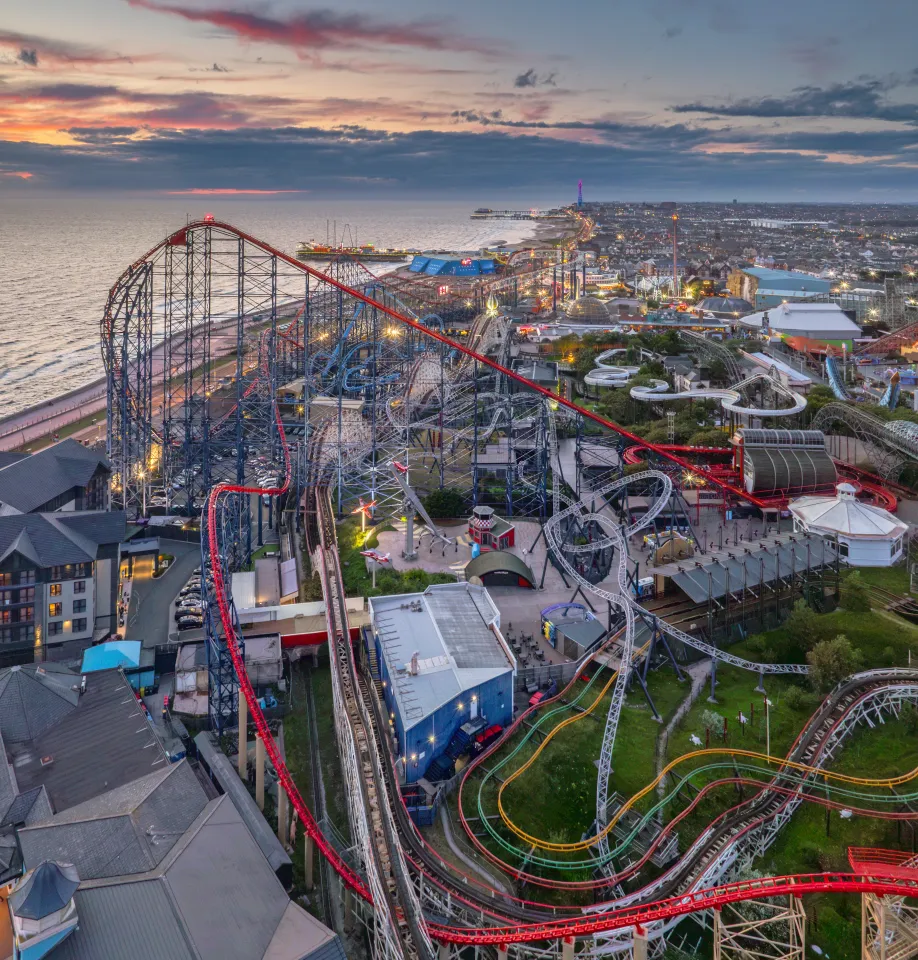
The £8.7million ride is the largest ride of its kind in the UK, swinging riders 42 metres into the air on a rotating pendulum.
Amanda Thompson OBE, CEO of Pleasure Beach Resort said: “To be named Best of the Best is a massive achievement for our park.
“Our industry is full of so much talent, so to be recognised among the best speaks volumes on the dedication and hard work that has kept us moving forward for 130 years.
“Aviktas has been a hugely valuable addition to the park and I’ve been delighted by its reception so far.
Earlier this year a new ride opened at the park as well, which has been named the bestCredit: Pleasure Beach
“If they haven’t already I’d absolutely encourage people to visit Pleasure Beach and give our ride, now recognised as one of the world’s best a go!”
If you fancy heading to the theme park this autumn, Pleasure Beach Resort will remain open for most of September and October.
In October, you could also head to the theme park’s Halloween event – Journey to Hell – where you head through an immersive scare experience with three new scare mazes.
The winners of the Park World Excellence Awards
HERE are the top winners:
Best Roller Coaster of the year: Falcons Flight at Six Flags Qiddiya City
Best rollercoaster (limited budget of the year): Fireline Redwood, Fraispertuis City at Jeanménil, France
Best Ride(s) of the Year: Skywatch at Six Flags Widdya City and Aviktas at Blackpool Pleasure Beach Resort
Best Ride(s) (limited budget of the year): Seesaw Swing at Bellewaerde and Rush Water Canyon and Gold Rush at O’Fun Park
Best Dark Ride or Media-Based Experience of the Year: Rally Flaklypa at Hunderfossen Eventypark
Best Water Park Experience: Aquaticar at Legend of the Glowing Gaurdians, Aquarabia Qiddiya City
Best Large Park of the Year: Europa Park
Best Regional Park of the Year: Bellewaerde and Nigloland
Best Waterpark of the Year: Aquarabia Qiddiya City
THE price of a big night out in the UK costs on average £74 per person when you factor in food, travel and drinks.
When you’re looking at those kinds of numbers, it makes way more sense to splash the cash on the latest trend for Brit holidaymakers – all inclusive weekenders in a hot country.
Leave the kids at home for these mega cheap hotel breaks abroadCredit: Trip Advisor/BLUESEA Al-Andalus ManagementWho needs to leave the Grand Muthu Forte da Oura when all your booze and snacks are included?Credit: Trip Advisor/Grand Muthu Forte da Oura Management
I searched every autumn weekend across October and November to find the absolute cheapest two-night all-inclusive packages for two adults – including return flights.
Somehow, you can jump on a plane, sleep in a hotel, eat three meals a day, enjoy unlimited drinks, and soak up some sunshine for little more than the cost of a couple of nights out at home. Grandparents, get the babysitting schedule ready.
Cala Millor, Majorca – £180pp in October
Cala Millor is one of the best places for international date nights, with its immaculate sandy beach and a flat, palm-lined promenade if you fancy stepping outside the hotel gates for an evening wander.
Early October still feels properly summery in Majorca, with temperatures around 25C – warm enough for poolside lounging without the oppressive August heat.
The outbound flight leaves Birmingham at 7.35pm on Friday and lands in Palma at 11.05pm, so there’s no need to sacrifice a full day’s annual leave.
Even better, the return flight doesn’t leave Palma until 11.15pm on Sunday, landing back in Birmingham at 12.50am – giving you almost all of Sunday on the island.
The hotel sits close to Cala Millor’s main strip and around five minutes’ walk from the seafront, with an outdoor pool, sun terrace and buffet restaurant to eliminate virtually all food-related admin for the weekend.
BLUESEA Don Jaime is right by a flat sandy beach tooCredit: Trip Advisor/BLUESEA Don Jaime Management
Alanya, Turkey – £195pp in October
If serious heat is your primary objective, Alanya takes the top spot on the shortlist.
The Turkish Riviera regularly stays in the mid-twenties throughout October, while its beaches, bars and resorts remain alive and kicking long after the British summer has packed up.
I found two nights all-inclusive at Sun Star Beach Hotel for £195pp, with the flight leaving London Stansted at 7.55pm on Friday meaning you can complete the working week before heading to the airport.
The return flight then leaves Antalya at 4.30pm on Sunday and lands back at Stansted at 6.55pm, so you’ll still get most of Sunday in Turkey without arriving home in the middle of the night.
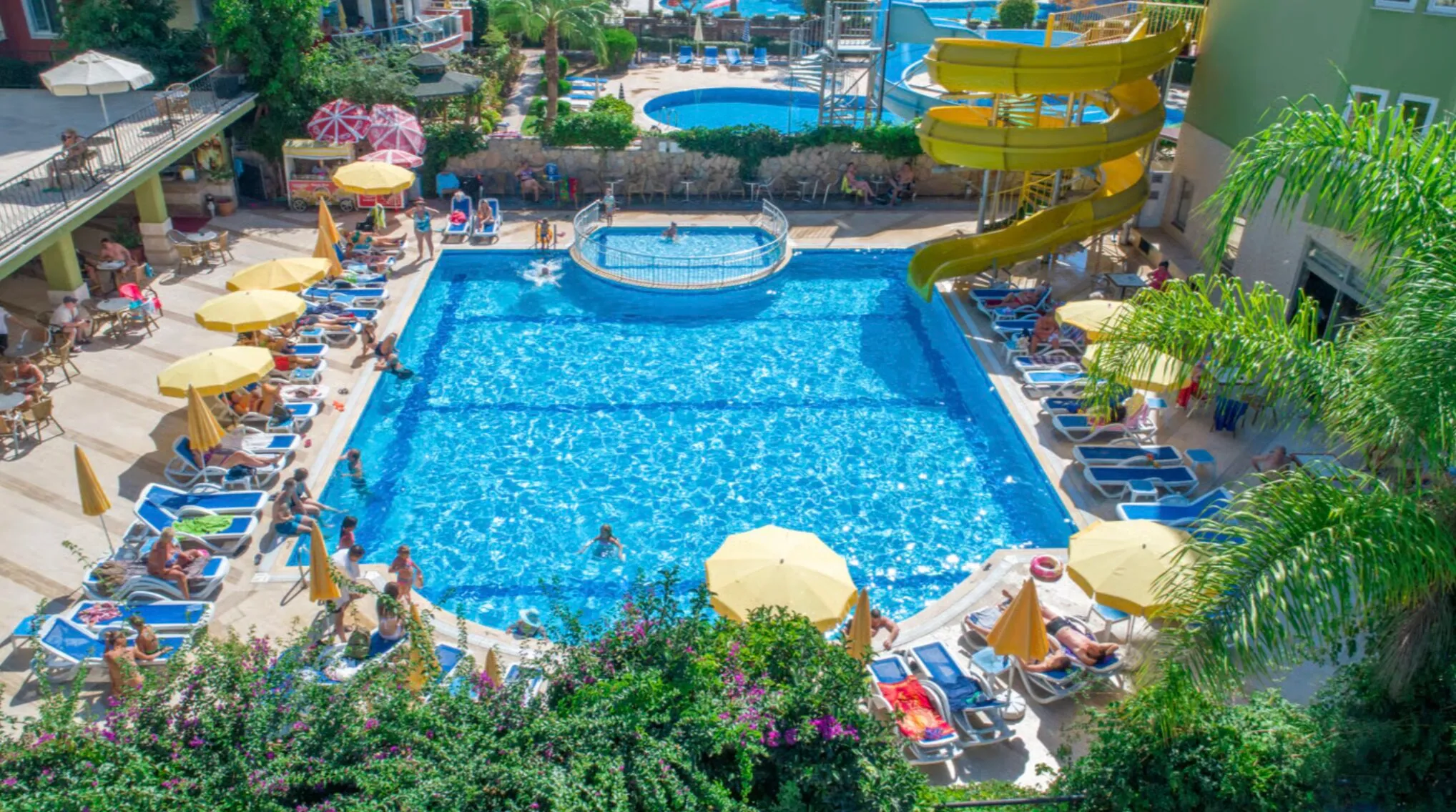
The hotel sits in Mahmutlar and has its own beach area, an outdoor pool with waterslides and an on-site Turkish bath and spa.
For knackered parents, that means you can spend the weekend alternating between the hammam, the beach and the all-inclusive bar. A demanding schedule.
Sun Star Beach Hotel is on the Turkish Riviera and still mid-20s in OctoberCredit: On the beach
Calas de Mallorca, Majorca – £180pp in October
We’re heading back to Majorca for mid-October, but this time to the more peaceful east coast where it sits at 24C mid-October.
Calas de Mallorca is built around a series of sheltered, dramatic coves rather than one enormous resort strip, making it ideal if your perfect child-free weekend involves making as few decisions as humanly possible.
The outbound flight leaves Birmingham at 7.35pm on Friday, so you can work the day before setting off, and the Sunday flight leaves at 11.15pm, unlocking virtually the whole weekend without using a full day of annual leave.
The real trade secret at HSM Canarios Park is its free shuttle bus, which drops guests at Cala Antena Beach.
The hotel also has three outdoor pools, mini golf, tennis courts and a poolside bar – so you can get competitive before a post-workout tipple.
Majorca is still around 24C in OctoberCredit: Trip Advisor/HSM Canarios Park Management
Lloret de Mar, Spain – £225pp in October
Late October on the Costa Brava loses the peak-summer surge of tourists while keeping hold of pleasant daytime temperatures of around 22C.
The flight leaves London Luton at 7.40pm on Friday, allowing you to finish work before disappearing to Spain.
The return departs Barcelona at 4.10pm on Sunday and lands back at Luton at 5.35pm, getting you home at a surprisingly sensible time while still giving you the chance to spend the morning and early afternoon wringing every last drop out of the all-inclusive bar.
The hotel is close to Lloret de Mar town centre, putting you within easy reach of its shops, seafront promenades, tapas bars and beaches.
It may still be difficult to peel yourself away from the hotel’s sun terrace and outdoor pool, though – particularly once you’ve established a steady flow of all-inclusive drinks and snacks.
Make the most of the free-flowing food and drink at BLUESEA CopacabanaCredit: Trip Advisor/BLUESEA Copacabana Management
Agadir, Morocco – £150pp in November
This is the single best deal on the entire list, for me.
While the UK drops into its usual grey drizzle, Agadir serves up temperatures in the mid-twenties and miles of golden sand.
And for anyone who thinks Morocco is too far for a couple of nights, the outbound flight takes less than four hours.
It leaves London Stansted at 3.45pm on Friday and lands in Agadir at 7.35pm, meaning you may only need to take Friday afternoon off work.
And the return flight leaves Morocco at 7.30pm on Sunday and lands back at Stansted at 11.25pm, giving you almost all of Sunday in the sunshine.
It’s a sprawling, traditional Moroccan-style resort surrounded by gardens, with several pools, restaurants and bars.
And Agadir’s enormous beach and seafront promenade are only a short walk away, too.
A weekend in Morocco is the cheapest on our listCredit: supplied
El Arenal, Majorca – £155pp in November
El Arenal sits on Majorca’s southern coast, delivering a wide, flat seafront promenade, easy beach walks and plenty of open cafes, bars and restaurants.
November is mild here, with temperatures around 20C, making it a brilliant low-cost escape from the weather, household chores and anything requiring a packed lunch.
The flight leaves London Gatwick at 5.05pm on Friday and lands in Palma at 8.25pm.
Even better, the Sunday return doesn’t leave Palma until 10.45pm, landing back at Gatwick at 12.15am, giving you another full day on the island.
The hotel sits only around 80m from the sand and right in the heart of El Arenal, meaning you can fit in an early-morning beach walk before heading back for an unlimited breakfast.
Sea views and 20C Novembers make for a great stay at BLUESEA MediodiaCredit: Trip Advisor/BLUESEA Mediodia Management
Albufeira, Portugal – £175pp in November
Albufeira is a really smart late-autumn pick because its Old Town remains open and lively long after summer ends.
You get historic cobbled streets, cliff-backed beaches and seafront restaurants without fighting half of Britain for a table – and temperatures up to 20C in the day.
And yes, there is a greater chance of rain than in summer, but there’s also every chance of blue skies, alfresco drinks and wondering why you ever considered the local cinema.
The outbound flight leaves Newcastle at 5.20pm on Friday, fitting neatly around the working day.
And the return leaves Faro at 5.25pm on Sunday, so you still get most of Sunday in Portugal without rolling through the front door after midnight.
The hotel is close to Oura Beach and the lively Areias de Sao Joao area, with a large outdoor pool and spacious terrace surrounded by gardens.
Perfect for an Aperol Spritz-fuelled wander before heading down to the beach.
Grand Muthu Forte da Oura is right by the Old Town tooCredit: Trip Advisor/Grand Muthu Forte da Oura Management
Torremolinos, Costa del Sol – £180pp in November
Closing out November, Torremolinos delivers mild 20C Andalusian weather, a gorgeous seafront and excellent fresh seafood in the historic La Carihuela district.
The flight leaves Dublin at 5.05pm on Friday, so there’s no need to lose your entire Friday.
And the return doesn’t leave Málaga until 10.30pm on Sunday, meaning you can squeeze the maximum possible amount of sunshine out of a two-night stay.
The hotel is set in peaceful subtropical gardens, with an outdoor pool and sun terrace and within walking distance of La Carihuela Beach – famous for its long promenade and plenty of dangerously tempting seafood restaurants.
That is a four-star all-inclusive escape for less than some couples spend on dinner, drinks and a taxi home. No-brainer.
We’ve found a deal under £200 to stay at BLUESEA Al-Andalus in SpainCredit: Trip Advisor/BLUESEA Al-Andalus Management
This article highlights the historical significance of Founder’s Day in Ghana, a public holiday established to honor the legacy of the nation’s first president, Dr. Kwame Nkrumah. The text recounts Ghana’s journey from a British colony known as the Gold Coast to becoming the first sub-Saharan African country to gain independence in 1957. It explains the symbolism of the national flag designed by Nkrumah and details his instrumental role in the country’s liberation and early governance. Beyond historical analysis, the source provides contemporary updates on Ghanaian sports, including the reappointment of the national football coach. Finally, it situates these stories within a broader global news context, covering exchange rates an …
There is no better way to explore a city than by foot, but not all places are as suitable for an adventure as others, as I found out during a recent visit to the world’s most walkable city
I set out on a walk around the city(Image: Milo Boyd)
There is no better way to explore a city than on foot. Once touched down in a city, bag in the hotel and a fresh pair of socks on, the first thing I do is go for a walk.
It is impossible to get a feel for a place from the back of a taxi or from the elevated vantage point of a coach. You’ve got to start pounding the pavement, ideally without a destination in mind, and see where you end up.
On a recent trip to Rome, I set out from my central station hotel and marveled at the carnage of the Trevi Fountain queues, crossed the Ponte Sant’Angelo, and witnessed a coordinated group of ball-under-cup scammers sweatily fail to take anyone’s money. Last spring, I headed out into Benidorm, finding myself an impossibly cheap roast, a seafront pint of Guinness, and a ‘Good boys go to heaven, bad boys go to Benidorm’ t-shirt.
And so, in April, I applied the same approach to Seoul, a city recently named the most walkable in the world.
Do you have a story to share? Email webtravel@reachplc.com
Each year, Time Out conducts an annual city survey, this time around quizzing 24,000 people on how easy or not it is to discover given cities on foot. The ranking is based on the highest percentage of locals who rated their city’s walkability ‘good’ or ‘amazing’, and the South Korean capital tops the list.
“A city doesn’t have to be small to be walkable. In fact, Seoul is one of the largest cities on the list by surface area and population, but its impressive 93 percent approval rating from locals has secured the South Korean capital joint-first position. Why? Well, the city has a reputation as an exceedingly safe place to stroll by day and night, and is home to neighbourhoods such as Myeongdong, Insadong, and Hongdae, which are all primed for exploring on foot,” writes Time Out.
“Then there are the innovative pedestrian walkways, like Seoullo 7017, an 1074m-long elevated ‘sky garden’ which has seen an old inner city highway revamped into a stroll-worthy green space, home to 24,000 different plants. In downtown Seoul, the Cheonggyecheon Stream is flanked by a walkway that not only links many of the city’s central metro stations, but also landmarks such as Gwanjang Market, Jongmyo Shrine and Gyeongbokgung Palace.”
I could not disagree more.
Seoul is a fantastic city. It’s alive with a kind of youthful, optimistic energy that feels far removed from most places I’ve visited; it’s fearlessly trendy, and it’s centered on an urban mountain blanketed with cherry blossoms come the spring.
But walkable it is not. Seoul is a car city.
The almost unbelievably cheap cost of an Uber (we’re talking around £5 for a half-hour ride) means that hopping in a cab is far more common than in the UK, while the wide, four and six-lane roads that dominate much of the city encourage motoring. And produce a lot of fumes.
According to NASA, Seoul is one of the world’s cities with the worst air pollution, beating Los Angeles, Tokyo, Paris, and London. You can certainly feel it. On one crisp morning, I walked up Namsan, the 170-meter-tall hill in Seoul’s center. The view from the top would be spectacular, were it not for the heavy, shimmering cloud that hung over everything.
Walking back down, I started to get the vague feeling I’d done something wrong. I hadn’t accidentally offended a waiter or lost my hotel pass; it was the signs. Seoul is a city of signs. From the expected ‘no smoking’, to the less typical ‘no archery’, to the possibly unique ‘no hiking without a flashlight’, everywhere you look, some kind of rule is being transmitted to you. It doesn’t leave you with a feeling of freedom and exploration, nor do the CCTV cameras placed on tall metal poles in the city’s woodland.
It’s a place that’s big on rules and completely opposed to bins. Having finished a snack, I walked for two hours without finding a trash can. South Koreans are expected to take their rubbish home with them – a system that says a lot about the population’s diligent character, but one I find inherently anti-social.
As I do the lack of pavements that had me regularly sliding down alleyway walls to give way to cars, and the complete, frustrating prohibition of jaywalking. Couple all of this with the fact that the city lacks an obvious centre and is exhaustingly massive, and its status as one of the world’s least walkable cities is clear.
Given my love of treading the tarmac, it says a lot about how fantastic the rest of Seoul is that I left in love with the place. From the fish-filled waters of Cheonggyecheon River, the rusty octopus of Yongma Land, and the impossibly cheap but high-grade cosmetics, it’s a fascinating place that feels like it’s at the centre of the world. Just prepare to order a cab.
HAVEN has just bought its 40th holiday park – and it’s already one of the most popular in the country.
The park found in West Sussex has 2,500 pitches, is right next to its own private beach and you can book a stay from less than £10per night.
Seal Bay Resort in West Sussex has 2,500 pitches and has been bought by HavenCredit: TripAdvisor It’s one of the most popular with families with outdoor pools and lots of activitiesCredit: TripAdvisor
It has thousands of pitches, there’s plenty of entertainment for the whole family and it’s minutes away from the beach, what’s not to love?
Sign up for the Travel newsletter
Thank you!
Seal Bay sits on the coast in Selsey and when it comes to picking a place to stay, visitors can choose from seaside caravans to beachfront pods or glamping options.
All stays come with kitted-out kitchens, bed linen, as well as access to the swimming pools and entertainment.
The simplest option is camping, with a choice of grass, electric or serviced pitches – each has a parking space and access to hot shower facilities.
Caravans range from comfy Bronze bases which sleeps up to eight guests, all the way to Platinum caravans that feel more like a homely cottage.
Lodges are larger with their own decks – and some luxury ones even come with a private hot tub.
Beachfront pods are a great choice for those wanting a cosy hideaway facing the sea – they have mezzanines and fold-out double beds, as well as private decking to enjoy that sea breeze.
For those visiting as a large group, you can even book an entire self-catering house.
As for entertainment and play there’s plenty for all ages – some of the highlights are its arcades, bowling, and soft play zones.
Seal Bay Resort is steps away from a private beach in SelseyCredit: TripAdvisor
There’s also a swimming pool with a splash zone for toddlers, wave simulator, inflatable obstacle course, lazy river and waterslides.
Families with young children can get crafting at the create-your-own teddy bear factory, sand art sessions and try out mini archery which is for those between two and five-years-old.
Older kids should head to the Dockyard which has a large climbing wall and adventure golf.
There’s plenty for adults and couples too, like live music, comedy nights, and Big Red Button Bingo.
When it comes to eating, there’s the Above the Bay Bar & Kitchen which opened earlier this year, along with Smokey’s BBQ Kitchen and the Cafe Lido.
From the park, holidaymakers have direct access down to Seal Bay Beach – and almost one mile of it is reserved for guests only.
The indoor pool has waterslides and tipping bucketsCredit: TripAdvisorInside the Dockyard are activities like climbing walls and adventure golfCredit: TripAdvisor
Mid-week breaks can be booked for under £250.
A family of up to six can book a four-night stay in May 2027 from £244 in a Classic 2 Bed Holiday Caravan – or £10.16pppn.
If you fancy a break in the next few weeks, a four-night stay in a Classic Caravan from 12-16 October can be booked out from £196 – or £8.16pppn.
Seal Bay will continue to trade under its current name for the remainder of 2026, before changings its name to the Haven brand for 2027.
It’s not the first holiday park that has been taken on by Haven in the last few years – it previously acquired the Richmond Holiday Centre which has now been named Haven Skegness Holiday Park.
Simon Palethorpe, CEO, Haven said: “I’m delighted that we are welcoming Seal Bay to the Haven family. It’s a fantastic park in the most stunning location and will sit brilliantly alongside our 39 other parks.
“Haven’s mission is all about making memories that last a lifetime and we can’t wait to start working with the Seal Bay team to deliver this for thousands of holiday makers and owners in the years to come.”
Holidaymakers can still book holidays on the current Seal Bay resort website – including for breaks in 2027.
Oasis ticket sales kick off this weekend and that means the lucky ones who’ve snapped up their tickets will be making plans. But how much will a trip to see the Britpop band set you back?
This article contains affiliate links, we will receive a commission on any sales we generate from it. Learn more
The Gallagher brothers will return to the stage for an epic tour in 2027(Image: Joe Maher/Getty Images)
Oasis tickets go on sale this weekend ahead of the Britpop band’s 2027 tour. Not only will the Manchester band be touring the UK and heading to Ireland, but they’ll also be doing dates in Europe and the USA, meaning fans from around the world will see them perform hits from Wonderwall to Live Forever.
Ticket sales have been carefully controlled to avoid scalpers turning a profit, and fans have needed to sign up to even get a chance to try to buy a ticket. If you’re not successful bagging a ticket for a UK show, then you may be thinking of heading over to see Oasis in Europe. However, this means booking transport and accommodation.
Here’s a rundown of the costs of seeing Oasis in various cities. Prices are likely to rise closer to the time, especially as hotel rooms near the stadiums are likely to be snapped up.
UK dates and costs
If you’re lucky enough to snag Oasis tickets in the UK, the dates and costs for their UK tour are:
Glasgow – Celtic Park
May, 21, 23, 25, 28 and 29
Seated tickets from £71.50 – standing from £170.50
The tour kicks off in Glasgow at the Celtic Park stadium, which is in the east of the city. It’s well connected by public transport, so you might want to opt to stay in the city centre. The Moxy Glasgow Merchant City has rooms from £337 based on two sharing and is about a mile and a half from the stadium.
Manchester – Ethiad Stadium
June 4, 6, 8, 11, 12, 15, 18, 19, 22, 25 and 26
Seats from £74.60 and standing from £173.60
Oasis will perform a string of dates in Manchester, and the city will have a huge influx of fans, so if you’re booking a hotel, you’ll need to do it as soon as possible. Hotel prices are already becoming dear. For example, on the June 2027 nights when Oasis are playing, the prices at Copthorne Hotel Manchester Salford Quays have hit £302 a night for two sharing, whereas visitors on nights without a gig pay as little as £92 for a room in this four-star property.
Knebworth – Knebworth House
September 11, 12, 18 and 19
General admission £170.50
Oasis’ return to Knebworth means this area of Hertfordshire will be very booked up. Your best bet is to get a coach bundle, as these will be available through Ticketmaster with routes across the UK. Knebworth House is a remote location, meaning staying in nearby towns with a bus connection may be wise. Hitchin has a Premier Inn, although at £349 on September 11, it’s a pricey option.
European tour dates and prices
Munich, Germany – Allianz Arena
July 2 and 3, 2027
Oasis will have two nights of shows in Munich next July, with seated tickets from €96.25 (£82.51) and standing from €165.25 (£141.68).
There are direct flights to Munich from London, Manchester, Glasgow, and several regional airports. Fly out on July 1 and come back July 4, and you’ll find flights on Lufthansa from London-Heathrow from £113 return.
The stadium is on the edge of Munich in an area called Fröttmaning. As you can imagine, hotel options are limited and already expensive for July dates. But it’s close to a Metro, so look for accommodation elsewhere in Munich that’s close to public transport, such as the ibis Hotel München Garching, which has rooms on July 2 from £218 a night and is just one stop away.
Barcelona, Spain – Estadi Olímpic Lluís Companys
July 10 and 11
Tickets to see Oasis in Barcelona start at €85 for seats and €204 for standing (£72.89 and £174.93 respectively). The Estadi Olímpic Lluís Companys stadium, where the show takes place, is on the Montjuïc hill overlooking the city, making it a memorable location for major shows. You can even take the Montjuïc Funicular to the top to get to the show, although you’ll need to take a bus back as it stops running at 10pm.
Barcelona is, of course, packed with places to stay and the metro makes it easy to get around, so you don’t necessarily need to book somewhere next to the stadium. Stay at the Radisson Blu 1882 Hotel, Barcelona Sagrada Familia, available from £332 a night for two sharing, and you’ll be close to the major tourist attractions, so you can enjoy a city break too. If you’d rather stay closer, Mambo Tango is about a 20-minute walk away and has double rooms from £284.
Barcelona is served by several regional airports, and weekend flights from London Luton start at £89 return with Wizz Air.
Amsterdam, Netherlands – Johan Cruijff Arena
July 16 and 17
The next stop on the tour is Amsterdam’s Johan Cruijff Arena, where tickets start at €84.15 for seats and €201.96 for standing (£72.15 and £173.16 respectively).
Again, the arena is on the outskirts of the city, and is found in the Zuidoost area. Just a short walk away is the Joy Hotel, which has budget double or twin rooms on the tour dates from £265. However, the cheapest rooms don’t have a window, so don’t expect lovely views of Amsterdam.
There are lots of options for getting to the city and public transport is excellent. There are both a train and a metro station serving the arena. Eurostar offers London to Amsterdam tickets from £39 one-way, although they tend not to run at weekends, so you would need to travel down Friday and come back Monday. There are also lots of flight options from multiple airports, and even the London to Amsterdam overnight FlixBus, which starts at £44 in July. While nearly 12 hours on a coach is an endurance test, it does save you from needing to pay for a hotel that night.
Paris, France – Stade de France
July 23 and 24
Seated tickets for Oasis’ Paris shows start at €84.00 (£72), while standing options start at €199.50 (£171). However, these dates coincide with school summer holidays, so expect higher prices and demand not only from Oasis fans but also holidaying families.
The Paris leg of the tour will take place at the Stade de France in Saint-Denis, in the north of the city, and a metro line runs to the area. You can either opt to stay centrally, such as the boutique Chouchou Hotel, which has rooms from £325 a night and explore the city, or simply stay near the stadium. The Ibis Styles Paris Saint Denis La Plaine is about half a mile away, and has basic rooms from £350 a night for these July dates.
Eurostar is an excellent way to get to Paris. It arrives at Paris Gare Du Nord, and tickets currently start at £49 each way. There are also lots of flights to the sprawling Aéroport de Paris-Charles de Gaulle, about 40-minutes from the stadium, from airports across the UK.
Rome, Italy – Stadio Olimpico
July 29 and 30
Rome is another great option for Oasis fans, and the band will be playing in late July. However, it’s worth remembering that these are school holiday dates again, so travel is likely to be expensive and book quickly.
Seated tickets will start at €92.29 (£79.21), while standing will start at a whopping €221.49 (£190.09). There are some cheap flights available, such as Wizz Air, which offer a return from London Luton to Rome for around £131 for late July dates.
Stadio Olimpico is in the north of the city, and it’s served by metro and tram, which is useful as hotel options in the area are thin on the ground and expensive. Sweet Home Parioli is just over a mile away and has rooms from £180 a night based on two sharing, and offers simple accommodation that’s perfect for post-gig sleeps.
Slane Castle – Ireland
September 4 and 5
Before heading to Knebworth, Oasis will play two huge shows at Slane Castle, which is about 45 minutes north of Dublin. There will be a variety of bus services available to take visitors from the city to this rural castle for the gigs.
General admission tickets will be priced at €181.25 (£155.58) – and if you’re coming from the UK, there are lots of inexpensive flights available to Dublin. For example, Ryanair flights from Newcastle to Dublin for those dates are showing for £70 return, although there are often sales where you can buy flights more cheaply.
There will be a few pick-up and drop-off points for coaches across the region, so you might want to stay centrally in Dublin and spend some time exploring the city too. Four-star Riu Plaza The Gresham Dublin has rooms from £350 a night for two sharing, or, for £61 each per night, you can opt for a bunk at the Gardiner House Hostel for a budget-friendly stay.
Have a story you want to share? Email us at webtravel@reachplc.com
I love Loch Lomond in autumn. I’d start with a walk around Balmaha village and a stretch of the West Highland Way, pretending I’m there for the scenery rather than earning the right to eat something massive afterwards. Autumn is when it looks best: orange hills, cold air, dramatic clouds and the constant Scottish gamble of whether you’ll get sunshine, sideways rain, or both within 10 minutes. I finish, if I’m not driving, with a wee dram to properly round things off. Pete
Cornwall’s wild autumn seas
The coastal path from Godrevy. Photograph: Peter Lane/Alamy
The rough beauty of Cornwall’s sea views appeals to me. A great autumn day involves walking along the staggered cliff edges between Godrevy and Portreath. The isolated nature of the coastal paths makes me feel as if the sea is singing just for me, while below the waves go wild, waiting to be admired. On this walk, you will be rewarded with the most breathtaking views, lone benches and burnt orange sunsets. Oliwia
A hydro-powered house in Northumberland
Cragside was a technological marvel of the 19th century, with hydroelectric power and hydraulic gadgets. Photograph: Jonathan Ayres/Alamy
When I first visited the National Trust’s Cragside in Northumberland, a staff member at the entrance made the bold claim that it was “the best place in England”. In autumn you can really see their point. The estate’s 1,000 acres are covered with a huge variety of trees that transform the landscape into a mixture of reds, oranges and deep greens, contrasting perfectly with the often misty Northumberland weather. It’s a perfect autumn day trip for woodland walks, possibly stopping for a picnic at one of the many lakes or gardens, and visiting the extraordinary hydro-powered Victorian house with its pioneering gadgets. Everly
Profile
Readers’ tips: send a tip for a chance to win a £200 voucher for a Coolstays break
Show
Guardian Travel readers’ tips
Every week we ask our readers for recommendations from their travels. A selection of tips will be featured online and may appear in print. To enter the latest competition visit the readers’ tips homepage
–
– back sections make it manageable without losing the drama. Bonita Philp
Deep in the forest in the Scottish Borders
Lichen on fir trees in the Glentress Forest. Photograph: Tom Richardson Scotland/Alamy
Glentress Forest in the Scottish Borders is hard to beat on a crisp autumn day. Start with a walk or mountain-bike ride through the forest, when the trails are surrounded by copper, red and gold, and climb high enough for brilliant views across the Tweed valley. Afterwards, warm up with coffee and something sweet at the cafe before heading into nearby Peebles for a wander along the river and around its independent shops. It feels properly remote despite being less than an hour from Edinburgh. And, whether you’re cycling or walking, autumn is when the forest is at its most spectacular. Remi Lapeyre
Birmingham’s secret oasis
Winterbourne Gardens. Photograph: Michael Kemp/Alamy
Winterbourne House and Garden at Birmingham University is a wonderful little oasis in Edgbaston, just outside the city centre. A beautiful Arts and Crafts style house, set in stunning gardens, it is a lovely place for a wander and is especially beautiful on a sunny day in early autumn when everything is golden. See herons at the reservoir, talk to friendly robins by the walled garden and browse the bookshop. Have coffee there and then head into nearby Harborne for lunch or dinner. Rachel
Rivers and ruins in a Lancashire valley
The River Roddlesworth near Darwen. Photograph: Walker/Alamy
Rocky Brook is the name given by locals to the River Roddlesworth, which flows through a wonderful wooded valley at the edge of the West Pennine Moors. The woodland, planted by Liverpool Corporation Waterworks, provides plenty of autumn colour. A network of paths allows exploration of the woods and the ruins of Hollinshead Hall and well house. There’s a public car park, cafe and pub (the Royal Arms) at Ryal Fold, and for those who walk north-west through the woods there’s also the Hare & Hounds at Abbey Village. Four buses a day run from Blackburn to the Royal. Graham Dean
Sessile oaks in Padley Gorge. Photograph: Septemberlegs/Getty Images
The Longshaw estate in the Peak District is perfect for an autumn stroll. Both Oaks Wood and Bolehill Quarry have a huge variety of fungi in their hidden depths. The twisted oak trees in Padley Gorge look at their most spectacular on early autumn misty mornings. It’s easy to explore pathways on the estate with the friendly free social walk every Wednesday. Finish a wonderful day with a treat in the cafe. Katharine
A lime tree avenue in Nottinghamshire
Clumber Park’s avenue of trees is one of the longest in Europe. Photograph: Eye35 Pix/Alamy
Clumber Park is a must-visit at this time of year. The National Trust property features peaceful woodlands with golden leaf carpets, crisp lakeside views and an ornamental bridge. You’ll want to keep your camera handy as you enter a double tree avenue of 1,296 limes stretching three miles (one of the longest in Europe), which provides a gorgeous golden canopy. The walled kitchen garden is a favourite with its massive apple collection and seasonal displays. The apple juice I’ve tried here is some of the best I’ve tasted. Asma
A Roman autumn at Hadrian’s Wall
Late autumn at Steel Rigg. Photograph: Donaleen Shiell/Alamy
My perfect autumn day is walking Hadrian’s Wall from Steel Rigg, when the moorland turns copper and gold and every climb rewards you with another enormous Northumberland view. Pack a flask, sturdy boots and something waterproof – the weather changes its mind even faster than I do. You only pay for parking, and shorter out- and
Winning tip: Steaming through north Wales
The Llangollen Railway. Photograph: Paul Weston/Alamy
My perfect autumn day out is a trip on the Llangollen Railway in north Wales. There’s something magical about travelling through the Dee valley on a steam train when the leaves have turned orange and gold. We start in Llangollen, grab something warm to drink, then climb aboard for the journey alongside the River Dee, watching the autumn scenery through the window. Afterwards, we wander around Llangollen, exploring the little shops. It’s simple, nostalgic and feels like autumn properly arriving – especially when you hear the steam train whistle through the valley. Chelsea
Los Angeles County officials aim to break ground on the new Eaton Canyon Nature Center before 2028, with plans to construct a facility that can withstand the region’s changing climate and future disasters.
The previous nature center, which replaced the original Robert M. McCurdy Nature Center that burned down in 1993, was destroyed in the Eaton fire last January. The fire not only destroyed the structure but also a large library and several decades’ worth of archives, and it also killed the reptiles that lived inside the center.
It took about five years to rebuild and open the last nature center. L.A. County Parks Director Norma Edith García-Gonzalez said after the design phase is completed, which could be soon, the county and the architect firm hired for the project will plan out the construction phase.
“We modeled 100-year patterns of wind, fire and flood so that when we build back, we are building back with resistance, and that is able to guide how we plant [and] what type of plants, and how we build, [including] how we build back trails,” García-Gonzalez said.
Norma Edith García-Gonzalez, director of L.A. County Department of Parks and Recreation, speaks during an Eaton Canyon design meeting in mid-September.
(Kayla Bartkowski / Los Angeles Times)
The biggest impediment to rebuilding, though, is funding. The county has about $16.2 million in state money, about half of what county officials think is needed to build a new nature center, she said. García-Gonzalez said she hopes the philanthropic community will step up to fill the gaps, but county leaders have noticed that “philanthropy goes from one hot issue to another,” and interest to donate to fire recovery is cooling.
In this week’s edition of The Wild, our weekly outdoors newsletter, I will provide an update on the design plans for the new nature center and when we can expect to hike again in Eaton Canyon — and how you can help with the canyon’s restoration too.
You are reading The Wild newsletter
Sign up to get expert tips on the best of Southern California’s beaches, trails, parks, deserts, forests and mountains in your inbox every Thursday.
By continuing, you agree to our Terms of Service, which include arbitration and a class action waiver. You agree that we and our third-party vendors may collect and use your information, including through cookies, pixels and similar technologies, for the purposes set forth in our Privacy Policy such as personalizing your experience and ads.
First, let’s discuss a little bit of the history of the area.
The Eaton Canyon Natural Area, managed by L.A. County Parks and Recreation, is a 190(ish)-acre swath of land at the foothills of the San Gabriel Mountains near Altadena.
“Originally called ‘El Precipicio’ by the Spanish settlers because of its steep gorges, it is now named after Judge Benjamin Eaton, who built the first Fair Oaks Ranch House in 1865 not far from Eaton Creek,” according to the Eaton Canyon Nature Center Associates, a volunteer-run education and stewardship group. “Judge Eaton was the first to use irrigation from the creek to grow grapes on the slopes.”
The canyon has long been a fascination of adventuresome L.A. residents.
The hike to Eaton Canyon Falls in the San Gabriel Mountains before the Eaton fire last January.
(Myung J. Chun / Los Angeles Times)
In 1921, writer Frances Mathilda Purdy wrote for The Times that few people knew of the “hidden, but very easily accessible waterfall” in Eaton Canyon. Purdy outlined a few ways to access the canyon and reach the falls, including a shorter route where visitors “after alighting from motor, or stage,” could take a small flight of stone steps near the Mt. Wilson Toll Road bridge.
I chuckled when I read Purdy’s suggestion that this particular route was “perfectly comfortable for those who have arrived on the scene in city garb.” Apparently, underprepared hikers have been coming to Eaton Canyon for more than 100 years. What do you think was the 1920s version of hiking in flip-flops?
For the more rugged adventurer, Purdy laid out a “serpentine trail” that leads to “such lovely possibilities for the pleasure-seeking jaded worker, who, from only one afternoon spent in this quietly entrancing corner of the great outdoors, will return, refreshed and invigorated to meet the daily grind with a mind stored full of the charm of Lower Eaton Canyon.”
Architect Anne Mooney of Sparano + Mooney Architecture speaks about a site plan for the next Eaton Canyon Nature Center.
(Kayla Bartkowski / Los Angeles Times)
It wasn’t until 1930 that Pasadena set aside property that the city owned for a bird and game sanctuary in Eaton Canyon and Eaton Wash, preserving the land from development, according to a historical record compiled by the nature center associates.
There was interest in doing more.
Pasadena Park Superintendent Gilbert Skutt, who served from 1923 to 1936, wanted to see a large scenic public park in Eaton Canyon similar to what the city had built along the Arroyo Seco, according to city records. “He sought to correct the imbalance in the distribution of park space in Pasadena, which favored the west side of town,” according to a historical document. “During the Depression, however, the city could not afford to purchase the land.”
Over time, the city started working with county officials on Eaton Canyon Regional Park, eventually giving the entire project to the county.
In 1931, the L.A. County Board of Supervisors considered financing a 1,000-acre “gigantic regional park system” for the area, according to The Times’ archives, but that idea apparently never fully came to fruition.
Thankfully, in 1950, landowner Mary Beatrice Fox sold the canyon portion of her property to L.A. County to use for a park, “with a provision that mammals are not to be kept in cages,” according to a park history compiled by the Eaton Canyon Nature Center Associates.
A hiker slips in a creek in Eaton Canyon after a 2023 storm.
(Wally Skalij / Los Angeles Times)
Then, in 1958, naturalist Louise A. Luckan moved her “nature appreciation operation from the Eaton Canyon Golf Course to Eaton Canyon Park,” according to the organization’s history.
Soon, L.A. County officials set aside $154,797 — about $1.7 million in today’s dollars — for the Robert M. McCurdy Nature Center. They had big plans for the facility, which was to include two classrooms, an office, museum, library, display area, gift shop, laboratory and an auditorium that could seat 200.
“This park will be an outstanding facility — the only one of its kind in magnitude this side of Chicago,” Supervisor Warren Dorn said in a 1962 Times story.
The nature center opened in 1963, and became popular among scouting and school groups, to whom naturalists taught about the local flora and fauna. By the early 1970s, more than 2,000 school children were regularly attending lectures at the nature center, according to Times archives. The students wrote thank-you notes to the park staff, including one that read, “I think it was nice of you to buy this park instead of someone buying it for houses and factories. Because if they did, it would ruin this beautiful land.”
L.A. County sustainability policy director Rebecca Ferdman talks with community stewards about how to educate and engage the public about the goldspotted oak borer, a pernicious invasive beetle that destroys oak trees, during a meeting at Eaton Canyon Nature Center in 2024.
(Brian van der Brug / Los Angeles Times)
But, in 1993, the canyon’s first nature center was destroyed by the Kinneloa fire. The next nature center didn’t reopen until 1998.
Karen Mateer, vice president of the Eaton Canyon Nature Center Associates, said for more than 25 years, that nature center served as a meeting place and an educational hub for the millions who visited the canyon over the years.
Mateer, who started volunteering in 1998, said many local schoolchildren first experienced the concept of “nature” at Eaton Canyon on field trips. Volunteers would regularly hear from adults, who pursued recreation- or nature-focused careers, that the first place they ever hiked or learned about their natural habitat was at Eaton Canyon.
“Eaton Canyon also, for the community, for those of us up here who lost so much, it is familiar and is a place you often go for recreation, for solace,” Mateer said. “It means a lot.”
At a presentation last week, architect Anne Mooney said her firm analyzed where to best place the new nature center, and not wanting to destroy any existing habitat or take down any of the area’s oaks or other trees, recommended the new building be placed east of the previous site.
It was easy for visitors to miss the previous nature center, because it was situated in a thick stand of oaks, and the new location will allow the nature center to serve as a gateway to the park, as it will be near the canyon’s trailhead.
“The nature center has always been more than just a building,” Mooney said. “It’s really been a gateway to an experience of learning about nature, experiencing a connection to the wildlands and developing stewardship of the canyon. We want to continue that tradition.”
A diagram of the wind analysis conducted by architects as they assessed where to place Eaton Canyon’s new nature center.
(Kayla Bartkowski / Los Angeles Times)
The new nature center, as shown in the current design plan, is horseshoe-shaped with a covered entryway. It will be constructed using durable, fire-resistant materials, including stone and steel. Builders would also construct curved walls to serve as windbreaks, which would not only slow gusts but also divert airborne embers during a fire.
The proposed designs also include roof and eave sprinklers that could pre-wet the building and nearby surrounding area with a specialized firefighting foam during a wildfire.
“We recognize that the fire is a recurring part of the ecology, and we will have another fire,” Mooney said. “We’re working to design something that allows us to be more prepared in the future.”
The Eaton Canyon Nature Center, a 7,600-square-foot building, was destroyed in the Eaton fire. It housed live animals, exhibits, classrooms, a gift shop and more.
(Jaclyn Cosgrove / Los Angeles Times)
The design also includes a research lab, a learning lab or classroom, a large multipurpose space that can fit an estimated 150 people when seated (or 300 people when standing), an exhibit space, a gift shop and a large courtyard in the center with shade, seating and live animal enclosures.
Officials stressed that the design is preliminary and dependent on funding. Anyone who wants to see the design for themselves and provide their feedback can attend the next public meeting, From Ashes to Action: Reimagining Eaton Canyon, from 5 to 7 p.m. Oct. 7 at the L.A. County Arboretum.
Kevin Singleton, center, points to the Eaton Canyon Nature Center design during a recent county event where officials discussed the future of Eaton Canyon.
(Kayla Bartkowski / Los Angeles Times)
In terms of when hikers will return to the canyon’s trails, García-Gonzalez said the county needs an estimated $8 million to reestablish the trail system. The county has fundraised and received only $900,000 of that.
“We already put that money to work,” García-Gonzalez said, partnering with L.A. Conservation Corps to start rebuilding trails. “But there are some [trails] that really need significant and heavy engineering.”
The county also has to plan its work around the strong winter storms forecasted as a result of El Niño, she said. “We are bracing ourselves for even more damage,” García-Gonzalez said.
A map of the proposed courtyard of the new Eaton Canyon Nature Center.
(Kayla Bartkowski / Los Angeles Times)
Since the fire, volunteers have donated hundreds of hours to work on restoring the canyon’s habitat.
You can join them. Volunteers meet from 8 to 11:30 a.m. every Friday and the second and fourth Saturday of every month. Participants remove invasive plants that zap up resources for native plants trying to reestablish themselves. Training and tools are provided. You can sign up by visiting signupgenius.com.
“The love, the care, the stewardship, the commitment, the hope, the inspiration of the volunteers is unparalleled,” García-Gonzalez said. “They’re driving us to build back because they’re so committed. They’re all in.”
3 things to do
“MASH,” a military dramedy that aired on CBS from 1972 to 1983, is one of several Hollywood productions filmed at Malibu Creek State Park.
(Courtesy of California State Parks, 2026.)
1. Celebrate 50 years of public land in Calabasas Malibu Creek State Park will celebrate its past 50 years from 4:30 p.m. to 10 p.m. Saturday at 1925 Las Virgenes Road in Calabasas. Attendees can touch fossils, explore the park‘s trees and make art, all while listening to music and eating from local food trucks. At Stories Under the Stars at 6:30 p.m., a diverse cast of storytellers will teach visitors about the park’s history, culture and science. The L.A. Astronomical Society will host a star party at 8 p.m. Guests are encouraged to carpool or use the free shuttle from Juan Bautista de Anza Park to the park. The event is free, but parking is not. Register at eventbrite.com.
2. Repair the river near Azusa Volunteers are needed from 8 a.m. to noon Saturday, which is National Public Lands Day, at the Oaks Picnic Area near the San Gabriel River for a cleanup effort. Organized by five community conservation corps groups, including San Gabriel Valley Conservation Corps, volunteers will pick up trash and help clean the river. Register at docs.google.com.
3. Cast a line under a full moon in Castaic Friends of Castaic Lake will host the organization’s final Moonlight Madness event of the year from 6 p.m. to 12:30 a.m. Saturday at Castaic Lake. Guests can fish from the shore, from a boat or not fish at all as they enjoy an evening in the outdoors. Tickets start at $23. Glow sticks required for each participant. Register at givebutter.com.
The must-read
Jim Crouch stands in a field with Englemann oaks at the Santa Ysabel Open Space Preserve.
(Sandy Huffaker / For The Times)
Jim Crouch, a retired science teacher near San Diego, noticed how the oak trees around him were disappearing, succumbing to disease, drought and development. Times contributor Jessie Schiewe wrote that Crouch, moved to action, collected acorns and gave away the resulting potted seedlings to others. Now, after planting 10,000 acorns, he dreams of the day he completes his 20,000th seedling. “I’ve never been so ambitious,” he says, “and I’ve never done a project with as much love in it and as little ego.”
Happy adventuring,
P.S.
Torrey Pines State Natural Reserve will be closed until March as construction workers upgrade gas, water, wastewater and communication lines. They also will install new accessible parking stalls and an accessible pedestrian path from the upper parking lot to the restroom and park’s lodge. Times staff writer Christopher Reynolds wrote that the park’s 1,750-acre Torrey Pines reserve attracts about 4 million visitors each year (about the same number as visit Yosemite National Park). Torrey Pines State Beach will remain open through the closure. If you’d hoped to visit this particular park in the fall, consider instead one of 13 places in California that Reynolds recently wrote are ideal to check out in autumn. Warning: As I read the piece, I felt the immediate urge to book campsites at several spots around our state! I am so ready for cozy season.
For more insider tips on Southern California’s beaches, trails and parks, check out past editions of The Wild. And to view this newsletter in your browser, click here.
THE weather might be about to turn in the UK but in Europe there’s still time to enjoy the sunshine.
So for affordable yet full-of-activity stays, we’ve rounded up 10 best Eurocamp resorts from Croatia to Italy where temperatures are still about 20C in autumn – and stays can be as cheap as £6 per night.
There are plenty of Eurpcamps where temperatures will still be over 20C in autumnCredit: Jaume DevesaEurocamp in Tuscany has six swimming pools and waterslidesCredit: Paul-N. Dubuisson
hu Park Albatros Village, Tuscany, Italy
Tuscany still has temperatures of up to 22C during the autumn, so families can make great use of its six swimming pools, waterslides.
Make sure to try out its treetop adventure course and mini golf too.
Sign up for the Travel newsletter
Thank you!
The new entertainment complex overlooks the beach – it also has a restaurant, pizzeria, ice cream kiosk and there’s a free kids’ club for ages 4-17.
Seven nights from September 28 staying in a Comfort three bedroom holiday home that sleeps up to six guests starts from £236.20 per party – or £35.62pppn.
Holacamp Albufeira has a stretching sandy beach five minutes awayCredit: Unknown
Holacamp Albufeira is perfect for those wanting to blend beach and camping.
As the stretching sandy beach is five-minute drive away and with highs of 22C you can enjoy it well into autumn.
On-site are three swimming pools to splash about in, along with space to sunbathe and don’t forget to try out some watersports or a friendly game of padel.
Alannia Costa Blanca has a beautiful palm-tree lined swimming poolCredit: Jaume Devesa
Just a few hours away in on the Costa Blanca, this Eurocamp has enormous palm-tree lined swimming pools.
There’s also a splash zone for little kids and a spa with sauna and steam room.
When it comes to activities try out tennis, archery, padel tennis, mini golf and there’s a soft play area for the little ones too.
Seven nights from September 28 staying in a Premium two bedroom holiday home that sleeps up to five guests starts from £642.17 per party – or £18.34pppn.
Camping Fabulous Village, Rome, Italy
This Eurocamp is a 30-minute drive outside of central RomeCredit: Paul-N. Dubuisson
When in Rome, head to Camping Fabulous Village – kids will love the swimming pools.
Make sure to head to the on-site restaurant for classic Italian dishes.
The park is a 30-minute drive from Rome too so it’s easy to go sightseeing and book excursions to Ostia Antica, Tivoli, Pompeii and Naples through the parc.
Seven nights from September 28 staying in a Classic two bedroom holiday home that sleeps up to six guests starts from £200.85 per party – or £6.78pppn.
Saint-Aygulf Plage, Riviera, France
For a huge waterplay tower and lots of sports, head to Saint-Aygulf PlageCredit: Eurocamp
Along the French Riviera is this impressive Eurocamp with views across the water. It also has a lagoon-style pool.
The towering waterplay area with tipping buckets and slides actually looks over the Mediterranean Sea.
There are plenty of sporting activities to try out like basketball, volleyball, archery and football – not to mention there’s direct access to the beach where guests can try kayaking and high-octane jet skiing.
Seven nights from September 28 staying in a Comfort two bedroom holiday home that sleeps up to four guests starts from £274.10 per party – or £9.78pppn.
Camping Village Simuni, Dalmatia, Croatia
On the Dalmatian Coast this Eurocamp is by six beaches – one has a huge inflatableCredit: Paul-N. Dubuisson
The Dalmatian Coast can bask in temperatures between 22C and 25C between September and October.
So it’s easy to take advantage of the fact that Camping Village Simuni has access to six beaches – one even has an inflatable obstacle course.
It has four restaurants including Pescaria which serves fresh seafood and Mali Raj where traditional Croatian dishes are cooked right in front of you.
Seven nights from September 28 staying in a Classic three bedroom holiday home that sleeps up to six guests starts from £350 per party – or £8.33pppn.
La Masseria, Puglia, Italy
On the Puglia coastline, La Masseria has an outdoor pool, paddling pool and two JacuzzisCredit: Eurocamp
This Eurocamp is on the Puglia coast – it has a huge swimming complex with an impressive an outdoor pool, paddling pool.
There are also two Jacuzzis, diving boards and the private beach is minutes away on foot.
There are three restaurants on-site and adults can try out wine tours and tastings at the on-parc vineyard.
Seven nights from September 28 staying in a Comfort three bedroom holiday home that sleeps up to six guests starts from £229.30 per party – or £5.45pppn.
El Garrofer, Costa Dorada, Spain
The centre of Barcelona is only a 40-minute drive away from El GarroferCredit: Paul-N. Dubuisson
Described as having an “air of quiet” this resort is much quieter than other Eurocamp sitse.
But it still has swimming pools, waterslides, kids’ clubs and plenty of sport activities to try out.
If you want to see the sights of Barcelona, the city is only a 40-minute drive away so it’s perfect distance for a daytrip.
Seven nights from September 28 staying in a Comfort three bedroom holiday home that sleeps up to five guests starts from £449.95 per party – or £12.85pppn.
Les Dunes, Roussillon, France
Les Dunes has plenty of waterslides and activities throughout autumn for kidsCredit: Paul-N. Dubuisson
This Eurocamp has all you need from a holiday – swimming pools, watersides, restaurants, snack bars all just metres from the beach.
If you visit during September, the parc will be hosting new activities for babies and toddlers.
During October, there will be ‘Day of the Dead’ themed activities like mask-making, games and mini-discos.
Seven nights from September 28 staying in a Classic two bedroom holiday home that sleeps up to four guests starts from £223.23 per party – or £7.97pppn.
Bella Italia, Lake Garda, Italy
If you fancy a visit to Lake Garda had to Eurocamp Bella ItaliaCredit: Paul-N. Dubuisson
On the very tip of Lake Garda is the Bella Italia Eurocamp which has access to the lakeside beach where guests can try out parasailing, para-flying and banana-boat riding.
The resort has four swimming pools with features like waterslides and mushroom fountains.
Not to mention it’s a 10-minute drive away from family-friendly theme park, Gardaland.
Seven nights from September 28, staying in a Classic two bedroom holiday home that sleeps up to six guests starts from £318.07 per party – or £7.57pppn.
THE enormous new Eden Project being built in the seaside town of Morecambe is officially underway.
Work started last month on the £100million project and the public will be able to visit part of it as soon as next year with a full opening expected in 2028.
The Eden Project in Morecambe will sit right on the beach frontCredit: Eden Project ‘The Elder Tree’ attraction is the most expensive at £4.5millionCredit: Eden Project
The first part to open will be the Bring Me Sunshine Garden, it will have tall Austrian pine trees, a natural flower meadow and a solar-powered, shell-shaped outdoor pavilion and classroom that harvests rainwater.
The garden was shown off at the 2026 RHS Chelsea Flower Show and will open as a permanent part of the Eden Project in Morecambe in spring 2027 – it will be completely free to visit.
Sign up for the Travel newsletter
Thank you!
The rest of the Eden Project Morecambe is scheduled to fully open in winter 2028.
The biggest part that has been unveiled so far is called ‘The Elder Tree‘ – it will be 65 feet tall and will guide visitors on a journey from its roots to the trunk hollows.
It is set to show people how to “reconnect” with and “restore nature”.
There will be two very different experiences called The Realm of the Sun and The Realm of the Moon.
The Realm of the Sun has been described as “a bright, lush landscape of the near future — a place where humanity has rediscovered how to repair and re-engage with the broken rhythms of the natural world”.
The Realm of the Moon is as an immersive but “darker” space with a hyper-real rockpool which will have sped-up cycles of tides.
The two realms, will be linked by an area called Metronome, where visitors will buy their entry tickets.
It was revealed today that the Pears Foundation has gifted the attraction £2.5million towards the Eden Project’s habitations zone.
The Realm of the Moon will be a ‘darker space’ with a hyper-real rockpoolCredit: Eden Project
This area of the attraction has been described as Eden Project Morecambe’s “signature experience”.
Inside will be four theatrical spaces, named High Street, Market, Farm and Town Square with immersive activities in each.
Eden Project Morecambe said the activities will “reflect people’s daily lives, sharing how local place-based adaptation and world-wide innovation can collide to help us adopt approaches that can positively impact our planet”.
There will be a 750-capacity Tidal Theatre, a 300-capacity restaurant and a shop at the attraction as well.
Inside the biome will be paths around exotic plants and even waterfallsCredit: UnknownAt the very top is expected to be a restaurant with a large outdoor terraceCredit: Eden Project
Other details that have been previously mentioned include hangingplants,mini gardens, a multi-sensory area, and awaterfall.
There’s plenty to around Morecambe too like the Happy Mount Park, the Eric Morecambe Statue and The Smugglers Den pub all rated highly on TripAdvisor.
Morecambe has a pretty five-mile English beach too which in 2024 was named one of UK’s most beautiful in a list of 37 by Time Out.
Filming locations include SunderlandPoint, a village of 30 houses at the end of a tidal causeway and the Stone Jetty which is all that remains of the original Victorian harbour.
This stunning island, less than five hours from the UK, has been named the best destination for October sun
14:50, 24 Sep 2026Updated 14:54, 24 Sep 2026
This article contains affiliate links, we will receive a commission on any sales we generate from it. Learn more
Beautiful European island named best destination for autumnal sun(Image: Getty Images)
As the weather starts to drop and we head further into autumn, you may be looking for somewhere to jet off to for a week or two in order to enjoy some sun. Some of our favourite summer destinations can always carry a bit more of a weather risk in autumn, and British holidaymakers are increasingly likely to get caught in the rain while away.
With this in mind, the travel experts at Solmar Villas have looked at average weather patterns across Europe to determine the top 10 destinations for sun between September and November. Topping the list was Ayia Napa in Cyprus, with the beautiful island taking all four top spots, with Limassol and Larnaca in second and third, respectively, and Paphos in fourth.
It is perhaps unsurprising that Cyprus topped the list with an average of just 2.3 wet days per month during autumn, and an average temperature of 24°C to 29°C.
According to Skyscanner, the flight fare can be as little as £31 one-way, and will take around just four and half hours for most UK flyers.
Ayia Napa may be best known for its summer party scene, but in the autumn it begins to quieten down (although there certainly is still some nightlife for those wanting some), and you’ll certainly get a much better price than in party season.
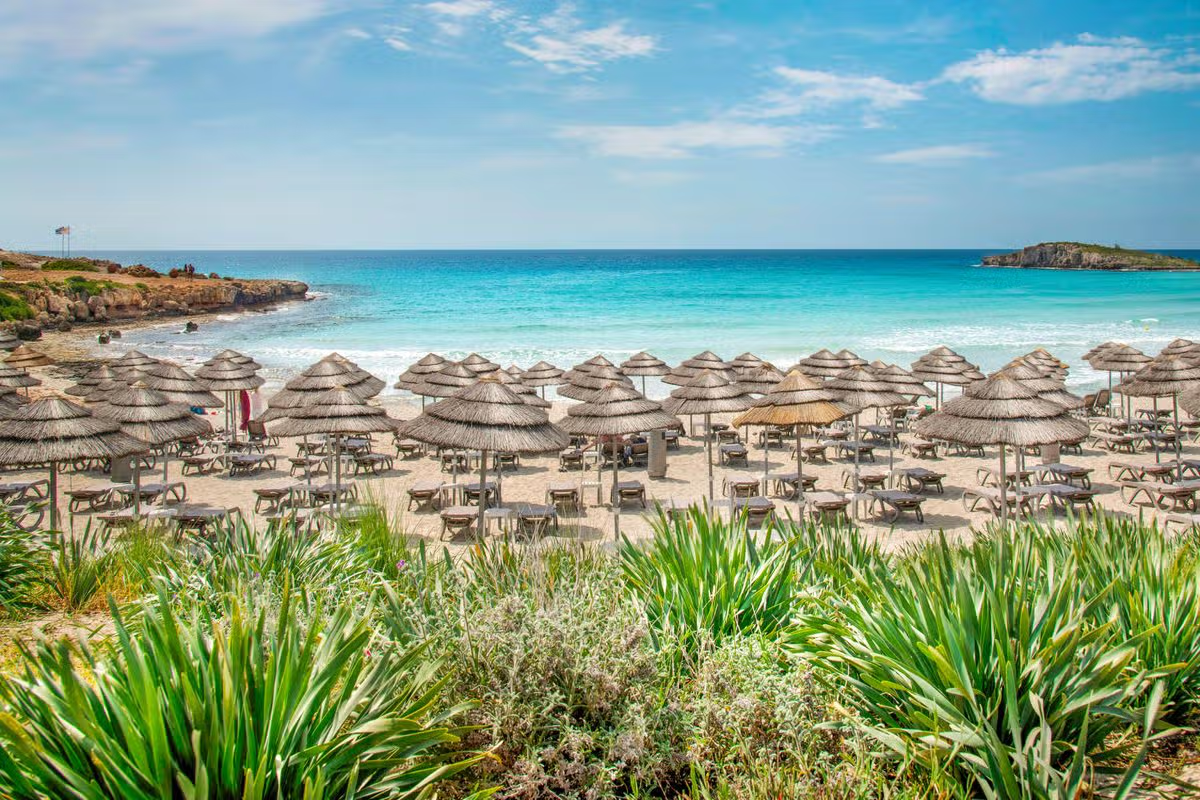
The resort town is full of stunning beaches, from Nissi Beach with its beautiful white sands, and the clear waters of Makronissos Beach.
Taking to TripAdvisor, a September visitor to Nissi Beach wrote: “Nissi Beach is heaven just around the corner! Probably one of the most popular beaches in Cyprus—and for good reason.
“Crystal-clear water, beautiful soft sand, and that creamy, turquoise texture that makes you feel like you’re in paradise. Add the amazing atmosphere and beautiful people, and you have the perfect beach experience.”
While an autumnal visitor to Makronissos commented: “The most beautiful beach, clean, lots of sunbeds, clear warm waters, absolutely amazing. The best beach we found. Lovely atmosphere. Bravo municipality, this beach and its staff do you proud. The sunbed prices are the same on every beach, ten euros for a set, so cheap compared to most places, bravo.”
Brits going on holiday this autumn have been urged to check their luggage for an item that can no longer be used on planes – and it could mess up your travel plans
One common item is now banned for use on planes (stock photo)(Image: Getty Images)
If you’re going on holiday this year, you need to make sure you follow a new travel rule that bans the use of one common item on planes. With summer behind us and the kids back at school, many Brits will be looking to book a holiday in the hopes that prices for flights and hotels have dropped.
Before leaving for your trip, it’s important to make sure you understand all the rules in place for everything from your flight to airport security, as you don’t want to get caught out with something that can ruin your holiday. One woman recently said her travel plans were almost scuppered by one little-known rule she didn’t know, as it only came into effect recently.
In a video on TikTok, a woman uploaded a video that captured the moment passengers on her Jet2 flight were told they could not use power banks while on the flight, due to a new rule.
Passengers were told: “As of the first of August, it is now illegal to use power banks on European aircraft, so if you’ve got a power bank with you, it should remain switched off, as these are forbidden for use on flights.”
The woman could be seen shaking her head and exchanging a confused look with her daughter, as she seemingly had no idea that the rule was in place. This was made even clearer with her video’s caption, where she admitted she had been hoping to use her power bank to charge her phone during the flight.
She wrote: “My phone’s about to die.”
It is not illegal to bring power banks on planes, but current aviation rules ban using them to charge devices or recharging the banks themselves during flights. This is because they carry a fire risk if the battery inside overheats, which can be dangerous to passengers on board – so it’s best to charge your device before you get on the plane.
Power banks must never be stored in your hold luggage, and should instead go in your hand luggage. This helps to reduce the risk of fire, as it can be quickly dealt with if something does go wrong and the battery does overheat.
Several commenters on the woman’s video said they agreed with the new rules for safety reasons, as they said they had heard horror stories of power banks catching fire on flights in the past.
One person said: “I can understand as they get really hot. Should really ensure this is known to people as it’s really important.”
Another added: “I brought a new power bank on a plane last year, and when I got off the plane, it had split the casing and was very hot.”
A third wrote: “About time!”
New rules, which came into force in March this year, aim to reduce the likelihood and impact of incidents involving power banks. The UK Civil Aviation Authority (CAA) is asking travellers to familiarise themselves with these rules, which are:
Power banks must be carried in hand luggage only
Each power bank must be individually protected when not in use, using a pouch, its original packaging or a separate bag to prevent short circuiting
You can take a maximum of two power banks per person
Power banks must not be recharged on board, including from an in-seat power outlet
Power banks up to 100Wh are permitted, while those between 100Wh and up to 160Wh need approval from the airline
Whether you can use your power bank to charge your phone on an aircraft actually depends on the airline. While you cannot charge the power bank itself on any flight, some airlines may allow it to be used as a portable charger.
Ryanair allows them to be used, except during taxi, take-off, and landing, while easyJet, Jet2, Emirates, and Virgin Atlantic do not allow power banks to be used on board at all.
THE CEO of Ryanair has warned that there’s “no doubt” that air fares will rise by summer next year.
However, if you secure a deal now, it’s likely to be cheaper than if you wait until the last minute – and we’ve found some worth booking.
Ryanair boss has warned that flight prices will go up next yearCredit: GettyTo avoid soaring costs – book your summer break now rather than leave it last minuteCredit: Getty
The conflict in the Middle East and the Strait of Hormuz has resulted in the rising price of oil – it has recently increased to over $100 (£75.57) a barrel.
Some airlines have hedged their fuel (meaning they pay a set price) but this could come to an end if the conflict continues into next year.
Sign up for the Travel newsletter
Thank you!
Talking about 2027, Michael O’Leary said that flight prices were “only going one way”, which is “significantly upward”.
He added: “Fares for Ryanair passengers and every other passenger into the summer of 2027 are going to rise materially, I believe, because of significantly higher oil prices.
“I have no doubt fares are rising next year. The question is by how much.”
If you want to bag yourself a summer holiday now before the price increases begin, here are some more affordable deals that we’ve found…
The Costas, Spain
Whether you want to hit the coast or the cities, Spain is always a safe option for Brits.
Consider coastal regions like the Costa Brava, Costa del Sol, Costa Brava and Costa de la Luz for your next break.
There are beautiful Mediterranean beaches with sandy shores and warm seas especially in the summer months – not to mention lots of spots are very affordable.
With On the Beach, book a stay for two at the Merce Hotel on the Costa Brava from July 1 for seven nights from £335pp – it has a rooftop pool, a restaurant and the seaside village has plenty of bars and coffee shops.
The Costa Brava has beautiful beaches and is a few hours from the UKCredit: Getty Images
Marrakesh, Morocco
For guaranteed sun, and short flights, Marrakesh is a great option when it comes to holidays.
The city centre has lots to see and explore like busy souks and huge palaces.
If you’re after a quieter break, there are lots of riads outside of the city – one of which is just beyond the Atlas Mountains.
A seven-night break for two in Marrakesh at the Riad Atlas Prestige between July 12 -19 can be booked from £279pp with loveholidays.
The small hotel has nine guestrooms with a roof terrace for dining and is close to waterfalls and a small village – the city centre can be reached in an hour and a half by car.
If you pay a £19 deposit today today – the rest can be paid in nine monthly instalments.
Marrakesh is a great option for summer with city and remote breaksCredit: GettyParts of Albania have been compared to the MaldivesCredit: Alamy
Albanian Riviera
The Albanian Riviera is predicted to be a popular destination next year thanks to its consistently growing tourist numbers.
Much of the coastline has white-sand beaches and bright blue waters with bustling beach clubs and bars.
Even better is that Albania sits around the mid-20s in spring, and during summertime can be over 30C.
The four-star Hotel Aliko is a few minutes away from the beach with views of both the sea and mountains.
Bulgaria
If you’re heading away with the kids in 2027 consider Bulgaria as a cheaper alternative when it comes to package breaks.
It doesn’t even take that log to get there with the average flight time of just over three hours and temperatures of up to 30C in August.
A family of four can opt for full board seven-night break at the Garden of Eden Hotel with loveholidays from £549pp between August 2-9.
The hotel sits right by a sandy beach, it has eight outdoor swimming pools, three restaurants, a spa and there’s a children’s club during the summer too.
If you’re heading on a family holiday in 2027 – here are more options with some of the best deals from £36pp a month from Malta to Tenerife.
Here are some tips on how to find cheap flights…
Skyscanner is a great option for comparing the price of flights with various airlines – and it even have a price drop tool.
The feature claims to scour up to 80 billion prices a day and shows which destinations have seen flights that have dropped 20 per cent compared to the last week.
Google Flights is another search engine which compares flight prices and shows multiple airline options.
If you choose the ‘explore’ option, it can show the cheapest, direct flights across the world.
For even more hacks on when to fly, Expedia has put together a handy list on the cheapest days to fly – which is Friday.
Compared to travelling on a Saturday, jetting off the day before can save up to 18 per cent.
It also found that found that international travellers can save £93 on average by booking between 15 and 30 days ahead, instead of six months.
Where you fly from also makes a difference – some of the most expensive UK airports to fly from are London Heathrow, Humberside and Manchester..
A four night family break will cost you less than £100Credit: Facebook
Book a four-night family break for £99 (save £70)
You can bag a four night Tots Break for £99, which works out to £6.19pp per night if you’re a family of four.
On a Tots Break, kids eat completely for free with fresh, hot meals provided as part of the package. Based on a family of four, this can save you up to £70 extra.
Sign up for the Travel newsletter
Thank you!
Kids can enjoy a free breakfast, lunch and dinner with main meals from the Starland Krew Menu, which includes favourites like beef burgers, tomato pasta and chicken strips and chips.
Not only can kids enjoy free food and drink, but there’s a whole host of free kids activities, too. So no need to feel like you’re constantly saying no, or watching your holiday budget spiral out of control.
Some of the free activities that are great for under-fives include messy play, Tots & Tunes music sessions, soft play and the purpose-built Tots Adventure Playground.
There’s even mini archery, mini fencing and ‘Mini Olympics’ on offer if you want to try a new skill together.
There are 40 resorts across the UK to choose fromCredit: SuppliedKids will be entertained the whole way throughCredit: Trip Advisor/ Skipsea Sands Management
All 40 Parkdean Resorts sites host Milkshake! Mornings, where kids can play, sing along and listen to stories from their favourite Milkshake! presenters.
Plus, fans of the popular Paw Patrol can meet and greet some of their favourite characters, such as Chase and Marshall.
As for evening entertainment, there are specific Tots early evening events, including discos, dances and even ‘kideoke’ sing-a-longs.
And if you’ve got little ones who love dressing up, make sure to go to the ‘Sparkle Like a Princess’ event, led by Parkdean’s own animal characters, the Krazy Krew.
Book a four-night family break for £99 (save £70)
All the kids meals are free too – giving them all the energy for the entire dayCredit: Trip Advisor/ Thorness Bay Management
Accommodation includes the comfortable Bronze caravans or even safari tents sleeping up to six, with the option to upgrade, too.
Caravans are sleek and spacious, with glam charcoal and cream-coloured interiors and fully kitted-out modern kitchens.
Inside you’ll find cosy sofas, freshly-made beds and large TVs to sit back and relax with a movie once the little ones have tuckered themselves out.
The safari tents feel more like a luxurious glamping getaway, with two bedrooms inside and their own decking with a seating area to enjoy your morning coffee.
Tots Breaks take place at dozens of Parkdean Resorts across the UK throughout all seasons, so make sure to check their website for availability.
At a press conference on Wednesday Michael O’Leary, the CEO of budget airline Ryanair, unveiled new routes from UK airports including Birmingham, Edinburgh, Liverpool, and London
Ryanair has unveiled its newly expanded winter schedule, with 22 new routes from UK airports added.
The budget airline will be adding 22 destinations to its schedule this winter, with Birmingham, Edinburgh, Liverpool, and London airports benefiting the most.
This morning, Ryanair also announced that it was adding nineteenth-based aircraft at Manchester Airport this winter, helping it to run one extra route from the North West hub. Ryanair is increasing its flight frequencies on another 26 routes from Manchester, including holiday hotspots like Malaga, Palma de Mallorca and Madrid, as well as city break destinations like Barcelona, Belfast, Venice, Porto, Prague and Krakow.
There are many eye-catching flights among the list, including the new winter sunshine route from Birmingham to Marrakech, which regularly enjoys mild winter temperatures. The bulk of the other routes are to northern and western European destinations where more festive pleasures are on the itinerary.
The new routes are:
Birmingham – Copenhagen
Birmingham – Rome Fiumicino
Birmingham – Marrakech
Birmingham – Tirana
Birmingham – Warsaw Modlin
Bristol – Knock
Bristol – Warsaw Modlin
East Midlands – Budapest
Edinburgh – Milan Malpensa
Edinburgh – Tirana
Edinburgh – Warsaw Modlin
London Stansted – Glasgow
London Stansted – Malmö
London Stansted – Parma
London Luton – Venice
Liverpool – Milan Bergamo
Liverpool – Copenhagen
Liverpool – Gdańsk
Liverpool – Porto
Liverpool – Tirana
Liverpool – Warsaw
Manchester – Warsaw Modlin
The new route announcement came as the boss of Ryanair warned that air fares would “no doubt” rise next year for summer holidaymakers amid the surging price of oil and the Iran war. Earlier this month, oil prices rose above 100 dollars a barrel for the first time since July after the latest round of strikes in the conflict.
At a press conference yesterday Michael O’Leary, chief executive of the budget airline, said ticket prices were “only going one way”, which is “significantly upward”. He said: “Fares for Ryanair passengers and every other passenger into the summer of 2027 are going to rise materially, I believe, because of significantly higher oil prices.
“I have no doubt fares are rising next year. “The question is by how much. We’re essentially hedged this year at about 80 dollars a barrel. If we hedge next year at 100 dollars a barrel, our oil bill goes up by 25%. Our oil bill this year is six billion. If it goes up by 25%, that’s seven-and-a-half billion next year.”
The airline has previously warned that it believes some of its competitors will “struggle to maintain capacity or even survive” this winter if oil prices remain high. According to the International Air Transport Association (IATA), the average global price of jet fuel rose 7.4% last week compared to the week before to 194.90 dollars per barrel.
SCARBOROUGH Spa Cliff Lift was closed with immediate effect last month – with fears it might never reopen.
The funicular is the oldest of its kind in the country and has been described as a ‘landmark’ for the town.
Scarborough’s funicular is the oldest of its kind in the UK first opening in the 1800sCredit: AlamyIt was closed last month due to safety concernsCredit: Alamy
Another assessment that examined the tracks and carriages said that the lift operates in a “challenging coastal environment, where salt-laden air, high winds and severe weather can accelerate wear and corrosion”.
The cliff lift is the oldest of its kind in the country, first opening in 1875.
Originally, it was used to transport passengers between the hotels on the Esplanade and the spa.
It was powered by water and gas engines until the 1950s when it was converted to run on electricity.
The funicular has been subject to coastal erosion due to its proximity to the seaCredit: Alamy
Council leader Carl Les, said: “The lift is an important part of Scarborough’s history and identity, and we recognise the affection people have for this landmark attraction.”
Last year when the attraction turned 150-years-old, live performances and exhibitions were held in the town to celebrate its anniversary.
There are roughly 12 funicular’s left in the UK with fewer that still function.
The Saltburn Tramway, which shut back in January 2026, reopened earlier this month.
And another one that’s set to open next year after a 10-year-closure is Folkestone’s Leas Lift which was forced to close in 2017.
The Sea Ranch Lodge, a focal point of a Northern California getaway destination that blends minimalist design with the rocky shores and meadows of the Sonoma County coastline, might have a growth spurt in its future.
Owners of the Lodge at Sea Ranch, which includes 17 hotel rooms, on Sept. 3 presented neighbors in the closely restricted community with plans that include 23 added guest rooms, a dining courtyard, a new dining space, a library and a “space for relaxation and movement.”
The Danish architecture firm BIG: Bjarke Ingels Group and San Francisco-based landscape architects Lutsko Associates are part of these plans. To become reality, however, those plans need to win design approval and permits from the Sea Ranch Assn. (which includes the lodge and surrounding homes) and Sonoma County.
The ram’s horns at the Sea Ranch Lodge were designed by artist Barbara Stauffacher Solomon.
(Myung J. Chun / Los Angeles Times)
The current owners of the lodge took over in 2018, completed a major renovation in 2023 and wish “to remain private,” a representative said. The Wall Street Journal has reported that the investors’ group includes San Francisco-based brothers Patrick and John Collison, who founded the tech company Stripe; venture capitalist Robin Chan; and Twitch co-founder Justin Kan.
The 53-acre lodge property is only one piece of the Sea Ranch puzzle. The surrounding development, which broke ground in 1964, includes about 2,200 homes and lots on roughly 7,000 acres, all subject to strict design standards enforced by the Sea Ranch Assn.
The homes, mostly clad in wooden exteriors, none more than two stories high, are scattered along 10 miles of coastline about 100 miles north of San Francisco. The nearest town is Gualala, about six miles north.
Rooms at the Sea Ranch Lodge often rent for $600 nightly or more. Many visitors rent neighboring Sea Ranch homes from Airbnb, Vrbo or local companies including Gualala-based Sea Ranch Rentals and Sea Ranch Escape. In fall, rental rates for homes often start around $400 nightly.
Widely praised as an model for environmentally sensitive building, the development sparked a years-long legal battle over public access to the coast. The result is a combination of private and public access: Six public-access trails cross Sea Ranch to on their way to the shoreline, while Sea Ranch residents retain access to several private beaches.
An ocean view along the trails at the Sea Ranch Lodge.
While most of us know Wetherspoons’ pubs, I had no idea it had also been running hotels since 1998, when the chain’s first opened in Shrewsbury with 22 rooms. It now has more than 50
Love it or loathe it, Wetherspoons is a British institution. Its patterned carpets, bargain drinks and grand old buildings are familiar features of high streets across the country.
For a long time, I’ve been in the loathe camp. Having whiled away much of my latter teenage years in one of its pubs – a once particularly grand building converted into the biggest, cheapest drinking den in the South East – I fell out of love with Tim Martin’s chain in my 20s. Partly because the local newspaper I worked for had no offices, so we had to hold news conferences in the room above our local Spoons. Partly out of support for independent pubs, which have been in a fight for survival for the past decade.
Something Spoons is certainly not doing. The chain is booming. It has around 800 venues across the UK and brought in £2.13 billion last year, an almost 5% year-on-year increase. But while most of us know its pubs, I had no idea it had also been running hotels since 1998, when the chain’s first opened in Shrewsbury with 22 rooms. A further 54 have opened since.
As you might expect with Spoons, the major draw is the price. A room for a night costs at most £50 at most venues, which is an absolute bargain anywhere near London. The chain also scored four stars out of five for value for money in a Which? budget hotel survey, one of only two to land the score.
So, on a bitter Wednesday in November, I arrived at the Thomas Ingoldsby in Canterbury, frozen and disheveled after a long bike ride from Broadstairs, ready to give Spoons another chance. I was glad that I did.
Price
Cheap drinks are a big part of Spoons’ appeal, and its hotel rooms follow the same formula.
In the Which? survey, Wetherspoons was one of just two hotel groups to earn four stars for value for money. The other was the overall winner, the Coaching Inn Group. While the Coaching Inn Group’s average room rate was £128 a night, Wetherspoons’ was £70. When I checked, a double at the Thomas Ingoldsby for the following Wednesday was available for just £55.
The savings didn’t stop at the bedroom door. I spent the evening drinking £1.89 pints of ale, then tucked into a £2.99 veggie breakfast the next morning. Both were rather decent. Perhaps I’d spent too long inside the M25, but those prices felt almost ridiculously cheap. At a time when leaving the house seems to cost £20 before you’ve done anything, the affordability was the standout attraction.
Atmosphere
My previous Spoons visit had been to the vast, strangely subdued Coronet on London’s Holloway Road. Canterbury on a chilly Wednesday evening couldn’t have felt more different. There were university students, cheerful groups of pensioners and solitary blokes reading books over onion rings. It was a lively cross-section of life, with people happily sharing the same space.
The hotel rooms are a short flight of stairs above the pub, so getting to bed after a pint couldn’t be much easier. You could even take a deli wrap and chips upstairs to enjoy in the bath. A member of staff told me rooms could be booked on a whim, although anyone who had overdone it at the bar might be turned away.
The room
I’ve stayed in plenty of budget hotels, and this was among the best. Everything felt fresh, well maintained and thoughtfully put together. My double room was generously sized, with a large desk, a well-stocked tea tray and a decent-sized television. Better still, it had a view of Canterbury Cathedral that few hotels in the city could rival.
Only two rooms at the Thomas Ingoldsby enjoy that outlook. Those on the other side not only miss out on the cathedral view but are reportedly disturbed by early-morning lorry movements. If you can get it, room 110 is the one I’d recommend. After a freezing day cycling across Kent, I was particularly pleased to discover the thermostat went up to 25C — and that the heating delivered. Within a short time, it felt as though I’d escaped somewhere considerably warmer.
What’s included
There is no all-inclusive package, which is perhaps just as well given the potential combination of Hooch and endless chips. Still, the room came with plenty of useful extras: reliable Wi-Fi, a couple of packets of biscuits, fresh towels, two bottles of water and a generous supply of tea, coffee and hot chocolate sachets. Check-out was at 11am. Breakfast wasn’t included, but at £2.99 for my veggie option, that hardly felt like a reason to complain.
The verdict
A friend’s dad once told me that Spoons was the closest thing Britain had left to a genuine social institution. Watching the mix of people enjoying their evening in Canterbury, I could see what he meant.
As nightclubs and members’ societies close, places where people from different backgrounds can gather feel increasingly valuable. Whatever my reservations about the business, this pub offered exactly that.
Add a comfortable room, a cathedral view and remarkably low prices, and the appeal becomes difficult to resist. I arrived as a skeptic, but Thomas Ingoldsby won me over.
This source provides an overview of cultural events and global news scheduled for September 2026, with a primary focus on the South Korean Chuseok holiday. It explains the historical origins of the Harvest Festival, tracing it back to an ancient weaving competition between Silla dynasty princesses. The text also details traditional customs, such as honoring ancestors and visiting family graves to strengthen communal bonds. Beyond the festival, the digest offers financial data including exchange rates and summaries of international headlines ranging from geopolitical tensions in North Korea to regional celebrations in Nepal and Ethiopia. Together, these snippets serve as a comprehensive daily briefing on world affairs, cultural hi …
CENTER Parcs has been blasted for offering a 45-minute Christmas activity – which costs an extra £300 per family.
The “Twilight Elf Visit” involves two members of staff in elf costumes visiting a family in their lodge for less than an hour.
Parents have slammed Center Parcs for its pricey new Christmas experience
The visitors will tell stories and share “festive surprises” and “magical moments”, including making a wish for Santa, posing with the elves and receiving keepsakes including a festive ribbon and bauble.
The activity is now available to book in November and December across all locations – but for a very steep price.
Sign up for the Travel newsletter
Thank you!
For one child, the cost is around £300 while for two it’s £350, with the price rising by £50 for every extra child – up to £550 for six kids.
It’s not clear if these prices will change as Christmas approaches.
One said on a Facebook post: “Wow. That’s crazy money.”
Another added: “It’s only 45 mins! It’s a shocking price.”
A third moaned: “What in the name of Scrooge is this? Surely those prices can’t be correct?”
But some families said they would go for it, with one explaining: “Ooh my child (adhd/autistic) would have ADORED this as they loved the elves etc and we’d have happily paid it as they struggled in most settings.
“I think it sounds great!”
The activity description states: “When dusk begins to settle over the forest, a very special Christmas adventure awaits.
Two elves come to the lodgesThe park has revealed the other Christmas events returning this yearCredit: Center ParcsWinter Wonderland is also returningCredit: centerparcs
“Gather in the comfort of your lodge as two magical elves arrive with an enchanting tale to tell.
“Through personalised storytelling, festive surprises and magical moments, you’ll discover the secret connection between the forest and the North Pole, and the important role Christmas wishes play in keeping that magic alive.
“Together, you’ll create a special Christmas wish, enjoy thoughtful keepsakes and share magical moments designed to capture the wonder and belief of the season.
“With personalised touches throughout, it’s a truly memorable way to spend an evening together, creating festive family moments you’ll treasure for years to come.”
The cost comes on top of the holiday itself – we’ve found four-night stays on December 7 for £779, in a basic Woodland Lodge in Sherwood Forest (or £859 for Longleat).
Center Parcs has also revealed the return of its Winter Wonderland from November 6 until January 4.
Taking place every Wednesday and Saturday at 5pm, Santa’s Parade sees his sleigh glide through the village accompanied by a festive cast of entertainers.
Meanwhile, the Enchanted Light Garden invites guests into twinkling light displays, where storybook characters come to life daily from 4pm to 9pm.
Children can also enjoy Elf Playtime, collect their Elf Explorer Passport, and dance along at the Elf Disc.
Lee Carpenter, Head of Leisure at Center Parcs, said: “We’re passionate about creating memorable experiences for families, especially during the festive season.
“As we look ahead to Winter Wonderland this year, we want to continue building on our incredible offers to create something truly immersive and unique, and the Twilight Elf experience brings that vision to life.
“Together with the return of guest favourites and a selection of newly enhanced activities, it offers even more opportunities for families to embrace the magic of Christmas and enjoy a festive break they’ll never forget.”
THERE’S a specific point during every peak-summer holiday when even the most committed sun worshipper has to admit it’s all getting a bit much.
The beach is shoulder-to-shoulder, the sand is hot enough to cook an egg and you’ve started timing dinner around whether you can secure a table without joining a queue.
Holiday expert Rob Brooks has hunted down seven destinations that are seriously cheap in OctoberCredit: Rob BrooksThe cheapest resort Holiday Expert Rob found was an underrated stretch of coastline in SpainCredit: Getty
That’s why I’ve become a massive advocate for the October break.
Across the Mediterranean, daytime temperatures comfortably hover in the mid-twenties and, even in October, there are hours and hours of proper sunshine every day.
Meaning you can still pack your swimwear, bring the sun cream and expect to come home a lot more tanned.
And my favourite part is: you enjoy all of that without the intense August heat, peak-season crowds or, most importantly, peak-season prices.
I crunched the booking data across our most popular summer resorts and found that October breaks are up to 49 per cent cheaper than their peak-August counterparts.
So these are the seven classic summer spots where October can genuinely be a better and much cheaper time to travel.
7. Hersonissos, Crete – 40 per cent cheaper
Bag a week-long stay at the 4* Hotel Heronissos in Crete for £320ppCredit: Trip Advisor/Hotel Heronissos Management
Crete is one of the best places to squeeze a final dose of proper Greek sunshine out of the year.
As one of Greece’s most southern major holiday islands, it holds onto summer far longer than many of its northern neighbours.
October in Hersonissos still serves up highs of 24°C and warm seas, keeping proper beach-and-pool days firmly on the menu.
Hersonissos also stays lively well into autumn, and the gentler heat also means exploring Heraklion or visiting the Palace of Knossos doesn’t turn into a sweaty endurance test.
Matched booking data shows that October packages here are, on average, 40 per cent cheaper than in August.
It has a huge outdoor pool and puts you within walking distance of the resort centre, while your meals, snacks and local drinks are all included.
The full package works out at £320pp for 7 days – roughly £46pp a day – including the flights. Bargain.
Book a 7-night all-inclusive stay at Hotel Heronissos from 8 October 2026, with direct return flights from Bristol, for £320pp.
6. Cala Millor, Majorca – 40.1 per cent cheaper
Cala Millor in Majorca can still hit highs of 25°C in SeptemberCredit: Trio Advisor/Garbi Cala Millor Management
Majorca doesn’t just pull down the blinds the second September finishes, you know?
October in Cala Millor can still hit highs of 25°C earlier in the month, with sea temperatures sitting at a very swimmable 23°C.
But the biggest win in October, by far, is the elbow room.
In August, finding a towel-sized patch on Cala Millor’s huge sandy bay feels like bidding for a London flat – but in October, you can just walk down and lay your towel out.
Booking data shows that October packages are, on average, 40.1 per cent cheaper than in August, which is a pretty crazy saving for Majorca.
I found a four-star, half-board stay at Bakour Garbi Cala Millor, which sits just 400m from the beach, has a large outdoor pool, kids’ club and playground, and its heated indoor pool and spa area is ideal for an October break.
It gives your family a built-in back-up plan if an autumn cloud briefly rolls past.
Book a 7-night half-board stay at Bakour Garbi Cala Millor from 14 October 2026, with direct return flights from Bournemouth, for £340pp.
5. Afandou, Rhodes – 43.7 per cent cheaper
You could be soaking up the sun in Rhodes for £185pp with the deal our expert Rob foundCredit: Getty
Rhodes is arguably the strongest weather bet on the entire list for autumn.
October brings highs of 25°C, around nine hours of sunshine a day and sea temperatures of approximately 24°C.
That is still proper tanning weather, and feels particularly nice when everyone back home has already turned the central heating on.
Afandou is ideal for a quieter escape, with one of the longest beaches on Rhodes and a traditional village centre.
The slightly gentler heat also means you can explore the island properly without spending the entire day desperately seeking shade.
My booking data shows that October packages are, on average, 43.7 per cent cheaper than in August – another massive saving.
I tracked down a room-only stay at Golden Days Aparthotel, a simple, cheap-and-cheerful base with an outdoor pool, a separate children’s pool and a tourist train running down to Afandou Beach.
Getting a full week on one of Greece’s warmest islands for under £190pp is an absolute steal. In fact, I’ve paid more than that for a train ticket to London this year.
Book a 7-night room-only stay at Golden Days Aparthotel from 2 October 2026, with direct return flights from East Midlands, for £185pp.
4. Albir, Costa Blanca – 44 per cent cheaper
A stay at Sun Palace Albir delivers Costa Blanca glamour away from the business of BenidormCredit: Trip Advisor/ Sun Palace Albir Management
Albir delivers Costa Blanca sunshine without putting you in the middle of Benidorm.
That being said, Benidorm is still close enough for waterparks, nightlife and an emergency tribute act, but Albir itself stays super-relaxed.
October brings highs of 24°C and around eight hours of sunshine a day, alongside a palm-lined promenade overlooking the pebble beach.
The cooler autumn breeze also makes it a far better time to tackle the scenic walk up to Albir Lighthouse without desperately searching for shade every five minutes.
Booking data shows that October packages are, on average, 44 per cent cheaper than in August.
It has an outdoor pool, a big sunbathing terrace and a spa area for when you fancy taking relaxation very seriously.
The stand-out feature here, though, is its restaurant terrace, which has panoramic views across the mountains and out to sea, a far better spot for breakfast than a rainy motorway service station – speaking from experience.
Book a 7-night bed-and-breakfast stay at Sun Palace Albir from 20 October 2026, with direct return flights from Manchester, for £305pp.
3. Kusadasi, Turkey – 44.3 per cent cheaper
The Marbel Hotel in Kusadasi has a roomy pool. tennis courts, a gym, hammam and moreCredit: Trip Advisor/Marbel Hotel Management
Kusadasi stays properly hot into October, with daytime temperatures reaching highs of 26°C along the Aegean coast – and I have to say it’s absolutely gorgeous.
You could easily spend seven days flitting between the pool and the buffet, but October’s gentler heat also makes exploring the ancient marble streets of nearby Ephesus infinitely more enjoyable than during the height of summer.
When I took a peek, matched booking data showed that October packages to Kusadasi are, on average, 44.3 per cent cheaper than in August.
It has a huge outdoor pool, tennis court, gym and Turkish hammam bath house, with your meals and drinks wrapped into the price.
It’s a great choice if you want plenty to do at the hotel while remaining close enough to dip into the centre of Kusadasi.
Book a 7-night all-inclusive stay at Marbel Hotel from 7 October 2026, with direct return flights from London Stansted, for £365pp.
2. Laganas, Zante – 45.7 per cent cheaper
Stay at the Atlantis Hotel in Zante from £255pp for a whole weekCredit: Trip Advisor/Atlantis hotel Management
Laganas in August and Laganas in October feel like two completely different worlds.
Peak summer brings wall-to-wall crowds and full-throttle nightlife, but by October, the volume turns right down, but temperatures can still reach highs of 25°C.
You get to enjoy Laganas’ vast golden-sand beach and the clear Ionian Sea without sharing them with thousands of foam-party-obsessives.
Some seasonal bars and clubs begin closing as the month progresses, but for me that’s part of the appeal.
You still get the sunshine, warm sea and beautiful coastline – just with considerably less people around.
And booking data shows that October packages are, on average, a whopping 45.7 per cent cheaper than in August.
That means you can be beside the pool remarkably quickly instead of spending the first afternoon touring every hotel on the island aboard a transfer coach.
The hotel has an outdoor pool, a separate children’s pool and a Jacuzzi, while the rooms include a mini fridge, kettle and toaster to keep the snack admin easy.
Book a 7-night bed-and-breakfast stay at Atlantis Hotel Zante from 13 October 2026, with direct return flights from London Stansted, for £255pp.
1. Oropesa del Mar, Costa del Azahar – 48.6 per cent cheaper
Magic Sports Oroposa del Mar has themed rooms, huge swimming pools and an on-site waterparkCredit: Trip Advisor/Magic Sports Hotel Management
Taking the top spot for the biggest seasonal saving is Oropesa del Mar on Spain’s underrated and underdiscovered Costa del Azahar.
October temperatures here can still climb to highs of 25°C, allowing summer to stretch on long after the UK has descended into grey drizzle.
This purpose-built Spanish resort has broad beaches and wide promenades that feel calm and effortless once the July and August rush clears out.
The slightly gentler temperatures also make October a much better time to explore the coastline or head towards Castellon and Valencia.
My booking data shows that October packages are, on average, a staggering 48.6 per cent cheaper than in August – nearly half the price for the same Spanish coastline.
It has sports simulators, themed rooms, huge swimming pools and an on-site waterpark with slides inspired by everything from Formula 1 to winter sports.
Finding seven nights here with direct return flights for £265pp feels, quite frankly, ridiculous – and it’s my pick of the deals, for sure.
Book a 7-night bed-and-breakfast stay at Magic Sports Hotel from 3 October 2026, with direct return flights from London Stansted, for £265pp.