A Togo-flagged merchant ship sank off Bulgaria after a drone attack, with its crew missing. A second ship was also hit and its crew was rescued. Bulgaria’s prime minister called the attacks a ‘flagrant violation’ of international and maritime law.
Novac Djokovic won 102nd match of his career, while ATP 500 tournament victory was Carlos Alcaraz’s third of the year.
Published On 6 Oct 20266 Oct 2026
Novak Djokovic won the China Open after his opponent Alex de Minaur retired from the final with injury, while Spaniard Carlos Alcaraz retained his Japan Open crown to continue his resurgence after a lengthy wrist injury layoff.
The 39-year-old Serbian won the first set in the tie-break 7-6 (7-3) and was down a game in the second set when the Australian ended the match with retirement on Tuesday.
Recommended Stories
list of 4 itemsend of list
Djokovic extended an astonishing unbeaten streak in Beijing and winning the 102nd title of his career.
De Minaur left the court for a medical timeout after losing the first-set tie break but played on with his left thigh heavily bandaged. However, he had to stop after winning the first game of the second set, leaving him trailing 7-6(3) 0-1.
“I don’t feel great … I want to say sorry to all the amazing fans,” de Minaur said at the trophy presentation.
“I didn’t want to finish like this … hopefully see you next year,” added the 27-year-old fifth seed.
The win in China was Novak Djokovic’s 102nd of his career [Tingshu Wang/Reuters]
Alcaraz retains Japan Open crown
Alcaraz made another slow start before cruising past unseeded Czech Jiri Lehecka 7-6(4) 6-4 in the Japan Open final on Tuesday.
The ATP 500 tournament victory is Alcaraz’s third of the year after the Australian Open and Qatar Open, before the 23-year-old was sidelined by an injury for nearly five months and returned at the US Open in late August.
“I’m really happy to be able to lift a trophy again,” Alcaraz said. “It’s been a while and obviously it’s extra special after my injury and my comeback, in the second tournament that I’m playing.
“It was a really tough week and I didn’t play my best tennis and my best level but I did find good solutions and that’s what matters in the end.”
Alcaraz became the first man to go back-to-back in Tokyo since American Pete Sampras won the men’s title in both 1993 and 1994.
The world number three started shakily, dropping serve in the first game, but soon recovered and dialled up the intensity to break world number 19 Lehecka’s serve with a scorching backhand to level at 3-3.
More uncharacteristic errors from Alcaraz gave Lehecka hope in the tiebreak, but the Spaniard unleashed a sublime drop-shot en route to clinching the opening set to lay the platform for his 27th title overall.
Alcaraz says he ‘trusted’ himself
The seven-time Grand Slam champion took control midway through the second set, breaking to claim a 4-3 lead before sealing victory by forcing an error on match point and then celebrating wildly with his team courtside.
Alcaraz said his triumph helped erase the doubts that he faced during his injury break.
“A lot of negative thoughts come to your mind,” Alcaraz added: “If you’re going to come back healthy, if you’re going to come back the same as you were before, if I will be able to hit the ball normally without pain. I trusted myself and it worked out.”
Alcaraz will return to action at the Shanghai Masters where he will take on Argentina’s Juan Manuel Cerundolo or a qualifier first. The main draw of the ATP 1000 event begins on Wednesday.
Several years ago, DreamWorks Animation veterans Joel Crawford and Januel Mercado pitched the studio an original story centered on friendship and steeped in Filipino culture.
That draft became the animated film “Forgotten Island,” which opened in late September and counts singer H.E.R., Liza Soberano and Dave Franco among its voice cast. The movie focuses on best friends Raissa and Jo, who will soon be separated when Raissa goes to college in the U.S., and the final adventure they take to the fantastical island of Nakali.
The movie opened to a softer $13 million in the U.S. and Canada and has so far made $23.6 million at the domestic box office over two weekends. Globally, “Forgotten Island” has brought in $38.5 million on an $80-million production budget.
That opening haul is lower than the average for original animated films from a major studio, which is about $14.6 million, according to the FranchiseRe movie industry newsletter. But the studio is hoping the movie — which has garnered a strong 95% rating on Rotten Tomatoes — will pick up steam and benefit from the relative lack of animated competition at the box office until the early November debut of “The Cat in the Hat,” developed by Warner Bros. Pictures Animation.
You’re reading the Wide Shot
Samantha Masunaga delivers the latest news, analysis and insights on everything from streaming wars to production — and what it all means for the future.
By continuing, you agree to our Terms of Service, which include arbitration and a class action waiver. You agree that we and our third-party vendors may collect and use your information, including through cookies, pixels and similar technologies, for the purposes set forth in our Privacy Policy such as personalizing your experience and ads.
“Forgotten Island” is a big bet for Glendale-based DreamWorks Animation, which like many studios, has largely depended on sequels to drive box office success.
Original animated stories — or original movies at all — have become rarer gambles in Hollywood these days, when sequels and reboots feel like safer options. But Crawford and Mercado knew they wanted to develop a new story together.
The pair, who wrote and directed the film, have been friends for nearly two decades after they met at DreamWorks Animation as storyboard artists. Together, they’ve worked on 2011’s “Kung Fu Panda 2,” 2013’s “The Croods” and 2022’s “Puss in Boots: The Final Wish.” The two bonded over their similar sense of humor and their love for movies, and their longtime friendship was apparent in their easy banter during a joint interview shortly after the “Forgotten Island” premiere last month.
Early on, Crawford and Mercado knew they wanted to tell a story set in the Philippines that celebrated Filipino culture. Mercado is Filipino American and Crawford’s wife is Filipino, so a movie that authentically represented Filipino culture was important to them. In the film, the island of Nakali has many creatures inspired by Filipino folklore, and the characters casually use Tagalog words alongside English.
“There’s a sophistication in terms of respecting that the audience is smart, and doing our part as filmmakers to make sure that the visual storytelling and the context gives everything the audience needs to know,” Mercado told me.
Audiences, too, are more comfortable with content in other languages these days, as I wrote last week about Neon’s Korean-language thriller “Hope.” After all, kids will sing Korean lyrics in K-pop songs, and even “Puss in Boots: The Final Wish” interspersed Spanglish into the story.
“It feels timely to update the way we tell stories, to not treat the audience like, ‘They won’t understand this,’ but really treat them with respect,” Crawford said. “It just felt right to chase authenticity and let go of expectations, especially of what an animated movie should be and has been, and really do something fresh because it’s just coming from who we are.”
In the last few years, animation has been a powerhouse at the box office. Disney and Pixar’s “Toy Story 5” and Universal Pictures, Nintendo and Illumination’s “The Super Mario Galaxy Movie” have each crossed $1 billion at the global box office, two of only five movies to do so this year. In 2024, Disney and Pixar’s “Inside Out 2” was the highest grossing movie in the U.S. and Canadian markets.
Original stories have been tougher. Pixar has recently struggled to match the theatrical success of its prior original films and the slower start for “Forgotten Island” may be a sign of similar hurdles for new stories. But culturally accurate storytelling has paid recent dividends — just look at the success of Netflix’s “KPop Demon Hunters,” which won two Oscars, broke streaming records and sold out theatrical singalongs.
“We believe that there is a platform and space for everyone’s story, for people to feel seen and to know they matter,” Mercado said. “Even when they see a story that is specifically Filipino, if we’ve done our job right, we’ve shown you that you could connect to the story, whether or not you have this experience with the Filipino community or the culture.”
With “Forgotten Island,” Mercado and Crawford also want to push the boundaries of animation beyond its perception as films just for kids. Later this year, films such as Laika’s PG-13 rated “Wildwood” and Brad Bird’s noir film “Ray Gunn” will test the audience appetite for more adult animated and original fare.
“We’re in a time of massive sequels,” Crawford said of stories today. “When you expand where you’re telling them and who is telling them, you naturally get originality. This year has been really exciting for original stories in both animation and live action. You are taking a chance on originality, but it pays off.”
The Warner Bros. film was plagued by very mixed reviews from critics, as well as a challenging marketing campaign. The film stars Cruise as an aging oil tycoon whose drilling operations trigger a catastrophic climate change disaster. Worldwide, the film brought in $20 million on a production budget of $125 million.
It’s been a tough theatrical year for Warner Bros., which has seen a string of disappointments before “Digger.” Beyond the cinema, the company is now in the process of being absorbed by Paramount Skydance, with the merger set to finalize Tuesday.
What I’m watching
It’s been yet another busy week, so about the only thing I was able to watch was a few WNBA playoff games. Since the Sparks were left out of the playoff picture again, I’ve sort of adopted the Golden State Valkyries as the next best California team to root for, and what a wild game that was over the weekend against the Las Vegas Aces.
Embattled FIFA President Gianni Infantino has been accused of a potential abuse of power and conflict of interest after the Norwegian Football Federation (NFF) filed formal complaints to two FIFA committees.
Infantino’s aborted plan to open up the World Cup to private investors, the lifting of US forward Folarin Balogun’s suspension at the 2026 World Cup following an intervention by United States President Donald Trump, and FIFA’s awarding of a so-called Peace Prize to Trump form the basis of the filings.
Recommended Stories
list of 4 itemsend of list
The first filing made on Tuesday “asks the Ethics Committee to examine the conduct of FIFA President Gianni Infantino and any other individuals identified through the investigation for potential breaches of FIFA’s Code of Ethics”.
The second filing is aimed at FIFA’s Governance, Audit and Compliance Committee (GACC) and “asks whether FIFA’s governance, financial oversight, internal controls and decision-making processes [have] worked as intended”.
Lise Klaveness, the NFF’s straight-talking president and longtime critic of Infantino, told British media that Trump was the common thread in all three issues.
The venture capital firm of Josh Kushner, the brother of Trump’s son-in-law Jared, was to be the chief investor in the ill-fated FIFA Forward Enterprise (FFE) plan.
Infantino’s plan, launched just after this year’s hugely successful World Cup cohosted by Canada, Mexico and the US in July, would have allowed private investors to acquire stakes in a company created under the FFE initiative.
“FIFA Forward Enterprise is a governance issue, but it’s connected to the two other cases because [of] conflict of interest and abuse of position, potentially,” Klaveness said in her interview with a British newspaper.
“There is a line between all these three cases, and it’s the same political regime.”
Klaveness, a former international footballer, said Infantino had some serious questions to answer over a lack of transparency.
Balogun’s red card in the last-32 win over Bosnia and Herzegovina during the World Cup resulted in an automatic suspension for the match with Belgium.
But FIFA stepped in and suspended his ban, leading to widespread condemnation, especially when it emerged that Trump had intervened by phoning Infantino.
The FIFA Peace Prize award that Infantino presented to Trump in December has also been widely criticised.
“These are three very different factual cases, but they all have something in common that we want examined,” said Klaveness.
“Is it an abuse of power, an abuse of position? Is it a breach of political neutrality?
“Is it in accordance with the rules of governance, as the FIFA Council should be the strategic body, and the president shouldn’t really have any unilateral power?”
‘Misinformation campaign’
Klaveness, 45, had, in August, called upon Infantino to resign and forgo his bid to be elected to a fourth and final term as president.
The 56-year-old Swiss has insisted he will seek re-election in Rabat next March, and as yet no other candidate has declared themself.
Infantino, who was first elected in 2016, must secure a majority of the 211 votes from the organisation’s members in order to be re-elected.
The deadline to declare a candidacy is November 18.
Klaveness has said she will not be a candidate — despite some observers, including Infantino’s predecessor Sepp Blatter, believing she would be a good fit as FIFA chief.
Aleksander Ceferin, president of European football’s governing body UEFA, has said he is not interested.
UEFA have been unsparing in their verbal assaults on Infantino and FIFA, dismissing the FFE plan as “a shady and opaque backroom deal”.
The likeliest rival is thought to be Canadian Victor Montagliani, president of CONCACAF, whose body, along with UEFA and the Asian Football Confederation (AFC), has formed an anti-Infantino alliance.
However, while a swath of UEFA’s members have publicly withdrawn their support for the 56-year-old Swiss, some of the AFC’s associations, such as 2034 World Cup hosts Saudi Arabia and 2022 hosts Qatar, have pledged their loyalty to him.
African football’s governing body CAF and South America’s CONMEBOL are also supportive.
UEFA has also gone to a court in Florida in an attempt to access documents related to Infantino’s failed plan, hoping to gather evidence for a potential criminal complaint in Switzerland, where UEFA and FIFA are based.
The latter responded by accusing UEFA of a “misinformation campaign” and saying it was attempting to “influence” the election.
After Israeli soldiers stormed Birzeit University near Ramallah to demolish a stone memorial dedicated to dead students, Rania Washaha, 47, felt the pain of bereavement again.
Her brother, Fadi, 34, was shot in the head by an Israeli soldier near the northern entrance to el-Bireh in the central West Bank in May 2021.
Recommended Stories
list of 4 itemsend of list
His name was among the 38 students from the university killed by Israel and listed on the stone pillar known as the Martyrs’ Monument.
Israeli soldiers raided the university campus at dawn on Monday, accompanied by 10 military vehicles. A bulldozer demolished the pillar, and soldiers took away the marble stone. In its place, the Israelis left a planter containing a fig sapling, bearing the inscription: “Water it twice.”
Targeting the University
This raid marks the fifth Israeli incursion into the campus since the beginning of 2026 and the 28th since 2002.
Birzeit University’s administration condemned the recent raid, describing the destruction of the Martyrs’ Monument as a violation of international law and an attack on education and national memory.
“Bulldozers won’t erase the memory of the martyrs, military vehicles won’t extinguish the light of knowledge, and these assaults won’t break the university’s resolve to pursue its academic and national mission,” a statement by the university pledged.
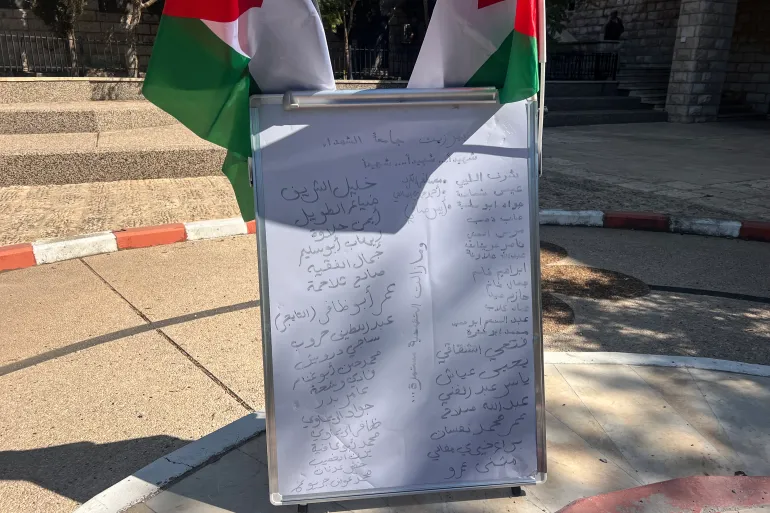
Birzeit University students again wrote the names of martyrs that were inscribed on the memorial [Mohamad Turkman/Al Jazeera]
It came 10 days after another incursion by Israeli forces during the daytime, a day before the start of the new fall semester.
Nardeen al-Memi, the university’s public relations and media officer, told Al Jazeera in the brief minutes of their incursion, Israeli soldiers approached the monument for the first time and photographed it.
The Martyrs’ Monument was erected between 1994 and 1996, bearing the names of students and alumni at Birzeit killed by Israeli forces. The list starts with Sharaf al-Tayyibi, who was shot dead by Israeli forces on the campus in 1984. The names of other students and alumni were added during the years that followed.
“The last name inscribed on the monument was that of student Omar al-Naasan, whom soldiers killed in al-Mughayyir east of Ramallah on September 2 while he was confronting settler incursions,” said Nardeen. “Days after his death, his father came and personally wrote his son’s name on the monument.”
University students organised a protest at the site of the destroyed memorial on Tuesday afternoon, most viewing it as an Israeli attempt to intimidate them.
Sami Adel, a Birzeit student who wanted to use a pseudonym due to his fear of being detained, told Al Jazeera the memorial holds a place in the heart of everyone who has attended the university since the 1990s.
In recent years, Israel has tried to suppress any student activity dedicated to commemorating the martyrs, he said.
“Soldiers detained me for several hours three weeks ago and threatened that if I participated in any political student activity on campus, I would face a long and harsh detention,” he added.
Erasing memory
The removal of the memorial is part of a broader Israeli policy targeting memorials dedicated to Palestinians killed by Israel in the occupied West Bank.
The Israeli far-right has made the issue part of its campaign to erase markers of Palestinian identity.
Zvi Sukkot, a member of the Knesset from the Religious Zionism Party, destroyed one such memorial in the village of Madama, south of Nablus, with a sledgehammer in August. The Israeli military later said that it routinely removes “symbols of incitement”.
The location of the demolished memorial in Birzeit University [Mohamad Turkman/Al Jazeera]
Israeli Finance Minister Bezalel Smotrich submitted a list of approximately 40 Palestinian memorials, proposing their destruction, to Prime Minister Benjamin Netanyahu.
There has been a wider targeting of civic and cultural symbols across the West Bank, particularly in Jenin, by Israeli authorities.
“Jenin Horse”, a monument constructed from the wreckage left behind by an Israeli incursion into the city, was removed. A memorial dedicated to Al Jazeera journalist Shireen Abu Akleh in Jenin was also targeted in 2023.
A cemetery containing the bodies of Iraqi soldiers killed during the 1948 war, also located in Jenin, has been raided by Israelis from illegal settlements.
Other landmarks embedded in the city’s collective memory, including the “Watermelon Roundabout”, have also been targeted.
Crushing resistance
Israel’s targeting of Palestine’s collective memory has coincided with a wider campaign of suppression in the occupied West Bank.
Palestinian universities have been a particular target in this pressure campaign, with campuses raided, students detained, and strict restrictions on activities and events within university grounds.
Israeli authorities are likely focusing on Palestinian universities because they hold a special significance for Palestinian resistance. They historically served as spaces for anti-occupation activism and have been an integral part of the Palestinian political landscape for decades.
Rania Washaha looks at her brother’s photo in her office inside Birzeit University [Mohamad Turkman/Al Jazeera]
Political analyst Mohammed al-Qeeq, who served as president of the Birzeit University Student Council between 2006 and 2007, told Al Jazeera that Israel has targeted writers, influencers, and activists, along with students, to deter any resistance to the occupation.
Universities have historically served as a “fundamental pillar” of Palestinian resilience and identity.
“Israel had also sought to weaken Palestinian political and social cohesion inside universities by deepening divisions between factions and creating chaos”, he said.
Remembering Fadi
For Rania, the memorial served to cement the names of the martyred students in the minds of the next generation of Berzeit students, including her brother’s.
“I cannot deny that I felt a pang of anguish when the memorial was demolished,” she told Al Jazeera. “I realised the goal wasn’t simply to uproot a physical object; I felt the suppressed violence Israel inflicts upon us.”
The memorial, constructed in 1996, stood on the campus when Fadi studied at Birzeit University. He had been arrested multiple times, spending a total of eight years in detention, and Israel denied Fadi the chance to wear a graduation gown.
“He didn’t even complete two years of study due to repeated arrests and injuries from soldiers’ gunfire,” Rania said. “Yet, he loved Birzeit University dearly and would stand by the memorial, contemplating the names of the student martyrs, never knowing that his own name would one day be added to theirs.”
This year, Rania’s son enrolled at Birzeit University as a first-year student. Shortly before classes started last September, an Israeli officer phoned him, threatening him if he participated in any student activities on campus. “Remember what we did to your uncle,” they warned him.
On the set of CBS’ legacy soap opera “The Bold and the Beautiful” at the Sunset Las Palmas Studios in Hollywood, two actors were caught in a fiery exchange.
“Do you want to know where Jack was last night?” actor Skyla Lynne asked with a sly grin. “He was with me.”
From behind a monitor displaying a vertically oriented feed, the director interjected: “Could you pause a bit more in between those lines? We might want to do an episode break there.”
The scene wasn’t for an episode of the famous soap opera. It was part of the 40-episode second season of “Hollywood Starlet,” a new microdrama series from “The Bold and the Beautiful” head writer Bradley Bell and his son Oliver.
“I’ve been doing soap operas my whole life, and it felt like there’s been a buzz about microdramas, and it really felt like a natural extension to the stories that we do,” Bradley Bell said. “[On soap operas] we build two cliffhangers usually on Fridays to keep the viewers over the weekend. Here, you do it every couple of minutes. It’s like speeding up the dance routine, but it’s really right in our lane of soap operas.”
Microdramas are the scrollable, cliffhanger-heavy stories built for phone screens. They are giving audiences a new way into the kind of stories that once belonged to traditional soap operas and telenovelas. The so-called vertical format originated in China a few years ago and has drawn a growing global audience thanks to its short, addictive nature. Hollywood names, including Issa Rae and Kevin Hart, are joining in.
Now, Bell is moving into the space. The 16-time Emmy winner and his son Oliver recently launched a production company called Red Flair Entertainment to capitalize on the format.
“Hollywood Starlet,” their first production, premiered Sept. 3 on aTwist, a new vertical series app founded by industry veterans Jana Winograde, former president of Showtime; Susan Rovner, former president of Warner Bros. Television; and Lloyd Braun, former chairman of WME.
Oliver Bell, founder of Red Flair Entertainment, is producing the micro series, “Hollywood Starlet,” being filmed at Sunset Las Palmas Studios in Los Angeles.
(Genaro Molina/Los Angeles Times)
Bradley Bell says it was Oliver who hatched the idea.
“I saw this unique format and was fascinated by it,” Oliver Bell said. “I noticed some areas that we could quite easily improve on.”
Microdramas first came across Oliver’s social media feed around a year and a half ago when he was still in college. The 24-year-old said he quickly “fell down a rabbit hole” and became so obsessed with the format that he wrote his dissertation at the University of St Andrews in Scotland on soap operas and microdramas.
After he graduated in December, he and his father founded Red Flair Entertainment and started to develop “Hollywood Starlet,” with Oliver serving as an executive producer and his father as a producer.
The series — which costs about $175,000 to $220,000 a season to produce — is being financed by aTwist. Red Flair has a backend deal, allowing it to share in subscription revenue the show generates for the platform.
After filming two seasons of “Hollywood Starlet,” Red Flair plans several more vertical series across many different genres, like horror and romance, the Bells said.
Oliver grew up visiting sets and eavesdropping on writing meetings from under his father’s desk. The family’s storytelling line runs back to his grandparents, William Bell and Lee Phillip Bell, who created “The Young and the Restless” and “The Bold and the Beautiful.” Oliver says he’s carrying on that legacy in a very Gen Z way.
“In a way, microdramas are just the natural evolution of the soap opera,” Oliver Bell said. “You could kind of trace the legacy through that and the modernization of serialized TV.”
His father, who was working on episode 9,911 of “The Bold and the Beautiful” while speaking with The Times, said the short-form stories can reach younger viewers who might be daunted by the soap’s decades of history.
“It’s like cracking open a book, and it’s hard for people to get into it to learn the history,” he said. “So having smaller, bite-sized pieces is appealing to us.”
“The Bold and the Beautiful” has aired continuously for 39 years, but it’s now one of American TV’s last soap operas. Until the 1980s, 10 to 12 soaps typically aired at once, said Elana Levine, a media professor at the University of Wisconsin-Milwaukee who studies the genre. Today, five remain: four on broadcast TV and one, “Days of Our Lives,” is on streaming only.
“It makes sense to take this storytelling form that has been super popular and enduring in the U.S. and find a way to translate that into the mobile devices that we carry around us all of the time,” Levine said.
While soap operas historically targeted a mostly female audience, microdramas reach a much broader audience, said Michael Berry, director of UCLA’s Center for Chinese Studies, who has studied the rise of vertical series.
“It gives us essentially the main beats that we would get from a soap opera format, but it’s happening in a much more compact and addictive way,” he added.
Cameramen prepare for a scene on the set of the micro series, “Hollywood Starlet,” being filmed at Sunset Las Palmas Studios in Los Angeles.
(Genaro Molina/Los Angeles Times)
Lou Trabbie, the soap’s production designer, had never heard of a microdrama before working on “Hollywood Starlet.”
“It’s all going in a different direction. You just adapt and move forward, and that’s what we see here,” Trabbie, who’s worked in the industry for 38 years, explained. “It’s really great to see how these are done with smaller crews. I feel like this is where the business is going.”
“Hollywood Starlet” shoots on the same Sunset Las Palmas soundstage as “The Bold and the Beautiful,” filming during the soap’s monthly dark week.
The first season, 45 short episodes, was shot in six days at the start of summer with a non-union cast and crew of 45. Less than a week after its release, much of the same crew was back to start working on season two.
Oliver Bell said the series used non-union crew due to “budgetary restrictions.”
Excluding China, vertical video is expected to generate $150 billion globally in revenue this year, according to consulting firm Owl & Co. Most of that comes from TikTok, YouTube Shorts and Instagram Reels.
Sunset Las Palmas Studios, where “La La Land” and the first two seasons of “I Love Lucy” were filmed, dedicated an entire sound stage in June to standing sets for vertical series. The sets include a courtroom, a bar/restaurant, an apartment, an office and a hospital.
Paxton Fuller, left, executive producer of “Hollywood Starlet,” walks with Sean Griffin, Vice President of Sales and Business Development, for Las Palmas Studios, through a courtroom set on the stage meant specifically for microdramas.
(Genaro Molina/Los Angeles Times)
Still, the Bells don’t think microdramas will replace soap operas. The two formats, they argue, can “coexist.”
“Coming into someone’s living room or bedroom, soap operas were almost like an extension of their family that they can count on for years and decades with the same actors. The same families that have watched since day one,” Bradley Bell said. “It’s a different type of viewer for microdramas.”
Oliver Bell added: “We’re trying to grab the scroller’s attention, not necessarily ‘The Bold and the Beautiful’ viewer … Microdramas are unavoidable through social media. [It’s] conditioning our brains and how we process media.”
Tens of thousands have taken to the streets across France as unions and teachers joined high school students who, for days, have been demanding better learning conditions in protests punctuated by violent confrontations.
The French Ministry of the Interior said 86,000 people had already joined demonstrations across the country early on Tuesday, while the General Confederation of Labour (CGT) union put the figure at 260,000.
Students have blocked the entrances to hundreds of high schools since late September, complaining of missing teachers, overloaded timetables, dilapidated classrooms and buildings unable to cope with rising temperatures.
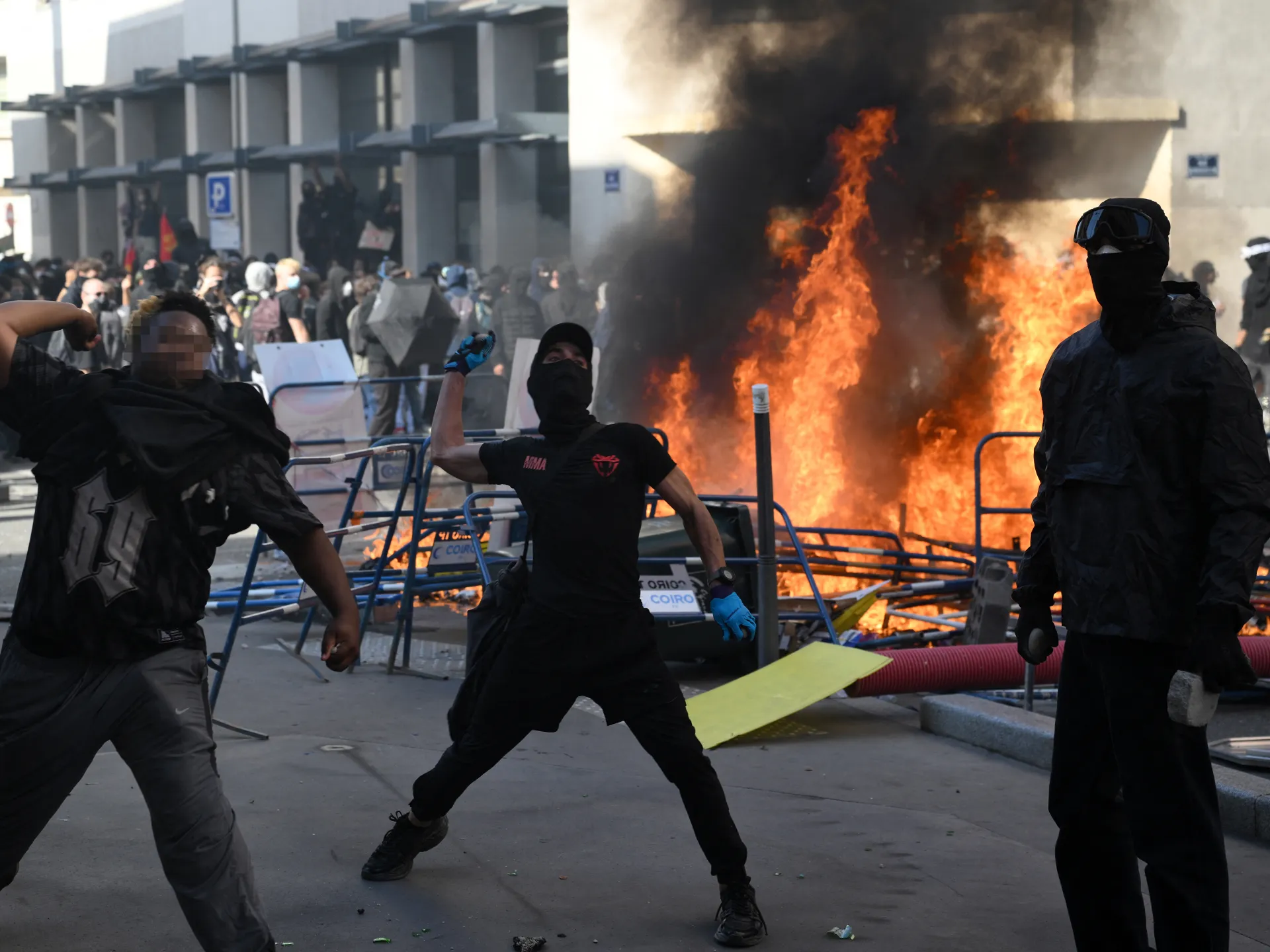
While many protests have been peaceful, some demonstrators have started fires, destroyed bus shelters or clashed with riot police.
Police have responded with batons, tear gas and riot-control rounds.
Injuries, investigations
The government says 215 students and 715 police officers have been injured since the start of the movement.
Unions, rights groups and students have accused the authorities of using disproportionate force.
A 15-year-old lost a hand to a stun grenade fired by riot officers in the northern town of Lens on Monday.
Police have launched 10 internal investigations into allegations of brutality since the protests began, Interior Minister Laurent Nunez said late on Monday.
Since the start of the movement, 24 schools have been burned or ransacked, according to the Ministry of Education.
More than 5,000 people, 87 percent of them minors, have been arrested.
Prime Minister Sebastien Lecornu’s office said 85 members of teaching staff have also been injured.
The government is also pushing legislation to make those responsible for damaging public property pay for repairs themselves, instead of using public funds.
The Navy has announced plans to buy 30 new drone boats, 10 from each of three companies, under its Medium Unmanned Surface Vessel (MUSV) program. The deals are an important step forward for the Navy’s latest attempt to field larger USVs after years of setbacks and shakeups, but it remains to be seen when these new capabilities might actually become operational.
Galliano Marine Services, Huntington Ingalls Industries (HII), and Saronic Technologies each received so-called Other Transaction Authority (OTA) agreements in relation to the MUSV program today. OTA is a contracting mechanism designed to support rapid prototyping and other research and development work without having to use more traditional and often lengthy processes.
The awards “mark a significant step forward in translating the strategic vision into a tangible fleet capability,” Chris Miller, the Navy’s Acting Direct Reporting Portfolio Manager for Robotic and Autonomous Systems (DRPM RAS), told TWZ and others at a media roundtable earlier today. “Each agreement is for the procurement of 10 MUSV at an average procurement cost of $40 million per vessel.”
A rendering of HII’s Romulus design. HII
Saronic and HII submitted their Marauder and Romulus designs, respectively, to the MUSV Phase I competition. Galliano Marine Services, which does business as Edison Chouest, does not appear to have announced its entrant publicly. At a unit cost of $40 million, the total price tag for 30 MUSVs, regardless of type, would be $1.2 billion.
“Production will begin immediately at shipyards in Loreauville, Houma, and Franklin, Louisiana, with deliveries starting as early as the fourth quarter of [Fiscal Year] 2027,” Miller added.
Saronic’s Corsair, seen here, is an example of a speedboat-sized USV already in operational Navy service. Saronic
Threshold MUSV program requirements the service put out in March included a range of at least “2500 nm [nautical miles] at 25 knots while carrying a 25 MT [metric ton] load on the payload deck in NATO STANAG 4194 Sea State 4.” Sea State 4 is characterized by wind speeds of 17 to 21 knots and wave heights between four and eight feet, per that NATO standard. The MUSVs also had to be able to carry forty-foot equivalent units (FEU) containerized payloads and refuel at sea at a rate of “2,000 gallons per minute of fuel through deck connections.” Various other operational and sustainment requirements were laid out at that time, as you can read more about here.
The OTAs announced today were awarded “following successful at sea testing” under Phase I of the MUSV program, according to a press release the Navy put out today. A total of seven companies competed in this initial phase, with the others being Birdon, Leidos, PacMar Technologies, and Sea Machines. That work was conducted under an earlier round of OTAs.
“The testing evaluated, among other things, the vessel’s ability to see and understand the surrounding maritime environment, how well the vessels navigated autonomously according to the international regulations for preventing collisions at sea, and the vessel’s ability to conduct a long-duration mission,” the Navy’s Miller said at the roundtable earlier today. “The demonstrations had to prove that the designs were mature enough to meet the Navy’s operational standards and our requirements.”
In terms of the long-duration mission requirements, “the test was that they had to be able to execute [over] roughly 26 hours and over 360 nautical miles with only a single input during that time from a C2 [command and control] station allowed,” Milleter further explained. “So, it basically demonstrated that the vessel could run for an excess of 24 hours at an extended range with very minimal input from the actual operator from a C2 station. This provided basically our input and our ability to assess how truly autonomous the functionality was of the platforms.”
Overall, the OTA awards “were based on the optimal mix of autonomy, performance, design, production schedule, and cost,” he added.
The MUSV Phase II contracting notice outlines additional parameters, including that submitted designs cannot be more than 295 feet (90 meters) long or displace more than 5,000 metric tons. The USVs also have to be able to accommodate “at least 2x Twenty-foot Equivalent Unit (TEU) [containerized payloads] weighing 24,000 kg each and consuming 25 kW each” and be “capable of executing multi-day unmanned operations of at least 10 days.” The drone boats need to be “operable in NATO STANAG 4194 Sea State 4 and survivable in Sea State 6,” as well. The full lists of threshold requirements and desired attributes are reproduced below.
USN
In addition, “to be considered for this Call for Solutions, the proposed MUSV must be ready for operational demonstration at the time of solution submission,” according to the Phase II contracting notice. “An MUSV requiring substantial modifications for the production platform compared to the as-demonstrated platform will not be considered.”
“The Phase II solicitation allows entrants to compete and existing vendors to submit updated product blocks and modular payload configurations,” Miller, the Acting DRPM RAS, said today. “Testing evaluations will begin as early as November 16th, and proposals will be assessed on a continually rolling basis over the next five years.”
Miller also drew attention to the elimination of the speed and at-sea refueling targets previously outlined in Phase I.
“What we learned from Phase I is that as you increase the speed requirements and some of these other things, it does present certain challenges for industry,” according to Miller. “So I’m trying to actually find the sweet spot in the market where there is healthy competition, and there’s opportunities, and we can have more things that potentially are dual use, both military and civilian.”
A rendering of Saronic’s Marauder with containerized payloads. Saronic
So far, the Navy has only offered limited insights into exactly what specific mission sets it wants the MUSVs to perform, even initially.
The “MUSV Phase I requirements were closely tailored to fulfill operational requirements for a specific mission set focused on demonstrated ability to carry containerized payloads while meeting specific vessel performance requirements for speed and range,” Miller said during today’s roundtable. “However, there is an ever-increasing demand signal that we must be ready to meet. To ensure scalability across the broader mission sets and to support our joint force, we issued a formal call for solutions for MUSV Phase II integration and testing.”
He also stressed that the modularity of the designs being acquired now would allow for the continued evolution of their capabilities as time goes on.
With the focus on containerized payloads, “honestly, inside you could have a sensor, you could have repair equipment for ships,” Rebecca Gassler, who was the Navy’s Portfolio Acquisition Executive for Robotic and Autonomous Systems (PAE RAS) until August, also told TWZ and other outlets back in March. “You could have any number of payloads inside those, and you basically are able to just swap them on.”
In announcing the new OTAs today, as well as discussing the Phase II MUSV plans, the Navy also highlighted continued opportunities for the other companies that had been involved in Phase I.
“Leidos, PAC MAR, and Sea Machines were determined to complete the project provided for in their prototype other transaction agreement and will receive a $15 million award as part of the previously established terms of the prototype OTs,” the Navy’s MUSV announcement today adds. “Alongside the OT awardees, will be accepted onto the Drones.mil hosted Maritime Marketplace, where they are now eligible to receive follow-on production agreements from authorized acquisition authorities across the DOW [Department of War].”
A rendering of Steamracer, a larger USV design Sea Machines has pitched to the US Navy in the past. Sea Machines
Birdon did not complete the required testing. Based on the terms of the Phase I OTAs, Galliano, HII, and Saronic will also receive $15 million awards and be included in the marketplace. The aforementioned Phase II CFS is intended “to expand its acquisition pipeline through a Maritime Marketplace to broaden offerings and satisfy future MUSV mission sets,” as well, per the Navy.
The Navy stressed the importance of this open-ended “marketplace” model as a way to accelerate the acquisition process when it first outlined the MUSV program to the public back in March, as you can read more about here. Just last week, the service also established a new Robotic and Autonomous Systems Warfighting Development Center (RASWDC) to serve as a focal point for “the development, operational integration, and employment of robotic and autonomous systems (RAS) across the maritime domain,” to include the MUSV effort.
The Drones.mil marketplace also extends to all branches of the U.S. military and beyond just USVs. Miller today did highlight the potential for possible cooperation with other services on drone boat efforts through this framework. He also said the Navy might be willing to consider additional acquisition strategies, including leasing uncrewed platforms, in the future.
Larger USVs have long been seen as key to bolstering the U.S. Navy’s overall operational capacity above the waves, and doing so in a cost-effective and rapidly producible manner. They are also viewed as central to enabling new, more distributed concepts of operations designed to help expand operational coverage and reduce the vulnerability of crewed ships, especially in any future high-end fight in the Pacific with China.
A pair of optionally-crewed vessels the Navy has been experimenting with for years now seen sailing together with a Japanese Mogami class frigate. USN
“Unmanned technology is redefining operations and providing our combatant commanders with unprecedented scale, persistence, and risk tolerance,” the Navy’s Miller said at the roundtable.
At the same time, as mentioned, the Navy has attempted to acquire operational fleets of larger drone boats in the past without success. Today, the service’s capabilities in this regard remain limited to a pocket force of still largely experimental optionally-crewed designs.
Since the Navy first unveiled it in March, MUSV has already faced certain hurdles. This includes a major leadership shakeup in August that saw PAE RAS Rebecca Gassler, the first person to ever hold that post, removed from her post after just eight months for reasons that are still not immediately clear.
In July, it also emerged that Blue Water Autonomy and Saildrone had filed suit against the Navy over being left out of Phase I of the MUSV competition. The companies alleged that the service did not follow its own selection criteria. That lawsuit is still ongoing. Blue Water Autonomy, among others, had also previously made investments in response to requirements the Navy had laid out for a previous effort called the Modular Surface Attack Craft (MASC) last year. The MUSV program has now fully supplanted MASC.
In speaking at the roundtable today, Miller acknowledged potential budget limitations and other hurdles that could still impact MUSV going forward. “I’m trying to be prepared depending on where that demand goes,” he said.
As said at the start, today’s MUSV announcement is an important new step forward for the Navy’s efforts to acquire fleets of larger USVs, but the service still has to transition these efforts into operational realities.
David Ellison emerged with his prized Hollywood juggernaut Tuesday as the merger of Paramount Skydance and Warner Bros. Discovery officially closed.
The $111-billion transaction culminated a year-long battle by the 43-year-old tech scion to add Warner Bros. Discovery to his family’s growing portfolio.
The Ellison family now controls one of the largest traditional media companies ever formed, with HBO, CNN, CBS, Comedy Central, TBS, Food Network, two traditional Hollywood studios and two major streaming services.
Shares of the new company began trading under the ticker SKYD, a switch from last week when the company went by PSKY for Paramount Skydance. Ellison has called the merged company, Skydance, the name he selected two decades ago when he began building his Hollywood studio.
Protests have continued across France for a third week as tens of thousands of school pupils and trade unionists have taken to the streets across many cities.
Students initially began boycotting classes in deprived areas of Paris on September 21 over teacher shortages and poor conditions, but protests have quickly morphed into a nationwide movement, with some of the largest demonstrations taking place on Tuesday.
Recommended Stories
list of 4 itemsend of list
School blockades have turned violent, with protesters accused of hurling items at police and officers allegedly responding forcefully using batons, tear gas and rubber bullets. In one case, a teenager lost his hand in a grenade explosion.
The mass demonstrations, which also coincided with a public sector strike over government budget plans last week, have presented another challenge for President Emmanuel Macron’s cash-strapped government ahead of next year’s elections, amid an ongoing fiscal crisis as government debt has rocketed in recent years.
Here’s what we know:
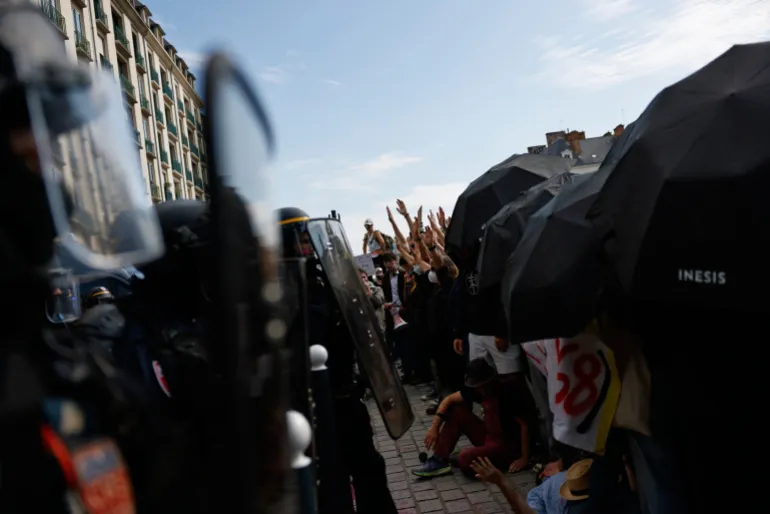
Riot police face students during a protest against under-resourced schools in Rennes, western France, on October 6, 2026 [Jeremias Gonzalez/AP]
What do protesters want?
Students have been protesting over what they say are poor conditions in France’s high schools – or lycees – especially in poorer areas. Protests have been held in Strasbourg, Bordeaux, Nantes, Marseille, Lyon and other towns and cities.
Students say absent teachers are not replaced, dilapidated school buildings are sometimes rodent-infested, there are inadequate tables and chairs, large class sizes and long classroom hours.
The intense heatwave which hit France in the summer exacerbated existing problems in neglected school buildings, which also suffer from a lack of air conditioning, school pupils say.
The protests have coincided with ongoing nationwide public sector strikes over a proposed 2027 cost-cutting budget that aims to achieve 54 billion euros ($61.3bn) in savings as Macron’s government races to bring a large public deficit under control.
Public sector staff and unions object in particular to a government plan to freeze salaries to save about two billion euros ($2.27bn).
Parents are also increasingly present at protests amid widespread anger about the police response to demonstrating minors.
But the protests are happening amid wider discontent over soaring fuel and commodity prices and reduced public spending under Macron.
Government officials have meanwhile accused political opposition groups and unionists of taking advantage of the student movement. Prime Minister Sebastien Lecornu accused political opponents last week of encouraging escalation.
What has happened so far?
At least 6,100 people had been arrested by early Tuesday, many of them under the age of 18, as police tactics come under intense scrutiny.
Serious injuries have also been reported.
A 15-year-old lost a hand in the northern city of Lens on Monday after he reportedly came into contact with a police stun grenade, which then exploded. Public prosecutors say investigations are ongoing into whether the youth actively picked up the grenade or if it landed on him.
Overall, at least 190 high school students have been injured, Education Minister Edouard Geffray said on Monday. On Sunday, he said 78 teaching staff had been injured, and 24 schools had been burned or ransacked.
Some 715 police officers have been injured, according to Interior Minister Laurent Nunez on Tuesday.
Officials said as many as 589 schools have been disrupted this week, down from 735 on Friday last week.
Rights groups, including Amnesty International, have criticised the use of force against minors amid media reports of students being hit with batons and rubber bullets, as well as sprayed with tear gas.
What happened on Tuesday?
Protesters again blockaded schools on Tuesday as thousands demonstrated over their demands.
Placard-waving crowds were reported in southern Marseille, eastern Strasbourg and other major cities.
In Paris’s 20th district, protesters outside the shut Helene Boucher lycee tipped over rubbish bins and bicycles and created a makeshift barricade, The Associated Press news agency reported. Parents, meanwhile, positioned themselves between the demonstrators and police to protect their children.
“They are our children. Teachers, parents, federations, we all share the same goal: the protection of children’s rights, and it is a legitimate right to demonstrate and to make demands,” said Emilia Sichili Suriam, one member of a parents’ association.
Interior Minister Nunez rejected criticism of the police on Tuesday, saying the response has been proportionate in “almost all cases”. He claimed that the protests were transforming into “riots”.
What does this mean for the French government?
These are only the latest in a series of high-profile protests that have marked Macron’s presidency and undermined his government’s reform efforts ahead of elections in April and May.
Macron will not run in next year’s elections, but his image and that of his government have no doubt been tainted by photos of police chasing students in the streets, France expert Jacob Ross, from the German Council on Foreign Relations (DGAP), told Al Jazeera.
“He is not taken seriously any more because many think of him as already out of government,” Ross said of Macron. “But this is still very significant for his government because it has become clear that they don’t have the capacity to calm things down. There’s clearly little fiscal room to manoeuvre.”
Macron’s terms have long been beset by political and financial instability. Successive prime ministers have faced difficulties in pushing through policies in the highly polarised National Assembly where Macron’s centrist Renaissance party and allied blocs lack a majority.
Critics have taken aim at Macron’s deeply unpopular austerity measures, which have seen drastically reduced government spending taking a toll on pensions and healthcare. Officials, however, have defended these policies amid rising debt following COVID-19-era spending.
On Sunday, Lecornu said the government had kickstarted initiatives to address the protesters’ demands and that a report was expected by the end of the month. He, however, added that Paris would not “yield an inch” to violence.
Meanwhile, frontrunner and opposition leader Marine Le Pen of the far-right National Rally party submitted a shadow budget on Tuesday promising 140 billion euros ($157.6bn) in cost savings by 2032 if elected next year.
U.S. Customs and Border Protection (CBP) has retired the last of its P-3 Airborne Early Warning (AEW) aircraft. The AEW version is instantly recognizable from the saucer-like radar dome on top, as seen on other AEW types like the E-2 Hawkeye and the E-3 Sentry. CBP was the only operator of this variant of the P-3 Orion and is said to have been the only law enforcement agency to fly any kind of dedicated AEW plane. The retirement of these aircraft comes at a time when American AEW assets, in general, are under heavy strain by demands globally.
CBP officially retired its final P-3 AEW on September 30, 2026, after a final flight from National Air Security Operations Center Jacksonville (NASOC Jacksonville), in Jacksonville, Florida. CBP has also flown Long Range Tracker (LRT) variants of the P-3, configured for more traditional maritime surveillance missions. The current plans for the LRT aircraft, and whether their sunset may also be on the horizon, are not immediately clear, and TWZ has reached out for more information. Orions of all types have been steadily disappearing from service with the U.S. military and elsewhere across the U.S. government as the aging aircraft become more difficult to operate and maintain.
End of the Road: AMO’s Iconic P-3 Dome Takes Its Final Flight!
On September 30, 2026, the distinct silhouette of a four-engine turboprop carrying its massive rotating radar dome touched down for the final time at the National Air Security Operations Center in Jacksonville.
“Our Jacksonville-based P-3 AEW fleet has served as a cornerstone of America’s outer-layer border security,” according to a brief announcement from CBP about the retirement on social media. “Its crews flew far beyond our borders, providing wide-area surveillance across the Caribbean, Gulf of America [Gulf of Mexico], and the transit zones of Central and South America, helping detect and track threats before they could reach the United States.”
By all indications, including official CBP sources, the P-3 AEW fleet consisted of eight aircraft at its peak. There is a confusingly worded 2014 CBP press release that mentions an “11th and final Lockheed Martin P-3 Airborne Early Warning (AEW) aircraft overhaul,” but that figure looks to also include three of the six LRT versions. The same release says that CBP only had 14 P-3s of all types at that time.
What was then known as the U.S. Customs Service (USCS) first began operating the P-3 AEW version in the late 1980s. The aircraft were converted from second-hand maritime patrol variants of the Orion. The first example had started life as a P-3B for the Royal Australian Air Force (RAAF). Ex-U.S. Navy P-3s were also converted.
A picture of a P-3 AEW in USCS service circa the late 1980s. CBP
The initial three P-3 AEWs were equipped with the AN/APS-138 radar. The same radar was used on early E-2C Hawkeye airborne early warning and control aircraft operated by the U.S. Navy, as well as several other armed forces internationally.
“The Customs Service had previously borrowed U.S. Navy E-2Cs to meet its antinarcotics surveillance requirements, but required an aircraft with longer range and on-station time,” according to a 2006 report from Forecast International. “In June 1989, the U.S. General Accounting Office issued a report on the drug interdiction P-3B AEW aircraft. The findings indicated that the radar performance was as specified, but the P-3B (when compared to the E-2C) was less costly to operate per square mile of area covered because of the higher cruising speed and longer endurance. The P-3B had at least twice the in-flight endurance of the E-2C.”
Starting in the 1990s, USCS began the process of acquiring additional P-3 AEWs with newer AN/APS-145 radars, as also used on later model E-2Cs. The original AEW Orions were eventually refitted with APS-145s, as well. It’s worth noting here that the U.S. Coast Guard separately moved to acquire an AEW version of the C-130H, designated the EC-130V, in the 1990s, which used the AN/APS-125 radar, also used on older E-2s. Budget cuts led to the end of that program. The EC-130V that had been built was redesignated as an NC-130H and subsequently used for test purposes.
A US Navy E-2C Hawkeye. USNThe NC-130H test aircraft with its radar dome still on top. US Military
The P-3 AEWs were also equipped with a sensor turret containing electro-optical and infrared (EO/IR) video cameras, allowing the aircraft to more closely investigate targets spotted on radar. CBP regularly conducted P-3 operations that paired AEWs with LRT variants to provide an even broader array of sensor capabilities on missions. The LRTs have EO/IR sensor turrets, as well as AN/APG-66 and SeaVue radars. The pulse-doppler AN/APG-66 is primarily designed for spotting and tracking aerial targets, and was originally used on early variants of the F-16 fighter. SeaVue is a multi-function type with surface search and synthetic aperture radar (SAR) imagery modes. Images produced via SAR are highly detailed maps of the surface below, and can be captured day or night, and regardless of any cloud cover, smoke, or dust.
Beyond radars and other sensors, the P-3 AEWs also had a robust communications suite consisting of VHF and UHF radios, as well as satellite communications links by the end of their career. CBP’s entire P-3 fleet, including the AEWs and LRTs, has received various updates over the years, including new ‘glass cockpits’ starting in the early 2000s.
CBP Air and Marine Operations: Extended Border Operations
Though primarily employed in support of counter-narcotics interdiction operations, the airborne radar and command and control capabilities were also applied to other missions, including disaster relief and humanitarian assistance efforts at home and abroad. As an example, CBP’s P-3 AEWs helped with air traffic coordination, as well as provided other support, during relief efforts in Texas in the wake of Hurricane Harvey in 2017.
At the same time, CBP’s entire P-3 fleet, including both the AEW and LRT versions, has only been getting increasingly older and difficult to sustain. The P-3B variant first entered U.S. Navy service in the 1960s. CBP did put its P-3s through a Service Life Extension Program overhaul in the 2010s, which included “new wings and tail for each aircraft and completely strips down the aircraft to its bare metal for an inspection,” according to a 2014 press release.
A P-3 AEW seen during a test flight as part of the SLEP overhaul. The aircraft notably lacks its radar dome. CBP
A key question now is how CBP will fill any gaps left by the retirement of the final AEW version. The agency does continue to operate a mix of other crewed fixed-wing aircraft with mixtures of radars and other sensors, as well as MQ-9 drones, but none of these platforms are equipped with a sensor like the AN/APS-145. CBP also has a network of tethered aerostats with radars at fixed sites around the Caribbean. As an aside, General Atomics, together with Saab, is now working on an AEW configuration for the MQ-9B drone, but there are no known U.S. orders for that capability at the time of writing. That platform will not offer the same level of flexibility and look-down capability as modern crewed AEW aircraft, either. Look-down AEW capability is only growing in importance today amid expanding and evolving drone threats, including to the U.S. homeland.
Another look at one of CBP’s now-retired P-3 AEWs. CBP
The Air Force, in particular, is also aiming to eventually push most, if not all, air moving-target indicator (AMTI) tasks currently performed by aircraft like the E-3 and E-7 into space. The service is heavily investing to accelerate the fielding of those capabilities, which could eventually offer revolutionary constant, persistent coverage globally. The first of those satellites are still not expected to reach an early operational state until 2028. It is possible that CBP could get access to a tailored data feed from this system when it does become operational. It still does not obviate the need to have crewed or uncrewed aircraft capable of more closely investigating tracks of interest using EO/IR cameras and other sensors.
Whatever the future might now hold, CBP’s unique time as the operator of the P-3 AEW aircraft has come to an end.
A new series of the Channel 4 competition recently took place in Northern Ireland, concluding with a payment day episode airing on Friday, October 2.
It saw Belfast city-centre luxury apartments owner Melissa criticise Enniskillen hotel owners Shaun and Aoife over their taste in decor. Having walked into her home for the night, she had commented: “It’s nice and bright,” before inspecting the panelling and wallpaper above the bed.
She said: “We’ve got panelling here, an LED light and this pattern here, there’s far too much going on, it’s a bit tacky.” She also rated them a low score of six for facilities, for a lack of fridge and coffee machine in her room.
“That’s disappointing,” the hosts had remarked at the time, before bringing up the issue around the payment day table. “I really hope there is some justification for these comments,” Shaun added.
During Friday’s episode, Aiofe asked Melissa about her “harsh” criticism of the decor, with Melissa replying: “It might have been your personal taste, but you need to keep it as neutral as possible.”
Shaun hit back: “I think the language, dated and tacky… there’s so many words available to us.” Melissa argued: “What I say is what I think.” Another contestant jumped in to say that Melissa didn’t need to use the word tacky, though she stood by her comment, saying she didn’t know what else to use to “describe three different patterns”.
“Busy,” Shaun quickly replied. Melissa said: “Tacky to me, I don’t think it’s that bad of a word.” “It’s too subjective,” Shaun added, saying: “It really undermined the value of the rest of the feedback.”
He went on: “An overall six is a hard score,” saying it was a “strategic” move of Melissa to underpay her competitors. He added to the cameras: “Feeding back in that way, it was low in quality, high in ego and that isn’t a set of characteristics that command respect.”
Melissa meanwhile said: “I never knew tacky was such an upsetting word.” Viewers jumped in to Shaun and Aiofe’s defence, with one writing: “Calling someone’s decor tacky is rude and untrue.”
Another called Melissa “awful” after her comments, while someone else said: “Oh shut up Mel! The decor might not be to your taste but it is not tacky, and a standard white bathroom is not dated. She really rates her own abilities.”
Another said that Mel “showed her true colours”, while someone else said Mel was “desperate to mark every B&B down just so she wins the competition”.
August Hanning’s former chief of staff was also arrested on suspicion of ‘aiding and abetting attempted treason’.
Published On 6 Oct 20266 Oct 2026
Germany’s former foreign spy chief has been arrested on suspicion of espionage and treason, prosecutors have said.
August Hanning, 80, is under investigation for attempted treason and acting as an agent for a foreign intelligence service, the Office of the Federal Public Prosecutor General confirmed on Tuesday.
Hanning was president of Germany’s Federal Intelligence Service between 1998 and 2005.
He was arrested in Bad Toelz-Wolfratshausen in southern Germany. His former chief of staff, partially identified as Manfred D, was arrested in Steinfurt in western Germany on suspicion of “aiding and abetting attempted treason and treasonous espionage”.
The prosecutor’s office said, “On one occasion, Hanning used classified intelligence provided by Manfred D to draft an analysis for an officer of a foreign intelligence service.”
Prosecutors said Manfred D also served as the chief of staff for Hanning’s successors between 2012 and 2026, and used his role to gain access to confidential information which he then passed on to Hanning “in exchange for remuneration”. Hanning then used the information in his private consulting work, prosecutors added.
“The current findings suggest that, over the years, Manfred D provided Hanning with approximately 2,000 documents, many of which contained classified information to be used exclusively by the federal intelligence service for internal purposes, particularly for executive intelligence briefings,” the statement said.
The statement did not reveal who the two men were suspected of spying for or which country the foreign agent worked for, adding that “it has yet to be determined if the material reached the intended recipient”.
German MP Marc Henrichmann told the AFP news agency that Germany “will not tolerate the betrayal of secrets”.
Henrichmann, who chairs the German parliament’s intelligence oversight committee, said, “Whoever allies themselves with the enemies of our liberal democracy will be found out.”
The premises of Manfred D and Hanning were being searched in several locations, including in the capital, Berlin.
Spain is moving ahead with plans to rebuild its airborne signals intelligence (SIGINT) capability, with the Airbus A321 — part of the highly successful A320 twin-engine airliner family — selected as the basis for three new SIGINT aircraft.
The choice is disclosed in the latest issue of Spain’s Revista de Aeronáutica y Astronáutica, the Ministry of Defense’s official publication. Airbus and Indra are currently working on the program’s conceptual design under the Santiago II initiative, which aims to deliver a crewed platform capable of collecting and processing intelligence across the electromagnetic spectrum.
The program is intended to restore a capability Spain lost when its last Boeing 707 SIGINT aircraft was retired in 2014. Equipped with Israeli SIGINT equipment, this 707 was designated TM.17-4 in Spanish service, and nicknamed Reina del Espectro (Queen of the Spectrum).
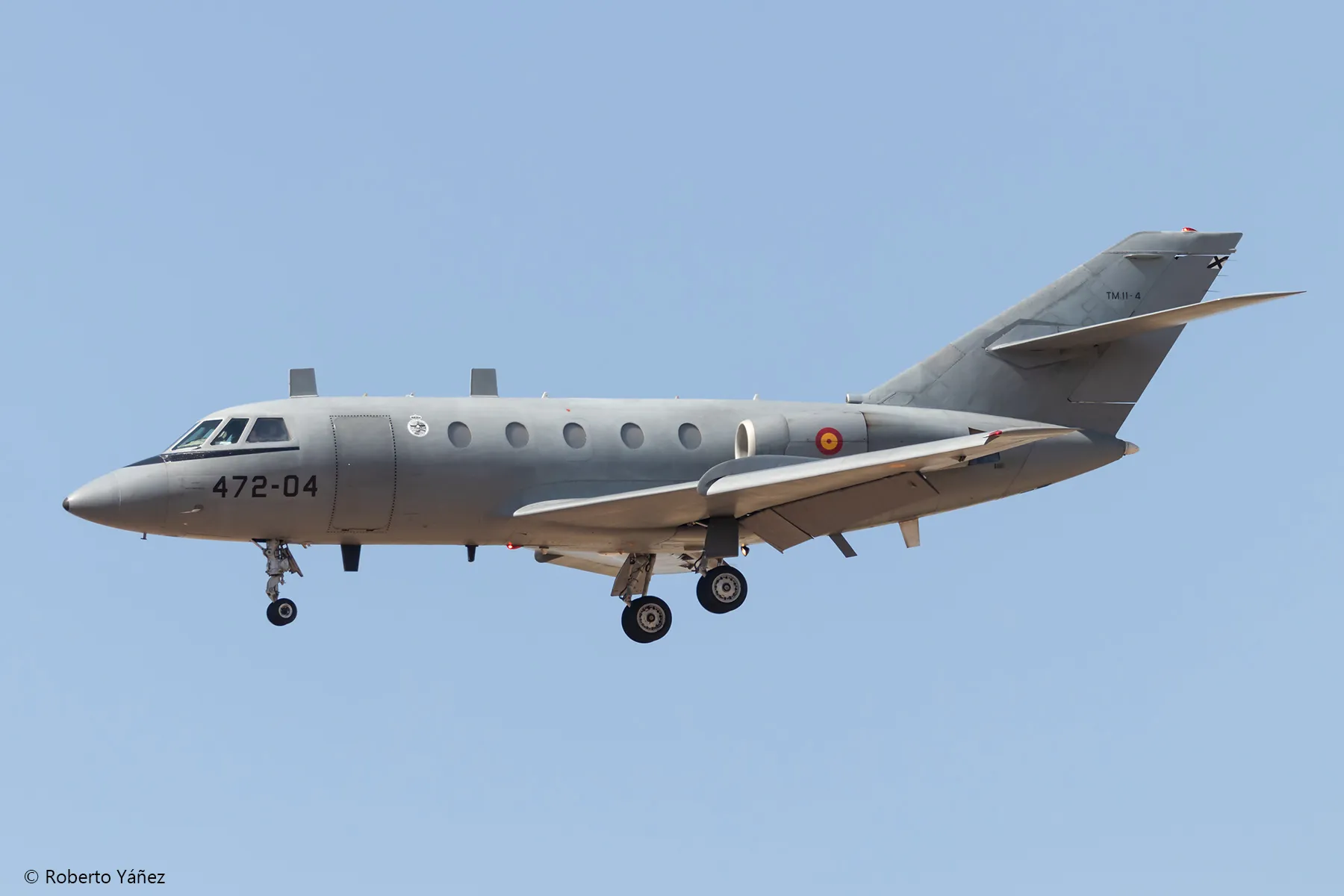
It served in the 47th Mixed Air Force Group, alongside four Dassault Falcon 20s (designated TM.11 in Spain), that were used for navigation aid calibration, remote sensing, and electronic warfare training.
A Spanish Air Force Falcon 20 EW. Roberto Yáñez/Spanish Air and Space Force COPYRIGHT ROBERTO YANEZ
The new aircraft will have to undergo extensive modification, including the installation of antennas, receivers, signal-processing equipment, operator consoles, communications systems and associated electrical and cooling infrastructure.
Indra is expected to provide much of the mission-system architecture. The company’s AirSign concept, unveiled in 2023, incorporated COMINT and ELINT sensors alongside data fusion, real-time signal analysis, communications, and command-and-control functions.
An earlier Airbus concept for a multi-mission A320neo family, including an AEW&C version with conformal radar arrays, a SIGINT platform, and a VIP jet. Airbus
While COMINT is concerned primarily with collecting intelligence from communications, ELINT focuses on non-communications electromagnetic emissions, including radar signals. Together, these capabilities provide a much fuller intelligence picture of not only what the enemy is doing in terms of their electronic emissions, but what they are planning, and their processes of operation.
Bizjets have become the platform of choice for many new intelligence aircraft, particularly where operators want a relatively low-cost, long-endurance platform with a smaller logistical footprint. Aircraft such as the Bombardier Global 6000/6500, Gulfstream G550, and Dassault Falcon 8X have been adapted for electronic intelligence and special-mission roles.
An Israeli Air Force Nachshon Oron multi-missionintelligence-gathering aircraft, based on a Gulfstream G550 airframe. Israeli Air Force
Spain’s decision to use the substantially larger A321 points instead toward the other end of the spectrum, providing significantly more room for antennas, processing hardware and crew, and allowing the aircraft to carry a much larger and more power-hungry mission system than the typical bizjet-based SIGINT platform.
At one time, the A321 was envisaged as the platform for NATO’s Alliance Ground Surveillance (AGS) system, which provides the alliance with reconnaissance capabilities, including synthetic aperture radar. However, this capability was eventually fielded on NATO’s fleet of five RQ-4D Phoenix uncrewed aerial vehicles, specialized versions of the Global Hawk.
Early concept artwork showing an A321 equipped with NATO’s Alliance Ground Surveillance (AGS) system. NATO
Elsewhere in Europe, Airbus launched a risk-assessment study for France’s future maritime patrol aircraft (MPA), also to be based on an A321 platform. Billed as a “flying frigate” by the company, the new MPA is intended to replace the French Navy’s Dassault Atlantique 2 fleet and emerges at a time when NATO nations are increasingly adopting the in-production Boeing P-8 Poseidon for their maritime patrol requirements.
A rendering of the A321 MPA, France’s future maritime patrol aircraft. Airbus
Airbus does, however, have relevant experience in the conversion of airliners for military roles. The company’s A330 Multi-Role Tanker Transport (MRTT) aircraft are modified at Airbus’s Getafe facility, providing an existing industrial base for converting commercial-derived aircraft into specialized military platforms.
The A330 Multi-Role Tanker Transport (MRTT) conversion line at Airbus’s Getafe facility in Spain. Airbus
The Santiago II program is currently in its definition phase. Spain awarded Airbus and Indra a €16-million ($17.9-million), 18-month contract to study the platform and define the overall system. A subsequent phase will cover modification and integration of the three aircraft. The Spanish Ministry of Defense estimates the complete program at approximately €436 million ($489 million).
The program also has an industrial objective. Spanish authorities want domestic industry to acquire expertise and control over the integration of the SIGINT system, rather than simply purchasing a finished foreign intelligence aircraft.
The A321-based Santiago II fleet is intended to address the shortfall left by the retirement of the specially modified Boeing 707, providing a substantially more modern platform, and with more airframes for improved availability.
The three new aircraft will also complement Spain’s emerging uncrewed SIGINT capability. The Spanish Air and Space Force is introducing the L3Harris Scalable Open Architecture Reconnaissance (SOAR) system on its Predator B drones, giving the fleet ELINT and COMINT collection capabilities. The two systems are likely to fill different niches: the Predator B offers a relatively persistent, lower-cost uncrewed collection option, while the much larger A321 will provide substantially greater payload capacity, onboard processing, and crewed mission-management capabilities. Together, they will give Spain a layered airborne SIGINT architecture.
A Spanish Air and Space Force Predator B. Luis Alfonso Hernández Carrón/Spanish Air and Space Force A.Trigo
Spain’s decision also reflects a broader drive to invest in long-range SIGINT platforms capable of collecting, processing, and fusing vast amounts of electromagnetic data, as competition over the electromagnetic spectrum becomes increasingly central to modern warfare.
If the program remains on schedule, three heavily modified A321s will eventually provide Spain with a persistent airborne capability to detect, classify, locate, and analyze electromagnetic emitters in support of a host of operations. Especially when paired with the Predator B, the capability will likely be of considerable interest to other NATO partners in Europe, too.
Macklemore’s replacement as the warm-up act for Ed Sheeran’s under-fire tour has come to lightCredit: GettyThe US leg of Ed’s Loop tour has been shrouded in controversy relating to politicsCredit: Getty
Billionaire businessman Robert Kraft banned the American musician, real name Benjamin Haggerty, from his stadium after he made a speech on stage in support of Palestinians amid the ongoing conflict with Israel.
At the time, Robert deemed his words “hate speech” and the move sparked a mass exodus of support acts who all quit 35-year-old Ed’s tour in solidarity with the Thrift Shop hitmaker.
Sign up for the Showbiz newsletter
Thank you!
Ed continued to perform alone, but he has now been joined by surprise guest, The Fray’s Isaac Slade.
The rock band’s former frontman, 45, opened proceedings at Atlanta’s Mercedes-Benz Stadium on Saturday, with his band’s hits, which included How to Save a Life and You Found Me.
The Fray’s Isaac Slade was Ed’s opening act in AtlantaCredit: GettyIsaac addressed the ‘wrong’ situation in Gaza life on stageCredit: Nick Ray – The TimesSinger Ed made it clear that he was not personally responsible for Macklemore’s departureCredit: ReutersThe pair have been pals for 13 yearsCredit: AFP
Despite politics taking precedence over performances during the Loop tour, Isaac had his say.
He told fans: “What’s happening over there [in Gaza] is wrong, but if we’re going to get through it, we’re going to need people to step into that middle place, that common ground.
“That bonfire in the middle of the field that sees both sides, that understands that peace is not a lack of conflict. Peace is not a blank canvas that we need to guard and be polite.”
“[Peace] holds enough beauty, enough tragedy, enough sorrow, enough joy and life if we learn how to integrate it and hold each other in balance.
“We will find a way through this together”.
It isn’t the first time that Isaac, who quit The Fray in 2022, has appeared on the tour.
He also took to the stage in Toronto in August.
Following the Macklemore controversy, which saw Billie Eilish‘s brother Finneas, Irish acts Aaron Rowe and Beoga, and Danish pop star Lukas Graham withdraw in solidarity, Ed spoke out.
Ed insisted in a statement that he would not be drawn on voicing his own views on the Israel/Gaza conflict publicly but is committed to ensuring his gigs are a place of “safety and sanctuary” for people from all ethnicities, faiths and backgrounds.
He also made it clear that he was not personally responsible for Macklemore’s departure and had been trying to find a solution with promoters and billionaire Robert, who owns Massachusetts‘ Gillette Stadium.
New England Patriots owner Robert had accused Macklemore of having a “broader history of antisemitic rhetoric and imagery that we believe has been deeply offensive and hurtful to the Jewish community”.
It was Macklemore declaring “Free Palestine” ahead of his protest song Free Hind’s Hall, written about pro-Palestinian protesters at Columbia University, which sparked the controversy.
In his own statement, Macklemore insisted his stance was a “criticism of apartheid and genocide” and not of the Jewish people.
Ed wrote on social media: “Macklemore coming off tour was the promoter’s decision, it was not mine.
“I would never let down the fans who had made plans, nor would I abandon the touring crew and the other support acts and musicians who rely on me for work and to make a living.”
He added that fans at his shows did not want a “political forum” and that despite his apolitical stance he is “not complicit”.
Ed and Macklemore’s friendship goes back 13 years and the latter said he hoped it would continue despite them having had “difficult conversations”.
The other acts also highlighted their friendships with Ed and their gratitude for being given the opportunity to perform on such a high-profile tour, but said they could not continue with clear conscience knowing a fellow artist had been “silenced”.
Over the course of Sunday, a dozen B-1B bombers took off from Royal Air Force (RAF) Fairford in western England and flew home to the United States. Their departure abruptly ended the base’s role as a launchpad for US strikes on Iran, which began on February 28.
The base, roughly 160km (100 miles) west of London, is the US Air Force’s only European airfield for heavy bombers and a key forward operating location for deployed bombers.
Over the past two weeks, six people were arrested on suspicion of “terrorism”. They were all released on bail.
US President Donald Trump said on Monday the bombers were moved because “there were some threats”, which he believed were linked to Iran. “So we moved them around a little bit, not very far,” he told reporters at the White House.
Hours earlier, US Secretary of State Marco Rubio played down any link to the alleged plot, saying it was “not unusual to see rotations happen” and that he had confidence in the security of US bases.
What happened at RAF Fairford?
On September 27, police arrested five men on suspicion of plotting to plant explosives near Fairford in the United Kingdom. They were released on bail a day later.
Investigators found petrol but no explosive devices in their vans, though UK officials say the men remain under investigation. On Thursday, police arrested a 25-year-old UK-Iranian dual national in London on suspicion of plotting an attack on the airbase. He was also released on bail on October 3.
UK Prime Minister Andy Burnham suggested that “Iran played a part” in the alleged plot but declined to give details. Iran has denied any such scheme and summoned the UK ambassador in Tehran in protest at the arrests.
What bombers does the US have?
The US Air Force flies three types of bombers, with a fourth on the way.
The B-52 Stratofortress is the oldest. The B-52H model currently in service was built in the early 1960s. With a wingspan of 56 metres (185 feet), it is the largest US bomber and can carry about 31 tonnes of weapons, including nuclear bombs and cruise missiles.
A B-52 Stratofortress takes off from RAF Fairford on March 19, 2026 [Leon Neal/Getty Images]
The B-1B Lancer, which entered service in the mid-1980s, is the fastest of the three. It can reach 1.2 times the speed of sound and has a swing-wing that sweeps back for high-speed flight. It carries the largest conventional payload, about 34 tonnes, but no longer carries nuclear weapons. These were the aircraft that left Fairford.
The B-2 Spirit is a flying-wing stealth bomber designed to slip past air defences. Only 20 were built, of which 19 remain in service. It can carry both nuclear and conventional weapons, including the 13,600kg (30,000lb) “bunker buster” bomb used in US strikes on Iran’s nuclear sites in June 2025.
The B-21 Raider, a smaller stealth bomber, is still in flight testing, and it remains on track for delivery in 2027. Over the next decade and a half, the air force plans to replace the B-1B and B-2, leaving a future fleet of B-21s and upgraded B-52s.
The B-21 Raider, a new high-tech stealth bomber developed for the US Air Force, is seen in an undated photograph in Palmdale, California, US, released on December 2, 2022 [Handout/US Air Force via Reuters]
Where do these bombers fly from?
All US bombers are permanently based in the US, at five main airbases:
B-52H: Barksdale Air Force Base in Louisiana and Minot Air Force Base in North Dakota
B-1B: Dyess Air Force Base in Texas and Ellsworth Air Force Base in South Dakota
B-2: Whiteman Air Force Base in Missouri
B-21: Due to arrive at Ellsworth in South Dakota in 2027
All of these bases have long, wide runways, typically exceeding 10,000 feet (3,048 metres).
That makes bomber runways about as long as those at a big international airport. What limits where bombers can operate is not tarmac but security, weapons storage and support.
For missions abroad, the US rotates bombers through a handful of forward bases. Other important overseas operating locations include Andersen Air Force Base in Guam and Diego Garcia in the Indian Ocean.
Beyond these, the air force sends small groups of bombers to allied airbases for a few weeks at a time, in what it calls Bomber Task Force deployments. Recent rotations have included B-52s at Moron in Spain, B-1Bs at Orland in Norway and Misawa in Japan, and B-52s at Tindal in northern Australia, which arrived in September.
The bombers can also go on a strike mission from the US with the help of aerial refuelling. Bomber missions during the US-Israel war on Iran lasted more than 30 hours there and back. Each group of three bombers needed six to nine tanker aircraft to refuel them along the way.
This image released by the US Navy shows an aerial view of Diego Garcia [File: US Navy via AP]
The Saudi-backed Yemeni forces battling the Iranian-backed Houthi rebels claim they have regained a large swath of territory in a new counteroffensive launched on Monday. This includes the recapture of the Red Sea port city of Mokha and other key positions near the highly-strategic Bab al-Mandeb Strait (BAM). As we reported last month, the Houthis had taken these areas during an offensive of their own.
“On Monday, the Nation Shield Forces, the Giants Brigades, and the Tihama Resistance—supported by the Popular Resistance—seized control of the city of Al-Mokha in western Taiz Governorate following fierce battles against the terrorist Houthi militias backed by the Iranian regime,” the official Yemeni Saba news outlet reported. “The forces, aided by air support, succeeded in capturing Al-Mokha after clashes with the terrorist Houthi militias, which had controlled the city since early last September. The battles, which took place at various locations surrounding Al-Mokha, involved the use of diverse weaponry and resulted in casualties among the terrorist Houthi militias, the capture of several of their members, and the flight of others.”
Dubbed Operation Yemen Dawn, the counteroffensive aims to “restore state institutions, liberate the capital Sana’a, and end the Houthi terrorist militia coup,” Rashad al-Alimi, president of the internationally recognized government of Yemen, stated Monday on X.
“With God’s aid, the will of our people, the valor of our armed forces and all military formations, and the support of our brothers and friends, Yemen will march toward a new dawn of freedom, peace, and stability,” al-Alimi added.
على بركة الله، انطلقت عملية “فجر اليمن” لاستعادة مؤسسات الدولة، وتحرير العاصمة صنعاء، وإنهاء انقلاب الميليشيات الحوثية الإرهابية. بعون الله، وإرادة شعبنا وبسالة قواتنا المسلحة وكافة التشكيلات العسكرية، ودعم أشقائنا وأصدقائنا، سيمضي اليمن نحو فجر جديد من الحرية والسلام والاستقرار. pic.twitter.com/bP1h9EVdu2
The claims about the recapture of Mokha follow statements made earlier on Monday that the National Shield Forces and Giants Brigades, “liberated Dhubab [also spelled Dhobab] District and strategic positions around the Bab al-Mandab Strait in western Taiz Governorate on Monday following clashes with Iran-backed Houthi militias,” Saba claimed. “The clashes left a number of Houthi fighters dead or wounded, while others fled under pressure from the military operation. Several military vehicles and pieces of equipment were also destroyed or disabled. The forces are continuing clearance and security operations in the liberated areas and cutting Houthi supply routes.”
In addition, the Kingdom’s Maj. Gen. Turki al-Maliki, spokesman for the Saudi-led coalition, stated that “100 fighter jets were providing support to the forces of Yemen’s internationally recognized government fighting against the Houthis,” according to The Associated Press. “He said the coalition has secured ‘air protection’ of the strategic Bab el-Mandeb Strait and destroyed hundreds of Houthi targets as part of the ongoing campaign.”
After Yemeni officials announced the new counteroffensive on Sunday, al-Maliki vowed “full operational support” to the Yemeni government forces, until the Houthis are “eliminated,” the AP added.
On Monday, the Humanitarian Operations Coordination Center (HOCC), an organization closely aligned with the Houthis, confirmed increased Saudi airstrikes and threatened a response. HOCC warned “all airlines operating in Saudi airspace that it is unsafe, with the exception of the airspace over ‘Mecca and Medina,’” the official Houthi Telegram channel reported.
HOCC did not elaborate on that warning.
While TWZ cannot verify these claims, independent Yemen analyst Mohammed al-Basha said it appears that the anti-Houthi forces have gained ground on the Red Sea coast.
The founder of the widely quoted Basha Report stated on X that he had “high confidence” that Yemeni government forces recaptured Dhobab Airport, “cutting off the Houthi supply route between Mocha and Bab al-Mandab.” He added that “Southern Giants Forces are now heading towards the city of Dhobab, Al-Omari Camp, and Bab al-Mandab.”
بثقة عالية الساعة العاشرة صباح الاثنين ٥ أكتوبر استعادة مطار ذوباب وقطع طريق إمداد الحوثي بين المخا وباب المندب قوات العمالقة الجنوبية الان تتجه نحو مدينة ذوباب ومعسكر العمري وباب المندب https://t.co/6eHYJ3cnza
Videos have emerged showing what appears to be Saudi-backed forces running over Houthi fighters. The Houthis have called this a war crime.
Several videos emerging of Saudi-backed government forces driving over and shooting fleeing Houthi fighters caught off guard by their offensive in southwestern Yemen.
Amid the spike in fighting, the State Department issued a new warning to Americans in Saudi Arabia.
“Due to the ongoing security situation in Saudi Arabia and the potential for aerial drone or missile attacks on Saudi Arabia, the U.S. Mission strongly encourages all U.S. citizens to remain vigilant and follow the guidance of national alerts released by Saudi Arabia’s Civil Defense,” the department stated on X.
Saudi Arabia: Due to the ongoing security situation in Saudi Arabia and the potential for aerial drone or missile attacks on Saudi Arabia, the U.S. Mission strongly encourages all U.S. citizens to remain vigilant and follow the guidance of national alerts released by Saudi… pic.twitter.com/QzVaER1WZ8
Yemen Dawn was launched in the wake of large-scale Houthi advances. As we noted earlier in this story, the rebel group captured the port of Mokha and two key islands in the Red Sea, increasing its control over the Bab al-Mandab Strait (BAM). That moved the front lines to the key city of Taiz, which sits astride a major roadway linking it to the port city of Aden. The Houthis recently captured strategic hilltops near Taiz, advancing on the last road between the city and Aden, which serves as the interim capital of the Yemeni government.
The conflict between Saudi Arabia and the Houthis grew out of a civil war in Yemen that erupted in 2014. It expanded a year later when a Saudi-led coalition joined forces with the government ousted by the Houthis and raged on until the parties reached a tenuous ceasefire in 2022. The Saudis held off on getting involved in the recent Red Sea conflict which saw the U.S. and coalition warships duking it out with the Houthis, and eventually led to a U.S.-led air campaign over Yemen. Tensions, however, reignited after that conflict ended when the Houthis joined the U.S.-Iran conflict on the side of their major supporter.
Earlier this year, the Houthis imposed a blockade on the BAM and began striking Saudi ships in the southern part of the Red Sea as well as targeting critical energy terminals on that body of water and Saudi refineries. Iranian proxies have also struck the vital East-West pipeline that carries oil to the Red Sea to bypass the Strait of Hormuz, where Iran has vastly curtailed shipping after the launch of Operation Epic Fury. That line has reportedly since reopened after being shut down following a long-range drone attack.
Bab al-Mandab Strait. (Google Earth)
On Monday, Turkey and Pakistan said they will undertake a “rapid deployment” of troops to Saudi Arabia under the Mecca Joint Defense Agreement, a pact designed to assist the Kingdom’s fight against the Houthis, the Middle East Eye reported.
“The announcement on Monday came after representatives of the three countries held an emergency meeting in Riyadh where they condemned recent attacks on Saudi Arabia, in particular those targeting the holy cities of Mecca and Medina, without mentioning the Houthis by name,” the publication added.
Concern about maintaining the flow of energy resources from the region has spurred France and the U.K. to send additional forces to help the Saudis.
You can see Macron’s announcement in the following video.
Nous agissons pour protéger nos compatriotes des conséquences de la crise au Moyen-Orient. Objectifs : sécuriser les approvisionnements et faire baisser les prix à la pompe. pic.twitter.com/kvrgHcV4E4
The U.S. also appears to be increasing its assistance to Saudi Arabia. Though President Donald Trump turned down the Kingdom’s request to directly attack the Houthis, the U.S. is “providing aerial refueling for Saudi warplanes conducting defensive air patrols,” The New York Times reported on Sunday. That’s in addition to the previously known assistance to Riyadh provided by “more than 200 U.S. intelligence and military analysts working in Saudi command centers helping to analyze and select targets in support of its Yemeni allies,” the newspaper added.
The stark reality, especially facing European leaders like Macron, is that if Saudi oil infrastructure and transport nodes near the Red Sea are destroyed or the pipeline that feeds them is shut down for months, the last major oil lifeline from the region — and especially to Europe — will be closed off, sparking a deeper energy crisis.
Iran has already severely curtailed the flow of oil through the Strait of Hormuz since the U.S. and Israel attacked it on Feb. 28. The movement of oil has been further impeded by a U.S. blockade on Iranian ports. However, transits have been increasing as of late, thanks in large measure to U.S. military escorts that U.S. Central Command claims have allowed more than a billion barrels of crude to pass through the Strait of Hormuz.
Still, the price of Brent crude continues to hover over $100 per barrel due to a combination of factors that still make this a very dangerous region. This includes the ongoing threats from the Houthis in the BAM and the aforementioned spike in fighting between the Houthis and Saudi-backed forces. In addition, there are continuing Iranian attacks on shipping, including one today and three over the weekend, the skyrocketing cost of insuring vessels and the possibility Gulf countries may be paying Iran to allow their oil through. Such payments, essentially a toll, are “potentially handing Tehran a significant portion of the value of the cargo,” Al Jazeera noted.
Asked about the Saudi-backed counteroffensive, Trump said “It will all work out very well.”
Question: What’s your view on the Saudi and Yemeni counter attack against the Houthis?
Meanwhile, talks between the U.S. and Iran to end hostilities between the countries remain at an impasse, though the two sides have not directly attacked each other in weeks. The U.S. rejected Iran’s conditions for reopening the Strait of Hormuz, and Tehran says it is preparing a reply to the U.S. counterproposal, CBS News reported Monday morning.
For his part, Trump continues to waver, suggesting the U.S. could “leave tomorrow” or resume striking Iran.
It is far too early to tell whether the new Saudi-backed counteroffensive in Yemen will have any lasting effect on the battlefield. The coalition arrayed against the Houthis isn’t known to be highly robust and the quality of its forces have been in question. Still, it has been clear that the Saudis and their allies had to act strongly, and this would be exactly that.
The documentary is now available to stream on BBC iPlayer, but there is a strong viewer warning
The BBC documentary has been dubbed a hard watch as it hears from family and friends including Tunde Taylor (Image: BBC/Optomen TV)
BBC viewers have struggled to watch a heartbreaking documentary that they say “cuts deep” as a strong warning has been issued.
Just last night (Monday, October 5), BBC Two took viewers back to 2000 in a cast that shocked the UK. Damilola Taylor was just 10 years old when he was stabbed and killed in what became one of the country’s most high profile killings.
He was stabbed in the leg just metres from his home whilst leaving an after school club. For the first time for some, Damilola’s friends and family speak out about that tragic event, sharing previously unheard testimony, including that from Star Wars actor John Boyega.
Damilola: The Untold Story revisits the young boy’s killing, 26 years on as it premiered on BBC Two last night (October 5). However, for those that missed it, it can be streamed on BBC iPlayer, but viewers have warned it is a hard watch.
Taking to X, one person wrote: “I watched the documentary on bbc (yes bbc) on the senseless murder of Damilola Taylor, Rip poor little lad, heart breaking, although the documentary was focal on Damilola and the those immediately impacted, it also drew the lens back to show the amount of kids murdered.”
Another said: “I’m not sure I have it in me emotionally to watch this Damilola Taylor documentary”, as a third admitted: “That Damilola Taylor documentary is so heart wrenching.”
A fourth added: “This Damilola Taylor documentary cut deep. Imagine stabbing a 10 year old innocent boy and leaving him to bleed to death. Those two brothers are evil with so much hate in their hearts.”
A fifth replied: “It was a very hard watch. I had to pause a few times. RIP Damilola, Mr Richard and Mrs Grace Taylor.” Another penned: “The ending of the Damilola Taylor documentary, I can count my family members and school friends in that montage of lost souls. I started watching the doc as a mother, ended it as a child, if that doesn’t speak to the cycle… and its longevity then idk what does.”
Taking to TikTok to share the recommendation, one true crime fan admitted it was a “heartbreaking watch”, adding: “Be warned because it’s quite shocking.”
One person replied: “Just watched this last night… so sad.” Another commented: “Absolutely heartbreaking you’re right, so incredibly sad.” A third wrote: “This will be a hard watch.”
Taking viewers back to the final 24 hours of his life, the documentary also explores the years it took to bring a conviction. Two brothers, who were themselves aged 12 and 13 at the time, were convicted of manslaughter.
An official synopsis reads: “Made 26 years after the murder of 10-year-old Damilola Taylor shocked Britain, this documentary returns to his story with new testimony that sheds fresh light on what happened to him.
“Actor John Boyega, who was eight when Damilola died and was one of the last people to see him alive, joins Damilola’s childhood friends to return to his final months and the years of youth violence that followed his death.”
Damilola: The Untold Story can be streamed on BBC iPlayer
London, United Kingdom– At a meeting organised by a Muslim group in London ahead of a closely watched by-election, candidates from the Green and Liberal Democrat parties made their cases to residents beside empty seats. Their Labour and Conservative peers did not turn up.
Labour candidate Sagal Abdi Wali, a Somali-Muslim woman, told The Guardian she did not attend because she had a prior obligation and the invite had come too late. But the organiser, the Camden Muslim Network, pushed back, saying that she was invited earlier.
Recommended Stories
list of 3 itemsend of list
Fifteen candidates are in the race for former Prime Minister Keir Starmer’s old seat, including Green Party leader, Zack Polanski, who hopes to become a member of parliament.
Since the seat was created in Holborn and St Pancras in 1983, the Labour Party has held it. Starmer was first elected in 2015 and held it until his resignation, which triggered the by-election.
At the meeting, the conversation ranged from local issues such as housing to Israel and Palestine.
Lib Dem candidate Patrick Stillman said his party had long called for Palestinian statehood but would not support a full boycott.
But Polanski had a different opinion.
“I think the Labour government’s position is deeply cynical to apologise over Gaza, to recognise that mistakes have been made but to continue to sell arms to Israel, a country that’s committing a genocide,” he said to applause, adding that his party, which recently voted to describe Zionism as racism, supports a full boycott.
‘Vote Palestine’
In leaflets sent to constituency residents, the Green Party focused on Abdi-Wali’s time as a Labour councillor and, more recently, as leader of Camden council – a role she secured in May.
One reads: “Bring change, Replace Labour, Vote Green”. On its reverse: “Every single Camden Labour councillor refused to sign the Palestine solidarity pledge or support pension fund divestment. Only Greens continue to stand firm on Palestine.”
Last month, Abdi-Wali spoke to the Camden New Journal, a local newspaper, about Gaza and the Green Party’s leaflets.
It was “obviously inaccurate” to say the Labour council did not feel strongly about the issue, she told the paper. “I want to focus on making sure that we’re able to put the message of what [Foreign Secretary] Ed Miliband is now doing with the government and on Palestine and Israel and Gaza and the West Bank.”
In January, Camden Friends of Palestine (CFOP), a local group that formed in response to Israel’s genocidal war on Gaza, presented a petition to the local council with 4,000 signatures calling for the council to divest its pension fund from companies involved in Israel’s actions in the occupied Palestinian territories.
Abdi-Wali, then a Labour councillor, did not support the motion. Rather than committing to divestment, most councillors voted to refer the question to the pension board for review.
“My impression of her and her politics is that she’s just really incredibly silent on everything, if there isn’t a career motive for her, and that’s kind of disappointing,” said 38-year-old Shadin, a resident and CFOP organiser, who plans to vote for Polanski.
“Watching a livestreamed genocide has made a lot of people that I know … disengage from mainstream politics or parliamentary politics”.
Like many London constituencies, a key issue is housing.
According to a “2026 state of the borough” report by Camden council, 8,380 households were on the waiting list for social housing at the end of March 2025, “an increase of 9.5 percent on the year before.”
On Friday, in the constituency’s more affluent area of Primrose Hill, one resident said they would vote for Labour in the upcoming election, while another believed that regardless of who wins, life will not change.
In Camden, another resident told Al Jazeera that while they live in the area, they were not aware of the election, as Labour canvassers buzzed to gain entry into a nearby estate in the background.
As both parties make their final efforts to secure victory, recent polls predict a close race.
In the 2024 general election, Starmer won the seat with 49 percent. Andrew Feinstein, a pro-Palestine independent candidate came second, with 19 percent. The British gambling firm Ladbrokes and Stats for Lefties, which examines polling, both predict Labour will win.
United States President Donald Trump has approved the death by firing squad of Nidal Malik Hasan, a former army officer convicted of carrying out a 2009 mass shooting at Fort Hood, an army base in Texas.
The move, if it proceeds, will revive executions in the army, which has not carried one out since 1961.
Recommended Stories
list of 4 itemsend of list
Death sentences, as well as executions in the US military, are rare and require presidential approval.
Under the army’s code of military justice, premeditated murder does carry the death penalty, but the process is often strict and prolonged.
However, the Trump administration has shown more willingness to seek death penalties for serious crimes, including against civilians.
Here’s what we know about the case:
What is the presidential order?
Defense Secretary Pete Hegseth had initially recommended an execution order for Hasan, and Trump has now approved it, according to an X statement posted by Pentagon spokesperson Sean Parnell.
Parnell said the time and date of the execution will be set by Army Secretary Adam Telle, who is serving in an acting capacity.
“Judgement day for Hasan has finally come,” he wrote.
What happened at Fort Hood?
On November 5, 2009, the US-born army major, Hasan, a psychiatrist in the force, walked into an army processing centre in Fort Hood, shouted “Allahu Akbar” (God is great) and opened fire on fellow staff members waiting to get medical attention.
Thirteen people were killed, including a pregnant soldier, and 32 others were wounded during 10 minutes of shooting. Analysts have called it the worst shooting at a US military base targeting members of armed forces.
Hasan was shot several times after two officers engaged him and remains paralysed from the waist down.
What happened during the trial?
Hasan was immediately court-martialled, and military prosecutors, from the start, sought the death penalty against him.
However, the process would play out over the course of several years even after his conviction – largely because the US military is averse to capital punishment.
During the trial, Hasan represented himself and admitted to the attacks, saying he was trying to stop deployments to Afghanistan and the killing of his fellow Muslims. He was due to be deployed weeks later.
Investigations revealed Hasan had exchanged emails with Yemeni-American scholar Anwar al-Awlaki, accused of ties to al-Qaeda, before the shooting. He had also repeatedly voiced opposition to the US wars in Iraq and Afghanistan to colleagues and the treatment of Muslims in the army.
Hasan made little effort to defend himself, and his assigned lawyers claimed his testimony aided the opposing side.
He was charged and convicted on 13 counts of premeditated murder in 2013, and jurors recommended the maximum sentence of death. Controversially, Hasan was charged with “workplace violence” because the military justice code does not address the crime of “terrorism”.
The judgement was further delayed by appeals mandated by the military, not because Hasan sought them.
In 2020, the US Army Court of Criminal Appeals upheld the death penalty for Hasan, and in 2023, the US Court of Appeals for the Armed Forces did the same. In March 2025, the US Supreme Court denied a mandatory petition for a judicial review.
In September 2025, Hegseth announced he was seeking presidential approval for Hasan’s execution.
At the time, there was no report of Hegseth specifically seeking death by firing squad.
The president holds the ultimate authority to specify the designated method of execution.
Other forms of execution could have been lethal injection or hanging, which the US military has used in the past.
What next?
While Trump’s approval will begin a series of steps towards preparing for the execution, Hasan can still put the process on hold for years with an appeal in the civilian federal court system.
However, that might be unlikely as Hasan made no effort to defend himself during the trial.
He has been remanded to the US Disciplinary Barracks at Fort Leavenworth in Kansas, where three other men have also been on the military death row for years.
Among them is Hasan Akbar, convicted of two counts of murder after attacking fellow army members on a Kuwait base in 2003, during the invasion of Iraq.
Another is the convicted serial killer and rapist Ronald Gray, who was found guilty of four counts of murder and eight counts of rape in 2008. He was approved for execution in the same year under President George W Bush, but the process was put on hold by a judge.
Timothy Hennis, a former sergeant, was convicted in 2010 of a triple murder and is also on death row.
The last military execution took place in 1961, when former soldier John Bennett was hanged for the rape of an 11-year-old girl.
For My Sister Nicole: Love Shouldn’t Hurt — What to Know About Domestic Violence
By Denise Brown Blackstone Publishing: 240 pages, $30
If you buy books linked on our site, The Times may earn a commission from Bookshop.org, whose fees support independent bookstores.
Nicole Brown Simpson wore a long-sleeved cover-up by the beach, despite the warm weather. “We kept telling her, ‘C’mon, get in the water.’ She wouldn’t,” Denise Brown recalls of a Hawaiian vacation with her sister, Nicole, and the rest of her family, including her brother-in-law, O.J. Simpson. “We didn’t know it then, but he’d beaten the [hell] out of her the night before in the hotel room. We found out later, after she was killed, when we were reading her diaries.”
The incident is one of many chronicled in Brown’s new memoir, “For My Sister Nicole: Love Shouldn’t Hurt.” The book chronicles who Nicole was — from her happy SoCal childhood to meeting beloved celebrity and football star Simpson at the age of 18 (he was 30) to the physical and mental abuse she suffered over seven years of marriage. Brown also reveals the troubling incidents she witnessed behind the scenes, and pairs them with the knowledge she has now of what could have been done to help her sister.
(Blackstone Publishing, Inc.)
Nicole and her friend Ronald L. Goldman were murdered outside her Los Angeles home in Brentwood in June 1994. The brutal homicides set off a media frenzy, and overnight, Brown became the voice for her slain sister.
Images of an angry and sobbing Brown became the media’s hallmark of grief during the criminal trial, particularly when Simpson was acquitted in 1995. He was found guilty in a subsequent civil trial, yet still awarded custody of the divorced couple’s two children.
Now, 69, with sleek silver hair and a voice raspy from the many speaking engagements tied to her advocacy work, Brown has devoted her life to raising awareness about domestic violence. “It’s too late for Nicole,” says the former model who moved from her native Southern California to Florida decades ago. “I want this book to help others avoid what happened to her.”
This interview has been edited for length and clarity.
We’re meeting today in downtown L.A., very close to the courtroom where the trial happened, and to the former LAPD headquarters Parker Center where Simpson was booked after Nicole’s death. Is it difficult being here? Should we have done this somewhere else?
No. This is where it all happened, so it’s OK for me to be here to talk about [the book]. It should start here. And I’m glad it’s with the L.A. Times because Nicole was here in Los Angeles, as was all the chaos. Everything started here.
Denise Brown.
(Ronaldo Bolaños / Los Angeles Times)
It’s been 32 years since your sister’s murder, yet this is the first book you’ve written about what happened.
I had a [previous] book deal, but I wasn’t ready.
It was really hard going back because you think about all the things that should have been, that could have been, that she missed out on, especially with her kids. And everything was so public. It was so out in the open, with everybody looking at you. If you were too happy and laughing, it was, “Oh God, she doesn’t even know how to grieve.” If you’re crying, it’s, “My God, can’t she just get over it?”
I understand why people make these kinds of comments now, because if you’ve never been through something so horrific, you don’t know how to act. You don’t know how you’d respond.
Aside from raising awareness about domestic abuse issues, you haven’t spoken much about your sister’s life or murder until the 2024 Lifetime docuseries, “The Life & Murder of Nicole Brown Simpson.” It was the first production that included interviews and involvement from you and your sisters, which is stunning because there have been so many docs and dramas about the case.
I know. And without asking Nicole’s family, can you really make a good documentary?
A girlfriend of mine who is a producer wanted to [make a documentary] at the 10-year mark, and I just wasn’t ready. Then she asked me at the 20-year mark. I said, “No, this doesn’t feel right yet.” Then on the 30th, I asked my sisters [Tanya, Dominique and Wendy], “Do you guys want to do this?” And it was “Yes, let’s humanize Nicole. Let’s bring her back because she was lost in all of this.” Ron and Nicole were both lost. The trial has been done and saturated. Let’s humanize her, get videos of when we were kids. Stuff like that. So that’s what we did.
In the book you write that the docuseries provided new revelations about Simpson.
What I found out all these decades later shocked me. I learned after Simpson moved down to Florida with the kids, there were 17 calls to 911. There was an FBI raid. I don’t know what it was for, but the police came to the house 17 times?! I was friggin’ livid when I heard that. Where were the advocates? Where were the people protecting those children out there? They would have been protected by my mother and father, by all of us. Coming off that, I thought that it’s time to write a book.
We know so much more about recognizing the signs of domestic violence now than we did in the 1990s. The progress is of course welcome, but it also has to be hard applying that knowledge in hindsight to your sister’s case.
Back then I saw. I was privy to. I was there. I was involved. But I didn’t know it was domestic violence, and that’s what I want people to understand. Don’t read this book like it’s something that I knew about all along because I didn’t. I thought [the fights] were isolated incidents because they didn’t happen every single time I saw Nicole. They were years apart. I learned about domestic violence patterns after the murder.
Can you talk about what was in the diary you found in her home after she was gone?
A couple of months after her murder, my dad was reading her diaries, and I saw him lying on the bed, just broken. He said take a look at these, and it was Nicole’s writing and about the things that were happening. And I sat there like, “Oh my God. We were there.” We were there when this happened, like on a vacation in Hawaii. But we were not in the room with them.
Nicole wrote in her journal of that trip that once they were in their hotel room alone, he beat her and threatened to hang her off the balcony. But the diarywasn’t admissible in court. And maybe it wouldn’t have even made a difference given the lack of awareness about domestic abuse patterns.
Domestic violence, the jurors didn’t really understand it. They thought if you’re not dead after he’s finished strangling you, it’s not domestic violence. Jurors even said, “This is not a domestic violence trial. This is a murder trial.” Well, lo and behold, the ultimate form of domestic violence is murder.
Your passionate statement to a reporter during pretrial hearings marked the first time a member of your family publicly expressed doubt regarding Simpson’s innocence. From then on the press made a point of painting you as the furious, avenging sister.
Why wouldn’t I be angry? My sister was slaughtered, for God’s sake. I became the spokesperson for our family after I went upstairs to the press room [during the hearing] and said to a reporter: “If O.J. so innocent, why is he trying to suppress all the evidence?!” I couldn’t sit there and watch the so-called Dream Team [Simpson’s defense] constantly berating Nicole and belittling her and turning her into something that she wasn’t.
Before testifying in criminal court, you testified before Congress in 1994, urging lawmakers to fully fund programs and shelters supported by the Violence Against Women Act.
It was a bipartisan act from Orrin Hatch and Joe Biden, who were both senators at the time. Bill Clinton signed it into law after Nicole’s murder. I went to Washington and spoke before Congress because the funding was all [tied up ] in state appropriations. I was the first one to speak. I thought I was going to die. But it all worked out [laughs].
How did you deal with such an immense loss in private?
I ran every day for like an hour and a half until I collapsed because there was so much anger in me. My mom said, “Denise, I’m really worried about you because you’re just so angry,” and I said, “Why wouldn’t I be?!” She said, “I know, but you need to be able to deal with it.” So she invited our pastor over to the house who was a friend of the family. He said to me, “Denise, this is not God’s doing. This is the evil of man.” And as soon as he said that, there was something that just came off my shoulders. I could breathe again. You’re right. This is the evil of man. So I was the one who kept saying from the very beginning that I knew who did it: Simpson.
Nicole emerges as a whole person in this book, which after all these years feels long overdue.
Nicole was a wonderful person. Even when he gave her a Ferrari for her birthday, she didn’t give a s— if there was French fries in the gear shelf. Her kids, her friends, her people meant everything to her, and that was taken away from her by a f—ing monster. She was the best wife. All she wanted was her two kids, a white picket fence. The American family. So for her to put up with everything that she went through, it just breaks my heart because she was such a good person. Stubborn as all hell, but that’s OK. You don’t get murdered because you’re stubborn.
And people ask, “Why didn’t you just grab her by the hair and take her out [of that marriage]?” Well, because she was an 18-year-old girl who knew what she wanted, and she wanted him. She was totally in love with him, and she was not going to listen to her sister.
Your sister did eventually leave. She had been divorced for two years before she was killed. During that time, she wrote in her diaries that Simpson stalked her at the gas station, the supermarket, when she ate out, and your family witnessed it.
She did get away — for two years, and he couldn’t handle it. His ego could not handle it. His narcissistic behavior couldn’t handle it.
He was there for every move she made. She’s with a boyfriend having dinner, and he’s there, plopping his ass down at the table and having dinner with them. And at the supermarket?! C’mon, he doesn’t shop.
People [like him], they’re just so obsessed with control. And they’re narcissists. I don’t believe she could have ever gotten out of her situation because [of all the support he had]. He was so loved.
Why do you think she kept the abuse from you?
I asked [a family friend] why they think she hid the abuse. They said she was trying to protect her family and her friends, and to me that made all the sense in the world because that’s exactly what a victim does. The abuser will threaten the family. That’s their MO. I’m going to kill you. Your family. The dog. Our kids. Something you love will get hurt, and you’re the only one that knows about it. You’re the only one who knows how bad and how mean he can actually be.
I don’t have to look over my shoulder. Actually, the funny thing is, I was never afraid. There was never a fear of running into him. But is there a relief that he’s gone? I didn’t even know he was sick, and I hope he suffered the way Nicole did. I wish it would have been longer. You can quote me on that.
Is there ever any closure for you?
You try to move on. You never forget. It’s always there. So to go back, it just ripped my heart out. In 32 years I’ve not told my sister I love her, like we did every single phone call, every single time we left each other. It was always, “I love you. I’ll see you later.” But it was never goodbye. We never said goodbye to each other because that’s so final. It was always, “I’ll see you later.”
What impact do you hope this book has on readers?
I just really want your readers to know, if it can happen to Nicole, it can happen to you. It can happen to anybody: rich, poor, Black, white, gay, Democrat or Republican.
At the end of the book, I say that I think Nicole was put on this earth to be the person that shines the light on domestic violence. The 24-hour national domestic violence hotline didn’t exist before Nicole. The Violence Against Women Act didn’t exist before Nicole. There weren’t a lot of shelters. There wasn’t a lot of education. There weren’t PSAs. She changed that.
The first imported case of Ebola has been recorded in Kenya. The health minister said a Kenyan citizen who had been living in the Democratic Republic of the Congo, arrived in Nairobi on Saturday and died from the disease.