Bishkek, Kyrgyzstan – It was a round table of some of the most influential men in the world. Representing Russia, China, India, Iran, Pakistan – and when they extended to the Shanghai Cooperation Organisation Plus – Turkiye, as well as the United Nations Secretary-General, Antonio Guterres. Gathered here in Kyrgyzstan were countries at the centre of some of the world’s biggest geopolitical tensions.
What brings them together is not necessarily agreement on everything. It is the space to pursue their interests outside a Western-led framework. Moscow sees that space as evidence of a changing world.
Recommended Stories
list of 3 itemsend of list
“Over the 25 years since its inception, the Shanghai Cooperation Organisation has evolved into one of the independent and influential centres of the emerging multipolar world,” Russian President Vladimir Putin told the summit.
The organisation, he said, had grown from six founding members in 2001 into what he described as the world’s largest regional association.
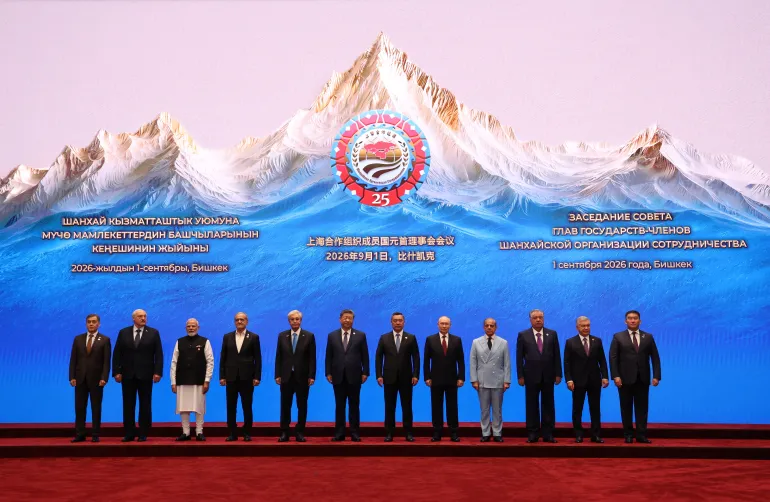
Shanghai Cooperation Organisation leaders at their summit in Bishkek, September 1, 2026. [Vyacheslav Prokofyev/AFP] (AFP)
Kyrgyzstan is a small, mountainous, landlocked country with Russia to the north and China next door. The calculation is more immediate: how do you balance between giants?
As Europe and the United States are increasingly looking towards Central Asia, Kyrgyzstan needs to balance relations with all of them.
Shairbek Dzhuraev, president of the Crossroads Central Asia think tank, said the timing of the summit is particularly important.
“The members in the room are precisely heavyweights that are directly involved in key geopolitical conflicts of the day,” he said.
That balancing act is not new. Since independence in 1991, Central Asian states have largely operated through what is known as a multi-vector foreign policy.
Bishkek – like other Central Asian nations – operates by keeping Russia close and building ties with China, while keeping open doors to Europe and maintaining healthy relations with Washington.
For Kyrgyzstan, it is less about choosing sides than keeping options open, underscored by its geography. Being landlocked means dependence on transport corridors and being mountainous makes infrastructure more difficult. Dependence on imported energy and external markets leaves the economy exposed to shocks beyond its borders.
“The biggest weakness of Kyrgyzstan, geopolitically and geographically, is the dependence in terms of transport routes, in terms of energy, in terms of economic relationships”, Dzhuraev puts it bluntly.
So diversification becomes more than an economic ambition. Kyrgyzstan, being one of the smaller members, cannot dictate the SCO’s agenda. But it helped to shape the language.
For decades, Central Asia was viewed largely through the prism of the powers surrounding it. But the wars in the region and beyond have changed that – Russia is under sanctions, so is Iran, China is looking west, Europe is looking east. Suddenly the geography has acquired new value with highways, railways, pipelines, trade corridors, power networks and the periphery is becoming a strategically important passageway. Dzhuraev said: “Kyrgyzstan wanted the summit declaration to recognise that transformation, Central Asia’s movement into the centre stage of international politics”.
The Shanghai Cooperation Organisation is increasingly seen as a counterweight to US influence — a grouping through which China and Russia can advance a different vision of the global order. But the SCO is too diverse for a simple East-versus-West confrontation. That description comes with a qualification that the SCO is not a unified anti-American bloc.
Its members have competing interests, different relationships with Washington and, in some cases, deep disagreements with one another. The question is not whether the SCO rejects the West, it is whether it can resist being defined entirely in opposition to it.
Iran brings that to the centre stage – where geopolitical theory meets a much more immediate crisis. Tehran and Washington have returned to confrontation after more than a month of relative calm. Iranian President Masoud Pezeshkian used the SCO summit to put the diplomatic question directly on the table.
“I state explicitly that if the United States returns to its commitments under the aforementioned memorandum of understanding, the Islamic Republic of Iran will immediately take reciprocal action,” he said.
The Islamabad MoU signed in June collapsed, with Tehran and Washington blaming each other for violating its terms. Iran’s Foreign Minister, Abbas Araghchi, also called on Washington to return to what its president signed under the MoU. “In that case, everything can be put back on the right track,” he said.
For the SCO, however, Iran is not simply a diplomatic issue – it is an economic one. Washington has renewed sanctions on Tehran and expanded the threat of penalties for those doing business with Iran. For Central Asia, that matters, particularly for countries whose economies are deeply intertwined with Russia and increasingly connected to Chinese trade networks. Dzhuraev is sceptical whether countries such as Kyrgyzstan comply fully with sanctions, “The declaration will most likely not match the reality,” he said. “China and other countries have already rejected what they describe as unilateral sanctions.”
The reality is that sanctions can hurt, as they have hurt Iran and Russia. Not as intended for economic collapse, but they brought pain for the masses and put a spanner in their economies. But enforcement across a region built around cross-border trade is another matter. For Central Asian economies, complete compliance is difficult because the economic relationships are too dense, which is quite different from Western compliance. Both with Iran and Russia, transport and trade links have been growing steadily, so countries are unlikely to simply switch them off overnight.
Russian President Vladimir Putin, right, and Iranian President Masoud Pezeshkian during their meeting on the sidelines of the Shanghai Cooperation Organisation summit in Kyrgyzstan, Tuesday, Sept. 1, 2026. (Vyacheslav Prokofyev/Sputnik/Kremlin Pool Photo via AP)
That makes the SCO summit an important political moment.
Not necessarily because its members can defeat the sanctions regime, but because they can collectively signal where they stand on unilateral pressure.
When you speak to delegates from the global south, there is also a broader message: that the SCO is becoming a forum where countries that do not necessarily agree on everything can nevertheless agree on one principle: they want room to manoeuvre.
Putin calls that the emergence of a multipolar world, Pezeshkian is using the forum to keep diplomacy with Washington alive on Iran’s terms, China is defending its economic relationships, India is pursuing its own strategic interests, and Kyrgyzstan is trying to make sure none of these relationships closes the door to another.
But there is a second question confronting Kyrgyzstan — and it is not sitting around the summit table. How much of its rise belongs to Kyrgyzstan itself?
As transit trade has risen, the economy has been growing rapidly, wages have increased, construction has accelerated and exports have increased.
There is visible momentum in Bishkek, with new roads and buildings appearing to fill the empty spaces. Extraordinary circumstances have generated a lot, such as the war in Ukraine, which has altered regional trade and expanded Chinese investment. When trade routes shifted, money and demand moved across borders. The government is proud that much of the recent development has been undertaken without the external borrowing that characterised earlier periods. But buildings alone do not create a productive economy. External momentum can be a dangerous foundation for long-term growth, as Dzhuraev points out. “Productivity is growing. Exports are rising. More goods are being produced domestically. But much of the momentum remains connected to external factors — particularly the Russia-Ukraine war and Chinese investment. One of the biggest drivers of poverty reduction has been rising salaries.”
The harder question is what comes next? Where are the productive sectors that will sustain those incomes? Agriculture could be an obvious answer as Kyrgyzstan is an agricultural country. But glaciers are melting and climate change is having an impact. Plus, its long-term capacity to generate higher-value growth remains uncertain. That may ultimately be the more important story behind this summit. Not the speeches, the flags, nor the declaration.
Kyrgyzstan wants to convert geography into leverage and its vulnerabilities into options. But the wider questions remain, whether Central Asia can move from being the space between Russia, China, Iran and Europe to becoming a centre of its own? As well as whether today’s economic growth can survive when the external forces driving it inevitably change?
Kyrgyzstan finds itself at the centre of a changing region that brings opportunity but also pressure. Between the giants, keeping every door open may be the most important strategy of all.
Spain has found no evidence that Moroccan authorities planned or orchestrated the massive migrant surge into the Spanish enclave of Ceuta in July, Prime Minister Pedro Sánchez told parliament. His comments come amid conflicting accounts over whether the unprecedented border crossing was a spontaneous migration event or a coordinated operation designed to overwhelm Spanish border controls.
A Massive Border Surge
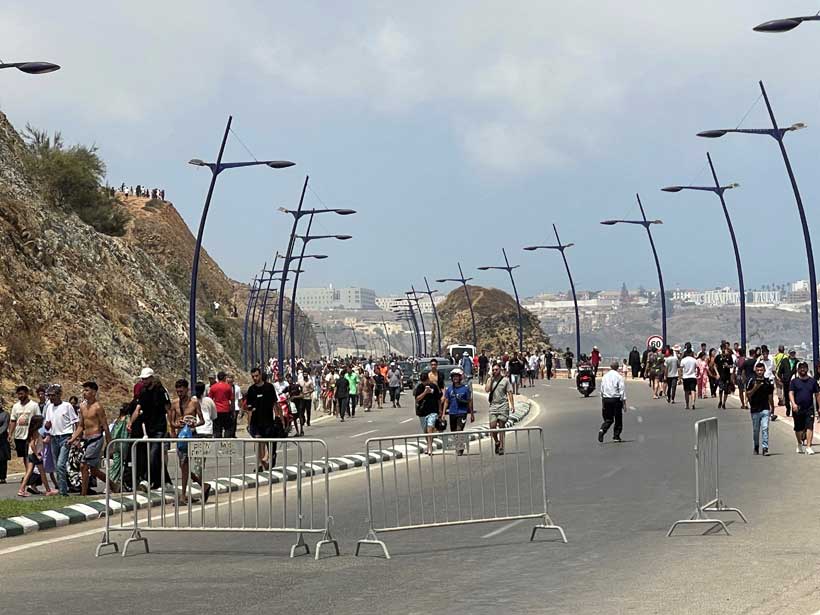
More than 70,000 migrants entered Ceuta from Morocco during the July 30 to 31 crisis, overwhelming local authorities and creating a major humanitarian and political challenge for Spain.
The scale of the movement has raised questions about how such a large number of people were able to reach the Spanish enclave within such a short period.
Sánchez Rejects Moroccan Involvement
Sánchez told lawmakers that neither Spain’s diplomatic services, the European Commission nor international organisations had provided evidence showing that Morocco had planned or carried out the incident.
Stay ahead of the geopolitical week.
MD Briefing delivers expert analysis across five global fronts — the Indo-Pacific, energy, geoeconomics, European security, and the Middle East — every Monday morning. Free.
However, he acknowledged that Moroccan security forces allowed crossings to continue during a critical 10 hour period on July 30, when arrivals reached their peak.
Sánchez said Spain had not yet determined whether this reflected deliberate inaction or an inability to control the situation.
Police Report Raises Questions
The government’s position has been complicated by a police report that reportedly described the influx as a planned and phased operation rather than a spontaneous movement.
According to reports on the document, Moroccan security forces were initially deployed in smaller numbers near the Tarajal crossing and did not make a serious effort to disperse the crowds. Some uniformed officers were also allegedly seen directing people towards the crossing.
However, the report did not identify individual officers or provide independently verified evidence that Moroccan authorities had ordered the operation.
Morocco Denies Enabling the Crossing
Moroccan authorities have rejected accusations that they deliberately facilitated the mass movement into Ceuta.
The controversy has nevertheless put renewed pressure on Spain’s relationship with Morocco, a crucial partner in controlling migration across the western Mediterranean.
Conflicting Accounts in Spain
The allegations have also created a political problem for Sánchez’s government.
Spanish authorities have previously attributed the surge largely to misinformation circulating online and the activities of smuggling networks. Reports suggesting possible Moroccan involvement therefore challenge part of Madrid’s explanation for how the crisis developed.
Spain’s police leadership has also pushed back against claims that an official police report conclusively blamed Morocco for orchestrating the incident.
Why Morocco Matters to Spain
Morocco plays a central role in Spain’s efforts to manage migration from North Africa. Any deterioration in bilateral cooperation could make it harder for Madrid to control future crossings and could turn migration into a wider diplomatic dispute.
Ceuta and Melilla are particularly sensitive because they are Spanish territories located on the North African coast and represent the European Union’s land borders with Africa.
Analysis
The central issue is no longer simply whether thousands of migrants crossed into Ceuta, but who enabled the conditions that made the surge possible.
Sánchez’s position protects Spain’s strategically important relationship with Morocco and avoids directly accusing Rabat without conclusive evidence. At the same time, the reported police findings create a credibility problem for Madrid because they suggest that Moroccan security forces may have played some role in allowing or directing the movement, even if they do not establish government-level planning.
The distinction between deliberate orchestration, passive border enforcement and inability to control the crowd is therefore crucial. Evidence of Moroccan officials physically facilitating crossings would not necessarily prove that the Moroccan state ordered the operation.
For Spain, the episode also exposes the vulnerability of Ceuta’s border to sudden mass movements and information campaigns. For Morocco, the accusations carry diplomatic costs because migration cooperation is an important component of its relationship with Spain and the wider EU.
The immediate challenge for Madrid is to establish what happened without turning an unresolved border investigation into a diplomatic confrontation with Rabat.
Love Island host Maya Jama’s mysterious role in the Gentlemen season two has been revealed.
Hayley Anderson Screen Time TV Reporter
11:28, 03 Sep 2026
Netflix releases The Gentlemen season 2 trailer
Love Island icon Maya Jama has made her debut in The Gentlemen season two on Netflix.
A number of new faces are being welcomed into the fold of Netflix’s epic crime drama The Gentlemen season two, including Downton Abbey star Hugh Bonneville.
But someone who subscribers may not have been expecting to see in the eight-part second outing is Love Island presenter Maya Jama as it marks her first major scripted TV debut.
The only other acting experience that the 32-year-old has had was in a breif cameo role for Katherine Ryan’s The Duchess on Netflix six years ago.
With The Gentlemen season two now ready to binge-watch, fans are eager to find out all there is to know about Maya Jama’s role.
When does Maya Jama appear in The Gentlemen season 2?
It isn’t long before Maya Jama pops up on our screens as she features in the first episode of The Gentlemen season two.
She is mostly seen speaking to Kaya Scodelario’s Susie Glass but shows up once again in episode four.
Maya Jama’s The Gentlemen season 2 role explained
Maya Jama portrays a character named Aisha in the second season of The Gentlemen on Netflix.
She plays the wife of one of Eddie Horniman’s (played by Theo James) criminal associates, Prince Amir bin Abdullah al-Hadidi, brought to life by actor Amra Mallassi, reports the Express.
Susie Glass (Kaya Scodelario) describes her as a “clever girl” and “aspirational”, saying: “Looks after herself and everyone who comes within her orbit. She moved out to the Middle East five years ago to work in hospitality. Now she’s snagged herself a seat at the royal table.”
Talking about her experience shooting The Gentlemen, Jama described creator Guy Ritchie as “very personable” to Variety.
She continued: “He’s really kind and nice. He doesn’t feel as intimidating as you’d think, being who he is. He’s very personable and he would be like, ‘Yeah, you’re doing well’, and reassure me, which was really nice.
“He’s just really involved and kind of a genius to watch, because everyone’s practising their lines and then he says something that’s way better than the original. You just feel like you’re in the presence of greatness.”
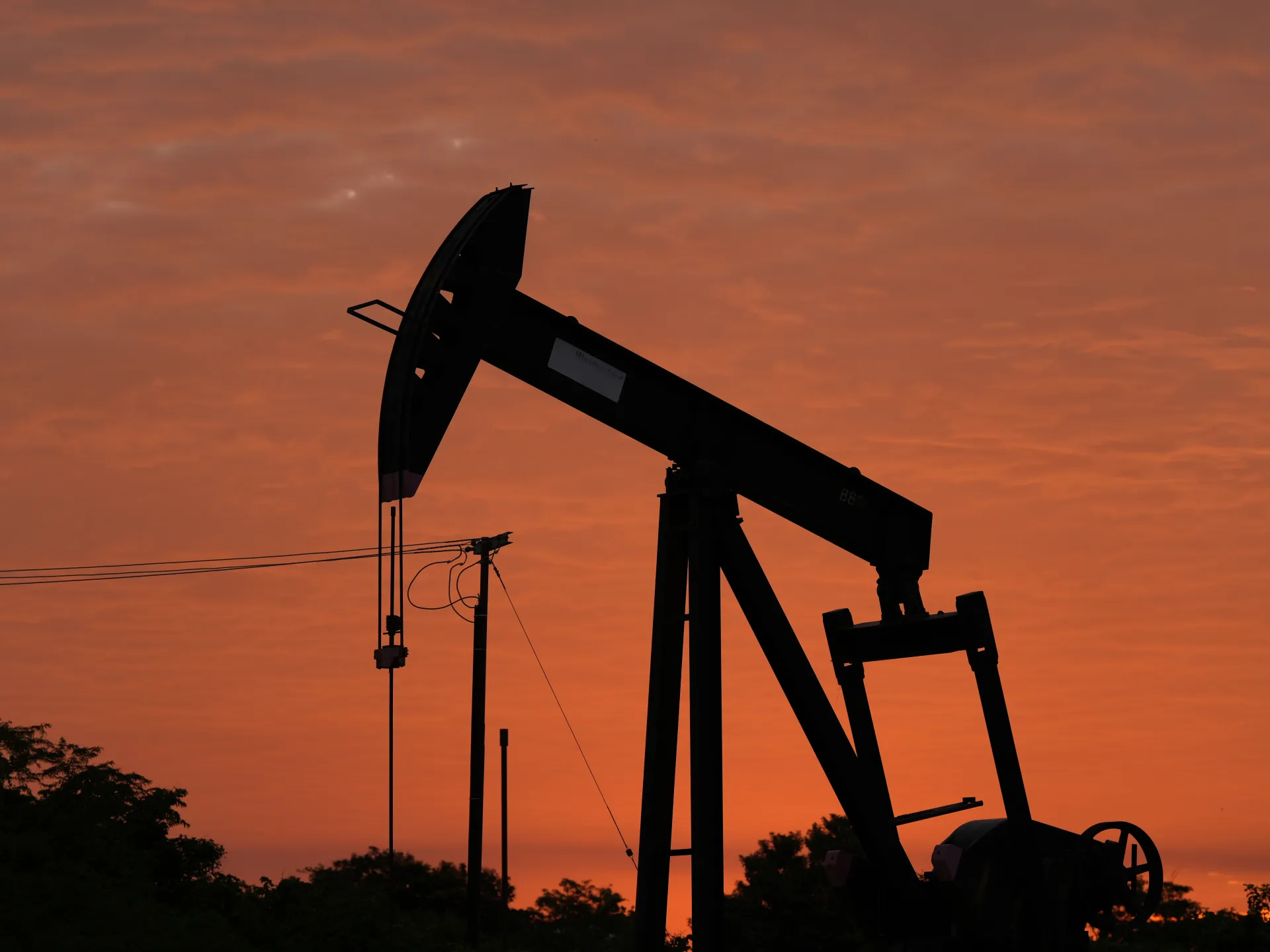
US President Donald Trump celebrated on Truth Social what he called the “biggest oil deal in history” – a 100-year concession on 17 oil fields in Venezuela that would secure 65 billion barrels of oil.
Around the same time, QatarEnergy informed Edison, one of its biggest European customers, that force majeure on its liquefied natural gas (LNG) deliveries would continue until early November. Five more cargoes were cancelled, taking the total to 29, or about 3.8 billion cubic metres of gas.
The contract has run since 2009 and normally covers roughly a tenth of Italy’s annual consumption. Edison has kept supplying its customers by finding replacement cargoes elsewhere, including in the US.
For decades, the bargain between Washington and the Gulf was clear. The US protected the region and kept its sea lanes open; Gulf producers supplied the energy on which the global economy depended and settled their sales in dollars to benefit the US economy.
That bargain has been turned on its head. America no longer simply protects Gulf energy. It competes with it, and increasingly profits when the Gulf cannot deliver due to insecurity.
Six months of war have reportedly impacted Qatar’s LNG exports significantly. Other Gulf countries like Kuwait, Saudi Arabia and the UAE have seen a substantial drop in oil exports as well. Meanwhile, US oil and gas have moved into the space left behind, with US energy giants raking in record-high profits.
It is important here to distinguish between the US as a government and the dense network of private interests that operates around it. Washington wants strategic leverage over Iran and continued influence over the Gulf states. Energy companies want access to reserves, favourable regulation, profitable prices and new customers. Trump brings the two together under the banner of energy dominance. State power opens the door; private capital walks through it.
Israel adds another layer. Chevron operates its two main offshore gas fields, owning almost 40 percent of the Leviathan gasfield and 25 percent of the Tamar gasfield. Leviathan is expanding after a $35bn agreement was signed last year to increase exports to Egypt.
Israel is therefore not an independent energy rival to the US in the way Qatar is. Its growing role as an Eastern Mediterranean gas hub is tied to a US operator and fits comfortably within a US-backed regional system linking Israel, Egypt and Jordan.
Chevron is the thread running through much of this story. It has major interests in US production, controls Israel’s most important gas assets and is positioned to expand in Venezuela. This does not mean Chevron determines foreign policy. It does show how easily the exercise of American power can translate into commercial opportunity for American companies.
Israel is also determined not to let the confrontation with Iran end on terms it considers not to be in its interest. The US-Iran memorandum of understanding signed in June fell well short of Israeli war aims. Israel said it was not bound by all its provisions, insisted on freedom of action in Lebanon and briefly resumed attacks while the US was trying to sustain negotiations.
For Israel, ceasefires have tended to be pauses, not settlements: opportunities to regroup while preserving the option of striking again. The reasons are chiefly strategic. Israel wants to prevent Iran from rebuilding its nuclear, missile and regional capabilities, while Israeli leaders fear accepting a deal and looking weak ahead of elections.
The consequences of Israel pushing for continuous conflict align with US energy interests. Continued pressure on Iran keeps the Strait of Hormuz insecure, Gulf exports vulnerable and risk premiums for energy transport high. Israel and US energy companies do not need to be following a common plan for their interests to reinforce one another.
Price is where the argument becomes clearest. Trump talks constantly about cheap oil, but US producers cannot prosper if it becomes too cheap. A Dallas Federal Reserve survey found that US companies needed an average price of about $43 a barrel to operate existing wells and $66 to drill new ones profitably. The two main Permian basins sit at roughly $61 to $62.
Trump therefore needs a narrow band: oil cheap enough to contain inflation, but expensive enough to keep shale, fracking and export investment alive. Gulf insecurity helps maintain it. The disruption need not be catastrophic. It only has to keep prices at a point where the next American well makes economic sense.
This may help explain the attraction of a no-war, no-peace outcome. A full regional war could close Hormuz, send prices soaring and threaten Chevron’s Israeli operations. A durable settlement would remove the risk premium, restore confidence in Gulf supply and limit Israel’s freedom of action.
Managed insecurity sits conveniently between the two: enough restraint to protect US-linked production, but not enough diplomacy to make Gulf energy entirely dependable again.
Israel keeps Iran under pressure. Washington retains leverage over its allies. US producers gain customers and commercially supportive prices. The danger lies in the convergence: Several powerful actors now have something to gain from preventing the crisis from reaching a final resolution.
The Gulf still holds vast reserves and enjoys production costs US companies cannot match. But reserves alone no longer decide market power. Reliability does. Only an estimated 3.5 to 5.5 million barrels a day can bypass Hormuz through Saudi and Emirati pipelines. The rest remains exposed to a single point of failure, despite decades of arms purchases, foreign bases and security guarantees.
The greatest threat to the Gulf’s energy future is not depletion. It is that customers learn to live without it. Every delayed tanker strengthens the case for an Atlantic alternative. Every Qatari cargo replaced by US LNG creates a relationship that may endure long after the war.
US power once rested partly on protecting the flow of Gulf energy. It now rests increasingly on replacing it.
The views expressed in this article are the author’s own and do not necessarily reflect Al Jazeera’s editorial stance.
Moscow challenges Norway’s seizure of vessel, the Professor Molchanov, calling it an act of piracy.
Published On 3 Sep 20263 Sep 2026
Norway has seized a Russian ship in the Arctic to enforce a compensation claim by Ukrainian energy firm Naftogaz, linked to Russian asset seizures in Crimea.
Norway seized the ship on Wednesday, after Moscow failed to pay Naftogaz $4.22bn plus interest and legal costs to compensate for assets it seized in Crimea after a tribunal ruling at The Hague in 2023.
Recommended Stories
list of 3 itemsend of list
In a post on X, Naftogaz said the seizure made up “part of global efforts to enforce the arbitral award obtained by Naftogaz against the Russian Federation in connection with the unlawful expropriation of their assets in Crimea, which Russia illegally annexed in 2014”.
The vessel, the Professor Molchanov, was taken off the Norwegian Arctic archipelago of Svalbard after a 24-hour standoff with the Norwegian Coast Guard, according to Covington, the US law firm representing Naftogaz.
Russian state news agency TASS quoted a Ministry of Foreign Affairs spokesperson as calling the Norwegian action “piracy”.
Alexei Chekunkov, Russia’s minister for the development of the Russian Far East and Arctic, said Moscow would challenge the ruling.
Chekunkov called Norway’s seizure of the Professor Molchanov “another example of Western countries’ legal nihilism and lawlessness,” according to the Interfax news agency.
Naftogaz has been pursuing legal action against Russia since 2016 to seek compensation for the expropriation of its property in Crimea.
“Russia cannot evade responsibility simply by refusing to comply with an international arbitral award,” said Naftogaz Acting CEO Sergii Fedorenko.
“We will continue to pursue Russian assets around the world until the compensation awarded to Naftogaz and other Naftogaz Group companies is paid,” the Ukrainian company said.
Covington, the law firm, said it had been tracking the Professor Molchanov, a Russian-owned vessel that is used for commercial cruises, for months.
The ship was being used for commercial expedition cruises, including to Svalbard, according to the company.
Naftogaz said the passengers on board are being handled by Norwegian authorities.
Emmerdale actress Nicola Wheeler was left “gutted” by her long-term co-star’s exit, following emotional scenes that brought viewers to tears
10:13, 03 Sep 2026Updated 10:15, 03 Sep 2026
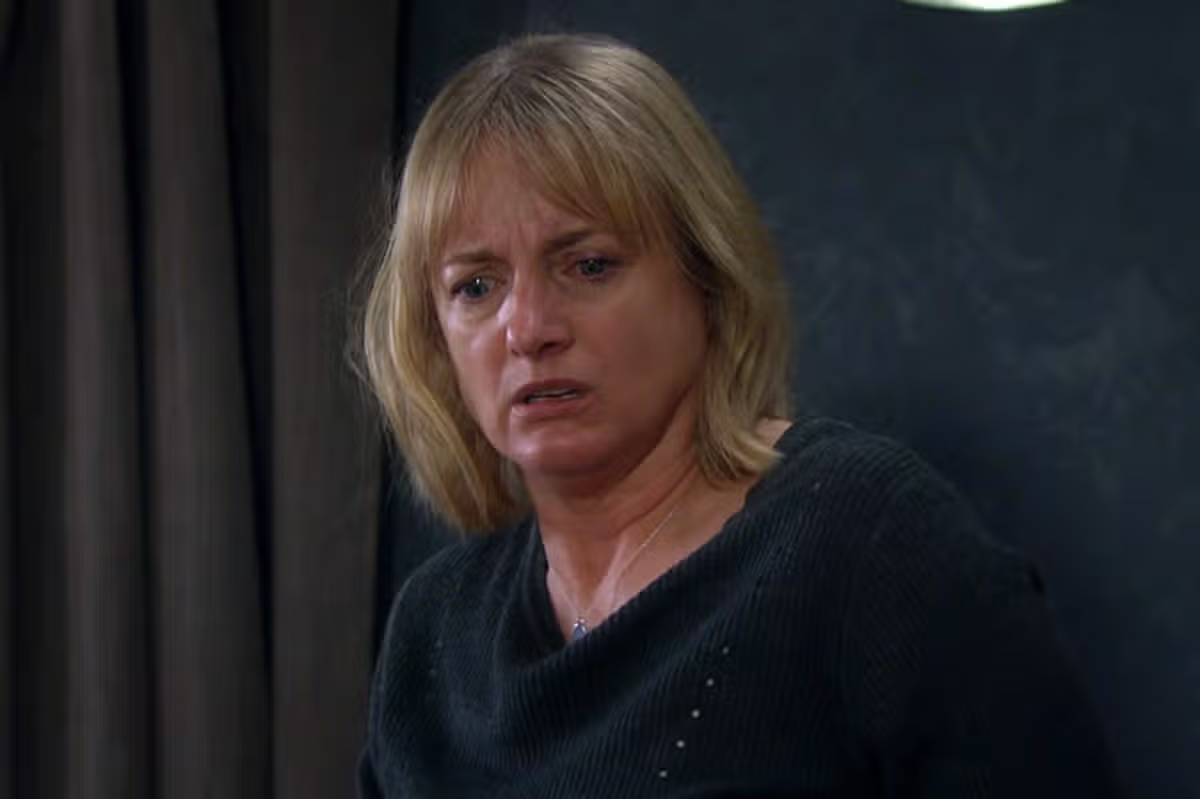
Emmerdale’s Nicola Wheeler says it’ll be ‘odd’ without her long-term co-star (Image: ITV)
Last week, Emmerdale fans were left in tears as long-term resident Jimmy King, played by Nick Miles, lost his life in a horrific car accident. The actor had played Jimmy for 22 years, with much of that time spent portraying the husband of Nicola King.
His on-screen wife, Nicola Wheeler, has now opened up about the sad moment Nick told her he was stepping away from the soap.
Speaking to My Weekly magazine, the 52-year-old revealed: “I’ve worked with Nick (Miles) for 17 years. It was Nick who told me the news he was leaving. He contacted me after he’d told his real wife. We will stay friends, so it’s not like I won’t see him, I just won’t see him being Jimmy King again, which is odd.”
Nicola also reflected on filming their final scenes together, telling the Press Association that it suddenly dawned on her that it was the end of an era for their characters.
She said she felt “gutted” by the end of Jimmy and Nicola’s long-running partnership, explaining that filming the death scenes felt particularly strange. Episodes are shot out of order, she said, meaning the reality of Nick’s departure did not always feel real – while part of her also did not want it to be over.
Despite her sadness, Nicola praised the scripts, describing the farewell scenes as “beautifully written”, adding that she wanted to do them justice, even though filming them made the ending feel final.
Reports of Nick’s exit first emerged in May, amid claims that his contract would not be renewed and that producers had informed him earlier in the year.
While he has not addressed the reason behind his exit specifically, he has admitted that the script left both him and others who read it in tears.
Jimmy’s final scenes saw him telling his wife he loved her before succumbing to injuries sustained in the crash. As the tragedy played out on August 27, viewers flocked to X to share their sadness.
One said the soap “won’t be the same without Jimmy King,” while another admitted they were “in bits”.
Sharing what she believes could be next for her character, Nicola said: “I can’t imagine the character would ever fully move on.
“I think there’s always going to be part of her that loves him. Her heart will grow to fit another love in, but she will never let Jimmy go.”
She also teased a new storyline involving Kev Townsend, played by Chris Coghill. “Something happens in which I can only say Nicola behaves appallingly, and Kev is a gentleman, and I think from that moment she starts to see him in a different light,” she added.
Emmerdale continues tonight at 8pm on ITV and ITVX.
Sept. 3 (UPI) — Sen. Thom Tillis has called on President Donald Trump to fire Pete Hegseth as secretary of Defense following a series of high-profile exits and firings of senior Pentagon officials in recent months.
Tillis’ comments on Wednesday are the strongest yet from a Republican politician amid mounting GOP criticism of Hegseth’s leadership of the Department of Defense, and came two days after Army Secretary Dan Driscoll resigned following months of reported of clashes with Hegseth.
“I have never witnessed more inept management of the brave men and women who serve our country. He is intimidated by competence and retreats to ginning up culture wars instead of soberly attending to the vital work of our national defense and the health and well-being of our fighting force,” Tillis said on X.
“I urge the president to find a new leader at the Pentagon who will retain and empower our military talent rather than diminish it.”
Hegseth, a former Army National Guard major who took office with less senior government and military leadership experience than any other secretary of Defense, has overseen a sweeping overhaul of the department, which has seen nearly two dozen generals, admirals and senior civilian defense officials resign, retire early or be fired. Several have left following reported clashes with Hegseth.
Critics have accused the former Fox News host of politicizing the traditionally nonpartisan position, highlighting his purge of senior leadership and his effort to eliminate policies he has characterized as “woke.”
In his statement, Tillis, who served on the Senate Armed Services Committee, thanked Driscoll for his leadership and praised him and Gen. Randy George, who stepped down at Hegseth’s request in April, for having initiated “a transformative period of innovation in how we array our forces and equip our soldiers.”
“If we had a @SecWar who maintained the same priorities and forward-thinking, he would be fighting to retain talented leaders like Dan and the many flag officers he has forced into retirement,” he said. “Instead, he is creating a leadership void at the top of our military ranks.”
Hegseth faced strong criticism from Democrats over his lack of experience and alleged issues with alcohol and high-profile allegations of sexual misconduct and abuse, but there has been a growing chorus of Republicans who have voiced concerns since the U.S. war with Iran began on Feb. 28.
A former Trump supporter whom Trump endorsement ahead of his successful 2020 re-election bid, Tillis became a target of the president after saying he could not support his so-called One Big Beautiful spending and tax cut bill. In June 2025, Tillis announced he would not seek another term.
“My Senate colleague Thom Tillis is right,” Sen. Mark Kelly, D-Ariz., said in response to the Republican’s statement.
“Pete Hegseth has long passed his expiration date as SecDef. He needs to go.”
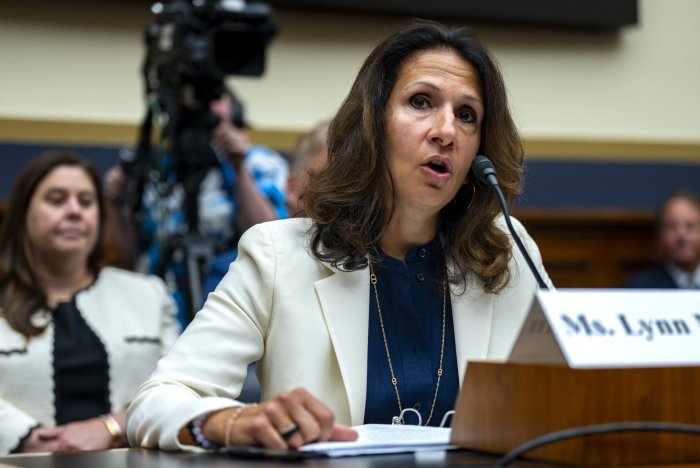
President of the New York Stock Exchange Lynn Martin speaks during a House Financial Services Committee hearing on the economy at the U.S. Capitol on Wednesday. Photo by Bonnie Cash/UPI | License Photo
Families in Nepal held symbolic funerals for relatives who remain missing, hoping to free their souls after they were presumed dead.
In Hindu tradition, cremation is a vital final rite, and for some families, performing the ceremony without the bodies of their loved ones has brought a measure of spiritual release.
Authorities in Nepal have meanwhile been burying recovered bodies in temporary graves until they can be identified. DNA samples are being preserved, distinguishing facial features photographed and other identifying details recorded to help match the remains with missing people and eventually return them to their families.
The August 26 flash flood has been one of the deadliest disasters to hit the Himalayan nation in recent years.
More than 1,200 people were killed and about 4,750 remain missing in Nepal and China’s Tibet region, after a huge wave of mud and debris destroyed towns, roads, bridges and several hydropower dams.
The fans of the BBC show think one beloved character should take the spotlight and lead the Saint Marie team.
Death in Paradise fans have been having their say(Image: CREDIT LINE:BBC / Red Planet Pictures / Lou Denim)
It looks as though Death in Paradise viewers are in agreement for a shake-up.
Earlier this year, the beloved BBC crime drama came to an end after a dramatic series for DI Mervin (Don Gilet). Following a season of new additions, family reunions and a much-welcomed return, people are eager to see what’s next in store for the Saint Marie police team.
The programme ended with DI Mervin deciding to let his niece remain with him on the island as her dad and his brother, Solomon (Daniel Ward), finished his time in prison. Elsewhere in series 15, people saw the new DI grow closer to Detective Sergeant Naomi Thomas (Shantol Jackson).
While the pair worked together to solve the crimes on the island, their relationship got stronger as he often turned to her for advice and guidance. As people gear up for the annual festive special later this year, they are looking forward to the return of the beloved characters.
However, it seems as though many are calling for a major shake-up for the island, with demands for DS Naomi to step up in the new series in a higher role. During a discussion thread on Reddit, one person shared their thoughts on the matter.
They commented: “Although I adore Don Gilet/Mervin, I think it’s time for a female inspector. Naomi would be awesome as Inspector, with Mattie as her Sgt. I really hope that before the series ends and/or she leaves, they give the character a chance to advance.”
Someone else added: “I would love for Naomi to be the DI at some time.” As another wrote: “She’s really spot on. I hope the writers show more of her investigative skills this season.”
In another thread, someone shared: “I really hope when there is a next inspector that Naomi gets the nod. Watching her navigate being in charge would make a good story.” The demand for a change comes after actor Don Gilet joined the BBC show back in 2024.
He joined the long-running drama following the exit of actor Ralph Little, who played Detective Inspector Neville Parker for four years.
As each lead DI has been fronted my a male since the series began, could there be a first female DI on the way for Death in Paradise?
Earlier this year, it was confirmed that the BBC drama has been recommissioned for another two series. There will also be two more Christmas specials for fans to look forward to.
Speaking about the news, Lindsay Salt, Director of BBC Drama, said: “Death in Paradise is a global phenomenon and we are incredibly proud to have it on the BBC, where it goes from strength to strength. It’s with great pleasure that we share the news that we’ll be returning to Saint Marie for two more sun-soaked series and Christmas specials.”
Meanwhile, Tim Key, Executive Producer, Red Planet Pictures added: “We remain incredibly proud of the show and the team that makes it, and delighted that the audience continue to love it as much as we do.
“The response to our latest series has been wonderful and we can’t wait to get started again – we’ve got something very special lined up to kick off our 16th season, with a big surprise setting it up in our Christmas special. Watch this space…”
Death in Paradise is available to watch on BBC iPlayer.
China has long been a rare partner to Iran, with the economic heft to blunt the United States’ efforts to strangle the Iranian economy.
Yet even as China opposes US President Donald Trump’s latest pressure campaign, few observers expect it to go much further than the modest economic links it has thus far forged with Iran to shield it.
Recommended Stories
list of 4 itemsend of list
While China opposes the Trump administration’s military attacks and sanctions against Iran, Beijing’s relationship with Tehran is just one consideration in a foreign policy that seeks to balance relations with numerous countries, including the US and the Gulf states, limiting its appetite to prop up the Iranian leadership at any cost, analysts say.
“China, with broader global interests, can only actively promote de-escalation of the US-Iran conflict, and cannot and will not engage in fierce confrontation with the US for Iran’s sake,” said Hongda Fan, director of the China-Middle East Center at Shaoxing University in China.
“Ultimately, the US-Iran conflict must be resolved by the two countries themselves,” Fan said.
China and Iran share substantial trade links, particularly in energy, and a mutual suspicion of US dominance, but their relationship is heavily lopsided, with Tehran depending on Beijing far more than vice versa.
That asymmetry in ties was on full display this week at the annual gathering of the Shanghai Cooperation Organisation, a 10-member bloc widely seen as a counterbalance to US hegemony, where Chinese President Xi Jinping joined more than a dozen non-Western leaders, including Iranian President Masoud Pezeshkian.
While Iranian state media reported that Pezeshkian held a “brief meeting” with Xi on the sidelines of the summit in Bishkek, Kyrgyzstan, Chinese outlets made no mention of the encounter.
Xi immediately followed his attendance at the summit with his first visit to Egypt in a decade on Tuesday, using the visit to call on countries in the Middle East to oppose “external interference” and reiterate his calls for a diplomatic resolution to the Iran war.
As Iran’s top trade partner, China has taken up to 90 percent of Iranian oil exports since the US and Israel launched their war in late February.
Iranian crude, however, accounts for only about 2 percent of China’s overall energy mix.
While China’s oil purchases have been an economic lifeline for Tehran, Chinese importers have not been immune to fears of exposure to US sanctions.
China’s major state-owned refiners such as Sinopec and PetroChina have shunned Iranian oil for years, leaving the trade to independent “teapot” refiners with minimal links to the dollar-based global financial system.
Though the Trump administration has imposed sanctions on these “teapot” refiners and a limited number of China- and Hong Kong-based firms and individuals, it has yet to target major Chinese banks accused of facilitating Iranian oil purchases.
The Trump administration has hinted at targeting China’s financial system as part of its ramped-up sanctions campaign, dubbed “Operation Economic Outcast”, though analysts are sceptical that Washington will risk provoking Beijing’s ire as the sides seek to lower the temperature in their trade war before a scheduled summit between Xi and Trump on September 24.
“The legitimate question is why third countries should be expected to adopt Washington’s unilateral economic policy towards another sovereign state,” said Zichen Wang, deputy secretary-general of the Center for China and Globalization (CCG) think tank in Beijing.
“That does not, however, mean that Beijing will provide Tehran with a blank cheque,” Wang said.
“China is likely to continue opposing US secondary sanctions politically and to defend what it considers legitimate Chinese commercial interests. But past behaviour also shows that major Chinese banks and state-owned companies are highly conscious of sanctions exposure.”
Rhetoric versus reality
Even as Beijing and Tehran have forged closer ties, their relations have for years been marked by a substantial gap between rhetoric and reality.
While China pledged to invest up to $400bn in Iran over 25 years as part of a “comprehensive strategic partnership agreement” signed in 2021, few projects have materialised amid what analysts say is Chinese firms’ reluctance to navigate sanctions and the opaque Iranian bureaucracy.
In 2023, Iran’s then deputy economy minister, Ali Fekri, complained that he was “not satisfied” with China’s level of investment since the agreement, saying it had only amounted to about $185m.
“Iranian experts often blame their government for not doing enough to attract Chinese investors or not pushing Chinese companies to share more technology,” said Andrea Ghiselli, head of research at the ChinaMed Project.
“However, the reality is that there is no point for Chinese companies to give up their ties with the international financial system to expand their business in Iran,” Ghiselli said.
“It is much easier and more profitable to trade and invest elsewhere. Iran’s own domestic physical and bank infrastructure is also an obstacle.”
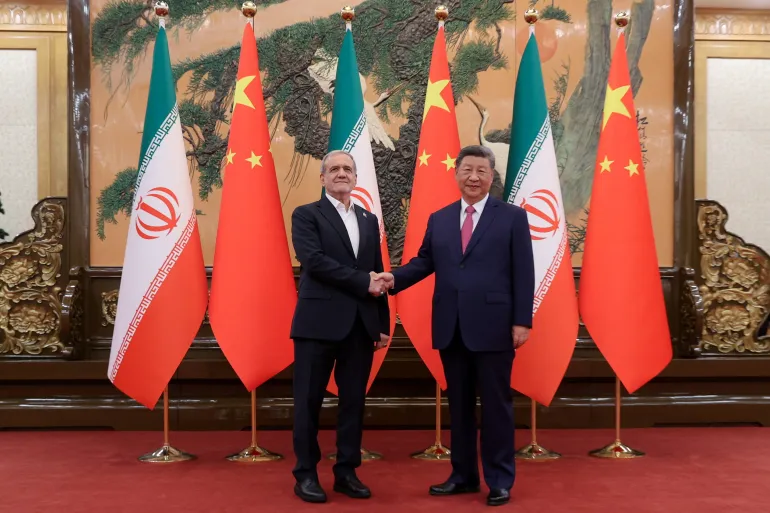
Iranian President Masoud Pezeshkian and Chinese President Xi Jinping shake hands as they meet in Beijing, China, on September 2, 2025 [Iran’s presidential website/Handout via Reuters]
Meanwhile, the most tangible measure of China’s economic support, purchases of Iranian oil, has been dwindling amid the US blockade of Iranian ports.
Iranian crude exports via the Strait of Hormuz, mostly bound for China, fell from an estimated 1.85 million barrels per day (bpd) in March-April to just 240,000bpd in August, according to data from ship-tracking platform Kpler, though millions more barrels shipped before the blockade are still at sea.
In an interview with CNBC on Monday, US Treasury Secretary Scott Bessent said “only” about 30 million barrels of Iranian oil remained on the water and Chinese remittances to Iran were “going to run out”.
Kpler last month estimated that about 80 million barrels were in on-water shortage, enough to provide revenues to Tehran for up to six months.
“For China, Iran is valuable – but replaceable across many dimensions. Iranian oil matters, but China can obtain energy from Saudi Arabia, Russia, Iraq, the UAE, and numerous other suppliers,” said Mordechai Chaziza, an expert on China’s Middle East policy who lectures at Ashkelon Academic College in Israel.
“Iran offers geopolitical access, but China possesses relationships throughout the region. Iran supports China’s multipolar agenda, but so do many other states.”
China’s support for Iran is also not risk-free for Beijing, given its important relationships with Iranian rivals such as Saudi Arabia and the United Arab Emirates, Chaziza said.
“Saudi Arabia and the UAE are major energy and commercial partners.
“Gulf stability is vital because China obtains roughly half of its crude imports from the Middle East,” he added.
The “ideal outcome” for Beijing, Chaziza said, would be “a stable, sovereign, economically connected, and internationally non-Western” Iran, but not one “whose confrontation with Washington, Israel, or the Gulf monarchies forces China to choose sides”.
Wang, at the CCG, said that while Beijing appears determined to defend Chinese commercial interests, it is unlikely to sacrifice its broader interests in the region or elsewhere.
Beijing’s warning that it is ready to take countermeasures against unilateral sanctions is “not the same thing as promising to underwrite the Iranian economy”, Wang added.
For China, Iran is seen more as a customer than an ally, said Kerri Bitsoff, a former senior official at the US Treasury’s Office of Foreign Assets Control.
“I don’t think this is the alliance some people think it is, even though there’s real support. I think of a more like a customer relationship that Iran can’t walk away from,” Bitsoff said.
“And it was good for China – they got cheap oil, they got a US tied up in the Middle East, but I think that only lasts up until the point where it threatens China’s other interests,” she added.
Last week, a prominent Saudi Sheikh, Mohammed Al-Issa, visited the Auschwitz concentration camp in Poland to commemorate the 75th anniversary of its liberation, which signalled the end of the Nazi Holocaust. Although dozens of Muslim scholars have visited the site, where about one million Jews were killed during World War Two, according to the Auschwitz Memorial Centre’s press office, Al-Issa is the most senior Muslim religious leader to do so.
Visiting Auschwitz is not a problem for a Muslim; Islam orders Muslims to reject unjustified killing of any human being, no matter what their faith is. Al-Issa is a senior ally of Saudi Crown Prince Mohammad bin Salman (MBS), who apparently cares little for the sanctity of human life, though, and the visit to Auschwitz has very definite political connotations beyond any Islamic context.
By sending Al-Issa to the camp, Bin Salman wanted to show his support for Israel, which exploits the Holocaust for geopolitical colonial purposes. “The Israeli government decided that it alone was permitted to mark the 75th anniversary of the Allied liberation of Auschwitz [in modern day Poland] in 1945,” wrote journalist Richard Silverstein recently when he commented on the gathering of world leaders in Jerusalem for Benjamin Netanyahu’s Holocaust event.
Bin Salman uses Al Issa for such purposes, as if to demonstrate his own Zionist credentials. For example, the head of the Makkah-based Muslim World League is leading rapprochement efforts with Evangelical Christians who are, in the US at least, firm Zionists in their backing for the state of Israel. Al-Issa has called for a Muslim-Christian-Jewish interfaith delegation to travel to Jerusalem in what would, in effect, be a Zionist troika.
Zionism is not a religion, and there are many non-Jewish Zionists who desire or support the establishment of a Jewish state in occupied Palestine. The definition of Zionism does not mention the religion of its supporters, and Israeli writer Sheri Oz, is just one author who insists that non-Jews can be Zionists.
Mohammad Bin Salman and Netanyahu – Cartoon [Tasnimnews.com/Wikipedia]
We should not be shocked, therefore, to see a Zionist Muslim leader in these trying times. It is reasonable to say that Bin Salman’s grandfather and father were Zionists, as close friends of Zionist leaders. Logic suggests that Bin Salman comes from a Zionist dynasty.
This has been evident from his close relationship with Zionists and positive approaches to the Israeli occupation and establishment of a Jewish state in Palestine, calling it “[the Jews’] ancestral homeland”. This means that he has no issue with the ethnic cleansing of almost 800,000 Palestinians in 1948, during which thousands were killed and their homes demolished in order to establish the Zionist state of Israel.
“The ‘Jewish state’ claim is how Zionism has tried to mask its intrinsic Apartheid, under the veil of a supposed ‘self-determination of the Jewish people’,” wrote Israeli blogger Jonathan Ofir in Mondoweiss in 2018, “and for the Palestinians it has meant their dispossession.”
As the de facto ruler of Saudi Arabia, Crown Prince Bin Salman has imprisoned dozens of Palestinians, including representatives of Hamas. In doing so he is serving Israel’s interests. Moreover, he has blamed the Palestinians for not making peace with the occupation state. Bin Salman “excoriated the Palestinians for missing key opportunities,” wrote Danial Benjamin in Moment magazine. He pointed out that the prince’s father, King Salman, has played the role of counterweight by saying that Saudi Arabia “permanently stands by Palestine and its people’s right to an independent state with occupied East Jerusalem as its capital.”
Israeli journalist Barak Ravid of Israel’s Channel 13News reported Bin Salman as saying: “In the last several decades the Palestinian leadership has missed one opportunity after the other and rejected all the peace proposals it was given. It is about time the Palestinians take the proposals and agree to come to the negotiations table or shut up and stop complaining.” This is reminiscent of the words of the late Israeli Foreign Minister Abba Eban, one of the Zionist founders of Israel, that the Palestinians “never miss an opportunity to miss an opportunity.”
Bin Salman’s Zionism is also very clear in his bold support for US President Donald Trump’s deal of the century, which achieves Zionist goals in Palestine at the expense of Palestinian rights. He participated in the Bahrain conference, the forum where the economic side of the US deal was announced, where he gave “cover to several other Arab countries to attend the event and infuriated the Palestinians.”
US President Donald Trump looks over at Crown Prince of Saudi Arabia Mohammad bin Salman al-Saud as they line up for the family photo during the opening day of Argentina G20 Leaders’ Summit 2018 at Costa Salguero on 30 November 2018 in Buenos Aires, Argentina [Daniel Jayo/Getty Images]
While discussing the issue of the current Saudi support for Israeli policies and practices in Palestine with a credible Palestinian official last week, he told me that the Palestinians had contacted the Brazilian President Jair Bolsonaro to ask him not to relocate his country’s embassy to Jerusalem. “The Saudis have been putting pressure on us in order to relocate our embassy to Jerusalem,” replied the Brazilian leader. What more evidence of Mohammad Bin Salman’s Zionism do we need?
The founder of Friends of Zion Museum is American Evangelical Christian Mike Evans. He said, after visiting a number of the Gulf States, that, “The leaders [there] are more pro-Israel than a lot of Jews.” This was a specific reference to Saudi Arabia’s Crown Prince, and his counterpart in the UAE, Mohammed Bin Zayed.
“All versions of Zionism lead to the same reactionary end of unbridled expansionism and continued settler colonial genocide of [the] Palestinian people,” Israeli-American writer and photographer Yoav Litvin wrote for Al Jazeera. We may well see an Israeli Embassy opened in Riyadh in the near future, and a Saudi Embassy in Tel Aviv or, more likely, Jerusalem. Is Mohammad Bin Salman a Zionist? There’s no doubt about it.
The views expressed in this article belong to the author and do not necessarily reflect the editorial policy of Middle East Monitor.
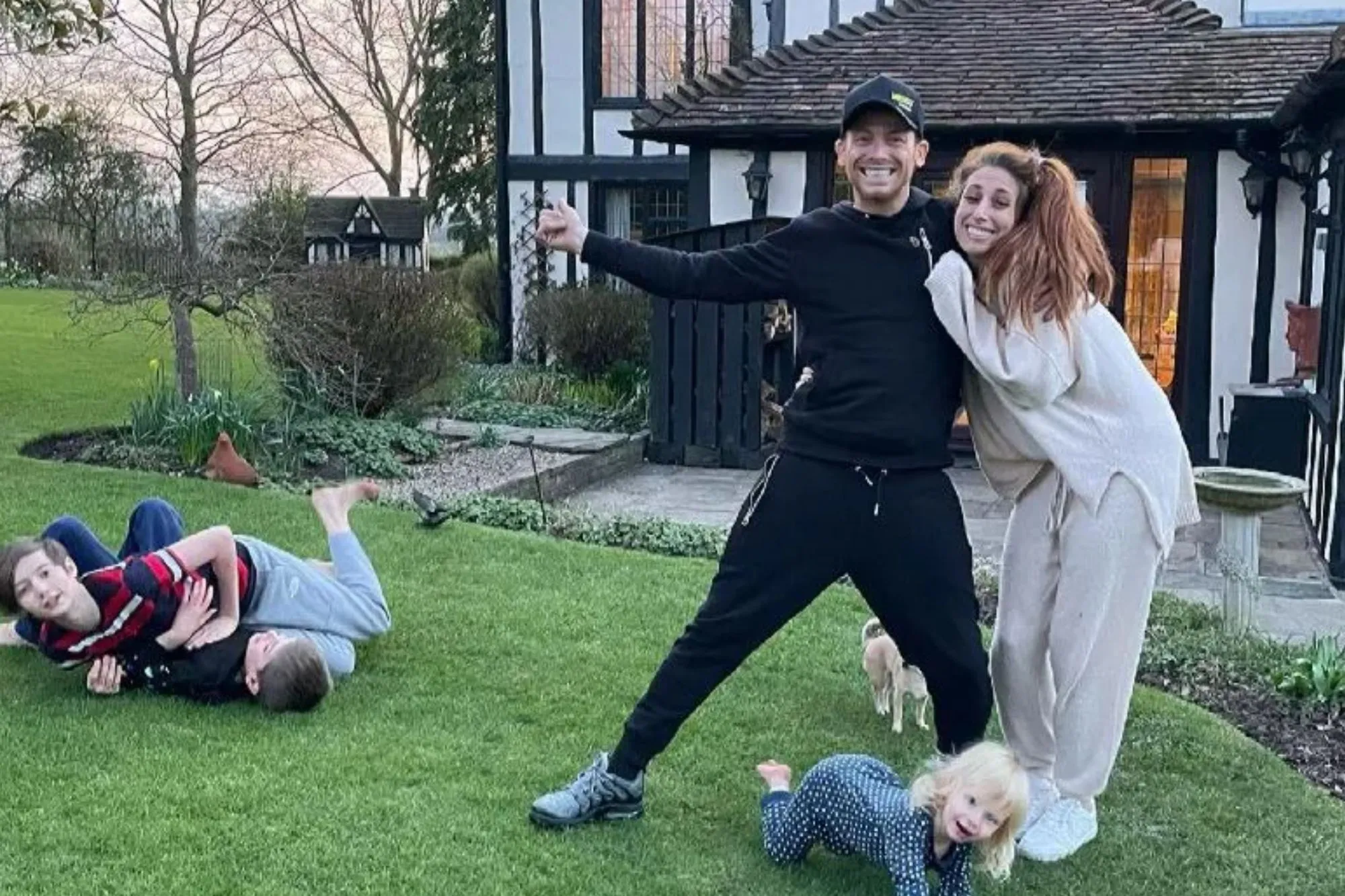
AN emotional Stacey Solomon has revealed that she’s sold £1.3m ‘dream home’ Pickle Cottage.
The Sort Your Life Out presenter, 36, took to her Instagram story alongside husband Joe Swash, 44, to share the news.
Emotional Stacey Solomon reveals she’s sold her £1.3m ‘dream home’ Pickle CottageCredit: instagram @staceysolomonStacey and Joe bought the property back in 2021Credit: Not known, clear with picture desk
The pair, who tied the knot in the garden of their former home in 2022, bought the property back in 2021.
Now, five years later, they have decided to “start a new chapter” with their three kids Rex, Rose and Belle, as well as Stacey’s older children Zachary and Leighton.
Sign up for the Showbiz newsletter
Thank you!
Speaking to her 6.1 million followers, Stacey said: “We are leaving Pickle Cottage, we are moving out of Pickle Cottage, which I never thought I’d say, imminently.
“The reason we haven’t said anything up until this point is, anyone who has moved before knows what it is like. You don’t know if it is going to actually happen before it happens.
Over the years, Stacey has shared her renovations online with fansCredit: InstagramThe coupled named their house Pickle CottageCredit: @staceysolomon
“Also, leaving Pickle Cottage was a massive, massive, decision for us, we had a lot of people we needed to speak to, we needed to get the kids around to the idea and speak to all our neighbours and lovely friends in the area. There were so many people we needed to speak to before we told everybody.
“Then also, even the thought of selling Pickle Cottage would be impossible if everyone knew we were selling Pickle Cottage.
“Does that make sense? We have just waited until someone amazing come along and fell in love with the cottage.”
Stacey continued: “Pickle Cottage is our dream house, as soon as we moved here we fell in love with it and I still love it so, so, so, so much.
“It’s a really special place to us. I gave birth to both of the girls there, we got married there, it’s just so special to us.
“But for a little while we have always wanted to rescue more animals, grow more vegetables, my vegetable patch, I have got so much joy out of it, but it’s on Farmer Scott’s land. So if he decides to do something with that land, it’s gone.
“So we have always been thinking if there was ever a chance to move further out and to get a bit more land, then we would consider it.
“We saw somewhere, found somewhere, and I was like ‘Oh my God’ and I was like, we could have a massive vegetable patch and we could offer our land to animals who need it and stuff like that.
“We could bring the horses back there, the ponies, and we went to see it…”
Joe chimed in: “We fell in love. It wasn’t an easy decision, like we said, we’re leaving behind somewhere we built our lives together at Pickle Cottage but now we have find somewhere where we can see our family growing and really flourishing. And this is the place.”
Stacey ended the video with: “So it’s time to say goodbye to Pickle Cottage, which feels so weird and basically move across to our new chapter.
“It’s a project, we’re moving somewhere really, really different. And it needs a lot of love. What I can say is I loved bringing Pickle Cottage back to life.
“I had so much joy from that. I genuinely, every single thing I did there, I loved.
“I will truly miss Pickle.”
Stacey captioned the post: “A new chapter…”
Fans rushed to the comments section to share their love and support about their huge move.
One said: “Good luck on your new journey.”
Another wrote: “Can’t wait to see it!! Happy for you all!”
A third chimed in: “You did such a great job before and you will again.”
“Living the dream guys,” a fourth added.
Over the years Stacey has shared her renovations online.
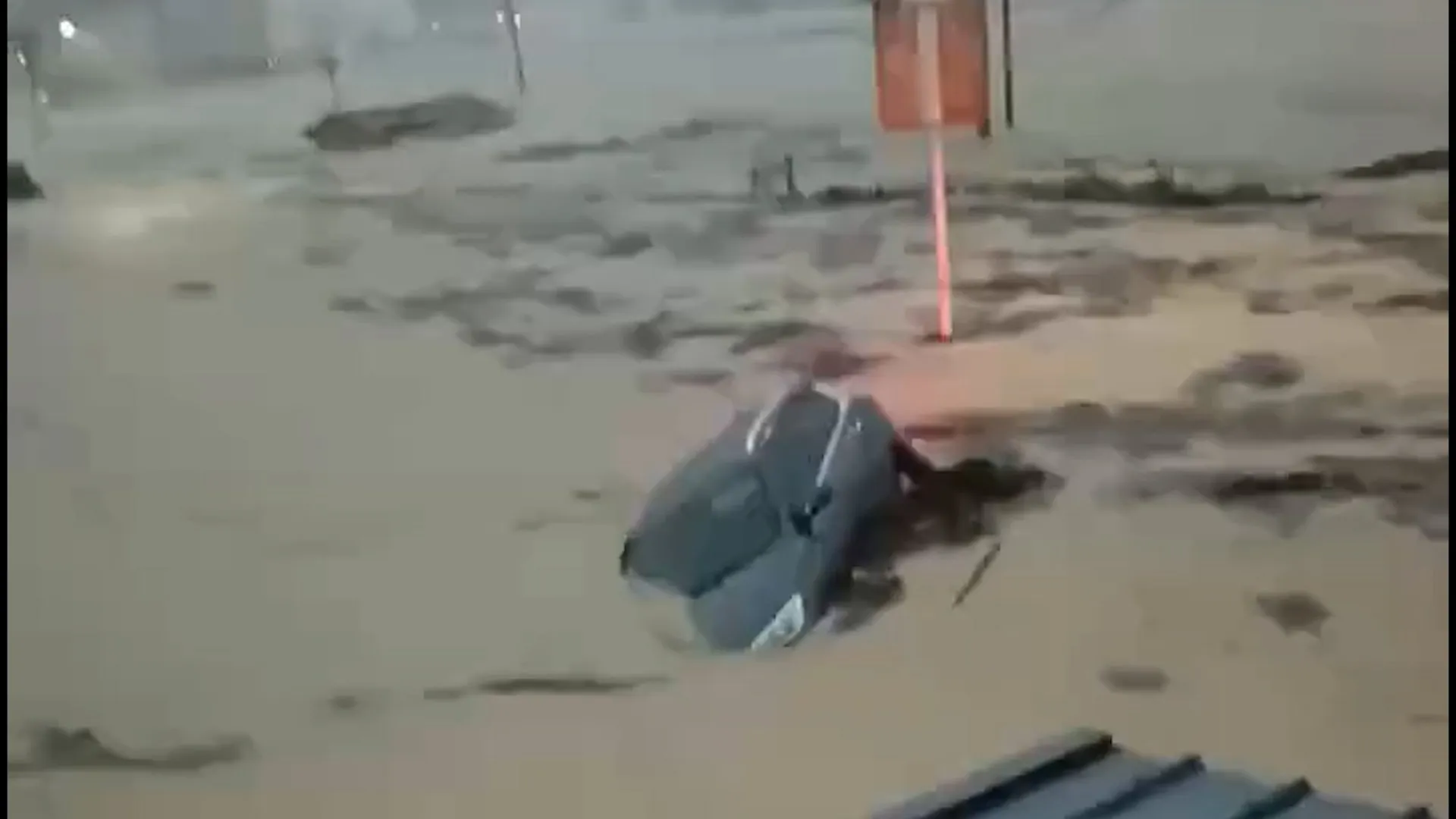
Torrential rain triggered severe flooding across parts of eastern China, rushing down streets and sweeping away vehicles. One weather station recorded more than half a metre of rain as authorities raised the emergency response to the highest level.
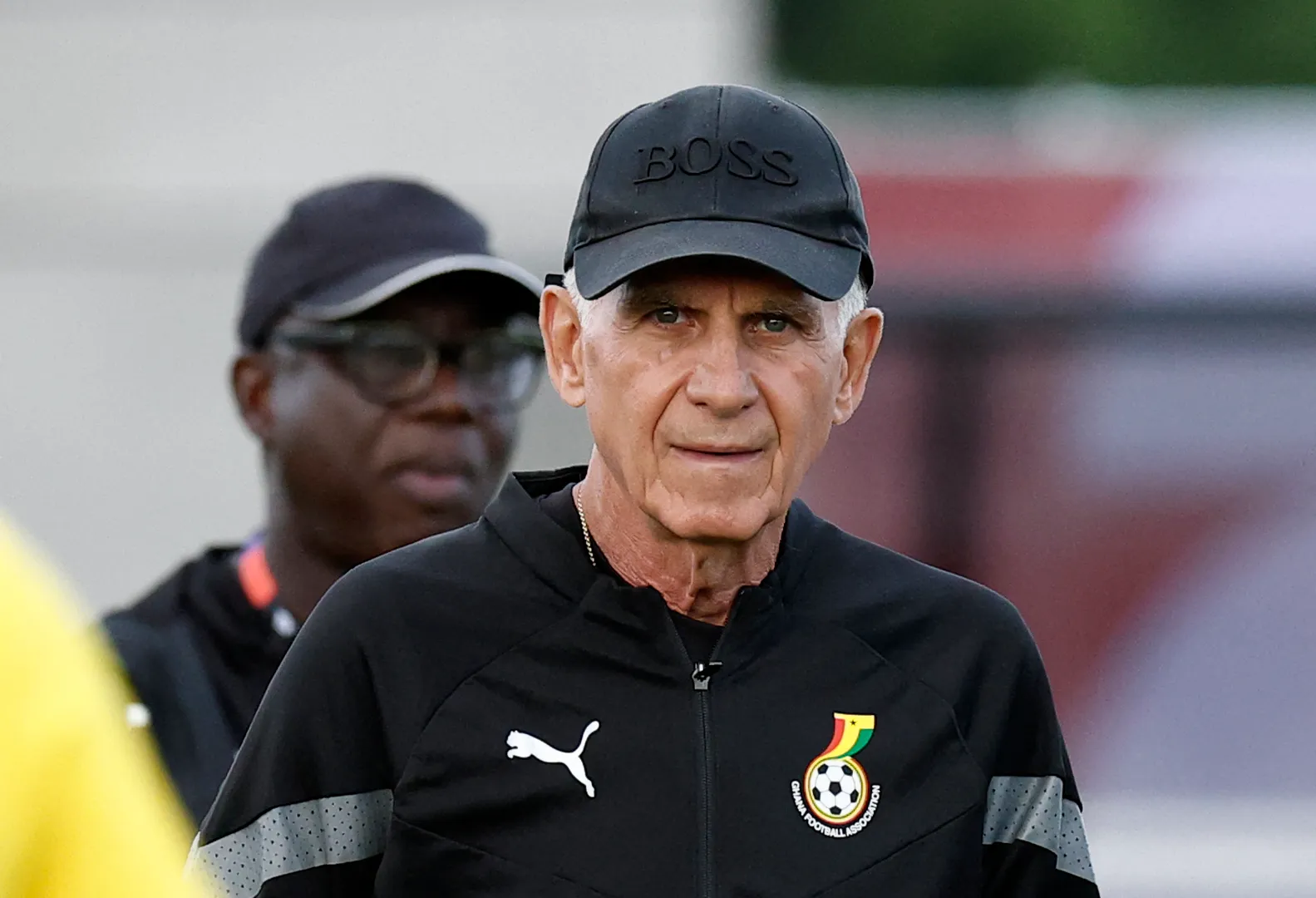
Carlos Queiroz quit the job after leading Ghana to the World Cup Round of 32 but has returned for an interim period.
Published On 3 Sep 20263 Sep 2026
Carlos Queiroz has been reappointed Ghana coach for an indeterminate period, two months after stepping down in the wake of the country’s FIFA World Cup campaign.
The Ghana Football Association (GFA) said on Wednesday the 73-year-old Portuguese coach would “embark on a new coaching mandate, commencing with the upcoming international window”.
Recommended Stories
list of 4 itemsend of list
“The GFA believes Queiroz’s extensive international experience, technical expertise, and knowledge of the Black Stars position him strongly to lead the team into this next chapter,” the association said in a statement.
The experienced former Iran, Portugal, Colombia and Egypt coach guided the Black Stars to the round of 32 at the World Cup despite having only a couple of months to prepare them for the tournament.
Ghana were left without a coach 72 days before the World Cup kickoff after parting company with Otto Addo following friendly defeats by Austria and Germany in March.
Ghana are scheduled to play home and away group matches against Ivory Coast in qualifying for the 2027 Africa Cup of Nations during the next international window, which runs from September 21 to October 6.
Queiroz led Portugal to the round of 16 at the 2010 World Cup and later coached Iran in the last three editions of the tournament, recording three wins in 13 matches.
Born in Mozambique, the former goalkeeper has also held coaching positions with Egypt, Japan, Colombia and South Africa, and previously led Portugal in the early 1990s.
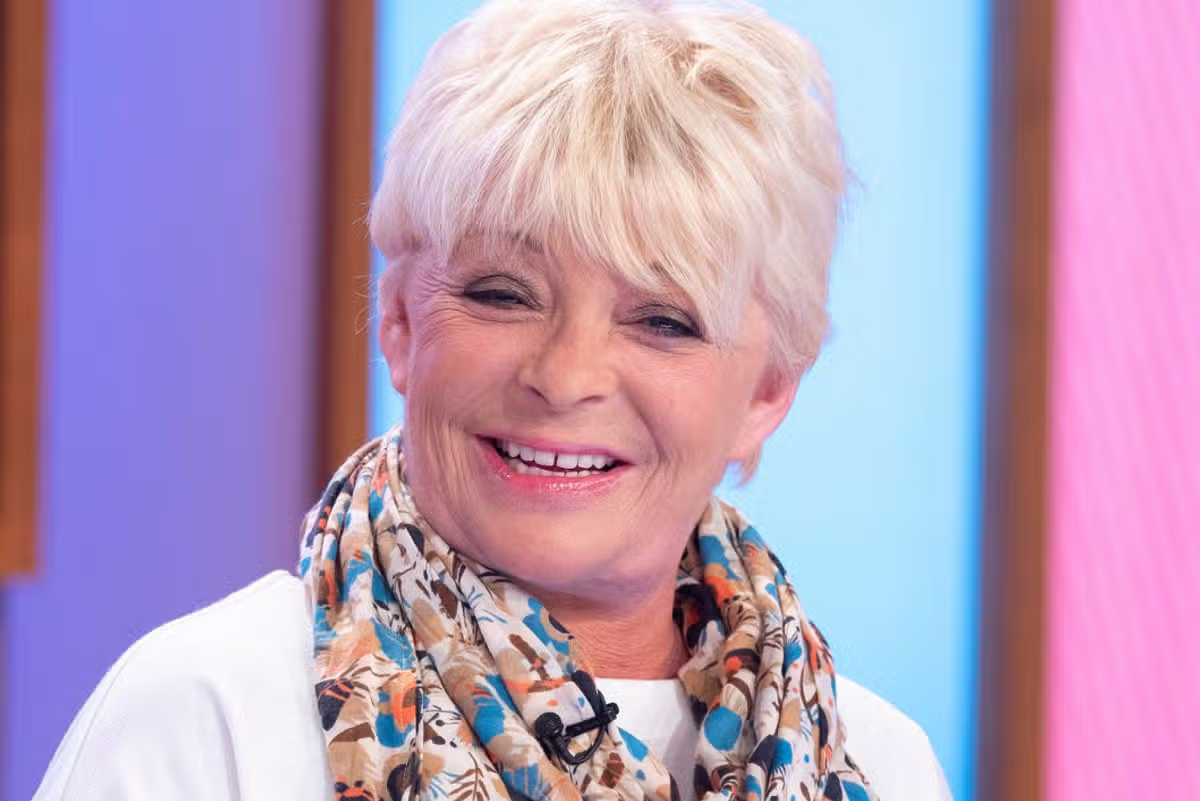
EXCLUSIVE: Crissy Rock has admitted she would love to join the Loose Women panel following the exit of Denise Welch and revealed that there was a time she could have had a part in Coronation Street
20:14, 02 Sep 2026Updated 20:30, 02 Sep 2026
Crissy Rock has said she would like to join Loose Women as a panellist(Image: Ken McKay/ITV/Shutterstock)
Crissy Rock has revealed that she would like to join Loose Women. The actress, 67, is probably best known for playing hotel manageress Janey Yorke during the first four series of the sunny sitcom Benidorm, and has also had an incredibly successful career as a stand-up comedienne.
When it was suggested that she could act as a replacement for Denise, who recently quit after more than 20 years, Crissy said: “Oh yeah, I’ll have to get in there!” Denise, also known for her roles in Waterloo Road and Coronation Street, said she was stepping down because acting is her “first love and the thing she’s best at,” so would like to make the most of new opportunities.
Crissy shot to fame when she took on the role of Maggie in the Ken Loach film Ladybird, Ladybird in 1994 and won critical acclaim for her performance. Since then, the Liverpool-born star has appeared in episodes of Peak Practice, Brookside and Dalziel and Pascoe, whilst also treading the boards regularly in productions such as Snow White, Cinderella and Menopause the Musical.
Shortly after Crissy competed on I’m A Celebrity…Get Me Out Of Here! in 2011, there was speculation that she could be about to join the cast of Coronation Street as the sister of Jackie Dobbs, played by fellow Liverpudlian Margi Clarke – but it never came to fruition.
She said: “I’ve never done Coronation Street, ever. There was rumours, but it never, ever happened. It never come about. It would have been lovely, that, wouldn’t it? To play Margi Clark’s sister, Tyrone’s auntie. That would have been a good thing, but it just never happened.
“You always hear things. Like ‘Oh, Benidorm’s going to come back.’ but is it or isn’t it? We don’t know, and I’m just as in the dark as everyone else!”
Benidorm began in 2007 and, over the course of 10 series, followed the escapades of a group of British holidaymakers, with a host of names such as Sheridan Smith, Siobhan Finneran, and Hannah Waddingham all checking into the Solana hotel during its long run.
Whether a Benidorm revival is on the cards or not. Crissy admitted that even though she had been in the industry for years before it all began, that was the role that cemented her status in showbiz.
She said: “I’ve been an actress way before Benidorm, but I think Benidorm because of what it did and how it influenced everyone, and it become like a cult thing, it did, in my eyes, put me firmly back on the map, you know what I mean?”
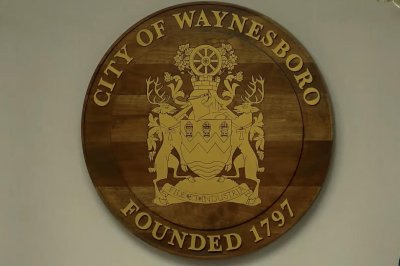
Sept. 2 (UPI) — A 19-year-old gunman forced his way into a Virginia elementary school on Wednesday morning where he wounded an employee before turning the weapon on himself, authorities said.
The suspect, identified as Anthony Ignatiadis-Isabelle of Waynesboro, Va., was found by police dead from a self-inflicted gunshot wound in the library, the Waynesboro Police Department said in a statement.
Authorities said police were notified of a suspicious individual on the grounds of Westwood Hills Elementary School in Waynesboro at 9:12 a.m. EDT. Officers responded within minutes, entered the school and found Ignatiadis-Isabelle in the library where there were no students at the time of the incident.
One staff member, identified only as an adult, was shot by the suspect, suffered what police described as a non-life-threatening gunshot wound and was released from the hospital after receiving treatment.
Little information about the shooting has been made public. Waynesboro Police Chief David Shaw would not detail during a press conference exactly how the suspect was gained entry to the school, which requires one to be buzzed in, only that it was “forced.”
He said he was unsure of what position the wounded employee held at the school, what their possible relation was to the shooter or where they were shot. He also said he did not know if the alleged shooter was known to police. The suspect was not and had never been a student at Westwood Hills Elementary School, Superintendent Jeffrey Cassell said.
The school was immediately put into lockdown following the shooting, according to Cassell, who said the facility would be closed on Thursday.
“Today is the day every school system hopes they never have to deal with,” an emotional Cassell said. “Every student and staff member is safe and returned home to their families. Please hug your children and your families this evening.”
Shaw said that as a precautionary measure, additional law enforcement would be at the school for the remainder of the week.
The Bureau of Alcohol, Tobacco, Firearms and Explosives said in a statement that its Washington field office responded to the shooting.
“My heart is with these young students, their parents and families, and the teachers and staff at the school,” Virginia Gov. Abigail Spanberger said in a statement that explained she was monitoring the emergency at Westwood Hills Elementary School.
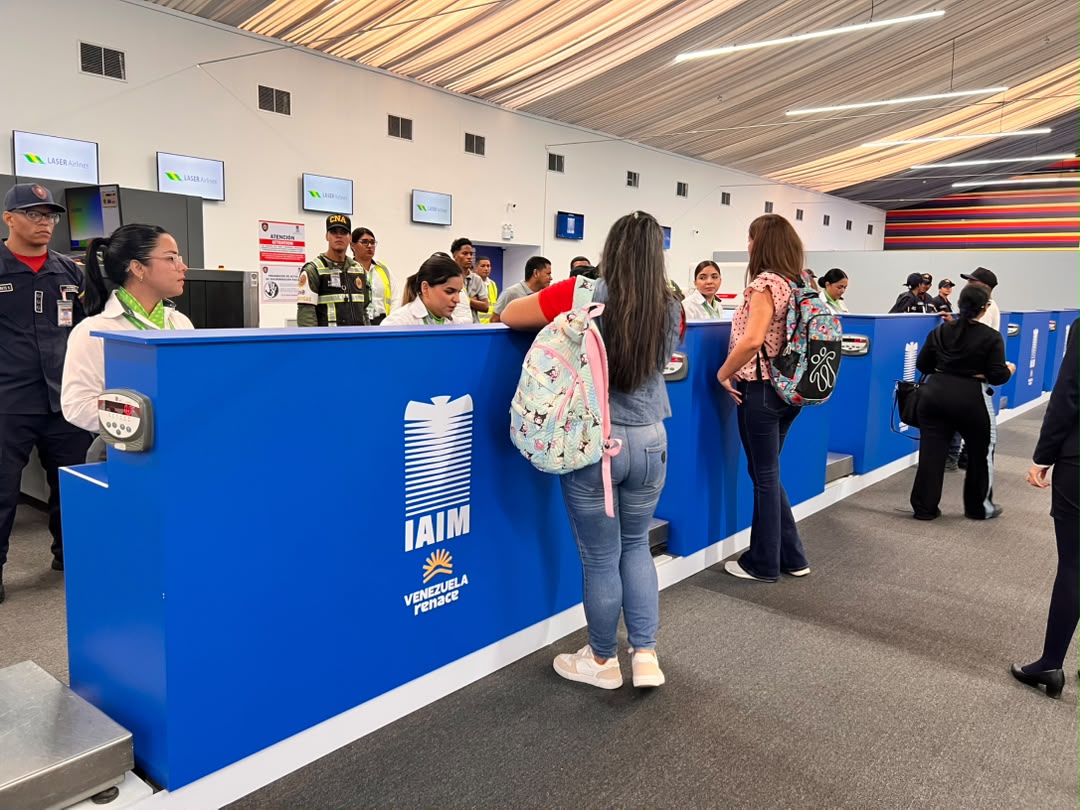
Multiple airlines have resumed connections from Venezuela’s main airport. (AVN)
Mérida, September 2, 2026 (venezuelanalysis.com) – Venezuela’s Simón Bolívar International Airport, located in Maiquetía, La Guaira State, officially resumed commercial flight operations on Tuesday through newly constructed temporary terminals.
Air connections resumed more than two months after a powerful double earthquake struck central and coastal Venezuela on June 24, causing severe structural damage to the Simón Bolívar Airport, including fractured runways.
The initial phase of renewed operations relies on four modular, temporary terminals erected in the airport’s external parking areas. Spanning more than 10,000 square meters, the temporary structures house fully functional services for ticketing, baggage drop and retrieval, security checkpoints and migration control.
Venezuelan authorities have also set up shuttle buses to take passengers from the modular gates to the aircraft on the tarmac. They have also issued operational guidelines for passengers and organized a security deployment in the airport grounds and surrounding areas.
Before official operations began, national aviation authorities executed four operational simulations to test passenger circulation routes, security protocols, luggage handling, and overall system readiness.
During an official inspection, Minister of Transportation Francisco Garcés outlined the operational milestones, technical parameters, and long-term recovery timeline for the nation’s main aviation hub.
“There is full operationality from these temporary terminals, with capacity to accommodate 720 departing and 496 arriving passengers in the international area, and 480 and 472, respectively, in the domestic sector,” Garcés stated during a media briefing. “We have made a strong effort to maintain rigorous international standards for user comfort and safety, completing this complex logistical solution in record time.”
Garcés explained that the current facilities restore approximately 25 percent of the airport’s pre-earthquake operational capacity, with projections of expanding to 40 percent within the next two months and 60 percent by the end of the year.
Meanwhile, engineering teams continue comprehensive structural repairs on the main permanent terminals, with full reconstruction scheduled for the first quarter of 2027.
On September 1, the opening day of the temporary facilities featured eight scheduled flights split equally between domestic and international routes, with the inaugural flight departing to Valera, Trujillo State.
Air carriers currently operating or scheduling their immediate return to Maiquetía include national lines Conviasa, Laser Airlines, Estelar, Avior and Venezolana, alongside international operators such as American Airlines, Iberia, and Copa Airlines.
Throughout the two-month shutdown following the June 24 seismic events, national and international air transit was diverted through smaller, regional airports across the country, including Barcelona (Anzoátegui State), Valencia (Carabobo State), and Maracaibo (Zulia State).
Alongside the reopening of Venezuela’s main air hub, the acting Delcy Rodríguez government has continued to address housing rehabilitation and structural reconstruction in damaged urban centers.
In La Guaira State, Rodríguez oversaw the formal handover of 210 fully repaired apartments in the Ana Victoria community. The rehabilitation works under the Plan Venezuela Renace allowed displaced families to return to their homes after two months in temporary shelters.
Additional structural works in La Guaira include “tetra-houses” in Catia La Mar and public infrastructure reconstruction near the El Trébol highway interchange.
Concurrently, Rodríguez announced the delivery of direct financial assistance and low-interest loans to 104 condominium boards and 1,216 individual housing units in the Chacao and Altamira areas of Eastern Caracas.
“We have begun an inspection process; I know it may take some time, but it is important because we are in a phase of changing the seismic resistance standards for construction,” she said.
Disbursed through joint public and private banking channels, individual loans can be up to US $5,000, while funding for common area repairs can reach $20,000.
These funds enable residents and homeowner associations to address structural issues on buildings categorized under yellow and red risk tags, ensuring compliance with updated seismic resistance construction standards.
Jason Watkins and Robson Green are back for the next chapter in their dangerous game of cat and mouse.
Hayley Anderson Screen Time TV Reporter
21:00, 02 Sep 2026
The Game season two won’t be airing tomorrow as fans might expect. (Image: CHANNEL 5)
Channel 5’s The Game season two is well underway with fans already desperate to find out what happens next.
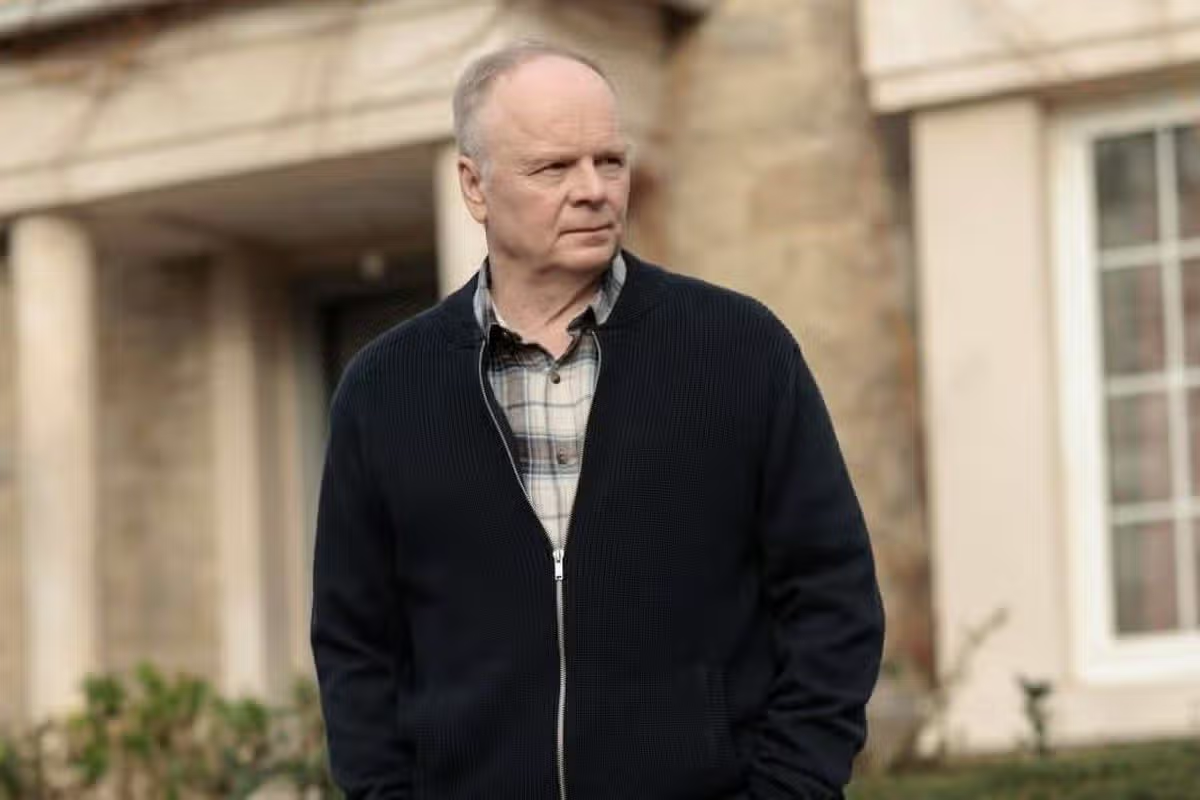
Patrick Harbottle (played by Robson Green) continues to attack Huw Miller (Jason Watkins) and his family from behind bars but this time, he sets his sight on his daughter Margot (Indy Lewis).
This time around, Patrick goes a step further in the second episode, getting prison guard Jackie ( Tanya Franks ) to break into her flat and steal her diary in a bid to really get under Margot’s skin.
Things get even more intense though when she discovers that Huw has secretly visited Patrick in prison again, causing her to “explode”.
But the worse could still be yet to come as she grows suspicious that Patrick has hired someone to stalk her.
But as she grows suspicious that Patrick is hiring someone to stalk her, will Margot be able to trust that her own father wasn’t somehow involved?
When is Channel 5 The Game season 2 next on?
Channel 5’s The Game has returned one year later for its second series which made its debut last night, Tuesday, September 1.
Fans have since been treated to episode two this evening, Wednesday, September 2, but unfortunately, its third instalment won’t be airing on Thursday night as expected.
Channel 5 viewers are going to have to wait until the following week for the remaining two episodes of the four-part drama.
The Game season two, episode three, will be shown on Tuesday, September 8, and the grand finale on Wednesday, September 9, both at 9pm, on Channel 5.
What will instead be taking its place tomorrow night will be the sixth and final episode of Benidorm is Murder starring John Hannah.
The intense official synopsis for the finale reads: “A farewell party takes a deadly turn after a power cut plunges the gathering into darkness.
“When the lights return, one guest lies dead on the floor, a kitchen knife in his chest.
“Forced to investigate to clear his name, Dennis reconstructs the blackout second by second, exposing contradictions in the guests’ stories and asking whether the killing was a sudden act of rage or meticulously planned.”
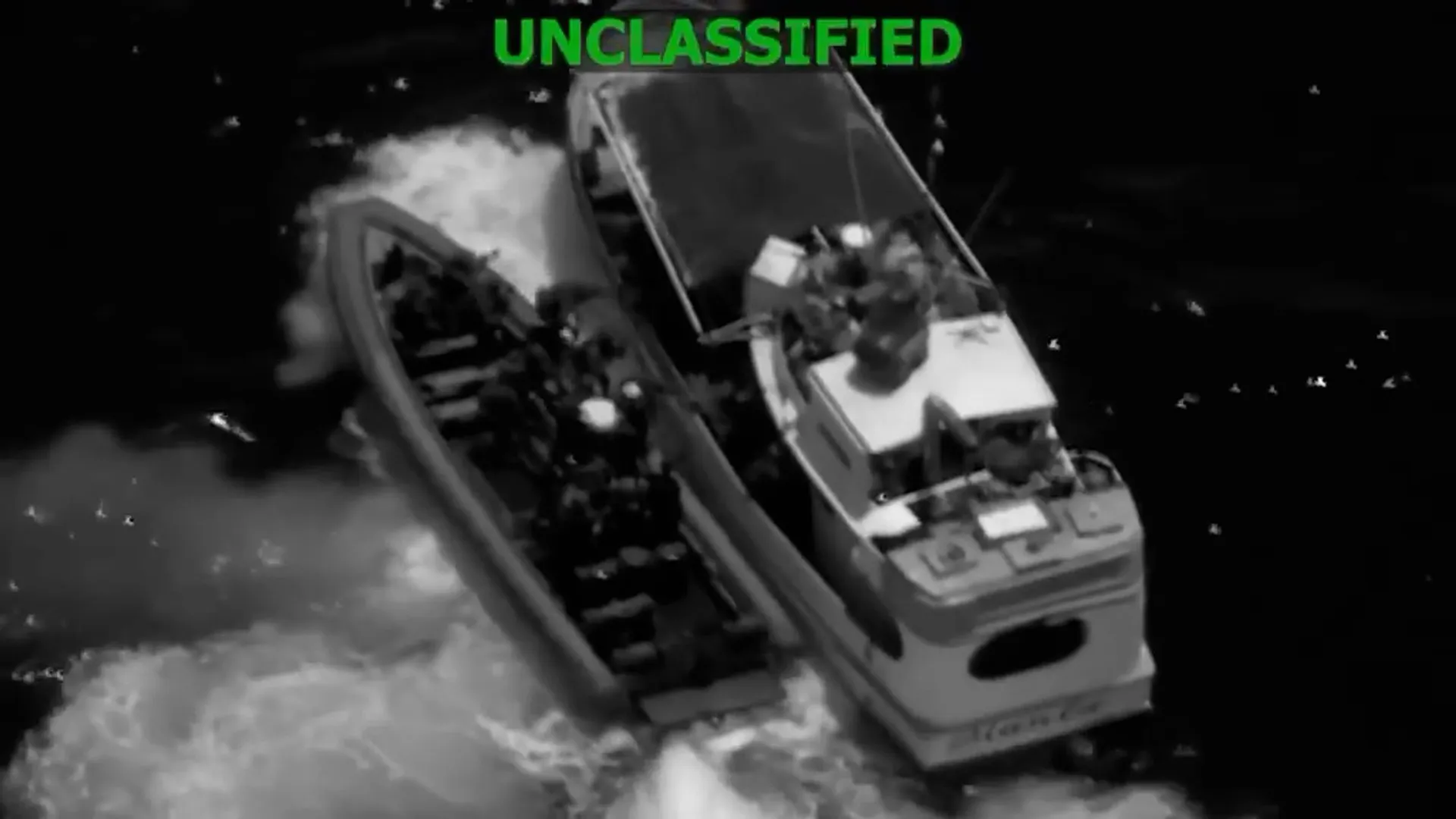
US forces boarded and sank a boat in the eastern Pacific saying it was a floating refueling station for drug-traffickers. The boat’s destruction was captured by a US military recording. The men aboard are suspected of being part of Ecuador’s Los Choneros gang.
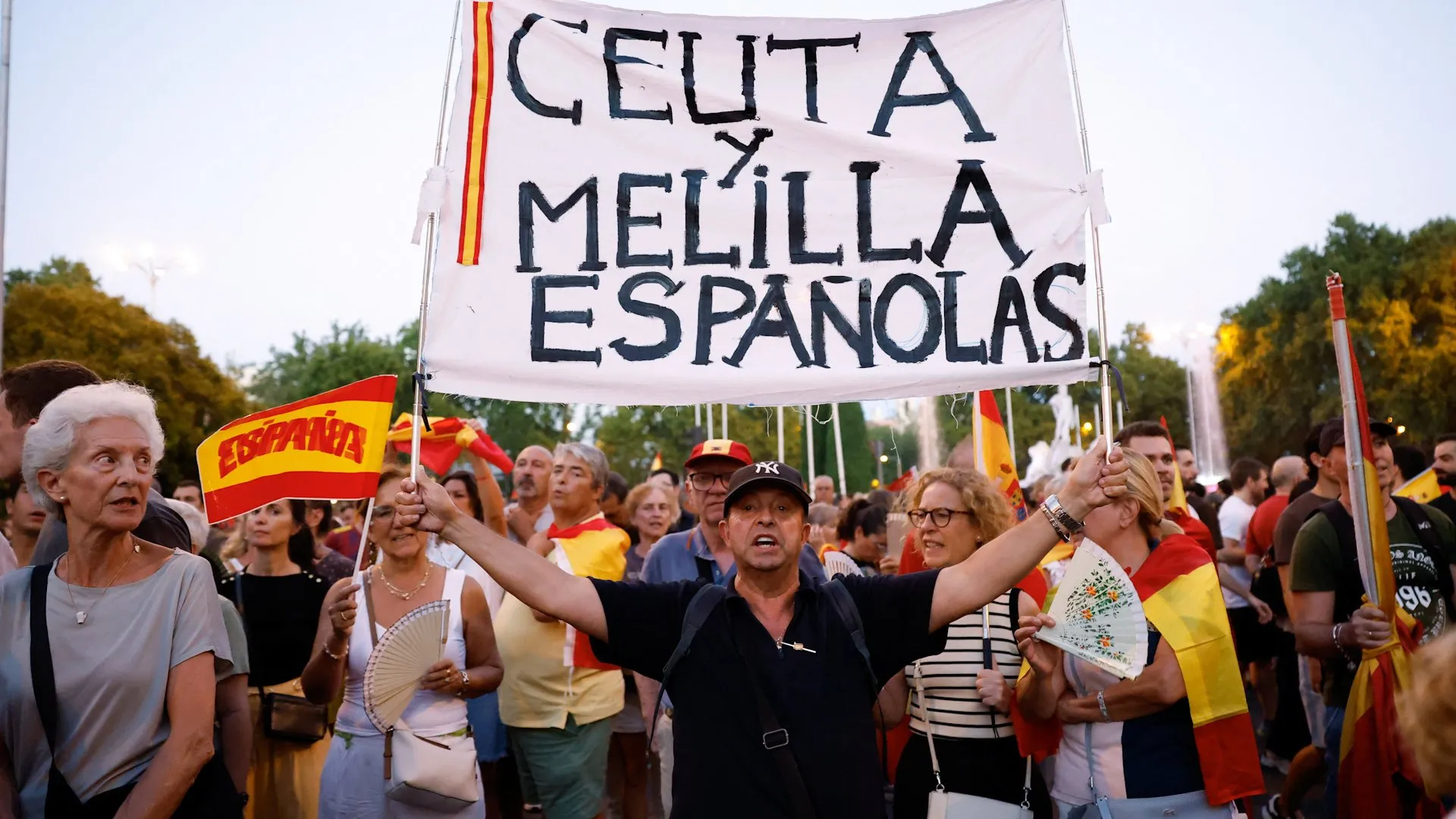
Tens of thousands rallied across Spain in support of Ceuta, protesting the government’s handling of the migrant crisis and accusing Morocco of involvement in the border surge.
The Quintanilla family is taking their personal disputes to the public.
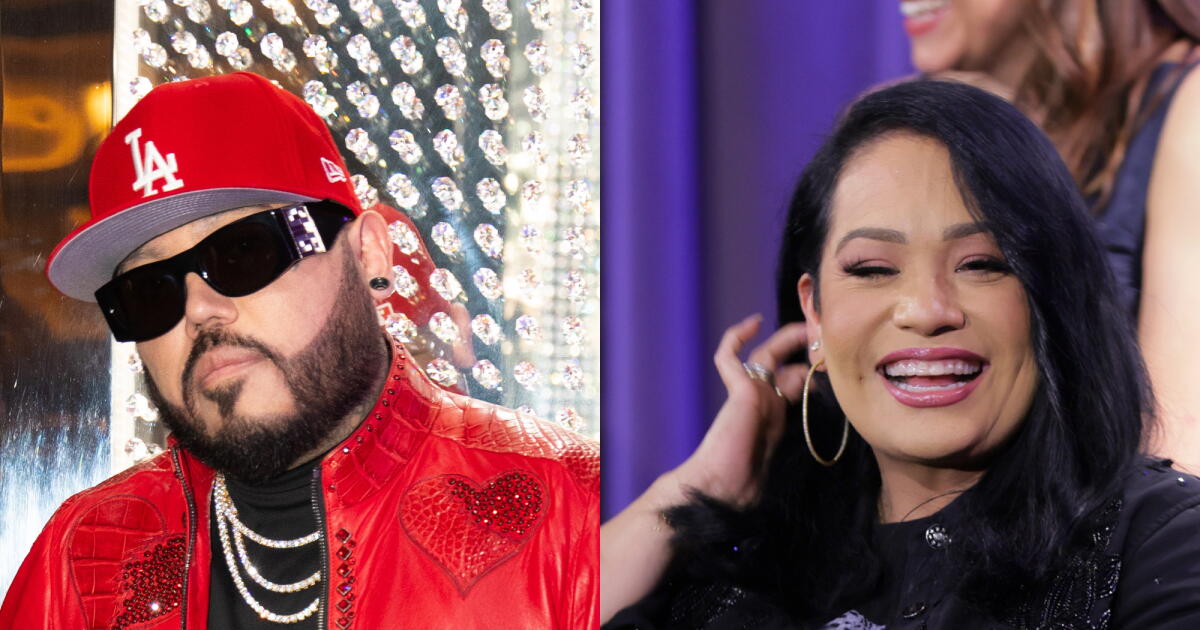
On Tuesday, A.B. Quintanilla III — brother of the late Tejana singer Selena Quintanilla — uploaded a statement to Instagram claiming that there is a lawsuit involving Suzette Quintanilla Arriaga, as well as “facts and circumstances” related to their father, Abraham Quintanilla Jr.
According to the Latin Grammy-winning producer and songwriter, the lawsuit began a “few months ago,” but he shared that the circumstances surrounding the case have been simmering for years.
“What led me to this point did not start a few months ago. It comes from years,” stated A.B. “Years of accumulated situations, decisions and circumstances that for a long time I chose to keep silent out of respect, out of loyalty, and above all, because it involved my own family.”
While no clear wrongdoing was presented in his statement, the Kumbia Kings musician shared that, when the time is right, he will disclose his side of the story. “I was never the type to wait for the paycheck from someone else’s hard work to come to my door,” he added.
After his post, Suzette and Marcella Quintanilla, their mother, published a joint statement Wednesday morning on the official Selena Instagram account, claiming that the parties involved were not served a lawsuit, nor have they been able to locate the alleged lawsuit in public records.
“[Suzette] has received no court-filed complaint, summons, petition, or other legal pleading concerning the allegations A.B. is describing,” read their statement. “So, we ask a simple question: What lawsuit? Where was it filed? What is the case number?”
In a subsequent Instagram post uploaded Wednesday by A.B., he alleged that Suzette and her lawyers were notified with the corresponding documents via mail and electronic mail; the carousel also contained a letter by Manatt, Phelps & Phillips addressed to Michael A. Trauben, Esq., of Sign, Sign & Trauben.
“She was notified of a lawsuit related to her fiduciary duties, that is, her legal obligations to act with loyalty, transparency and in the best interests of those she was responsible to,” read the statement uploaded by A.B. “She responded, but did not provide what was being requested: contracts, documentation and financial information.”
The Times attempted to locate the lawsuit in Nueces County, Texas, court — headquarters for Q-Productions, an entertainment company founded by Abraham, as well as the Selena Museum — but was unable to locate any case filings related to “Suzette Quintanilla” or “Suzette Arriaga.”
In their Sept. 2 Instagram post, Suzette and Marcella claimed that A.B.’s insinuations concerning Suzette, Abraham and the overall Quintanilla family were false.
The pair also addressed rumors that Suzette is selling personal belongings related to Selena, stating that “any potential sale of an ownership interest in a company is entirely separate and should not be mischaracterized as the sale of Selena’s personal items.”
“There was no theft by Suzette. Suzette has not stolen, misappropriated, or improperly taken money or property belonging to A.B., Abraham, Chris, Selena’s estate or any family-owned or jointly owned business,” read the statement. “If A.B. has evidence that Suzette stole or misappropriated anything, he should present it.”
This online dispute comes almost nine months after Abraham’s death on Dec. 13, 2025. The patriarch played a crucial role in the development of his daughter Selena’s career, establishing his family-led band Selena y Los Dinos in the 1980s as a way to meet financial needs. With A.B. on bass, Suzette on drums and Selena as the tender vocalist, the group would eventually sign their first recording contract with Freddie Records in 1984.
In 1995, after Selena’s tragic death at the hands of Yolanda Saldivar, the former president of her fan club, Abraham dedicated his life to safeguarding her legacy and overseeing primary control over her estate. This included managing the rights to her image, name and likeness — at times, to controversial ends.
“If he is alleging wrongdoing by Abraham, he should clearly state what he is alleging rather than leaving the public to speculate about a man that is no longer here to respond for himself,” stated Suzette and Marcella jointly.
A.B. and Suzette’s representatives did not immediately respond to a request for comment.
In his Wednesday Instagram statement, A.B affirmed that more information will be shared via his lawyer on Friday.
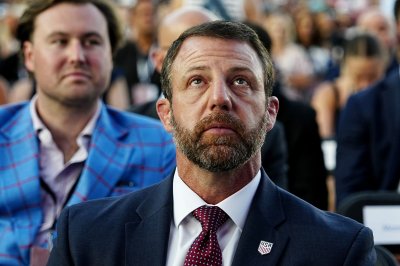
Sept. 2 (UPI) — A Coast Guard jet with Homeland Security Secretary Markwayne Mullin onboard made an emergency landing Wednesday afternoon near Washington, after the jet suffered a mid-flight engine failure.
“The United States Coast Guard pilots made the single-engine landing feel routine,” Mullin said online, confirming the incident.
“No panic, just straight professionalism. After we landed, the pilots told me that was a first for them! We could not have been in better hands.”
Ronald Reagan Washington National Airport confirmed the C-37A with 14 people onboard landed safely at 1:35 p.m. EDT. No other flights were disrupted, it added.
According to audio of communication between the plane’s pilots and air traffic control, the aircraft had lost its right engine, and had requested an emergency landing at the airport, which was granted.
Ronald Reagan Washington National Airport is located in Arlington County, Va.











![Mohammad Bin Salman and Netanyahu - Cartoon [Tasnimnews.com/Wikipedia]](https://i0.wp.com/www.middleeastmonitor.com/wp-content/uploads/2018/01/2017_11-29-Mohammad-Bin-Salman-and-NetanyahuCaricature_of_Mohammad_Bin_Salman_03.jpg?w=1200&ssl=1)
![U.S. President Donald Trump looks over at Crown Prince of Saudi Arabia Mohammad bin Salman al-Saud as they line up for the family photo during the opening day of Argentina G20 Leaders' Summit 2018 at Costa Salguero on 30 November 2018 in Buenos Aires, Argentina. [Daniel Jayo/Getty Images]](https://i0.wp.com/www.middleeastmonitor.com/wp-content/uploads/2018/12/2018-12-3_trump-and-bin-salmanbin-salman-g20-trump.jpg?w=1200&ssl=1)