Finance Desk

Educational Development outlines $1.2M+ annual expense savings as brand partner count rises above 5,200 (NASDAQ:EDUC)

Earnings Call Insights: Educational Development Corporation (EDUC) Q1 fiscal 2027

Management View

  • “During March, we ran a recruiting special surrounding our March 14 Pi Day, which yielded better-than-expected results. We added over 1,300 new brand partners, which brought our Active Brand Partner numbers above

Seeking Alpha’s Disclaimer: This article was automatically generated by an AI tool based on content available on the Seeking Alpha website, and has not been curated or reviewed by humans. Due to inherent limitations in using AI-based tools, the accuracy, completeness, or timeliness of such articles cannot be guaranteed. This article is intended for informational purposes only. Seeking Alpha does not take account of your objectives or your financial situation and does not offer any personalized investment advice. Seeking Alpha is not a licensed securities dealer, broker or US investment adviser or investment bank.

Source link

EU to probe Chinese Pekin duck imports as market-flooding row hots up

Published on Updated

The European Commission launched an investigation on Thursday into Chinese Peking duck after several EU producers complained of unfairly low prices harming their industry.


ADVERTISEMENT


ADVERTISEMENT

Without disclosing their names, the Commission said that five EU producers had complained that China is unfairly subsidising domestic production via its five-year plan for agricultural modernisation.

The probe comes at a time of heightened tensions between Beijing and Brussels, as the EU seeks to shield its market from cheap Chinese imports, triggering Beijing’s ire as it aims to preserve access to the lucrative European market.

After China repeatedly threatened retaliation over several EU legislative proposals restricting access to EU public procurement and setting strict conditions on foreign investment, the two sides started negotiations last week to ease tensions.

However, the EU’s latest move targeting duck imports could disrupt the talks by hitting China’s agricultural sector for the first time.

It also said that the volume and prices of imports had a “negative impact on the quantities sold, the level of prices charged and market share held by the Union industry,” and that this had resulted in “substantial adverse effects on the overall performance” of the sector.

The Commission’s investigation could result in anti-dumping duties being imposed on Chinese producers to protect the EU market.

Anti-dumping and anti-subsidy duties are among the EU’s main trade defence instruments against China’s aggressive push into its market. However, EU leaders gave the Commission a mandate in June to step up efforts to reduce the EU’s €1 billion-a-day trade deficit with China. They want the EU executive, which has competence over trade policy, to review its trade defence tools and pursue a dialogue with Beijing that delivers tangible results.

EU Trade Commissioner Maroš Šefčovič met his Chinese counterpart, Wang Wentao, in Brussels last Monday to kick-start negotiations aimed at restoring a level playing field and addressing trade imbalances, which Brussels said had become “unsustainable”.

The EU already imposed tariffs on Chinese electric vehicles in 2024, triggering China’s investigations and sanctions targeting EU brandy, pork and dairy products.

The EU hopes to achieve a breakthrough in negotiations with Beijing by October, when Šefčovič is due to travel to China.

Source link

SK hynix: From near-collapse to a $1 trillion valuation and a Nasdaq listing

South Korean chipmaker SK hynix, known for its high-bandwidth memory chips, is preparing to raise roughly $28 billion (€24.5bn) on Wall Street, a sum surpassed only by SpaceX’s record flotation last month.


ADVERTISEMENT


ADVERTISEMENT

It is an extraordinary outcome for a firm that once survived on job cuts and asset sales.

Pricing is due on Thursday, with trading expected to begin on Friday under the ticker SKHY.

SK hynix is issuing 17.79 million new shares in the form of American depositary receipts (ADRs), each representing a tenth of a Seoul-listed share, and cornerstone investors including Baillie Gifford and funds run by Coatue Management have signalled interest in up to $7 billion (€6.1bn) worth of stock.

The target was trimmed from an initial $29.6 billion (€25.9bn) after the shares slipped in recent weeks.

ADRs are certificates traded on a US exchange that stand in for shares held abroad, letting American investors buy into a foreign company without dealing in a foreign currency or market.

Unlike a conventional flotation, this is not SK hynix’s stock market debut. Its primary listing remains on Seoul’s Kospi index, and the Nasdaq offering simply opens a second, dollar-denominated avenue for investors to gain exposure.

The listing arrives with the company already worth more than $1 trillion (€876bn), a threshold also crossed by rivals Samsung Electronics and Micron, after a surge of more than 200% this year.

Proceeds will fund new fabrication plants, chiefly a vast cluster in Yongin, plus its first US packaging facility in Indiana.

The move is partly about valuation. Korean-listed chipmakers have long traded at a discount to American peers, and a Nasdaq listing offers a chance to close that gap.

The AI memory boom — and the risks

The AI build-out has transformed the industry’s economics.

As hyperscalers pour hundreds of billions into data centres, memory prices have exploded, with DRAM up 44% and NAND flash up 53% in a single quarter, according to Citi Research, and manufacturers have already sold most of their 2026 production.

SK hynix reported first-quarter revenue above 50 trillion won (€29bn) and operating margins north of 70%, figures unheard of for a chipmaker, and commands about 60% of the high-bandwidth memory (HBM) market, according to Counterpoint Research.

Yet the timing is delicate.

Memory has always been a brutally cyclical business. The AI-driven rally that transformed SK hynix has begun to wobble as chip stocks sold off sharply across Asia last week, and Samsung lost more than $100 billion (€87.5bn) in market value despite posting a record profit.

Investors are increasingly asking whether the vast sums being spent on AI infrastructure will earn a return, a question that the Bank for International Settlements raised in late June when it warned that the boom could seed the next financial crash.

Built, broken and rebuilt

Those concerns are not new for SK hynix.

SK hynix traces its roots to Gukdo Construction, founded in 1949, which moved into electronics in 1983 as Hyundai Electronics, an arm of the Hyundai empire.

The Asian financial crisis of the late 1990s brought disaster. Under an IMF-backed restructuring of the Korean economy, Hyundai absorbed rival LG’s semiconductor business, creating a giant that promptly buckled under its own debts.

Salvation came in stages.

Renamed Hynix Semiconductor in 2001, a contraction of “high” and “electronics”, the firm cut jobs, shed assets and split from Hyundai. Profits returned, but the violent swings of the DRAM market left it perpetually exposed.

Starved of capital, it was rescued in 2012 by the telecoms conglomerate SK Group, becoming SK hynix. The takeover proved decisive. SK Group poured money into high-bandwidth memory, then a costly and unprofitable technology that few believed in.

Today it has become the scarcest commodity in AI computing. And the firm employs nearly 46,900 people.

Additional sources • AFP

Source link

Cuba Forced to Adopt Free-Market Reforms

Facing a 7% GDP contraction, the socialist island nation opens up to private banking and investment.

In June, the Cuban National Assembly unanimously passed 176 economic reforms aimed at staving off an economic crisis partly caused by U.S. sanctions.

Prime Minister Manuel Marrero announced the reforms, which aim to reduce the state’s presence in the economy and attract foreign investment in agriculture, banking, and tourism. Officially, they are described as the most significant attempt to update the current state-socialist economic system.

“Times have changed, geopolitics have changed, and the United States’ aggression toward Cuba has changed,” President Miguel Mario Díaz-Canel Bermúdez told the Dominican Republic’s Telenoticias. “We cannot remain the same; we must transform. These are times of transformation.”

Economic Crisis Prompts Action

A multitude of internal and external crises plagued the island economy during the first half of this year. Prolonged blackouts due to an electricity system in severe need of modernization, and chronic shortages of fuel and basic goods, partly caused by a U.S. oil blockade, top the list.

Economists project a 7% contraction in GDP for this year.

Faced with capital flight by foreign businesses due to U.S. sanctions, the Cuban government felt the pressure to change. Hotel chains, international commerce, and airlines had left Cuba, and in early June, the Central Bank of Cuba announced it could no longer accept Visa and Mastercard transactions.

Dismantling State Monopolies

The Cuban government grouped the 176 reform measures into 23 pillars. They include expanding the private sector by removing the 100-employee limit on companies.

Additionally, the reforms allow corporate and multi-ownership structures; reforming state-owned enterprises; authorizing private banks to enter the financial system; partially dollarizing the economy; transitioning from universal to targeted subsidies; facilitating foreign direct investment; and opening up foreign trade and real estate tourism.

“Today, our banking and financial system creates obstacles, hinders development, and does not facilitate investment, development, or agricultural production,” said Díaz-Canel.

Arguably, the measures represent the most significant changes to the economic system since the 1959 Cuban Revolution, dismantling longstanding state monopolies and allowing investors to acquire stakes in state-owned businesses.

No less a figure than Raúl Guillermo Rodriguez Castro, grandson of Fidel Castro, told The National, the United Arab Emirates’ English-language newspaper, “Our country must seek a path to economic development where we must inevitably diversify our economy, diversify the way we do business, and diversify the way we do investments.”

Nic Wirtz is a contributing writer based in Guatemala.

Source link

Commission to tighten access to EU market as foreign interference concerns rise

Published on

In a draft regulation obtained by Euronews and due to be presented in September, the European Commission plans to tighten access to the EU market by allowing public authorities to exclude foreign companies that present risks of interference from public procurement.


ADVERTISEMENT


ADVERTISEMENT

The draft proposal comes amid heightened geopolitical tensions, with concerns over data leaks from sensitive public services to Beijing and Washington and as well as the weaponisation of the EU’s dependence on rare earths and technology products from China.

The draft document proposes that “public buyers shall take appropriate measures, where relevant at any stage of the procurement procedure, from planning and market consultation to contract award and execution, to ensure the protection of the security and public safety interests of the Union.”

The document adds that risks to security or public safety in a public contract may arise from firms whose “ownership, control, or financing structure” bears “risks of undue interference or influence over it,” as well as companies whose “exposure to third-country legislation […] may compel disclosure of sensitive information or interference with contract performance.”

Finally, public buyers would be allowed to introduce a European preference in public procurement, although the draft regulation would not make it compulsory.

Such provisions could confirm the EU’s protectionist shift towards a “Made in Europe” strategy, which the EU executive already proposed last March for strategic sectors such as clean technologies, the automotive industry and energy-intensive industries.

The risks of foreign interference and data transfer have become more acute in recent years, with the US and China both adopting legislation allowing them to request that companies under their jurisdiction transfer data stored in the EU.

Some European governments are already taking steps to mitigate these risks. In April, the French government ended its contract with Microsoft to protect French health data, and in June, it replaced US tech company Palantir with French company ChapsVision for the processing of sensitive information held by the the country’s domestic intelligence service, the Directorate General for Internal Security.

Over the last few years, several EU countries, including Germany, France, Italy and Denmark, have also cancelled or denied public contracts to the Chinese telecoms giant Huawei over security concerns.

The draft regulation also seeks to protect “critical infrastructure, critical supply chains, critical technologies or essential services, resilience against physical, cyber, or hybrid threats, and prevention and protection against risks of their disruption including due to harmful strategic dependencies on third-country suppliers.”

Last year, China cut off the EU from exports of rare earth minerals, which are essential for green technologies and the defence sector. It also stopped the Dutch-based Nexperia, owned by China’s Wingtech, from importing Chinese chips essential to the EU’s car industry.

Source link

Gig Economy Payment Problems: Can APIs Help?

Gig platforms offer seamless checkout for buyers, but emerging market payouts remain broken for workers.

In June 2026, member states from more than 180 countries convened for the International Labour Conference to determine international labor standards for digital platform workers. However, even with those standards set, payments remain a big issue. 

Imagine a freelance developer in Lagos, who successfully completes a project for a client in London on Upwork. While the client’s payment is secured instantly, the developer faces a mandatory five-day security hold on their funds, followed by conversion to Naira at unfavorable rates, and fees of up to $20 per withdrawal, all eroding a significant portion of their earnings. 

The Booming Gig Economy in Emerging Markets

Carlos Menendez,
dLocal

The gig economy has taken off like a rocket around the world, making up for 46% of the global workforce in 2025. Global projections state that it is set to increase to $2.52 trillion by 2035 from $674 billion in 2026. And it is expanding aggressively in the Global South. According to recent Compound Annual Growth Rate (CAGR) numbers, emerging markets have growth rates of roughly 21% in India, 17% in Egypt, and 16% in Argentina and Brazil. 

Platforms such as Uber Inc. for drivers and Upwork for freelancers offer great opportunities for a second or even a primary income. However, while these companies provide seamless purchasing options for their services, they have largely not adapted their payout structures for workers in emerging markets. 

Beyond the lack of stability and control that can come with side hustles, paying workers simply and on time remains a challenge for many gig economy platforms. 

Funds get stuck between payer and recipient as they navigate local currencies across fragmented banking and mobile money ecosystems, compliantly and at speed. For all the sophistication of modern payment infrastructure, the last mile of the payout stack remains one of the most technically underserved problems in the industry.

The Fragmented Payment System

Paying is harder than it looks. There are dozens of local currencies, many with volatile exchange rates and limited convertibility. To pay in a timely, consistent manner, platforms must have local liquidity ready to go, which can be cumbersome when applied globally. Compliance complexities, such as know your consumer (KYC) and AML requirements, vary by region, while worker classification and tax withholding obligations differ. 

Additionally, many workers rely on being paid via mobile money such as M-Pesa in Africa, digital wallets, and cash-out networks rather than bank accounts, which have low penetration in some regions. 

There are no dominant payout rails, meaning a platform operating in Kenya, Nigeria, Brazil, and Colombia is working with M-Pesa, bank transfers, PIX, and PSE simultaneously. Each comes with unique settlement times, failure rates, and reconciliation requirements. These issues result in delays, unfavorable exchange rates and high cash-out fees that are all absorbed by workers.

Beyond a minor inconvenience, these issues can mean not eating or paying rent for some who live day to day. As a result, workers switch to whichever platform pays fastest, while platforms face churn and risk their local reputations. Marginal inefficiencies, such as failed transaction fees, can add up significantly for platforms such as Rappi and Glovo, which process millions of transactions per week. 

Regulatory pressure is also building. The ILC conference this month will determine standards for digital platform workers, including employment classification, pay transparency, and social protection.

Smooth Payments With a Single API

Platforms are exploring multiple solutions for workers’ payment issues in emerging markets.

Aggregator models with multiple partners are one model that helps, but simultaneously increases operational overheads, with ongoing liquidity issues. Local wallets that are pre-funded require capital and incur high management costs, making them a barrier of entry for small to medium businesses. Earned wage access ensures workers are paid on time; however, it doesn’t resolve fees. Partnerships with local in-market banks provide faster settlements, with platforms owning compliance and currency conversions. 

Single APIs may increase costs for platforms; however, they handle the complexities of local rails, currencies, payment methods, and compliance across multiple markets, making it seamless for platforms to pay workers with minimal overhead. 

It can’t be denied that side jobs and flexible working are an attractive opportunity for many, particularly in emerging markets. However, delayed payouts for workers who live paycheck to paycheck is one practical aspect that impedes on a stable standard of living and erodes trust. Those looking to expand their billion-dollar businesses must ensure that the experience is seamless not only for the customer but for all parties involved.

***

Carlos Menendez, chief operating officer of dLocal, is a seasoned general manager with extensive global experience in creating and scaling businesses. Prior to dLocal, he spent 14 years at Mastercard, most recently as president of the Global Commercialization Office, and 14 years at Citi, serving senior roles such as COO of Western Europe Retail Banking, EMEA Bankcards regional director, and CFO of Citibank USA. He holds a BA in Economics from Harvard University, an MBA in Finance from The Wharton School, and an MA in International Studies from the Lauder Institute at the University of Pennsylvania.

Source link

Oil spikes and European stock markets slide as Trump says Iran ceasefire over

Shares fell on Wednesday in Europe and Asia, and oil prices surged nearly 6% after US President Donald Trump said the tentative ceasefire with Iran was over, raising the prospect of renewed military conflict between the two countries.


ADVERTISEMENT


ADVERTISEMENT

Asked whether the memorandum of understanding with Iran was over, Trump told reporters at the NATO summit in Ankara: “To me, I think it’s over. I don’t want to deal with them,” according to Reuters.

This came after US Central Command said its forces struck more than 80 targets in Iran overnight, including command-and-control networks, coastal radar installations, anti-ship missile capabilities and vessels operated by the Islamic Revolutionary Guard Corps (IRGC). Washington also revoked a waiver that had allowed Iran to restart oil exports.

Brent crude, the international standard, jumped more than 6% by 10:45 CEST to $78.79 a barrel, while US benchmark crude rose 6.3% to $74.88 a barrel. Both had declined recently to around the levels seen before the war with Iran began in late February.

The latest flare-up, despite commitments to seek a peaceful resolution to the conflict, has added to uncertainty over oil prices after they fell from their peak well above $100 during the war. It also comes amid worries that the craze for artificial intelligence-related shares has pushed prices beyond the productivity gains and profits likely to result from massive investments in computer chip production capacity and data centres.

“As such, geopolitical headlines will likely determine market sentiment over the coming hours. A further deterioration in the situation could weigh further on equity valuations along with rising stress in technology,” Ipek Ozkardeskaya of Swissquote said in a commentary.

Stock markets fall

In share trading, Germany’s DAX shed more than 2.2%, at around 11 CEST, while the FTSE 100 in London lost 1.5%, and France’s CAC 40 fell more than 2%.

US stock futures were down about 1% at the same time.

In Asia, Tokyo’s Nikkei 225 lost 2.1% to 66,819.05, while South Korea’s Kospi shed 5.4% to 7,246.79.

The South Korean index has soared and then fallen back, briefly surpassing the 9,000 level last month before succumbing to heavy selling in AI-related technology shares such as Samsung Electronics and SK Hynix. Samsung fell 6.3% early Wednesday after dropping about 7% the day before. SK Hynix reversed early gains to fall 5.7%.

Taiwan’s Taiex rose 0.6%. In Hong Kong, the Hang Seng rose 3% to 24,193.56.

Shares in Chinese AI model start-up Zhipu, also known as Z.ai and traded as Knowledge Atlas Technology, rose nearly 14% on Wednesday.

The Shanghai Composite index declined 0.5% to 3,970.88.

On Tuesday, the roller-coaster ride for AI stocks turned lower again, dragging Wall Street down. The S&P 500 fell 0.4%, though the majority of stocks within the index rose.

Losses among AI-related stocks dragged the Nasdaq Composite 1.2% lower, while the Dow Jones Industrial Average fell 0.2%.

Advanced Micro Devices sank 6.5%, Intel shed 9.7%, and Micron Technology lost 4.7%.

SpaceX, which owns the xAI business, fell 6.8% on its first day of trading in the Nasdaq-100 index.

Rivian Automotive dropped 18.1% after the electric vehicle company said it would sell 75 million shares, diluting existing shareholders’ stakes.

In currency trading early Wednesday, the US dollar rose to 162.26 Japanese yen from 162.11 yen. The euro climbed to $1.1426 from $1.1414.

Source link

The key global economic risks to watch in the second half of 2026

The second half of the year rests on a delicate chain of dominoes, according to a new briefing from Oxford Economics, and whether the US-Iran peace agreement holds is the factor that determines how the rest fall.


ADVERTISEMENT


ADVERTISEMENT

“Its durability will determine whether the global economy gets an energy-driven disinflation tailwind or absorbs a second oil shock,” stated chief global economist Ryan Sweet in the report, calling the deal “the key domino that will determine whether other risks are amplified or dampened”.

The consultancy expects the global economy to accelerate, forecasting annualised growth of 3.1% in the second half against an estimated 1.6% in the first, powered chiefly by cheaper oil feeding through to household incomes, although Sweet puts the odds of reaching a durable deal at “a coin flip”.

If the truce holds, Oxford Economics sees Brent crude averaging in the low $70s per barrel, easing inflation and financial conditions across emerging markets and tech valuations.

If it breaks, the consequences would not stay contained to the oil market.

Early on Wednesday, the US military attacked Iran after it said Tehran struck three ships in the Strait of Hormuz. Iran retaliated with strikes targeting Bahrain and Kuwait. The regional crossfire raised the risk that the interim agreement to halt fighting in the war could break down. However, the exchange of fire followed a pattern of similar attacks during the deal’s shaky ceasefire, and neither country immediately signalled it would step away from the negotiating table.

Oil prices reacted to the attacks by increasing more than 3% by Wednesday morning, with international benchmark Brent trading above $76 a barrel.

“A peace deal breakdown won’t just raise oil prices, it would also increase pressure on AI supply chains in Asia, force central banks to be hawkish, tighten financial conditions, and could shift the outcome of the US midterms and Israeli elections […] the cascade runs fast,” Sweet stated.

A coinflip with a $20 spread

Not everyone shares Oxford Economics’ outlook for oil prices.

Morgan Stanley’s mid-year outlook, published in May, forecast crude climbing back to roughly $90 a barrel by the end of the year, a gap of some $20 compared with Oxford Economics’ forecast that amounts to two different bets on the same peace process.

The World Bank is also more cautious, forecasting Brent crude to average about $94 a barrel this year while warning that global GDP growth will slow to 2.5% in 2026.

Reflecting on how the recent exchange of attacks is testing the fragile truce, Sweet said, “Traffic through the Strait of Hormuz is a good bellwether. The deal committed to fully restoring traffic through the chokepoint within 30 days, making mid-July the first hard deadline,” he explained.

“A sustained return to 75% or more of pre-war traffic by mid-July would increase the odds that the agreement is holding and vice versa,” Sweet concluded.

The other indicator, he says, is whether Iran formally invokes the accord’s Lebanon clause over Israeli strikes, and whether its response comes in military or rhetorical form.

Tariffs, trade and AI

Trade is another risk that could reshape the outlook.

US Section 122 tariffs are due to expire on 24 July, but Washington has already lined up replacement levies under Section 301. Oxford Economics expects the changes to push effective tariff rates higher from late July as the US seeks to maintain monthly tariff revenues of between $25 billion (€21.8bn) and $30 billion (€26.2bn).

Europe is also taking a tougher stance. The European Commission has more than 50 trade-defence investigations open against China, up from 17 a year ago, and plans to unveil a broader economic security strategy by September.

These trade tensions also feed into the AI boom that has powered financial markets this year.

Oxford Economics notes the US AI industry depends heavily on semiconductors and other hardware shipped from Northeast and Southeast Asia, the regions with the most to lose from any further disruption to commodities passing through the Strait of Hormuz.

Meanwhile, the Bank for International Settlements (BIS), the umbrella body for central banks, warned that the AI boom increasingly rests on opaque “circular financing” between chipmakers, cloud giants and artificial intelligence labs, as well as lightly regulated private credit, where lending to the sector has quadrupled in five years.

The BIS’s Asia-Pacific chief, Zhang Tao, cautioned that the sector’s reliance on non-bank funding means an AI downturn could trigger a sharper and faster correction than a traditional banking crisis.

Sweet modelled what such a reversal could look like.

“We have created a so-called tech bust scenario where US technology stocks fall by 25% over the course of a year,” he told Euronews.

According to Sweet, such a shock would cause the US economy to “grind to a halt”, spilling over to technology exporters and investor sentiment worldwide, leaving global growth 1.1 percentage points below Oxford Economics’ baseline next year.

Central banks, ballots and the calendar

The final dominoes are policy and politics.

Oxford Economics expects the major central banks to prove more dovish than financial markets currently anticipate, though they could pivot quickly if traffic through the Strait of Hormuz falters or AI-input prices signal supply stress.

The nearest test is the Federal Reserve’s rate decision under chair Kevin Warsh later this month, coming on the heels of June’s soft jobs report.

Beyond that lie November’s US midterms and Israel’s general election, due by late October, both of which could influence the Middle East peace process. In September, German state elections could also test the coalition behind Germany’s fiscal policy, a key driver of the eurozone economy.

Oxford Economics also flags genuine upside, from stronger AI-driven productivity to an EU economy that weathered the second quarter surprisingly well.

Whether the resilience in Europe is real will show up first in Germany and in credit data, Sweet argues.

“If corporates were absorbing margin compression from the jump in energy prices without cutting investment and drawing down credit lines, that would strengthen the case that underlying momentum in the economy is better than we expected,” he told Euronews, adding that a contraction in eurozone bank lending would push the other way.

It is important to highlight that the typical Oxford Economics forecast miss is nearly a full percentage point, and the range around this assessment in particular is wider than usual.

Source link

Samsung loses over $100bn in market value despite record AI-driven profit

Published on Updated

The South Korean technology giant Samsung said on Tuesday it expects operating profit of about 89.4 trillion won (€51bn) for the April-June quarter, roughly nineteen times the 4.7tr won (€2.7bn) it earned a year earlier and more than it made in the previous three years combined.


ADVERTISEMENT


ADVERTISEMENT

The extraordinary numbers reflect the same force reshaping the memory industry worldwide: the race to build AI data centres has pushed chip prices to record highs.

According to Citi Research, average selling prices for DRAM memory rose 44% quarter on quarter, and NAND flash 53%, as AI demand spilled beyond specialised high-bandwidth memory into the conventional chips that go into phones, servers and PCs, with customers now chasing longer-term supply contracts.

The estimate beat analyst forecasts, but far from celebrating, the market sold.

Samsung shares fell by over 10% before closing nearly 7% lower, dragging rival SK Hynix and the wider Kospi index down with them.

Samsung’s stock has more than doubled this year alone, so a historic quarter was already priced in, and leveraged local ETF products tracking the shares have made them prone to outsized moves.

There was also a blemish in the numbers as revenue of 171tr won (€97.6bn), though up 129% year on year, came in slightly below forecasts.

“We believe the slight revenue miss was largely driven by more moderate DRAM price hikes than expected, which likely spooked investors who are increasingly pricing in structural strength in memory prices,” said Jing Jie Yu, an analyst at Morningstar.

Hanging over everything is durability.

Investors are increasingly asking whether the technology giants bankrolling the AI build-out can sustain their spending without piling up debt against a payoff that remains unproven, the worry behind last week’s chip sell-off across Asia.

Samsung publishes its full results, with a breakdown by division, on 30 July, a report the market will scour for clues about whether the boom is structural or simply another memory cycle nearing its peak.

Additional sources • AP

Source link

World Cup High Rollers: Bank of America Shows Record Fan Spending

As World Cup spending surges, BofA’s year-long merchant preparation is paying off.

Exorbitant ticket prices be damned. Die-hard soccer fans are flocking to host cities across the U.S., Canada, and Mexico for the first tri-nation tournament in FIFA history. And they are proving to be exceptionally big spenders.

The Bank of America Institute — the firm’s research arm — mined its credit and debit card data and learned that the 2026 FIFA World Cup is delivering a massive economic win for host cities, driven overwhelmingly by these hefty-spending, out-of-town visitors.

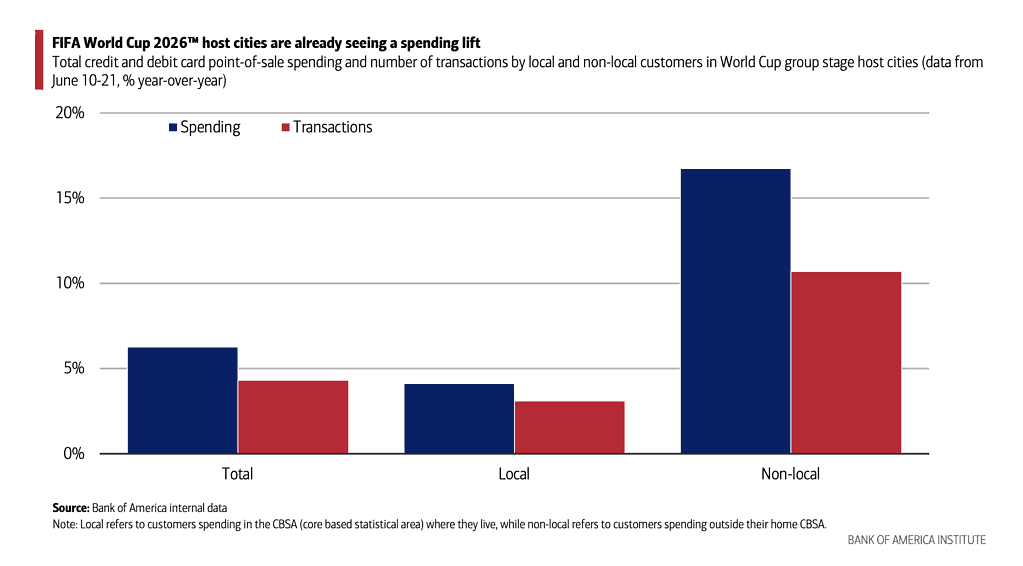
During the tournament’s opening days from June 10–21, overall consumer spending in host markets jumped 6.3% year over year. “Non-local” cardholders — a category tracking both international tourists and U.S. residents traveling out of state for matches — fueled the lift. Their spending, according to data shared with Global Finance, climbed 16.7% year over year.

Bank of America’s data also highlighted a lucrative trend for local merchants: visiting fans are out-purchasing non-fans by a nearly 3-to-1 margin.

Bank of America Institute data on FIFA World Cuphost cities and the spending lift from credit and debit card point-of-sale spending.

Pre-Tournament Warmup

“We’re really only halfway through, as you know, so no surprise that the majority of that spend has been driven from non-local residents coming in,” said Sara Walsh, a Bank of America managing director who oversees the bank’s relationships with vendors and networks in payments and has spent more than a year preparing merchants for the tournament. “Restaurants, bars, hotels, of course, make up the majority of that.”

The data tracks with results from last year’s FIFA Club World Cup, a smaller-scale tournament that Bank of America Institute found drove a 7% year-over-year rise in consumer spending in host zip codes. Walsh told Global Finance in a phone interview that the event effectively served as a dry run for the numbers the bank is now seeing at scale.

“The Club World Cup gave us a nice little pilot into what the stats would look like, and they were very consistent with what we’re seeing here,” Walsh said.

Soccer fans, meanwhile, are proving to be especially heavy spenders. A study Bank of America conducted with Visa found that soccer fans spend on average 2.8 times more than non-fans, according to the Institute. Walsh said the bank analyzed customers making purchases tied to FIFA and MLS tickets to reach that conclusion.

The scale of the opportunity is significant. The tournament’s 16 U.S., Mexican and Canadian host cities together represent:

  • $11 trillion in gross domestic product (GDP)
  • Roughly 130 million people, and
  • An expected draw of 33 million international visitors annually.

Historically, host nations have seen an average 0.4 percentage-point lift in GDP growth in the year following the tournament, the Institute found.

A Year of Preparation

Sara Walsh,
Bank of America

Bank of America began preparing merchants for the World Cup surge more than a year ago. It drew on its position spanning treasury, card-issuing and merchant-services clients. The prep work centered on three areas: building tools for merchants to capture customer data and loyalty even after fans leave the U.S.; speeding up checkout through contactless and pay-at-table technology; and ensuring cards from international networks, such as Japan’s JCB, are accepted without triggering declines.

“Merchants can either survive the World Cup or prosper from the World Cup,” Walsh said, citing a colleague’s framing of the stakes.

Restaurants and bars needed the most hand-holding, Walsh said, particularly around pay-at-table functionality that’s common internationally but was slower to catch on in the U.S. The bank also coached retailers on when to use 3D Secure authentication — the phone-based verification step common in Europe — given the risk of transaction friction in crowded, high-traffic settings with spotty connectivity.

“We did not want to have customers who are standing in line, they’ve come all this way, get ready to purchase, and have their cards decline,” Walsh said. So far, she said, cross-border approval rates have held up as fans travel from city to city.

Spillover Into Other Events

One surprise for the bank has been spending spillover into unrelated events and sectors. Walsh said Bank of America has seen international visitors attending Major League Baseball games and concerts during their trips, alongside a pickup in merchandise sales tied to breakout national teams.

“You’re going to have people who are purchasing things from some of these teams that maybe a month ago no one had ever even heard of these countries, and all of a sudden they’re winning,” Walsh said, adding that merchandise sales represent a “fun kickback” opportunity for merchants tied to Cinderella-story squads.

Cape Verde’s inspiring World Cup run, for example, captivated fans. The team, representing an island nation of just 535,000, reached the knockout stage unbeaten and pushed Argentina, the reigning champs, to a hard-fought 3-2 extra-time loss.

Bank of America worked with Visa and FIFA, along with industry forums including Money20/20, the Electronic Transactions Association, and the Merchant Advisory Group, to prepare merchants of all sizes through its Merchant Engagement Program, Walsh said.

Looking ahead, Walsh said that the bank plans to apply lessons from the World Cup to future events on U.S. soil. That includes the 2028 Summer Olympics in Los Angeles and the 2031 FIFA Women’s World Cup, which the U.S. will jointly host with Mexico, Costa Rica, and Jamaica.

“We will definitely continue to use these events for learning opportunities to improve where we need to and get ready for those events as well,” she added.

Anthony Noto covers corporate finance and private credit. Contact him at anoto@gfmag.com

Source link

South Korea to funnel AI chip tax windfall into public investment, housing and jobs

Published on

The South Korean government intends to set aside the extra tax income flowing from its record-breaking chip industry in a dedicated “future response fund”, the presidential office said, using the proceeds of the AI boom to bankroll public projects ranging from industrial infrastructure to support for younger generations.


ADVERTISEMENT


ADVERTISEMENT

Behind the windfall sit Samsung Electronics and SK hynix, whose memory chips have become essential to the data centres powering the global AI race.

Their record profits this year have propelled the wider economy, and swollen the government’s tax receipts along the way.

Presidential chief of staff Kang Hoon-sik outlined the plan at a meeting between the government and the ruling party on Sunday, saying the fund would help finance large-scale projects built around AI and semiconductors, while also tackling inequality and helping young people with housing, start-ups and work.

Kang warned that the extra revenue thrown off by the chip boom must not be squandered at what he described as a decisive moment for the country’s future.

No figure was provided for the fund’s size, as the government will consider its use at a fiscal strategy meeting this month before consulting the public.

In an interview with the Dong-A Ilbo newspaper, Kang added that part of the money would go towards the utilities on which chip plants depend, above all power and water.

A boom that keeps giving

The windfall reflects an extraordinary run for Korea’s chipmakers.

Samsung shares surged more than 170% in the first half of the year, and SK hynix shares rose more than 300%, carrying both companies past $1 trillion (€874bn) in market value.

Samsung is due to publish preliminary second-quarter earnings on Tuesday, while SK hynix plans to raise 45 trillion won (€25.7bn) through a listing on the Nasdaq.

Both are also part of an 800 trillion won (€457bn) public-private push, unveiled last week, to build a new chipmaking hub in the country’s southwest.

How the windfall should be spent has become a live political debate.

In May, presidential policy chief Kim Yong-beom floated using it for start-ups, young people, basic income schemes in rural and fishing communities, and support for artists.

The boom has also emboldened workers as Samsung averted a major walkout in May by agreeing to a bonus deal with its largest union.

Additional sources • AFP

Source link