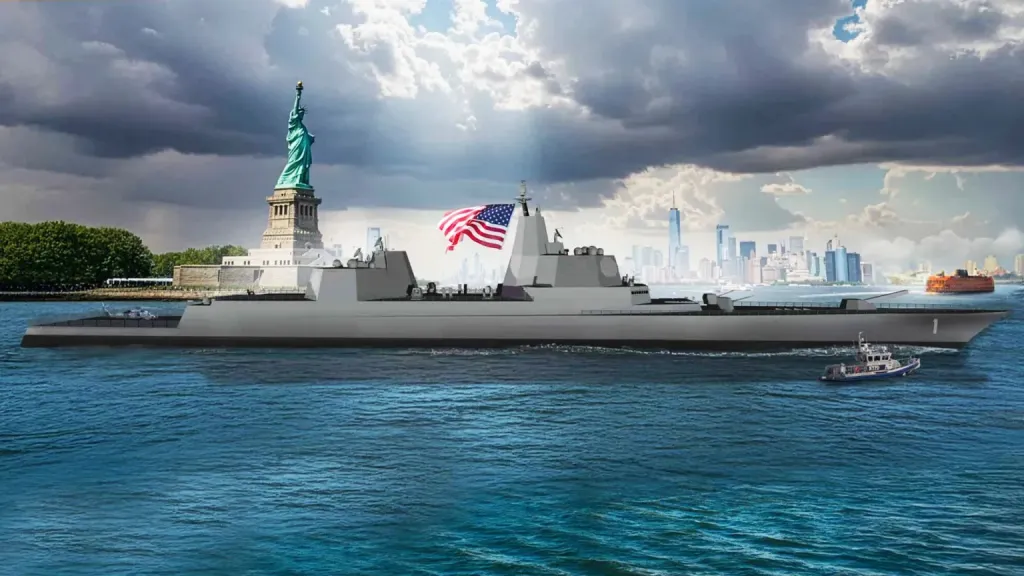
The Democratic Party’s historic blowout of its Republican opponents in yesterday’s mid-term elections is extremely likely to result in a slew of high-profile Trump administration programs and initiatives getting put under the microscope and slashed. In the defense arena, the nuclear-powered Trump class battleship is likely the biggest target of opportunity for the new majority in the House and Senate.
The questionable utility and opportunity cost of the Trump class warships have made the program a hot topic of debate since it was first rolled out in December 2025. The battleship effort has already faced growing bipartisan pushback over its price tag and practicality, as well as industrial base concerns.

To provide some quick additional context, Democrats are now set to take firm control of both chambers of Congress in January. This will give the party immense sway over how defense and other federal spending is authorized and appropriated, as well as how broader policy is set.
Control of key committees that oversee the U.S. military and its budgets will also change hands. Rep. Adam Smith, a Washington state Democrat, could be in line now to become chairman of the House Armed Services Committee. Rep. Joe Courtney, a Democrat from Connecticut, may be similarly poised to head up the Seapower and Projection Forces Subcommittee. Smith and Courtney have both been particularly outspoken critics of the Trump class battleship already.

“We need an appropriate mix of high-end survivable systems and lower-cost attritable capabilities, not a fleet of nuclear-powered battleships as proposed by the President,” Rep. Smith wrote in a letter to Democratic Party colleagues just today, which has now leaked online. The missive’s main thrust was to call for support for him returning to the role of Chairman of the House Armed Services Committee in January.
“I think the Democrats will make a broad effort to remove Trump branding from Washington,” Mark Cancian, a retired U.S. Marine Corps colonel who is now a senior adviser with the Defense and Security Department at the Center for Strategic & International Studies (CSIS) think tank, also told TWZ. “The Trump battleship is likely doomed both because of the branding and because the program is extremely expensive and weakly justified.”
“The battleship program was in stormy seas before the midterm elections, because it was premised on a strategy that ran counter to a decade long bipartisan effort to distribute maritime lethality,” Mark Montgomery, a retired U.S. Navy rear admiral who is now a senior fellow at the Foundation for Defense of Democracies (FDD) think tank, told us, as well. “Compounding this challenge was the fantastically high cost per battleship, equating to as many as 10 Arleigh Burke class Destroyers for one battleship – a terrible trade off.”
Montgomery is of the view that, “given the midterm election results, the battleship program is now aground and taking on water.”
The current state of the Trump class battleship plan
As it stands now, the Trump class battleship design is a 35,000-ton-displacement warship that is expected to boast a wide array of weapons, as well as advanced sensors and other systems. From what the Navy has said so far, the ship will be able to fire nuclear and conventional missiles, including hypersonic types, from several very large Vertical Launch System (VLS) arrays. Its armament package is also set to include an electromagnetic railgun and a pair of traditional 5-inch naval guns. Several classes of laser directed energy weapons, as well as other weapon systems for close-in defense, are to be fitted, as well.

In May, the Navy confirmed that the plan is also for the Trump class battleships to be nuclear-powered. The service retired its last nuclear-powered surface combatants – a category that does not include aircraft carriers and submarines – in the 1990s. It has been even longer since a ship of this type was built in the United States. Russia’s Kirov class battlecruiser Admiral Nakhimov is the only nuclear-powered surface combatant currently in service anywhere in the world.
The Navy has previously outlined plans to order at least 15 Trump class battleships between Fiscal Years 2029 and 2055. The first one, currently set to be named the USS Defiant, is not expected to enter service until 2036.
The USS Defiant could cost as much as $23 billion, and the average price of the next 14 battleships could be $18 billion, according to estimates the Congressional Budget Office (CBO) put out in August. To put this in perspective, even the $18 billion figure would make these warships significantly more expensive than each of the next three Ford class aircraft carriers.

From the start, TWZ has raised detailed questions about the actual viability of the Trump class design, as it has been described to date. This includes the ability of these warships to conduct independent operations, as well as the value of employing them in this way. At least right now, the Navy only plans to acquire a very small number of these ships, each of which can only be in one place at one time, and that would be top targets for adversaries in future conflicts.
All of this comes at a time when the Navy has been struggling to meet operational demands for surface combatants with its existing fleets. This has been further exacerbated by shakeups in separate plans to acquire new frigates and larger uncrewed surface vessels (USV), as well as rising costs associated with its workhorse Arleigh Burke class destroyers.

Though top Navy officials have voiced significant support for the Trump class since December 2025, there had been no calls publicly for a ship of this type before Trump started his second term. For his part, Trump has been enamored with the idea of the Navy sailing new battleships for years now. He notably floated the idea while running for his first term in 2015.
TWZ has previously drawn further attention to industrial base concerns stemming from the battleship plans. Naval shipyard capacity in the United States has steadily dwindled since the end of the Cold War, and what remains is under immense strain from existing demands. Navy shipbuilding programs, even established ones, routinely run up against workforce shortages and growing costs. This is despite extensive efforts by the federal government, including under Trump, to reverse these trends.
Nuclear shipbuilding presents additional challenges. There are currently only two shipyards qualified to build nuclear-powered vessels of any kind in the United States, and only one supplier of naval reactors. This part of the naval industrial base is already heavily committed to building aircraft carriers and submarines. This includes new Columbia class nuclear ballistic missile submarines, the on-schedule delivery of which is critical to national security, but that also faces potential risks.

Bipartisan pushback already to Trump’s battleships
For its part, the Republican-controlled House Armed Services Committee has already demanded that the Secretary of the Navy outline what the service is doing to ensure the battleship program will not disrupt carrier and submarine production. Rep. Courtney was the one to call for this report, which is due no later than March 1, 2027.
Earlier this year, the Republicans in the House also allowed the passage of a version of the annual defense policy bill, or National Defense Authorization Act (NDAA), for Fiscal Year 2027, with a key provision related to the Trump class battleship. Section 131 would block any work on the future USS Defiant until the Navy provides assurances that key weapon systems are “sufficiently mature.” Efforts to pass a final version of the Fiscal Year 2027 NDAA have since stalled in the Senate over non-battleship-related issues.

In July, the White House’s Office of Management and Budget issued a formal Statement of Administration Policy regarding the House’s version of the NDAA that included explicit opposition to Section 131 among other criticisms of the bill’s contents.
TWZ has pointed out on several occasions in the past that plans for the Trump class battleships could change dramatically given the lengthy schedule for the program. As mentioned, the USS Defiant is not expected to be delivered until 2036, well after the end of Trump’s second term, which will come to an end in January 2029.
There is still the possibility the battleship program could be reformulated in various ways rather than outright cancelled. Work on specific components, such as the railgun, might potentially be redirected to other programs.

“Any money allocated to the program will be for research or long term parts ordering that could just as easily support a next generation destroyer effort rather than the battleship,” FDD’s Montgomery also told us. “The battleship program itself probably can’t be killed until Trump leaves office, but all involved need to ensure that it does minimal damage to other Navy program efforts as it sinks to the bottom.”
“The Navy still needs the capabilities resident in the proposed battleship,” Brent Sadler, Senior Research Fellow for Naval Warfare and Advanced Technology at the Allison Center for National Security within The Heritage Foundation think tank, also argued in response to queries from TWZ. “The name – Trump class – likely won’t survive but the ship will.”
Sadler added that, in his view, what is really “needed is a national shipbuilding industrial plan that includes upgrading shipyard capacity to build the needed large surface warship.”
New pressure from Congress likely to go beyond battleships
The future prospects of other high-profile Trump administration defense initiatives are also very likely to at least see new scrutiny in the next year. Beyond battleships, the President has notably injected himself directly into other aspects of future naval shipbuilding plans as part of a larger effort dubbed the Golden Fleet.
In August, Trump released a memo titled “Rebuilding the United States Navy and America’s Shipbuilding Industrial Base” that called for, in part, the drawing up of plans for installing steam-powered catapults and hydraulic elevators on the future Ford class aircraft carrier USS Doris Miller. The President has long been a critic of the Electromagnetic Aircraft Launch System (EMALS) catapults and Advanced Weapons Elevators (AWE) that are central to the Ford class design. EMALS and AWE have been a persistent source of reliability and maintenance issues over the years, but going back to steam and hydraulics would be a costly and risky undertaking, as TWZ has previously explored in detail.

Reports later in August also said Trump was pushing the Navy to physically reposition the island superstructure on the Ford class on aesthetic grounds. The President has been very vocal over the years about what he thinks warships should and should not look like.
The Golden Dome missile defense initiative is another potential area where the new Democrat-led Congress could clash with the administration. The full scale and scope of the Golden Dome plan, as well as its cost, remain very murky. In August, U.S. Space Force Gen. Michael Guetlein, the top officer in charge of the initiative, warned that work could come grinding to a halt if key budgetary hurdles were not overcome.

The leaked letter from Rep. Smith makes clear that many more programs and policy issues, as well as defense spending writ large, are set to be put under the microscope when the Democrats take control of Congress in the new year. The Trump administration continues to pursue a roughly $1.5 trillion defense budget for Fiscal Year 2027, which includes some $350 billion that would come from outside normal defense spending streams via a process called reconciliation.
“We must thoroughly review our national defense strategy and develop a more realistic and sustainable approach that does not require a defense budget in excess of $1 trillion or paid for through draconian cuts to critical domestic programs,” Rep. Smith wrote in his ‘dear colleagues’ letter today.
Many other defense programs could potentially be at risk of being truncated or even cancelled if defense spending plateaus in the near term. Spending priorities also now have to take into account the need to restock critical munitions expended in the course of the war with Iran, as well as other crises in the Middle East in recent years. There are also ongoing demands to support allies and partners, especially Ukraine.
“President Trump has outlined a bold vision to restore American maritime dominance and construct a Golden Dome to protect our homeland and our citizens,” Deputy White House Press Secretary Anna Kelly told TWZ when asked about concerns about the fate of certain defense programs following the mid-term election results. “President Trump will work with anyone to protect the United States from threats abroad – if Democrats oppose these critical projects, they are playing politics at the expense of our national security.”
Asked to confirm her comments included the Trump class ships, Kelly added that these remarks also extended to the realm of “maritime dominance.”
It is still far too early to know the full extent of the fallout from this year’s mid-term elections on the U.S. government’s defense and other priorities. When it comes to the Trump class battleship, the program’s course had already looked increasingly uncertain before this massive shift in the political winds, and it looks one heck of a lot more precarious now.
Contact the author: joe@twz.com