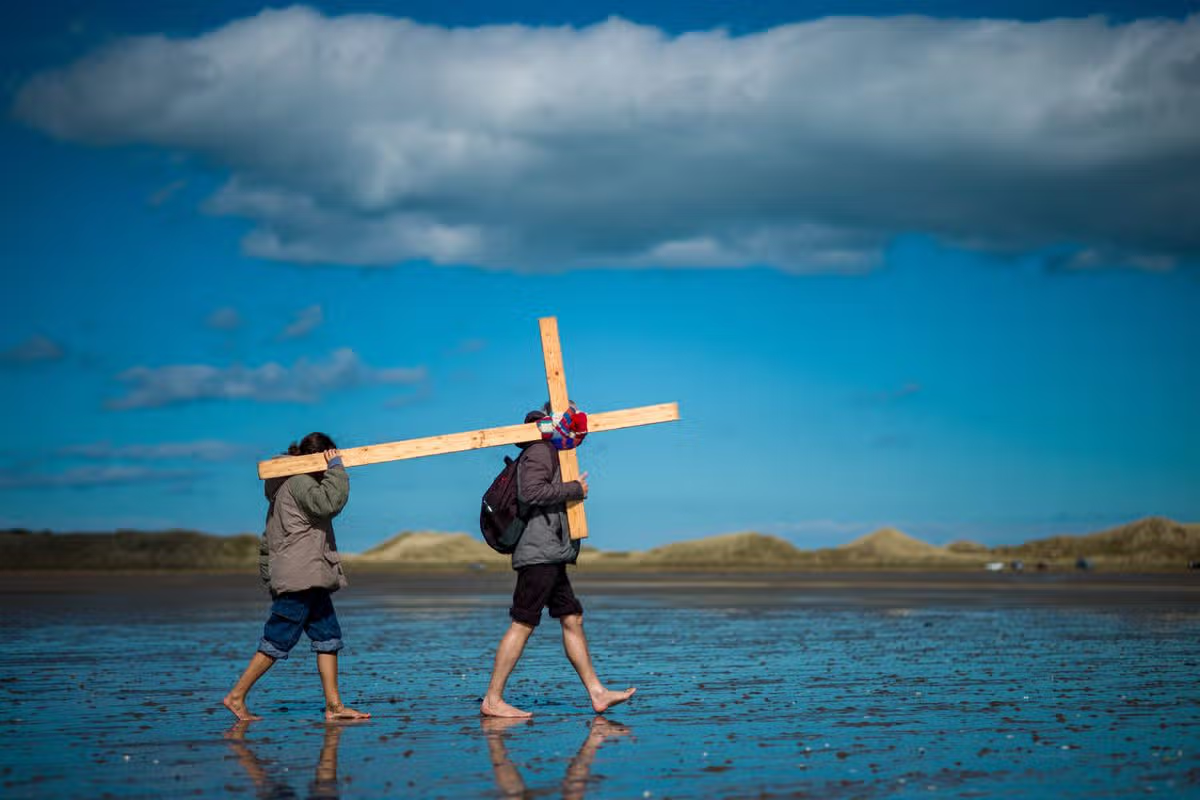
St Cuthbert’s Way now ranks alongside the Darjeeling Himalayan Railway and France’s scenic Route Napoleon as the ‘Best in Travel’ for Lonely Planet guide.

The traditional Good Friday Pilgrimage to Holy Island in 2024(Image: Getty Images)
A 62-mile walking route to England’s Holy Island has been named as one of the world’s top experiences in the ‘travel bible’ Lonely Planet.
St Cuthbert’s Way now ranks alongside the Darjeeling Himalayan Railway and France’s scenic Route Napoleon as the ‘Best in Travel’.
The list also highlights lesser-known destinations like Quebec and Veneto, and cities such as Dessau in Germany, Šibenik in Croatia, León in Spain and Rabat in Morocco.
St Cuthbert’s Way covers 100km from Melrose in the Scottish Borders through some of the most peaceful countryside in the UK to Lindisfarne in Northumberland.
The BBC featured “The Road to Holy Island’ in a series earlier this year, including sections of St Cuthbert’s Way. It featured celebrities Patsy Kensit, Ashley Banjo, Hermione Norris and Jayne Middlemiss.
Lonely Planet recommends its “moorlands” and “ghostly hillforts” and village pubs. The walk officially opened in the summer of 1996. It begins in Melrose where St Cuthbert started his religious life in 650 AD and makes its way through the Eildon hills, past Jedburgh to Morebattle and Town Yetholm.
From there it crosses the border into England passing through Wooler before ending up on Holy Island off the Northumberland coast where St Cuthbert was first laid to rest.
Most people walk it from west to east as that follows the chronology of the saint’s life and also benefits from having the prevailing wind at your back.
It is described as enjoying an “ever-changing variety of scenery and spectacular views” and can be “easily completed” in four to six days.
The walk offers dramatic views of the countryside of southern Scotland and northern England, and an area identified as the most peaceful in the UK.
It ends with a ‘bit of a bang’ at Lindisfarne, famous for its causeway, castle and beautiful views. St Cuthbert is recognised as one of the world’s earliest wildlife conservationists. He was born in 635 AD and, after a “divine vision,” the young shepherd entered the monastery in Melrose.
A decade later, the town was struck by the plague and afterwards, he helped victims throughout the countryside and was reported to have performed many miracles.
He transferred to Lindisfarne in 664 but, described as a “hermit by nature,” retired to Inner Farne in 676. His efforts to protect birds led to his recognition as one of the earliest wildlife conservationists.
Andrew Fox, Chair of Visit Northumberland, said: “We are thrilled to see Northumberland featured in Lonely Planet’s Best in Travel 2027.
This recognition shines a global spotlight not only on St Cuthbert’s Way, but on the wider range of world-class experiences that make Northumberland such a distinctive destination.
“St Cuthbert’s Way perfectly captures the growing demand for more meaningful travel experiences.
Whether visitors come to walk, reflect, explore our coast and countryside, discover our historic sites or simply slow down and reconnect with nature, Northumberland offers an unforgettable journey and a genuine sense of place.”
The Lonely Planets top places and experiences in Europe are:
Places
- Veneto, Italy
- Dessau, Germany
- Swedish Riviera (Skanör-Falsterbo), Sweden
- Šibenik, Croatia
- León, Spain
Experiences
- Road-trip through history on the Route Napoléon, France
- Sail the Aeolian Islands, Sicily
- Walk St Cuthbert’s Way to Lindisfarne, United Kingdom
- Dive into an unexpected underwater world, Greece
- Be wowed by wonderful Killary Fjord, Co Galway, Ireland