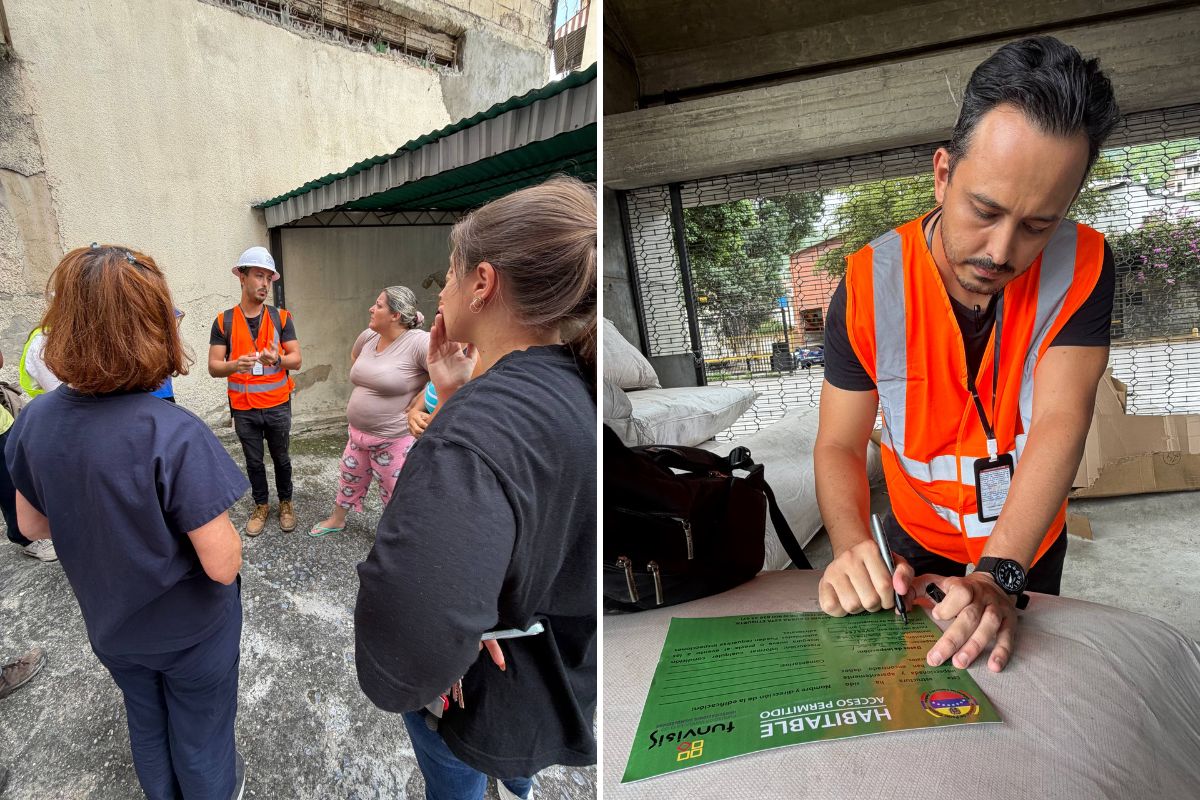
Rengel stressed the importance of completing seismic microzoning studies in La Guaira. (Venezuelanalysis)
José Gregorio Rengel is a civil engineer with a master’s degree in seismic-resistant engineering from the Central University of Venezuela (UCV), where he presently teaches, and specialization studies in geological risks at the University of Geneva, Switzerland. Rengel is a member of the government commission tasked with assessing the structural damage from the June 24 double earthquake.
In this interview, he discusses the effects of the tremors, Venezuela’s building codes, and the steps toward reconstruction.
Why did the double earthquake on June 24 have such devastating effects on La Guaira?
Every seismic event is caused by a rupture along geological faults, and in this case, the rupture –which began in Yaracuy State –follows a distinct east-west direction along the San Sebastián fault. The coastal strip that is La Guaira lies directly on that rupture plane. In fact, the distance from La Guaira to the fault –specifically, the fault’s rupture plane –is 0 kilometers in some areas; in other words, the state lies directly on the rupture. This is made clear in all the reports released by various agencies, from [Venezuela Seismological Research Foundation] FUNVISIS to the US Geological Survey.
In an earthquake, the effects are maximized the closer cities are to these rupture planes. Furthermore, the earthquake was a very shallow event. In other words, it occurred at a small depth, which also leads to stronger effects. Thus, La Guaira meets these two specific conditions: first, it is practically located on the rupture plane, and second, the earthquake was a shallow event.
From a structural standpoint, with thousands of buildings affected, what are the priorities right now?
For now, our task is to inspect the buildings that were affected. Four weeks after the earthquake, we have conducted more than 32,000 inspections using the traffic-light system. Buildings that have not been damaged in any relevant way receive a green label; those that have been moderately affected, a yellow label; and those with significant damage, where people should not remain, a red label.
Next will come a reconstruction phase, which must be carried out in accordance with Venezuela’s seismic codes, most recently updated in 2019. In the case of La Guaira, additional studies are needed, such as developing a seismic microzoning analysis that already exists for Caracas. Although several studies are well underway, this classification has not yet been completed in La Guaira.
Can you explain a bit further what these building inspections consist of?
The current inspections are rapid assessments designed to enable an immediate decision regarding the occupants: whether they can stay, use the building under restricted conditions, or whether they must evacuate. Our job is to categorize the level of damage to the building.
This is followed by a second phase, during which a more detailed inspection will be conducted on structures that received yellow or red labels to determine which of these could proceed to the repair stage. This, in turn, requires a more detailed assessment by structural experts to determine what type of repair work can be performed and how it would be carried out. In cases where it is not possible to restore the structure, for those that are too severely damaged, protocols for safe, controlled demolition must be established.

The corporate media has tried to push the narrative that buildings constructed as part of the Great Venezuela Housing Mission (GMVV) were particularly hard hit in La Guaira. Is there any truth to it or is it a myth?
We have witnessed the collapse of various types of buildings, ranging from those built by the private sector, which account for the majority of the destroyed buildings observed, to those built by the public sector. Some of them were part of the Great Venezuela Housing Mission.
In some cases, the flattened buildings were very old. In other cases, they had structures that were supposed to be built in accordance with the latest codes. We will need to assess whether they failed to meet the standards, and that must be investigated. We cannot jump to conclusions.
However, it is also possible that the buildings did meet the standards, but the seismic event exceeded them. So far, everything seems to indicate that this was an extraordinary geological event and may have surpassed the country’s existing codes, especially in La Guaira.
As far as we understand, in Venezuela the building codes are primarily governed by the standards of the Ministry of Habitat and Housing and the COVENIN industrial norms system. What do these standards establish?
Basically, there are two types of standards: seismic standards, which specify the level of acceleration for which a building is designed to withstand, in terms of ground acceleration. In other words, this relates to the force that an earthquake exerts on structures. Therefore, the structural setup of buildings is designed to withstand these lateral forces caused by earthquakes through a calculation of acceleration at the base. This is something the standards define very clearly. Our most recent seismic standards were updated in 2019.
And then there are the building codes. These are essentially regulations governing how to construct with reinforced concrete, steel, and other materials. But fundamentally, in Venezuela, we build with concrete and steel. Currently, both types of codes are up to date and comply with international standards. Furthermore, Venezuela has a long tradition of good engineering practices in earthquake-resistant construction and structural engineering.

If the investigations ultimately reveal that those standards were not met, should penalties be imposed?
Certainly, yes. It is necessary to conduct an investigation into each collapsed building, or at least a sample of these buildings. This is the ideal approach. Of course, we must also take into account that the earthquake was an event with characteristics that we might call extreme or extraordinary.
In the case of La Guaira, given that the geological fault is very close to the affected areas, this generated what in science jargon are called near-field effects, which subject structures to extreme stress. That is why even buildings that were well-constructed and very robust sustained significant damage.
However, all cases of total collapse must be investigated to understand the causes: whether the earthquake exceeded the standards under which they were built, or whether there were construction defects or regulatory violations. The goal is to determine the predominant cause of the collapse. In La Guaira, we are working with the hypothesis that the seismic event exceeded regulatory parameters.
Looking now toward reconstruction, what are the next steps, particularly in La Guaira?
The first step is to continue developing seismic microzoning studies. This is what will allow us to understand in which areas of La Guaira there is an amplification of accelerations, an amplification of the effects of earthquakes, so that we can impose the strictest design and construction requirements precisely in those areas. Therefore, these rigorous microzoning studies must be conducted, completed, and translated into a map that complements the other regulations.