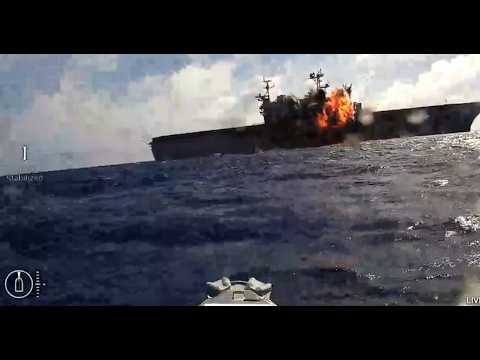
Just weeks after the U.S. military publicly acknowledged using kamikaze drone boats in combat for the first time, the Navy has confirmed that its Global Autonomous Reconnaissance Craft (GARC) uncrewed surface vessel (USV) took part in its first live-fire training exercise. The kamikaze drone boat was employed during RIMPAC 2026, attacking the ex-USS Peleliu in one of the operation’s high-profile sinking exercises (SINKEX). You can learn more about this latest round of SINKEXs here.
On July 24, the Navy released a video showing USVs taking part in the SINKEX in the Pacific Ocean, which targeted the decommissioned Tarawa class amphibious assault ship, but it was hard to tell what the USV in question was. The event itself had taken place on July 17 and saw the former USS Peleliu pummeled by multiple U.S. and allied assets. The video shows significant damage already inflicted on the assault ship, especially around the waterline, and water already being taken onboard. The footage was captured by the second drone boat, as it inspected the damage done by all the fires.

Amazing Footage from USV’s as they Attack the USS Peleliu (LHA 5)
Yesterday, Sarah Weinstein, a Surface Warfare Officer currently serving as the first commanding officer of Unmanned Surface Vessel Division 32, posted on LinkedIn, stating that she was “honored that USVDIV-32 was given the opportunity to execute the Navy’s first GARC Live Fire during RIMPAC 2026.”


A product of Baltimore-based BlackSea Technologies, the GARC is the major platform used by USVDIV-32, a unit that was established early this year. According to the Navy, USVDIV-32 is “tasked with maintaining and implementing unmanned vessels … the division’s sailors regularly conduct exercises and training with multiple platforms, with the most common being Global Autonomous Reconnaissance Craft, or GARC.”

GARC: The Most Proven Tactical USV
“It was incredible to watch my team execute with precision, and we were thrilled to provide a perspective of the former USS Peleliu that isn’t often captured in a SINKEX,” Weinstein added.
A source familiar with the SINKEX operation today told TWZ’s Howard Altman that there were two GARCs present at the SINKEX, but only one was used destructively in an end-to-end attack. The USV used a full autonomy package, in the shape of Anduril’s Lattice. It carried a 1,000-pound payload, although it remains unclear how much of that weight was accounted for by the warhead. We have reached out to RIMPAC officials and others for additional details.

Other specifications of the GARC include a length of around 16 feet, a full-load displacement of 4,800 pounds, and a range of 700 nautical miles at a speed of 22 knots.
USVDIV-32 took its GARC drone boats to exercise Baltic Operations (BALTOPS) 2026 last month. On that occasion, the USVs operated alongside the Blue Ridge class command and control ship USS Mount Whitney. The Navy confirmed that USVDIV-32 was providing realistic counter-USV training to NATO allies while in the Baltic.

“The first difficult part is spotting the USV,” Weinstein said at the time. “What does it look like? What are the telltale signs that it might be a USV? How to tell if it’s coming inbound, and its different behaviors that it’s able to display as it gets closer to the ship”
A defining feature of USVDIV-32 is its inclusion of a new rate, Robotics Warfare Specialist (RW), who are trained to operate and maintain vessels such as GARCs.
In a Navy release last month, Chief Robotics Warfare Specialist Christian Butler explained: “I think most commands, if not all commands, are going to have some component of RWs. Just because there’s no going away from unmanned systems at this point, they’re only going to grow in scale, and you’re going to need RWs to carry that weight.”
Before USVDIV-32 stood up, the GARC took part in maneuvers in the Atlantic Ocean during the UNITAS multinational maritime exercise in September 2025. This was part of an effort that tested the ability of “unmanned and remotely operated vehicles and vessels [to] extend the capability of interconnected manned platform sensors to enhance capacity across the multinational force,” the Navy disclosed.

Yemen’s Houthi rebels were at the forefront of employing kamikaze USVs operationally. We first reported on the capability in January 2017, after an explosive-laden Houthi drone boat struck a Saudi frigate. The technology traces back to Iran, which developed a variety of rudimentary one-way attack USVs before transferring the capability to its Houthi proxies, who became the first to use them in combat in the Red Sea.
As we have reported extensively, Ukraine has demonstrated the devastating potential of USVs against the Russian Black Sea Fleet. The Magura family of drone boats, among others, has been central to that campaign, and has taken on a wide variety of roles.
Repeated successful strikes against Black Sea Fleet vessels and naval infrastructure forced Russia to relocate much of its fleet from occupied Crimea to the relative safety of bases in mainland Russia.
The U.S. military employed USVs as offensive strike weapons in combat for the first time on July 12 during a wave of attacks against “dozens” of Iranian targets, according to U.S. Central Command (CENTCOM). The strikes, which involved Saronic-built Corsair USVs, occurred amid an escalating exchange of attacks between the United States and Iran centered on the Strait of Hormuz. Among the targets of the attack was an Iranian Ghadir class diesel-electric midget submarine.
Earlier this month, another Saronic Corsair USV rescued the crew of a U.S. Army AH-64 Apache that crashed in the Gulf of Oman after it was downed by Iran. That was the first known instance of a drone boat being used to recover personnel as part of a search and rescue mission, and further underscored how the U.S. Navy’s use of drone boats in combat is really ramping up.
As we have discussed in the past, the U.S. military’s employment of drone boats in a kinetic strike role sets a new precedent not only for operations in the CENTCOM area of responsibility, but also for potential conflicts elsewhere. The U.S. Navy now has this capability and is gearing up to employ it in the Pacific, which will be yet another threat to deal with for adversaries. With exercises like RIMPAC, the Navy can evolve its playbook for the employment of USVs as kinetic weapons.
With a mission that includes helping the Navy and its allies counter the growing USV threat while refining offensive concepts of operation for one-way attack drone boats, USVDIV-32 appears poised to play an increasingly important role here. As the service pushes toward a hybrid fleet of crewed and uncrewed vessels, GARC is also emerging as one of its most significant new capabilities.
Contact the author: thomas@thewarzone.com