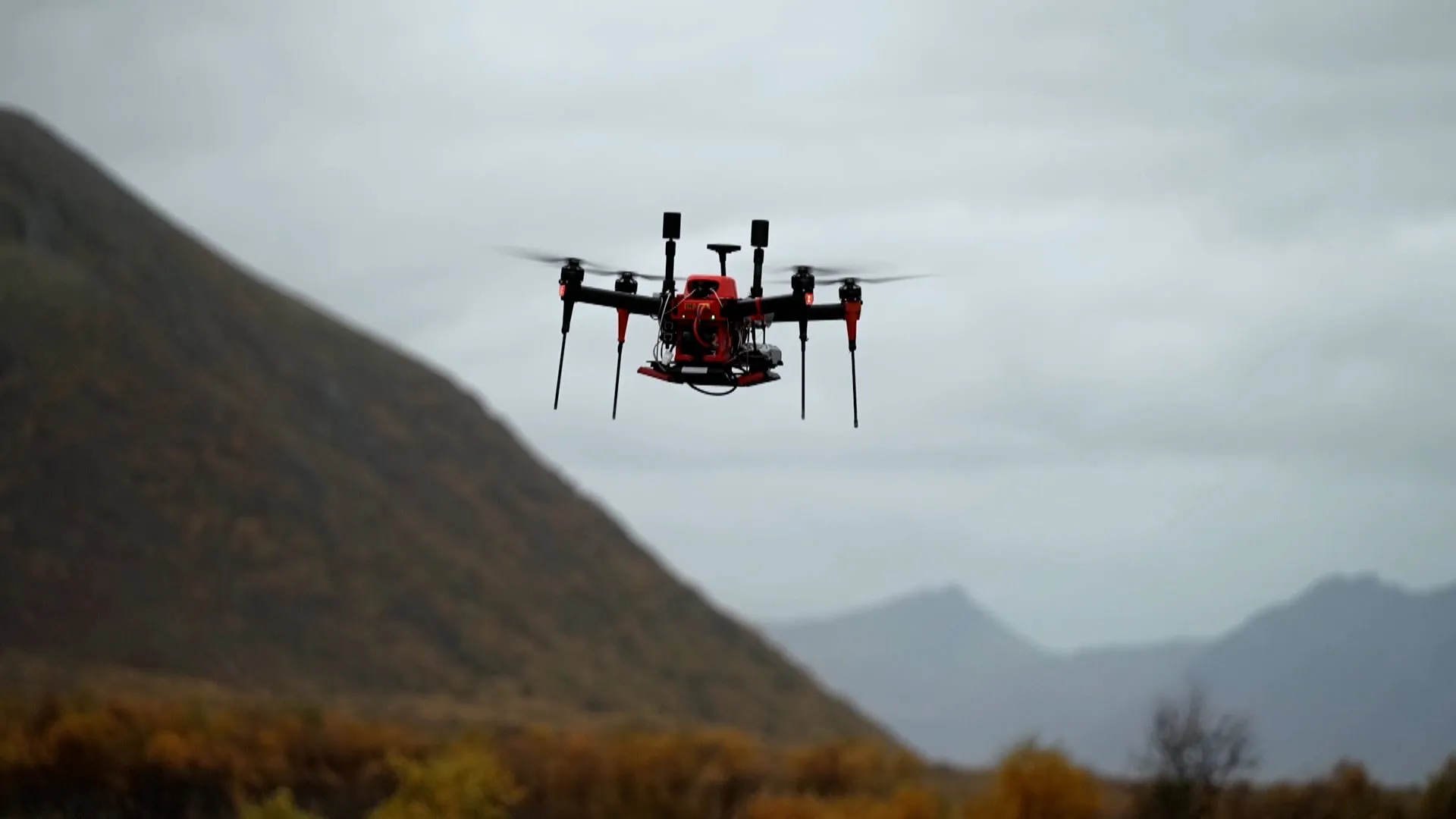
Defence and tech companies have been taking part in annual exercises in Norway aimed at countering the threat against satellite signal jamming, which can affect everything from aircraft and ships to financial markets. Paul Rhys explains from Norway.
U.S. Air Force Collaborative Combat Aircraft (CCA) are set to take part in a large-force employment (LFE) exercise for the first time later this year. Sending CCAs to the next iteration of the Emerald Flag test exercise is another important new stepping stone toward fielding the drones operationally.
“We have not yet done a LFE with these [CCAs], for real. The first one is going to be Emerald Flag. That’s in December,” Lt. Col. Lyndon “OTTO” Bartlett, Director of Operations for the Experimental Operations Unit (EOU) at Nellis Air Force Base in Nevada, said earlier today. “That’ll be our first tip dip of the toe in an actual force integration.”
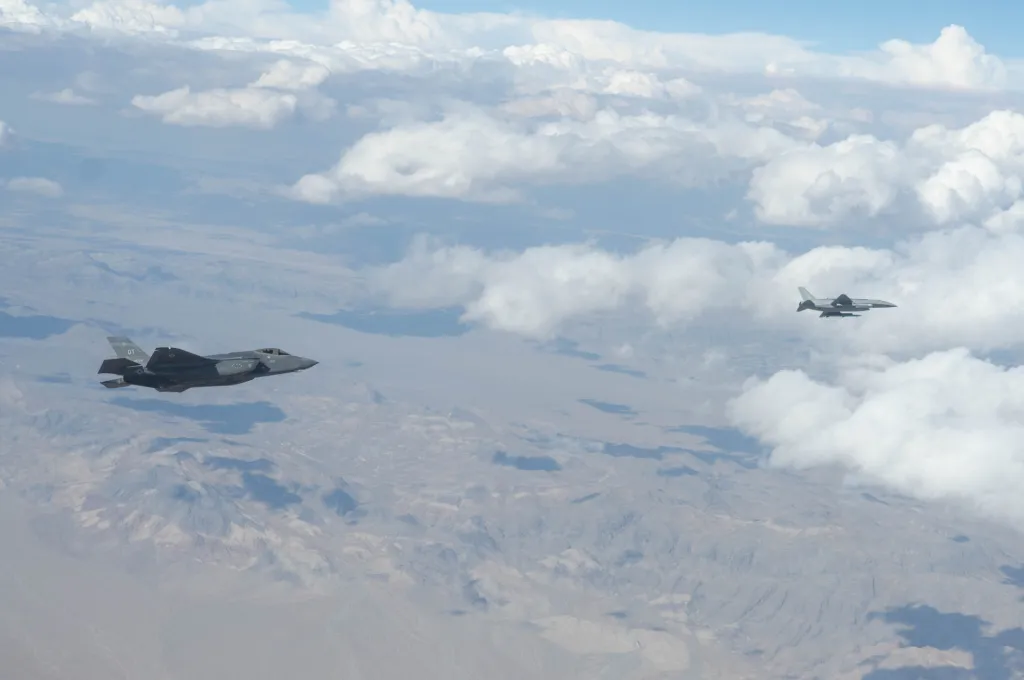
One of the Air Force’s YFQ-44A Fury CCA drones flies together with an F-35 Joint Strike Fighter. Anduril
It is worth noting here that Boeing’s MQ-28 Ghost Bat, a CCA-type design, did take part in Valiant Shield 26, another LFE exercise, earlier this year. The EOU was also involved. However, the MQ-28, originally developed for the Royal Australian Air Force, is not officially part of the Air Force’s CCA program at present.
Emerald Flag in December “will, in OTTO’s mind, be the first time that we will ever do some CCA end-to-end chain [demonstration] live. That’s the first time we’ll ever be integrated in a fourth- and fifth-gen combined OCA [offensive counter air] push,” Lt. Col. Bartlett added. “It’ll be small, but those type [sic] of building blocks are where I think you get the intangibles like trust in the CCA.”
“Those learnings are going to be just as valuable as the technical, [like] does the radio work properly? Does the button I push to say ‘target’ work properly?” he continued.
A General Atomics YFQ-42A CCA drone during an earlier test flight. General Atomics
“If it’s in a simulated environment, it’s immediate,” Lt. Col. Bartlett said during the panel when asked about the “feedback loop” in testing the EOU is already taking part in. In that environment, “when the mission autonomy iterations are happening, our guys are literally with the programmers … They give the feedback, and if it’s possible to do immediately, they take that feedback. If not, then they work on it on the next turn of the software.”
Real-world testing, of course, offers opportunities to explore additional aspects of future CCA operations, including when it comes to loading weapons and maintenance. A key component of the Air Force’s vision for CCA employment is being able to forward deploy the drones to far-flung locations, including airstrips with limited infrastructure and access to logistics chains. Rapid, distributed deployments like this are central to still-evolving concepts of operations currently referred to collectively as Agile Combat Employment (ACE). The EOU has been involved in at least two rounds of ACE-focused testing this year, one at Edwards Air Force Base in California in April and another at Creech Air Force Base in Nevada in July. TWZ was the first to report on the latter event.
Visualizing ACE
During the panel today, Lt. Col. Bartlett also talked more generally about work EOU has done to date. This has included exploring “sortie generation, how easy they are to maintain, [and] how small a footprint could be.”
“We’ve been pleasantly surprised. The jets are extremely easy to maintain,” he continued. “We’re at a one-to-one maintainer-to-airplane ratio, which is crazy small.”
With “CCAs, [it] seems like because they’re a little bit simpler, because their role is so focused, what we found is that just about any – not just about, but we found that any AFSC [Air Force Specialty Code; alphanumeric codes used to identify specific jobs within this service] can be trained to generate sorties to load weapons, and we’ve done some of those things already,” he further explained. “It’s our job to bring them [CCAs] out and make sure that, beyond the technical specifications of it, that we’re kind of experimenting with the more complex things like logistics, and C2 [command and control], and how do we battle manage these things.”
Airmen prepare to load an inert AIM-120 Advanced Medium Range Air-to-Air Missile onto a YFQ-44A CCA drone. USAF/Senior Airman Renee Blundon
The head of the EOU did acknowledge challenges that still have to be surmounted. This notably includes hurdles currently imposed by Federal Aviation Administration (FAA) regulations on the operation of fully uncrewed aircraft, even by the U.S. military, within U.S. airspace. This is further compounded by the explicit intention to operate CCAs with far more minimal human engagement compared to most existing drones.
“Mission autonomy is going to be the secret sauce that lets these things become decisive or not, and we’ll know that over the next couple years as that develops,” according to Bartlett. “If I were to identify the two biggest problems from the trenches of the EOU, [one] is FAA integration or policy implications to an autonomous airplane.”
“So these things don’t have pilots. They’re not RPAs [remotely-piloted aircraft]. They’re not manned fighters. They have no pilots,” he continued. “Our system is not set up for that, and that is a challenge that we are finding extremely hard to navigate through, and to not go around, but to make a policy.”
“We need to make sure the Air Force is ready for these things, to set policies that make sure the enterprise and the country is [sic] ready to receive these, and internalize an autonomous fighter that does not have a pilot that is running on a mission autonomy agent that doesn’t listen to ATC [air traffic control],” he added.
Another look at a YFQ-44A prototype during at test in 2026. USAF
The second problem, per Bartlett, is making sure the Air Force develops new internal policies and doctrine that are not “copy and pastes from old regulations” that do not take into account the specific nuances that CCAs will bring. What the service needs is “something that enables us to move quickly with these things, to weigh what we need, and to experiment with novel types of air superiority.”
All of this circles back to the discussion of trust in autonomous capabilities. It also speaks to the potential for future operations where CCAs could operate far more independently.
“It’s in the name that they’re collaborative,” Bartlett said. “Taking them out of that could technically be effective, but would not enhance the joint force the way that we see a collaborative, integrated force package to be.”
“What we need autonomously to do is written down. I won’t discuss the particulars in this forum, but we know what we need it to do, or we know what we think it really needs to do,” he noted. “We’ve structured our experimentation game plan to analyze ‘can it do those things?,’ and if not, then how do they need to be different? And then as they iterate on it, which we’ve already seen a couple times, we get that at the EOU, we get the new version down, we fly it again. Is it fixed? Yes or no.”
A General Atomics YFQ-42A seen from another angle during earlier testing. General Atomics
Some members of industry are clearly envisioning futures with different definitions of ‘collaborative’ that could lean more toward independent operations involving highly autonomous drones.
What “the whole entire program is trying to do is [figure out] what is the requirement to put out into the field to get to the warfighter and to start operating this thing this [sic; in] real time?” Robert “Otis” Winkler, Vice President of Corporate Development & National Security Programs at dronemaker Kratos, another one of the panelists, said. “The collaborative part of this makes it a much easier, I think, technical problem to be able to limit and grow the autonomy as you field this.”
“I think eventually we may see these aircraft utilized as collaborative aircraft, but not in conjunction with your traditional pulsed operation, but in support of that pulsed operation when the pulse isn’t there yet. But I do think that that is a bit of a stretch goal that’s going to be down the road.”
CCAs “have been designed really around increasing both survivability and lethality of current force packages. So there are many manned platforms that you would describe in the exact same fashion,” Jason Levin, Senior Vice President for Air Dominance and Strike at Anduril, who was also on the panel, said. He was responding here to a specific question about whether his use of the term “fighter” to describe these drones implied more emphasis on independent operations.
All of this underscores the importance of bringing CCAs to Emerald Flag in December, as well as other events in the future offering opportunities to see how the drones really fit in with other crewed platforms. The Air Force is hoping to start seeing CCAs enter operational service around the end of the decade, and have 500 of them, at least, in inventory by 2032.
During the panel today, the EOU’s Lt. Col. Bartlett made clear that “we’re going to learn a lot over the next couple years.”