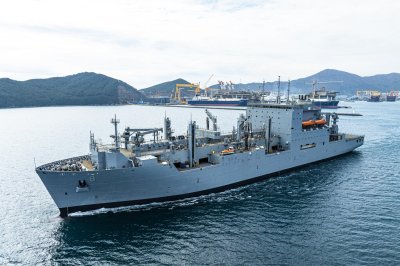

The USNS Wally Schirra departs Hanwha Ocean’s Geoje shipyard after completing approximately six months of maintenance work. Photo courtesy of Hanwha Ocean
July 14 (Asia Today) — The U.S. Navy has asked major South Korean shipbuilders for information about their ability to design and build destroyers and fleet support vessels, potentially opening the world’s largest naval market to South Korea’s shipbuilding industry.
The requests for information mark a significant step in Washington’s effort to address shipyard capacity constraints and strengthen its maritime industrial base with help from key allies.
The development comes as South Korea and the United States expand cooperation under MASGA, short for Make American Shipbuilding Great Again, a bilateral initiative intended to revitalize U.S. shipbuilding through investment, workforce development, technology cooperation and naval vessel maintenance.
The prospective U.S. market could dwarf South Korea’s recent efforts to win Canada’s next-generation submarine program, estimated by the industry at about 60 trillion won, or approximately $43 billion. Long-term U.S. naval construction and modernization spending could reach about 1.6 quadrillion won, or roughly $1.2 trillion, according to industry estimates cited in South Korea.
U.S. Navy examines Korean shipbuilding capacity
Naval News reported Friday that the U.S. government had issued two requests for information involving destroyer-class surface combatants and medium-sized fleet tankers.
HD Hyundai Heavy Industries and Hanwha Ocean responded to requests covering both destroyers and support vessels. Samsung Heavy Industries submitted information concerning fleet replenishment ships, an area in which it has extensive commercial tanker-building experience.
A request for information is an early market-research procedure rather than a formal order or bidding process. It allows a U.S. government agency to assess potential suppliers, technical capabilities, prices and delivery schedules before deciding whether to proceed with a procurement program.
The inquiries are nevertheless notable because U.S. law and defense procurement rules generally require Navy vessels and major hull components to be built in American shipyards.
Changes to existing law or a congressionally approved national security exemption would probably be required before a U.S. warship could be constructed at a South Korean yard.
The outreach reflects growing concern about delays, workforce shortages and limited production capacity within the U.S. shipbuilding industry. The U.S. Government Accountability Office has repeatedly reported that Navy shipbuilding programs are running years behind schedule and billions of dollars over budget.
U.S. policymakers are also seeking ways to respond to China’s rapidly expanding naval and commercial shipbuilding capacity.
Korean companies highlight destroyer experience
HD Hyundai Heavy Industries and Hanwha Ocean have experience designing and constructing some of the South Korean Navy’s most advanced surface combatants.
South Korea’s Sejong the Great-class and Jeongjo the Great-class destroyers use the U.S.-developed Aegis combat system, which is also installed aboard the U.S. Navy’s Arleigh Burke-class destroyers.
That experience could make South Korean shipbuilders attractive partners in vessel design, component manufacturing or joint production, although U.S. technical, security and domestic-content requirements would remain major obstacles.
South Korea’s latest Aegis destroyers displace more than 8,000 tons and incorporate advanced radar, missile defense and stealth-related technologies.
HD Hyundai Heavy Industries has also been developing export-oriented destroyer designs and has pursued partnerships with U.S. defense contractors and shipbuilders.
Hanwha Ocean has established a direct foothold in the United States through its acquisition of Philly Shipyard in Pennsylvania. The company has announced plans to expand the yard’s capacity and introduce South Korean production technology.
The company has also completed maintenance work on U.S. Military Sealift Command support ships at its Geoje shipyard in South Korea.
The USNS Wally Schirra, a Lewis and Clark-class dry cargo and ammunition ship, entered the Geoje facility in September 2024 for maintenance, repair and overhaul work. The ship departed after approximately six months of repairs.
Such projects allow South Korean yards to demonstrate their ability to meet U.S. Navy technical standards and delivery requirements, while helping Washington reduce maintenance backlogs.
MASGA moves from proposal to implementation
The Navy inquiries come as the two governments seek to turn MASGA into a broader industrial partnership.
South Korea proposed the initiative as part of trade and security negotiations with the Trump administration. The package includes investment in American shipyards, training for U.S. workers, supply-chain development and maintenance services for U.S. naval vessels.
South Korea and the United States signed a memorandum in May establishing a bilateral shipbuilding partnership initiative and plans for a Korea-U.S. Shipbuilding Partnership Center in Washington.
The program is expected to support cooperation among government agencies, shipbuilders, research institutions and equipment suppliers in both countries.
U.S. officials have increasingly acknowledged South Korea’s mass-production capabilities. U.S. Army Secretary Daniel Driscoll praised South Korean defense manufacturing during a congressional hearing in April, citing Hanwha as an example of an effective industrial production model.
The U.S. administration has also pushed for faster construction of commercial and naval vessels as part of its effort to restore the country’s maritime industrial capacity.
Legal and political barriers remain
Despite the growing cooperation, an RFI does not guarantee that South Korean shipyards will receive orders for U.S. Navy vessels.
Congress would have to address laws that restrict foreign construction of naval vessels. U.S. labor unions and domestic shipbuilders could also resist proposals they believe would transfer American jobs or defense production overseas.
A possible compromise could involve South Korean companies investing in U.S. yards, supplying ship components or jointly constructing vessels in both countries rather than building complete American warships in South Korea.
South Korean shipbuilders could also provide designs and production management systems while final assembly takes place at an American facility.
Industry specialists said the South Korean government will need a coordinated strategy involving the presidential office, defense and industry ministries and diplomatic officials if Korean companies are to secure a meaningful role.
They said technical competitiveness alone may not be sufficient because major defense contracts are also shaped by alliance politics, domestic employment considerations and long-term security relationships.
South Korean companies recently faced difficulties in European and Canadian defense competitions despite offering competitive prices, technology and local production plans.
The prospective U.S. programs therefore represent both a major commercial opportunity and a test of Seoul’s ability to coordinate industrial policy with security diplomacy.
For South Korean shipbuilders, the immediate goal is not necessarily the full construction of U.S. destroyers at Korean yards. Securing design work, component orders, maintenance contracts or joint-production projects would still mark an important expansion of the country’s naval defense industry.
The Navy’s decision to formally examine South Korean capabilities indicates that cooperation once considered politically difficult is now under active consideration.
— Reported by Asia Today; translated by UPI
© Asia Today. Unauthorized reproduction or redistribution prohibited.
Original Korean report: https://www.asiatoday.co.kr/kn/view.php?key=20260714010005100