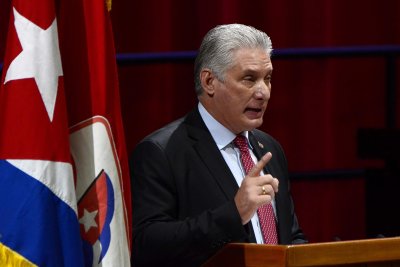

President Miguel Díaz-Canel’s package of 174 economic reforms were approved by Cuba’s parliament in just one week. File Photo by Ariel Ley Royero/EPA
June 19 (UPI) — Cuba’s parliament approved a package of 174 economic reforms in just one week, marking the most significant shift in government policy in at least 15 years. Driven by President Miguel Díaz-Canel in response to the country’s deepening economic crisis and mounting pressure from the United States, the plan approved Thursday opens the door to private capital and reshapes the rules governing the island’s economy.
Economists and analysts, however, warned that the real impact of the measures will depend on their implementation and on broader institutional changes that remain absent from the government’s plans.
Cuban economist Alfie Ulloa, a professor at the University of Chile’s Law School, told UPI the reforms represent a significant change in official rhetoric but questioned whether they will translate into meaningful change.
“They are a profound adjustment in discourse and, if implemented, would represent an important adjustment to the model. But for now they are nothing more than another declaration like many made in the past. I do not believe they will be implemented, nor that they will truly free the private sector,” Ulloa said.
The package includes 23 areas of transformation and more than 170 measures aimed at loosening state control over the economy. Among the most significant are allowing direct foreign investment in small and medium-sized private businesses, reviewing activities currently prohibited to the private sector, authorizing direct imports and exports by both state and non-state actors, granting greater autonomy to enterprises and gradually replacing broad subsidies with targeted assistance for vulnerable populations.
The reforms also eliminate broad price controls, a policy Díaz-Canel acknowledged had failed after years of inflation, shortages and expansion of the informal market.
While presenting the plan, the president admitted that part of the country’s current crisis stems from longstanding internal problems.
“There are obstacles that do not come from abroad or from the embargo. There is bureaucracy, delays, regulations that prevent people from producing and decisions that we have postponed,” Díaz-Canel said.
The proposal amounts to an implicit acknowledgment of economic policy failures that Cuban authorities had largely attributed to the U.S. embargo for decades. Analysts noted that several of the measures had been debated previously and rejected by the country’s communist leadership.
Many of the initiatives mirror reforms introduced decades ago in China and Vietnam, although they arrive as Cuba faces one of its worst economic crises since the collapse of the Soviet Union.
Cuban economist Mauricio de Miranda, a professor at the Pontifical Xavierian University in Cali, Colombia, argued in social media posts that the program points toward a transition from bureaucratic socialism to a form of capitalism controlled by political elites.
“It will become the fast track for relatives and close associates of those in power to become shareholders without anyone knowing where their capital came from,” he warned.
De Miranda said Cuba will inevitably need to privatize part of its state-owned assets to attract investment and rebuild its struggling economy. However, he argued that the process lacks the institutional safeguards needed to prevent wealth from being concentrated among groups close to the government.
“Something like this would require a capital market with clear rules, transparency and equal opportunity,” he said.
Questions about legal protections for investors have also emerged as a central criticism.
“None. Cuba is not a state governed by the rule of law. Citizens are completely defenseless before the state,” Ulloa said when asked about protections for potential investors.
He added that investing in Cuba remains highly risky because government power faces few constraints and judicial institutions lack independence.
Cuban economist Pedro Monreal also criticized the process, questioning the secrecy surrounding the package in a lengthy post on X.
“It should not be surprising that the first act of the ‘transformation proposals’ show has reaffirmed public frustration over the secrecy of those proposals,” Monreal wrote.
Monreal also pointed to the failure of the so-called “Monetary Reorganization Task,” a 2021 reform that eliminated the country’s dual-currency system but became associated with surging inflation and declining purchasing power. He argued that experience severely undermines the credibility of the new package.
Despite the skepticism, several specialists acknowledged that some measures could help address urgent problems if fully implemented.
Ulloa said a genuine opening to private investment, particularly from Cubans living abroad, could help revive agriculture, services and food production. He cautioned, however, that critical sectors such as energy, infrastructure, transportation and banking require investment levels that are unlikely to materialize in the near term.
The Cuban government said Thursday that former President Raúl Castro explicitly endorsed the reforms and expressed full support for the package, describing it as what “best serves the Revolution today.”
For critics, that endorsement highlights one of the process’ central contradictions.
The measures acknowledge problems that independent economists have identified for years, yet leave intact the political structure that many blame for creating the crisis.
“The most important point from my perspective is that we are not talking about deep reforms within a new globalized economy. We are simply talking about removing obstacles,” Manuel Cuesta Morúa, vice president of the Council for Democratic Transition in Cuba, told Radio Martí.
He said the reforms arrive too late because Cuba’s economy now operates under extensive U.S. sanctions.
According to Cuesta Morúa, progress will require political and diplomatic negotiations to make the measures viable. He argued that the package merely liberalizes some restrictions but does not yet constitute a genuine economic reform program.
He added that authorities must first address citizens’ immediate needs, create confidence through legal certainty and open Cuban society in broader ways.
Analysts agree that the central question is whether this latest reform effort will produce tangible change or join a long list of initiatives that were announced and later postponed.
Regarding the matter, Vice President JD Vance said, “Right now, we are talking with the Cuban government about how they might change their behavior to achieve that. We’ll see what they do and, obviously, if they do one thing, we’ll do another. If they make smart decisions, we’re going to have a much better relationship with that island.”
Just hours later, details of the measures emerged. For now, however, the White House has remained silent.