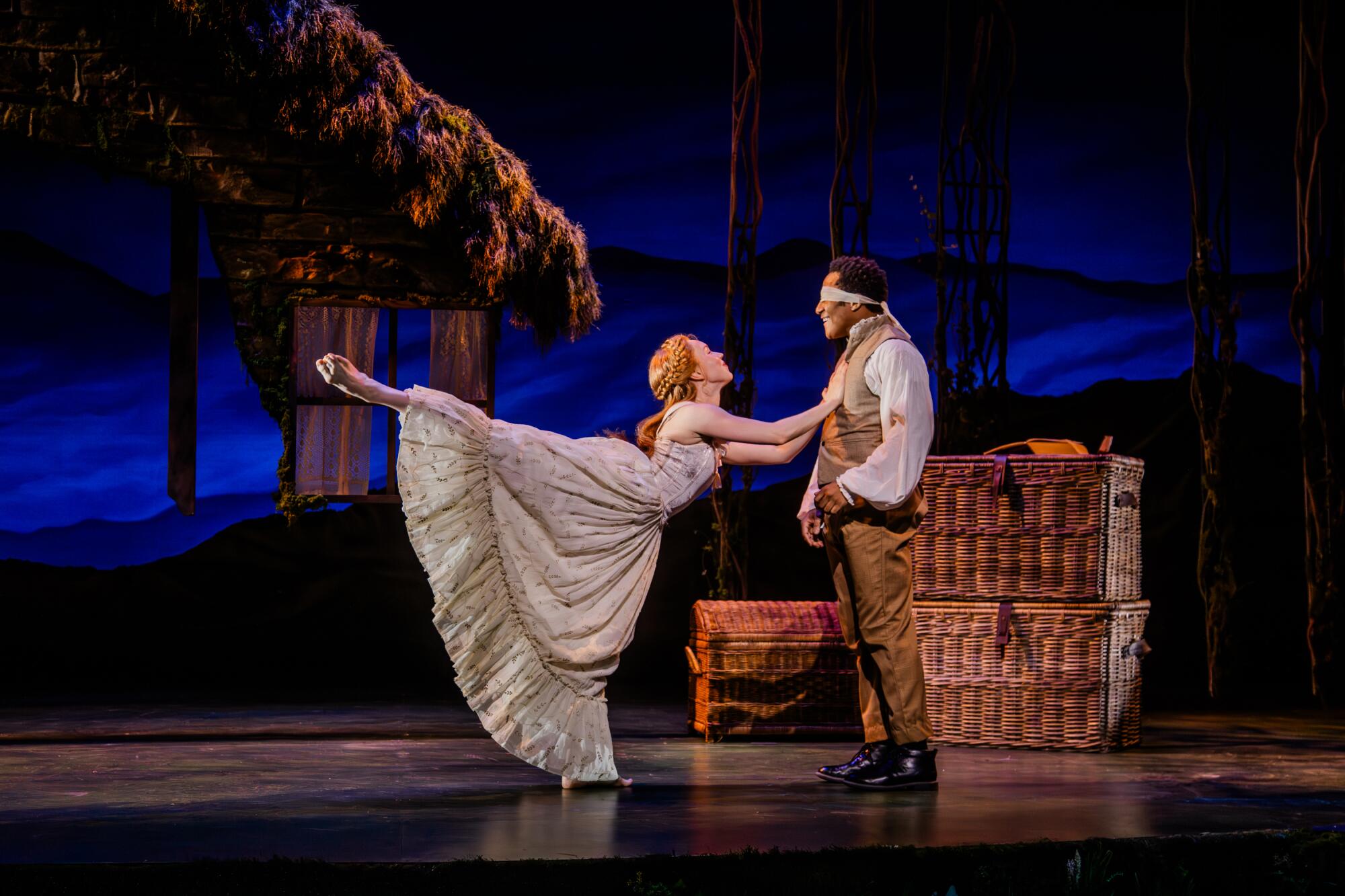
Few would contend that Lerner and Loewe’s “Brigadoon” and Rodgers and Hammerstein’s “Flower Drum Song” represent the best work of these legendary duos.
Unlike Lerner and Loewe’s eternally popular “My Fair Lady,” “Brigadoon” hasn’t had a Broadway revival since 1980. “Flower Drum Song,” relegated to the shadows of Rodgers and Hammerstein’s “Oklahoma!” and “South Pacific,” didn’t last long when it received its first and only Broadway revival in 2002.
I assumed nostalgia was fueling the desire to give these Golden Age musicals a makeover. But when I sat in the audience for these shows and fell immediately under the spell of their scores, I had a different answer.
The music makes a case for why “Brigadoon,” now in a soaring revival at Pasadena Playhouse, and “Flower Drum Song,” making a less assured reemergence at the Aratani Theatre in Little Tokyo, should live again. I was particularly skeptical of “Brigadoon,” with its airy-fairy book and heavy dose of romantic hokum, but the Broadway-level production at Pasadena Playhouse may be the best local staging of a musical I’ve seen in my 20 years covering the scene for The Times.

Kylie Victoria Edwards and Daniel Yearwood in “Brigadoon” at Pasadena Playhouse.
(Jeff Lorch)
I knew both musicals principally from their film adaptations. I missed David Henry Hwang‘s original rewrite of “Flower Drum Song,” which was a storied success at the Mark Taper Forum in 2001 but fared less favorably when it moved to New York the following year. I suppose I first saw “Brigadoon” as a kid at my grandmother’s house, amused at the way she goofily sang along. When I recently watched both movies again, it was like falling into a musical comedy time warp.
The enduring love for these Broadway shows isn’t just about the standards they have bequeathed to the American songbook. It’s also about the yearning for a more optimistic era of musical storytelling, when goodness could be counted on to prevail and a happy ending might be delayed but only rarely denied.
“Brigadoon,” a romantic fantasy about two Americans who stumble upon a mystical Scottish village that magically comes to life for a single day once every 100 years, might seem to be irredeemably old-fashioned. The show, which premiered on Broadway in 1947, was Lerner and Loewe’s first hit after a string of flops and fizzles. Without the success of “Brigadoon,” “My Fair Lady,” “Camelot” and the movie musical “Gigi” might never have happened.

Betsy Morgan and Max von Essen in “Brigadoon” at Pasadena Playhouse.
(Jeff Lorch)
But how do you solve a problem like Alan Jay Lerner’s book, written for a sensibility markedly more wholesome than our own? Enter playwright Alexandra Silber, whose fresh adaptation works for the most part remarkably well. There are a few lumpy patches, moments when the revision over-explains itself or belabors a point. But the way Tommy Albright (Max Von Essen) and Jeff Douglas (Happy Anderson), the accidental American intruders, have been modernized is a fizzy delight.
Imagine if Vincente Minnelli’s screen version of “Brigadoon,” starring Gene Kelly and Van Johnson, was remade with Paul Rudd and John Goodman, and you’ll have some idea of the comic chemistry here. But I should preface this thought exercise by first extolling the musical theater prowess of Von Essen, who received a Tony nomination for his work in “An American in Paris” and has a voice that could make the angels swoon. Less is required of Anderson’s jaded, booze-sodden Jeff, but this smart-alecky sidekick is re-imagined with crackling comic vitality.
The production, directed and choreographed by Katie Spelman, saves its most assertive interventions for its female characters. Fiona MacLaren (Betsy Morgan), the unmarried heroine who catches Tommy’s amorous eye, still falls heedlessly in love but not before correcting some of her American suitor’s chauvinistic assumptions. Morgan might overdo Fiona’s fiery streak when she sings “Waitin’ For My Dearie,” but the driving impulse is to bring the musical’s out-of-time female characters into the 21st century.

“Brigadoon” ensemble at Pasadena Playhouse.
(Jeff Lorch)
Meg Brockie (Donna Vivino), no longer the town floozie single-mindedly out to bed Jeff, is now the proprietor of Brockie’s Pub and the keeper of Brigadoon’s traditional language and culture. She’s still a sensual wrecking ball, but she’s too formidable to be treated as comic relief.
Silber has transformed Mr. Lundie, Brigadoon’s schoolmaster and moral guide, into Widow Lundie. The casting of the great Tyne Daly in the role is reason enough to make the gender switch, but it’s all part of a recalibration of the values of this theatrical world.
The dynamism of the singing and dancing smooths out some of the adaptation’s rough edges. Spelman puts her own stamp on Agnes DeMille’s original choreography, which was as integral to the storytelling as the book, lyrics and music.
When Charlie (a phenomenal Daniel Yearwood), a genial groom readying himself for the big wedding day, performs with his buddies “I’ll Go Home With Bonnie Jean,” Pasadena Playhouse erupts in a stomping frenzy of Celtic ecstasy. And Yearwood’s gorgeous rendition of “Come to Me, Bend to Me” is so seductive, it’s no wonder that Jean (Kylie Victoria Edwards), Fiona’s sister, has chosen to marry him.

“Brigadoon” ensemble at Pasadena Playhouse.
(Jeff Lorch)
All, however, is not idyllic in time-forgotten Brigadoon. Casting a pall over the nuptials, Harry Beaton (Spencer Davis Milford), hopelessly in love with Jean, threatens to destroy Brigadoon’s miracle by leaving the town for good.
Silber deepens Harry’s character and gives his story more emotional weight. (Milford manages to be both convincingly menacing and pitiably heartbroken.) The movie tweaked Harry’s fatal ending, but the adaptation does something even more striking with his desperation. The change is absorbed naturally by the musical, even if the funeral dance that Maggie (Jessica Lee Keller) elaborately performs might be more moving on a reduced scale.
The adaptation doesn’t always get the dramatic proportions right. When Jeff bares his soul to Tommy after the two are back on barstools in New York, the revelation that he is a heartsick widower complicates our understanding of a character originally conceived as a cynical bachelor. But Silber tries to extract too much sympathy from the exchange and stops the action when it should be moving rapidly toward its big finish.

Marc Oka, foreground, and Esther Lee, from left, Gemma Pedersen, Ai Toyoshima, Sally Hong, Hillary Tang and Emma Park in Rodgers and Hammerstein’s “Flower Drum Song,” produced by East West Players and the Japanese American Cultural and Community Center.
(Mike Palma)
But nothing can derail the success of this extraordinary production, the high watermark so far of Pasadena Playhouse producing artistic director Danny Feldman’s ongoing reexamination of the American musical canon. Jason Sherwood’s ravishing scenic design, full of eye-catching texture and lush density, makes it impossible not to dream along with the characters. Even the stage curtain, graced with Brigadoon’s floral insignia, is a work of art.
A 22-piece orchestra, under the music supervision of Darryl Archibald, draws out the all the sublime color of Frederick Loewe’s music. Most spectacularly, the blend of Von Essen’s lyric baritone and Morgan’s assertive soprano gives eternal life to Tommy and Fiona’s numbers. Hearing “The Heather on the Hill,” “Almost Like Being in Love” and “From This Day On” in the majestic intimacy of Pasadena Playhouse is a memory that will last at least a lifetime.
It’s a bit harder to judge this update of “Flower Drum Song,” which is Hwang’s second crack at revising the book, originally written by Oscar Hammerstein II and Joseph Fields. A co-production between East West Players and the Japanese American Cultural and Community Center, the revival doesn’t have the resources of Pasadena Playhouse’s “Brigadoon” and likely doesn’t have the same goals.

Ai Toyoshima, from left, Brian Shimasaki Liebson, Grace Yoo and Scott Keiji Takeda in Rodgers and Hammerstein’s “Flower Drum Song,” produced by East West Players and the Japanese American Cultural and Community Center.
(Mike Palma)
The musical, which premiered on Broadway in 1958, was groundbreaking for the way it provided a showcase for Asian American performers. Henry Koster’s 1961 studio film adaptation followed suit with an even greater reach. The intention was to create musical theater entertainment built around generational conflict — a longstanding device of romantic comedy. But here the clash involves immigrants in San Francisco trying to reconcile traditional Chinese culture and modern American life.
Stereotypes, however, prevailed, leaving a community at once grateful for representation and uncomfortable with the reinforcement of old tropes. Hwang (author of the Tony Award-winning “M. Butterfly”) set out to re-imagine the characters from the perspective of a contemporary Asian American dramatist nearly 25 years ago. But times continue to change along with cultural sensitivities, and he wanted to revisit his work for East West Players’ 60th anniversary season.
Directed by EWP artistic director Lily Tung Crystal, who is of Chinese heritage, the production is on a quest for a deeper authenticity. This mission is to provide a more genuine reflection of Asian American experience — community members speaking directly to fellow community members.

Grace Yoo, left, and Scott Keiji Takeda in Rodgers and Hammerstein’s “Flower Drum Song,” produced by East West Players and the Japanese American Cultural and Community Center.
(Mike Palma)
The production is most effective when the actors are singing, especially Grace Yoo, who plays Mei-Li and had me entranced the moment she started singing “A Hundred Million Miracles.” Don’t let the traditional flower drum she totes around fool you. She’s no longer the quietly obedient daughter of authority. Having fled communism, she has arrived in the U.S. without papers and (unlike the original) her father, and isn’t too keen on anyone dictating to her what she can and cannot do.
Scott Keiji Takeda, who plays Ta, Mei-Li’s reluctant inamorato, has a sumptuous voice that captures the hues of Richard Rodgers’ music. But unfortunately his wooden characterization raises questions about what exactly Mei-Li sees in him.
There’s a tension between the update’s good intentions and the tendency of musical comedy to traffic in amusing caricatures. (Exaggeration and simplification are par for the course.) In trying to root out offensive Asian American stereotypes, Hwang imports swishing stereotypes for laughs in his creation of a new character, Harvard (Kenton Chen), who works at the theater owned by Ta’s father and seems a throwback to the campy, wisecracking gay characters that were a staple of 1980s big-budget movie comedies. Harvard may get a more empowering storyline than his florist-hairdresser-retail-clerk predecessors, but the humor is redolent of the same punishing cliches.

Krista Marie Yu in Rodgers and Hammerstein’s “Flower Drum Song,” produced by East West Players and the Japanese American Cultural and Community Center.
(Mike Palma)
Emily Kuroda as take-charge producer Madame Liang and Marc Oka as Wang, Ta’s old-school father, throw themselves into the revival with full farcical force. Crystal’s fluid staging, full of agile and vibrant design choices, smoothly maneuvers the action. But earnestness is the enemy of hilarity. Hwang can be very witty, but how can the production let itself go when it’s so often being called upon to make an important point?
Linda Low (Krista Marie Yu), no longer Mei-Li’s rival for Ta’s hand in marriage, is now her ally. When she sings a middling version of “I Enjoy Being a Girl,” the joke isn’t on her but a society that leaves women so few options. The problem is that for Hwang to rebuild Mei-Li and Linda into characters of credible modern-day complexity, he would have to start from scratch, not just retooling the book but commissioning a new score to flesh out his more complicated vision. In other words, leaving Rodgers and Hammerstein’s musical behind.
“Brigadoon” manages to transcend time, but this take on “Flower Drum Song” falters between eras.
‘Brigadoon’
Where: Pasadena Playhouse, 39 S. El Molino Ave.
When: 8 p.m. Tuesdays (5/26), Wednesdays and Fridays; 7 p.m. Thursdays; 2 and 8 p.m. Saturdays; 2 p.m. Sundays and 7:30 p.m. June 14 (closing night).
Tickets: Start at $44.
Contact: (626) 356-7529 or PasadenaPlayhouse.org
Running time: 2 hours, 30 minutes (including intermission).
Rodgers & Hammerstein’s ‘Flower Drum Song’
Where: The Aratani Theatre, 244 S. San Pedro St., Little Tokyo.
When: 7:30 p.m. Thursdays-Fridays; 2 and 8 p.m. Saturdays; 1 and 7 p.m. Sundays. Ends May 31
Tickets: Start at $10
Contact: (213) 625-7000 or eastwestplayers.org
Running time: 2 hours, 35 minutes (including one 20-minute intermission)