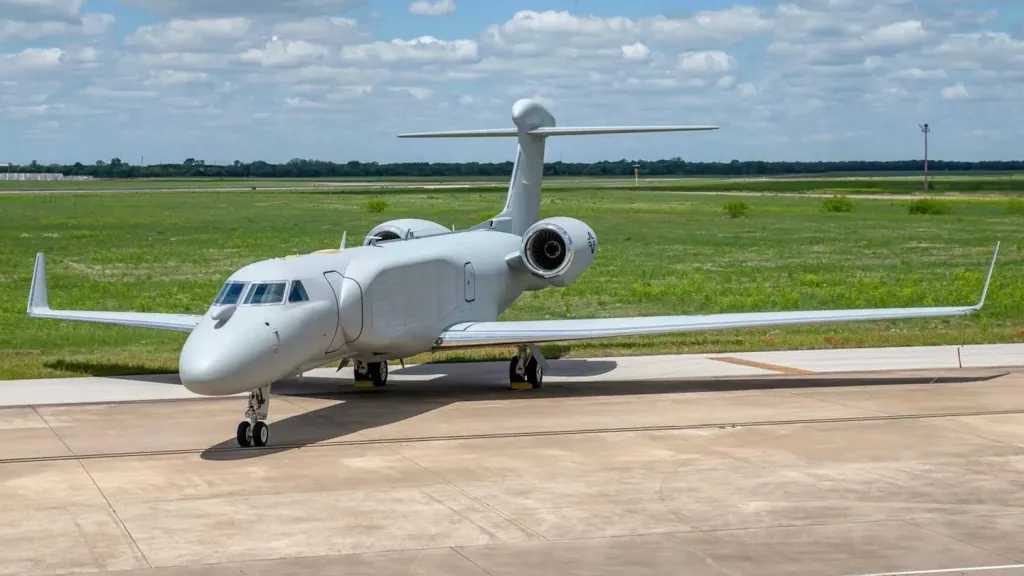
With the U.S. Air Force now in the process of transitioning from the aging EC-130H Compass Call to the brand-new, bizjet-based EA-37B Compass Call, TWZ caught up with top executives from the two co-primes on the electronic attack aircraft program. In the process, we learnt more about its capabilities, related platforms, and other prospects for the future. We spoke with Jason Lambert, president of the intelligence, surveillance, and reconnaissance sector (ISR) at L3Harris Technologies, and Dave Harrold, who leads the Countermeasure & Electromagnetic Attack (CEMA) Solutions business area at BAE Systems.

TWZ: Can you give us a better understanding of what the EA-37B Compass Call does conceptually? There are clearly a lot of different parts to its mission, so I am just interested to hear that in your words.
Dave Harrold: This aircraft is the Department of War’s only long-range, electromagnetic spectrum aircraft. Interestingly enough, it used to be called the EC-37B until it was formally changed to the EA-37B, signifying that it is a dedicated electronic attack platform.
When I say electronic attack, what we’re talking about is really degrading, denying, and disrupting adversary communications. It’s about causing havoc in their command-and-control system, so that adversary leaders are unable to make clear decisions. So that’s about integrated air defense systems [IADS] and disruptions there. It’s about [disrupting] different communication nodes. This really is a dedicated counter-C5ISRT [command, control, communications, computers, cyber, intelligence, surveillance, reconnaissance, and targeting] platform. We’ve been doing this mission set for over 40 years with the EC-130H workhorse starring in every conflict since it was put in the inventory, particularly in the Global War on Terror.
We saw the need to be able to do that at a higher altitude, longer range, higher speed, if we were going to turn this capability toward other regions. And so the challenge was really around: how do you take all of that stuff on an EC-130H and package it down to an EA-37B? That has been a challenge of innovation and technology, for us to reimagine: how do you take that size and weight and reduce it, but not reduce the power? Because we need that power to be able to execute the kinds of techniques that we’re doing on the system. So really, it’s about controlling the electromagnetic spectrum, making sure we can enable our side and disable the other side.

Electromagnetic warfare, evolved
Jason Lambert: The EA-37B does that really on a theater level. There are other capability sets that the Department of War has in their inventory that are more of a point solution, whereas this is really a theater-level, strategic solution, dominating the electromagnetic spectrum and being able to defeat what’s happening on our adversary’s side, while our forces continue to operate in full, with what they need to do for their communications, with what they need to do with their command and control systems. Other systems out in the world are broad jammers. This is not that; this enables our assets to be able to continue to do their job in a non-degraded manner.
Dave Harrold: Yeah, this is really important. One of the strengths of the EA-37B is the simultaneity. What that means is we’ve got the power and the capability. We’re not in a one-versus-world anymore, or using a point solution: here’s a threat, here’s a technique. The threat environment is getting more and more sophisticated and challenging, and so it’s really about how many different techniques can you run at one time to neutralize or disrupt or deny how many different threats that are out there? That’s what’s important about the power and what distinguishes this platform from point solutions.

Jason Lambert: And it is all software-defined, which is a very important thing. The threats are evolving, and we’ve got the capability, and our Department of War has the capability, for some of our other platforms, our ISR platforms, specifically, to go out and collect on what those potential threats might look like and how those threats evolve over time. That information is able to be configured within the mission system that BAE Systems produces to be able to go and defeat those threats. It’s not like a one-off solution that’s going to be made obsolete. It’s a solution today that’s built for tomorrow and beyond, because it can continue to evolve based on the threats.
TWZ: Can you kind of indulge us in terms of what could it do? What’s a tangible thing this could actually go and do? Could it go and shut down a big part of an integrated air defense system [IADS] for example?
Jason Lambert: I’m gonna go back to one of the things I’ve already said: sophisticated comms networks. Our enemy adversaries have more and more sophisticated comms networks. We have to affect those comms networks in order to affect their overall capability. And, you know, you mentioned IADS, that is an original mission of the Compass Call platform, to disrupt the IADS.
Dave Harrold: Exactly, this is designed to break the kill chain. If there’s no command and control system to process the information for the kill chain, it won’t work. And you can do that significant range. That’s what it does.

TWZ: Can you explain a bit more about what you have to do to port these systems and capabilities from the EC-130H into the EA-37B?
Jason Lambert: L3Harris is the integrator. We purchase the aircraft either directly from Gulfstream or from the VIP market. Then we work with Gulfstream to do the conversion of the aircraft. We essentially time it back to what the plane was when it initially left the production line. Then we go and do the outer mold line shape; Gulfstream provides that to us at our facility in Waco, Texas. Then we do the integration of the BAE Systems mission system that Dave and his team provide.
Dave Harrold: We’re the prime mission equipment provider, so that’s our co-prime split, and we build all of that up in Nashua, New Hampshire. We build that equipment, we test it, we lay it out. We have an integration lab up there, where we actually lay it out as if it were in the aircraft, and then we ship that off to Jason’s team, who then lay it out to make sure it all fits again before they put it on the actual aircraft. It’s a very choreographed way to make sure that we’re hand in hand about building the equipment, that the cabling is all appropriate, and all that kind of stuff, so that Jason’s team can integrate it on the aircraft.

Jason Lambert: The EC-130H is still in service today, but it is obviously a very different airplane in terms of the capability set. We think about it, we think about the SWAP — size, weight, and power are three constraints or criteria that we look at. Obviously, they are very different on a business jet platform, but we’ve successfully done that integration on the new system. Now we can, of course, put that all on an aircraft that’s got a much larger range, time on station, and altitude to be able to perform this mission.

The EC-130 Crew
TWZ: Returning to the EC-130H comparison. Can you compare the performance of the two platforms? How does that affect survivability?
Jason Lambert: From a speed perspective, the EA-37B flies at Mach 0.82… versus 300 miles an hour for the EC-130H. For altitude, the EC-130H flies at 20,000 feet. The EA-37B is going to be north of 40,000 feet. So we have double the altitude. And when we think about time on station, it’s not comparable. I mean, from a range perspective, we have more than double. We have around 2,300 nautical miles on the EC-130H and 4,400 nautical miles on the EA-37B. Couple that with additional content that can be put on from defensive perspective, and it’s far more survivable, no question about it. In terms of how it operates, the altitude it operates, the standoff range it can operate at, it’s a different plane
TWZ: Does greater altitude improve your ability to do this missions with greater standoff?
Dave Harrold: It actually does. Just the geometry of being at that higher altitude, you can get a far greater view to the horizon, and and not just on the ground, but communication at large. So think what might be above you as well as below you.
Returning to survivability, I think the other thing to remember is that the mission here is to degrade, disrupt, and deny the adversary’s ability to communicate. And so by doing that, we’re contributing to the survivability of the whole campaign, and by itself, also the platform itself, right? If I’m out there disabling different comms networks that are integral to threats actually being successful, the platform is making itself much more survivable through its actual core mission.

TWZ: Could it go and operate as an escort jammer? I mean, could it go and follow a package to a certain point to protect it?
Jason Lambert: I mean, I guess. I guess we use the word jammer. But it’s not just a simple jammer. It’s a very different mission set, a very discrete set of techniques. But it is absolutely essential to the overall strike package to make sure that that the goals of that package are achieved.
TWZ: Can we just talk a little more about some of the improvements in the EA-37B version of Compass Call? I guess one of the big improvements is the ability to rapidly insert new capabilities in the form of upgrades. Is there anything you can say about that?
Dave Harrold: I think as we move forward, the original baseline was really about just cross-decking the capability from the EC-130H. Now we’re moving into a much more software-defined radio architecture, an open systems architecture. The whole point there is that we go from SABER [BAE Systems’ Small Adaptive Bank of Electronic Resources], which is sort of what I would call Baseline 3.5, interim, the bridge, to get to Baseline 4, which is the fully open software-defined radio architecture. The whole point there is that it used to take months or longer to find a threat, get a new technique, and figure out how to put it on the hardware. Hardware now is all about adaptability and speed, and, more importantly, it’s not just about BAE Systems’ techniques that this open architecture allows for. Anybody who has the right technique can come and plug into our system. We’ve got a development kit that people can get access to, and they can write new skills that we can rapidly insert into the open architecture. As the threat environment gets more sophisticated, we have to get more sophisticated with how rapidly we can come forward with something to counter those threats.

TWZ: Just in terms of the CONOPS, does this airplane follow a scripted battle plan? Or can it do real-time adjustments, performing more dynamically?
Dave Harrold: It’s a sophisticated system that is adaptable and flexible to the combatant commanders’ needs, so it can be tasked in that way, to be used optimally, for whatever the commander needs. I also think the exploitation that the system needs to do is flexible enough to be able to change depending on if we are pre-war or at war.
TWZ: How do the mission players actually see the data? Is it processed on board, or can it be worked offboard as well?
Jason Lambert: We’ve got a crew of up to nine people on the aircraft. Of course, the pilot and co-pilot are responsible for the flying, but there are an additional seven members in the back that operate and employ the electronic attack mission system and equipment that’s permanently integrated into the mission and cargo compartment. That crew can include a mission crew commander, which would be an electronic warfare officer, and a weapon system officer. There are experienced cryptologists, linguists, analyst operators, and airborne maintenance technicians. So it’s an entire team that’s up there. The aircraft can process that work onboard, or it can send signals and content to other aircraft in the network.

BAE Systems Compass Call Jammer
TWZ: Can a ground operating team manipulate the Compass Call system? Or does it have to be done airborne?
Jason Lambert: I’m a little cautious on how to answer that question, just in terms of the nature of the classification. I’ll just say it is set up to operate in theater and on a network and so also autonomously. As we continue to evolve our solution set, not just for Compass Call, but what we’re doing on our other ISR platforms, AI is becoming a big part of that in terms of operator workload and being able to do more of the mission set with fewer individuals on the plane. That is evolving as the threat goes up.
TWZ: I think that’s an obvious thing, isn’t it, to want to have fewer operators on board?
Jason Lambert: It helps with weight. If you take out a member of the personnel and a mission crew station, now you can do the same on either a smaller platform, or you can bring more gear onto the same aircraft. There’s always that tradeoff.

TWZ: Can we go back very briefly to the point about reducing the personnel on board. How will you harness AI to do that?
Jason Lambert: It’s really through AI decision content provided to the operator. So think about it in terms of an AEW&C [airborne early waring and control] equation, and a little bit different in terms of what would happen in Compass Call. But in the AEW&C equation, your operators are looking at the number of assets to track. Think of aircraft, airborne assets. They could be ballistic threats, anything that’s been launched and in the sky. There’s a certain number per operator and that number is typically classified. But if you think about it in terms of the things that the human in the system can actually manage at any one point in time, the AI will help that human be able to do a lot more of that by giving the information, compacting the information, and the decision tools to enable them to do more. That’s really what AI does. It’s not a supplement. It’ss an enhancement for the operators.
TWZ: In terms of expandability, the nose and the tail are currently empty. Are you looking at putting anything in there? Is there a need for that? Could you add additional cooling, for example, in the future?
Jason Lambert: We have expansion options for additional content. So we’re continuing to look at that in terms of what you mentioned on the nose. In terms of cooling, there’s both air cooling and liquid cooling on the platform, and so we typically operate in both environments. More broadly, though, about expandability, we talk a lot with our customer about what a roadmap to additional capabilities might look like. Whether that’s new techniques because of emerging threats, prime mission equipment itself, or other capabilities that might take advantage of real estate on the platform. So we’re executing an existing program and at the same time talking about what incremental upgrades might look like in the future.

TWZ: Could you expand the mission set by adding new sensors?
Jason Lambert: It’s actually not so much the hardware, it’s the software, right? And it’s all software defined. The expandability in the mission packages is really designed to evolve based on what the threat package looks like. And so the threat identification is more and more about the adversary, then we can involve the system through the software integration on the platform. It’s already like it’s designed to be self-expanded. Again, that’s why this simultaneity thing is really important, it’s because as new mission sets come on board, I don’t have to sacrifice one mission for another mission and I can simultaneously execute.
TWZ: The first export customer for the EA-37B is Italy, with two jets on order. Can you talk about those aircraft?
Jason Lambert: They will be the same. Italy may use a different nomenclature when the aircraft are delivered, but they will be EA-37B aircraft. We both co-prime this program for the U.S. Air Force. We also do that for Foreign Military Sales [FMS]. Italy is our first international customer, and there is some additional interest beyond that.

TWZ: So you are going to build additional sets of the Compass Call kit to go in that?
Jason Lambert: We are. That particular contract, and the way we execute these programs on an international basis, is we do a hybrid contract. We do a direct commercial sale, typically on the airplanes, and then the mission system and integration are done on an FMS case through the U.S. Air Force. Of course, this has to go through U.S. government approvals with the State Department in terms of policy release and whatnot, for the technology, which has been approved for Italy. There are additional customers that are also interested on the international front.
TWZ: Presumably the benefit there is that the Italians already have G550s and the associated infrastructure?
Jason Lambert: We have an ISR program known as JAMMS [Joint Airborne Multi-Mission Multi-Sensor System]. When you think about a country that wants to go take on an electronic attack capability, the precursor to that is, typically, an ISR capability. They’ve got an aircraft known as JAMMS. We have a legacy program called SPYDR that we’ve done with the Italians. Understanding the signals that you want to go and eventually exploit and get dominance over in terms of the electromagnetic spectrum, having that understanding of them first through the ISR path is typically the starting point. In recent news you might have seen we have also successfully delivered MC-55A Peregrine to the Australians. That’s their foray into this space as well. And they’ve got interest in potentially looking at the EA-37B Compass Call downrange. But to start right now, it’s the ISR capability that’s been delivered.

TWZ: And so do other export customers for the EA-37B get a U.S.-standard Compass Call, or is it going to be a slightly different standard? How will they work alongside the U.S. Air Force jets?
Jason Lambert: It’s all subject to releaseability in the U.S. Air Force. But they will be getting the same capability. It’s helpful for the United States, because you want to have your partners involved in this. In an unclassified realm, right now, the need from the U.S. Air Force is over 20 planes. We’re currently under contract, in terms of the mission system, for 10. There are congressional plus-ups that have been looked at for FY 26. The budget’s been increased, and it looks like there’s going to be another two aircraft placed on order for this fiscal year. We’re excited about that. As industry, we’re always looking at how we can expand capacity to go address that need. But you think about a need of 20-plus aircraft in an unclassified space with 10 under contract, soon to be 12. Partners are a big part of how we can go address that global challenge, for the global threat. Italy is the foray into doing that in the EUCOM theater, and what could be done in the eastern realm of NATO. Now, potentially, we’re working with partners from PACOM.
Dave Harrold: The RC-135 Rivet Joint is another aircraft in the U.S. Air Force asset base. That is our intelligence, surveillance, and reconnaissance asset employed by the United States and United Kingdom. Again, that works hand in hand and collaboratively with the EA-37B feet. They will combine, and they can also provide information to each other.

TWZ: In terms of the airframes, the G550 program has come to an end. Where will you source new aircraft from?
Jason Lambert: The G550 is currently out of production. Right now, on any given day, there are roughly a dozen aircraft that are available for sale. Think of it as high-net-worth individuals or corporations that want to trade up or trade in their business jet fleet. So we would go procure those aircraft as they were looking to go buy another asset from Gulfstream or another partner, and we would take those aircraft and work with Gulfstream to do that modification work and get ready to go host the BAE Systems mission kit. That’s how we grow the current G550 base with the used assets on the market.
Additionally, the U.S. Air Force has got 16 C-37 or G550 aircraft that they operate. There are discussions right now on a recap program. Not all those aircraft are a perfect fit for the mission system. They have to be above a certain serial number in terms of how they were produced. Five of the 16 are potential candidates that could be converted to Compass Call. That’s incremental, of course, on top of dozen or so the VIP market. But there are planes available for us to do the expansion. When Dave and I look out and we get the question from Air Force about how do we grow and expand, industry is ready to go do that. We know the need is for greater numbers and we have plans to be able to go execute that.

TWZ: So the extra two EA-37Bs for the Air Force will be existing airframes that you will harvest from somewhere else?
Jason Lambert: We will purchase those from the market. We’ve already identified owners and tail numbers. We’re ready to go.
We want to thank Jason Lambert and Dave Harrold for taking the time to answer our questions about the EA-37B and share their passion for the aircraft with our readers.
Contact the editor: thomas@thewarzone.com