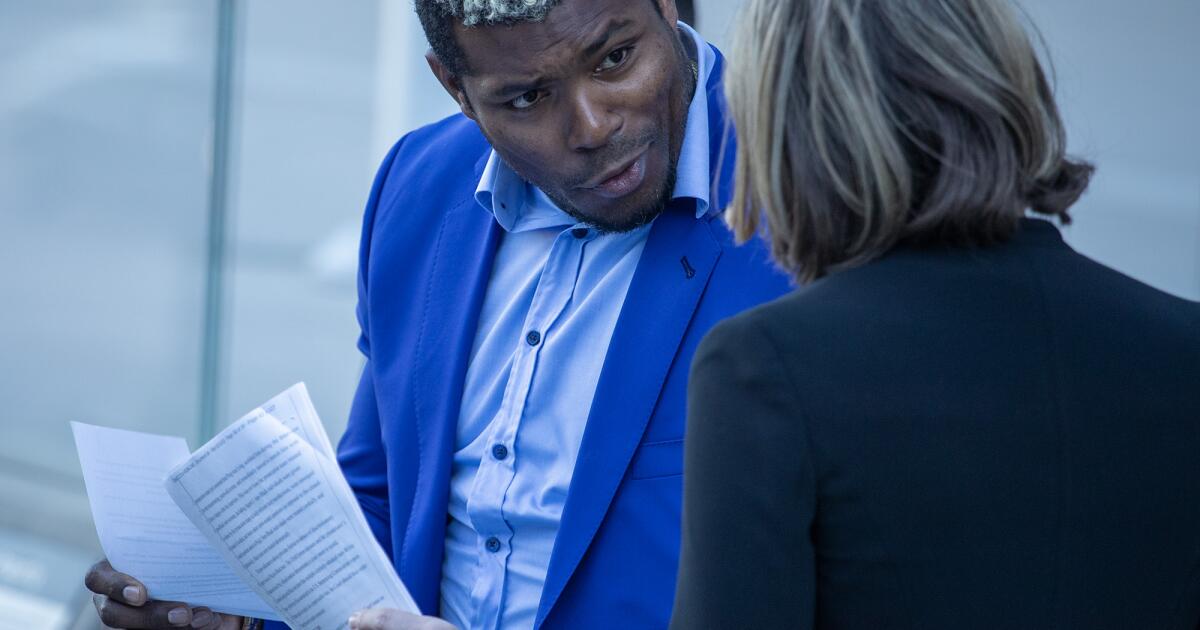
A jury found former Dodgers outfielder Yasiel Puig guilty of obstruction of justice and making false statements to investigators Friday in Los Angeles federal court.
The two-week trial concluded with the jury deliberating for nearly two days. Puig, 35, could face up to 20 years in prison. Sentencing is scheduled for May 26.
Puig faces a statutory maximum sentence of 10 years in federal prison on the obstruction of justice charge and up to five years in prison for the two false statement charges. He remains free on his own recognizance.
The charges stemmed from a January 2022 videoconference interview with federal investigators during which Puig was alleged to have lied about his sports betting. The investigators — led by Assistant U.S. Atty. Jeff Mitchell — were gathering information at the time about an illegal gambling ring headed by Wayne Nix of Newport Coast.
Investigators alleged that Puig denied he had placed bets with Nix despite evidence establishing that he made 899 wagers with the former minor league pitcher on football and basketball games and tennis matches from July to September 2019.
Puig — who was not accused of betting on baseball — lost more than $1.5 million in sports bets, Internal Revenue Service Special Agent Christen Seymour testified, and owed Nix $282,900.
Nix pleaded guilty in 2022 to one count of conspiracy to operate an illegal gambling business and one count of subscribing to a false tax return. He is awaiting sentencing.
Mitchell would soon be best known for overseeing the investigation and conviction of Shohei Ohtani’s former interpreter Ippei Mizuhara, who was sentenced a year ago to 57 months in federal prison for bank fraud and filing a false tax return after stealing $17 million from Ohtani to pay off his own illegal gambling debts.
But Mitchell’s interest in Puig centered around what he knew about Nix, the target of the federal probe in 2022. According to a court declaration reviewed by The Times, Mitchell told Puig’s attorney that he didn’t believe it was a federal crime to make payments to an illegal bookmaker. Investigators were after “an unlawful sports gambling organization,” Mitchell said.
Yet when Mitchell concluded Puig lied about placing bets through Nix intermediary Donny Kadokawa, he swiftly charged the outfielder with making false statements and obstruction of justice.
Puig agreed in August 2022 to plead guilty to one count of lying to federal authorities and would have served no jail time while paying a $55,000 fine. Weeks later, however, he backed out of the agreement, and a judge ruled he could do so because he had not yet entered his guilty plea in court.
“I want to clear my name,” Puig said in a statement at the time. “I never should have agreed to plead guilty to a crime I did not commit.”
It took three more years of pretrial legal wrangling, but Puig finally got his day in court in January. Assistant U.S. Attys. Juan Rodriguez and Michael Morse served as prosecutors after Mitchell resigned from the U.S. Attorney’s Office in May.
Puig’s defense centered around issues with the 2022 interview with Mitchell and investigators who represented the Department of Homeland Security and the IRS.
Defense lawyers Keri Curtis Axel and Brian Klein contended in court filings that Puig, who is from Cuba, was confused because of his language barrier and a dual diagnosis of ADHD and post-traumatic stress disorder. The investigators misinterpreted his answers, the attorneys said.
Steven Gebelin, who represented Puig in 2021 and 2022, testified at trial that his then-client tried to be helpful during the interview but, because the interpreter’s Spanish dialect differed from Puig’s, his answers were translated poorly. Puig did not testify at trial.
Axel contended during her closing statement that Puig did not lie about his interactions with Nix and his associates, which occurred two years before the interview with investigators.
The investigators assumed Puig was lying when he became confused by the questioning and felt pressured to accurately recollect the details of his gambling activity, Axel argued, telling the jury that “assumptions and speculation are not evidence, and you shouldn’t rely on it.”
Prosecutors also alleged Puig said during the interview that he had lost $200,000 in 2019 betting on a website he couldn’t identify and that a person whose name he couldn’t recall instructed him to purchase $200,000 in cashier’s checks made out to another client of Nix’s to settle his gambling debt. Investigators considered Puig’s inability to remember the name a lie.
Kadokawa testified that he was the person giving Puig instructions. Axel argued that Puig told the investigators later in the interview that he had placed bets through Kadokawa, according to court documents.
Prosecutors said Puig also lied when he went through the naturalization process to become a U.S. citizen in 2019, producing evidence that he said on an application and in an interview that he never gambled illegally.
After growing up in Cuba, Puig came to the United States in 2012 and signed with the Dodgers. His attorneys called an expert who testified that Puig’s arduous journey from his home country caused post-traumatic stress disorder.
UCLA psychology professor Marcel Pontón, a neuropsychology expert witness for the prosecution, disputed that diagnosis. And Morse rebutted the contention that Puig couldn’t understand English by playing audio of Puig reflecting in English about his interview.
The power-hitting outfielder quickly became a Dodgers fan favorite, finishing second in National League Rookie of the Year voting in 2013. Nicknamed the “Wild Horse,” Puig remained a fearsome presence in the lineup for six years and helped the Dodgers to the World Series in 2018 when he hit a three-run homer in Game 7 of the NL Championship Series against the Milwaukee Brewers.