

trial

Claudine Longet dead: Starlet who shot her Olympian boyfriend was 84

Claudine Longet, the French-born star and ex-wife of crooner Andy Williams who became notorious for the fatal shooting of Olympic skier Vladimir “Spider” Sabich, has died. She was 84.

Her death was confirmed by her nephew, Bryan Longet, who posted a social media tribute on Thursday. Translated from French by The Times, he wrote, “You have been a true inspiration in my life and you will always be. … Another star in the sky. Thank you for everything, my aunt.”

Born in Paris on Jan. 29, 1942, Longet was the daughter of a doctor and an X-ray manufacturer. From a young age, she showed a knack for singing and dancing and envisioned her name on the marquee. In 1960, when she turned 18, American impresario Lou Walters (father of Barbara Walters) saw Longet dancing on French television and hired the ingénue to join the Tropicana casino’s flashy new production. She bid Paris adieu and sashayed to Las Vegas, where she starred in the Folies Bergère revue.

While working as a showgirl in Sin City, Longet met then-fellow Vegas performer Andy Williams one evening when her car broke down on the side of the road. Williams happened to be passing by as the young dancer was pushing her car down the highway with a friend, and Williams along with his manager stopped to help and was quickly charmed. The two were married on Christmas Day the following year, in 1961.

In 1962, Williams released “Moon River,” and the crooner’s career took off. The newlyweds left Las Vegas and moved into an oceanfront mansion in Malibu where they started a family, and over the next several years welcomed daughter Noelle and sons Christian and Robert, or “Bobby,” who was named after the couple’s close friend Robert F. Kennedy. Also in 1962, Williams’ eponymous variety show debuted and quickly became a hit. Longet was a regular on the show, and the family-oriented Christmas TV specials, often featuring the entire Williams clan, were a ratings juggernaut.

In addition to her regular appearances on “The Andy Williams Show,” Longet acted in television and film. Notably, the chanteuse captivated audiences singing Henry Mancini and Don Black’s “Nothing to Lose” in the 1968 comedy “The Party,” in which she played an aspiring actress. From 1967 to 1972, she released seven studio albums, five with A&M Records, including her debut single and album titled “Claudine,” and two with Barnaby Records. Her music was known for its breathy, lounge-pop quality, and she sang in both English and French.

By 1970, Williams and Longet’s marriage was on the rocks, and the pair separated. They officially divorced in 1975. The Emmy-winning host chalked it up to the pair growing apart. He told CBS’ “This Morning” during a 2009 appearance that he was never home. “It was all my fault, and I just didn’t take care of my marriage,” he said, noting that he regretted the split. The two stayed friendly afterward, and Williams stood by Longet when tragedy and scandal struck a year later, in 1976.

Longet met Olympian skier Sabich in Bear Valley at a celebrity skiing exhibition in 1972. There was an instant attraction between the two, and Longet relocated to Aspen, Colo., and ultimately moved into the pro skier’s ritzy Starwood chalet around 1975. On March 21, 1976, Longet shot Sabich in the abdomen with an imitation World War II .22-caliber German‐made pistol. Her daughter, Noelle, who was in the house at the time, testified that she heard Sabich yell out, “Claudine! Claudine!”

According to The Times’ archives, Longet told authorities that she found the handgun and asked Sabich how to use it. During Longet’s trial, Aspen Det. David Garms testified that Longet insisted the shooting was an accident. Garms said that Longet told him she’d pointed the gun at Sabich and then “jokingly said ‘bang, bang.’” She told investigators she thought the safety was on, and a ballistics expert said the safety did not work.

Longet was with Sabich in the ambulance when he died en route to the Aspen hospital. The “Love Is Blue” singer was subsequently questioned by investigators and charged with felony reckless manslaughter weeks later. She initially faced up to 10 years in prison. But in January 1977, after four days of testimony and 3½ hours of deliberations, Longet was acquitted of the felony charge and convicted of a misdemeanor charge of negligent homicide.

Ex-husband Williams accompanied Longet to her trial and told “This Morning” years later that he supported his ex-wife because he believed in her innocence.

“I did because I thought it was unfair,” he said. “I thought she was innocent. I thought it was an accident.”

During the trial, she testified in her signature French accent that she and Sabich were the “best of friends.”

“There were times over the four years that we would disagree. … [T]here would be times he would be a little bit offended by the attention I got and I would be a little bit offended by the attention he got, but we were the best of friends and we loved each other very much,” she told the court, per The Times’ archives.

Longet was sentenced to serve 30 days in jail “at a time of her own choosing.”

“There is not really much to say,” she told reporters outside the courtroom, per The Times’ archives. “Only that I have too much respect for living things to do that. I’m not guilty.”

The parents of Sabich filed a $1.3-million civil suit against Longet later the same year, but the case was settled out of court two years later. Longet was reportedly forbidden from speaking or writing about the shooting. As for her career in show business, she was finished.

The Sabich case became an absolute sensation in the media, not just in America but also globally, and Longet was internationally labeled Aspen’s femme fatale. Pop culture had its way with the incident as well. The Rolling Stones’ song “Claudine” was withheld from their 1978 album, “Some Girls,” because of legal considerations but was featured on the 2011 reissue of the album.

“You’re the prettiest girl I ever seen / I want to see you on the movie screen / I hope you never try to make a sacrifice of me, Claudine,” belted Mick Jagger in what may have been considered a diss track or a tribute, depending on whom you ask. “Nah ah / Don’t get, don’t get trigger happy with me, Claudine.”

In an April 1976 episode, “Saturday Night Live” also took aim at the deadly affair with a sketch titled “The Claudine Longet Invitational,” in which Chevy Chase and Jane Curtin play sports commentators who offer a play-by-play of a competition in which male skiers are “accidentally” shot by Longet as they race down the slopes.

The producers read an apology on air the following week.

Aspen attorney Ron Austin, who was on Longet’s defense team, left his wife shortly after the trial concluded to be with the embattled starlet. The two married in 1985 and remained in Aspen afterLonget’s conviction but also spent time at their second home in Hawaii. In 2023, the pair listed her $60-million Red Mountain Ranch estate, according to Robb Report.

Longet’s last known public appearance was in 2003 on the A&E channel’s Andy Williams “Biography” documentary, in which she recorded only voice-over. “To this day people stop me in the street and say how much they loved the Christmas show.”


Source link

House passes bill to discourage release without bail before trial

The House Rules Committee debates the Cashless Bail Reporting Act on Tuesday in Washington before advancing it to the full House, which passed it Thursday. Photo by Olivia Ardito/Medill News Service

WASHINGTON, May 14 (UPI) The House on Thursday passed the Cashless Bail Reporting Act, which is intended to deter states and communities from releasing people charged with crimes before trial without paying bail. Ninety-six Democrats joined most Republicans to approve the measure, 308 to 116.

If the Senate were to write a companion bill and pass it, the act could have significant repercussions for the Black, Latino and low-income communities, according to researchers and activists. Advocacy groups also had raised concerns that the bill would lessen states’ rights.

“We have seen state and local governments making reforms to their bail systems in response to the growing body of research which has highlighted the inequities in bail systems, which disproportionately burden racial minorities, women and overwhelmingly the poor,” Rep. Mary Gay Scanlon, D-Pa., said in an earlier hearing on the bill

The bill expanded on a 2025 executive order from President Donald Trump, “Taking Steps to End Cashless Bail to Protect Americans,” which required the U.S. Attorney General to send a list of states and local jurisdictions that have eliminated cash bail for some crimes that “pose a clear threat to public safety and order.”

These crimes include violent, sexual and indecent acts, and burglary, looting and vandalism. To encourage elimination of cashless bail, the executive order also directed agencies to identify funding to these communities that could be “suspended or terminated.”

The bill would require annual lists of states and communities that allow cashless bail.

“It would be creating a bit of a hit list for different policymakers to attack and to try to pressure those states, counties, localities to change their policies and practices, to avoid … a lot of public safety funding that they get every year from the federal government getting completely gutted,” Nicole Zayas Manzano, deputy director of policy for the Bail Project, a non-profit group that advocates for bail reform and provides bail assistance, said about the lists.

In a Rules Committee meeting on Tuesday, Republicans said the act would lower crime rates.

“We know violent criminals released on cashless or artificially low bail have reoffended,” said Rep. Andy Biggs, R-Ariz.

Rep. Jamie Raskin, D-Md. voted for the bill, but said it would do little more than track bail practices in states and localities.

“It’s hard to see how issuing a report advances community safety or justice, given the strangely hostile rhetoric we are hearing from our colleagues about cashless bail,” Raskin said in the debate before the vote.

In a 2024 study, the Brennan Center for Justice found that there was “no statistically significant relationship” between cashless bail policies and increases in violent crime.

In the Rules Committee meeting, Rep. Michelle Fischbach, R-Minn., referenced the Bail Project, a non-profit organization that pays bail for low-income people who cannot afford it. She claimed that the group put violent offenders back on the street.

“In Indiana, from 2019 to 2021, 24% of the roughly 1,000 defendants cut loose by the Bail Project … had been charged with a crime of violence, so we’re putting violent offenders back on the road. And 35% were facing felony charges and had a previous charge of at least one crime of violence,” Fischbach said.

The group rejected the congresswoman’s description.

“The cutting loose reference mischaracterizes our work. We only step in after a judge has deemed somebody eligible for release, and it is only the affordability of cash bail that is preventing them from getting out, which is also unconstitutional,” Zayas Manzano said. “Then we really connect them with social services in their own communities.”

Moreover, studies found that cash bail disproportionately harms minorities, notably those in Black, Latino and low-income communities. In 2024, the Criminology & Public Policy Journal reported that Black defendants were 34% more likely to be recommended to be held behind bars until their cases were resolved when compared to white defendants.

Zayas Mazano said people jailed before trial were more likely to pre-emptively plead guilty, receive harsher punishments and end up with worse criminal records.

“Your life also just falls apart once you’re trapped inside, right? You could lose your housing if you can’t go and pay rent. You can lose your job if you’re not able to show up after a certain number of days. You could lose custody of your children. I mean, all kinds of things can really happen, but then just really snowball onto communities of color, in particular, and low-income people in general,” she said.

According to the Prison Policy Initiative, 69% of pretrial detainees were people of color, with Black (43%) and Hispanic (19.6%) defendants especially overrepresented compared to their share of the total U.S. population.

“Study after study shows that judges tend to assign people of color higher cash bail amounts and that they are less likely to be able to afford those cash bail amounts. And so they are very often forced into whether or not they must stay behind bars, which we certainly see huge racial disparities in jail, pretrial, and otherwise,” Zayas Manzano said.

During the Rules Committee meeting, Democrats mirrored concerns about the bill passing. Notably, Raskin discussed how the federal court system has functioned on a cashless bail system for about 60 years, instead of making bail decisions based on the danger of flight or violence to others.

“In America, whether you’re a president or a pope or a pauper, you’re innocent until proven guilty beyond a reasonable doubt as to every element of the charged offense,” Raskin said. “And no one should be detained pretrial simply because they don’t have the financial resources to post bail.”

Source link

Court delays Trump’s $83-million defamation award to E. Jean Carroll

President Trump won’t have to pay an $83-million defamation award to a longtime advice columnist until the U.S. Supreme Court gets a chance to review the case or reject an appeal, according to a court entry Tuesday.

The 2nd U.S. Circuit Court of Appeals agreed to a request by one of Trump’s lawyers to let the president delay the payment to E. Jean Carroll, though it required that Trump post a $7.4-million bond to cover any additional interest costs, a request Carroll’s attorney had made.

The appeals court late last month refused Trump’s request for a rare meeting of the full 2nd Circuit to hear an appeal of a three-judge panel’s affirmation of the January 2024 verdict.

Afterward, Trump attorney Justin D. Smith asked the 2nd Circuit to stay the effect of its decision upholding the award so that the president would not be forced to pay the judgment before the high court has a chance to consider an appeal.

Smith said last week there was a “fair prospect” that the Supreme Court will find in favor of Trump, who has called Carroll’s claims — first made publicly in 2019 — that she was sexually attacked by Trump in a Manhattan luxury department store dressing room in the spring of 1996, a “made-up scam.”

The $83-million award to Carroll, 82, came from a jury that briefly heard Trump testify and observed his animated behavior for several days.

In upholding the verdict, a 2nd Circuit panel wrote in September 2025 that Trump continued his attacks against Carroll for at least five years, making them “more extreme and frequent as the trial approached.”

“He also continued these same attacks during the trial itself,” the appeals court said. “In one such statement, issued two days into the trial, Trump proclaimed that he would continue to defame Carroll ‘a thousand times.’ ”

The jury had been instructed to accept the findings of a jury that in May 2023 awarded Carroll $5 million after concluding Trump sexually abused her in the department store and then defamed her after she published her account of it in a 2019 memoir.

Trump is challenging the $83-million award on several grounds, asserting “absolute immunity” for comments he made while president as he disavowed knowing Carroll and attacked her motivations, saying they were politically driven or arose from a desire to promote her memoir.

Sisak and Neumeister write for the Associated Press.

Source link

Beyoncé unreleased music thief pleads guilty, is sentenced

A man accused of nabbing unreleased music by Beyoncé in a vehicle break-in last summer has pleaded guilty to the theft and has been sentenced to serve time in prison.

Kelvin Evans, 41, on Tuesday entered guilty pleas in Fulton County Superior Court in Georgia to counts of entering an automobile and criminal trespass. Fulton County Superior Court Senior Judge Jane C. Barwick sentenced Evans, who was set to go on trial this week, to two years in prison and three years on probation. Evans was also warned to keep his distance from the victims and the scene of the theft.

Evans was sentenced less than a year after stealing the pop diva’s unreleased music from her choreographer’s van in Atlanta. According to police, Evans broke into the Jeep Wagoneer rented by choreographer Christopher Grant and dancer Diandre Blue when they stopped at a restaurant to eat. The artists were in town for the “Diva” singer’s four-night takeover of Atlanta’s Mercedes-Benz Stadium for her Cowboy Carter tour.

Evans damaged the trunk window and stole a pair of suitcases that contained two computers and five jump drives of unreleased music as well as footage, plans for the tour production and past and future set lists, the police report said. He also stole clothing, Apple AirPods Max headphones and designer sunglasses, police said.

Police arrested Evans in August. He was indicted in October and initially pleaded not guilty in January and even rejected the plea deal during a hearing last month.

Despite his arrest, police have not recovered the stolen items.

The chances of Beyonce releasing new music was already pretty slim heading into Evan’s scheduled trial. Speculation swirled online that the Grammy winner would drop the third act of her planned music trilogy timed to the summer. The singer’s rep Yvette Noel-Schure put a hard stop on those rumors in late April.

“This is unequivocally false!!” Noel-Schure posted on X.

Times assistant editor Christie D’Zurilla and the Associated Press contributed to this report.

Source link

Sam Altman says Elon Musk wanted 90 percent of OpenAI in high-stakes trial | Courts News

In a United States court, OpenAI chief executive Sam Altman has rejected claims from fellow tech mogul Elon Musk that he betrayed the artificial intelligence company’s original vision.

Tuesday marked the start of Altman’s testimony in a contentious trial unfolding in Oakland, California, between some of tech’s richest and most powerful titans.

Recommended Stories

list of 3 itemsend of list

Musk, the wealthiest man in the world, has sued Altman and OpenAI president Greg Brockman on the basis that they “stole a charity” by shifting its purpose.

He alleged that OpenAI’s leader persuaded him to invest $38bn, based on a goal of improving humanity, only to see the company pivot to a for-profit venture in 2019.

On the witness stand on Tuesday, Altman instead framed Musk as a competitor obsessed with exercising control over OpenAI.

“It does not fit with my conception of the words ‘stealing a charity’ to look at what has actually happened here,” Altman told the court.

The two men have long had an acrimonious relationship, driven in part by differing views about artificial intelligence.

Musk — a self-described free speech “absolutist” — currently runs his own AI chatbot, Grok, which has been accused of perpetuating right-wing conspiracy theories and offensive materials.

He is seeking $150bn in damages from OpenAI and Microsoft, one of its principal investors.

Altman’s testimony comes more than two weeks into the trial, which has seen him and Musk square off against each other.

In his testimony, Altman argued that Musk knew of the plans to develop OpenAI into a for-profit enterprise when he invested, and he asserted that Musk even petitioned to have a majority stake in the company.

“An early number that Mr Musk threw out was that he should have 90 percent of the equity to start,” Altman told the jury. “It then softened, but it always was a majority.”

The outcome of the trial could determine the future of OpenAI, its leadership, and products like ChatGPT. As part of his lawsuit, Musk is pushing for the removal of Altman and Brockman.

The trial comes as OpenAI prepares for a potential initial public offering that could see it valued at $1 trillion, a historically large sum.

During earlier testimony, Musk portrayed Altman as a liar who could not be trusted with the development of the technology.

“If you have someone who is not trustworthy in charge of AI, I think that’s a very big danger for the whole world,” Musk said.

Musk’s lawyer, Steven Molo, also sought to undermine Altman’s reliability during questioning on Tuesday.

“Have you misled people when you do business?” Molo asked Altman.

“I do not think so,” Altman replied.

Altman, meanwhile, sought to cast doubt on Musk’s leadership; Musk ultimately left OpenAI’s board in 2018 to pursue his own AI development.

“I don’t think Mr Musk understood how to run a good research lab,” Altman said. “He had demotivated some of our most key researchers.”

The US public, for its part, has been largely unconvinced by high-minded rhetoric about the transformative potential of AI.

A March 2026 poll by the Pew Research Center suggested that a majority of respondents in the US believe AI will worsen, rather than improve, the ability to think creatively, form meaningful relationships, make difficult decisions, and solve problems.

Just 10 percent of respondents said they were more excited than concerned about the increased use of AI in daily life.

But the industry has been quick to translate its substantial economic power into political influence as lawmakers consider how best to regulate the technology.

The use of AI has emerged as an election-season issue as the US midterms approach in November, and the administration of President Donald Trump has proposed a “national policy framework” for the technology to avoid a patchwork of state regulations.

The AI industry has become a driver of eye-watering investment in recent years, with the United Nations estimating that the global market could be worth $4.8 trillion by 2033.

Source link

Bolivian court: Arrest Evo Morales for skipping human trafficking trial

Former Bolivian President Evo Morales attends a public event in Chimore, Bolivia, in Feburary. Morales reappeared at the event in his political stronghold in the center of the country a little more than a month of not being seen publicly and amid differing reports about his health and whereabouts. File Photo by A/Jorge Abrego/EPA

May 11 (UPI) — A criminal court in the Bolivian city of Tarija declared former President Evo Morales in contempt after he failed to appear for trial on charges related to the alleged trafficking of a minor.

The hearing, scheduled for Monday, was expected to begin the final stage of a case investigating Morales’ alleged relationship with a 15-year-old girl in 2015, from which a child was allegedly born.

The contempt ruling triggered measures intended to ensure the appearance of the former leader of the ruling Movement for Socialism, or MAS.

Authorities issued an arrest warrant authorizing security forces to detain Morales anywhere in the country and prevent him from leaving Bolivia. The court also ordered freezing his bank accounts and precautionary registration of his assets.

Prosecutors said they gathered more than 170 pieces of evidence in the case, which were expected to be presented during the trial.

After Morales and his legal team failed to appear in court, the judge applied Bolivian law that prohibits criminal trials in absentia.

“Because the accused failed to appear and did not legally justify his absence, this court issues a contempt ruling,” the judge said, according to Bolivian newspaper El Deber.

The trial will remain suspended until Morales is arrested or voluntarily appears before the court.

Morales’ defense team argued the case already had been addressed and resolved in 2020, adding the former president should not face prosecution again. His lawyers also claimed “there is no victim” and describe the charges as politically motivated, according to Chilean news outlet Emol.

Attorney Nelson Cox, a member of Morales’ legal team, said insufficient security guarantees existed to transport the former president from the Chapare region of Cochabamba. He also described the case as a “political fabrication” intended to block Morales from running for office again, according to Bolivian broadcaster Unitel.

Prosecutors and lawyers representing the alleged victim criticized interruption of the trial.

“It is a mockery of the victims and the judicial system. The evidence is overwhelming and the accused must answer for his actions before the law,” the regional prosecutor’s office said.

Since October 2024, Morales has remained in the Chapare region, his main political stronghold, where he is protected by thousands of supporters and self-defense groups.

At that time, police were unable to execute an earlier arrest order after Morales supporters blocked roads for 24 days to prevent officers from entering the area where he remains sheltered.

The government of President Rodrigo Paz announced Tuesday it would seek information from U.S. judicial authorities to investigate Morales’ alleged links to drug trafficking networks. Bolivian authorities are seeking to participate as a “victim” in ongoing U.S. legal proceedings to gain access to evidence.

One of the most significant cases involves former anti-drug chief Maximiliano Dávila, who was extradited to the United States in December 2024 and sentenced in March to 25 years in prison for conspiracy to import cocaine.

Morales has argued that Dávila’s extradition is part of an effort to pressure him into testifying against the former president in exchange for legal benefits.

Source link

James Anderson calls injury replacements trial ‘daft’ and ‘nonsensical’

The England and Wales Cricket Board (ECB) could decide to alter the regulations around replacements after the first block of County Championship fixtures is concluded. Each team has two more games before the competition breaks for the T20 Blast.

During those two rounds of matches, match referees will speak to the directors of cricket at the 18 counties to gain feedback on the trial. The ECB wrote to counties this week to confirm they will be consulted.

The governing body has stressed that the new regulations are a trial, and it will learn each time the rules are applied. The protocols for selecting a replacement player are not new – substitutions for concussions and cases of Covid were in place before this season.

The International Cricket Council has permitted trials for injury replacements to take place in domestic cricket, with India and Australia implementing their own versions.

Though Anderson admits his team would have been left short of fit players against both Gloucestershire and Durham had replacements not been permitted, he said he was “leaning towards” scrapping injury replacements.

The 43-year-old is the most successful seam bowler in Test history, with 704 wickets.

Anderson suggested he would not ever be permitted to come into a game as an injury replacement, because he would always be more experienced than the player he would be replacing.

“It basically means I’ve got to play every game,” said Anderson.

“There’s no point me resting, because I can’t then come into a game – I can’t be a replacement, ever. If I get injured, I get injured. There’s more chance of me getting injured if I try to play every game.

“I can be replaced, because no one in our squad has the same experience, but I could never replace someone else.”

Source link

Stefon Diggs found not guilty of felony strangulation on personal chef

Free agent NFL receiver Stefon Diggs has been found not guilty of felony strangulation and not guilty of misdemeanor assault and battery in connection with an alleged dispute with his private chef over money she said he owed her for her services.

Diggs remained stoic in the courtroom as the verdicts were announced, following less that two hours of deliberation by the jury.

Diggs was charged Dec. 30 and pleaded not guilty during his arraignment at Massachusetts’ Dedham District Court on Feb. 13, five days after playing in Super Bowl LX with the New England Patriots.

Diggs did not take the stand during the trial, which started Monday in Norfolk County District Court in Dedham, Mass.

His accuser, Jamila Adams, told the jury that the 11-year NFL veteran “smacked me with an open hand” and wrapped his arm around her neck during an incident that is alleged to have occurred at Diggs’ house on Dec. 2.

“When I went up to block him, he took his arms and came around my neck and he began to choke me,” said Adams, who became emotional during her testimony.

Defense attorney Andrew Kettlewell told jurors there was no evidence of an assault, with no one in the house reporting anything of the kind and no medical records, photos or video that documented any injuries.

Adams said she did not take any photos or video that showed any marks on her body that could be used as evidence because she “was in shock.”

According to Adams, her employment dynamic with Diggs was “complicated.” The two of them have known each other for more than four years, she said, and had previously been in a sexual relationship, although they were not at the time of the alleged assault. As Diggs’ private chef, she lived in his home and prepared him meals and snacks, she said.

In reporting the alleged incident to police Dec. 16, Adams said she and Diggs had a dispute over payment she thought she was owed. Kettlewell told jurors that Adams had sought money from Diggs after reporting the alleged incident, in amounts that increased over time and culminated in her attorney seeking $5.5 million.

“She was furious and she wanted Mr. Diggs to pay in every sense of that word,” Kettlewell said.

Asked Tuesday about the $5.5-million claim, Adams answered at various points, “I can’t speak on that,” “I don’t understand the question” and “I don’t know how to answer the question.”

At times during the trial, Judge Jeanmarie Carroll instructed jurors to disregard parts of Adams’ testimony that the judge said went beyond the scope of the questions.

The Associated Press contributed to this report.

Source link

Contractor who allegedly leaked classified information released ahead of trial

A judge on Monday ordered that a former federal contractor who allegedly passed top secret information to a Washington Post reporter be released on home detention — with his location monitored and no access to internet-connected devices — ahead of his trial next February. File Photo by Sascha Steinbach/EPA

May 4 (UPI) — A man accused of leaking classified military information to a Washington Post reporter will be released on home detention ahead of his trial next year, a judge ruled Monday.

U.S. District Judge Michael Maddox ordered the Justice Department to release Aurelio Perez Lugones to be held on home detention until his trial in February.

Lugones, whose location would be monitored and blocked from using internet-connected devices, is charged with leaking classified information to Washington Post reporter Hannah Natanson, Politico and The New York Times reported.

Natanson’s home was raided in January by the FBI, with the agency seizing two laptop computers, a cell phone and a Garmin Watch as it investigated Lugones, who was a systems administrator at the Pentagon with a top-secret security clearance.

He allegedly had been taking classified reports home and keeping them before passing some to Natanson, which motivated prosecutors to suggest he could send more information to her if she was not held in jail until the trial.

“The government has no way of knowing what he has retained and what he is able to provide to others,” Assistant U.S. Attorney Patricia McLane said during the hearing.

“The person he was communicating with is still employed and has a willingness to accept classified and national defense information … The receptacle of additional national defense information is still available to the defendant,” she said.

The controversial search of a journalist’s home was triggered by stories Natanson wrote about various national security issues, including one that noted the more than 1,000 sources she had cultivated during the course of her reporting.

Magistrate Judge William Porter approved the search warrant, though he was not told about a federal law that restricts the government from raiding reporters and news organizations, and has said he would go through Natanson’s records for things related to the national security case.

Lugones attorney pushed back on the prosecutors’ assertion that he has “a historical Rolodex of classified information in his head,” and that he’d lost his job, top-secret clearance and access to classified information.

The prosecutors said, however, that the information Lugones retained and passed to Natanson “was not old information.”

“This was current information regarding military movement in the Caribbean, in the Gulf and specifically with Venezuela,” McLane said during Monday’s hearing.

“We have a man who has thrown everything away in an attempt to get back at the administration,” she said.

Calling the prosecution’s argument for holding Lugones in jail speculative, Maddox ordered his release and set a trial date of Feb. 22.

Source link

Blake Lively and Justin Baldoni end legal fight ahead of trial

Blake Lively and Justin Baldoni have reached an agreement to resolve their legal dispute, bringing an abrupt end to a high-profile and increasingly contentious battle that had been set to go to trial in two weeks.

“The parties in the Blake Lively and Wayfarer Studios litigation have reached an agreement to resolve the matters,” lawyers for both sides said in a joint statement Monday in a case that has drawn outsized attention for more than a year.

“The end product — the movie ‘It Ends With Us’ — is a source of pride to all of us who worked to bring it to life. Raising awareness, and making a meaningful impact in the lives of domestic violence survivors — and all survivors — is a goal that we stand behind. We acknowledge the process presented challenges and recognize concerns raised by Ms. Lively deserved to be heard. We remain firmly committed to workplaces free of improprieties and unproductive environments. It is our sincere hope that this brings closure and allows all involved to move forward constructively and in peace, including a respectful environment online.”

The statement did not disclose the terms of the agreement.

The bitter dispute, which grew out of the production of the 2024 romantic drama “It Ends With Us,” had sprawled over months into a series of lawsuits, countersuits and public claims, with both sides offering sharply different accounts of what took place during and after filming.

Lively sued Baldoni, his production company Wayfarer Studios and others in December 2024, alleging sexual harassment, retaliation and other claims tied to her experience on the film. Baldoni denied the allegations and pushed back in court filings, arguing that the dispute had been mischaracterized.

Last month, U.S. District Judge Lewis Liman dismissed most of Lively’s claims, including her sexual harassment allegations, significantly narrowing the case ahead of a trial that had been scheduled to begin May 18 in New York.

The remaining claims, centered largely on alleged retaliation, had been expected to be the focus of the trial, which was likely to last two to three weeks and risked reputational damage to both parties.

It was not immediately clear whether the court had formally vacated the trial date.

Source link

Steven Tyler is headed to trial after child sexual assault claims

A child sexual assault case filed against Aerosmith frontman Steven Tyler will proceed to trial in Los Angeles County Superior Court.

The singer is accused of grooming, sexually assaulting and impregnating 16-year-old Julia Misley in the 1970s. The suit, first filed in 2022 in Torrance, claims he “used his role, status, and power as a well-known musician and rock star” to exploit Misley. The complaint also argues Tyler admitted to the alleged crimes in his own memoir, “Does the Noise in My Head Bother You?,” where he refers to her as his “teen bride.”

Earlier this week, a judge dismissed most of the case, citing the statute of limitations in Massachusetts, where the pair lived during their three-year relationship. But they allegedly crossed state lines while Tyler toured the country with his band, including to California, according to the complaint. Because of California’s Child Victims Act — a 2020 statute that allowed a “lookback window” where alleged victims can file lawsuits regardless of a statute of limitations — a portion of the case will still be tried.

“This is a massive win for Steven Tyler. Today, the Court has dismissed with prejudice 99.9% of the claims against Mr. Tyler in this case,” Tyler’s lawyer, David Long-Daniels, said in a statement to The Times. “The court has decided that only one night, 50-plus years ago, out of a three-year relationship is allowed to remain.”

New York has a similar statute that was recently employed by singer Casandra “Cassie” Ventura in her case against Sean Combs. She filed a sex-trafficking and sexual assault lawsuit against the music mogul in 2023, in the U.S. District Court for the Southern District of New York, just days before the expiration of a lookback window.

The lawsuit against Tyler, who previously appeared as a judge on “American Idol,” claims he and Misley first met at an Aerosmith concert in 1973. According to the document, he “performed various acts of criminal sexual conduct upon Plaintiff that night.” At the time, Tyler was in his mid-20s and Julia was 16.

The alleged encounter was the first of many, the lawsuit claims. In 1974, Tyler was named Misley’s legal guardian and took her on tour with the band.

According to the complaint, he described the nature of the relationship in his 2011 memoir, writing, “She was 16, she knew how to nasty … with my bad self being twenty-six and she barely old enough to drive and sexy as hell, I just fell madly in love with her. … She was my heart’s desire, my partner in crimes of passion. … I was so in love I almost took a teen bride. I went and slept at her parent’s house for a couple of nights and her parent’s fell in love with me, signed paper over for me to have custody, so I wouldn’t get arrested if I took her out of state. I took her on tour with me.”

The lawsuit also describes Misley’s alleged pregnancy with Tyler’s child, which ended in a “pressured” abortion.

In previous court documents, Tyler has denied the allegations and attempted to get the case dismissed.

“This reflects years of resilience and courage by Ms. Misley, driven by an unwavering pursuit of truth and justice. It is time for justice and for Tyler to be held accountable by a jury,” Misley’s attorney, Jeff Anderson, said in a statement.

The trial is scheduled for August.

Source link

Liam Payne drug suspect may be let off with community service ‘after striking plea deal’ that means he won’t face trial

A CLEANER accused of supplying Liam Payne with drugs before his death could be let off with community service and a rehab course after reportedly striking a plea deal.

Ezequiel David Pereyra, who worked at the Argentina hotel where the ex-One Direction star died, might not face trial and his sentence could be cut from a possible 15 years to a suspended term.

The man suspected of supplying Liam Payne drugs before his death could be let off with just community service – Liam pictured here with girlfriend Kate Cassidy Credit: Getty
Ezequiel David Pereyra, who worked at the Argentina hotel where the ex-One Direction star died, might not face trial Credit: Jeff RaynerColeman-Rayner

Last night sources said Pereyra was “over the moon”.

The sources also claimed waiter Braian Nahuel Paiz, who is also accused of supplying cocaine to the star, has been offered the same deal. However it is understood that Paiz, 25, will not be accepting the deal.

It came as Liam’s girlfriend, Kate Cassidy, posted a heartbreaking video of her last day with the singer, showing them riding horses together.

A source said: “This will be terribly upsetting for Liam’s  loved ones to hear — as there is now the possibility that there will never be a trial and they will never get answers as to what happened that night.

MAGIC MOMENT

Cheryl gives rare glimpse of son Bear, 9, at Disney after ex Liam’s death


TO THE STARS

Liam Payne’s name blasted to moon in sweet gesture to late space-loving singer

It came as Liam’s girlfriend Kate Cassidy posted a heartbreaking video of her last day with the singer, showing the couple riding horses together Credit: Inastgaram
Liam fell to his death from his hotel balcony in Buenos Aires in October 2024 Credit: Getty

“No one will be held accountable for his death.”

Pereyra, 22, was awaiting trial for allegedly selling cocaine to Liam, 31, before he fell to his death from his hotel balcony in Buenos Aires in October 2024.

He was facing a hefty jail sentence if found guilty.

But his new lawyer, Augusto Maria Cassiau, is said to have struck a deal  with prosecutors to lessen his charge if he admitted his role in the incident.

His new charge will be “facilitation for personal consumption, non-profit” —  admitting he gave the drugs to Liam when he died but he was not a dealer.

Pereyra has been offered a two-year suspended sentence, with time already served in custody awaiting trial being  taken into consideration.

He will have to  perform community service and complete a drug awareness course. 

Pereyra  was released from jail and put under house arrest in December after an appeal court agreed he had  family support, a fixed address and no criminal record.

Last month Paiz, who was also released from prison in December, had his house arrest conditions scrapped.

No new evidence has appeared in the case file and prosecutors have been unable to  secure a trial date.

In October, on the first anniversary of Liam’s death, Pereyra exclusively spoke to The Sun, offering his condolences to Liam’s family.

He also claimed bosses at the CasaSur Palermo Hotel ignored Liam’s drug use.

In a TikTok video posted on Wednesday, the same day prosecutors offered a plea deal, Kate, 27, can be seen riding horses with Liam.

She wrote: “Enjoy each moment life brings you.

“Because I didn’t know this would be the last time I’d ever see my boyfriend again in this lifetime.”

Liam had flown to Argentina with Kate   to see his former 1D bandmate Niall Horan in concert.

Liam extended the trip but Kate returned to the US.

An autopsy confirmed he died from multiple trauma and internal and external bleeding.

Tragic Liam with his former One Direction bandmates in 2011 Credit: Getty

Source link

Evidence in D4vd murder case could become public at May hearing

Evidence in the murder case against the singer D4vd — who is charged with the brutal killing of 14-year-old Celeste Rivas Hernandez — will not become public until at least late next month, after his defense attorneys pumped the brakes on a preliminary hearing that was scheduled to take place this Friday.

David Anthony Burke, 21, was charged with murder, continuous sex abuse of a minor and mutilating a corpse earlier this month after Los Angeles police stormed a Hollywood Hills home and arrested him. He pleaded not guilty last week.

The singer has long been linked to Hernandez’s disappearance and death, after her badly decomposed body was found in the trunk of a Tesla he owned at a Hollywood tow yard last September. Authorities said Hernandez was last seen at Burke’s Hollywood residence on April 23, 2025.

Los Angeles County Dist. Atty. Nathan Hochman said last week that Burke killed the 14-year-old because she threatened to expose the fact that he’d been sexually abusing her for nearly a year. An autopsy report made public last week revealed Hernandez died from a pair of stab wounds. Her body was dismembered when police found it in the trunk and two of her fingers had been amputated, the report said.

Burke’s lead defense attorney, Blair Berk, said she does not believe the prosecution’s case can hold up to scrutiny and pushed for an immediate preliminary hearing during his initial court appearance. Defendants have a right to a preliminary hearing, in which a judge determines whether prosecutors have enough evidence to bring a case to trial, within 10 business days. In Burke’s case, that would have put the preliminary hearing on track for May 1.

But on Wednesday afternoon, attorney Marilyn Bednarski asked that the hearing be pushed back to May 26, citing the voluminous amount of discovery in the case. Los Angeles County Superior Court Judge Charlaine Olmedo agreed there was “good cause” to delay the hearing a few weeks.

Deputy Dist. Atty. Beth Silverman expressed some annoyance at Bednarski and Berk’s change of heart, noting she’d already warned the defense team that prosecutors had a trove of evidence to turn over.

Silverman said last week that discovery materials would include the results of a wiretap and searches of Burke’s cellphone and iCloud accounts, which prosecutors allege turned up “a significant amount of child pornography.” Law enforcement executed 54 search warrants in the case, according to court records.

The medical examiner’s report detailing how Hernandez died was not available to the defense until last week. Prosecutors also convened three secret grand juries between November 2025 and February 2026 to collect evidence against Burke, according to Silverman. Transcripts from those hearings were under seal as of last week.

Bednarski said Wednesday she needed “additional time to review the discovery we either just got, or are about to get, in order to have a full and free preliminary hearing.”

“We told them that this was what was going to be coming,” Silverman argued in reply. “As I said in my brief, we sent out subpoenas, we’ve been preparing, we’ve been telling witnesses to cancel planned vacations.”

Berk also sought to have Olmedo seal a filing that Silverman submitted early Wednesday that laid out evidence she plans to present at a preliminary hearing.

“The prosecution has appeared to file a rather unusual pre-preliminary hearing brief that appears to be a very one-sided view of what is anticipated as the evidence in this case. But no evidence has been presented by the prosecution in a courtroom. Certainly there has been no adjudication of the admissibility of that evidence,” Berk said, expressing worry that the publication of such materials would taint future jury pools.

Prosecutors normally file such briefs ahead of trial, which include a list of witnesses they plan to call and a summary of arguments they will make. Olmedo rejected Berk’s request to seal the motion. A copy of the document was not immediately available for review at the downtown Los Angeles courthouse.

Source link

From exile to judge: Symbolism in Syria’s trial of Assad, former officials | Syria’s War News

On March 13, 2013, Fakhr al-Din al-Aryan, a judge at Idlib’s Civil Court of Appeal, publicly defected from the Syrian regime – an act that led him to be sentenced to death in absentia.

In December 2024, more than a decade later, Bashar al-Assad’s regime – the very one he had defected from – was overthrown, and al-Aryan was able to finally return to Syria’s judiciary.

Recommended Stories

list of 3 itemsend of list

In the latest step on al-Aryan’s journey from defection to exile to return, he was the presiding judge on Sunday at the opening of the trial of Atef Najib, a cousin of former President al-Assad and the former head of political security in the southern province of Deraa who faces charges of premeditated murder, torture leading to death and crimes against humanity.

Al-Assad and his brother Maher al-Assad, a former top military commander, are also being tried in absentia. Both men fled to Russia after their 2024 overthrow.

Fadel Abdulghany, the founder of the Syrian Network for Human Rights (SNHR), told Al Jazeera that the moment carries deep symbolic weight.

“A judge once sentenced to death by the Assad regime for defending the rule of law has returned to the bench to apply that same law to one of the regime’s most extensively documented perpetrators of violations,” Abdulghany explained. “This reversal of power dynamics reflects the promise of the rule of law so rarely fulfilled in post-authoritarian transitions. The significance of this moment lies not in spectacle but in its adherence to due process.”

Defection and return

Al-Aryan was a judicial adviser during the early years of Syria’s uprising, which began in March 2011, as protests intensified and the state increasingly relied on security-based rule.

By 2013, he decided that he had to break from the Syrian state and defected in a recorded statement that framed his decision as a matter of legal and moral responsibility.

“In light of the responsibility placed on the shoulders of judges, who are the guardians of justice and truth, and as a result of the massacres committed by the regime against civilians, children and women, … I announce my defection from the Ministry of Justice and my joining the Independent Syrian Judicial Council … to be a strong shield for justice and equality,” he said in the video.

After his defection, al-Aryan joined the judicial bodies of the then-Syrian Interim Government and became involved in building what was described as a parallel judicial track in opposition-held areas.

As part of that, he worked on establishing alternative courts, handling legal cases and documenting alleged crimes committed by the now former regime.

In response, the authorities sentenced al-Aryan to death in absentia and confiscated his property, including assets later sold at public auction.

After the fall of al-Assad’s regime, al-Aryan’s name re-emerged in June after a presidential decree reinstating dismissed judges. That process culminated in his appointment as head of the Fourth Criminal Court in Damascus, positioning him at the centre of the country’s first transitional judicial proceedings.

The transformation in al-Aryan’s life mirrors that of the man on trial in his courtroom on Sunday.

The position of the al-Assad family member as a top security official in Deraa in 2011 placed Najib at the centre of some of the first major confrontations between civilians and state security officers. Deraa is called the “cradle of the revolution” after government repression of protesters there inspired al-Assad’s opponents in other areas of the country to rise up.

One specific incident – the arrest and torture of schoolchildren detained after scrawling, “The people want the fall of the regime,” and the killing of one of them, 13-year-old Hamza al-Khateeb – is widely regarded as the spark for the country’s revolution.

Najib’s connection to that incident and the death of Hamza is one of the reasons why his trial is so significant in Syria.

The former official was arrested in January 2025 in the Latakia region, where some former regime loyalists had taken refuge.

Transitional justice

For the Syrian Network for Human Rights, the trial is significant because of how it is being conducted and not just who is being tried.

Abdulghany stressed that “this is neither a revolutionary court nor a victors’ court” but a case that has moved through formal legal stages, including arrest by the Ministry of Interior, investigation, prosecution and referral to a criminal court in Damascus.

The charges include premeditated murder and torture leading to death, classified as crimes against humanity under international law. This framing, Abdulghany said, is deliberate: It places domestic proceedings within the framework of international criminal standards, which is essential for the credibility of any verdict.

Abdulghany also highlighted the institutional message of the trial and in particular the inclusion of the former president and his brother as defendants despite their absence from the proceedings and from Syria.

“Physical absence does not amount to legal immunity,” he said.

Despite this, Abdulghany stressed that the trial was not the end of the transitional justice process in a country where hundreds of thousands of people died and disappeared during the war and the five-decade rule of al-Assad and his father, Hafez. There is still little information in many of the cases of the disappeared and imprisoned. The SNHR has documented at least 177,000 cases of enforced disappearances since 2011 with the vast majority attributed to the former government.

Abdulghany explained that accountability in Syria cannot be reduced to criminal trials alone and instead must include four interconnected pillars: criminal accountability, truth-seeking, reparations and institutional reform.

These, he argued, must function together under a unified structure rather than as separate or sequential processes.

Abdulghany placed particular emphasis on institutional reform, noting that Syria’s judiciary was previously used as a tool of repression rather than justice.

“Without these reforms, transitional justice trials risk being conducted through judicial institutions that have not themselves been transformed,” he said, pointing to the need to dismantle exceptional courts and rebuild judicial independence.

Truth-seeking, he added, is equally essential.

Families of victims have a right to know what happened to their relatives, and this right exists independently of criminal prosecutions, Abdulghany said.

“They deserve answers,” he said, adding that recognition of truth, justice and reparations must be unconditional if any durable reconciliation is to be achieved.

Source link

Man pleads guilty to plotting attack on a Taylor Swift concert in Vienna

A man accused of pledging allegiance to the Islamic State group and plotting to attack one of superstar singer Taylor Swift’s concerts in Vienna nearly two years ago pleaded guilty as his trial began on Tuesday, his lawyer said.

The plot was thwarted, but Austrian authorities still canceled Swift’s three performances in August 2024. The singer’s fans, known as Swifties, who had flown to Austria from across the globe to attend a performance of her record-setting Eras Tour were devastated, but rallied to turn Vienna into a citywide trading post for friendship bracelets and singalongs.

The defendant, a 21-year-old Austrian citizen known only as Beran A. in line with Austrian privacy rules, faced charges including terrorist offenses and membership in a terrorist organization. He could be sentenced to up to 20 years in prison, and has been in custody since August 2024.

The Vienna plot drew comparisons to a 2017 attack by a suicide bomber at an Ariana Grande concert in Manchester, England, that killed 22 people. The bomb detonated at the end of Grande’s concert as thousands of young fans were leaving, becoming the deadliest extremist attack in the United Kingdom in recent years.

Defendant regrets his actions

Anna Mair, his defense attorney, said her client pleaded guilty to the charges related to the concert plot.

“Of course, he deeply regrets it all,” Mair said outside the court, adding that “he says it was the biggest mistake of his life.”

Austrian media reported that he also pleaded guilty to being a member of a terrorist organization.

Beran A. is facing trial alongside Arda K., whose full name also has not been made public. They, along with a third man, planned to carry out simultaneous attacks in Saudi Arabia, Turkey and the United Arab Emirates during Ramadan in 2024 in the name of the Islamic State group. Beran A. and Arda K. never carried out their attacks.

Only Beran A. was charged in connection with the concert plot. He pleaded not guilty to the charges related to the plot for simultaneous attacks.

He allegedly planned to target onlookers gathered outside Ernst Happel Stadium — up to 30,000 each night, with another 65,000 inside the venue — with knives or homemade explosives. The suspect hoped to “kill as many people as possible,” authorities said in 2024. The U.S. provided intelligence that fed into the decision to cancel the concerts.

Beran A. also allegedly networked with other members of the Islamic State group ahead of the planned attack. Prosecutors say they discussed purchasing weapons and making bombs, and that the defendant also sought to illegally buy weapons in the days ahead of the performance. In addition, he swore allegiance to the militant group.

Authorities searched his apartment on Aug. 7, 2024, and found bomb-making materials. The concerts were scheduled to begin the next day.

“Having our Vienna shows canceled was devastating,” Swift wrote in a statement posted to Instagram two weeks later. “The reason for the cancellations filled me with a new sense of fear, and a tremendous amount of guilt because so many people had planned on coming to those shows.”

A representative for Swift did not immediately return a request for comment Tuesday.

The trial is being held in Wiener Neustadt, about an hour south of Vienna. The proceedings are set to continue May 12.

Three attacks planned in Saudi Arabia, Turkey and UAE

Prosecutors have also filed terrorism-related charges against Arda K. in the trial in connection with the plan for simultaneous attacks in Saudi Arabia, Turkey and the United Arab Emirates.

The third man in that plot, Hasan E., allegedly stabbed a security guard with a knife at the Grand Mosque in Mecca, Saudi Arabia, on March 11, 2024. He was arrested and remains in pretrial detention in Saudi Arabia, Austrian prosecutors said.

Beran A. and Arda K. did not carry out their plans in Turkey and the UAE. Beran A. returned to Vienna and then allegedly began plotting to attack a Swift concert there.

Jenne, Schrader and Dazio write for the Associated Press. Dazio reported from Berlin. AP writer Daniel Niemann in Cologne, Germany, contributed to this report.

Source link

Elon Musk trial against Sam Altman to reveal OpenAI power struggle | Business and Economy News

The trial’s outcome could sway the balance of power in AI, and jury selection starts on Monday.

Technology tycoons Elon Musk and Sam Altman are poised to face off in a high-stakes trial revolving around the alleged betrayal, deceit and unbridled ambition that blurred the bickering billionaires’ once-shared vision for the development of artificial intelligence.

The trial, which is scheduled to begin on Monday with jury selection, centres on the 2015 birth of ChatGPT maker OpenAI as a nonprofit start-up primarily funded by Musk before evolving into a capitalistic venture now valued at $852bn.

Recommended Stories

list of 4 itemsend of list

The trial’s outcome could sway the balance of power in AI, breakthrough technology that is increasingly being feared as a potential job killer and an existential threat to humanity’s survival.

Those perceived risks are among the reasons that Musk, the world’s richest person, has cited for filing a lawsuit in August 2024 that will now be decided by a jury and US District Judge Yvonne Gonzalez Rogers in Oakland, California.

The civil lawsuit accuses Altman, OpenAI’s CEO, and his top lieutenant and a cofounder, Greg Brockman, of double-crossing Musk by straying from the San Francisco company’s founding mission to be an altruistic steward of a revolutionary technology. The lawsuit alleges they shifted OpenAI into moneymaking mode behind his back.

The bitter legal fight may come down to a few pages in one executive’s personal diary.

“This is the only chance we have to get out from Elon,” wrote Brockman in the autumn of 2017. “Is he the ‘glorious leader’ that I would pick?”

Brockman’s diary entry is part of the thousands of pages of internal documents revealed in court.

Musk said the defendants kept him in the dark about their plans, exploited his name and financial support to create a “wealth machine” for themselves, and owe damages for having conned him and the public.

He also wants OpenAI to revert to a nonprofit, for Altman and Brockman to be removed as officers and for Altman to be removed from its board.

OpenAI has brushed off Musk’s allegations as an unfounded case of sour grapes that’s aimed at undercutting its rapid growth and bolstering Musk’s own xAI, which he launched in 2023 as a competitor.

The trial also carries risks for Musk, who last month was held liable by another jury for defrauding investors during his $44bn takeover of Twitter in 2022. Any damaging details about Musk and his business tactics could be particularly hurtful now because his rocket ship maker, SpaceX, plans to go public this summer in an initial public offering that could make him the world’s first trillionaire.

Source link

Syria puts first Assad-era official on trial in Damascus | Syria’s War News

Atef Najib, former head of political security in the Deraa province, is charged with ‘crimes against the Syrian people’.

Syria has begun its first public trial of officials who served under longtime leader Bashar al-Assad, 15 years after the start of the civil war.

Trial proceedings opened in Damascus on Sunday for Atef Najib, the former head of political security in southern Syria’s Deraa province.

Recommended Stories

list of 3 itemsend of list

He is accused of overseeing a violent crackdown on protesters there during the 2011 uprising, and faces charges related to “crimes against the Syrian people”, according to Syria’s state-run news agency, SANA.

Najib, who is a cousin of al-Assad, was the sole defendant in court for Sunday’s preparatory session of the trial set to continue next month.

Charged in their absence are Al-Assad and his brother, Maher, former commander of the Syrian military’s 4th Armoured Division. Along with other former high-ranking security officials also charged in absentia, they are accused of killings, torture, extortion and drug trafficking.

Crowds gathered outside the court on Sunday in celebration, as families of victims, including some from Deraa, attended the session.

Speaking to Al Jazeera Mubasher, a spokesman for Syria’s Justice Ministry said holding the trial in public was important to ensure transparency and judicial independence as part of the transitional justice process.

People gather in the courtroom, on the day Atef Najib, a brigadier general and former head of the Political Security Department in Daraa during Syria's ousted President Bashar al-Assad's rule, who is accused of committing war crimes, attends a trial session at the Palace of Justice, in Damascus, Syria, April 26, 2026. REUTERS/Khalil Ashawi
Syrians pack the Palace of Justice in Damascus as Atef Najib, former head of political security in Deraa, attends a trial session, April 26 [Khalil Ashawi/Reuters]

Najib oversaw political security in Deraa when teenagers who scrawled antigovernment graffiti on a school wall in Deraa were arrested and tortured, in a case that became a catalyst for the broader uprising.

Further protests were met by a brutal government crackdown and spiralled into a 14-year civil war that ended with al-Assad’s overthrow in December 2024 in a lightning rebel offensive. Al-Assad then fled to Russia, and most members of his inner circle have also escaped Syria.

The government of interim President Ahmed al-Sharaa has faced criticism over delays in launching a promised transitional justice process following the civil war, in which an estimated half a million people were killed. But authorities now appear to be moving more aggressively to prosecute officials linked to al-Assad.

On Friday, Syrian authorities arrested former intelligence officer Amjad Yousef, the main suspect accused of the 2013 Tadamon massacre in Damascus, when at least 41 people were killed.

In 2022, a leaked video appeared to show Youssef shooting civilians who had been detained and blindfolded, with their hands bound.

Source link

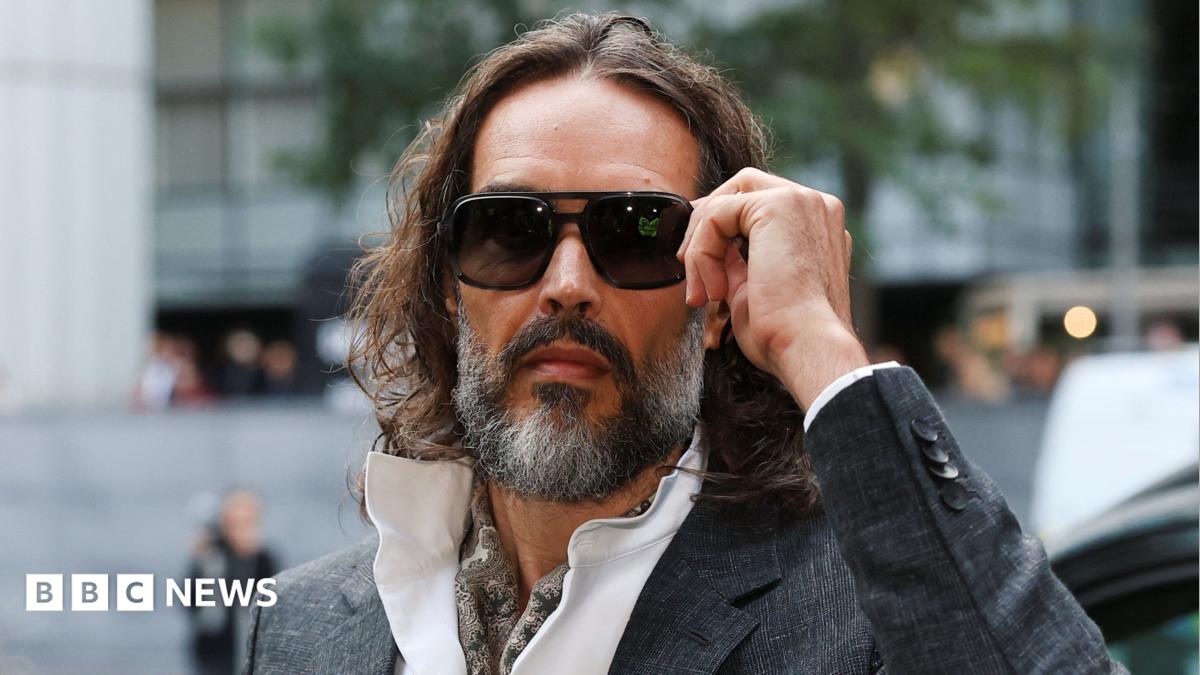
Russell Brand thinks about going to prison ‘every day’ ahead of rape trial as he denies being a ‘grifter’

RUSSELL Brand has confessed he thinks about going to prison “every day” ahead of his rape trial and denies being a “grifter”.

The comedian and actor, 50, who now hosts a podcast is facing trial on three counts of rape, three of sexual assault and one of indecent assault against six women from 1999 to 2009.

Russell Brand, right, admits he thinks about going to prison as he faces a trial in October Credit: Piers Morgan Uncensored/YouTube
The comedian and actor denies all the charges Credit: Piers Morgan Uncensored/YouTube
Brand denied being a ‘grifter’ when he appeared on Piers Morgan Uncensored Credit: Piers Morgan Uncensored/YouTube

He denies all the charges against him.

The star, who wore a crucifix around his neck, talked at length with Piers Morgan on his YouTube show Uncensored.

Asked if he thought about the reality of going to jail if he was found guilty, Brand said: “Yes… all the time, every day.”

He added: “I will be with God wherever I am. And of course, I would prefer to be with God with my wife and my kids… I’m not saying that that’s not a difficult image, you know, and a difficult thing to contemplate, of course it is.”

RING IT ON

Harry Styles and Zoe Kravitz ‘are engaged’ after eight-month romance


Snub rumours

Paris Fury reveals the REAL reason Molly-Mae wasn’t at Venezuela’s hen do

Brand, who brought a Bible with him, continued: “We are going to find out the truth, and we’re going to deal with the truth.

“Because actually, I am not afraid of the truth and if the truth is I am going to prison, then I am. My job will be, do not be afraid of that truth, that is what you are going to do.”

The one-time Hollywood star claimed he would face being behind bars “with God” if he was found guilty of the charges against him.

He also strenuously defended his innocence.

Morgan put it to him that there were people who considered him “basically just a massive grifter”.

Brand immediately shot back: “No, that’s what they say about you.”

Morgan added: “You’re very eloquent, you can be very persuasive with the power of your words, but that actually when it comes to any of these issues, you don’t really have a personal principle.”

Brand said: “I do, I do.”

In an earlier interview for The Megyn Kelly Show podcast admitted he had sex with a 16-year-old when he was 30.

He said his relationships at the time were “exploitative” – but stressed his sex with the girl was legal.

Brand said: “In Europe and in the United Kingdom where I’m from, the age of consent is 16. And I did sleep with a 16-year-old when I was 30.

“But when I was 30, I was a very different person. I was a lot younger and I was an immature 30-year-old.”

Brand told host Megyn Kelly his relationships in the past were “selfish”.

He continued: “I did not apply enough consideration barely any I suppose really to how that sex was affecting other people.”

At the height of his fame, the actor starred in a number of Hollywood films, including Forgetting Sarah Marshall and Get Him to the Greek.

His trial at Southwark Crown Court is due to start on October 12.

Brand admits he slept with a 16-year-old when he was 30 Credit: YOUTUBE
His trial is set to start on October 12 Credit: Reuters

Source link

Civil case against Alec Baldwin, ‘Rust’ movie producers advances toward a trial

Nearly two years after actor Alec Baldwin was cleared of criminal charges in the “Rust” movie shooting death, a long simmering civil negligence case is inching toward a trial this fall.

On Friday, a Los Angeles Superior Court judge denied a summary judgment motion requested by the film producers Rust Movie Productions LLC, as well as actor-producer Baldwin and his firm El Dorado Pictures to dismiss the case.

During a hearing, Superior Court Judge Maurice Leiter set an Oct. 12 trial date.

The negligence suit was brought more than four years ago by Serge Svetnoy, who served as the chief lighting technician on the problem-plagued western film. Svetnoy was close friends with cinematographer Halyna Hutchins and held her in his arms as she lay dying on the floor of the New Mexico movie set. Baldwin’s firearm had discharged, launching a .45 caliber bullet, which struck and killed her.

An aerial shot of an old, wooden church building surrounded by people, equipment and trucks

The Bonanza Creek Ranch in Santa Fe, N.M. in 2021.

(Jae C. Hong / Associated Press)

Svetnoy was the first crew member of the ill-fated western to bring a lawsuit against the producers, alleging they were negligent in Hutchins’ October 2021 death. He maintains he has suffered trauma in the years since. In addition to negligence, his lawsuit also accuses the producers of intentional infliction of emotional distress.

Prosecutors dropped criminal charges against Baldwin, who has long maintained he was not responsible for Hutchins’ death.

“We are pleased with the Court’s decision denying the motions for summary judgment filed by Rust Movie Productions and Mr. Baldwin,” lawyers Gary Dordick and John Upton, who represent Svetnoy, said in a statement following the hearing. “He looks forward to finally having his day in court on this long-pending matter.”

The judge denied the defendants’ request to dismiss the negligence, emotional distress and punitive damages claims. One count directed at Baldwin, alleging assault, was dropped.

Svetnoy has said the bullet whizzed past his head and “narrowly missed him,” according to the gaffer’s suit.

Attorneys representing Baldwin and the producers were not immediately available for comment.

Svetnoy and Hutchins had been friends for more than five years and worked together on nine film productions. Both were immigrants from Ukraine, and they spent holidays together with their families.

On Oct. 21, 2021, he was helping prepare for an afternoon of filming in a wooden church on Bonanza Creek Ranch. Hutchins was conversing with Baldwin to set up a camera angle that Hutchins wanted to depict: a close-up image of the barrel of Baldwin’s revolver.

The day had been chaotic because Hutchins’ union camera crew had walked off the set to protest the lack of nearby housing and previous alleged safety violations with the firearms on the set.

Instead of postponing filming to resolve the labor dispute, producers pushed forward, crew members alleged.

New Mexico prosecutors prevailed in a criminal case against the armorer, Hannah Gutierrez, in March 2024. She served more than a year in a state women’s prison for her involuntary manslaughter conviction before being released last year.

Baldwin faced a similar charge, but the case against him unraveled spectacularly.

On the second day of his July 2024 trial, his criminal defense attorneys — Luke Nikas and Alex Spiro — presented evidence that prosecutors and sheriff’s deputies withheld evidence that may have helped his defense . The judge was furious, setting Baldwin free.

Variety first reported on Friday’s court action.

Source link

Stomach churning moment Craig Charles vomits in cruel I’m A Celeb trial

Corrie star Craig Charles took on the Retching Ball challenge with fellow campmate David Haye in a bid to earn food for camp in the latest bushtucker trial

The latest bushtucker trial left I’m A Celeb star Craig Charles throwing up a mouthful of maggots.

The 61-year-old Corrie star took on the Retching Ball challenge with fellow campmate David Haye in a bid to earn food for camp. The duo were strapped into a revolving ball while having to answer questions directed at them by Ant and Dec.

But of course in true I’m A Celeb style they were not alone in the ball cage, as creepy crawlies were dumped on them to add to their distress. Following a dumping of maggots on the duo, David Haye cried out ‘I’ve got maggots in my mouth’ and it wasn’t long before co-star Craig began throwing up.

READ MORE: Mum fumes as family banned from Parkdean resort after “inappropriate behaviour”READ MORE: Police update on teens arrested in connection with 73-year-old’s death as family pay tribute

David and Craig carried on for another round but the momentum seemed to catch up with Craig. As he threw up Ant quipped “Oh I think we’ve had a vomit. Now Craig you’ve just worked out why it’s called the wretching ball,” he added.

Despite his sickness, he kept going but he ended up being sick again in the final round where they were asked to name Adele songs. Craig looked delighted when time was up and he and David were removed from the retching ball to learn they had secured seven out of a possible 11 stars in total.

In a sneak peek at tomorrow evening’s episode Gemma Collins appears to quit again. She told the cameras: “I’m A Celebrity get me out of here. I am done.”

She looked to be in tears again as a stunned Scarlett watched on. It left fans pondering if she had actually walked again, or if it was another low moment for the reality TV star.

On X, formerly known as Twitter, one user said: “Hope Gemma doesn’t go from that clip! I need misery guts David gone before anyone else in camp!”

Like this story? For more of the latest showbiz news and gossip, follow Mirror Celebs on TikTok, Snapchat, Instagram, Twitter, Facebook, YouTube and Threads.


Source link