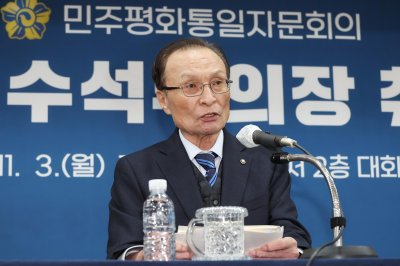

Former Prime Minister Lee Hae-chan, new senior vice chairman of the presidential Peaceful Unification Advisory Council, speaks dung a ceremony at the council’s secretariat in Seoul, South Korea, 03 November 2025, to mark his inauguration. The council advises the president on unification issues for policymaking purposes. Photo by YONHAP/EPA
Dec. 26 (Asia Today) — A South Korean public opinion survey released Friday found majority support for a concept described as a “peaceful two-state” approach aimed at long-term unification, with respondents saying tensions should be eased first to pursue peaceful coexistence.
The Democratic Peaceful Unification Advisory Council said its fourth-quarter national unification opinion survey found 55.5% agreed with the view that hostility between South and North Korea should be resolved first to achieve peaceful coexistence and pursue long-term unification. About 40.5% disagreed.
The survey also found 56.8% approved of the Lee Jae-myung administration’s North Korea policy direction, including goals described as a Korean Peninsula “free from war worries,” “a new era of peaceful coexistence” and “joint growth” between the two Koreas. About 35.1% disapproved.
On prospects for inter-Korean relations next year, 49.4% said they expected no change, 34.3% predicted improvement and 13.6% forecast deterioration.
Asked about the necessity of unification, 68% said it is necessary, down 0.6 percentage points from the previous quarter. The most-cited reasons were economic development, at 28.2%, and eliminating the threat of war, at 27.6%.
Views of North Korea were nearly split, with 44% seeing it as an object of vigilance and hostility and 42.7% seeing it as an object of cooperation and support.
The council said the survey was conducted over three days from Friday through Sunday among 1,000 adults ages 19 and older. It reported a 95% confidence level and a margin of error of plus or minus 3.1 percentage points, using proportional allocation by gender, age and region and a combined telephone interview method on landlines and mobile phones.
— Reported by Asia Today; translated by UPI
© Asia Today. Unauthorized reproduction or redistribution prohibited.