finds

Many Californians feared federal meddling in elections before Trump’s latest baseless attacks, poll finds

Even before President Trump’s latest wave of unfounded claims of election fraud in California, a significant share of voters in the state expressed concerns about federal interference in the electoral process, according to a new poll.

Trump on Monday claimed on his social media site that the race for Los Angeles mayor was a “Rigged Election,” an allegation that came after Democrat Nithya Raman overtook Republican Spencer Pratt for second place in the ongoing primary election vote count.

Raman’s lead had prompted Rep. Abe Hamadeh, an Arizona Republican, to call for the election to be federalized, or run by the federal government rather than the state, a message Trump reposted.

Earlier Sunday, Trump had alleged during an interview with NBC News that California elections officials “were cheating.” That came after a debunked social media conspiracy theory claiming that a lag in an update of electronic voting data by the Associated Press showed Pratt was being cheated. On Monday, House Speaker Mike Johnson said the elections process in the L.A. mayoral race “stinks to high heaven.”

The ongoing attacks by Trump and his supporters continue to erode confidence in the nation’s elections, especially among Republicans, threatening a pillar of American democracy, said political scientist Eric Schickler, co-director of the Institute of Governmental Studies at UC Berkeley.

“The president … wants to use those claims to make changes in the election process that could make it harder for people to vote, and that certainly is a threat to our democratic institutions,” Schickler said.

“One thing we’ve learned in recent years is that we just cannot take the voting process for granted, cannot take for granted that both sides will accept as legitimate the outcome, and can’t take for granted the idea that there won’t be efforts to essentially manipulate the vote counting process,” he added.

A new poll released Friday by the institute found that 41% of California voters were “not confident” that this year’s elections would be free of federal interference. Although 48% had confidence that there would be not meddling, the concerns expressed were still significant, Schickler said.

More telling was the partisan divide among voters when asked whether they have confidence that local officials would conduct fair and secure elections and that the vote count would be accurate. Among Democratic registered voters, 79% said they trusted elections officials to provide an accurate vote count. Among Republicans, 55% said they were not confident that would occur.

California voters who don’t belong to either party said by a 2-1 margin that they had confidence in the vote count, the poll showed.

“The positive is that local officials are still widely trusted by Democrats, no-party-preference voters, and at least a share of Republicans, though a lot fewer than I think in the past, and a lot fewer than you know we would want for a really healthy democracy,” Schickler said.

That growing mistrust among certain parts of the electorate comes after years of baseless claims by Trump that the 2020 election was stolen from him, as well as Republican-led efforts to restrict the use of mail-in ballots and impose new requirements for voters to show identification and proof of citizenship.

Recent rulings by the conservative-leaning Supreme Court also have rolled back federal protections under the Voting Rights Act. In April, the court sharply limited a part of those protections that had forced states to draw voting districts to help elect Black or Latino representatives to Congress, as well as state and local boards.

Trump and his allies have used California’s slow vote-counting process to allege cheating. The day after the June 2 primary, Trump claimed without evidence that Democrats were trying to “steal” the gubernatorial and L.A. mayoral primaries. The next day, he alleged that California Democrats had “found” mail-in ballots and were “rigging the election” with them.

Secretary of State Shirley Weber and other officials have said California’s voting system prioritizes voter accessibility and security over speedy results. The state has more than 23 million registered voters, and ballots go through numerous verification steps, including verifying signatures on mail-in ballots.

“Over 97% of our folks actually vote by mail. They want to keep that system. That system demands more contact, more touching of the ballot, more verification of the individuals who are voting. All of those things take time,” Weber said during a recent interview with ABC10 in Sacramento.

Gov. Gavin Newsom’s office called Trump’s claims during the recent “Meet the Press” interview the “most severe case of California Derangement Syndrome we’ve ever seen.”

Newsom is considering a 2028 run for president and has consistently warned that Trump may try to interfere in both the 2026 and 2028 elections.

The Berkeley poll found that California voters overall — 74% — want candidates running for president in 2028 to prioritize defending democracy and making voting more accessible. Among Democratic voters, 95% said that was important; among Republicans, 41%.

Funding for the poll was provided to IGS by the Evelyn and Walter Haas, Jr. Fund, a private foundation based in San Francisco that aims to increase civic participation and improve the state’s democratic processes.

The poll of 8,578 registered California voters was conducted between May 19 and 25 online in English and Spanish and has a margin of error of about 2 percentage points in either direction.

Times staff writers Alene Tchekmedyian and Kevin Rector contributed to this report.

Source link

Fewer Americans say democracy is central to country’s identity, AP-NORC poll finds

As the U.S. prepares for an extravagant celebration of its founding principles, fewer Americans see their country as exceptional, a new poll finds.

The survey from The Associated Press-NORC Center for Public Affairs Research highlights many Americans’ feeling of unease over the future of its representative government — particularly among young people. It presents a jarring contrast as communities around the country commemorate the nation’s 250th anniversary.

Only about one-quarter of Americans say the U.S. stands above all other countries in the world, the new poll found, while 44% say it’s one of the greatest countries in the world, along with some others. About 3 in 10 say there are better countries than the U.S., an increase from 19% in an AP-NORC poll conducted in June 2016.

Americans remain divided about whether diversity is an essential feature of the U.S.’s identity, and agreement about other aspects of the country’s underlying character appears to be eroding, the survey found. Americans are less likely to see a democratically elected government as “extremely” or “very” important to the United States’ identity as a nation than they were just a few years ago. About two-thirds of U.S. adults now say a democratically elected government is highly important to the U.S.’s identity as a nation, down from 80% in 2021.

“It’s not that the democracy part is not working,” said Derricka Wall, 24, of Chickasaw, Alabama. “It’s the people that are actually being put in office that is the problem.”

Wall believes politicians have damaged America’s governing system, which was designed to ensure representation and guard against government misuse.

America, she said, “is not what it used to be. I feel like our founding fathers would be kind of disappointed with how it is now.”

Rising belief that democracy is not essential to American identity

Young adults are much less likely than older Americans to believe the U.S. is special, compared with other nations, the poll found.

About 4 in 10, 44%, of U.S. adults under 30 say there are other countries better than the U.S., compared with 22% of U.S. adults ages 60 and older.

Fewer, too, see democracy as a key element of the U.S.’s identity. Only about half of Americans under 30 believe this, compared with 81% of those 60 and older.

Wall said the people who established the government with co-equal branches thought they were erecting safeguards to keep any one person or group from attaining too much power. But she believes they didn’t foresee how easily those guardrails would crumble if the people in the system stopped enforcing them.

“I feel like they would actually roll out of their graves,” she said. “I feel they would be very disappointed in us.”

The belief that politics isn’t working for everyday people extends beyond the youngest generations. Kent Stage, 62 and a retired senior enlisted man in the Army, is a registered Republican in Indiana. He does not think the current political system addresses the country’s problems. He’d like to see term limits on politicians and more working-class people serving.

“I’ll trust the ambulance-chasing lawyer and a shady used car salesman before I trust the politician,” he said.

Stage, who is also a former Marine, believes public servants make self-serving choices for their families “while mine and yours still got to hit the old grindstone.”

Many feel it’s harder to get ahead in the U.S.

The survey also finds widespread cynicism about America as the land of opportunity. About half of U.S. adults, 51%, say the American Dream — the idea that if you work hard, you’ll get ahead — once held true but does not anymore. About one-third say it “still holds true” while 15% say it never held true.

Jack Hermanson, a 27-year-old software developer in Denver, said his belief in the American Dream changed when he saw his engineer husband struggle to find a job. “That really shattered my impression that if you work hard, you get what you deserve,” Hermanson said.

Only 22% of Americans under 30 say the American Dream still holds true, compared with 46% of Americans ages 60 and older.

Angela Toombs, 31, works at a senior living facility in Atlanta where her clients talk about how easy it was to buy a house while working their first regular jobs in their 20s and are incredulous about the obstacles facing Toombs’ generation. Toombs recently gave up her own apartment to rent a room in order to save money.

Skepticism about the American Dream is more widespread among Democrats and independents, compared with Republicans. Most Republicans, 57%, say the American Dream still holds true, compared with about one-quarter of independents and 17% of Democrats.

Republicans are also much likelier than Democrats to see the U.S. as exceptional. About half of Republicans say the U.S. stands above all other countries in the world, compared with only 7% of Democrats.

Quintin Sharpe, 28, lives in a resort town on Lake Geneva in Wisconsin. A financial planner who is Republican, he said the American Dream remains accessible and he is proud of the country. “It’s been a great experiment.”

“The opportunity is there for those who want to work for it,” he said. Sharpe believes the country is “a meritocracy, and the best ideas, the best work ethic, those with the best succeed regardless of race, skin color, any of those factors.”

He and his wife will celebrate the country’s 250th anniversary watching the fireworks over the lake.

Divides on whether diversity is essential to U.S.

Just over half of U.S. adults — 56% — say a shared American culture and set of values are “extremely” or “very” important to the country’s identity, down from 65% in 2017. Younger Americans are less likely than older ones to say a singular set of values is important to U.S. identity.

But Americans remain sharply divided on the centrality of welcoming diverse perspectives: About half of adults, 51%, say the ability of people to come from other places in the world to escape violence or find economic opportunities is “extremely” or “very” important to American identity, while 55% say this about the mixing of cultures and values from around the world.

Only about 4 in 10 Republicans see the mixing of cultures and values from around the world as central to the country’s identity, compared with 76% of Democrats.

Rose Nunez, 70, of San Antonio, was a small business owner but now is a caregiver for family members. Nunez, who tends to vote for Democrats, said there is an unease and tension that are just beneath the surface, especially focused on Hispanics. She said some people have started carrying their papers showing their immigration status in case they are challenged.

“It is hard to celebrate when the feelings towards immigrants and communities of color are so strong,” she said of the upcoming America 250 celebrations.

She said even citizens are questioned now. If it gets to a point where being naturalized is challenged, “guess what, my mom would be leaving. She’s been living in this country since she was maybe four years old. She’s 93.”

Fields, Sanders and Riccardi write for the Associated Press. The AP-NORC poll of 2,596 adults was conducted April 16-20 using a sample drawn from NORC’s probability-based AmeriSpeak Panel, which is designed to be representative of the U.S. population. The margin of sampling error for adults overall is plus or minus 2.6 percentage points.

Source link

Democratic voters confident California election is secure, Republicans less so, poll finds

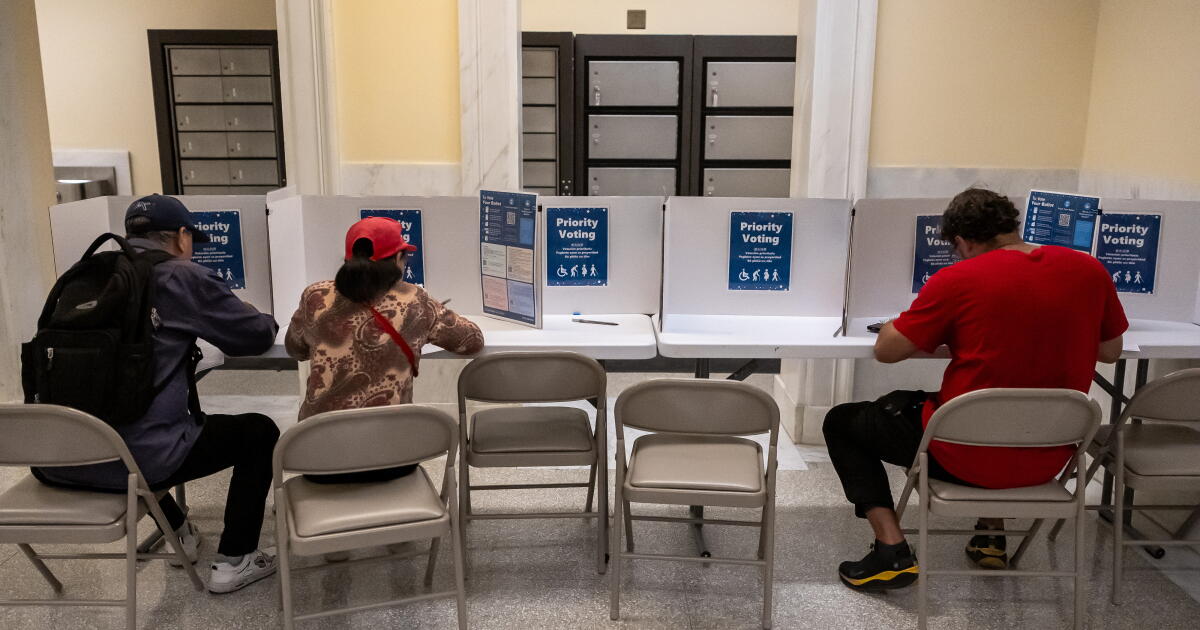
California voters are deeply divided over the trustworthiness of state elections heading into Tuesday’s primary, with most Democrats but less than half of Republicans expressing confidence in the electoral process, according to a new poll.

The polarized view follows a years-long campaign by President Trump and his Republican allies to question the legitimacy of American elections, especially in California and other blue states. It also follows robust efforts from liberal leaders, elections officials and voting rights experts to denounce Trump’s claims as baseless.

Overall, registered voters in the state — which skews heavily Democratic — expressed confidence in local election officials by a 2-to-1 margin, with 65% expressing confidence and 31% expressing a lack of confidence, according to the poll released Tuesday by the UC Berkeley Institute of Governmental Studies and co-sponsored by The Times.

However, those figures shift dramatically when sorted by political party, and even more when parsed by partisan leaning.

For example, 79% of Democratic voters expressed confidence in local officials running a secure and fair election, compared to 62% of independent voters and 42% of Republican voters, the poll found.

While 82% of voters who identified as strongly liberal expressed confidence, just 38% of voters who identified as strongly conservative did so.

A volunteer assists a voter at a polling site.

A volunteer assists Melani Hurwitz at a polling location Monday at the Cal State Long Beach Walter Pyramid.

(Eric Thayer / Los Angeles Times)

“It’s clearly a partisan issue, and it is being promoted by the president and others who are his followers,” said Mark DiCamillo, the director of Berkeley IGS polls. “Strong conservatives and the Republicans are the least confident, and a lot of them are saying [they are] not at all confident. That’s a pretty extreme statement.”

Rick Hasen, an election law expert and director of the Safeguarding Democracy Project at UCLA Law, said he expected Republican confidence to be even lower given Trump’s decade of undermining trust in elections, especially in liberal, diverse states such as California. But he said neither Trump’s narrative nor public sentiment about election security — which generally shows voters are more confident “when their side wins” — reflects reality, which is that “our elections are administered well.”

“There’s very little evidence of manipulation or of fraud or even of incompetence,” Hasen said. “Anyone who looks objectively would see that there are numerous safeguards to ensure we have free and fair elections in California.”

Trump has long contended without evidence that voter fraud is pervasive among undocumented immigrants and in states, such as California, that use mail ballots, and blamed his 2020 loss to Joe Biden on such fraud despite experts rejecting the claim and Trump’s own allies and lawyers being unable to prove it.

A voter's feet in a poll booth.

A voter casts their vote inside the Westchester Family YMCA Annex on Monday.

(Kayla Bartkowski / Los Angeles Times)

Since returning to the White House last year, Trump has tried to implement strict new requirements for voter ID and proof of citizenship and to limit or bar mail-in voting, and called for greater federal or Republican Party control over state-run elections. In February, he said that “Republicans ought to nationalize the voting” in “at least 15 places” where they lose.

On Saturday, Trump falsely claimed that California doesn’t have any voting booths and only accepts mail ballots.

Democratic leaders, elections experts and voting rights advocates have all pushed back. They’ve backed their assurances that the state’s elections are safe with lawsuits to block Trump’s efforts to assert federal control. They also warn that his administration may try to intervene anyway, including by sending federal immigration agents to polling locations or intercepting or invalidating mailed ballots.

When Trump issued an executive order in March 2025 purporting to require voters to provide proof of citizenship, California sued, with a court blocking the policy while the litigation continues. When the Justice Department sued California Secretary of State Shirley Weber in September for refusing to hand over the state’s voter rolls, California won a dismissal in court. When Trump issued another executive order this March directing the U.S. Postal Service to take control of mail balloting, California sued again. That litigation is ongoing.

Last week Gov. Gavin Newsom signed a bill barring federal agents and other law enforcement from interfering with local and state elections officials or confiscating ballots, voter rolls or voting machines without a warrant. Newsom said California voters were experiencing “legitimate anxiety” over election integrity given the threats from the Trump administration and the recent actions of Riverside County Sheriff Chad Bianco — a MAGA-backed Republican candidate for governor who recently seized hundreds of thousands of ballots as part of what he said was an investigation into potential fraud in last year’s election.

An election worker carries a bin of ballots.

An election worker collects extracted vote by mail ballots to be tallied at the Los Angeles County Registrar-Recorder/County Clerk Ballot Processing Center in City of Industry.

(Gary Coronado / For The Times)

Newsom said he expects Trump to interfere with the upcoming election as well because “every single thing that Donald Trump is saying only suggests that he will do more, not less, to intimidate and to impact the outcome of this election,” but that the state stands ready to respond.

California Atty. Gen. Rob Bonta last week said that his office is preparing for “all different types of scenarios” involving federal interference, from ballots being seized to immigration agents showing up at polling locations.

“We are currently monitoring any potential risks or threats, and we’re ready for any possibility,” he said.

Sen. Alex Padilla (D-Calif.) last week blasted the U.S. Postal Service for issuing a proposed rule to implement Trump’s mail ballot changes, despite the ongoing litigation. In April, Rep. Nancy Pelosi (D-San Francisco) helped convene a pair of “shadow hearings” in California where fellow House Democrats and a panel of experts shot down Trump’s claims about widespread fraud and expressed confidence in state elections.

A Berkeley IGS Poll from a year ago found that California voters support requiring first-time voters to show ID to prove citizenship in order to register, and that most supported requiring a government ID every time a voter casts a ballot. However, another Berkeley IGS Poll from last month found that strong majorities of California voters believe American democracy is under attack or being “tested.”

Dean Logan, head of the L.A. County registrar-recorder/county clerk’s office, said that overall confidence, “despite a sometimes volatile state and national narrative,” was “gratifying.”

“Election officials take connection to their community seriously. We recognize that our job is to facilitate their voting experience, and that voter participation is key to election security,” Logan said. “Regardless of party affiliation, our role as election officials focuses on the function and process of ensuring the voice of the electorate is heard and that compliance with the election laws adopted in our state is achieved.”

Jesse Salinas, president of the California Assn. of Clerks and Elections Officials and the registrar of voters in Yolo County, said local elections officials are “proud to be a steady source of trust at a consequential moment,” and stand ready to “open our doors to any voter who wants to see firsthand how our elections work and to answer any questions they may have.”

Times staff writer Iris Kwok contributed to this report.

Source link

ICE detainees are dying by suicide at an ‘alarming’ rate, an AP investigation finds

Brayan Rayo Garzon was distraught. Detained by Immigration and Customs Enforcement, he was on his fourth day of isolation in a Missouri jail as he battled the fevers and chills of COVID-19.

His request for mental health treatment had been put off, records show, and staff had forbidden Rayo from making his nightly call to his mother as a precaution intended to prevent the spread of illness.

He pleaded with his jailers in handwritten notes to arrange a conversation with her. “I feel in my heart that she’s very worried about me,” he wrote in Spanish.

A guard collected the note and walked away. Within an hour, jail records show, he was found unconscious in his cell. An autopsy determined he killed himself.

Rayo’s April 2025 death was the first suicide in a spike among ICE detainees that has alarmed public health officials and jail experts. They said the unprecedented number of suicide deaths is an indication that authorities are failing to properly oversee the detention of tens of thousands of immigrants swept up in the Trump administration’s aggressive deportation strategy.

An Associated Press investigation found that at least 10 detainees, all men, have died by suicide since President Trump took office in January 2025, a pace that far exceeds the growth in the detainee population, according to a review of ICE data, autopsy reports, coroners’ rulings and police records. Since October, seven deaths have been classified as suicides, a number that is already the most for any fiscal year in the agency’s history. ICE has usually recorded one or no such deaths annually.

“Something is going profoundly wrong from any kind of public health or mental health perspective,” said Dr. Sanjay Basu, a University of California-San Francisco epidemiologist who cowrote a study documenting the increase in mortality and suicide rates among ICE detainees. “This is one of those alarming, sudden increases.”

Nine of the deaths were of Hispanic men who had arrived in the U.S. from four countries, the AP found. One man was a Chinese citizen. Their average age was 32. While Trump has characterized those facing deportation as the “worst of the worst,” seven of the 10 had no record of violent crimes in the U.S.

The suicides account for nearly a fifth of the 51 deaths in ICE custody since January 2025. The majority of those deaths were from natural causes and experts say many of them would have been preventable with timely medical care.

Department of Homeland Security acting assistant secretary Lauren Bis said suicide deaths in ICE custody remain “extremely rare.”

Bis said detention staff follow protocols to protect detainees who show signs of self-harming and that ICE requires annual suicide prevention training. She said detainees receive comprehensive healthcare, including mental health services.

Reacting to AP’s investigation, Colombian President Gustavo Petro wrote Wednesday in a post on X that the country’s foreign ministry should issue a formal protest regarding Rayo’s death and that the U.S. government should “reflect on how its immigration policy is killing Americans and Latin Americans.”

Investigation finds violations of ICE detention standards

The reasons behind any suicide are complex, and each death often has multiple contributing factors, according to experts. ICE detainees report intense stress after being detained, fear of being returned to countries where their safety may be jeopardized, and frustration and loneliness over the inability to communicate due to language barriers.

Detainees can also feel helplessness because of the complexity surrounding immigration law. Unlike those in the criminal justice system, most detainees do not have lawyers and their detention on immigration violations is not meant to be punitive.

ICE becomes responsible for their well-being when they enter detention, and experts say well-run lockups should have few, if any, suicides. That’s because staff can take steps to mitigate the chances that detainees harm themselves by identifying those at risk, getting them care and monitoring them closely, the experts said.

AP’s investigation found that ICE detention centers have repeatedly fallen short in ways that violate ICE’s own standards.

An examination of the 10 suicide deaths found the men died across ICE’s detention network, including at centers long run by private contractors and county jails that recently became ICE partners. The AP found that staff in the facilities ignored signs of distress, delayed mental health treatment and failed to monitor detainees who were already deemed at risk. They also permitted detainees to have access to materials that could be used for self-harm, according to AP’s review of ICE inspection reports and death records.

In some cases, they jailed distressed detainees in isolation, which can exacerbate feelings of humiliation and helplessness, according to experts.

ICE has repeatedly asserted that it screens detainees within 12 hours of arrival for medical, dental and mental health conditions.

At least three of the nine facilities where ICE detainees died by suicide have struggled to meet that standard, according to ICE inspection reports and jail records.

Dr. Homer Venters, former chief medical officer of New York City jails who previously consulted with ICE on preventing detainee deaths, called the rise in suicides terrifying.

The increase “reflects failures in how the system’s being operated, and particularly failures in how the first stages of coming into detention are happening so that people aren’t being assessed adequately,” Venters said. “And then if that receiving screening picks up red flags, they’re not acted on in a way that reduces the risk of them having preventable death.”

From border crossing to detention

Among those who took their own lives was a 19-year-old from Mexico who had been detained following a misdemeanor traffic stop while riding his scooter.

Another was a 36-year-old restaurant worker who lost contact with his relatives in Nicaragua after ICE detained him in Minnesota and sent him to a crowded camp in Texas. A third was a 45-year-old who had repeatedly crossed the U.S.-Mexico border illegally and had a long criminal record.

Rayo, who took his own life after pleading to talk to his mother, was a veteran of the Colombian military who had worked as a street vendor in his home country. A week after he turned 26 in 2023, his family crossed the U.S. border in California. He was detained for three months before being permitted to settle with family in St. Louis, records and interviews show.

His mother, Adriana Garzon, said Rayo caught on quickly to life in the U.S., making friends easily and working as a housepainter and food delivery driver. He wanted to save money to hire a lawyer to help him stay in the country after a judge in 2024 ordered that he be sent back to Colombia, she said.

He was arrested in March 2025 by St. Louis police after being caught using a stolen credit card, which he had obtained from a friend, at a vape shop, court records show. ICE then took him into custody. An ICE record obtained by AP classified Rayo as a laborer who was a low risk to public safety.

ICE placed Rayo in the Phelps County jail in Rolla, Mo., about 100 miles from St. Louis.

Suicides reveal shortcomings across ICE’s detention network

The deaths have revealed holes in treatment and oversight across ICE’s system, where the detained population has spiked by 50% to 60,000 during Trump’s second term.

Five died in centers run by longtime ICE detention partners CoreCivic and the GEO Group. A sixth died at a camp operated by an inexperienced contractor that ICE has since replaced. Three died in jails run by sheriffs, and one at a federal prison.

“We are deeply saddened by and take very seriously the passing of any individual in our care,” CoreCivic spokesperson Brian Todd said.

GEO Group spokesperson Christopher Ferreira said the company trains staff on suicide prevention and seeks “to maintain a safe and secure environment in compliance with the standards and requirements set by the federal government.” Officials at the three jails either declined comment or didn’t return messages.

Leo Cruz Silva, a 34-year-old who had repeatedly illegally entered the country from Mexico, suffered an acute mental health crisis following his detention after an arrest for public intoxication last fall in a St. Louis suburb, records show.

For two nights in Missouri’s Ste. Genevieve County Jail, Cruz screamed, hid under his bed and reported hallucinations, according to an ICE report on his death. Yet he did not get help quickly.

A nurse ordered antipsychotic medications and planned to get him treatment the next week, the ICE report said.

On the third day, he was found dead in his cell.

Chaofeng Ge arrived in ICE custody last summer at a Pennsylvania facility run by the GEO Group in mental distress, having pleaded guilty to a minor gift card fraud and attempted suicide in state custody, said David Rankin, an attorney representing Ge’s family.

In five days at the facility, he did not get mental health treatment and was unable to communicate because no one spoke Mandarin, Rankin said. Ultimately, Ge went unmonitored before he was found hanged in a shower stall.

“It’s clear that ICE has taken very few steps to ensure the safety of these people,” Rankin said. “They appear to want to make this process as cruel and inhuman as possible. It’s completely unacceptable.”

At Camp East Montana in El Paso, Texas, 36-year-old Victor Diaz died by suicide in a medical holding room in January, according to an ICE report. He had been moved into isolation after reporting harassment by fellow detainees, the report said.

Days earlier at the same facility, Geraldo Lunas Campos died of asphyxia after ICE said guards restrained him following a suicide attempt. His death was ruled a homicide by a medical examiner and Trump administration officials said the FBI was investigating its circumstances.

ICE inspectors visited the facility in February, documenting 49 violations of detention standards at what was then ICE’s largest detention facility, according to their report.

The report found that staff did not record “required checks to prevent significant self-harm and suicide” while inspectors found tools and equipment unsecured and unaccounted for throughout the facility that could be used for harm. Calls to 911 show several other detainees had attempted suicide there.

At the time of the deaths and inspections, Acquisition Logistics was the contractor running the facility. ICE has since replaced Acquisition Logistics with another contractor. Acquisition Logistics did not return messages seeking comment.

Detainee spent final days sick and isolated

The Phelps County Jail had started taking ICE detainees a month before Rayo’s arrival. Sheriff Michael Kirn, a Republican in a county where voters overwhelmingly supported Trump’s reelection, told commissioners his department’s budget was hurting and partnering with ICE could generate millions in revenue.

Records show Rayo’s trouble started immediately. It took the jail 35 hours to conduct the initial medical screening ICE promises within 12 hours, according to jail records obtained by the AP under the open records law.

Rayo exhibited labored breathing and told a nurse he was anxious and wanted mental health treatment.

A nurse who didn’t speak Spanish used a “handheld translator” to assess Rayo, concluding he denied thoughts of suicide and depression, according to the documents compiled by the Missouri State Highway Patrol during an investigation into Rayo’s death.

She recommended him for the general population, listing his physical and mental condition as stable, records show. And she referred him for a routine mental health appointment.

Two days later, he reported head pain and body aches. Staff learned he was positive for exposure to tuberculosis bacteria. He was sent to a hospital, where he was diagnosed with COVID-19. He was returned to jail the following day.

The mental health appointment was scheduled but canceled due to “mental health clinic time and staff,” a jail record shows. Two days later, they again canceled his appointment, this time citing his coronavirus infection.

The delays violated an ICE standard requiring mental health treatment within a week of a referral.

Bis, the DHS spokesperson, said Rayo received “high-quality medical care during his time in ICE custody.”

To ease his anxiety, Rayo called his mother before bed to share a Catholic blessing. “I gave him strength,” said Garzon, whose first name, Adriana, was tattooed on her son’s arm.

As Rayo grew sicker with nausea, chills and aches, staff moved him into a cinderblock isolation cell with a surveillance camera overhead for closer monitoring and to prevent the spread of disease. He was not allowed to call his mother.

On his fourth day of isolation, Rayo passed two notes under his door, begging guards to let him talk to his mom. In one, which was reviewed by AP, he appealed to the guard’s humanity. “I know you have family, and you know that they worry about us,” he wrote in Spanish. “God bless you.”

The English-speaking guard used a colleague’s phone to translate the notes and wrote in a report that he planned to follow up.

Within an hour, guards found Rayo unconscious on his bed with a sheet around his neck.

Emergency responders tried to revive him, transporting him to a hospital. That’s when an official called Rayo’s mother — to let her know her son was in very bad shape and would be flown to a St. Louis medical center. At the hospital, a doctor gave her the devastating news: Her son was dead.

Foley, Biesecker and Lee write for the Associated Press.

Source link

Most young South Koreans distrust election polls, survey finds

1 of 2 | Employees of the National Election Commission take part in a campaign in Ilsan, just outside of Seoul, South Korea, 26 April 2026, to encourage voter participation in the June 3 general election. Photo by YONHAP / EPA

May 19 (Asia Today) — More than 60% of young South Koreans and college students do not trust elections or political opinion polls, according to a survey released ahead of the June 3 local elections.

The Korean Law Consumers Federation, a legal advocacy group, released the results Monday after surveying 1,201 young people and college students from 119 universities nationwide. The respondents had an average age of 23.4.

The survey found that 60.37% of respondents said they do not trust elections or political opinion polls, while 38.80% said they do.

Despite the distrust, 59.95% said they would definitely vote in the local elections, and 35.89% said they would try to vote.

Asked whether one vote can have an important effect on election results, 75.27% agreed, while 24.56% disagreed.

On early voting, 53.54% said there is a possibility of election fraud, while 40.30% said such claims are completely false.

The survey also asked about possible constitutional revisions. A total of 62.28% supported including language related to the May 18 Gwangju Democratization Movement in the Constitution, while 35.97% opposed the idea.

However, 91.01% opposed removing the word “freedom” from the Constitution.

The survey included 53 questions and was conducted with the help of student volunteers. It had a margin of error of plus or minus 2.83 percentage points at a 95% confidence level.

— Reported by Asia Today; translated by UPI

© Asia Today. Unauthorized reproduction or redistribution prohibited.

Original Korean report: https://www.asiatoday.co.kr/kn/view.php?key=20260519010005434

Source link

Probe finds signs of martial law planning in 2024

Kim Ji-mi, an aide to special counsel Kwon Chang-young, attends a press conference at the counsel team’s office in Gwacheon, south of Seoul, South Korea, 04 May 2026. The special counsel team announced that it has found signs a military unit was making preparations for martial law operations in the first half of 2024, well before former President Yoon Suk Yeol’s declaration in December of that year. Photo by YONHAP / EPA

May 4 (Asia Today) — A special counsel team said Monday it has identified signs that South Korea’s military counterintelligence unit may have begun preparing for a declaration of martial law as early as the first half of 2024.

Kim Ji-mi, a deputy special counsel, said during a regular briefing that investigators confirmed indications of early preparations through questioning of officials from the Defense Counterintelligence Command.

She declined to elaborate on who led the preparations or whether specific plans were in place.

The findings differ from earlier conclusions by a separate special counsel team led by Cho Eun-seok, which had investigated allegations of insurrection and foreign conspiracy related to a Dec. 3 emergency martial law declaration. That team charged former President Yoon Suk Yeol as the alleged ringleader, citing a notebook belonging to former intelligence commander Noh Sang-won as evidence that planning began before October 2023.

However, a lower court rejected the evidentiary value of the notebook, ruling that any decision to impose martial law appeared to have been externally expressed no earlier than Dec. 1, 2024. The court said concrete steps toward implementation began only about two days before the declaration.

The court also found that meetings cited by prosecutors – including a presidential residence dinner in December 2023, a series of gatherings with senior military officials through August 2024 and other meetings in Seoul – could not be directly regarded as preparations for martial law.

Separately, the special counsel team said it would impose a one-month pay reduction on an investigator who posted investigation-related materials on social media. The investigator had uploaded photos including a certificate of appointment and a suspect’s signed statement, which have since been deleted.

The team said it questioned two suspects and 43 witnesses last week as part of the ongoing investigation.

— Reported by Asia Today; translated by UPI

© Asia Today. Unauthorized reproduction or redistribution prohibited.

Original Korean report: https://www.asiatoday.co.kr/kn/view.php?key=20260504010000426

Source link

Poll finds 61 percent of Americans believe attacking Iran was a mistake | US-Israel war on Iran News

Poll finds that Americans are concerned about impact of the war on the cost of living and sceptical of success thus far.

A new poll has found that a large majority of people in the United States believe that the decision to take military action against Iran was a mistake, as the war roils the global economy and fuels cost-of-living concerns in the US.

A Washington Post-ABC-Ipsos poll released on Friday shows that 61 percent of respondents believe the use of military force against Iran was a mistake, with just 36 percent saying it was the right decision.

Recommended Stories

list of 3 itemsend of list

The poll is the latest to find low levels of support for the war launched against Iran by the US and Israel in late February, which has killed thousands of people across the Middle East and sent global energy prices surging.

Asked if they had changed their behaviour due to higher gas prices, 44 percent of respondents said they had cut back on driving, and 42 percent said they had done the same for household expenses. Those figures increased to 56 percent and 59 percent for respondents making less than $50,000 per year.

Those concerns come at a time when President Donald Trump’s approval ratings have dropped to new lows, with voters expressing frustration over economic issues and the cost of living.

The war has also been depicted as a contrast with Trump’s promise to keep the country out of unnecessary foreign wars, and 46 percent of respondents said the decision to attack Iran was inconsistent with the position Trump took during his presidential campaign.

Despite relatively low casualty figures among US forces, the poll found that the war on Iran is as unpopular as the Iraq War was during a period of heightened violence in 2006 and the Vietnam War was in the early 1970s.

Asked whether US military actions against Iran have been successful thus far, 39 percent said they had been unsuccessful, while 19 percent said they had been successful. A plurality of 41 percent said it was too soon to tell.

Support for the war remains robust among members of Trump’s Republican Party, however. Nearly 80 percent of Republicans said that the decision to attack Iran was the correct one, even as they were split evenly between rating operations as successful or stating that it was too soon to tell.

Source link

L.A. ‘barn’ explodes with colorful thrifted finds and maximalist flair

“Gambrel roofed Barnhaus,” the listing read, “next door to the best burritos in town.”

Its photos revealed something unusual for Inglewood, which is famous for its mix of architectural styles, including Midcentury Modern homes by R.M. Schindler and Googie-style coffee shops: a brick-red barn-style house on a large corner lot, listed at $449,000.

When Meeshie Fahmy and her husband, Aaron Snyder, toured the house, they learned that the burrito claim was true. The photos, however, had clearly been touched up to make the house, located just a few miles from the Kia Forum and SoFi Stadium, look better than it actually was.

A blue barn-style house with a lush garden filled with flowers.

Outside, the former dirt lot is now a lush garden with towers of colorful black-eyed susans on arches, planters full of nasturtiums and vegetables, a firepit and pergola.

Inside, the house had “wall-to-wall carpets on both floors that were heavily stained and worn, dated wood paneling on the walls, holes in the walls,” Fahmy says.

Despite these flaws, the couple saw the home’s potential and decided to buy it, even though a leaning retaining wall nearly derailed their escrow. “It was a blank canvas for us to play and experiment,” she recalls a decade later.

  • Share via

After they moved in, neighbors revealed the house was not original to the site. Years earlier, the original Craftsman had been torn down; the current house, a sweepstakes prize, arrived in two pieces by crane. “Our neighbors recalled it was quite a sight,” Fahmy says.

At the time, Fahmy, 44, worked as an event planner at the Getty Museum. As renovations started and she followed her passion for interior design, Snyder proudly introduced her to staff at the local Carniceria as “an interior designer.” She replied, “That’s not what I do.”

“I told her, ‘If you don’t start saying it, it’s not going to happen,’” says Snyder, 49, who pursued his own dream of becoming a professional skateboarder before moving into video editing. “Speak it to existence.”

Finishing the house took years, patience and a lot of DIY projects because of their budget. But Fahmy didn’t just dream — she made it happen. In 2018, she started working for interior designer Willa Ford, who mentored her at WFord Interiors. By 2020, Fahmy launched her own design firm, Haus of Meeshie. “It’s been a progressive layering of colors, furniture, reupholstering, adding art, wallpaper, lighting,” she says. “Low and slow; the flavor is richer.”

Meeshie Fahmy and Aaron Snyder's family room, a colorful and over the top maximalist dream.

Meeshie Fahmy and Aaron Snyder’s family room is a colorful maximalist dream with thrifted furnishings, art and layered textures and patterns.

A trippy clock stands next to a large scale print
A living room with green walls, art and eclectic furnishings

Ninety percent of the furnishings are thrifted. “Nothing is too precious,” Fahmy says.

Today, their home reflects Fahmy’s fearless approach — it’s a true “petri dish for experimentation.” The vibrant, layered four-bedroom house is a maximalist fever dream, packed with furniture, accessories and art sourced from Facebook Marketplace, vintage shops, flea markets (Long Beach flea is a favorite), estate sales and secondhand stores in L.A. and elsewhere.

She estimates about 90% of the furnishings and accessories in her home are thrifted, antiques or things she found on the side of the road, and nothing is too precious, reaffirming her playful approach to decor.

A dining room with art hung salon style on the wall.

A Jonathan Adler dining table, found on sale, sits in front of a wall filled with art arranged salon-style. Among the pieces is Fahmy’s favorite: a wedding portrait her father, Walter Fahmy, painted of her.

A colorful lounge with green wallpaper.

The speakeasy features a vintage standing bar from Craigslist, barstools and a Geo pendant light by Los Angeles designer Jason Koharik and a mirror Fahmy found at a neighborhood estate sale.

She likes to refer to her decorating style as “creatively unhinged.”

“It all flows,” she says, curled up with her dogs on a CB2 couch she found on Craigslist. “There’s a rhythm. Every piece tells a story. Pick one — I’ll share it.” She recalls throwing herself on a vintage Baker sideboard at a Florida Goodwill without knowing how she’d get it back to Los Angeles and laughs when Snyder discovers a tiny Jack Black-as-Jesus portrait tucked into a gilded dining-room oil painting.

The sink and vanity in the guest bathroom? That used to be a dresser she found on Craigslist.

Although others have questioned their home purchase, Fahmy never doubted they could transform the space into something special.

A kitchen with blue cabinets.
A purple bathroom with artworks hanging on the walls.

A red wall with photographs.
A staircase leading up to the second level, backed by a pink wall.

Color ties the house together. The powder room is purple, the entry hall is red, the kitchen has blue cabinets and the hallway is painted pink.

“When I first saw the house, when they bought it, I thought she was crazy,” Meeshie’s friend and former colleague, Talene Kanian, says in an email. “Other than keeping the ‘barn’ shape, she completely transformed the interior. Now, when you step inside, you’re welcomed into a home full of color, pattern and playfulness.”

Snyder adds: “Meeshie is able to visualize things 10 steps ahead of everyone else, even things that seem like a complete mess.“

Working together, the couple removed the shag carpeting and wood paneling from the first floor and the stairway, installing drywall in their place.

Next, they painted the walls — no beige here. The deep green living room sets a bold scene: a clock worthy of Dalí, leopard prints, pink Persian rugs, a snake ottoman and a thrifted tufted chair with Art Deco vibes from CB2.

Designer Meeshie Fahmy pictured with her pet dogs in her garden.

“I did not venture into interior design formally,” Fahmy says. “I feel very lucky to have found this passion.”

The color story flows through the house: The powder room is purple, the entry hall red and the dining room walls pink, with one wall in a bold 1970s-style mushroom-pattern wallpaper from Londubh Studio. The speakeasy features a vintage standing bar from Craigslist that Snyder squeezed into his car, barstools and a Geo pendant light by Los Angeles designer Jason Koharik and a mirror Fahmy found at a nearby estate sale.

In the kitchen, they removed the 1970s-era wooden cabinets and Formica countertops, replacing them with more pink walls, Moroccan-style tile flooring and blue cupboard fronts from Semihandmade, which creates cabinet doors for IKEA cabinets.

Fahmy painted a Keith Haring-style black-and-white mural at the top of the stairs and continued onto the second-floor walls using a paintbrush taped to a broomstick. She finished by painting the handrail bright blue and wrapping each stair with a Persian-style runner.

Outside, the couple leveled the once-dirt backyard, added pea gravel, built a pergola with a handyman and installed a firepit where they enjoy entertaining their friends.

A bedroom with burgandy walls
A bathroom with perisan rug print wallpaper

The main bedroom features burgundy walls, while the bathroom next to it has Persian rug-patterned wallpaper from House of Hackney.

Now the once-empty backyard is a lush garden: towers of colorful black-eyed susans on arches, planters of nasturtiums and homegrown vegetables. A trickling fountain greets visitors as they walk through the French doors. Snyder, an avid cook, can easily step out to cut fresh herbs mid-simmer, making the outdoors a true extension of the home.

The couple’s home is full of memories, and as you walk through, you can sense how much their stories matter to them. In the downstairs hallway, Snyder smiles as he points out photos of his family in Wisconsin. Similarly, Fahmy proudly shows a photo of her great-great-grandmother Theresa “Tessie” Cooke Haskins, a noted harpist whose daughter Maud Haskins was the first harpist to perform with the orchestra at the Hollywood Bowl.

Art is everywhere, from the Polaroids pinned to the walls in the powder room to the ceramics and masks hanging throughout the house. Yet Fahmy’s favorite possession is deeply personal: a portrait of her on her wedding day, painted by her father, Walter Fahmy, who studied art in Egypt before coming to America.

A staircase with pink walls leads to the downstairs.
Upstairs hallway leading into designer Meeshie Fahmay and Aaron Snyder's primary bedroom.

Upstairs, Fahmy created a black-and-white mural inspired by Keith Haring at the top of the stairs, then kept going along the second-floor walls using a paintbrush taped to a broomstick. She finished by painting the handrail a bright blue and wrapping each stair with a Persian-style runner.

View of designer Meeshie Fahmy and Aaron Snyder's dining room looking onto their outdoor garden in their home.

French doors connect the house to the garden, so the backyard feels like a natural part of the home.

For Fahmy, these details matter. “I feel like our home is a love letter to my upbringing,” she says, referring to her parents, who were both pharmacists. “It’s an ode to them and the sacrifices they made for me.”

Visitors feel the same way. Their house is a true labor of love, apparent the second you enter,” Kanian adds. “It radiates warmth and love.”

Snyder feels it too. “I feel an immense amount of pride when I walk into our house,” he says.

Like a barn raising that brings people together, their house has become a welcome part of the neighborhood with its blue siding, bright yellow front door and a playful mural by Venice artist and skateboarder Sebo Walker. “We’ve had neighbors knock on our door and tell us, ‘We love what you’re doing,’” says Snyder.

A blue kitchen looking into the living room.

“I love color,” Fahmy says. “I love to experiment.”

With the main house finished for now, Fahmy hopes to turn the garage into an accessory dwelling unit, or ADU, in the style of Mexican architect Luis Barragán: bold with color and texture. “I’m envisioning a mini boutique hotel,” she says. “Simple to execute, yet unique in L.A. I’d love a pink building.”

Like the possibility of a pink building — or not — Fahmy’s freewheeling style proves it’s OK to experiment and make mistakes. (She wants to demo the kitchen next for a fresh look.)

“You’re not tattooing your face. You’re painting your walls,” she says as a way to encourage others to experiment. “Your home should be a reflection of who you are. I hope our home inspires others to live how they want to live.”

Source link

Plane passenger finds adorable note in flight seat pocket and ‘can’t stop smiling’

An air passenger found a handwritten note in the pocket of her seat and shared it on social media, as she admitted she “couldn’t stop smiling” after spotting it

A traveller who found an adorable note in the pocket of the seat on their flight admitted she “can’t stop smiling” after posting it online. Taking to Reddit, she shared a snap of the sweet handwritten letter from a “kid who wants to make the world a nicer place”.

“Hello, I don’t know who you are but I sat in this seat before you,” the note began. “I hope you have a good day and a good flight. However, if you are vomiting in this bag I feel for bad for you. I’m writing this message because I am a kid with a goal to make the world a nicer place”.

The child’s note proceeded to request that the “act of kindness” be passed on to create a “chain” of goodwill, meanwhile.

“So please, do an act of kindness today out of the good of your heart and tell the person to pay it forward,” it continued. “This way we can start a chain of good in this world. Have a good day.”

The note clearly struck a chord with numerous other Reddit users.

“This is absolutely adorable, that kid has an amazing goal!” one person declared. “It’s one of my goals too.”

A second exclaimed: “What a great kid! That is the most wholesome note. Hats off to the parents. The world needs more of this.”

A third individual agreed: “Very sweet. Even the kids feel that the world is rotten. Let’s all regardless of our origin heal the world. Let’s all be nice and kind, and it won’t hurt or take anything away from any of us.”

Whilst a fourth gushed: “That’s lovely and also good to see when we live in a world where there is so much selfishness and evil.”

Indeed, the note inspired others to do the same including on Reddit who shared snaps of their own similar gesture.

“Hopefully this helps someone in a bad spot at 30K feet,” they penned. “I was inspired by the internet (thanks Reddit) and wrote a letter on a Barf Bag. Hopefully someone eventually sees this and it makes someone’s day.”

They later added: “It felt really good to put positive vibes out there. Hopefully someone sees it and it brightens whatever mood they are in.”

The note comprised words of wisdom for those suffering difficult times, encouraging any readers to “hang in there”. It continued: “This sucks but will be over soon. Everyone will be able to relate to the misery you are going through. You can do it.”

Source link

ICE went on a hiring spree. Sterling credentials were not required, AP investigation finds

Their backgrounds stand out. And not in a good way.

Two bankruptcies and six law enforcement jobs in three years. An allegation of lying in a police report to justify a felony charge against an innocent woman — an incident that led to a $75,000 settlement and criticism of his integrity. A third job candidate once failed to graduate from a police academy, then lasted only three weeks in his only job as a police officer.

Their common bond: All were hired recently by U.S. Immigration and Customs Enforcement during an unprecedented hiring spree — 12,000 new officers and special agents to double its force — after the agency received a $75-billion windfall from Congress to enact President Trump’s mass deportation campaign.

The president put a premium on swift action, and for ICE that meant rapid-fire recruitment and hiring, which in turn led to new employees with questionable qualifications. Their backgrounds and training have come under scrutiny after numerous high-profile incidents in which ICE agents used excessive force.

“If vetting is not done well and it’s done too quickly, you have higher risk of increased liability to the agency because of bad actions, abuse of power and the lack of ability to properly carry out the mission because people don’t know what they are doing,” said Claire Trickler-McNulty, who served as an ICE official during the Obama, first Trump and Biden administrations.

The agency has said the majority of new hires are police and military veterans. But evidence is mounting that applicants with questionable histories were either not fully vetted before they were brought on or were hired in spite of their past, an investigation by the Associated Press found.

ICE’s acting director, Todd Lyons, said during a congressional hearing in February that he was proud of the hiring campaign, which drew more than 220,000 applications. “This expansion of a well-trained and well-vetted workforce will help further ICE’s ability to execute the president’s and secretary’s bold agenda,” he said.

Unlike many local law enforcement agencies, ICE said it shields the identity of employees to protect them from harassment, making a full accounting of the new hires impossible.

The AP focused on more than 40 officers who recently made public their new jobs as ICE officers on LinkedIn pages, using public records to check their backgrounds. All but one were male.

While most of them had conventional qualifications as former correctional officers, security guards, military veterans and police officers, it’s unclear how many should have potentially been disqualified because AP did not have access to their full personnel files. But several had histories of unpaid debts that resulted in legal action, two had filed for bankruptcy and three others had faced lawsuits that alleged misconduct in prior law enforcement jobs, the AP found.

Marshall Jones, an expert on police recruiting at the Florida Institute of Technology, said it’s hard to get a full picture of ICE’s new employee pool without more data. But he said ICE has likely hired some “less than ideal candidates” who meet minimum requirements but would be passed over in a normal hiring cycle.

“If you’re hiring hundreds or thousands of people, even with the best of background processes, there are going to be outliers,” he said. “The question is, are these normal outliers from human beings doing things, or is there a systemic challenge in properly vetting folks if there are issues?”

DHS says ‘vetting is an ongoing process’

The Department of Homeland Security, ICE’s parent agency, did not answer questions about specific hiring decisions. But it acknowledged some applicants received “tentative selection letters” and offers to begin working on a temporary status before they had been subjected to full background checks.

“ICE is committed to ensuring its law enforcement personnel are held to the highest standards and rigorously vets them throughout the hiring process,” the department said. “Vetting is an ongoing process, not a one-time occurrence.”

The process includes reviewing their criminal histories and credit scores and conducting background investigations that include interviewing prior employers and other associates, which can take weeks. But the deluge of hires has strained the agency, which promised signing bonuses of up to $50,000 and advertised that college degrees were not required.

An internal memo, first reported by Reuters in February, told ICE supervisors that if they receive “derogatory information about a newly hired employee’s conduct” they should refer the allegations to an internal affairs unit for investigation. Such information could include the employees’ termination or forced resignations, the memo said.

Two bankruptcies, six jobs before ICE hired him

Among the new hires is Carmine Gurliacci, 46, who resigned as a police officer in Richmond Hill, Ga., to join ICE in Atlanta in December, according to a resignation letter obtained by AP.

He filed for bankruptcy in 2022, saying he had no income and had been unemployed for two years after moving from New York to Georgia, court filings show. He said he was living with a friend and doing chores in exchange for housing, listing tens of thousands of dollars of unpaid loans, bills, child support and other debts. He also had filed for bankruptcy in 2013 in New York, when he listed $95,000 in liabilities, records show.

Serious financial problems are “a pretty big red flag” because they might make employees susceptible to bribes or extortion, which have been problems at ICE, Trickler-McNulty said.

After his 2022 bankruptcy petition was approved, Gurliacci rejoined the work force, hopping to six Georgia law enforcement agencies within three years, each time resigning before moving on, records obtained by AP show.

He left one campus security job in 2023, citing “unforeseen personal issues that render me unable to fulfill my duties,” a resignation letter shows. But he then began working for the Butts County Sheriff’s Office soon after.

He lasted months there before moving to the Chatham County Sheriff’s Office, where he quit after two months on the job, records show. The federal government recently obtained his Chatham County personnel file as part of a background check, two months after he started at ICE.

Reached by phone, Gurliacci told a reporter he would call back. He never did and did not respond to follow-up messages.

Critic says new ICE hire ‘abuses his power’

Another new hire is Andrew Penland, 29, who joined ICE after resigning in December as a sheriff’s deputy in Greenwood County, Kansas.

Penland had spent most of his career as a deputy in Bourbon County, Kansas, but left last year after facing a lawsuit alleging he arrested a woman on false allegations in 2022. The county’s insurer paid $75,000 to settle the case, the agreement shows.

The woman, June Bench, recounted in an interview what happened. One of her neighbors, a county official, claimed Bench had purposely made a wide turn and nearly hit him with her car.

Penland responded to the property. Body camera video shows he urged the neighbor to press charges and told the man Bench would go to jail but he would not have to testify in court because it would get resolved through a plea.

Bench denied the allegation and said it was part of a personal dispute. But Penland arrested her on a felony assault charge, took her to jail and seized her car. Penland wrote in a report that he watched surveillance video showing her neighbor jumping out of the way of her speeding car.

It took a week for Bench to get out of jail and more than a year to defeat the charge, which was dismissed for lack of evidence. When she obtained the video Penland cited as proof, it showed her car appearing to make a routine turn and no near-collision with the neighbor.

Bench said she was outraged to learn Penland had been hired by ICE.

“That’s scary to me. He abuses his power,” she said.

After being reached for comment, Penland deactivated his LinkedIn account and alerted ICE to the inquiry but did not respond to AP.

New hire struggled at police academy

A third new ICE hire, Antonio Barrett, initially failed to graduate from a Colorado law enforcement academy in 2020, one of two students who did not “complete portions of the academy” and received “an incomplete grade,” an email obtained by AP shows.

He finished the program after a community college arranged a special one-day training and test for him, and landed a job at the police department in La Junta, Colo., in July 2020. But he worked only three weeks before resigning and never worked in local policing again.

Previously, Barrett worked as a corrections officer at a Colorado prison.

He was accused in a lawsuit of excessive force for inflicting pain on a handcuffed inmate when he and another colleague forcibly removed the man from a wheelchair in 2017. But state officials argued their actions were not excessive and a court agreed, dismissing the case.

Barrett didn’t respond to a message seeking comment.

Ex-ICE instructor says training is inadequate

ICE has denied removing any training requirements, saying new recruits receive 56 days of training and 28 days of on-the-job training. The agency said that most of the new officers have already completed law enforcement academies.

But former ICE academy instructor Ryan Schwank testified in February that agency leaders cut training on the use of force, firearms safety and the rights of protesters. He said the new recruits include some as young as 18 who lack college degrees and whose primary language is not English.

“We’re not giving them the training to know when they’re being asked to do something that they’re not supposed to do, something illegal or wrong,” he said.

Foley writes for the Associated Press.

Source link

Jury finds Ticketmaster and Live Nation operated illegal monopoly

Beverly Hills-based Live Nation and its Ticketmaster subsidiary faced a bruising courtroom loss Wednesday after a federal jury found that the company operated a monopoly over concert venues.

The verdict by a Manhattan, N.Y., jury came after a five-week trial and caps a closely watched case that could have far reaching effects across the music industry, potentially leading to the breakup of the companies.

Ticketmaster is the world’s largest ticket seller for live events, while Live Nation is a dominant force in the concert business.

The civil case began when the federal government alleged that Live Nation used its clout to engage in a variety of anticompetitive practices, including preventing venues from using multiple ticket sellers.

“It is time to hold them accountable,” Jeffrey Kessler, an attorney for the states, said in a closing argument. He called Live Nation a “monopolistic bully” that drove up prices for ticket buyers.

Jurors agreed. They found that Ticketmaster had overcharged consumers by $1.72 for each ticket. The judge will assess damages later.

Live Nation, which owns and operates hundreds of venues, countered that it did not violate U.S. antitrust laws, arguing that artists, sports teams and venues decide prices and ticketing practices.

“Success is not against the antitrust laws in the United States,” Live Nation attorney David Marriott said in his summation.

Live Nation said in a statement that the “jury’s verdict is not the last word on this matter,” noting the court had yet to rule on a motion it had filed to challenge its liability in the case.

The trial revealed some embarrassing internal communications, including emails from a Live Nation executive who called customers “so stupid” and said the company was “robbing them blind, baby.” The executive, Benjamin Baker, testified that the messages were “very immature and unacceptable.”

The original lawsuit, led by a cadre of interested parties including the federal government, 39 states and the District of Columbia, dates to 2024. It alleged that Live Nation and Ticketmaster monopolized various aspects of the live music industry, such as concert promotion, venue operations, artist management and ticketing services.

Live Nation manages more than 400 artists and controls more than 265 venues in North America, while Ticketmaster simultaneously controls around 80% of the primary ticket marketplace and also is increasing its involvement in the resale market, according to the lawsuit.

Last month, Live Nation secured an unexpected tentative settlement with the Department of Justice in which the company agreed to several structural changes to its business, including adjustments to ticketing deals with venues, capping service fees and paying a $280-million fine.

However, more than 30 states, including California, decided to proceed with the trial. California Atty. Gen. Rob Bonta praised these state-led efforts to protect consumers, even amid dwindling antitrust enforcement from the Trump administration, he said in a statement.

“This is a historic and resounding victory for artists, fans, and the venues that support them,” Bonta said. “We are incredibly proud of today’s outcome … this verdict shows just how far states can go to protect our residents from big corporations that are using their power to illegally raise prices and rip-off Americans.”

Though a verdict has been reached, remedies for how Live Nation will be held accountable for its actions are still being decided by the judge.

One possibility is that the companies could be split up, an outcome favored by critics.

National Independent Venue Assn. Executive Director Stephen Parker said Ticketmaster and Live Nation need to be separate for the industry to see change.

“Live Nation and Ticketmaster must be broken up now. Ticketmaster should not be permitted to participate in the ticket resale market. Live Nation should not be able to promote more than 50% of artists’ tours,” Parker said in a statement. “And the damages paid to the states should be remitted to the independent venues, promoters, festivals, and fans that have suffered under Live Nation’s monopolistic reign over the last 15 years.”

Serona Elton, attorney and interim vice dean at the University of Miami’s Frost School of Music, said that the separation of Live Nation and Ticket master seems to be “on the table,” but she said it’s too early to assess the verdict’s fallout on the music industry.

Elton said fans might notice small changes in pricing, but there are factors other than Live Nation that are contributing to high ticket prices, such as the secondary ticket market as well as supply and demand challenges.

The verdict, Elton said, “sends a message of support to music companies and professionals working in the live space who have felt like they have suffered financial consequences because of Live Nation’s behavior.”

The ruling is a small but necessary step toward achieving a balanced and competitive ticketing industry, said Hal Singer, a managing director of economic consulting firm Econ One, who specializes in antitrust and consumer protection issues.

Forcing a Ticketmaster sale probably is the only remedy that will bring real change, Singer said.

“We’re not out of the woods quite yet,” Singer said. “We’ve kind of tilted the probability.… It could change the competitive balance. But that requires that a meaningful remedy follows the liability. You need both.”

Fans and some artists have long groused about Ticketmaster, which was founded in 1976 and merged with Live Nation in 2010.

Dustin Brighton, director of government relations for the Coalition for Ticket Fairness, agreed that although the verdict is a landmark moment for fans, “it’s not the end of the road.”

“As the court considers remedies, the focus must be on restoring competition, increasing transparency, and ensuring fans have real choice,” Brighton said in a statement.

Times staff writer August Brown and the Associated Press contributed to this report.

Source link