unification

Unification minister calls resuming tourist railway to border with N. Korea starting point for peace

A train enters Dorasan Station near the border with North Korea on Friday. South Korea resumed tourist rail service to the border station for the first time in over six years. Pool Photo by Yonhap

Unification Minister Chung Dong-young said Friday the resumption of tourist rail service to the border with North Korea is a “small” starting point for establishing peace with Pyongyang, as Seoul reopened a long-closed border rail station.

Earlier in the day, South Korea resumed tourist rail service to and from its northernmost Dorasan Station in the border city of Paju, which is a symbol of inter-Korean cooperation that once connected the two Koreas.

“The resumption of train service is a small starting point toward establishing everyday peace, allowing people to experience it in their daily lives,” Chung said in a ceremony marking the event.

“When tourists can visit, see and experience the site of peace at Dorasan Station, peace will finally become an everyday language that breathes in our lives, rather than grand discourse,” he said.

The station, the northern endpoint of South Korea’s rail network just south of the inter-Korean border, was established after the then South and North Korean leaders agreed to connect their railways at a 2000 summit held amid a period of reconciliation between the two Koreas.

Freight trains once ran through Dorasan Station between the two Koreas, carrying materials and finished goods to and from the Kaesong Industrial Complex, a jointly operated factory park in North Korea that was shut down amid inter-Korean tensions in 2016.

Since then, the station had served tourist trains carrying passengers in South Korea to border areas, before closing completely in late 2019 due to the COVID-19 pandemic.

The resumption of the border station comes as Seoul continues efforts to resume dialogue and engagement with North Korea to reduce military tensions and establish peace, despite Pyongyang’s repeated rebuffs.

“Only peace and coexistence, as well as reconciliation and cooperation, are the path to mutual prosperity for the South and the North, not worthless animosity and confrontation,” Chung also noted.

He said he believes the two Koreas can surely establish new relations that accommodate the changing international situation and their respective national interests, expressing hope that their railways could be reconnected in the future.

The resumption of rail service to the station will allow tourists to travel by train beyond the Civilian Control Line, which restricts public access near the Demilitarized Zone (DMZ) separating the two Koreas.

The train, named “DMZ Peace Link,” departs from Seoul Station and stops at Unjeong and Imjingang before reaching Dorasan Station, where tourists can visit a nearby observation post and a tourist village.

It runs once on the second and fourth Fridays each month till May, before expanding to every Friday from June.

Going forward, the government, municipalities and the rail agency plan to add more tourist destinations near the border station to provide various programs aimed at promoting peace on the Korean Peninsula.

Source link

South Korea urges ‘peaceful coexistence’ over unification focus

Unification Minister Chung Dong-young, South Korea’s point man on inter-Korean relations, attends a ceremony to mark his inauguration at the government complex in Seoul, South Korea, 25 July 2025. File. Photo by YONHAP / EPA

March 25 (Asia Today) — South Korea’s unification minister called for a shift in policy toward “peaceful coexistence” with North Korea, emphasizing that the approach does not mean abandoning unification but rather institutionalizing peace on the Korean Peninsula.

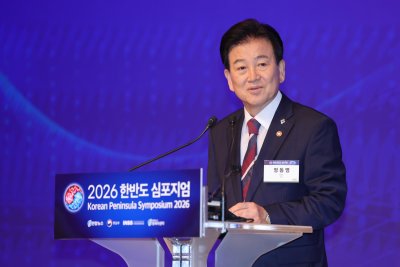
Unification Minister Chung Dong-young made the remarks Wednesday during an academic conference co-hosted by the ministry and a state-run research institute, where officials and experts discussed ways to end hostilities and establish a lasting peace framework.

Chung said Seoul should redesign its Korean Peninsula policy with peaceful coexistence at the center, arguing that formalizing stable relations between the two Koreas could open the door to broader dialogue.

“This is not about giving up unification, but about institutionalizing peace,” Chung said. “If peaceful coexistence is established politically, economically and legally, any issue between the two sides can be addressed.”

He added that discussions among relevant countries on building a peace regime, alongside a basic inter-Korean agreement, would be key to resolving long-standing tensions.

Chung also described North Korea’s recent push for a “two hostile states” framework as a structural shift that should be turned into an opportunity to move beyond confrontation.

“We must end the hostility and conflict that have devastated inter-Korean relations and create a relationship where there is no need to fight,” he said.

The minister avoided directly using the term “North Korea” during his remarks, instead referring to “the North” and its formal state name, a choice some analysts interpret as reflecting a more conciliatory tone.

Chung reiterated that the Korean Peninsula remains technically at war and said the starting point for peace is formally ending the conflict. He stressed that improving relations between Pyongyang and Washington would be essential and urged North Korea not to miss opportunities for dialogue with the United States.

He also said the South Korean government would act as a “pacesetter” to help sustain momentum for U.S.-North Korea talks while fulfilling its role as a key stakeholder in peninsula affairs.

At the same event, former intelligence chief Seo Hoon underscored the continued relevance of a “top-down” approach centered on leader-level diplomacy.

“The more uncertain and difficult the conditions, the more powerful summit diplomacy becomes,” Seo said, calling for a potential fourth meeting between U.S. and North Korean leaders.

Seo noted that past summit diplomacy led to repeated exchanges between former U.S. President Donald Trump and North Korean leader Kim Jong Un, arguing that even limited agreements or renewed dialogue could be meaningful steps forward.

— Reported by Asia Today; translated by UPI

© Asia Today. Unauthorized reproduction or redistribution prohibited.

Original Korean report: https://www.asiatoday.co.kr/kn/view.php?key=20260325010007733

Source link

Unification minister warns war preparation raises conflict risks

South Korean Unification Minister Chung Dong-young speaks to reporters at a press briefing in Seoul, South Korea, 18 February 2026. Chung said South Korea will seek to reinstate a no-fly zone over the border with North Korea under the suspended 2018 inter-Korean military pact aimed at easing tensions, and expressed regret over drones sent by South Korean civilians into North Korea earlier this month. Photo by YONHAP / EPA

March 13 (Asia Today) — South Korea’s Unification Minister Chung Dong-young warned Friday that preparing for war could increase the likelihood of conflict on the Korean Peninsula, emphasizing that “peace itself is the path forward.”

Chung made the remarks during the third meeting of the Korean Peninsula Peace Strategy Advisory Group held at the Inter-Korean Talks Headquarters in Seoul.

“People often speak lightly of war and repeat the phrase that if you want peace, you must prepare for war,” Chung said. “But preparing for war only raises the chances of war.”

Chung also pointed to growing global instability, citing the upcoming U.S.-China summit and tensions related to the Iran crisis.

“The Korean Peninsula sits on unstable ground and tends to sway whenever global events shift,” he said.

Noting the global interconnectedness of security issues, Chung said the distance between Seoul and Tehran is about 6,700 kilometers but developments in the Middle East can still affect the Korean Peninsula.

“A war 6,700 kilometers away is shaking the Korean Peninsula,” he said, adding that the situation underscored the importance of maintaining peace and stability in the region.

Experts attending the meeting suggested that North Korea’s recently proposed “two-state theory” should be reinterpreted in light of current conditions.

They proposed linking it to the inter-Korean confederation stage of South Korea’s long-standing National Community Unification Plan and called for the creation of a new peace roadmap for the Korean Peninsula reflecting changing security dynamics.

Participants also urged the government to shift from a “pace-maker” role to a more proactive “peace-maker” role by expanding diplomatic engagement.

They recommended exploring multilateral approaches involving neighboring countries and international organizations in addition to dialogue between the United States and China.

— Reported by Asia Today; translated by UPI

© Asia Today. Unauthorized reproduction or redistribution prohibited.

Original Korean report: https://www.asiatoday.co.kr/kn/view.php?key=20260313010004062

Source link