As military and economic pressure builds on Venezuelan dictator Nicholas Maduro, an E-3 Sentry Airborne Warning and Control System (AWACS) aircraft was tracked on FlightRadar24 flying close to the Venezuelan coast. To our knowledge, at least in recent days, these aircraft have not been present on flight tracking software in this increasingly high-activity area. And if they have popped-up, their presence has been impersistent at best. At the same time, E-3s are no stranger to this region though and have played a role in drug interdiction operations for years in this exact area.
While E-3s may have been present but not trackable over the Caribbean in recent days, this one being trackable is not a mistake. U.S. military aircraft executing easily trackable sorties very near Venezuelan airspace has been a key component of the pressure campaign placed on Maduro.
The reappearance of the E-3s is a relatively important development, as they would be key to any major kinetic operation against Venezuela. While the carrier-based E-2D Hawkeye, which have been a staple of operations in the area for weeks, is extremely capable, and in some ways more so than the E-3, they are not as well suited for providing airborne early warning, data-sharing and command and control functions for a large and diverse force beyond the carrier air wing. The E-3 also has a higher perch for its radar and passive sensors to take advantage of. It can also better integrate with USAF forces.
Now that one has reappeared publicly in the region, we will likely be seeing much more of them, especially once the contingent of F-35As from the Vermont Air National Guard arrives.
Meanwhile, other U.S. combat aircraft made their closest and most sustained publicly-known presence near the northern Venezuelan coast on Thursday. It’s worth mentioning that we do not know how close aircraft with transponders turned off have been getting, as we can only see the flights that are publicly trackable. These missions are part of Operation Southern Spear, a counter-narcotics mission that morphed into one aimed at Maduro and Venezuelan oil, the country’s main source of income.
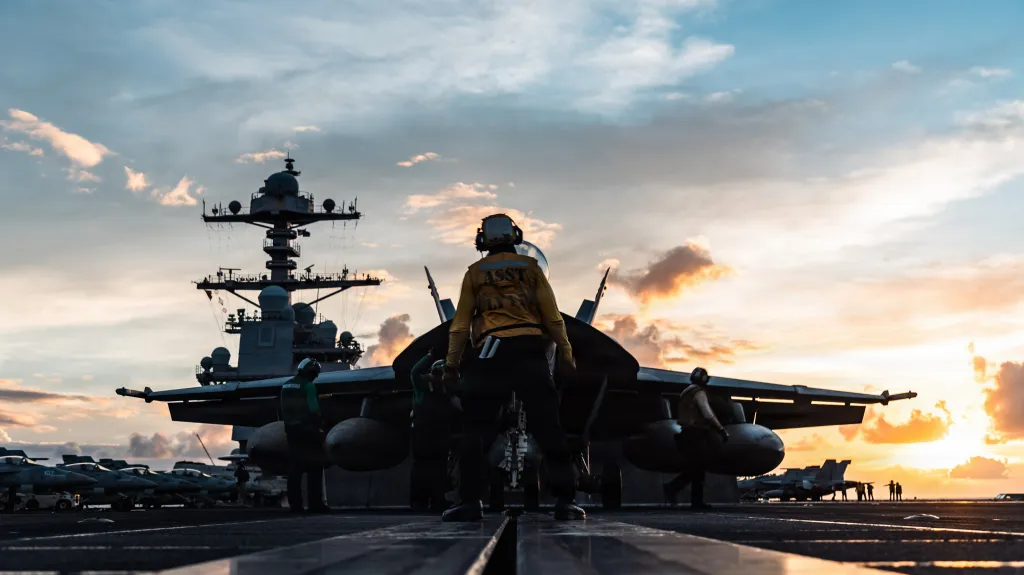
The FlightRadar24 open source flight-tracking site showed a U.S. Navy F/A18E Super Hornet making repeated loops reportedly right on the outer edge of Venezuela’s northern airspace. In addition, two U.S. Navy E/A-18G Growler electronic warfare jets, two more Super Hornets, and an E-2D Advanced Hawkeye airborne early warning plane were tracked on FlightRadar24 flying close to the Venezuelan coast. There has been a notable uptick in such trackable flights recently.
Amid all this aerial activity, President Donald Trump today said he was open to notifying Congress before a direct attack on Venezuela. His comments to reporters at the White House today came a day after the House of Representatives shot down measures requiring the president to obtain prior permission for such an action.
“I wouldn’t mind telling them,” Trump said when asked if he would seek permission from lawmakers for land and boat attacks against Venezuela. He added that prior notification is not required.
“I don’t have to tell them,” he posited. “It’s been proven, but I wouldn’t mind at all. I just hope they wouldn’t leak it. You know, people leak it. They are politicians, and they leak like a sieve, but I have no problem.”
Trump’s views on Congressional authority have generated debate on Capitol Hill that broke down almost completely along party lines, with nearly all Republicans in agreement and Democrats opposed.
Under the 1973 War Powers Resolution, the Commander-In-Chief must notify Congress within 48 hours after “introducing United States Armed Forces into hostilities or into situations where imminent involvement is clearly indicated by the circumstances.” The Resolution also says any such actions are limited to 60 days without subsequent Congressional authorization, though the President can extend that timeline by 30 days with a written certification of the need for the continued use of force.
Trump, who ordered a blockade against sanctioned ships carrying oil to and from Venezuela, continues to assert that the U.S. has a right to that oil. On, Wednesday, Trump doubled down on his blockade warning, telling reporters that the U.S. is “not gonna let anybody go through that shouldn’t go through.”
The blockade announcement sparked a separate debate in Congress and elsewhere about its legality.
“American presidents have broad discretion to deploy U.S. forces abroad, but Trump’s asserted blockade marks a new test of presidential authority,” international law scholar Elena Chachko of U.C. Berkeley Law School told Reuters.
Meanwhile, Venezuela condemned the blockade and said it would take its case to the United Nations.
Despite Trump’s pronouncement, several ships carrying oil byproducts from the South American country sailed from Venezuela’s east coast under escort from that country’s Navy “between Tuesday evening and Wednesday morning,” The New York Times reported.
“The ships transporting urea, petroleum coke and other oil-based products from the Port of José were bound for Asian markets,” per that story, citing anonymous sources. “The Venezuelan government imposed the military escort in response to Mr. Trump’s threats.”
The blockade announcement came after the U.S. government had already seized one sanctioned oil tanker, the M/T Skipper. That mission, which occurred on December 10, was led by the U.S. Coast Guard with elements of the U.S. military providing support.
In a social media post on Tuesday, Trump designated the Maduro regime as a foreign terror organization. That announcement and the blockade declaration were the latest moves in the Trump administration’s efforts to increase the range of actions it can take. The cartel Maduro allegedly leads was officially designated as a foreign terrorist organization (FTO) last month, a move Defense Secretary Pete Hegseth said increases U.S. military options in the region.
To that end, the U.S. military, as we have frequently noted, has been building up a large military presence in the region.
At present, the Navy has at least 11 surface warships in the region, including the USS Gerald R. Ford, the world’s largest aircraft carrier. It has four squadrons of F/A-18 Super Hornets, a squadron of E/A-18 Growler electronic warfare jets, a squadron of E-2D Advanced Hawkeye airborne command and control aircraft, MH-60S and MH-60R Seahawk helicopters and a detachment of C-2A Greyhound carrier onboard delivery planes.

There are also a number of other aircraft, including combat search and rescue (CSAR) aircraft, E/A-18G electronic warfare aircraft, Marine Corps F-35B and AV-8B Harrier II combat jets, and MV-22 Osprey tilt-rotors, MQ-9 Reaper drones, AC-130 Ghostrider gunships, and various helicopters already in the region. In addition, there is a looming deployment of an unspecified number of F-35A stealth fighters, which we were the first to report.
The presence of aerial refueling tankers is also growing. KC-46 Pegasus tankers have been flying sorties out of the U.S. Virgin Islands for months, with a ramp-up in activity in recent weeks. There are now at least 10 KC-135 Stratotanker refuelers deployed to the Dominican Republic.
While these assets, along with about 15,000 deployed U.S. troops, are capable of limited sustained operations, it is far from the force that would be required for a land invasion or any large ground operation in Venezuela.

Since September, U.S. military operations in the Caribbean Sea, as well as the Eastern Pacific, have already included nearly two dozen strikes on boats allegedly involved in drug smuggling. The first of these strikes, which came on September 2, has become the focus of particular controversy, including allegations that it may have constituted a war crime.
The Sept. 2 incident has spurred numerous Congressional briefings, but on Wednesday, the Chairman of the House Armed Services Committee, Mike Rogers, an Alabama Republican, said he was satisfied by testimony about that strike and that no further hearings would be held. It is unclear if there will be other Congressional action, though, since the Senate Armed Services Committee has also been investigating the matter.
The boat attacks continued on Wednesday, with another four suspected traffickers killed, bringing the total number of fatalities to about 100.
Amid all this tension, Brazilian President Luiz Inacio Lula da Silva offered to serve as an intermediary between Trump and Maduro to “avoid armed conflict.”
Lula told reporters on Thursday that Brazil was “very worried” about the mounting crisis between Venezuela and the United States. He added that he told Trump that “things wouldn’t be resolved by shooting, that it was better to sit down around a table to find a solution.”
The Brazilian leader suggested that he may speak to Trump again before Christmas to reinforce this offer “so that we can have a diplomatic agreement and not a fratricidal war.”
“I am at the disposal of both Venezuela and the US to contribute to a peaceful solution on our continent.”
We’ve reached out to the White House to see if Trump might be amenable to having Lula, an influential leftest leader, as a go-between.
In the interim, the world continues to wait to see what the U.S. president will do with the forces he has amassed in the Caribbean.
Contact the author: howard@thewarzone.com