A BUSY UK train station is set to CLOSE for seven months for a major upgrade.
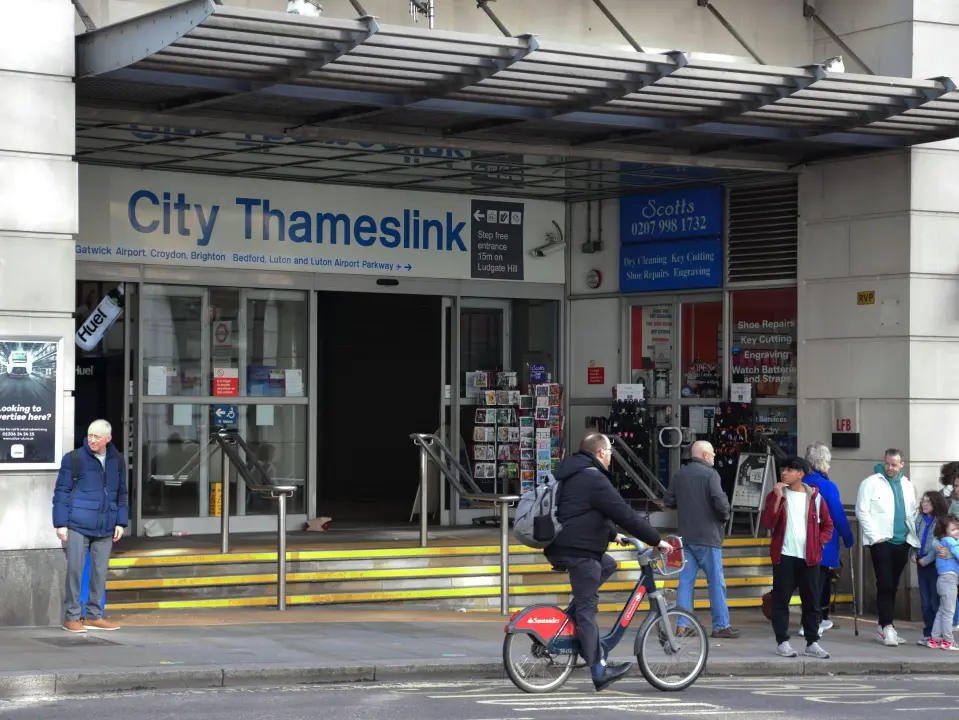
City Thameslink station in London has confirmed the next year closure, for a multi-million pound project to replace ten escalators.
City Thameslink station will close for seven months for a major upgradeCredit: Alamy
The closure will take place from May 17, 2027 until late December 2027.
Thameslink trains will continue to run as normal but will not stop at the station.
Sign up for the Travel newsletter
Thank you!
Network Rail is recommending travellers to use Blackfriars as an alternative, which is around a six- minute walk away.
Lucy McAuliffe, Sussex Route Director for Network Rail, said: “We know closing City Thameslink is a significant change and we’re sorry for the disruption it will cause.
“This is not a decision we have taken lightly. We have looked long and hard at every possible option and, although none of them are without impact, a single closure is the least disruptive and most efficient way to carry out this vital work.
“City Thameslink’s escalators are at the end of their operational life. By replacing them now we’re tackling the root causes of access disruption for passengers in one go.
During the closure all of the escalators will be replacedCredit: Alamy
“This means that when City Thameslink reopens in December 2027, customers will benefit from completely renewed escalators, designed to provide safer, more dependable and accessible journeys through this important station on our network.”
The current escalators have been at the station for around 35 years, but recent flooding damaged them.
The station, which opened in 1990, welcomes around 7.6 million people a year, as it is near popular attractions like St Paul’s Cathedral.
A full closure of the station was decided on instead of a partial closure for safety reasons.
If you’ve watched anything from “Jesse Watters Primetime” to “The Daily Show” this week, you’re already up to date on the most important issue in America today: the decor of the Cheesecake Factory.
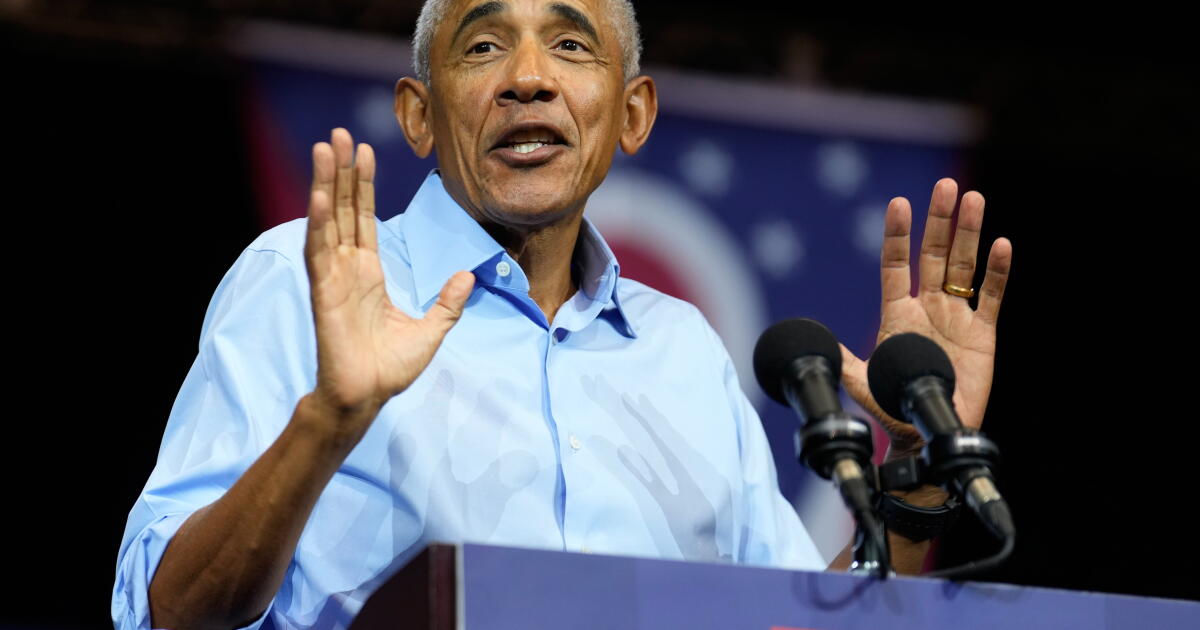
Earlier this week, former President Obama made a quip at a Cleveland rally that President Trump has renovated the White House to look like “Saddam Hussein opened a Cheesecake Factory.”
Trump lost it. If we’ve learned anything about the president in recent years, it’s that he loves gold as much as he hates Obama. Roll them together in one moment, and the leader of the free world can’t help but freak out. He freaked out so badly, in fact, that he sent Treasury Secretary Scott Bessent — a guy worth at least $500 million — to eat a French dip cheeseburger at the chain just to prove how great it was.
But if you think this is all a silly back and forth with an unserious administration, think again. Obama is masterful at political strategy, and this wasn’t just a joke. It was rage-bait, crafted for engagement.
Why Saddam Hussein?
The deeper point of Obama’s remarks seemed entirely buried by media coverage that focused on the Cheesecake part. But why Saddam Hussein?
Trump didn’t seem to take issue with being likened to the brutal dictator responsible for killing and disappearing thousands to maintain power. In fact, in all of the rebuttals from Trump and his minions, the Hussein reference hasn’t been mentioned once.
But don’t think Obama choose that reference carelessly, or just for humor.
That ostentatious excess wasn’t just bad taste. It was a show of power. At the same time that Hussein was amassing his wealth and consolidating that cult of personality, his people were broke. Now, I’m in no way saying that Americans in 2026 are suffering the way Iraqis were under Hussein. But there’s a Marie Antoinette-style similarity between Hussein’s narcissist tendencies and Trump’s obsession with all that glitters — from the water in the reflecting pool to the walls of the Oval Office — even as the economy crashes.
Obama clearly understands that: Maybe you don’t want to cut food stamps to millions while you’re slapping up a new ballroom. Obama, after all, could have said the White House looked like Liberace had opened a Cheesecake Factory, but he didn’t. Instead, he chose to insert Hussein, a man whose ego-driven rule came at the expense of his own people.
Which brings me to the absolute brilliance of the joke. Sure, it was funny. Yes, it was quickly picked up as a viral clip.
But more than anything, it got to Trump in a way that was entirely predictable with his unbridled ego, and a way in which Obama almost certainly knew it would. In a way that links him to a dictator who cared more about gilt than people, but in a way so clever Trump himself grabbed the bait and ran with it.
Trump couldn’t stop himself
Hearing his taste criticized, all his beautiful, shiny gold mocked — by Obama of all people — was rage-bait that Trump could not ignore. Trump could not stop himself from responding, and even more, he couldn’t stop himself from demanding others defend him and his gaudy aesthetics.
And the ever-willing members of his cult of personality across government and right-wing media quickly complied — with an attack that Obama surely knew would be the only possible pushback: That he was elitist for making fun of the decor of a wildly popular average-family spot (Obama quickly hit back that the Factory was “his jam” and he, like many parents of teens, myself included, had eaten there numerous times.)
Dozens and dozens of Trump minions parroted the same line for days — how dare Obama mock such a beloved American eatery? How out of touch. How tan-suit, Martha’s Vineyard of him. Trump brought it up at multiple rallies. The official White House social media account posted about it. It was all over the right-wing ecosphere for days.
Never mind the economy, or the war in Iran, or inflation that makes a meal at the Cheesecake Factory increasingly feel like a caviar-and-Champagne night.
Or even this insane comment from Trump about inviting supporters to Mar-a-Lago, his Florida club that makes the Las Vegas Strip look classy, to spend the money he’s promised to them if Republicans win elections: “You’ll be my guest at Mar-a-Lago,” he promised at an Ohio rally. “The problem is that for $5,000, the most you’ll be able to buy is a hamburger and maybe a small dessert. … I’m not even sure you could buy that. No, don’t go there. That’s not a good place if you’re price conscious.”
And Obama’s elitist? That’s bonkers-level disconnection from the audience, but back to my point.
Suddenly, in the middle of a pivotal election, all Republicans are hearing about is the Cheesecake Factory, and how wonderful it is their president is plastering gold all over everything while they are wondering if they’ll be able to pay the gas bill this month.
Granted, the Republicans don’t have a lot of bright spots to focus on as they give their final message to voters. But I am guessing that even the reddest of ballot-clutchers doesn’t want to hear about the Cheesecake Factory, or how much marble Trump has installed at the entrance to the White House. That seems tone-deaf.
Obama’s purposeful provocation completely derailed Republican messaging for multiple, critical news cycles, all because Trump couldn’t stand to have his taste criticized by a guy who has become a bogeyman in his own brain.
Trump had to defend his excess, he couldn’t resist — and in failing to check his own ego, again, he put into the bright spotlight the truth that his followers are increasingly unable to ignore: The only thing that matters to Trump is Trump. Not the economy. Not the war, and certainly not the concerns of voters in the final days of the election.
Obama’s one-liner wasn’t just a zinger. It was political gold, an artful bit of rage-bait trolling that casually took control of the narrative with a well-aimed poke.
Get the latest on L.A.’s teams in the daily Sports Report newsletter.
By continuing, you agree to our Terms of Service, which include arbitration and a class action waiver. You agree that we and our third-party vendors may collect and use your information, including through cookies, pixels and similar technologies, for the purposes set forth in our Privacy Policy such as personalizing your experience and ads.
This week, a Boston University study was published that analyzed the medical records of more than 2,000 deceased former NFL players. The study estimated that 74.5% of them likely had CTE.
Defensive tackle Aaron Donald, 35, played 10 seasons before retiring after the 2023 season. He rejoined the Rams this season. When asked about the study and CTE, Donald said, “That’s a real thing.”
But he said, “You don’t think about it. You just play. When you sign up to play football, you know what you’re signing up for.
“You obviously don’t want nothing like that to occur.”
His attempt to surpass his career long of 57 yards against the Spartans last week fell short, but Bhaghani doesn’t linger long on errant kicks. He knows he will only be successful when his team needs him most if he focuses on the fine details of every kick.
“I love the feeling of making field goals and helping the team win,” Bhaghani said. “It’s a different type of adrenaline; going out there, with all that pressure — is so fulfilling and relaxing for me.”
The daily attention to detail has helped Bhaghani hit all 102 of the extra points he has attempted during his college career.
The following interview with Bhaghani ahead of the Bruins’ game against Nevada Saturday has been edited for length and clarity.
Ottawa Senators forward Hayden Hodgson received a game misconduct and major penalty for boarding defenseman Brandt Clarke in the Kings’ 6-5 overtime victory Thursday night.
Hodgson took a run at Clarke, charging in at 21 mph according to the game broadcast. Clarke was just below the goal line when he was driven into the boards. The hit caused a brief scrum, and the Kings’ Erik Haula received a two-minute penalty for roughing Hodgson.
Clarke was ruled out for the rest of the game for what the Kings called an upper-body injury.
The play with 8:45 left in the second period came shortly after the Kings scored three goals in 4:03 to take a 4-1 lead and chase goalie Jonas Johansson.
Tage Thompson had three goals and two assists, Zach Benson added a goal and two assists, and the Buffalo Sabres scored six consecutive goals during a 7-6 victory over the struggling Ducks on Thursday night.
Thompson’s 10th career hat trick tied him with Alexander Mogilny and Danny Gare for the third-most in Sabres history. One night before his 29th birthday, Thompson scored twice in 15 seconds in the second period, skating around the Ducks’ inert defense for a breakaway third goal that sent a dozen hats flying onto the Honda Center ice.
Tyson Kozak, Noah Ostlund and Jack Quinn also scored and Colten Ellis made 28 saves for the Sabres, who roared back from an early two-goal deficit and then hung on to improve to 2-0-1 on their four-game trip.
Captain Mikael Granlund scored and Leo Carlsson had three assists in the Ducks’ seventh loss in eight games.
1943 — Gus Bodnar of Toronto scores a goal 15 seconds into his first NHL game as the Maple Leafs beat the New York Rangers 5-2.
1945 — Branch Rickey signs Jackie Robinson to the Montreal Royals.
1955 — Jim Patton of New York returns a kickoff and a punt for a touchdown as the Giants beat the Washington Redskins 35-7.
1966 — Jim Nance of the Boston Patriots rushes for 208 yards and two touchdowns in a 24-21 victory over the Oakland Raiders.
1971 — Eric Allen of Michigan State rushes for 350 yards in 43-10 rout of Purdue.
1974 — Muhammad Ali knocks out George Foreman in the eighth round in Kinshasa, Zaire, to regain the world heavyweight title in the “Rumble in the Jungle.”
1975 — John Bucyk of the Boston Bruins scores his 500th goal in a 3-2 victory over St. Louis.
1977 — Walter Payton of the Chicago Bears rushes for 205 yards and two touchdowns in a 26-0 triumph over the Green Bay Packers.
1993 — Erin Whitten becomes the first woman goalie in pro hockey to be credited with a victory as Toledo beats Dayton 6-5 in the East Coast Hockey League.
1996 — The WNBA announces the eight cities that will compete in the WNBAs inaugural season. Charlotte, Cleveland, Houston and New York will play in the Eastern Conference and Los Angeles, Phoenix, Sacramento and Utah will compete the Western Conference.
1997 — Argentine soccer star Diego Maradona announces his retirement from football on his 37th birthday.
1997 — Violet Palmer makes pro sports history by becoming the first woman to officiate an NBA game. There is little reaction by the crowd when her name is announced just before tip-off of the game between the Dallas Mavericks and Vancouver Grizzlies.
1999 — Marques Tuiasosopo becomes the first college player to pass for 300 yards and run for 200, racking up a school-record 509 yards as Washington rallied to beat Stanford 35-30. Tuiasosopo completes 19-of-32 passes for 302 yards and a touchdown and rushes 22 times for 207 yards and two TDs.
2001 — Michael Jordan misses his biggest shot of the night and commits two crucial late turnovers in the Washington Wizards’ 93-91 loss to the New York Knicks, Jordan’s first regular-season game after a 3 1/2-year retirement.
2003 — In the first regular-season game of his NBA career, 18-year-old LeBron James has 25 points, nine assists, six rebounds and four steals, but the Cleveland Cavaliers lose 106-92 to the Sacramento Kings.
2004 — Trainer Bobby Frankel finally breaks through in the Breeders’ Cup Classic, with Ghostzapper blazing to victory in America’s richest race held at Lone Star Park. Frankel, who had just two wins with 62 Breeders’ Cup starters before the $4 million Classic, had saddled the beaten favorite the past three years.
2004 — Dana College’s Tom Lensch sets an all-division college record by attempting 101 passes in a 60-35 loss to Hastings College. Lensch completes 56 passes for a school-record 507 yards with three touchdowns and three interceptions.
2011 — The Baltimore Ravens erase a 24-3 deficit to defeat Arizona 30-27. It marks the fifth time this season a team trailed by at least 20 points and came back to win. That is the most in a single season in NFL history.
2016 — Derek Carr throws a 41-yard touchdown pass to Seth Roberts with 1:45 remaining in overtime, capping a record-breaking day for the Oakland Raiders in a 30-24 victory over the Tampa Bay Buccaneers. Carr throws for a franchise-record 513 yards — completing 40 of 59 passes without an interception — and the Raiders overcome an NFL-record 23 penalties for 200 yards.
2019 — World Series: Washington Nationals beat Houston Astros, 6-2 in Game 7 at Minute Maid Park, Houston to win first title in franchise history; MVP: Washington pitcher Stephen Strasburg.
2024 — World Series: Dodgers win eighth title in franchise history; overcome 5-0 deficit to beat New York Yankees 7-6 at Yankee Stadium for 4-1 series victory; MVP: Dodgers 1B Freddie Freeman (4 HR, 12 RBI).
Compiled by the Associated Press
Until next time…
That concludes today’s newsletter. If you have any feedback, ideas for improvement or things you’d like to see, email me at houston.mitchell@latimes.com. To get this newsletter in your inbox, click here.
A symbol of independent journalism, Novaya Gazeta has been classed as a ‘foreign agent’ by Moscow.
Published On 30 Oct 202630 Oct 2026
Russian newspaper Novaya Gazeta has announced it will shut down, citing pressure from the authorities.
The independent outlet’s editorial board said in a statement released on Friday that the newspaper has been forced to end its operations.
Recommended Stories
list of 4 itemsend of list
The Russian media has come under increased scrutiny from the state amid Moscow’s war on Ukraine. The authorities recently searched the home of Novaya Gazeta’s senior editor and arrested the editor-in-chief.
“The newspaper is gone. The Russian authorities and … intelligence services forced the editorial staff to cease operations,” the editorial board said in the statement, which was entitled: “We were killed.”
Viewed as a relative bastion of independent journalism in Russia, Novaya Gazeta has been classed as a “foreign agent” by Moscow, a label used to stifle dissent.
“Novaya Gazeta is ceasing to exist,” editor-in-chief Sergei Sokolov said in a video statement published on YouTube. “On November 9 we will turn off the lights in our home, where we have lived for 30 years. We will shut down the servers and leave.”
Earlier this month, Sokolov was taken in for questioning as Russian authorities searched his home due, they said, to a link to a criminal case involving his colleague Oleg Roldugin.
Roldugin was arrested in April and charged with “unlawful access to computerised information”.
“How far will the Kremlin’s relentless campaign against Novaya Gazeta go?” asked media watchdog Reporters Without Borders in a statement after Sokolov was arrested on October 15.
“Six of its journalists and staff members have been murdered, its newsroom has been raided, its journalists have been prosecuted, and the publication has been designated a ‘foreign agent’,” the press freedom organisation noted.
The forced closure of Novaya Gazeta marks another escalation in Russia’s crackdown on press freedom, with few independent media outlets or journalists left in the country, as censorship levels and arrests of regime critics have skyrocketed since it launched its invasion of Ukraine in February 2022.
The newspaper had already trimmed production inside Russia after Moscow invaded Ukraine, as authorities revoked its media licence.
The paper’s then editor-in-chief, Dmitry Muratov, jointly won the Nobel Peace Prize in 2021 for his “efforts to safeguard freedom of expression” at the helm of the paper.
“A national strike is planned from 9pm on 29 October to 9pm on 30 October.
“The strike may disrupt rail and air travel, taxis, highways, local public transportation, schools, and government offices.
Rome (pictured) Milan and Turin are just some of the cities affectedCredit: AFPThe Government is now warning Brits heading to the countryCredit: Shutterstock Editorial
“Check with your travel provider for the latest information.”
Over the past week, Washington and Tehran have sent mixed signals about whether their eight-month war is heading back to full-scale strikes or towards a peace deal.
On Thursday, the head of United States Central Command (CENTCOM), Admiral Brad Cooper, briefed US President Donald Trump on options for renewed attacks on Iran, The Wall Street Journal (WSJ) reported.
Recommended Stories
list of 4 itemsend of list
The US and Israel have drawn up joint plans to attack Iran after the November 3 US midterm elections, The New York Times (NYT) reported last week.
Yet on the same day, The Washington Post reported that Vice President JD Vance had offered to meet Mohsen Rezaei, the secretary of Iran’s Supreme National Security Council, in person to negotiate an end to the war.
On Friday, Qatari mediators returned to Tehran for talks coordinated with the US, an official told Reuters.
So is Washington heading back to war, or towards a deal? Here’s what we know:
Why are there conflicting reports?
Essentially, Washington is preparing for war while keeping a diplomatic channel open.
The WSJ reported that the US has boosted air defences and munitions in the region and moved some troops away from bases vulnerable to Iranian retaliation.
Ten US military cargo planes landed at the Ovda and Nevatim air bases in Israel’s Negev region on Thursday, with more sent to Jordan, Saudi Arabia and Qatar, the Israeli public broadcaster Kan reported.
Democratic Senator Chris Murphy, who said he had been briefed on the plans, called them “insane” and warned of a devastating escalation.
Senator Chris Murphy in Washington, DC, United States [File: Kylie Cooper/Reuters]
Can diplomatic efforts hold off a return to strikes?
Diplomacy has not stopped.
Vance’s letter, delivered to Rezaei through Qatari mediators on Sunday, proposed direct talks led by Vance, with Iran’s nuclear programme on the table from the start, according to the NYT, in a bid to prevent a renewal of strikes.
Whether it might have any influence over what happens next is a matter for debate. Rouzbeh Parsi, an Iran analyst who is an affiliated researcher at Lund University’s Department of History and Human Rights Studies in Sweden, described Vance as the “voice of reason” on Iran within the Trump administration, saying his signals have been “the least volatile and unpredictable”.
But he also told Al Jazeera that Vance’s position has “never proven to be sturdy enough to actually sway Trump”.
“Thus, while the optics with Vance look better than anyone else in the Trump administration, I doubt that they [Iranian officials] give the outreach much credence until Vance proves able to actually deliver something on his own,” he said.
Furthermore, Nader Hashemi, a professor of Middle East politics at Georgetown University, told Al Jazeera that “Rezaei is just one voice among many” adding that the “reality is that decisions are made collectively inside the Islamic republic”.
Wolfgang Pusztai, a security and defence analyst and Austria’s former defence attache to Libya, has a different view, however, telling Al Jazeera, “There is no doubt that the IRGC [Islamic Revolutionary Guard Corps] currently calls the shots in Iran.”
In February, Iran’s then supreme leader, Ayatollah Ali Khamenei, was killed in the initial attacks by Israel and the United States, and his son became the new supreme leader, but Pusztai says he “simply does not have the influence his father did”.
“Without the IRGC’s approval, there will be no agreement with Iran,” Pusztai said, adding it is safe to assume that when Rezaei makes a statement or endorses a proposal, “it reflects the position of the IRGC leadership” and that the US was “absolutely right to negotiate with him”.
Pusztai said it is unclear whether Rezaei is indeed ready to make a serious compromise, but under sustained US pressure, Rezaei, who holds a doctorate in economics, could come to see that “Iran’s interests and the regime’s survival can be better secured without nuclear weapons and through a less aggressive foreign policy”.
“He certainly knows that peak oil is approaching and that time is running out for Iran’s economic recovery through the use of its oil revenues,” he said.
Parliament Speaker Mohammad Bagher Ghalibaf said progress depends on Iran’s seven conditions being met – including the lifting of sanctions, ending the US naval blockade of Iranian ports, guarantees to an end to US-Israeli strikes, and the unfreezing of Iranian assets – adding that the “carrot-and-stick approach has no effect on Iran”, according to the semi-official Tasnim news agency.
Vance, meanwhile, told Fox News on Thursday that Trump would “never” let the conflict become “a forever war”.
Iran’s President Masoud Pezeshkian in Tehran [File: AFP]
Which of all these signals matter most?
The diplomacy may say more than the threats.
Andreas Krieg, an associate professor of security studies at King’s College London, told Al Jazeera that Vance’s offer of direct talks “suggests that the Americans do have second thoughts” and that they are less ready to strike than they publicly suggest.
But he warned that Cooper, whom he called “quite hawkish”, could give Trump false confidence “that there is a military way out of it, when in reality there isn’t a military way out of it”.
“This idea that there is a short and crisp military operation to solve this issue is obviously an illusion,” he said.
Paul Musgrave, an associate professor of government at Georgetown University in Qatar, told Al Jazeera the White House could be sending signals to coerce Tehran, but that “the better interpretation is the simplest one”.
He believes “the United States is getting ready to carry out substantial attacks relatively soon”. He said he does not expect Washington to accept what he called the unfavourable deal Tehran is offering “without another round of attacks”.
Pusztai said Trump’s main focus is now the midterms, making it “very unlikely that he will order another large-scale attack on Iran before the elections”.
“Starting in mid to late November, there could be a major wave of attacks aimed at advancing the American agenda,” he said, adding that the aim would be to weaken the IRGC enough to push it towards a deal on US terms.
Whatever the vote’s result, “in the short term it will not change much”, Musgrave said.
A strong Republican showing could encourage more aggressive tactics, while a Democratic win could push Trump to show his unilateral powers, including by attacking, he said.
A funeral for the bombing victims of Minab School in Iran, which killed 120 children during the first day of the United States-Israel war on the country [File: Amirhossein Khorgooei/ISNA/WANA via Reuters]
Hasn’t this all happened before?
It has. Iran was attacked by Israel or the US while talks were under way in both 2025 and 2026.
“We’ve seen this pattern of behaviour before from the United States,” Hashemi said, describing it as “talking diplomacy while preparing for war”.
On June 13, 2025, Israel launched major strikes on Iranian nuclear and military sites, two days before a sixth round of US-Iran talks was due in Oman. The US joined on June 22, bombing Iran’s Natanz, Fordow and Isfahan nuclear sites.
This year, the US and Israel attacked on February 28, two days after talks in Geneva that mediator Oman said had made “significant progress”.
A day before the strikes, Oman’s foreign minister said Iran had agreed to reduce its nuclear stockpiles to “the lowest level possible”.
Iranian President Masoud Pezeshkian told Al Jazeera in September that Iran no longer trusts negotiations with Washington because attacks had come during previous rounds of talks.
Hashemi said he suspects “the same pattern is repeating itself”, with the US preparing “a massive bombing campaign in Iran, replete with war crimes like we haven’t seen before”, citing his reading of Murphy’s comments.
An explosion in Tel Aviv after Iran launched missiles into Israel, following the Israeli-US attacks on Iran, on February 28, 2026 [Gideon Markowicz/Reuters]
What is blocking a deal?
“The issue is mostly around sequencing and the lack of trust on the Iranian side that the Americans will actually follow through with their commitments,” Krieg said.
Tehran wants sanctions and the US naval blockade lifted quickly, fearing that a slow process gives Trump room to backtrack, he said.
Some IRGC hardliners do not necessarily see war as a bad thing if it tightens their grip on the Hormuz strait, he added, and “the Iranians have been prepping for this war for the last three weeks, so they are ready to fight”.
Krieg said he expects “nothing is going to happen until the 3rd of November [the date of the US midterm elections]”. After that, he said, the likelihood of war will “increase exponentially”.
Any new escalation would be worse than in February and March, he said, with Iran readier to strike critical infrastructure in Gulf countries.
He said the threat to the Gulf “will be unprecedented”.
A major change for train travel has emerged, and it impacts three million people in the UK who have ADHD, as a discount railcard is now available, saving more than £100 annually
People with ADHD are able to save a third on train travel (Image: Getty Images/Stock Image)
People with ADHD can now apply to get a third off train tickets for themselves and one adult companion. It follows an expansion to the requirements for a disabled railcard.
ADHD (attention deficit hyperactivity disorder) is a common neurodevelopmental condition that can impact someone’s ability to concentrate, control impulses, or experience high energy levels. There are three million people in the UK living with the condition, according to ADHD UK, with 881,922 of those estimated to be children aged between five and 24 years.
People who are neurodivergent, with ADHD falling into this category, are now eligible for a Disabled Persons Railcard (DPRC) that offers discounted train tickets. It follows new eligibility criteria for the disabled railcards, which were expanded earlier this year to include a wider range of conditions, including “neurodiversity where it has a substantial impact on a person’s ability to travel by train”.
Anyone with a disability listed on the Railcard’s eligibility checklist can save a third on the usual price of a train ticket for themselves and one adult companion. The disabled railcard costs £20 for one year, or £54 for three years, with the Rail Delivery Group, which manages and distributes railcards, estimating that it can save travellers around £126 every year.
This year, the number of people with a disabled railcard reached a record high of more than 450,000, compared to fewer than 200,000 in 2016, according to Office of Rail and Road data. The number is expected to significantly increase as more people are eligible to apply.
The development was hailed as a “railcard revolution” by the rail minister, Lord Hendy, earlier this month. He said it would “help thousands more people access cheaper rail travel, helping disabled people travel with confidence”.
Lord Hendy added: “The Government is determined to help ordinary people live better lives and this change is just one measure that will make it that bit easier for disabled people to get to education, employment, and stay in touch with friends and family.”
Those with ADHD who wish to apply for a Disabled Persons Railcard will need to provide the following, as outlined by Railcard:
A report or letter from a health professional that helps explain your access needs. Confirmation of diagnosis alone for conditions with variable impact may not be enough to process your application. Remember, to be eligible, you must experience significant disability-related barriers to rail travel
Or a completed impact declaration form signed by a suitably qualified and regulated health or social care professional
The Rail Delivery Group encouraged anyone who thinks they might fit the criteria for a disabled railcard to apply. A spokesperson said: “There is no list of neurodivergent or degenerative conditions that automatically qualify. Instead, applications are assessed on a case-by-case basis, recognising that experience and support needs can vary considerably between individuals.”
Devin Elle Kurtz makes her opinion on generative AI known. For the last few years, the 29-year-old Pasadena artist says she’s been frustrated when strangers tell her that her art style looks AI-generated.
They have it backward, she insists. Kurtz, who has been sharing her art on the internet since she was a teenager, suspects that her viral art may have been used to train AI models. Her Instagram bio reads, “NO AI,” alongside a circle-backslash emoji.
Her feelings on the subject made what she discovered Thursday morning all the more painful, the artist said. Kurtz woke up to multiple emails from fans telling her that the Trump administration’s Department of Education had posted a meme on X that looked eerily similar to one of her works — fan art inspired by one of her favorite scenes from the animated series “Avatar: The Last Airbender.” In the work, Aang and Zuko are shown practicing fire-bending moves as two dragons move around them.
There’s Magic in Learning 🪄 https://t.co/hJdp0Y2qho
The Department of Education’s post includes an image of the two characters in seemingly identical stances, outfits and color scheme. “There’s magic in learning,” reads text added over the image. “Make education great again.”
The Department of Education did not immediately respond to a request for comment late Thursday.
Kurtz soon took to social media to condemn the Trump administration. She wrote on the platform: “I did not and would never consent to this administration running my fanart through AI and posting it. Can’t even believe I’m saying these words.” Her response had 150,000 likes as of late Thursday night.
“It definitely made me angry,” Kurtz told The Times on Thursday. “Seeing something that I made appropriated with a Make America Great Again-adjacent slogan on it made me quite upset. I knew I wanted to make it really clear that this was not something that I co-signed.”
Kurtz said she made the artwork in 2023 to share her love of the series with its creators and with other fans.
“Fandom at its core is supposed to be humans loving something together,” Kurtz said. “I want to live in a world where the things that I see around me are made by people. That is what being a human being is all about. Not just output for the sake of output.”
Kurtz said several tells led her to conclude that AI was likely used to alter her work. In the version shared by the Trump administration, the dragons have been removed, and the platform the duo is standing on has oddly sized bricks.
Since her fan art is based on existing intellectual property, she doesn’t intend to pursue legal action.
“It would be fantastic if the government didn’t take artists’ work and run it through AI and post it,” Kurtz said.
In December, singer Sabrina Carpenter was angered when her song “Juno” was used in the soundtrack for a Department of Homeland Security promotional video featuring clips of officers tackling and handcuffing people.
“[T]his video is evil and disgusting,” Carpenter replied. “Do not ever involve me or my music to benefit your inhumane agenda.” The Department of Homeland Security has since deleted that video.
The Los Angeles Board of Public Works has been overseeing work on streets, sidewalks and sewers since 1905. But if voters approve Measure LA on Tuesday’s ballot, it might not be around much longer.
The charter amendment enacts a half-dozen changes, and the most divisive is a provision that would “allow for the elimination of or changes to the Board of Public Works.”
Proponents assert that passage would lead to better city services and quicker repairs of deteriorating infrastructure. They also say the five-member board wouldn’t just disappear, and disbanding it actually would require a two-thirds vote of the 15-member City Council.
Opponents say the board plays a crucial role in managing billions of dollars of infrastructure projects while maintaining public accessibility and handling matters that don’t merit council attention (such as tree removal votes). They fear that eliminating the five-member oversight panel, and putting a single person in charge, would open the door to graft, with some citing San Francisco’s former director of public works being sentenced in 2022 to seven years in federal prison for his role in a kickback and bribery scheme.
“If the Board of Public Works was eliminated and concentrated within the authority of one person, I think that gives way to more corruption than transparency,” Councilmember Monica Rodriguez said.
Storm drains and sidewalk repairs
The board generally convenes Mondays, Wednesdays and Fridays in an ornate, high-ceilinged room on the fourth floor of City Hall.
One recent 2½-hour meeting kicked off with a lengthy celebration of Latino Heritage Month, and then the four members present moved through a series of agenda items tied to low-profile infrastructure projects, including:
A reveal of seven bids for a package of sidewalk repairs, with Acting Executive Officer TJ Knight reading aloud the name of each applicant, and the bid amount, sometimes down to the penny. They ranged from a high of $2.47 million to a low of $1.9 million
A Bureau of Engineering representative requested authority to boost the budget of a storm drain project in the Pacific Palisades in advance of El Niño storms.
A Bureau of Street Services staffer broke down a request to remove protected trees (with plans for replacement) on a project on Mulholland Drive.
Each discussion item drew questions from the commissioners. All items were unanimously approved.
Paid positions
The five board members are all full-time city employees who earn slightly less than $200,000 a year. The members, including the board president, are appointed by the mayor and together oversee more than 5,500 people who work for city bureaus and offices that handle sanitation, street lighting, engineering, graffiti removal and more. Each bureau also has its own head.
A Board of Public Works meeting at City Hall.
(Jonathan Alcorn/For The Times)
The board members aren’t commenting on Measure LA. Former members, however, say the five-member board is an effective way to manage and coordinate a wealth of projects.
Rodriguez, who served on the board from 2013-16, said that during her tenure she focused on overhauling the procurement process to allow small, women-owned and minority-owned businesses to better compete for city contracts. She also learned the inner workings of the panel that approves more than 85% of the city’s construction contracts.
Diffusing the workload, former members say, allows for regular interaction with elected officials and the private sector.
Valerie Lynne Shaw, who served on the board from 1996 to 2013, said the board plays an important role in serving as a “coordinating mechanism” for infrastructure projects, and that commissioners regularly assist in solving problems raised by the public. She echoed the benefits of a larger panel.
“Power in the hands of many better serves the city as opposed to power in the hands of one,” she stated.
One former board member, who asked not to be identified to preserve professional relationships, said the existing system yields frequent public interaction, whether it’s people speaking during meetings or via other channels.
“I regularly went to neighborhood council meetings, homeowners association meetings, town halls, county board of supervisors meetings, to the state legislature,” the former member said. “A director can do some of that, but not all of that.”
Who’s in charge?
Councilmember Katy Yaroslavsky begs to differ. From her vantage point, the current system is fragmented with no clear authority.
Yaroslavsky has been frustrated in getting information on a long-running intersection repair project on La Cienega Boulevard in her Fairfax area district.
“I can’t get any information from anybody, and I’m the councilperson,” she says.
Yaroslavsky contrasts the city setup with that of Los Angeles County, which she says has a well-known leader in Director of Public Works Mark Pestrella. She believes the city system of five board members serving as a collective general manager is a vestige of another era that never would be created today.
“When you have one person in charge, you know who you can hold accountable,” she says.
Councilmember Bob Blumenfield, another Measure LA supporter, agrees that accountability and efficiency could be bolstered under a revamped system. He believes that when certain projects require the participation of multiple bureaus, there can be a silo effect that slows progress.
“For years we’ve talked about, how do we better coordinate the bureaus? There have been advances, but it’s still fundamentally been a challenge,” he says.
In June, when the full council discussed changes to the board, during a marathon meeting about what would go on Tuesday’s ballot, panel President Marqueece Harris-Dawson also indicated that the current setup can cause confusion.
He said that, when discussing a project, “I have someone from Street Lighting saying to me, ‘Well, yeah, I can fix that light, but you also have to talk to Engineering.’ And Engineering says, ‘Well, that isn’t on our list to do.’ So it just feels like it’s bounced around, and there isn’t any one person that can say, ‘Here’s how the problem gets solved.’”
At the meeting, Rodriguez countered that having a single person in charge would not necessarily change that.
“A director isn’t going to be the omnipotent one that knows everything about what’s being coordinated between the different bureaus,” she said. Instead, she added, “If we want to talk about the real problems, we’ve got to talk about the resources and staffing support of each of these bureaus.”
Hiding the poison?
According to a City Ethics Commission database, no money has been spent by groups either supporting or opposing Measure LA. But for some political observers, the measure remains multifaceted and the debate heated.
Opponents of Measure LA question why something so significant and controversial as the potential eradication of a board that has been in existence for more than 150 years is on a ballot measure with more palatable proposals, such as adopting a two-year budget cycle and establishing a capital infrastructure plan.
Some have compared it with city Measure EE, the November charter amendment that includes good-governance elements such as boosting penalties for campaign finance violations and a more consequential proposal to allow the full council to meet at least once a week, rather than the current requirement of three times a week.
The former Board of Public Works member suggested that altering the five-member panel should have been its own item, saying, “The longer the paragraphs are, the fewer words the public will read.”
Rodriguez was even more direct, saying, “I think those are all tethered together to make you swallow the poison.”
Yaroslavsky described some of the board members as “very talented,” including its president, Steve Kang, and she acknowledges that separating aspects in the measure would have allowed a more focused conversation on public works. But she believes putting everything together is part of addressing “common-sense, obvious stuff” that will help the city function better.
Blumenfield also understands the objection but points out that the ballot already is overwhelming, and that everything in Measure LA addresses a change in governance and efficiency.
He also points out that voter approval would only set the stage for a later discussion. If a future council opts to change or eliminate the board, it would require 10 votes — or 12 if the mayor vetoed such a move.
“It’s a question that is worth asking, but nobody wants to take the time to go deep on how could we be better if we can’t even have the authority?” Blumenfield said.
Replacements: Kuge, Mine, Fuji, M Nishimura, Korai, Seo, Ito, S Nishimura
Wales: Neumann; N Metcalfe, Cox, Keight, A Williams; George, Lockwood, Pyrs, K Jones, Tuipulotu, B Metcalfe, Crabb, K Williams (co-capt), Lewis, Callender (co-capt).
Replacements: Reardon, Davies, E Jones, Aiono, Evans, King, Bevan, De Vera.
Nevada Day is a regional holiday observing the official entry of Nevada into the United States on October 31, 1864, as the thirty-sixth state. The name of the region originates from a Spanish term meaning snow-covered, while its flag proudly displays the motto battle born to reflect its establishment during the American Civil War. During this festive day, public establishments such as government offices, schools, and libraries typically close, whereas standard mail services and financial institutions generally remain open. The biggest celebration features the historic Nevada Day Parade held in downtown Carson City, which is the state capital. Although informal observances began locally in the 1870s under the original name of Admission Day, the occasion was formally recognized as a state holiday in 1933 following legislation introduced by Senator Ira L. Winters.
Kenya, Tanzania and Uganda will cohost the next AFCON in 2027, with subsequent tournaments in 2028, 2031 and 2033.
Published On 30 Oct 202630 Oct 2026
The Africa Cup of Nations (AFCON) will be held every two years, not four as was planned, governing body the Confederation of African Football (CAF) announced after reversing an earlier decision.
AFCON has traditionally been staged every two years, but CAF’s surprise decision last December to move to a four-year cycle was not widely welcomed.
Recommended Stories
list of 4 itemsend of list
“The Confederation of African Football (CAF) Executive Committee today unanimously decided that the CAF Africa Cup of Nations will return to taking place every Two Years,” CAF said in a statement.
Under the previous plan, AFCON would have moved to a four-year cycle, with the proposed CAF Nations League becoming the continent’s biennial competition.
CAF President Patrice Motsepe said at a strategy conference in Cape Verde earlier this month that the organisation was considering returning AFCON to a two-year cycle.
CAF said the Nations League would take years to generate enough revenue to sustain African football.
“The decision by the CAF Executive Committee to reinstate the organization of the AFCON every two years aims to advance, protect and promote the interests of African football and the 54 CAF Member Associations, as well as those of African players playing for clubs outside the continent,” Motsepe said in a statement.
Kenya, Tanzania and Uganda will cohost the next edition in 2027, with subsequent tournaments to be held in 2028, 2031 and 2033.
There will be no AFCON in 2030, with CAF maintaining its tradition of not staging the tournament in a World Cup year.
Dock and port workers have long had a tradition of solidarity with the oppressed, upheld by strong labour unions and workers’ rights.
In February 2025, nearly a year and a half into Israel’s genocidal war on Gaza, dockworkers’ unions from Mediterranean countries came together to disrupt weapons shipments to Israel and Western countries’ military support of the onslaught.
Recommended Stories
list of 4 itemsend of list
“Weapons need transport, infrastructure, and workers’ hands to reach their destination,” Markos Bekris, leader of Greece’s dockworkers’ union, ENEDEP, at the Port of Piraeus in Athens, told Al Jazeera. “That is where our power lies.”
Now, dock and port workers in 22 countries across five continents are holding a strike on Friday, which workers and researchers told Al Jazeera is expected to be “historic” in scale. The International Day of Action of Dockworkers and Port Workers – also called “Dockworkers do not work for war” – involves 110 ports and 25 trade unions.
“Every union will do what they choose, but be connected to the same principles and struggle,” Francesco Staccioli, the national secretary of transport and ports in Italy’s USB trade union, told Al Jazeera.
The unions’ main demand is “an immediate end to the genocide of the Palestinian people and all imperialist wars”.
Mohammed al-Attar, a dockworker who left Gaza in 2015 and is now based in Hamburg, Germany, said the workers “are the power”.
“We can save thousands of lives if we stop working just for two days,” he said.
Al-Attar feels hopeful about the global strike, but is “deeply disappointed” in his trade union Ver.di in Germany, which he accused of “incomprehensible silence” over Gaza.
What is the International Day of Action of Dockworkers and Port Workers?
In early 2025, dockworkers in the Mediterranean area came together to discuss how to concretely act “against privatisation, and against the genocide in Palestine”.
The original meeting included five unions organising in 20 ports across five countries, but continued to grow. The unions met several times, first in Athens, then in Genoa, and later in Istanbul. That was where unions from more than 35 ports published the Istanbul Declaration in May this year, and declared October 30 as their day of action.
In a statement, the unions called for the “recognition of an independent Palestinian state, recognised by the international community, within the 1967 borders and with East Jerusalem as its capital”, and “an end to the US-Israeli wars of aggression in the Middle East and against Iran, and full solidarity with the peoples of Cuba, Venezuela and Sudan”.
“Refusing the war is giving humanity a chance to live better. This is what I’m really convinced about,” the USB’s Staccioli told Al Jazeera.
How many ports and unions are taking part?
More than 25 dockworkers’ trade unions, representing more than 110 ports in 22 countries and regions across five continents, are taking part. Most of the strikes will happen at regular working hours, but in France, Italy, India, Greece and Turkiye, 24-hour strikes have been called.
Strikes of up to two hours have also been announced in Morocco, Cyprus and other ports.
Organisers told Al Jazeera that workers and trade unions from other sectors have been called on to join with port workers, notably in Greece, while in Italy the USB has called for a general strike.
“It’s bigger than we thought,” Staccioli said. “This has spread all over the world.”
No Harbour for Genocide (NHG), a campaigning collective that researches weapon supply chains, supports the action. A spokesperson told Al Jazeera that maritime infrastructure was important in “facilitating military trade within the context of the genocide in Palestine”.
Dockworker unions in India, Sweden, Denmark, Australia, Brazil, Mexico, Uruguay and the west coast of the United States have all pledged to take part, the spokesperson added.
The Palestinian labour movement endorsed the strike and called on more to join, urging unions to “escalate Boycott, Divest, Sanctions (BDS) pressure to end all state, corporate and institutional complicity in Israel’s illegal occupation, apartheid and genocide.”
How are these ports involved in wars?
Of the ports participating, Genoa, Livorno and Gioia Tauro in Italy, Marseille in France, Piraeus in Greece, and Tangier in Morocco all have proven links to weapons shipments to Israel, according to No Harbour for Genocide.
The group said that between August 2025 and September 2026 it tracked 315 shipments of components for Elbit Systems, Israel’s largest arms manufacturer, moving through 56 commercial ports in 29 countries. All these 56 ports are expected to be on strike on October 30 , representing a major disruption, even if only for a day.
NHG said it expects that more than $2bn worth of cargo will sit idle on October 30 .
“Up to 95 percent of Israel’s imports and exports travel by sea, relying on port infrastructure across the Mediterranean,” the campaign’s spokesperson said. “Tangier, Piraeus, Gioia Tauro and Genoa, where the largest vessels unload containers onto smaller ships for the rest of the sea, are a few of the Mediterranean’s most frequently used transshipment hubs. All four are taking part on Friday.”
“The participating Mediterranean ports handle 63 percent of all container activity in the sea,” the spokesperson added, noting that “between southern France and Piraeus, the striking ports hold 74 percent of container activity. Worldwide, the ports taking part [in the strike] handle 13.5 percent of global shipping.”
Linda Maggiore, an Italian journalist and activist, said that she has discovered several examples of increasing weapons shipments from Italy’s major ports to Israel since the start of the war on Gaza.
“In Europe, a regulation on military mobility is about to be approved, which will make it even easier for arms to be transferred without scrutiny,” Maggiore told Al Jazeera. “Blockades are essential actions, because they make it clear that civil society does not wish to be complicit.”
From the Vietnam war to Iraq, the USB’s Staccioli said that “dockworkers have a long tradition of rallying against any imperialist war or aggression in the world.”
Are protest actions prosecuted?
In Greece, union leader Bekris is facing prosecution for a protest in which he and other workers blocked the loading of a container holding 21 tonnes of ammunition destined for Israel in October 2024.
“We carry forward the tradition of workers who refuse to load weapons against other people,” Bekris told Al Jazeera on the eve of the global strike. “Our hands get covered in grease and sweat every day. We refuse to let them be stained with the blood of other people.”
A MAJOR UK trainline has launched a huge Black Friday sale – and over 50,000 Brits can travel for half price.
Tickets are available to purchase now with discounted journeys starting from next week.
Great Western Railway has launched a 50 per cent off sale on select journeys for Black FridayCredit: Alamy
Passengers looking to journey through Wales, the South West and the West of England can snap up a major deal this month, as Great Western Railway has launched a huge 50 per cent off train fares.
The Black Friday sale covers trips across the South West, Thames Valley, Cotswolds and South Wales with offers on 60,000 tickets.
Sign up for the Travel newsletter
Thank you!
Discounted tickets will be available on travel from November 6 to December 17, 2026.
Head of marketing at GWR, Helen da Costa, said: “Black Friday is a great opportunity to grab a bargain and give yourself something exciting to look forward to before Christmas.
“Whether you’re planning a festive day out, visiting friends and family or simply fancy a change of scenery, our sale offers savings of up to 50% on selected Standard and First-Class Advance tickets.
“With 60,000 discounted tickets available, there are plenty of opportunities to make plans without spending a fortune.”
The sale only applies to Advance Single fares and is non-refundable.
Ticket prices are as low as £22 for a standard fare from Bristol Temple Meads to London Paddington, or from £32 for journeys to Exeter St Davids.
Travellers will need to act fast if they want to nab cheaper tickets as they must be booked by Monday, November 2.
Customers have also been advised to book early, as discounts are limited and only available on selected routes and services.
Orders can be placed through either the GWR website at gwr.com/blackfriday or via the GWR app.
WITH soaring heating bills, expensive food shops and a trip to the fuel station easily costing you over £100 – even staying at home is hard on the wallet nowadays.
It all got me thinking: how much would it cost to swap all that for four weeks in an all inclusive hotel?
Somewhere your meals are prepared, selected drinks are included and your daily commute involves getting from your room to breakfast?
So I went looking and I found 28-night all inclusive holidays from £580pp – that’s four weeks away for less than £21 per person per night!
According to the 2026 Minimum Income Standard, a single working-age adult needs £973 per calendar month to afford daily essentials including food, energy and travel – before rent or a mortgage.
So here are seven 28-day holidays that cost less, and the seventh gets you a five-star beachfront stay for about £11 more. No-brainer.
1. Djerba, Tunisia – El Mouradi Djerba Menzel, from £580pp
The cheapest on the list is this stay in Tunisia for just £20.71pp a nightCredit: On The Beach
A coastal setting, palm trees and four weeks where someone else is responsible for feeding you – Djerba makes a very tempting alternative to the usual November routine.
And El Mouradi Djerba Menzel offers a whole host of hotel amenities to make you really feel at home.
There are indoor and outdoor swimming pools, tenniscourts and mini golf, so your days can involve a swim, a little friendly competition or simply finding a comfortable spot with a book.
The resort also has several restaurants and bars, with its main buffet providing the centre of your all inclusive dining routine (so no food shop and no washing-up).
The deal I found is 28 nights all inclusive from £580pp, including direct return flights from Manchester on November 21, 2026.
That works out at £20.71 per person per night, with the flights included – our cheapest on the list.
2. Alanya, Turkey – Kleopatra Atlas Hotel, from £635pp
A 28-night stay at Kleopatra Atlas Hotel has all your food and drink, and stay and flightsCredit: On The Beach
Alanya gives you a lovely coastal setting for a longer escape, and Kleopatra Atlas Hotel is the one I’d look at for an adults-only stay.
The hotel welcomes guests aged 16 and over, with a pool, a restaurant, a snack restaurant and poolside and lobby bars.
And Kleopatra Beach is also around 100 metres away, making a seaside stroll an easy addition to your daily routine.
The all inclusive package covers your main meals and selected drinks, which is particularly useful over four weeks.
Breakfast, a swim, lunch, a read and dinner later… Sounds pretty good, right?
The deal I found is 28 nights all inclusive from £635pp, with direct return flights from London Gatwick on November 23, 2026.
That’s £22.68 per person per night, including flights and accommodation.
For an adults-only hotel with meals included and the beach close by, that’s a very pleasing place to spend the run-up to Christmas.
3. Monastir, Tunisia – Delphin El Habib Hotel, from £635pp
Monastir is a seaside break, and the hotel has balcony rooms tooCredit: Alamy
Monastir brings the seaside setting and Delphin El Habib Hotel provides somewhere to make yourself VERY comfortable for four weeks.
The hotel has indoor and outdoor swimming pools, gardens and a terrace, giving you a choice of places to spend your days.
Rooms also all have balconies, and the central location makes a gentle wander an easy option when you fancy stretching your legs.
The indoor pool is a particularly useful feature for a long winter stay.
And here’s how I’d approach this one: settle in, find your favourite spot and enjoy having all your meals taken care of. Easy.
The deal I found includes 28 nights all inclusive from £635pp, with direct return flights from London Southend on November 11, 2026.
That works out at £22.68 per person per night for flights, accommodation, your main meals and selected drinks.
You’re getting four weeks of hotel living for a price that makes the daily supermarket trip look considerably less appealing.
4. Sousse, Tunisia – Royal Jinene Sousse, from £655pp
Whizz into the water followed by a hearty lunch at Royal Jinene SousseCredit: On The Beach
If your idea of a good November involves a pool, some sunshine and all you can eat, Royal Jinene Sousse deserves a look.
This hotel has indoor and outdoor pools, tennis courts and a buffet restaurant, with the beach just 100 metres away.
That gives you the ingredients for my ideal daily routine.
By that, I mean spending hours at the breakfast buffet, breaking up the day of swimming and sightseeing with more trips to the hotel restaurant.
For a four-week stay, it means you can spend time around the hotel, get out for some sea air and come back knowing dinner is already sorted.
The all inclusive basis does a lot of the work here, as your main meals and selected drinks are covered throughout the stay, helping keep the everyday spending predictable.
The deal I found is 28 nights all inclusive from £655pp, including direct return flights from Manchester on 12 November 2026.
That’s £23.39 per person per night, including the flights. Bargain.
5. Side, Turkey – Sun Beach Park, from £745pp
Turkey is a great affordable escape with highs of 22CCredit: On The Beach
Side gives you an endless coastline, and Sun Beach Park hotel is the ideal spot to enjoy it.
The hotel has plenty of pools and its own beach area too.
That’s a big part of the appeal over 28 nights, where you can pop to the beach after breakfast and even after lunch too, without having to spend a dime.
Early November is a good time to make the most of the region’s milder autumn weather too.
Antalya’s long-term average daytime high is around 22C in November, which isn’t boiling, but is much warmer than hanging off a radiator in the UK.
The deal I found is 28 nights all inclusive from £745pp, with direct return flights from London Gatwick on November 1, 2026.
That works out at £26.61 per person per night, with flights, accommodation, main meals and selected drinks included.
Four weeks where you’re fed, watered and close to the sea for that price? You can see why I’d be tempted.
6. Kemer, Turkey – Miarosa Kemer Beach, from £890pp
Beautiful pool, all your food and drink – why not spend 28 nights at Miarosa Kemer BeachCredit: On The Beach
A mountain backdrop and a private beach make Miarosa Kemer Beach a gorgeous place to swap November in the UK for something considerably more appealing to look at.
The hotel has swimming pools, a gym and loads of activities, with restaurants and bars providing the centre of your all inclusive stay.
I’d definitely make this one about taking your time over everything.
A proper breakfast, a decent bit of slow exercise, lunch and a long afternoon with nowhere urgent to be whatsoever.
Having your main meals and selected drinks included makes that particularly easy, because you’ve paid for the hotel stay, so you can settle in and just enjoy it all.
The deal I found is 28 nights’ all inclusive from £890pp, including direct return flights from London Gatwick on November 3, 2026.
That’s £31.79 per person per night, including flights.
A compelling alternative to another month of the usual routine.
7. Port El Kantaoui, Tunisia – Iberostar Selection Diar El Andalous, from £910pp
My top pick is Iberostar Selection Diar El Andalous, as it’s 5* luxuryCredit: On The Beach
Now, personally, this is the one I’d be choosing.
Iberostar Selection Diar El Andalous is a five-star beachfront hotel with direct access to the sand, gardens, outdoor pools and a heated indoor pool.
For four weeks away, that gives you a very attractive choice of places to chill out.
It’s all inclusive again, too, so you can tuck into a buffet breakfast, lunch and dinner, snacks, ice cream and local-brand bar service.
You can swim, settle down with a book, enjoy lunch and work your way gently towards dinner.
The heated indoor pool adds another reason to enjoy the hotel during a stay that stretches into December.
The deal I found is 28 nights’ all inclusive from £910pp, with direct return flights from London Luton on November 22, 2026.
Despite being the most expensive on this list, that still works out at just £32.50 per person per night.
It’s about £11 more than the estimated four-week UK budget I mentioned at the start, but that gets you flights, a five-star beachfront hotel, your main meals and selected drinks all thrown in.
For me, that’s a very, very, very persuasive way to spend the difference.
Paul Sinha, known as The Sinnerman on The Chase, has spoken about an awkward moment he suffered a few years ago, one which he said had forced him to learn the hard way about preparing for the show
Paul Sinha has spoken about an embarrassing moment on The Chase(Image: ITV)
The Chase star Paul Sinha has provided some insight into how he prepares for his role on the famous ITV programme. Paul, 56, joined the programme in 2011 and has gone on to become a fan favourite.
Before he was a television star and stand-up comedian, Paul was a GP and professional quizzer. Earlier this month, he sat down with fellow former medical professional, and current comedian, Harry Hill, 62, for an interview.
Appearing on The Harry Hill Show podcast, the pair discussed a variety of topics, but it was after a discussion about some of his scores at the World Quizzing Championships, that Harry asked Paul what sort of preparation he had to do for The Chase, where he is known as The Sinnerman.
In response, Paul said: “Practically, try not to look ignorant, like old and ignorant. Years ago I said, ‘I’ve never heard of John Legend’ on The Chase, and it’s haunted me ever since that I could appear on television as a quiz expert and not have heard of John Legend.”
He added: “So the most important thing is to just keep up with the things that would make you look old if you reveal you don’t know anything about it…I learn stuff every day, every afternoon, every evening.”
Harry followed up his first question by asking if Paul put “time aside” to learn, to which he said: “No….Life’s too short.”
This isn’t the first time Paul has spoken about what life is like behind-the-scenes of The Chase, with the former Taskmaster contestant admitting that although he is competitive whilst playing the game, some parts of it are harder than others.
In an interview with the Metro, in which he touched on his approach to contestants who take on the Chasers, he said: “I don’t mind if they win and it’s close, but if I’m going to stop some real human beings winning money that could change their lives.
“I want it to be as uncontroversial as it’s possible to be, because it’s horrible. But for me, it’s always hard watching the disappointment in their eyes as a large amount of money slips away. I’d much rather not a close thing.”
However, Paul added that, in some cases, he will speak to some of the contestants afterwards, particularly if all four players have won, but not if only one of them has lost.
Ensure our latest Celebrity News headlines always appear at the top of your Google Search by making us a Preferred Source. Click here to activate or add us as Preferred Source in your Google search settings
Canadian Prime Minister Mark Carney and Europe forge new alliances in the face of U.S. trade hostility.
This article appears in the November issue of Global Finance Magazine.
Tariffs and a return to the U.S.’ manufacturing glory days have been rallying cries for President Donald Trump since his first term in office. One ally, surprisingly, is now in his sights: Canada, the friendly neighbor to the north. After attempts at negotiation, appeasement, and policy changes on such matters as taxes on tech companies and electric vehicle imports from China, Canada has pivoted in a big way.
As recently as early last month, Washington said it was in no hurry to resume trade negotiations with Canada because commodities such as oil and potash still trade freely.
Accordingly, under Prime Minister Mark Carney, Canada is taking steps to pivot away from the U.S. and toward other middle powers, mainly—but not exclusively—in Europe. However, Canada’s trading and diplomatic shift is not just about Trump; Ottawa is motivated to diversify its trading relationships with more stable partners, who have, in turn, reciprocated with friendly overtures and relationship-building.
Last summer, the Carney government hosted a first-of-its-kind Canada Investment Summit, inviting some of the world’s top investment firms and institutional investors. The summit led to nearly 500 billion Canadian dollars in new investment across sectors such as critical infrastructure, digital technology, energy, and defense.
In his keynote address, Carney announced major policy measures, including a new productivity mega-deduction for business investment that allows businesses to write off most new capital investments immediately, effectively lowering the marginal tax rate on new investment from 6.4% to 13%; a streamlined permitting process for new projects; a formal asset-recycling policy; and plans to seek private investment for Canada’s four largest airports.
Also in the mix: a new Maple Fund, created by the Canada Pension Plan Investment Board and New York-based Brookfield Asset Management, to invest in Canadian projects, and CA$10 billion in additional Canadian investment committed by the Ontario Teachers’ Pension Plan. Not to be overshadowed, Canada’s major banks have committed billions to key Canadian sectors over the next five to 10 years.
From AI to the Arctic
Carney left the summit early for Europe, where he delivered a keynote address to the European Parliament. European Commission President Ursula von der Leyen followed with a proposal that Canada become the EU’s first “associate member”: a term not yet defined and not fully desired by some on the left side of the Atlantic.
And the ties continued to deepen. An EU-Canada summit was scheduled for the end of October in Montreal, where discussions are expected to focus on cooperation and partnerships in areas such as digital trade, critical minerals, defense, and energy.
The proposed partnership goes beyond trade. Ottawa and Brussels are expected to pursue greater coordination on AI, quantum technology, cybersecurity, and economic security, while integrating parts of their defense industries, with the Arctic at the center of their cooperation.
“We are joining forces voluntarily,” von der Leyen said in her State of the Union address before the European Parliament. “We will create a tech alliance. We will integrate defense industrial bases. We will make the Arctic a flagship joint project. We will work on energy, critical minerals, and batteries, on AI, quantum, cyber, and economic security.”
Voluntarily, perhaps, but with a significant push from an ally who may be increasingly isolated in a changing geopolitical environment.
Joel Kranc is a contributing writer based in Canada.
England’s women took one step back in the hope of taking two forward as they exited the Rugby League World Cup at the group stage.
With Stuart Barrow’s side defeated by Samoa – despite a spirited display – their focus immediately shifts forward to 2030.
Whether that long-term strategy will bear dividends, though, is as uncertain as the location of the tournament in four years’ time, which is yet to be confirmed.
After reaching the semi-final stage at the previous four World Cups, England’s eye was clearly on the future this time.
That was reflected in Barrow’s thinking for this tournament when he named a squad containing 11 players aged 23 or under.
While the 70-6 rout of a Wales team ill-equipped to compete at this level on their bow had been anticipated and briefly raised expectation levels, what has followed has only underlined the gulf in class England still have to bridge.
And having been humbled again by the Jillaroos just under a week ago, any suggestions that the experience was the “best preparation” they could have for a make-or-break final group game were trashed on Friday in Wollongong.
Instead, the great power and pace of the Samoa players showed almost straight away.
Freedom Crichton Ropati twice went over in the right corner as England fought a rearguard action and the Parramatta Eels winger completed her hat-trick before the break as Samoa enjoyed a huge territorial advantage.
And it looked ominous for England when Mercedez Taulelei-Siala capitalised on a huge overload down the left to score straight after half-time and extend Samoa’s lead to 16-0.
However, when Evie Cousins, who had been in tears towards the end of the first period after failing to catch a routine high ball, skipped over in the left corner, after a superb line break from Hollie-Mae Dodd, it sparked England back into life.
Isabel Rowe added the extras and when Pauline Piliae-Rasabale elected to take two points from a penalty for Samoa it underlined the pressure that Barrow’s side had been able to apply.
While England went out in the last four on a dark and dank night in York four years ago, their departure from this World Cup was in an altogether more scenic setting, with the Pacific Ocean as the backdrop.
Had Fran Goldthorp been able to offload without her pass straying forward, when England had two players spare and the try-line at their mercy, it could have made for an entirely different conclusion.
Instead, when they then failed to find touch after winning a penalty, they were punished ruthlessly as Fanua Rimoni crashed over for Samoa’s fifth try to seal their passage into the last four and a meeting with New Zealand.
Oil flows out of the Gulf have increased substantially, easing the huge supply disruption caused by the United States/Israel war on Iran.
Crude exports from the Gulf averaged 24.6 million barrels per day (bpd) in the week to October 18, exceeding the pre-war average, according to market intelligence firm Kpler.
Recommended Stories
list of 4 itemsend of list
Yet, oil prices continue to rise.
Brent crude, the global benchmark, is trading at its highest prices since April, up more than 60 percent compared with before the war.
On Friday, Brent crude front-month futures – contracts for oil deliveries in December – rose more than 2 percent to briefly top $117 a barrel.
The climbing prices reflect anxiety about the possibility of renewed hostilities in the US war on Iran, dwindling oil stocks, and the increased costs of transporting supplies out of the region, according to market analysts.
“The market is doing exactly what it is supposed to do: It is telling us there is plenty of prompt oil, but there is no end to this war in sight – in fact … escalation is very likely,” Adi Imsirovic, a lecturer in energy systems at the University of Oxford, told Al Jazeera.
“Therefore, futures markets reflect that expectation,” Imsirovic, a veteran oil trader, said.
Oil producers have become increasingly adept at responding to the volatile climate in the Middle East to keep supplies flowing.
Facing the threat of Iranian attacks on shipping in the Strait of Hormuz, shipping lines have established a shuttle system involving ship-to-ship transfers off Oman and the United Arab Emirates to reduce the distance any one vessel must travel in perilous waters.
Shuttle boats carry the oil through the strait and load it onto waiting tankers once they are out of the danger zone.
In August, more than 70 percent of the crude that crossed the strait did so via ship-to-ship transfers, according to Kpler.
Oil producers have also ramped up exports that bypass the strait altogether via Saudi Arabia’s East-West pipeline, which carries oil supplies from its eastern oil fields to its Yanbu port on the Red Sea in the west, and the United Arab Emirates’ Habshan-Fujairah pipeline.
As of September, 40 percent of exports from the Gulf were bypassing the strait, a conduit for one-fifth of global oil and liquefied natural gas supplies during peacetime, compared with 17 percent before the war, according to Kpler data.
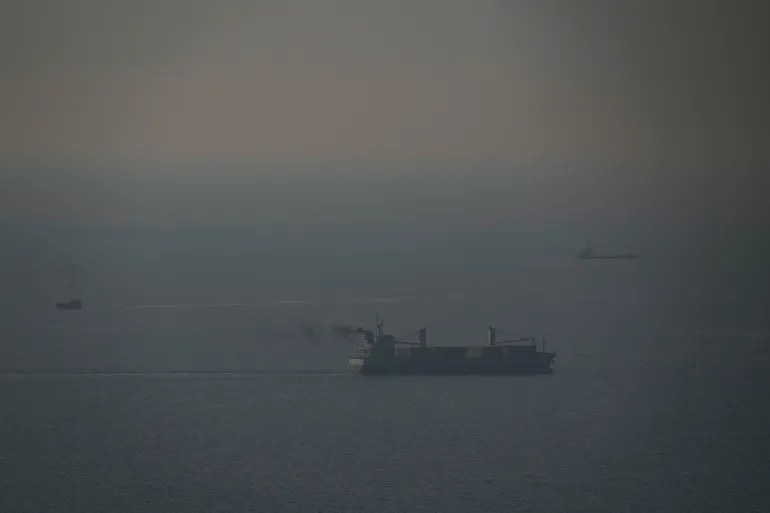
A cargo ship sails in the Gulf towards the Strait of Hormuz, as seen from Dubai, United Arab Emirates, on October 21, 2026 [Altaf Qadri/AP]
The soaring cost of delivery
Such workarounds have nonetheless come at a cost.
Freight costs have reached as much as $40 per barrel in recent weeks, about 10 times the usual rate, according to data from the London Stock Exchange Group, the surge driven by elevated insurance premiums in addition to logistical challenges.
October has been the deadliest month for attacks on commercial vessels since the start of the war, with 32 incidents logged by the United Kingdom Maritime Trade Operations (UKMTO) as of Friday.
“So barrels are moving, but neither smoothly nor reliably. That should not be read as a sign of normalisation,” Isabel Figuerola-Ferretti, an expert in oil markets at Comillas Pontifical University in Madrid, Spain, told Al Jazeera.
“Delivering a barrel has become far more expensive,” Figuerola-Ferretti said.
While market intelligence data has shown exports reaching pre-war levels at various points in recent weeks, the longer-term supply trend is less clear.
Pavel Molchanov, an investment strategist at Raymond James & Associates, expressed scepticism that supply has returned to the pre-conflict trend.
“The IEA’s most recent production data – for September – shows OPEC Gulf production at 15.8 million bpd, which equates to 75 percent of the pre-war baseline,” Molchanov told Al Jazeera, referring to the International Energy Agency’s latest energy outlook.
“That slightly surpassed July’s 74 percent to reach the highest level since the start of the war, but it’s still a considerable distance from 100 percent.”
Meanwhile, oil stockpiles, a buffer during supply disruptions, are waning.
Observed inventories fell by 10 million barrels in September, taking the global stockpile to 509 million barrels below its pre-war level, according to the IEA.
“The market has moved to a chronic squeeze, driven by concrete supply risks: Hormuz transit, shipping and depleted inventories,” Figuerola-Ferretti said.
No reprieve anytime soon
With no permanent end to the Iran war in sight, few analysts see prices returning to normal anytime soon.
Brent futures for delivery in October 2027 stood at more than $90 a barrel on Friday, in a sign that markets see normality as a long way off, still.
“When could prices return to $70? Not soon,” Figuerola-Ferretti said.
“It would need durable de-escalation, a return to normal transit and shipping conditions through Hormuz, rebuilt inventories and freight costs back to normal,” she added.
Molchanov, the investment strategist, said he did not believe supply could realistically exceed 85 percent of pre-war levels without a permanent diplomatic solution to the war.
“Once the political groundwork is in place, the next steps will be logistical: Demining Hormuz, bringing shipping crews back to work, and resuming production at currently shut-in oilfields,” he said.
Rodríguez made the announcement during a Wednesday cabinet meeting. (Presidential Press)
Caracas, October 29, 2026 (venezuelanalysis.com) – Venezuelan Acting President Delcy Rodríguez has instructed the Foreign Ministry and the Attorney General’s Office to advance diplomatic and legal efforts to recover 31 tonnes of Venezuelan gold held by the Bank of England’s vaults for more than six years.
The freeze on the reserves, currently valued at around US $4 billion, dates back to the United Kingdom’s refusal to recognize Nicolás Maduro’s 2018 reelection. A year later, opposition leader Juan Guaidó formally asked British authorities to prevent the Venezuelan government from accessing the gold.
During a cabinet meeting on Wednesday, Rodríguez described the ongoing freeze as a theft.
“It is a mockery, but one aimed at illegitimately appropriating Venezuela’s gold reserves. We want no more excuses. Even the irrational lawsuit pursued by opposition factions was withdrawn by the very same people who brought it,” she said.
Rodríguez added that she “will not give up” on the claim and recalled that “there is an agreement among Venezuela’s political sectors” to secure the gold’s return.
The Venezuelan government and an opposition sector representing the defunct 2015 National Assembly have been engaged in a US-backed dialogue process. On October 21, the delegations agreed to establish a joint commission to engage with London and seek the return of the reserves. The parties announced that the funds would be destined for post-earthquake reconstruction efforts, though Rodríguez has also pledged to use it to bolster public services and the electricity grid.
The acting leader had previously written to King Charles III requesting the release of the gold. In September, London and Caracas likewise began a diplomatic rapprochement and announced plans to appoint ambassadors to their respective missions.
According to reports, the Venezuelan gold is set to be transferred to the US Federal Reserve in New York, where its sale or use as collateral for loans would be contingent on the Trump administration’s approval and subjected to foreign audits.
Wednesday’s cabinet meeting additionally saw Rodríguez announce the arrival of 41 heavy machinery units to southeast Bolívar State to strengthen the Venezuelan Mining Corporation’s (CVM) operations at the Chocó plant.
The acting president said the delivery was part of a comprehensive state plan to acquire 544 pieces of equipment, including surface and underground machinery, drilling equipment, and mobile units.
“More than 60 percent of this purchase will have arrived before the end of the year. What does that tell us? More gold production in 2027,” she affirmed. The Venezuelan executive has pushed a pro-business overhaul of mining legislation in recent months in a bid to court foreign investment. In September, New York-based Heeney Capital and commodities trader Mercuria Energy received a 30-year concession of the Chocó 10 mine in Bolívar State.
Rodríguez also promised short-term relief from electricity outages, often lasting up to 12 hours a day in certain parts of the country. However, she criticized the recurrent protests against blackouts
“I have not seen a single megawatt added to the national electricity system, which has been battered by the blockade, as a result of burning a tire (…) Soon, you will see relief in a country that has been hit so hard by the sanctions demanded by radical sectors,” she said.
Venezuelan authorities have pledged to restore 1,300 MW of generation capacity before the end of the year to mitigate a current deficit of around 4,500 MW. The Venezuelan National Assembly is close to approving a reform that will open electrical generation, transmission, distribution, and commercialization to the private sector.
Caracas has also turned to multinational corporations in a bid to recover the electrical grid.
However, GE Vernova CEO Scott Strazik stated that the company had already selected its contractors and completed the planning work but had not begun repairs because it has yet to be paid. “This is not an environment in which we are going to act without receiving payment upfront,” he said.
Meanwhile, popular organizations and trade unions staged demonstrations in Caracas and other cities on Tuesday. Through the newly formed “Blackout Victims Committee,” activists criticized the government for prioritizing the oil industry to satisfy US interests at the expense of rationing electricity throughout the country.
The epic war drama is based on a true story and viewers have hailed it an ‘outstanding masterpiece’ that’s ‘as good as Saving Private Ryan’ – it’s leaving Netflix on November 5.
The war film is being hailed as a ‘masterpiece’(Image: Warner Bros)
For most film fans when the subject of war films arises a handful of reliable titles dominate the conversation and establish the standard. Movies such as Saving Private Ryan, Black Hawk Down, and The Hurt Locker have long been regarded as masterworks in the genre, with discussions inevitably returning to these films.
However, audiences are now claiming there’s another war movie by a legendary actor and director that rivals, if not surpasses, the Holy Trinity referenced above.
Viewers have just a few more days remaining to watch the ‘masterpiece’ war drama, though, as the film is departing the Netflix library on November 5.
Featuring an outstanding Bradley Cooper in the central role – who has received endless praise for his titular performance in the picture – this 2014 war drama has been helmed by acting icon Clint Eastwood.
American Sniper is presently streaming on Netflix – and audiences simply cannot get enough of the war drama, reports the Express.
The picture’s official synopsis states: “Navy S.E.A.L. sniper Chris Kyle’s pinpoint accuracy saves countless lives on the battlefield and turns him into a legend. Back home with his family after four tours of duty, however, Chris finds that it is the war he can’t leave behind.”
Sienna Miller plays the female lead of the picture alongside Cooper, and the leading duo are supported by Luke Grimes, Jake McDorman, Cory Hardrict, Kevin Lacz, Navid Negahban, and Keir O’Donnell in additional roles. American Sniper draws from the 2012 memoir of the same title written by war veteran Chris Kyle alongside Scott McEwen and Jim DeFelice.
The war drama proved a colossal box office triumph, raking in $547 million against a production budget of roughly $59 million.
Beyond its commercial triumph, the picture garnered critical acclaim, securing six Academy Award nominations including Best Picture, Best Adapted Screenplay, and Best Actor for Cooper, while ultimately claiming an Oscar for Best Sound Editing.
Audiences are completely taken with the war drama, as one fan writes on Rotten Tomatoes: “Powerful, emotional and very gritty. Directed to a tee by Clint Eastwood and Bradley Cooper excels as usual exceptionally well in character. Top class cinematography and writing. Succeeds in gripping you to the point where you can almost experience the settings physically. Outstanding on absolutely every level. Truly a memorable movie about a memorable man.”
Another viewer said of the film: “I can’t remember a movie in the last decade, that was as riveting and captivating as “American Sniper.” I kept seeing the trailer on TV and when I finally went to see it, I was already jacked-up…and it delivered. A+ Script A+ Director A+ Lead Actor A+ Supporting Actors A+ Cinematographer. Eastwood, Cooper and the screenwriter made a great team…which eventually became a great film.”
While another audience review reads: “One of the best war movies of our time. The character is really in focus and has a lot of development which makes it stand out in the sea of meaningless war stories. Really emotional and intense throughout. Amazing performance from Bradley Cooper too.”
Critics have been left equally bowled over, as one writes: “… a mature film of the toll war takes on its warriors, and you should see it, regardless of your politics.”
While another reviewer noted: “What a surprise that rather than an uncritical testament to the might of the armed forces, Eastwood delivers this complex, conflicted and profoundly moving look at the military machine, and the toll it takes on the soldiers.”
A third critic added: “American Sniper is devastating on the emotional level, especially with a very buffed-up Bradley Cooper in the lead role.”
American Sniper is available to stream on Netflix till November 4.