In a document sent to EU legislators and seen by Euronews, the US has threatened the EU with retaliation if it does not scrap European preference provisions in its multiannual budget.
ADVERTISEMENT
ADVERTISEMENT
EU member states are currently discussing the EU’s long-term budget (2028-2034), which includes a €402 billion fund dedicated to competitiveness that favours the production of key goods within the EU, including in defence.
The measure would potentially exclude foreign firms from EU financing to protect strategic and economic security interests.
“With further expansion of European preference measures in EU defence funds, the United States will review all potential response measures, including a rollback of the existing ‘Buy American’ blanket waivers and exceptions associated with the RDPAs [Reciprocal Defence Procurement Agreements] with 19 of the 27 member states,” the non-paper reads.
The Buy American Act requires the US government, including the US Department of Defence, to give preference to products manufactured in the US for certain public procurements, with some exceptions being granted in defence for some EU countries.
The non-paper adds that the European preference would impede “partnership” and “collaboration” with the US, and calls on the EU to introduce a “made with Europe” system – or, in the specific area of defence, a “made in NATO”.
Trade tensions
The US’s latest warning comes after the creation of the Security Action for Europe programme in 2025, already sparked trade tensions between Washington and Brussels over a European preference for joint purchases of arms and military equipment.
The “made in Europe” approach is also pushed by France and the European Commission in several pieces of legislation over the last year designed to boost EU industry, with foreign countries lobbying hard against being excluded from the EU market.
The US and EU have been at loggerheads over trade since the start of the second Trump administration, amid repeated tariff threats and disputes over environmental and digital regulations which the White House deems to be non-tariff barriers.
The Commission hoped that the conclusion of a trade agreement in July 2025 would be a step towards a more stable transatlantic relationship.
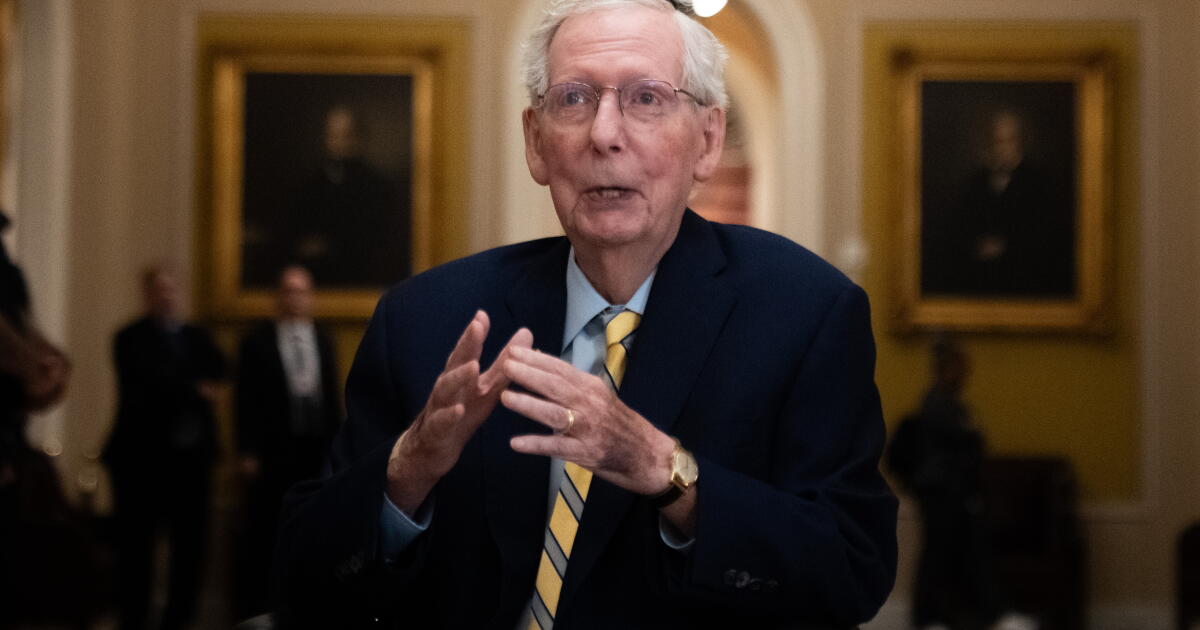
WASHINGTON — Republican Sen. Mitch McConnell of Kentucky returned to the Senate to vote on Monday for the first time in three months, looking noticeably more frail after he was hospitalized for a June fall in his home.
McConnell’s lengthy absence from the Senate generated a flood of criticism and online speculation, as he initially remained quiet for weeks about his condition. The 84-year-old senator eventually disclosed a month later that he had been “briefly unconscious” due to the fall and had also been treated for mild pneumonia in the hospital.
He briefly addressed reporters Monday from a wheelchair outside the Senate chamber, smiling but speaking slowly and with some difficulty. McConnell joked that he wasn’t sure how many reporters would be there after dodging so many questions during his almost two decades as leader.
He said he was back in the Senate to work on a pending farm bill and because he has an ongoing interest in NATO and “backing up our good friends who are totally in the fight against the Russians.”
Reporters and photographers were told by Senate staff not to take video of his remarks in the second-floor hallway, even though video is often permitted in that area. Still images were allowed.
McConnell, who holds the distinction of being the longest-serving Senate leader, is in his final months of his four decades in office. He is retiring at the end of January after one of the most consequential careers in modern politics.
Republicans have nominated U.S. Rep. Andy Barr to replace him, while Democrats have nominated former state lawmaker Charles Booker. McConnell has said he is determined to finish out his term.
McConnell suggests he’s still recovering
In a statement issued before his remarks, McConnell made clear that he may still miss some votes due to his health issues.
He said that he is “still not quite back to 100%, but I’ve assured Leader (John) Thune that, as I continue with physical therapy on the advice of my doctors, I will do my best to be present for tough votes when our Conference needs me.”
“My recovery has been a long and often frustrating process, and the lingering effects of childhood polio haven’t made it any easier,” McConnell said in the statement.
The senator’s extended leave highlighted increasing public concern about the age of lawmakers and their capacity to carry out their duties. Speculation about his condition grew so intense at one point that Kentucky’s Democratic Gov. Andy Beshear took the extraordinary step of issuing a public letter asking McConnell to update the public in a “transparent manner.”
McConnell’s absence was also felt over the summer as Republicans were unable to advance a farm bill out of committee. His return could give GOP leaders a needed vote as they try to advance legislation on cryptocurrency regulation and college sports.
A history of health problems
McConnell had polio in his early childhood and has long acknowledged difficulty as an adult in walking and climbing stairs.
A statement from the Capitol physician that was included with McConnell’s July release said that the senator has “experienced several falls through the year” due to his “post-polio condition.” The office said his physical therapy was aimed at reducing the risk of him falling again.
“A comprehensive evaluation by a multidisciplinary team determined that he had no fractures, cardiac abnormalities, stroke, tumor, or hemorrhage,” the physician’s office said.
McConnell was first elected to the Senate in 1984 and was the Republican leader from 2007 until last year, serving as both majority and minority leader during that period.
Toward the end of his time as leader and in the last two years as a rank and file senator, McConnell’s health has visibly declined.
He was hospitalized with a concussion in March 2023 and missed several weeks of work after falling in a Washington hotel. He twice froze up during news conferences after he returned, staring vacantly ahead before colleagues and staff. A year later, he fell and sprained his wrist while walking out of a GOP luncheon.
BERLIN: Iraqi Prime Minister Ali al-Zaidi said on Tuesday that he discussed selling oil to Europe during visits to France and Germany, as Baghdad seeks to diversify its export routes and reduce its reliance on the Strait of Hormuz.
During a press conference with German Chancellor Friedrich Merz in Berlin, Zaidi said “we want to expand and diversify our export routes”.
He added that “Iraq cannot remain hostage to a single corridor” as recent events have demonstrated, referring to the Strait of Hormuz, which has been blockaded by Iran during the Middle East war.
Zaidi said that he had discussed oil exports to Europe with Merz and French President Emmanuel Macron, whom he met in Paris on Monday.
Crude oil sales account for nearly 90 percent of Iraq’s revenue but its exports have been hurt by the outbreak of the Middle East war between Iran and the United States.
Before the war began in February, Iraq produced around four million barrels per day, and exported an average of 3.4 million bpd, mostly via Hormuz.
Most of its oil exports go to East Asia, with China and India its largest buyers.
Due to the disruption, Iraq began exporting crude using tanker trucks through Syria, as well as through a pipeline to the Turkish port of Ceyhan, although these routes can handle only a fraction of its usual sea-bound trade.
Zaidi said that Baghdad could “double its oil exports through the Mediterranean” to supply markets in Europe and the United States.
Zaidi, who hopes to increase Iraq’s oil production to 10 million barrels per day, said that “a large share, or nearly half, can go to European countries and the West”.
He said that Iraq and Germany were expected to reach “an understanding on the export of crude oil” while Baghdad would purchase German technology and equipment.
Merz said that the main focus for Iraqi-German cooperation is the economy.
“Many German companies are now active in Iraq. They are developing new solutions, for example for energy supply,” he said, adding that “the best example is an agreement on Iraq’s electricity supply, which we will sign today”.
Merz also expressed his concerns after Yemen’s Houthis cemented their control over the Bab al-Mandab waterway at the entrance to the Red Sea, a vital route for Saudi oil exports.
“This further exacerbates the situation on the energy markets, and also affects Germany,” he said.
Moscow and Copenhagen trade blame for the incident as Denmark says it will not invoke NATO treaty.
Published On 15 Sep 202615 Sep 2026
Moscow has warned Denmark to avoid “reckless” action after a Russian frigate fired two flares that narrowly missed a Danish military helicopter.
Moscow’s ambassador in Copenhagen, Vladimir Barbin, on Tuesday insisted that “dangerous manoeuvres” taken by the Danish aircraft were to blame for the Baltic Sea incident.
Recommended Stories
list of 3 itemsend of list
The Russian diplomat told state news agency RIA Novosti that he had delivered a formal note demanding steps to prevent a repeat of the episode.
He said that the helicopter’s actions were provocative and condemned Danish attempts to call them routine, saying they raised “serious concern about the possible consequences of such recklessness”.
The Fennec helicopter was on a routine mission to photograph the frigate as it sailed in international waters off Denmark, the Danish defence command said. Ships typically use such flares as warning signals.
Denmark’s Defence Minister Jeppe Bruus told TV 2 News that one flare passed within a “matter of metres” of the aircraft, and accused Russia of “deeply unprofessional seamanship”.
When asked if Denmark would seek Article 5 consultations over the incident – invoking the NATO measure that considers an attack against one member of the bloc to be an attack against all of them – Bruus said the incident was being taken seriously, but “we are not there”.
Barbin said he had complained last year about what he called dangerous fly-bys and low hovering by a Danish helicopter over the Russian warship Vice-Admiral Kulakov.
Kremlin spokesman Dmitry Peskov declined to comment, saying he lacked details.
The Danish Straits – where most Danish incidents with Russia have taken place – are the Baltic’s main shipping gateway and a key oil route, including for Russian oil tankers.
Danish Prime Minister Mette Frederiksen called the incident serious but not surprising, describing it as part of a pattern of intensifying Russian hybrid warfare against Europe and testing NATO.
‘Fear and discord’
“Russia wants to sow fear and discord,” Frederiksen said, calling for closer unity and stronger defences for Denmark and Europe.
Russia denies carrying out hybrid attacks in Europe. However, the potential for the war in Ukraine to escalate and entangle Europe’s NATO member states is rising.
A spokeswoman for Russia’s Foreign Ministry later on Tuesday warned Western politicians and diplomats to “soberly” assess the risks of travelling to Ukraine, following a Russian drone strike on a rail line on which a train carrying former British Prime Minister Boris Johnson and former Swedish Prime Minister Carl Bildt had passed minutes earlier.
Rail hubs and transport infrastructure serving Ukraine’s military are legitimate targets, she said, and Russia warned foreign diplomats in May to leave Kyiv because of strikes on Ukraine’s military-industrial complex.
It’s been more than six years since teenager Noah Donohoe was found dead 600m into a freezing underground water tunnel in Belfast.
His death – and the speculation over what happened to him in the week between his daylight disappearance and the discovery of his body – became a huge news story that provoked countless unanswered questions.
Now, after an inquest and months of exhaustive hearings and long deliberations by a jury, there is a verdict – but much is still unknown about what happened to Noah.
Why, the night before he disappeared, did he leave his home in the middle of the rain-soaked night? Where did he go? Why did he come back 34 minutes later, as documented by CCTV, barefoot?
Hours later, on Sunday 21 June 2020, he left the south Belfast home he shared with his mother for the final time.
Why did he leave and go to an unfamiliar part of north Belfast? Why was the teenager naked when he was last seen in the area of the water tunnel entrance?
And what might have been if he had seen the social media message sent him by one of two friends he planned to meet in north Belfast telling him their plans were cancelled?
An autopsy found Noah had died from drowning, with the tunnel he was found in heading towards Belfast Lough and its tides.
Now, after years of delays, a jury has found that it was possible, but not probable, that failings by the Department of Infrastructure over the tunnel in which he was found contribute to his death.
They also found 13 failings by the Police Service of Northern Ireland (PSNI) but that these did not in any way contribute to the 14-year-old’s death.
Having spent months in court following all the evidence, it was clearly not an easy process for the men and women of the jury.
They heard from dozens of witnesses and received voluminous amounts of official and expert documentation.
This week they deliberated on Monday and Tuesday. But it came more than two months after the inquest was dramatically adjourned in the early hours after three days of deliberations did not lead to a verdict.
A federal film and television tax credit could boost U.S. production spending by $125 billion and add more than 143,000 jobs by 2035, according to a new study commissioned by the Motion Picture Assn.
The analysis, released Tuesday morning, is expected to bolster Hollywood’s push for a federal production incentive, which the industry says is necessary to compete with the generous credits offered abroad. Sixty-five nations now offer them, the study said.
The effort has been quietly building for more than a year. It got a major boost last month when President Trump posted on Truth Social backing a proposed credit.
Details are still being worked out,, but the study assumed a transferable credit with a minimum rate of 20% on qualified spending for U.S. resident labor — broadly what industry groups have supported. It also assumed add-ons of 5% for independent production companies and 5% for labor costs in areas the Federal Emergency Management Agency has declared disasters.
If the incentive took effect Jan. 1, 2027, U.S. production spending would reach $277.5 billion through 2035, the study said, compared with $152.2 billion without it.
A coalition that includes the Motion Picture Assn., industry unions, producers’ groups and small production businesses, along with Democratic and Republican lawmakers, is expected to press the case at a virtual news conference Tuesday.
“A federal incentive would be a gamechanger for our industry,” Charles Rivkin, chairman and chief executive of the Motion Picture Assn., said in a statement. “This study tells us that we can bring more opportunities to life for people in all 50 states who bring great stories to life.”
RIYADH: Saudi Arabia has surpassed its goal of training 1 million people in AI through a new initiative that embeds ethical use and safety standards into national skilling programs
Speaking at the 4th UNESCO Global Forum on the Ethics of AI in Riyadh, Ahmed Al-Ghamdi, CEO of the Saudi Data and AI Authority’s capacity building sector, said: “We launched SAMAI (One Million Saudis in AI initiative) last year to train 1 million in AI, raise awareness and provide them with the knowledge and skills to use AI in life and in their work.
“We trained more than that number and an important part of the training focused on ethical AI, responsible use and data preservation,” he told Arab News.
The UNESCO forum is co-hosted by Saudi Arabia, represented by the SDAIA and the International Centre for AI Research and Ethics.
Al-Ghamdi said that the forum had brought together more than 25 ministers from around the world, as well as global leaders and tech companies under the umbrella of UNESCO to shape the future of AI safety and responsible use.
SAMAI was part of a broader push to invest in capability building across national sectors and entities, enabling them to develop the skills needed to adopt AI safely and effectively, he said.
“In SAMAI we provided training with knowledge on what data to show and what tools to use safely.”
Al-Ghamdi said that ethical AI was positioned as a core element across the SDAIA’s training programs and frameworks, rather than a standalone topic.
The authority announced national frameworks and curricula for AI in January as part of efforts to align education pathways with national needs.
Additional capacity building frameworks were also announced at the International Conference on Data and AI Capacity Building, aimed at professionals, educators and training programs to support wider adoption across the economy, Al-Ghamdi said.
“For example, for the developers it includes training the right model on the right data, avoiding bias, and not using AI for fraud or any violence,” he said.
“It includes respecting the data privacy of people and organizations and complying with data laws within the country and within the world.”
The pace of AI advancement had raised the stakes globally, making governance and ethics central to discussions about safe deployment and public trust, he said.
“The ethics of AI comes in the heart of all activities of capability building in SDAIA. We believe the ethical use and the safety of AI are a priority for us.”
Draper will not qualify for a protected ranking if he does return in January, as only those who are out for over six months are able to retain the ranking they had when they left the tour.
He is currently ranked 155, which means he would require wildcards or have to come through qualifying to play in Grand Slams and ATP Tour events.
But none of that will worry him if he is able to play freely and without so much pain.
Draper peaked at four in the world last June after winning a first Masters 1000 title in Indian Wells and finishing runner-up at another in Madrid.
“Last summer, all the dedication and work I had put into this sport was coming together,” Draper added.
“It was all going my way and the path seemed so clear. However a complicated injury made things incredibly challenging, and since that moment I’ve been desperately trying to get back and feel as I once did on the court.
“Managing so much change, adversity and pain has helped me to grow massively in many areas of my life but has also made me feel a level of fatigue.”
Draper has taken a holiday with friends in recent weeks and has been trying to aid his recovery by taking a mental break from the sport.
He is expected to make a gradual return to training over the next few weeks, as his team try to work out the principal causes of the injury.
If you’re planning a weekend in Windsor with a trip to Legoland included, this fancy hotel is a treat for the grown-ups but still has everything you need for the kids
15:58, 15 Sep 2026Updated 16:03, 15 Sep 2026
This article contains affiliate links, we will receive a commission on any sales we generate from it. Learn more
(Image: Julie Delahaye)
“Oh no, this place looks fancy,” I told my partner as we drove up the winding path towards the De Vere Beaumont Estate in Windsor.
With its stately home feel and landscaped gardens, it had all of the makings of a lovely romantic getaway. Except we’d turned up with our two-year-old toddler, and now I worried that, despite promising to be a family-friendly hotel, this might be one of those properties where ‘family friendly’ means ‘as long as your kid sits quietly in the corner’. Thankfully, I was wrong.
De Vere Beaumont Estate is quietly family-friendly; at a first look it doesn’t feel like children are welcome, but once you actually settle in, it’s very accommodating.
The hotel may feel grandiose from the outside, but it’s not pretentious. It’s modern with quirky artwork, cosy armchairs, and a parlour bar serving an impressive array of drinks, with a large outdoor terrace.
My only quibble was the check-in process; there was a wedding onsite which caused a long queue at the reception. We actually gave up for a while and went to the bar for about an hour before returning, and even then we still had to wait 20 minutes.
Still, when we did get the keys to our room, it wasn’t disappointing. It was a decent size with a double bed, two armchairs and a table, a desk, and a large bathroom (shower only). If, like us, you’re travelling with a little one who still needs milk at night, be warned that rooms don’t have mini fridges – but we had prepared and packed an ice cooler.
The estate is very picturesque with large landscaped gardens, patches of woodlands, and a playground for older kids. It felt like we scratched the surface when we went for a wander, but there are some longer walks for those who aren’t tied to taking a pram along for the ride.
When it came to dinner, we decided to stick onsite at the hotel’s 1705 Restaurant & Bar. Again, at first glance I wasn’t sure if it would be stress-free with a toddler.
For a start, there wasn’t a children’s menu which had me instantly panicking about whether we’d need to convince our two-year-old that he did in fact want the likes of salad or soup for dinner, but thankfully the staff were incredibly accommodating when we asked if there was anyway we could get some sort of simple pasta dish, and they made us a special portion of mac and cheese.
The menu for grown-ups did tick all the boxes though. We went for the scallops and mozzarella salads as our starters, and steaks for the main. Prices range around £14-£35 per person so it’s not a particularly cheap meal, but the overall vibes, good food and friendly staff made it feel like a holiday treat.
With a toddler, it was time to head back to the room for an early night. However, after an hour of him resisting sleep, we admitted defeat, and headed back down to the terrace for a drink, taking the toddler in his pyjamas, in the pram. Nobody batted an eyelid, we easily found a table, and ended up enjoying some nice wine in the last of the sunshine.
The next morning, after making the most of the hotel’s extensive breakfast and dropping off our room key in a very quick check-out process, we made the most of the hotel’s location just a 15-minute drive from LEGOLAND Windsor.
Our toddler was under 90cm which meant he could enter for free, but also meant he was too short for a few of the bigger attractions. Still we managed to tick off more than I expected including a submarine ride, a train, and the iconic Fairy Tale Brook boat ride. There were also heaps of playgrounds throughout the theme park. As for queues, the longest we saw was 35 minutes for a NINJAGO ride, but generally we were impressed at how quickly everything moved – a very welcome feature when you’re waiting around with a toddler.
The theme park allows you to bring your own food and drink in the park which was very helpful for snacks (our little one, like most his age, is spectacularly picky about what he will eat), but I wish we’d packed more for ourselves too as when we did decide to just get some nuggets and chips for lunch, as well as some ice creams, it set us back about £30.
Overall, De Vere Beaumont Estate proved an ideal base; a lovely space for us grown-ups to enjoy, and a handy location to one of the UK’s biggest attractions. It’s definitely one we’ll be returning to!
Rooms at the De Vere Beaumont Estate start from £129 a night based on two people sharing. Book at devere.co.uk.
LEGOLAND Windsor day tickets start from £32pp when booked online in advance at legoland.co.uk.
The United States has acknowledged deploying space weapons in orbit of the Earth.
US Air Force Secretary Troy Meink confirmed on Monday that the so-called “space control weapons” would be used to defend US forces on the planet, marking a significant new chapter in the militarisation of space – or at least the transparency of it.
The announcement, which Meink framed as a message to US rivals China and Russia, could turn Earth’s orbit into an increasingly contested military domain, experts warn. Warfare could include countries targeting each other’s satellites, which provide critical services such as GPS, communications and intelligence to military forces on the ground, as well as civilian infrastructure.
“Space Force doctrine describes ‘space control’ as having the outcome of space superiority, which they define as the ability to operate at the time and place of their choosing, while denying the same to an adversary,” Victoria Samson, chief director of Space Security and Stability for Secure World Foundation, a private non-profit focused on military space and security issues, told Al Jazeera.
So, what do we know about the US-deployed weapons in space? And do some countries already have them?
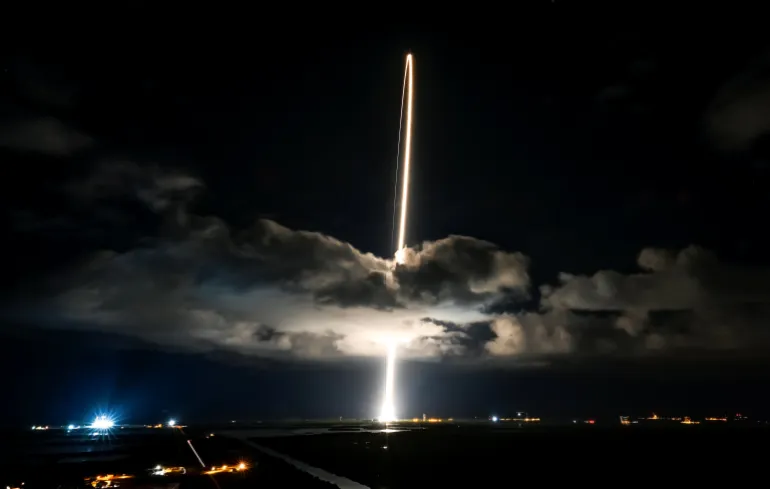
NASA’s Lucy spacecraft, atop a United Launch Alliance Atlas V rocket for a mission to study the Trojan asteroids in the outer solar system, launches from Pad-41 at Cape Canaveral Space Force Station in Cape Canaveral, Florida, the US, October 16, 2021 [Steve Nesius/Reuters]
What do we know about these space weapons?
Not a lot. Air Force Secretary Meink said the US has stationed “weapons” in Earth’s orbit, but did not specify when they were placed there, how many there are, or what they are designed to do.
“Today, we continue to ensure we remain ready to meet the challenges of evolving threats wherever they exist,” Meink said at the Air, Space and Cyber Conference. “This is why the United States now has on-orbit space control weapons capable of defending the Joint Force against hostile adversary action.”
However, he did not give any details about what sort of weapons these may be, where they are positioned or what they are designed to do.
Samson said the keyword from Meink’s announcement is “weapons” in the context of “space control”. “Space control encapsulates the mission areas required to contest and control the space domain – employing kinetic and non-kinetic means to affect adversary capabilities,” Meink said, adding that “these capabilities can be employed for offensive and defensive purposes”.
“That’s the first time any official has acknowledged an actually designed weapon has been placed in space,” Samson told Al Jazeera. “It’s always been ‘systems with capabilities’ prior.”
Experts say these weapons are likely to be space-based communications jammers rather than kinetic ones that launch strikes. Kinetic weapons – for instance, a suicide satellite designed to ram into an adversary’s satellite – would likely cause fast-moving debris to be launched dangerously into space.
Bleddyn Bowen, an associate professor in astropolitics at Durham University in the United Kingdom, told the BBC’s Radio 4 Today programme: “We don’t know exactly what the mechanism of the weapon is. I would expect there to be some kind of electronic warfare or radio-jamming platform. This would be a non-destructive kind of anti-satellite weapon, and these variants already exist on Earth.
“Less likely would be a kinetic kill vehicle of some sort, so a vehicle that would release a projectile of some sort that would ram into a satellite and destroy it.”
US President Donald Trump gestures towards the US Space Force flag during a presentation of the flag in the Oval Office of the White House in Washington, DC, the US, May 15, 2020 [Kevin Lamarque/Reuters]
What is the US Space Force?
The US Space Force is the newest branch of the US military, created in December 2019 under President Donald Trump’s first term, responsible for organising and conducting US military operations in and through space.
Unlike NASA, which focuses on civilian space exploration, Space Force is part of the US Air Force and comes under US Space Command, which is headquartered at the Pentagon in Arlington, Virginia.
Its responsibilities include operating and protecting military satellites, providing satellite communications and positioning services, monitoring objects and potential threats in space, and supporting US forces on Earth.
“China and Russia are developing new space systems to enhance military effectiveness and end any reliance on US space services,” the Space Force’s website says. “China and Russia are also testing and fielding sophisticated counterspace capabilities with the intent to disrupt and degrade US space-enabled capabilities.”
US Secretary of the Air Force Troy Meink speaks during the 2026 graduation ceremony at the US Air Force Academy, in Colorado Springs, Colorado, the US, on May 28, 2026 [Matt Rourke/AFP]
Aren’t there treaties limiting weapons deployments in space?
Yes, but they do not amount to a blanket ban on weapons in space.
The key agreement is the 1967 Outer Space Treaty, which prohibits countries from placing nuclear weapons or other weapons of mass destruction in orbit or stationing them in outer space. It also bans military bases and weapons testing on the moon and other celestial bodies.
However, the treaty does not expressly prohibit conventional weapons from being placed in Earth’s orbit. That means systems such as conventional anti-satellite weapons, electronic-warfare systems, or other counterspace capabilities are not automatically prohibited.
Such gaps leave room for interpretation and are at the heart of current international efforts to enhance military activities in space.
How have Russia and China reacted to the US announcement?
China’s Foreign Ministry opposed the move, warning against the “weaponisation of outer space, turning it into a battlefield, as well as an arms race there”.
“We urge the US side to stop expanding its military capabilities and preparing for war in outer space,” ministry spokesman Guo Jiakun told a news briefing.
Russia called for space to be kept “free of any weapons”.
“We are counting on broad international consolidation to continue working towards the complete demilitarisation of space,” said Kremlin spokesman Dmitry Peskov.
Are Russia and China developing space weapons too?
Independent reports from research groups and think tanks note that both China and Russia are developing a broad range of counterspace capabilities designed to interfere with, disable, or potentially destroy satellites and other space systems.
The Center for Strategic and International Studies (CSIS), a foreign policy think tank based in Washington, DC, identified both countries as possessing or developing kinetic and non-kinetic counterspace weapons.
A 2025 CSIS report notes that both Moscow and Beijing have direct-ascent anti-satellite (ASAT) weapons, as well as capabilities involving jamming, spoofing, and cyber operations.
Samson of the Secure World Foundation (SWF) told Al Jazeera that her team has highlighted in their reports that “China and Russia have space-based jammers”. Therefore, she told Al Jazeera, “I always thought it would be strange that the US didn’t have them too.”
Bowen told the BBC: “In the last 10 years, Russia and China have been doing a lot more manoeuvres in space – rendezvous and proximity operations, as we call them – so, flying up really close to Western satellites, inspecting them, taking pictures. And on another occasion, the Chinese have demonstrated a ‘space tug’ capability. So, a vehicle that goes up to a satellite can grapple it and then move it into a different orbit.”
China has executed such a manoeuvre only with one of its own old satellites, which needed to be moved away from its location, he added.
What about other countries?
The emerging space-weapons race is not limited to the US, Russia and China: India has also demonstrated an ASAT capability and is developing technologies that could allow spacecraft to operate alongside other satellites.
France is also reported to be developing co-orbital capabilities, while the UK has conducted on-orbit cooperative operations with the US.
A 2026 report by SWF also notes how Iran, for instance, illustrates the less visible side of space warfare, relying increasingly on jamming and spoofing satellite-based services. Israel, meanwhile, has developed significant military space and electronic-warfare capabilities, although there is no public record of it conducting a debris-generating ASAT test.
Countries like North Korea and South Korea are also racing to develop more sophisticated space-based tech.
A view of NASA’s Orion spacecraft in the foreground, lit up by the sun as the moon and Earth are visible behind it as photographed by one of the cameras on the Orion spacecraft’s solar arrays during the Artemis II crew’s flyby of the moon on April 6, 2026 [NASA/Handout via Reuters]
Is space the next frontier of war?
Samson told Al Jazeera that the US announcement of deploying weapons in Earth’s orbit is not essentially disruptive in the context of space technology. “What this does is normalise weaponising space,” she said.
“Space has always been a domain with the potential of being a flashpoint for conflict; this just turns up the heat there,” Samson added.
A US Space Force spokesperson told ABC News that the US “capabilities can be employed for offensive and defensive purposes at the direction of combatant commands”. The spokesperson noted that Washington “has warned about Russian and Chinese weapons testing and operationalisation since 2007”.
“Due to their actions, it is no longer a question that space is a warfighting domain,” the spokesperson said. “Open communication strengthens deterrence, prevents adversary miscalculation, and normalises space operations alongside the other services.”
Samson further noted that Meink’s statement “crosses a line”, and would “either encourage China and Russia to also declare weapons in space, or will make US allies and partners want to also place weapons in space”.
“Counterspace capabilities have been proliferating already – this speeds up that trend,” she said, adding that this “is incredibly destabilising and will work against US national security goals”.
“By opening the door to weaponising space, the US loses the most,” Samson noted. “Every person on this planet uses space-based data and services in some way. Any interference with access to or use of space will affect everyone, not just space powers.”
HILTON has revealed 10 new locations are set to come to the UK – and one is coming to a major capital city.
The new hotels will form part of the chain’s “value-focused” brand.
The new hotels will operate under Hilton’s budget-friendly brandCredit: Spark by HiltonThe hotels provide clean and reliable rooms at an affordable rateCredit: Spark by Hilton
Ten new hotels, operating under the Spark by Hilton brand, are set to come to major railway stations, stadiums, motorways and visitor attractions across the UK.
The locations, confirmed to open in Cardiff, Coventry, Derby, Doncaster – among others will add a total of 672 rooms to Hilton’s portfolio.
Sign up for the Travel newsletter
Thank you!
Created with “value” in mind, the sites will provide reliable, comfortable and affordable accommodation.
Exact dates of completion and room rates are yet to be confirmed, however the company said the new locations could open as early as late 2026 through to 2028.
Paul Blackmore, vice-president of development for the UK and Ireland at Hilton, said: “With nearly 700 rooms in the pipeline, including the brand’s first hotel in Wales, Spark continues to gain momentum.”
Launched in 2023, Spark by Hilton operates more than 275 hotels worldwide, with more than 200 properties in development.
The budget conscious “premium economy” brand was designed to provide a reliable and value-driven stay at an accessible price point.
The 10 properties have been signed through an agreement between Hilton and UK hotel owner and operator AG Hotels Group.
An additional 53-room property in Dunfermline, Scotland is scheduled to launch in late 2026.
However this is set to operate separately from the 10 hotels included in the latest agreement.
All 10 new Spark by Hilton locations
Spark by Hilton Cardiff North – 51 rooms
Spark by Hilton Coventry Walsgrave – 48 rooms
Spark by Hilton Derby Station – 100 rooms
Spark by Hilton Doncaster East – 51 rooms
Spark by Hilton Hull Central – 51 rooms
Spark by Hilton Peterborough Norman Cross – 99 rooms
Spark by Hilton Runcorn – 53 rooms
Spark by Hilton Sunderland Northern Spire Bridge – 63 rooms
Spark by Hilton Wakefield South – 77 rooms
Spark by Hilton Washington Newcastle South – 79 rooms
ITV will air some dramatic scenes on Big Brother just a couple of days into the series
Frankie struggled to hold back the tears(Image: ITV)
The emotions are already too much for some housemates.
One Big Brother star broke down in tears as they spoke about the real reason they have joined up for the ITV reality series. Chaos is also set to erupt in dramatic scenes airing tonight (September 15).
Fans have been teased about what to expect in the upcoming episode. It comes as more than a dozen new housemates moved into the famous residence to spend up to eight weeks as part of the unique social experiment.
However, despite being in there for less than 48 hours, it is clearly proving too much for some. The first morning in the house has already seen one star break down in tears.
Viewers tuning in will see Frankie, Johanne and Pauline are in the bathroom during a cryptic conversation. Frankie said: “I ain’t slept one bit. I feel like I went from a really big high to a really big low last night. Quick and all, the turnaround was weird. I went from high to straight low…”
Pauline asked: “But what caused that though?” Frankie hinted: “Oh, to be fair, like, I’ve come on here for various reasons. I know why, I need to get that sorted. Once that’s sorted…”
Johanne responded: “You’re so top secret with that. Everybody when you ask them like why did you come on it’s just like simple answer.”
Frankie explained: “Do you know what it is, I don’t want to… like I’ll be honest, I come on cause I was like… I don’t want to get upset though man.”
Try ITVX Premium free for a week
This article contains affiliate links, we will receive a commission on any sales we generate from it. Learn more
ITVX Premium offers exclusive ad-free content that can be streamed on-demand and on the go, with everything from Hollywood blockbusters to bingeable British box sets.
An annual plan costs £59.99 – equal to £4.99 per month – after a seven-day free trial.
Johanne said: “Your answer, it must be very complicated… You okay?” Frankie then struggled to hold back tears and puts his hand to his face, as he wiped his eyes.
Looking on, Pauline said: “Oh gosh.” They both asked if he is ok as Pauline reassuringly told him: “Frankie don’t. If you don’t want to disclose it, you don’t have to, you know.”
While Johanne offered: “Or if you need to disclose it and you need someone to talk to, you can.” It’s not yet known if Frankie does reveal the truth behind his motives but he confessed: “I knew it was gonna hit me but I didn’t think it’d hit me early. It’s hit me straight away…”
He also stated: “It has to be done, I have to face myself. I can’t run forever, do you know what I mean?” Meanwhile, later in the house there is a heated exchange between Johanne and Rochelle.
While some housemates attempted to play a game, it went too far. As part of it, Charlotte asked Johanne: “Who annoys you the most?”
Johanne replied: “Rochelle. It’s gonna be the same thing. She asked me who annoys me the most and I said Rochelle. I mean every answer, who do I like least, who annoys me the most. It’s gonna be her.”
Rochelle quipped: “Ditto… You’ve got a real f****** problem. You’ve only been here one day.” To which Johanne retorted and repeated the phrase: “You’re my f****** problem.” The argument continued and resulted in some of their fellow housemates stepping in to try and calm the situation.
Big Brother continues tonight at 9pm on ITV2 and streaming on ITVX.
Joy Ryan, 96, has visited six continents since getting her first passport at 91, but she must follow her doctor’s advice to do the same routine every hour on long-haul flights
Joy Ryan, pictured with her grandson Brad, has visited six continents (Image: grandmajoysroadtrip/Instagram)
A 96-year-old grandmother who didn’t get her first passport until she was 91 has still found the time to visit six continents. Joy Ryan shared one of the biggest issues with long-haul travel in her advanced years as she has to follow strict doctor’s orders.
Since first travelling abroad, Joy has explored destinations including Kenya, the Galapagos Islands and Antarctica. But her adventures come with a health concern: long-haul flights increase the risk of blood clots, something she has experienced before.
Flights lasting more than four hours can increase the risk of deep vein thrombosis, with the risk rising further on journeys lasting more than eight to 10 hours. For Joy, following her doctor’s advice to keep moving is an important part of her travels.
The grandmother, from Duncan Falls, Ohio, USA, and her grandson Brad are set to visit Thailand, Australia and South Africa later this year.
Her passion for travel began long before she needed a passport. Joy had originally planned to see the world with her husband, but he died just months into his retirement in 1994.
Two decades passed before another opportunity arose. She hadn’t even seen a mountain before joining Brad on an overnight trip to the Great Smoky Mountains, along the Tennessee-North Carolina border.
Brad had been struggling with depression after starting vet school and hoped spending time in nature with his grandmother would help his mental health.
That overnight stay grew into a mission to visit every US national park. Along the way, Joy discovered her favourite destination: American Samoa.
The US territory in the South Pacific sits almost 5,000 miles from America’s west coast. Joy was determined to visit its national park, and got her first passport ahead of the trip, reports the Express.
Speaking to the Daily Telegraph, she said: “You just feel comfortable because everybody’s so friendly. They don’t have much, but they share it with you.
“They take care of their elders, too. There are no nursing home. They take them into their homes and keep them, and then, when they pass away, they bury them in the front yard so they’re still looking after them.”
Now 96, Joy says it is remarkable to witness how differently people communicate around the world, even when she cannot understand them.
The pair’s Instagram account, @grandmajoysroadtrip, has more than 115,000 followers. Joy shares their adventures there, along with dating advice.
Brad’s book Grandma Joy and Me: A Journey of Healing, One National Park at a Time was published earlier this year.
Fund managers have shifted their primary market worry. Bank of America’s September Global Fund Manager Survey, which polled 170 investors overseeing $470B in assets now ranks a disorderly rise in bond yields as the top tail risk.
This is an abridged version of the original story in Spanish, the second part of award-winning investigative journalism project Dorada Opacidad. We will publish the second (and last) part of this investigation tomorrow.
When they pass through the streets of the Las Claritas–Kilómetro 88 mining corridor in Bolívar state, southern Venezuela, a thick, yellowish cloud of dust blankets them like a veil. The sound is unmistakable: a convoy of 15, 20, or 25 motorcycles riding together. Aboard are soldiers from the Orinoco Mining Arc Protection Group (GPAMO)—a unit conceived and activated in 2022 under the command of the Strategic Operational Command of the Bolivarian National Armed Forces (CEOFANB) to safeguard the deposits. They had never been there before June 9, 2026, when three rockets, shot by a US aircraft, shook the area’s flimsy houses. Now, GPAMO is the law.
Although some cover their faces, Rafael knows them well. He owns one of the gold mills operating at the El Mecatico mine—one of many in an area that holds the world’s fourth-largest gold deposit, according to a 2018 certification by Canadian mining company Gold Reserve. Standing beneath the tin roof that shelters his business, he explained that he would soon have to pay the GPAMO 20 grams of gold (roughly 2,000 US dollars) in exchange for a registration form that in theory is free. He is also required to make monthly payments to remain on the site.
For Rafael and the residents of Las Claritas, everything changed on the morning of June 9, when they woke up to find the area occupied by the military. In the early hours, dozens of vehicles transported hundreds of troops from various branches of the Bolivarian National Armed Forces (FANB)—such as the Special Affairs Directorate (DAE) of the General Directorate of Military Counterintelligence (DGCIM)—who patrolled the streets alongside unidentified men dressed in black and carrying long guns. Meanwhile, a pair of military aviation Cougar helicopters flew just above the rooftops of the houses.
The objective of that mobilization was to dismantle “The System.” That was the name given to the criminal alliance between Juan Gabriel Rivas Núñez—known as “Negro Juancho”—and Yohan José Romero (nicknamed “Johan Petrica” or “El Viejo”), one of the leaders of the “mega-gang” born in the Tocorón prison: the Tren de Aragua. For over a decade, this criminal alliance had dominated the territory containing one of the world’s largest gold mining complexes—Las Brisas-Las Cristinas—and had subjugated the local population through torture, mutilation, and murder.
All signs pointed to a “change of government”—a term used in the Venezuelan criminal underworld to describe one criminal group replacing another in a territory.
The residents were so terrified that they remained locked themselves in their homes for days. Rafael did not hear the explosions that rang out mid-morning in Brisas de Cuyuní, near the Kilómetro 88 mining area, because he had gone to his ore mill in the early hours of the morning without noticing the military deployment. Hours later, the military arrived in El Mecatico to destroy the warehouses and properties belonging to The System. This operation was repeated at other mines, as well as at hotels, homes, and businesses in the town.
To determine who truly holds power along the Las Claritas-Kilómetro 88 corridor and in the southern mining towns extending as far as Guasipati, a team of reporters from the Alianza Rebelde Investiga (ARI) and Convoca toured the region as part of the investigative series Dorada Opacidad (Golden Opacity). Interviews with more than twenty sources—ranging from merchants, mill operators, police officers, and local residents to religious figures and local government officials—made it possible to map out the new criminal landscape of the Orinoco Mining Arc.
For days, information about the events was available only through social media or details gathered by journalists working remotely. The first official explanation did not come from any Venezuelan authority, but from Donald Trump. Three days after the bombings, the president stated that his country’s Southern Command had launched a “kinetic attack” to “take out” AKA Niño Guerrero—the nickname of Héctor Rusthenford Guerrero Flores, the most prominent leader of the Tren de Aragua—with the collaboration of the Delcy Rodríguez government.
A new criminal governance
From then on, a military-imposed order took hold in Las Claritas. Rafael recounted that shortly after the town was seized, all mine workers were summoned to a meeting where a FANB captain urged them to keep working without pause, as they had to “produce as Commander Delcy Rodríguez ordered.”
All signs pointed to a “change of government”—a term used in the Venezuelan criminal underworld to describe one criminal group replacing another in a territory, without necessarily putting an end to criminal activities.
That call for productivity came with no guarantees. The mill operator, his shoulders slumped in despair, recalled the sense of security The System had once provided: he could leave his tools outside and stay at his mill until midnight. After the military incursion, however, he had to finish his work and leave before 6:00 pm for fear of being robbed, as happened to others in the mine.
The military has displaced the armed group in the Las Claritas-Kilómetro 88 area, but shares control with criminal mafias in El Dorado and Guasipati.
Since the military took control to oust The System, extortion of merchants, gold buyers, and even random passersby had become commonplace, according to several sources on the ground consulted for this investigation. Soldiers seized sacks of gold-bearing sand left behind by members of The System in order to process them and extract the gold, recounted Óscar, speaking from a shop on the town’s main road. “A captain who extracts gold every day exchanges 5,000 or 6,000 dollars in cash, and asks a friend to convert it to USDT [a cryptocurrency] and send it to Puerto Ordaz,” he said.
Military personnel capitalized on the gold-bearing sands that The System had not processed. Photo: Lorena Meléndez G.
According to witnesses, soldiers confiscated motorcycles and vehicles belonging to people with no ties to The System and spread fear across all the mining towns in southern Bolívar, about whether FANB would bomb all territories within the Mining Arc where armed groups operate, or the joint operation with the Americans would end in another massacre of workers by military forces.
However, local residents confirmed that the intervention was limited to Las Claritas-Kilómetro 88. Meanwhile, in towns like El Dorado, Tumeremo, and El Callao, criminal gangs continue to reign, albeit more discreetly and without the brazen displays of the past.
Former Bolívar lawmaker Américo De Grazia claimed on social media that The System’s ringleaders had returned to their old territory, though locals dispute this. Yet De Grazia’s account is not far-fetched: locals told the ARI and Convoca team that some of The System’s bosses—including the men known as Juancho and Johan Petrica—had left Las Claritas a few days before the military incursion. Apparently, they had been tipped off and fled. They were spotted trying to lay low near the Brazilian border.
What does seem clear is that in the Las Claritas-Kilómetro 88, the military displaced the armed group, but in El Dorado and Guasipati, they share control with criminal mafias—albeit maintaining a lower profile to preserve appearances before the Venezuelan government’s new partners: American businesspeople.
The American footprint
Five days after Maduro was taken away, Delcy Rodríguez announced a package of legislative amendments designed to appease Washington—such as a reformed mining law, whose latest version offers low taxes and numerous concessions to foreign capital that was previously unwelcome.
The new legislation, enacted in April, repealed the decree that had reserved the exploration and exploitation of gold and other strategic minerals for the State, paving the way for private and international companies to engage in these activities through concessions lasting up to 50 years.
Furthermore, it established special payments (up to 1% of gross production under the concession contract for the National Mining Fund and a royalty of up to 13% for the State), a tax of up to 6% regulated by the government, and incentives such as exemptions from the Large Assets Tax, as well as special contributions mandated by four other laws—including the Law on the Protection of Social Security Pensions—all aimed at benefiting the new companies operating in Venezuela’s mining sector.
Alongside the law’s approval, the United States also took action: in March, it issued licenses allowing American companies to purchase, transport, and resell Venezuelan gold. On September 2, the Treasury Department’s Office of Foreign Assets Control (OFAC) expanded the scope of these licenses, authorizing US companies to participate in the export, sale, purchase, storage, transport, processing, and refining of minerals of Venezuelan origin, including gold. It also permitted the supply of specific goods and services for mineral operations, as well as the negotiation and execution of contracts within the mining sector.
This entire framework has enabled Rodríguez to consolidate her economic team within the government through the appointment of key officials—both civilian and military—to positions within the Mining Arc. Their key figures are positioned not only within the executive branch but also across the State-owned enterprises involved in the business, and among military personnel capable of guaranteeing gasoline supplies and mine operations.
The interviewees’ identities have been changed for their safety.This report was supported by the Pulitzer Center.
Text and photos: Lorena Meléndez | Coordination and editing: Ronna Rísquez | General direction: Milagros Salazar | Design and infographics: ET
Houthi-run TV has aired drone video of Yemen’s Mocha International Airport, empty and abandoned after the Iran-backed group took control of the city. The Houthi capture of the Red Sea coast puts a key global trade route at risk.
“No more imported rice” sign at a recent protest. (Archive)
Caracas, September 14, 2026 (venezuelanalysis.com) – The US Department of Agriculture’s (USDA) Foreign Agricultural Service announced a package of measures to boost US agricultural exports to Venezuela amid growing concerns about the South American country’s national production.
According to the USDA, the plan will facilitate Venezuelan corporations’ purchase of US food products and agricultural commodities through government-backed credit and will include the delivery of food assistance and training for Venezuelan technicians.
“The Trump administration is committed to Venezuela’s economic prosperity, and USDA is leveraging its export financing, market development programs, technical scholarships, and food assistance initiatives to address this situation,” said Under Secretary for Trade and Foreign Agricultural Affairs Luke J. Lindberg.
Lindberg added that he “looks forward to positioning US agriculture to help meet needs and build lasting trade relationships.” The US official visited Venezuela as part of an official delegation in early July.
Washington’s credit program for food exports will be provided through the reactivation of the GSM-102 guarantee program. The mechanism offers guarantees to exporters that reduce the risk for financial institutions backing the transactions in case importers fail to meet their commitments.
The Agriculture Department also announced that it will lift restrictions to allow foreign banks to back Venezuela-related transactions.
A USDA report had already estimated that Venezuela would need to import 1.5 million metric tons of wheat during the 2026-2027 marketing year. Corn and soybeans are likewise identified as key staples to be exported to the Caribbean nation. The latest initiative
The Trump administration also lifted restrictions under its Feed the Future Agricultural Resilience Mission Initiative and plans to include Venezuela in a regional agribusiness trade mission scheduled for early 2027.
A bigger influx of US farm products will place an additional strain on Venezuelan food production, with local campesinos increasingly protesting against imports from agribusiness corporations that seek to drive crop prices down.
On September 9, rice growers from Guárico and nearby states organized a “tractorazo,” blocking a major highway in Calabozo with trucks and tractors to demand that the government halt the entry of imported rice during the domestic harvest season and ensure that agroindustrial companies adhere to established prices.
Protesters complained that imports from countries where food production is subsidized, including the US, create unfair competition and risk driving Venezuelan campesinos bankrupt. The latest mobilization was sparked by the reported arrival of a shipment of 355 thousand tons of rice, more than half of the Venezuelan production in 2025.
Rural organizations have likewise denounced the exoneration of tariffs and import taxes as another factor putting national production at a disadvantage. Venezuelan authorities, including the National Assembly and the Agriculture Ministry, have vowed to review the import issue but have offered no measures to date.
In the Calabozo protest, producers denounced that imported rice had saturated silos and storage facilities during the 2025-2026 winter-summer crop cycle, forcing them to sell below production cost or lose their crops altogether. Demonstrators demanded a $0.25-per-kilogram subsidy from the state to compensate for the losses incurred and vowed to take the protests to Caracas if they receive no response from authorities.
The September 9 “tractorazo” was the latest in a series of mobilizations in recent months in Venezuela’s main agricultural states. Rice growers have complained about high fuel and input costs and urged the government to establish and enforce fair crop prices.
According to agriculture lobby FEDEAGRO, more than 2.2 million metric tons of white corn, yellow corn, and rice have entered the country so far in 2026, more than triple the recent combined high of 709,000 metric tons in 2023.
“We cannot continue depending on a neighbor’s pantry. That is a failure. In Venezuela, we have the land, a committed agricultural sector, and people investing in farming, but excessive imports place us at a dramatic disadvantage,” stressed FEDEAGRO President Osman Quero.
Quero stressed that foreign producers have access to credit programs, fuel and fertilizer subsidies, and better infrastructure, while Venezuelan farmers face inflation and a lack of financing programs.
The 78th Primetime Emmy Awards saw a number of firsts: A first-time host, a first-time Emmy winner and the first to win two lead acting Emmys in a night. These notable achievements were coupled with moments of remembrance for legendary actors and creators, like Dolly Parton, Rob Reiner and Catherine O’Hara, among many others.
With Mariska Hargitay at the helm, the show ran at a quick pace without feeling rushed, giving room to winners to say their thanks in acceptance speeches while still having moments of fun in between. Here, our writers discuss some of the best moments of the ceremony. — Maira Garcia
Best moment of overdue recognition: Rhea Seehorn
Rhea Seehorn finally won an acting Emmy, an accolade that was long overdue.
(Robert Gauthier/Los Angeles Times)
If you appreciate Rhea Seehorn’s complex, subtle acting, her dynamic range and her deadpan humor, then you’ve probably found the Emmys to be maddening over the years. She famously wasn’t nominated for playing poker-faced attorney Kim Wexler on “Better Call Saul” until the show’s two-part final season. And she never won, not even for the raw, heartbreaking work she did in those last episodes. So seeing her win, finally, for her lead turn on “Pluribus” was thrilling, long overdue recognition that, given her history, made you wonder if it would ever come. Awards voters typically don’t appreciate nuanced acting, too often equating “best” with “most.” But Seehorn’s work on “Pluribus” was undeniable. Playing Carol Sturka, a sad woman forced to save the world from happiness and hive mind, Seehorn had the role of a lifetime and ran with it. This Emmy was a long time coming, and you could feel that when she choked up on stage accepting it. Her palpable joy thanking “Pluribus” creator Vince Gilligan, wiping away tears, is one reason why we keep watching the ceremony. — Glenn Whipp
Best double Emmy haul: Matthew Rhys
Matthew Rhys with his double Emmy haul for “The Beast in Me” and “Widow’s Bay.”
(Ronaldo Bolanos/Los Angeles Times)
It was the sort of epic night that might make life vest-wearing mayor Tom Loftis jolt from his boat seat in shock or compel the villainous real estate heir Nile Jarvis to scarf down a whole rotisserie chicken with a glint in his eye — Matthew Rhys, the actor who brought both characters to life on screen, won two Emmys during Monday’s ceremony.
In doing so, he achieved a feat no actor has accomplished in 78 editions of the Emmy Awards: he won two lead acting Emmys in the same night. He was recognized for lead actor in a limited series for his turn in Netflix’s psychological thriller “The Beast in Me,” where he played Nile equal parts charming and terrifying. Later, he took the stage to accept the lead comedy actor prize for his optimistic but skeptical take on a mayor of a small, haunted island town in Apple TV’s horror comedy “Widow’s Bay.”
Rhys didn’t react like his characters might have — instead, he thanked his homeland: “To the great and good people of Wales… we are a small but mighty nation!”) And he took in the moment being feted by his partner, Keri Russell, who hung on him with pride as he made his way back to the main seating area after his first win.
The double wins add to Rhys’s collection of gold across the acting categories. In 2018, he took home the prize for lead drama actor for “The Americans.” — Yvonne Villarreal
Best reaction to someone else winning: Martin Short
Martin Short, left, with his “Only Murders in the Building” co-star Steve Martin on the red carpet at the Emmys.
(Christina House/Los Angeles Times)
Rhys may have taken home lead actor Emmys for limited series and comedy series, but the award for best reaction belongs to Martin Short.
During Rhys’ acceptance speech for lead actor in a comedy, the camera briefly panned to Short, who was nominated for “Only Murders in the Building,” just in time to catch him ripping paper into pieces — presumably his speech — and throwing it on the floor in anger and disbelief.
It lasted only a few seconds, but Short took advantage of the moment.
The timing. The commitment. The expressive performance. Short’s full comedic arsenal was on display before the camera moved on. It was the kind of quick visual gag that was easy to miss, and plenty of people probably did. But for those who caught it, I hope it was worth the spit-take. I am certainly glad I had a napkin at hand.
Short may have lost the Emmy, but his comedic timing remains undefeated. Stay funny, Short. — Anthony Solorzano
Best emotional moment that emptied our tissue box: Michael J. Fox
Michael J. Fox received the Bob Hope Humanitarian Award for his work and advocacy on Parkinson’s disease.
(Robert Gauthier/Los Angeles Times)
In an Emmys telecast full of genuine emotion — Reba McEntire’s musical celebration of Dolly Parton, a heartbreaking In Memoriam segment that ended with Jamie Lee Curtis’ personal tribute to Rob Reiner — the most moving moments were claimed by Michael J. Fox, receiving the Bob Hope Humanitarian award.
Fox’s decades-long battle with Parkinson‘s disease, and for those who suffer from it, is well known, as is his refusal to let it define him or his career — he received his 19th Emmy nomination this year, for guest actor in “Shrinking.” But when he first came out on stage, in a wheelchair and classic black, he spoke first about his admiration for Bob Hope, a man whose tireless support of soldiers “and military families like mine” illuminated, for Fox, the necessity of showing up for others. “When it starts to get tough, you show up, you help, and if you add a little joy while you’re doing it, that’s so you know it’s even better.”
The utter silence of that room as he spoke, the admiration on all those famous faces said it all. Fox remains as he has long been — funny, sincere, wildly talented and one of the most courageous people many of us will ever know. — Mary McNamara
Best self-depricating host: Mariska Hargitay
Mariska Hargitay didn’t take herself too seriously as host, cracking a number of silly jokes throughout the night.
(Robert Gauthier/Los Angeles Times)
Host Mariska Hargitay was refreshingly lewd and charmingly self-deprecating as the first female host of the Emmys in 15 years.
By not taking herself too seriously, she set a laid-back tone for a high pressure show that for many nominees feels like a life or death moment.
Winning is not everything, Hargitay regularly reminded the crowd, with bits that grounded actors’ experience, like a clip from a 1984 B-horror film she starred in called, “Ghoulies,” which, as she explained to everyone, is a film, “where a monster pops out of a toilet.”
“Jamie Lee Curtis isn’t the only scream queen around here,” Hargitay quipped.
That joke came after an ongoing series of goofy, blue wisecracks, including one about “Law & Order” producer Dick Wolf, saying his real name was “Richard Penis;” that her “SVU” character, Olivia Benson, was “America’s sweetheart sex cop;” that aging fans who once loved and watched “Hannah Montana” would soon need “Hannah Mammogramas;” and an aside about her packed work schedule, noting that “Margo may have money troubles, but Mariska’s doing just fine.”
She ended the night with a mic drop by introducing Woody Harrelson and Matthew McConaughey as “my two favorite flavors of vape.” — Jessica Gelt
Best changes to a host’s hair: Hargitay and her hairstylist
A sampling of Mariska Hargitay’s hairstyles at the Emmy Awards.
(Robert Gauthier/Los Angeles Times)
Beach waves, bombshell, Targaryen-inspired twists, luscious locks and a tousled bob. Mariska Hargitay changed her hairstyle so many times throughout the Emmy Awards it was hard to keep track. One can only imagine the quick work happening backstage to get her hair coiffed amid costume changes. And one can only hope there was a wig wall somewhere inspired by Catherine O’Hara’s Moira Rose. The bombshell blowout was reportedly a tribute to her late mother, ‘50s starlet Jayne Mansfield — Hargitay took home two Emmys earlier this month for a documentary she directed about her. Her quick-turn tresses were yet another example of the first-time host’s infectious enthusiasm. — Brittany Levine Beckman
Best presenter who should host the next awards show: John Mulaney
John Mulaney introduced the award for lead actor in a drama series, but not before sending up men.
(Robert Gauthier/Los Angeles Times)
I’ll say it: I’m not sure how I feel about John Mulaney. I’ve waffled over the years. I used to love his work, then I found it tired, then I fell off the bandwagon altogether. So believe me when I tell you: I wasn’t sure how I’d feel about him presenting lead actor in a drama series. I wasn’t primed to like his speech. And yet.
He won me — I’m not necessarily a certified Mulaney hater, but certainly not a full-blooded Mulaney lover — over with a truly funny arpeggio of riffs about the mediocrity we accept from men and male actors. I was trepidatious, as was the live audience. (“This award is for the guys. Just men being men,” is a scary start.)
But then Mulaney rounded the curve with a tongue-in-cheek reference to the “Bluey” dad controversy and I sat up straighter. If the line, “some of the men in this category do method acting, and some do regular, less annoying acting” didn’t get me, then “they can play anything, these nominees, not just doctors — they can play a cop or an FBI agent or a secret agent, and then that’s it, no other examples,” certainly did. Don’t get me started on the DJ Khaled quote (I loved it).
Let this man host an awards show, as he is clearly trying to do. I recognize the game, and I respect it.
Also: a very honorable mention to Meg Stalter dressed as a literal Emmy statue. Meg, you are the only method actor I respect. — Laura Zornosa
Best Targaryen family reunion: Emma D’Arcy and Emilia Clarke
Emma D’Arcy and Emilia Clarke nodded to “Game of Thrones” before presenting the award for lead actress in a limited series or television movie .
(Robert Gauthier/Los Angeles Times)
One of the last things I ever expected to see on an awards show in 2026 is the Mother of Dragons speaking in High Valyrian on stage. So “Game of Thrones” star Emilia Clarke hitting the stage with “House of the Dragon’s” Emma D’Arcy to present the award for lead actress in a limited series or television movie was a pleasant surprise.
“In the ‘Game of Thrones’ universe, Emilia is my great-great-great-great-really-great granddaughter,” D’Arcy said. “And in honor of our shared Targaryen lineage, Emilia is going to address you in High Valyrian — our mother tongue — and I will translate.”
Clarke earned four Emmy nominations during “Game of Thrones’” run for portraying Daenerys Targaryen, one of the last surviving members of the family that long reigned over Westeros. D’Arcy, meanwhile, plays Rhaenyra Targaryen in “House of the Dragons,” which is set at a time when there are so many Targaryens that a war of succession became inevitable.
The Targaryen team-up was my favorite but it wasn’t the only name-based collaboration of the night. An earlier segment saw Olivia Benson, the fan-favorite “Law & Order: SVU” character played by Hargitay, share the screen with another Olivia Benson — Taylor Swift’s cat that is named after her. The cat made a surprise cameo along with the mega pop star in a pre-recorded segment about the likelihood of Swift appearing at the Emmys. — Tracy Brown
Best invitation to dinner at their house: Marcello Hernández
Marcello Hernández presented an award, but not before presenting some dinner invitations to a few people in the crowd.
(Robert Gauthier/Los Angeles Times)
When I saw “SNL’s” Marcello Hernández would be presenting at the Emmys, I knew it would be a special moment, and he didn’t let me down. The actor, who presented the award for directing for a comedy series, promptly made himself at home, shouting out, “Donde ‘tan los Latinos?” He then took the opportunity to say hello to a few fellow actors in the room.
“Very quickly, I would like to say hello to Harrison Ford,” he said, looking at the actor sitting in the audience, who gave an exasperated look and waved. “You are a legend and a real inspiration to me and I would like to invite you to have dinner at my house.”
The room erupted in laughter, but he wasn’t finished. He then extended an invitation to Zendaya and her partner, Tom Holland: “I want to say hi to Zendaya, you’re a beast and you’re amazing. And I saw you and I wanted to play it cool, and I decided I can’t do that. So I would like to invite you and Spider-Man to have dinner at my house.”
Then he proceeded to invite Oscar Isaac, the Guatemalan actor who utilizes his given name professionally, suggesting they might be related. “You are so good in ‘Beef’ and you are also Hernández, like I am. So we could be cousins, you never know. And I will see you at Christmas, I will cook you whatever you want.”
Lastly, he said a hello to Matthew McConaughey, and quoted his Cuban tía, who told him if he works very hard, he can hang out with “Matthew McCon-i-purse.” It was a light-hearted speech that spoke to anyone who suddenly finds themselves in a room wondering how they got there. — M.G.
YOU’ll soon be able to enjoy a tipple in one of the capital’s grandest landmarks that was once home to Winston Churchill and is thought to have sparked the creation of 007.
Admiralty Arch will soon be home to a huge new bar called The Admiral’s Mess.
A new ‘immersive’ bar is opening inside a famous London landmarkCredit: Hilton HotelsThe Waldorf Astoria London Admiralty Arch hotel will open later this yearCredit: Hilton Hotels
And what makes it even more exciting is that it will be an ‘immersive’ bar.
While few details have been revealed, the bar is from the team behind Mr Fogg’s and Bunga90, which are both known for their fun interiors and entertainment including arcade games.
Sign up for the Travel newsletter
Thank you!
The bar will open at The Waldorf Astoria London Admiralty Arch hotel, which is set to launch in autumn of this year.
It will be the first hotel inside the Grade I-listed Arch.
The Admiral’s Mess will span 223sqm and have a 60-seat capacity.
All that has been revealed about the bar so far is that guests will be able to “discover something distinctive and unexpected”, according to the Inception Group (the team behind the new bar).
If other Inception Group venues are anything to go by, visitors can expect a bar that is more than a place for drinks.
For example, Inception Group has Cahoots in Soho which is themed around the London Underground.
At Bunga90, another of the company’s destinations, guests travel back to the 1990s through a fridge, where they can play on old arcade games, sing karaoke and order cocktails in cups that are the heads of famous 90s stars including Britney.
Meanwhile, inside The Waldorf Astoria London Admiralty Arch hotel, there will be restaurant Coreus by Michelin-star chef Clare Smyth.
And another Michelin-star chef, Daniel Boulud, will open Cafe Boulud.
Of course, there will be an expansive rooftop terrace as well, with views across the capital.
The hotel will be inside the Grade I-listed ArchCredit: AlamyIn addition to the immersive bar, there will be Michelin-star chef restaurantsCredit: Hilton Hotels
As for bars, there will be the signature hotel cocktail bar as well as Whisky & Seaweed by Clare Smyth.
As for the bedrooms, each will honour the heritage of the building with sleek interiors.
Guests will also be able to head to the Waldorf Astoria Spa with a sauna, steam room and hydrotherapy pool.
And it wouldn’t be a lavish London hotel without a ballroom, which guests will be able to reach via a Grade I-listed oval staircase.
The ballroom will feature a huge chandelier and enough room for 500 guests.
Admiralty Arch was commissioned by King Edward VII as a memorial to his mother, Queen Victoria and was completed back in 1912.
It has previously been used as offices and residences for the British Royal Navy and at one point, Winston Churchill and Lord Mountbatten had offices or lived within the building.
The building is also said to have inspired Ian Fleming’s James Bond stories.
The UK government left the offices in the building back in 2011 and since then it has been left empty.
Works for the hotel then started at the site back in 2014.
The expansion will create nearly 700 additional rooms, with the hotels expected to begin welcoming guests between late 2026 and 2028
A popular hotel chain has announced plans to open 10 new locations across the UK. The expansion will create nearly 700 additional rooms, with the hotels expected to begin welcoming guests between late 2026 and 2028.
The properties will be positioned near major railway stations, motorways, stadiums, business centres and visitor attractions. Hilton confirmed the hotels will operate under Spark by Hilton, its value-focused “premium economy” brand.
The company says Spark offers reliable and comfortable accommodation at an accessible price, although room rates and individual opening dates have not yet been announced. A total of 672 rooms will be added across nine locations in England and one in Wales.
The new hotels will open in Cardiff, Coventry, Derby, Doncaster, Hull, Peterborough, Runcorn, Sunderland, Wakefield and Washington. The 10 properties have been signed through an agreement between Hilton and UK hotel owner and operator AG Hotels Group.
Paul Blackmore, vice-president of development for the UK and Ireland at Hilton, said: “With nearly 700 rooms in the pipeline, including the brand’s first hotel in Wales, Spark continues to gain momentum.”
The full list of new hotels is:
Spark by Hilton Cardiff North – 51 rooms
Spark by Hilton Coventry Walsgrave – 48 rooms
Spark by Hilton Derby Station – 100 rooms
Spark by Hilton Doncaster East – 51 rooms
Spark by Hilton Hull Central – 51 rooms
Spark by Hilton Peterborough Norman Cross – 99 rooms
Spark by Hilton Runcorn – 53 rooms
Spark by Hilton Sunderland Northern Spire Bridge – 63 rooms
Spark by Hilton Wakefield South – 77 rooms
Spark by Hilton Washington Newcastle South – 79 room
Spark by Hilton Dunfermline – 53 rooms
The Dunfermline property is separate from the 10 hotels included in the latest agreement. Spark by Hilton launched in 2023 and now has more than 275 hotels operating worldwide, with over 200 additional properties in development.