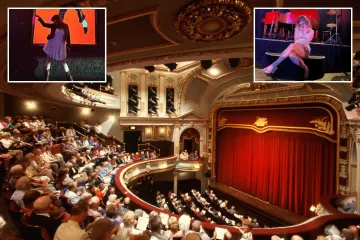
YES, we know it’s still T-shirt weather in much of England for at least five hours of the day in between downpours, but it’s time to start thinking about booking your Christmas days out.
One for the calendars is an immersive festive experience that transports families through a snowy North Pole, that’s returning for the second year in a row – and it has a new village and playground.
An immersive experience will return to London this yearCredit: suppliedChildren will travel through the North Pole to meet SantaCredit: supplied
The Wundrful World of Christmas will return this November taking families on a journey through the snowy landscape to see Santa.
It’s specifically designed for children between the ages of three and eight, who will venture through the frosty landscape in a 50-minute experience.
Sign up for the Travel newsletter
Thank you!
The journey through the North Pole will begin in the Enchanted Forest towards the Elves’ Workshops.
Little ones can say hello to the elves who will be busy making presents and working at the toy sorting station.
Then onto visit Mrs Claus in her cosy cottage where she’ll have plenty of biscuits to go around and tell a story or two.
Then it’s into Santa’s Study to do some letter writing and meet him in person.
Along the way there will be live performers, theatrical sets, storytelling animation screens and plenty of festive lights.
New for this year is the Elves’ Playground which will be fully kitted out with Christmas lights and trees.
It will also have fairground rides, food and drink and even a Christmas market for trinkets and gifts.
For anyone who visited last year at its Borough Yards venue, the experience has moved to Immerse LDN at Excel London.
Mrs Claus will have a biscuit or two and a story for the kidsCredit: suppliedThe elves will be busy at the sorting station and there will be a new playground tooCredit: supplied
Last year, one visitor said: “Lovely doing this experience with you guys!”
Another added: “We loved it too. Ours [kids] chewed the ear off Santa and he was brilliantly patient with the epic chinwag session.”
It will run from November 13 until December 24 and you can buy tickets here.
Tickets for adults start from £29.90 and £24.90 for children (1-15 years).
Government bond markets remain under pressure as rising energy prices revive inflation concerns and increase expectations that major central banks will keep interest rates higher for longer.
ADVERTISEMENT
ADVERTISEMENT
The benchmark 10-year US Treasury yield briefly touched 5.011% on Monday, according to Dow Jones Market Data, before falling back below 5%. The level was the highest since October 2023.
The yield crossed the psychologically important 5% threshold as higher government borrowing, resilient economic growth and heavy corporate debt issuance linked to artificial intelligence investment compounded pressure on US bonds. Yields move inversely to bond prices.
Rising Treasury yields can feed through to mortgages, corporate loans and other forms of credit, potentially slowing economic growth. They can also make bonds more attractive relative to highly valued equities.
The latest rise followed the US Treasury’s previously announced expansion of its bond-buyback programme. Last week, it offered to purchase up to $6 billion of debt maturing in 10 to 20 years – three times the previous operation’s size.
The yield on the 30-year US Treasury bond, meanwhile, remained close to its highest level since 2007.
The sell-off has also spread across Europe. France’s 10-year government bond yield rose to 4.50% on Monday, while the equivalent Italian yield reached around 4.40%.
Germany’s benchmark 10-year Bund yield climbed as high as 3.538%, according to Dow Jones Market Data, its highest level in 15 years.
Energy prices are a major source of pressure. Brent crude rose to around $107 a barrel on Tuesday morning, while US West Texas Intermediate traded close to $103, as attacks on Saudi energy infrastructure and shipping in the Gulf intensified concerns about supplies through the Strait of Hormuz.
The European Central Bank raised its deposit rate by 25 basis points to 2.5% last week and warned that inflation could remain above its target for an extended period. Markets are pricing in at least one further ECB increase this year.
Attention now turns to three major central-bank decisions. The US Federal Reserve announces its decision on Wednesday, followed by the Bank of England on Thursday and the Bank of Japan on Friday.
A Reuters poll found that 85% of economists expected the Fed to raise rates by 25 basis points, while money markets placed the probability of an increase at around 93%.
The BoE is widely expected to leave rates unchanged. Economists surveyed by Reuters unanimously forecast no change, although some analysts have warned that a surprise increase cannot be ruled out. The BoJ is widely expected to raise borrowing costs.
BOOKING a weatherproof autumn break with luxurious lodges, woodland spas and tropical indoor waterparks doesn’t have to be expensive.
We’ve tracked down the UK’s ultimate budget-friendly staycations this autumn to save your rainy weekends – from less than £3pp per night.
You won’t be stuck for things to do on rainy days with these weatherproof UK holidaysCredit: GettyFinlake Resort & Spa offers unique lodge stays and activities that feel like a dupe for Center Parcs
From clever Center Parcs dupes in stunning forests, to mega family holiday parks with tropical pool complexes, these sites guarantee a great time even when the British weather turns grim.
Whether you want to float along a lazy river while rain taps against the window, or enjoy a drink in a private hot tub under the pine trees, we’ve found some unbeatable breaks for the cheapest rates this autumn.
Finlake Resort & Spa
Finlake Resort and Spa offers luxury wooden lodge stays in the forestCredit: Supplied
Set across 130 acres of Devonshire woodland, Finlake gives you the premium forest village feel of Center Parcs – but for far less money.
Fill your days with an action-packed itinerary of axe-throwing, Segways, laser tag, den building, horse riding and more. Activities start from £7, and there are plenty of free options, too.
When rainy days hit, Finlake Falls is your best friend. This indoor waterpark boasts a spacious indoor pool heated to 30C with a ‘beach style’ entrance for little ones, where they can gently wade into shallow waters.
For older kids and young-at-heart adults, there’s high-speed waterslides and flumes – plus activities like Seascooters, where you can twist and glide through the water holding onto a propeller.
Similar to Center Parcs, there’s also a woodland spa here, the Sirona Spa, where you can enjoy a soothing massage or Elemis skincare treatments.
The holiday resort is only two miles from Dartmoor National Park, where you can spot wild ponies, and three miles from Canonteign Falls – a breathtaking waterfall with a friendly gift shop and cafe nearby.
Four people can spend a week in Scandinavian-style woodland cabin with a log burner from £265 this autumn, working out at £9.46pp per night. A luxury woodland lodge won’t cost you much more, with a week from £305.
In contrast, we found a seven-night October break at Center Parcs Longleat Forest in their cheapest accommodation for £1,458. That’s a saving of £1,193.
Bluestone National Park Resort, Wales
Bluestone National Park Resort in Wales is a fantastic rural retreat
If you’re wanting a luxury woodland break this autumn that won’t break the bank, book in at Bluestone National Park Resort in Pembrokeshire.
The crown jewel of Bluestone is the Blue Lagoon Water Park, a massive, heated, subtropical indoor pool complex that is completely free for guests.
The subtropical waterpark has a huge wave machine, four twisting, high-speed flumes, a lazy river and even warm, bubbling spa pools to retreat to.
Little ones can make a splash in Nippers Cove, a shallow pool with its own mini waterslide, water cannons and indoor rockpools.
You might even find mermaids and pirates at the waterpark during themed events.
Outside of the pool, you can try an indoor zipline, take an electric bike tour through the woods, tackle a climbing wall or even have a go at bushcraft skills including fire lighting and outdoor cooking.
As for accommodation, you can stay in everything from a stylish apartment, to a cosy pastel-coloured cottage, to a mega six-bedroom wooden lodge.
We found a three-night break in a silver lodge sleeping four for £420, working out at £35pp per night.
Highfield Grange, Essex
Parkdean Resorts Highfield Grange recently received a £5million upgrade
This newly-upgraded Essex holiday park reopened in spring of this year, packed with £5million worth of shiny new activities.
Parkdean has pumped serious money into weather-proofing this park, with new Bear Grylls escape rooms, an expanded soft play area, and even an indoor Chocolate Factory where families can create their own concoctions.
Another new addition is the Hat Tricks Sports Bar, where you can spend rainy afternoons indoors playing shuffleboard, darts, pool and mini golf.
To cut costs, there’s also an all-inclusive food and drinks package, starting from £25 per day for adults and £10 per day for kids.
This includes three meals a day plus unlimited soft drinks and Costa Coffee, so you and the kids can cosy up with a hot chocolate whenever you please.
This park is only 10 minutes’ drive from Clacton-on-Sea, where you can stroll quiet beaches on dog walks or take a trip to the amusements without the frantic summer crowds.
We found a deal for a two-night break in a Bronze Caravan sleeping up to six for £99. That works out at £8.25pp per night.
Haven Hafan y Mor
Hafan y Mor is home to a huge indoor water complex, perfect for rainy days
Hafan y Mor is one of Haven’s biggest holiday parks, and is one of the top-rated, too, as a three-time winner of the AA 5-Platinum Star award.
On dry days, head to the Dragon Lakes Adventure Village for mini 4×4 off-roading, high ropes courses, and to battle it out at a NERF training camp.
Inside, Splashaway Bay is one of the biggest and best holiday park pool complexes in the UK, with a lazy river, giant tipping buckets and a four-lane waterslide.
For food and drink you can grab a bite from Chopstix, Slim Chickens, and family restaurant The Coast House Bar and Grill.
As for getting out and about, you can take a breezy beach walk just steps from the park or take a 10-minute drive to the pretty seaside town of Criccieth, where you can explore a historic 13th-centurycastle.
We found a deal for a four night stay in October for six people in a Bronze Caravan for £69 total, which works out at a tiny £2.88pp per night.
Vauxhall, Great Yarmouth
Vauxhall Holiday Park in Great Yarmouth has plenty of indoor attractions and activitiesCredit: Parkdean Resorts
Vauxhall Holiday Park is another that has recently undergone a £5million mega-revamp, and it may just be one of the best UK parks when it comes to rainy day activities.
Kids can spend hours in the massive Tropical Waterworld, complete with slides and a splash zone, or burn off energy tackling the indoorsoft play.
If you visit in October you’ll see the park go all-out for Halloween with spooky ghost walks, costume contests and creative craft workshops – plus the Parkdean chain-wide Monster Ball party.
The fairground indoor golf is a real highlight here, with a sparkly-new course decorated with swirls and pinstripes just as colourful as the sticks of rock and sweets sold on Great Yarmouth‘s Pier.
Twinning with Highfield Grange, this site also has a new Hat Tricks Sports Bar – but you can also hang out in the site’s other two entertainment venues, and take part in quizzes, bingo or rock and roll nights.
You can book a three night stay for four people in a Bronze Caravan this October for £135, which works out at £11.25pp per night.
Parkdean Resorts Warmwell
Parkdean Resorts Warmwell is a peaceful park, with wooden lodge accommodation and a large lakeCredit: Refer to Source
Parkdean’s Warmwell Resort in Dorset is a lodge-only park, meaning that you won’t find static caravans here – just cosy wooden lodges that are perfect for autumn.
Tucked away among the trees, these cabins offer instant access to the lake for swimming and fishing. And if you want to dial up the luxury, you can book a stay with a private hot tub.
You can even practice your skiing at this Dorset holiday park, with a 110-metre dry ski slope which you can tackle via skis, snowboard or sledge.
If the weather plays up, you can whizz around in the massive indoor roller rink, spend spare change in the amusements or warm up in the heated indoor pool – and yes it has a waterslide.
Autumn stays here are all about throwing on a coat, tearing through the woodland trails on biks, and returning to a cosy, heated lodge afterwards.
You can book a three-night stay in a superior lodge sleeping eight for £266 this October, working out at £11.08pp per night.
WE MIGHT all be sad that summer is over but the good news is that an indoor waterpark that happens to be the biggest in the country has also just been named the best.
Of course, there’s a shed load of things to do already in Blackpool but on a recent weekend craving a dip in a pool, I made a beeline for the Sandcastle Waterpark located on the beach.
The biggest indoor waterpark in the UK has also just been named the bestCredit: Cyann FieldingThe waterpark has more than 18 slides and attractionsCredit: Cyann Fielding
Sandcastle Waterpark in Blackpool is kept at a toasty 29C and has more than 18 waterslides and attractions.
The real gem of the show is the adult-only spa, hidden in plain sight in the middle of the waterpark.
Sign up for the Travel newsletter
Thank you!
Win one of five incredible holidays to the Turkey, the Norwegian fjords and Spain by voting in The Sun’s Travel Awards – enter here to win.
You’ll have to pay an extra £7.50 per person to enter the Sea Breeze Spa but it is well worth the money.
When I visited it was quiet, with only one or two other people using the area, compared to the packed waterpark surrounding it.
Dipping in and out of the saunas and steam room was the ideal way to relax.
I spent half an hour in the salt inhalation room allowing my lungs to fill with warm, salty air and calm my nervous system.
There are also foot spas for the ultimate pampering and the loungers are great for chilling out while hearing the joyful screams of the waterpark around you.
There are wavepools tooCredit: Cyann Fielding
The main waterpark area is obviously great as well.
The Master Blaster snakes around the park and claims the title as the longest indoor roller coaster waterslide in the world, stretching 250 metres.
There’s Sidewinder too, which is the world’s first indoor vertical drop slide.
Hovering over the edge of the half-pipe, butterflies flittered around my stomach anticipating the drop.
Before I knew it, I was tipped over the edge in my rubber ring, dropping metres down before being propelled up the other side of the pipe.
After, I ambled over to Aztec Falls, where in a rubber ring I dropped into a pitch-black bowl, swirling around like I was inside a waterfall.
There’s also Montazooma, where you head down a large drop and then whizz through high-speed bends.
A good family option is to head on the Duelling Dragon slides, where you can race side by side in the near dark.
And there’s even a hidden spa in the middle of the waterparkCredit: Cyann FieldingTickets to the spa cost an extra £7.50pp but are well worth itCredit: Cyann Fielding
If you don’t fancy any thrills, there’s also the option to be gently lulled by waves in the Typhoon Lagoon Wavepool.
The Ushi Gushi Action River is quite gentle too, where there’s a gentle current as if you were floating on a real river.
Little ones can have a splash in the Caribbean Storm Treehouse as well where there are water cannons and splash zones.
Tickets to the waterpark cost from £25.50 per person over the age of eight.
Tickets for kids between three and seven-years-old cost from £16.50 per person.
RIYADH: Saudi Arabia’s inflation held at 1.8 percent in August for the fourth-straight month, as housing, food and transport costs continued to drive consumer prices higher, official data showed.
This increase was mainly driven by a rise in housing, water, electricity, gas, and other fuel prices by 3.9 percent, food and beverage prices by 1.4 percent, and transport prices by 2 percent, the report added.
Saudi Arabia’s inflation remains relatively subdued compared with some regional peers.
Oman’s rate accelerated to 3.4 percent in August, driven by an 8.5 percent increase in transport costs and a 7 percent rise in food and non-alcoholic beverages, while inflation averaged 2.9 percent in the first eight months.
Jordan’s inflation stood at 2.66 percent in August, taking the average for the first eight months to 2.20 percent.
This comes as Kamco Invest said in a report last month that regional tensions could fuel inflation by pushing up oil prices and disrupting fertilizer exports, although inflation across the Gulf Cooperation Council remained subdued in June and July.
In its latest report, GASTAT stated: “The housing, water, electricity, gas and other fuels division was the main contributor to the annual inflation with a contribution of 0.8 percentage points, followed by the food and beverages division with a contribution of 0.3 percentage points, in addition to the transport division with a contribution of 0.3 percentage points.”
Since housing remains the single largest driver of Saudi CPI, authorities have leaned heavily on real estate interventions to keep it in check. A five-year freeze of annual rent increases for new and existing residential and commercial contracts within Riyadh’s urban boundaries took effect in September last year.
Housing and personal care lead gains
The housing, water, electricity, gas and other fuels division rose 3.9 percent year on year, largely due to a 3.9 percent increase in actual rents.
The personal care, social protection and other goods and services division followed with a 3.5 percent annual rise, pushed up by a 13.3 percent jump in other personal effects, itself driven by a 14.4 percent surge in jewelry and watch prices.
Recreation, sport and culture climbed 2.8 percent, helped by a 4.7 percent rise in holiday package prices.
On the downside, furniture, home appliances and routine home maintenance fell 0.6 percent, while clothing and footwear slipped 0.5 percent.
Monthly movements mixed
On a monthly basis, personal care, social protection and other goods and services rose 0.8 percent in August, transport gained 0.6 percent, and insurance and financial services rose 0.5 percent.
Housing costs edged up 0.2 percent on a 0.2 percent rise in actual rents. Food and beverages slipped 0.1 percent, while restaurants and accommodation services fell 0.4 percent, the steepest monthly decline among divisions.
Average prices show sharp swings
A separate GASTAT report on average prices of goods and services showed some of the sharpest monthly moves came from fresh produce and construction inputs.
Local onions posted the largest monthly gain of any tracked item, up 17.9 percent, followed by imported onions at 11.6 percent, medium local potatoes at 7 percent, and local zucchini at 6.7 percent.
Hotel accommodation rose 2.5 percent, while furnished apartments increased 2.8 percent on the month.
On the other side, local tomatoes recorded the steepest monthly drop at 15.2 percent, followed by imported tomatoes down 9.3 percent and medium African lemons down 9.2 percent.
Among construction materials, national reinforcing iron of various diameters fell between 1 and 2 percent month on month, while national electrical cables and wires rose broadly, led by a 25.7 percent annual increase in 35mm cables.
Wholesale Price Index
Saudi Arabia’s Wholesale Price Index stood at 4.6 percent in August, down from 5 percent in July, GASTAT said.
This was driven mainly by an 8.2 percent jump in other transportable goods, excluding metal products, machinery and equipment, on the back of a 51.4 percent surge in basic chemical prices and a 4 percent rise in refined petroleum product prices.
Metal products, machinery and equipment prices rose 2.2 percent annually, while agriculture and fishery products increased 4.8 percent. Ores and minerals prices fell 1.8 percent.
“On a monthly basis, the WPI recorded a decline of 0.2 percent in August compared to July 2026,” the report noted, weighed down by a 1 percent drop in other transportable goods and a 2 percent fall in ores and minerals, even as metal products, machinery and equipment rose 0.8 percent and food, beverages, tobacco and textiles gained 0.6 percent.
Producer Price Index
Separately, Saudi Arabia’s Producer Price Index for July — the most recent data available — recorded a 5.3 percent annual increase compared with July 2025, according to GASTAT.
The rise was driven by a 5.5 percent increase in manufacturing prices, a 2.3 percent rise in electricity, gas, steam and air-conditioning supply prices, and a 6.8 percent increase in water supply, sewerage and waste management activity prices.
Within manufacturing, prices for chemicals and chemical products jumped 13.1 percent annually, wearing apparel rose 12.9 percent, and basic metals climbed 8.8 percent.
On a monthly basis, however, the PPI fell 2.8 percent in July compared with June, mainly on a 3.0 percent decline in manufacturing prices, led by a 6.8 percent drop in refined petroleum product prices.
ZAWTAR AL GHARBIYEH: The US ambassador to Lebanon on Tuesday visited a southern village that recently came under the control of the Lebanese army as part of a framework agreement with Israel.
The US-backed June agreement states that the Israeli military will withdraw from areas of south Lebanon it occupied in parallel with the deployment of the Lebanese army, starting with “pilot zones”, under the condition that militant group Hezbollah disarms.
An AFP correspondent saw a convoy carrying the US envoy, Michel Issa, entering the village of Zawtar al-Gharbiya, where he visited a church, according to Lebanon’s official National News Agency (NNA).
The news agency said an Israeli drone surveyed the area during the visit, reporting Israeli military vehicle movements in the neighbouring town.
Israeli troops remain deployed in what it calls a “security zone”, a stretch of Lebanese territory about 10 kilometres (six miles) deep along the border.
It recently blew up a strategic Hezbollah location at the Ali al-Taher ridge in the Nabatieh region, creating a blast so powerful that a 4.1 tremor was registered.
Fresh talks between Israel and Lebanon over the implementation of the framework agreement were due to be held this month, but were postponed to October.
A source from the Lebanese presidency told AFP that during the last round of talks in August, Israel refused to discuss new “pilot zones” without ensuring that the Lebanese army had full control of the first ones.
The Israeli and Lebanese ambassadors to Washington are due to meet this week to discuss the implementation of the agreement.
Lebanese President Joseph Aoun also visited Zawtar al-Gharbiya on Saturday, where his office said he inspected army units and observed nearby Israeli military positions.
Violence declined following the June framework agreement and a wider US-Iran deal, but Israel has pressed its attacks on Lebanon.
Hezbollah, which pulled Lebanon into the war in March with strikes on Israel, rejects the negotiations with Israel and refuses to disarm, but has not claimed any recent attacks.
Israeli strikes have killed more than 4,300 people since the hostilities began in March, according to Lebanese authorities.
The United States Supreme Court has rejected Donald Trump’s bid to restrict voting by mail ahead of the November midterm elections, in a setback to the US president’s efforts to change rules governing elections.
The ruling on Monday by the conservative supermajority court allows states to continue sending out mail ballots as they have done for years, dealing a blow to Trump’s plans to stop the ballots before the elections and halting possible last-minute legal actions as voting begins in some states.
Recommended Stories
list of 4 itemsend of list
Trump has repeatedly cast doubt on the security of mail-in voting, citing debunked claims of widespread election fraud associated with it. That is despite the president voting by mail himself, including during the 2024 election.
Mail ballots, in place for decades, have been found to increase voter turnout and currently account for a third of all votes cast in the US.
Here’s what we know about the legal challenge to overturn them:
President Trump speaks at the Republican National Midterm Convention in Dallas, Texas, US, September 9, 2026 [Evan Vucci/Reuters]
What are mail-in votes?
Voting by post works by sending ballots to the homes of registered voters, who then mail them back before a deadline.
Eight states, several of them Democratic-leaning – California, Colorado, Hawaii, Nevada, Oregon, Utah, Vermont and Washington – as well as the District of Columbia, allow all elections to be conducted entirely by mail.
Others only allow smaller elections to be conducted by mail.
Although there are cases of forgery or repeat voting, they are rare and amount to just four in 10 million mailed votes, according to the Brookings Institution.
What has Trump said about the mail-in votes?
Trump falsely blamed his 2020 presidential election loss on mail-in voting fraud. He and his supporters also opposed changes made during the COVID pandemic to expand mail-in voting.
During the 2020 Republican National Convention, Trump called mail-in voting changes “the greatest scam in the history of politics”.
His attempt to push the SAVE America Act, which calls for sweeping voting laws, has stalled in the US Senate. The bill, passed in the House of Representatives in February, faces opposition over concerns that millions of voters will be disenfranchised.
How did Trump target mail-in votes?
In March 2026, Trump signed an executive order directing the US Postal Service to take control of mail voting by designing new envelopes with special barcodes that would allow the federal government to ensure ballots are only from eligible voters.
For the midterms, that move would force all states to adopt a uniform envelope style in a short time.
The order also required states to provide the US Postal Service with a list of eligible voters ahead of elections. Several government departments, including Homeland Security and US Citizenship and Immigration Services, would also have the voters’ lists.
The postal agency was additionally empowered to deny mailed ballots if they did not comply with new standards or were not associated with registered voters on the states’ lists.
What happened to the order?
Democrats and activists challenged the order in several courts, resulting in a series of back-and-forth rulings between May and August.
US District Judge Indira Talwani imposed an injunction against the rule in June on the basis that it likely violated the US Constitution. Talwani also noted in her injunction that Trump’s executive order would be impossible to apply when the midterms were already so close.
But her ruling was overturned by the conservative-majority Supreme Court in late August in a temporary judgement.
The Supreme Court had not decided at the time whether Trump’s move was constitutionally legal. Rather, it only sided with the Trump administration on procedural grounds after the administration argued that Democrats sued too soon.
What does the latest judgement mean?
In the latest and final decision, the Supreme Court refused to lift Judge Talwani’s injunction.
In a brief written order that did not go into detail, the court noted that the administration was likely to fail in its push to restrict mail-in votes ahead of the midterms.
Justice Brett Kavanaugh, who was appointed by Trump, voted with the majority against the administration, though he indicated he could support the policy at a later stage. Two judges, Samuel Alito and Clarence Thomas, dissented.
Critics have long warned that restricting mail-in ballots could disenfranchise some voters who typically rely on this method.
It could also disrupt the delivery of mailed votes, as some states, including Alabama, North Carolina and Wisconsin, have begun sending in midterm ballots.
After claims she is sexualising women’s sport, the criticism of Sydney Sweeney’s new advert is growing and TeamGB golden girl Amy Hunt explained why she has spoken out
11:10, 15 Sep 2026Updated 11:10, 15 Sep 2026
Sydney Sweeney featured in a promotional video for bookmaker Novig – and it’s not gone down well(Image: INSTAGRAM)
The American has been slammed following the campaign, which sees the 29-year-old with no clothes on as she pretends to play a number of different sports. The ad, for US sports prediction market company Novig, has been bashed with many suggesting sportswomen are still being defined by their appearance – and not their achievements.
British sprinter Amy Hunt, the four-time European champion, made a cutting comment after her race at the inaugural World Athletics Championship in Budapest on Sunday, saying: “Sydney Sweeney, this is what women in sport look like,” in her interview with BBC Sport after.
She is far from the only athlete hitting out. Sydney’s decision to take part has been widely criticised, with retired swimmer Ariarne Titmus saying she understood this type of “bulls**t”marketing” to be a thing of the past.
Water polo silver medallist Tilly Kearns joined the anger, saying, “I absolutely f***g hate Sydney Sweeney’s new sports ad”, while world champion boxer Skye Nicolson said the ad was making a “mockery” of women in sport.
Amy has spoken more about her decision to join the outrage, and appeared on Good Morning Britain to discuss her post-race remarks.
Telling presenters Susanna Reid and Ed Balls about her reasons for speaking out, the star sprinter said there are already enough barriers in place.
“I think when we’re trying to provide role models for young people and young women in sport,” she said. “We really want to show that it’s about what your body can do, not so much what it looks like. I think when we see the stats of 64 per cent of young girls drop out of exercise and sport before they reach the age of 16.
“We don’t need to place any kind of barrier whatsoever in their way in terms of providing the opportunity and the empowerment for them to still exercise, whatever that looks like, professional or kind of just going to do a park run with your friends.
“So it’s about empowering young girls and young women and young people to show that you really can just get out there and you don’t have to worry what you look like. You don’t have to worry about what you’re wearing.”
When grilled on whether the ad could impact how men view female athletes, she agreed and went on: “That was a big thing this year for us with the introduction of new kind of broadcasting regulations, in showing the correct or the more appropriate angles of women competing.
“It’s important to show kind of young people that it’s okay to be whoever you want to be, to wear whatever you want to wear, to look however you want to look, and you can achieve your dreams.”
While some suggested anger should be directed at the betting firm rather than the Euphoria actress, Novig said in a statement that Sydney is not just the face of the campaign, but has joined as “strategic partner and equity holder”.
Sydney finally responded and in a statement, said the campaign was “about embracing a fun idea”. She went on: “The concept is simple: cut through the noise and put the focus entirely on sports. The campaign brings that idea to life with confidence, humour and a playful edge.”
Watch Good Morning Britain weekdays from 6am on ITV
RIYADH: David Livingstone, chief client officer at Citigroup, believes investor appetite for Saudi debt issuances reflects confidence in the Kingdom’s long-term story, while Gulf countries remain capable of maintaining their positive performance in debt markets despite higher yields and increased global supply.
Livingstone said in an interview with Nour Amache on the “East-West” program on Asharq Business with Bloomberg that the performance of Saudi sovereign issuances, as well as those of the Public Investment Fund, demonstrated the resilience of Saudi Arabia’s market and continued demand from international investors, despite the obstacles created by the Iran war this year.
Livingstone’s comments came after the Kingdom raised $3.25 billion through international sukuk in early September, attracting orders of around $16.5 billion, or more than five times the issuance size. Saudi Arabia tightened the pricing spread by about 30 basis points from the initial guidance.
The Citigroup head added that the pricing adjustment “demonstrates confidence in this long-term story,” placing it within the context of the transformations underway in the Kingdom under Vision 2030.
The comments came after Citigroup helped its clients in Saudi Arabia raise more than $40 billion since the beginning of the year. The bank also decided to increase its direct exposure limits to the Kingdom after it demonstrated “strong economic and financial resilience,” according to CEO Fahad Al-Deweesh.
Debt-market pressures
Higher global yields and increased government borrowing will give investors a wider range of choices in the bond market, Livingstone said, noting upward pressure on yields amid abundant debt supply in emerging markets, Europe, the UK and the US.
Despite this, he said that “Saudi Arabia, and Gulf countries as a whole, can continue this positive performance compared with the recent past.”
Yasir Al-Salman, chief financial officer at the Public Investment Fund, told Asharq Business with Bloomberg that international debt markets would remain the fund’s largest source of financing. The fund had around SR3.4 trillion ($906.1 billion) in assets under management after injecting about SR750 billion into the Saudi economy over five years.
Debt instrument pricing in the Kingdom is linked to US bond yields, which have recently been elevated. The yield on the 10-year US Treasury continued to rise for a fifth consecutive session on Sept. 14, exceeding 5 percent, its highest level since 2023.
Are investors affected by project reviews?
Asked about the effect of media reports concerning the postponement or reassessment of some projects in Saudi Arabia on foreign investor appetite, Livingstone said this did not change the fundamental basis of investor interest in the Kingdom. He said economic diversification remained “the attractive factor for investors,” as infrastructure development and projects connected to the economic transformation continued.
He added that the review was “justified” in light of the economic circumstances surrounding the projects being financed, with attention focused on their feasibility and sustainability.
AirBaltic, the national airline of Latvia, has filed fo Chatper 11 protection in New York. The airline currently operates direct services between London Gatwick and Riga, as well as twice-weekly seasonal Aberdeen to Riga service
AirBaltic has filed for bankruptcy, casting the airline’s future in serious doubt.
Latvia’s national airline filed for Chapter 11 protection in New York on 14 September as it seeks to restructure its debts.
AirBaltic currently operates direct services between London Gatwick and Riga, as well as twice-weekly seasonal Aberdeen to Riga service. These serve approximately 4,144 passengers each week, according to AirAdvisor.
Earlier this year, the airline announced it would launch flights from the UK to Lapland in December, offering five new routes to Kuusamo in Finnish Lapland from European airports, including services from London Gatwick and Manchester.
The airline plans to reduce its fleet from 54 aircraft to 36 by the end of 2026, while some staff members may also lose their jobs. CEO Erno Hilden has said that consultations are underway regarding workforce reductions, although no figure has been decided.
AirBaltic has faced a number of financial challenges since it took a €30 million (£26 million) state loan in April 2026, the company said in a statement, “including increased fuel costs arising from the crisis in the Middle East.”
Supervisory board chairman Andrejs Martinovs said in a written statement: “We have carefully assessed the restructuring options available to the company, with one priority in focus – to give airBaltic the best possible basis to continue operating and to build a sustainable financial structure. Under court supervision and with protection from creditor claims, this process provides a clear framework and timetable for reaching agreements with creditors, including aircraft lessors and other stakeholders. At the same time, it allows the company to continue operating.”
What does this mean for passengers?
If you have a flight booked with airBaltic, you shouldn’t panic. Passengers should not interpret the word ‘bankruptcy’ as meaning the airline has stopped flying and cancel valid bookings themselves – it has not cancelled any flights.
The airline has a commitment for €350 million (£300 million) in financing, subject to court approval, and insists that scheduled flights, bookings and customer services are continuing normally.
AirBaltic said flights would operate as scheduled during the court-supervised process, which it expects to finish by June next year.
Flights departing the UK fall under UK261. Riga to UK services are protected under EU passenger-rights rules because they depart from an EU airport. In either direction, a cancellation would normally allow passengers to choose between reimbursement and rerouting.
Anton Radchenko, Aviation Expert and CEO of AirAdvisor, said: “Chapter 11 is designed to give a company space to keep operating while it restructures, so I would not cancel a valid airBaltic booking when the airline is still flying and says the ticket remains valid. Cancelling voluntarily could leave the passenger subject to the ticket’s normal restrictions, whereas waiting for the airline’s decision preserves their statutory rights if the service is later changed or cancelled.
“I would use this moment to identify exactly what protects the booking. A direct flight is not usually ATOL protected, airline-failure insurance is not standard, and the practical fallback may depend on whether the passenger booked a genuine package, paid directly by credit card or can make a chargeback claim.
If airBaltic cancels while continuing to operate, passengers should request a refund or rerouting and the necessary care rather than accepting whichever option is presented first. Fixed compensation may also apply depending on the notice and reason, but if an airline ceases trading completely, possessing a legal claim does not guarantee immediate repayment, which is why the financial protection behind the booking matters.”
The Foreign, Commonwealth and Development Office (FCDO) has updated its travel guidance for British nationals travelling to Thailand, with tighter visa-free stay restrictions for UK travellers coming into force on 15 September 2026, alongside revised weather warnings
The new rules came into force this morning(Image: Twenty47studio via Getty Images)
The Foreign Office has warned Brits to check their paperwork is in order as a country changes its entry rules.
As of today, Thailand’s entry system has changed. After two years running a generous scheme under which citizens of 93 countries and territories could enter visa-free for stays of up to 60 days, a harsher system has taken over. Effective this morning, the length of stay has been cut in half from 60 days to 30 days for many nationalities.
For US, UK, Australian and Canadian citizens, the principle remains straightforward: no visa is required for a tourist stay of up to 30 days in Thailand. However, the visa-free period has been halved from 60 to 30. If you want to stay in the country for longer than that, you’ll have to apply for an extension of up to 30 additional days. The Thai government has indicated that this should be granted.
Another major change is that the visa-free scheme now applies only to tourists. Those entering the country for work or other purposes now use the visa category corresponding to their activity.
The reform also reintroduces a restriction on land-border entries, with those using the 30-day visa exemption allowed only two land-border crossings per calendar year. Nationals of Brunei, Indonesia, Malaysia and Singapore are not subject to this limit.
Ahead of the changes coming into effect today, the UK’s Foreign, Commonwealth and Development Office (FCDO) issued updated advice to Brits, a record-breaking million of whom visited Thailand last year. The government warned of the consequences of overstaying your visa or visa-free period.
“If you overstay the period of your visa, you will get a fine of 500 Thai baht a day up to a maximum of 20,000 baht. You risk being:
held in detention
deported at your own expense
banned from re-entering Thailand for up to 10 years
“Conditions in detention centres can be harsh.”
Thailand relaxed its visa rules in 2024, expanding the number of countries that qualified for visa-exemption, while extending the maximum length of stay to 60, in a bid to boost its tourism sector post-Covid. Tourism accounts for as much of 20% of the country’s GDP.
However, the rise in visitor numbers has caused tensions in the country. Back in May government spokesperson Rachada Dhanadirek told reporters that while tourism provided “benefits, such as boosting the economy”, the former visa scheme had allowed people to “exploit” the system. Foreigners overstaying and illegally operating businesses in tourism hotspots, without the proper permits, is a particular concern in parts of the country.
The full FCDO advice reads: “From 15 September 2026, if you enter Thailand under the visa exemption scheme, you can stay for up to 30 days for tourism. If you entered Thailand before 15 September 2026, you will usually be allowed to stay for the period granted when you arrived. If you want to stay longer, you must get the appropriate visa before you travel or, if eligible, apply for an extension through the Thai immigration authorities.
“You may be asked to show that you meet the entry requirements. This could include proof that you have enough money for your stay (at least 10,000 Thai baht per person or 20,000 Thai baht per family) and evidence of onward or return travel. British nationals have been refused entry for failing to provide this evidence.
“If you overstay your permission to stay in Thailand, you could be fined, detained, deported or banned from re-entering the country. Make sure you understand the conditions of your stay and get any visa extension you need before your permission expires.”
Alongside the entry guidance, the Foreign Office has revised its advice on Thailand’s rainy season and the dangers posed by heavy downpours.
The rainy season generally runs from May to October across most of the country, and from November to March in Koh Samui and south-east Thailand. However, the updated guidance warns that “weather patterns have become increasingly unpredictable and periods of intense rainfall can occur across Thailand.”
It continues: “Heavy rainfall can cause flash flooding, landslides and disruption to transport, particularly in northern, north-eastern and mountainous areas. Conditions can change rapidly and may result in road closures and local travel disruption. Lakes, caves and waterfalls are particularly at risk of dangerous flash flooding.”
Holidaymakers should follow instructions from local authorities and keep a close eye on weather warnings from the Thai Meteorological Department.
The virtual safety car (VSC) definitely throws jeopardy into races, but it does not do virtually what the safety car does. Would it not be more balanced to have a minimum of at least one full lap? Yes, this would dampen the jeopardy effect but what happened to Lando Norris feels like a chance card in Monopoly. – Kyle
Lando Norris’ bad luck with the virtual safety car at the Spanish Grand Prix has certainly focused attention on the ways this can disrupt races.
The VSC has always had issues – it freezes a race rather than resets it, which can be a bit boring compared to an actual safety car – but it has the benefit of minimising disruption when a track hazard can be cleared relatively quickly.
It has long been an opportunity for someone to benefit over a rival, because making a pit stop under a VSC takes significantly less time than under racing conditions.
But usually this has been in cases where one team has changed or deployed its strategy with the express intention of waiting for a safety car or VSC (such as Norris himself in his maiden victory in Miami in 2024), and benefiting over a rival who has run a more conventional strategy.
That sort of thing is considered fair game. What happened to Norris – a driver lost a race win because his specific track positioning at the time of a VSC meant he alone was unable to pit under it – is, to the best anyone could remember on Sunday, unique.
The media are not privy to conversations in drivers’ briefings, and Norris in particular gets a bit sniffy when information from those meetings leaks out because they are meant to be a safe space where the drivers and FIA can share opinions without it becoming a controversy.
But it emerged after the race that this issue, as Norris put it, “has been spoken about many, many times”.
Whether Norris’ misfortune leads to a change, such as ensuring that a VSC is deployed for at least one whole lap, remains to be seen.
There is no easy answer, because within F1 it’s recognised that safety cars are part of the competitive jigsaw, and can be used to a team’s advantage. And the latest rules have been arrived at after various previous iterations that worked in different ways, such as shutting the pit lane for specific periods.
McLaren team principal Andrea Stella said: “Offering a personal opinion, I’m puzzled myself as to what’s right.
“Is it correct to give enough duration such that everyone will have been subject to the same track conditions? So, for instance, the virtual safety car lasts at least one full lap.
“Or you just keep it in the hands of the Gods, and sometimes you are lucky, sometimes you are not. I’m not sure.”
There is process for these sorts of discussions – they go to a sporting advisory committee for analysis, before being reviewed by the F1 Commission of teams, commercial rights holder F1 and governing body the FIA.
That won’t happen quickly – unless it is decided by F1 and the FIA that it is a desirable outcome to change the rules. Right now, the momentum for that does not appear to be there.
What are the prospects for rookies coming into Formula 1 next year? Many drivers are re-signing long contracts with their teams. Are there likely to be any new recruits? – Mia
The most likely place for a new driver to come into F1 next season is Haas, where Esteban Ocon’s position looks shaky.
The two main candidates there are Italy’s reigning Formula 2 champion Leonardo Fornaroli, who is part of McLaren’s driver development programme, and Brazilian Rafael Camara, who is second in F2 this year and part of the Ferrari driver academy.
Both have tested for Haas and are said to have impressed the team.
Haas will want a quick driver who brings money, and it’s not clear who the favourite is. Ryo Hirakawa, Haas’ reserve driver and a long-time protege of Haas’ technical partner Toyota, is also in the picture, but considered a less likely candidate.
Elsewhere, there is talk of Red Bull considering moving F2 championship leader Nikola Tsolov, who is Bulgarian, into their Racing Bulls team.
To do so, they would have to drop either Liam Lawson or Arvid Lindblad. It’s hard to see how it would be Lindblad, after such an impressive rookie campaign.
But Lawson has also been doing a good job this year, so it’s not a given.
At Cadillac, they have Indycar race-winner Colton Herta as reserve. They have been planning for Herta to be in F1 before too long – the idea behind him moving to Europe and doing Formula 2 this year was so he could learn the ropes on this side of the Atlantic and be as prepared as possible for graduation to F1.
But Herta has had a very difficult F2 campaign this year – his best result is a fifth place and he is 19th in the championship – so moving him up to F1 for 2027 would be a massive risk.
Ugo Ugochukwu, who won the Formula 3 title in Madrid on Sunday, is another American said to be of interest to Cadillac.
He had been part of the McLaren driver development programme for several years until they parted ways at the end of last season.
But even if Ugochukwu’s Cadillac links become formalised, next year is probably too early for him to make F1.
He’s also extremely tall – well over six foot and much taller even than Ocon, Alex Albon and George Russell, the current tallest drivers – so getting him into an F1 car would not be easy.
The other teams are pretty much locked down, although it’s still unknown whether Fernando Alonso is going to continue in F1 next year.
Fighting is continuing along Yemen’s western front, with government forces reporting strikes against Houthi positions in areas stretching from Taiz toward the Red Sea coast.
The government said on Monday that its forces targeted Houthi personnel, equipment and positions in Dhu Bab in Taiz governorate and Khokha in neighboring Hodeidah governorate.
The areas are strategically important because they lie along Yemen’s western coastline near the Red Sea and Bab Al-Mandab Strait, one of the world’s key maritime chokepoints connecting the Red Sea with the Gulf of Aden and wider Indian Ocean.
Dhu Bab is close to Bab Al-Mandab, while Khokha lies further north along the Red Sea coast. The fighting is taking place along territory that links the front lines around Taiz with Yemen’s strategically important western coastline.
Yemen’s armed forces spokesman, Col. Majid Al-Nazili, said government forces targeted Houthi equipment, personnel and positions in the two areas.
Military commanders also visited several front lines around Taiz, including areas near Bani Omar, Jardad and Al-Wazi’iyah, to assess combat readiness.
Maj. Gen. Abu Bakr Al-Jubouli, commander of the Tor Al-Baha axis, said government forces had inflicted heavy losses on the Houthis during recent clashes.
Artificial intelligence is increasingly being treated not simply as a technology sector but as a strategic capability tied to economic power, national security and geopolitical competition. Recent warnings from leading AI researchers and executives that increasingly autonomous systems could pose extreme risks have intensified debate over whether development should be slowed.
Yet the same warnings could make a slowdown less likely. If advanced AI can provide major military, economic and technological advantages, governments may view continued development as a strategic necessity. The result could be a paradox in which growing concerns about the dangers of AI encourage countries to accelerate the race to control it.
The United States and China are at the center of this competition. Both governments have strong incentives to maintain their technological advantage, while companies are investing enormous sums in data centers, chips and computing infrastructure.
The scale of investment shows why reversing course would be difficult. Goldman Sachs estimates that cumulative global AI spending through the end of the decade could reach as much as 5% of global GDP. At the same time, financial markets are increasingly sensitive to whether the extraordinary investment in AI infrastructure will ultimately generate sufficient economic returns.
Stay ahead of the geopolitical week.
MD Briefing delivers expert analysis across five global fronts — the Indo-Pacific, energy, geoeconomics, European security, and the Middle East — every Monday morning. Free.
Why it matters
The central question is no longer simply whether AI development should be regulated. It is whether governments can realistically agree to meaningful limits while competing for technological dominance.
A country that slows development unilaterally risks allowing competitors to move ahead. That creates a classic security dilemma: measures intended to reduce risk can themselves create strategic vulnerability.
The problem is particularly significant because AI has applications far beyond commercial technology. Advanced systems could affect cybersecurity, intelligence, military planning, financial markets, biotechnology and critical infrastructure.
That makes AI different from many previous technology debates. Governments may be willing to regulate individual applications, but they are less likely to accept restrictions that could permanently reduce their strategic advantage.
The investment dilemma
The AI boom has already become deeply connected to wider economic growth.
Companies are spending heavily on computing capacity and data centers, while investors have placed enormous valuations on firms expected to benefit from AI adoption. A significant slowdown could therefore have consequences far beyond technology companies.
Morgan Stanley has estimated that almost $200 billion in U.S. data center projects were cancelled or delayed amid political resistance to new infrastructure. The bank has also argued that capital expenditure linked to AI could account for roughly one third of U.S. GDP growth over the current period.
This creates another obstacle to restraint. AI investment is no longer only a corporate decision. It has become connected to employment, infrastructure, financial markets and national economic growth.
The longer the investment cycle continues, the more difficult it becomes for governments and companies to voluntarily step away from it.
Washington and Beijing
The geopolitical dimension makes a coordinated slowdown even harder.
U.S. policymakers increasingly view technological leadership in AI as an element of national power. China, meanwhile, sees AI development as part of its broader effort to reduce dependence on Western technology and strengthen its own economic and strategic capabilities.
That means Washington and Beijing have incentives to monitor each other’s progress rather than simply establish limits.
The political rhetoric surrounding AI increasingly reflects this competition. Trump has portrayed opposition to AI infrastructure as benefiting China, while Chinese state media has described warnings about AI as part of a broader geopolitical strategy against Beijing.
The result is a familiar strategic dilemma: if either side believes the other may continue developing advanced AI, neither has much incentive to slow down first.
Can international rules work?
Meaningful AI restrictions would ultimately require international cooperation.
Individual countries can establish domestic safety standards, require companies to conduct risk assessments or impose restrictions on specific applications. But those measures cannot fully address the geopolitical problem if competitors outside those jurisdictions remain free to develop more powerful systems.
The nuclear comparison illustrates the difficulty. The first nuclear weapon was developed in 1945, but the Nuclear Non-Proliferation Treaty did not emerge until 1968. Even after the treaty, nuclear proliferation continued beyond the five states formally recognized as nuclear-weapon states.
AI could present an even more complicated challenge because it is not confined to a small number of military facilities. Its development involves thousands of companies, researchers, data centers and computing systems spread across multiple countries.
Economic security could become the new arms race
The most important shift may be that AI competition does not need to resemble a conventional military arms race to produce similar strategic pressures.
Advanced AI could generate advantages in productivity, financial markets, scientific research, cybersecurity and military technology. Falling behind could therefore be perceived as an economic and national security threat even without the development of an explicit weapon.
This could produce what might be described as mutually assured economic dependence. Countries may recognize the dangers of uncontrolled AI while simultaneously believing that abandoning the technology would be even more dangerous.
That dynamic makes voluntary restraint increasingly difficult.
Implications and analysis
The growing warnings about AI may therefore have an unintended geopolitical consequence: they could accelerate the race they are intended to constrain.
If governments become convinced that highly capable AI could fundamentally alter national power, they are unlikely to leave its development to private companies or accept restrictions that allow competitors to gain an advantage. Instead, the technology could become more closely integrated with national security policy.
That could eventually mean greater government involvement in AI companies, computing infrastructure, semiconductor supply chains and access to advanced models.
The biggest danger is therefore not simply that AI becomes too powerful to control technologically. It may become too strategically important for governments to willingly slow down.
For meaningful safeguards to emerge, major powers would need to treat AI safety as a shared security interest rather than another arena of geopolitical competition. Without that shift, every warning about the potential consequences of advanced AI could strengthen the argument for moving faster.
The paradox is clear: the more dangerous AI becomes, the more governments may feel they need to control it. And the more they compete to control it, the harder it becomes to slow the race.
PASSENGERS are facing disruption today at an airport in Sicily following a volcanic eruption.
Catania Airport has suspended all flights until this afternoon due to an eruption on Mount Etna – and it’s not for the first time as hundreds of flights were forced to cancel last month.
Catania Airport has been forced to close again after more eruptions on Mount EtnaCredit: Roby Fazio / SplashNews.comAsh has drifted into the airspace resulting in flight cancellations and diversionsCredit: Roby Fazio / SplashNews.com
An ash cloud has caused airspace closures in Sicily which is affecting both arrivals and departures at Catania Airport.
Due to volcanic ash into the atmosphere, flights have been suspended until at least 2.30pm (local time) today.
Sign up for the Travel newsletter
Thank you!
The airport said: “Passengers are kindly requested to check the status of their flight with their airline before travelling to the airport.
For Brits, the disruption today has affected one easyJet flight so far, it is departing London Gatwick at 10am and will be diverted to Palermo.
Another easyJet flight heading to London Gatwick from Catania Airport remains on the schedule for 10.35am – although it’s likely to be cancelled following the suspension.
Later today, a BA flight scheduled to depart London Gatwick for Catania Airport remains scheduled for 7.55pm.
Flights first started being cancelled and diverted yesterday when Mount Etna erupted again.
Last month, ongoing eruptions from Mount Etna forced Sicily’s busiest airport to shut for five days in a row resulting in hundreds of cancelled flights.
Families who had their flights cancelled were left stranded with videos on social media showing holidaymakers sleeping on the airport floor and even luggage belts.
Last time Mount Etna erupted nearby Malta International Airport had to cancel 19 flights due to volcanic ash.
What does the disruption due to Mount Etna mean for passengers?
Anton Radchenko, air passenger rights expert and founder and CEO of AirAdvisor, explainedwhat the disruption means for customers…
“When volcanic ash closes airspace, airlines will usually class it as an extraordinary circumstance, which means fixed cash compensation is unlikely.
“However, I would urge passengers not to confuse ‘no compensation’ with ‘no rights’.
“The airline must still offer a refund or rerouting and provide reasonable meals, accommodation and transport while passengers wait.
“If you still need to get home, do not automatically accept a refund.
“Once you accept it, the airline’s rerouting and care obligations will normally end.
“Ask for the earliest reasonable alternative and, if another airline can get you back significantly sooner, ask to be transferred to that service.
“If you have to pay for reasonable essentials because the airline fails to provide them, keep every itemised receipt so you can seek reimbursement.”
This is supported by the UK Civil Aviation Authority’s current cancellation guidance which you can findhere.
As the fall equinox approached from a week away, the Primetime Emmy Awards made its 78th visit, leaving trophies in some hands, the honor of just being nominated for others and bupkes for the rest of the thousands who make what we call television. Once again I have been called to witness (from afar) and report, so let’s get down to it.
It was the turn of NBC (and Peacock) in the round robin of major networks who broadcast the show, and to keep things literally in-house it was hosted by Mariska Hargitay, “America’s sweetheart sex cop Olivia Benson” from the network’s “Law & Order: Special Victims Unit” and broadcast from the Peacock Theater, formerly the Microsoft Theater, formerly the Nokia in #DTLA, formerly downtown Los Angeles.
When reviewing the Emmys, or any awards show, as television in its own right, the only real questions are what distinguishes it from its many previous appearances on the karmic wheel of life — how it tricks up the basic, immutable form, like different decorations on the same sugar cookie recipe you have been using forever. Anything unexpectedly or especially moving, rousing, funny or strange, things that go against the grain of a production that wants to keep things controlled in order to bring the ship in on time.
This year the critic has been given the gift of Hargitay, primarily a serious actor (and director and producer), following in a long line of comedians and comic actors. There have been other serious actors as host, for example, Raymond Burr in 1959, Tom Selleck in 1984 and Angela Lansbury in 1993. And certainly, if you’re looking for someone to represent the medium rather than merely to comment on, celebrate or joke about it, you could do no better than Hargitay, the longest-serving actor on the longest-running prime-time live-action series on American TV. She’s beautiful, glamorous, self-possessed. She was recently on Broadway in “Every Brilliant Thing,” which involved a degree of what comedians call “crowd work,” so standing up in front of a live audience of people no more famous than she wasn’t going to throw her. Professional comedian Nate Bargatze, who hosted last year, was much more of a dark horse.
Emmys host Mariska Hargitay with singer Taylor Swift and her cat Olivia Benson on screen during a skit the 78th Primetime Emmy Awards.
(Patrick T. Fallon / AFP via Getty Images)
Although I would have bet on a pre-filmed “Special Victims Unit” routine to open the show, which is why I’m not a gambler, it wasn’t until an hour in that it appeared. (It involved murder-style boards, concerning the Case of Whether Taylor Swift would be making an appearance; she did, in the bit.) The pre-filmed production number that did open the show began with Hargitay and her actual good friend New York Knick Jalen Brunson steaming their clothes when Hargitay suddenly realizes she is due across the country to host the show. This led to Joan Jett’s “I Love Rock ’N Roll” reconceptualized as “I Love TV Screens,” which included the “Widow’s Bay” sea hag revealed to be Jennifer Coolidge, bringing boba tea (rhymes with “TV”); other rhymes matched “eating beef” and “watching ‘Beef’” and “Ed Gein” and “mean.” It moved to the live stage, with Hargitay flanked by dancers with television heads. Both segments felt more effortful than funny, but not unfunny.
On her own, however, Hargitay was above all a woman having a good time, never less than likable and game and enthusiastic, managing the scripted patter as well as anyone might have. Her monologue included several jokes about age, one about “L&O” producer Dick Wolf’s real name (Richard Penis), and another about her inability to pronounce “finale” because she’d never been in one. As is practically an Emmys tradition, some of these were confusing (even to the people performing it), or went on too long (Nick Offerman, cornered at his table, describing his work as an erotic house painter), or just had the effect of having been put on their feet without much, if any, rehearsal. Presenting the final award, for outstanding comedy, Woody Harrelson and Matthew McConaughey, told to stretch — the show was actually running short — described the plot of their upcoming Apple series, “Brothers,” until they were allowed to move on.
As to what the Television Academy calls “creative elements,” everything that isn’t a presentation or a speech, they advertised tributes to the 30th anniversary of “Buffy the Vampire Slayer,” certainly a typo, and the 50th of “Charlie’s Angels,” a logical impossibility, but these were really just themed groupings of presenters — Sarah Michelle Gellar and David Boreanaz in the former, Kate Jackson, Cheryl Ladd and Jaclyn Smith in the latter. (The Angels managed a few words for Farrah Fawcett, but none for Shelley Hack, Tanya Roberts or David Doyle.) But there were full tributes to Dolly Parton (Sally Field enthused, Reba McEntire sang); to James Burrows, with Jamie Lee Curtis pivoting emotionally to talk about old friend Rob Reiner, who won a posthumous guest appearance Emmy this year for “The Bear”; and to Catherine O’Hara, with her “Home Alone” child Macaulay Culkin and “Schitt’s Creek” children Annie Murphy and Dan Levy, who spoke to “helping her build a TV character over the age of 60 that wears leather miniskirts and eight-inch heels and speaks in a strange, sometimes unintelligible transatlantic accent, and know that she will not scare an audience away.”
And there was Julianna Margulies presenting the Bob Hope Humanitarian Award to Michael J. Fox, who, in his usual way, was eloquent and funny, and let the people know about the goodness of Bob Hope, setting up a punchline in the bargain. Like a lot of you, I love Michael J. Fox, and I’m just going to leave that here, with a pile of soaked-through tissues.
John Mulaney stole the show as a presenter at the 78th Emmy Awards ceremony at the Peacock Theater in Los Angeles.
(Robert Gauthier / Los Angeles Times)
But what America will mostly remember from this night was John Mulaney, introducing the award for lead actor in a drama, and burning the house down with a routine that went wherever it wanted. “They can play anything, these nominees. Not just doctors. They can play a cop or an FBI agent or a secret agent. And then that’s it. No other examples.”
“Since the creation of television, men have been historically underrepresented,” Mulaney said, explaining that the medium was all “beauty contests and children talking to hand puppets until the early ’60s. Until a man walked out and said, ‘Enough. My name is Fonzie and the president’s been shot.’” Mulaney is a man who has convulsed crowds in arenas and stadiums, but, as a local, nothing made me laugh harder than the words, “You know, I was shooting down Barham last night at 90 miles an hour.”
Nothing against Hargitay, but it’s clear that Mulaney should host this show, and every awards show, from now on.
Geneva: The United Nations called Tuesday for international investigators to be granted to access to all of Gaza “to assist with evidence-gathering” as hundreds of bodies are pulled from the rubble.
“The discovery of extensive remains under the rubble in Gaza City resurfaces these concerns of war crimes and other atrocity crimes,” UN rights chief Volker Turk said in a statement.
This news digest provides a historical retrospective on Guatemala’s journey to sovereignty, marking its Independence Day on September 15. The text explores the nation’s pre-colonial rootsas the center of Maya civilization and its eventual Spanish conquest, alongside its contributions to global agriculture through crops like corn and avocados. It further explains how the weakening of the Spanish monarchy during the Napoleonic era paved the way for the 1821 Act of Independence. Beyond historical analysis, the source includes contemporary news updatesregarding immigration issues in Spain, deportation statistics in Central America, and international political developments. This compilation serves as both a cultural tribute …
The city has been highlighted by Tripadvisor Travelers’ Choice Awards: Best of the Best Restaurants for 2026, which is based on first-hand reviews from millions of travellers over the last year
One UK city is.a standout when it comes to food(Image: Getty Images)
A charming UK city with medieval streets and a towering minster is also home to the country’s best restaurants.
While the silver-spoon-holding residents of foodie capitals London, Manchester, and Edinburgh may consider themselves to live in the UK’s culinary epicentre, they’re wrong.
The newly released Tripadvisor Travelers’ Choice Awards: Best of the Best Restaurants for 2026, which is based on first-hand reviews from millions of travellers over the last year, shows there is one UK city with a far higher concentration of great eateries than anywhere else, despite having a population almost 50 times smaller than London.
The city of 200,000 had the highest-ranked restaurants of anywhere in the UK, with Brazilian joint Casa Brazilian Rodizio ranking eighth worldwide. The family-run, authentic Brazilian rodizio-style restaurant aims to “provide an unforgettable authentic taste, service and experience for an unbeatable set price!” By all accounts, it has succeeded.
“Went out for a family meal yesterday, the food was absolutely amazing, the place was astonishing. The meat tasted rich, and the buffet had so many amazing options,” wrote one of Casa Brazilian Rodizio’s reviewers among the thousands awarding it 4.9/5 stars.
Other York restaurants performed really well in the UK rankings, with Buongiorno, Enoteca By L’uva and Damastique making the top 25 in the ‘best casual dining’ list. Legacy At The Grand also found itself at number seven in a rundown of the UK’s best date-night restaurants, and Melton’s reached the same spot on the ‘best fine dining’ rundown. And finally, the family-run Turkish outfit Kapadokya 50 was named one of the UK’s best hidden gems.
York’s rise to become the country’s premier gastronomy spot is an interesting one. The medieval city has always tempted in history buffs with its minster, Jorvik Centre and Quilt Museum, and it’s long boasted of having more pubs than days of the year to drink in them, a fact that seemed suspect when I lived there a decade ago and is almost certainly not true now. But the foodie revolution that’s taken place there is a more recent and quiet phenomenon.
A new crop of young chefs has been putting the city’s food in the spotlight, in backstreets from Micklegate to The Shambles. Among the gang is Tommy Banks, one of the youngest chefs in the UK to win a Michelin star, who leads Roots York in the city centre. His cooking relies heavily on homegrown produce, farm-to-table tasting menus, and unique preservation techniques.
Another is Ahmed Abdalla, head chef at Legacy inside The Grand hotel, who creates modern British tasting menus with classic Yorkshire ingredients. And Joshua and Victoria Overington run Restaurant Mýse, a place that specialises in local Anglo-Saxon culinary heritage.
The Michelin Guide lists 16 restaurants in York and its surroundings, three with stars and a Michelin Green Star, including Roots and Mýse.
Eduardo Caetano, owner of Casa Brazilian Rodizio, opened the restaurant 11 years ago. “The philosophy of the restaurant is casa, which means home. When you come in, you come into our home. You are my guest. If the food is not good enough for me, it’s not good enough for me,” he told the Mirror.
“The offering in York is an extremely competitive market, there are loads of places to eat. I love that there are so many family businesses here. For me, York is the only place in the world that feels like home.”
In terms of places in York he loves to eat, Eduardo recommended Delrio’s Italian Restaurant. “I love going there,” he added.
It’s not just in high-end restaurants that York is excelling; its casual dining scene is also strong. Recent additions doing well locally include authentic Neapolitan pizzeria Cresci Pizzeria, which has become a citywide favourite, while the gut-busting sandwiches of Browns in Heslington remain a cheap, filling option.
This all sits against a backdrop of the Shambles Market, York’s main daily open-air market, located at Silver Street in the heart of the city. Come early November, it is joined by the Christmas Market, with Alpine chalets filling up Parliament Street and St Sampson’s Square. Whether you find festive fare charming or a logistical impediment, stallholders not only bring a real buzz to the city, but plenty of gastro-delights.
You can get loaded on artisanal hot cocoa, locally made gin, scratchings, high-end crumble and much more.
Similarly, the long-term culinary heritage of York is evident in its fantastic pubs, many of which also serve up delicious food. The House of Trembling Madness is a wonderfully wonky pub that pairs cheese boards and yards of ale, while Valhalla York on Patrick Pool is a Viking-themed ale house serving hearty meat and cheese boards alongside local mead and ales.
The success of York as a food city is no accident. The city has actively invested in growing this reputation through events such as York Restaurant Week, now one of the UK’s biggest events of its kind since its 2019 launch, with the most recent edition doubling to two weeks and featuring over 100 participating venues. The previous October’s event saw over 22,000 vouchers downloaded, bringing in nearly £400,000 for local businesses, a 70% jump from the year before.
EES delays update over 9 UK tourist destinations – key details – The Mirror
Need to know
The EES entry/exit system has been widely criticised for causing long EU border delays at airports in popular UK tourist travel destinations
Crowds of passengers gathered at passport control areas at Amsterdam Airport Schiphol following the introduction of a new European digital border control system(Image: Anadolu, Anadolu via Getty Images)
Need to know on EU delays: Latest over the controversial EES system
British holidaymakers could finally get relief from airport chaos as the EU has reportedly postponed its controversial Entry/Exit System across nine major countries.
Portugal, Italy, France, Belgium, the Netherlands, Germany, Malta, Greece and Switzerland have all been granted permission to postpone the EES system indefinitely, reports say. The scheme has caused delays of up to four hours at European airports this summer, but the Times reports the 9 nations have been allowed to delay implementing the scheme, with no timescale on when to actually bring it in.
The automated system forces non-EU residents to queue at special machines before entering 29 Schengen area countries. It was designed to track whether people have exceeded their permitted 90-day stays in Europe.
Despite the EU previously insisting there would be no extensions after September 6, countries have informally been allowed to drop the checks until the technology works properly. The system has faced fierce criticism from airlines including Ryanair.
Nadia from Greater Manchester described her Frankfurt airport experience as “pretty shambolic” after facing ridiculously long queues. “People missing their flights because of it is just not acceptable,” she said.
The controversial system has sparked widespread debate on social media, with one traveller saying: “They made a mess of it.”
MARFA, Texas — Landowners, ranchers and business owners in the Big Bend region of Texas along with a nonprofit organization dedicated to protecting the region’s landscape and heritage are suing to stop the Trump administration’s plans to build a wall and other border infrastructure through the remote section of the state.
The lawsuit, filed by Conserve Big Bend and with the support of dozens of landowners, comes as the administration is ramping up a $46-billion effort to line the roughly 2,000-mile southern border with a collection of 30-foot steel bollard walls, vehicle barriers and technology intended to keep out smugglers and migrants.
In Texas, the effort has run up against numerous lawsuits and bipartisan opposition from sheriffs, elected officials, tour guides, environmental groups and landowners.
Officials backing the wall “were woefully unprepared for the hornet’s nest they stirred up because they had no idea how much we love this place,” said David Keller, an archaeologist and historian who specializes in the Big Bend and lives in the region.
“For us, the Big Bend is not an empty place on the map,” he said. “It is our home.”
As part of its wall-building efforts, the administration has waived numerous regulations and statutes designed to protect the environment, archaeology or wildlife, on the basis that there’s an urgent need to protect the border in what Homeland Security has called areas of “high illegal entry.”
But in the lawsuit announced Monday, the plaintiffs argue that when it comes to the Big Bend region, that’s not an accurate description. They’ve cited historical statistics issued by Customs and Border Protection showing how few people cross the border in Big Bend compared with other areas along the U.S.-Mexico border.
Big Bend has about 500 miles of border with Mexico — roughly one quarter of the length of the border from the Pacific Ocean to the Gulf of Mexico. But the region only accounted for about 1% of arrests, according to the lawsuit’s stats.
The plaintiffs are arguing that the Department of Homeland Security is misusing powers from Congress that allow the secretary broad authority to waive regulations in order to build border walls or other infrastructure in areas where there are large numbers of people trying to cross into the country illegally.
“That determination is legally and factually unsound and unsupported,” the plaintiffs wrote.
The lawsuit filed Monday is the latest in efforts to slow or stop the administration’s plans in Texas and elsewhere.
The biggest outcry has come over Customs and Border Protection’s plans for the Big Bend National Park, which sits in a far southwestern corner of Texas where the Rio Grande separates the U.S. from Mexico.
The park’s remote and rugged location, its steep limestone canyon walls and crystal clear starry night views attract visitors from around the world. The government has said in court hearings that no final plans have been decided for what will be built in the park but plans made public so far have included building a new road, installing detection technology and barriers to stop vehicles from crossing the border.
When bulldozers were spotted clearing land in the park in August, people across the state were outraged. CBP Commissioner Rodney Scott temporarily paused construction-related activity in the park but many activists and residents would like to see even more changes to the administration’s plans in the broader Big Bend region.
Native American groups have argued that the construction could inhibit their ability to practice their faith and is damaging important religious sites while environmentalists worry the wall will cause flooding or keep animals from migrating.
Landowners who’ve lived and worked along the Rio Grande for years have questioned how they’ll feed livestock or water their crops if they can’t access the river.
Washington: US President Donald Trump has nominated Republican congressman Wesley Hunt, a US Army veteran, as his new ambassador to Saudi Arabia.
Hunt’s nomination was sent Monday to the US Senate, which must vote on his confirmation.
“Having served in the region both in combat as an Army officer and for two years as a diplomatic liaison in the Kingdom, I understand the strategic importance of the partnership between the United States and Saudi Arabia and the profound responsibility of this position,” Hunt said in a post on X.