SpaceX (SPCX) will account for a larger weighting of the Nasdaq 100 (NDX) when the quarterly rebalance of the index takes effect next week, Bloomberg reported on Saturday, confirming provisional data published by the index provider last week.
NEW YORK — Journalists from three major news organizations — CNN, MS NOW and Politico — were denied access to the White House on Saturday morning, with reporters from the two cable networks both going live to report they’d been barred following a ban imposed by President Trump.
The actions escalated Trump’s long-running efforts to restrict news coverage by journalists he finds objectionable, and is the latest test of 1st Amendment protections in the United States. Trump said Friday he would ban all three organizations because of their coverage — which he called “fake news.”
Politico said its White House reporter Cheyenne Haslett was denied entry to the White House and had her badge confiscated Saturday. The announcement came shortly after the turning away of MS NOW and CNN journalists.
Editor in chief Jonathan Greenberger said in a statement to the Politico newsroom: “We stand by her and all reporters here covering the White House. … We will vigorously defend our First Amendment rights.”
CNN and MS NOW have issued similar statements.
“We will not be deflected from our duty to hold the government and other public bodies to account,” CNN said. The statement was shown on the air before senior White House reporter Betsy Klein began to report on her ban.
Journalists from three major news organizations — MS NOW, CNN and Politico — were denied access to the White House on Saturday morning.
(Graeme Sloan / Getty Images)
MS NOW said in a statement that it stands behind its journalists. “The White House belongs to the American people and the decisions made inside are funded by our tax dollars,” the network said in a statement Saturday. “MS NOW intends to take any and all steps necessary to defend our First Amendment rights and the essential role of independent journalism in our democracy.”
In his second term, Trump and his administration have upped the ante and punished certain media outlets, both in the courtroom and through regulatory action. Trump has also lashed out at individual reporters in person or over social media, sometimes in strikingly personal terms.
Turned away, badges confiscated
Both CNN White House reporter Betsy Klein and MS NOW reporter Akayla Gardner went on the air to report they’d been banned from entering the White House.
Network correspondents are usually present on the weekends when the president is in Washington or at nearby Camp David. Trump is at the presidential retreat in Maryland this weekend.
Gardner was turned away and her entry badge confiscated, she said. She noted she had walked through two gates successfully, but once she got to where her badge needed to be scanned, an officer told her it was disabled and asked her to hand it over. He said the decision “was above him,” she reported. An MS NOW producer was able to get in, but a photographer’s badge was also disabled, Gardner said.
CNN Senior White House Reporter Betsy Klein, left, walks to the White House, Saturday.
(Jose Luis Magana / Associated Press)
Klein, senior White House reporter at CNN, also said her badge had been deactivated.
CNN media analyst Brian Stelter called the move “a direct threat to press freedom in the United States.”
“It’s so much bigger than CNN,” Stelter said. “This is a free speech test in America.”
Continued attacks on press freedom
The president wrote on his social media site Friday that effective immediately, “I am banning” CNN, MS NOW and Politico “from the White House as a result of their constant ‘reporting’ FAKE NEWS!” Minutes later, speaking at an event in the Oval Office, Trump was asked to explain his statement.
“Because they’re fake news,” he said. “You get so tired of reading and seeing fake news. When you look at CNN, it’s just fake. That’s why their ratings are no good. When you look at MS NOW … , it’s fake news.”
President Donald Trump arrives at the Ellipse before departing the White House on Friday. Trump hosting a MAGA fundraiser at his private club in Sterling, Virginia, before spending the weekend at Camp David.
(Chip Somodevilla / Getty Images)
“And when you look at Politico … the stories they wrote are fake. So there’s a lot of news and there may be others to join them, and maybe they can get better,” he said. “But our country has to have honest news.”
The move follows the president’s decision last year to bar Associated Press reporters from the Oval Office, Air Force One and other events in retaliation for the news outlet’s decision not to follow his lead in changing the name of the Gulf of Mexico, which lies partially in Mexican and other waters. The AP said that it would note when appropriate that Trump had ordered it renamed the “Gulf of America.”
The AP filed suit and the case is ongoing. Since returning to office, Trump has pursued other legal action against a variety of outlets, including the New York Times, the Wall Street Journal and the BBC. His administration is also involved in a long-simmering confrontation involving ABC over renewal of its broadcast licenses.
Alexandre Pantoja and Joshua Van hope their fight Saturday at Crypto.com Arena will last longer than 26 seconds.
It has been nine months since their first bout, which ended in less than a minute because of a Pantoja injury and made Van the UFC flyweight champion. Pantoja aims to reclaim the belt he lost at UFC 331, with the main event beginning at 6 p.m. and streaming on Paramount+.
Pantoja dislocated his elbow when he fell while trying to defend against one of Van’s moves on Dec. 6 at UFC 323 in Las Vegas. The fight ended immediately.
Van celebrated winning the 125-pound title, but both fighters walked away from that night feeling everyone deserved more than the premature result.
Alexandre Pantoja holds his arm after losing his flyweight title fight on Dec. 6 in Las Vegas.
(Ian Maule / Getty Images)
Pantoja, of Brazil, has not competed since that night. He has spent most of the past nine months recovering from the injury, while Van successfully defended his title once against Tatsuro Taira in May, winning by stoppage in the final round.
“It’s been [nine] long months,” Pantoja said. “I’ve been working hard. And at a certain point, I think that after two years as champion, five title fights — almost six title fights — at a certain point it’s good to take some time off, enjoy my family, enjoy myself. But at the same time, I’m really hungry to win again.”
Pantoja said he returned to the gym two days after that first fight. Although the injury kept him out of the octagon, he didn’t want to stay away from training for too long because he said that would have made it harder to get back to fighting at the championship level.
During his time out of the octagon, he observed how the division changed.
“I see a lot of good fights. We’re seeing the top 10 change almost completely,” Pantoja said Wednesday. “I see incredible fights in the flyweight division. And I think this Saturday, with my fight against Joshua Van in the main event here in Los Angeles, is very special.”
Van, meanwhile, enters the rematch coming off a five-round championship bout.
“I’ve been working on my ground game, and you’ll see it,” said Van, who holds dual American and Myanmar citizenship. “I tried it in the fight against Taira, but I didn’t quite pull it off. But this time, you’ll see a different level from Joshua Van.”
The champion’s confidence remains undiminished, as he sees the rematch as an opportunity to put any debate surrounding that first fight in 2025 to rest and prove his place in the division.
“When I beat him, I’ll be one of the greats in this division, and then the next challenger will come and try to take the belt from me,” Van said.
Pantoja said Van has changed since December, highlighting the fight against Taira and noting the champion has refined aspects of his fighting style.
Joshua Van celebrates after defeating Alexandre Pantoja in a flyweight title bout during UFC 323 on Dec. 6 in Las Vegas.
(Ian Maule / Getty Images)
“I think Van definitely evolved a lot after our fight,” Pantoja said. “He had the fight against Tatsuro Taira; I think he evolved and corrected some mistakes he made in that fight. So I think it’s going to be completely different.”
Pantoja doesn’t consider himself the same fighter who will face Van.
“The drive is always the same,” Pantoja said. “I’ve had the same drive since I was a kid — I’ve always wanted to fight the best fighters in the world. The drive is the same; it’s just that I think I’m much more mature now.”
Pantoja said Van is a top-tier fighter, but he believes the injury prevented both of them from showing everything they were capable of.
“He’s an incredible fighter,” said Pantoja, 36. “When you watch Joshua Van fight, his expression never changes — he always tries to stay in control. And that proves just how good you are.”
Although Pantoja officially lost that night, the injury changed the course of the fight before it could truly get underway.
“I injured my arm. I know that, as an athlete, I lost that fight, and now I have the opportunity to fight world champion Joshua Van — and that’s what I want. I want him at his best because I’m at my best too,” Pantoja said.
Tensions have escalated since their first encounter.
At a news conference in August in Los Angeles, the fighters got into an exchange that forced UFC president Dana White to intervene. Pantoja stood up from his seat after Van interrupted him, but the situation did not escalate into a physical confrontation.
“As far as I’m concerned, I’m his dad,” Van said. “He was being respectful before the fight, and I don’t know what he’s doing in interviews and stuff like that to make me look like the bad guy.”
Pantoja offered a different explanation.
“He does a very good job,” Pantoja said. “He needed a lesson. When I stood up, I tried to teach him a lesson. I’m from the ‘90s. Back then, if you didn’t respect your mother or father, you’d get a slap.”
Despite the disagreement, both have shown respect for their opponent’s skills. Van described Pantoja as a “very, very dangerous” fighter.
“He’s going to be motivated, he’s going to be hungrier, and I think this will be the best Pantoja we’ll see,” Van said. “So I’m very well prepared for this fight.”
Pantoja, for his part, knows he’s facing a champion who’s already had the chance to prove he can go the distance for five rounds. The Brazilian also viewed Van’s fight against Taira as a source of insight for his preparation.
“An incredible fight, very good,” Pantoja said of his 24-year-old opponent. “I think it’s a good fight for all the fans. It showed me something, but I know Joshua Van is very young and can fix a lot of things from that fight.”
For the Brazilian, the goal this weekend is clear.
“At the end of the day, what matters is the victory,” said Pantoja. “However it plays out — whether it’s by decision, split decision, KO or submission — I think the closer we get to the fight, the less those things matter. The closer we get to the fight, the championship doesn’t matter anymore, the money doesn’t matter — all that really matters is the win.”
Van doesn’t expect to let the fight go to the scorecards.
“I don’t think it’ll go five rounds; I’ll finish it within the first three rounds,” he said confidently. “It’ll be by knockout or submission, but I’m leaning more toward a knockout.”
If Pantoja regains the championship, he would become only the third flyweight champion in UFC history to reclaim the belt after losing it, joining Deiveson Figueiredo and Brandon Moreno.
For the Brazilian, returning to Los Angeles also holds personal significance. He recalled that it was the first city he visited when he arrived in the United States in 2014 and that, back then, he slept in a gym.
Now he’ll return as a title challenger in the main event of UFC 331.
“It’s so nice that people see where I started here and see how far I’ve come,” Pantoja recalled. “For me, the best part is being the same guy I was when I arrived here in 2014; I’m the same guy right now, and I’m very happy and proud of myself.”
It’s the first official day back to school for Gaza’s children, but whether they’ll make it home alive is their parents’ biggest concern. Meanwhile, Israeli settlers and soldiers continue pogroms across the occupied West Bank.
CNN and MS NOW journalists have been denied access to the White House after US President Donald Trump announced he was banning the outlets.
An MS NOW reporter and a photographer tried entering the White House grounds on Saturday morning, but their badges would not scan and an officer confiscated them, the outlet reported.
CNN also said Saturday morning that one of its reporters was denied access and had her badge seized.
Trump said on Friday he was barring MS NOW, CNN, and Politico – three major US media outlets – from the White House, accusing them of writing “fiction or lies” about his administration. Press freedom advocates called the move “unconstitutional”.
“The officer asked me to hand over my badge. He said that it was disabled,” MS NOW reporter Akayla Gardner said. “I asked why I was not able to get inside. He said it was above him.”
Gardner added that while her and her colleague’s badges were disabled, an MS NOW producer was still able to scan her badge to get in, though she was not given an explanation as to why the producer’s badge still worked.
CNN reporter Betsy Klein said a Secret Service agent told her her badge had been deactivated.
An MS NOW spokesperson said in a statement that the White House “belongs to the American people and the decisions made inside are funded by our tax dollars”.
“MS NOW intends to take any and all steps necessary to defend our First Amendment rights and the essential role of independent journalism in our democracy.”
It was not clear whether Politico reporter were at the White House on Saturday. Following Trump’s ban, all three outlets have spoken out against the decision, accusing Trump of violating their constitutional rights to free speech and freedom of the press.
“We have a right under the US Constitution to do our reporting without hindrance or interference from the government and this ban is an illegal assault on this fundamental right,” CNN said.
In his announcement, Trump did not mention specific stories or reporting from the three outlets that prompted the move, but later said “it’s really just cumulative stories over the last few years”.
Trump added that there “may be others to join them”, but has not given a directive banning additional news outlets. When later asked by a reporter what he meant by others to come, Trump responded: “Others to come in terms of fake news? Well, you know, the New York Times is fake news, the Washington Post is fake news.”
Several groups dedicated to the freedom of the press have called out Trump’s White House ban as illegal and unconstitutional.
A major group that provides legal services to the media – the Reporters Committee for Freedom of the Press – said it expected Trump’s ban to be struck down quickly by the courts because it was “flatly unconstitutional”.
“The First Amendment is clear that once the White House invites in some journalists, it can’t ban others because it doesn’t like their reporting,” said Bruce Brown, president of the Reporters Committee for Freedom of the Press, which provides legal services to the media.
It’s the latest in a series of moves by the administration to target media outlets Trump says are critical of him, including legal action against US and international outlets like The New York Times, The Wall Street Journal, and the BBC.
Some of the lawsuits have resulted in media organisations agreeing to pay multimillion dollar settlements. Trump’s lawsuit against the BBC is ongoing.
Additional reporting from Bernd Debusmann Jr and Max Matza.
Born into an African American family with a grim history of enslavement, Marian Anderson was determined from an early age to master the art of singing for the concert hall. A contralto of great range and warmth, Anderson’s abundant gifts as a performer of spirituals, arias and German Leider brought her global fame even as she endured the indignities of racial discrimination at home. Her Easter Sunday performance at the Lincoln Memorial in 1939 in front of 75,000 spectators remains a touchstone of defiance in an age of racial violence.
Anthony Tommasini’s excellent biography of Anderson, “Voice of A Century,” reclaims the singer as a great artist who only embraced her power as a symbol of racial equality much later in life. I spoke with Tommasini about Anderson, Franz Schubert and Albert Einstein.
You’re reading Book Club
An exclusive look at what we’re reading, book club events and our latest author interviews.
By continuing, you agree to our Terms of Service, which include arbitration and a class action waiver. You agree that we and our third-party vendors may collect and use your information, including through cookies, pixels and similar technologies, for the purposes set forth in our Privacy Policy such as personalizing your experience and ads.
✍️ Author Chat
Anthony Tommasini’s biography reclaims Anderson as a great artist who embraced her power as a symbol of racial equality later in life.
(Ahna Tessler Photography)
I feel like people know Marian Anderson in the abstract, but they regard her as a symbol rather than an artist. And among the virtues of your book is that you reestablish Anderson’s legacy as a great singer and performer.
She was a contralto, which is the lowest female vocal register. But that register had such resonance, and she had complete control over it. She also had enormous range; the uncanny, beautiful thing about Anderson’s voice is that when she started ascending even into the soprano sphere, she held those notes so beautifully. They were emanating from below, grounded in that low voice. It made for a mesmerizing sound. I’ve made a playlist to accompany the book.
She embodied this kind of fierce dignity and grace in the face of racial discrimination. But as you point out, she was reluctant to make herself a symbol of the civil rights movement, preferring to let audiences focus on her artistry.
In 1939, she was banned from performing in Washington’s Constitution Hall because of her race, and her manager, with help from Eleanor Roosevelt, arranged a performance in front of the Lincoln Memorial on Easter Sunday. Yet, the night before the performance, she was trying to get out of it. She felt the whole affair had turned into a civil rights demonstration. When it came time to write her memoirs in 1956, she wanted to excise the event from the book. She felt that what she could do is be an example of excellence and possibility for aspiring black artists.
She did play to segregated audiences, even long after she had become a national star.
[This type of segregated performance featured what] was called vertical seating. But she refused to forsake her career, which she had worked so hard to attain, and so she played these segregated shows. Eventually, there was a performance in Virginia which was boycotted, and that sort of broke the trend. She then performed in front of an integrated audience in Florida.
There is an encounter with Albert Einstein, of all people, who counsels her to take a stand against these racist booking policies.
In 1937, she showed up for a concert in Princeton, New Jersey, only to discover she was being refused a room at the Nassau Inn. As it turns out, she had a friend in Princeton who had seen her at Carnegie Hall and had meekly gone backstage to meet her. This was Albert Einstein, who was teaching at Princeton University at the time, and who offered to put Anderson up for the night at his house. He really pressed her on being more outspoken on racial equality.
Anderson played Europe multiple times in the 1930s, right before the rise of Hitler and the Third Reich. As you write, German audiences were blown away by Anderson’s mastery of their music, specifically Franz Schubert’s Lieder, or art songs, which were among Anderson’s most beloved repertoire.
So extraordinary, right? She also made two tours of the Soviet Union during that time. They went crazy for her in the Scandinavian countries, as well. But for the German audiences who are so nationalistic about their Leider, it was confusing. They couldn’t imagine how a Black American woman could sing their music so beautifully.
Anderson was the first Black soloist to perform at the Metropolitan Opera in New York, in Verdi’s opera Un ballo in maschera.
That was really a huge risk and a huge leap for her. She wasn’t a trained opera singer, and she had to dig deep into that material. She was already 58 by that time. There is a radio recording of the performance. There’s this dignity, like she’s calling upon this power. It’s exhausting and it’s draining, but it’s also exhilarating.
This Q&A was edited for length and clarity.
📰 The Week(s) in Books
Book jacket for “Body Language” by Meg Howrey
(Los Angeles Times illustration; jacket from Doubleday)
Marlon James has published his highly anticipated new novel “The Disappearers,” a sprawling story about gay culture in ’80s Jamaica, and Mark Athitakis is quite taken with it. “James is … determined to unwind the cliches of gay fiction: the tragic victim, the heartwarming gestures of solidarity, the blunt porniness,” he writes. “Mere survival will have to be enough for most of these characters; the sense of fear is pervasive, but so is a determination to work through it.”
What’s it like to be the primary dissenting liberal voice on Fox News? Stephen Battaglio found out when he talked to Jesssica Tarlov about her hybrid memoir and self-help book “I Disagree.” “I have a good amount of shyness to me,” she tells Battaglio. “I have a lot of imposter syndrome. I’m constantly in wonder that I ended up getting to do this and that hopefully, am the right person to do it.”
Finally, Emily Wilson, the classicist who has been a lightning rod of controversy over her disparaging remarks in regard to the film version of “The Odyssey,” is going to translate Homer’s epic for a second time, reports Emily St. Martin.
📖 Bookstore Faves
The Hammer Museum’s gift shop is one of the best art book shops in L.A.
(Eric Petschek)
Sure, the Hammer Museum’s gift shop stocks the requisite art-themed mugs, tea towels and tchotchkes, but it’s also one of the best art book shops in L.A. Inside the sleekly designed Hammer Store is a vast inventory of monographs, children’s books and critical texts about modern and contemporary art. In an email exchange, store managers Sara Beattie and Brooke Berlin tell us what museumgoers are buying right now.
Hammer’s store is really the best museum bookshop in L.A. How do you decide what to put on the shelves?
We’re an eclectic bunch of book nerds and love the written word. We start by looking at upcoming programming, exhibitions and the season, and we buy accordingly. And we have a great team that gives us suggestions. We’ve learned to trust our instincts. The Hammer is an experimental institution, and we approach our buying in that spirit.
Do you have patrons that are not necessarily there to check out museum exhibits?
Of course! We’re not only a museum, but a cultural center, which means there’s always something happening — like mindful meditation on Thursdays, or family programming on weekends, or people coming in just to enjoy a meal at Lulu.
What kinds of books tend to do well for you?
Art monographs, especially on contemporary or Los Angeles artists; books about living more conscientiously; and everyone loves a children’s book (even if it’s just to heal your inner child). We love finding unique books that can’t be found elsewhere. Whenever we can, we work with small presses and book distributors. They often make books that can only fully be enjoyed or understood by seeing them in person.
Is there any particular title that is presently selling well?
Why do we still enjoy art books, when we can look at millions of paintings and sculptures on the internet?
Why go outside if you can look through a window? There is a lot of talk of people returning to the analog or physical media, and that includes renewed interest in physical books. BookTok is huge. People love talking about books and showing off their special deluxe book editions on TikTok. Art books by their very nature are deluxe, image filled and thoughtfully designed. A well-produced book is an art object in itself. Nothing beats the experience of paging through a beautiful book. That experience can’t be replicated on a screen.
The Hammer Museum store is located at 10899 Wilshire Blvd., Los Angeles.
This week, insider transactions were seen across firms like CrowdStrike (CRWD) and Uber (UBER). The following deals occurred between September 14 and September 18.
CrowdStrike (CRWD) director Roxanne Austin sold 50,000 shares in the price range of $237 to $238 each
The advertising blitzkrieg of L.A.’s mayoral campaign is here.
Mayor Karen Bass and her opponent, City Councilmember Nithya Raman, dropped new campaign commercials over the last week, buying time on television, streaming channels and other platforms. Supporters of both candidates released ads as well.
The two candidates relied heavily on free media for most of the summer, putting videos on Instagram and inviting the news media to cover their appearances.
The dam effectively burst on Monday, with Raman touting her new Hollywood-themed ad “For Your Consideration,” timed to coincide with the Emmy Awards.
You’re reading the L.A. on the Record newsletter
Sign up to make sense of the often unexplained world of L.A. politics.
By continuing, you agree to our Terms of Service, which include arbitration and a class action waiver. You agree that we and our third-party vendors may collect and use your information, including through cookies, pixels and similar technologies, for the purposes set forth in our Privacy Policy such as personalizing your experience and ads.
The 30-second spot starts with Raman stepping out on the town, then shifts to some standard L.A. imagery: freeways, palm trees, Echo Park Lake and, of course, the Hollywood sign.
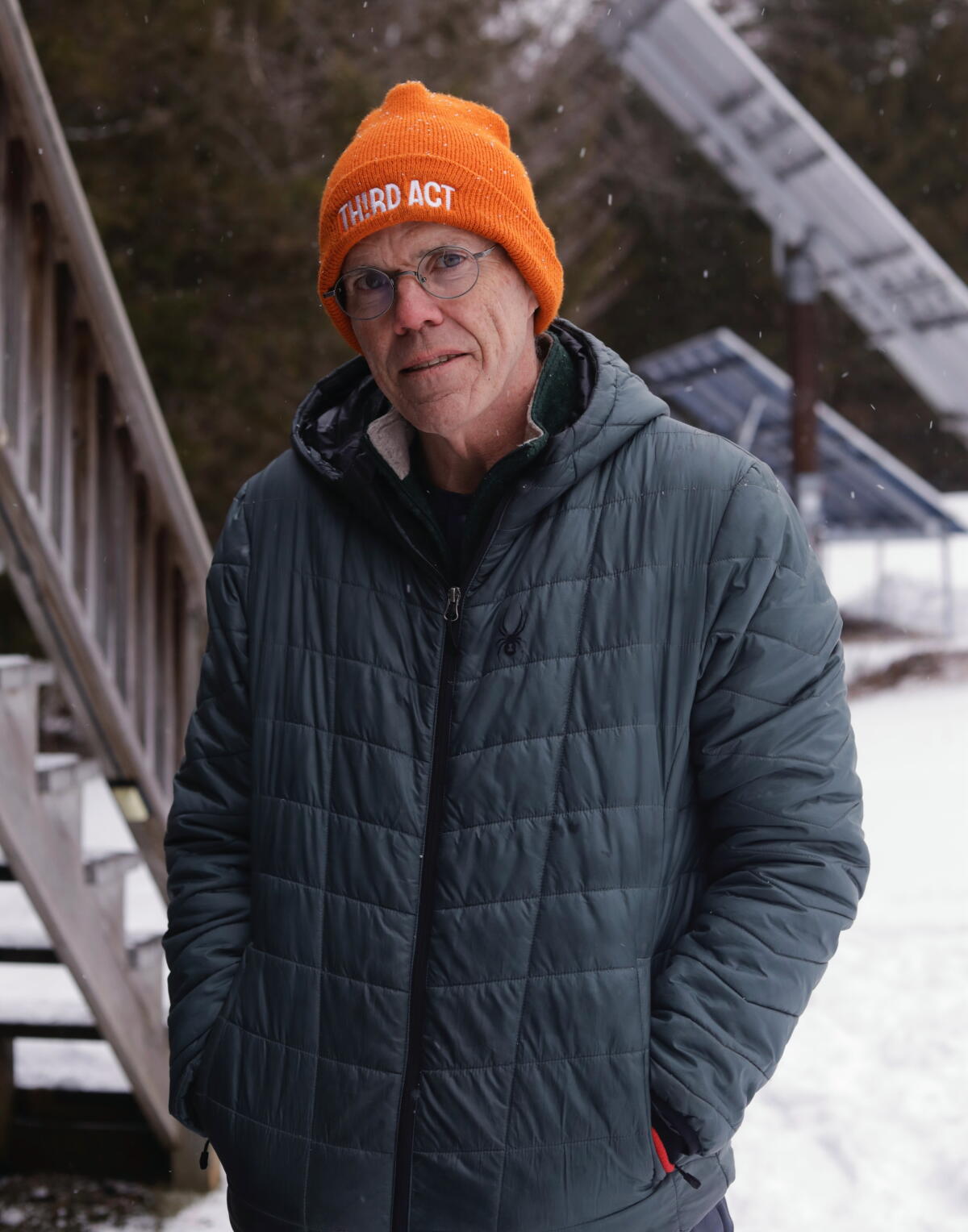
“L.A. shows the world what it means to be a star,” declares the ad’s narrator, actor and screenwriter Bob Odenkirk. “And every Angeleno deserves the chance to reach for their own.”
After Raman has stopped off at a taco stand and hugged a dog, Odenkirk delivers the ad’s final message: “Change. Affordability. An L.A. that loves you back.”
That ad ran on television a few times before being cycled onto social media, per the Raman campaign.
Three days later, Bass went up with a 30-second spot — on digital platforms for now — centered on President Trump’s immigration raids.
The ad offers footage from the day in July 2025 when Bass confronted federal immigration agents in MacArthur Park. The video features images of gun-toting federal agents in military uniforms and Bass hopping out of a car in an aquamarine pant suit to face them.
“When someone comes after your family, you don’t hesitate,” Bass says. “You stand up. You fight.”
One of Bass’ most formidable allies — the Los Angeles Police Protective League — went hard negative with its first ad of the runoff campaign, offering the message that Raman “Doesn’t Get It.”
The commercial, released Friday, follows a young girl as she walks past a homeless encampment, juxtaposed against video of Raman talking about her opposition to a law that prohibits encampments near schools.
“I don’t think a kid’s gonna be safer because a tent is 500 feet away from a school,” Raman said in the clip, which was taken from a 2024 candidate forum in Sherman Oaks.
The backpack-wearing child speaks to the camera and says: “Walking to school shouldn’t be scary.”
“I’m just a kid,” she says. “But even I know I’d be safer if this was 500 feet away.”
The police union says the ad will start running on television this weekend and already is on social media platforms.
Meanwhile, Raman’s backers have an assortment of attack ads running on Facebook and Instagram.
Streets For All, a group that wants to expand the city’s bus and bike lane network, pulled video footage from a different Sherman Oaks candidate forum — this one featuring Bass and Raman last month.
At that event, Bass told the audience that Raman is unresponsive to her constituents, forcing many in Sherman Oaks to contact the mayor’s office directly.
“Many of you have my cellphone, you have called me,” Bass says in the ad. “You called on me specifically for help.”
Streets For All contends those remarks show that Bass gives wealthy homeowners her number while “regular Angelenos get ignored.”
“L.A. deserves a mayor who doesn’t just listen to the rich and powerful,” the ad says.
By Friday, Streets For All had nearly two dozen different video spots opposing Bass over such issues as homelessness, transparency and the Palisades fire, according to Ethics Commission filings.
The biggest backer of the group’s political action committee is hedge fund manager Aaron Sosnick. Of the $1.2 million that the group plans to spend in the mayor’s race, Sosnick has provided $1 million, said Michael Schneider, who heads the group.
Schneider said the committee also has financial support from retired real estate developer Yuval Bar-Zemer — known for his work in the Arts District — and Todd Wexman, chief principal of 4SITE Real Estate, a real estate development company.
Raman pollster says she’s in the lead
The Raman campaign shared the results of a new internal poll that showed their candidate with a five-point lead over Bass.
Of the 600 likely voters who were surveyed, 44% supported Raman and 39% backed Bass, with 17% undecided, according to a memo provided to the campaign and viewed by The Times. The survey, conducted by Hart Research Associates in early September, had a margin of error of 4 percentage points.
“In the initial trial heat for Los Angeles mayor, Councilmember Nithya Raman is in the rare position for a challenger of already LEADING the incumbent,” the polling firm wrote.
Another poll, commissioned by an independent expenditure group supporting Raman, portrayed the race as a statistical tie, at least initially. Estamos con Nithya for Mayor of LA 2026, sponsored by the Western States Regional Council of Carpenters, said its poll showed Bass with 38% and Raman at 37%.
However, when voters received more information on the candidates, Raman took a 7-percentage-point lead, with 41% supporting her and 34% supporting Bass, according to a memo prepared by the group’s pollster.
The margin of error was 3.7 percentage points.
The Bass campaign declined to share its internal polling when contacted by The Times.
However, Neighborhoods for a Better L.A., an independent expenditure group supporting the mayor, said a survey it commissioned in early August showed the mayor with an edge over Raman of 41% to 35%, with 24% of the electorate undecided.
That poll, conducted by Tulchin Research, surveyed 1,200 likely Los Angeles voters and has a 2.8-percentage-point margin of error, the group said.
The poll also found that when given “balanced biographies” about both candidates, Bass’ support grew to 45% while Raman went down to 33%.
“Communications focused on Raman’s record can both reduce her support and consolidate voters behind Bass,” the pollsters wrote.
Giving back El Grito cash
Los Angeles City Councilmember Imelda Padilla locked down sponsorships for the city’s celebration of El Grito, which marks Mexico’s independence.
Tuesday’s event, which featured an evening of musical performances, was sponsored by an assortment of city contractors and government agencies, including waste hauler Athens Services and the Department of Water and Power.
Still, Padilla decided she didn’t want to partner with one particular business, announcing at the last minute that organizers no longer would accept a $5,000 sponsorship from Home Depot.
On the day of the celebration, Padilla issued an apology on Instagram, saying she had heard from community members upset over the event’s affiliation with Home Depot, whose parking lots have been the site of many federal immigration raids.
“We have rescinded their partnership for this event,” Padilla said in her post. “The spirit of El Grito is rooted in celebrating our Latino heritage and creating a space where our families feel welcomed, safe, and celebrated.”
In an email, a Home Depot spokesperson said the company is not involved in immigration enforcement activities and doesn’t coordinate with Immigration and Customs Enforcement or U.S. Border Patrol. The company also doesn’t receive advance warning about enforcement actions, the representative said.
“We cannot legally interfere with federal enforcement agencies, including preventing them from coming into our stores and parking lots,” Home Depot spokesperson Evelyn Fornes said.
State of play
— COZY WITH CARUSO: Billionaire developer Rick Caruso, who was defeated by Bass in 2022, appeared alongside the mayor at a groundbreaking for the Palisades Recreation Center. Caruso praised her for her work on the project but stopped short of endorsing, saying he intends to meet with Raman in the coming weeks.
— LIFE AFTER PRATT: The voters who picked reality TV personality Spencer Pratt in the June 2 primary election are now up for grabs. But will they stay home instead of picking a mayoral candidate?
— BASS BAILS: The mayor skipped a congressional hearing on waste and fraud in homeless spending this week, calling the session politically motivated. Rep. Tim Burchett, the Republican who chaired the subcommittee meeting, accused her of dodging accountability.
— FINDING FRAUD: Federal authorities arrested three people who were working in Los Angeles-area homeless nonprofits this week, accusing one of them of misappropriating more than $7.5 million in taxpayer funds. Scott Turner, secretary of the Department of Housing and Urban Development, said the Los Angeles Homeless Services Authority, which provided the funding, had allowed fraud to “run rampant.”
— WE’RE IN THE MONEY: The 2028 Summer Olympic Games in Los Angeles will generate up to $40.6 billion in increased economic output and add as many as 224,000 jobs, according to an upbeat economic forecast released this week. Another, more tempered estimate put the increase at $20.5 billion to $25.4 billion.
— SEETHING OVER SKID ROW: Some activists want dogs taken away from homeless residents living in Skid Row, saying those animals are living in an unsafe environment. A Bass aide responded by cautioning that it is “neither humane nor legal to remove animals from their human companions without appropriate cause.”
QUICK HITS
Where is Inside Safe? The mayor’s signature program to combat homelessness went to Avalon Boulevard and 64th Street in South L.A., an area represented by Councilmember Curren Price.
On the docket next week: The council’s Public Works Committee meets Tuesday to discuss ways of cleaning, safeguarding or demolishing nuisance properties.
Stay in touch
That’s it for this week! Send your questions, comments and gossip to LAontheRecord@latimes.com. Did a friend forward you this email? Sign up here to get it in your inbox every Saturday morning.
The Manchester United Muslim Supporters group says club co-owner Sir Jim Ratcliffe “must go” after he spoke out against immigration levels and said the country was “on the slide”.
Billionaire Ratcliffe, who is one of Britain’s richest people and founder of petrochemical giant Ineos, made the comments in an interview with the BBC on Saturday.
Ratcliffe said the UK was in decline because of a combination of high taxes and high immigration.
He has previously apologised for “offending some people” with his language after saying the UK had been “colonised by immigrants”.
At the time, in February, United responded by saying the club “prides itself” on being “inclusive”, while BBC Sport cited a source familiar with the Glazer family as understanding the club’s majority shareholders were “horrified” by his initial remarks and saw them as showing “disregard for their ownership”.
“We condemned those comments then,” said a statement of no confidence from Manchester United Muslim Supporters Club (MUMSC) in the club’s ownership, issued on Saturday.
“He [Ratcliffe] subsequently apologised for his choice of language. We hoped a lesson had been learned. Clearly, it has not.
“This week, Sir Jim has again placed immigration and people receiving benefits at the centre of his explanation for Britain’s problems, arguing that nobody is ‘tough enough’ to deal with either.
“We find these latest comments deeply disappointing and completely unacceptable.”
Ratcliffe campaigned for a Leave vote in the 2016 European Union referendum and has been a tax resident in Monaco since 2020.
He acquired a 27.7% stake in Man Utd in 2024, and has since restructured the organisation, overseeing 450 redundancies, overhauling senior management and sacking two managers.
MUMSC highlighted that United’s “players, staff, stewards, security teams and supporters come from different countries, cultures, ethnicities, religions and backgrounds”.
The group added: “Manchester United would not be Manchester United without them. That diversity isn’t a weakness of Manchester United. It is part of Manchester United.”
In the statement, the MUMSC also called on the Glazer family to go.
MUMSC said its members were among the club’s fans who hoped Ratcliffe’s arrival “would finally signal meaningful change” after the Glazer family had “presided over Manchester United’s decline”.
However, the group pointed to “higher ticket prices” and “a stadium allowed to deteriorate”, along with “a football team that continues to fall further behind where Manchester United should be”, among their concerns which “now extend beyond the pitch”.
Manchester United entered the weekend sitting 13th in the Premier League after gaining four points from their first four Premier League games, and they were knocked out of the Carabao Cup on Wednesday with a 3-2 home defeat by Brighton.
“After years of decline, broken promises and repeated failure, Manchester United Muslim Supporters’ Club has lost confidence in the current ownership structure of Manchester United Football Club,” MUMSC concluded.
“Enough is enough. It is time for change. The Glazers and Sir Jim Ratcliffe must go.”
Unai Emery’s side get first league win of season with goals from Johan Manzambi, Nicolas Jackson and Emi Buendia.
Published On 19 Sep 202619 Sep 2026
48he end to Tottenham’s Premier League goal drought came too late as Aston Villa won 3-2 in north London to compound a miserable start for Roberto De Zerbi’s men.
Spurs remain without a league win this season and only netted their first goals of the campaign after the visitors had surged into a 3-0 lead on Saturday.
Villa had also struggled for goals themselves since the side that won the Europa League last season was torn apart during the transfer window.
But new signings Johan Manzambi and Nicolas Jackson struck either side of half-time to give Unai Emery’s new-look team their first league win before Emi Buendia’s wonder strike.
Even Tottenham’s first late consolation needed the aid of a Villa deflection when Conor Gallagher’s effort went in off Matty Cash before Jan Paul van Hecke headed home in stoppage time.
Spurs splashed out more than 300 million pounds ($400m) on new players to try and avoid a repeat of the battle for survival they endured last season.
Yet there remains little return on that investment.
In keeping with recent performances, Spurs started brightly before fizzling out.
Twice in a matter of seconds, Savio was kept out by Suzuki before the Japanese goalkeeper spread himself to turn behind Archie Gray’s powerful strike.
Villa had picked up just one point from their opening four league games but have missed their club record signing Manzambi for most of that period.
The Swiss international opened his Villa account when he tapped home Boubacar Kamara’s cross.
However, Tottenham will protest about new laws that force a player off the field for at least a minute after receiving treatment for an injury.
A head knock to centre-back Micky Van de Ven left them a man down at the back when Manzambi swept home.
Spurs only had themselves to blame for the second goal as van Hecke failed to deal with a long ball straight down the middle.
Jackson did well to evade the Dutch defender and then fired down into the ground and past Antonin Kinsky.
The Czech goalkeeper was powerless to stop Villa’s third 11 minutes from time when Buendia took aim from long range and brilliantly picked out the top corner.
A chorus of boos greeted Buendia’s strike as thousands of home fans headed for an early exit.
But those that left missed finally have something to celebrate.
Fine persistence from Mohammed Kudus teed up Gallagher to find the bottom corner via the outstretched foot of Cash.
Van Hecke then bulleted in from Andy Robertson’s free-kick with virtually the last touch of the game.
Spurs now must stew on another defeat for a three-week international break while rooted in the relegation zone.
Villa, by contrast, will hope victory can prove the catalyst to storm up the table as they did last season.
Emery’s men failed to win any of their first five league games a year ago, but ultimately finished fourth.
DEEP in the forest, I’m watching tiny, rare frogs swimming and croaking (more of a weird squeak, really) in a flooded chamber at ancient Roman city, Bouthroton.
This is not what I expected in “the Maldives of Europe”.
Stunning Butrint National Park in AlbaniaCredit: Getty ImagesThe ancient amphitheatre at Butrint parkCredit: Getty Images
Apparently someone, somewhere posted online a couple of years ago that Albania has some fabulous beaches with turquoise water like the Indian Ocean paradise islands, and the nickname stuck.
I’d long been intrigued by what was a communist totalitarian state until the mid-Nineties and had thought of it more as “the North Korea of Europe”!
Sign up for the Travel newsletter
Thank you!
So when I was on holiday in nearby Corfu, and discovered full-day tours operated, I jumped at the chance to see for myself.
The good-value trips are run by Tui-owned Musement and mine started at 7.30am with a 30-minute coach transfer from the hotel to the port, then a 75-minute ferry across to beach resort Sarandë in Albania, a coach pick-up there and a few hours of guided sightseeing.
After a coffee pitstop, the coach headed south to the uncrowded, unspoilt Butrint archaeological site and its surrounding national park.
I’d heard of Butrint’s large lake but was not aware of its history, with human habitation here dating back thousands of years.
However, this visit took my group back to a “mere” 800 BC and the Unesco-listed ruins of Bouthroton founded by Greeks and taken over by Romans.
There’s a lot of walking on rough tracks in the forest and a fair few steps, so trainers are best.
Enthusiastic guide Lindita was a mine of information about the ancient forum, amphitheatre, public baths, aqueduct and almost 3,200ft of encircling walls, up to 23ft high.
A 4th-century earthquake affected sea levels, and the city was finally abandoned in the Middle Ages, with high tides causing flooding – but creating a habitat for those noisy little Greek water frogs and cute terrapins.
On to the adjacent national park, with Lindita explaining about the lake (actually a lagoon), which is linked to the sea by a 1.6-mile channel.
The rich birdlife includes the magnificently-named short-toed snake eagle while the mussels in the lake are hailed as Europe’s best.
Before the ferry back to Corfu, we had a brief photo stop at Sarandë’s Lëkurësi Castle – on an 800ft hill with outstanding views – and time for a chilled Albanian beer at a seafront bar.
The downside? It’s a 12 hour-plus day, with an agonising 2hr 10min journey back from the port to my hotel as other guests were dropped off. Still, I saw a lot of Corfu.
And while my included lunch was OK, I’ve never been on any excursion where water is not provided.
On the bus back to Sarandë – and from the ferry – I did spot some lovely beaches, but is Albania “the Maldives of Europe”? Hmm, not atoll. And there is a huge amount of unsightly hotel construction around Sarande and nearby Ksamil.
But the trip is an enjoyable, insightful taste of Albania and I’d definitely think about a holiday there. Maybe I’d even get to see a short-toed snake eagle.
Albania day trip from Crete, from £67pp plus port tax of 20Euros pp.
Who: Atletico Madrid vs Real Madrid What: La Liga Where: Metropolitano Stadium, Madrid, Spain When: Sunday, September 20, at 4:15pm (14:15 GMT) How to follow:Al Jazeera Sport will bring you all the build-up from 11:15 GMT before our live text commentary stream
Atletico host bitter city rivals Real for the Madrid derby as both sides look to keep up with early La Liga pacesetters Barcelona.
Madrid trail unbeaten champions Barcelona at the top of the table by three points, with Atletico third.
Atletico have bounced back from back-to-back defeats to Bilbao and Liverpool earlier in September, beating Real Sociedad 3-0 and Osasuna 4-0 in their last two games.
Real come into the game in decent form under boss Jose Mourinho but have had wobbles this month, with a defeat to Betis and scoring late to beat bottom club Elche after squandering a two-goal lead.
Improving Atletico cruise to win over Osasuna
Atletico Madrid thrashed Osasuna 4-0 on Wednesday to build some form in the run-up to Sunday’s derby clash against rivals Real Madrid.
Jonathan David, Lee Kang-in, Robin Le Normand and Alex Baena’s goals helped Diego Simeone’s side cruise to a comfortable home victory.
They were without injured striker Julian Alvarez, but it did not matter after they secured a second straight win to cut the gap on top two Barcelona and Real Madrid.
The comfortable victory was important for an Atletico side with lots of new faces still bedding in, after two defeats in their three matches prior.
“We controlled it in the first half even though we weren’t clinical,” said coach Diego Simeone. “We were clinical in the second half and controlled the game.”
Atletico Madrid’s Alex Baena runs with the ball during the win over Osasuna at the Metropolitano Stadium [Oscar del Pozo/AFP]
Mourinho rues lack of game control
Real Madrid squandered a two-goal lead before substitute Carlos Espi struck in stoppage time to secure a dramatic 3-2 victory at Elche in La Liga on Tuesday.
Real went 2-0 up inside 33 minutes through a Matias Dituro own goal and Kylian Mbappe, but second-half strikes from Abiel Osorio and Fer Nino hauled Elche level before Espi restored the visitors’ lead in the 91st minute.
It was the second time in six league matches that the 21-year-old Espi had come off the bench to score a late winner, although Mourinho remained concerned by Real’s failure to control the second half in advance of Sunday’s derby against Atletico Madrid.
“The problem seems obvious to me. It’s harder to know why, but it’s easy to understand that there are matches that seem over and, in the end, aren’t,” said Mourinho.
“[There are] matches where we have three, four, five chances to finish them and don’t,” he said at the pre-match news conference.
“After failing to do so, it feels like we go from ease, because it seemed easy, to losing control.”
Mourinho said his team’s defensive issues were of concern.
“Not just for Sunday’s match, but for every match. I like my team to score goals … but I also like controlling matches,” explained Mourinho.
“I don’t like gifting control. It’s not about the goals, it’s about giving away control of the match.”
Mourinho’s side gave him a fright during their win over Elche [Alberto Saiz/AP Photo]
Prediction
The Opta supercomputer has made Real Madrid the favourites, with a win probability of 46.6 percent. Atletico were given a 28.3 percent chance of winning, while a draw was estimated at a 25.1 percent likelihood.
Head-to-head
The rivals have faced each other on 243 occasions; Real Madrid won 125 games, Atletico won 60, while 58 matches ended as draws.
Last five encounters:
March 22, 2026: Real Madrid 3-2 Atletico (La Liga)
January 8, 2026: Atletico 1-2 Real Madrid (Spanish Super Cup semifinal)
September 27, 2025: Atletico 5-2 Real Madrid (La Liga)
March 12, 2025: Atletico 1-0 Real Madrid (Champions League last 16, second leg)
March 4, 2025: Real Madrid 2-1 Atletico (Champions League last 16, first leg)
What happened the last time the two clubs played each other?
Vinicius Jr scored twice as Real Madrid fought back to beat Atletico Madrid 3-2 at the Santiago Bernabeu in a breathless Spanish capital derby in March.
Atletico’s Ademola Lookman opened the scoring in the 33rd minute, finishing a slick counterattack involving Matteo Ruggeri and a delightful back-heel from Giuliano Simeone.
Vinicius equalised from the penalty spot in the 52nd minute, after David Hancko clumsily tripped Brahim Diaz, and Federico Valverde capitalised on a Jose Maria Gimenez error three minutes later to make it 2-1 to Real.
Nahuel Molina silenced Real’s Bernabeu stadium with a thunderous 30-metre strike in the 66th minute, but Vinicius restored Real’s lead with a cracking solo effort six minutes later.
Vinicius Jr celebrates scoring his team’s winner [Florencia Tan Jun/Getty Images]
What happened in the corresponding fixture last season?
Julian Alvarez scored twice as Atletico Madrid came from behind to thrash city rivals Real Madrid 5-2 in a pulsating derby in September 2025.
Atletico’s aggressive start paid off when Robin Le Normand opened the scoring with a header in the 14th minute.
However, Kylian Mbappe burst through to level with an unstoppable strike from close range in a quick counter in the 25th minute, with Arda Guler netting a volley from a Vinicius Jr cross 11 minutes later to put the visitors in front.
Alexander Sorloth’s header in added time before the break gave Atletico a boost, and they regained the lead five minutes into the second half when Alvarez converted a penalty after Guler’s high boot clipped Nico Gonzalez on the face inside the box.
After Alvarez extended their lead in the 64th minute with a sublime free kick into the top corner, substitute Antoine Griezmann sealed the win in a quick counter in added time.
Alvarez scores Atletico’s third from the spot [Angel Martinez/Getty Images]
Atletico Madrid’s team news
Alvarez, Pablo Barrios, and Sorloth are doubts, as all three are struggling with muscle issues.
Jonathan David is likely to continue up front if Alvarez is absent or starts on the bench.
AN 80s rock icon, who was once in a love triangle with Hollywood A-listers Brad Pitt and Christina Applegate, looked unrecognisable as he strolled through an airport.
This famous singer, now 58, passed by fellow travellers unnoticed – but can you guess who it is?
Can you guess who this 80s rock star is?Credit: BackGridThe rocker was once in a love triangle with Christina Applegate and Brad PittCredit: BackGrid
The rock star in question is none other than Sebastian Bach, known for the heavy metal band, Skid Row.
The group shot to fame almost four decades ago with hits like Youth Gone Wild and 18 and Life.
Sign up for the Showbiz newsletter
Thank you!
With his trademark long locks tied back in a ponytail, Sebastian strutted through LAX Airport with his haul of luggage in tow.
The rocker is currently on tour with Skid Row and fellow heavy metal band Twisted Sister, and was jetting into Los Angeles after playing in Oklahoma.
Sebastian was dressed down for his flight and was wearing a black t-shirt and matching jogging bottoms.
The singer went unnoticed in the airport as he got ready to head home, before his next gig in Washington at the end of the month.
Did you guess the singer in question is Skid Row’s Sebastian Bach?Credit: AlamyThe rocker got in the middle of Brad Pitt’s and Christina Applegate’s romanceCredit: Getty
During his heyday, the rock legend was famously caught up in a love triangle with two of Hollywood’s now-elite stars.
The twice- married singer, who is currently wed to wife Suzanne Le, got in the middle of Brad Pitt and Christina Applegate‘s romance.
Known for his heartthrob status, back in 1989 Sebastian, who was 21 at the time, caught the eye of a 17-year-old Christina – who was dating rising star Brad Pitt, who was 25.
Things kicked off when the young couple attended the MTV Video Music Awards together that year.
Sebastian shot to fame in the late 80s with Skid RowCredit: AlamyChristina opened up about Seb ‘catching her eye’ in 1989Credit: Getty
However, despite having hunky Brad on her arm, Married With Children star Christina found her head had turned in the direction of Sebastian – and she ditched her date for the rocker.
Speaking in her memoir earlier this year, the actress told fans exactly what happened.
“I had spent all night staring at Bach, who was then a long-haired hunk fronting the band Skid Row,” she penned in her book, You With The Sad Eyes.
“I hate to put it like this, but Brad back then was still making his way as an actor, and he wasn’t yet THE Brad Pitt, the man of so many people’s dreams.”
Continuing, Christina wrote: “And it gets worse: Brad was left to sullenly drive my mom … home.
“Apparently, at a gas station on the way, Brad almost got into a fight with a bunch of gang members, and, not surprisingly, was subsequently very mad at me.”
The Dead To Me star also revealed that Brad didn’t speak to her after the incident for many years. – but added that they are “friends again” now.
“Eventually, we agreed that I’d been a kid, and though he deserved much better, it was time to forgive the child who dumped him for the lead singer of Skid Row,” Christina said.
“Of course, Brad is now THE Brad Pitt, and Sebastian Bach … well, he still has long hair, I guess.”
Sebastian also reflected on him stealing Christina, now 54, from Brad, now 63, and told Billboard earlier this year: “I was a single guy on tour, in a band, and I met a lot of girls and Iapologisee if I hurt her…If I hurt anybod,”.
“When you’re young you get thrown into the whirlwind of rock ‘n’ roll, meeting a lot of people and you’d better hold on tight.
“It’s like being on a roller coaster.
“It was a long time ago. If I hurt anybody, I apologise for it.”
In La Palma Park Stadium in Anaheim, a month before the Bay of Pigs invasion, 7,500 students and parents skipped school or work and gathered to learn about communist plans to take over the United States.
“Right now, we have a 50-50 chance of defeating the communist threat,” Herbert Philbrick, a former FBI agent, told the crowd on March 8, 1961. “Each day our chances grow less.”
Walter Knott, of berry-farm fame, sponsored the five-day “Christian Anti-Communist School” to help Orange County see the world that he saw, one where big government and liberalism led to Soviet domination.
The message stuck. Within the decade, Orange County would have 38 chapters of the conspiracy-minded, ultra-right-wing John Birch Society, which called Republican President Dwight D. Eisenhower a “communist tool.” Knott and actor John Wayne were members, as was the county’s congressman.
The rightward mobilization during the suburban explosion of the 1960s gave Orange County a national reputation for hard-line conservatism with a crackpot edge — “nut country,” in the words of Fortune magazine.
The county’s deep pockets funded right-wing candidates and movements throughout the nation. At home it spawned popular but ultimately doomed measures such as the Briggs Initiative in 1978 to ban gays and lesbians from working in public schools, and Proposition 187 in 1994, which would have denied public services to immigrants in the country illegally.
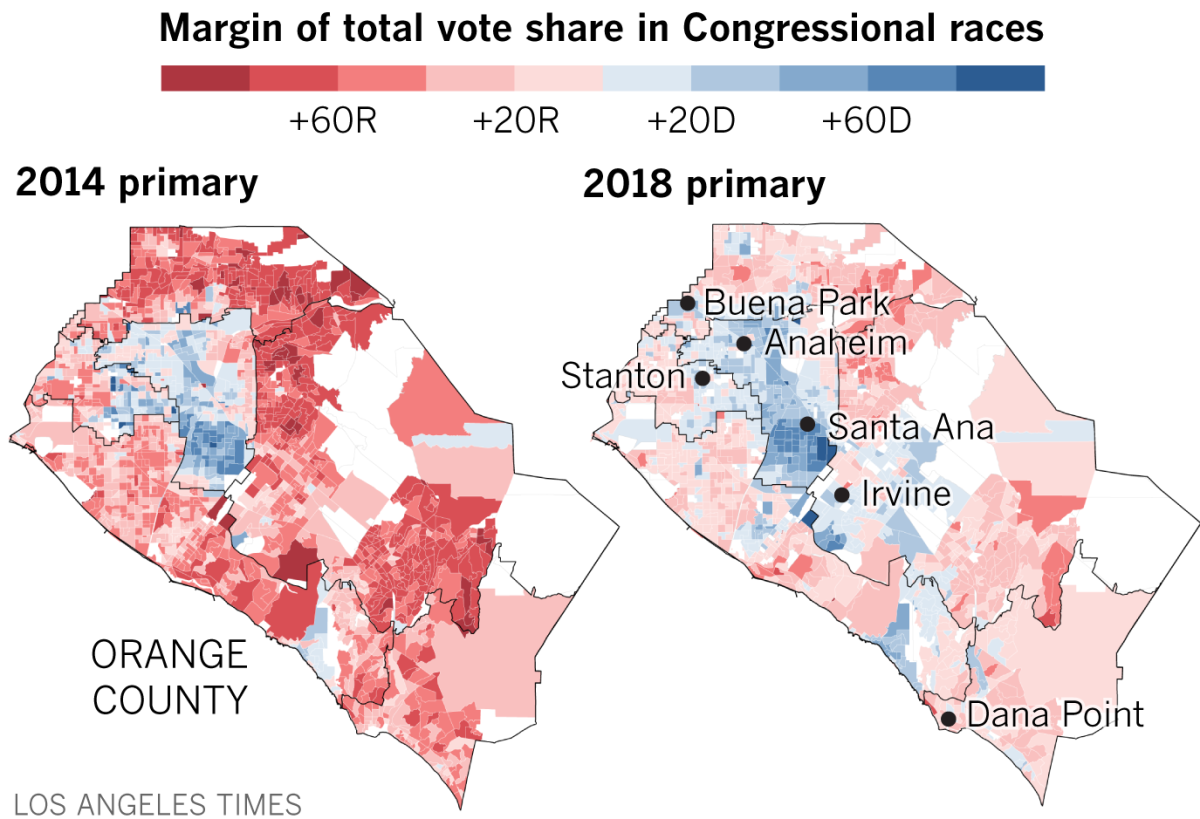
The Republican Party reached its peak in the Reagan era and has been slowly losing its membership edge since 1990, as the diversity of Los Angeles and the world at large started to bleed through the so-called Orange Curtain.
Source: California Secretary of State
(Priya Krishnakumar / Los Angeles Times)
Registered Republicans today outnumber Democrats by only 2 percentage points, down from 22% at the peak, with a large contingent of self-declared independents positioned to swing elections either way. The GOP has a chance of losing four congressional seats in the county in Tuesday’s midterm election. If so, it would be the first time since the 1930s that Orange County would be without Republican representation in the House.
A GOP loss of even one or two seats would be significant, not as a turning point so much as a powerful sign of change — hastened by dislike for President Trump — in this one-time heart of American conservatism.
Source: Political Data, Inc.
(Priya Krishnakumar / Los Angeles Times)
::
Orange County seceded from its northwestern neighbor, Los Angeles, in 1889, led by fiercely independent ranchers, sheepherders, beekeepers, citrus growers and crop farmers who had bristled under the control of a rich city 30 miles up the rail line.
The county then was a constellation of small farm and dairy towns in the north and scattered resort towns along the coast. In the south, the basin tapered off into a narrowing valley between the Santa Ana Mountains and the coastal San Joaquin Hills, where sheep and cattle ranches had thrived since California was part of Spain and Mexico.
Americans had taken over the ranchos in the late 19th century after a devastating drought left many old landowners of Spanish ancestry, the Californios, broke.
Lewis Moulton was one of the Yankee migrants. He came from Boston in 1874 and grazed sheep on the open range from Oceanside to Long Beach. Family lore has it that natural gas seeps were so rich in some spots that, as he camped, he would light them to cook his breakfast.
After two decades of renting land, he and a Basque shepherd, John Pierre Daguerre, had enough money to buy Rancho Niguel, which they eventually expanded to 22,000 acres. It was rugged, isolated country, good mostly for grazing. The cheapest land was the steep part near the coast, between what would become Laguna Beach and Dana Point — about $15 an acre. Today, small fractions of an acre go for double-digit millions.
In the second half of the 20th century, these backwater ranchers and farmers, the Moulton family, the O’Neills, Floods, Irvines, Segerstroms, would physically and culturally shape Orange County into the suburban giant it is today.
But there was always an underclass that made their dreams work.
Tenant farmers — often with roots in Mexico, the Basque country or in California before the American conquest — rented spots on these ranches to graze and grow barley. Others toiled as hands for the landowners.
In the north, they lived in segregated barrios in Santa Ana, Westminster, Anaheim and Garden Grove — where their children attended separate “Mexican schools” until a federal appeals court ruled them unconstitutional in 1947. In the south, they made up smaller communities in El Toro and San Juan Capistrano.
Stephen Rios stands in the doorway of the adobe house in San Juan Capistrano built by his family in 1794.
(Mark Boster / For The Times)
“My tata got killed right there by the train when he was 93 years old,” Stephen Rios said of his grandfather, an American Indian named Mochanai, as he sat in his front garden across from the Mission San Juan Capistrano. “He was a vaquero, a well-known horse trainer.”
Rios’ family worked for the Moultons and O’Neills and lived in the adobe house built in 1794 for their ancestor Feliciano Rios, who came to California as a Spanish soldier and married an American Indian woman.
Rios, an attorney, inherited the home from his father and lives there today. His son’s bedroom has the ceiling boards that the famed bandito Joaquin Murrieta, a family friend known as the Robin Hood of El Dorado, would lift to hide in the attic in the 1850s. A flat-screen TV sits below them now.
The American Indian, Californio and Mexican residents of their dirt street — the oldest neighborhood in California — were conservative. “They loved their families, their church,” he said. “They loved their pieces of land. They were strong, religious independent people.”
Republicans reigned during the rural era. The land barons did not want labor organizers anywhere near their field hands.
When orange pickers walked out of the orchards in 1936, the strikers were arrested and beaten by police and mobs. The Times reported “old vigilante days were revived in the orchards of Orange County yesterday as one man lay near death and scores nursed injuries.”
Changes in Orange County’s 948 square miles — physical, demographic and political — have always rolled from north to south. While the Rios family was still living in the cowboy era, World War II brought rapid transformation to the northern part of the county.
The military needed more West Coast bases to fight the Japanese, and the open space between Long Beach and San Diego was perfect. The government built bases in Seal Beach, Los Alamitos, Santa Ana and El Toro.
Defense contractors and other big manufacturers followed: Hughes Aircraft, Rockwell, Ford Aeronutronic, Boeing, American Electronics, Beckman Instruments.
The farmers and ranchers became developers, or sold their land to other builders, creating vast tracts of homes across the northern end of the county from Huntington Beach to Fullerton. In this era of big cars and backyard barbecues, houses turned inward. Garages replaced porches and picture windows; neighborhoods were quiet.
The newcomers, many from the South and Midwest or white-flighters from Los Angeles, converged at church.
::
At its core, Orange County held a tension between Midwestern traditionalism and California’s drive for reinvention.
The midcentury suburbs in the north were libertarian-leaning enclaves, yet living on Washington defense spending, and listening to a sunny California-bred gospel of self-empowerment and prosperity.
An Iowan named Robert Schuller put out a newspaper ad in 1955, “Come as you are … In the family car!”
He preached from the roof of the snack bar at the Orange Drive-in theater, not about fire and brimstone, but about “possibility thinking” with catchphrases like “Turn your scars into stars.”
Robert Schuller, who delivered a new type of self-healing Gospel to the country, at the new Crystal Cathedral in 1980.
(Tony Barnard / Los Angeles Times)
Schuller’s congregation boomed, becoming one of the nation’s first megachurches. His “Hour of Power” television sermon beamed across the country. In 1980, he built a glass church longer than a football field, the Crystal Cathedral.
Orange County birthed hugely influential ministries that mixed God with conservative politics: Chuck Smith’s Calvary Chapel, Greg Laurie’s Harvest Crusade, Paul and Jan Crouch’s Trinity Broadcasting Network and Rick Warren’s Saddleback Church.
“The megachurches reinforced and marinated the conservatism coming out of the defense plants,” said Fred Smoller, associate professor of political science at Chapman University.
Orange County’s open space and space-age technology, coupled with fervent entrepreneurship and an-edge-of-the-continent mentality, let tinkerers and visionaries experiment with minimal regulation.
This was a suburban county that, like no other, reached deep into popular culture.
Knott’s Berry Farm was the nation’s first theme park. Disneyland became one of the world’s biggest destinations. The ministries reached millions. South Coast Plaza shopping mall would draw more people from around the world than Disneyland. The Irvine ranch grew into the largest planned city in America. Leisure World became the first retirement community.
Leisure World resident Jerry Wyss enjoys the pool in 1999.
(Mark Boster / Los Angeles Times)
In new coastal towns such as Dana Point and San Clemente, Hobie Alter, Gordon “Grubby” Clark and John Severson (living next door to Orange County native Richard Nixon in his “Western White House”) helped create a whole new culture around an ancient Polynesian sport that would become a multibillion-dollar surf industry.
In Laguna Beach, Tom Morey, a Douglas Aircraft composites engineer, invented the bodyboard. In Anaheim, the Van Doren brothers opened the first Vans store.
And the likes of Knott and Anaheim’s Carl Karcher, the founder of Carl’s Jr., would help give America a new brand of conservatism, with their friend John Wayne in Newport Beach to embody it.
With the Cold War at its peak in the 1960s, families in Orange County, so many of them in the military or defense industry, heeded their call.
“At living room bridge clubs, at backyard barbecues, and at kitchen coffee klatches, the middle-class men and women of Orange County ‘awakened’ to what they perceived as the threats of communism and liberalism,” wrote Lisa McGirr, a professor of history at Harvard, in “Suburban Warriors: The Origins of the New American Right.” “They became the cutting edge of the conservative movement in the 1960s.”
“The lack of a large organized working class and the near absence of racial minorities made it likely that Orange County’s political rainbow would consist of relatively few colors.”
The quiet homogeneity of the walled and gated communities allowed politicians to exploit fears of the outsider — whether they be African Americans from Los Angeles, immigrants from Mexico, or gays, Muslims and Koreans.
“The anti-minority stuff accelerated political careers here,” said Smoller, the political scientist. “We have a history of sending some real oddballs to Congress.”
An early one was Rep. James Utt, who in 1963 warned about the United Nations training “a large contingent of barefooted Africans” in Georgia to take over the country.
Cementing this conservatism: its daily newspaper, the Register, and its libertarian owner Raymond C. Hoiles. He had once waged war against a measure to improve mental health care in Alaska because he said it was a communist plot to brainwash Americans in concentration camps.
In 1964, Pat Donnelly, a young aerospace engineer working at McDonnell Douglas, bought a small home in Buena Park for $18,500. His neighbor’s first admonition to him: They must help ensure no blacks, Mexicans or Catholics moved in.
Donnelly was a Catholic, and even worse, a union-card-carrying Democrat who once played guitar and banjo in a touring folk band. He and his wife had two girls and joined the St. Pius V Church on Orangethorpe Avenue and started a choir. With his own slice of suburbia, he became more concerned about taxes and grew more conservative.
“I didn’t like some of the stuff I was seeing in the cities, the drugs and crime. It seemed like people were abusing welfare. I was paying for that.”
He switched parties and never looked back.
After Orange County’s favorite candidate Barry Goldwater lost to President Lyndon B. Johnson in 1964, Republican rainmakers turned their attention to Reagan’s run for governor. His first political fundraiser was at a home in Anaheim, and the county would nurture his ambitions the rest of his career.
By the 1970s, developers had reached deep into south Orange County. The Irvine Co. had wound down its cattle operations and was parceling out its 185 square miles of land. Some 1,500 acres near Newport Beach would become UC Irvine. The company developed a master plan for a city to grow around the university, which would incorporate in 1971.
The Moultons sold their land soon after to developers who would build Laguna Hills, Laguna Woods, Laguna Niguel and Aliso Viejo. In their yards, homeowners would find rattlesnakes that wandered out of the wild canyons and steep hillsides between subdivisions.
To the east and south, the O’Neills’ vast scrubby land would give way to even newer, posher cities such as Rancho Santa Margarita, Ladera Ranch and the community of Coto de Caza — the setting for the “Real Housewives of Orange County.”
With all this construction, Stephen Rios’ 225-year-old adobe home is hemmed in by suburbia.
The “Los Rios District” is now on the National Register of Historic Places and is highly sought-after real estate for its quaint atmosphere.
Most of the old Californio families sold and moved on.
“Everyone else wants to live here now,” Rios said.
Jared Mathis, left, and Scott T. Barnes stand off the trail in the Aliso and Wood Canyon Wilderness looking over the 22,000 acres that their great-grandparents bought in the 1890s.
(Mark Boster / For The Times)
Lewis Moulton’s great-grandson, Jared Mathis, came back from a job back east to Laguna Hills to manage the family’s remaining holdings. A few years ago, he took his dad — who moved away in the 1970s — for a drive to look at the old ranch where he grew up.
But his father couldn’t get his bearings. All the landmarks were gone, the hills terraced, new trees and houses blocked once wide views. “They say they moved more dirt building Aliso Viejo than they did digging the Panama Canal,” Mathis said.
Mathis drove his father to the ridgeline of Laguna Beach. From there, you could see the whole ranch area, smell the laurel sumac in Aliso Canyon, glimpse some old corrals in the distance, get a grip of the topography. The white striations of terraced neighborhoods faded in the haze. The twin peaks of Modjeska and Santiago, called Old Saddleback, framed the view, as they did in most of the county, one thing that never changed.
“He could see where they had the old roundups,” he said. “That was a powerful image for him.”
As development moved south, the older, northern parts of the county lost some of their luster. The affluent white Republicans drifted to the shinier places depicted in shows such as “The O.C.”
The explosion in South County home construction created thousands of jobs. “The people building all of those houses were Latino,” said Smoller, the political science professor. Like the old tenant farmers, they helped families such as the Irvines realize their dreams.
Thousands of other Latinos would follow to work in service jobs in these wealthy new areas.
The humming economy overall and good schools also lured professional and middle-class Latinos to the northern neighborhoods that Anglos were leaving in their migration south.
In Santa Ana in the 1970s, the population of Latinos went from 40,000 to 90,000. Today, Latinos account for 78% of Santa Ana’s population. Northwest Orange County looks a lot like Southeast L.A. County. La Habra is 57% Latino; Anaheim, 52%; Buena Park, 40%; Garden Grove, 37%.
The other big factor that brought demographic change was seeded 53 years ago, when the federal government removed racist quotas on immigrants from Asia, and Greater Los Angeles became a major destination for Koreans and Chinese.
In 1975, after Saigon fell, 50,000 South Vietnamese landed in nearby Camp Pendleton, and conservative Orange County stepped up to take the anti-communist refugees.
The Register called on churches and citizens to sponsor these newcomers. They were put up in apartments in neglected parts of Westminster and Garden Grove still surrounded by bean fields.
Soon the fields and dilapidated commercial strips gave way to bustling places such as Saigon Market and Hoa Binh Market, ushering in a wave of new Vietnamese businesses that would revitalize the area.
Frank Jao started off in America selling Kirby vacuum cleaners in Whittier. Within a year, he moved to Garden Grove, became a real estate agent, then developer, first building a shopping mall in Westminster with the help of Chinese investors.
So many Vietnamese storefronts were opening in Westminster, changing its look so rapidly, that more than 100 residents signed a petition calling for the city to stop issuing business licenses. It was an ugly time.
“Anyone driving on Bolsa would more than occasionally be confronted by drivers who rolled down their windows and asked us to roll down ours, and they’d give us the middle finger,” recalled Jao, now 70. “When we’d go to work in the morning, we’d find the windows shot out by BB guns.”
His buildings became the core of Little Saigon, notably its landmark Asian Garden Mall. His company built $400 million worth of shopping centers and apartment buildings throughout Orange County and beyond.
Upscale Chinese families took to Irvine. Many had left China because of the lack of opportunities for their children to attend college, and this master-planned community, built around UC Irvine, was a huge draw, as it was to moderately affluent Koreans, Iranians and Latinos. Irvine is nearly 40% Asian now.
Koreans had begun trickling in from Los Angeles during the 1980s, seeking better schools. The 1992 Los Angeles riots, in which many Korean store owners lost their businesses, sped up the flow. They often stuck close together, moving into specific neighborhoods in Garden Grove, Fullerton and Buena Park.
The Asian influx has also contributed to the reordering of politics in once reliably Republican Orange County.
As a whole, Asian Americans are more likely to register as “no party preference” and vote based on specific issues, not party, said Karthick Ramakrishnan, a professor of political science and public policy at UC Riverside. They leaned Republican during the Reagan era and well into the 1990s while subsequent generations moved to the left.
“About one-third of Asian Americans voted for Clinton in 1992,” Ramakrishnan said, “but two-thirds voted for Obama in 2008.”
He said in the last five years strong GOP outreach to the community in Orange County — and encouragement of Asian Americans to run for office — has brought many back to the party. But Ramakrishnan said too many factors are at play to say how they will vote on Tuesday. An example: They don’t like Trump’s anti-immigrant rhetoric, but Vietnamese, Taiwanese and Koreans like his confrontational stance toward China.
In Buena Park, Pat Donnelly, still a Republican, met a Korean American estate attorney named Sunny Park — a Democrat — at his Lion’s Club. He came to realize she had values he admired: honesty, a family focus, strong work ethic. Now he’s campaigning for her as she runs for City Council.
Park had followed her aging Korean clients from Los Angeles, moving into the affluent and increasingly Korean Bellehurst neighborhood. When she knocks on doors, many white people have offered support. But some have grumbled “No Koreans” and shut the door in her face.
A couple weeks ago, she started seeing campaign signs that said “No Sunny Park, Carpetbagger.”
She says the message that sends the Korean community is that she — and by extension they — are not from here and they shouldn’t try to take part in politics.
The political dynamic in Orange County is not so much a rising blue tide, but an ebbing red one. Since 1999, registered Democrats rose by less than 2 percentage points to 33.6%, while Republicans have fallen 14 points to 35.6% of voters. The wave is of independent voters who increased in numbers nearly as much as the Republicans fell.
A majority of Latinos vote Democrat, and growth in their community has buoyed the party. While they tend to be more socially conservative, they favor more lenient immigration policies, social programs that help the poor, strong unions and high minimum wages.
Historically, turnout has not matched their share of the population, but some Republican strategists fear Trump’s derogatory comments about Mexican and Central American immigrants might motivate them this year.
In 1996, the anti-immigrant rhetoric surrounding Proposition 187 helped end the ultra-right Orange County Republican Bob Dornan’s political career, and put Democrat Loretta Sanchez in Congress.
Just like the development, the diversity and Democratic edge are pushing south in this county of 3.2 million people.
In 2002, Democrats outnumbered Republicans only in Santa Ana, Buena Park and Stanton. Now they do in 11 cities reaching down to Irvine.
In Laguna Niguel, Candy Antone, 47, said Democrats such as her essentially lived in the closet until recently. She would go quiet when a Republican friend or neighbor would go on a political rant. “You just had to bite your lip,” she said.
But Trump is repelling even many Republicans here. “Democrats are coming out of the woodwork,” Antone said. “People we’ve known for years, we’re just finding out they’re Democrats.”
London City Lionesses earn their first away win of the season, ending a four-game streak without a victory on the road, as they emphatically beat a struggling Charlton side that have lost all three of their WSL games.
Tehran, Iran – Hossein, a 32-year-old marketing specialist based in Tehran, has been thinking of replacing his 13-year-old Iranian-made car with a newer model.
Even though he earns about four-and-a-half times the minimum wage after a recent pay rise – his salary is now close to 900 million rials (about $390 at the current exchange rate) – imported vehicles are not even remotely affordable for him.
Recommended Stories
list of 4 itemsend of list
Even finding a locally made car might be out of his budget, with an economic crisis gripping the country since the United States and Israel launched a surprise war on Iran on February 28 and later enacted a crippling siege and sanctions on the country.
“I’m losing hope of ever being able to buy a new domestic production car too, unless the country opens up and becomes a bit more normal again,” Hossein, who asked to keep his full name confidential for security reasons, told Al Jazeera.
His old manual Peugeot 206 model, an originally French-made car but now produced domestically after foreign counterparts left Iran due to sanctions, can fetch up to 10 billion rials ($4,350) if he sells it towards making a new purchase. However, his replacement options are limited.
Upgrading to a slightly improved Peugeot 207 with an automatic gearbox could cost him 28 billion rials ($12,170) now. This means that, after selling his car, he would need more than 20 months of his entire salary.
A domestic sedan Shahin model costs more than 31 billion rials ($13,480), and a crossover Reera is priced at more than 43 billion rials ($18,700).
With these options, he would need to save about 24 months and 37 months of his whole salary, respectively, and that is if prices remain stable and he does not spend a rial on anything else. But the reality of the fast-rising living costs and lagging incomes in Iran means he can barely put aside any money, let alone afford a new car.
Domestic car prices have mostly risen 40 to 80 percent since the start of the war, while some vehicles sell for more than 130 percent of their September 2025 costs.
The costs of maintaining the vehicles are also rising much faster than people’s salaries. Domestically produced tyres, motor oil, brake pads and clutch kits have at least doubled since last year, with some car parts having more than tripled in price.
Domestic vehicles have generally low safety standards, meaning that they contribute to staggering road accident deaths. At least 1,609 Iranians have been killed so far on intercity roads in the current month of Shahrivar of the solar Hijri calendar, which ends on September 22. More than 20,000 people lose their lives on the roads every year. In comparison, fewer people in the whole of the European Union, nearly five times Iran’s population, died on roads last year.
Iran’s fuel-guzzling cars also contribute to smoke-congested city streets, degrade vehicles faster and increase fuel costs, just as petrol prices have risen for users.
How did we get here?
Experts say, due to a combination of protected state-linked businesses, privileged access, economic isolation and a curtailing of imports, Iranian households have no choice but to pay exorbitant prices – compared with their salaries – to buy low-quality cars.
The damage from the war, including the extensive bombing of multiple steel giants by Israel and the US, has only added insult to injury. The naval blockade of Iran’s southern ports has prevented goods coming in from popular neighbouring markets like the United Arab Emirates.
Under such circumstances, domestic vehicle manufacturers have little incentive to improve.
End customers are also beset by government charges, currency and financing costs, margins levied by murky intermediaries – and in numerous documented cases, industry corruption.
“People are forced to buy expensive low-quality cars whose real prices should be a quarter of global prices, and this is a direct harm done to them,” Mohammad Rashidi, a member of the presiding board of Iran’s parliament, told local media on Saturday. “The traces of a mafia system are visible throughout the process.”
His claims echo those of other officials and state-linked media, who have openly described the industry as resembling an organised crime operation.
According to the latest figures released by state media, about 233,000 cars were manufactured or assembled in Iran in the first five months of 2026, compared with 366,000 the year before. Only about 25,000 vehicles were imported in that period.
Only a handful of state-linked companies or intermediaries are allowed to import vehicles, with duties plus value-added tax increasing final prices up to 200 percent.
The government and parliament have discussed lowering import tariffs this year, with no agreement announced so far.
Cars leave a ferry as ships remain anchored on May 16, 2026 in the Strait of Hormuz near Larak Island, Iran [File: Majid Saeedi/Getty Images]
The premiums are more visible for high-end cars, with a 2026 Toyota Land Cruiser VXR going for approximately 660 billion rials ($287,000) in Iran at the moment, while the same model is available for about $86,000 in the UAE. The same story applies to most other models, at different rates depending on the rarity of the vehicle and the availability of parts.
The price of a mid-range Chinese-designed SUV sold as Exeed VX in international markets is listed at about $32,000 in China, while it is priced at about $42,000 in the UAE. The same car, assembled from imported parts by a state-linked company in Iran under a different name, currently costs Iranian customers the equivalent of $53,000.
The bizarre situation was on full display during a three-day “international” car exhibition in Tehran last week that mostly featured Chinese-manufactured vehicles. These remain available in Iran despite the US sanctions, since Tehran exports almost all of its oil to China and barters this for goods, including cars.
Some domestic manufacturers and importers were absent, either because they had no products to offer or because they had angry customers who registered months ago to get vehicles they never received. Spare parts for some of the vehicles on display are currently either not available in the Iranian market or cost several times their price in international markets.
Even the cheapest vehicles offered at the exhibition were completely unaffordable to the average Iranian. It would take a worker on the minimum wage with standard allowances 50 years to buy an XPENG G9, a Chinese-made electric SUV priced at 120 billion rials ($52,150), on his or her salary, without spending a rial on food, housing or clothing.
Still, there were huge queues outside the exhibition centre each of the three days.
“It was sad because most people just came to take pictures with the cars they knew they could never afford,” a young man who attended the exhibition told Al Jazeera. “The doors of the cars were locked too.”
EUROCAMP has hundreds of resorts across Europe – but there is one that has been backed by mums as being the best.
Found in Holland, Duinrell has a lot to shout about including a theme park as well as a huge indoor and outdoor waterpark.
Eurocamp Duinrell in the Netherlands has a huge theme park that’s free for guestsCredit: EurocampIt also has an indoor and outdoor waterparkCredit: Eurocamp
With all this, it’s no surprise that it’s one of the top-rated Eurocamp resorts for families – and it was voted as such on Mumsnet.
Its main draw is the enormous theme park which is completely free for guests with over 40 rides and attractions.
Sign up for the Travel newsletter
Thank you!
It has high thrill rollercoasters like The Falcon which is 72 feet tall with vertical drops, loop the loops and a top speed of 43mph.
There are other more family-friendly rides like log flumes, bumper cars, slides and climbing towers.
Something else that makes it so popular is the enormous waterpark which has a total of 21 waterslides and huge swimming pools which are both indoor and outdoors.
The complex has a lazy river, a wave pool and an outdoor Tiki pool with tipping buckets and fountains which is open in the summer months.
Inside is where families will find the Playa waterpark which is especially designed for little kids up to 12 years old, with four waterslides for children.
Guests will need to pre-book time slots and pay up to €15 (£12.88) per person for the waterparks.
Activities don’t stop there either, as families can spend hours in its arcade which has over 80 games.
There’s mini golf, air hockey, classic arcade games, including eight immersive racing simulators.
The outdoor pools and slides are open during the summer monthsCredit: Eurocamp
In the comments, one previous visitor wrote: “We love Duinrell…I would do at least a week as loads to do.”
Another added: “This is an absolutely brilliant place!! Everything about it is spot on! Between the accommodation and the theme park, it’s all fantastic.”
A third said the waterpark was the “best we’ve been to!”
The park has eating options too from a creperie to an Italian restaurant and at the bars there’s entertainment like discos, karaoke and talent shows.
As for a place to stay the Eurocamp has a selection of ultimate holiday homes which can sleep up to eight across three bedrooms.
They have fully kitted out kitchens with open living areas and spacious bedrooms.
All of its attractions mean Duinrell has been declared the best for familiesCredit: EurocampYou can stay in Duinrell Eurocamp from £23.70pppnCredit: Unknown
When the sun shines there’s an outdoor decking and a barbecue too.
For eight people to stay in an Ultimate 3-bedroom cabin next May for seven-night works out to £1,327.48 or £23.70pppn.
The Eurocamp is just outside The Hague, meaning that luckily for Brits it’s very easy to get to as it sits in between Amsterdam and Rotterdam.
Flights to Rotterdam can be as quick as 50-minutes and heading to Amsterdam can take just one hour.
The cities can also be reached by the Eurostar in three hours and 15 minutes.
For more Eurocamp resorts, here are 10 with pools, waterparks and beaches.
Lockheed Martin and the U.S. Air Force are once again discussing new-build F-16s. The development comes as the service grapples with a fighter fleet that is simultaneously aging, shrinking, ballooning in sustainment cost and being called upon to do more. This also comes at a time when the Air Force is now investing heavily in the F-15EX, another fourth-generation type it hadn’t bought for many years after committing to an all stealth future fighter fleet in the 2000s.
According to Aviation Week, the company has proposed an aircraft called the F-16G, an enhanced derivative of the F-16 Block 70. The proposed configuration reportedly incorporates conformal fuel tanks, 600-gallon wing tanks, an infrared search-and-track (IRST) system, a Sniper targeting pod, and a drag chute. All of these features have appeared on previous F-16s in one form or another. Lockheed is positioning the new version as a potential replacement for USAF F-16 units whose existing aircraft are approaching the end of their useful lives.
A Bahraini Block 70 F-16D flown by members of the 416th Flight Test Squadron pulls away after receiving fuel from a KC-135 tanker with a crew from the 370th Flight Test Squadron during asortie out of Edwards Air Force Base in California on March 7, 2024. U.S. Air Force
The Air Force, for its part, says that it has not yet settled on either the requirements or the options for addressing the problem. As it stands, the service has not committed to buying any new F-16s. The proposal is nevertheless notable because it follows an earlier round of discussions in which the Air Force was already examining whether a new-build F-16 could help address the growing fighter gap.
In December 2025, Inside Defensereported that the Air Force had reached out to Lockheed Martin about pricing for Block 70 F-16s — the current export standard. The conversations were described as exploratory, with no firm procurement plan, but the reporting established that the idea had moved beyond a purely theoretical discussion. One congressional aide told the publication that officials were looking at ways to “plug their holes” as part of their future force-structure planning.
A new Viper variant based on the Block 70 would be cheaper than replacing an aging F-16 with an F-35, while allowing the Air Force to retain much of the infrastructure, training, and experience associated with the existing aircraft. This is a major advantage as the F-35’s unique infrastructure and support requirements are a costly addition to the aircraft’s base price tag. An even bigger factor is unrelated to acquisition and bed-down costs: a Block 70 is far cheaper to sustain and operate over its service life than an F-35, a difference that compounds significantly across a fleet.
A line-up of F-16s assigned to the 149th Fighter Wing, a unit of the Texas Air National Guard. Air National Guard photo by Airman 1st Class Jonathan Rasco Airman 1st Class Jonathan Rasco
The idea of a new Viper buy had already reached the highest levels of Air Force leadership several months earlier.
In May 2025, Sen. Tom Cotton asked then-Air Force Chief of Staff Gen. David Allvin about the possibility of buying a U.S.-configured “Block 80” F-16 if Congress provided additional funding. Allvin did not endorse the proposal, but he did not dismiss it either, saying he needed to examine the time required to adapt the Block 70 design, where a U.S. aircraft could fit into Lockheed Martin’s production line, and what the industrial base could support. He also noted that the existing Block 70/72 line was already heavily occupied by foreign military sales.
At the same hearing, Allvin acknowledged the broader force-structure logic, saying the Air Force needed both the high-end capabilities required for an Indo-Pacific fight and other fighters that “may not need to be as sophisticated as our fifth-generation, sixth-generation.” He also emphasized that the first increment of Collaborative Combat Aircraft (CCA) was intended to augment rather than replace crewed fighters like the F-16.
General Atomics’ YFQ-42 for the first increment of the Air Force’s Collaborative Combat Aircraft program, which has now received the official nickname Vengeance. General Atomics
Taken together, the developments show that the concept has remained alive through the Air Force’s evolving force-structure debate.
The Numbers Game
At first glance, the idea of buying new F-16s for the Air Force in the late 2020s might seem puzzling. The F-16 entered U.S. service in the 1970s, and the Air Force stopped buying new examples for itself more than 20 years ago. The established plan has been to replace the legacy F-16 fleet with the F-35A. For a long time, the service’s stated ambition was ultimately an all-stealth tactical fighter force — but that vision has already largely melted away as budget, operational and industrial-capacity realities have set in.
Today, the fighter fleet is still far older on average than it needs to be and legacy fourth generation types, minus a handful of new F-15EXs, are now well over 20-years old at the youngest. The oldest of these aircraft are increasingly challenging and costly to support. Meanwhile, the F-35 has had its fair share of successes and challenges, but replacing all of the USAF’s oldest fighters with JSFs in a timely and efficient manner, and operating those aircraft over future decades, looks increasingly problematic. The F-47 is also on the horizon, but that aircraft fits a different capability set more aligned with the F-22 than the F-16 and will come at a much higher cost than any fighter currently being procured.
Above all else, the problem is that the Air Force’s fighter challenge is one of numbers.
The service’s 2025 long-term fighter force-structure assessment concluded that it needed 1,558 combat-coded manned fighters by 2035 to reach what it considers a low-risk operational posture. The Air Force had only 1,098 fighters in its inventory as of May 2026, below the statutory minimum of 1,145.
An MQ-28 Ghost Bat and a U.S. Air Force F-15EX participate in Valiant Shield 2026 over the Philippine Sea, June 27, 2026. U.S. Air Force photo by Tech Sgt. Thomas Barley Tech. Sgt. Thomas Barley
For the Air Force, the question has not simply been whether the F-16 remains militarily useful, but also whether the aircraft provides a possible answer to a capacity shortfall, while also dealing with delays in F-35 deliveries, and the retirement of the A-10, blowing another hole in the inventory. Meanwhile, some older F-16s that had been expected to leave the fleet are instead receiving upgrades, including a new radar and electronic warfare suite, to keep them flying longer.
A U.S. Air Force airman works to install a new active electronically scanned array (AESA) radar system onto a 480th Fighter Squadron F-16C at Spangdahlem Air Base, Germany, May 23, 2022. U.S. Air Force photo by Tech. Sgt. Maeson L. Elleman 2nd Lt. Maeson Elleman
That creates a difficult transition period. The Air Force wants to retire aging fighters, but it also needs to keep enough aircraft available while their replacements arrive. The F-16 keeps reappearing because it offers a way of addressing at least part of that problem with a very well known commodity and without requiring every legacy fighter to be replaced by an F-35 or F-15EX.
The Production Line Matters
There is another reason the F-16 procurement idea refuses to disappear: Lockheed Martin already has an F-16 production line operating in the United States.
The Greenville, South Carolina, facility was established to produce Block 70/72 aircraft for foreign customers and is now the world’s only F-16 production facility. The Air Force helped establish the line as part of its broader effort to sustain the F-16 industrial base through foreign military sales. The line moved there after the massive Lockheed Martin plant at Fort Worth, Texas — where the F-16 had been built for decades — transitioned fully over to F-35 production.
So, buying new F-16s would not require reviving a dormant production line or spinning up an entirely new aircraft program. The basic manufacturing infrastructure already exists, and the additional work required for a U.S.-specific aircraft may end up being minimal — potentially amounting to little more than taking an existing Block 70 and tweaking it, rather than a large-scale new engineering, testing, and weapons-integration effort.
A two-seat F-16D Block 70 on the production line in Greenville. Lockheed Martin
The Air Force has been aware of that possibility for years. In 2021, then-Air Force Assistant Secretary for Acquisition Will Roper argued that the service should consider the new F-16 production line as part of its capacity solution. Roper specifically pointed to the upgraded capabilities available from the South Carolina production line.
However, Greenville is not an empty production line waiting for a U.S. customer. Lockheed Martin’s F-16 facility already has a substantial Block 70/72 backlog for foreign operators, with the company reporting more than 100 aircraft in the queue and continued potential for additional international orders. It’s also unclear how much the facility could realistically be expanded, since it was designed around a relatively more modest foreign military sales production volume rather than the kind of surge a large U.S. order could require. Still, the USAF could step in and buy up open slots, which would also ensure the line stays open for the foreseeable future, which has major strategic and industrial protection benefits.
That brings us back to Gen. Allvin’s question in May 2025 about where a U.S. aircraft could fit on the production line. Even if the Air Force decided to buy the jets, it would have to compete for production capacity with an established international order book while developing whatever U.S.-specific configuration, testing, and integration work it requires.
This Is Not Your Dad’s F-16
The proposed F-16G is also significant because it is not simply another upgraded F-16C/D like the USAF already has.
Lockheed’s proposed configuration reportedly would add conformal fuel tanks and 600-gallon wing tanks, along with an IRST, and the latest Sniper targeting pod, as well as a drag chute. All of these systems are already fielded and available today rather than requiring new development.
Those additions point toward an aircraft intended to provide even more basing flexibility, range, persistence, weapons and sensing capability than the current F-16, which had already grown into a medium-weight fighter years ago. That is relevant to how such an aircraft might actually fit into the future Air Force.
A U.S. Air Force avionics specialist prepares to install a Sniper Advanced Targeting Pod onto an F-16. U.S. Air National Guard photo by Airman 1st Class Sarah Stalder Lundgren Staff Sgt. Sarah Stalder Lundgren
A contemporary F-16 is already a very different proposition from the aircraft that entered U.S. service decades ago. Modern AESA radars, electronic warfare systems, digital architecture, datalinks, advanced cockpit interfaces and weapons have substantially expanded its capabilities. The proposed F-16G would push that evolution further, but, like the F-15EX, it would still occupy a different part of the spectrum from the F-35 and whatever eventually emerges from the F-47 program.
That distinction could be useful in a larger force. An F-35 provides capabilities, particularly its combination of stealth and advanced sensor fusion, that an F-16 can never reproduce. But the Air Force does not conduct every mission in the most heavily defended portion of an adversary’s airspace. Homeland defense, training, defensive counter-air, a range of strike missions, and operations in permissive or partially contested environments don’t necessarily require the same characteristics as a penetration mission against an integrated air defense network. In a major conflict, no fighter will fight alone, either. Far from it. Operation Midnight Hammer, the B-2 strikes against Iran’s nuclear program, provides a salient example here, with F-16s flying deep into the country along with F-22s and F-35s, to clear the way for the B-2 strike force. By now, the Air Force is well-versed in leveraging the total-force fourth-and-fifth-generation mix, and it has discovered that they complement each other in unique ways that can be an advantage, not just compensation for lack of capability.
As far as the drag chute, that is a highly relevant addition to the USAF’s F-16 capability set. The chute would allow for the F-16 to better execute Agile Combat Employment (ACE), which includes operating from austere airfields within the enemy’s weapons engagement zone. The F-16 can get off the runway pretty quick, but landing is a different story. The chute can help greatly in this regard.
A U.S. Air Force C-5M Super Galaxy aircraft assigned to the 9th Airlift Squadron, Dover Air Force Base, left, sits beside an R-11 fuel truck and an F-16C Fighting Falcon aircraft assigned to the 122nd Fighter Wing on the flight line at the 122nd Fighter Wing, Fort Wayne, Indiana, July 24, 2025. The C-5 participated in an agile combat employment exercise that included wet wing defueling to the fuel truck which then provided fuel to the F-16. (U.S. Air National Guard photo by Tech. Sgt. David Sherman) Tech. Sgt. David Sherman
There is no question that an F-16 is not a replacement for an F-35. But it could help the Air Force better allocate its limited inventory of increasingly expensive fifth-generation and future sixth-generation aircraft while also maintaining a much larger overall fighter fleet.
CCA Changes the Calculus for Fourth-Gen Jets
One factor that is easy to overlook is Collaborative Combat Aircraft. CCAs are not just a complement to fifth- and sixth-generation fighters, they can also breathe new relevance into fourth-generation types like the F-16. Pairing stealthy, and even optionally expendable CCAs with a fighter like the F-16G could substantially boost its survivability and lethality by pushing sensing, shooting, and some of the risk forward onto uncrewed platforms, extending the F-16’s combat relevance even into higher-end scenarios where it would otherwise be at a disadvantage. In that sense, CCA may end up being arguably as relevant to fourth-generation aircraft as it is to fifth-generation ones.
In other words, CCAs are a positive factor in the F-16G’s business case.
A U.S. Air Force YFQ-44A Fury aircraft, assigned to the Collaborative Combat Aircraft Experimental Operation Unit, takes off for a mission flight during an Agile Combat Employment exercise at Creech Air Force Base, Nevada, July 21, 2026. The flight was part of a broader ACE exercise designed to test the resilience, adaptability, and combat effectiveness of the semi-autonomous fleet. (U.S. Air Force photo by Staff Sgt. Kristal Munguia) Staff Sgt. Kristal Munguia
While the F-22 and F-35 are slated to get CCAs first, the F-16G can be built ready to interoperate with them, which could be a massive force multiplier to what would be the most affordable crewed tactical asset in the inventory. CCAs can eventually be used to also help augment F-16Gs operating in a homeland defense mission and other more mundane roles as well.
The Guard Argument
New Block 70s could make particular sense for the Air National Guard.
The Guard continues to operate F-16s in large numbers, meaning that its personnel, facilities, simulators, and maintenance infrastructure are already built around the aircraft. A new-build F-16 could therefore replace an aging F-16 without requiring the same organizational transition associated with converting a unit to an entirely different fighter, and especially a highly complex fifth-generation type with all its unique support requirements.
That has financial implications beyond the aircraft itself. Replacing an existing F-16 squadron with Block 70s would reduce construction costs and training requirements because much of the existing infrastructure and expertise could be retained.
From left, two U.S. Air Force F-16Cs assigned to the 177th Fighter Wing, New Jersey Air National Guard, and two F-35As assigned to the 158th Fighter Wing, Vermont Air National Guard, follow a KC-135 Stratotanker off the coast of Atlantic City, New Jersey. U.S. Air National Guard courtesy photo by Tech. Sgt. James Norman Andrew J. Moseley
The Air Force would still have to pay for the aircraft and sustainment, but it would not be starting from scratch in terms of operating infrastructure, while the modernized fourth-generation capabilities of an F-16G would still mark a step forward for the Guard over its older F-16s.
It’s worth noting there has also been discussion of replacing more aging F-16s with additional F-15EXs instead. That path, however, is more expensive on both the acquisition and operating-cost side, and it would still require units to convert to a different airframe rather than simply recapitalizing in place.
Viper Refreshed
A new F-16 offers a fresh and highly mature airframe — one with a full service-life ahead of it, on the order of 12,000 flight hours without the need for structural upgrades — double that of the original F-16. This is compared to existing F-16s in the inventory with the decades of wear and fatigue already accumulated on them, with structural upgrades keeping them in the air. That difference in remaining structural life is arguably the single biggest advantage a new-build aircraft has compared with extending an existing one.
U.S. Air Force aircraft armament systems specialists assigned to the Ohio National Guard’s 180th Fighter Wing load 20mm ammunition into an F-16’s M61A1 Vulcan cannon. U.S. Air National Guard photo by Master Sgt. Kregg York Master Sgt. Kregg York
Dumping more money into existing F-16s is becoming questionable. Service life extensions and technical upgrades can only go so far and supporting these jets is becoming harder as parts dry up and suppliers who made them are long gone. A new airframe would give the Guard many decades of highly efficient service and the piece of mind for future force planning that goes with it.
Also, just like F-15EX, the development of the Block 70 F-16 has already been paid for largely by foreign customers over many years. It is as off-the-shelf of a solution as it gets and that is a very attractive proposition to an air arm trying to balance its books.
Above all, F-16 sustainment and operating costs run far below the F-35’s — a gap that already holds true even with older F-16s, and one that would widen further with new-build jets.
The Argument Against Simply Buying More F-35s
One seemingly obvious alternative would be to accelerate F-35A procurement. But the F-35 is not simply another fighter that can be substituted one-for-one whenever an F-16 reaches the end of its service life. That would also be difficult to do in practice. F-35A production is effectively capped and there are dense order books, and the well-documented troubles with the Block 4 upgrade are a huge factor pushing the Air Force to look at alternatives like the F-16G in the first place.
The Air Force’s current force-structure plans call for significantly more fighters overall, while the service is simultaneously pursuing F-35As, F-15EXs, and the F-47.
A U.S. Air Force F-15EX Eagle II. U.S. Air Force U.S. Air Force photo by Tech Sgt. Jacob Stephens
Among the reasons why a modernized F-16 might be considered alongside those programs are concerns not only about the cost of those aircraft, but also about the timing of F-35 deliveries, something that has been disrupted by well-publicized problems with Joint Strike Fighter upgrades. At the same time, keeping older F-16s active through upgrades is an increasingly unattractive way of managing the shortfall.
The issue is therefore less about choosing the F-16 instead of the F-35 than about deciding whether the Air Force should use both aircraft for different portions of the force structure.
The service is already doing something along these lines with the F-15EX. It has accepted that a modernized fourth-generation aircraft can have a role alongside the F-35 and the F-22, rather than requiring every new fighter to be stealthy.
A new F-16 would extend that logic to a lower-cost segment of the fleet, potentially allowing the Air Force to use F-35s where their particular capabilities are most valuable while maintaining additional capacity with a less expensive aircraft.
What Could Happen Next?
Even if Air Force leaders conclude that the F-16G makes operational sense, Congress would still have to decide whether it is worth funding.
The December 2025 reporting identified the central problem: lawmakers would want the service to demonstrate that buying new aircraft is preferable to continuing to upgrade the F-16s it already owns. They would also have to weigh the proposal against the F-35 and CCA programs.
If an existing F-16 can be kept operational with a relatively inexpensive upgrade, a new aircraft has to justify its acquisition cost and the additional long-term sustainment burden. But if maintaining an increasingly old F-16 fleet doesn’t save large sums of money over the long haul, the new Block 70 variant begins to look more compelling.
A U.S. Air Force F-16 takes off at a base in the U.S. Central Command area of responsibility on August 10, 2026. U.S. Air Force photo by Staff Sgt. Justin W. Moore Senior Airman Justin Moore
There remains a substantial gap between Lockheed Martin pitching the F-16G and the Air Force actually buying it. The service told TWZ that it is “in the initial phases of analyzing options for the next Future Years Defense Program.” The Air Force spokesperson added: “At this stage, we have neither defined the precise mission requirements nor the spectrum of options that could fill it.”
That is consistent with the status described by Inside Defense nine months earlier. At the time, the Air Force had no plans to procure Block 70s, and the discussions with Lockheed were described as exploratory. Even if senior officials ultimately favored the aircraft, Inside Defense reported that the program could not appear in the Future Years Defense Program until at least fiscal 2028 because the FY2027 budget process was already too far along.
The F-16G therefore remains a proposal rather than a program. But the persistence of the idea is itself significant. It should be noted that the F-15EX buy emerged out of very similar machinations, with the benefits proving to be undeniable.
The new proposal would let some Guard and Reserve units swap their F-16s for vastly improved F-16s — the same logic that drove the F-15EX buy — while also keeping the Greenville line hot, which is a significant benefit in its own right. And it accomplishes both in the most efficient way possible: not just in acquisition cost, but in sustainment cost, which is really the more problematic burden of the two. In the end, this points to another glaring reality check for the all-stealth-force concept, a vision the Air Force has effectively already abandoned.
The Air Force has spent years describing the F-35 as the replacement for its F-16 fleet, yet it now has to contend with aging F-16s, delayed or constrained fighter production, a larger stated requirement for total fighter capacity, and the lengthy transition toward the F-47 and uncrewed combat aircraft. In that environment, a new-build F-16 provides an option that sits between extending legacy aircraft and buying the most sophisticated — and expensive — fighters available.
Regardless, there are so many priorities facing the force right now, buying new F-16s will be a challenge at every turn, but that doesn’t mean it won’t become too compelling of a proposition to accept. Still, many will argue that every dollar should be invested in higher-end fighter and uncrewed platforms that are more survivable against America’s primary pacing threat, China. That country is rapidly evolving its own air arm with stealth fighters and advanced uncrewed aircraft. Stepping back to the F-16 while facing down such a threat can appear to be counterproductive when taken at face value. At the same time, the F-16 is already slated to stay in the inventory by the hundreds for decades to come, which does take some of the bite out of that argument.
In the end, it is remarkable that the F-16 was supposed to have left the U.S. fighter equation years ago. Instead, every time the Air Force looks closely at the gap between the fighter force it has and the force it says it needs, the aircraft somehow finds a way back into the conversation.
KIM Kardashian and Lewis Hamilton swapped luxury cars for humble Lime bikes as they enjoyed a casual day out in London.
The couple, who are estimated to be worth a combined $2.5bn, looked happy to keep it low-key as they pedalled around the capital.
Kim Kardashian and Lewis Hamilton were pictured riding Lime bikes in LondonCredit: GoffIt’s a slower turn of pace than F1 star Lewis is used toCredit: Goff
Lewis, 41, might have swapped Ferrari red for lime green but he still set the pace and maintained his eye for fashion in a leopard print jacket.
While glam Kim, 45, who owns the leisurewear brand SKIMS, kept it simple in a white vest top and black leggings.
Sign up for the Showbiz newsletter
Thank you!
He might be a seven-time F1 world champ on four wheels, but Lewis was in no rush and swapped smiles with Kim as they cruised along.
The duo were joined by a minder who hung back and let the couple soak up the sights uninterrupted.
The couple traded smiles as they biked side by sideCredit: GoffLewis led the way, more familiar with the London streetsCredit: GoffThey dismounted and pushed the bikes through a parkCredit: GoffKim looked confident on two wheels after a night out celebrating her SKIMS brandCredit: Goff
The reality star and businesswoman was in her element waving to fans and taking pictures, before having a costume change and heading to exclusive members club Maison Estelle for the afterparty.
It followed a shock diagnosis Kim received in the latest episode of Keeping Up With The Kardashians.
Viewers watched her learn she has esophagitis, which is a condition characterised by the inflammation of the lining of the oesophagus, and is the same condition that led to her father’s death.
Robert, a top lawyer who represented O.J. Simpson, died from esophageal cancer in 2003 at the age of 59.
The revelation about her health made both Kim and her mum, Kris, tearful.
Lewis is more used to the famous Ferrari redCredit: GoffThe superstar couple have an eye-watering combined wealthCredit: Goff
Volkswagen (VWAGY) anticipates more than 4,000 additional job cuts at its sports car subsidiary Porsche (POAHY) as part of a massive restructuring drive, German business daily Handelsblatt reported on Saturday.
The German automaker’s turnaround plan calls for a reduction of “about
We’re living under a dark cloud, with a steady downpour of graft, thuggery and baloney.
There’s the raffling of presidential pardons and the attacks on reporters for doing their jobs, the clownish trade war with Canada, the bungled disaster in Iran, the petty obsessions with the ballroom and the Kennedy Center, the hogwash about a stolen election, the attacks on immigrants and the shameless presidential profiteering while working people suffer the cost of Trump’s countless broken promises.
I could go on, and I will. But rest assured, I have not forgotten about the boost I promised.
For all the affronts, nothing strikes me as more sinister than the Trump administration’s ambitious assault on the planet. Despite nearly daily headlines about the global calamity of overheated oceans, melting glaciers, stark weather transformations and species extinction, Trump keeps shoveling more coal onto a fire that will rage long after he’s dead and gone.
He’s gutted environmental protections and scientific research and dismantled clean energy initiatives. Now his administration is rolling back limits on power plant emissions, attempting to open the California coast to more oil drilling and sabotaging the state’s ambitious goals on emission controls and electric vehicle conversion.
We don’t need AI to threaten the future of humanity. We’ve got Trump.
It’s tempting to duck under the covers and wait for the nightmare to end, but the good news is that a lot of people are standing up rather than rolling over, rebelling against the ignorance and callous disregard that threatens our most precious and fragile shared inheritance.
In August, hundreds showed up to defend California’s authority to govern its own coast at a Santa Monica hearing of the National Oceanic and Atmospheric Agency, and 18,000 more people filed comments online.
The rollback of environmental safeguards is, for many, a call to arms.
“Yes, I am discouraged. … But I am not despairing,” said Bill McKibben, an author and environmental activist who is organizing a worldwide event called Sun Day for next year to promote clean energy. “We’re reacting to multiple crises, and we’re led by a pack of fools, so why would anybody not stand up?”
McKibben launched a national movement five years ago called Third Act, and tens of thousands of people 60 and older have signed on to advocate for climate action, voting rights and civic participation. Third Act now operates in about 30 states, with a robust chapter in Southern California.
Former Times reporter Zan Dubin has worked as both a volunteer and a paid communications consultant for Third Act, and I asked her what someone could expect to do if they became a member of Third Act/SoCal.
Environmentalist and author Bill McKibben is organizing a worldwide event called Sun Day next year to promote clean energy.
(Amanda Swinhart / Associated Press)
“We do it all,” Dubin said, from promoting climate-friendly candidates to running phone banks and testifying at public meetings. She said Third Act co-sponsors protests at Dodger Stadium, and she and others planned to meet at Vin Scully Avenue and Stadium Way for Sunday’s game against the San Francisco Giants. They want the Dodgers to stop doing business with Big Oil and bench their sponsorship deal with Phillips 66.
She also called out Disneyland for its exhaust-spewing Autopia attraction, along with former Times climate columnist Sammy Roth, and Disneyland responded by announcing in 2024 that it was switching to electric cars beginning in 2027.
Dubin, co-founder of National Drive Electric Week, said 170 volunteer-led events were being held nationwide over the next month to promote EVs, and she was leading one Friday in Irvine.
“Action is absolutely the antidote to despair,” Dubin said. “I find that despite the onslaught of these horrifying headlines … taking action invigorates me.”
Claremont resident Margaret Davis knows that feeling. She emailed me in 2023, prior to participating in a Third Act event, and said many retirees have time on their hands, which puts them in a powerful position.
“The climate crisis is the greatest existential threat humans have ever faced, hence we live in a time when we can make the greatest change for the better,” Davis wrote at the time.
When I called her a few days ago, Davis told me she’s now a member of Senior Stewards Acting for the Environment. She lives at Pilgrim Place — a senior community with a focus on justice, peace and environment — where residents meet regularly to study, discuss and advocate for sustainability, biodiversity and environmental causes.
“When I was in college in 1970, we had the antiwar movement and that was the first year of Earth Day,” Davis said. “At the time, I thought Earth Day was just a distraction from what was going on in the world.”
Later, she said, “I came to realize it was the biggest issue of all time.”
Climate activist Sim Bilal stands next to pumps at an oil field in Los Angeles in 2024.
(Allen J. Schaben/Los Angeles Times)
Like Davis, I went to college in the ‘70s, and there’s no denying that our aggressively consumptive generation played a key role in manufacturing a crisis for our children and grandchildren. We’ve got matches in our hands and smoke on the horizon, and if we’re honest with ourselves, we’d see atonement not as a hobby, but as a duty.
As for the next generation, climate activist Sim Bilal, 24, said he too shares the sense that this is both a wickedly frightening time and a moment of opportunity.
“In the last month, we’ve gotten more young people involved,” said Bilal, executive director of Youth Climate Stewards 4 Local Action. “We usually have to reach out to them, but so many people have been wanting to get involved, and they’re so eager, and that’s been affirming for me. The policies are depressing, but the fact that people are reenergized and want to fight back is really exciting.”
Bilal said faith in politics, government and corporations is not high among his peers, but he’s trying to grow a network of young people to cultivate and support future leaders.
“A mentor told me there are two kinds of power — organized people, and organized money,” said Bilal, whose activism began when his grandmother died and he began wondering if her cancer, and global warming, were connected to the oil drilling in his South L.A. neighborhood. “We don’t have the money, but a lot of the work we do is political and civic education, demystifying power, and making people understand they have agency.”