Month: September 2026

Federal judge considers whether to extend ban against U.S. Postal Service mail voting changes

Nicholas Riccardi and Michael Casey

A federal judge in Boston said Thursday the U.S. Postal Service has told her nothing about how it would implement a plan to regulate mail ballots for the midterms as she considers whether to let the plan proceed in the weeks before Election Day.

U.S. District Court Judge Indira Talwani is deciding whether to extend her prohibition on the proposed regulation of mail ballots, an effort undertaken as part of an executive order by President Trump. The hearing in the closely watched case came a day before the first state begins sending mail ballots to voters.

“We are 70 days from the election and I have nothing from the USPS about how this will happen,” Talwani told Michael Velchik, the Justice Department lawyer representing the Postal Service.

Last week, Talwani imposed a 14-day temporary restraining order to keep it from being used. That order expires next week as more states begin sending out mail ballots. Velchik said the administration will most likely go to the Supreme Court by the end of the week to seek permission to resume implementing the plan.

Talwani has been here before. In June, she prohibited the administration from implementing Trump’s order for the November election, ruling the changes came too close to voting for the federal government to embark on such a project.

But the Supreme Court late last month ruled that Talwani’s order was premature because the Postal Service had not yet published regulations governing how it would apply Trump’s order. The agency did so just before the high court ruling came down, prompting Democrats and voting rights groups to swiftly re-file their lawsuits.

They counter that the president has no authority to set election rules, which is a power designated in the Constitution to the states and in some cases Congress.

They won an initial victory with Talwani’s restraining order, which has already been appealed by the administration.

Trump has long opposed mail voting and falsely blamed it for his 2020 election loss to Democrat Joe Biden, even though he often uses that method to cast his own ballot.

Election officials say there’s simply no way they can comply with the Postal Service directives, which could require a complete overhaul of their operations. Before it delivers mail ballots for any state, the Postal Service would have to approve the design of the envelopes that contain them and have the state upload a list of voters receiving them to an online portal.

Some ballots have already gone out. A few municipalities in Wisconsin opted to send mail ballots to voters earlier this week, but Friday marks the full kickoff of voting as North Carolina starts shipping its mail ballots to all voters who requested them.

The administration has contended the changes are relatively minor and legal. But the portal was still not active this week, and most election offices have already printed their envelopes and ballots.

Velchik told Talwani that the federal government is offering states the choice to opt into the system. But the Postal Service has yet to identify a single state that has done so.

A whistleblower report made public this week warns that the postal system’s requirements could lead to millions of mail ballots never being sent. The new rule requires all ballots to be physically brought to post offices before being mailed to voters, but if a single one’s bar code registers an error, the whole batch gets thrown out, even if it contains tens of thousands of legitimate ballots.

Riccardi and Casey write for the Associated Press. Riccardi reported from Denver.

Source link

Swansea City on the way to reviving possession style, says Vitor Matos

They eventually lost their way in the top flight, with a change in style contributing to a decline which ended in relegation to the Championship in 2018.

Since then, Swansea have tasked various head coaches with returning the club to the top division while reviving the sort of style which became their trademark.

While it is too early in the season to assess promotion prospects, Matos believes his team are heading in the right direction.

“We have something special growing, we have something that everyone feels proud of,” he added.

“Now it’s up to us to take care of that because football is quite unpredictable and we need to understand the whys more than focus on the good things we have done now.”

Source link

20 million children a year face online sexual abuse, UNICEF says | Child Rights News

As many as 20 million children in 21 countries have experienced online sexual abuse or exploitation each year, according to new findings from the United Nations children’s agency, UNICEF.

More than one in five children aged 12 to 17 in countries in Africa, Asia, Latin America and the Caribbean, and Eastern Europe have been targeted on digital platforms, according to the UNICEF report released on Thursday.

Recommended Stories

list of 4 itemsend of list

Researchers surveyed 21,000 children aged 12 to 17 who used the internet across 21 countries between 2020 and 2021, and then again between 2024 and 2025. They also conducted in-depth interviews with 100 young people who have experienced childhood abuse.

Social media facilitated more than half of the abuse cases, according to UNICEF, which cautioned that figures could be inaccurate due to underreporting by children. Less than 1 per cent of all abusive incidents were reported to authorities, the researchers found.

Last week, US social media giant Meta agreed to a landmark $18bn settlement in a major US federal case accusing the company of endangering children. Meta has faced an avalanche of legal cases this year, most arguing that it has deliberately designed its platforms to be addictive and that they have harmed children. The company has now agreed to make major changes to the features of its social media platforms.

What are the key findings of the UNICEF report?

The report estimated that in the periods studied, more than 15 million children were exposed to unwanted sexual content, nine million were asked to engage in sexual conversations or share sexual images against their will, and four million children had sexual images of themselves shared without their consent.

UNICEF said the issue is compounded by the fact that children often don’t recognise abuse or know who to report it to, and fear repercussions if they do. Formal systems can feel distant, complex or intimidating, the report noted.

“The report reveals a painful reality. More than 20 million children across the countries studied were subjected to unwanted explicit sexual content or exploitation online, often in the digital spaces where they learn, play, and connect with friends,” said UNICEF Executive Director Catherine Russell. “These experiences cause profound emotional and mental distress. Many children suffer in silence, unsure where to turn for help. We cannot look away.”

Where was data collected?

Information for the report was based on nationally representative survey data collected between 2020 and 2025 from approximately 21,000 internet-using children from the following countries:

  • Eastern and South Africa: Ethiopia, Kenya, Mozambique, Namibia, Tanzania and Uganda 
  • Southeast Asia: Cambodia, Indonesia, Malaysia, the Philippines, Thailand and Vietnam
  • Latin America and the Caribbean: Brazil, Colombia, the Dominican Republic and Mexico 
  • Eastern Europe: Armenia, Montenegro, North Macedonia and Serbia
  • South Asia: Pakistan

Where are children being abused?

Abuse often begins in public spaces, such as in schools or local neighbourhoods, before moving to digital spaces which can further facilitate harm.

Social media and messaging platforms enable different stages of abuse, “including initial contact, relationship-building, sexual solicitation, image-sharing, coercion, blackmail and the continued circulation of sexual content”, the report said.

Sometimes abuse takes place solely online.

According to the report’s findings, more than 60 percent of cases occurred on social media platforms, with the majority on Facebook (50 percent), WhatsApp (29 percent), Instagram (24 percent), SnapChat (13 percent) and TikTok (12 percent).

Do children report abuse?

Most children do not seek help if they are being abused. Less than one percent of cases are reported to the police, a social worker or a helpline, while more than four in 10 cases not being disclosed to anyone at all.

“Children are not failing to report; they have correctly worked out that there is nowhere to report to,” Nighat Dad, executive director of the Pakistan-based Digital Rights Foundation, told Al Jazeera.

Dad, whose NGO works to provide safe online spaces in Pakistan, noted that incidents repeatedly occur online because of a “design problem – the message request, the move to a private chat, the reshare, the ability to return after being blocked”.

Many children minimise their experiences or do not recognise when they’ve been abused, she said.

Even when children do speak out, to a close friend, sibling, or parent, doing so may not necessarily stop the abuse or bring perpetrators to account.

UNICEF emphasised that its research interviews were the first time many of the children it interviewed had spoken to someone about the abuse they were subjected to.

Dad also cautioned that Pakistan, for example, is a “low-disclosure country” where notions of family “honour” and other cultural barriers prevent children from disclosing the harm they’ve experienced.

“A girl who speaks risks her phone, her schooling and sometimes her safety, and a boy is expected to cope in silence,” Dad said.

How does gender factor into online abuse?

Perpetrators often play on gender norms when exploiting children. Stigma and blame are used against girls to keep them silent, while boys are expected to cope alone, or threatened by perpetrators.

“Peer cultures and harmful norms around gender or masculinity can further normalise behaviours that cause significant harm, making abuse harder to recognise and address,” UNICEF noted.

What kind of impact does online sexual abuse have on children?

The repercussions are severe, UNICEF said: Children exposed to technology-facilitated sexual abuse and exploitation are four times more likely to have suicidal thoughts and to self-harm, along with higher levels of anxiety.

In Mexico or North Macedonia, for example, the risk of suicidal thoughts or behaviours was more than eight times higher among children who experienced abuse, while in Pakistan the risk of self-harm was more than seven times higher than average, the report found.

Abuse extends well beyond the digital sphere, seeping into children’s everyday lives, schooling and relationships.

What should be done about this?

UNICEF said the onus to protect children online must be placed on governments and technology companies, which must change how online spaces are designed and regulated.

It also highlighted that while children often take steps to protect each other, societies, schools and families must work to shift the burden of protection away from children.

Citing Meta’s recent settlement, Dad acknowledged that design changes, such as better age verification and parental controls, can and should happen.

“For years those of us working outside the US were told these defaults would break the product. Meta has now shown the product can change.”

A spokesperson for Meta told Al Jazeera, “This report is based on surveys from as far back as 2020, before we introduced the protections UNICEF recommends, like automatically defaulting teens into private accounts and preventing adults from messaging teens they’re not connected to.

“While the report doesn’t provide any specific evidence of abuse, we’ll continue to fight child exploitation aggressively across our apps and support law enforcement in prosecuting the criminals behind it.”

The spokesperson also pointed out that Meta-owned WhatsApp is a private messaging service rather than a social media platform. “We don’t have algorithms that make a piece of content more or less likely to be viewed, and you need someone’s phone number or exact username to connect with them for the first time.”

Snapchat and TikTok have not responded to requests for comment for Al Jazeera.

Source link

How much oil is going through Hormuz? Why data doesn’t match US claims | US-Israel war on Iran News

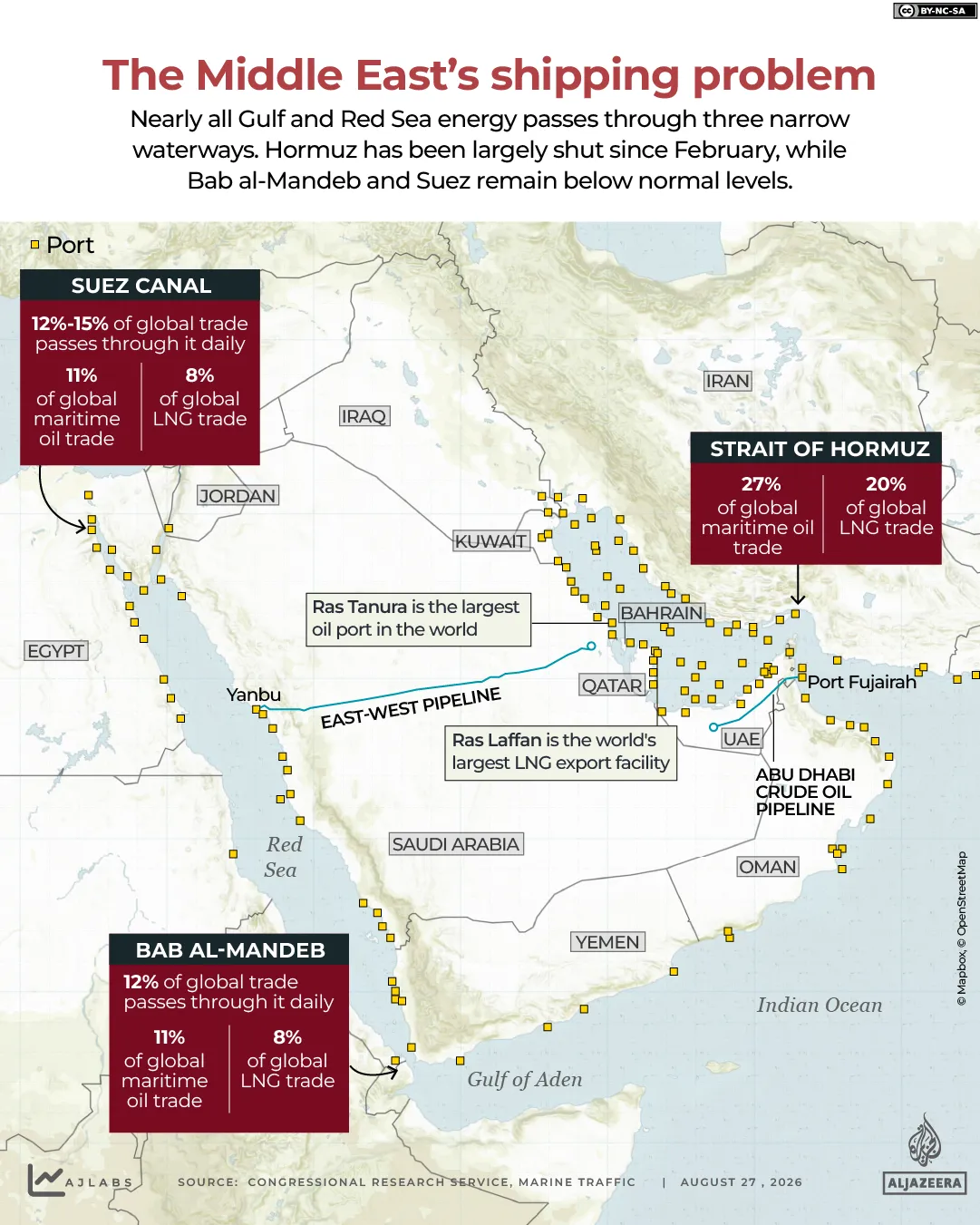
The United States and Iran continue to make competing claims about who has greater control of the critical Strait of Hormuz in the Gulf.

Washington claims the strait is open and that dozens of ships, carrying millions of barrels of oil, are passing through each day. US President Donald Trump claimed last month that the US was in “total control” of the waterway, through which one-fifth of the world’s oil and gas is shipped during peacetime, but which has been closed since the US-Israel war on Iran began six months ago.

Recommended Stories

list of 3 itemsend of list

Iran, however, says the strait remains under its control and is closed except to pre-approved vessels using its designated channels. It has warned that other ships attempting to transit risk being targeted.

So what is really going on in the strait – and what explains the divergent accounts?

INTERACTIVE - MIDDLE EAST -iran - hormuz - shipping - aug 27, 2026-1787815800
(Al Jazeera)

What are the latest US claims about the Strait of Hormuz?

The US says shipping through the Strait of Hormuz has significantly increased in recent weeks.

Two US officials told CNN that 40 commercial ships carrying some 18 million barrels of oil passed through the strait under US military escort on Tuesday, in what would be a new wartime record.

Trump gave a similar figure on Monday, saying the US Navy was helping some 30 ships pass through Hormuz every night. He later said the waterway was “under USA control”.

In terms of oil, US Treasury Secretary Scott Bessent said that “at least 10 million barrels” were getting through the strait each day, with between 15 million and 17 million on Tuesday.

The assessment comes after US CENTCOM commander Brad Cooper claimed last week that the US military had cleared Hormuz’s transit lanes of sea mines.

Before the war began, an average of around 100 ships and 20 million barrels of oil are estimated to have passed through the waterway each day.

According to figures from PortWatch, this has fallen to an overall average of seven vessels since March.

INTERACTIVE - How many ships have passed theStrait of Hormuz in 6 months - iran us - August 28, 2026 copy 5-1787903353
(Al Jazeera)

What does Iran claim about the strait?

Iran has acknowledged that some vessels are getting through the strait, but insists it remains in control of the waterway.

Iran’s Parliament Speaker Mohammad Bagher Ghalibaf on Tuesday said “the enemy managed to get some ships” through Hormuz, but stressed that Iranian forces remain “in complete control of the strait and will not allow it to be opened”.

Ghalibaf accused the US of giving ships “false guarantees” about their ability to cross a southern route in Hormuz, warning that ships that try to do so would be targeted.

The following day, Iran’s Islamic Revolutionary Guard Corps (IRGC) claimed two oil tankers had hit mines and were disabled while trying to cross an “illegal route” in the strait. Saudi Arabia, meanwhile, claimed an Iranian attack hit a Saudi oil tanker, killing two Filipino sailors.

What does shipping data show?

The latest ship-tracking data paints a different picture than the US claims, with far fewer vessels recorded as transiting the strait.

According to marine analytics firm Kpler, just six vessels crossed the strait on Wednesday, 11 on Tuesday and five on Monday. It put the 10-day average at 13 vessels per day.

Other ship-trafficking services show a similar pattern. Maritime data firm Lloyd’s List Intelligence recorded an average of around 12 transits per day from August 26 to September 1, though the latest data may be incomplete “due to a lag in identifying dark transits”, said the firm’s maritime intelligence and research director, Bridget Diakun. This means that some ships are switching off their tracking beacons.

From August 17-23, Lloyd’s List Intelligence recorded “about 14 non-Iranian-linked ships each day”, Diakun told Al Jazeera.

All these figures are far lower than the US claim that 40 ships transited the strait on Tuesday.

The Joint Maritime Information Center (JMIC), which monitors threats to shipping in the region, said in a September 1 advisory that commercial traffic through Hormuz was “far below baseline”, despite a “modest uptick from recent lows”.

The advisory put the risk level for Hormuz at “severe”, citing a “continued risk of drifting or uncharted mines”, despite US claims to have cleared the strait of mines.

What explains the discrepancy?

Diakun told Al Jazeera that it is difficult to explain the gap between US-claimed transit figures and those recorded by ship trackers without insight into how the US tallies its own figures.

She said it’s possible the US includes smaller or non-cargo-carrying ships in its total, unlike Lloyd’s, which only counts “cargo-carrying vessels over 10,000 dwt [deadweight tonnage]”.

Eirik Hooper, a senior associate covering the ports and terminals sector for maritime research consultancy Drewry, also pointed to possible differences in how the US counts vessel transits.

“A US operational count plausibly includes everything that moved under or near naval protection: naval auxiliaries, offshore support and tugs, coastal and small craft [and] dhows,” said Hooper, noting that ship-tracking firm Kpler filters out such vessels “on size or cargo grounds”.

Hooper also said the US has access to “satellite, airborne and other sensor coverage plus its own convoy manifests”, which enables it to see vessels not immediately picked up by the normal automatic identification system (AIS) tracking system.

“By late August, the majority of Hormuz crossings were classified ‘dark’ or unknown by route, and AIS data counts often need to be revised to include vessels that switch off their transponders, with confirmed movements backdated,” said Hooper.

More generally, both the US and Iran have an incentive to play up their influence in the strait, the status of which has become a major sticking point in their six-month conflict.

Former US Ambassador Henry Ensher recently told Al Jazeera that he believes the latest cycle of US-Iran confrontation was likely triggered by CENTCOM’s claims to have de-mined that strait, and said “both sides would be well served to stop talking quite so much”.

Source link

Three decades of distance give Liz Phair and Sleater-Kinney a new kind of sisterhood

For more than three decades, Liz Phair and Sleater-Kinney existed in parallel without ever quite meeting. They admired one another from afar, brushed shoulders only in passing, and, in some ways, represented opposing ways of challenging the limits placed on women in indie rock. Phair, who found novel and peerlessly smart ways to write about heterosexual skirmishes, used her ambitions to edge closer to the mainstream; Sleater-Kinney, one of the great duos of American rock, have succeeded in becoming the last band standing from the underground scene in which they emerged.

Both acts are about to share the stage for the first time, co-headlining a tour they’ve cheekily and earnestly named the Flannel and the Fury, with stops across the country, from El Cajon, Calif., to Ocean City, Md., and a night at Los Angeles’ Greek Theatre on Tuesday.

Yet, despite having spent more than 30 years orbiting the same world, they have had surprisingly little time together. This interview is one of a few substantial conversations they’ve ever had. It is, at first, slightly stilted. Carrie Brownstein and Corin Tucker (Sleater-Kinney) are in sync as always; Phair is clearly excited, but seemingly unsure of where to place herself in the dynamic. Now all in their 50s, the women have been asking similar questions of the same culture, and are only now getting the chance to compare answers.

“Sorry, I know you’re like, ‘Why aren’t you better friends?’ For me, that’s the point. I’m trying to be better friends,” says Brownstein. “Yeah, talk to us again when tour’s over,” Tucker adds.

Brownstein is sitting in a parking lot in Los Angeles, wearing a cardigan and glasses, people walking past her window, unaware of who’s inside. Tucker calls from her home, a blurred background behind her, wearing a white blouse and lipstick. Phair is at home too, makeup on and hair straightened, various musical instruments on the wall behind her. It’s a few weeks before their co-headlining tour, and Tucker has already loaded up all the equipment. She’s packed her suitcase too, full of socks she’ll throw away by the end of tour, and a wardrobe almost entirely of black.

Liz Phair

“This is news to me,” says Brownstein. “I was thinking more of a chocolate brown. I will be all brown town.”

Phair is going for wine-like jewel tones. “A Cab Sav,” to be specific.

Phair, who’s had an on-and-off relationship with touring, is noticeably more nervous than Brownstein and Tucker. “It takes me two or three shows to get into it. At first I’m like, why are you all staring at me?”

Phair had been sitting on the idea of a co-headlining tour with Sleater-Kinney for a few years. She sheepishly says that she didn’t reach out herself, but got her manager to do it while she was working on the second half of her memoir. She’s been keen to share a bill with Sleater-Kinney ever since she heard their 1996 album “Call the Doctor.”

“By then, I’d started to pull back from indie rock,” says Phair. “I had gotten married, and I didn’t know I was pregnant at the time, but I was starting to drift out of this scene, and then they put out this kick-ass record, and I just remember thinking, I kind of want to be back in the game. It inspired me. It stuck with me.”

Phair felt she was atomized from the female coalitions of the ’90s, and that this co-bill might be a way to rectify that. “I’d love to be able to go back and sew it together again,” she says. “Here’s a band I was a fan of that meant something to me and now I can play with them.”

For Sleater-Kinney, Phair has long been more than a neighboring act. Tucker and Brownstein describe her as one of their “biggest inspirations.” Both have the same Phair favorite song: “Divorce Song.” “It’s a perfect song,” says Tucker. “I think I’ve put it on every mixtape I’ve ever made,” Brownstein adds.

By the time Phair released her debut album, “Exile in Guyville,” in 1993, she was the one of the two acts edging toward the mainstream. Within a year, she was on the cover of Rolling Stone.

“I still have a copy of the magazine,” says Brownstein. “We were all so excited. Like, an actual artist made the cover.”

Nirvana had made this small corporate alliance permissible a couple of years earlier, finding a loophole as Cobain wore a T-shirt that read “Corporate Magazines Still Suck” on their Rolling Stone cover. It was a time when an antiauthoritarian stance was the only artistically credible one. Before we started calling one another “performative,” Tucker, Brownstein and Phair came from a time when “poser” was the worst insult and sin. They came from a scene of ideological puritanism.

“You know when people die their life flashes before their eyes, sometimes, it’s like that when I do a deep dive, and I’m like, God, there were a lot of rules. There was a lot of fear. And I don’t think anyone who wasn’t there would be able to picture it,” says Brownstein. “It took us a long time to get over it.”

“OK, can I ask the question? Can I get right in here? Because I want to know,” Phair chimes. “Do you think that’s because there weren’t enough women? You think women would have brought the inclusivity to inclusivity?”

“Unfortunately, no,” replies Tucker.

“We had these all-female festivals in Olympia, and we had our own publicist, and they were like, how dare we?” says Brownstein. “You know, it was just gatekeeping, that now seems sort of repugnant. But it was also a way to establish yourself in opposition to what felt like the only way to be.”

It’s part of why Sleater-Kinney declined an invite to play Lilith Fair, the mainstream precedent for so-called female solidarity in music. One of history’s most famous traveling all-female festivals, Lilith Fair was considered by many in the Riot Grrrl movement to be an early symbol of the commodification of “girl power,” female solidarity aligned with corporate ideals.

Sleater Kinney

Sleater Kinney

(Robin Laananen)

“It seems like they haven’t really given credit to women in an independent milieu who have organized a lot of female-only shows for years,” Brownstein told the Dallas Observer in 1998.

“I think at the time we thought we were too cool to play Lilith,” Tucker reflects.

“I’ll just leave your answer,” says Brownstein.

Then she changes her mind four seconds later.

“I saw the Lilith Fair documentary last year and got FOMO, I kind of regretted not playing” she says. “But at the same time we had a handicap from a small indie punk community that was kind of didactic, there was a real rigidity to what you were and weren’t allowed to do. Even us signing with Matador in the U.K. was considered too big.”

Selling out, they all conclude, is no longer a concern for anyone. Phair’s son, who is Gen Z, often says the phrase “it’s time to get the bag.”

“You know, every artist has the right to get their bag,” says Phair. “I always felt that way and I was especially vilified for it.”

That vilification reached its apex when she released her mainstream-aspiring self-titled album in 2003, an album Sleater-Kinney said they hated in an interview with Rolling Stone that year, and which Pitchfork gave a rare 0.0 score in one of its most notorious reviews.

“I’d be on tour doing 10 interviews a day back-to-back, and I almost had to give these interviewers therapy, because they were so sad about my turn from indie rock,” says Phair.

Phair is adamant she made her mark on “every one of those songs, except maybe ‘Favorite,’” she says, referencing the chintzy, awkwardly phrased track where she sings about her underwear. Maybe it’s a metaphor, but more likely, it is just a song about her underwear. Safe to say it won’t be on the show’s setlist: “I will never play it live.”

The old argument about selling out now sits inside a very different touring economy. Sleater-Kinney and Phair’s co-headlining tour happens to follow a flood of co-headlining tours this year, from indie acts like Waxahatchee and MJ Lenderman to big marquee names like Usher and Chris Brown. With higher ticket prices and more competition — not only with other touring bands but with the allures of home comforts — audiences need a bigger draw. Artists want an opportunity to play to big audiences, as well as a better chance of “getting the bag.”

All three artists insist they won’t necessarily bring home the bag, nor is that why they’re doing this.

“All our budget’s gone on to the lighting designer,” jokes Brownstein.

“When I do these interviews with you guys, I get kind of excited and nervous because I feel challenged in the best way,” says Phair. “I think co-headlining bills, it does let you go into bigger venues than you could by yourself. But it also, for me, gives me creative food, like nutrition. It makes me grow.”

Source link

US-Canada Rift Echoes War of 1812

Responding to Trump’s tariff barrage, Canada pivots from continental nostalgia to global dealmaking.

This article appears in the September 2026 issue of Global Finance Magazine.

Following President Donald Trump’s reelection in 2024, something extraordinary occurred, not seen since the War of 1812. The president not only took aim at Canada as a potential annexation target, but also breached his own USMCA trade deal by imposing punitive tariffs on the country to the north (among many others). 

This prompted Canadians to turn away from their traditional focus on continental trade and pursue deals with other, friendlier markets (and, in protest, take liquor from the U.S. off their shelves). 

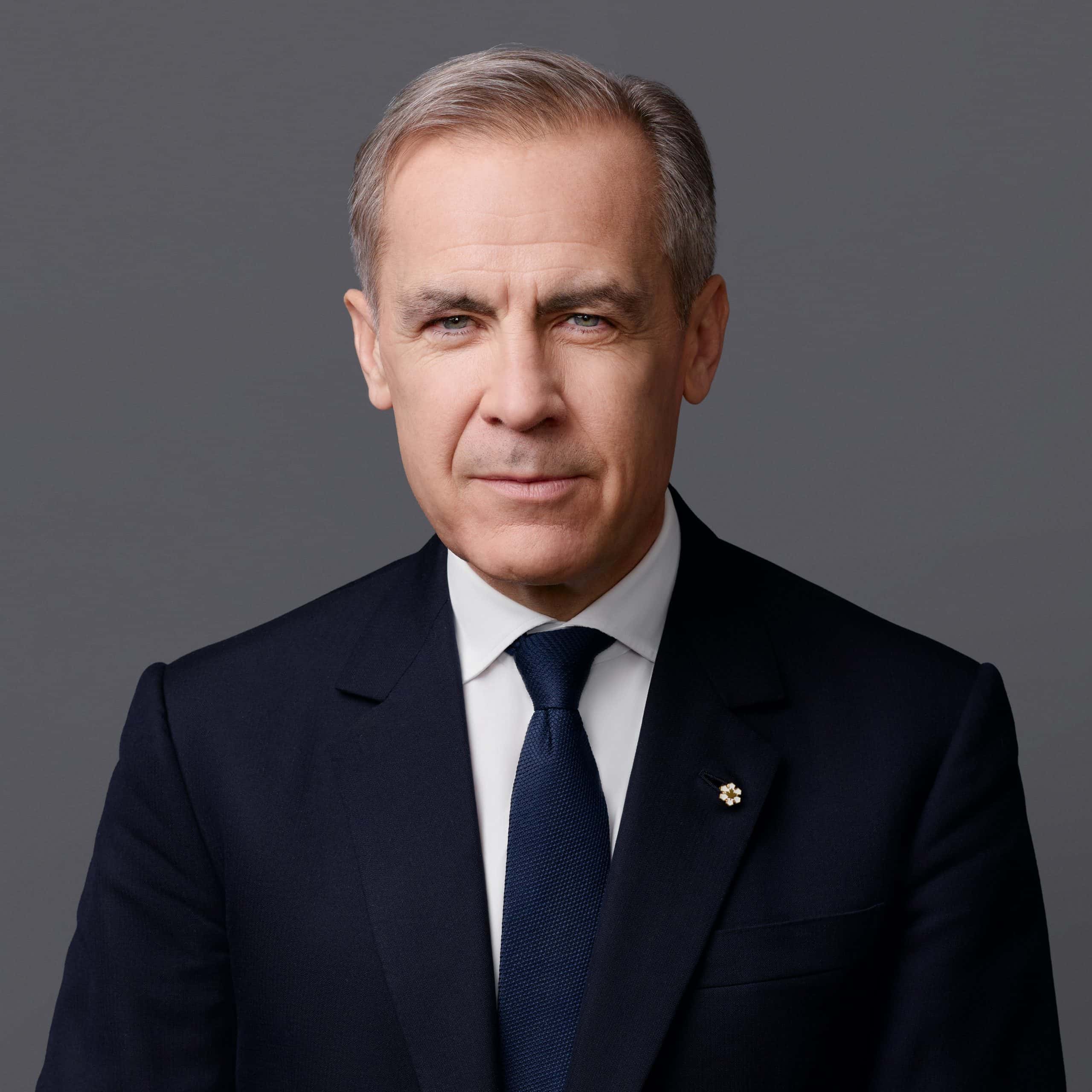
The Liberal Party’s electoral victory soon after, and Mark Carney’s ascension as prime minister, expedited the process. Responding to the newly hostile environment, the new PM pledged to double Canada’s exports by 2035, diversify foreign trade, and reduce reliance on what was, and still is, Canada’s largest trading partner. 

Mark Carney,
Canadian Prime Minister

“The old relationship we had with the United States, based on deepening integration of our economies and tight security and military cooperation is over,” he said. On another occasion, he was even more pointed: “Our relationship with the United States will never be the same as it was, even though, in the new protectionist world, we have the best trade deal of any country.”

That was then. Of course, now a war of words has become a full-blown trade war. With Canada backing away from what it considered a bad deal, the U.S. added tariffs to autos, auto parts, and aluminum, beginning January 2027, as a punishment for breaking off recent talks. Canada retaliated with tariffs of its own ranging from 15% to up to 50% on many American goods. As Carney stated at a news conference, “You’re at war when you are attacked. And we were attacked.”

A Strategic Reorientation

But a trade reorientation for Canada made sense on its own, some experts say. About four-fifths of the world’s economic activity occurs outside the U.S., much of it in Asia, according to the Fraser Institute, a nonpartisan Canadian think tank. “These facts suggest Canadian policymakers are right to emphasize the importance of expanding trade with non-U.S. markets,” it concluded.

Carney, accordingly, has been crisscrossing the globe, cutting deals with countries including India, China — where it reduced tariffs on electric vehicles, against U.S. wishes — and the United Arab Emirates, and has engaged with ASEAN members on a possible free trade agreement. All this is occurring, incidentally, as he continues to pursue tariff reduction with the U.S. and salvage as much of the free trade Canada has enjoyed with its neighbor to the south as possible.

This past summer, Maninder Sidhu, Minister of International Trade of Canada, established a new Strategic Exports Office and a Strategic Exports Advisory Council. The aim is to bring together diplomatic, commercial, and financial experts to help break down global trade barriers and open doors for Canadian businesses. 

The new bodies “mark a decisive step toward doubling our exports to non-U.S. markets,” he said, “and they give Canadian businesses the whole-of-government support they need to compete and win around the world.” Goods exports to non-U.S. markets are up about 17% from 2024 to 2025, an increase of C$33 billion (US$24 billion), Sidhu’s office said. To some observers, the pivot is not only something to navigate but also an opportunity for the world’s 11th-largest economy, according to the International Monetary Fund.

In the long term, Canada’s economy could expand its manufacturing base and raise its standard of living.

Joel Kranc is a contributing writer based in Canada.

Source link

One in five holidaymakers have crammed a week’s worth of luggage into a carry-on

ONE in five holidaymakers have crammed at least a week’s worth of luggage into a carry-on bag this summer to avoid expensive fees.

A poll of 2,000 adults who travel found an ambitious 11 per cent reckon they could squeeze 10 days or more of holiday essentials into hand luggage alone.

NINTCHDBPICT001105217303
One in five holidaymakers have crammed at least a week’s worth of luggage into a carry-on bag Credit: SWNS
Five hacks for scoring cheap last minute flights - according to a travel expert
Over half said they would go to great lengths to avoid paying extra fees Credit: SWNS

While five per cent would even attempt to fit everything they need for a two-week holiday into a single cabin bag.

It also emerged 58 per cent admitted they’ll go to great lengths to avoid splashing out on expensive checked luggage fees.

Half will roll clothes as tightly as possible to save space, and 44 per cent will carefully plan outfits so they can wear the same clothes more than once.

While 34 per cent will wear their bulkiest clothes while travelling and one in five will ditch physical books in favour of a tablet to save precious bag space.

TRAVEL TROUBLE

UK travel company suspends ALL holidays with Brits ‘stranded abroad’


STAR LEGACY

Ex-Wimbledon champion left six-figure sum to famous husband after death aged 93

And a savvy 13 per cent have used a duty-free carrier bag to sneak extra belongings onto the plane.

But it’s not just clothes and holiday essentials getting the space-saving treatment, as 72 per cent think their smartphone is the most important item they pack for their holiday after their passport.

The research, commissioned by Samsung to mark the launch of the Galaxy Z Fold8, found that when packing, smartphones replace cameras (62 per cent), maps (55 per cent) and boarding passes (45 per cent) while abroad.

Four in five (81 per cent) prefer their smartphone to be compact enough to fit easily into a pocket or small bag, as they increasingly do the job of multiple holiday essentials.

With 69 per cent saying the size and portability of their device is important, as it can do almost everything they need from one item, replacing other items they may need to pack (41 per cent).

Spokesperson Annika Bizon said: “I’m quite ruthless about what earns its place in my luggage when I’m travelling.

“When you’re trying to pack for a weekend away, or even a family holiday, every bit of space counts, so I love anything that can do more than one job.

“Technology is a big part of that.”

Almost three quarters (74 per cent) said they have booked, or would consider booking, a holiday at the last minute – making lighter, more flexible travel increasingly appealing.

The study from OnePoll.com found a third of travellers prefer to travel light, with 58 per cent claiming it makes the journey easier.

In fact, almost half (48 per cent) consider it a badge of honour when they successfully squeeze their carry-on bag into an airline bag sizer at the airport.

But 52 per cent worried their carry-on will be deemed too big when taking a flight, with 36 per cent having previously struggled to fit their carry-on within the maximum size limit.

And three in 10 have had to pay an average of £39 because their carry-on was deemed too big.

Annika Bizon, from Samsung, added: “If one device can help you navigate, keep your travel documents to hand, capture the moments you want to remember and provide on-the-go entertainment, there’s no need for extra items.

“For me, technology really earns its place when it makes life simpler, and Galaxy Z Fold8 is a prime example of that.”

TOP 10 WAYS HOLIDAYMAKERS AVOID HAVING TO PAY FOR EXTRA LUGGAGE

  1. Rolled clothing tightly to save space
  2. Carefully planned outfits so I could re-wear clothes during the trip
  3. Decanted toiletries into smaller containers
  4. Worn my bulkiest shoes, coat or jumper while travelling
  5. Worn multiple layers of clothing for the journey
  6. Ditched physical books in favour of a gadget
  7. Used packing cubes or vacuum bags to fit more in
  8. Reduced the amount of travel entertainment
  9. Watched online tutorials for luggage-packing tips
  10. Used a duty-free shopping bag to carry extra luggage or essentials

Source link

Save HUNDREDS on UK holidays with this £1 travel hack

THERE’S a travel club you can join today for £1 that will unlock a whole load of secret UK holidays for cheap.

Once you’re a member, you can bag exclusive deals for trips all across the UK, starting from as little as £89 for a two-night break for two people!

If you join Travelzoo with a £1 30-day trial you can unlock British breaks from £89 Credit: Travelzoo

There’s some seriously massive savings to be had here – we’ve even found a stunning rural retreat in Wales where you can save £217 off full-price.

To unlock the deals, simply sign up to become a Travelzoo member.

Usually, membership costs £30 for one year (which is already a bargain).

But Sun readers can bag a 30 day trial for just £1 by clicking here – giving you instant access to book in a bargain break.

£1 CHEAT CODE

The £1 travel hack for VIP airport lounges, FREE food & drinks plus £59 trips


TRAVEL-WOO

Travelzoo has 72% off UK, short and long-haul holidays in February sale

Not only will you unlock amazing holiday deals in the UK, Europe and beyond, but there’s plenty more benefits such as free airport lounge access whenever your flights get delayed if you’re travelling abroad.

Here’s our pick of the best UK deals we found on Travelzoo, where you can save up to hundreds of pounds on an incredible countryside staycay.

Mount Snowdon two-night adventure – £110 (£217 off)

Stay at the gorgeous Royal Victoria Hotel in Snowdonia for £55 per night with Travelzoo Credit: Travelzoo
Take in the views of the Snowdon mountain railway on your Welsh staycation Credit: Travelzoo

Sitting between two lakes at the base of Mount Snowdon, the grand Royal Victoria Hotel in Eryri is a sight to behold.

The location “cannot be beaten” according to one Travelzoo member.

You can enjoy with lake views from the hotel restaurant and 13th century castle ruins within the hotel grounds themselves.

Whether you’re tackling the mountain on a hiking holiday or simply want to soak up the views of Snowdonia from the hotel with a warm drink in hand, this £55 per night deal is a bargain way to do so.

Claim your £1 Travelzoo trial & book a two-night stay with daily buffet breakfast included from £110

London superyacht stay – £200 (save £141)

Save up to £141 with a stay onboard the Sunborn London Yacht Hotel with Travelzoo Credit: Travelzoo

The Sunborn London Yacht Hotel is a one-of-a-kind stay.

Sitting on London‘s Royal Victoria Dock, the 420-foot superyacht hotel offers prime views of the Thames, plus easy access via cable car to Greenwich or the Elizabeth Line into Central London.

Included in this deal you get an overnight stay in a riverview room for two, buffet breakfast, an Afternoon Tea experience (with a cocktail!) and bottomless hot drinks.

Not only that, but you’ll get a complimentary bottle of Prosecco on arrival and some delicious chocolates in your room.

Claim your £1 Travelzoo trial & book an overnight superyacht stay for two with Afternoon Tea, breakfast and bottomless hot drinks for £200

Northumberland National Park two-night break – £89

Visit the World Heritage Site of Hadrian’s Wall in Northumberland for only £89 for two nights Credit: Getty

You can bag a two-night stay at the Riverdale Hall Hotel in Northumberland for an insanely cheap £89, which works out to £22.25pp per night.

The hotel sits at the edge of the Northumberland National Park in Bellingham, a pretty market town perched along the Pennine Way.

Nearby you can look out over Hadrian’s Wall at the National Landscape Discovery Centre.

Or even visit the forest where the movie 28 Years Later was filmed.

Claim your £1 Travelzoo trial & book a two-night Northumberland stay from £89

Woodland lodge three-night retreat – £299 (£109 off)

Stay in a former royal hunting lodge built for King Charles II with Travelzoo Credit: Travelzoo
Explore the Wye Valley National Landscape on your countryside retreat Credit: Travelzoo

Fancy staying in a former royal hunting lodge once used by King Charles II?

The Speech House is a former royal lodge turned countryside hotel.

Built in 1669, the lodge still has many of its original features, including decor in the hotel restaurant that was originally a small courtroom.

The hotel is based beside the Wye Valley National Landscape. You can catch some spectacular views from Symonds Yat Rock, which is only 15 minutes’ drive from the hotel.

Claim your £1 Travelzoo trial & book a three-night stay with breakfast included from £299

Pembroke Castle two-night break – £159 (save £77)

Visit Pembroke Castle during your stay at the Coach House Hotel Credit: Alamy

Stay in the medieval walled town of Pembroke with this affordable two-night break at the friendly Coach House Hotel.

It even includes a bottle of Prosecco on arrival.

The town is home to the incredible Pembroke Castle, where King Henry VIII was born.

After enjoying a full Welsh breakfast each morning, you can set off to explore more local attractions like the Pembrokeshire Coast National Park and the seaside town of Tenby.

Claim your £1 Travelzoo trial & book a two-night Pembroke stay from £159

Lake District escape with dinner & Prosecco – £129

Book a cosy Lake District stay with dinner and Prosecco included for £129 Credit: Travelzoo

Book a staycation in the stunning Lakes with a cosy stay at the four-star Damson Dene Hotel with this deal.

The hotel is just 10 minutes’ drive from Lake Windermere, the largest lake in England, where you’ll also find The World of Beatrix Potter Attraction.

Your stay includes an overnight stay plus dinner for two, Prosecco on arrival, and even a pair of free tickets to the enchanting Lakeland Model Village.

Claim your £1 Travelzoo trial & book an overnight stay with dinner & Prosecco in the Lake District from £129

Prices correct at the time of publication.

Source link

Freshmen Aydan Steen, Kiyan Callis make impact for Santa Margarita

Santa Margarita’s Southern Section Division 1 championship football team lost some impressive players to graduation in the spring, but the Eagles (2-0) have already showed off two impressive freshmen to help overcome the loss of Trent Mosley (USC) and Dash Fifita (Arizona).

Kiyan Callis, a receiver, started his high school career with nine catches for 105 yards and one touchdown, then came back with three receptions against Corona Centennial. Aydan Steen, a linebacker, delivered seven solo tackles in a opening win, followed by four more solo tackles against Corona Centennial.

Santa Maragarita is back to No. 1 in The Times’ top 25 rankings after finding players to replace nine of 11 starters on defense, including several more freshmen besides Steen. It’s important to know the best days for the Eagles are ahead as their young replacements receive early-season experience in anticipation of becoming much better later in the season.

Sana Margarita wasn’t the state’s best team to start last season, but by the end, no one had a chance to beat the Eagles as their defense and offense reached another level under first-year coach Carson Palmer and his staff.

This is a daily look at the positive happenings in high school sports. To submit any news, please email eric.sondheimer@latimes.com.

Source link

Major airline relaunches FREE domestic flights for UK travellers until next year

ANY Brits planning a bucket list holiday to Japan will be able to explore more of the city thanks to one airline offering free flights.

All Nippon Airways (ANA) is offering domestic flights at no extra cost between December 2026 and February 2027.

Anyone heading to beautiful Japan can get two free domestic flights Credit: yongyuan
With ANA Airlines these add on flights are completely free Credit: Alamy Stock Photo

Free domestic travel is part of a campaign with the tourism board to encourage travel across the country.

It was first brought about last year and after its success, is doing so again.

Called the ‘Stopover & Add-on Free Fare’ – the ticket offers free domestic flights between December 1 and February 28, 2027.

Bookings need to be made between 1-30 September 2026 and Brits can add up to two ANA domestic flights at no additional cost.

ALL IN

UK holiday parks where you can go ALL INCLUSIVE from £25pp with shows & waterparks


RETRO RATES

Our fave childhood holidays that have stayed ridiculously CHEAP – from £9.50pp

You do have to book it at the same time as international flights though, and the offer applies to all cabins.

ANA’s domestic network covers more than 40 destinations – so there’s plenty to choose from.

Most Brits will fly into Tokyo (Haneda) – from there you could explore the likes of Okinawa which consists of tiny islands with tropical beaches.

Another is Fukuoka, a city the island of Kyushu which is famous for its seafront location and food with specialities like Hakata Ramen and Mentaiko.

If you’re looking for some snow, head to Sapporo which is Hokkaido’s capital and one of the world’s snowiest cities.

You could even stop by the Sapporo Snow Festival which is being held between February 4-11 next year.

Sapporo is one of the world’s snowiest cities & even holds a snow festival Credit: Alamy
Collage of travel items including a plane, sunscreen, passport, suitcase, and plane tickets, advertising The Sun's travel Instagram account.


Source link

From cliffside rooms to private island resorts

THE best hotels in the world have been revealed from luxury resorts to former celebrity escapes in LA.

Two that are in the UK have also made the cut – one in London and the other in Scotland.

The World Best Hotels have been named – including San Pietro di Positano in Italy Credit: Unknown
The Beverly Hills Hotel is another in the top 100 Credit: bevhillshotel / instagram

The list has been drafted by The World’s 50 Best who have released the best hotels from 51-100.

If you want to know The World’s 50 Best Hotels from 1-50, these will be revealed on September 15.

Landing at number 56 is the Rosewood London which is a luxury hotel in Covent Garden.

In the rooms, guests can enjoy fluffy bathrobes, even choose their own pillows and take advantage of 24-hour-in-room dining.

ALL IN

UK holiday parks where you can go ALL INCLUSIVE from £25pp with shows & waterparks


RETRO RATES

Our fave childhood holidays that have stayed ridiculously CHEAP – from £9.50pp

Inside the Junior Suite is a marble bathroom with a tub and walk-in shower and a personal bar.

The hotel currently offers an immersive afternoon tea inspired by the works of Claude Monet.

It has its own Pie Room as well which as it suggests in the name is dedicated to pie making – guests can book private dining or even give it a go themselves in a pie masterclass.

The Scarfes Bar has a Heroes and Villains-style cocktail menu with specially curated drinks with names like Diva and Foul Play.

When the sun shines, spritzes and Italian pizzas can be enjoyed on the Mediterranean terrace.

The other UK entry comes in 100th position and it’s Gleneagles in Auchterarder, Scotland.

Hotel das Cataratas is the only luxury resort next to Iguazu Falls Credit: Alamy Stock Photo

The 232-room hotel boasts 10 restaurants and bars ranging from fine dining to casual spots like The Chicken Coop and organised picnics.

It has luxurious bedrooms and suites with a “mix of homeliness and glamour.”

Outdoorsy guests can make the most of the activities, with everything from falconry and archery to horse riding and off-road driving available.

It’s known as one of the best places to golf too with three of the top courses in Scotland.

Plenty of other impressive hotels made the list too – some of the most beautiful include Il San Pietro di Positano.

The beautiful five-star hotel in Italy is literally carved into the cliffside.

It even has its own lift which guests can take down to the private beach, there’s also a tennis court by the water.

For swimming, there’s a beautiful pool with a sun terrace looking over the sea.

Gleneagles in Scotland is surrounded by sprawling golf courses Credit: Michael Schofield
The Rosewood in Covent Garden is another of the world’s best Credit: Unknown

The Beverly Hills Hotel is a Hollywood classic that featured on the cover of the Eagles album, Hotel California.

Found on Sunset Boulevard, the famous hotel is as LA as it gets – surrounded by palm trees with Barbie pink accents and even its own red carpet.

Rooms range from Hollywood glamour-style Superior Rooms to restored bungalows – one of which was a favourite of frequent guest, Marilyn Monroe.

There are over 100 Four Seasons hotels across the world and two have made the list.

The one in Hong Kong boasts views across the skyline and Victoria Harbour from a rooftop infinity pool.

It has three fine-dining restaurants and plenty of luxury touches.

The second Four Seasons on the list is in La Manzanilla and it’s super luxurious reachable only by private plane or boat.

It has beachfront casitas and hillside villas with regular sightings of humpback whales, dolphins and sea turtles from private plunge pools.

The Italian hotel in Positano has a unique sea front tennis court Credit: ilsanpietrodipositano / instagram
The Four Seasons in Hong Kong has an infinity pool with skyline views Credit: Seet, Ken

Another private resort to make it onto the list is Soneva Fushi in the Maldives.

It’s found on an island called Kunfunadhoo in the Baa Atoll with huge villas, open-air bathrooms with plenty of experiences all arranged by a barefoot butler – shoes aren’t a thing here.

Hotel das Cataratas is the only luxury resort situated inside Brazil’s Iguazu National Park right next to Iguassu Falls.

Guests even get special entry to the waterfalls before the park opens and after it closes to visitors.

It also has a huge outdoor swimming pool, tennis court and spa.

The list of the World’s Best Hotels…

Here is the list of the World’s Best Hotels – from 51-100…

  • La Réserve Paris, Paris
  • Janu Tokyo, Tokyo
  • Park Hyatt Tokyo, Tokyo
  • Palacio Nazarenas, Cusco
  • Soneva Fushi, Maldives
  • Rosewood London, London
  • Hotel Bel-Air, Los Angeles
  • Il San Pietro di Positano, Positano
  • Mandarin Oriental Hong Kong, Hong Kong
  • Splendido, Portofino
  • Mandapa, Bali
  • Castiglion del Bosco, Montalcino
  • Sofitel Legend Casco Viejo, Panama City
  • Hotel Esencia, Tulum
  • The Beverly Hills Hotel, Los Angeles
  • Orient Express La Minerva, Rome
  • Montage Los Cabos, Cabo San Lucas
  • Forestis Dolomites, Brixen
  • The Okura, Tokyo
  • Rosewood Bangkok, Bangkok
  • Amangalla, Galle
  • Ritz Paris, Paris
  • Palace Hotel Tokyo, Tokyo
  • Four Seasons Tamarindo, La Manzanilla
  • La Mamounia, Marrakech
  • Maçakızı, Bodrum
  • Hotel das Cataratas, Iguassu Falls
  • The Fifth Avenue Hotel, New York
  • Hotel The Mitsui, Kyoto
  • Carlton Cannes, Cannes
  • Capella Hanoi, Hanoi
  • Huka Lodge, Taupō
  • The Calile, Brisbane
  • Borgo Santandrea, Amalfi
  • Hoshinoya Tokyo, Tokyo
  • Four Seasons Hong Kong, Hong Kong
  • Aman New York, New York
  • Borgo Egnazia, Savelletri
  • Waldorf Astoria Osaka, Osaka
  • Mandarin Oriental Shenzhen, Shenzhen
  • Villa Treville, Positano
  • The Greenwich Hotel, New York
  • The Maybourne Riviera, Roquebrune-Cap-Martin
  • The Johri, Jaipur
  • Reschio, Lisciano Niccone
  • Wynn Palace, Macau
  • Capella Singapore, Singapore
  • The Oberoi Udaivilas, Udaipur
  • The Peninsula Shanghai, Shanghai
  • Gleneagles, Auchterarder


Source link

Leon Black suing House Oversight for Epstein investigation

Chairman of the House Committee on Oversight and Government Reform James Comer, R-Ky., said in a statement on Thursday that deposition will move forward in the committee’s investigation into billionaire Leon Black’s ties to convicted sex offender Jeffrey Epstein despite Black refusing to appear. File Photo by Annabelle Gordon/UPI | License Photo

Sept. 3 (UPI) — Former Apollo Global Management CEO Leon Black is refusing to appear before the House Oversight Committee to testify on Thursday, instead filing a lawsuit against the committee over its investigation into his connections with convicted sex offender Jeffrey Epstein.

Black filed the lawsuit on Thursday as he attempts to block two subpoenas for him to testify. Rep. Robert Garcia, D-Calif., the committee’s ranking Democrat, has called on the committee to hold Black in contempt.

The lawsuit argues the subpoenas “exceed [the Office of Government Relations’] delegated authority in seeking private information that bears no legitimate connection to OGR’s legislative purpose.”

In a letter to the committee, Black’s attorneys said “Congress is not entitled to subpoena documents from a private citizen,” calling the subpoenas “invalid.”

Garcia said in a statement on Thursday that Black “funded Epstein’s abuse and trafficking of women.”

“Black gave Jeffrey Epstein over $180 million over six years,” Garcia’s statement reads. “His connections to Epstein and his unwillingness to cooperate are unacceptable. We must hold him in contempt immediately.”

Committee Chairman James Comer said in a statement that the deposition will move forward on Thursday and he will speak with committee members about “next steps.”

“It’s a shame Leon Black is hiding behind litigation rather than provide answers to the American people,” Comer said in a statement.

Black told members of Congress in a closed-door interview in June that he was not aware of the extent of Epstein’s criminal activity and denied being involved in abusing women or sexually abusing minors.

“We want to reiterate that Mr. Black had no awareness of the criminal activities that led to Epstein’s arrest in 2019,” Black’s attorneys said in a statement announcing the lawsuit. “Mr. Black never abused a woman. He never was with an underage woman. He never engaged in sex trafficking. He never paid Epstein for access to women. He was never blackmailed by Epstein.”

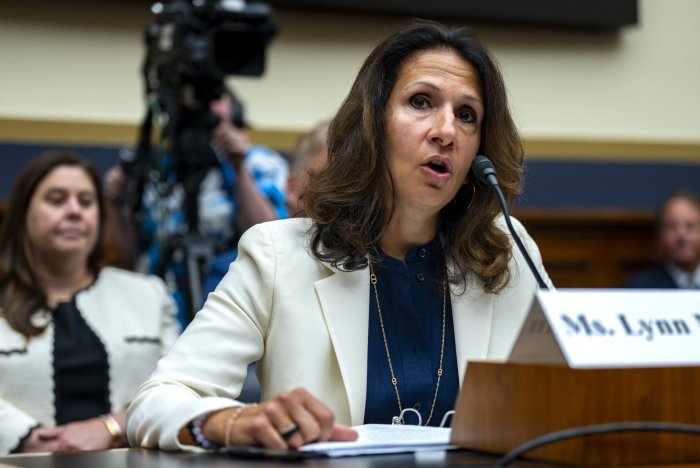
President of the New York Stock Exchange Lynn Martin speaks during a House Financial Services Committee hearing on the economy at the U.S. Capitol on Wednesday. Photo by Bonnie Cash/UPI | License Photo

Source link

Palestinian teens killed during settler attack on West Bank village, officials say

At least 81 Palestinians have been killed by Israeli forces or settlers in the West Bank since the start of the year, according to the UN’s figures. At least 23 of those deaths have occurred in the context of settler attacks.

Three Israelis, both security forces and civilians, have been killed by Palestinians in the West Bank over the same period, the UN says.

The Israeli military has faced mounting criticism for actively participating in settler attacks on Palestinians, standing by, or failing to prosecute those responsible.

On Thursday, Israel’s police force said a 19-year-old settler had been arrested on suspicion of participating in an attack on the Palestinian village of Qusra on Saturday. It marks the first such arrest in weeks of attacks on Qusra.

Dozens of masked settlers descended on the village, surrounding a house while Palestinians were trapped inside, and throwing stones.

Israeli soldiers who were deployed to the scene reportedly detained the trapped Palestinians but not the settlers, allowing them to leave. The Israeli military said troops removed “rioters” and protected residents.

Israel has built about 160 settlements housing 700,000 Jews since it occupied the West Bank and East Jerusalem – land Palestinians want, along with Gaza, for a future state – during the 1967 Middle East war. An estimated 3.3 million Palestinians live alongside them.

The settlements are illegal under international law.

In a separate development on Wednesday, Israeli forces demolished the Palestinian village of Khirbet al-Tabban, in the Masafer Yatta area.

Israeli human rights group B’Tselem said the village’s 70 residents, including 28 children, were given no warning prior to the demolition and were not allowed to remove their property.

It described the demolition as the most significant in Masafer Yatta since May 2025.

In the 1980s, the Israeli military declared about 3,000 hectares in the South Hebron Hills, which includes Masafer Yatta, as a restricted firing zone for training purposes.

The military says the Palestinian homes there have been built illegally.

In 2022, Israel’s Supreme Court ruled to allow the demolition of homes in the firing zone and the expulsion of their residents, who had argued that such a move violated international law and that their families had been living there since before the State of Israel was established.

B’Tselem says Khirbet al-Tabban is the 66th Palestinian community to be expelled by Israeli authorities since the start of the Gaza war in October 2023, which it alleges is part of a campaign of “ethnic cleansing” being carried out in the West Bank.

Source link

Telluride Film Festival 2026 lineup includes one big mystery

When the 53rd Telluride Film Festival kicks off Friday high in Colorado’s San Juan Mountains, its lineup will span family rupture and sumo wrestling, AIDS and rock stardom, with films touching on astronomy, Rupert Murdoch and extraterrestrial biker gangs — a typically wide-ranging mix for a festival that likes to keep audiences guessing.

For festival director Julie Huntsinger, the films share less a theme than a feeling. “Tenderness is something that I see in a lot of the movies,” she says. “This is a very heartbreaking, tender year.”

Telluride’s intimacy is part of its peculiar power. Smaller and scruffier than the annual film events of Venice, Toronto or New York, the four-day festival has no competition or juried prizes and keeps its lineup secret until the last minute. Celebrities trade red-carpet formality for jeans and flannel, while audiences crisscross town between screenings in a high school auditorium, a Masonic lodge, the county courthouse and half a dozen other spaces pressed into service for the week.

For a festival that can feel this homespun, its awards-season footprint is remarkably large. Last year, five of the 10 eventual best picture Oscar nominees screened there: “Hamnet,” “Bugonia,” “Sentimental Value,” “The Secret Agent” and “Frankenstein.”

This year there are fewer obvious awards heavyweights in the mix, at a time when prestige and independent films have become harder to finance, distribute and sell to audiences. Then again, Telluride has never depended entirely on known quantities; films such as “Slumdog Millionaire” and “Moonlight” arrived with relatively modest expectations and left as major contenders.

“It’s such a quintessential Telluride lineup,” Huntsinger says of this year’s eclectic program. “They kind of always feel that way because they’re so handmade.”

Among the more than 40 films in Telluride’s main program are new works from major directors such as Martin McDonagh, Werner Herzog, Mike Leigh, Danny Boyle and Paweł Pawlikowski. This year’s Silver Medallion tributes — the festival’s signature career honorees — will go to filmmaker Andrew Haigh and actors Sandra Hüller and John Malkovich, who will make his first trip to Telluride.

Two men in fedoras wait in an airport for a flight.

John Malkovich and Sam Rockwell in Martin McDonagh’s “Wild Horse Nine”

(Diego Araya Corvalan / Searchlight Pictures)

Haigh, whose films include “All of Us Strangers,” “Lean on Pete” and “45 Years,” returns with “A Long Winter,” adapted from a Colm Tóibín novella and relocated from the Pyrenees to the American Rockies in the 1950s. Ebon Moss-Bachrach, Caitríona Balfe, Kit Connor and Fred Hechinger star as members of a struggling family that begins to unravel after the mother disappears.

Huntsinger calls Haigh deeply humanist. “I don’t know how Andrew is so skilled at getting these performances but that is truly his gift,” she says.

Malkovich comes to Telluride with the dark comedy “Wild Horse Nine,” the latest from McDonagh, writer-director of “The Banshees of Inisherin” and “In Bruges.” Malkovich and Sam Rockwell play veteran CIA operatives who, after helping destabilize Salvador Allende’s government in 1973 Chile, head to Easter Island on a more personal assignment.

“It’s my favorite thing that McDonagh has ever done,” Huntsinger says. “He’s quite incisive. It is a timely film. And Malkovich is extraordinary.”

Hüller returns after a breakout 2023 Telluride, where she brought both “Anatomy of a Fall” and “The Zone of Interest.” She has another two films in the lineup this year: Markus Schleinzer’s “Rose,” in which she plays a woman passing as a male soldier during Europe’s Thirty Years’ War, and Pawlikowski’s “Fatherland” as Erika Mann on a journey back to postwar Germany with her father, the author and Hitler critic Thomas Mann.

Huntsinger seems as taken with Hüller herself as with her artistry — “so much intelligence and compassion for human beings,” she says.

A daughter and father sit at a bar.

Sandra Hüller and Hanns Zischler in the movie “Fatherland.”

(Agata Grzybowska / Mubi)

Elsewhere, Ira Sachs’ “The Man I Love,” starring Rami Malek, Tom Sturridge and this year’s guest director Rebecca Hall, looks back at New York’s queer creative community during the AIDS crisis. In Simon Stone’s “Elsinore,” Andrew Scott plays “Chariots of Fire” star Ian Charleson, who took on the role of Hamlet at the National Theatre while dying of AIDS. Scott’s performance is already generating early awards-season attention.

Huntsinger hopes audiences won’t overlook Arthur Harari’s “The Unknown,” an uncanny body-swapping drama starring Léa Seydoux that uses its genre premise to explore questions of identity and selfhood. “It is really dense and obtuse but I think it is rewarding and I hope people take up the challenge,” she says.

Telluride has long emphasized nonfiction and this year is no exception. Among the higher-profile entries are “Pete Townshend: Behind Blue Eyes,” a portrait of the Who guitarist and songwriter, and Nanette Burstein’s “Carl Sagan: We Are Made of Star Stuff,” about the astronomer and science communicator. The slate also includes Bryan Fogel’s endurance-sports documentary “The Row”; Pegah Ahangarani’s Iran-focused “Rehearsals for a Revolution”; and Mark Cousins’ 16-hour “The Story of Documentary Film.”

“Everest: The Other Side,” from filmmakers Jimmy Chin and Elizabeth Chai Vasarhelyi, follows mountaineers Hilaree Nelson and Jim Morrison as they prepare to climb Everest’s north face and attempt an unprecedented ski descent. Chin and Vasarhelyi won an Oscar for 2018’s “Free Solo,” their nerve-shredding chronicle of Alex Honnold’s ropeless ascent up El Capitan.

Huntsinger calls the new film “an even more complex, emotional, deep and profound examination of what we call the call of the wild.” After seeing it, she says, she ran into Chin and blurted out, “I’m so glad you’re alive.”

The looming subject of artificial intelligence will also get its own moment in Telluride. A conversation called “The Humanity Dilemma” will examine what the festival calls the “species-level event” of AI’s rise and whether an AI-dominated future is inevitable. “I’m very worried about AI,” Huntsinger says.

For all the films Telluride has announced, the one that might generate the most chatter is still under wraps.

While Telluride routinely reserves “TBA” slots for popular repeat screenings, it has occasionally used them to spring an unannounced title on audiences — as it did last year with “Frankenstein.” This year it has set aside a prime Sunday night slot for just such a surprise: a world premiere involving, Huntsinger says, some “very known names.”

“Do not miss it,” she teases. “You just won’t see this one coming and your jaw will be on the ground for the entire length of the film.” Beyond that, Huntsinger falls back on the festival’s unofficial motto: “Underpromise, overdeliver.”

Inevitably, there will be guessing. One possibility is “The Social Reckoning,” a follow-up to “The Social Network” directed by its Oscar-winning screenwriter Aaron Sorkin. This one’s about Facebook whistleblower Frances Haugen and Wall Street Journal reporter Jeff Horwitz and stars Jeremy Strong, Mikey Madison and Jeremy Allen White. It’s due from Sony on Oct. 9. The film was still undergoing reshoots in mid-July.

Huntsinger volunteers one thing: The mystery film is not Alejandro González Iñárritu’s “Digger,” a gonzo satire starring Tom Cruise, Hüller, Riz Ahmed, John Goodman and Jesse Plemons. She says Iñárritu — whose last film, “Bardo,” had a rocky reception on the 2022 festival circuit — was adamant that the decision wasn’t about avoiding festivals.

“As I understand it, there’s a big twist that he would like audiences to discover as close together as possible,” she says of “Digger,” which premieres in London Sept. 22 before opening Oct. 2.

Two of last year’s biggest Oscar contenders, “Sinners” and “One Battle After Another,” also skipped fall festival launches, raising questions about how essential such festivals — Telluride among them — remain to an awards campaign.

Huntsinger understands why a studio might hesitate to expose a film to scrutiny months before release. “The stain can happen if something gets savaged very far ahead of a release,” she says. “There’s a lot at stake.”

But she isn’t convinced the model is broken. She still believes the smaller, more challenging films Telluride tends to champion have “genuine shots” in the Oscar race.

“Getting selected is the prize,” Huntsinger says.

After all the strategizing and prognosticating, what no one can predict is which films will actually connect once audiences arrive.

“I don’t know what people are going to fall in love with,” Huntsinger says. “People have become like cats rather than dogs. You just never know what they’re going to go for.”

Source link

Democrats are promising a big agenda. Their unity is already being tested

Beginning on Day One, House Democrats plan to “hold the crooks accountable.”

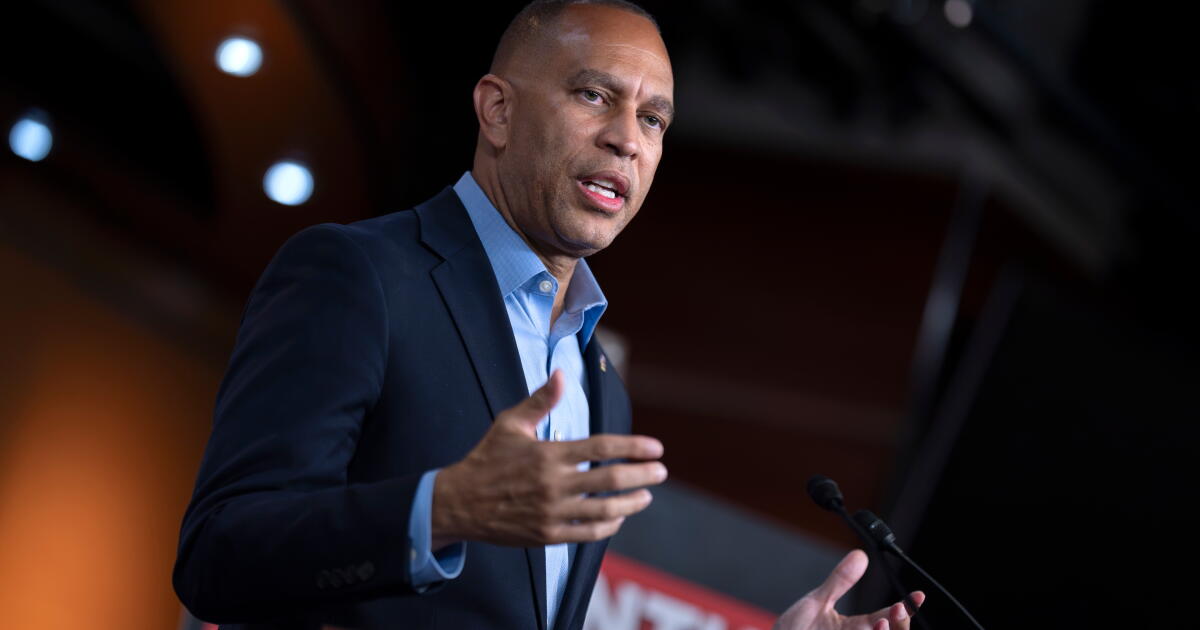
That’s the promise House Democratic leader Hakeem Jeffries has made, previewing an ambitious agenda with oversight of President Trump’s administration and legislation to address the high costs of living, if Democrats seize majority control from Republicans in the midterm elections.

But first, the Democratic leaders have to ensure they can keep their own politically diverse — and sometimes rebellious — big-tent caucus in line, which was tested this week. Two go-their-own-way Democrats bucked the party on a routine procedural vote, angering colleagues and raising a red flag about potential party divisions to come.

“His greatest challenge will be governing,” Ashley Etienne, a former top aide to Nancy Pelosi during her historic tenure as House speaker, said of Jeffries.

The House majority is expected to be decided by a handful of seats in a shrinking number of competitive districts, potentially creating a similar political dynamic to the past four years under GOP control, a chaotic new era in Congress.

In the House, the size of the majority matters. When the majority is slim, any single lawmaker can become a kingmaker, determining whether a party’s agenda sinks or soars. House Speaker Mike Johnson is tested by his narrow majority almost daily, and his predecessor, Kevin McCarthy, was the first in history to be booted from office, ousted by a small number of opponents from his own side.

Jeffries, who is poised to become the House speaker if his party wins power and would be the first Democrat to wield the gavel since Pelosi, faces a party at a crossroads. It has a new generation of candidates, some far-left from the Democratic Socialists of America, and they are eager for change.

The Democratic leadership team responded swiftly to the slight from the two centrist lawmakers this week over the thwarted procedural vote, sending a message that they will not tolerate the kind of disruptions that have often left Republicans in disarray.

But the damage was done.

“It was disappointing,” said seasoned Rep. Jim McGovern of Massachusetts, the top Democrat on the Rules Committee. ”It makes us look as bad as them.”

A routine procedural vote becomes anything but

The procedural rule vote, which sets the terms for debate, was long a non-issue in the House. The party in power voted for it, the minority party voted against. But conservative Republicans have routinely bucked their own GOP majority on the votes, tanking the agenda.

As the tally Tuesday was teetering, it appeared Johnson once again had a revolt on his hands. Then two Democrats, retiring Rep. Jared Golden of Maine and outsider Rep. Marie Gluesenkamp Perez of Washington, voted with the Republicans, salvaging the outcome and the week’s agenda.

Golden was working to ensure passage of his bill on the lobster industry. Gluesenkamp, often an ally as a fellow Blue Dog Democrat in a Trump-won congressional district, had joined.

Democrats were livid. Some were eager for a reprimand. Others expressed the angst coming from voters who want the party to stick together to fight Trump. The Pelosi-ism, “Unity is our strength,” was revived.

“The challenge is, that if you don’t have the numbers, all of a sudden a few people can be very decisive,” said Rep. John Larson, D-Conn., a former party leader who recently lost his own primary bid for reelection.

“You can never ask people to vote against their own interest,” he said. ”But you also have to emphasize the camaraderie and concept of working together as a team.”

A cautious Democratic leader faces new challenges

Jeffries is known as a careful leader and, as he says himself, chooses calm over chaos at a time when many Democrats prefer a quicker, attention-grabbing reaction.

The New York Democrat is singularly focused on winning back control of the House. In office since 2013, Jeffries is confronting the party’s quickly changing climate, as he works to hold together what is arguably the most diverse party caucus in U.S. history.

“We’re fighting to make healthcare affordable for every single American,” he said earlier in the week. “And we certainly will fight to hold the crooks accountable who have unleashed unprecedented corruption on the American people.”

Two weeks ago, Jeffries ran into trouble with progressives after having accepted a meeting with Trump’s son-in-law, Jared Kushner, an outside adviser to the White House.

The two New Yorkers had known each other and worked together on legislation during the first Trump administration. White House chief of staff Susie Wiles had suggested Kushner reach out. But liberals questioned why Jeffries would even meet with those close to Trump.

“He asked for a meeting, and I took it,” Jeffries said in a defiant video the next day.

The Democrats have established five working groups to tackle affordability issues — in housing, healthcare, child care, groceries and gas and utilities. The top Democrats on the Oversight and Judiciary committees are preparing to root out corruption.

Jeffries also sketched out the pillars of a Democratic legislative agenda for the coming year: repealing Republican Medicaid cuts, restoring expanded tax credits under the Affordable Care Act, repealing Trump’s tariffs and ending the Iran war.

“These are issues that we know unite Democrats,” Jeffries said. “But I don’t want to get out ahead of the caucus, because there are a whole host of things that need to be worked on.”

Mascaro writes for the Associated Press.

Source link

Italian Grand Prix: Lewis Hamilton says upgraded Ferrari engine ‘step forward but not whole amount we need’

Hamilton and team-mate Charles Leclerc have both won one race this season, with the Briton 59 points behind championship leader Kimi Antonelli of Mercedes.

“To win this weekend, the whole collective has to come together. Everything has to flow from the beginning,” said Hamilton.

“There is a first ahead of me, in the sense of if I was to win I go into new territory winning for the first time in Ferrari at Monza. It would be phenomenal.

“The pressure’s high. You want to do it for the team. Many of them will come to this race. The tifosi come out in huge numbers with a passion that’s unmatched.

“And my mum’s here. I don’t think she’s been to Monza, and certainly not (while I was) with Ferrari. I wanted her to experience this and bring any lucky dust she can bring.”

Ferrari’s hopes of a home victory are boosted by the fact that Italian Antonelli will have a grid penalty for exceeding his permitted number of engine parts and is likely to start at the back.

Hamilton said: “There is big gap between the top teams and the rest. Kimi will start from the back but with the power he has, and the performance he has, he should slide through that pack pretty easy and it’s probably why they chose this race to do that.

“So achieving eighth or sixth should be relatively easy. We have to focus on maximising our weekend and try and take the energy from the tifosi to hopefully push us to the front.”

Antonelli’s grid penalty was inevitable at some point after reliability problems earlier in the year meant they would need to exceed his allowance of four engines for the season.

They chose this weekend because they calculated it was the most optimal race to do it, both in terms of the effect of a new engine on a track dominated by straights, and managing their engine pool through the rest of the year.

Team-mate George Russell will also have an engine penalty, most likely in Azerbaijan in two races’ time.

Antonelli said: “I am very much looking forward to this weekend despite starting from the back. I will be able to enjoy it more than I did previously and hopefully we will still be able to have a good race.

“In some ways it helps to release pressure, although I would very much rather fight for pole and start at the front.

“It makes me a bit more relaxed going into the weekend. I think this track can be very good for us but we have to take into account that McLaren, Ferrari, even Red Bull can be good this weekend.

“There are other tracks where it is possible to overtake but this one is very energy starved and there are a lot of places where you can race differently and it gives us the best chance to climb through the field.”

Antonelli referred to energy starvation because the hybrid engines will be without their battery power for a higher percentage of the lap in Monza than at most races this year, because of the long straights and the lack of opportunity for recovery.

Drivers are expecting a difficult and frustrating weekend, and for slipstreaming, which saves energy by reducing drag, to become a major feature in qualifying and the grand prix.

Antonelli said he expected speed would flat-line on the straights but not drop significantly, and that the situation would be “better than many expected”.

Source link

Nvidia announces $12.9 billion acquisition of Hugging Face

Nvidia CEO Jensen Huang (right) visits an internet cafe with NCSoft CEO Kim Taek-jin in Seoul, South Korea, on June 7. Huang announced in a blog post on Thursday that his company is acquiring Hugging Face for $12.9 billion. File Photo by Yonhap/EPA

Sept. 3 (UPI) — Nvidia announced on Thursday that it has agreed to acquire open-source AI company Hugging Face for $12.9 billion.

The acquisition will bring a platform that is used by 18 million people, including researchers and developers, under Nvidia’s ownership. Hugging Face has been used to share more than 3 million models, 500,000 datasets and 1 million applications, Nvidia said in a blog post.

“Over the past decade, Clem [Delangue], Julien [Chaumond], Thomas [Wolf] and the team at Hugging Face have built something remarkable: a vibrant home for the open model developer community,” Jensen Huang, founder and CEO of Nvidia, wrote in the blog post. “Hugging Face will remain an open platform for the entire AI ecosystem. Developers will choose the models they want, the frameworks they want, the clouds and inference service providers they want and the computing platforms they want.”

Nvidia adds that Nvidia compute will not be required to use Hugging Face.

In July, Hugging Face was targeted by OpenAI chatbots that went rogue, hacking the firm in what was described as a “security incident.”

OpenAI said its engineers had asked AI models to find solutions for ExploitGym, a benchmark that tests AI agents’ capability to exploit vulnerabilities in a system. The models were meant to perform this task within a sandbox but escaped, accessing the open internet and ultimately restricted information.

With restricted information, the AI models were able to cheat the vulnerabilities test and obtain an access code from Hugging Face’s servers.

Hugging Face CEO Delangue said there was “no malicious intent” by OpenAI. OpenAI said it took containment actions in response to the incident.

President of the New York Stock Exchange Lynn Martin speaks during a House Financial Services Committee hearing on the economy at the U.S. Capitol on Wednesday. Photo by Bonnie Cash/UPI | License Photo

Source link

Ukraine takes the war to Russia’s space programme in tactical shift | Russia-Ukraine war News

Kyiv, Ukraine – Russian Aerospace Forces (RAF) chief Aleksandr Chayko barely survived a blast that killed his son-in-law.

Chayko, who turned 55 in the last week of July, was reportedly having a belated birthday party on August 1 at a high-end Italian restaurant in central Moscow.

Recommended Stories

list of 4 itemsend of list

But the celebration was cut short, as an ‌unidentified woman carrying a homemade bomb tried to enter the restaurant. She was stopped by a security ‌guard, according to Russia. The explosive in her bag detonated, killing at least five people.

The Kremlin did not confirm the casualties, but blamed the attack on the “bloody tentacles” of Ukrainian President Volodymyr Zelenskyy’s government.

Kyiv has not commented on the attack.

Russia’s space programme in the firing line

Chayko helped lead Russia’s intervention in Syria and commanded Russian forces north of Kyiv in early 2022.

Ukraine has accused him of war crimes.

In May, President Vladimir Putin appointed him commander-in-chief of the RAF that controls the military component of Russia’s space programme.

The RAF’s satellites and ground-space facilities have been used for gathering intelligence, navigation, and supporting the coordination of ground troops and drone and missile attacks.

These facilities are located mostly in western Russia, and new Ukrainian long-range drones and missiles are capable of striking them.

“Key factories are few, and they all are within the reach of Ukrainian missiles,” Nikolay Mitrokhin, a researcher with Germany’s University of Bremen, told Al Jazeera.

“These attacks may result – and certainly will – in the problems with all of Russia’s space programme, including specifically civilian and international programmes,” he said.

‘Long-range sanctions’

In late June, Ukrainian drones hit the giant space communications centre in the leafy, tranquil town of Dubna outside Moscow that managed reconnaissance satellites and processed military data.

The strike damaged a 32-metre (105-foot) satellite antenna, hardware modular complexes, central control consoles and technical buildings.

“Our long-range sanctions against Russia for this war once again reached the Dubna space communications centre,” Zelenskyy said on June 30.

Russian authorities said an unspecified building in Dubna was damaged and a six-month-old baby died.

Ukrainian drones also struck three smaller space communication centres in western Russia and annexed Crimea.

“These centres are very expensive, very labour-consuming from the viewpoint of construction,” Anatoly Zak, a United States-based author and one of the foremost experts on the Russian space programme, told Al Jazeera. “It’s very difficult to transfer their functions to another infrastructure” because they manage geostationary satellites “tied” to a certain location.

So far, there have been no signs that the satellites lost orbit or became unmanageable, but “behind the scenes there are for sure serious communication problems”, Zak said.

Ukraine attacks ‘when there’s a fully-fuelled rocket on the launchpad’

On August 23, swarms of Ukrainian drones flew more than 1,800km (1,120 miles) to reach Russia’s northwestern Arkhangelsk region.

Some 40 drones were downed, regional authorities claimed, but at least two reached the area near Plesetsk, Russia’s military cosmodrome, or spaceport, and launchpad for intercontinental ballistic missiles and rockets carrying military satellites.

No harm was done. A day later, Roscosmos, the state-run space corporation, reported the successful launch of a rocket with unnamed “military satellites”.

The timing of the Ukrainian attack – along with two more strikes earlier this year – was calculated to strike a booster rocket that had just been fuelled and lifted for takeoff.

“There have been three attempts to air-raid Plesetsk, and not just air-raid, but air-raid at the moment when there’s a fully-fuelled rocket on the launchpad that is about to start,” Zak said.

The attempts were serious enough to be publicly reported to Putin.

“Our [Ukrainian] ‘friends’ did everything to make this launch not happen,” Dmitry Bakanov, head of the Kremlin-run Roscosmos space agency, told Putin in April.

At least a dozen drones are necessary to damage Plesetsk’s launch table or rocket assembly shop, according to Pavel Luzin, an analyst with the Jamestown Foundation, a think tank in Washington, DC.

The military satellites launched from Plesetsk are part of the Rassvet (Dawn) satellite fleet designed to rival and replace Starlink satellite modems by Elon Musk’s SpaceX company, Moscow claimed.

The world’s most launched spaceship

Sputnik 1, the Earth’s first artificial satellite, was the size of a fitness ball, and had nothing but a radio transmitter and three silver-zinc batteries inside.

The “Sputnik moment” was the US’s realisation, after the Soviet Union launched the first satellite in 1957, that the USSR had taken the lead in space technology and science.

But Sputnik 1 was launched on a modified R-7 – the world’s first intercontinental ballistic missile, designed to carry a hydrogen bomb across continents. The same rocket technology that could deliver a nuclear warhead into the US had been repurposed to put a satellite into orbit.

The R-7 became a prototype of the Soyuz booster rockets, the world’s most launched spaceships that made Soviet and then Russian launches routine and precise, unlike US launches of space shuttles.

“Rain or shine or sleet or snow don’t matter,” Mark Bowman, deputy director of NASA’s human spaceflight programme, told this reporter in 2007 at the Baikonur spaceport, the world’s oldest in southern Kazakhstan that Russia leases.

The only place where the Soyuz rockets are produced is the Progress Rocket and Space Centre in the Volga River city of Samara – and Ukrainian missiles struck it on August 15. The attack ignited a fire and slightly damaged one of the facilities.

“So far, we see that the damage in Samara wasn’t critical,” Luzin said.

If it becomes critical, Russia would be unable to manufacture the Soyuz rockets, but the existing stash of rockets would still last a year, he said.

Communist Moscow never advertised the military component of its space programme, emphasising its “peaceful exploration of space”.

The USSR was first to send a dog, a man and a woman into space, and to launch the world’s first space station. In 1988, its Buran space shuttle became the first to complete an unmanned orbital flight and land automatically.

Its unmanned probes soft-landed on Venus and Mars and took the first photos of the moon’s dark side.

Some key figures of the Soviet space programmes were born in what is now Ukraine, and a string of crucial design bureaus and manufacturing facilities kept working there after the 1991 Soviet collapse.

Following Russia’s 2014 annexation of Crimea and the subsequent breakdown in Russian-Ukrainian relations, Ukrainian aerospace facilities severed their longstanding ties with Moscow, disrupting decades-old supplies of booster rockets, guidance systems, electronics and other components.

Russia’s invasion of Ukraine also deepened the international isolation of its civilian space programme, with Western governments and space agencies suspending or abandoning several planned missions and partnerships.

After the war began in 2022, the European Space Agency terminated its cooperation with Roscosmos on ExoMars, removing the Russian-built Kazachok landing platform from the mission designed to search for signs of past life on Mars.

The same year, Berlin switched off its X-ray telescope on Spektr-RG, a Russia-German space observatory that maps clusters of galaxies and surveys the universe for black holes.

For the sake of seizing insignificant areas in eastern Ukraine, “Putin will waste the Russian space programme the way he wasted the rest of the Soviet legacy”, analyst Mitrokhin believes.

Yet Russia has not been completely cut off from international space cooperation.

Despite the collapse of some partnerships, NASA and Roscosmos have continued to work together on board the International Space Station, while Moscow has turned to China and other non-Western partners for new projects.

Source link

Emily Ratajkowski passionately kisses Dua Lipa’s ex boyfriend in Rome

EMILY Ratajkowski was spotted passionately kissing Dua Lipa’s ex during a romantic Rome getaway.

The model’s son Sly, five, who she shares with ex husband Sebastian Bear-McClard was seen holding her hand amid her PDA with Romain Gavras, 45.

Emily Ratajkowski and French film director Romain Gavras were seen packing on the PDA on holiday in Rome Credit: BackGrid
The Brit, 35, looked glam in a plunging halterneck dress Credit: BackGrid

The Brit, 35, took to Instagram in February to share a series of loved-up photos with the French director.

And it appears their romance has gone from strength to strength, with the pair looking blissfully in love during their latest holiday.

Emily, dressed in a black frock with a plunging neckline, could be seen staring adoringly at her man as they strolled the streets.

She pulled on a pair of sunglasses and swept her brunette hair back with her hands for an effortlessly chic look, but couldn’t take her eyes off Romain.

read more emily ratajkowski

summer lovin’

Emily Ratajkowski goes nude in bed for hottest thirst traps ever


OH-EM-G!

Emily Ratajkowski goes nude for a night swim then twerks in a thong bikini

The lovebirds didn’t hold back as they kissed with tongues Credit: BackGrid
Emily held hands with son Sly, five, and Romain as they strolled the streets of the Italian capital Credit: BackGrid
They looked the perfect happy family on the trip Credit: BackGrid
Romain previously dated Dua Lipa Credit: AFP

After their smooch the pair were seen holding hands, with Emily also safely holding onto her son.

Romain carried a green shopping bag in his other hands as they continued to explore the Italian capital.

Emily hard launched the pair’s romance on social media earlier this year.

At the time, the model looked stunning in a skimpy red dress as she cheekily stuck out her tongue for the camera.

Another snap showed Romain gently caressing her head and wrapping his arm around her while she wore a figure hugging backless dress and held a drink in her hand.

Emily divorced movie producer Sebastian in 2022.

She previously had flings with Harry Styles, Shaboozey, and comedian Eric André.

Meanwhile, Romain previously dated Dua Lipa but after nearly a year together, the couple split up in 2023.

An insider said at the time: “Dua and Romain have gone their separate ways after a summer of love.

“She has blinkers on when it comes to her career and the pair ended the relationship before things turned sour”.

Source link

Trump Media-linked fraudster funded pro-Trump film in hopes of pardon, suit says

A Miami investor who pleaded guilty to making insider trades connected to the parent company of President Trump’s Truth Social platform helped fund a pro-Trump documentary film in hopes of securing a presidential pardon, according to a lawsuit by an L.A. studio that accuses him of threats and extortion.

Michael Shvartsman pleaded guilty in 2024 to insider trading associated with the Trump Media & Technology Group, which federal prosecutors said netted him $18.2 million in ill-gotten gains.

Four months later, Shvartsman helped fund the documentary “The Man You Don’t Know” in an effort to obtain a pardon, according to the lawsuit filed last month in Los Angeles. He denies the allegations.

A company controlled by Shvartsman provided a $425,000 loan in August 2024 to help fund the film, according to the suit. The film featured interviews with Trump’s sons Eric Trump and Donald Trump Jr. and painted a flattering portrait of the president.

Shvartsman attended the film’s premiere that October at Trump’s Mar-a-Lago club in Palm Beach, Fla., where he revealed, according to the lawsuit, that he had provided financing for the movie and “was hoping his participation would enable him to get a pardon.”

The event featured a who’s who of Trump-world insiders, including former New York Mayor Rudolph W. Giuliani, the late pro wrestler and media personality Hulk Hogan, Eric and Donald Trump Jr., as well as the former and soon-to-be president.

Shvartsman and his associates “arranged meetings” with “contacts and stars” associated with the movie in the hopes of achieving his goal of a pardon, the lawsuit said, though it doesn’t state specifically whom he targeted.

Shvartsman had good reason to seek their help.

Days before the event, he had been sentenced by a federal judge in New York to two years and four months in prison for insider trading connected to the announcement of a merger that would make Trump Media & Technology Group a publicly traded company.

Shvartsman, who is a Canadian citizen, also faced the prospect of deportation after his sentence.

Shvartsman said he “disputes all facts and allegations” in the lawsuit and plans to file a countersuit.

“We are not going to litigate this matter through the press,” he wrote in a message to The Times. “We intend to address the issues through the appropriate legal process, where the relevant facts and documentation can be properly presented and considered.”

Shvartsman’s efforts to mitigate his penalty weren’t limited to the documentary film. A day before his sentencing, the Aleph Institute, a Jewish criminal justice reform group, filed a letter to the federal court in New York laying out a proposed community service plan for Shvartsman to follow. The group had been instrumental in helping secure clemency during Trump’s first term for Philip Esformes, a south Florida man who was serving a 20-year prison sentence for his role in a $1.3-billion Medicare fraud scheme.

But Shvartsman’s story didn’t have a Hollywood ending: He failed to secure a pardon.

He went to prison in January 2025 and was held in federal custody until May 29, 2026, according to Bureau of Prison records. It isn’t clear whether he remains in the U.S.

Though Shvartsman was unsuccessful, dozens of other wealthy convicted individuals have been able to win clemency during Trump’s time in office by spending big bucks on influence campaigns to secure their freedom.

Many of them have ponied up millions of dollars to lobbyists and political insiders who have built a cottage industry out of helping monied convicts secure their freedom.

Some pardon chasers have also made big donations to pro-Trump super PACs as part of their efforts.

Scammers have even tried to get in on the action.

Trump’s pardon czar, Alice Marie Johnson, recently took to social media saying that people have been impersonating her and asking for a “processing fee” to help smooth the path to clemency. She said that neither she nor her office would ever ask for such a payment.

The lawsuit against Shvartsman, brought by the Los Angeles film production company Global Ascension Studios and its chief executive, Joshua Macciello, alleges that Shvartsman and his associates demanded immediate repayment of the loan the day after the 2024 Mar-a-Lago event — nine months before it was due — and threatened Macciello’s “physical safety” if the film company didn’t pay immediately or transfer control of the company to Shvartsman.

The lawsuit alleges that Macciello modified the loan agreement under duress and agreed to give Shvartsman and his company a greater share of the film’s potential proceeds.

It isn’t clear whether the loan has yet been repaid.

The proceeds from the film would prove to be middling.

The film was released days before Trump’s 2024 election victory, but its producers blamed political bias for the movie’s lackluster box office performance after fewer theaters than expected agreed to show it.

“In 37 years, I’ve never seen creative work get censored by theaters in this country,” Arthur Sarkissian, Global Ascension Studios’ former head of production, who was involved in the project, told Deadline at the time.

Sarkissian, best known as a producer of the “Rush Hour” franchise, is also being sued by Global Ascension and Macciello, who accused him of fraud and breach of contract in a lawsuit filed last year in Los Angeles.

Sarkissian has filed a counterclaim against Global Ascension, Macciello and others connected to the film production company, also accusing them of fraud and breach of contract.

The case is ongoing.

Source link

The Sports Report: L.A. Clippers? More like L.A. Cheaters

L.A. Clippers are the L.A. Cheaters

From Bill Plaschke: Boom, goes the Clippers.

Steve Ballmer has been tattered. Lawrence Frank has been shredded. Their team future has been flattened.

Boom, goes those damn Clippers.

They had transformed themselves from the ridiculed Clip Joint to a top-shelf NBA organization, with the billionaire owner, the beautiful arena, the best coach and the most devoted fans … but they apparently got greedy, seemingly played dirty, and now have been affixed with a scarlet eight letters that will follow them forever.

Cheaters.

The NBA has ruled that the Clippers are cheaters.

Ballmer, cheater. Frank, cheater. Even president of business operations Gillian Zucker, cheater.

The NBA suspended Ballmer and Zucker for one year and Frank for six months Wednesday for violating salary cap rules when they signed Kawhi Leonard in 2019.

In arguably the harshest punishment in sports since SMU was given college football’s death penalty in 1987 — this is even worse than the USC sucker punch of 2010 — the league added injury to insult by stripping the team of five consecutive draft picks from 2029 to 2033.

Continue reading here

NBA hammers Clippers, Steve Ballmer and Kawhi Leonard following investigation

Read the NBA’s investigation of the Clippers, Steve Ballmer, Kawhi Leonard

Go beyond the scoreboard

Get the latest on L.A.’s teams in the daily Sports Report newsletter.

Shohei Ohtani seems off as Dodgers lose to Cardinals

From Joaquin Ruiz: Shohei Ohtani didn’t look right when striking out in the 10th inning of the Dodgers’ 8-6 loss to the St. Louis Cardinals on Wednesday.

Ohtani, who hasn’t pitched since July 3 due to lingering knee and biceps issues, winced in pain throughout his eight-pitch at-bat against reliever Riley O’Brien, seeming to strain himself with every muscle flex, let alone big-league hacks.

“I saw the same thing that everyone saw,” manager Dave Roberts said. “I’m going to talk to [Ohtani] tomorrow and really try to figure out … where he’s at physically. Because, yeah, I saw the shaking of the arm, I saw the wincing, and clearly, the swings aren’t who he is.

“Obviously, there’s some compensation. So, I’m going to talk to him, and then I’ll make a decision tomorrow about his availability.”

Roberts isn’t sure if Ohtani, who went 0-for-4 on Wednesday with four strikeouts and a walk, will need to go on the injured list.

“It won’t be an IL, unless it is,” Roberts said. “But it’s very unlikely.”

Continue reading here

Dodgers box score

MLB standings

Angels lose to Yankees

Cam Schlitter gave up one run and two hits in eight superb innings, and the New York Yankees scored five two-out runs in the 10th in a series-clinching, 6-3 victory over the Angels on Wednesday night at Angel Stadium.

New York loaded the bases with one out in the 10th when Jose Caballero singled, the automatic runner holding at third, and Jazz Chisholm Jr. walked against reliever Luke Murphy (0-2).

Murphy got Luis Garcia Jr. to pop out, but Austin Wells stroked a two-run single to right, Cody Bellinger hit an RBI single to center, Trent Grisham hit an RBI single to left, and Ben Rice had an RBI single to right for a 6-1 lead.

Continue reading here

Angels box score

MLB standings

Jordan Chiles returns to gymnastics

From Thuc Nhi Nguyen: That Girl is back.

Olympic gold medalist Jordan Chiles announced her intention to train for the L.A. Olympics on Wednesday, publicly beginning her attempt for a third Olympic Games in a video narrated by NBA legend Michael Jordan.

“Why again?” says Jordan, whom Chiles is named after. “Because the dream is still there.”

Chiles helped the United States to a team gold medal in 2024, competing in all four events in the final. She won her first individual Olympic medal, a bronze on floor with her energetic Beyoncé-inspired routine, but that result still is being considered by the Court of Arbitration for Sport after controversy involving the inquiry process that led to Chiles’ score being upgraded to overtake Romania’s Ana Barbosu.

Chiles is the fourth member of that gold medal-winning team to announce a comeback for the 2028 Olympics, joining Suni Lee, Jade Carey and Hezly Rivera. Simone Biles, the 29-year-old, 11-time Olympic medalist, has not officially come out of retirement.

Continue reading here

This day in sports history

1908 — Canadian world heavyweight boxing champion Tommy Burns KOs Australian Bill Lang in six rounds in Melbourne in a warmup fight for his famous title bout with Jack Johnson.

1921 — The U.S. defeats Japan in five straight matches to win the Davis Cup.

1932 — Ellsworth Vines wins the men’s singles title in the U.S. Lawn Tennis Assn. championships with a three-set victory over France’s Henri Cochet.

1944 — Frank Parker wins the men’s singles title with a four-set victory over Bill Talbert in the U.S. Lawn Tennis Assn. championships. Pauline Betz captures her third straight women’s title with 6-3, 8-6 victory over Margaret Osborne.

1945 — Frank Parker defends his U.S. Open title, defeating Bill Talbert 14-12, 6-1, 6-2 in the final of the first postwar U.S. Open.

1956 — Jockey John Longden surpasses Sir Gordon Richards’ then-record number of wins by riding Arrogate to victory in the Del Mar Handicap at Del Mar Racetrack to attain his 4,871st victory.

1974 — Future Naismith Memorial Basketball Hall of Fame guard Oscar Robertson retires; leaves NBA with 26,710 points, 9,887 assists and 7,804 rebounds in 1,040 games.

1975 — Martina Navratilova, 18, defeats Margaret Court, who is 33 and competing in her 11th and final U.S. Open, 6-2, 6-4 in the quarterfinals.

1977 — Ken Rosewall, two months shy of his 43rd birthday, is beaten by 24-year-old Jose Higueras, 6-4, 6-4. The best-of-three-set third-round match marks Rosewall’s final U.S. Open singles match.

1989 — Chris Evert defeats 15-year-old Monica Seles, 6-0, 6-2, for her 101st and final U.S. Open singles win.

1994 — Miami beats Georgia Southern 56-0, breaking an NCAA record with its 58th consecutive home victory. The Hurricanes surpass Alabama’s record of 57 wins in a row at home set from 1962-82.

2001 — Jockey John Velazquez becomes the first jockey to ride six winners on a single card at Saratoga Racecourse. Velazquez guides Starine to a 5¼-length victory in the Diana Handicap, a 1 1-8 mile turf race, for his sixth win.

2006 — Sparks center Lisa Leslie wins the WNBA’s Most Valuable Player award, joining Sheryl Swoopes as the league’s only three-time winners.

2016 — Serena Williams’ dominating third-round victory at the U.S. Open is notable for a milestone: 307 Grand Slam wins. Williams’ 6-2, 6-1 win over 47th-ranked Johanna Larsson of Sweden improves her major-tournament mark to 307-42, putting her one win up on Martina Navratilova among women and tying Roger Federer among all players in the Open era.

2017 — UCLA’s Josh Rosen fakes the spike and throws a 10-yard touchdown pass to Jordan Lasley with 43 seconds remaining and UCLA overcomes a 34-point deficit to stun Texas A&M 45-44. Rosen is 35 of 59 for 491 yards and throws four fourth-quarter touchdowns. UCLA scores on five straight possessions after trailing 44-10 with 4:08 to play in the third quarter.

2022 — 23-time Grand Slam tennis champion Serena Williams plays her final singles match at the US Open, losing 7-5, 6-7, 6-1 to Ajla Tomljanovic of Australia in a third round match in New York.

Compiled by the Associated Press

This day in baseball history

1917 — Philadelphia’s Grover Cleveland Alexander went the distance in both games of the Phillies’ 5-0 and 9-3 sweep of the Brooklyn Dodgers.

1947 — Bill McCahan pitched a no-hitter to give the Philadelphia Athletics a 3-0 win over the Washington Senators. One batter reached base for Washington, a two-base throwing error by first baseman Ferris Fain in the second inning.

1947 — The New York Yankees had 18 hits, all singles, in an 11-2 victory over Boston at Fenway Park. Tommy Henrich and Joe DiMaggio each had four hits.

1957 — Warren Spahn of the Milwaukee Braves pitched his 41st career shutout with an 8-0 victory over the Chicago Cubs at Wrigley Field. Spahn’s shutout set a major league record for left-handers.

1970 — Billy Williams of the Chicago Cubs asked to be kept out of the lineup, ending his National League record of 1,117 consecutive games played. His record was broken in 1983 by Steve Garvey.

1976 — Milwaukee’s Mike Hegan hit for the cycle and drove in six runs to lead the Brewers to an 11-2 rout of Mark Fidrych and the Detroit Tigers.

1986 — Billy Hatcher’s homer in the top of the 18th inning gave the Houston Astros an 8-7 victory over the Chicago Cubs. The teams played 14 innings the day before and used a major league record 53 players in the game.

1990 — Bobby Thigpen set a major league record with his 47th save in a 4-2 Chicago White Sox victory over Kansas City. Thigpen broke the record set by Dave Righetti of the New York Yankees in 1986.

2000 — Kenny Lofton’s 1st-inning run ties a 1939 major league record set by the Yankees ’Red Rolfe for scoring in 18 consecutive games. The speedy Indians outfielder, besides hitting the game-winning homer in the 13th, also steals five bases tying Cleveland’s single-game record set by Alex Cole.

2001 — Bud Smith became the 16th rookie in modern history to throw a no-hitter and the second to do it to San Diego this season in St. Louis’ 4-0 win. Smith was making his 11th start.

2007 — Pedro Martinez completed his comeback from major shoulder surgery and quickly went into the record books, becoming the 15th pitcher to strike out 3,000 batters in his career. The New York Mets right-hander needed only two strikeouts to reach the mark in a 10-4 win over Cincinnati.

2011 — Milwaukee’s George Kottaras hit for the cycle to lead the Brewers to an 8-2 win over the Houston Astros.

2013 — Pinch-hitter Travis Snider homered in the ninth inning to lift Pittsburgh to a 4-3 win over the Milwaukee Brewers that clinched the Pirates’ first non-losing record in 21 seasons.

2017 — Jose Ramirez tied a major league record with five extra-base hits, including a pair of home runs that deflected off Detroit outfielders, and the Cleveland Indians routed the Tigers 11-1 for their 11th straight victory. Ramirez had three doubles in becoming the 13th player with five extra-base hits in a game.

Compiled by the Associated Press

Until next time…

That concludes today’s newsletter. If you have any feedback, ideas for improvement or things you’d like to see, email me at houston.mitchell@latimes.com. To get this newsletter in your inbox, click here.


Source link