Greek teenage star Konstantinos Karetsas faced ‘circulatory problems’ and was stretchered off against Villarreal.
Published On 9 Sep 20269 Sep 2026
Borussia Dortmund teenage star Konstantinos Karetsas was being treated at the hospital after slumping to the turf 25 minutes into his Champions League debut, the German club said.
“Konstantinos Karetsas had to leave the field due to circulatory problems,” Dortmund said in a statement late on Tuesday. “Kosta is doing well under the circumstances and is on his way to the hospital for further tests.”
Facing Villarreal, the 18-year-old Greek prospect passed the ball to a teammate, then signalled his distress to the referee before sitting on the grass.
Karetsas was treated lying down and then taken away on a stretcher. The score was 0-0 at the time in what became a 3-2 win for Dortmund.
“I hope and I think that everything is OK, and I hope that he’s back and fit with us soon,” Dortmund goalkeeper Gregor Kobel told a broadcaster.
Konstantinos Karetsas receives medical attention before being put on a stretcher [Leon Kuegeler/Reuters]
Karetsas and his Greek teammate Giannis Konstantelias were marquee signings for Dortmund in the off-season. Former Belgium youth international Karetsas joined for $34.9m from Genk and Konstantelias for $30.2m from PAOK.
Karetsas was reportedly a target for many clubs after impressing at Genk last season. He set up 11 goals in 28 Jupiler Pro League appearances. He signed a five-year contract through June 2031.
“With his creativity and game intelligence, Kos will enrich our team,” Dortmund sporting director Ole Book said. “He is technically very skilled and has the ability to find quick solutions in tight spaces, especially in the final third.”
Karetsas played for Belgium’s youth teams before opting to represent his parents’ country and making his debut for Greece in March 2025. He has scored three goals in 10 international appearances.
Meanwhile, 23-year-old Konstantelias’ season was likely ended last month by an ACL injury on his Bundesliga debut.
The Channel 4 star has continued to bag huge television and film roles
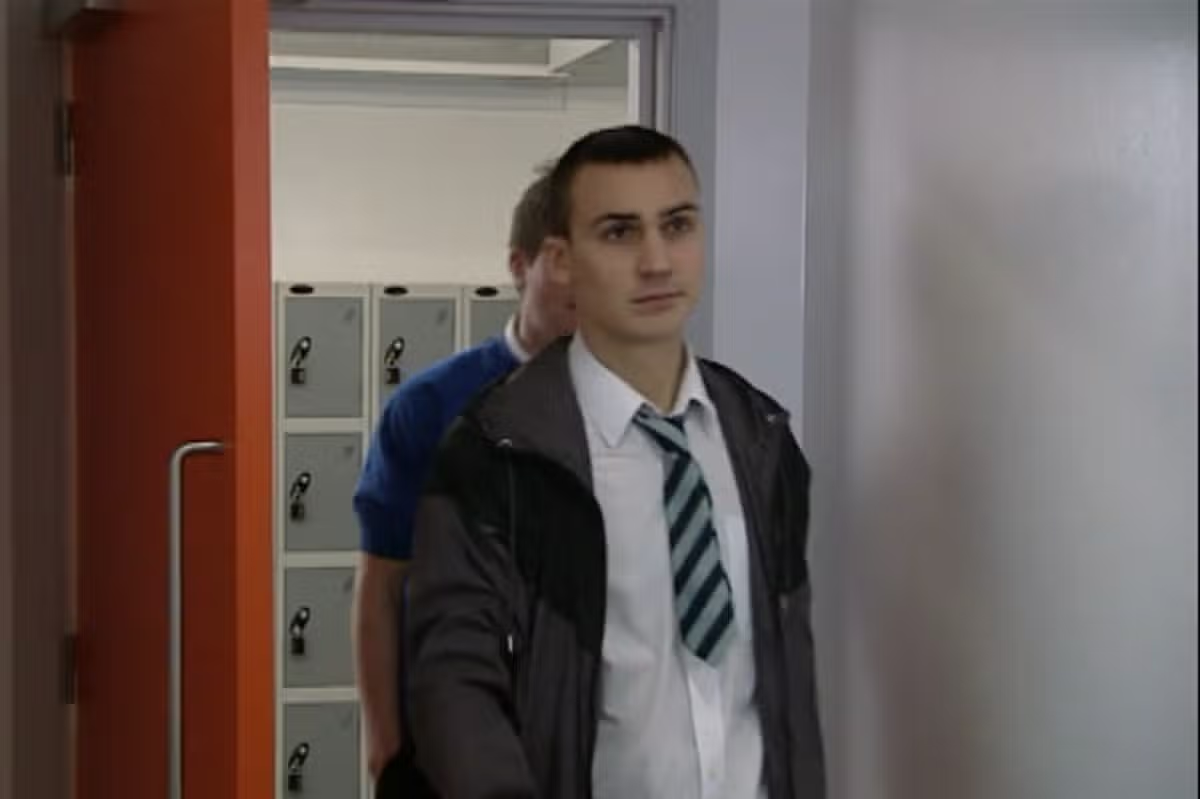
Henry Lloyd-Hughes played bully Mark Donovan in The Inbetweeners (Image: Channel 4)
The Inbetweeners star Henry Lloyd-Hughes looks almost unrecognisable almost 20 years after he found fame on the hit comedy.
Fans will remember the British actor, 41, for playing school bully Mark Donovan in the now-iconic series. For those who missed it, the E4 drama aired for three seasons between 2008 and 2010.
It followed the wild adventures of pupil Will (played by Simon Bird) and his group of friends: Simon (Joe Thomas), Jay (James Buckley) and Neil (Blake Harrison). Donovan was known for picking on the main characters, and infamously snapped a picture of Will in the toilet on his first day of school.
We watched the schoolmates’ last adventure together over a decade ago, and Netflix is bringing them back for a third feature-length film. But whatever happened to villain Donovan?
Lloyd-Hughes, the actor behind the teenager, is almost unrecognisable these days. He has remained in the industry, just like most of his co-stars.
The London-born performer recently appeared in Netflix’s The Thursday Murder Club, opposite the likes of Helen Mirren and Pierce Brosnan. He has also enjoyed roles in Killing Eve and Steven Spielberg’s new thriller, Disclosure Day.
Although casual viewers may not instantly recognise the actor as a “grown up,” devoted fans can pick him out of a crowd even after all these years.
Get Netflix free with Sky
This article contains affiliate links, we will receive a commission on any sales we generate from it. Learn more
Sky is giving away a free Netflix subscription with its new Sky Stream TV bundles, including the £15 Essential TV bundle. This lets members watch live and on-demand TV content without a satellite dish or aerial and includes hit shows like Stranger Things and The Last of Us.
Lloyd-Hughes shared the story of a sweet run-in with a fan back in 2021. “This is not a humblebrag but I was giving blood this morning. Obviously you’ve got to wear a mask,” he told Square Mile.
He went on to reveal that a nurse came over to him and said: “Excuse me, I’d like to ask a question. Have you ever done any acting?” To which he replied: “Yeah, sometimes.”
The healthcare worker then asked: “Are you The Inbetweeners?” Lloyd-Hughes went on to explain: “It was a middle-aged to elderly Indian man who recognised me.
“I was not expecting, when I was wearing a school uniform, filming for like £5 a week, that ten years later or whatever I’d be getting recognised. Even behind a mask!”
The Inbetweeners series is available to stream on Channel 4’s on-demand service. The Inbetweeners 3 will stream on Netflix.
TRAVELLERS face another day of chaos across UK airports today following a major tech outage cancelling flights yesterday.
Thousands of passengers were hit by flight cancellations and delays yesterday due to an air traffic control issue emerging around 1pm.
Thousands of travellers have been left stranded at airports after a Air Traffic Controller tech outageCredit: Shutterstock EditorialThe outage impacted all airports across the UKCredit: Shutterstock Editorial
People reported being stuck on planes on the tarmac for hours and many travellers are currently stranded abroad with new flights home only available next week.
NATS has now warned that delays are expected to continue as it tries to “clear a backlog of flights” – but here is all you need to know if you have been impacted.
Sign up for the Travel newsletter
Thank you!
My flight has been cancelled, what do I do?
Contact your airline immediately and ask to be rebooked onto the next available flight.
Airlines must provide you with this option. Unfortunately, in a situation like this where so many flights have been cancelled, it may be that they offer you a flight well into the next few days.
You do not have to accept this. If you can find an alternative flight with a different airline that will get you to your destination sooner, you have the right to either have the airline book you onto this or book it yourself.
Use a credit card, keep all receipts and claim it back from your airline. In situations like this, the last thing you should do is simply get a refund if you have no alternative means of getting to your destination.
If you do this, your airline no longer has any duty of care and does not have to get you home.
Only request a refund if you are happy for the airline to no longer have any responsibility for your travel options. – Lisa Minot, Head of Travel
At several airports, travellers reported being stuck on planes for hours on the tarmacCredit: Shutterstock Editorial
How do I contact my airline?
You will likely be contacted by your airline directly if your flight has been affected by the air traffic control meltdown.
If you are already at the airport or on your way there, the best thing to do is speak to someone on the ground.
Phones will be ringing off the hook right now so the check in desk or your airline help desk is your best bet.
Anyone who is at home and has not been provided with a satisfactory alternative flight or the option to a refund should either call the airline via the customer services number or make contact via the live chat option on the website.
Some airlines, like British Airways, will allow you to rebook within their airline app.
If the changes are complicated, however, phone or in-person is best. – Sophie Swietochowski, Assistant Travel Editor
Some travellers are also stuck abroad struggling to get back to the UKCredit: PA
What if I have a holiday package booked?
If you have a holiday package booked, you have more protection than flight-only bookings.
This is because they are ATOL protected, which means your money is safeguarded by a a UK financial protection scheme (often needed for when holiday companies go bust).
If your flight is cancelled, your tour operator must offer an alternative flight or replacement holiday.
If neither work you, then you must be given a full refund – Kara Godfrey, Deputy Travel Editor
Can I get compensation?
No. Airlines are only required to give you compensation if the delay or cancellation is the airline’s fault, as in a technical failure on a plane or issues with crew.
In this situation, where ATC is the reason for the chaos, there is unfortunately no compensation due.
Check your insurance policy to see if you have any redress if you have incurred additional costs like missing a concert or unable to pick up car hire. You may be able to claim for that.
Generally for delays, if an airline looks after you or provides you with food and drink or hotels, you cannot claim for the same costs against your travel insurance. – Lisa Minot, Head of Travel
How do you claim compensation?
If your flight has been cancelled strictly as a result of yesterday’s incident, you will not be entitled to compensation.
This is because the situation is deemed to be outside of the airline’s control and falls under the category of extraordinary circumstances.
Airlines do, however, still have a duty of care to their passengers and anyone experiencing delays of between two to four hours will be entitled to food and drinks vouchers.
These are usually handed out according to the distance you are flying.
For example if your trip is short haul then you are entitled to vouchers once the delay reaches two hours.
The delay must be at least three hours for mid haul or four hours for long haul.
If you are stranded and need to stay in a hotel, this also falls under duty of care and the airline should assist you in this.
As mentioned above, if you end up paying for anything yourself, you must keep receipts so that you can claim this back. – Sophie Swietochowski, Assistant Travel Editor
There have been further cancellations and delays today across EuropeCredit: Getty
Am I covered by travel insurance?
This is strictly down to what your insurance policy says. It really depends on the level of policy you paid for, so it’s worth checking the small print.
You’ll need to be covered for things like delay, travel disruption, cancellations and missed connections.
If you went for the cheaper option when booking your policy, it’s likely there may be some holes in your cover.
Always make sure you take out travel insurance and check the details before signing on the dotted line – instances like this are why it’s worth protecting yourself. – Caroline McGuire, Head of Travel (Digital)
I missed an event can I get my money back?
It depends what you booked and how.
For a missed concert, theatre show or other event, check your travel insurance to see if it is covered because of the delay or cancellation – you may be able to claim.
The same applies for car hire or missed accommodation expenses but only if your travel insurance policy includes such disruption.
If you paid by credit card and the value is over £100 it may be worth calling your credit card provider and seeing if you can claim under Section 75 of the consumer credit act. – Lisa Minot, Head of Travel
Passengers are unable to get cash compensation as the issue is classed as an “extraordinary circumstance”Credit: AFP
What about if you’re supposed to be flying soon?
If you’re due to jet off in the coming days and have not yet been contacted by your airline, take this as a good sign.
The specific issue that resulted in yesterday’s chaos was fixed within four hours and many airports have said that they are operating as normal today.
Despite this quick fix, yesterday still saw over 1000 cancellations across UK airports which has had a dramatic knock on effect that could continue for days.
Keep a look out for any changes to your flight and act immediately if a cancellation arises.
If your flight is not cancelled, be warned that it could be busier than anticipated, with airlines struggling to find space for passengers who are trying to reach their destination after a cancellation. – Sophie Swietochowski, Assistant Travel Editor
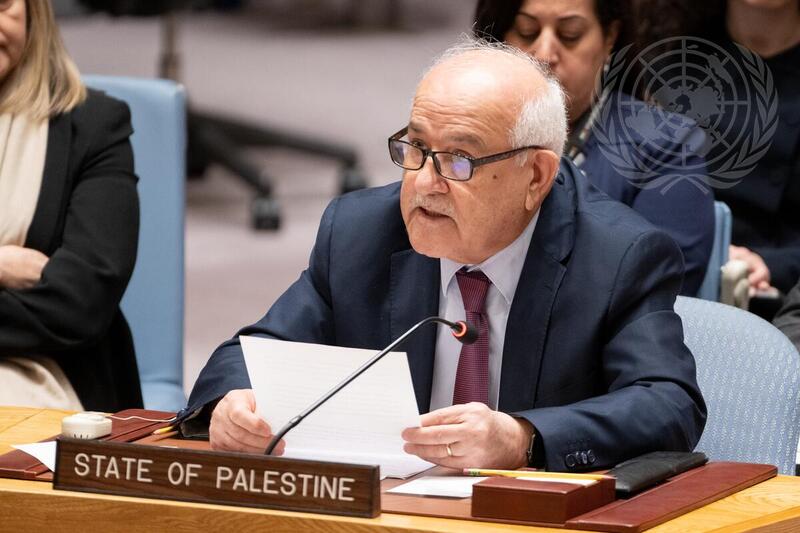
NEW YORK: Israel’s “decades-long ethnic cleansing” of the Palestinian people “has reached its height through the commission of genocide,” Palestine’s permanent observer to the UN told the Security Council on Tuesday.
Riyad Mansour cited a string of statements by senior Israeli officials that amount to open declarations of a plan to forcibly remove Palestinians from Gaza and the West Bank.
In a five-page letter to Security Council President Jerome Bonnafont, Mansour said Israeli officials “are proudly declaring their ethnic cleansing plan, enunciating their decades-long policy to remove the Palestinian people from their land, and rapidly and actively implementing their crimes on the ground.”
The letter, seen by Arab News, quotes Defense Minister Israel Katz telling an interviewer on Sept. 2 that “there’s no real solution for Gaza in the end without migration,” and that Israel is “organized and prepared to get them out — by sea, by air, by every way possible.”
Katz said “the plan hasn’t been cancelled; it’s being discussed all the time, even now, and I think there’s no other solution for everyone’s good.”
He added that “today, 70 percent of Gaza’s territory is a desert thanks to what the Israeli army has done; there are no longer any inhabitants or houses there,” and that Israeli forces have “reoccupied the refugee camps in the West Bank and expelled 40,000 Palestinians.”
Katz denied the existence of Jewish settler violence, saying: “There is no Jewish terror. I have cancelled that term. Terrorism is committed by those who act against the State of Israel.”
On Sept. 7, he said he and Prime Minister Benjamin Netanyahu had instructed the military “to prepare for the opening of a full-scale war” in the West Bank, including “the evacuation of residents from cities and villages … exactly as we did in the security zones in Gaza,” and announced plans for “targeted eliminations” of senior Palestinian Authority officials.
The letter cites Netanyahu filming himself at a military post in Gaza on Sept. 2 saying: “We are not withdrawing. We are staying on this line. We control 60 percent of the strip. And there is still more to come.”
The same day, it says, he visited a religious school in the city of Sderot and looked on as young settlers chanted: “And we will take vengeance, one eye for the two eyes of Palestine, may its name be erased.”
National Security Minister Itamar Ben-Gvir unveiled a plan on Sept. 3 called “Disengagement 710,” which he said would “encourage the voluntary migration of 1.86 million Gazans within seven years.”
He said 250,000 Palestinians would be removed from Gaza in the first year and a million within three years, adding: “It is possible. It is realistic. It is in our hands. It is within our ability.”
Ben-Gvir said a survey found that “76 percent of Israeli society support encouraging immigration from Gaza.”
The letter references a video generated by artificial intelligence that Ben-Gvir posted showing Palestinian detainees entering what it described as a slaughterhouse-style conveyor system, and a separate video of him telling women detainees: “The good conditions in the prisons are over … I’m glad we lowered these conditions to the bare minimum.”
The letter links this rhetoric to reports of Israeli soldiers marking Palestinian detainees with numbers on their bodies, including a case in which a man identified as Ahmad Al-Hathnawi was released with the number 44 written on his forehead. The Israeli military acknowledged the practise, saying “lessons have been learned.”
Finance Minister Bezalel Smotrich, who also holds a ministerial post within the Defense Ministry overseeing settlement policy, announced a new settlement near Bethlehem on Sept. 3 and said: “We want to bring a million settlers.”
He repeated the assertion that “there is no such thing as a Palestinian people,” and on Sept. 7 said the PA “should be brought down,” declaring that the Oslo Accords are “null and void anyways.”
Israel’s Chief Rabbi David Yosef told a crowd on Aug. 22 that Palestinians “are not a people” and “have no rights here.” The crowd responded: “Amen. May the Holy One, blessed be He, destroy all of Gaza.”
The letter documents the “infrastructure of ethnic cleansing” on the ground, saying Israeli forces demolished the village of Khirbet Al-Tabban in the past week, displacing more than 70 people and bringing to 47 the number of Palestinian communities erased since October 2023.
It says Israeli settlers and soldiers killed teenagers Omar Al-Nassan, 17, and Khalil Abu Alia, 16, in the village of Al-Mughayyir the same day Israel’s president told CNN that his country was making a “major effort” to curb settler violence.
Citing a UN report issued on Sept. 4, Mansour said Israeli forces “killed civilians, destroyed hundreds of homes … and went door to door forcing residents to leave” in the Jenin, Nur Shams and Tulkarm refugee camps, and displaced families “were told by Israeli officers there would be no more refugee camps and that they should all go to Jordan.” More than 40,000 Palestinians remain displaced from the camps, the letter says.
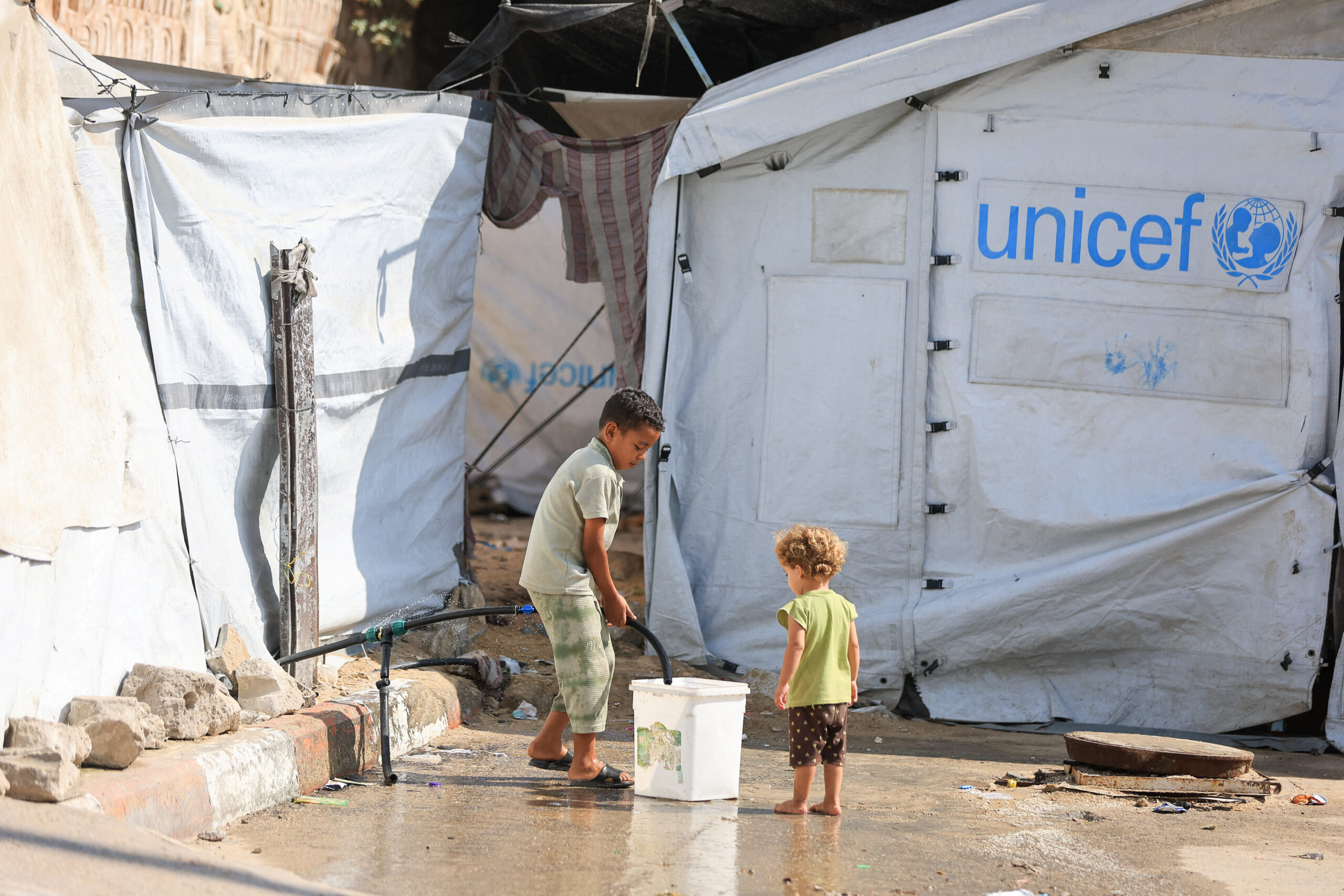
In Gaza, 2.3 million people, including a million children, remain confined to less than a third of the territory’s area, with 1.9 million displaced and two-thirds of households living in tents.
More than 30,000 tents are being held at border crossings against a need for 130,000 before winter, and roughly two-thirds of Gaza’s population face crisis-level food insecurity or worse.
More than 30 Palestinians were killed in Gaza between Aug. 28 and Sept. 7, including 8-year-old Wafaa Akila and her father.
They were killed as he drove her to school, bringing to more than 270 the number of children killed since the ceasefire was announced.
Mansour welcomed recent moves by Britain, France, Canada, Spain, the Netherlands, Ireland, Norway and Belgium to restrict settlement products and sanction those financing the settlement enterprise, as well as similar steps under consideration in Denmark, Finland, Iceland, Poland, Portugal and Sweden.
He called on the Security Council to go further, urging states to halt arms transfers, close diplomatic missions in Jerusalem, and impose travel bans and asset freezes.
“Action, not statements, will help the Palestinian people to survive Israel’s ethnic cleansing campaign,” Mansour wrote, calling it “the most organized, methodic, and broadcasted ethnic cleansing campaign in modern history.”
The letter is the 892nd that Palestine has sent to the Security Council on the situation since September 2000, according to the Palestinian mission to the UN.
ONE of the most iconic buildings in the capital’s skyline is set to become a 400-room hotel.
The Grade-II BT Tower in London is being transformed into a hotel, with rooms in the tower itself.
The BT Tower in London is set to reopen as a hotelCredit: OrmsIt will feature bedrooms in the tower itselfCredit: Orms
Levels seven to 23 of the Tower will all have accommodation, with each floor featuring four curved rooms around the central structure.
As for the lower floors, a new building will be developed at the bottom of the Tower, with a rooftop poolon level six, outdoor seating areas and wildflower roof gardens.
Sign up for the Travel newsletter
Thank you!
The lower ground floor will then feature events spaces and restaurants, and the ground floor will have a wine bar as well as other Class E businesses which could include a gym, shops and cafes.
Hotel rooms will then start on the first floor as well as another events space with the same for levels two to six, with some outdoor terraces, too.
At the top of the Tower (level 34) – which used to be home to a revolving restaurant and viewing platform – there will be a 360-degree visitor attraction including a ‘revolving floor’, with suggestions it could be a restaurant again.
There will then be another events space on level 35 with an outdoor terrace and level 36 will have two more events spaces and two lobbies.
Levels 31 to 33 will also have events spaces.
Levels 24 to 28 and 37 to 40 will all be used for storage and building maintenance.
There will also be a rooftop pool on level sixCredit: OrmsThe hotel is expected to open in 2033Credit: Alamy
Outside the base of the Tower, a new public square will be constructed too.
The park will feature curved timber benches, large pebble seating areas and bronze metal artwork.
Construction is expected to start in 2029 and the hotel is then due to open in 2033.
The BT Tower first opened in 1964 as the Post Office Tower and was the capital’s tallest building until the NatWest Tower opened in 1980.
The Tower then closed to the public in 1981 – though, there will be some private events.
The hotel was then purchased by MCR, an American hotel chain, in 2024 for £270million.
Often compared to Hawaii and dubbed the ‘new Canaries’, a paradise island with azure waters and unspoilt beaches has been named as one of Europe’s most beautiful places to visit
This European destination offers a stunning island escape(Image: Getty Images)
A tropical island retreat with crystal-clear azure waters and pristine beaches has been crowned as Europe’s most breathtaking destination to visit this year. Conveniently, its stunning scenes are just a four-hour flight away.
Nestled in the middle of the Atlantic Ocean, to the west of mainland Portugal, lies the spectacular archipelago of nine islands known as the Azores. Long compared to Hawaii, they’re frequently referred to as the new Canary Islands, thanks to their unspoilt beaches, shimmering crater lakes and cascading waterfalls, set against dramatic green cliffs and lush forests that remain wonderfully untouched.
With nine volcanic islands comprising the Azores, there’s a wealth of discoveries to be made, with each island boasting its own jaw-dropping coastline and diverse landscape that is sure to leave you speechless. So much so that Lonely Planet has named the Azores as one of the ‘most beautiful places to visit in Europe’ and the best for a ‘remote island escape’.
The publication noted that the Azores have been “long overlooked” and are like “stepping stones to another world”, with their collection of subtropical gardens, forests, and “brilliantly blue caldera lakes” that draw in nature lovers. For those keen to visit, Lonely Planet recommended spending time “floating in the dazzlingly turquoise thermal waters of Caldeira Velha on São Miguel island, hiking through botanical gardens brimming with azaleas, camellias and hydrangeas on Flores, gasping out loud as sperm whales and humpbacks emerge from the deep blue on Faial, or climbing up to Mt Pico’s cloud-shredding, 2351m cone for sensational views across the archipelago.”
For those wanting to experience these breathtaking landscapes firsthand, direct flights are available from London Heathrow Airport (LHR) to the Azores’ main gateway, Ponta Delgada Airport (PDL), with a journey time of just over four hours. Prices start from £118 per person, according to Skyscanner, with limited availability, but it’s well worth securing a trip to savour this slice of paradise, reports the Express.
What’s more, set against the Azores’ spectacular scenery and dramatic coastlines, visitors can also take advantage of remarkably affordable prices. A pint will typically cost around €1.50 (£1.28), while a meal at a local restaurant comes in at between €10 to €15 (£8.57 and £12.85) per person, or €30 (£25.70) at a popular establishment.
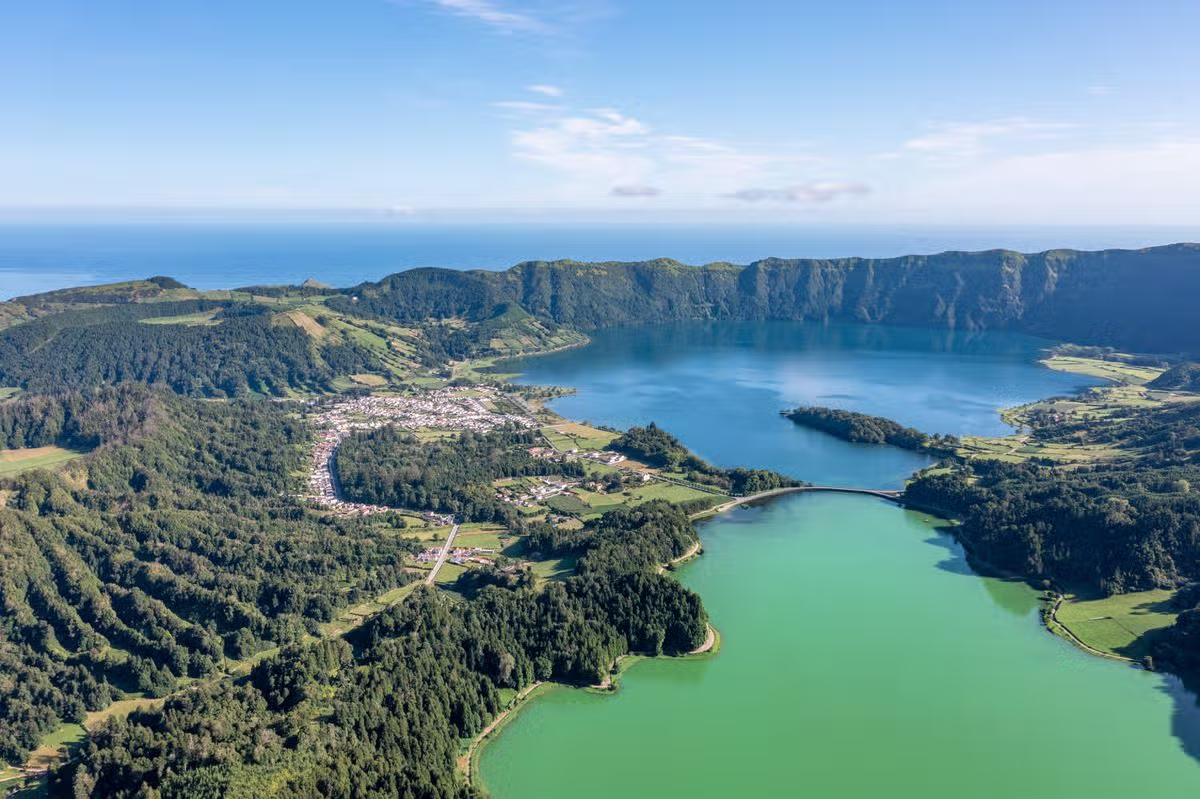
One of the most coveted destinations to visit is São Miguel Island, also known as the ‘Green Island’. It’s the largest island in the archipelago and is famed for its striking twin-crater lake, Sete Cidades, which boasts contrasting blue and green-tinted waters. Recognised as one of Portugal’s seven natural wonders, it’s undeniably breathtaking with its magical surroundings.
Elsewhere, São Miguel Island offers a wealth of dramatic volcanic beaches with black sand and crystal-clear waters, ideal for soaking up the September sunshine. These include Praia de Santa Bárbara, a well-known surfing hotspot, and Praia dos Mosteiro, complete with heated rock pools for a dip away from the ocean waves.
Yet the offshore islet at Vila Franca do Campo is arguably the most stunning stretch of coastline of them all, with its curved sunken volcanic crater forming an extraordinary natural swimming pool. What’s more, dotted throughout the Azores are secluded coves, beaches and volcanic thermal springs just waiting to be uncovered, meaning you’ll never be stuck for options on where to spend your island escape.
Direct flights from the UK to the Azores depart from London Heathrow via British Airways, typically operating during the summer months.
You can fly from many other UK airports, such as London Gatwick and Manchester, with one stop via major carriers including TAP Air Portugal, which connects through Lisbon or Porto, or SATA Azores Airlines, which connects via mainland Portugal or North America connections.
Do you have a travel story to share? Email webtravel@reachplc.com
MEXICO CITY — When the Trump administration announced this summer that illegal crossings into the U.S. from Mexico had reached historical lows, Homeland Security Secretary Markwayne Mullin declared, “Our border is CLOSED to lawbreakers.”
Even so, the administration continues to pressure both Mexico and U.S. officials serving there — publicly and behind the scenes — to curb illegal immigration further. The crackdown has prompted smugglers to become more creative, turning more often to tunnels once reserved for transporting drugs.
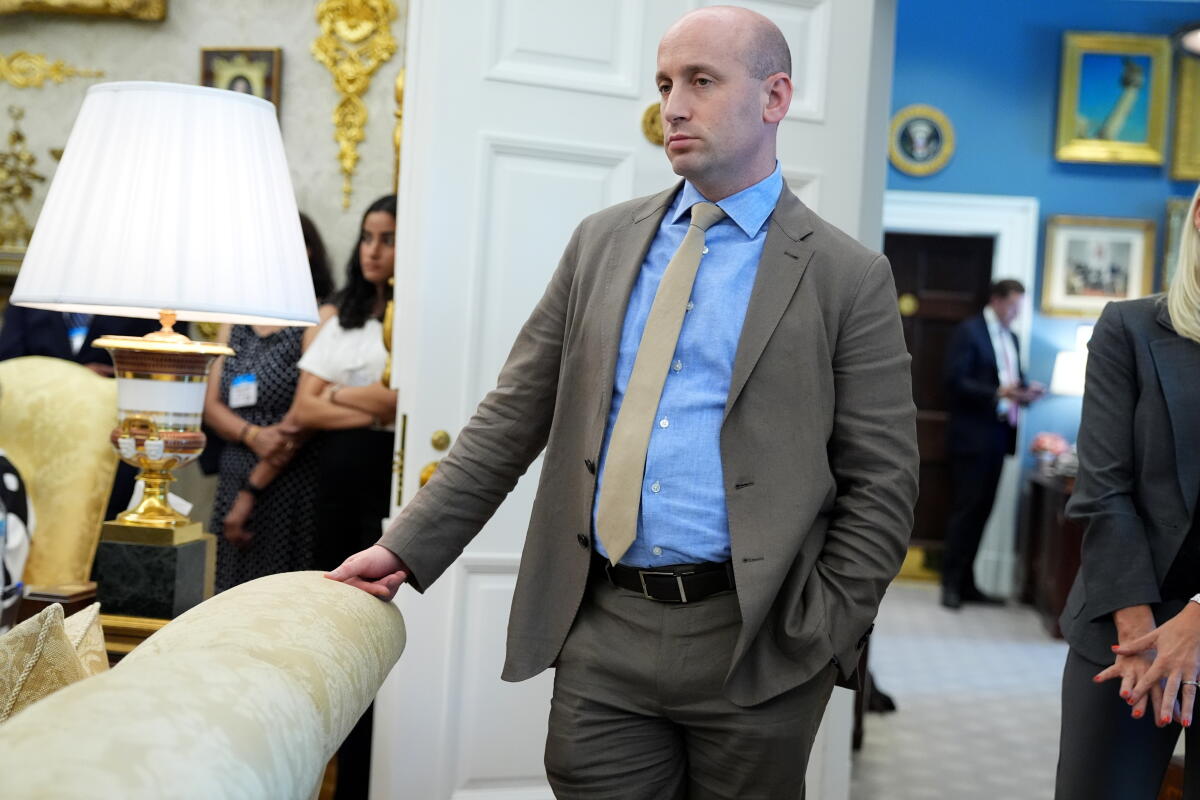
White House Deputy Chief of Staff Stephen Miller, in the White House on Sept. 4, has been the main architect of the Trump administration’s immigration policies.
(Jacquelyn Martin / Associated Press)
Stephen Miller, the main architect of President Trump’s immigration policies, has been in near-daily communication with senior U.S. law enforcement officials, including the U.S. ambassador to Mexico, Ronald Johnson, looking for new ways to stop migrants from entering the United States, according to people familiar with the conversations.
An average of 400 migrants were apprehended while crossing into the U.S. every day in July, according to data by U.S. Customs and Border Patrol. It’s a precipitous drop from the thousands who crossed daily at the peak of a migrant surge in 2022.
Sometimes the number of crossings has dropped to 200 a day. But for Miller, that reduction is still not enough, said sources not authorized to speak publicly about internal matters. Miller’s goal, they said, is to have zero migrants entering the U.S.
Miller has directed officials to increase investigations into migrant smuggling networks, people familiar with his directives said.
Mexican Foreign Minister Roberto Velasco Álvarez, left, and U.S. Secretary of State Marco Rubio in Washington, where they met Aug. 26 to discuss what the minister called “priority issues on the bilateral agenda.”
(Chip Somodevilla / Getty Images)
Since returning to the White House in 2025, Trump has often asked Mexican President Claudia Sheinbaum to crack down on immigration. On Aug. 26, Secretary of State Marco Rubio met with Mexico’s foreign minister, Roberto Velasco Álvarez, and urged him to take “decisive action on illegal immigration,” according to a statement from the State Department.
The Trump administration’s border crackdown has been so effective it’s forced some smugglers literally underground.
Mexican drug cartels are increasingly turning to tunnels built for drug smuggling to ferry migrants into the United States. They are linking into sewer drains, according to people familiar with the trend.
Though the number of migrants apprehended while using tunnels appears to be relatively small — there are no hard statistics — authorities believe it is increasing, given the crackdown on the border and financial incentive for the cartels to smuggle people and not just drugs.
“Enforcement along the border has become more robust and that has increased the demand for alternative methods of passage,” said David Shirk, director of the Justice in Mexico program at the University of San Diego.
The Trump administration has added extra miles of razor wire to border fences, has increased surveillance technology and uses autonomous Predator drones with surveillance and infrared technology to monitor swaths of the border for migrants crossing into the U.S.
1
2
1.A bulldozer sits near Santa Elena Canyon on Aug. 14 in Big Bend National Park, Texas, where contractors have begun construction of a border wall. (Brandon Bell/Getty Images)2.Protesters gather in San Antonio, Texas, on Aug. 28 to demonstrate against construction of a border wall in Big Bend National Park. (Alma E. Hernandez/San Antonio Express-News via Getty Images)
And, picking up on Trump’s “build the wall” pledge from his initial run for president, more border barriers are being built.
Trafficking through cross-border tunnels is not new. In 2023, Ken Salazar, then the U.S. ambassador to Mexico, said there were at least 200 tunnels that spanned the border. Many of them were found linking Tijuana and San Diego.
But in a twist, some tunnels now connect to drainage and sewer systems. This May, authorities captured 19 migrants, including three unaccompanied minors, in the San Diego storm water drainage system. A remote surveillance camera spotted the migrants emerging from the system.
The smugglers were two brothers who had previously been charged with methamphetamine trafficking in the Northern California town of Yreka in 2017.
Smugglers employ tunneling specialists whose work is getting more sophisticated, outfitting the tunnels with lights, ventilation systems and sometimes mini rail lines. Many tunnels are faster, safer and much more expensive for migrants who would otherwise face increasingly dangerous mountain and desert routes, experts said.
Last year, Customs and Border Protection and Homeland Security Investigations agents also found a tunnel that ran under the Rio Grande from Ciudad Juárez, Mexico into El Paso.
The passage tapped into the El Paso sewer system, where, according to U.S. authorities, migrants surfaced from a manhole. They climbed into a box truck outfitted with a trap door that was parked over the manhole.
Cartels charge migrants from Latin America up to $15,000 dollars each to use tunnels to El Paso, an official familiar with the dynamics said. For people from the Middle East or Southeast Asia, the price can be as high as $25,000.
The tunnel traffic continues to vex U.S. officials.
A Homeland Security Task Force drug investigation of a supposed retail store in Otay Mesa, Calif., resulted in the discovery of a sophisticated cross-border tunnel leading to Tijuana.
(U.S. attorney’s office)
In Tijuana, one tunnel discovered last year stretched from Tijuana to what appeared to be a Buy 4 Less store near the Otay Mesa port of entry. The store never had customer traffic, so U.S. law enforcement suspected it hid a tunnel and began monitoring the business.
Authorities raided the building and found the entrance to a tunnel controlled by the ruthless Jalisco New Generation Cartel. It was 55 feet deep and nearly half a mile long. It featured a hydraulic lift, ventilation and a rail and cart system. Authorities stopped a freezer truck after it left the location and seized more than a ton of cocaine, worth roughly $45 million.
In 2024, U.S. law enforcement found a tunnel in the border town of San Luis, Ariz. Authorities said it was used to smuggle migrants and drugs. Its exit was hidden in an abandoned KFC restaurant.
This article was co-published with Puente News Collaborative. Fisher is a special correspondent.
BRASILIA: A judge ordered the reinstatement of Brazil’s federal police chief on Wednesday after another judge ordered his suspension amid a deepening crisis in the nation’s top court.
Supreme Court Justice Flavio Dino ordered police director-general Andrei Rodrigues to return to his duties, overturning a decision Tuesday by Justice Andre Mendonca, who had suspended him after accusing the police of illegally spying on him.
Scandal has engulfed the court ahead of October presidential elections after it emerged last week that a disgraced banker charged with fraud apparently asked one of its judges for help, days before his arrest.
IS your holiday is a gruelling test of your love for your partner? Here are some behaviours you wish they’d saved for when you’re not in their company 24/7 after spending a fortune.
Sulking
Sulking is childish and annoying at the best of times, but worse if it’s over some trivial holiday thing like not wanting to buy a hideous souvenir donkey. If the relationship isn’t too serious you may even feel they’re a pain the arse you should split up with. Although you won’t be telling them immediately, because it’s nice to have someone to eat sardines with and shag on holiday.
Total lack of basic planning skills
It’s clearly hot, so did they bring a bottle of water? No. Let’s go back to that shop you pointed out earlier which sold it. They didn’t bring sunscreen either? Well, it’s the last thing you’d think of when going to the beach. Their sunglasses are back at the hotel, so can they borrow yours? Of course, my sweet… and so the irritation builds until you’re scared to go up that historic tower in case you push them off it.
Unadventurous eating
It’s rare that food on holiday is wildly exotic – you’re hardly likely to be served a whole fried monkey in the Algarve. The problem arises when your partner hates food not totally sanitised like in Sainsbury’s, and is horrified and disgusted by a fish having a head. Don’t worry, you’ll speak to the waiter and get them to turn it into oblongs in breadcrumbs.
Pointless money-saving
On holiday you’ve got to accept a fair bit of unplanned expenditure in the name of spontaneity and having a good time. However your partner may feel a holiday you’ve already spent thousands on is a good time to economise on minor costs. And who doesn’t love debating at length whether your should purchase each individual ice cream?
Worthy interests
It’s traditional on holiday to do worthy things you don’t do at home like visiting a cathedral. That’s probably why they’ve all got gargoyles – to alleviate the boredom. However there’s a limit, and you really don’t want your partner to suddenly discover a deep interest in wine production or local history. If they’re that interested in the Moorish conquest of the Iberian Peninsula they should have gone on holiday with David Starkey.
Personal habits
Snorting, making a clicking sound with your tongue, picking your nose and other such habits are tolerable occasionally. However on holiday you’re with your beloved constantly so those little irritations are magnified to the size of Jupiter. Has a boyfriend ever been beaten to death with an espadrille because he kept sniffing? It’s likely. The Spanish courts probably don’t even consider it an offence.
Mum of two Hannah Britt took her daughters to Mallorca by herself this summer – and found this want-for-nothing all-inclusive to be a suitable co-parent
13:59, 09 Sep 2026Updated 14:01, 09 Sep 2026
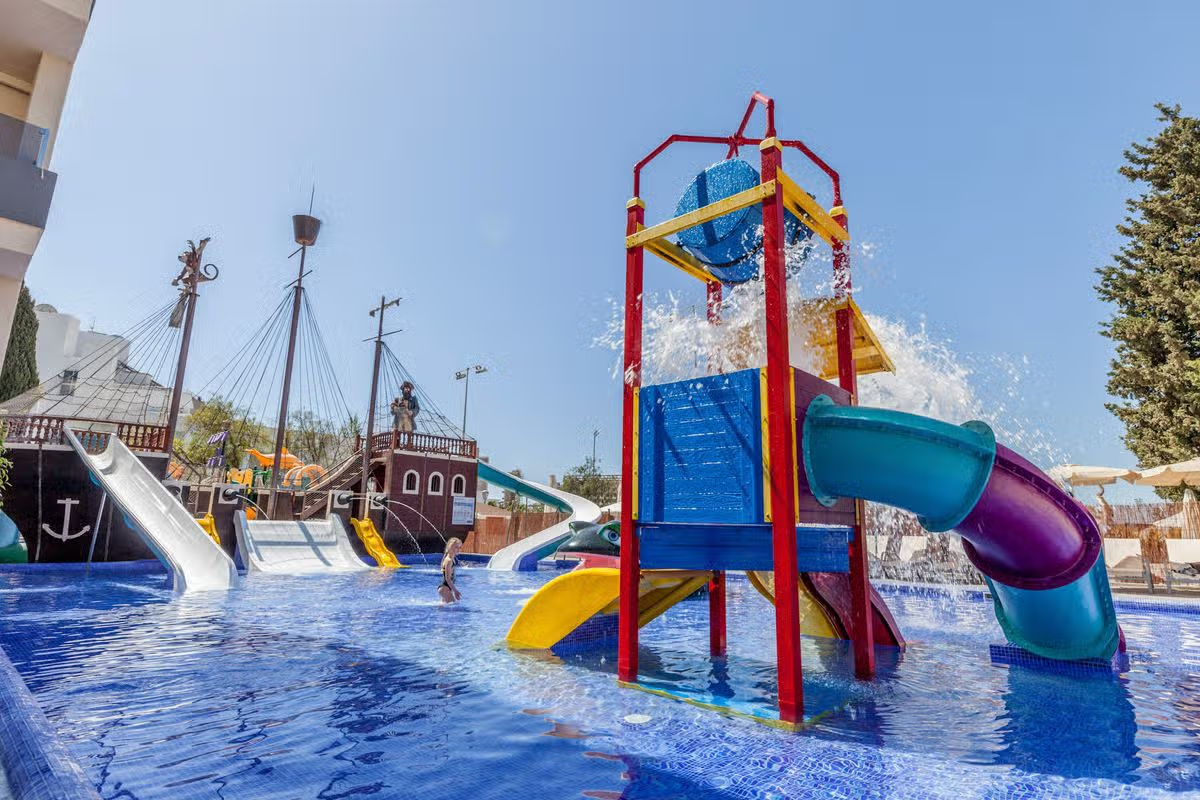
The kids’ pool at Zafiro Palace Palmanova is incredible
“You’re mad,” said my partner John when I mooted the idea of taking the girls to Mallorca without him. But with the six weeks of the summer holidays stretching ahead of me, I decided to ignore him and spend a long weekend abroad with my two daughters, aged six and two. And I’m so glad I did.
When your partner is otherwise engaged (read: work) choosing the right hotel is much like choosing a temporary replacement. This summer, my right hand man was the five star Zafiro Palace Palmanova. And the want-for-nothing all-inclusive turned out to be an excellent co-parent.
FOOD FOR ALL
One of the brilliant things about an all-inclusive hotel is that it takes all the guesswork out of mealtimes. Will they eat anything? What will they eat? Will the toddler tip her entire bowl on the floor and ask for more? (Yes – sorry Zafiro).
The food at Zafiro Palace Palmanova was brilliant. A large main buffet restaurant (The Market) provided endless, ever-changing choice from fresh seafood and local dishes like paella, to more child-friendly options like pasta and pizza. The salad selection was delicious – and drinks were premium, and incredibly well made. The best coffee is to be found in the bar, which opens at 9am – thank me later.
Elsewhere, a la carte options (Mediterranean El Olivo, Italian El Portico and Japanese Tastes) provide upmarket eateries for something a little more special. We loved The Veranda too, which served food at more irregular times, meaning there was a meal to be had whenever anyone was hungry.
FUN, FUN, FUN
There is so much to do for children on-site, taking any stress out of activity planning for the day. A dedicated kids’ club team put on everything from pool games to foam parties to ensure there’s never a dull moment.
A large kids’ pool sits tucked away to the back of the site, with a huge inflatable bounce slide and a mixture of slides to occupy them for hours. Next to it, a bouncy castle, large trampoline and play area delighted my children too – particularly in the evening, when the sun was less ferocious.
Also in the evening, a daily kids’ disco gets children singing and dancing, while their grown ups watch on adoringly with a well-earned glass of wine.
POOL TIME
In the middle of the hotel complex lie the main pools, many of which welcome children – although some are adults-only. A swim-up bar in the main pool makes smoothies, milkshakes and virgin cocktails for little ones, and most days there is a running mat brought onto the water for children to run/dance/roll along, before splashing into the pool at the end.
KIDS’ CLUB
Children who attend kids’ club during the day are given a medal at the kids disco in the evening, which is a brilliant tactic for drawing them in. Suitable from ages four to teens, the cute little house, set next to the kids’ pool, puts on activities like bracelet making and T-shirt painting.
BEAUTIFUL ROOMS
There are lots of room options to choose from at Zafiro Palace Palmanova, from swim-up suites to penthouses with hot tubs – and everything in between. Cots for babies and day beds for children are provided when required.
Decor is chic, sleek and modern, with pretty wooden accents and high-thread-count cotton. We were lucky enough to have a swim-up suite, which had a large superking bed, and a sofa bed for my six year old. Large glass doors opened up onto a private pool area, with a small space just for us, then a larger expanse of water which we shared with a few other families in neighbouring rooms. A boltable gate ensured water safety and a decking area with a circular lounge bed provided somewhere to chill out.
Having a pool so close, meaning we only really had to leave the room for meals, was incredible. We stayed in the water until our fingers wrinkled.
EXPLORING NEARBY
When feeling intrepid one day, we took a taxi a short way into Palma to explore, choosing a private walking tour available on Tripadvisor. Our guide was fascinating, with endless facts about the city, making it fun for my six year old too. The location of the hotel made exploring Palma easy and we were able to visit the cathedral, castle and the old town, before my two year old decided she’d had enough. Palma is stunning, and well worth seeing. Wandering around the ancient streets provided shade too, as did swinging inside the town hall.
BEACH TIME
A back gate out of Zafiro Palace Palmanova takes you on a path straight to the Palmanova beach and the Mediterranean Sea beyond. A beautiful sandy beach, it makes for a brilliant day trip – especially as it’s lined with cafes, bars and ice cream shops. After our 15th sand castle of the day, I took the girls for a drink at the sandy-toed Turtle Beach, which was a hit with all three of us.
*Nightly rates at Zafiro Palace Palmanova start from €438 per night with All Inclusive Redefined ®
THE Netherlands has ground to a halt today due to a staff strike – and it is affecting public transport across the country.
It has also impacted Eurostar routes with all trains to two popular cities completely cancelled today.
A nationwide walkout of public transport will affect Eurostar todayCredit: Getty Eurostar has had to cancel around 25 trains today to Amsterdam and RotterdamCredit: Getty
The strike is being held by the country’s largest trade union for staff who operate public transport – the walkouts started at 2am and will end at 2am tomorrow.
As a result, Eurostar has been forced to cancel its routes to Amsterdam and Rotterdam – of which there are usually around 25.
Sign up for the Travel newsletter
Thank you!
Around 25 direct and indirect routes usually go to Amsterdam and Rotterdam from St Pancras, but none are running today.
“No national or international trains will be able to run on the Dutch network on that day. There will also be some disruption on the evening of Tuesday 08 September and the morning of Thursday 10 September.
“If you’re due to travel with Eurostar, you can check whether your journey is affected by the strike on our live train info page. We’ve also contacted all affected passengers whose contact details we have. If you have a connecting journey, please get in touch with the relevant train company for more information.
“We know how important your travel plans are and we’re sorry for the disruption this strike will cause.
“If your Eurostar train can no longer serve your departure and/or arrival station, you can choose one of the following options:
• Exchange your booking for free to travel in the same travel class at a different time or date. It only takes a minute to rearrange your trip.
Eurostar is offering affected customers different options to travel later on or get a refundCredit: Getty
• Cancel your booking and get a refund. You’ll receive a refund for the value of your ticket but not for any booking or exchange fees. We’ll process your request within 28 days.
“You have three months from the date you were due to travel to claim your preferred option.
“Thank you for your patience and understanding. We apologise again for the disruption to your journey.”
Due to the early hours of the strike ending, services on Thursday morning could be affected too with several Eurostar journeys in showing as ‘Not available’.
In Amsterdam, metros, trams, buses and ferry services have been suspended.
In Rotterdam, the metros, trams, buses are suspended as well, and in The Hague, trams and buses are not running.
A Eurostar spokesperson told Sun Travel: “Following the national public transport strike on Wednesday 9 September 2026 from 2AM until the 10th of September at 2AM in the Netherlands, no Eurostar trains will be able to run on the Dutch network on Wednesday.
“Affected passengers have been notified and can obtain a reimbursement or change their tickets free of charge. We apologise for the inconvenience.
“Trains on the other Eurostar routes are running normally.”
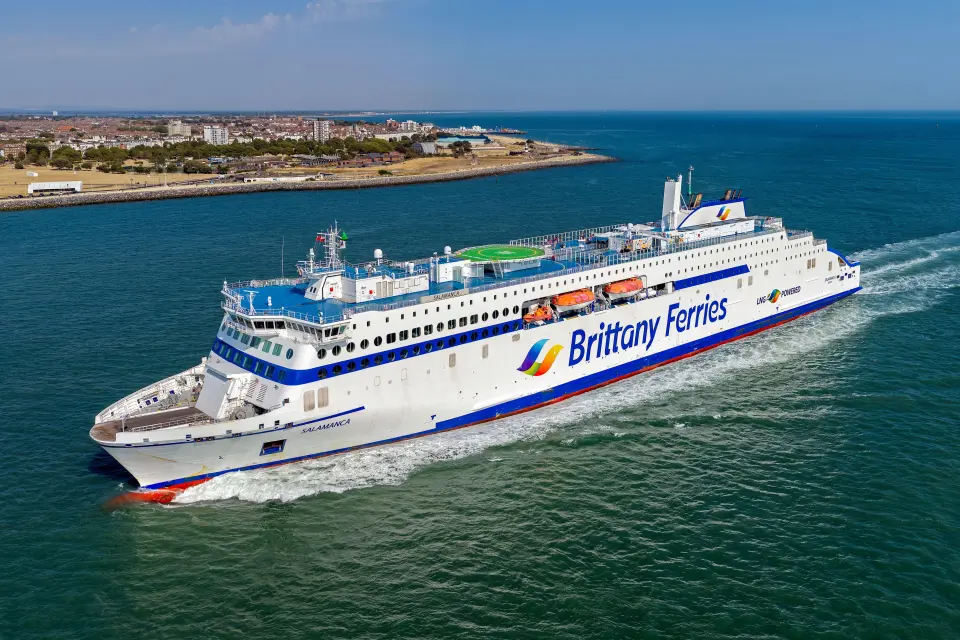
Brittany Ferries will be axing a popular route linking the UK and France this autumnCredit: AlamyThe Poole to Cherbourg crossing has been operating for the past four decades, but rising financial pressures led to the closure of the routeCredit: Unknown
Brittany Ferries is set to permanently axe its Poole to Cherbourg crossing route at the beginning of November.
Passengers have been travelling between Dorset and France for over forty years, but now the popular journey will shut down.
Sign up for the Travel newsletter
Thank you!
The company cited growing financial pressures as the cause for the decision, including outstanding Covid-19 loan repayments, competition on the Eastern Channel and weaker demand for travel.
Rising costs of the European Union’s Emissions Trading System have further burdened the company’s remaining debt.
Around 20 jobs are expected to disappear as a result of the closure.
The decision comes as part of a wider restructuring by Brittany Ferries, with the firm taking a “pragmatic approach” to the economic challenges.
Steps also include the sale of the Cotentin, which sails between Cherbourg and Rosslare, alongside the closure of the Portsmouth to Le Havre route from October 2026.
A spokesperson for Brittany Ferries told The Sun: “This wasn’t a decision we took lightly, and we know it will be disappointing news for our customers in Poole and the surrounding area.
“We’ve worked hard over many years to keep this route running, but a long-term decline in passenger and freight numbers, compounded by rising costs and red tape, including Brexit-related border processes, EU environmental taxes, and unfavourable exchange rates, has made the route commercially unsustainable.
“We’re not withdrawing from Poole. Customers will still be able to travel to France with us via a seasonal service from Poole to St Malo, as well as our conventional routes from Portsmouth and Plymouth to Caen, Cherbourg, St Malo and Roscoff, including a new daily Portsmouth–Cherbourg service.”
A high-speed crossing between Poole, Guernsey and St Malo is also set to be debuted in 2027.
The crossing was first introduced in 1985, with the iconic MS Barfleur starting her voyages between Dorset and France in 1992.
It takes just four hours and 15 minutes – the shortest journey over the Channel – and garnered a huge amount of success, leading to a £6million overhaul of the ferry terminal in the 1990s.
The route has faced a number of challenges in recent years, temporarily shutting down in 2010 owing to a decrease in ticket sales – however it was reopened in 2013.
The Barfleur will soon undertake its final journey, but all may not be lost quite yet for the route.
Captain Brian Murphy, chief executive of Poole Harbour Commissioners told the Bournemouth Echo that Brittany Ferries’ departure could pave the way for another operator to take over the route.
The United States Republican Party – and its talisman President Donald Trump – is descending on Dallas, Texas, to host a rare convention before the midterm elections in November.
Usually reserved for presidential election cycles, Trump’s call to hold the high-cost event before the November 3 midterm vote has underscored both the president’s unorthodox campaign style and the urgency of the political moment for his Republican Party.
Recommended Stories
list of 3 itemsend of list
Trump’s approval rating has tanked in the lead-up to the midterm vote, with polls pointing to a panoply of factors, most notably the US-Israel war on Iran and its knock-on economic effects for US consumers.
The lack of enthusiasm threatens what are already considered long-shot odds in the Republicans’ effort to hold on to control of the House of Representatives. Shifting public opinion has also put control of the Senate increasingly in play, although Democrats still face an uphill battle to pull off an upset.
A loss of control in either chamber would serve as a major check on Trump’s authority in the final two years of his second term.
But not all Republicans have bought into Trump and the party’s claims that the convention will spur voter turnout.
Several, particularly those in the tightest races, have kept the event at arm’s length amid concerns that associating with the president could only further mobilise his detractors.
Here’s what to know:
When and where is the Republican midterm convention?
The convention will be hosted at the American Airlines Center in Dallas, Texas, on Wednesday, September 9 and Thursday, September 10.
The event is expected to run from 3pm to 9pm Central Time (20:00 to 02:00 GMT) on both days.
Trump is scheduled to speak on both nights, including a Wednesday address and the convention’s closing keynote on Thursday from 8pm to 9pm Central Time (01:00 to 02:00 GMT on Friday).
US Vice President JD Vance will close out night one with a speech.
A person takes pictures of signage during preparation for the Republican National Committee (RNC) Midterm Convention at the American Airlines Center on September 7, 2026 in Dallas, Texas [Brandon Bell/Getty Images via AFP]
Is this a typical political convention?
Not at all.
The Republican National Committee (RNC), the party’s official organising body, has billed the Dallas midterm convention as a “first in American political history”.
Both Democratic and Republican national conventions have historically capped the primary season before a presidential election. The emphasis has historically been on the presidential nomination process during the largely ceremonial events.
During those conventions, so-called “delegates” from every state pledge their votes for a candidate based on the primary election outcome from their home state.
A candidate who secures the required majority of delegates formally becomes the party’s presidential nominee at the convention.
Parties also typically hold several smaller meetings surrounding the event to establish and release the party’s official platform.
Why are Republicans holding a midterm convention in 2026?
To start with, there will be no nominating process – presidential or otherwise – during the event, as there is no presidential election in 2026.
Instead, the convention has taken the shape of a supercharged campaign rally and fundraiser.
It has been pitched as an opportunity to introduce candidates in punishing races to potential donors and to give a clear, if Trump-dominated, party message as the races enter their final stretch.
The RNC has promised “a primetime showcase for President Trump’s success, candidates, and causes that have propelled the 2026 midterms to unprecedented focus”.
What’s on the schedule?
There will be quite a lot. The official programme lists “53 items and speakers” on night one, followed by 56 more on night two.
The first night will focus on issues including tax cuts, healthcare affordability, immigration, border policy, trade and domestic manufacturing.
The second night will focus more on affordability and families, including policies related to taxes on tips, overtime and Social Security.
The subject areas hew closely to Trump’s wider political messaging.
The official programme gives relatively little attention to several other subjects. The US-Israel war with Iran and Trump’s aggressive tariff policy receive scant mention.
Who else is speaking?
Trump and Vance are the convention’s marquee speakers, but an array of prominent Republicans and candidates are expected to feature across the two-day programme.
Texas Attorney General Ken Paxton is likely to get a healthy amount of stage time. Paxton is running for Senate against Democrat James Talarico, whose early lead in polling has raised alarm bells for Republicans. A Democrat has not won statewide office in Texas since 1994.
“We’re going to have a lot of speakers, and the ones we want to focus on will be obviously Ken Paxton,” Trump told reporters last week. “We gotta get him elected.”
The race is particularly personal for Trump, who endorsed MAGA-aligned Paxton over Republican Senator John Cornyn, a four-term incumbent seen by many as the surest challenger for Talarico.
Will Trump’s convention help Republicans in the midterms?
It remains to be seen whether the convention will help to turn out voters in a meaningful way.
Trump has proven a canny campaigner in the past, leveraging his eye for television spectacle to build support and turn out low-propensity voters. But several factors could limit the impact.
Trump’s Thursday night speech conflicts with the opening games of the National Football League (NFL) season. The event also runs up against several memorial events for the September 11, 2001 attacks throughout the week.
Some Republican officials have also reportedly criticised the hasty announcement of the event, which Trump called for in late June, raising questions over whether organisers will indeed be able to achieve the spectacle envisioned.
For his part, Trump enters the convention with his approval rating continuing to tank, hovering at a 38 percent average in major polls. Several of the most recent polls, including a Reuters-Ipsos poll and a Financial Times-Focaldata poll conducted in late August, reflected only a 33 percent approval.
Trump entered office in January 2025 sitting at about 52 percent approval.
Why are some Republicans skipping?
To be sure, several Republicans in key races have said they will attend the convention.
They include former Congressman Mike Rogers, who is running against Democrat Abdul El-Sayed for an open Senate seat in Michigan; Ohio Senator Jon Husted, who is facing an unnerving challenge from former Democratic Senator Sherrod Brown; and Georgia Congressman Mike Collins, who is seeking to unseat Democratic Senator Jon Ossoff.
Others have been wary.
Trump’s policies in his second term have cast a long shadow, leaving many candidates calculating whether attendance could backfire and instead energise voters opposed to Trump.
Democratic primary turnout in several key states – including Michigan, Wisconsin, Texas and Georgia – has soared this year, while Republican turnout has remained steady but unextraordinary, as reported by The Associated Press news agency. That has been a worrying sign for Republicans.
Maine Senator Susan Collins, a Republican incumbent seen as vulnerable in her race against Democrat Troy Jackson, has been among those who have said they will not attend.
Several candidates in key House races have pointed to prior commitments.
Representative Mariannette Miller-Meeks told The Bulwark she preferred to spend her time in her home district in Iowa, where she faces a challenge from Democrat Christina Bohannan.
“Because I have a district that I have to be in and take care of, so I’ll be in my district,” she explained about her decision.
Miller-Meeks eked out a victory over Bohannan in 2024, winning by a margin of just 0.1 percent.
Are Democrats countering?
Several left-leaning groups are organising protests.
House Democratic leader Hakeem Jeffries has announced that four Democratic lawmakers will travel to Dallas for counterprogramming during the Republican convention.
However, the cash-strapped Democratic National Committee (DNC) has avoided holding its own midterm convention.
The committee went into debt in the wake of the 2024 presidential election, even putting up its Washington, DC-based headquarters as collateral for a $15m loan, the NOTUS news site reported in July.
The RNC has not yet released a final price tag for its convention.
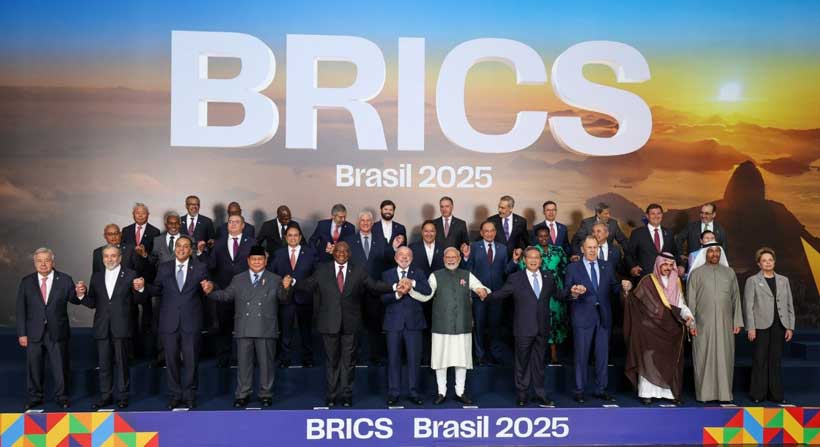
BRICS is moving into a more meaningful phase in its evolution. Its larger membership, considerable resources, population, and markets position it as a voice for the global south. Nevertheless, the fact that the BRICS is economically big does not guarantee that it will turn into a powerful organization. The difficult question is whether BRICS will be able to use the potential of its diversified members to create the institutions and means of collaboration that will meet the needs and interests of different countries, businesses, and banks.
This is where the next chapter of BRICS collaboration will be decided. It is definitely not in need of aspiration. The main question is not whether BRICS will develop a common geopolitical approach but whether BRICS will be able to simplify the issues of cooperation for countries with divergent economic interests and institutional capabilities.
The enlargement of BRICS has brought about both a chance and an enigma. An increased number of members boosts the economic and diplomatic power of the group, but it also entails the presence of more currencies, regulations, economic systems, and foreign policy priorities. States such as India and China may share a desire to amplify the role of developing economies while being in competition with regard to trade, technology, and geopolitics. Resource-rich countries may have their priorities with respect to the manufacturing countries. Financial centers may deal with payment integration differently from countries interested in getting more monetary independence.
Stay ahead of the geopolitical week.
MD Briefing delivers expert analysis across five global fronts — the Indo-Pacific, energy, geoeconomics, European security, and the Middle East — every Monday morning. Free.
The key challenge before BRICS is not about making all the members agree about everything; rather, it is about creating means for cooperation between different countries in the areas where their interests coincide.
This differentiation is essential because BRICS is frequently assessed based on scale indicators, including population, economic output, energy resource reserves, and trade. While these parameters demonstrate the affiliation, the affiliation is not the key to institutional power. BRICS is still functioning as an informal coordinating mechanism and not as a supranational institution due to the absence of an establishing treaty, budget, and secretariat. The conversion of its total economic capabilities into total actions should rely substantially on its members’ coordination. BRICS needs to change its approach, so instead of pursuing expansion, it should focus on implementation.
The issue of cross-border payments can serve as an example. The necessity to improve payment processes within BRICS may be easily explained. International transactions require correspondent banks, multiple currencies, currency exchange, and several commissions. Using local currencies and interoperable payment systems may help reduce some of these expenses and create additional ways of settlements for countries.
However, establishing a new financial structure is much more difficult than just talking about it. The real barriers are technical and institutional: interoperability between national payment systems, regulatory compatibility, foreign exchange liquidity, cybersecurity, anti-money laundering and know-your-customer norms, settlement systems, and trust among the entities participating in the payment system. A domestic payment system cannot simply be hooked up to a foreign payment system without addressing these problems. This leads us to a more practical goal for BRICS countries. Instead of concentrating on the joint BRICS currency, they should work on interoperability among national payment systems.
The example of India’s UPI-PayNow linkage to Singapore shows how this principle works. Two entirely different payment systems can be interlinked without destroying their own systems. The same gap can be figured out at the level of BRICS if all necessary regulations, settlements, and risk management conditions are fulfilled. In order to understand how this can be achieved, BRICS can refer to the examples of other countries that have already applied the same logic.
The same issue of coordination can be observed in trade and supply chains as well. BRICS countries have complementary assets such as resources in energy, agriculture, manufacturing, minerals, technology, and large markets for consumer goods. However, having complementary resources does not automatically result in integrated supply chains.
Businesses need predictable customs, standards that will fit one another, reliable logistics, availability of finance, and clarity of regulation. If countries have different certification systems, digital documents, and technical standards, the theoretical advantages of a large BRICS market will not be fully realized. Therefore, standards will probably prevail over declarations in the end.
So far BRICS has spoken about cooperation of national standard organizations and overcoming technical barriers between trade. Further work is getting cooperation of national standard organizations transferred into standards that will be in demand in real business. Common standards for digital trade documents, selected product certification, customs data, payment systems, and technical standards can connect BRICS economies without full harmonization of their economies.
This method would make it easier to justify politically. There would not be a need for members to give up their power when it comes to buying a wider range of economic policies. The only thing left is for countries with technology to agree on their particular rules where technology will help provide measurable benefits.
The same goes for agricultural projects, as the BRICS countries share similar problems in the fields of food supply, climate, water conservation, and productivity. The BRICS has started pushing for agricultural research and cooperation. So, the question is not whether the BRICS countries have recognized these areas; they already have. The larger question is whether anything can be implemented across borders.
In a situation where one country has effective technology to grow crops and another one has a good way of bringing the crops to a field, BRICS has to find a way to transfer that knowledge or have an organization that can help in that transfer. There should be a value on the moves made regardless of whether formal treaties have been produced or not. This points towards a different institutional model for BRICS: modular cooperation.
BRICS needs to develop a model that allows all members to be part of the major framework and subgroups of interested members cooperating with each other in specific areas that require deep integration. Countries interested in making payments and settlements between them could organize a coalition in charge of finding and implementing technical solutions for that. Those ready to work jointly in the field of agriculture can proceed with agricultural cooperation, while others can focus on critical minerals, logistics, AI technologies, energy, and development finance.
This model recognizes one uncomfortable truth: diversity is BRICS’ asset, but it also acts as an obstacle in its functioning. In a highly heterogeneous grouping, it is impossible to expect rapid integration in view of the differences among its members. Compliance with the needs of all BRICS states only produces long negotiations and ambitious statements that do not work. Modular cooperation, in its turn, enables countries to pursue their own policy while being part of the larger framework.
Moreover, it could also establish a more trustworthy framework for testing. A limited number of members would be given the opportunity to run an initial test of payment or trading procedures, determine any legal or technological obstacles, and welcome other participants once the system is successful. The outcome would be a lowering of the chances of running into challenges that would be involved in the launch of a full project for all members simultaneously. BRICS should also reconsider its parameters of success.
Rather than concentrating on the number of members or the quantity of agreements accepted, BRICS should focus on the outcomes of its activities. There are political benefits to this strategy as well. BRICS will find it difficult to forge sustainable alternatives simply by selling them as counters in the geopolitical confrontation with the West. Governments and businesses respond not just to geopolitical signals but also to incentives. If the BRICS mechanism is cheaper, quicker, safer, and more efficient, then the chances of adoption increase.
This point is especially important for the discussion of de-dollarization. The reduction of dependence on dollar-based systems may in itself be a rational objective for some members; however, viewing de-dollarization as a success in and of itself can overshadow the distinction between geopolitics and economic efficiency. A payment mechanism can only gain credibility if banks and companies use it to solve a problem at hand.
India’s BRICS presidency in 2026 is an excellent opportunity to work on the practical implementation of the above approach. New Delhi can focus on enhancing cooperation based on interoperability and standards, collaboration of sectors, and measurable results. Instead of trying to create a homogenous group, India can create a framework where willing participants will devise their solutions for implementation by others.
Instead of striving to make BRICS like other supranational bodies, we should acknowledge the fact that, given its diversity of membership composition and structure, it is not realistic nor necessary. BRICS differentials provide a comparative advantage of allowing a mix of countries with both different political and economic systems that nevertheless share aspirations for greater policy autonomy and a voice in international affairs.
BRICS does not need to reach consensus on every issue to become successful. What it requires is to be able to determine areas where cooperation can be beneficial economically and create institutions able to do that.
Thus, the biggest problem is not the absence of power. The problem is how to convert power into capacity and capacity into institutions. If BRICS succeeds in this task, its economic capacity will transform from empty statistics into collective power. If it does not, then enlargement might improve visibility of the group, but its effectiveness would stay at the same level.
*Kanav Sharma is a Public Policy Researcher from Jammu & Kashmir with a postgraduate degree in English Literature from the University of Jammu. His interests include public policy, governance, parliamentary and strategic affairs.
A TOP screenwriter working on the new James Bond film has let slip that the role may already have been cast and the audition process completed.
The identity of the next 007 remains shrouded in mystery, but Steven Knight appeared to suggest a decision had been made.
The identity of the next 007 remains a closely guarded secretCredit: AlamySteven Knight appeared to let slip that the next James Bond has already been chosenCredit: Getty
Speaking on BBC Radio 4’s Today show, the Peaky Blinders creator was asked whether he had written the film with the chosen actor in mind or based on what he already knew about the character.
He replied that it was “a bit of both”, seemingly confirming that an actor had been picked.
Sign up for the Showbiz newsletter
Thank you!
Steven added: “It does make life a little bit easier if you know who that person is, but also you have to write the character, not the actor.”
He went on to discuss the honour of writing for such an iconic franchise.
Daniel Craig bowed out as 007 in 2021’s No Time to DieCredit: AlamySlow Horses star Jack Lowden is among the frontrunners to replace DanielCredit: Getty
Steven said: “The thing with Bond is that it’s its own universe and its own franchise, so there are certain rules.
“Obviously, you have to move it along, but I love where it sits.
“I love that it’s British and it’s not DC or Marvel. The only thing I can say is I feel like I’m doing my duty for King and country.
“It’s something that, if you’re a British writer, you have to do.”
The next Bond will fill the shoes of Daniel Craig, who last played the secret agent in 2021’s No Time to Die.
Slow Horses actor Jack Lowden remains one of the frontrunners for the coveted role, while a host of other stars have been linked to the part since Craig’s departure.
Jack’s co-star Gary Oldman also appeared to fuel speculation during a recent TV appearance on Canada’s The Morning Show.
Discussing rumours that Lowden was on the shortlist, he told the host: “We’re going to find out pretty soon, aren’t we? Because they have picked him.”
The Oscar winner then doubled down, saying: “They have made their choice, but they have not announced it yet.”
LONDON: The algae bloom that clogged intake pipes at Israel’s Mediterranean desalination plants in late August exposed the fragility of a water system that supplies not only Israel, but also Gaza.
Five of Israel’s six coastal desalination plants, which convert seawater into drinking water, shut down after microscopic algae clogged their intake systems, CNN reported on Sept. 4, citing Mekorot, Israel’s national water company.
The plants produce more than 80 percent of Israel’s drinking water, according to Israeli media.
Some privately owned plants have since resumed partial operations. But as of Sept. 3, only one was operating at full capacity. By Sept. 7, two plants remained closed and three others were operating at limited capacity for a ninth consecutive day, The Times of Israel reported.
Authorities responded by restricting water use, increasing withdrawals from reservoirs and the Sea of Galilee, and limiting supplies to agriculture, Haaretz reported.
Mekorot spokesperson Lior Gutman called the disruption unprecedented, according to CNN.
Scientists believe the bloom formed near Egypt’s Nile Delta before Mediterranean currents carried it north along Israel’s coast. The algae extended at least a dozen kilometers, said Edo Bar-Zeev, an associate professor of water research at Ben-Gurion University of the Negev.
“This is the first time I saw something of this extent,” Bar-Zeev, who has tested coastal water for two decades, told CNN.
Environmental experts say untreated sewage from Gaza may be worsening the nutrient-rich conditions in which algae thrive. Gaza’s six wastewater treatment plants have been damaged or destroyed during the war, allowing untreated sewage to flow into the Mediterranean for months.
Zalul Environmental Association, an Israeli nonprofit, said in a statement that satellite imagery suggested that pollution feeding the bloom came from both Gaza and the Nile Delta.
But for Palestinians in Gaza, the crisis did not begin with an algae bloom, but with the destruction of water and sewage infrastructure during the war, compounded by Israeli restrictions on supplies and movement.
Maysa Yousef, an artist and mother in central Gaza, said she first noticed green algae forming in bottles filled with Mekorot water, which is piped from Israel into Gaza through a network of transmission lines.
“Before Israel announced that the water had become contaminated, we already knew,” Yousef told Arab News. “Every morning, I filled the water bottles, then when I went to wash them in the evening, I found them all covered in algae.”
She said her husband initially dismissed her concern because the water came from Mekorot.
“I told my husband, ‘The water coming to us from Israel is contaminated. It is not clean,’” she said. “He said, ‘No, it is Mekorot water — it is desalinated and treated.’ I told him, ‘No, there is algae in it. Look inside the bottles.’”
Other Gaza residents have shared similar accounts on social media, reporting algae and small worms.
When Israel announced the desalination shutdowns in late August, Mekorot supplies to Gaza were cut off, Yousef said. For many families, the water had been one of the few comparatively safe sources available.
“Gaza relied on Mekorot water because it is close to drinking-water quality,” she said. “Some people drink it although it tastes awful.”
Her family used it for cooking and tea because safe drinking water was already scarce.
The World Health Organization said on Sept. 1 that microbiological contamination in Gaza water samples had risen from less than 6 percent in January to nearly 20 percent in August.
Since 2024, Gaza residents have faced severe water shortages. In many areas, people have reportedly resorted to makeshift latrines as sanitation systems failed.
Nearly 90 percent of Gaza’s water infrastructure, including desalination and wastewater treatment facilities, has been destroyed, according to UN agencies and media reports. Damaged sewage lines have also contaminated the aquifer on which many residents depend.
In February, the UN Office for the Coordination of Humanitarian Affairs said its partners reported that the Mekorot supply line was fully shut. The line had already been operating at reduced capacity because of two identified leaks, and repairs near a reservoir had not been completed.
Humanitarian groups have increased water trucking to affected neighborhoods, but access remains uneven. In Al-Mawasi, residents have complained that available water is visibly contaminated.
“If you put it in front of a donkey, it would refuse to drink it because it is so filthy and full of worms,” one local woman, whose name is being withheld at her request, said. “But we had no alternative. Otherwise, you die of thirst.”
The WHO warned in early September that Gaza’s deteriorating water quality was raising the risk of disease outbreaks. Winter rains could further spread sewage and contaminated water through overcrowded displacement sites, the agency said.
Reinhilde Van de Weerdt, the WHO representative for the Occupied Territories, said microbiological contamination found in water samples had nearly tripled since the beginning of 2026.
Cases of acute watery diarrhea nearly doubled, from about 30,000 in March to more than 58,000 in August, she told a weekly briefing in Geneva.
Yousef said her husband was among those who became ill after drinking contaminated water.
“About two weeks ago, my husband started having stomach pains,” she said. His condition worsened and he needed to go to the hospital. With no transportation available, the family walked to Al-Aqsa Martyrs Hospital in Deir Al-Balah.
At the hospital, she said, care was being delivered in tents and essential services were scarce. After running tests, they discovered that he suffered from an inflammation of the stomach lining caused by consuming contaminated water.
“Now he is forbidden from drinking water except imported bottled drinking water,” Yousef said. “No coffee, no soft drinks, and only limited vegetables and fruit, and so on.”
Gaza’s health system has been devastated by the war, with hospitals and other medical facilities damaged or destroyed and restrictions limiting the entry of medicines, medical supplies and fuel.
For Gaza’s residents, the algae bloom was not an isolated environmental disruption but another sign of a broader collapse: a water system already battered by war, damaged infrastructure and the loss of basic public health protections.
If elected governor in November, Republican Steve Hilton said Tuesday he would eliminate the state Department of Motor Vehicles and slash registration fees for car owners — expressing confidence that the Democratic-controlled Legislature would embrace the plan.
“My starting expectation would be, they would be with me on things to reduce the cost of living, so let’s work together,” he told The Times on Tuesday.
Hilton said that once state lawmakers met with him and realized he was not the “caricature” his critics portray, they would realize that he is “not a particularly tribal person. I’m just looking to solve problems, and we all agree about the cost of living.”
Eliminating a state agency would require approval from the state Legislature, where Democrats hold super majorities in both chambers. Assembly Speaker Robert Rivas (D-Hollister) and Senate President Pro Tem Monique Limón (D-Santa Barbara) have both endorsed Hilton’s Democratic rival in the governor’s race, former Biden cabinet member Xavier Becerra.
The Becerra campaign scoffed at Hilton’s confidence.
“You can’t spend a year calling Democrats a failure and then expect two-thirds of both chambers to take your calls,” said Becerra spokesperson Jonathan Underland. “Steve is in for a very rude awakening, and the fact that he can’t see it coming just shows how little he understands the job he’s asking for.“
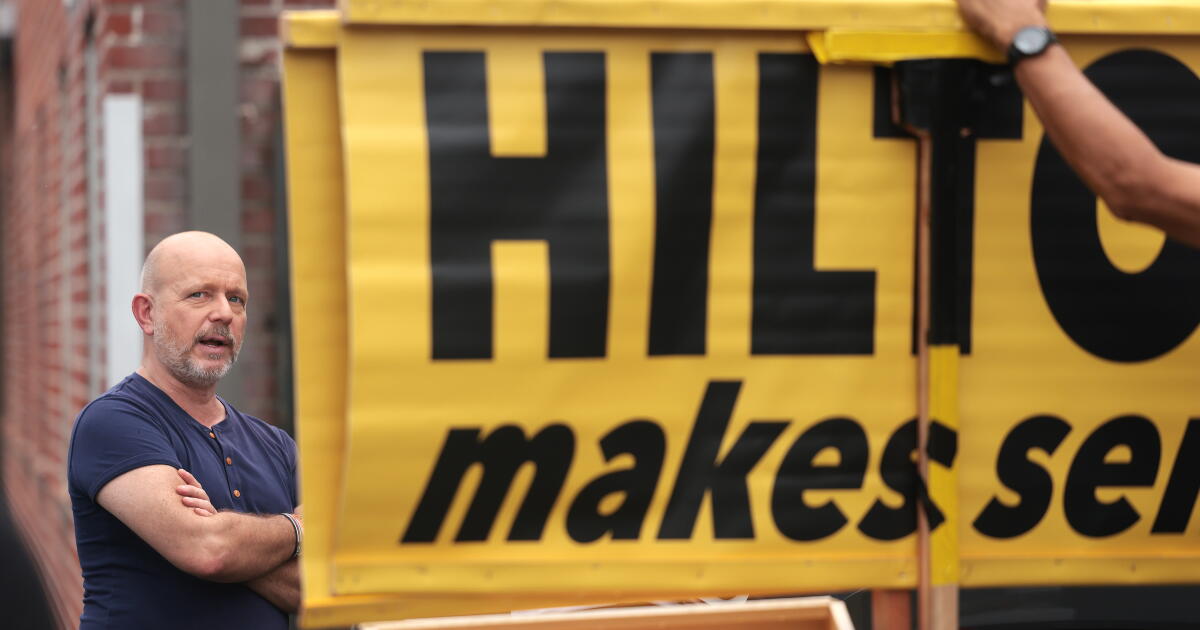
Hilton announced his plan at a news conference outside of a DMV office in West Hollywood, where he touted proposals to eliminate the state agency, which has a $1.6-billion budget, and reduce the annual vehicle registration fee to $73 per year.
“We are going to shut down this bloated, nanny-state bureaucratic agency that treats Californians with complete contempt,” he said to cheers at the event. “We are done with it. Enough is enough with the DMV. Enough is enough with sky-high registration rates. We are done.”
Hilton said he could issue an executive order to reduce the vehicle licensing fees, as Gov. Arnold Schwarzenegger did less than an hour after being sworn into office upon winning the 2003 recall election. While the fee is set by state tax code, governors can waive it in specific circumstances, as Schwarzenegger did.
Californians currently register more than 36 million vehicles with the DMV each year, and the average annual fee paid for each is $329, according to the state Legislative Analyst’s Office. The registration fees, along with driver’s license costs and other fees related to the California Highway Patrol and identification cards collected by the DMV, are the primary funding sources of the CHP and DMV.
Hilton said the state currently reaps $11 billion to $12 billion per year from vehicle registration fees, and that his proposal would reduce the revenue to roughly $2.7 billion. He said he would make up for the revenue shortfall created by the proposal — and other plans, including eliminating state taxes on the first $150,000 of income — by reducing the state’s workforce by 10% and agency budgets by 5%.
To eliminate a state agency, Hilton would need legislative approval, although he says that if Sacramento lawmakers were to rebuff his efforts, he could use the budget to slash the DMV’s operations.
Hilton cited a discussion he had with Schwarzenegger at an August dinner at the movie star’s Brentwood estate.
“Arnold said the Democrats who led the Legislature when he was there much preferred” having a Republican governor to a Democratic one, Hilton said.
Hilton lacks Schwarzenegger’s worldwide fame, and the nation and Sacramento are far more polarized than when the Austrian bodybuilder turned action movie star took office. Still, Hilton’s vehicle registration proposal is reminiscent of a major plank of Schwarzenegger’s successful 2003 campaign to recall and replace Democratic Gov. Gray Davis.
Davis had tripled the state’s annual vehicle license fee shortly after being reelected in 2002 to help address a state budget shortfall. Schwarzenegger seized upon the issue during the recall campaign, at one point dropping a wrecking ball from a five-story crane onto a car spray-painted with the words “Davis Car Tax” in front of a cheering crowd in Costa Mesa.
“We had the biggest action star in the world. He’s going to show action,” said Rob Stutzman, who worked as one of Schwarzenegger’s top advisors. “Arnold demanded it. It was always a production to tell a story. He was genius at it.”
“Californians got a huge increase in their vehicle license fee and it was being done to backfill a deficit arguably revealed to them by surprise after the [2002] election,” Stutzman said.
Stutzman said the fee created a backlash that fueled the recall campaign against Davis, along with rolling blackouts during the energy crisis of 2000 to 2001.
Schwarzenegger’s executive order reducing the license fee to its former rate resulted in billions of dollars of losses to the state’s general fund. The Republican had to respond with spending cuts as well as issuing bonds to make up for the shortfall.
If Matthew Fine, a 5-foot-8, 165-pound senior running back and lacrosse star for Loyola High, needs a walk-up song, he can go back to 1969 when Frank Sinatra’s hit “My Way” came on the radio with the lyrics, “I did it my way.”
Fine, who lives in Manhattan Beach, declined to be interviewed last week before the Cubs’ game against the public school he lives five minutes from, Mira Costa. He didn’t want to give friends he grew up with any bulletin board material. Then he went out and rushed for 105 yards in a 14-7 Loyola victory.
It was fun for him to catch up with neighborhood kids he used to play with starting at age 5.
“I traded jerseys and traded photos,” he said. “It was nice talking to them.”
Asked if he walked home from the game, Fine said, “I actually considered it.”
Fine, with his speed and strength from lacrosse training, could be the comeback player of the year in football. He quit football after his sophomore year to focus on lacrosse. Loyola has one of the best lacrosse programs in the state, winning last season’s Southern Section championship. He’s earned a lacrosse scholarship to Utah.
Football coach Drew Casani had lobbied Fine to return to football before his junior year with no success. Last school year, after the lacrosse season ended, Casani sent him a text inviting him to return.
“I’m in,” Fine responded.
“I love football,” Fine said. “There was a lot of uncertainty. My junior year is where you get recruited for lacrosse. After sitting out a year and watching all the guys playing football, I got really jealous and wanted to jump back in.”
He rejoined the team this year starting at the bottom of the depth chart. Now he’s had back-to-back games rushing for more than 100 yards. This will be his first and only year playing on varsity.
“I’m doing this for fun,” he said. “I love football. I’ve been doing it longer than any other sport.”
Whenever the season ends, it will be Fine’s final football game.
“I don’t think I’ll have any regrets,” he said. “I’ll just be sad. I don’t want to think about that.”
Incredibly, as much as people believe football gets players in the best shape of their life, Fine once flunked his conditioning test for lacrosse after playing football.
“It’s a different type of conditioning,” he explained.
Casani is thrilled that Fine’s one year off from football has had little effect.
“He picked up seemingly where he left off,” Casani said. “ He’s fast, has vision and is hard to tackle.“
Don’t ask his father, Mickey, what Fine might do next or any day.
“My son does things his own way,” he said. “Sometimes I don’t understand it.”
With a 4.0 grade-point average and terrific lacrosse talent as an attacker, Fine has a bright future. For those who play intramural flag football on Utah’s campus, Fine could be the ringer to deliver a championship next year.
Yemen’s more than a decade-long civil war has flared up once again after the Houthi rebel group launched an offensive in several locations against Saudi Arabian-backed government forces. The conflict has already spilled over beyond the country’s borders with the Houthis launching an attack on southern Saudi Arabia, targeting oil facilities and wounding dozens of people this week.
The renewed hostilities are the most serious since a United Nations-brokered truce halted large-scale fighting in 2022, after eight years of a full-blown conflict that killed tens of thousands of people in one of the world’s poorest countries.
Recommended Stories
list of 3 itemsend of list
So who is involved in this conflict? Here’s a look at the main actors:
The Houthis
The Houthis, also known as Ansar Allah (supporters of God), are an armed group controlling most parts of Yemen, including the capital, Sanaa, and some of the western and northern areas close to Saudi Arabia.
The Houthis emerged in the 1990s but rose to international prominence in 2014, when the group rebelled against Yemen’s government, forcing it to step down and causing a crippling humanitarian crisis.
The group then spent years, with Iran’s backing, fighting a military coalition led by Saudi Arabia. The two warring sides have also repeatedly tried to hold peace talks.
Seen as part of a regional alliance known as the “axis of resistance” backed by Iran, the Shia Zaidi group nevertheless has its own base, its own interests – and its own ambitions.
The Houthis have demonstrated their missile and drone capabilities during the Yemen war in attacks on Saudi Arabia and the United Arab Emirates, targeting oil installations and vital infrastructure. They have also proven resilient, defying more than 10 years of bombing by the Saudi-led coalition, as well as US and British strikes in recent years.
The group has gained international prominence for its attacks on Israel and shipping in the Red Sea since the start of Israel’s genocide in Gaza in October 2023.
Saudi Arabia
Riyadh entered the Yemen war when it led a military coalition against the Houthis in March 2015, seeking to restore the government of then-President Abd-Rabbu Mansour Hadi. Back then, Saudi Arabia and Iran were at the peak of a regional competition, both deeply distrusting each other. An Iran-supported group expanding control at the kingdom’s southern border was unacceptable, hence the military action.
This was before a China-brokered rapprochement between Saudi Arabia and Iran in 2023 marked the beginning of a more practical and less confrontational relationship.
Presidential Leadership Council
The PLC was established in 2022 when the former president, Abd-Rabbu Mansour Hadi, formally transferred his powers to the new eight-member body.
It represents the internationally recognised government of Yemen, with a mandate to manage the country’s political, security and military affairs, and to steer negotiations towards a permanent ceasefire. It is chaired by Rashad al-Alimi, an adviser to Hadi and former interior minister with the government of the late president, Ali Abdullah Saleh.
The PLC is backed by Saudi Arabia and the alliance that Riyadh leads.
Islah party
The Yemeni Congregation for Reform, better known as Islah, is a Sunni Islamist movement with historic ties to the Muslim Brotherhood. It is a faction within the recognised PLC-led government but has long had an independent identity. Its major stronghold has long been Marib, the country’s sole gas-producing region with one of its largest oilfields.
National Resistance Forces
The National Resistance Forces is a government-aligned military faction led by Tareq Saleh, nephew of the late former President Ali Abdullah Saleh.
The force has maintained ties to Saudi Arabia and, like the Islah party, is part of the PLC. It aims for a unified Yemen, positioning itself as a counterweight to both the Houthis and southern secessionists.
The Strait of Hormuz has become the central pressure point in the escalating confrontation between the United States and Iran. Before the conflict, roughly 20 million barrels of oil moved through the narrow waterway each day, equivalent to about one fifth of global oil consumption. For years, traders could therefore rely on relatively consistent estimates of the volumes passing through one of the world’s most important energy corridors.
That certainty has now disappeared.
The use of “dark crossings,” in which tankers switch off their identification and navigation systems, has made vessel movements increasingly difficult to monitor. Satellite imagery, port records, tanker drafts, loading schedules and shipping data are being used to reconstruct movements, but the information remains incomplete. Recent estimates of Hormuz flows have differed dramatically, leaving traders and governments uncertain about the true scale of oil moving through the waterway.
The uncertainty comes as Brent crude has moved above the $100 a barrel threshold for the first time since July, driven by renewed military escalation and concerns over Middle Eastern oil supplies.
Stay ahead of the geopolitical week.
MD Briefing delivers expert analysis across five global fronts — the Indo-Pacific, energy, geoeconomics, European security, and the Middle East — every Monday morning. Free.
The Hormuz Information Gap
The most unusual feature of the current oil crisis is not simply that supplies may have fallen. It is that markets cannot confidently determine how much oil is actually moving.
U.S. Energy Secretary Chris Wright said more than 17 million barrels crossed the strait on August 31 under U.S. Navy supervision. Shipping intelligence firm Kpler, however, estimated that only around 6 million barrels crossed that day. Kpler put average August flows at approximately 4.3 million barrels per day, with flows rising to nearly 5 million barrels per day during the first days of September.
The difference could partly reflect different methodologies, including whether shipments using alternative routes outside Hormuz are included. Tankers that remain invisible to tracking systems for days or even weeks make the picture even harder to reconstruct.
This means that traders are attempting to price global oil supplies without reliable visibility over one of the world’s most important supply arteries.
Why the Strait of Hormuz Matters
Hormuz is strategically important because of the enormous concentration of energy exports that normally pass through it. Any sustained disruption can affect crude supplies, tanker availability, insurance costs and shipping times, eventually feeding into fuel prices and broader inflation.
The current situation is different from a straightforward blockade. The strait has not necessarily become completely impassable. Instead, its reliability has been severely compromised.
That distinction matters because a tanker does not have to be physically prevented from crossing for markets to react. The possibility that vessels may be delayed, attacked or unable to cross safely is enough to increase the cost of transporting oil.
As a result, the market is responding not only to actual supply losses but also to the risk of future disruption.
Iran’s Strategic Leverage
Iran’s ability to disrupt maritime traffic remains an important source of leverage despite indications that its military capabilities around Hormuz have been weakened.
U.S. demining operations and a growing U.S.-protected shipping corridor along Oman’s coast have allowed more vessels to enter and leave the Gulf. At the same time, Iran-linked forces continue to threaten commercial shipping, meaning Tehran retains the ability to create uncertainty even if it cannot completely shut down the waterway.
This gives Iran a form of asymmetric leverage. Tehran does not necessarily need to close Hormuz completely to impose economic costs. Sporadic attacks, warnings or restrictions can increase insurance premiums, delay shipments and encourage traders to price in a greater possibility of supply disruption.
The renewed attacks on Saudi energy infrastructure have added another layer of risk by threatening alternative routes that have become increasingly important as traffic through Hormuz has declined.
Impact on Global Oil Markets
The immediate consequence is a higher geopolitical risk premium on crude.
Oil prices normally respond to measurable fundamentals such as production, consumption, inventories and transportation. But when the market cannot establish how much oil is moving through Hormuz, uncertainty itself becomes part of the fundamental picture.
This can keep prices elevated even if actual physical supply losses are smaller than feared.
Brent has already moved above $100 a barrel, while analysts and major financial institutions have raised their oil price forecasts as concerns about prolonged disruption increase.
For oil-importing countries, sustained high crude prices could translate into higher fuel and transportation costs, increased inflationary pressure and greater economic uncertainty. Airlines, manufacturers and businesses dependent on energy-intensive supply chains would also face higher operating costs.
Economic and Geopolitical Implications
The crisis demonstrates how vulnerable the global energy system remains to a single strategic chokepoint.
For the United States, maintaining freedom of navigation through Hormuz is not simply a military objective. It is also essential to preventing a regional conflict from becoming a wider global energy crisis.
For Gulf producers, the challenge is equally significant. Even countries with substantial production capacity cannot fully compensate for disrupted shipping if export routes remain vulnerable.
For major Asian importers, the risks are particularly serious because much of the energy normally passing through Hormuz is destined for Asian markets. A prolonged disruption could therefore create significant pressure on import bills, currencies and inflation across energy-dependent economies.
The crisis also highlights the limits of alternative routes. Pipelines and routes outside Hormuz can reduce some of the pressure, but they cannot immediately replace the enormous volumes that normally pass through the waterway.
What’s Next?
The key variable is whether the confrontation between Washington and Tehran moves toward negotiations or further escalation.
A diplomatic breakthrough could rapidly reduce the geopolitical risk premium by restoring confidence in shipping and improving visibility over oil flows. A further escalation, however, could produce additional attacks on tankers, restrictions around the Gulf or renewed pressure on alternative shipping routes.
The oil market will therefore be watching tanker movements as closely as military developments.
If shipping activity becomes more visible and flows recover, some of the current premium could disappear. If the information blackout continues, traders may continue pricing the possibility of a much larger supply disruption.
Analysis
The deeper significance of the Hormuz crisis is that information itself has become a strategic commodity.
Modern energy markets have traditionally depended on the ability to monitor ships, cargoes and supply chains with increasing precision. Satellite imagery, tracking systems and port data created an assumption that physical oil flows could be observed and measured with reasonable accuracy.
That assumption is now being challenged.
The result is a market where perception can influence prices almost as powerfully as physical shortages. If traders believe Hormuz is becoming less reliable, they will pay more for crude today even without definitive evidence of a catastrophic supply loss.
This gives Iran an important form of strategic leverage. The threat of disruption can generate economic consequences even when actual disruption remains limited.
At the same time, Washington faces a difficult calculation. Greater military protection may help keep shipping moving, but prolonged confrontation can also increase the geopolitical risk premium that the United States is trying to contain.
The central question, therefore, is no longer simply how much oil is passing through the Strait of Hormuz. It is how long the global market can function without knowing the answer.
If that uncertainty persists, the oil market could continue carrying a substantial security premium even if physical supplies prove higher than current estimates suggest. The longer the uncertainty lasts, the more deeply it can become embedded in prices, inflation expectations and global economic planning.
BBC fans saw a new face join The Great British Sewing Bee as Sophie Willan became the host of the competition alongside judges Patrick Grant and Esme Young.
11:56, 09 Sep 2026Updated 11:57, 09 Sep 2026
Sophie joined the BBC show this year as the new presenter
Great British Sewing Bee fans have been thrilled with the latest addition to the BBC show.
The competition is nearing its end, as BBC viewers will see one contestant crowned Britain’s Best Amateur Sewer, along with a golden mannequin trophy. After weeks of challenges, tasks, and plenty of tears, Anna, Emma, or Beth will win this year’s Great British Sewing Bee.
Ahead of the highly anticipated final, judge Patrick Young appeared on Morning Live to speak about what viewers can expect to see. However, the conversation soon turned to the latest host to front the show, comedian and actress Sophie Willan.
Highlighting that the show is kept ‘fresh’ by bringing in new presenters, the Morning Live star asked what it’s been like with Sophie as part of the cast. Patrick replied: “We’ve had some alright presenters over the years.
“Sophie is amazing. I was a massive Alma’s Not Normal fan. Quite often, we get told who is going to be coming on, and I had to pinch myself. I was like, ‘Oh my god, I loved Alma’s Not Normal’. She’s brilliant, she’s so fun.
“Esme loves her. She just helps create the most amazing atmosphere on set. We’ve been making the show for a long time. A lot of the crew and everybody behind the scenes are the same, but it’s lovely having somebody come in and give it a little zhuzh.”
Despite the show often shaking up who fronts the programme, Patrick confirmed Sophie’s future, and it’s good news for fans. He continued: “She’s amazing, we’re filming next year already, and I love going into work with her every day.”
Elsewhere in their conversation, he spoke about the upcoming final and the pressure he feels comes with it as a judge. He told the BBC presenters it’s mainly because he wants the contestants to excel.
Patrick commented: “We’ve seen it so many times when brilliant people have got to the final, and things just haven’t quite clicked for them. You do feel a certain amount of disappointment, but luckily, this year we didn’t have that.
“We got three brilliant people, and they all brought something really special to it. So actually there is a relief when it’s done, and you’re like, ‘They really have nailed this’.”
Sadly, BBC viewers bid farewell to Heather this week as the contestant narrowly missed out on a place in the final. Although she was teary-eyed over the exit, she was proud of all she achieved.
She commented, “All the stress and sleepless nights have been beyond worth it.” Meanwhile, Beth was awarded garment of the week for her little black dress.
During the show, Patrick told her, “We absolutely loved it. It was so elevated, such beautiful use of the fabrics, and such a lovely story of you know, personalising the LBD. Well done.”
Morning Live is available to watch weekdays on BBC One from 9:30am. The Great British Sewing Bee final airs Tuesday, September 15, on BBC One at 8pm.
Helsinki has landed the biggest cheque Google has written anywhere in Europe
ADVERTISEMENT
ADVERTISEMENT
The company announced on Wednesday that a €13 billion investment will fund data centres and supporting infrastructure across four municipalities, along with clean energy projects and funds dedicated to local biodiversity, education, research and workforce development.
The facilities in Hamina, Kajaani, Muhos and Vaala will power a range of Google services, among them its Gemini chatbot. The company described the decision as “a testament to Finland’s leadership in responsibly building AI infrastructure.”
Construction is expected across 2027 and 2028, and the firm estimates the investment will add €3.6 billion a year to Finland’s GDP while supporting more than 37,000 jobs, roughly 16,000 of them in construction.
Once the building stops, Google projects the sites will sustain around 7,000 jobs annually, spanning technical and facility roles, equipment suppliers, as well as the shops, restaurants and services used by those workers and their families.
Finnish Prime Minister Petteri Orpo welcomed the announcement in Google’s statement.
“Google’s decision is a clear testament to our strengths. The value of the data economy extends far beyond direct investment into spurring innovation, research and development,” Orpo said, adding that closer collaboration would “deliver lasting benefits for both parties.”
Why Finland
The appeal to invest in Finland is rooted in its cold climate.
Data centres generate enormous heat and consume vast quantities of electricity, and Finland offers a cold climate that reduces cooling costs alongside relatively cheap and stable power from nuclear plants, wind and hydro.
That combination has produced a boom, with dozens of data centres already under construction across the country.
Google’s own presence dates back to 2009, when it bought a disused paper mill in the coastal city of Hamina and converted it, expanding steadily since.
For Orpo’s right-wing government, attracting this kind of investment has also been a priority, especially since Finnish elections will take place in April of next year.
Finland is contending with record unemployment and weak growth, and the data economy has become one of the few sectors offering the prospect of substantial investment and job creation.